Dean Graber shows his love for his hometown of Nashville, Tenn., in ways you can see. In the past two years he has participated in nearly 100 diverse community service projects through Hands On Nashville, logging more than 250 volunteer hours.
Dean Graber sorts donated food for the St. Luke’s Community House food bank.
“I’ve had the chance to experience a variety of activities through Hands On Nashville,” Graber says. “What sticks out is working on farms and gardens, maintaining trails, preparing and serving meals, distributing food at food banks and food drives, and working with people who are studying to become U.S. citizens.”
Graber goes where he’s needed. When a flood overwhelmed homeowners last summer, for example, he immediately responded to Hands On Nashville’s call for volunteers to remove debris. He has helped restore trails at Radnor Lake State Park, delivered holiday gifts to families in need and accompanied seniors from their rooms at the Blakeford at Green Hills retirement community to an activity space where they enjoy fellowship and musical performances.
Graber, born and raised in Nashville, started volunteering when he was in junior high school at an American Red Cross blood bank, packing boxes of blood and delivering them to local hospitals and to bus stations for shipping to other towns. He moved to Texas in the early 1990s for 18 years, then returned to Nashville. Along the way he worked with several nonprofits, in print journalism and public radio, and on organic farms and gardens.
Back in Nashville, Graber says it’s vital for people to give back to communities in need.
“Nashville continues to have enormous imbalances and disparities,” Graber says. “It’s important for those of us who can to do small things within our means – like giving our time – to address these imbalances.”
Volunteering led Graber to work with Dismas House of Nashville, which helps people released from prison become re-acclimated to their communities. The nonprofit has hired Graber to help the staff gather information and interviews for a book and oral history CD that explores Dismas House’s 40 years.
“I started volunteering there and it evolved into something that it is very interesting for me professionally since I’ve worked for – and volunteered with – many nonprofits in Austin and Nashville, and also worked in journalism,” Graber says. “It’s a fusion of interests.”
If you’re new to volunteering, Graber suggests picking a few different projects to get a feel of what type of service and work you would like to do. You may not find the perfect fit at first, but keep looking. Once you find your niche, find similar projects to fulfill your desire to serve your community.
A Girl Scout since third grade, Lauren Levy has grown up serving her community. So when the Nashville, Tenn., teen found out about the Hands On Nashville internship program during her sophomore year in high school, she knew it was for her.
Lauren Levy, far right, smiles with her art class students at the Salvation Army.
As a Hands On Nashville intern, Levy – now a senior – leads and takes part in several community service projects and events throughout the year. Through the program, Levy has pitched in at a career fair for the unemployed; worked with the Salvation Army and the YMCA on community projects; and partnered with Starbucks for Global Youth Service Day. She also teaches a yearlong art program for 10 to 15 elementary school students as part of HandsOn Nashville’s Youth Volunteer Corps.
“I love working with the elementary school kids; it’s a great bonding opportunity,” Levy says. “It makes me feel very happy to see kids appreciate all my work I put into it.”
And Levy enjoys working with volunteers. At one of the five annual Hands On Nashville youth service events Levy worked with Starbucks partners and was put in charge of creating a butterfly garden, assigning roles to the other volunteers.
That leadership experience inspired Levy to establish the Summer Youth Leadership Program. She saw that many high school students had leadership roles during the school year on sports teams, in clubs and other activities, but during the summer leadership roles for teens were sparse.
“A lot of youth wanted to get involved with leadership during summer but they didn’t know how,” Levy says.
Levy created an application process, interviewed students and developed training and program materials to establish the youth leadership program. Each student accepted into the program tackled a different issue in their community – homelessness, the environment, hunger and others. The students then created and lead projects designed to address each issue. Levy oversaw each of the student leaders, assisted them in implementing their projects and evaluated their performance.
“A lot of teenagers can be self-centered,” says Levy, who is leaning toward majoring in a health care-related field in college. “Once you start to help others you see it makes you better as a person. If you do good then others will do good and it will make the world a better place.”
Shirin Hakim
Shirin Hakim, a graduating senior from the University of Massachusetts Amherst, has dedicated her passion and time to serving the homeless.
During the spring of her junior year, Hakim began an internship at Craig’s Doors – a local homeless shelter in Amherst, MA. While at Craig’s Doors, she saw a need to reach out to clients on a one-on-one basis to determine exactly what the shelter could provide to them and in a way, tailor a program where homeless individuals who come through Craig’s Doors have the opportunity to better their lives.
As a result, Hakim created the Craig’s Doors Resource Advocacy Program, which is comprised of college students from the five-college consortium in the area. Through this advocacy program, Hakim and her fellow students help Craig’s Doors guests tackle barriers to achieving housing as well as connecting guests with transportation and job opportunities. By implementing the initiative, Craig’s Doors is assisting individuals ranging from the ages of 18 to even 40 to achieve essentials such as permanent housing to even job-training opportunities. Thus, helping a once underserved population to get back on their feet and become productive members of society. Importantly, helping guests achieve their goals whether it is to attend college or applying for a job.
To sustain this program and Craig’s Doors work, Hakim continues to collaborate with various non-profit organizations as well as community leaders to advocate for more fundraising opportunities and importantly, resources for clients. For example, through Hakim’s efforts, clients are able to receive healthcare resources and some of these resources include an area physician visiting the shelter to provide medical care. Additionally, Hakim meets with resource advocates each week to discuss ways on how to improve their work and how to approach challenges that may arise while working at the shelter. Furthermore, local leaders from non-profits are invited to attend these meetings and give presentations on the work their non-profits are doing as well as advice on how to work efficiently with homeless clients on a number of issues.
Ashley Exner
In 2008, Ashley Exner of Woodbourne, New York created Songs for Soup to serve those in need of food.
Working in partnership with her local Future Farmers of America (FFA) club, Exner performs for local events sponsored by community organizations in exchange for cans of soup. In addition to performing at the event, Exner educates participants on hunger and food insecurity issues many community members face and provides more information on FFA’s Feed the Hungry Initiative. After the event, Exner delivers the cans of soup to a food pantry in the area with the lowest supply of items for their patrons.
California Dental Association Foundation
California Dental Association Foundation provides pro bono dental services and oral health education to Californians who experience barriers to care. The main goal of the clinic is to reduce pain and infection. In addition to providing care, they conduct a media and grass roots campaign to educate the public about the importance of maintaining good oral health and educate policymakers at the local, state and federal level about the lack of an oral health infrastructure.
Approximately 1,500 volunteers from dentistry, medicine and the community staff the clinic. Dental volunteers include dentists, oral surgeons, pediatric dentists, lab technicians, hygienists and dental assistants. Medical volunteers include physicians, nurses and pharmacists; community volunteers provide translation services, assist with patient and volunteer registration and escort patients to treatment areas. The services offered include cleanings, fillings, extractions, dentures and stayplates (temporary partial dentures).
The vast majority of people seeking care are the working poor, people who have lost their job, people without dental insurance, and those who cannot afford basic preventive services, nor cover the extensive dental work that many of them need. Most of the patients who seek care at such events have been in pain for months or even years.
Kevin Lewis
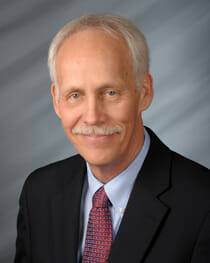
Since the founding of the Lee County Coalition for a Drug-Free Southwest Florida in 1989, Kevin Lewis has been involved in a leadership capacity as a direct service volunteer, and as a community booster for Coalition for Families in Lee County. Lewis serves on a number of statewide task forces on drug and alcohol treatment and prevention, including the board of directors for the Florida Addiction and Drug Abuse Association. In addition, he is the president of the Rotary Club of Fort Myers.
The Richard Family
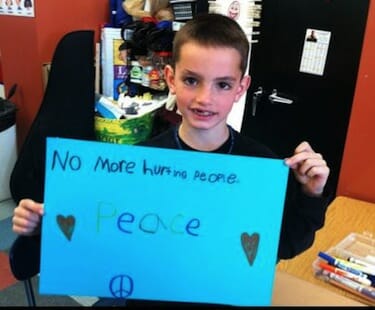
Eight-year-old Martin Richard became a symbol of what was lost after the Boston Marathon bombings a year ago. The Dorchester, Mass., boy had gone with his family to see the end of the race and was killed by one of the blasts.
Martin Richard holds up a sign he made that reads, “No more hurting people. Peace.”
In the days that followed, a photo that appeared widely in the media of Martin holding up a poster he’d made as a school project became a heart-wrenching remembrance. The poster read, “No more hurting people. Peace.”
As the city of Boston mourned the three people who died, including Martin, the Richard family suffered overwhelming personal losses. Bill and Denise Richard had lost a son. Their daughter, 7-year-old Jane, lost a leg. And they, themselves, suffered serious permanent injuries – among the more than 250 people hurt at the scene.
As part of their effort to heal, the family created the Martin W. Richard Charitable Foundation this year. Its broad mission is to spread Martin’s message of peace by investing in education, athletics and community.
“Martin was a true peacemaker,” says Larry Marchese, a longtime friend of the Richards who volunteers as a spokesperson for the family. “He was an outdoorsy and athletic little boy with a high appreciation for fairness. He looked out for other kids, tried to make sure everyone was included in games and other activities, and it was common for him to moderate disputes on the playground. His school even honored him with the designation ‘peacemaker’ when he was in second grade.”
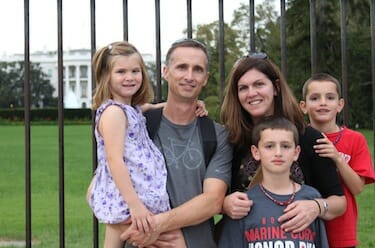
The Richard family during a 2012 visit to Washington, D.C.; Henry is in the front and in the back, from left, are Jane, Bill, Denise and Martin.
While the family foundation is still in the early stages of development, its first major initiative will culminate at the running of the 2014 Boston Marathon, April 21. Team MR8 (Martin’s initials and age), a group of 100 runners personally selected by the Richards from a large group of applicants, has been holding fundraisers since January and will compete in the marathon on behalf of the Richards’ foundation.
Team MR8 members have raised more than $800,000 for the group. The team actually has a 101st member, a U.S. serviceman stationed at an Air Force base in Afghanistan, who will run the marathon distance of 26.2 miles in the desert.
Other team members include a U.S. representative from Arizona, first responders, doctors and nurses, corporate CEOs, teachers, two wounded veterans, and a woman traveling from Shanghai, China. Fifty of the runners are from Massachusetts.
The Richards are already planning the first programs they would like to launch with funds raised by Team MR8.
“As the education component, the family is looking at creating ‘peace corners’ in school libraries, with books about famous peace figures and other relevant subjects,” says Marchese. “They also aspire to work with educators and other nonprofit organizations to develop a curriculum for peace education in schools.”
In the area of athletics, which Martin loved, the Richards would like to create social athletic competitions that emphasize giving participants the chance to get to know each other and inspire both kids and adults to come together to make change.
“The family is also coming up with ideas for programs that would bring people out of the house to get to know their neighbors and contribute together to the quality of life in the community,” says Marchese.
While the Richards are still not ready to speak publicly, the family makes regular posts to a blog to provide friends and supporters with both news of the foundation and personal family updates. According to a recent post, Jane is progressing well “on what has been a long and difficult road to recovery.” She is currently learning to use a new prosthetic running leg donated by the organization Wiggle Your Toes, which supports people who have lost limbs.
“Our gratitude will never diminish for the support and love we have received,” the blog post continues. “As the next few weeks come and go, we will be thinking about all of the families that have been impacted by the senseless events of last April, and proud of the way the community around us has persevered.”
Andrew Moyseowicz
Andrew Moyseowicz with Governor Deval Patrick at the 9/11 Massachusetts Military Heroes Fund service project on September 11, 2013
Last year, Andrew Moyseowicz served at the New England Center for Homeless Veterans as an AmeriCorps VISTA member. Moyseowicz’s service helped the organization provide homeless and at-risk veterans with access to vocational-training courses to improve their employment and housing outcomes.
Often, veterans are overrepresented among the homeless population, and are more likely to experience higher unemployment than the national average. Moyseowicz interacted with homeless veterans of all eras, spanning World War II to Operations Iraqi/Enduring Freedom. The population is highly vulnerable, with many veterans experiencing unemployment, addiction, mental health issues, and physical disabilities, all on top of homelessness. By increasing access to vocational training, Moyseowicz assisted veterans in exiting homelessness as well as preventing veterans from becoming homeless.
As a child, Moyseowicz was convinced his dad made toys. Moyseowicz’s father served in the Navy, and every time he went away for six to nine months, he would bring Moyseowicz back exotic, Middle Eastern toys.
In spite of his father’s frequent deployments to the Persian Gulf and the Balkans, Moyseowicz remembers enjoying a loving home life and attending excellent schools. He never quite realized the wealth of support his family received through friends and community organizations that made his great life possible.
As an AmeriCorps member, serving two-yearlong terms, Moyseowicz has tried to give back, what he feels was so freely given to him. Over the last two years, Moyseowicz has interacted with homeless drug addicts, ex-convicts, traumatized veterans, none of whom have had the good fortune he has had.
He strives to excel as an volunteer, but perhaps most importantly Moyseowicz says he strives “daily to be a genuine and approachable volunteer, one who is not afraid to shake hands with a street dweller, share a meal at a soup kitchen, or be there to listen to a veteran in need.”
When high school junior Isaac McFarland participated in a 4-H tour of a Shreveport, La., food bank last year, he found the shelves sparsely stocked. He was startled to learn that many local families didn’t have enough to eat, and that food banks and shelters were struggling to meet the needs of the hungry.
The 16-year-old, who works on his family’s cattle ranch near Shreveport, decided to help. Last spring, with assistance from his parents, Isaac created his own foundation, Game Changers, to help fight hunger.
Aided by a $500 grant from the Sodexo Foundation, Isaac launched a campaign called Let’s Tackle Hunger. He purchased 1,000 miniature lunch boxes, which he named “tackle boxes,” and asked the art teachers and students at his school, 4-H members in multiple cities and local civic leaders – including the mayor and police and fire chiefs – to decorate the boxes in some personal way.
Isaac then raised money from 4-H, other community organizations, local businesses, students and community members to purchase nutritious breakfast foods. Students and 4-H members volunteered to pack this food into the lunch boxes. Isaac got 300 of his classmates at Caddo Parish Magnet High School, from all 40 student organizations on campus, involved.
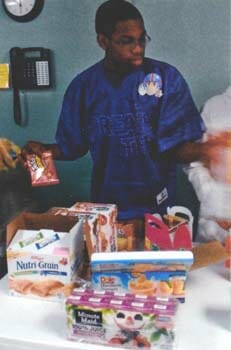
On a Saturday that spring, Isaac and 30 volunteers distributed more than 300 lunch boxes to families in a low-income Shreveport neighborhood. In July, during a cow show in Bryan, Tex., Isaac and 4-H volunteers delivered 300-plus lunch boxes to a food shelter there. Later that summer, when Isaac attended a 4-H cow conference in New Orleans, he and volunteers donated the remaining 300-plus lunch boxes to the local Boys Town. In its first drive, Game Changers collected and distributed 7,000 food items.
But Isaac was just getting started. He quickly enlisted the help of his mother, Regina, to help provide meals, cooked with beef from the McFarland ranch, to local food shelters. In 2013, mother and son prepared giant meals for two facilities, Providence House and the Shreveport Rescue Shelter. Isaac plans to cook for both shelters at least once a year.
Last fall, Isaac held another major Game Changers event. He asked police, firefighters and hospitals in the Shreveport area to set up collection sites for a two-week food drive. At the end of the drive, on Make A Difference Day, Isaac and volunteers delivered more than 6,000 pounds of donated items to the Louisiana Food Bank.
“I want to do anything I can to help people in situations so bad that they aren’t even able to get simple nutritious foods,” says Isaac. “Many of them did nothing to end up in these situations, and I think if we are able to help, we should.”
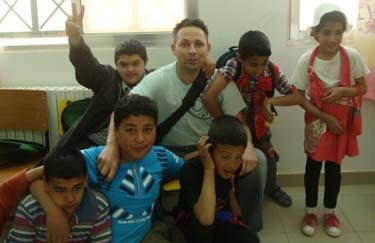
Ben Pohl pals around with kids he takes on fun outings.
In March 1997, a catastrophe changed Benjamin Pohl’s life. But today he insists the change was for the better.
Two weeks before his 18th birthday, Pohl, of Chicago was in a car accident that nearly killed him. He suffered multiple fractures, including a broken back, and severe internal injuries. A doctor in the emergency room said he didn’t expect Pohl to survive the night.
Pohl lay in a coma for a month. Finally, he regained consciousness.
“It was very scary,” says Pohl. “I had no idea where I was, and I couldn’t remember anything about the accident.”
Pohl spent six months in the hospital learning how to speak and walk again, and two more years in outpatient therapy. Gradually, he began leading a normal life. With encouragement and support from his parents, Pohl completed his final high school credits and, in 1999, entered college at the University of Iowa – while still walking with crutches. He had once dreamed of a career practicing military law with the Judge Advocate General Corps, but now he wanted to major in recreation therapy so he could assist people with disabilities.
“My entire perspective changed during my rehabilitation,” says Pohl. “I’ve been 100 percent dependent on other people, and now I feel a unique bond with people who have disabilities. I have a level of empathy that few can understand.”
After earning his degree, Pohl worked for the next two years as a recreational therapist at a maximum-security prison and a mental health facility. He discovered his real love – volunteerism – when he moved north, to suburban DuPage County, Ill., in 2006 and began volunteering at the Western DuPage Special Recreation Association, where he accompanied kids with disabilities on fun outings to ball games, bowling alleys, restaurants and more. A favorite with clients, Pohl has kept up his relationship with the association over the years, sometimes as a volunteer and sometimes as a part-time staffer.
In 2007, Pohl entered graduate school at Northern Illinois University, where he graduated in the top 10 percent of his class with a master’s degree in public administration. He then joined the Peace Corps and spent a year in Jordan, where he trained teachers in special education, with an emphasis on promoting awareness and acceptance of children with disabilities.
Today, Pohl works one week a month for a tech firm in Iowa, and hopes to start a full-time career working for the government in public administration. For three weeks of each month, he spends most of his time back in DuPage County volunteering for a variety of organizations.
While his volunteer credentials are too numerous to mention, he currently serves on the board of directors of the DuPage County Habitat for Humanity. He also does volunteer development work for Celebrating Differences, a group that serves children with Down syndrome. Pohl also volunteers as a journalist, writing newsletters and promotional materials, for Easter Seals.
“After my accident, I had a lot of help, and it’s my way to give back,” says Pohl. “I pretty much came back from the dead. I was given a second chance, and I feel an obligation to help others have equal opportunities. It’s my passion and it makes me feel good. It’s an intrinsic high to help people.”




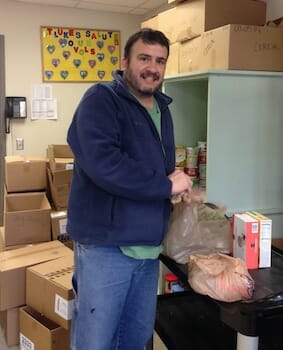 Dean Graber sorts donated food for the St. Luke’s Community House food bank.
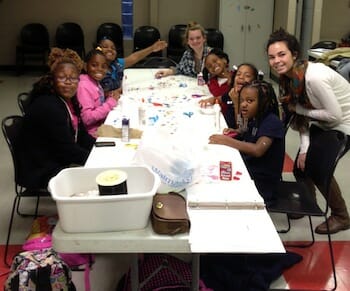 Lauren Levy, far right, smiles with her art class students at the Salvation Army.
 Martin Richard holds up a sign he made that reads, “No more hurting people. Peace.”
 The Richard family during a 2012 visit to Washington, D.C.; Henry is in the front and in the back, from left, are Jane, Bill, Denise and Martin.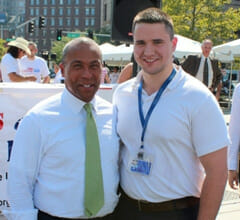
 Isaac McFarland packs food at a food drive.