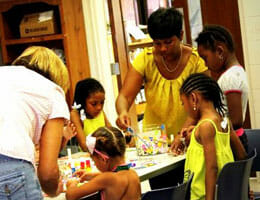
Because many students in Walnut, CA do not have exposure to math outside of math classes, Walnut MathCounts fills a void by demonstrating how the whole of math success is greater than the sum of its parts. This volunteer group providing an outlet for students to advance their problem-solving skills and to learn more practical applications for math.
Walnut High School students volunteer their time, teaching Suzanne Middle School students on a weekly basis. The high school students often instill in the middle school students enthusiasm and a passion for mathematics. They emphasize that the purpose of the club is to have fun and enjoy doing math, not just to win a competition and solve problems correctly.
The effort began originally as an after-school club that met once a week. Over time it has evolved into a program that offers weekly classes, teaching students math and problem-solving beyond their grade. The club also gives students an outlet to a wider range of global math competitions.
Changing perceptions about mathematics and helping young people excel, the volunteers involved with Walnut MathCounts prove there is strength in numbers. That makes Walnut MathCounts a genuine Daily Point of Light.
Laurel Kaufer
Violence and conflict is a part of daily life in prison. Most often, it is covert. Guards can respond to it when they are aware of it, but they cannot prevent it. Because of this, inmates do not have the safety, peace and community they need in order to learn, grow, heal and rehabilitate, so that they can live productive lives. And when they get out, many are ill-equipped to handle the stresses of interpersonal relationships and lack of opportunity, strained by poverty, ignorance, racism, and oppression, leading to high rates of recidivism.
A group of lifers at Valley State Prison for Women in Chowchilla, CA, realized that if they wanted peace, they had to create it themselves. These inmates decided that they needed to take action, and began sending handwritten letters to mediators throughout California, asking for assistance in setting up a conflict resolution program at the prison where they resided. One of the letters reached Laurel Kaufer, who, with her colleague Doug Noll, responded to the request. Through their collaboration, Prison of Peace was born.
Laurel employs an innovative method of prison conflict resolution known as prisoner facilitated mediation, in which inmates are trained as peacemakers and mediators, in order to help resolve conflicts within the prison.
Prison of Peace trains inmates to be Peacemakers and Mediators in prison. Teaching them how to listen to emotions opens inmates who are shut down, allowing them to develop empathic connections with others. To begin sharing the skills with others, they learn a “peace circle” process in which such listening shows respect, tolerance and patience. By participating, inmates reconnect with their own humanity and recognize it in others, becoming morally reengaged. As mediators, they learn to intervene in conflicts and prevent violence.
Today, five years after that initial letter crossed her desk, Laurel has helped expand the work of Prison of Peace to more California institutions, including two more women's prisons, a men's prison and a Los Angeles County Jail facility. Laurel and her colleagues have trained more than 75 mediators and 250 peacemakers, creating a sustainable and replicable program.
Fostering peace both inside and outside the walls of prisons, Laurel is a genuine Daily Point of Light.
Kristen Weber
Kristen was a high school graduate on her way to law school when she became pregnant. She found herself dealing with the opposing forces of raising a child and finding a way to attend college. Along this journey she wanted to help other young mothers in similar situations. Kristen started the L.I.F.E. Foundation in Fenton, MO, and serves as a community advocate for providing resources to allow these young mothers to continue their education.
Kristen helps young mothers who are homeless or living in foster care. The programs she has developed through the L.I.F.E. Foundation include:
• providing bus passes to young women so they can attend college courses
• assisting with the college application and financial aid paperwork
• mentoring, tutoring, providing school supplies, computers, and GED prep work
• graduation celebrations, back to school fairs and resume building
Fostering partnerships with Missouri state agencies, her organization’s work has helped open new avenues of opportunity for young mothers. Kristen’s experience demonstrates to other young moms that they can pursue an education and succeed. That makes this young changemaker a Daily Point of Light.
Cynthia Shafer
Inspired by the story she heard of a grandmother who was unable to take custody of her grandchild because she did not have a bed for the child, Cynthia Shafer and her husband, John, started Beds for Kids in Fort Myers, FL in 2001. The program provides foster children around with a new bed and bedding, including delivery and set-up. Up to 300 new beds and bedding have been provided annually in emergency situations throughout five counties in southwest Florida. Guardian ad Litem volunteers can request a bed and bedding from Beds for Kids on behalf of children they represent.
Cynthia tells of situations where siblings have been on the verge of being separated due to the lack of beds in a foster home, and of disasters such as house fires that can displace foster children. Her cause brings stability through a simple piece of furniture. Cynthia balances her full-time job as a real estate agent with her volunteer work, handling the purchase of new beds, mattresses and sheets.
“Imagine as a child getting to sleep in a real bed,” Cynthia says. “That one piece of stability can make a huge difference for a young person in uncertain times.”
Many relatives and qualified citizens are willing to care for a child who has been removed from his or her home, but they may not be able to afford the separate bed and bedding necessary for a child’s placement to be approved by child welfare. In addition, at age 18, foster children are considered adults by the state and expected to be self-sufficient and live on their own. Eighteen-year-old foster children often do not have the resources to purchase a bed and bedding. Cynthia has struck up partnerships with groups such as Sewing Circle to create custom pillowcases and others who provide stuffed animals.
Cynthia calls every family to make the appointment for delivery and sets up the sheets and blankets to be delivered to each child. She also purchases all beds and makes the deliveries. Known around her community as “The Bed Lady,” Cynthia talks excitedly about how she and her husband load up their truck each Saturday and drive as many as 300 miles over the course of the day delivering beds to families.
“On a Saturday we might put 300 miles on our truck delivering beds,” Cynthia explains. “You see some bad stories on Monday through Friday about hard luck. Seeing how happy these children are to have a bed of their own makes Saturday worth it.”
Food Recovery Network
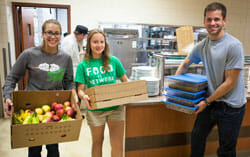
Credit – James Souder, Food Recovery Network.
Points of Light gives thanks – today and every day – for the exceptional work of volunteers creating change. Meet today’s Daily Point of Light Award honoree organization, Food Recovery Network, and learn how they brought several groups together around the table to fight hunger.
University of Maryland classmates Mia Zavalij and Ben Simon saw a systemic challenge at their university dining hall with vast amounts of prepared food going to waste. So they conceived an elegantly simple idea: triangulate the efforts of students, on-campus dining facilities and off-campus local hunger-fighting nonprofits to redistribute surplus food.
Food Recovery Network began in 2011, with Mia, Ben and students from three other universities leading food recovery programs who decided to get serious about expanding their efforts to other campuses. The organization works with college students to help them approach campus dining and identify non-profit beneficiaries nearby, train them in food safety and offer support to grow chapters all over the US.
“What connects us all is that it just didn’t make sense to us that we live in a country that wastes almost 40% of the food it produces while 1 in 6 individuals doesn’t know where his or her next meal is coming from,” Mia explains, citing national statistics on food insecurity. “Growing food takes a tremendous amount of energy, labor, and time so we shouldn’t be wasting it, especially when there are people who need it.”
The premise for Food Recovery Network is different than a food bank dealing in non-perishables in that Food Recovery Network’s efforts happen in real-time, with prepared food that is eaten soon after it’s made. Student volunteers trained in food safety take the surplus food from their dining halls, pack it into containers and transport it to nearby charities such as homeless shelters and soup kitchens. Having access to this resource frees up time for the off-campus caretakers and offers different meal options from what many hunger-fighting partners can afford to serve. And busy students can take part from start to finish in a recovery effort typically in about an hour’s time.
In the past 12 months alone, the cause has added more than 70 chapters, using the same formula to bring on-campus dining services and off-campus hunger-fighting nonprofits together through student volunteer work. Overall, the effort has attracted more than 1,000 student volunteers at 105 campus chapters in 30 states plus District of Columbia.
Student volunteers build skills by participating in the effort, cultivating with representatives from university dining services and partner agencies. Some become founders and presidents of their campus chapter, honing their organizational and communication skills. They learn the importance of collaborating with others to make a difference.
Having collected and redistributed more than half a million pounds of prepared food to date, Food Recovery Network is working to change the norm on college campuses from food waste to food recovery.
“In the long run, we envision zero food waste on college campuses across the country and that we have changed the conversation around food waste,” says Mia. “Food is for people, not for trash cans.”
Tell us about the dynamic people in your community doing good deeds and finding solutions to everyday problems through volunteer service. Submit a nomination for the Daily Point of Light Award at https://www.pointsoflight.org/programs/recognition/dpol/nomination
Matthew Whisman
Matthew Whisman is addressing the need for social justice for marginalized groups in the state of Kentucky, including underprivileged people living in the Appalachia region and the homeless. His compassion for these groups even extends to an area of service most people have never considered: proper burial services for those less fortunate.
Matthew leads the St. Joseph of Arimathea Society in Berry, KY, providing funeral services for the homeless and other groups that would not otherwise be able to afford funerals, which cost an average of $20,000 per person.
Named after the Gospel figure who donated his own prepared tomb for the burial of Jesus after Jesus' crucifixion, the St. Joseph of Arimathea Society has helped provide headstones for about eight funerals per year under Matthew’s leadership. Matthew is in charge of arranging for gravestones, clothes donations for dress clothes, and internment gowns.
Matthew’s good work has also helped him earn the Presidential Volunteer Service Award, recognizing volunteers who give hundreds of hours in service to their communities.
Who are the people in your community that quietly make a difference for others in need? Nominate an exceptional volunteer for the Daily Point of Light Award to bring more attention and resources to their cause. Go to https://www.pointsoflight.org/programs/recognition/dpol/nomination.
Riley Strube
Eleven-year-old Riley Strube has found a way to use her passion for dance to help others in her North Little Rock, AR community. She volunteers weekly with special needs children by helping teach them dance and performing with them onstage.
Riley quickly saw how the classes help special needs children gain confidence, improve balance, advance their social skills and make new friendships.
The effort to make a lasting difference even transcends beyond the dance studio, as Riley has spearheaded fundraising activities so these special children can have a playground built specifically for them. Through this community service, Riley has found success attracting her peers to join her: students from seven local schools are now involved in this work.
This young leader merged together her creative talents and her compassion to make a difference in the lives of others. That makes Riley Strube a Daily Point of Light. Who are the people in your community that are performing exceptional volunteer work for the greater good? Nominate someone for a Daily Point of Light Award at https://www.pointsoflight.org/programs/recognition/dpol/nomination
Dr. Patricia Wolff
Twenty-five years ago this week President George H. W. Bush gave the first Daily Point of Light Award. Commemorating the silver anniversary of the award program, Points of Light invites you to meet today’s honoree, Dr. Patricia Wolff, and to nominate someone you know as a Point of Light.
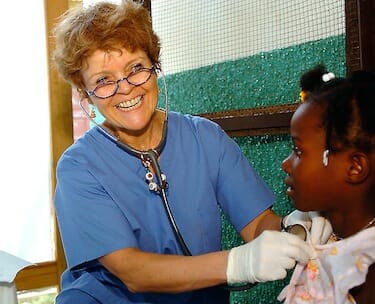
Dr. Patricia Wolff examines a young patient in Haiti.
Her skills in critical demand, Dr. Patricia Wolff traveled Haiti to provide medical care to those in need more than two decades ago.
On subsequent trips, the St. Louis physician kept running into the same issue with the kids she was treating: They were so chronically malnourished that they kept getting sick.
“It was like spitting into the ocean, because they couldn’t fight off illness,” Wolff recalls.
She got in touch with a colleague in Africa who had been researching a superfood made from peanuts. “Medika Mamba” is Creole for “peanut butter medicine.” It is known clinically as a ready-to-use therapeutic food.
The recipe was manageable – a mix of ground peanuts, powdered milk, sugar, oil, vitamins and minerals. Wolff started with a hand-operated grinder stationed in a room at a church. The yield was 100 kilograms a month, enough to feed 10 children.
Today, the effort has evolved into a factory employing more than 40 Haitians who can produce 40,000 kilograms per month, enough to feed 4,000 children.
For nearly 10 years, Wolff has divided her time between St. Louis and Haiti, typically spending three out of every six weeks in Cap Haitien. She gave up her thriving St. Louis practice to dedicate more time to this effort.
Wolff founded the nonprofit Med & Food for Kids in Haiti (MFK Haiti) to treat malnutrition with a multi-pronged approach that includes treatment, jobs, training and agriculture. She has surrounded herself with specialists on food safety, manufacturing, engineering, fundraising and more.
The team she leads is helping transfer knowledge and skills to Haitians so they can sustain the effort to produce Medika Mamba independently.
“It feels good to be a rescuer,” says Wolff. “But that is just the beginning. We’re working to create jobs and transfer skills so in the future, the people there won’t need to be rescued.”
Others have taken note of Wolff’s success at leading change in Haiti. Encore.org – a nonprofit that promotes making a difference in the second half of life – recognized Wolff as a Purpose Prize fellow in 2013.
The long arc of Wolff’s story isn’t about manufacturing food: It’s about saving lives – more than 120,000 of them. And while she has made progress in 25 years, she knows the work is not done.
Haiti is more advanced today than when Wolff first began volunteering there. She explains that malnutrition has been cut in half. There are better roads. More kids are in school. More people have clean water. A middle class has begun to emerge. MFK Haiti’s factory began exporting Medika Mamba to Guatemala, Senegal and Chad, offering sustenance to others in dire need.
“You stay long enough,” says Wolf, “and you see the progress being made.”
The Daily Point of Light Award, created by President George H. W. Bush in 1989, celebrates the power of individuals to spark change and improve the world. Earlier this year, British Prime Minister David Cameron started the daily award in the UK to recognize outstanding individuals who are voluntarily making change in their communities and inspiring others. Today’s UK awardee is Mike Barrett, who has dedicated the last 49 years to conservation and protecting wildlife. He spends much time at his local bird reserve, taking people on guided history walks, working on the reserve and distributing information to visitors. Barrett also studies the fluctuations of bird populations, taking part in the Bird Breeding Survey run by the British Trust for Ornithology and working on various other censuses.
D’Ambra-Coplan Family
In honor of Family Volunteer Day, Nov. 22, Points of Light and Disney are recognizing the exceptional work of volunteer families with the Daily Point of Light Award. Meet today's family, the D’Ambra-Coplan Family of Scarsdale, NY, and nominate someone in your community.
When Susi Coplan and Scott D’Ambra got married, they claimed Thanksgiving as their holiday to host, bringing parents, in-laws and friends together for the big meal. The Thanksgiving table became the anchor for their family tradition. But when the couple and their two children, 11-year-old Daniel and 8-year-old Rachel found an incredible opportunity to give back to those in need in New York City, their holiday tradition took on a new meaning.
Many families who struggle to make ends meet every day cannot afford to take on the additional expenses that surface during the holiday season. According to the NYC Coalition Against Hunger, as many as one in five of the city’s children battle food insecurity.
To help mitigate this hardship, the D’Ambra-Coplan family volunteers with the Salvation Army at a special event in Harlem that provides food baskets – filled with all the trimmings for a traditional Thanksgiving dinner – for 250 families to prepare and enjoy together in their own homes.
Members of the D’Ambra-Coplan family have been involved with the Salvation Army Food Basket giveaway since the activity began six years ago. They pitch in everywhere at the all-day event, greeting families, placing frozen turkeys in baskets, even manning the Salvation Army food truck.
Susi first learned about this service opportunity through the VoluntEARS initiative at her employer, ABC, a subsidiary of the Walt Disney Company. Disney officially marks the Saturday before Thanksgiving as Family VoluntEAR Day, encouraging employees and their families to give back to their communities through service. The family is involved in other volunteer activities throughout the year supporting causes for advancing music, science and art.
Through their steadfast participation every year in this special Thanksgiving event, Susi, Scott and their children have created a family tradition of service they can call their own. According to Susi, “Since this activity takes place right at the start of the holidays, it helps ‘set the table’ for gratitude, and helps get us involved with other ways to donate as a family.”
Susi sees how the world has become bigger for Daniel, as her son has learned about cultural, societal and economic differences through service. “When he started helping, Daniel was the youngest VoluntEAR they’d ever had,” Susi recalls. Over the years Daniel has become so invested in the annual Salvation Army event that when a family vacation once competed on the calendar with the food basket giveaway, he insisted that his mother reschedule their trip for a different week.
The impact of the D’Ambra-Coplan family’s volunteer work touches the lives of hundreds of families in need each year. Distributing food baskets keeps the joy of a truly iconic family experience – the reunion of loved ones around a table to give thanks – within reach for those less fortunate.
“When I tell the kids and my husband it is time to sign up for the Salvation Army event, there is great excitement to be able to help others have that experience,” Susi explains. “It’s just a remarkable day.”
Moore Family
In honor of Family Volunteer Day, Nov. 22, Points of Light and Disney are recognizing the exceptional work of volunteer families with the Daily Point of Light Award. Meet today’s winning family, the Moore Family of Philadelphia, PA, and nominate someone in your community.
Like most working families, Khadijah Johnson-Moore and her husband were each trying to balance job commitments and reclaim minutes out of their busy day to bond with their children in their hometown of Philadelphia, PA. When she learned that the afterschool program her four children attended was raising tuition, and the free programs folded because of budget cuts, Khadijah felt called to take action. She saw a way to bring her family and others together to enjoy reading, crafting and being active in the community.
“It had to happen,” Khadijah says about getting this program off the ground. “With all the hustle and bustle of everything going on, there was less time to be together. Unless we made the time.”
The first order of business was to find a physical space where they could meet. It didn’t take Khadijah long to zero in on the perfect place: her local library, which she has supported for years, serving on the Friends committee, a community group that raises funds for the library.
Through RADical Readers, Khadijah and her family merged together literacy, crafting and community service, setting an accessible path for other families to get involved and use the time to bond together. Khadijah plans the activities with older daughters Niemah, 20, and Jaida, 16. Her husband Rodney gathers up materials. The younger Moore Family children – Mia, Olivia, Elaina, all 9-year-olds and Myles, age 6 – help with setting up the room, assist with reading, and lead the service projects with their mom.
“Our library feels like home to my children,” says Khadijah. “I used to tell them that the library was for cool kids. RADical Readers kind of validates that & they believe me now.”
In November, the group got together to learn about healthy eating. They read a children’s book together called “The Sandwich Swap,” made an art project out of dry beans and then turned their attention to a community service project to collect children’s books and canned goods for The Big Give Philly, a service project in celebration of Family Volunteer Day.
Over three years, the effort Khadijah started with her family has become a fixture on Saturdays each month at the Philadelphia inner-city library. “We see new faces all the time,” she says. “And the older children who have been involved with the program are still involved as volunteers to help out.”
“The volunteer service projects are great because they show children how they can help their community,” Khadijah explains. “These experiences show the kids ‘you may be little, but you’re powerful.’”




 Dr. Patricia Wolff examines a young patient in Haiti.