Jack King
Sometimes we take for granted simple pleasures like a fresh new haircut. Jack King, a hairstyle pro that once managed the manes of Hollywood stars, has come out of retirement to ensure that individuals at Family Hospice Care in California’s Coachella Valley of have the opportunity to get their hair washed, cut and styled. Jack gives people in hospice something to look forward to, and they walk away feeling good about how they look.
Jack King owned a salon in West Los Angeles for years. “I worked in Beverly Hills for 30-40 years. I eventually converted to a children’s hairstylist because no one liked to cut children’s hair and I found it easy,” Jack says while recalling the start to his career. Jack was happily retired, but felt a calling to serve.
Jack started volunteering at Braille Institute in Palm Desert, teaching cooking for blind people. “It helps them become more independent because many are not allowed to cook on their own,” he explains, adding, “I started volunteering for hospice 2-3 years ago, which is really rewarding.”
What does a new ‘do mean for the people who need care and their caregivers? “Getting their hair styled lifts their spirits, and as weird as it sounds, it lifts the spirits of the caregivers and the people around them,” Jack reflects. He recognizes some of the simple needs of those in hospice, but he also has a great admiration for those who tend to these individuals. “The caregivers are great communicators. And they need to be cared for too,” Jack says.
Some people would find the thought of working with individuals who are in the final stages of their life to be unappealing. But Jack is working with hospice patients almost daily. His smile is so warm and comforting to the patients, and he always has a kind word and a joke for the patients while their hair is being styled. Even if the patient is bedridden, he manages to make them feel like royalty. Jack devotes his time to meet with at least five patients a day, giving them all special treatment and attention. His smile and kindhearted personality eases the minds of the patients, all while providing a simple, but necessary, service.
Jack's work is never done and it keeps him going even through his own health struggles. He never complains, just smiles and remarks that “people are waiting to look good.” This hairstylist knows every square inch of his trade. “I don’t find it challenging,” Jack explains. “It’s a constant learning experience and you have to be flexible. The gift you give to others, you get back yourself. Its good vibrations.”
Jack King is a true Point of Light and a testament to the power of volunteering, putting his talents to work for the benefit of those in dire straits. Jack urges others, “Try it once. Start somewhere. You will be amazed by the reward you receive. “
Do you know someone like Jack making an impact in your community? Nominate them today for the Daily Point of Light award at https://www.pointsoflight.org/programs/recognition/dpol/nomination.
Emily Fabre and Kaitlyn Fabre
Five years ago, Emily and Kaitlyn Fabre of Salem, Mass., were touched and gratified by the generous support their grandmother received from the Salem Council on Aging. The council, a department of the city government, sent a van and attendants to take their grandmother, who was receiving chemotherapy treatments for cancer, to and from medical appointments—all free of charge. In 2010, after their grandmother had passed away, Emily and Kaitlyn decided to honor her memory and help needy seniors in the area by collecting returnable cans and bottles and giving the proceeds to the Salem Council on Aging.
“We realized that many seniors could be in the same situation as our grandmother and that some could have even tougher times,” says Kaitlyn, now 17. “Some might not have any family in the area, and the Council on Aging could be their only source of transportation.”
After starting out on their own, picking up cans and bottles from roadsides and parks, the Fabres enlisted the help of friends and neighbors, their 4-H club and local churches and businesses. They also launched a Facebook page. Their project evolved into an annual can and bottle drive that, in less than four years, has raised more than $3,000.
Most of the money has gone for directly to the Council on Aging, which has used it to buy new tires for its vans and pay for van repairs. A small amount has come in the form of donations from businesses, such as gift cards and certificates, which are given out as bingo prizes at the council’s Senior Center.
Dozens of people in the Salem community support the drive by dropping off their cans and bottles in collection boxes at the Fabre’s home, the Essex County 4-H, the Council on Aging, and at the workplace of the Fabre’s mom, Tammy. Each bottle or can is redeemable for five cents.
According to Tammy, the lion’s share of the collecting is still done by Emily and Kaitlyn, who spend more than 10 hours each week volunteering.
“They still pick up cans regularly along the roads,” says Tammy. “They also get permission in advance to collect leftover cans and bottles from public activities such as sporting events and banquets.”
For their public service, Emily and Kaitlyn have been honored by the Salem Council on Aging and by Prudential Financial, Inc. Two years in a row, Kaitlyn received a certificate for community service from Prudential. And in 2013, Emily, now 14, received Prudential’s Spirit of Community Award.
“I’m really proud of them,” says Tammy. “When Emily won Prudential’s top award, it brought tears to my eyes. They’re helping keep the memory of my mom alive and helping the elderly in our community.”
Emily and Kaitlyn also enjoy stopping in every week to socialize with visitors at the Senior Center.
“I’m glad we’re able to give back,” says Kaitlyn. “They’re just awesome people. They’re always very nice to us, and it makes us want to help even more. Life is busy, but there are always people who have it harder. So why not help them?”
“It’s really fun for me seeing the seniors and talking,” says Emily. “They’ve told us we’re making a big difference. They’re always very positive and uplifting every time we come in. It feels good to know we’re helping people the way my grandmother was helped. I think she’d be very proud of what we’re doing.”
Lori Lee
When Lori Lee’s son, Folden, was battling leukemia, family members would ask him each day how he felt. His answer was always, “Me fine!” At age two, Folden lost his 15-month fight with the disease. In his memory, Lori, who lives in Smithfield, N.C., started the Me Fine Foundation.
For 10 years, the foundation has provided resources and financial assistance to families with children in treatment at the Duke University and University of North Carolina children’s hospitals. Lori’s personal goal has always been to help make the journey a little easier for the kids and families forced to endure the devastating lifestyle changes associated with long-term care for childhood illness or disease.
“During our own journey, we were surrounded by friends and family who helped us carry our overwhelming financial and emotional load,” says Lori. “We realized that families just like ours came from all over the world, leaving behind their support systems to acquire the state-of-the-art and, in some situations, last-chance treatment for their children. Parents and caregivers lose jobs, homes and many of their personal possessions to gain access to the treatment required to save their children.”
The Me Fine Foundation has helped more than 900 families from around the world. The foundation has raised well over $1 million for its mission, with the largest percentage going directly into the hands of parents and caregivers who might have nowhere else to turn for financial relief.
Beyond providing financial assistance, Me Fine takes a hands-on approach to helping families. The foundation has remodeled substandard housing so that a child could go home after treatment was completed, organized last-minute trips for families, and provided Christmas gifts and birthday parties for hundreds of kids. Foundation volunteers have been present to hold hands during end-of-life situations. The organization has saved homes from foreclosure and kept power going.
Part of Me Fine’s business model is self-sustainability. To that end, it operates the Second Hope Shop, a successful thrift store in Princeton, N.C. The shop enables Me Fine families, as well as local residents, to purchase affordable furniture, clothing, appliances and other items. Revenues help offset the foundation’s operating and administrative costs.
Lori has overcome tremendous challenges to build Me Fine into a successful foundation. She worked while dealing not only with grief over her son’s loss, but later, a personal struggle with breast cancer.
“I think it has been a personal challenge on so many levels,” says Lori. “I’ve had to watch other children endure what my son went through. I’ve had to see the fear in caregivers’ eyes as the reality of the situation sank in. It’s all a little too familiar sometimes.”
Asked what motivates her to continue giving her time to Me Fine, Lori replies: “A great love for a little boy named Folden Lee and the knowledge that every year hundreds of other kids will fight a similar battle — and something I can do might make it a little easier.”
Foster Grandparent Program CLS/LHS
Established in 1973, the Foster Grandparents program, carried out by a group of senior volunteers ages 55 and over, is making a difference in the lives of incarcerated young people in northern Wisconsin. For the 300 at-risk young men and women inside the Copper Lake and Lincoln Hills Schools, bolstering their education with help from these volunteers means making a better life when they get out from behind bars.
Spending five to six hours each weekday assisting the youth in classrooms, Foster Grandparents program volunteers provide one-on-one help with reading skills in a sanctioned Title I reading class. The volunteers also assist those falling behind in other academic classes by providing the extra attention they need to stay on task and improve. Some of the young students involved in this program have improved their reading comprehension by up to three grade levels in one year.
Jack Crowley, a volunteer Foster Grandparent with two years of service under his belt, found out about the reading program through a friend and signed up. “I was a theater major in school,” Jack explained, “so reading was everything.” Jack admits that when he first arrived and went inside the fence, he didn’t know what to expect. “I was anxious, but then I saw that these were kids, and they needed me. So I treated them like my own children,” explains Jack, a father of nine.
One of Jack’s proudest moments to date was seeing a young man he had helped go on to earn his high school diploma. Jack played an instrumental role in helping him learn to read, and he knew the young man was well on his way when he breezed through a science textbook in just three weeks.
Clarine Wilcox , a retired nurse and 12-year volunteer with the program, remembers what it was like to go in for the first time. “When I saw that great big fence with the razor wire on top and had to go through three locked doors to get to the classroom, I wondered if I’d ever get out,” she laughs. But amid the serious nature of the facility, Clarine is the person that many at-risk youth seek out for a hug and to share a laugh. “I leave this place every day with a smile,” Clarine declares. “Before we start working with them, many of these kids think they’ll be dead by age 20. I know I’m helping them look toward the future.” Clarine sees her pupils walk taller, and conduct themselves more assuredly, as a result of the educational help she’s providing.
Outside the classroom, Foster Grandparents teach basic home activities like baking and sewing to help these youth develop the skills they will need to adapt to life outside of prison. According to Donna Nash, the volunteer coordinator and program supervisor, pairing older teachers and younger pupils together has proven to be a model for success. A big part of Donna’s role is to match the personality and skills of her volunteers with the needs of the incarcerated youths. “Many of the young people here have never developed strong inter-generational relationships,” she explains. “This program helps at-risk youth see a future for themselves.”
The group of 18 Foster Grandparent volunteers Donna oversees has been working with at-risk youth for 41 years, collectively serving over 960,000 hours. Donna notes how the volunteers benefit from their service, describing their desire to “become engaged in using their knowledge and staying mentally and physically sharper by working.”
Creating hope for at-risk youth by teaching life skills, and sharing lots of hugs and laughs along the way, the senior volunteers and staff from the Foster Grandparent Program at Copper Lake and Lincoln Hills Schools shine brilliantly together as today’s Daily Point of Light.
Who are the volunteers in your community challenging the status quo and making an undeniable impact for those in need? Nominate an outstanding volunteer or group today for the Daily Point of Light Award at https://www.pointsoflight.org/programs/recognition/dpol/nomination
Michaela Coplen
Meet Daily Point of Light Award winner Michaela Coplen. Read her story and nominate someone you know as a Daily Point of Light.
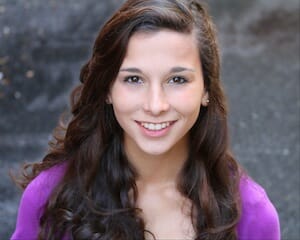 Michaela Coplen (Photo Courtesy of the Alliance for Young Artists & Writers)
Growing up the daughter of two Army officers, 18-year-old Michaela Coplen had to start over every time her family moved, and she struggled during her parents’ frequent deployments. But she found a remedy and set out to share it.
“The military is often a very stoic community and so I found it difficult to express myself, leading to feelings of loneliness and isolation,” says Coplen, of Carlisle, Pa.
“I knew that I wanted to help alleviate these feelings in other military kids by introducing them to what I eventually found to be the most fulfilling and effective outlet – poetry.”
In that medium, her words are honest and raw. She writes: “I told you I was a child of war who never learned to be at peace. I told you that when they asked me what I wanted to be when I grew up, I said `gone.’ I told you I saw life through a burgundy kaleidoscope. I told you there were things I couldn’t tell you. I told you the truth.”
The maturity and rhythm of her poetry led to a special honor – being named a 2013 National Student Poet. Each year, five students who have won national Scholastic Art & Writing Awards are chosen from thousands of outstanding writers as National Student Poets, a distinction that led Coplen and her fellow poets to meet First Lady Michelle Obama at the White House.
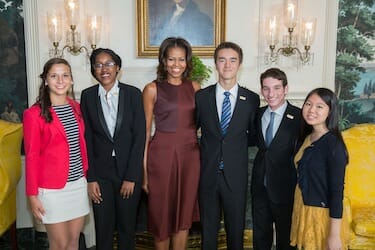 Michaela Coplen, left, poses with First Lady Michelle Obama and Coplen’s fellow 2013 National Student Poets. (White House photo by Lawrence Jackson)
The recognition carries a responsibility to promote an appreciation for poetry and creative expression by leading workshops and readings.
“She has been astounding to watch,” says Olivia Morgan, a member of the President’s Committee on the Arts and the Humanities, who led creation of the National Student Poets Program. “Michaela has this incredible talent and is so mature and responsible in how she lives her life.”
Coplen credits her parents – mother, Lorelei, a retired Army colonel, and father, Richard, a retired lieutenant colonel – with deeply instilling in her a sense of service to her community and country.
But while she’s grown up in a family that has an extensive history of military service on both sides, she says, “I’ve realized that the military is not the most effective way for me to serve.”
It helped that Coplen’s parents taught her about different kinds of service. Both have been active in a variety of nonprofit organizations – her dad was president of the local Rotary Club; her mother has served on a variety of community boards.
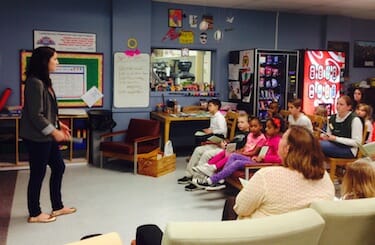 Michaela Coplen, left, presents her poetry workshop to children of military families at Carlisle Barracks.
 “We moved around a lot, so it was a little hard to find a good, consistent outlet,” Coplen says.
“We served at soup kitchens and through the local church community, but this year as a National Student Poet has really given me a lot of wonderful opportunities. It has opened up a whole new avenue of service and showed me that each person has a unique way to give back.”
Coplen volunteered with her Pennsylvania community, conducting two six-week workshop series this spring for students in grades kindergarten through 12 at the U.S. Army War College at the Carlisle Barracks. She developed the workshop to teach military children and teens how to use poetry to release some of the complicated emotions they feel.
“I really liked that these kids had an opportunity to speak about their military upbringing – about what it means to be nomadic – through their poetry,” Coplen explains.
The Carlisle Barracks workshops culminated in a community reading and publication of the students’ work.
“Oh my gosh, I had tears in my eyes watching them,” says Jacqueline Schultz, child liaison for education and outreach services director at the barracks. “It built up their self-esteem to realize they could write things that people would be happy to hear.”
Coplen wanted to make sure even more military kids could benefit from the workshop, so she created a guidebook that will enable others to replicate it at other military bases.
Beyond the barracks, Coplen has traveled to Vermont to lead poetry workshops at a women’s correctional facility; done virtual workshops for Blue Star Families, an organization that provides resources and programs to military families; and much more.
And this summer, she found another way to serve. She joined a group of volunteers to help dig the foundation of a primary school in a remote Haitian village. The drought-dry rocky ground was difficult to break through. The village had no electricity or running water.
“It was really easy to want to take a break, be sedentary for a few minutes and not get back up,” says Blakey Larsen, a volunteer supervisor on the trip. “Michaela was extremely positive and enthusiastic, and always ready to dive in and do whatever had to be done.”
Now a freshman at Vassar, Coplen has set a volunteering quota for herself – she wants to serve at least 10 hours a month and is open to possibilities, especially those that can include poetry.
“We should be investing in our brightest lights, and then asking them to pay it forward,” says Morgan, of the President’s Committee on the Arts and the Humanities. “And Michaela definitely has and is one of the brightest lights.”
Howey Hudson Lowe Foundation, Inc.
They saw their mothers each give selflessly over the years to make their community better. Then, as the daughters grew up, they banded together to create a lasting tribute honoring the great work of the previous generation, and ensure it would continue for generations to come. Brenda Jackson, Norma Washington and Goldie Evans-Upshaw started the Howey Hudson Lowe Foundation – named after the maiden names of each of their late mothers – powered by a small group of volunteers who tackle homelessness, promote healthy lifestyles, engage others in civic responsibility and support education in their metro Atlanta community.
“When I was growing up, my mother had a knack for helping every child she knew. People knew they could come to our house when they needed help,” Norma explains. Goldie added her own memory of her mother’s selfless giving, recalling that “My mother taught our family to share everything we had, even though we had very little. What she did has kept me grounded all my life.” Brenda had a similar experience growing up, stating “My mom always kept the door open. We didn’t have much food, but when other children came to our house hungry, we’d divide our plates in half to share."
Embracing the values their mothers taught them, these women help connect community resources to those in need, through a network of volunteers. Professional volunteers mentor homeless families for 12 to 18 months, guiding them on strategies to seek employment, dress for success, manage finances and problem solve. In exchange for the support they get from the foundation, the people who go through this program are also required to volunteer so they can learn about community service and civic responsibility.
Each year, the foundation gives a college scholarship to one student who demonstrates a commitment to volunteer service that benefits others in the community. According to Brenda, the recipient is chosen by a committee at the college, and the criteria place volunteerism ahead of prior academic performance. In addition, the group organizes annual collections of winter clothing, blankets and luggage, which are distributed to families living on the streets. Howey Hudson Lowe also collects bicycles and toys during the holidays to give to families. Over the past decade, this volunteer organization has helped make a positive impact, providing: 50 bicycles and helmets for low-income families; 1,000+ toys for local children; counseling, housing assistance, clothing and furniture for five adopted families; toiletries for 350 homeless people, and much more.
Norma remembers the early years of establishing their foundational work, comparing their efforts to an octopus, with all eight arms working simultaneously to carry so many activities. Now, she and Goldie and Brenda see the future of this work influencing their children. In some ways, the work of the Howey Hudson Lowe foundation is like an heirloom, capable of being passed on to the next generation in these proud families for them to carry out the work of their mothers, just as their mothers’ mothers did before them.
Brenda's daughter, Charmaine, reflects how "My mom has always raised her children to give of ourselves to help others who are less fortunate. I feel it is important to give back because we all have the ability to help someone else." Norma’s son, Chris, agrees, stating “I am amazed to see the outcomes and results of their work. We are proud to be part of their legacy.” Goldie’s son, G.G., adds “My mother has inspired me to serve others through her own actions.”
Going the distance to help families in need and carry on the tradition of selfless giving they learned from their mothers, the team at the Howey Hudson Lowe Foundation – today’s Daily Point of Light Award honoree – stands out as a shining example of volunteer service.
The women who inspired their daughters to serve: Norma Aretha Washington Howey (1917-2000); Annie Jones Hudson (1919-2006); Dorothy Kate Lowe (1928-1996).
Know anyone in your community who’s quietly making a difference through volunteer service? Tell us so we can share their story and motivate others to help! Submit a nomination today at https://www.pointsoflight.org/programs/recognition/dpol/nomination
Amir Hakimi
On campus at UCLA, sophomore Amir Hakimi observed a troubling ritual that occurred when each academic quarter would end: classmates moved out of housing and placed piles of perfectly good furniture out on the streets, no longer needing couches, tables, chairs and other items, but not knowing how to dispose of them properly. So Amir and his friends Sam and Kian conceived a great idea to help put the unwanted furniture into the hands of local families transitioning out of homelessness.
Furnish the Homeless helps prevent unlawful dumping of furniture around the Westwood community by scheduling free pickup of bulky furniture items right after finals week. Once the items are collected by Amir and his crew of volunteers, the team drives a van to the unfurnished homes of their previously homeless clients. There, the volunteers transform their clients’ houses into comfortable homes to help speed up their transition back into society and provide relief from the expense of buying costly furniture.
Amir knew about special programs that assist homeless individuals and families in getting into housing with help from counselors and case workers. But he also learned that often these previously homeless people struggle to maintain their new lives, given the added responsibilities of keeping up a home and creating financial stability from almost nothing. The houses usually come unfurnished, which creates challenges for people initially trying to break out of the cycle of poverty. To help visually communicate with donors the real impact their gift has made, Amir uses social media to share images of furniture items being delivered to homes. He talks excitedly about the sense of accomplishment he feels, stating “There's really no better feeling in the world than being able to make a positive impact. There are thousands of volunteer opportunities out there that aim to make a difference in the world, and if you can't find something you're truly passionate about, start it!”
The group began with three volunteers and a rental truck. Today, Amir leads a team of 18 enthusiastic students and a van of their own. Their combined efforts have brought nearly 200 pieces of furniture to 30 families transitioning out of homelessness. And Amir has reached out to students at other universities in California to start affiliates of Furnish the Homeless. The growth of his enterprise has skyrocketed, as Amir recalls this story from the group’s early efforts:
“We filled up a 14-foot rental truck in the first three hours of our first day and had nowhere to store the items to continue collecting. So we took very desperate measures and stored the furniture under my carport at home temporarily. My parents were not too pleased to come home to couches, tables, chairs, and a pinball machine almost completely blocking our front door. However, after the collection drive, all of the items were distributed, and my parents were happy to have supported their son's crazy idea.”
According to Amir’s friend Aria Hangval, “I have never met an individual so passionate about his work, and with the ability to influence others to similarly engage in community service.” Seizing the day to help solve a problem and turn it into a creative opportunity to help those in need, Amir Hakimi is a genuine Point of Light.
Tell us about the dynamic people in your community doing good deeds and finding solutions to everyday problems through volunteer service. Submit a nomination for the Daily Point of Light Award at https://www.pointsoflight.org/programs/recognition/dpol/nomination
Laura Grace Henry
Meet Laura Grace Henry, today’s Daily Point of Light Award winner. Read her story and nominate someone you know as a Daily Point of Light.
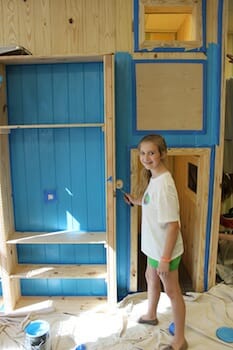 Laura Grace Henry paints a kids’ clubhouse at a center for domestic violence victims.
 Laura Grace Henry of Prattville, Ala., began volunteering when she was just 5, when she heard about the Children’s Miracle Network Hospitals. The organization raises funds for 170 children’s hospitals throughout the U.S. and Canada.
Laura Grace was impressed, and began going door to door in her neighborhood to raise money for the group.
“Her father and I didn’t even know she was doing it,” says DiDi Henry, Laura Grace’s mom. “She’s always looked at the world very maturely. When she sees a need, she wants to act, not step back and say, ‘I wish someone would help.’”
A few years later, DiDi, who works for Montgomery County, Ala., took Laura with her to see the One Place Family Justice Center, a nonprofit that provides free assistance to domestic violence victims and their children. Laura was again impressed, but she didn’t think the center’s design would help kids feel comfortable.
“It was very big,” says Laura Grace. “I thought that in a room like that, I’d feel sad and want to be in a more secluded place.”
Laura Grace decided the center needed an indoor clubhouse for kids and set out to raise the funds. By holding bake sales and garage sales and running a lemonade stand, Laura Grace raised almost all the money for the clubhouse on her own. It was built in 2013 and opened this year. Laura Grace recruited about 25 children to help paint and decorate.
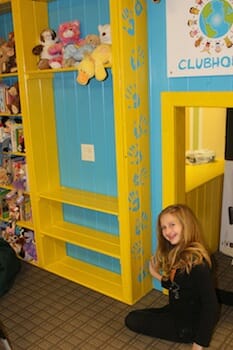 Laura Grace Henry shows the completed clubhouse at the One Place Family Justice Center.
 “It looks very nice, now,” says Laura Grace. “It has a TV, arts center, Xbox 360 and Wii.”
Laura Grace, now 11, has raised nearly $7,000 for One Place Family Justice Center. Along the way, she was inspired to write a book, “It Starts With One! Kids Can Volunteer, Too.” And in 2012, she launched her own foundation, It Starts With One, to encourage kids to volunteer in their communities.
Since she began working to help the justice center, Laura Grace has logged almost 1,800 volunteer hours, has earned the President’s Youth Service Volunteer Award for four straight years and has raised $22,000 for national and local charities. For her efforts, Laura Grace has also received a Prudential Spirit of Community award and Hasbro Community Action Hero Award.
By talking to children locally and spreading her message through a foundation website and Facebook page, Laura Grace promotes community service activities children can do.
“I try to help kids find what they’re interested in,” Laura Grace says. “I feel that more children should step up and volunteer. They’ll feel really good about the difference one person can make.”
Brunswick County Free Kicks
When high school athletes Ian Niggles and Sam Zeng learned there was no program in their community to help special needs students get out on a soccer field and participate in their favorite sport, these two local stars started a league of their own.
Drawing on their experience volunteering with Special Olympics, 15-year-olds Ian and Sam created Brunswick County Free Kicks, a soccer program for special needs children that is led by high school and middle school athletes who are passionate about sharing their love for the game with others. The dynamic duo worked with the Brunswick County Parks and Recreation department to create the program, which serves students ages 8-18, and recruit fellow athletes in their network to coach teams. A group of 17 volunteers from high school and middle school lead everything from planning to practice sessions and organizing competition through Special Olympics.
There is even a free summer camp run by these same volunteers, and Ian and Sam have a fun story to share about the last day of camp. “A few of the volunteers filled up around 200 water balloons so we could play games, and ultimately have a water balloon fight for a change of pace,” they recall. “After a long day of training and intense heat, we thought everyone needed some fun. The athletes absolutely loved it."
What Ian and Sam created in 2013 is more than a soccer program. Brunswick County Free Kicks empowers young people with special needs to form friendships in this rural community and develop a healthy lifestyle outside of school. The two boys are grooming other classmates to take over the program once they graduate.
"Starting Brunswick County Free Kicks and working with the special needs athletes on a regular basis has been an extremely gratifying experience,” Ian and Sam explain. “While the purpose of the program is to teach them, we have learned so much. Every practice, they come out ready to learn and play, but most importantly, to have fun. So for our peers not currently volunteering in some sort of way, we encourage them to see what they are missing out on."
Fostering a positive environment and leveling the playing field for special needs youth to participate in competitive sports, Brunswick County Free Kicks is a Point of Light. Because when volunteers step up to fill unmet needs in their community, everybody wins.
Did You Know? More than 5,000 honorees have been recognized since 1989 with the Daily Point of Light award. Help Points of Light share the stories of local heroes in your community by filling out a nomination today at https://www.pointsoflight.org/programs/recognition/dpol/nomination
Angela Liu
Fifteen-year-old Angela Liu, an accomplished musician with a gift for playing the flute, is helping bring more color and texture to the world for people who cannot see. In 2013, Angela started Blind Light Foundation with a mission to support students who are blind or visually impaired, enhancing their quality of life and creating new ways to interact with the sighted world around them.
"I’ve been wearing glasses since I was three," says Angela, "and I was very fortunate to receive great medical treatment. I want to give children the same kind of treatment that I received when I was young. I want to become a pediatric ophthalmologist and help kids with vision impairments."
Angela hosts an annual benefit concert in Pasadena, California, featuring student performances to raise money that helps pay for living expenses and tuition for 200 blind students in the U.S. and China. In total, Angela has collected $38,000 to date through these performances for her cause.
Half a world away, she is making inroads for blind students at schools in Zhengzhou and Beijing. On her travels to these schools, this young music protégé brings musical recorders to teach completely blind and severely sight-impaired students how to play the classic hymn, “Amazing Grace.” According to Angela, "Learning the musical recorder sparked something in them: self-confidence to take a risk and serve as class leaders. Music added another beautiful dimension to their life. It became a part of their identities. That was my 'aha' moment. Instantly, I realized why I went to China again, and why I want to keep going year after year." Angela keeps the friendships she has made abroad going strong by staying connected to her Chinese friends via social media.
This talented musician has performed in more than 50 classical music concerts as a soloist. "I started playing piano at the age of 5 and flute at age 9," Angela recalls. "In the beginning, I felt the thrill of producing music through an instrument for the very first time. Over the years, as the difficulty of the music pieces increased exponentially, I discovered a new joy. I love to share music with the blind and sight-impaired community. The joy of sharing with the community fuels my passion for playing music."
Using her musical gifts to enrich the lives of young people who are coping with visual impairments, Angela Liu is a genuine Point of Light.
Who are the dynamic young people in your city that could become the next wave of difference makers for a better world? Share their stories with Points of Light, and we’ll do the rest! Go to https://www.pointsoflight.org/programs/recognition/dpol/nomination



