Chandra Linnell
To commemorate the 10th anniversary of Hurricane Katrina, we are honoring volunteers who served along the Gulf Coast after the storm. Meet Chandra Linnell, today’s Daily Point of Light Award winner, and nominate an outstanding volunteer or organization you know as a Point of Light.
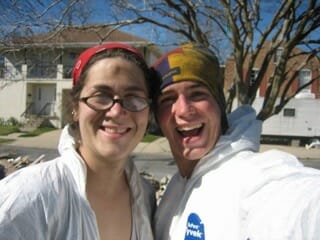 Chandra Linnell, with fellow volunteer Ryan Shuford
What started as a three-week volunteer project in New Orleans after Hurricane Katrina turned into a much longer stay for Chandra Linnell, working tirelessly under difficult conditions to bring hope and order into communities that had little of either.
Living in a bunk house with 100 other volunteers, Linnell led teams of workers six and seven days a week in gutting houses, removing mold and otherwise assisting homeowners. Within weeks she began taking on leadership roles and eventually took charge of training all team leaders.
“My time in New Orleans changed me,” says the 33-year old, who now works as a certified ELL (English language learner) teacher at a high-needs elementary school in western Massachusetts. “It impressed on me the importance that service would have in my life, always. It helped me understand how to do service in a way that is most impactful on the people who need the most help.”
Although she’d never volunteered before, and had zero experience with New Orleans and its diverse communities, a year after the storm Linnell connected with a friend of a friend who worked for HandsOn New Orleans, part of Points of Light’s HandsOn Network. Linnell decided to come down from her home in Minneapolis and see how she could help.
She had never considered herself handy, so she was surprised how much she enjoyed the physical labor.
“I knew I could work hard, and that’s what it took,” she says. “I loved the people we were meeting in neighborhoods like New Orleans East and Gentilly. And I loved being part of an intentional community of people living and working together.”
In January 2007 she joined the HandsOn New Orleans staff full time, continuing to coordinate volunteer efforts until she left the following October to pursue her teaching career.
“Chandra made her mark by opening her heart, getting her hands dirty and simply giving back,” says Kristin Burlage, who worked with her at HandsOn New Orleans. “She poured her heart and soul into each project and was a natural leader. She inspired a multitude. I know for certain, that although 10 years have passed, her work in New Orleans, and her continued service as a teacher in underserved communities inspires me to this day.”
For Linnell, that work in New Orleans is equally memorable.
“I learned about leadership, about trying things that were out of my comfort level, how to motivate and create a positive environment,” she says. “I got back so much more than I gave and that’s something I’ll always treasure.”
See more Hurricane Katrina stories and memories at www.pointsoflight.org/katrina.
John and Mary Mueller
To commemorate the 10th anniversary of Hurricane Katrina, we are honoring volunteers who served along the Gulf Coast after the storm. Meet John and Mary Mueller, today’s Daily Point of Light Award winners, and nominate an outstanding volunteer or organization you know as a Point of Light.
 John and Mary Mueller
When Hurricane Charley touched down in Lee County, Florida, in 2004, the Category 4 storm was the roughest to hit the area since the 1960s. John Mueller remembers seeing the endless caravans of utility trucks headed for Florida from all over the eastern seaboard.
“It was so humbling,” he says. He and his wife, Mary, “promised ourselves that if we ever got the chance, we’d be there to reciprocate.”
As a professional builder, John, 66, knew he had the skills to be of assistance. He even started training to be a volunteer project leader for Brethren Disaster Ministries, run by the Church of the Brethren, thinking that when they were ready to retire 10 years later, he and Mary, 65, (who handled the operations side of their business) would transition into serving devastated communities full time.
“Lo and behold, Katrina hit the next year,” he says, “and we got our chance a lot sooner than we thought.”
When she heard that the Brethren were looking for a regional director to oversee the rebuilding in Alabama, Mississippi and Louisiana after the Aug. 29, 2005 hurricane, Mary immediately thought of her husband.
“It sounded right up his alley, but I wanted him to figure it out for himself,” she says.
Soon enough, the couple would find themselves suspending their business and relocating to the area. They wound up mostly directing efforts in the town of Chalmette, Louisiana; normally home to a population of 16,000, it was basically deserted when they arrived in March 2007. By the time they left in May 2011, the Muellers had managed more than 3,400 volunteers, who helped repair and rebuild 250-plus homes.
Typically, the organization’s relief arm waits until it is invited by a community rebuilding agency, which researches families most in need of volunteer help and supplies the necessary materials.
“We simply show up with the labor a year or two after the disaster,” John says, “and stay until the community seems to be back on its feet.” In New Orleans, teams of 15-20 volunteers rotated weekly, working on a few houses at a time.
Volunteers came from all over the country and from all walks of life. “We had high school groups and young people training in the trades,” says John. “They were mostly affiliated with the Church of the Brethren, but not always. Among the first volunteers were a couple who just graduated from law school in D.C. and they looked online to see how they could help. We ask for those with the heart and desire to help – it doesn’t matter if they don’t know which end of the hammer to use to bang in a nail!”
Many friendships developed between volunteers and residents, John adds, noting that in fact a lot of the people who came to help never left.
“We weren’t just rebuilding houses, we were rebuilding lives,” he says.
As the couple at last prepares to retire, they’re gearing up to devote still more time to the ministry’s relief efforts. So, while they’d like to attend some of the events planned to observe the 10th anniversary of Hurricane Katrina, that’s the weekend when they’re also scheduled to participate in a brainstorming session about Brethren Disaster Ministries’ future.
Wherever they land, John and Mary know that it’s unlikely that their Katrina experience will be matched.
“To go to a place where nothing is under control and we were all flying by the seat of our pants was like nothing I’d ever experienced,” says John. “I thought I would get there, whip everything into shape and leave. Instead I stayed for four years. It was a life-changing situation.”
See more Hurricane Katrina stories and memories at www.pointsoflight.org/katrina.
Sherry-Lea Bloodworth Botop
To commemorate the 10th anniversary of Hurricane Katrina, we are honoring volunteers who served along the Gulf Coast after the storm. Meet Sherry-Lea Bloodworth Botop, today’s Daily Point of Light Award winner, and nominate an outstanding volunteer or organization you know as a Point of Light.
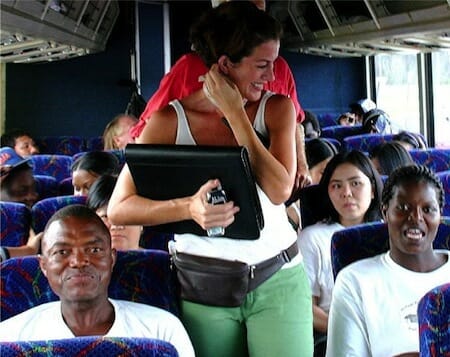 Sherry-Lea Bloodworth Botop, center, walks through one of the Gulf Coast evacuee buses she helped coordinate.
Sherry-Lea Bloodworth Botop’s drive to help others after Hurricane Katrina stemmed from her experience on 9/11. She was living in New York, a young, newly divorced, single mom with two small children.
“I remember walking downtown with the kids in their stroller to see what I could do” after the towers fell, she says. “There was nothing. I felt so helpless.”
Botop – a New Orleans native – moved south to rebuild her life, settling in Fairhope, Alabama, where she had family. She was there when Hurricane Katrina hit on Aug. 29, 2005. As water rose outside the church where she had taken shelter – the highest point between Florida and New Mexico – Botop went into action.
She persuaded the owner of a bus company, a fellow evacuee, to make every bus available for the rescue effort. Marshaling anyone with medical training, the convoy set out for New Orleans.
 Sherry-Lea Bloodworth Botop, left, celebrates the completion of a new Gulf Coast home with its future residents.
They never made it.
“We got just over the state line into Mississippi and saw that it was decimated,” Botop recalls. “There were people wandering, dazed and severely injured.”
Traveling back and forth from Biloxi, Mississippi, to shelters in Georgia and Alabama, the five busses continued the rescue mission. Coordinating with teams of volunteers, Botop helped rescue some 900 people, only stopping when the roads became impassable.
She mucked out shelters in Bay St. Louis, Mississippi, which had lost more than 80 percent of its housing stock, then headed to East Biloxi, one of the most underserved communities in Mississippi.
“Days and days after the storm there were still corpses on the street,” she recalls. “I was so angry. These people didn’t have food and water. I remember thinking, ‘Is this my country?’ More affluent communities were getting support, but this low-income community of African-American and Vietnamese people, it felt like somebody just forgot them.”
Botop, who had a background in the arts and nonprofit work, kept going to the next level looking for solutions. Whether asking the commanding officer of a military base set up in a Mississippi cow patch for packaged meals to feed the forgotten, or petitioning governors for funds and aid, she pressed on.
Her volunteer work took a personal toll. Separated from her children, who were staying with her parents, she wasn’t working, creating a financial strain. But she remained committed.
After the evacuations were completed, Botop shifted her focus to restoring the Gulf Coast and its communities. Her thought, always, was to create lasting change. The next phase – connecting survivors to resources so that they could rebuild their lives and homes – took the coordination of a village of experts and organizations.
“I was led to do what I did,” she recalls, adding that she drew from her Catholic faith for strength. “Somehow, with a little, pink flip phone, I was able to coordinate with governors in every state. I remember praying – If I’m doing the wrong thing, let me know. But we kept getting funding and doors kept opening.”
After five months of recovery work, Botop was hired by Architecture for Humanity as director of strategic development, working with communities and local architects in post-disaster rebuilding. In that role, she raised more than $40 million to help rebuild Gulf Coast communities. Now executive director of the Washington, D.C.-based Architects Foundation, Botop is a 2014 White House Innovation Fellow and a member of the Clinton Global Initiative.
“There is still plenty of work to be done,” she says of the Gulf Coast. “Especially in rural areas of Mississippi and in the underserved communities in New Orleans. If people want to help, they need to go to the source, to the neighborhood organizations and ask them what they need.”
See more Hurricane Katrina stories and memories at www.pointsoflight.org/katrina.
Ann Drorbaugh and Dave Kopra
To commemorate the 10th anniversary of Hurricane Katrina, we are honoring volunteers who served along the Gulf Coast after the storm. Meet Dave Kopra and Ann Drorbaugh, today’s Daily Point of Light Award winners, and nominate an outstanding volunteer or organization you know as a Point of Light.
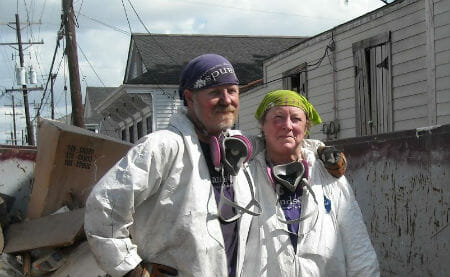 Dave Kopra and Ann Drorbaugh
Images of the lingering devastation caused by Hurricane Katrina – even many months after the Aug. 29, 2005 storm – moved Dave Kopra and Ann Drorbaugh. The Olympia, Washington, retirees yearned to help.
“We had the time, so why not?” Kopra says. “When we first came, we were just shocked at how bad things were a whole year after the storm – how quiet the city was and how depopulated lots of areas were. We immediately made plans to come back again, then one thing led to another.”
Since 2006, Kopra and Drorbaugh have been on a mission to rebuild New Orleans one home at a time. They have made 25 trips back to the city, recording blog entries for each trip. New Orleans is no longer a place where Kopra and Drorbaugh just visit or volunteer; the city feels like home.
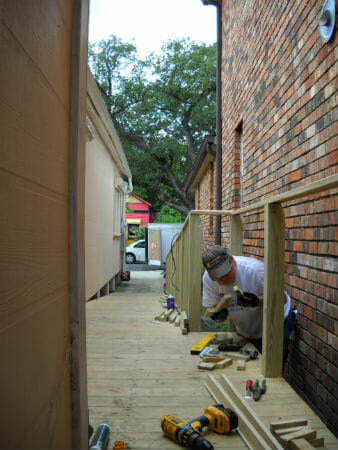 Dave Kopra builds a wheelchair ramp for a disabled New Orleans homeowner.
And the residents have embraced them. Peggy Severe, a Hurricane Katrina survivor whose storm-damaged home Kopra and Drorbaugh helped restore, speaks of them fondly.
“Every time they’re in New Orleans, they check on me,” Severe says. “They’re wonderful.”
The feeling is mutual.
“In the process of helping people put their homes back together, they became our friends, our family,” Kopra says. “We had Thanksgiving dinner here one year. One of the homeowners spent all night and all day preparing a meal for 25 of us. It is just that kind of stuff that has broadened our look at the world.”
Kopra and Drorbaugh have helped repair more than 50 homes damaged by Hurricane Katrina, with such organizations as HandsOn New Orleans – part of Points of Light’s HandsOn Network – and Rebuilding Together. Kopra and Drorbaugh will be back in New Orleans to volunteer during the 10th anniversary of the storm.
On their last visit in April, they helped complete the interiors of two homes in the Upper Ninth Ward. Last year, in October, they led a team in building front and back porches, as well as a wheelchair ramp, for a homeowner in Gentilly, Louisiana.
“There are lots of invisible residents now living in damaged homes,” says Drorbaugh. “All around the city are homes that look OK from the sidewalk, but are unrepaired inside. There are many homeowners who have exhausted their financial resources, now living in homes without water and other basic needs.”
As long as they’re still needed, Kopra and Drorbaugh say, they’ll keep coming back.
See more Hurricane Katrina stories and memories at www.pointsoflight.org/katrina.
St. Bernard Project
To commemorate the 10th anniversary of Hurricane Katrina, we are honoring volunteers who served along the Gulf Coast after the storm. Meet St. Bernard Project, today’s Daily Point of Light Award winner, and nominate an outstanding volunteer or organization you know as a Point of Light.
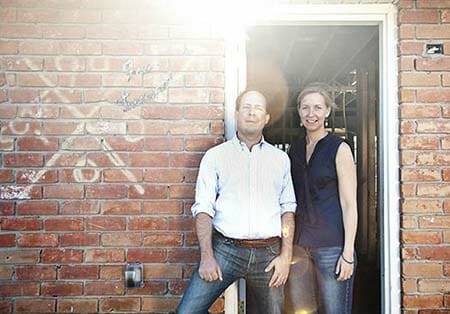 Zack Rosenburg and Liz McCartney
Six months after Hurricane Katrina decimated the Gulf Coast, Liz McCartney felt she had to do something to help. She persuaded her husband, Zack Rosenburg, to join her and started reaching out to nonprofits in New Orleans. From 30 emails, she got one just response.
“We thought, maybe we missed it, maybe the recovery is over,” recalls Rosenburg, who ran an indigent criminal defense practice in Washington, D.C., at the time, while his wife directed a nonprofit that provided training to at-risk young people.
The couple responded to the lone email. “A bunch of hippies feeding people out of a tent in Chalmette (near New Orleans) said come on down,” Rosenburg recalls. “When we got there we realized that – far from being recovered – the city was in horrible shape. It was just a wreck.”
While some folks were in FEMA trailers, many lived in horribly unsafe conditions. Then there was Mr. Andre, an octogenarian World War II veteran.
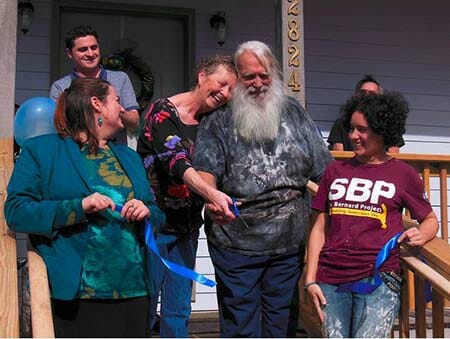 A New Orleans couple cuts a ribbon leading to their home, thanks to St. Bernard Project volunteers.
“Every day this proud man would show up for lunch, then he’d leave, and come back for dinner. After a few weeks, this guy broke down sobbing. He was sleeping in his Ford Ranger and went every day to ask for a FEMA trailer and was turned down,” recalls Rosenburg.
It was clear to Rosenburg and McCartney that getting people like Mr. Andre back into rebuilt homes was a top priority.
“We approached a bunch of big, institutional nonprofits and basically heard, ‘It’s too early for rebuilding.’ ‘That’s phase two of recovery and we’re in phase one.’ ‘We’ve done disaster recovery for 30 years; this is how it’s done,’” McCartney recalls. “We thought, if that was our family that was displaced we’d want people to start rebuilding houses now.”
So the couple started St. Bernard Project in March 2006. By that June, they had left their jobs and moved to New Orleans to nurture the nonprofit, in Louisiana’s St. Bernard Parish.
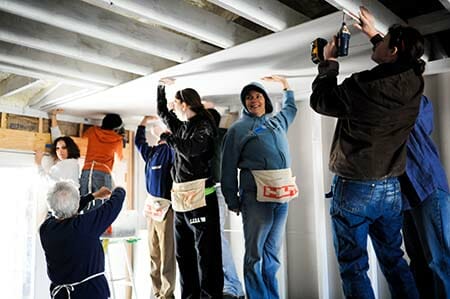 St. Bernard Project volunteers install a ceiling of a home.
“We had no vision – and that was our best asset,” recalls Rosenburg. “We had no ties to traditional ways of doing things.”
Working closely with local groups, including Habitat for Humanity, corporate donors such as Toyota and UPS, and AmeriCorps members from all over the country, St. Bernard Project has become a leader in disaster resilience and recovery, with 26 full-time team members in New Orleans.
Since 2006, St. Bernard Project has rebuilt homes for more than 900 families, with the help of more than 100,000 volunteers in New Orleans; Joplin, Missouri; Staten Island, New York; Rockaway, New York; Monmouth County, New Jersey; and most recently Marcus, Texas.
“What made the difference was our model, bringing what our clients need under one roof, with clear goals and accountability,” says Rosenburg.
For example, a client could receive construction and mold remediation services, insurance information, financing options and – for a time in New Orleans – mental health services. St. Bernard Project has grown to include a job training program for veterans and efforts to create affordable new housing.
The need in New Orleans remains great, even 10 years after Hurricane Katrina. While St. Bernard Project has rebuilt 612 houses in New Orleans, there are 5,000 families who still are displaced. The organization gets 15 to 20 requests every week from new clients who haven’t been able to move home, or folks who live in derelict homes because they can’t afford to go anywhere else.
For the 10th anniversary of Hurricane Katrina, St. Bernard Project is holding a 48-hour build-a-thon starting at 10 a.m. Aug. 26. The goal? To make sure 48 more families move back home.
“It’s not over 10 years later,” says Rosenburg. “America is not going to be whole or healed until New Orleans is rebuilt.”
See more Hurricane Katrina stories and memories at www.pointsoflight.org/katrina.
Tom McCann
On May 31, 2011, Tom McCann, 61, woke up bright and early in Nantucket and went fishing, then moved on to the beach, then came back for a big family barbecue, even his 88-year-old mother was there.
Sunburned and sated, everyone began to wind down by gathering before the television to watch a celebration on the Mall in D.C. “Gary Sinise and Joe Mantegna were acting out the stories of the young wounded from the last two wars,” McCann recalls. A 23-year-old soldier came to the stage. “He stood up with all his might on his prosthetic legs,” McCann continues. “The crowd went wild with admiration and inspiration. Tears were streaming down my face.
“We had just enjoyed the most perfect day and yet I knew we would soon go about our daily lives and forget what these young men and women had given up for us. Right then and there, I was determined that my wife and I would invite some of these heroes to come to Nantucket and make sure they got to do everything we did.”
McCann spent the next six months working with a newly-formed board of directors to establish the nonprofit that would come to be called Holidays For Heroes. “That first year, Memorial Day 2012, we brought four families to Nantucket,” he says. “Service people and their kids spent the weekend fishing, sailing and eating. We learned that it was a bigger and better idea than I had realized. Plenty of organizations do things for wounded heroes—but they’re geared to helping them rehabilitate, which means still more time away from their family.
“What we wanted was the exact opposite,” he explains. “For us, it was all about the family being together, the caregivers, the spouses, the small children.”
Hundreds of local inns, restaurants, attractions, and clubs have gotten behind the idea. Small businesses provide in-kind services like catering, plumbing, photography; others donate frequent flyer miles. “Everyone, down to the ice cream place where you have to stand in line for an hour, donates something,” McCann says.
Holidays for Heroes now welcomes four families to Nantucket on three different occasions each year: the weekends of Memorial Day, July 4th, and Sept. 11. The organization identifies those service people that might most benefit from such a break by visiting Walter Reed National Military Medical Center, as well as by teaming up with other nonprofits that work with wounded soldiers.
“When I meet these young men and women, I ask them what they want to do with the rest of their lives,” says McCann, a successful entrepreneur himself (he manufacturers and designs a variety of pet toy lines). “And I’ve been inspired by their stories.” The conversations have led to a second effort, The American Dream, which issues grants—and offers mentoring and business advice—to help veterans realize their aspirations. So far, seven soldiers have received funding to establish businesses as disparate as a fitness center and a home inspection business.
McCann knows he’s been fortunate in his own business efforts. “I should have been born in the 1800s,” he says. “I’ve always had that barn-raising mentality where working together achieves great things. If we all take care of just one piece of the puzzle, no matter how small, we all help improve the world. It makes a huge difference—and adds up an amazing puzzle.”
Laurel Sybilrud
Last year alone, thousands of lives were lost in the state of Georgia due to breast cancer. This year, because of the actions of Laurel Sybilrud, that number is sure to decrease.
In Georgia, if there are any new efforts in the fight against breast cancer, there’s a good chance that Sybilrud is behind it. As a founding board member and grant chair for It’s The Journey, Inc., Sybilrud has helped change Georgia’s breast cancer community.
Understanding that the fight against breast cancer is in fact a journey, It’s The Journey, Inc., is dedicated toward helping patients with that daily struggle. Founded in 2002, It’s The Journey is a 501(c) (3) charitable organization. Their mission is to strengthen Georgia’s breast cancer community by raising money and awareness for local organizations throughout Georgia that focus on breast cancer education, screening, early detection, supportive services and continuing care.
Each year, It’s The Journey hosts the Atlanta 2-Day Walk for Breast Cancer. Sybilrud has been an integral part of the creation and development of the walk since its inception 13 years ago. The 2-day event, a 20-mile walk on Saturday followed by a 10-mile walk on Sunday, is the flagship event for Its The journey, Inc.
Besides the work Sybilrud does with the 2-day walk, responsible for raising $1.1 million last year, she is on-hand to assist in any and every capacity. With Sybilrud involved since the beginning, she has helped the organization expand from 12 counties in the Metro Atlanta area to 90 counties in the state, while overseeing over $11 million in grants. Sybilrud’s impact and overall presence is truly irreplaceable.
Alexandra Minutillo
While different treatments and medicines are necessary in treating those with a life-threatening illness, a dose of love and support can go a long way in healing as well. Though she is no Doctor, Alexandra Minutillo has been on a mission, using her love and compassion to treat teens stricken with Cancer.
As founder of the non-profit company Kids Helping Kids with a Smile, Inc., Minutillo has created avenues to service teens and pre-teens at the Smilow Cancer Center at the Yale New Haven Children’s Hospital. Minutillo, who is always willing to help others, wanted to assist children in some capacity, but wasn’t sure how. After reaching out to a Child Life Specialist at the Smilow Cancer Center, who expressed that many efforts are geared toward young children but not as much attention on the teen demographic, Minutillo knew where she can make a difference.
Smiles for Smilow, the first program under Kids Helping Kids with a Smile, focuses on teens and preteens by providing resources to help with their treatment. Smiles for Smilow collects donations, distributes gift cards, and other sources of entertainment and goods for teens to enjoy, hoping to make their road to recovery a little less bumpy.
With Minutillo expected to graduate high school soon, she can definitely relate to those teenage years. Knowing that 25-30% of Cancer patients are of her similar age and that more of an effort can be made in helping them, Minutillo made it her responsibility to change that. She has engaged over 35 of her classmates and numerous adults, urging them to share some love and support for these children who need it most.
Peggy Coleman
In the town of Meridian, MS, there are far too many people that go hungry. With many pockets of the community stricken with poverty, many of its people are uncertain when and from where their next meal will come. One of the people on the front line fighting to make a difference is Peggy Coleman.
For nearly 10 years now, Coleman has provided some relief to the grumbling stomachs of Meridian. In 2006, Coleman created Feed by Faith, a non-profit soup kitchen strategically housed in the most destitute area of Meridian, so that it is in close proximity to those who need it most. Feed by Faith serves any and every one looking for a hot meal.
Coleman did not just create the outlet to feed those that are hungry, but she is actually on-hand the majority of the week, assisting in operations, making sure demands are constantly met and stomachs are full. Coleman is on location five to six days a week, from open to close. Three of those days she is serving food, while the remainder of the week she does just about everything else. Whether it’s cooking, cleaning, organizing, picking up donations or processing paperwork, Coleman does it all.
Feed by Faith is truly making a difference for the Meridian community. On an average day of meal service, upwards of 300 people receive meals they may otherwise not have access to. Besides feeding the hungry, Feed by Faith also provides services related to economic opportunity. They hold workshops teaching financial literacy and job training, they provide housing assistance as well as nutritional education – all very much needed in the community.
With Coleman’s dedication on display for the past 10 years, even though the hardships, it is safe to say Meridian is in good hands.
Jody Farley-Berens
Responsible for taking millions of lives, cancer leaves behind nothing but broken hearts and broken homes. Every day, there are families that feel that heartache. When Michelle Singleton passed away from breast cancer at the age of 30, she left behind four children who felt all of cancer’s ill effects.
A very close friend of Singleton is Jody Farley-Berens. Devastated by her friend’s death, Farley-Berens used that heartache as a source of motivation and created Singleton Moms. Realizing the legacy Singleton left behind, and understanding that this is an issue all too common around the country, Farley-Berens started Singleton Moms to help other single parents in similar situations. Singleton Moms directly impacts the day-to-day life of single parents with cancer, providing the parent and their children with physical support, financial assistance and emotional encouragement.
For the past nine years, Farley-Berens has been the Founding Member and Executive Director of Singleton Moms. As a non-profit, Singleton Moms’ sole focus is to provide a strong support system for both the single parent stricken with cancer and their children. From fund raising to community outreach, Farley-Berens has helped develop and implement successful organizational programs geared toward making a difference in the lives of those in need.
For those patients faced with the ills of cancer, the support of Singleton Moms is vital. Providing practical daily needs, such as healthy pre-prepped meals and house cleaning, is just one avenue of assistance. Cancer requires expensive treatment and often destroys one’s morale; Singleton Moms offers financial relief by helping patients with costly bills as well as emotional support through conversation and counseling. Singleton Moms supports over 60 single parents affected by cancer, as well as their children, making Farley-Beren’s impact truly amazing.



