Amputee Blade Runners
Meet Daily Point of Light Award honoree Amputee Blade Runners. Read the nonprofit’s story and nominate an outstanding volunteer or organization as a Point of Light.
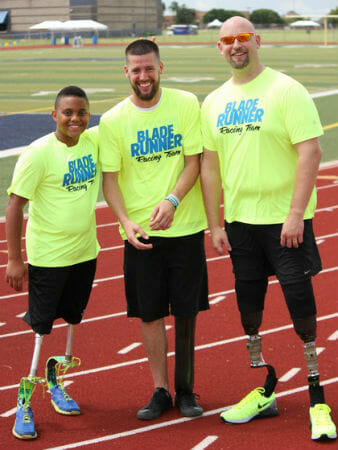 Ryan Fann, center, with other Amputee Blade Runners team members
When Ryan Fann was just 3, he lost his left leg after being hit by a truck while riding his Big Wheel tricycle. The accident didn’t stop this determined little boy. By the time he was a teenager, he was playing high school football and competing in races.
But it wasn’t until an interested coach and an anonymous benefactor outfitted him with a proper prosthesis designed for runners that Fann truly took off. The experience would lead him to co-found the nonprofit Amputee Blade Runners, which offers the same kind of help to other aspiring athletes.
“I had grown up using an everyday walking prosthetic (leg),” Fann, now 32, recalls. “It was all that our insurance covered, but I never let it slow me down. I attribute that to my parents, who always encouraged me to do the best I could.”
The prime difference between walking and running prosthetic legs is that instead of cushiony “feet,” the running version features blades that allow the user to spring with greater ease. After acquiring his advanced prosthesis, Fann went on to win medals and travel the world.
As his career as a professional runner wound down, Fann turned his attention to the field of prostheses. While finishing his coursework at Tennessee State University, he applied for an internship at The Surgical Clinic, a physicians’ network in Nashville.
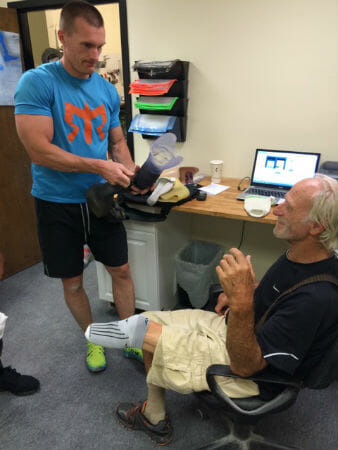 Aaron Fitzsimmons, left, does a prosthetic leg fitting for a team member from Amputee Blade Runners.
There, he impressed Aaron Fitzsimmons, the partner in charge of prostheses.
“Meeting Ryan opened my eyes to the opportunities that could unfold when someone was provided with a $5,000 piece of equipment that he couldn’t otherwise afford,” Fitzsimmons says.
Fitzsimmons notes that the cause behind about 80 percent of amputations is diabetes or vascular disease, and that about three-quarters of the patients affected are older than 65.
“People in Ryan’s position, who are young and especially athletic and active, represent a very small percentage of the amputee population,” he says.
With demand being relatively low, running prosthetics are much more expensive. And because they’re not deemed medically necessary, they’re not covered by insurance.
Fann and Fitzsimmons decided to get prosthetic running legs to those in need. They started with the people who came to the clinic, later creating a website so those elsewhere could apply.
Amputee Blade Runners has supported about 80 runners and introduced new products along the way. It designed a slip-on shell that covers the running blade for a young boy who had also lost his hands and couldn’t use the wrench normally needed to affix the blade.
For kids who also want to play football or volleyball, it developed prostheses that resemble the standard footwear used in those sports.
Meanwhile, the organization is developing a support network around the country – so far it has outfitted athletes, who now serve as ambassadors, in 24 states.
“The young athletes that we’ve worked with can provide the inspiration and guidance to help others reach their goals,” Fitzsimmons. “That’s the real value in what we do.”
Ryan P. Burns
To educate is to empower. One person who can definitely relate to the role education plays in uplifting a community and building confidence in adolescents is Ryan Burns.
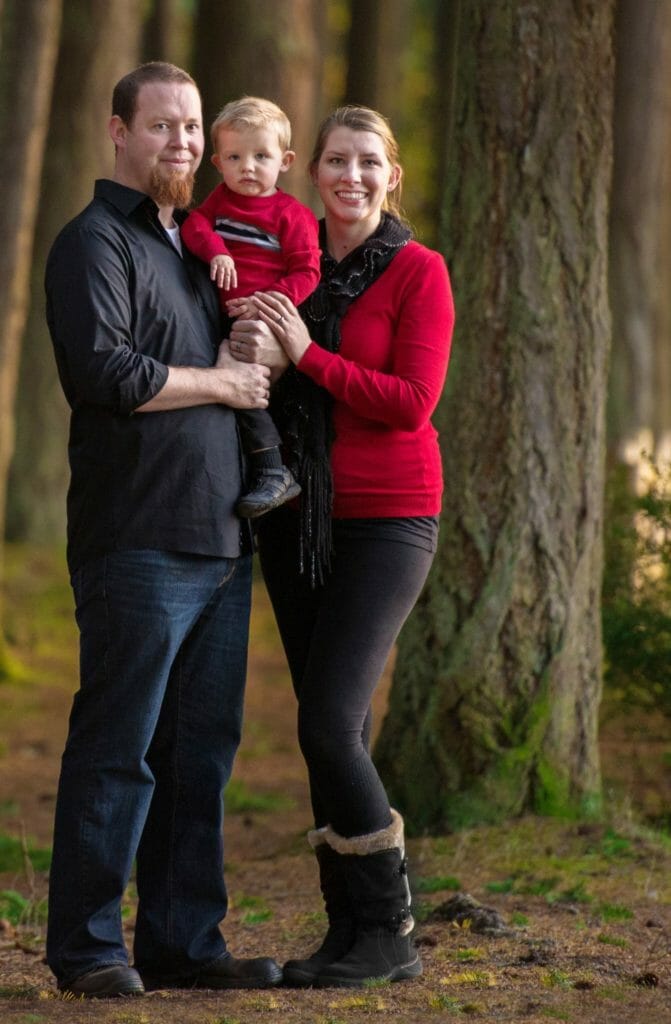 Ryan Burns, son Declan Burns, and wife Brooke Burns.
 Burns, who has served 10 years in the Unites States Navy, is now giving back his time to better the lives of children. He now serves as the leader of the Science, Technology, Engineering and Mathematics (STEM) Program for Central Kitsap Junior High School, in Washington, as well as trains and mentors students from local elementary schools all the way up to the high school level who are part of the Remotely Operated Vehicle (ROV) Program. While his work with STEM and the ROV program can be very complex, Burns’ goal is to make even the most complicated subjects relatable to all students.
Far too often students have a difficult time relating what they do in a math and science classroom to actual real life events. Burns’ objective through the ROV program is to bring practical application to the classroom environment. He realizes that creating a exciting and fun atmosphere, while making it very relative, is the best way to forge great learning experiences.
Through the ROV program students are tasked with assembling a water vehicle from pre-built materials. The initial stages start in elementary school, where they learn to work as a team, by the time they reach high school they are able to fully design the vehicle from the frame, to the controls, and even the layout of the motor.
“Ultimately it is all about opening their minds to future opportunities,” said Burns. “My main focus is to help these children succeed. Whether that be through the build process, throughout their class or in the future when they become scientists or engineers, my hope is that the information they learn from me helps them throughout life.”
Dr. Brenda Hage
Dr. Brenda Hage is a woman of many titles and talents. Brenda has always felt a strong commitment to serve her community. Brenda, an associate medical director and family nurse practitioner, has helped bring hope and healing to many families and at risk patients.
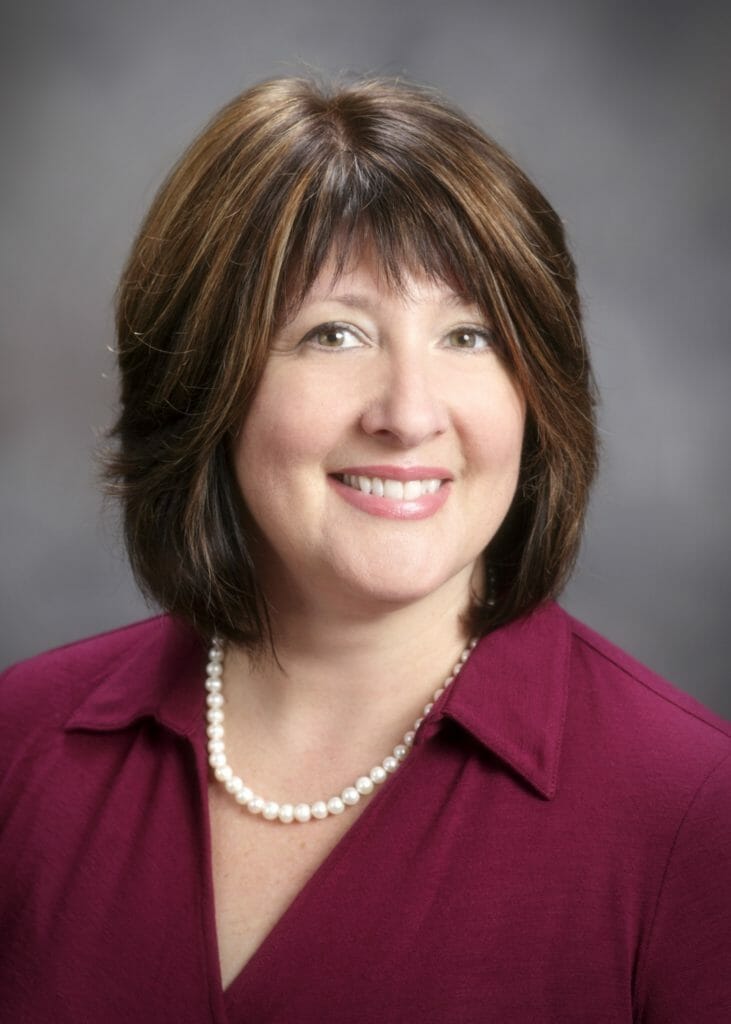 Dr. Brenda Hage
 Through The Hope Center, Dr. Hage has personally helped many of the 4,500 patients served last year through the clinic. Dr. Hage, who has an expertise in adult/family primary care, gerontology, migrant workers/immigrant care and administration, has led the clinic to serving many who were previously ignored. The clinic serves many unrepresented and uninsured people with free medical, dental hygiene, legal, medical, vision, audiology, pharmaceutical prescription assistance, pastoral care and social work care.
During Dr.Hage’s time at the Hope Center she has helped fill in other unaddressed services in the community such as hearing aids, glasses, and dental care for those in need. Dr. Hage has the full support of her community. The Hope Center uses social media to garner more volunteer support, share news and information pertinent to the clinic and health of the community and spread the message of kindness and giving.
In addition to managing the Hope Center, Dr. Hage has also provided grant writing and administrative support to the center. Dr. Hage goes above and beyond for her many patients even staying beyond her scheduled times to make sure every patient receives care when other providers aren’t available. Despite a grueling schedule, Dr.Hage uses her influence and talents to help benefit others who are in need and offers them a medical haven.
Nicolas Mintzer
Nicolas Mintzer, 17, didn’t choose to volunteer the first time. His parents pushed him to donate time to various Simi Valley, Calif., organizations. Eventually, though, it become second nature.
“At first, volunteering wasn’t fun,” he said. “But, during my high school freshman year, it become a passion because I enjoyed it. I could make impacts in many areas.”
Now, the Santa Susana High School senior gives time and energy to many volunteer organizations. During the last three years, he’s worked with the Key Club, Simi Valley Youth Council, and For the Troops.
As Key Club Treasurer, he coordinates fundraisers and led a bracelet sale that earned enough money to pay for an additional year of private school for a Guatemalan child.
“It was so emotional to be part of something so amazing,” he said. “I get the privilege of going to school every day, and to provide that for him was incredible.”
Through the Simi Valley Youth Council, he and others work with city councilmembers to devise solutions to problems important to the youth community. Recently, he said, the Youth Council replaced Simi Valley school-ground grass with succulent plants to limit gardening and watering costs.
Additionally, Mintzer gathered donations for For the Troops, a non-profit group that creates care packages for overseas military. Throughout the past four years, he’s gathered toiletries, clothing, candy, and food for more than 100,000 care packages.
After high school graduation, Mintzer knows continuing to volunteer will require extra effort. But, volunteering is part of his daily life now, and he wants to find a way to stick with it.
“I hope to continue my volunteer work through college and later in life,” Mintzer said. “Hopefully, I can be a part of as many programs as possible and maybe start one about something I feel passionate about.”
Christy Conk and Amy Schulz
Loving animals and the outdoors comes naturally to Christy Conk and Amy Schulz, a Central Florida couple who met when they were both working as animal trainers at Disney.
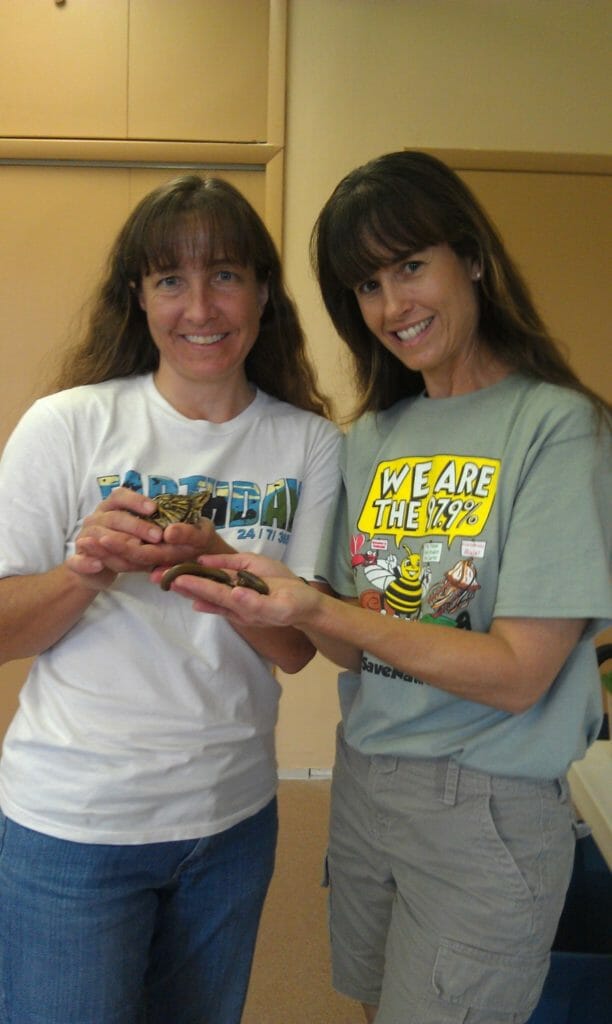 Schulz and Conk with a Florida Box Turtle and Florida millipedes giving a talk to middle school students on safety with wildlife.
The pair, together for more than 16 years, has made it their mission to bring that love of the environment to their service with Friends of Lake Louisa, the citizen support group connected to the Lake Louisa State Park. Together, they’ve spearheaded a slew of educational programming for the park along with two free annual events, Nature Fest and Poochapalooza, both designed to spotlight the many opportunities for outdoor fun available at Lake Louisa, a state park just 16 miles northwest of Orlando’s Walt Disney World.
“The conservation and animal programming at Disney is outstanding, but not everybody can afford to go there,” said Conk, 43, who started volunteering at animal shelters when she was 12. “Lake Louisa is close to where we live in Clermont, and we wanted to be sure that everybody in the community knew what a great place it is, 4000 protected acres with six lakes and two streams – so close to the city. So many kids are more hooked on being online or gaming systems than being outside. So we wanted to make it really fun.”
So with the support of their 3 dogs, 1 cat, 1 snake, 1 parrot, 10 tortoises and 1 box turtle – “most of our animals do volunteer work too,” – they came up with the idea for Nature Fest 10 years ago, an annual community event that now draws up to 1500 people. Conk and Schulz coordinate the day, working with about 80 volunteers, including educators and rangers from Disney, to make it happen.
Set for the first Saturday in May, the family oriented event includes guided hikes, kayaking, live animal demonstrations (that’s where Slingshot the green snake gets in on the action), hands on activities, tram tours, and activities for kids. Once the park admission is paid – $5 per car with up to 8 passengers or $2 for walk and bike-ins, all of the programs and activities are free. “We have somebody who loves spiders and shows tarantulas and scorpions, we do a bird hike, stand up paddleboard demos, it goes on and on,’ said Conk.
Next November marks the second annual Poochapalooza at the park, a Fido-friendly day of fun, food, and education, with trail hikes and activities for dogs of all abilities. “Amy came up with that idea because so many people don’t know you can bring your dog into the park. Next year we’re going to have demonstrations by working dogs – it’s a really fun day.”
Working with volunteers is a point of pride for them, and park facilities have benefited from their group efforts, from the addition of an ADA accessible playground, to trail maintenance, lighting improvements, and the opening of a sensory garden.
Volunteering together has brought the couple closer, added Conk. “We have so much beauty in our back yard, we just want to share it,” she said.
Annie Eissler
Meet Daily Point of Light Award honoree Annie Eissler. Read her story and nominate an outstanding volunteer or organization as a Point of Light.
After receiving her master’s degree in international affairs, Annie Eissler got a job she loved at a nonprofit devoted to promoting Africa’s development in education and work skills. She treasured getting to know a great variety of people and cultures on the continent.
Many years later, she would find herself back, virtually, in Africa, doing similar work as a volunteer. But it would take a much-needed career detour and a life-threatening illness to bring her full circle.
Working for the nonprofit for seven years, she gradually realized that while she had gotten very good at project management, she didn’t have the concrete skills and experience she felt she needed to more directly contribute to the communities. She decided to enter the business world and landed in the sales and marketing department of a tech company.
In 2012, she was diagnosed with, and successfully treated for, stage 3 colon cancer. During her recovery, she asked herself the hard questions about what she wanted to do with the rest of her life.
“I kept thinking I needed to get back to doing something in Africa – it had gotten under my fingernails,” she says. “I tried to figure out how to combine my passion for the continent with all of this great marketing know-how.”
An internet search brought her to Grow Movement, a London-based network of hundreds of professionals who provide virtual (via Skype, texting, etc.) consulting and mentoring services to entrepreneurs in Uganda, Rwanda and Malawi.
For her first project, Eissler was paired with a young man from Malawi whose small furniture and lumber business employed three others. Earlier this year, part of his business was destroyed when catastrophic floods struck the region.
Once again Eissler was there, available by computer and telephone, to help him “work through putting the pieces back together,” she says.
These days, she’s helping a young clothing designer in Uganda save money for a new sewing machine, create promotional campaigns, and get a better handle on her income and expenses.
This entrepreneur is part of #Uganda600, an ambitious initiative recently unfurled by Grow Movement. The program pairs 600 consultants with 600 small businesses.
Eissler, who holds a high-level marketing position at a software firm, was instrumental in recruiting and vetting the new consultants and now serves as a supervisor of 18 American volunteer consultants based on the West Coast.
The same qualities that go into the making of any successful consultant – flexibility, patience, persistence – are important in this work, Eissler says. But volunteers with the right stuff need to have still more.
“Often consultants are used to working with big companies with big budgets,” she says. “With these projects, they have to be willing to scale back their expectations while understanding that micro improvements can have macro impact.”
Juana Dwyer
Modern day slavery is a billion dollar industry that spreads across the world. Today millions are trafficked from and through their respective countries for many trades such as sex, labor, organ harvesting, and etc. Not only does modern slavery consists of people being trafficked, another aspect is many being paid low wages or not being paid at all. Many women, men, and children are stuck in this cycle with no end in sight as they have very little resources that allow them to seek help to get out.
Damayan Migrant Workers Associations is one foundation that is helping to end this cause. Founded in 2002, Damayan is a grassroots organization that was founded for immigrant and migrant Filipino women to help workers help themselves in fighting wage theft, human and labor trafficking, domestic violence and discrimination based on immigration and gender. The organization which is based in New York and N
Current chair person of the organization Juana Dwyer,a former volunteer to the foundation, has helped pivot the foundation to new heights. Dwywer joined Damayan in 2009 and volunteered her weekends and weeknights after being fired from her job without receiving her unpaid wages and unemployment insurance. Dwywer felt that Damayan was a great organization to help serve justice and give a voice to women just like herself.
Since becoming chair, Dwyer has led the Peer Mentoring Program, which helps harvest leadership skills in those that were previously being trafficked. Juana has also helped organize grassroots strategies to aid in locating severely isolated trafficked domestic workers. The grassroots strategy proved to be highly effective, which in return helped win Damayan the illustrious Well Stone Award in April, from Freedom Network USA.
Under the successful leadership of Juana, Damayan has grown to over 40 domestic workers and has won over $700,000 in unpaid wages. Juana has also helped women who were trafficked by diplomats and other powerful players break free and secure legal/social services , and trafficking visas. With the help of Dwyer and other volunteers like her, Damayan has brought 23 children, 3 spouses, and 11 families together.
Juana has and continues to make a change in many underprivileged and under represented women in society. She truly proves why she is a Daily Points of Light Award honoree.
Bethany J. Montjoy
For 17-year-old Bethany Montjoy, volunteering came naturally at a time when it’s often the furthest thing from a young person’s mind. As a middle-schooler, she was already becoming a veteran volunteer.
“I figured out volunteering is helping people on your own time,” said the Thomas Sumter Academy senior. “It was something I felt I should do.”
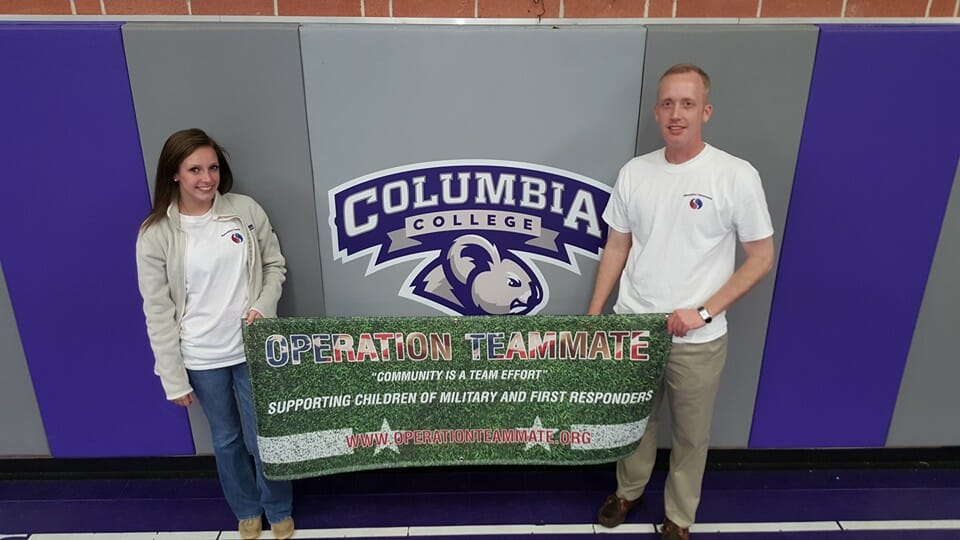 Bethany and her father, Timothy Montjoy, at an Operation Teammate event
As the daughter of an Air Force Technical Sergeant, Montjoy donates much of her time on base. For the past several years, she’s handed out candy during Halloween Trunk-or-Treat events. She’s also dedicated more than 300 hours of service through the Yes Program, an organization that helps high school students identify volunteer opportunities with local community programs.
Some of her most significant efforts, however, have been through two organizations –Operation Teammate and Red, White, and Babies. Launched by her father, Operation Teammate serves children, living on Shaw Air Force Base in Sumter, S.C., whose parents are deployed and those of First Responders. Montjoy works with area sports teams to give opportunities to these children, such as VIP dugout, sideline, or postgame experiences.
“You get to see how the little things you do – even helping out a little kid – can make people happier,” she said. “When their parents are deployed, they can get down. This helps keep their mind off things.”
Montjoy also works with Red, White, and Babies, an organization that provided needed supplies to young and expectant mothers whose spouses are deployed. She collects toys that will be distributed through baby showers alongside cribs, clothes, mattresses, and offers for prenatal classes.
Overall, she said, she volunteers for her action’s ultimate impact.
“Volunteering is important to me because you’re helping out other people,” she said. “It’s not just for your satisfaction. You’re helping someone else with things they couldn’t do.”
Alexandra Jackman
Alexandra Jackman learned something important about the world when she was nine years old. Now 16 and a high school junior in Westfield, NJ, Jackman was at a sleepaway family camp in Vermont that summer when she had an epiphany.
“There was a girl there named Jamie who always sat by herself with her aide at lunch,” she recalled. “I thought she just wanted to be alone. One day I went up and asked if I could join them and her aide said yes.”
That’s when Jackman found out that Jamie had cerebral palsy and couldn’t speak. “She used hand signals. We started hanging out and became good friends. I realized that if I hadn’t approached her, I would have missed out on a big opportunity. I saw that when a person has special needs, it isn’t who they are, it’s what they have. It’s up to us to see them as a whole person.”
Understanding that became the impetus for Jackman to be involved with the special needs community, first supporting programming with an organization called Autism Family Times and now as the leader and coordinator of a community based, social skills group for teenagers and young adults with special needs called Teen Night Out.
Jackman, her mom and a group of volunteers from local middle and high schools run the monthly socials with the sponsorship of Intensive Therapeutics of West Caldwell, a non-profit that provides group and individual occupational therapy services to children with special needs. Held at the community center at Forest Road Park in Fanwood, the themed parties draw 30-40 attendees representing a spectrum of special needs, from autism and down syndrome to other types of developmental and physical challenges.
“I can’t even express how happy I am when it’s Teen Night Out,” said the enthusiastic teenager. “We usually have a theme, like maybe a hoe down, with bandanas and country music. There is an annual talent show in January that’s just amazing. It’s all about creating bridges.”
The way Jackman sees it, young people navigating special needs have a lot on their plate to just manage day to day, maintain. Social time often goes by the wayside. “This is a place where everyone can be themselves. It’s an honest place, judgment free.”
Jackman understands that if a person hasn’t been exposed to someone with special needs, it might be a bit intimidating. “I don’t blame people if they are hesitant at first. When I see someone with a challenge I don’t know about, it can be scary.
“But I’ve learned there’s a lot more to a person than we might think.” She’s also learned leadership and organizational skills along the way. “I love working with this community so much – I get so much back.” Although she’s not sure of her career path just yet, one thing is for certain. “This community will always be a part of my life.”
Gina F. Regynski
Victims of domestic violence often feel by themselves trapped in a situation of fear. In a dark place, feeling as if they have no outlets to turn to, the Young Women’s Christian Association is there to help. Working with the YWCA, Gina Regynski is making sure that the journey to recovery for these victims is not one traveled alone.
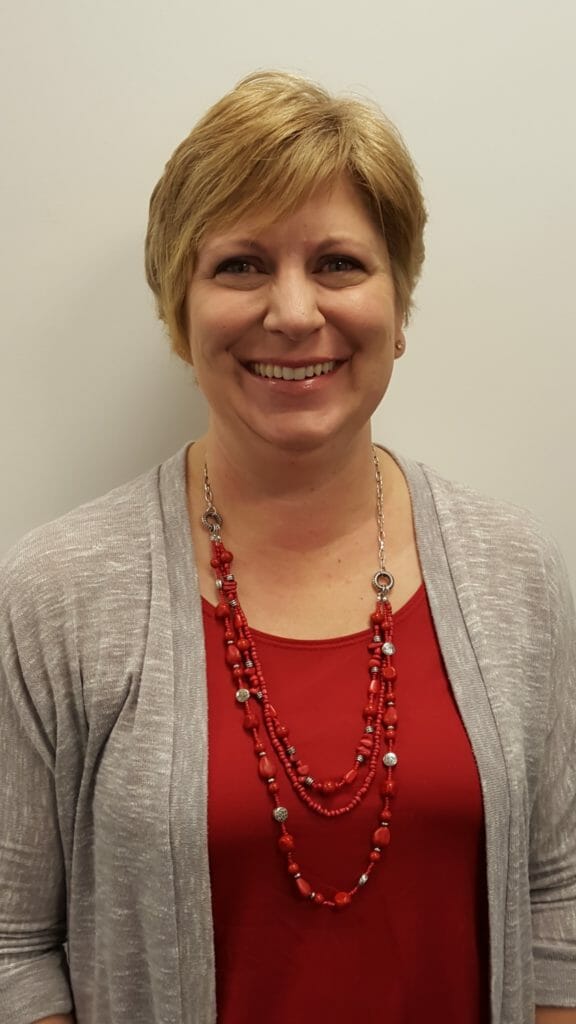 Gina Regynski
 The YWCA of Kitsap County, WA has shown a dedication to ensuring the personal safety, rights, welfare and dignity of those who experience domestic abuse. Regynski serves as an active member of the Executive Board and the Board of Directors for the YWCA. Her leadership and overall presence is felt in all facets of the association. From different functions to fundraisers, Regynski’s commitment is on display daily.
With Regynski’s help, the YWCA looks to spread awareness regarding domestic abuse in hopes of creating social change. Far too often, many victims are made to feel like targets, silenced or shamed for the actions taken against them. Regynski and the YWCA are hoping to reduce the stigma associated with domestic violence and give the victims the necessary attention and adequate treatment they deserve.
The YWCA is truly saving lives. While many victims of domestic violence often feel trapped, stuck in a position of unhappiness and uncertainty, it is the support of the Y and the actions of those like Regynski that is freeing this victims from their depression. The Y serves as an outlet for reform. Whether it’s medical and legal assistance, counseling, job training, or even temporary housing, the YWCA is present in each step to recovery.
As a board member and community activist, Regynski is tasked with planning, organizing and executing various projects. While she juggles her commitment to both her work and family, she still manages to shape her local community with an undying devotion and passion to make a difference.



