It was a simple question from a homeless teenager, but it gave Ginny Donohue pause. Thanks to her efforts, the young man had recently landed a spot at one of the country’s best music conservatories.
“You’ve helped me live my dream,” he said. “But, what’s your dream?”
“I wasn’t unhappy in the corporate world, but I realized I was never happier than when I was helping kids like him get into college,” Donohue recalls. “I had a unique set of experiences — I had been an inner city teacher and now I was a chief financial officer — I was 52 years old, I was ready for a change.”
That was 16 years ago and Donohue has never looked back. The nonprofit she founded, On Point for College, has enrolled some 5,500 students — generally between the ages of 17 and 29 — in hundreds of colleges. Unlike other such programs that identify at-risk but top performers in high school, On Point targets young adults who have already graduated but have given up hope on ever getting it together to apply to institutions of higher learning.
“This all started when my daughter told me about a friend who was basically homeless and couch surfing,” says Donohue. “She said ‘he’s great at computers and wants to go to college. I told him, you’d help.’” She did so, and news of her success spread. “Kids started stopping me in the grocery store. ‘Are you the lady who can help me get into college?’”
When she decided to formalize her efforts, she began by visiting local shelters and refugee sites in her hometown of Syracuse, N.Y. “I’ve never really had to motivate anyone,” she says. “It’s not that they’re not interested, it’s that they need a playbook.”
On Point has no shortage of volunteers, either. More than 200 assist with mentoring or fundraising, others drive kids back and forth to school when necessary. “People want to make a difference, and this is something they can easily do,” Donohue says. “A lot of them are ex-teachers, but entrepreneurs are supportive too because they understand the value of investing in people.”
In the end, she adds, everyone benefits. “Time in college is the best road out of poverty. And it usually ends up with someone giving back to their community.”
Little Helpers
“My family came over right after the fall of Saigon,” says Tran Smith, founding member of Little Helpers, today’s Daily Point of Light Award winner. “We grew up without very much at all and basically had to start over.” Smith remembers families she’d never met coming to their house, bringing with them toys and clothing: “For us it was such a big deal. Just that feeling that someone cared about us.”
“Little Helper” Michael Landsgaard shows cards he made to send to veterans.
At the time, Smith didn’t realize that the kindness of strangers would leave a permanent impression.
As Smith grew older, she found herself becoming more and more involved in charitable works, from serving on boards to doing more hands-on type service. “Feeling that sense of gratitude to what we had also opened my eyes to what so many people don’t have.”
The mother of two children, Jackson, 9, and Ava, 7, Smith remembers looking around at all her children’s toys and thinking, “They’ll never know what it’s like to not have… that’s a wonderful thing, but I want them to have a sense of appreciation and see their blessings.”
In December 2010, Smith along with two of her friends, Kristen Terrell Landsgaard and Pat Mitchell Worley, started Little Helpers, a family volunteering group for children of all ages.
“It’s more of an idea, like a movement… a kindness movement to teach children and to become good adults.”
Little Helpers is designed to help young people understand the value of volunteering, recognize the blessings in their lives, broaden their community perspective and feel the sense of accomplishment received from lending a helping hand.
“On average we have about 30 kids involved per project,” says Smith, who at the time lived in Memphis, Tenn., “the ultimate goal of the program is to raise confident children who see giving back to the community as a normal aspect of their lives.”
With chapters across the country including cities in New York, Colorado, Tennessee and North Carolina, Little Helpers, has plans to expand and is currently planning a program in Atlanta, Georgia.
The group has been recognized with proclamations from New York State Senator Ted O’Brien, Memphis Mayor AC Wharton and Shelby County, Tenn., Mayor Mark Luttrell.
“My goal has never been to make it big. It doesn’t matter to me if there are two families or 200 families,” says Smith, “We’re simply a family volunteer group.”
Jason Brown, right, shows his Olympic medal to children staying at a Ronald McDonald House in Chicago in November.
After figure skater Jason Brown competes, fans show their adoration by tossing stuffed animals on the ice.
With those keepsakes in hand, the 20-year-old Olympic bronze medalist recently showed his admiration for sick kids. He visited Chicago and Winston-Salem, N.C., locations of the Ronald McDonald House – which provides families of seriously ill children in treatment a place to stay close to the hospital – to donate the stuffed animals and visit the children.
“Being part of something bigger than me is really important,” says Brown, a 2015 National Figure Skating Champion. “There’s nothing more amazing than knowing that something you are doing is helping people, especially children when you see their smiling faces and hear their stories. And they inspire me to do more.”
Jason Brown, center, delivers toys to children staying at a Ronald McDonald House in Chicago in November.
From renovating schools in need with Chicago Cares to spending time with Alzheimer’s patients at nursing homes, Brown’s loyalty to volunteer service began when he himself was a kid.
His involvement with Chicago Cares, part of Points of Light’s HandsOn Network, started when his older sister wanted to do something more meaningful than a traditional party for her bat mitzvah, a coming-of-age tradition for Jewish girls (bar mitzvah for boys).
With the help of their parents, his sister set out to help renovate a school through Chicago Cares and have the party – complete with a DJ – in the school gym as the guests finished the project.
Jason Brown performs in the 2014 Winter Olympics.
“I was so inspired that I did the same thing for my bar mitzvah, renovating another Chicago school – Shiloh Park Elementary School in Zion – through Chicago Cares,” Brown says. “It was so cool to see 300 guests pitching in to make a difference at the school by painting hopscotches, designing murals, planting flowers and creating mosaics. And we had the wonderful opportunity to meet the principal and the teachers who were so appreciative of the work we did and the positive influence the renovation would have on the children.”
A native of Highland Park, Illinois, a Chicago suburb, Brown grew up in a family that believes in the power of volunteerism as a way to bond while helping others.
“I love when people come together for a cause,” he says. “No matter what you do for a living, what your background is, how old you are, how young you are – volunteering brings everyone together as one, as a community. It’s teamwork at its best.”
William Burwinkel
Many students have role models they look up to and that encourage them. Some students, especially in underprivileged communities, do not have a person in their lives to encourage them to keep pushing or offer fundamental advice and support. William Burwinkel is a successful entrepreneur from Cincinnati, Ohio, who is well versed in perseverance after starting his company out of his basement. In 2002, he determined it was time to give back so he and 30 of his employees at National Marketshare Group, Inc. started a tutoring program in a local public school.
This small effort has transformed into the Adopt a Class Foundation ( AAC). AAC is a group-mentoring program that connects businesses and civic groups with students in their community.“The idea was for my employees to serve as role models for the students and offer them a vision for what they could achieve upon attaining a high school diploma or college degree,” Burwinkel explains.Mentors meet with their classroom partner at least once a month and engage in letter writing as well.
AAC provides training, resources and continual support to mentors and teachers to ensure that students receive proper guidance. Over the past ten years, AAC has expanded into 23 schools in Greater Cincinnati and Northern Kentucky, and four schools in Portland, Oregon.
Currently, 290 business and community groups are working with over 7,500 students to teach social skills and relationship building. AAC’s growth and success in the past ten years is incredible. But Burwinkel finds joy in the individuals who have committed themselves to AAC. Burwinkel says, “The most rewarding part is to see the smiles on both the children we mentor and the Adopters who do the mentoring.”Although the graduation rates for The United States are slowly increasing, there is still a great need for mentors. Students from all backgrounds can benefit from having an older, wiser and more experienced individual to turn to. In times of frustration, transition or doubt, a mentor can offer essential advice that makes a lasting impact. Burwinkel and his team of professionals at AAC offer schools a support network of business and community groups that can provide needed resources. Resources have included assistance with testing, one-on-one tutoring, financial support, books and supplies, food and other essential items.AAC’s services are vitally important and necessary. Burwinkel says, “The most challenging part is to realize how great the need is for Adopt A Class across our country and the limited resources we have to spread the program.”These challenges inspire and invigorate Burwinkel and all of the volunteers at AAC. They lead by example: persevering in the face of obstacles.
If you know someone like William Burwinkel guiding mentoring our youth nominate them today for the Daily Point of Light Award!
Thereasa Winnett
Being an effective volunteer can be challenging at times. If not given proper resources, preparation or training, volunteer efforts alone can be inadequate or insufficient. Thereasa Winnett, of Dunwoody, Ga, realized that good intentions and genuine commitments aren’t always enough to make a sustainable impact. Winnett created Teach One Reach One to help ministers, missionaries, teachers and parents educate at the K-12 level.
“I worked with all sorts of educational programs in the community where children were involved. What I realized over time was a lot of these programs and volunteers really wanted to help and were doing everything they could but they didn’t always have access to the proper resources or training,” Winnett explains.
Teach One Reach One was created to help equip these programs and individuals with the tools they need to create a lasting impression.
“We’ve created workshops, teaching blogs, lesson plans and activities for these programs to use and to help take these volunteers, that might not have a teaching degree, and give them the tools so they can be as effective as they can be.” Winnett says.
The lessons and resources Teach One Reach One creates incorporate spiritual growth, service, The Bible, basic literacy skills (language, math and science), health and survival skills. The lessons are hands-on, experiential and designed to have lasting and positive impact on the participants. Programs and volunteers with varying levels of resource availability are able to use the Teach One Reach One materials because of its accessibility.
“Our goal is to help all sorts of churches, faith-based communities, tutoring programs and mission teams. We’re in the process of beginning to translate our materials into other languages,” Winnett says.
She says Teach One Reach One keeps blossoming to meet the needs they encounter. As the organization continues to grow, Winnett and the team at Teach One Reach One delve deeper into diversified needs of the children in their community and beyond. This journey has inspired Winnett and fuels her passion for education and children.
It has been a truly rewarding experience for Winnett.
“We were field testing a lesson at a place in Atlanta that wokrs with Latino children. We taught the children how to take their kitchen scraps and plant them to help them grow food for their families. I thought ‘Will they even remember this next time I come in?’ It just blew me away when the kids came in and were still so excited and had nurtured their plants while I was gone,” Winnett continues. “That’s when it hit me, that this could have such an impact.”
Winnett is continuously working to provide effective and efficient educational tools to all of those in need of support or guidance. Teach One Reach One resources cover a vast range of subjects tailored towards ensuring positive and spiritual growth.
If you know someone like Thereasa Winnett helping volunteer efforts be as effective as possible nominate them today for the Daily Point of Light Award!
David Bazerman
In 2011, Nubia Barahona, an 11-year old girl, was found brutally murdered after being abused by her adopted father. Her body was left to be found in a garbage bag in the back of her adopted father’s pickup truck. David Bazerman was one of the many who saw this story unfold and was so moved by the tragedy he knew he had to help in some way. Bazerman, today’s Daily Point of Light Award winner, made it his mission to defend the legal right of unrepresented children in Broward County, Florida.
The same year Nubia’s tragedy occurred, Bazerman began the Tracey McPharlin Dependency Project. The project honors the lives of Nubia and Tracey McPharlin, a Broward County Bar member and former chair of the Florida Bar Public Interest Law Section whose career had a profound and lasting impact on the lives of the many children she served individually through her pro bono work.
Florida is one of few states that do not provide representation for children who are classified as dependents. Children, the subjects of Juvenile Dependency Court proceedings, are the only parties who are not provided with representation. This, of course, leaves room for many to fall into a cycle of abuse without any assistance to escape. Bazerman, having an extensive history of defending the rights of abuse, neglected and abandoned youth, understood the plight the children were facing.
With the memories of Nubia and McPharlin to fuel them, the Tracey McPharlin Dependency Project serves newborns to children 19 years of age who are currently in or at-risk of entering the child welfare system. These children have legal issues involving mental health and medical problems, assistance with transitioning out of foster care, denial of needed social and educational services and many other issues of the Juvenile Court. Over the course of the last four years David has engaged many of his local colleagues and has successfully expanded pro bono representation to at risk dependent children of Broward County, Florida.
Do you know someone affecting change in your community? Nominate them for a Daily Point of Light Award!
Swaran Dhawan
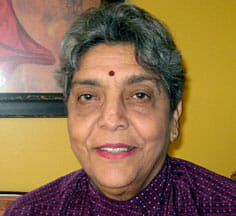
One in four people will suffer from mental illness in their lifetime. There is a great need for counseling services for those suffering from mental illness, especially those living far from their home country. Swaran Dhawan immigrated to The United States in the 1960s from the northern mountains of India and she empathizes with those seeking to make this country their new home.
While living in the United States, Dhawan worked as a therapist and went on to become a director of social work in a psychiatric hospital. In the late 1990s, Dhawan was gearing up for retirement when she and a fellow social worker began to address the arrival of South Indians immigrating to the Baltimore, MD, area. The two social workers were united by their passion to assuage cultural and generational gaps that are often linked to mental illness. Dhawan helped form Counselors Helping (South) Asians/Indians, Inc. (CHAI) to help bridge these gaps.
“It’s promoting mental health across generations. We take calls and connect people to the right resource treatment. We are reaching out to places of faith, arts, music and providing the assistance they need,” Dhawan explains.
CHAI takes a holistic approach to addressing the specific needs of the South Asian populations. By providing proactive, culturally competent information and referrals on mental health and wellness, CHAI is providing a valuable service for the South Asian community.
“Most of my professional life has been in the mental health field or with women, so this was very fitting for me to give back to this community,” Dhawan says. “It was also very worthwhile to see young people taking interest in this field.”
Beyond increasing access to mental health services for the South Asian population, CHAI is actively working to end the stigma surrounding mental health. They have crafted a pledge that urges people to “be part of the solution and not the problem” and to show compassion.
“The stigma is the biggest challenge; the secrets and the shame. We are encouraging people to keep the dialogue open,” Dhawan explains.
CHAI has trained more than 1,500 professionals and community members in cultural competency around mental health. Committed volunteers, like Dhawan, work tirelessly to ensure people are given the necessary resources to help manage their mental illness. They provide vast informational literature on mental health, locate providers with South Asian language and culture knowledge and provide workshops to increase cultural proficiency.
Everyday CHAI is making strides towards securing a welcoming environment for South Asians to address their mental health. “You know, it’s like a cherry tree. You plant a cherry tree, and you don’t see the cherries tomorrow,” Dhawan explains.
If you know someone like Swaran Dhawan affecting change in their communities nominate them today for The Daily Point of Light Award.
Yamilee Toussaint
Black and Latina women comprise 15 percent of the population, yet hold only 4 percent of STEM (Science, Technology, Engineering and Math) jobs, the fastest growing career track in the United States. Yamilee Toussaint, today’s Daily Point of Light Award winner, started her organization, STEM From Dance, to combat this reality. She works with New York City high school girls of color to prepare them academically in math, and to give them hands-on experience with being an engineer and other STEM careers while building their confidence through dance. In addition to working directly with girls, Toussaint oversees operations, strategic direction, fundraising and program design.
STEM From Dance uses dance—a confidence-building and culturally-relevant strategy—to grow the number of low-income, minority girls with science, technology, engineering and math degrees. Most of these girls don’t dream of being scientists or engineers. Not because they can’t, but because of a lack of confidence, preparation and awareness of STEM careers. The organization provides them with high-quality math tutoring, exposure to STEM and a dance curriculum designed to build the confidence needed to obtain a STEM degree.
Over the next 10 years, STEM job growth will outpace non-STEM jobs. Moreover, the annual starting salaries for STEM jobs average $70,000, double the median income for Black/Latino families.
Says Toussaint, “As a dancer, educator and MIT engineer, this is my passion and I have what it takes to get students there.” A high school teacher in a low-income neighborhood, Toussaint has impacted more than 200 students through teaching algebra. She has improved her students’ math performance, increased their self-esteem, and opened their eyes to STEM careers by building robots together and by visiting the Massachusetts Institute of Technology, her alma mater.
Toussaint believes in her innovative use of dance as a vehicle to make STEM a reality for low-income communities. She chooses to dance because girls of color are often drawn towards music and dance, “I took something that communities connect to (dance) to deliver something that historically they have not had access to (STEM).”
Do you know someone who has found a unique and innovative way to affect change in their community? Nominate them for a Daily Point of Light Award!
Caragan Olles
Dyslexia is the most common cause of reading, writing and spelling difficulties and one in five students has a language-based learning disability. Most people affected by dyslexia require intensive weekly tutoring to help improve these skills. Many schools do not provide these services and private tutoring can come at a high price. These high costs prohibit many students from getting the tutoring and support they need.
Caragan Olles, of Depere, Wisconsin, is all too familiar with the struggles dyslexia causes for students attempting to grasp the intricacies of the English language. A dyslexic herself, Olles, with the help of her brother Carter Olles, founded Bright Young Dyslexics (BYD) in March 2013.
“I basically looked around the community and started to see how many dyslexic children there were. I knew not everyone is as fortunate as I was to get tutoring at an early age,” says Olles.
Olles can easily relate to dyslexic students feeling frustrated in school. One mission of BYD is to rally awareness around dyslexia and its presence in the community. Olles often finds it challenging to explain the hardships of dyslexia to those who have no experience with this learning disorder. Says Olles, “It’s challenging getting schools and teachers to understand exactly what dyslexia is and how they can help their students.” But Olles and the team at BYD are working to fix this.
Beyond raising awareness, BYD offers incredible support for dyslexic students in Kindergarten through 12th grade. Through donations, BYD offers funding to these students for tutoring, classes or camps. They provide assistive technology to students to supplement their efforts. Through presentations and simulations, BYD supports dyslexia education for teachers, students, parents and the community.
Olles says, “The most rewarding part of working with BYD is teaching people about dyslexia with the dyslexia simulations. I like to see people, and especially my friends, participating and wanting to learn more about dyslexia and how they can help other dyslexic children.”
Olles has been able to reach more than 400 community members through BYD simulations and 15 youths in the community have become engaged with BYD through fundraising and awareness activities. BYD is currently working in the Northern Wisconsin communities, but hopes to increase awareness nationwide!
Olles was able to face adversity and then help others facing similar challenges. With support from her brother, the Olles family has brought awareness to a condition affecting millions of students. Because of their efforts, more students will be able to receive the tutoring they need, educators will be more adept at helping students with dyslexia and the community will be ready to support its youth population struggling with this condition.
If you know a family like Caragan and Carter Olles, working to mobilize awareness for a cause, nominate them today for the Daily Point of Light Award!
Ben Otten
Otten giving a speech to teens about
the importance of volunteering at the
HOBY Conference in Louisville, KY.
For Ben Otten of Louisville, Kentucky, there is no cause too small. Over the last seven years, Otten, 15, has completed nearly 2,000 hours of community service— in recent years managing about 500 hours a year. Otten accomplishes this despite what many would consider a hindrance; after suffering a stroke shortly after he was born, Otten was diagnosed with cerebral palsy, or CP, which resulted in the paralysis of the left side of his body.
“I started volunteering when I was young with my mom and my sister, it became our family passion,” says Otten, who began serving his community at a young age. Since then, his passion has only grown.
Being raised by a single mother in a family that moved often and struggling with the challenges of CP, Otten learned early on that everything happens for a reason.Every experience, both positive and negative, has helped prepare him for the life he leads today and serves as a force behind his volunteer service.
Otten’s volunteer service is expansive and varied. He works with his local Habitat for Humanity affiliate, helping with framing and foundation work as well as assisting with landscaping for new homes. He also lends a helping hand to the community’s elderly by doing landscaping and yard work. At Wayside Christian Mission Homeless Shelter, he works with young children by serving as a role model and mentor for those that are going through tough times. Otten also works with special needs children and even finds time to volunteer at his local Salvation Army and United Way.
On Sundays, instead of taking a break, he uses his technical skills to help with the lighting during church services. Otten never lets his diagnosis stop him, even on the most painful and challenging days, “The most rewarding part is how much more I get out of serving others than I ever expected. I really don’t see any challenges to it.”
Because Otten feels so passionately about serving and volunteering, he presents and speaks at ebetns to share the importance of giving back with members of his community. Despite the physical challenges he faces, he has been able to improve, inspire and redefine so many people’s lives,“I always meet new amazing people and I usually learn something new too.”
Ben Otten’s words combined with action inspire those who meet him, making him a true Point of Light in his community. He is a testament to the notion that everyone is capable of giving back to his or her community. Otten says, “If I can serve, so can you! Give it a try, you will get so much more out of it than you ever expected.”
If you know someone like Ben overcoming challenges to serve their communities, nominate them today for the Daily Point of Light Award!




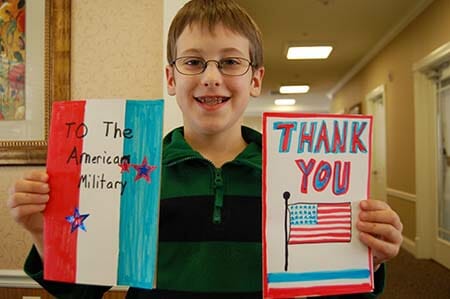 “Little Helper” Michael Landsgaard shows cards he made to send to veterans.
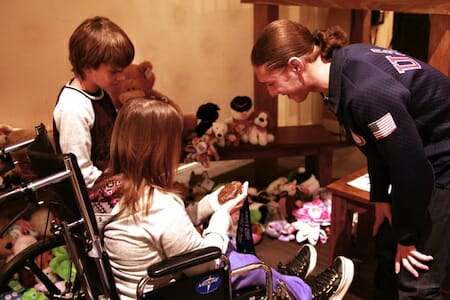 Jason Brown, right, shows his Olympic medal to children staying at a Ronald McDonald House in Chicago in November.
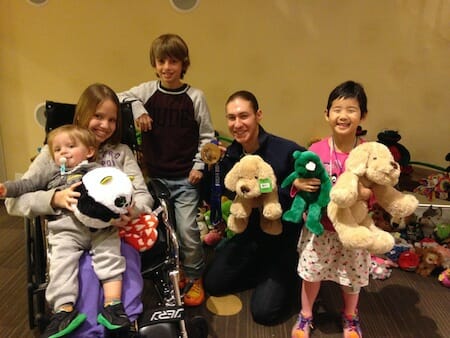 Jason Brown, center, delivers toys to children staying at a Ronald McDonald House in Chicago in November.
 Jason Brown performs in the 2014 Winter Olympics.