Leah Bernthal, right, works with an art student on a color palette.
“When children are chronically ill, the first thing they lose is their freedom and self-esteem,” says Leah Bernthal. “I wanted to change that.”
Bernthal co-founded CoachArt in 2001 in response to a profound need for support and enrichment programs for chronically ill pediatric patients outside the hospital. The organization offers free services to these children and their families, including scholarships, hospital events and even lessons in the child’s home.
The name of Bernthal’s program was inspired by Art Lurie (1935-1996), a gregarious friend of Bernthal’s family who worked as a cardiac surgeon, and the father of Bernthal’s co-founder Zander Lurie.
Bernthal remembers Art Lurie as a cheerful man, staying positive even when he was diagnosed with cancer. Despite his own illness, he thought only of young people in his situation who had not yet had a chance to realize their potential. Bernthal vowed to never forget the positive impact he had on young people.
CoachArt creates a transformative arts and athletics community for families affected by childhood chronic illness. Founded in partnership with Children’s Hospital Los Angeles, the organization is designed to meet the complex emotional, psychological, education and wellness needs of under-served children in the Los Angeles and San Francisco Bay areas.
CoachArt pairs people with shared passions. Art coaches give in-home lessons to young artists for everything from piano to painting and photography. Sports coaches conduct clubs and leagues for young athletes who play soccer, tennis, golf and other sports.
So far, 1,000 volunteers have contributed a total of 15,000 hours, enriching the lives of thousands of children.
Bernthal remembers at age 23 knocking on countless doors at medical offices to gauge interest and pitch her idea. She knew she would have to convince doctors of the value her idea could add to outpatient care. Advances in medicine were helping chronically ill children live longer. They needed more support at home.
Bernthal’s organization helps address a gap in community health care. Chronic illness affects 15 percent of California’s pediatric population – but upwards of 20 percent live in under-resourced communities.
About 80 percent of the children reached by CoachArt live in low-income households, where access to extracurricular activities is limited. Bernthal has found it easier to attract volunteers to her cause by appealing to their strengths as subject matter experts in art and sports – if a musician is already teaching piano lessons to kids and wants to tap into community service, why not do it with CoachArt?
CoachArt now collaborates with 117 community program partners and 47 local hospitals and health care providers.
As Bernthal explains, young people coping with chronic illness encounter challenges with maintaining a positive self-image. She recounts the story of a young boy dealing with spinal cancer who took piano lessons through CoachArt. Over the years, he excelled and formed a strong bond with his piano instructor, and now the boy attends The Colburn School, one of the most prestigious music schools in Los Angeles, with a full scholarship.
Bernthal grew a tribute to an influential person from her childhood into a full-fledged community program, making a difference in the lives of young people battling illness. She says: “I couldn’t imagine my life without it.”
Jeff Balek
Balek, right, follows along in braille while his student reads aloud.
Jeff Balek may not know what a book looks like but that doesn’t stop him from reading them.
Balek was born with retinopathy of prematurity, or Terry’s Syndrome, a condition where abnormal blood vessels develop in the retina. “I was born three months premature and the doctors gave me too much oxygen.” Blindness is a complication that can result after undergoing intensive oxygen therapy which he received to aid premature lung development.
But Balek has not let his blindness affect his outlook. “Even though I’m visually impaired it doesn’t mean I can’t do the same things sighted people can. I just do things in a different way, with alternative techniques.”
His first volunteer experience was in 2009 with a local elementary school where he taught kids how to read braille and use talking computers. in 2012, a friend sent him an email about a literacy program at the YMCA of Greater Charlotte. Since then, Balek has been volunteering as a reading tutor with the Y Readers program, a literacy program that serves students in grades K-3 who are reading below grade level. “I just love working with kids and helping out in whatever way I can,” says Balek who employs twin vision books during his tutoring sessions. “They have braille on one side of the page and print on the other side. I read the first page to the students and I follow along as they read the second page.”
Balek’s approach to teaching mirrors his approach to learning. “Confidence is key,” says Balek who learned how to read braille when he was 5 years old. “When the kids see me reading braille it gives them lots and lots of confidence. They’ve never seen a blind person reading to a sighted person before.”
Balek volunteers twice a week for about an hour each day. He loves to use Dr. Seuss books and Green Eggs and Ham is a particular favorite. “It’s very rewarding for me to volunteer with the kids and it gets me out of the house and gives me something to do.”
Karen Jeffries
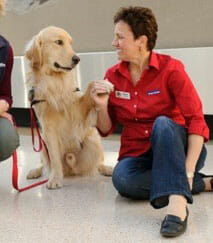
VMF President/CEO Karen D. Jeffries with Neil, one of the assistance dogs in training.
Karen Jeffries has a keen understanding of the struggles disabled veterans face when undergoing rehabilitation and or in recovering from an injury sustained as a result of military service. She knows what they’re experiencing because she is a disabled veteran. Karen and her husband both served our country and returned home to unfamiliar battles they had to overcome. Since its conception in 2010, Karen has been a fearless president and CEO leading Veterans Moving Forward, a group that has helped thousands of disabled veterans heal and live normal lives by providing trained therapy dogs and service dogs. As a former Naval Commander, Karen was not shy about stepping up to lead Veterans Moving Forward.
VMF’s uniqueness stems from its meticulous custom matching of the veterans’ needs and the dogs’ capacity to support each individual veteran’s requirements. This matching process includes multiple assessments and almost two years of puppy training.
“In the course of training a service dog for another organization, I saw first hand the benefits of what a service dog can do,” Karen reflects on VMF’s beginnings. A service dog is trained for almost two years to meet the specific needs of a veteran. Karen is an advocate for this process, but felt the love and support of a service dog could heal many more.
According to Karen, “I thought, in addition to training that one dog to mitigate the specific disability of one person, why not let that dog be involved in therapy work while training?” Karen remembers from training her first service dog that they can bring so much joy to everyone they meet. VMF is unique because the animals can be placed into roles as comfort dogs and therapy dogs while they go through the formal training process to become service dogs.. A single service dog can provide unconditional support and love to scores of people before completing formal service dog training. With Karen’s new model of service dog use, VMF has successfully enhanced veterans’ quality of life through more than 23,000 face-to-face veteran engagements.
Karen has helped bring joy back to so many disabled veterans who often lose hope after returning home. She says it can be frustrating managing expectations, but VMF’s goal is to encourage disabled veterans to find the right path to heal and cope, even if the right path is not a service dog. But with these trials come countless rewards. Karen recalls a story of a Vietnam disabled veteran who, after receiving a service dog, turned his life around completely. Karen states, “His nurse said she saw him smile for the first time in eight years. He is getting outside, getting to know his neighbors after years, and he even made a Thanksgiving meal.”
Karen is so passionate about helping veterans find their place once returning home. “I founded an organization that is 100% for the needs of the veterans,” she says. “Veterans first, and the dog is a tool to help that veteran get better.” She urges others to find a need and do something to help. “All I can say is, whatever you do will come back to you ten-fold.”
If you know someone like Karen working tirelessly to improve the lives of others, nominate them today for The Daily Point of Light Award at https://www.pointsoflight.org/programs/recognition/dpol/nomination
Kim Becker
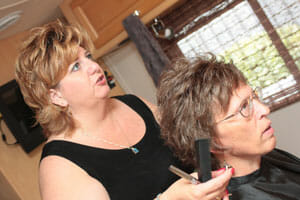
Kim Becker performs a surprise makeover for a cancer survivor.
Lost for many women in their battle back from cancer is the confidence and poise that used to come easy in front of a mirror. When you’re preoccupied with fighting a disease that has no known cure, who has time to enjoy applying rouge and eyeliner or running a brush through your hair?
One woman is volunteering her time to help cancer survivors with hair styling, hair substitution, skincare and cosmetic techniques that can help them to return to their jobs, their families, their friends and the general public eye with confidence. Kim Becker’s efforts in South Bend, IN empower ladies to step back out into the world, repairing some of the confidence that has been eroded by their struggle
Kim’s “Hello Gorgeous! Of HOPE” cause provides complimentary surprise professional makeovers and cosmetic education to women battling cancer. Before departing one of Kim’s events, women cancer patients and survivors learn how to replicate their new “look.” Women receive at no cost a supply of cosmetics, skincare and nail products used to complete her services.
The effort has branched out further than Kim’s hometown. The red-carpet concept has been brought to affiliated salons across the U.S. And Kim has a mobile day spa that brings her surprise makeovers to where the beneficiaries live.
The chance for a female in the U.S. to develop cancer during her lifetime is now one in three. That is why volunteers like Kim Becker are needed to help restore the self-esteem of women fighting for their lives.
HerShe
Kenadie Cobbin Richardson’s college experience included a friendship with an emancipated foster youth whose struggle Richardson witnessed firsthand. She saw how this young woman’s lack of support prevented her from graduating and sadly realized that this is a reality that many foster youth face. Statistically, one out of ten foster youth attend college and only one out of a 100 actually graduate.
Post-college, Richardson worked as a teacher in urban centers in the United States. She saw that the vast majority of her pupils were in foster care dealing with parents who were drug-addicted, incarcerated and sexually and/or physically abusive. Living in California at that time, Richardson decided to take action and began establishing empowerment programs for young women living in California. Richardson converted her compassion into action and, in 2006, founded the HerShe Group Foundation, Inc.
HerShe’s mission is to prepare girls in foster care for the transition from adolescence into adult independence. By exposing these girls to extraordinary experiences through mentorship, the performing arts, college and career readiness and leadership development, these young ladies become “the princesses and queens they were meant to be.”
Today, HerShe’s work has expanded beyond empowerment programs and also works to meet the needs of youth in foster care by promoting stable, permanent connections to caring adults; assisting youth with the management of their physical and mental health needs; providing opportunities for youth to engage in the performing arts; supporting economic success through education and career exposure; providing life skills training to help youth navigate the adult world; and improving access to stable and safe housing.
Anjana Murali
Meet Daily Point of Light Award honoree Anjana Murali. Read her story and nominate someone you know as a Point of Light.
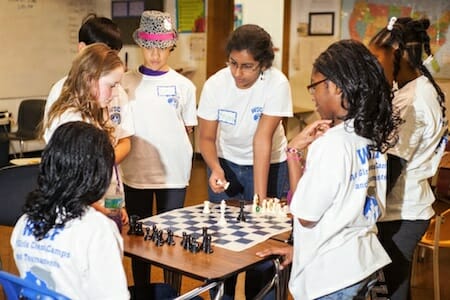
Anjana Murali, center, teaches participants in her chess camp for girls about the game.
At age 11 – playing in her first chess tournament – Anjana Murali learned about the gender disparity in the world of chess.
“I was the only girl,” she recalls. “I was intimidated but I thought, ‘Whatever, I can do this.’”
Murali sat down to play her opponent, a boy. She remembers overhearing him and his friends right before the game. He said, “I’m playing this girl. I should be done in five minutes.”
Chess is a game that takes planning and thought, and generally, more than five minutes to play. But five minutes later, Murali lost. “It was so humiliating,” she says.
Instead of letting the loss get her down, she was inspired to get to work.
“[Chess] was all new to me, and I wanted to get good at it and beat the guy,” she says. “I was determined to prove that any girl could become queen of the chessboard.”
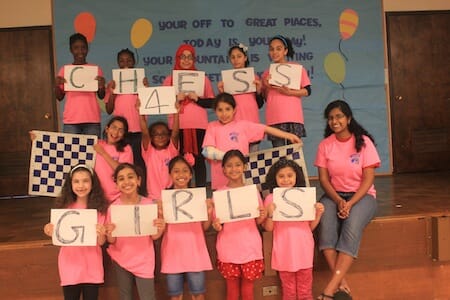
Anjana Murali, right, shares a lighthearted moment with her campers.
Two years later, at the same tournament, Murali was named the Wisconsin State Chess Federation champion.
Inspired by her tournament experience, Murali – now an 18-year-old college student in Pittsburgh – began Queen’s Game in 2012. The all-girl chess camp is designed to help break down gender barriers while introducing chess to girls.
“I conducted my chess camp in order to help women and girls take a stance against gender disparity,” Murali says. “Chess has been viewed as a male-dominated sport for a long time. Not very many girls are interested in the game of chess, as they think that it is not a game for them.”
The grant-funded day camps are free. In addition to introducing chess to more girls, Murali’s camps aim to boost confidence and improve critical thinking skills.
“Chess is a lot like life,” she says. “You have to be thinking about your next move and what you want to get out of it. The camps help teach girls these valuable types of critical thinking skills in a fun environment where they play a game.”
The U.S. Chess Federation has taken notice of Murali’s work. The organization has invited her to be a part of a national initiative designed to attract more girls and women to chess.
Meanwhile, Murali has a grand plan: “My goal is to expand my all-girls chess camp to the national level in order to encourage more girls to play chess and to remove the gender disparity that exists in the game.”
Katie Lopez
When it comes to maintaining a career outside the home, many military spouses face an uphill climb. So many factors stack up against the possibility of sustaining a professional career, from frequent relocation to the lack of opportunities surrounding the military installation, and the often inflexible schedules that exist around a military member's assignment. But one young military spouse is volunteering her time at Fort Campbell to help create job opportunities for other career-minded military spouses
Katie Lopez established the Fort Campbell chapter of In Gear Career, connecting career minded military spouses with professional development and networking. By facilitating meetings between community leaders and spouses pursuing job opportunities over the past year, Katie is helping her peers build their own networks to create referrals for possible employment. Katie has expanded the local Fort Campbell chapter to include 40 military spouse members as well as nearly a dozen community partnerships that include non-profits, city offices and local educational institutions.
Now the chapter has grown to include professional development events and lasting community partnerships that have enabled spouses to meet key community leaders. And after months of networking herself and building community relationships, Katie found her dream job, directing military and governmental affairs for the local chamber of commerce.
Nicole Muller
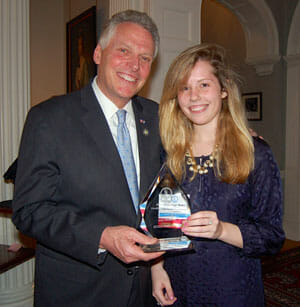
Nicole with Virginia Governor Terry McAuliffe.
Nicole Muller was 16 years old when she read a newspaper article about the need for food donations in Albemarle County. She knew she could pitch in and help. So she started a food drive … and has helped it grow over the past four years to reach all 50 states.
Nicole is now a 21-year old college student, running a national organization out of her apartment near the University of Virginia in Charlottesville. Her Neighbors-4-Neighbors program has secured more than 675,000 pounds of food and $65,000, providing meals for more than 500,000 people.
Nicole has motivated food drives throughout the nation to support community food banks with annual spring and fall campaigns that she organizes via email and phone. In states where she knew no one, Nicole directly contacted governors’ offices and asked them to hold food drives. She organizes friendly competitions among multi-county schools, fitness clubs and civic organizations, and has inspired others to orchestrate food drives at bowling alleys, children’s gyms and photography studios.
It is incredible to think that her national food drive began simply by asking 12 of her neighbors to contribute canned goods for her local food bank. But Nicole sees from her experience with volunteering that you really get back much more than you give.
“Volunteers don’t have to believe that all projects have to be big,” she says. “Every little act of kindness has a way to spark more kindness, and that is what makes volunteering so special. Just choose to be part of the solution and not concentrate on the problem.”
Hope After Project
Though the grief over losing a loved one may never go away, Jennifer White sees how it can be transformed over time.
She’s the founder of the Hope After Project, an organization that creates volunteer opportunities in memory of people who have died.
The concept grew out of White’s own loss.
In 2011, when White was 23, her mother took her own life. White spent months lost in the fog of grief. The pain overshadowed her lifelong memories of an intelligent, loving parent and kind spirit.
As the two-year anniversary of her mother’s death approached, White began seeking a new way to remember and honor their relationship. She found it while helping a volunteer group paint a school, a project similar to one her mother had participated in years earlier.
“People focus so much on the way she died. But she had this whole other life,” White says. “I wouldn’t want to be judged by the darkest time of my life. I would want people to remember me by the happy, positive things I did in this world.”
Through the Hope After Project, White helps those bereaving a loss by finding projects centered on the interests of their loved ones who have passed away. She reaches out to local nonprofits and community groups to customize service opportunities and recruit volunteers.
Anyone can request a memorial project, and there’s no cost to the recipient.
Recently, White worked with two siblings in Kansas City, Mo., who wanted to honor their mother by helping ailing cancer patients. Their mother had died of colon cancer seven years ago. White’s organization partnered with the American Cancer Society’s Hope Lodge program, which provides free housing to cancer patients and their families.
About 35 volunteers cleaned the entire Hope Lodge facility in Kansas City, cooked a meal, did arts and crafts projects and visited with cancer patients. The project went so well, White is planning more events with Hope Lodge locations around the country.
Another Hope After Project in Los Angeles gathered volunteers at an animal shelter, called Kitten Rescue, to groom and play with cats. The project applicant was a woman who wanted to memorialize her brother and his love of cats.
In just over a year, White has completed six projects around the U.S. They have included cleaning community areas, assembling military care packages and caring for trees.
Recipients can participate in as much or as little of the organizing as they want. They only need to show up. White coordinates fundraising for the projects using online tools and community partners, including the Creative Visions Foundation and Daily Point of Light honoree Kathy Eldon.
Some participants have returned to past projects and continued volunteering, White said. Though the projects last only one day, White hopes their impact stretches beyond their communities through the photos and videos taken at some projects and shared online, which White calls “living memorials.” (Watch a short Hope After Project video here.)
“I feel really honored that I get to hear about people’s loved ones that have passed away,” White says. “And I feel even more honored that I get to build Hope After Projects for them.”
Monroe Bank & Trust
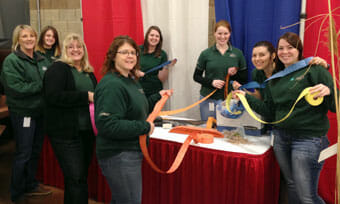
ENLIST volunteers participate in a range of activities from helping out at fundraisers to cooking, cleaning and serving at senior dinners.</figure
Monroe Bank & Trust (MBT) may seem like just a community bank on the surface, but behind those doors lies a veritable army of altruists. In addition to MB&T’s more traditional role as community banker, with services ranging from providing consumer banking to operating one of the area’s largest wealth management groups, they are also the muscle behind ENLIST—Employees Now Linked in Service Together—a 30 year old corporate engagement volunteer program that is as well known within Monroe County, Michigan, as the bank itself.
The ENLIST program is partly a result of the nationwide reduction in funding to local nonprofits in the early 1980s. President and CEO Doug Chaffin explained that during that time, MBT was receiving a lot of requests for volunteer assistance from a number of local organizations. The then- bank president saw the opportunity to formalize the volunteer efforts that bank employees were already doing and establish an official corporate engagement program. ENLIST began in 1984 as a means to encourage employees to volunteer time and make a difference in their community. Says Chaffin, “The first year we had a little over 1,000 hours of service. And now we have over 9,000 hours of service every year.”
Today, the program averages 6,178 volunteer hours annually having donated more than 185,000 volunteer hours to various community-based causes since its inception.
ENLIST volunteers serve 365 days a year, supporting more than 300 local organizations. “It’s kind of a badge of honor for our employees to become ENLIST members,” says Senior Vice President of Marketing, John Betrus. “It’s certainly not required, but new employees come to the bank and hear stories about how rewarding the program has been to [the staff] personally. At this point, over 85 percent of our employees participate in ENLIST.” Also important to note is that employees do their volunteer work on their own time, after work and mostly on weekends.
And MBT makes it easy to join the program. ENLIST coordinator Diana Lingle says that while she always had an interest in volunteerism, she didn’t know quite how to start before joining the team at MBT. “I signed on within the first month of starting,” she explains. “Volunteering was always something I was interested in but never had a way to start. The bank made it easy to jump on board and get into the community to help out.”
Most employees start right away at time of employment. New employees have the option of joining on their start date or can opt in at any point down the line. Says Betrus, “Many of the employees already know about ENLIST before they start. They find that it’s a lot of fun and they really kind of become addicted to volunteerism.”




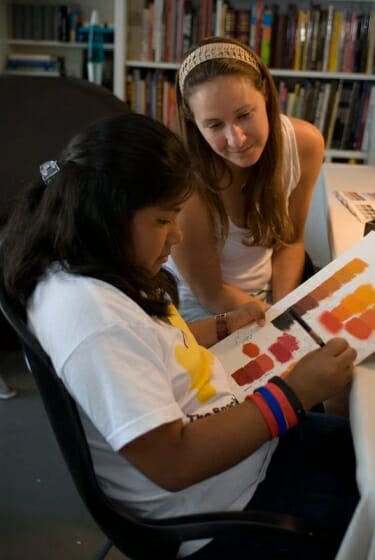 Leah Bernthal, right, works with an art student on a color palette.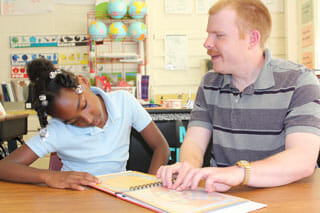
 Anjana Murali, center, teaches participants in her chess camp for girls about the game.
 Anjana Murali, right, shares a lighthearted moment with her campers.