In celebration of International Volunteer Day, Dec. 5, we honor Ivan and Torrae Owen of Washington state with a Daily Point of Light Award. Through their compassion, ingenuity and global collaboration, the Owens are helping to bring low-cost prosthetics to those who need them around the world.
Ivan Owen, right, with his wife, Jen, and daughter, Torrae
Since his early teens, 30-year-old Ivan Owen has been an artistic nomad – moving from playing guitar to learning sculpture to designing movie props. A few years ago when he found himself building marionettes, he posted a video of his latest project, a giant mechanical hand with semi-articulated fingers.
That post would spark a movement that became known as e-Nable, a global community of inventors dedicated to sharing their efforts to help make affordable prosthetics.
Owen’s video caught the attention of Richard Van As, a South African carpenter who had lost several fingers on his right hand and was looking for help using his skills to build his own device.
Over the course of nearly a year, the duo embarked on a long-distance collaboration, testing and refining until they had a functional index finger.
Ivan Owen, center, poses with Keegan Bair, of Oregon, Ben Stephens of Washington state and Dawson Riverman of Oregon after Owen taught them how to assemble their own hands.
They posted a video of their creation online and someone offered to donate frequent flyer miles so Owen could fly to South Africa to actually meet with Van As. Around the same time, the mother of a 4-year-old who was born with no fingers on his right hand sent an email:
“Could you create an entire set of fingers?” she asked, adding, “We live in South Africa.” Suddenly, Owen’s trip assumed new urgency.
“I was due to be in the country for just three days,” he says, “In that time, we had to come up with a design and start building its components. I worked on fingers, while Richard worked on the palm and forearm.”
By the time Owen left South Africa, the team had a working prototype that would allow the boy to slide the device over his own palm and use his wrist to manipulate the fingers.
Made of metal and plastic, the device cost about $300 to build, compared with similar products on the market retailing for about $5,000.
But because children grow so quickly, the team continued looking for cheaper alternatives.
“That led us to use 3-D printing, and our first printable prototype cost $150 in materials,” says Owen, who runs a 3-D printing lab at the University of Washington, Bothell.
To help reduce the cost further, Owen and Van As decided to release the intellectual property rights and make everything available for free download.
Other tinkerers noticed and shared their own experiments. Soon, Jon Schull, a research scientist at the Rochester Institute of Technology, started a forum to bring designers, researchers and users together and e-Nable was born.
Today, about 7,000 people from 45 countries are part of the network.
From the start, Owen’s daughter, Torrae, 10, has been a key contributor. Owen calls her his “ever-patient guinea pig from day one. … As she’s gotten older, she’s taken an active interest in learning to build hands and in teaching others to do so.” (See video above.)
Depending on the model, a typical hand contains about 25 components and takes between eight and 20 hours to print and then two to three hours to assemble.
So far, about 2,000 devices have been produced and delivered free of charge, according to Owen. Present models are being made for about $35 to $50 from printers that can cost as little as $2,000 or are available in libraries and other centers for free or for per-hour rental.
“This is a drop in the bucket compared to the need – there’s about a million amputees of all sorts in America alone,” Owen says. “But it’s a great start.”
Know an outstanding volunteer, a family who makes volunteering a priority or an organization that calls upon volunteers to change the community? Submit a Daily Point of Light Award nomination today!
Judson Kinnucan
Volunteer service isn’t new to KPMG recruiter Judson Kinnucan. But, his efforts took an environment turn when he realized how many hotel hygiene products were discarded.
In 2009, at 35, he cashed in his 401(k) and launched Bin Donated, an organization committed to bringing much-needed hygiene products to Chicago-area charities.
“I wanted to provide the logistics between the donors and non-profits,” Kinnucan said. “I try to make donating easy for people. If it’s difficult, things end up in the garbage.”
Currently, Kinnucan works with nearly two dozen Chicago hotels, including Sheraton, Hyatt, Drake, Sofitel, and Swisotel to collect un-used or partly-used products, including shampoo, conditioner, and lotion. Housekeeping staff deposit collected bottles into 55-gallon tubs he places in each hotel. Each tub, rescued from a candy manufacturer, can hold roughly 1,000 bottles, weighing approximately 200 pounds.
Every four-to-six weeks, Kinnucan collects the tubs and distributes bottles to charities. Some combine bottles, others put many together in packages.
“The products are still good. They’re just not full bottles,” he said. “But, people who need showers don’t care. They just need shampoo.”
Alongside hotel donations, Kinnucan has collected between 8,000-to-10,000 pounds of skin and beauty products from manufacturers. All total, through Bin Donated, he’s transferred more than $2 million of hygiene products to Chicago-area charities, many serving women and children.
In the past, Kinnucan also conducted book drives twice annually, collecting at least 10,000 books each time. Via toy drives, he gathered up to 5,000 toys, and he’s also gathered school supplies in July for students heading back to school.
Ultimately, he wants to work with tracking and shipping companies to collect damaged, but usable, packages to expand his volunteer service.
“I’ve collected countless things and distributed them to touch the lives of people I’ll never met,” he said. “It’s hard to put into words what that means.”
Caitlin Crommett
Though hospice patients are approaching their final days, they still dream and aspire like anyone else. While their condition may make their goals very difficult to attain, with a helping hand, these patients are turning their life-long dreams into reality.
Caitlin Crommet
The organization providing hope to these deemed hopeless situations is Dream Catchers. Dream Catchers is a non-profit group of volunteers that work with terminally ill people to make their final wishes come true. Reaching out to patients, their families, or their caregivers, Dream Catchers uses the information gathered accompanied with their own resources to create a once-in-a-lifetime experience.
Inspired by her volunteer work at a hospice in her local community, Caitlin Crommett founded Dream Catchers when she was just 15 years old. Several years later, that same dedication and drive has turned over 100 dreams into reality, resulting into hundreds of smiling faces. These moments of joy for the patients, their families and all involved are definitely moments to be cherished.
“Connecting with these patients is definitely a two-way street,” said Crommett. “While we are helping to give them their final dream, at the same time, myself and many of the children who volunteer are learning so much more in return.
With over 100 volunteers in more than a dozen states, Dream Catchers is truly working miracles. Through simulation or real events, Dream Catchers goes above and beyond to get it done.
Whether it’s chartering a boat for a patient who wanted to sail with his family one last time, or whether it’s creating an elaborate beach scene for a patient who has limited mobility but wants to enjoy the sand one last time at his feet – Dream Catchers is there to make it happen.
Julianne and Jack Gassman
There’s an old chinese proverb that says, “give a man a fish and you feed him for a day; teach a man to fish and you feed him for a lifetime.”
Julianne Gassman couldn’t agree more. Her mission is to inspire and empower generations of service providers and she’s doing just that.
Gassman, an associate professor at the University of Northern Iowa, is also the executive director of The Non-Profit Leadership Alliance on the University’s campus. The Alliance, which operates in some 40 campuses around the U.S., offers a credentialed program that develops skills in students who want to lead in the non-profit sector. Gassman, 46, has long been focused on volunteer work at her church, serving on boards and helping coordinate resources for local non-profits.
Julianne and her son, Jack.
“Bringing a service component into the mix was a way to seamlessly use my skills and increase their social awareness in the real world,” she said. With that in mind, Gassman has developed touchstones for quality service learning by involving students in local communities. “It’s a way for them to practice what they’re learning in the real world,” she explained.
Student projects have included partnering with the Blackhawk County health department to organize a health fair geared to high school students, provide English literacy programming for Spanish speaking adults and their children, and partnering with schools in rural Hudson to help instill literacy and a love of reading in disenfranchised students.
“I’m trying to promote service learning and community engagement, not just for the Leadership program students but all students and faculty,” said Gassman. “We’re not just here to educate students for the job market, but also we have a responsibility to produce good citizens. And the best way to do that is through experiential learning.”
Gassman practices what she preaches at home, with her seven-year-old son Jack. Last year on Martin Luther King Day, Gassman wanted to be sure Jack didn’t just see the day as just a fun day off from school. “I explained that on certain days people go and help other people and that’s what we are going to do. He’s a fortunate child, and I want to be sure he is thoughtful and thinks about ways he can give to others. Hopefully we can take what I practice constantly at work and make sure it happens at home.”
Jodie Howerton
The mother of an HIV-positive son, whom she had adopted from South Africa, Jodie Howerton was dismayed over the lack of current information about HIV and AIDS in her children’s public school, near Seattle. The available educational materials for fifth graders, including an old video, fell short.
Jodie Howerton, center, with her family, from left, Alexandra, 15; husband, Mike; Duzi, 11 and Caleb, 13
“The video had been produced in the 1980s, was very fear based and had a lot of incorrect medical information,” recalls the mother of three. “I was very, very concerned about that.”
In 2012, Howerton founded Redefine Positive, a community-funded, grassroots initiative that provides age-appropriate, medically accurate materials that teach young people about transmission and prevention.
Howerton has spent hundreds of hours researching video concepts, working with a production team, ensuring that sexual health education standards are met, and networking with school districts to make them aware of Redefine Positive’s free resources.
Thanks to Redefine Positive, fifth graders are learning the facts about HIV and AIDS in a stigma-free video entitled, “HIV and Me: Marissa’s Story.” (Download it here.)
The materials are being spread and adopted by many school districts across the nation, including districts in Pennsylvania, Florida and Washington state.
“I think education plays the most crucial role in eradicating HIV and AIDS, because it is a completely preventable disease,” Howerton says. “We can get to zero new infections through education.”
The Ulloa family, from left, Ricardo, Nico, Cristina and Natalia
For the Ulloa family, giving back has been an international endeavor. But it didn’t become hands on until they came to the United States.
In Colombia, says mom Cristina, the family donated money to various causes. But their community involvement deepened when they moved to Weston, in Broward County, Florida.
“Weston is such a small community, and we felt very welcomed,” she says. “We started looking for ways to be involved in the community more. We wanted a way to pay our blessings forward.”
Several opportunities emerged three years ago through HandsOn Broward, part of Points of Light’s HandsOn Network. HandsOn Broward connects residents to local volunteer opportunities.
As architects, Cristina and her husband, Ricardo, were drawn to Habitat for Humanity, but their twins, Nico and Natalia, have been more deeply involved with the Movies, Muffins & Beyond project through their local Ronald McDonald House in Fort Lauderdale. The kids get to bake muffins and cupcakes for and watch movies with the families staying at the house to be close to their sick children, who are undergoing treatment at nearby hospitals.
In many ways, Cristina says, both volunteer opportunities give her family the chance to help other families who aren’t all that different from hers – parents trying to do their best and provide for their children.
As Habitat volunteers, the Ulloas construct homes alongside the families who will eventually live in the dwellings. Even though her children can’t participate in building or painting until they’re 16, they’ve still found a way to contribute – they pack and distribute snacks to all the workers.
Handing out snacks might be a small way to give back, but it lets the Ulloa kids feel like they’re part of giving someone a home.
“[My kids] enjoy the volunteering – it makes them feel good about themselves,” she says. “They feel good about helping other people.”
That’s a big reason why they enjoy their volunteer time with Movies, Muffins & Beyond. Many families spend months at the Ronald McDonald House, so many children get the chance to participate in the event several times. It’s given the Ulloa kids the opportunity to get to know them, and it offers a level of continuity for the children living there, Cristina says.
The Ulloas’ son, Nico, now leads the monthly gatherings. He schedules times and coordinates the number of volunteers and families that participate.
“The most important thing is to volunteer directly and with gusto,” he says. “I want to leave a footprint and create far-reaching benefits.”
The Palmer Family
Bottom row left to right–John F Palmer V, Jasmine Grace Major, Tiani Palmer, Josh Ketcher and Bea Palmer. Top Row: John F Palmer VI, Grace Major (2014)
The Palmer Family is one of 10 service-minded families being recognized by Points of Light and Disney in honor of Family Volunteer Day, Nov. 21.
What started out as a work team-building exercise for Beatriz Palmer quickly turned into a decade-long volunteering relationship that has touched numerous families, including her own.
After volunteering with colleagues to clean up Operation HOPE (Hope Outreach Providing Encouragement)-Vista, an emergency winter homeless shelter in San Diego that serves homeless families and single women with children, she accepted an invitation to return when residents were present. What she saw changed how she viewed her community and her family’s place in it.
“It really opened my eyes to the need in my own community,” she says. “When I returned to the shelter, I expected to see a homeless population like you see in the media – people who live under bridges. But, they were families just like us. That really hit me deeply.”
In fact, she saw herself under different circumstances as a young, single mother, working as an executive assistant and struggling to support her two kids after being abandoned by her husband. Beatriz knew then that she had to get her family and friends involved in supporting this endeavor.
Initially, her family reached out through their church to engage the shelter’s youth in Bible study, transporting the young residents to and from the church. Their involvement soon expanded to providing dinner for shelter residents once a month.
As a working class family, money is tight, but the Palmers have included the cost of the monthly dinner in their budget. Initially, feeding 45 people at the shelter cost $100, but that figure has grown to $250. Beatriz says she stays close to her Latin roots when planning menus, often making enchiladas and tostadas.
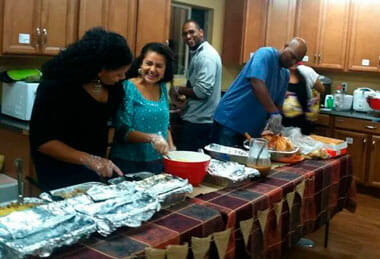
The Palmer family serving food at a Thanksgiving project at Operation Hope in 2014
On meal days, cooking begins in her small kitchen no later than noon, and it’s a family – and sometimes community – affair. She focuses on the main dish, and neighbors will occasionally offer to make a side dish, like beans. Her children are responsible for the preparation work, such as chopping vegetables or shredding chicken, and they also handle salads, fruit and desserts. Her husband packs the car and ensures everything arrives safely at the shelter to begin serving at 5:30 p.m.
Serving the meal isn’t where their involvement stops, however.
“We don’t just serve the food,” she says. “We sit down with the residents. We ask about their days, and we interact with them.”
Talking and spending time with shelter residents has become such an important and integral part of her family’s life that Beatriz says her children – a son, age 22, and daughter, age 17 – rearrange their schedules to ensure that they can participate. In addition to providing a monthly meal, the family volunteers their time at the shelter every first and third Saturday, and this year marks the fourth Thanksgiving they will spend with the residents.
“My main goal is to teach my children to do something for someone who can’t repay you. That’s where the satisfaction comes in,” she says. “It’s an important legacy for my husband and me to give our children, the belief that they should give to others without expecting anything in return.”
The Murray Family
The Murray Family is one of 10 service-minded families being recognized by Points of Light and Disneyin honor of Family Volunteer Day, Nov. 21.
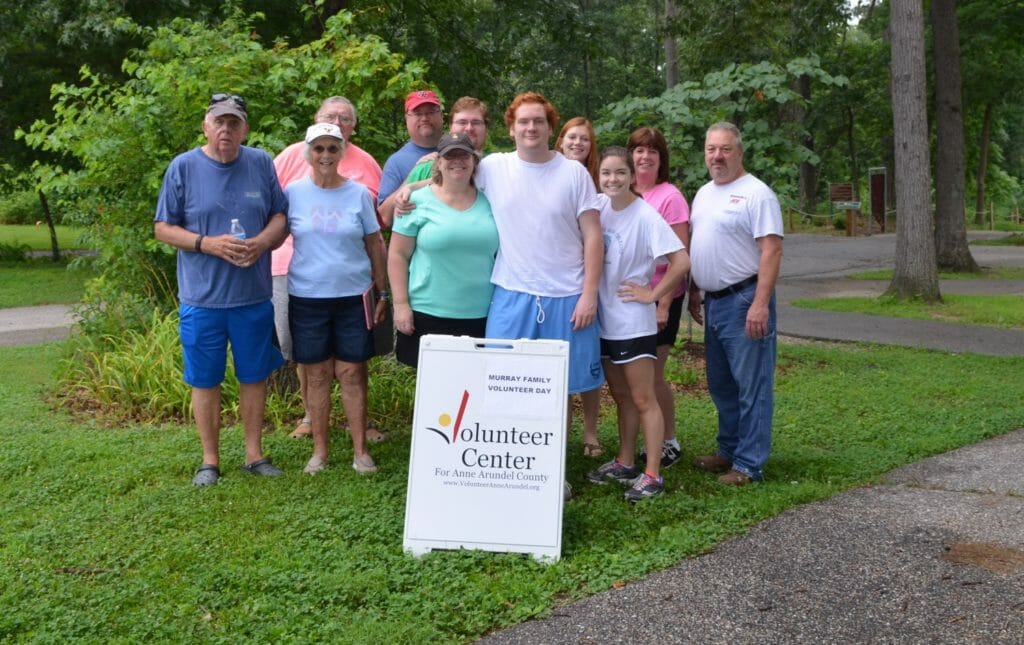
Born during the Great Depression, young marrieds Jerome and Grace Murray always made sure to include modest charitable giving in their budgets. As their fortunes grew, the couple — who were married for 60 years — continued to consider how they could ensure that their money would continue to do good. Today, more than 150 of their direct descendants are providing an answer; this year alone they cumulatively donated just over $750,000.
“My grandparents wanted a way for all of their children, and their children’s children, to stay connected after they were gone. Starting a foundation was their answer,” says Betsy Russo, 53. “It’s a bonus that we are a very prolific family.”
Some of the Murray descendants at the Murray Foundation Volunteer day in July 2015. .
By the time the couple decided to establish the foundation, they already had a focus. Spurred by the discovery that one of Betsy’s children was developmentally disabled, Jerome and Grace decided to make helping those with mental, emotional, and physical disabilities (and their caregivers) a priority. Based in Owings, MD, the Jerome S. and Grace H. Murray Foundation opened for business in 1992 after both founders had passed away — and it hasn’t stopped giving since.
It’s truly a family affair. Each year, every participating lineal descendant has a certain amount of money allotted to them (starting with those between the ages of 6 and 12, who each receive $200 a year) to donate to a nonprofit. Money that is left over or not used is pooled and divided up among eligible members (those over 18), who can use the funds to support larger projects. Often, members bundle their allotments: recently, 14 sponsors joined forces to donate $92,000 to a community farm.
“Traditionally, foundations have boards and [an] elaborate approval system,” observes Eileen Dillon, 78, Betsy’s aunt and one of Jerome and Grace’s ten children. “Here, no one’s in charge. No one’s saying you can’t do that. It’s amazing to see the results — there’s a whole gamut of support given by people who seek out projects based on their own interests.”
One of Eileen’s nieces, for instance, is a teacher in a low-income neighborhood in Annapolis, MD. She chose to use a portion of her foundation money to buy books for her school. Two other family members donated to a local hospice in memory of their grandmother.
Still another descendant volunteered at a therapeutic equestrian center, sharing her love of horseback riding with children with physical and emotional disabilities. Service grants like these are a popular choice for younger members, about a dozen of whom are great-great-grandchildren of the founders. The time that they volunteer is matched by a monetary grant from the foundation, making their efforts twice as impactful. “It’s really exciting to see this latest generation getting so involved in giving,” says Eileen.
The passion in service is instilled early. Betsy remembers her father, Denis — one of Eileen’s brothers — taking her children with him on field trips to show them where he was donating money. “From a young age, my children and their cousins were all very aware of what the foundation does and how it’s a big part of their family,” Betsy says.
However, to make a difference, a family doesn’t need to start with a multi-million dollar establishment as theirs did, the Murrays point out. “A mom can encourage her six-year-old to go through all of her baby books and then help her find somewhere to donate them,” says Betsy. “What’s important is to show kids how you can work together to make a difference in your community. What brings you greater happiness? Buying more Pokémon cards — or spending quality time with your family?”
Eileen has the last word. “This is a gift that we all have been given,” she says. “Being able to share it is a really wonderful legacy.”
Amanda and Catherina Gores
For sisters Amanda and Catherina Gores, severe food allergies weren’t an inconvenience suffered by someone else at school, ones that meant no one could bring a peanut butter-and-jelly sandwich for lunch or that led to birthday parties without the more traditional sweets. Instead, food allergies were a daily threat to the life of their brother Charles who suffers from a severe nut allergy and was diagnosed at age 1.
In the United States, according to the Centers for Disease Control and Prevention, one in every 13 children suffers from a severe food allergy. These reactions are caused most often by shellfish, milk, peanuts, soy, wheat, fish, eggs and, in cases like Charles’, tree nuts. Of these children, 40 percent have experienced a severe food reaction, prompting nearly 300,000 visits to ambulatory care clinics annually.
As scary as these potential allergic reactions are, it can be far more frightening to have no way to stave them off or lessen them when they occur, Catherina says. It should be easier for families who need it to have access to epinephrine, the life-saving medication present in EpiPens® that’s used to control allergic reactions.
“Given the emotional drain and the fear of allergic reactions, we began to ask, ‘What would families do if they didn’t have access to EpiPens® like we do?’” she says. “They’re expensive and expire quickly.”
So, the two sisters – daughters of Detroit Pistons’ owner Tom Gores – decided to launch EpiPals, an organization that supports families with children with severe food allergies through education, awareness and EpiPen® distribution. They partnered with the Children’s Hospital of Los Angeles (CHLA) to help gather donations and bring their idea to fruition.
To date, EpiPals has raised close to $800,000 and provided EpiPens® to hundreds of children from families that wouldn’t be able to afford them, Amanda says. Making these devices available to families is important because keeping active, effective EpiPens® is an ongoing cost.
In addition to collecting money to fund EpiPen® distribution, the sisters are also committed to raising awareness of food allergies among the public. Beginning in late 2013, the sisters began hosting events that highlighted the prevalence and dangers of food allergies. An initial event launch at an L.A. Lakers basketball game in November that year led to a holiday party with crafts and movies, catered with allergen-free treats.
In May 2014, they distributed donation jars in area businesses both to collect funds for EpiPen® purchases and to increase public knowledge. That same month, they hosted an educational session in conjunction with CHLA that featured Andrew Clark, M.D., an allergist with the department of medicine at the University of Cambridge in the United Kingdom.
They also took steps to make Halloween safer for children with food allergies. During the holiday, the sisters sold allergen-free treats for $3 that people could purchase and keep on-hand for children who might otherwise not be able to participate in the candy-laden festivities. In addition, they partnered with Vermont Nut Free Chocolates during the 2014 holiday season, gathering a portion of each purchase price to support EpiPals.
The sisters also expanded their work beyond Los Angeles this October. They held a shopping fundraiser at the store Intermix in Detroit where 10 percent of all sales were donated to the University of Michigan Food Allergy Center.
So far, the response has been far greater than what either Catherina or Amanda anticipated.
“Even though there is not a cure today for some allergies, we saw a way to make an impact now on the current lives, futures, and hopes of kids,” Catherina says. “It has been gratifying to see these immediate results.”
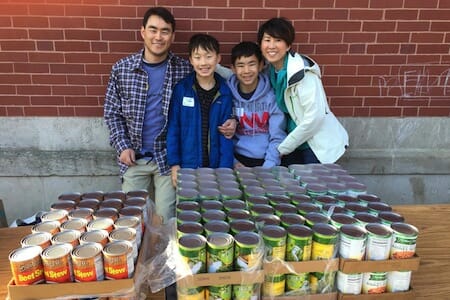
Something magical often happens when a child hands a can to an adult in line at a food pantry, says dad Albert Chung. Many times, a warm smile spreads across the adult’s face.
“I’ve been amazed at the smiles of people when a little kid hands them a can of peas,” he says. “We’ve found that kids are so capable, and if we’re able to encourage them toward volunteerism, it’s a really wonderful thing.”
But there aren’t many volunteer opportunities open to children. That’s why Chung and his wife, Jennifer, selected The Honeycomb Project – a Chicago-based, family-volunteer organization – as their service base in 2011.
Because Honeycomb has no age restrictions, participating in its programs has broadened the view the Chungs’ kids, Aidan, 12, and Ethan, nearly 14, have of the world. The program has given the boys chances to ask deep questions, Jennifer says.
As a family, the Chungs coordinate and participate in Honeycomb’s Feed Hungry Families initiative, a project through which volunteers deliver food to Chicago-area food pantries. It’s a good fit for the family, Jennifer says, because it also fulfills the passion she and Albert have for nutrition.
Sharing meals together is an integral part of their family’s life, and as project leaders, they enjoy giving other families the resources to potentially do the same thing. At the end of unloading every food delivery, they also provide a snack for participants.
Honeycomb manages more than 5,000 volunteers, and it has plans to expand the programs and recruit more people interested in donating their time, energy and resources.
“People want to volunteer as family units. It’s hard for someone that is part of a family to take time off for that,” Jennifer says. “With Honeycomb, you can bring the entire family over, and they can learn wonderful things in the process.”
For Feed Hungry Families, volunteers collect all food donations and ensure that they arrive at the correct locations, such as the Greater Chicago Food Repository. Once the food arrives, everyone gets a job, Jennifer says. Adults do the heavy lifting, carrying and moving large boxes. Even the smallest child is given tasks. Small children gain a sense of accomplishment simply by moving macaroni and cheese boxes one at a time.
To keep young people interested in volunteering, Honeycomb launched an incentive program though which kids can get keepsakes, such as a special Honeycomb ruler or pencil, for volunteering for a certain number of projects.
“If you involve kids earlier, at impressionable ages, they will be more likely to volunteer as adults,” Jennifer says. “We wanted to marry the idea of a strong family bond with a strong community bond. We wanted to show our kids that not everyone is as fortunate as we are, in an effort to help them start building empathy and understanding.”




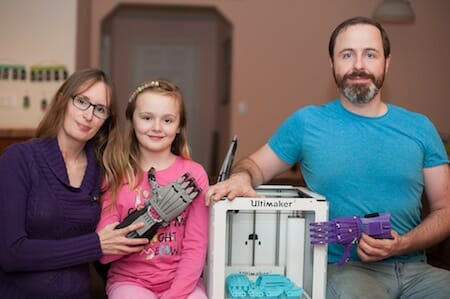 Ivan Owen, right, with his wife, Jen, and daughter, Torrae
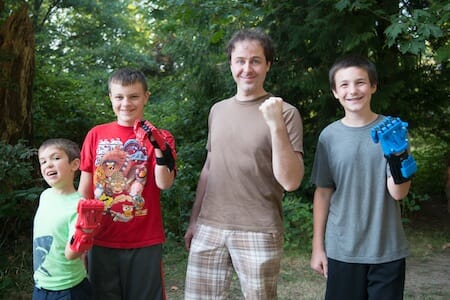 Ivan Owen, center, poses with Keegan Bair, of Oregon, Ben Stephens of Washington state and Dawson Riverman of Oregon after Owen taught them how to assemble their own hands.
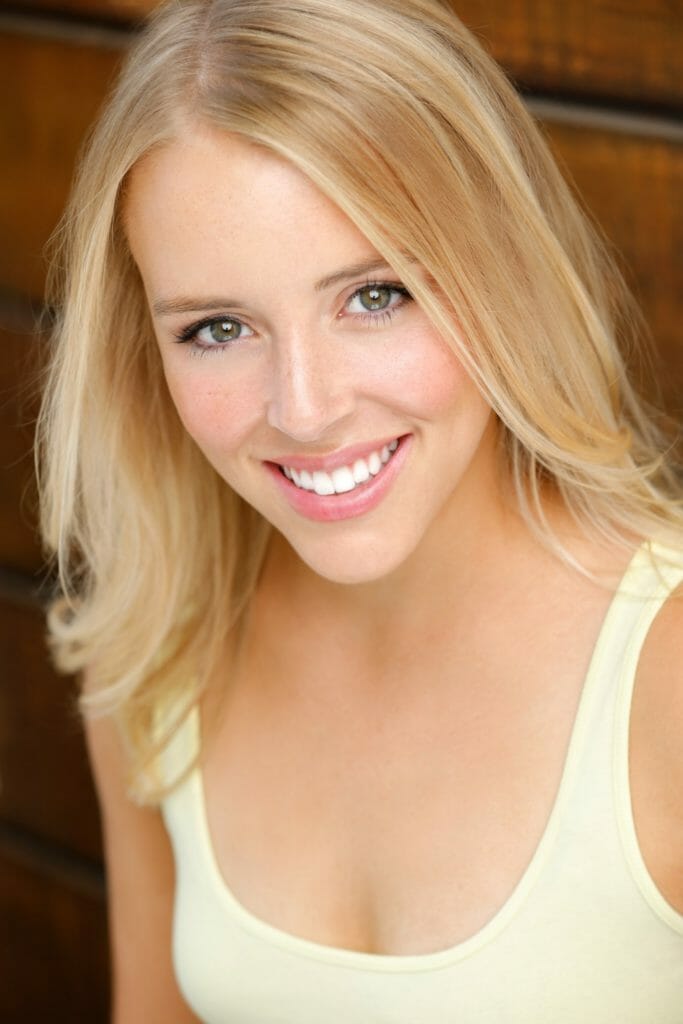 Caitlin Crommet
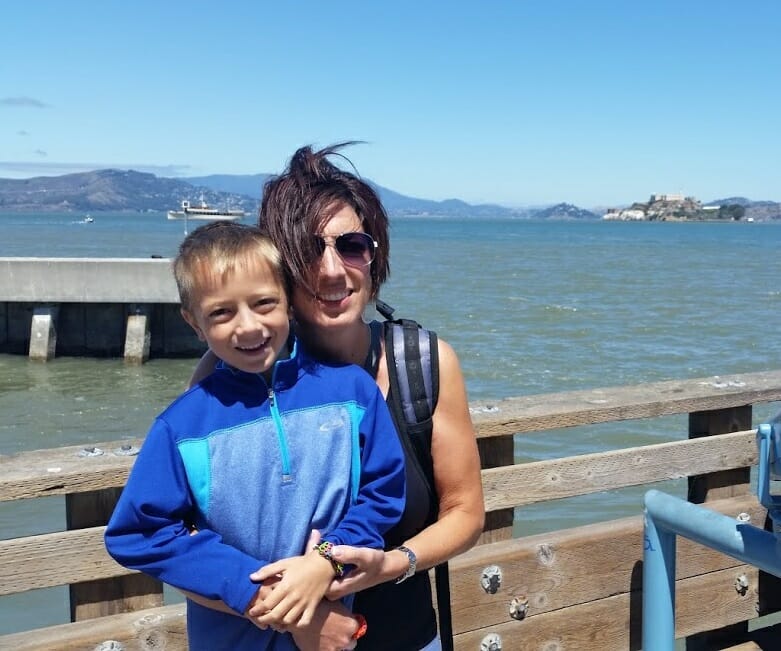 Julianne and her son, Jack.
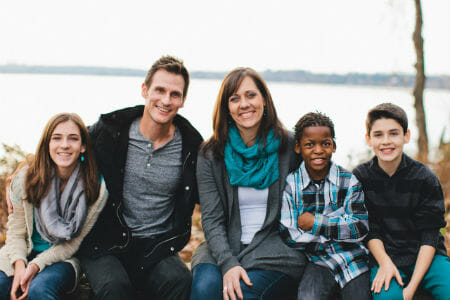 Jodie Howerton, center, with her family, from left, Alexandra, 15; husband, Mike; Duzi, 11 and Caleb, 13
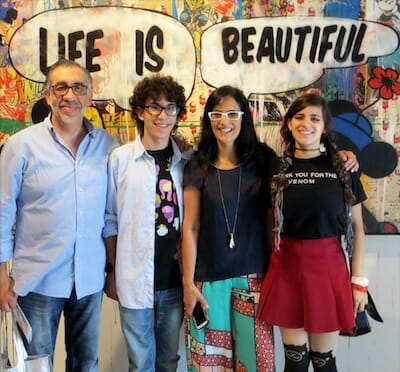 The Ulloa family, from left, Ricardo, Nico, Cristina and Natalia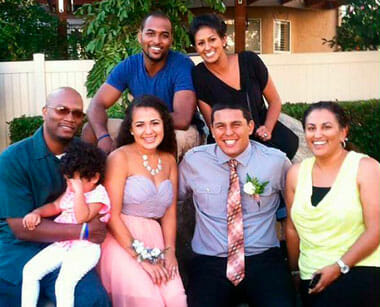
 Some of the Murray descendants at the Murray Foundation Volunteer day in July 2015. .
 The Chung family