The Volunteers of New York Says Thank You
Today, the 9/11 Day of Service and Remembrance, we honor the volunteers of New York Says Thank You with a Daily Point of Light Award. Read their story and nominate an outstanding volunteer or organization as a Point of Light.
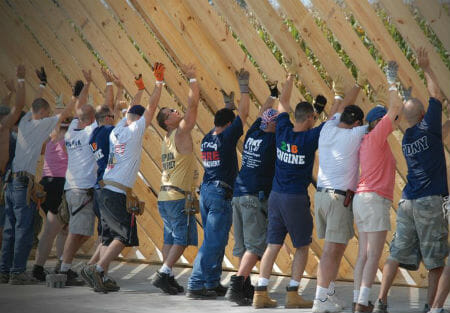 New York Says Thank You volunteers put up the first wall of Baker’s Chapel in DeGonia Springs, Indiana, in 2006.
After losing his business partner, Hagay Shefi, during the terror attacks on the World Trade Center in 2001, Jeff Parness says he “wondered every single day how I could commemorate his life.”
When Parness’ son, Evan, then 5 years old, volunteered to send his toys to children living through the California wildfires of 2003, things clicked. Together, father and son mounted an effort to collect as many toys as they could from their neighbors.
“People would come up to us with tears in their eyes,” Parness, 50, says. “They were thanking us for giving them the ability to help.” The experience was revelatory for Parness: “I realized that altruism is fundamentally selfish, in a good way.”
That year, Parness founded New York Says Thank You, to both recognize the lives lost on 9/11 and offer healing to those who had experienced personal loss as a result of the attacks.
The organization established a pay-it-forward model that was inspired by the fact that people from across the country – and the world – came to Ground Zero to help.
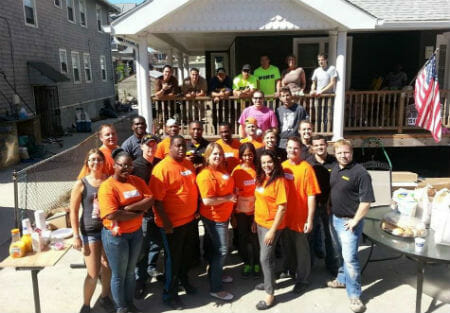 Volunteers from The Home Depot and the New York Fire Department gather during New York Says Thank You’s 2013 Big Build Weekend in Long Beach, New York.
The nonprofit’s original mission was to send volunteers from New York on rebuilding efforts throughout the nation every year on Sept. 11.
During the first official “barn raising,” 14 volunteers, including several first responders who served at Ground Zero, helped rebuild a house in Harbison Canyon, California, that had been damaged during forest fires.
Since then, there have been 10 more annual barn raisings.
John Walis, who retired from the New York City Fire Department after hurting his back and suffering from repeated respiratory ailments as a consequence of his service at Ground Zero, has participated in rebuilding efforts in Mena, Arkansas, and Little Sioux, Iowa.
“This time of the year is always a difficult one for me,” Walis, 50, says with a crack in his voice. “But there’s something spiritual when you find yourself working with others to help rebuild lives.”
Dawn Nelson, a New York Says Thank You volunteer from Stanley, North Dakota, agrees. The first project she worked on with the organization was building a ski lodge for disabled children in Bottineau, North Dakota.
Parness had read an article about what became known as “Annie’s List.” Ann Nicole Nelson had written the list – part motivational, part bucket – before she died in the World Trade Center attacks. Her mother found it on the young woman’s laptop.
Seventh on the list: “Buy a home in North Dakota.” So the volunteers built Annie’s House.
“We’re keeping the spirit of Annie alive,” says Nelson, 49.
This year’s New York Says Thank You build will bring a contingent to Nepal, where earthquakes killed more than 8,000 people and destroyed 52,000 classrooms this past spring.
All told, close to 40,000 volunteers have joined New York Says Thank You to help rebuild.
“Initially, I thought what we were doing was rebuilding stuff that was destroyed,” Parness says. “But I came to see what it was really about was empowering survivors and transforming a day of tragedy into one of wonderful memories.”
The Roberts Family
Feed My Starving Children (FMSC) is a Christian non-profit company that strives to feed malnourished children all around the world. With all proceeds directed toward hungry children, FMSC relies heavily on volunteers to reach its goal. While the company has an amazing reach across the globe, there are very few volunteers who show the dedication and eagerness to give back like the Roberts family.
With the cycle of poverty producing more and more starving children each day, the collective efforts of the Roberts Family is not only appreciated, but very much needed. For the past five years, the family has been highly involved and supportive of FMSC. Not only has the Roberts family donated money, which has helped feed thousands of hungry children, but their consistent activity has helped grow the FMSC Arizona branch and increase its volunteer base.
The family regularly volunteers at the packing site in Mesa, Arizona, where they prepare and package meals for the hungry. David, who serves as patriarch of the Roberts clan, actually serves on FMSC’s Arizona council. The entire family is truly ambassadors for FMSC.
When David is not serving on council, he is serving as an advocate for world hunger. He is responsible for key messaging, such as the idea of not just feeding the body, but feeding the spirit as well. David also hosted a MobilePack event at his church where he gathered 500 volunteers to help pack more than 100,000 meals for starving children.
With the help of the Roberts family and volunteers like them, children all around the world is provided a meal, therefore a better quality of life.
Open Heart Magic
There are thousands of children in hospitals all across America battling life threatening illnesses. While their fight usually consists of some complicated combination of medicine and extensive treatment, there is another method of healing that is becoming quite popular, especially amongst children.
Open Heart Magic (OHM) is a treatment that, instead of invoking pain and discomfort in the hopes of healing, it produces smiles and laughter. In 10 hospitals all across the Chicago area, OHM strives to reach young patients one-by-one regardless of their disease, medical situation or physical ability, so that all children may benefit from this engaging and entertaining therapy.
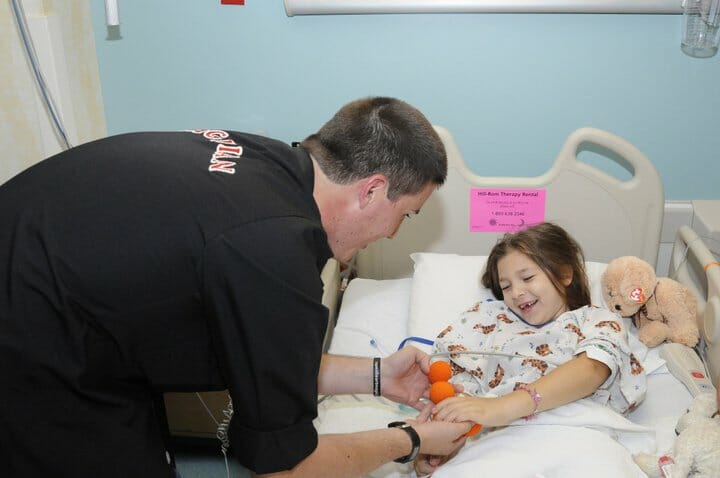 Volunteer magician, Diego, performing a trick with spongeballs-they are multiplying right in the patient’s hands!
 In 2003, Michael Walton walked into Rush Children’s Hospital looking to volunteer his time by performing magic for patients. Realizing that magic helped children deflect from their harsh reality, Walton decided that this tool isn't just entertainment, but in fact medicine. Just one year later, in 2004, Open Heart Magic was formed and officially registered as a 501(c)(3) non-profit company.
OHM serves as the ideal outlet for those wanting to give back. To help recruit and build upon this volunteer-based organization, OHM host Magic University. Magic University is a 12-week course with intensive instructions on magic techniques, the art of therapeutic humor, as well as strategies to maximize magician-child interaction.
In 2014, OHM engaged 7,756 patients at their hospital bedside, which is up 35 percent from the previous year. In that same span, the amount of Hospital Magicians has nearly doubled from 56 volunteers to 105. While the numbers have increased, OHM’s true impact is immeasurable. When a child plagued with an illness hasn’t smiled in days, possibly weeks, and their typical treatment isn’t working, it is Open Heart Magic that is there to provide them with relief.
Mary Pope
Camellia Hospice is home to numerous patients receiving comfort, care and compassion while facing terminal illness. While these patients have undoubtedly seen better days, Mary Pope seems to somehow put a smile on each one of their faces.
Pope has been volunteering at Camellia Hospice for over five years. Over that span, Pope has worn many hats, from greeting and spending time with patients, to helping them prepare for their daily activities. Though her role cannot be simply defined, in plane terms, she truly does it all.
“She never hesitates to call me if she is concerned about a patient, and always follows up to make sure that their needs are met,” said Julie Miley, Volunteer Coordinator at Camellia. “Whether she is spending extra time so that the caregiver can go to their Doctor appointment and run errands, or if she is cooking for a patient that has no family to care for him, Mrs. Mary is always willing to help.”
Pope is extremely popular not only amongst the residents of Camellia, but the staff as well. Pope helps prepare meals each week for the hospice, and each month she assists Miley with planning birthday celebrations. She is especially known for the cakes that she makes for each resident and staff. She also helps entertain each month with bingo games.
Coming out of Port Gibson, Mississippi, Pope is not just one of the few volunteers giving back her time, she is the only volunteer. Not just at the hospice but with the local Salvation Army as well. Port Gibson is a small, low-income community, and for all Pope has done and continues to do to help uplift her surroundings, she has become an inspiration.
Dean D’Errico
In some cities, where poverty exceeds privilege, it takes truly a collective effort to uplift the community. For a town like Plant City, FL, this is especially true
Plant City definitely has its struggles and it is not the most glamorous of towns. In one particular community, the poverty rate is an astonishingly 18%. With countless families in financial binds, Dean D’Errico has provided a way to alleviate some of the day-to-day stress to the people of Plant City
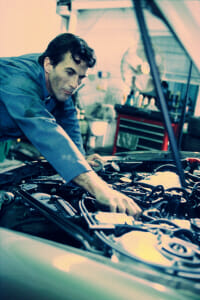 Dean D’Errico
Though D’Errico’s humble nature would never allow him to say it, to the people of Plant City he is a savior. Over a dozen years ago, after realizing the hardships single mothers in the community face, and motivated to provide them with consistent and reliable transportation, D’Errico was inspired to create Many-Hands Inc. Many-Hands organizes a community of skilled volunteers, trained mechanics, aimed at providing low to no cost on auto repairs for these families who lack the resources.
“A reliable car allows families to be more independent and more self-sufficient,” said D’Errico. “It helps the unemployed find and secure a job…Having a safe car available for seniors and children is essential in case an emergency arises.”
Initially serving members of their local church, Many-Hands involvement grew to the Plant City community and surrounding areas. Many-Hands expanded to not only serve single parent homes, but provide services for the elderly, those with disabilities, homeless, as well as other at risk families. Along with auto repairs, Many-Hands stretched its reach to assist with home repairs as well. The financial burden of auto repairs, as well maintenance around the home could be extremely costly. With the help of Many-Hands, these families are able to live more productive and happy lives.
George I. Whitehead
Meet Daily Point of Light Award honoree George Whitehead. Read his story and nominate an outstanding volunteer or organization as a Point of Light.
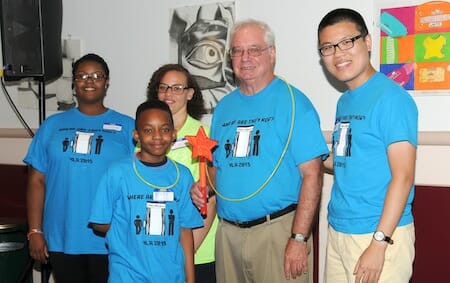 George Whitehead, second from right, celebrates with recent Youth Leadership Academy graduates. From left, Lena Ward, Noah Hughes and Zoey Mckenzie. On the right, Derek Wu.
George Whitehead uncovers young leaders who, without encouragement, might never discover their ability to lead.
“Sure, if you join the Boy Scouts you receive leadership training,” says Whitehead, 69, a psychology professor at Salisbury University. “The same for if you decide to participate in student governance. But if no one steers you in those directions, how do you get there? We want to make sure that those nontraditional candidates don’t fall through the cracks.”
Long involved in education – having participated in the state and county parent-teacher associations, on the Wicomico County board of education and with the local chapter of the youth-focused America’s Promise Alliance – in 2005 Whitehead founded the Youth Leadership Academy in Salisbury, Maryland.
During the last decade, about 500 middle and high school students – evenly split between male and female but skewing toward young people from minority backgrounds – have used their Youth Leadership Academy training to benefit their schools, communities and beyond.
One graduate became a student representative for the Maryland State Board of Education, another was chosen to bear the Olympic torch in 2010. Several interned on Capitol Hill and others earned scholarships to college.
“I think the skills we introduce – public speaking, working with teams – are really important in building confidence and determining what it is you’d like to do with your life,” Whitehead says.
Each summer, the program selects about 60 students, through recommendations from principals of the county’s four high schools, on-site recruitment and word of mouth. The academy invites the students to a three-day, all-expenses-paid, intensive program.
Academy students meet with civic and business leaders and listen to motivational presentations. As a group, they conduct research related to their year’s theme, such as world leaders or diversity. Then they leave behind their own “footprint” – papier mâché versions of Transformer toys representing the theme of transformation, for example – as a gift to the community.
At the conclusion of the program, students are invited to come back in January (about half do), when they make arrangements to meet regularly to choose a theme and schedule speakers for the next year’s academy program. For many, the effort is their first attempt at applying their newly acquired leadership skills.
“I think we all need to invest in our communities to make them work,” Whitehead says.” For me, it’s always been really important to help young people reach their potential. Experiences like this level the playing field.”
Joanie Balderstone
A few years ago, Joanie Balderstone knew the time was right to take steps to honor her late mother by starting a charitable organization with a mission to bring dignity to those who need it most.
Balderstone, along with Rebecca McIntire, created Distributing Dignity; a startup non-profit organization that lifts up women in need.
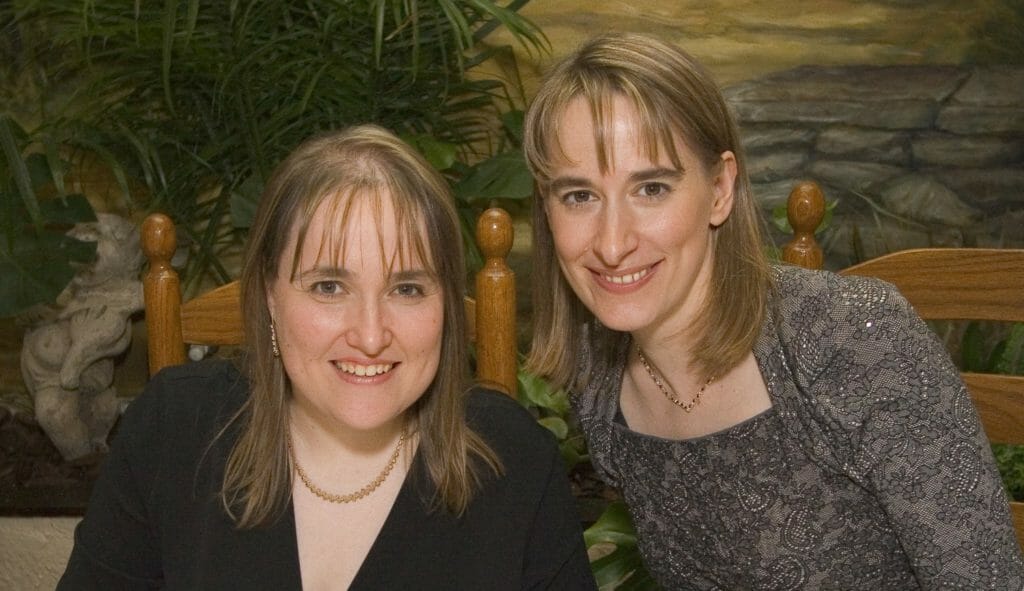 Balderston (L) with co-founder Rebecca McIntire
Distributing Dignity’s mission is to distribute new bras, pads and tampons; enhancing the dignity of women in need. Distributing Dignity provides donations of undergarments and feminine hygiene products to homeless and domestic violence shelters, transitional housing and other organizations that assist young women who are aging out of foster care, escaping domestic violence and/or dealing with homelessness.
Each recipient receives hand-wrapped gifts of new bras, in an effort to show that someone cares about them, their needs and their dignity.
Distributing Dignity recognized that these important items are severely under-donated, and has made its mission to provide underserved women with the dignity they deserve. Since, Balderstone has dedicated countless hours to running Distributing Dignity and helping it grow responsibly. By focusing on the most basic of women’s needs, Balderstone has created an innovative and niche-filling organization.
Through Distributing Dignity, Balderstone spreads her spirit around South Jersey and beyond. She has organized several very successful community events to promote Distributing Dignity’s mission and has successfully encouraged others to do the same on Distributing Dignity’s behalf. As a result, hundreds of women in need have received new brassieres and feminine products. “Find a project, mission or cause that touches your heart and it will feed your soul,” Balderstone encourages.
JoAnn Sawyer Cook
To commemorate the 10th anniversary of Hurricane Katrina, we are honoring volunteers who served along the Gulf Coast after the storm. Meet Daily Point of Light Award winner Joann Sawyer Cook and nominate an outstanding volunteer or organization you know as a Point of Light.
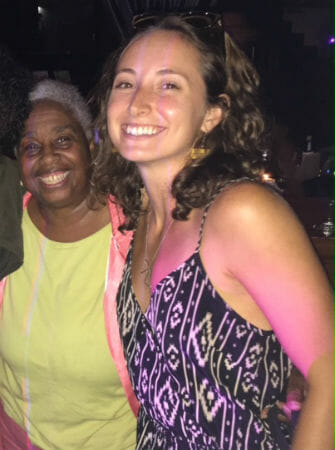 Joann Sawyer Cook, left, joins then-executive director of HandsOn New Orleans Kellie Bentz at an event.
Long before Hurricane Katrina, Joann Sawyer Cook worked to lift up New Orleans’ Central City neighborhood, an area plagued by poverty.
In 1996, she created a nonprofit called the Shalom Zone, a refuge for children and young adults in Central City. The organization, part of the First Street Peck Wesley United Methodist Church, aims to improve their quality of life through education, art and housing programs.
When Hurricane Katrina hit in August 2005, floodwater submerged Central City. Working with the church, Cook set out to help.
“The church doors were open to whoever didn’t have anywhere to go,” Cook says. “It was one of the few places that did not flood, so we were able to keep people throughout the storm and feed people. With no lights, water and basic necessities, everyone gathered at the church. It was our salvation.”
During the toughest of times, while the church served as an epicenter of the community, Cook served as a leader. Many local children, who were already lacking resources before the hurricane, had even fewer options after.
Simply looking for a comfortable place to sleep and a meal was a challenge. Being surrounded by poverty and despair, children are often forced to make some difficult decisions as a means to an end. But the Shalom Zone is geared toward that child straddling the fence; it’s a place that gives those with few options a choice.
“The Shalom Zone serves as a safe haven for the children,” says Cook. “We try to gather as many kids as we could from the neighborhood to let them know that the church is here for them. We wanted to provide as much normalcy as we could.”
In commemorating the 10-year anniversary of Katrina, Cook and the Shalom Zone will continue in its tradition. Starting one year after the storm, Shalom Zone has hosted performers from the Julliard School for workshops and shows.
Along with the connection forged with the Julliard School, Cook’s relationship with HandsOn New Orleans has also been instrumental in the development of the community. Hundreds of HandsOn volunteers have assisted Cook with building a stronger Central City.
See more Hurricane Katrina stories and memories at www.pointsoflight.org/katrina.
PJ and Marv Marshall
To commemorate the 10th anniversary of Hurricane Katrina, we are honoring volunteers who served along the Gulf Coast after the storm. Meet David Campbell, today’s Daily Point of Light Award winner, and nominate an outstanding volunteer or organization you know as a Point of Light.
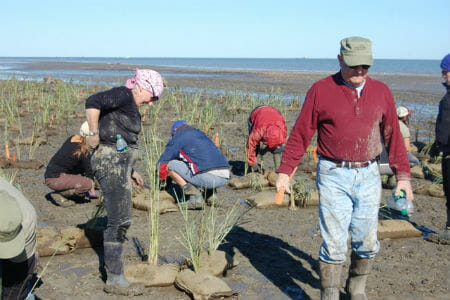 PJ Marshall, left, and her husband, Marv, right, work to restore wetlands at Pass-a-Loutre Wildlife Management Area in Louisiana, at the mouth of the Mississippi River.
Ripping across the Gulf Coast, Hurricane Katrina led to the destruction of 320 million trees and more than 5 million acres of forest, damaging critical ecosystems and threatening North America’s climate.
Marv and PJ Marshall – who were in Washington, D.C., attending the White House Conference on Conservation when the hurricane struck on Aug. 29, 2005 – set out to help.
Traveling to the Gulf Coast to volunteer alongside public and private organizations, the pair led a collaborative approach to secure funding to initiate and sustain effective, large-scale forest restoration.
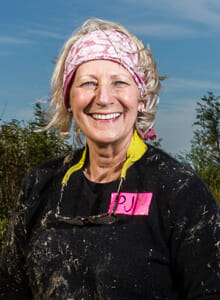 PJ Marshall
Marv and PJ had been stewards of the earth long before Hurricane Katrina, practicing positive environmental habits, and helping shape a world that is environmentally friendly and naturally sustainable.
In 2010 they created Restore the Earth Foundation, which restores ecosystems around the globe. The Ithaca, New York-based foundation has engaged more than 6,000 volunteers and helped reforest more than 40,000 acres.
“Restore the Earth’s mission is to restore the earth’s essential forest and wetland ecosystem,” PJ says. “It is the forest and wetland ecosystem that provides us with the essential services we need to survive.”
To commemorate the 10-year anniversary of Hurricane Katrina, PJ has spent time along the Gulf Coast helping restore the wetlands, which are still damaged.
It is estimated that every hour the Gulf Coast loses the equivalent of a football field of wetlands. Wetlands are essential because they act as sponges, absorbing the wind and the water to help alleviate strong weather conditions.
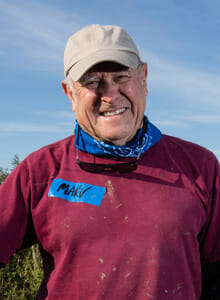 Marv Marshall
They also help purify the water, take carbon out the air, protect the soil from soil erosion and much more. The Gulf Coast has some of the largest concentrations of wetlands on Earth.
PJ says it is essential for people to take care the natural environment, so it can take care of us.
“We have had more destruction in the last 60 years than any other time in the history of man,” says PJ. “The best thing we can do is become more aware. We must take action to create a sustainable environment for future generations to come.”
See more Hurricane Katrina stories and memories at www.pointsoflight.org/katrina.
David Campbell
To commemorate the 10th anniversary of Hurricane Katrina, we are honoring volunteers who served along the Gulf Coast after the storm. Meet David Campbell, today’s Daily Point of Light Award winner, and nominate an outstanding volunteer or organization you know as a Point of Light.
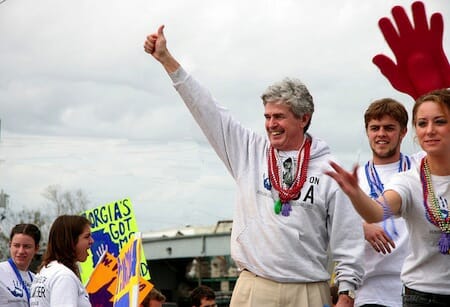 With volunteers from Hands On USA, David Campbell participates in a 2006 Martin Luther King, Jr. Day parade in Mississippi, where he led volunteers after Hurricane Katrina.
During his 40-year technology career in Buffalo and Boston, David Campbell led the charge as a good corporate citizen. He served on boards, was chairman of the chamber of commerce, raised money for the local cancer hospital.
But when the 2004 tsunami struck in the Indian Ocean, killing 230,000 people in 14 countries, something shifted for him.
“This was the largest disaster in my lifetime,” recalls Campbell. “I had to take action.”
For Campbell that action meant harnessing the power of “spontaneous, unaffiliated volunteers,” creatively using the Internet in a way that would have the greatest impact on the people left in the tsunami’s wake.
The model he created addresses the problem that happens so often after a tectonic disaster: governments, nonprofits and local community groups are so overwhelmed with immediate relief efforts that they are not able to utilize willing, outside help.
What Campbell observed first hand after traveling to Thailand was that this sort of work is often physical, hard to bear for survivors and requires many willing hands. Volunteers who want to help can provide the labor, but in order to be effective, safe and not be a burden on the community, they need to be organized and carefully directed.
Campbell saw that volunteers were being turned away. Considering the magnitude of the need, this seemed a wasted resource. He and some friends quickly set up a website to connect, organize and supervise volunteers where their help would make a difference.
They were able to raise money through the website to support their work, and ended up rebuilding five fishing villages. That clarity of vision led to Campbell founding All Hands Volunteers a decade ago, when he was 63.
When Hurricane Katrina hit the Gulf Coast on Aug. 29, 2005, Campbell saw a need All Hands Volunteers could fill. Just days after the hurricane – on Sept. 6 – All Hands Volunteers set up base with 1,500 volunteers on the ground in Biloxi, Mississippi.
“We tend to find a significant second community that is not getting served and base ourselves there. We embed in that community and usually live there for some months,” he explains.
With Campbell at the helm providing organization and overseeing funding, volunteers with a wide array of talents hit the ground running. Beyond cleaning out destroyed buildings and mucking out disaster sites, volunteers applied for grants, met with community leaders, attacked logistical problems and generally did whatever had to be done.
“Part of the magic of throwing enough volunteers together is that we can take advantage of on-the-spot creativity and flexibility,” says Campbell.
When a volunteer suggested using bikes to help local folks get around, the funds were raised and the bikes obtained. Significant milestones included the rebuilding of an emergency health clinic, a much-needed resource.
During that winter, All Hands Volunteers (under the name Hands On USA) transferred its Biloxi operation to Points of Light’s HandsOn Network, which named the outfit HandsOn Gulf Coast (now Hands On Mississippi). What All Hands Volunteers established in Biloxi also served as the model for the affiliate HandsOn Network established in New Orleans after Hurricane Katrina, HandsOn New Orleans. (For more about the creation of those affiliates, go here.)
In the last 10 years, All Hands Volunteers has contributed more than 750,000 hours at some 50 disaster response and rebuilding projects in the U.S. and around the world in such places as Nepal, Haiti and Malawi – work that has helped more than 45,000 families by providing shelter and other basic necessities, and by rebuilding homes, schools and boats.
When disaster strikes, a small, seasoned All Hands Volunteers team goes on site after the search-and-rescue mission. Once the immediate needs are assessed, the hands.org website issues a call for volunteers. Volunteers pay their own travel expenses and are housed and fed by the organization.
“The dedication and teamwork is astounding,” Campbell says. “We’ve carried on learning and changing and growing the model. And there’s always work to be done.”



