
Wayne Turner
Meet Daily Point of Light Award honoree Wayne Turner. Read his story, and nominate an outstanding volunteer or family as a Daily Point of Light.
From tragedy to triumph. Spurred by the devastation of Hurricane Sandy in 2012, which completely destroyed his hometown of Sea Bright, New Jersey, Wayne Turner used his loss to fuel his recovery.
Serving in the domain of public education for over 43 years, Turner is accustomed to helping others. The same effort and mentality he has brought to the classroom, Turner is now applying to recovery and restoration projects in his community. Working with entities such as Sea Bright Rising, the St. Bernard Project and AmeriCorps, for almost 2 1/2 years Turner has helped turn depleted houses to completed homes.
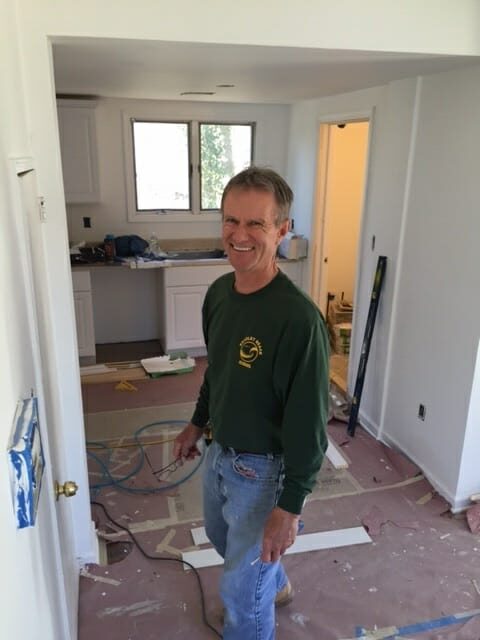
Volunteering eight hours a day, once a week, for over two years, Turner’s contributions has directly led to over 50 homes being rebuilt, and another 25 projects still underway. When he is not literally hammering nails, he could be found sharing advice with other volunteers. Though his past is centered around education, his skill set in construction has been invaluable. For projects like these, in which a total team effort is needed to get the job done, skill based volunteers like Turner is essential.
“Volunteers who have skills already can play an important role in teaching others,” said Turner. “I too have gained a number of construction-related skills to a point where I can teach and help other people. As long as a volunteer has a desire to help, many skills can be taught.”
When Turner is not helping restore homes damaged by natural disasters, he can be found either teaching a graduate course at Seton Hall University, or volunteering at the the Soul Kitchen, a community restaurant started by the Jon Bon Jovi Soul Foundation.
While natural disasters may be unavoidable, Turner has shown us that it is how we respond in the aftermath that truly reveals our character.
Do you want to make a difference in your community like Wayne? Find local volunteer opportunities.
James Roach
Working with animals was so important to James Roach that he retired early from his job to become a volunteer with Citizens for Animal Protection (CAP) in Houston. He learned early from his mother about the importance of giving back to others, and for him, animals fit that bill.
“My passion for animals filled that void for me,” he said. “There are so many abandoned or abused that have no one to speak for them.”
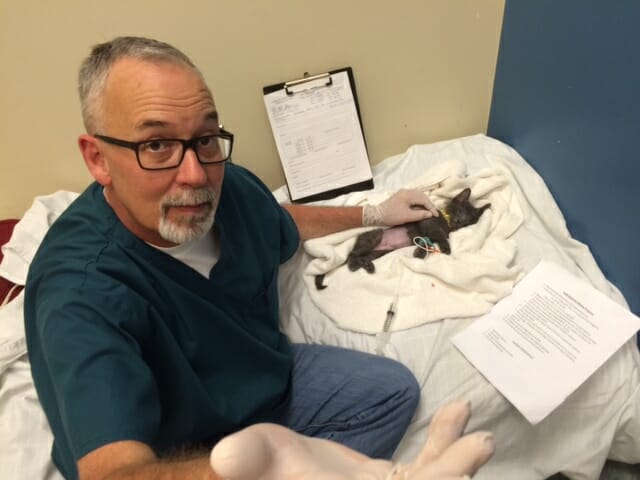 James Roach helping a furry friend in need.
In his previous career, Roach, 55, worked for a hand surgeon. In 2013, he pivoted to apply those skills to working with animals who come into veterinarian offices for surgery. Today, he works three-to-four days a week, fulfilling almost any job available in the clinics.
Since his first day, he’s devoted 1,086 hours to making dogs and cats comfortable before, during, and after surgical procedures. His typical day begins at 8:45 a.m., preparing rooms and tools for various cases, as well as setting out food for the animals when they wake. During surgeries, he monitors their heart rate, oxygen levels, and blood pressure to report any changes to the veterinarian as they occur.
After surgeries, Roach makes sure the animals recover well from the anesthesia and keeps them warm. He said he feels he makes a significant impact for veterinarians, the pet owners, and the animals because he gives so much of his time and pitches in wherever the needs are greatest.
While he finds fulfillment working with animals, he advocated that everyone find a volunteer opportunity that feeds into something they feel strongly about.
“Definitely do whatever you’re passionate about. My passion is animals, but there are lots of things you can be passionate about – working with the elderly, the homeless, or the hungry,” he said. “There’s so much opportunity out there. There’s something for everyone.”
To find opportunities near you, check out All for Good for projects that you’re passionate about!
Suzanne Chimera
Suzanne Chimera became a cosmetologist upon graduating from high school in 1990. She began working at Manny Roberts Hair Replacement in 1994. Since 2006, Chimera has traveled to countless cosmetology classrooms to lecture on the devastating effects hair loss can have on a person.
After one of Chimera’s clients appeared on 20/20 in an episode about strange afflictions, Chimera received a call from the mother of a 13-year-old with alopecia, who said she would “do anything for that wig.” The young girl was severely depressed and was being home schooled because she could not face the bullying from her classmates. The cost and maintenance of a custom made human hair wig was something this family could not afford. Chimera made a promise to get that wig; she posted on Facebook asking the community for blonde ponytails. In one week, she received 42 ponytails and the wig was made from hair donated by her friends and family and Hair We Share was born.
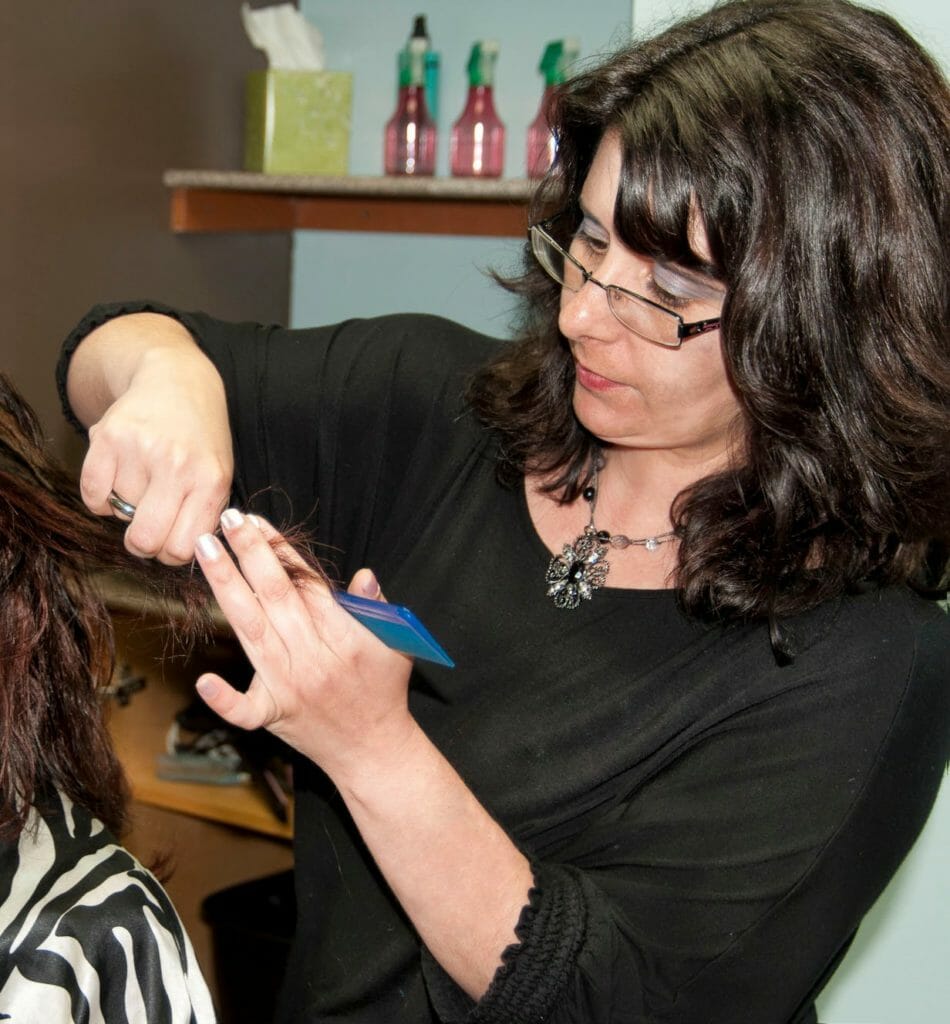 Suzanne Chimera
Chimera is now the president and co-founder of Hair We Share. Hair We Share makes wigs using donated ponytails and gives them to people with medical hair loss at no cost. Chimera matches ponytail donors to recipients.
Most of the ponytails come from children. It is a very special experience because they get to see who received their precious gift. Recipients of the wigs receive them for free. The wigs are custom made human hair that would not otherwise be affordable to the average person. The recipients get a sense of community when they see all of these people that get together to make this happen.
As a wig designer for 20 years Chimera has seen many different people suffering hair loss for many different reasons, but they all have the same feeling of being alone and afraid of what other people will think of them. She has serviced clients for several reasons ranging from chemotherapy, car accidents, burns to violent attacks.
Chimera has helped 12 people with custom-made wigs in the last year. She has made a huge impact in the lives of young girls helping them to feel beautiful, confident, and a sense of community. Each wig is designed for the recipient, this means the hair is selected based on color, texture, length and density, the cap is constructed to fit the recipients head exactly and the cap materials used are chosen based on the type of hair loss. It is personal “celebrity style” service and the results are like no other.
Chimera has taken the effort to create a way for those with medical hair loss to be made whole while getting the community to get involved. You can find ways to get involved too by checking out All for Good for projects near you!
Wicksburg Volunteer Fire and Rescue
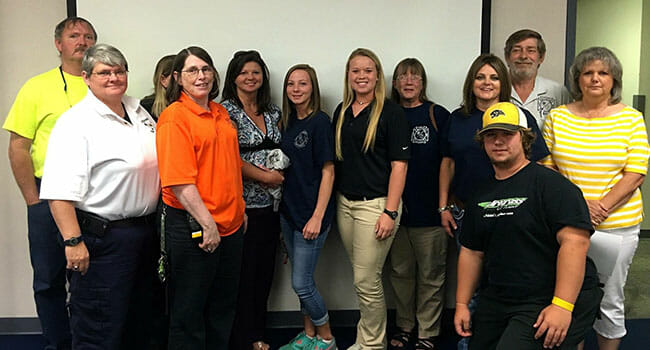
The call can come when he’s cutting grass or watching his 8-year-old son play baseball on a Sunday morning when he’s sitting in a church pew or a Tuesday night when he’s in a deep slumber. When it happens, Chad Dickerson, 33, is ready and on his way in seconds. As a member of the all-volunteer Fire & Rescue Department in Wicksburg, Alabama, Dickerson is prepared — whether it’s to respond to a fire or to help an elderly person who has fallen.
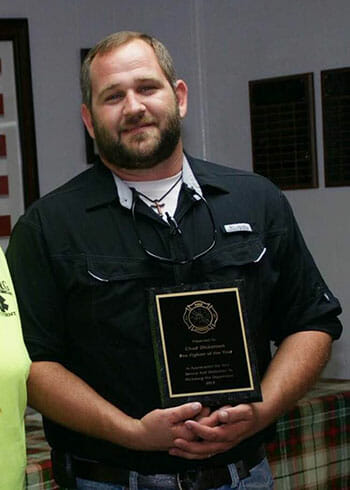
“I consider every call important, and it’s always a team effort — so I can’t let anybody down,” he says. “It’s a lot of pressure — but very rewarding. The folks we help always end up apologizing for interrupting us. We’re trying to take care of them and they’re watching out for us.”
Dickerson says he sometimes works 24 hours straight if a natural disaster like a major storm occurs, while other weeks all is calm and he uses the time to “take care of things around the station like fixing flats and repairing the equipment. Then,” he adds with a laugh, “the full moon arrives and things pick up again.”
For Dickerson, who works full-time as a heavy equipment operator for the State of Alabama, volunteering in this way is a family affair. His grandfather was involved with founding the department 40 years ago and, as a young boy, Dickerson often accompanied his dad on emergency runs. These days, even his wife volunteers as an emergency medical technician.
Fire Chief Wanda Andress, 46, is also following in her family’s footsteps. Two of her older brothers volunteered for the department while she was in high school and as soon as she graduated, she joined them. Nearly 30 years later, she’s still at it. A teacher by day, she heads to the station as soon as school is over and starts what amounts to a second job — putting in about 25 hours a week to dispatch volunteers and take care of administrative tasks.
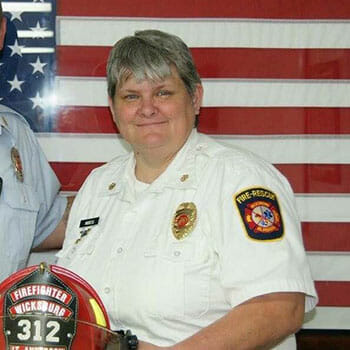
Her team makes about 600 calls a year, about three-quarters of which are rescue runs. “We take care of a little bit of everything from helping stranded people to ambulance calls for heart attacks to removing children from house fires. We also go into the schools to talk about fire safety and prevention,” she says.
The department serves about 40,000 people in an unincorporated part of Houston County. “It could take 30-45 minutes to get an ambulance or fire truck from elsewhere out here,” Andress says. “So although it’s a hard thing for volunteers to mix this into their work and personal lives, they’re committed because they know if we didn’t do it, our community would suffer.”
Andress says she can always use more volunteers but for those who can’t spare the time, there are other ways to help. For example, several times a year, the department stages fundraisers or offers raffles to raise money for equipment.
“The outpouring of people who help in so many ways makes me proud,” says Dickerson. “We’re like a family — we’re all in this together. We’re a small community and I reckon I’m stuck in the old world where everyone helps their neighbor.”
Sarah Wijnen-Reims
The effects of Hurricane Mitch in 1998 were some of the worst in Honduras history. It resulted in thousands of deaths, over 2 billion dollars in damage, and over 1 million people homeless. Almost 20 years later, unfortunately, not much has changed.
Aware of the devastation is Sarah Wijnen-Reims. She traveled to San Pedro Sula, Honduras, on a Mission Trip to give people a special gift. Not one that is monetary or material — instead, it’s a gift of compassion, the gift of volunteering.
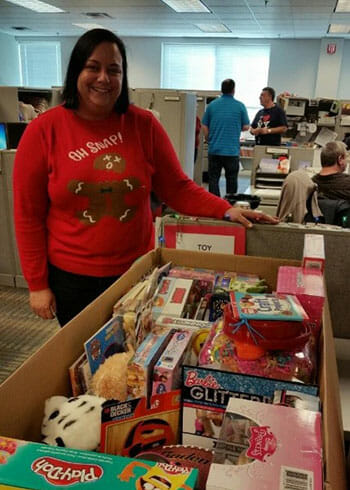
Sarah spent seven days providing a sense of hope and happiness to the people of Honduras. She helped deliver food and water to starving civilians, and even assisted with a toy drive that placed smiles on children’s faces for the very first time.
With the devastation still existing two decades later, it’s going to take a unified effort to restore Honduras. And that effort, as Sarah has shown, comes in the form of volunteering.
“I try to tell my children always to give more than what is expected,” says Sarah. “Because someday you may find yourself in a situation where you may need a helping hand.”
With Sarah preaching to her daughters the importance of volunteering, they have fully adopted the act of selflessness. So much so that they are paving their own path as volunteer vanguards.
Sarah is plagued with a rare blood disorder called ITP, characterized by a low count of platelets in the blood which can cause excessive bleeding. Wanting to assist, her daughter organized a blood drive at the Central Blood Bank in Pennsylvania resulting in 25 blood donations.
Whether it’s helping restore land in Honduras, or organizing blood drives domestically, the gift of volunteering is truly a gift that keeps on giving.
Christine Lott
Like many financial-institution executives, Christine Lott found greater fulfillment outside her job at Goldman Sachs in Boston. In 2009, she augmented her director role and founded the School of St. Nicholas in the Tanzanian village Moivaro.
Today, she provides free-to-low-cost education to some of the poorest children in Tanzania. The goal is to increase high school graduation rates.
“We began the School of St. Nicholas to educate disadvantaged children who could not afford school fees. We accept bright children born into chronic poverty,” Lott wrote on the School’s website. “Most of our children live with their single mothers or grandmother in a one-room rented hut with no internal plumbing, electricity, or toilets. It is through education that we will end the cycle of poverty for themselves and their families in the years to come.”
The School first opened its doors with 12 5-year-old students. Today, it serves 30 with more than 100 children on the waiting list. Lott and her partners hire trained and educated teachers to work with students, and she’s currently fundraising to build a larger school building to serve more children. She also currently organizes hundreds of volunteers in Tanzania and the United States to manage the School’s day-to-day operations.
As students, children receive free or 90-percent reduced cost education, free uniforms, shoes, and backpacks, as well as books, pencils, games, and creative learning tools. Additionally, students receive breakfast daily and quarterly worm protection to protect against parasites.
As an organization, the School offers volunteer opportunities both in Tanzania and the United States. Individuals interested in donating time to the School in Tanzania can sign up to be teaching assistants who spend five hours a day in the classroom, helping design curricula, administer tests, and work one-on-one with students. Longer volunteer assignments include participating in social media efforts, marketing, and policy management.
Those interested in volunteering in fundraising efforts in Boston can visit www.tanzaniaschoolfoundation.org .
Komal Ahmad
Hunger isn’t just a global problem — it’s the “world’s dumbest problem.” At least, that’s how Komal Ahmad, founder and CEO of COPIA, sees it anyway. She’s making it her life’s mission to eradicate it one city at a time with technology that seamlessly delivers excess food from restaurants, grocery stores, companies, and events to people in need. Her company has already helped to feed hundreds of thousands of people in the San Francisco Bay area, and it expects to feed over a million this year alone.
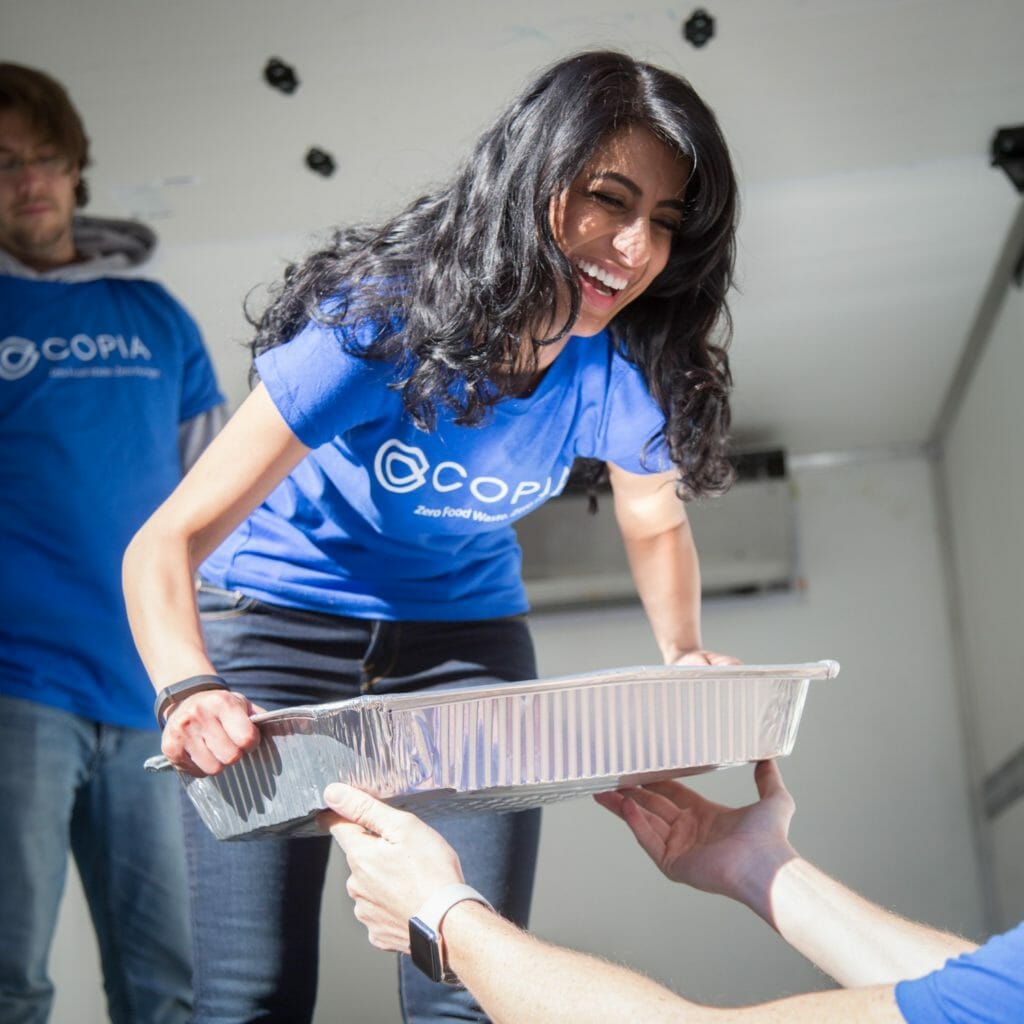 Komal Ahmad
Of course, there is nothing stupid about hunger. According to Feeding America, there are approximately 50 million Americans living in “food insecure” households, including more than 15 million children. This is all while 365 million pounds of perfectly edible food are thrown away every day. But Ahmad, who has been focusing on streamlining ways to feed the hungry since she was a senior in college at the University of California, Berkeley, believes that for problems that feel so overwhelming as hunger and food waste, the answer is simpler than we realize. “There’s not a problem that is so grandiose in scale that has such an obvious solution as hunger does,” the 26-year-old tells Points of Light. “Eradicating hunger requires better distribution systems. This is what COPIA is creating. The world’s most effective and efficient global food redistribution system.”
Historically, charitable organizations have tried to meet the challenge of feeding America’s hungry, but falling donations and increasing need have made their success difficult. Moreover, these organizations have failed to realize that hunger in the United States occurs not due to a lack of food, but due to an inequitable distribution of it.
Against this backdrop, in 2013, Ahmad founded COPIA, a technology-based platform that connects businesses with excess food to people in need. Through this mobile and web app, businesses can request food pick-ups, and COPIA will dispatch a Food Hero (a trained driver) to pick it up and deliver it to the nearest shelter, after school program, or nonprofit in need.
So how does COPIA work exactly? “We’re Match.com meets Uber for food recovery,” Ahmad explains. First, use COPIA’s app or site to identify yourself as a food donor or food recipient. Non-profits looking for food donations can register directly on COPIA’s website. Once verified, they can place a request for what types of food they are looking for, when, and how much. COPIA food donors can be anyone — from restaurants, grocery stores, farms, and catering companies looking to get rid of surplus perishable items, to private events that over-ordered food.
If you are a donor, simply express how much surplus food you have, and request a pickup. COPIA’s algorithm will match the surplus food with recipients currently looking for food donations of that amount and type. Then, a certified driver from COPIA’s Food Hero team will pick up the food, and distribute it to where it’s most needed at the time. For instance, if a company has 2,000 pounds of food leftover after a conference, 500 pounds of that food might go to a veteran’s agency, while another 500 pounds might go to a women’s shelter — and so on, until the food has been entirely divvied up. It’s all about figuring out who has the capacity to accept what and when. “Whenever we have an incoming donation, we will match the amount and type of food to the non-profit that’s open and able to put that food to the best use for the most amount of people. We never let food go to waste.” Ahmad says. Not only is her system an efficient way to bring food to the hungry, it also saves businesses money by lowering disposal and overproduction costs and reduces methane by keeping food out of landfills.
If it seems simple, that’s because it is. Since its start, COPIA has recovered more than 800,000 pounds of food. This has provided COPIA’s food donors with over $4.6 million in savings and enabled COPIA to feed over 700,000 people — for reference, that is the equivalent of feeding the entire population of Luxembourg. During Super Bowl 50 alone, which took place in nearby Santa Clara, Ahmad and her team recovered 14 tons of high quality food — enough to fill four 16-foot-long refrigerated trucks to the brim, and feed 23,000 people at non-profits and shelters all over the San Francisco Bay Area.
The piece of technology that COPIA’s built is so extraordinarily sophisticated that it can also be applied to other situations. This means that one day, COPIA could redistribute more than just food – medicine, medical supplies, books, clothing and so on. “If I were going to dedicate my life to something, it wouldn’t be something small scale,” she tells Points of Light. “If I were going to dedicate my life to something, it would be something that could move us forward as a global society. Something that could transcend borders. This is why we have built COPIA to scale — so that we can dramatically improve lives of people globally.”
Want to join COPIA in doing good, saving money, and feeding a lot of people? Sign up your company or event to join the movement by donating their excess food to COPIA. Find other ways to support COPIA on their website —- it is all of our responsibilities to help solve hunger: the world’s dumbest problem.
John Boerstler
Combined Arms in Houston Brings Vet Services Under One Roof.
Feeling patriotic is something most Americans have in common on Independence Day. But for the 3.6 million veterans who answered the call of service since 9/11, that patriotism can come at a high price. Unemployment, service related health challenges, PTSD and homelessness are just a few of the issues faced by these vets, a population included in the 21.2 million men and women who have served their country since World War II.
For former Marine John Boerstler, meeting the needs of this important population is a driving force. Boerstler, whose overseas assignments included Iraq and Kuwait, is Executive Director of NextOp a non-profit NGO based in Houston that provides job placement assistance, mentorship and support for vets, with a focus on the fields of energy, construction and healthcare.
“So far we’ve helped place more than 310 vets into jobs,” he explained. But Boerstler’s vision goes beyond NextOp.
Facing what he calls “a classic case of fragmented business,” Boerstler realized that the organizations serving vets weren’t as accessible as they could be. “Everybody was operating in silos, with redundant costs and efforts in eight different locations, making it difficult for vets to get the help they needed.” Working with the Lone Star Veterans Association, with grant funding provided by Wounded Warriors, Boerstler helped create Combined Arms , a partnership of some 30 different organizations serving vets and their families.
“The first step was to get all the groups physically in one location,” he explained. “We were fortunate to have the right leaders onboard from the beginning.” Since its inception in June 2015, Combined Arms has allowed Houston’s 300,000 veterans turn key access to governmental services, from the Houston Office of Veterans Affairs to Grace After Fire and Hope for the Warriors. From legal aid to housing assistance, wellness programming and a program that matches vets with rescued pets, these support organizations take a holistic approach to the transition process.
“The next phase is connecting all of the organizations with technology, which will not only improve communications but raise accountability,” he explained. “Vets can now check in with us both physically onsite or virtually.” The Combined Arms model is one that will be eventually replicated in other cities on a test basis.
“Transition is difficult for many veterans – they don’t know what they don’t know about civilian life. Combined Arms is committed to making Houston and the state of Texas the best place for post-9/11 veterans and their families to live and thrive.”
Roland Cotton
For Roland Cotton, healthy eating is a life saver.
He’s seen first-hand how effective healthy eating and fitness can be in helping individual reclaim their vitality. When his son suffered a near-fatal stroke at age 38, Cotton jumped into gear. By introducing a more nutritious diet, he helped his son reclaim a healthy, bike-riding lifestyle.
Today, and for the past three years, Cotton devotes his time to giving others – especially those with chronic illnesses – the same opportunities.
According to the Centers for Disease Control and Prevention data from 2012, 117 million Americans have one or more chronic illnesses. In fact, 1 in 4 adults have two or more chronic conditions. The most common chronic conditions are heart disease, stroke, cancer, type 2 diabetes, obesity, and arthritis.
Overall, 7 out of the top 10 causes of death in the United States are chronic conditions with heart disease and cancer accounting for 48 percent of all adult deaths. The total cost for treating heart disease and stroke in 2010 was estimated to be $315.4 billion.
Despite the prevalence of chronic disease, the National Health and Nutrition Examination Survey reveals only about one-third of adults with these conditions report receiving advice from their primary care doctors about choosing a healthy diet full of fruits and vegetables.
To encourage others to eat better for a better life, Cotton works with community gardens, farmer’s markets, and backyard gardens. Supporting food borne from personally digging in the soil is the driving force behind his efforts.
But, it takes more than his two hands to make these efforts effective. He easily engages other people and provides the leadership needed to help them carry on the same healthy behaviors in their own lives.
If you’re interested in finding opportunities to engage in your community through service, please check out All for Good for projects near you!