Diane Latiker
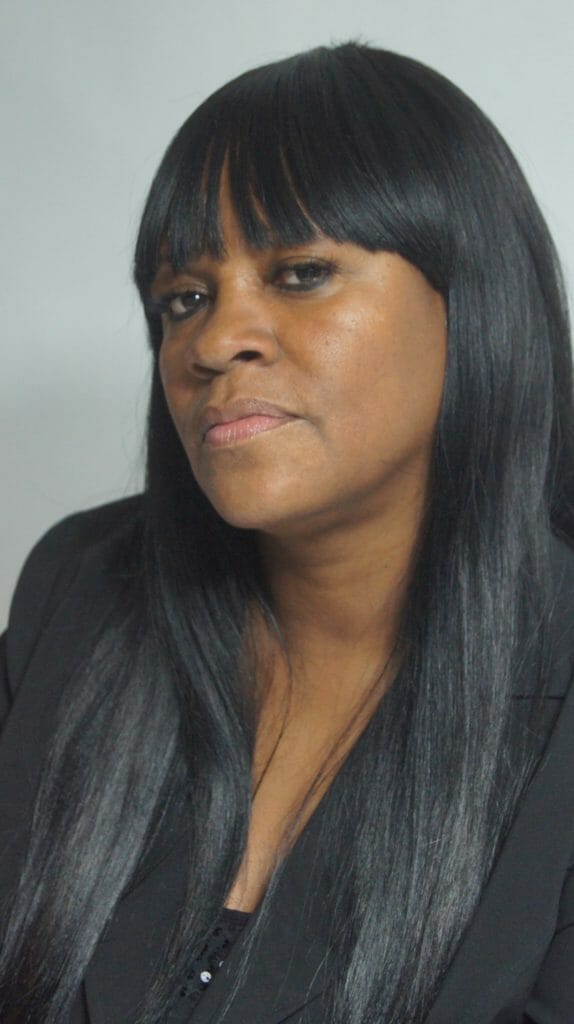
“I would be more scared to go in and close my door and not be a part of the solution. I have won over the most hardened young people,” says Diane Latiker, who’s given kids a safe place to go for activities, advice and respect since 2003. “They keep me alive and vibrant,” says Latiker, a former hairdresser and mother of eight grown children who founded – and still runs — the Kids Off the Block program, using a great deal of her own time, money and instincts to convince kids there’s hope for more than despair and poverty, guns and gangs.
 Diane Latiker
Latiker opens her home daily to dozens of youths in a tough Chicago neighborhood where some people would be afraid to even say hello to young residents. Kids Off the Block gives kids a place to do homework, play basketball, talk about issues, fears and dreams – and importantly, pile into Latiker’s van for rare opportunities to glimpse a world beyond their troubled Roseland neighborhood on the city’s far south side. “We take kids literally off the block,” says Latiker. “We have young men work so hard to buy and fix up a car that they’ll never drive more than a four-block radius. We’ve been to 22 cities. One time, we went to Elgin (Illinois) and they were excited because they’d never seen a duck. ”
Latiker relinquishes her own peace and quiet to allow up to 75 teens to visit her small home, many knocking after dark or early in the morning. This frequently strained relations with neighbors (“all these kids hanging around”) other parents (“they’ve called to complain that their kids are here more than at their own home”) and Latiker’s husband (“he was furious when I sold the TV”). Once, Latiker’s van was shot up by gang members. She knows why. “I’ve talked kids out of joining gangs. Kids have put down their guns to come and hear what I have to say.”
Roseland, adjacent to Chicago’s historic Pullman district, once boomed with railroad and factory jobs. As the manufacturing era ended, shops and other businesses closed as well. Last year, a study showed an unemployment rate for young black males at 92 percent in the Roseland area. Latiker’s latest goal is to focus on helping youths become employable by teaching them computer skills, talking up the possibilities of entrepreneurship and stressing “soft skills,” such as proper dress and communication.
This spring, Latiker is launched a TEC (Technology, Entrepreneur and Career) Center, which will teach coding, cloud computing and other skills. “Young people need careers, not just jobs,” she says. “But after 13 years, I’ve learned that our young people are not work-ready.” If she were to win prize money, “That would go directly into the TEC Center,” says Latiker, who once sold her own living room TV to buy 10 used computers, so economically deprived teens could be introduced to technology.
Latiker estimates that more than 3,000 teens have been impacted/participated in the Kids off the Block program. Last year six former participants graduated from college – the first in their families to do so. Once-skeptical neighbors now socialize with police officers at KOB’s annual “Feed A Teen” Thanksgiving Dinner, which has fed as many as 658 people at one time.
Delroy Folkes, now 24, says he was 12 or 13 when he discovered “Miss Diane.” He says she kept kids busy playing basketball, doing arts and crafts and listening to music. “She was tough and she was influential,” says Folkes. At the time, some of his young friends were getting into trouble and held little hope of escaping the impoverished neighborhood. “I can honestly say I knew some kids who’d never been to downtown Chicago, even though we lived in the city, which is sad,” says Folkes. Today, Folkes holds a bachelor’s degree in exercise science, and is studying for his master’s degree in sports management at Northern Illinois University. Inspired by “Miss Diane,” he hopes to one-day return to Roseland to practice his profession. “The one thing about her that I most want to emulate is her patience with troubled youth,” he says. Despite discouraging headlines about the community’s struggles, “She never gives up on them.”
Latiker found a quietly powerful way to remind Roseland residents of the toll that bad decisions can make. She and her husband, a retired auto body mechanic, bought and painted bricks to create a memorial to teen victims of violence in Chicago. As they can afford it, they add more. “We have over 500 stones marked with the names, ages and date of death,” says Latiker, adding, “We are behind by 521.”
Kids Off the Block recently lost the office space they occupied after the project outgrew Latiker’s home because of lack of funding—Latiker was paying utilities and rent out of her own pocket. Now, the kids are back in Latiker’s living room. But she’s not complaining. “The smallest things, like when they say, ‘Thank you, Miss Diane,’ keeps me motivated.” After 13 long years, Latiker’s noticed a difference in the neighborhood. “We were just talking about that,” she said. “We can sit on our porches at night. “
Yara Shahidi
For some celebrities, actuating social change is just another responsibility that comes with the trade. For 16-year-old Yara Shahidi, rising star of the hit ABC TV sitcom, “Black-ish,” engaging in social change is simply part of her DNA.
The bubbly Minneapolis native grew up in a family of humanitarians, including an aunt in social work and a grandfather known for his civil rights activism. As a tradition, every Christmas Yara’s family gives to a foundation, rather than each other. At 14, instead of beaching it in Jamaica, the ambitious teen and her mom, actress/model Keri Shahidi, used their time on the island to work with Integrative Clinics International, an organization that provides healthcare services in underserved communities.
With this kind of empathic upbringing, it’s no wonder that Shahidi is using her platform for good. From donating her time to film public service announcements, to speaking out against bullying in schools, Shahidi’s high profile is turning her into an influencer to be reckoned with. Unlike her character Zoey, who veers to the side of entitlement in the comedy about a prosperous black family wrestling with racial issues, Shahidi’s feet are firmly on the ground.
Her philanthropic passions are plenty. Shahidi, whose “Black-ish” costars include Tracee Ellis Ross, Anthony Anderson and Laurence Fishburne, is a vocal spokesperson for Saving Our Daughters, a nonprofit that encourages dialogue between girls ages 9-16 about anti-bullying, self-esteem, violence and hate crimes. Not long ago, she partnered with the organization’s Saving Our Cinderellas program, acting as a “Celebrity Godparent,” and taking part in a performance arts mentoring class.
“Yara feels strongly that there is no cause that we can’t affect,” according to publicist Erica Tucker. “She is always encouraging other young people to get involved and become the voice of change, no matter how big or how small that change might be.”
Filming a television series and keeping up a 4.6 GPA is more than a full-time job, but Shahidi, whose first name, in Persian, means “Someone who is close to your heart,” doesn’t let a busy schedule slow her down. A few of her projects include recording a public service announcement for DoSomething.org to encourage young women to go into STEM fields (Science, Technology, Engineering and Mathematics); her mentoring work, which includes creating vision boards with both the Boys and Girls Club and Young Women’s Leadership; and attending the annual (Em)Power Breakfast alongside big names like Estee Lauder, president & CEO for Fabrizo Freda, Kimberly Hatchett, executive director for Morgan Stanley, and Sherrie Westin, executive vice president of global impact and philanthropy for Sesame Workshop.
“Life as a teenager can be down right chaotic,” the actress told the audience at the New York luncheon. “We must also realize that it is up to us whether these years will feel like a melancholy struggle or an opportunity for growth or experiences of a lifetime.”
Shahidi’s star power, which earned her the NAACP Image Award, is at the heart of Yara’s Club, which she started last fall. Working with seven New York City schools, Shahidi initiates monthly digital meet-ups with young, socially conscious teens, leading discussions of empowerment and social good.
“Her goal is to inspire other young women to make a difference and get involved. In their own communities,” said Tucker. “Yara’s true essence is giving back and being kind. I’d say her over-arching motivation is to translate that to her fans. To inspire them not to be afraid, to get started now, not to wait. Right now is the time for change –Yara believes with her whole heart and soul that it’s exciting to be involved in that process.”
Veronika Scott
Veronika Scott, founder of The Empowerment Plan, has built an organization that began around a single idea: to design a coat specifically for the homeless. The coat is self- heated, waterproof, and transforms into a sleeping bag at night. That idea has now evolved into a system of empowerment in which homeless women are paid to learn how to produce coats for people living on the streets, giving them an opportunity to earn money, find a place to live, and gain back their independence.
Veronika is the youngest recipient of the JFK New Frontier Award from Harvard University. She has also received an IDEA Gold Award from the Industrial Design Society of America, has been named one of the 2015 Forbes 30 under 30 Social Entrepreneurs, as well as the regional Emerging Entrepreneur of the Year. The Empowerment Plan story has been told all over the world and shared at events such as the Forbes 400 Philanthropy Summit.
Muhammad Ali
Lonnie Ali, a native of Louisville, Kentucky completed her BA degree at Vanderbilt University in Nashville, Tennessee in 1978. After graduation and a brief stint as an Employment Counselor for the State of Kentucky, Lonnie began her business career in account sales with Kraft Foods, Inc. She continued her business studies at UCLA’s Graduate School of Management (now the UCLA Anderson School of Management) and received an MBA in 1986 with an emphasis in Marketing. After her marriage to Muhammad Ali in November 1986, she assumed responsibility for the coordination and eventual management of his business affairs. In September of 1992, she formally incorporated Greatest of All Time, Inc. (GOAT Inc.) to centralize and license her husband’s intellectual properties for commercial purposes. She served as Vice President and Treasurer of GOAT, Inc. from 1992 until the sale of the company in April 2006. During her tenure as Vice President, Lonnie managed the daily operations of the company while accompanying her husband on domestic and international business trips.
While actively managing GOAT, Lonnie partnered with her husband on many of his humanitarian initiatives around the world, including missions to Cuba, India, the Khyber Pass, Pakistan, Sudan and Uganda. Domestically, she has supported, accompanied and spoken on her husband’s behalf at numerous charitable organizations, including Athletes for Hope, Birch Family Services, the Cal Ripkin, Sr. Foundation, The Celebrity Fight Night Foundation, The International Red Cross, The Lou Ruvo Foundation, The Magic Johnson Foundation, Project ALS, Special Olympics, The Starkey Hearing Foundation and UNICEF.
Always an advocate for enhancing educational opportunities for youth, she and her husband partnered with Scholastic to develop the Muhammad Ali: GO THE DISTANCE reading program. The program provided teachers in grades 3-8 with a research-based curriculum along with instructional practices to motivate learning and improve comprehension in students who struggled academically. As part of the program, Lonnie would speak to groups of students at various schools throughout the US about her husband’s dyslexia and how he overcame his fear of reading to become a World Heavyweight Boxing Champion and American Icon.
After the sale of GOAT, Lonnie was asked to serve on the management board of the newly formed company, Muhammad Ali Enterprises.
In 1997, Lonnie and Muhammad helped launch the Muhammad Ali Parkinson’s Center (MAPC) in Phoenix, Arizona. MAPC is dedicated to the comprehensive care and support of Parkinson patients and their families regardless of their ability to afford treatment or other resources. In 2009, Lonnie and her husband unveiled the Muhammad and Lonnie Ali Pavilion which houses the newly built Muhammad Ali Parkinson’s Center at Barrow Neurological Institute. She and her husband opened the Muhammad Ali Center in Louisville, Kentucky in November of 2005 and serve as Lifetime Directors. The Ali Center is a multicultural center with an award-winning museum dedicated to Muhammad’s life and legacy. Its educational initiatives focus on promoting respect, hope and understanding; and inspiring people around the globe to be as great as they can be. Lonnie also serves as Vice Chair of the Muhammad Ali Center Board. After the sale of GOAT., Lonnie remained active in various charitable causes including advocating for children’s rights and Parkinson’s Disease research. She served on the Board of Directors of the Michael J. Fox Foundation and partnered with a major pharmaceutical company to launch a national campaign in support of Parkinson’s caregivers. She has been a frequent guest speaker at Parkinson Disease support groups and research gatherings. From 2010 to 2013, Lonnie served on the Presidential Commission for the Study of Bioethical Issues.
Lonnie was the 2010 recipient of AARP’s Inspire Award for her advocacy work for Parkinson’s research, patients and caregivers. In 2012 she was named one of Arizona’s 48 Most Intriguing Women as part of the state’s centennial celebration. The National Consortium for Academics and Sports inducted Lonnie into their Hall of Fame in 2013. Recently, in 2014, she was honored by The Foundation of Wesley Woods with the Key to a Cure Award which recognized her efforts to raise awareness and funding for Parkinson’s research. She has also been honored by Child Help and the HollyRod Foundation.
A proud mother and stepmother, Lonnie lives in Paradise Valley, Arizona with her husband, and also spend time at their home in Louisville, Kentucky.
Lorie Mayer
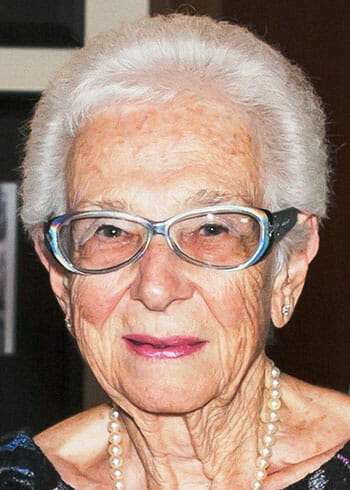
When 89-year-old Lorie Mayer looks around the Holocaust Museum & Education Center of Southwest Florida, she sees not only the hundreds of mementos and artifacts that she and other volunteers so carefully gathered and framed 15 years ago when they helped get the museum off the ground, but also reminders of her own story — and what might have been.
Mayer wasn’t quite a teenager when she and her family managed to emigrate from Germany to Chicago, where an uncle had set up home. The impetus for their speedy departure: the “night of broken glass” (or Kristallnacht) on Nov. 9, 1938, when hundreds of synagogues were destroyed, thousands of Jewish-owned shops were rampaged, and tens of thousands of Jews were taken to concentration camps.
“I lived through that,” Mayer says. “I still have personal items from that period.” Some of them are in the museum’s collection, but that’s not the only connection she has with the institution.
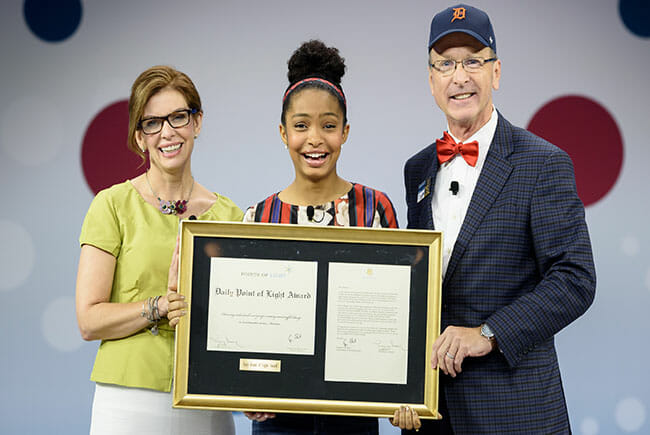
“Lorie has been one of the most integral individuals at the museum,” says education specialist Samuel Parish, who nominated Mayer for a Daily Point of Light Award. “In some ways, she been the embodiment of the museum.”
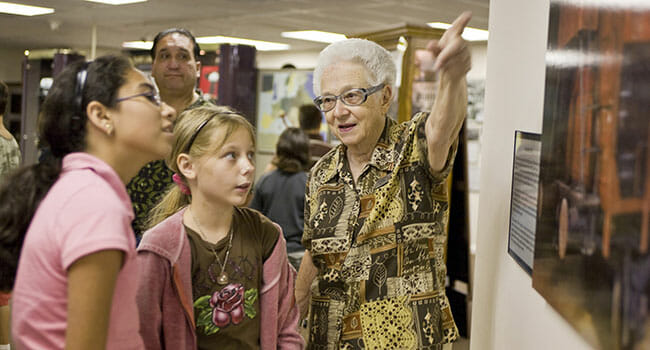
The idea of the museum has its roots in a middle school project. “First, the youngsters started assembling photographs from local survivors, then a local dealer got involved and before you knew it, there was quite a collection,” recalls Mayer. “I had been speaking in schools about my own experiences and I had materials from the U.S. Holocaust Memorial Museum and the Simon Wiestenthal Center and so the teacher incorporated those into the kids’ display, too.”
“It began to look like too good of a project to let go,” she says.
“Visitors who have been to other larger Holocaust museums located in bigger cities always compliment us,” Mayer says. “They say that detailing the rise of Nazism and the other events of the Holocaust in the order in which they happened makes the history easier to understand. Other museums act more as memorials and don’t tell the whole story as well as we do, in my opinion.”
Starting a museum turned out to be easier said than done for Mayer, as a time commitment of what she thought might be a few hours a week turned into a full-time job without pay. Along with several other helpers, she began organizing the materials they had amassed, arranging them in chronological order, and eventually locating them in a small storefront of 2,000-square-feet, or so, in Naples, Florida. The biggest challenges were authenticating the objects — from passports, to daggers, to maps — and keeping track of donations, but their efforts paid off.
Since opening, the museum — with a stated mission to inspire action against bigotry, hatred, and violence — has expanded twice, now employing a staff of seven. Besides displaying artifacts to tell the individual stories within the larger history and producing educational programs and activities, the nonprofit also presents general public programs that highlight elements of its collection and stories related to the Holocaust and other genocides.
Mayer still volunteers, coming in once or twice a week to “make trouble.” Volunteering “helped fill the void that my husband left in my life when he passed away 17 years ago,” she says. “The school kids who come in to tour the museum are truly in awe when they hear what it was like from people like me, the last surviving generation of that time. I’m hoping that after the people who lived through it are gone, youngsters will always be interested in learning more about this period.”
Want to make a financial gift, donate artifacts, or volunteer? Check out the Holocaust Museum & Education Center of Southwest Florida’s website for ways to get involved or find them on Facebook.
Kristopher Patterson
Volunteering is often looked at as an extracurricular activity, mostly done when one comes across some free time. For Kristopher Patterson, volunteering is no chore nor an afterthought, it is a focal point in his life.
Patterson’s involvement in the San Diego community is second to none. While he has a lot on his plate, juggling his own personal endeavors, he refuses to let that get in the way of his desire to help others.
Among being a devoted husband and loving father, he is also an active naval officer. When he is not assisting at home, or navigating ships, he can also be found pursuing his Master’s Degree. Though his plate is undoubtedly full, Patterson still manages to volunteer his time to several outlets.
“One of the examples I can give is that he volunteered for the ASYMCA (Armed Services YMCA San Diego) toy drive,”said Carlos Martinez, a Naval Captain. “He issued toys for service members children, so that they can have a better and prosperous holiday season.”
When it comes to balancing responsibilities, and still finding a way to impact your community, there is no better example than Patterson. Giving back is more than just a hobby to Patterson, it is a way of life.
Patterson’s list of volunteer deeds in the San Diego community runs deep. He has volunteered all over town. The ASYMCA, Our Daily Bread of Seneca, Meals on Wheels San Diego, San Diego Habitat for Humanity, Veterans Village of San Diego, are just a few places he volunteered.
It’s quite impressive how Patterson manages his time between his military duties, family obligations and furthering his education. His selflessness never wavers. Patterson shows us all that no matter how busy one may get, or regardless of how hectic your schedule may be, you can always find time to provide a helping hand.
Michael Lee Jackson
Volunteering, for Michael Lee Jackson, is a way of paying back the kindness he received as a 3-year-old child. So, for the past two years, he’s assisted others through the organization that came to his aid roughly three decades ago – the American Red Cross.
“As a child, I was affected by a house fire on Christmas Day at the age of 3, and the American Red Cross assisted my family,” he said. “It helped us get back on our feet, so I wanted to be able to help others.”
In 2015 alone, the American Red Cross offered relief efforts following 176 large disasters. Through those efforts, organization volunteers facilitated 34,000 overnight accommodations for displaced people, distributed 1.1 million snacks or meals, disseminated 800,000 relief items, and installed 195,000 home smoke alarms. They’ve also helped prepare 268,000 youths for the signs and dangers of home fires, and they’ve helped 214,000 individuals recover from home fires that do occur.
According to Jackson, he volunteers in almost every capacity, working to provide food, shelter, and comfort to families and individuals who have lost their homes and belongings through major disasters, including house fires, hurricanes, tornadoes, and wildfires.
His main efforts support the work done by local and state organizations as they prepare, respond, mitigate, and begin disaster recovery strategies.
“I work with families affected by major disasters so they have a safe place to stay and a plan for moving forward after the disasters,” he said.
If you’re interested in finding opportunities to engage in your community through service, please check out All for Good for projects near you!
Lisa Chirichella
Company holiday parties and picnics are generally times of professional relaxation, but for Lisa Chirichella, those events have morphed into chances to improve others’ lives.
“I’ve had a lot of opportunities in my life and people who helped me be successful,” she said. “I got to the point where I wanted to be the person who could help other people change their lives.”
The healthcare company Aetna, where Chirichella works, changed its party and picnic days five years ago to ones devoted to helping young girls connected to the nearby Young Women’s Christian Association (YWCA). The result is the Young Women’s Leadership Institute.
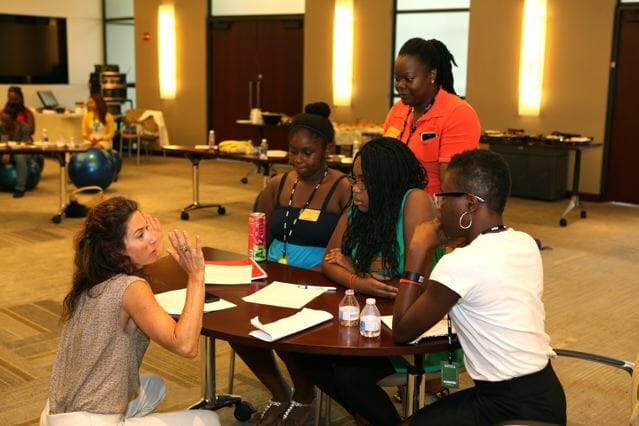 Chirichella, left, prepping young members of YWCA for a debate.
As an Institute volunteer, she mentors 25 to 30 young girls ages 12 to 18. She and other Aetna volunteers offer guidance on nutrition and physical fitness, as well as a variety of fitness classes – walking, dance, yoga, and stretching. Additionally, they focus on providing the skills necessary for successful careers, such as public speaking and resume writing, and including programs on science, technology, engineering, architecture, and mathematics (STEAM).
“The idea is for us to get them thinking about what their strengths are and the different things they can do with them,” she said.
Last year, the program expanded to include company-provided, paid internships for high school students. Selected girls, over age 16, have real job responsibilities – they’re required to scan and upload quarterly and annual reports that are used to serve Aetna’s wide customer base securely and privately. Some interns also contribute to the company’s 50,000-viewer blog, writing on topics intended to prompt conversations within the healthcare community.
Ultimately, she said, she chose – and recommends other select – a volunteer opportunity that allows both parties to learn from each other.
“They taught us to think about things differently and to be more open to understanding that not everyone looks at things alike, Chirichella said. “It’s been very emotional for all of us – we are just as fulfilled by these young women as they are by us.”
If you’re interested in finding opportunities to engage in your community through service, please check out All for Good for projects near you!
Germaine Jenkins
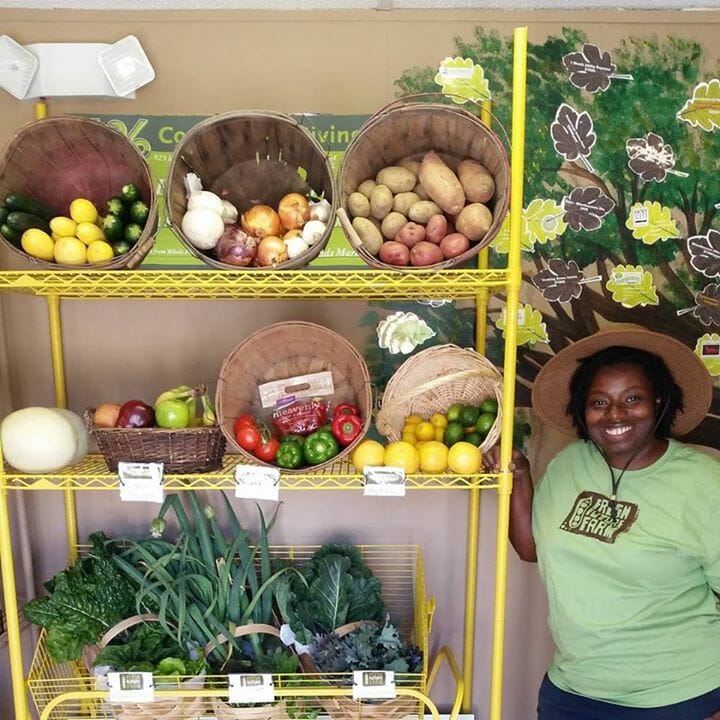
“We wanted to grow healthy food where it’s needed most,” says Germaine Jenkins, founder of Fresh Future Farm, a .81-acre oasis of vegetables and fruit trees in the heart of one of North Charleston’s poorest urban neighborhoods. The shelves of their onsite farm store are stocked with products we grow, extra produce that we don’t grow and basic grocery items, she adds, “People will make the connection that even though they don’t necessarily have traditional wealth, they have buying power. Plus, they’ll be helping to employ their neighbors.”
 Germaine Jenkins
Fresh Future Farm is an outgrowth of Jenkins’ gardening volunteer work within the Chicora-Cherokee neighborhood and her assistance with starting the nearly 5-year-old Chicora Place Community Garden project in North Charleston, SC since 2007. Buoyed at the enthusiasm for the garden’s fresh okra, eggplant, peppers, and peaches, Jenkins says she “listened to the neighborhood” and created an urban farm a few blocks away. The farm is a much larger, serious food-growing enterprise with the goal of producing enough food for residents to purchase regularly. Before the store opened in early May, crops were harvested and sold at a stand; now they have brand new refrigeration and sell staples, such as bread, milk and eggs. Jenkins is completing the transition from farm stand to grocery store to accept EBT benefits (also known as SNAP or food stamp benefits), and hopes the store will become a “one-stop shop” for families.
The average per capita income in the Chicora-Cherokee neighborhood is less than $11,000 per year. Yet it’s estimated that residents spent $3 million on groceries. Jenkins believes much of that goes toward unhealthy, overpriced junk food purchased at convenience stores, since the area has no traditional supermarkets stocked with fresh produce. Fresh Future Farm provides affordable healthy food for residents who would otherwise have to travel to other communities. Although shoppers from more affluent neighborhoods can – and do – stop by to purchase the tempting produce, Jenkins says, “We see our primary customer as our own residents first, and then Title 1 (disadvantaged) schools in the neighborhood. We want to have the most impact for our neighbors in the middle of a food desert.”
Using raised beds, Jenkins has planted more than 40 fruit trees, 70 blueberry and blackberry bushes, and crops that include cherry and plum tomatoes, basil, eggplant, sweet potatoes, cucumbers and cantaloupe. Jenkins has a bee observation hive and also plans to raise chickens at the farm.
Clover Hughie-Scott, a Jamaican-born resident who moved to North Charleston to be near family, is ecstatic at the chance to obtain fresh vegetables and fruit close by. “Elderly people in the area don’t drive – I don’t drive anymore,” says Hughie-Scott, who first spotted the Chicora Place Community Garden as she was getting off the bus. “This makes it so much easier.” Hughie-Scott says neighborhood families, including hers, “is thankful that the Fresh Future Farm store to be fully operational now.” Her family members are interested in pursuing a vegetarian diet because of their religion, Seventh-day Adventist, which promotes abstention from meat, alcohol and tobacco.
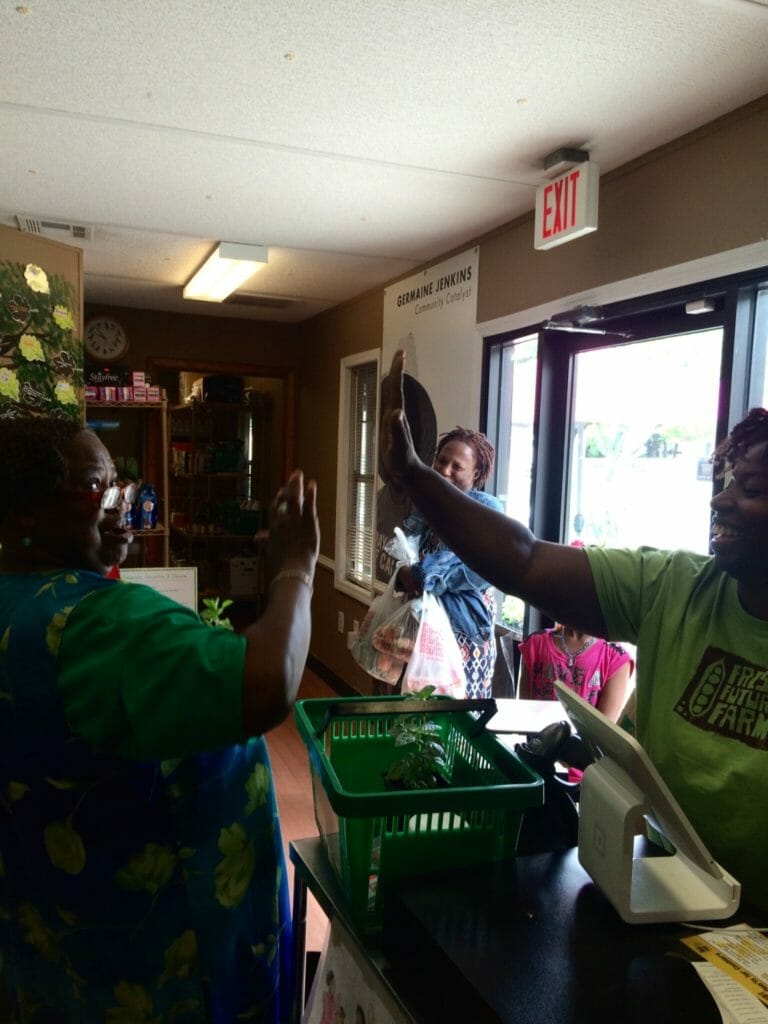 Hughie-Scott, left, and Jenkins at the store on its opening day in May 2016.
Jenkins, who once lived in public housing with her family, knows that urban agriculture benefits a community in many ways. Passers-by and riders getting on and off nearby buses can’t help but be impressed by the industrious labor that workers are putting into the project day after day. As the farm expands, Jenkins hopes to create job positions.
In addition, both the community garden and urban farm create a place for residents to socialize. Volunteer workdays with potluck lunches and outdoor movie nights have proven popular. Barbecue grills and picnic tables offer respite from hot kitchens during the summer while encouraging healthier meals. The organized monthly work parties offer camaraderie while teaching folks how to garden.
Jenkins has made the effort to become knowledgeable so she can effectively make her dream a reality. She’s been interested in gardening since childhood, but says, “Getting my own hands in the dirt to grow didn’t happen until I was in my 30s.” Jenkins took college classes in baking and pastry arts, then completed master gardener training. She soon discovered that the modern-day techniques in books don’t always work for space-limited and money-strapped urban agriculture, but undaunted, Jenkins said she hit up “Google university” to study how indigenous populations grew food. She’s taken business planning classes to better manage the nonprofit venture.
Hughie-Scott marvels that Jenkins has even managed to cultivate banana trees. “I didn’t know banana trees could grow here in America,” says Hughie-Scott. “In winter, she wraps them like babies in swaddling clothes and in spring, the bananas shoot up like crazy. I tell all my friends how this lady grows bananas here and protects them in winter.”
Jenkins is proud of her green thumb, but is already hoping others in North Charleston will match or outdo her success. “I want to teach others to do this,” she says. “I want competition. That way, we can form a co-op.”
Liana Roseman
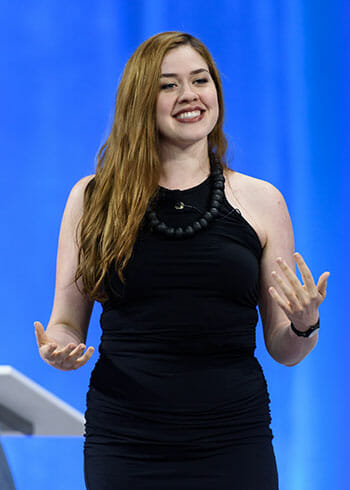
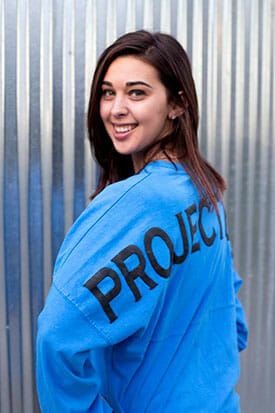
“I used to measure every bit of food to control my calories,” says Liana Rosenman of New York, a recovered anorexic who helps people with eating disorders get the help they need. “Now I measure success by living my dream of becoming a teacher and by helping others succeed.”
She and another recovered anorexic, Kristina Saffran, started Project HEAL: Help to Eat, Accept and Love, a 501(c)3 nonprofit organization that funds treatment for those who cannot otherwise afford it.
Rosenman was diagnosed with an eating disorder as an eighth-grader. But she resisted two years of attempts by her parents and counselors to acknowledge her disorder – until the day her parents took away her measuring cup. “I actually was hospitalized for a few days under suicide watch,” she says. “I carried that cup everywhere. They also threatened to take away my cell phone, but I was more afraid of losing the measuring cup than losing my phone. That was my wake-up call.”
Treatment for eating disorders, which can be fatal if untreated, can take months or years – and expenses add up. Those who starve themselves, binge and purge, or simply binge on food need to gradually acknowledge they need help. Then they need to identify and tackle the stresses that are causing the behavior. Counseling typically costs $150 per hour. Outpatient treatment at a hospital can run $2,000 a week; a month of residential treatment, up to $30,000.
“Both of us were lucky in that our insurance covered some of it and what it didn’t, our parents could afford,” says Rosenman, of herself and Kristina Saffran. “But we saw so many people who were getting kicked out of treatment because they couldn’t afford it – and these were people who were really motivated. So we started a treatment grant fund.” The pair, who earn no salary from the project, raise money every way they can, from merchandise sales to an annual gala. This year’s gala raised $120,000.
And, Project HEAL partnered with 16 treatment centers, each of which donates one free treatment plan per year. “So without any (additional) fundraising, we’ll be able to save 16 lives this year, and with fundraising, we’ll be able to help more,” says Rosenman.
Since its inception in 2008, Project HEAL has fully funded treatment for 52 individuals. “We’ve helped countless more by sharing our stories and being a presence on social media,” says Rosenman. Despite a trend toward body acceptance, Rosenman says eating disorders aren’t going away. Teen girls are especially vulnerable. But the Great Recession seems to have spurred an uptake in eating disorders among middle-aged women as well. “A lot of times people had an eating disorder when they were younger, but a job loss or divorce causes them to relapse in their 50s,” says Rosenman. “On the other hand, we’re seeing eating disorders in younger and younger children of 8, 9 or 10.”
Social media, such as Facebook and Twitter, have attracted both donations and applicants for help from as far away as Australia and Canada. Some 40 chapters of Project HEAL have sprung up, often on college campuses. Project HEAL’s website is being revamped to encourage more boys and men to feel comfortable getting help as well.

Through Project HEAL, Rosenman effectively uses social media to reach people like Amanda Lupacchino of New York City. Even with a job and health insurance, Lupacchino, an aspiring dancer, couldn’t afford the co-pays from treatment for her anorexia, which started at age 11. Counselors had persuaded her to get away from her troubled home at age 16, but she resisted suggestions that she had an eating disorder. “By age 20, I was taking 25 to 30 laxatives a day,” says Lupacchino. “I had stomach ulcers, sore joints and thinning hair. But I lacked a support system, plus there was pressure from the dance culture to remain thin.” After discovering Project HEAL online, Lupacchino received intensive hospital treatment. Now 24, she’s recovered enough to work as a dance instructor and a nanny, plus attend college, where she is close to achieving a bachelor’s degree in psychology and creative arts.
“Being put in that role of founder and a role model, it definitely helped me reach full recovery,” says Rosenman, who started Project HEAL when she was just a 10th-grader. “It’s like you have to walk the walk and talk the talk. It really pushed me to live up to what I wanted and what I wanted for other people.” Rosenman personally remains in touch via social media with thousands of people seeking encouragement and advice, despite her full-time job as a 5th-grade teacher who works with autistic children. “People can always reach out via email or Facebook message,” says Rosenman, who not only responds to messages, but is willing to follow people on their Instagram or Facebook accounts, if they like, to offer continuing encouragement. “I think they appreciate it,” she says.
Luppachino says the extra effort helps her avoid relapse. “I still call or text Liana when I’m having a bad day. She always responds and is super supportive.”