The loss of a child is immeasurable. But to lose a baby suddenly, before that life has a chance to take its first breath, is beyond devastating to the parents struggling with a stillborn death.
That was where Staci and Brandon Pitre of Lafayette, Louisiana found themselves two years ago, May 27, 2014. Their son Roman was stillborn at 20 weeks, a loss that affected both parents deeply.
“We had no time with him,” said Staci Pitre. “He was just gone.” Stacie and Brandon each went to grief counseling, despite learning that their private health insurance didn’t cover the process. In trying to make sense of their sadness, they discussed starting some kind of non-profit that would fund other parents’ counseling.
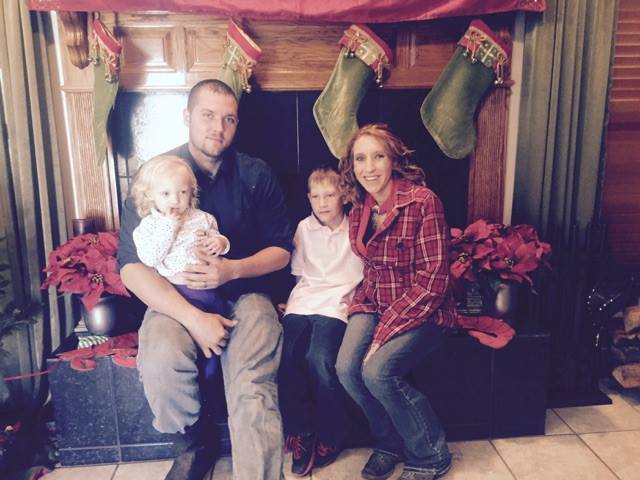
Staci and Brandon Pitre with their children, Cameron, 8, and Brooklyn, 3.
That was the beginning of Roman’s Wings of Hope, a nonprofit that has become Staci’s full-time passion. With Brandon by her side, the mother of four – Cameron 8, Brooklyn, 4, Roman, who would be two and Isabella, 1, gave up her regular job amd benefits to devote herself to family and helping other parents cope with their grief.
Initially, Roman’s Wings offered $300 towards grief counseling. “But when we found out there were other programs like that, we wanted to do more,” she said. Her oldest son Cameron is affected with Asberger Syndrome, and became very attached to a stuffed bear that would have been Roman’s – inspiration for the Hope Bear program.
“We saw how he slept with the bear and kept it close and thought, how many other siblings might appreciate having a bear, something tangible, connected to the little brother or sister they’ll never grow up with? said Staci. To date, more than 3,000 Hope Bears have been sent to hospitals throughout Louisiana, and around the country.
But when the couple found out about Cuddle Cots, Staci’s mission truly crystallized.
A cuddle cot is a medical cooling system, a temporary mausoleum in the form of a bassinet. The cooling unit allows parents time to spend more than the short window afforded due to the natural decomposition process. “Once we leave the hospital, there are no more kisses or physical connections,” said Staci. Only the few memories we were able to make.”
Roman’s Wings of Hope has made it possible for nine of the $3,700 units to be placed in hospitals around the state of Louisiana, including two in Lafayette. “This time means everything to a parent,” she said.
“Little is more tragic and devastating to parents than the loss of a child, especially those at a tender age and those just starting this journey of life,” said Katherine Comeaux, Neonatal Intensive Care Unit Director for Women’s & Children’s Hospital in Lafayette, where one of the units is now available. “The cuddle cot gives grieving parents additional time to be with their child after a tragic loss. These invaluable moments help parents to better cope.”
Lori Hardman
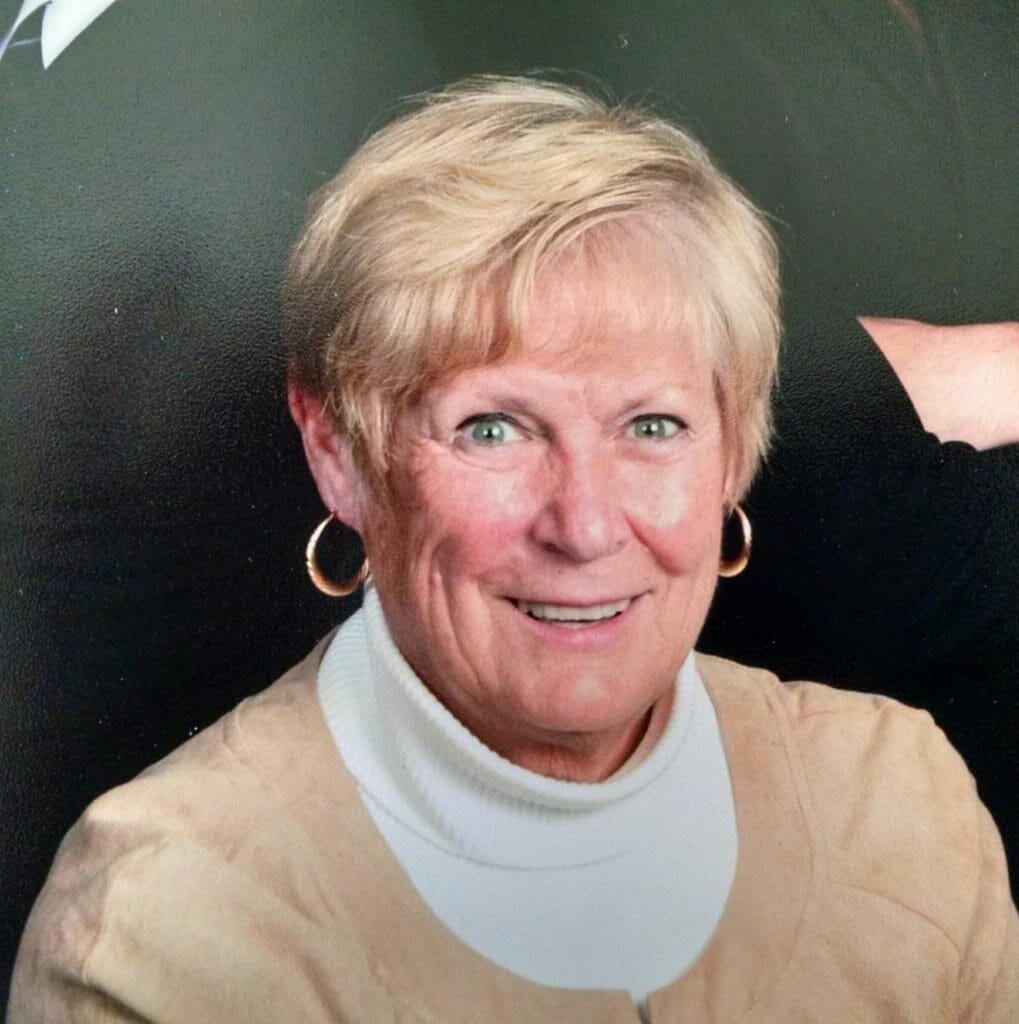
When Lori Hardman was writing rules and regulations for the EPA, she was used to the snail’s pace of bureaucratic red tape. “When I retired, I wanted to do something completely different, something that would give me immediate gratification,” she said.
Lori Hardman
Which is why on any given day, you might find Hardman outfitted with a tool belt working in the rafters of a Habitat for Humanity house in progress in Georgetown County, South Carolina. Located equidistant between Myrtle Beach and Charleston, Georgetown County is both coastal and rural, with a population in need of affordable housing. Hardman first volunteered with Habitat in her former home in New Jersey, a enthusiasm she transferred to South Carolina when she and her husband retired.
To date, she’s helped build 25 homes. “I’ve always been kind of handy,” she said. “After I retired, I volunteered at a women’s shelter and a local hospital, but when I found Habitat, I found my passion.” She spends an average of two days a week swinging a hammer or doing whatever it takes to make a family’s dream of owning a home come true. “Habitat Georgetown has given me the skills I need and a way to use them – I’m very grateful,” she said. “It’s a real team effort.” She also helps with fundraising events as well as volunteering at Habitat’s ReStore when needed.
Hardman likes that Habitat empowers people with a helping hand, not a hand out. “The homeowners have to qualify for a mortgage; they learn about the practical, financial and legal aspects of owning a home. They have to put in hundreds of hours on the build,” said Lori. The simple homes are built with mostly volunteer labor at an average cost of $70,000. They are then sold to families with a 25-30 year, no-interest, no profit mortgage. The mortgage payments go back into a revolving fund for building additional homes.
“Many of the homeowners stay on and volunteer to build the next home for somebody else,” she explained. “That’s great way to pay it forward.”
Hardman is usually one of the few women, and sometimes the only retired woman working with the Habitat team. “I do this instead of crossword puzzles – putting cabinets together is just a different kind of puzzle!
“I really wish more women would get involved and see how much fun this is,” she said. “It’s a great work out – I feel strong and healthy and very happy to be doing this work. Seeing the smiles on the faces of the homeowners is what keeps us going house after house.”
Charlie Starbuck
As a 10-year-old boy in Philadelphia, Charlie Starbuck spent most of his time up in a tree. Today, he volunteers his time, making sure another city’s children have the same opportunity.
Since 1981, the San Francisco resident has donated his time to Friends of the Urban Forest (FUF), an organization that plants trees on residential streets in an effort to increase the city’s canopy cover. Currently, he says, San Francisco ranks No. 18 in tree population among large American cities.
At least one day a week, Starbuck works as one of FUF’s 20 planting leaders, heading up a group of volunteers who gather each Saturday from 8:30 a.m. until noon. Of the groups that meet weekly, each plants between five to 10 trees, totaling 40-to-60 trees per session. Starbuck also teaches homeowners about tree species and how to care for them throughout their life cycles.
To date, Starbuck says he’s planted thousands of trees by working with the organization roughly one-to-two days a week. And, he has an emotional attachment to his work.
“I have a very large family,” he says. “I can’t go many places in San Francisco without seeing a tree I helped plant.”
In addition to adding foliage, FUF impacts the city economically. Staff members raise money to purchase the trees, keeping the cost low for interested homeowners. Instead of paying $600 for a city-provided tree, owners only pay FUF $100-to-$125. Realtors also estimate having a tree increases property values by approximately $20,000, he says.
Even with 30 years of weekly plantings, San Francisco still needs FUF’s contributions, Starbuck says. And, he’s committed to the mission.
“We have a long distance to go to get good canopy coverage in the city,” he says. “I’m going to be involved for as long as I can function.”
BB Maboby
“I started work as an oral surgery medical sales representative, and I saw dentists doing trial oral surgeries. I realized that there were people who could benefit from those services but who weren’t able to afford them. I decided to pair those people with surgeons who could help them.”
BB Maboby
BB Maboby created a network of dentists willing to volunteer their time and skills to provide life-changing dental services for patients, nationally and internationally, who either don’t have access to or cannot afford complex dental care.
As an oral surgery medical sales representative, BB worked with dentists who provided specialty services to patients. In some cases, patients’ dental needs were so severe they didn’t smile or covered their mouths when talking. To bring needed services to this group, she launched SmileOnU, an organization that pairs volunteer dentists with patients who need dental surgery to improve their smiles.
SmileOnU serves anyone who has a need for dental assistance. Potential patients fill out an online application and share their stories. In many cases, patients come from women’s shelters, homeless shelters and foster homes. The ones BB selects are matched with a dentist with the skill set that can meet the patient’s needs. Through partnerships with various dental supply companies, she gathers donations and provides the volunteer dentist with the resources to complete the surgeries.
In addition, BB organizes medical mission trips for volunteer dentists to provide services for people in other countries. In 2015, she will take partnering dentists to Cambodia, and in 2016, she has planned a trip to Nicaragua.
Within its first year, SmileOnU reached its goal of serving one patient a month. Dentists in the SmileOnU network offer specialty services, ranging from oral bridge work to full-mouth reconstructive surgery. Working alone, BB has already secured $130,000 of in-kind donated services and equipment. SmileOnU dentists provide services from beginning to end with many treatment courses lasting up to one year.
BB believes SmileOnU is an innovative endeavor because it brings together a wide variety of dentists, labs, and companies to offer complex, corrective dental procedures to patients who can’t afford the services. Through her referral system, she identifies patients and pairs them with the most appropriate dentist.
SmileOnU is BB’s passion because she believes a smile is the universal symbol for happiness and everyone deserves the right to eat comfortably with a smile. As an oral surgery device sales representative, she realized that complex dental procedures are a luxury service that many people can’t afford. She wanted to create an avenue that made corrective dental procedures more accessible for all people.
“I saw that I could give a smile as a gift. It can be very healing if you can give someone a smile when they’ve never had one before. It’s priceless.”
“I came from – and have seen – real hardship. I’m sensitive to that. That’s why I give.” BB was born in a refugee camp in Thailand during the Khmer Regime and credits her experience with wanting to give back to the community.
Amanda Ankner, Business Innovation Project Coordinator with dental supply distributor Benco Dental, a company that donates supplies to SmileOnU, says, “SmileOnU started a little more than two years ago, but the impact BB has made is real. She’s taking people who don’t have the ability or financial resources to get cosmetic procedures or necessary dental work done and giving them the opportunity to have a nice smile and present themselves in a better manner.”
Doug Graves
People who volunteer like to say they enjoy giving back to their communities. But what if you move every few years and you’ve only just arrived in your community? It takes a special drive, a special motivation, to be able to jump right in and start “giving back” to a new place where you have no history and don’t know a soul.
But that’s what Doug Graves has been doing for more than 40 years.
He says it’s an ideal way to meet people, make new friends and get to feel part of a new community.
Graves often relocated during his career with GTE, a nationwide telephone company that became Verizon Communications in 2000. His dad had also worked for GTE, so Graves was accustomed to moving all the time. But by the time he launched his own coast-to-coast career, he’d experienced something that drove home the importance of volunteering.
Graves was a junior in high school, living in Los Angeles with his family, when the Sylmar earthquake struck.
“That was one of the big tickers that pushed me into community service,” says Graves. “Being a high school student and being able to get out on my own and help people, along with other groups – I just continued that public service from then on.
“We had no running water, we had no electricity. But growing up camping, you have no running water and electricity, so you make do with what you have,” Graves explained. “Around my neighborhood, we helped. We’d go to houses and help them clean up.”
Over the years, Graves certainly did not seek out natural disasters. But when he was living and working in Kentucky, storms and tornadoes struck. When he was transferred to North Carolina, he experienced hurricanes. And in southern California, there were wildfires.
All of those events required scores of volunteers.
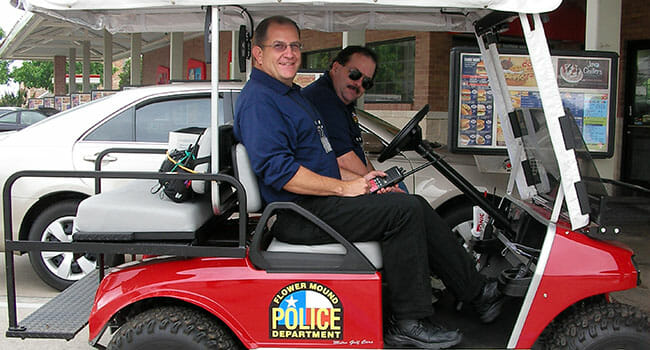
But Graves’ commitment to volunteerism extends beyond disasters. He became a volunteer firefighter while he was living in Kentucky, and works with the police department in his current home of Flower Mound, Texas, a few miles north of Dallas. He logs tireless hours with Special Olympics, and as a weather spotter for the National Weather Service.
His volunteer activities have exposed him to sad situations. He acknowledges that after helping at the scene of a fire or car crash, “You live with the image that you see.” But he adds, “It depends on how you look at things. If you look at it from, ‘That happened to that person and what can I do to help mitigate the long-term effects of it?’ – it makes a big difference. I don’t dwell on the incident; I do what I can to help the people involved in the incident.”
Graves has great memories, too. He met his wife, Pat, while giving his all one freezing night in Kentucky, when vehicles were sliding into ditches during a rare snowstorm.
“We were both out helping people along the Interstate,” Graves recalls. “At 2 o’ clock in the morning when it’s sub-zero and it’s cold, it was, ‘Hey, do you want to get some coffee somewhere?’ So we went back to the Red Cross Chapter house and it all started from there.”
To this day, Pat joins her husband in his volunteer activities.
“When I was out storm-spotting last night, she was my observer,” he says.
Now retired, Graves says he and his wife are staying in Texas.
Police Capt. Wess Griffin credits Graves with helping to build an enthusiastic volunteer network in Flower Mound. After completing the department’s first Citizens Police Academy class, Graves has rallied other alumni to embrace year-round projects, from helping with security at high school football games to collecting Christmas toys for kids to driving “citizen patrol” cars equipped with police scanners and radios.
“Every year, they bring Christmas dinner to our officers,” says Griffin. “That’s very selfless of them to leave their families on Christmas Day to feed a bunch of cops.”
In fast-growing Flower Mound, volunteer groups also promote friendliness and curb crime, says Griffin.
Graves advises newcomers who’d like to contribute to their community, but don’t know where to start, to check newspapers or the municipal website or Facebook page. “When you show up to some of these events, you meet others and socialize and they tell you about other things that are going on,” he says.
Another tip from Graves is to join a nationwide organization, such as the Red Cross, Rotary Club or Toastmasters, which have local chapters. That way, if you move again, you can pick right back up in your new neighborhood.
National Volunteer Week is a time where we celebrate people who make an extraordinary impact through service and solve problems in their communities. Nominate an outstanding volunteer, family or organization as a Point of Light!
Tired of Food Going to Waste, She Created an App So We Can Waste Less and Feed More
A food pantry volunteer since childhood in rural Iowa, Maria Rose Belding grew frustrated at the uneven nature of food donations. One day when Belding was 15, a well-intentioned donor gave her local food pantry a year’s worth of macaroni and cheese. “They didn’t ask us if we needed it,” she said. “But they gave us 5 tons of it.” After several months, clients at the food pantry were begging for something else, and after a year, the boxes were expiring. Belding was tasked with lugging the excess out in the snow to the dumpster. “As I did, I saw people outside, waiting in the cold for hours before we opened because they needed food so badly,” says Belding. “I thought, there has to be a better way.”
Belding says the need for food pantries across the United States is greater than ever. “Fifty million Americans used a food pantry last year,” she says. Yet pantries and soup kitchens were forced to discard some $650 million of food. Belding conducted hundreds of informational interviews and found that people loved the concept of connecting with each other to make more efficient use of food, but no one knew how to accomplish that. Her phone calls uncovered an additional problem: directories of food banks provided by community health departments and social workers proved terribly out of date. “Half of the numbers were incorrect because nobody was updating them,” Belding says.
Maria Rose Belding turned to technology to make more efficient use of items donated to local food pantries.
She created the MEANS Database (Matching Excess And Need for Stability), an interactive website allows food pantries and kitchens to quickly coordinate exchanges of excess food items before those items spoil—getting it into the hands of hungry people instead of the trash.
Belding, now a 20-year-old student at American University in Washington, D.C., sought technology for her solution. She tapped other students, especially her friend Grant Nelson, 26, a law student skilled in computer coding, to build a website where retailers and donors can post whenever they have unneeded food. A pantry, soup kitchen or other emergency feeding system can instantly claim the donation. They’re then given the contact information of the donor to arrange pickup.
Food pantries operate on a shoestring budget, so they often have older computers. To meet this need Belding and Nelson designed the program to be easily used on any system or smartphone. Alex Moore, chief development officer for DC Central Kitchen in Washington, says Belding’s program puts unused food in the hands of food pantry staff already trained in safe handling and delivery.
“Previous attempts to coordinate distribution of unwanted food failed to solve the problem of who’s going to get it,” Moore says. “MEANS helps people who are donating to feel better, knowing it’s going to be used well,” he said. A secret among food banks all across the country is that too often food spoils before it can be distributed, he notes. “Everybody kept saying, ‘If only there were an app for this.”
MEANS has spread to 42 states and DC in just two years, representing more than 3,000 partner agencies. Those users served more than 69 million meals last year. The system is so efficient that it works for perishable as well as nonperishable foods.
“Because we’re using the Internet, it’s actually fast enough to move fresher and healthier food,” says Belding. “If someone has extra bacon and eggs from a catering event, we can get those leftover bacon and eggs in the hands of homeless people who need it in less than 90 minutes.”
Belding’s enthusiasm for battling hunger proved contagious among others of her generation. Six more, all under the age of 26, work tirelessly to manage and improve the database. “Grant refuses to get paid,” she says. “Our computer developers are willing to work for much, much less than their work is retailed at. Most programmers trained in the complex coding used by MEANS make at least $100 an hour; Our programmers are willing to work for $100, or sometimes even less, a week.”
As a bonus, the MEANS Database is compiling an accurate directory of food pantries, designed to be updated regularly. “She’s like a superhero, doing MEANS in her spare time, while also doing homework as a pre-med student,” says Moore. “When she’s not doing that, she’s working at a camp for kids with diabetes, being a positive influence on their lives. She’s basically the Peter Parker of fighting hunger.”
Maria Rose Belding was also recognized by L’Oréal Paris and Points of Light as a 2015 Women of Worth honoree for her extraordinary efforts to cut down on food waste in the United States. If you know a woman who works to create lasting and significant change in her community, nominate her to be one of the 2016 Women of Worth.
Chess Without Borders
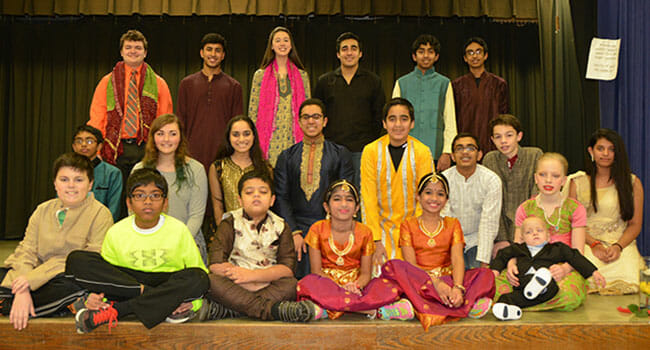
When nine-year-old Rishi Sethi started a chess club at his elementary school, he got the idea to teach the game at a nearby nursing home. Buoyed by the sense of helping others, the club branched out into other local community service projects, mostly chosen and managed by Rishi and his young classmates.
Now the club, Chess Without Borders, is about a lot more than chess. The Illinois-based club, started in 1998, has grown into an organization that helps causes around the world.
Club members have donated chess sets and textbooks to schools in the United States, as well as other nations, including in Nigeria, Sudan, India, Malaysia, Thailand, Chile, Cambodia and the Marshall Islands. Club members have done book drives for schools and raised money to buy wheelchairs for students with disabilities. Of course, the club holds chess tournaments all the time, managed by renowned chess champion Yuri Shulman, turning them into fund drives that have raised more than $125,000 for numerous charities.
Chess Without Borders is now open to kids throughout the Barrington 220 public school district, as well as nearby private schools.
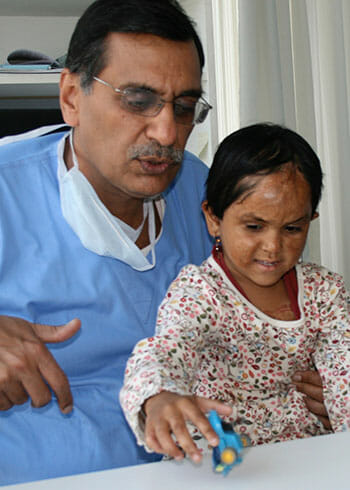
One of the group’s proudest efforts has been to help Meher, an impoverished little girl in India who was severely burned at age 4. Kids participating in the Chess Without Borders program raised thousands of dollars to help pay for Meher’s surgeries. But the kids didn’t stop there. They’ve continued to help Meher, now 12, and her peers, donating money for computers and other needs. Some students have even used their own birthday parties to raise money for Meher.
Many Chess Without Borders participants have been recognized for their service, with at least 100 club members and five teachers earning the President’s Volunteer Service Award for the depth of their community involvement. Rishi’s mother, Dr. Kiran Frey, says the President’s Volunteer Service Awards have made the kids want to volunteer even more, and Chess Without Borders participates as a certifying organization to help facilitate recognition of their most committed volunteers. Volunteers have earned the awards at the bronze, silver, and gold levels; in 2016, nine volunteers have been honored.
Frey continues to serve as director of volunteers for Chess Without Borders, even though her son is now an adult. She marvels at how “volunteering, which is supposed to be about others, helps the children” who do it.
“As a psychiatrist, I always see people at the end of the problem,” she says. “Here, these (positive) traits are becoming embedded into the characters of these students.”
Rishi, now 27, says volunteering during childhood helps develop the self-direction prized by millennials, a generation that seeks independence and ownership of their lives.
“I think the best thing about volunteering, especially as a kid, is it’s very entrepreneurial,” says Rishi, who founded New York-based Method Mill, which works with businesses to compile and analyze data. “It makes you deal with a lot of different people and things. I can say with certainty that the path I’m taking right now is very non-traditional. A lot of my friends, a lot of people that worked in Chess Without Borders, have taken a non-traditional career path. I would say that’s a direct result of early volunteering.”
Because he can do his work remotely, without being bound to an office, Rishi takes advantage of this mobility to visit home often – and remain active in Chess Without Borders.
But how does a chess club inspire kids to think of ways to help others?
Ethan Gagliano, 12, a participant in Chess Without Borders since he was 7, explains: “When Dr. Frey’s around, we really get going and we get great ideas. You know how some kids do soccer all the time? We’re thinking about fundraising and chess all the time.”
Gagliano came up with the idea of asking family and friends to sponsor him at chess competitions. He challenged them to donate $5 to charity for each win, and soon collected $500.
Eleanore van Marwijk Kooy, 18, who joined Chess Without Borders at age 10, says it’s been especially rewarding to help Meher over the years. Eleanore and other kids gave their own outgrown clothes to Meher and her classmates in India, and were thrilled to see them being worn in videos.
“It’s been incredible to see that she’s at the top of her class,” says Eleanore. “We’ve marveled at her progress. I’m very passionate about volunteering now and I’ll never lose that. I tell everyone, ‘If you’re not a mentor, become one.’”
“Once we had a consistent humanitarian venture to follow, the children got very motivated,” says Frey. “It’s been interesting to me to see how children build self-esteem and emotional intelligence through supporting philanthropy.”
Rishi was originally inspired by another Daily Point of Light Award honoree, Samantha Oliver, who was recognized in 1999 and is from his hometown of Barrington, Illinois – a reminder that we should take the time to share the stories of those who are making a difference in their communities, because we never know when it will inspire someone else to make a difference as well.
National Volunteer Week is a time where we celebrate people who make an extraordinary impact through service and solve problems in their communities. Nominate an outstanding volunteer, family or organization as a Point of Light!
Kathy Koenigsdorf
“An addict may maintain recovery by helping other people. To think about it visually, if he is reaching his hand out to grab another guy by the wrist to help pull him up, he can’t put a needle in his arm,” says Kathy Koenigsdorf, co-founder of the Jake Koenigsdorf Foundation. “We encourage everyone to help someone else; we foster a sense of community.”
Kathy is not addicted to drugs and never has been. But she learned how quickly it can happen and how tragic the results can be, after her 21-year-old son, Jake, died in 2013 from a heroin overdose. Today, Kathy works tirelessly to raise money for substance abusers who want help but can’t afford it. She created The Jake Koenigsdorf Foundation, and since 2013 has raised $156,000 and funded 172 people into facilities to start on the road to recovery.
Each day more than 120 people die from addiction. According to the Centers for Disease Control and Prevention website, the amount of prescription painkillers dispensed in the United States quadrupled between 1999 and 2013. Deaths from prescription painkillers have also quadrupled since 1999, killing more than 16,000 Americans in 2013. Nearly 2 million Americans, aged 12 or older, either abused or were dependent on opioids in 2013.
Too often, opioid abuse leads to heroin use. But while the trend has been widely publicized, Kathy found that she lacked support because “nobody talked about it.” She says grassroots efforts like hers are needed because doctors too often don’t take early signs of addiction seriously.
“In Jake’s case, they just started medicating him,” she says. “Nobody even used the word, addiction, except for my son.”
Kathy never thought she’d lose a son to heroin addiction. Jake came from a stable, well-to-do home on Long Island, raised by educated, professional parents. “Jake and I had a phenomenally close relationship,” says Kathy, but she was surprised when he confided that he’d developed an addiction to the prescription painkiller Oxycontin. He’d been given a pill from a fellow student in a cafeteria – it was a simple as that.
Just when Jake seemed to benefit from treatment, he was badly injured on the job at a construction site. Hospital personnel, unaware of his previous addiction, gave him strong opioids and prescribed plenty more for home. “It woke up the addiction,” says Kathy. Just weeks later, Jake was dead.
Kathy sets aside her grief to help others who are caught off guard by drug addiction. David S., of Ohio, credits her with saving his life. David, who says he’s battled multiple addictions for the past 10 years, is clean now, working at his trade of asphalt paving and working with others in recovery services. A year or two ago, he relapsed into heroin use after leaving a treatment center in South Carolina.
“This time, I really had no options for getting back there myself,” he said. “This time, I was busted, had no hope, nothing. I got in touch with the Jake Koenigsdorf Foundation and they—not knowing me from Adam—funded me to go into rehab for at least a month. They gave me a second opportunity at life.”
David says he’s so grateful for getting his health and life back that he mentors other recovering addicts and is extra-determined to stay drug-free.
“It’s always in the back of my mind that I don’t want to let her down,” he says. “There aren’t words for how grateful I am.”
Kathy has found that substance abuse isn’t a popular charitable cause. “There’s such a stigma,” she says. “It’s not cute. They’re not puppies or dolphins or little kids. We get absolutely no funding from commercial sources or other foundations. We have an incredibly hard time getting funding.”
In fact, she says, 90 percent of her project’s funding comes from individuals who’ve discovered the group’s Facebook page. “One lady gives me $5 a month; others will write a $500 or $700 donation once or twice a year.”
Kathy’s efforts to help fund drug abuse treatment have “morphed into a clearinghouse for connections” to help other mothers.
“After starting the foundation and helping their kids get help and find their direction, I help the moms and give them that support and sense of belonging,” she says. “I help facilitate them learning about other support groups—calling me when they need it, and calling other moms. We form a network of support, because women are getting really sick right now, both physically and emotionally. Addiction affects the entire family and we want to reduce the damage and promote healing for everyone affected.
Kathy Koenigsdorf was also recognized by L’Oréal Paris and Points of Light as a 2015 Women of Worth honoree for her extraordinary efforts to help substance abusers find the treatment they need. If you know a woman who works to create lasting and significant change in her community, nominate her to be one of the 2016 Women of Worth.
Norman Hurns
As a high school teacher in Detroit’s troubled public schools, Norman Hurns saw a need to inspire and motivate youth growing up in a city hit hard by changing economics and the shrinking auto industry.
But when Hurns transferred to an affluent suburban school district, he found no less of a need for his mission.
According to The Annie E. Casey Foundation, 40 percent of African-American children live in poverty – nearly double the national average. In Michigan, 56 percent of fourth-grade children in high-income homes are still reading below proficient levels. As Hurns suggests, income is not the only factor that affects a child’s performance in school.
“What I’ve noticed is the problem exists no matter where you are,” says Hurns. “Even in the suburbs, it’s still an issue, especially with black males. In general, our young men are just not performing at the same rate as young women; they’re not engaging in academics.
Brothers Making a Difference, the organization he founded in 2000, draws boys from a wider geographic swath, while meeting at a location that drives home his message of higher education: Oakland Community College in Royal Oak, Michigan. Since 2006, Hurns has focused the program in service to boys ages 6 to 9 because he believes it’s most effective to instill what he calls “life skills and character education” during the elementary school years.
Hurns ensures that the youngsters aren’t just “sitting and getting.” He teaches good citizenship by having them go out and do things for others.
“The experiential part of it, to me, is the most important part,” says Hurns.
The secret to engaging youths is doing something that teaches responsibility, he adds. The boys have participated in book drives and helping the homeless, exposing kids from affluent homes to the poverty “that’s in our backyard in Detroit” and showing less-fortunate kids that others struggle, too.
Hurns hopes to instill in the children of his community an allegiance to service. Leading by example, Hurns was awarded the President’s Volunteer Service Lifetime Award recognizing the more than 4,000 hours he has invested in serving the youth of his community.
Many of the activities are designed to open the kids’ eyes to personal responsibilities as they grow up. For example, Hurns arranged a field trip to a funeral home. “We talked about the responsibility as a man of your household to make sure you have insurance so your family will be taken care of,” he says. “We discussed with the funeral director about how to pay for a funeral, what it costs, and how devastating it would be if you can’t afford to do that and it happens. Then we had them go home and ask their parents if they have a plan. Do they have a folder where the information is?”
“We also do a financial literacy piece,” says Hurns. “We want kids to account for things, so nothing will be a surprise. There’s a fund if something happens to the house; there’s a fund if something’s not covered by insurance, for example, if the car needs tires. It’s your responsibility.”
It is important to learn at a young age that most things come with a cost, and while the kids are between the ages of 8 and 10, Hurns believes it is never too early to learn financial responsibility. He is intent on teaching children to plan accordingly, earn and then save money. He takes the kids to the bank and has them imagine various life scenarios, such as buying a car or home, and the financial impact these events will have.
The highlight of Brothers Making a Difference is a three-week summer camp on the college campus, where participants go on field trips, learn computer skills like coding, and read inspirational books and discuss how they can relate to the young male characters.
Torry Griffin, 10, has participated in Brothers Making a Difference for three years. Of helping to feed the homeless and pick up trash, Griffin says, “I was surprised that it was fun.”
Nathan Wells was a student of Hurns’ back in Detroit. Now, Wells is also a teacher and he volunteers as curriculum director for Brothers Making a Difference.
“Norman had a way of engaging African-American males to maximize goals for ourselves. He was just a great model of manhood,” says Wells. “Some 18 years later, here I am, with a bachelor’s degree in education, a master’s degree in reading literacy, working alongside him.”
Norman Hurns is a shining example of how social innovation, cross-sector collaboration and citizen engagement can drive change. Join us in Detroit in June for Points of Light’s Conference on Volunteering and Service, which provides the singular opportunity for thousands from around the world to come together to shape the future of volunteerism.
Kathy Hertz
Last winter, Kathy Hertz and her cousin, Joanne Feinberg, began discussing a vacation together, looking to echo the Mexican holiday they had enjoyed the previous year. “Nothing was quite speaking to us, though,” Hertz says.
Meanwhile, she says her heart was breaking each night as the news of a continuing humanitarian crisis unfolded before her eyes. Motivated by what she saw, Hertz turned to her career as a life coach, where she advises clients to disregard the voices that stop them from realizing their potential. “One night, I just said to Joanne — you know, what I really want is to go and help the refugees.”
By the end of the year more than 1 million refugees — about half of them from Syria, but others from Afghanistan, Iraq and other troubled nations — had arrived in Europe, according to The Independent. Often, they entered through Greece, which as a member of the European Union, serves as a geographically convenient portal into the Continent.
Feinberg was on board with the idea, and they soon learned that hundreds of volunteers from around the world had begun taking matters into their own hands by coming to the Greek island of Lesbos.
By the end of December, Hertz and Feinberg were right there beside them.
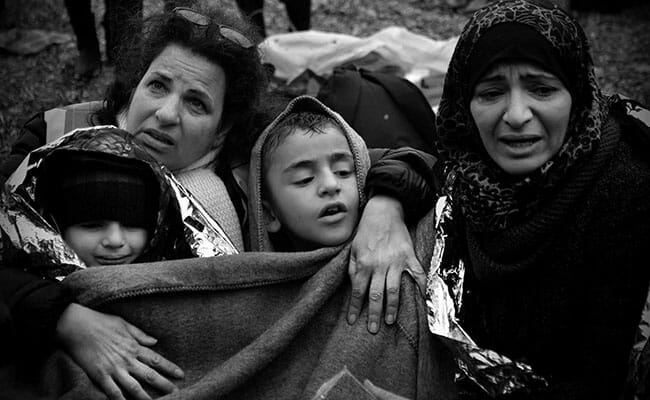
“Before we even got to the hotel, we noticed a dinghy on the water,” Hertz says. “I immediately pulled over and we tried to figure if and how we should help.” Three men were already in the water, waiting to greet the boat and rescue its children. A woman quickly explained that the volunteers should form two lines and pass each child down the line from person to person.
Although it may seem that the refugees are primarily men, Hertz points out that it only looks this way on television because, typically, the men fill the exterior of the boats to protect the women and children who huddle on the interior.
“I ended up holding a toddler,” Hertz continues. “He couldn’t have been more than three years old. I took him and wrapped him in foil blankets to keep him warm. He struggled for a bit, then laid his head on my shoulder and I just held him as tight as I could. Finally, someone came up to me and the child made a start and I realized it was his father.”
As if by clockwork, a bus operated by the United Nations High Commission on Refugees showed up to transport the refugees to a nearby camp.
There, Hertz discovered another amazing site.
Because the streams of refugees were too large to process, hundreds of people had been stuck in a holding pattern, wandering outside the environs of the registration center and sleeping in the dirt.
“By the time we got there just after Christmas, volunteers had built a whole community for them — there was a medical tent, a food tent, a prayer tent, a clothing distribution tent, a children’s play tent,” says Hertz. “It was still a hell, but one with a lot of love and caring.”
For the next week and a half, Hertz would divide her time between the shore and the camp, where she and Feinberg worked mostly in the clothing distribution tent.
For Hertz, participating in this huge grassroots volunteer effort illustrated how people can make a difference even in the smallest way.
“It’s just a matter of taking one little step to cross over the line against that voice in your head that says ‘I can’t do enough’ or ‘my contribution won’t really matter,’” she says.
Before leaving for Greece, the women raised $4,000 to spend on much-needed goods; for example, they used $1,000 of that money on site to buy shoes. They also brought donations with them — primarily cold-weather gear such as down jackets, gloves, hats and scarves.
“The best option, though, is to send money so the volunteers can determine what’s most needed and then go out and get it,” says Hertz. “Much of the clothing that they are receiving just can’t be used — stuff that is torn or dirty, or items like, if you can believe it, bikinis!”
If donors do send clothing, she added, it’s best to send gently worn item, pre-sorted and labeled.
Meanwhile, Hertz is helping to organize a rally in Washington, D.C., this summer that will raise awareness of the situation and give people the tools to help. Visit dcrally4refugees.org for more information or to get involved.




 Staci and Brandon Pitre with their children, Cameron, 8, and Brooklyn, 3.
 Lori Hardman
 BB Maboby