Dana Pounds
Dana Pounds, a marine biologist and co-founder of Nature’s Academy, brings science alive for many students and families in the Bradenton, FL area. Nature’s Academy is an experiential education non-profit that enhances classroom studies by engaging students in hands-on outdoor investigations. From sustainable agriculture practices to estuarine biodiversity, students study ecological concepts and issues, while understanding the importance of natural resources. Students are taught to “pay-it-forward” by participating in a coastal cleanup along local shorelines and making presentations to their schools about what they learned.
Pounds faced a rare cancer, desmoid tumors, in her late twenties followed by nine years of chemotherapy, radiation and the eventual amputation of her right leg. A constant advocate for scientific research and education, she she carted dry ice with her to the hospital to package her leg in order to donate it to scientific research. Her leg benefited studies at MD Anderson and Toronto’s Hospital for Children. These difficult struggles inspired Pounds to further realize her purpose and passion as an educator and spokesperson for cancer survival and research.
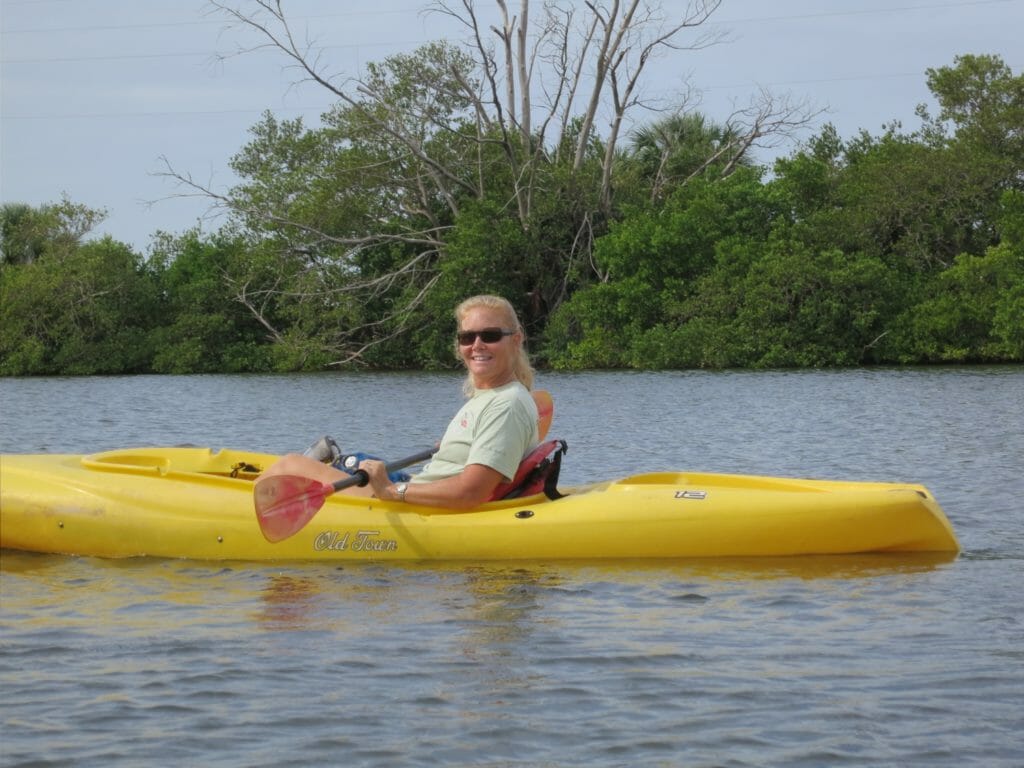 Pounds leading a group of students on a mangrove kayak.
Cancer drove Dana to truly consider how she wanted to spend her days, and what contribution she wanted to make to the world; which led her to create Nature’s Academy.
Last year Nature’s Academy served 7,000 participants in over 100 programs under Pounds’ leadership. Since 2009, more than 40,000 participants have attended Nature’s Academy programs. Students study water quality, science literacy, ecology, estuaries, watersheds and biodiversity. But students are doing more than just learning about this precious ecosystem; they have also collected more than 5,000 pounds of litter that may have ended up harming our waterways.
Although amputation often rids most survivors of cancer, for Dana, a desmoid tumor appeared in 2013. This recurrence didn’t stop her, but drove her to make an even bigger difference, and she took Nature’s Academy to a new level, securing an agreement that all 5th graders of Manatee County would receive a Nature’s Academy field trip. Pounds has overcome many obstacles in her lifetime, making sure nothing would stop her from advocating for science literacy and environmental stewardship.
Through her personal pursuit of running a marathon, Dana races with her prosthetic “running blade” in order to raise awareness and support for Nature’s Academy and The Desmoid Tumor Research Foundation. While teaching, Dana uses her disability as a platform to tell her powerful, inspirational story of perseverance and adaptation, encouraging participants to overcome challenges and pursue their dreams. Pounds hopes that her story of turning obstacles into opportunities will help others to navigate through and celebrate the gift of life.
Kelly Arbaut
As a 5-year-old, Kelly Arbaut was like many young girls – she loved horses. By 13, she owned one, and in 2004, she was using horses to therapeutically help special needs kids.
Today, with two other volunteers, Path International-certified riding instructors, Arbaut operates Kelly Therapeutic Riders (KT Riders), offering mounted and unmounted riding lessons on one of five horses mostly to children with special needs. Although they also serve some children without special needs, most children she works with have autism, Downs Syndrome, spina bifida, brain injury, Attention Deficit Disorder, or another mental health diagnosis.
Instructors offer lessons three times a week, teaching students how to ride, maintain their balance, improve their social skills, and augment their cognitive abilities. Group or private lessons are available with parents mostly choosing group lessons to strengthen their children’s social capabilities. In addition to weekly lessons, KT Riders offers spring and summer camps, as well as participation in horse shows.
Since its 2004 launch, Arbaut says, her program has impacted more than 100 children, and currently it serves upwards of 20 children each week. Even though most parents pay for the program, Arbaut says, she does give away lessons to less fortunate children she believes will benefit from participating.
“I do believe a horse can save a child or a family. I believe it with all my heart,” she says. “It’s not something you can really say with words. It’s something people must experience and feel. And, I just know when I see these kids out there with the smiles on their faces, it’s amazing for them. I can’t imagine it not existing.”
Within the next 10 years, Arbaut says she hopes to secure enough support and funding to begin paying her volunteer instructors a salary and covering all lesson costs, allowing children to participate in the program for free.
Kellon Oldenettel
The importance of socks, though it may seem pretty simple and rather inexpensive, should never be taken for granted. For the past three years, Kellon Oldenettel has been collecting and distributing new socks to those who are financially disadvantaged.
Collecting socks for those in need is so easy anyone can do it, just ask Kellon. At just seven-years-old, his project – Kellon’s Sock Drawer, has already collected and distributed over 5,000 pairs of new socks to those less fortunate.
“It does not matter how old you are, you can always make a difference,” said Kellon.
Kellon’s Sock Drawer has evolved into a recognizable asset of the Jacksonville, Illinois community. The program not only provides for those individuals in need, but the Sock Drawer directly services the local homeless shelter as well. Though Kellon is just a child, his effort has no limitations.
Kellon engages different people of the community to help with his cause. From children in his grade school, to a local college women’s society, Kellon reaches out to any and everyone that can assist. Besides reaching out to get others involved, Kellon also helps in collecting the socks, wrapping collection boxes as well as coloring and decorating flyers.
A lot of organizations will tell you that socks are often the most overlooked item and the least donated. Kellon is helping change that. Whether it’s the actions of children or adults, or whether it’s assistance from the Salvation Army or the local real estate company, Kellon’s volunteer efforts is helping lead his community to a better place.
Catherine Elliott
The way Cathy Elliott sees it, just because a person has special needs or is over a certain age or weight shouldn’t mean they lose their right to smile.
Elliott, a dental hygienist with more than 40 years of experience, worked for four years as a civilian contractor with the US Army in Germany, supporting deployed troops with mobile dental care. When she got back home in 2011, she saw a need in her own Albuquerque community and set about trying to fill it. There are an estimated 20,000 individuals with special needs and more than 130 senior care facilities in the greater Albuquerque area. That all adds up to thousands of people who can’t access regular dental care.
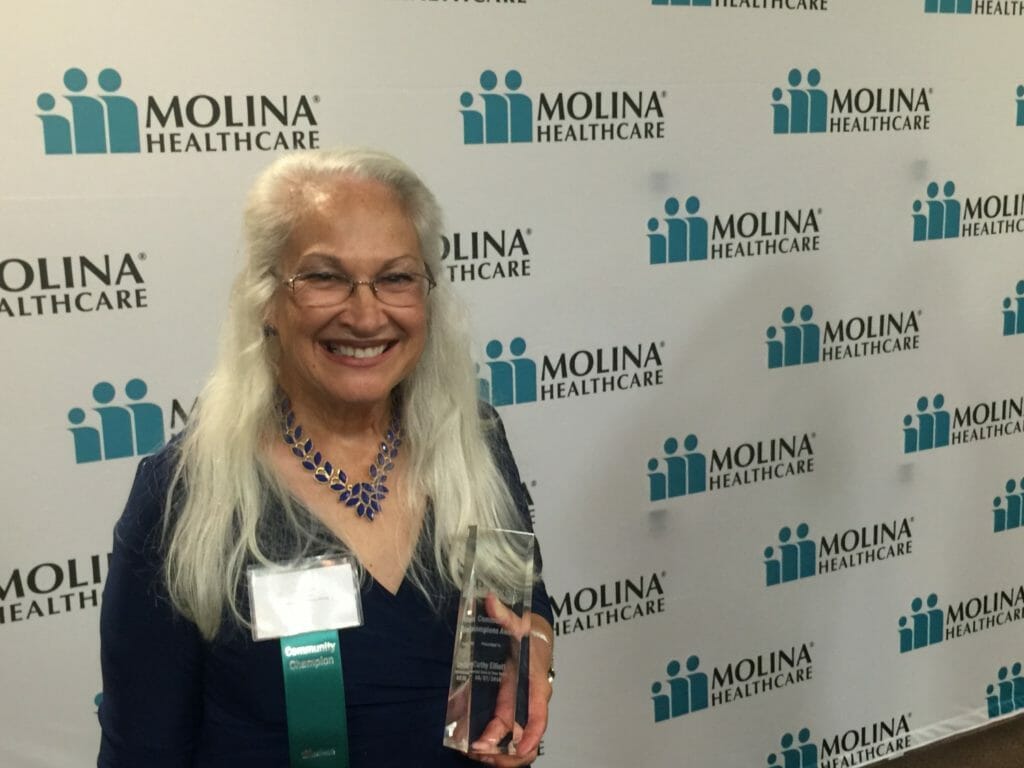 Elliott was recognized by Molina Healthcare of New Mexico with a Community Champions Award.
“In my regular job at a dental practice, I started noticing that there were patients who had quit coming in. Some had become frail or disabled, had problems with transportation, all kinds of reasons,” Elliott recalled. “Proper dental care not
only provides a better quality of life, but poor dental health can serve as an indicator for other underlying health issues like coronary heart disease and cancer. It’s important.”
Although she’d never been involved in any kind of non-profit business, Elliott knew she had to make a difference. Despite a warning that mobile dentistry was “back breaking and not profitable,” Elliott was not deterred. After doing plenty of research, and stepping out of her comfort zone to consult experts in the field, she founded Dental Care in Your Home (DCYH), a mobile dental unit that brings dentists and hygienists to the homes of people who can’t easily access traditional dental care. DCYH started seeing patients in 2012 and expect to take care of more than 600 people in the coming year, adding about 20 new patients a month to the roster.
The practice charges a standard fee schedule, works with Medicaid and private dental insurance. That said, since its founding, DCYH has given away some $150,000 in free dental care, with Elliott working completely pro bono and her colleagues at a much reduced pay scale.
Her patients can range from autistic adults to the morbidly obese and frail elderly with dementia. One man, in hospice for stage four cancer, was suffering from painful, inflamed gums exacerbated by chemotherapy. “We treated him with silver nitrate and three weeks later his gums were healthy and at least his mouth was free of infection and he could eat again,” she said. “It doesn’t matter how much longer he has to live, at least he’ll be able to smile and enjoy his food which will add to his quality of life. He deserves that. ”
Sandra Richardson
Meet Daily Point of Light Award honoree Sandra Richardson. Read her story and nominate an outstanding volunteer or family as a Point of Light.
When she was 11, Sandra Richardson’s family moved from St. Thomas, in the Virgin Islands, to Connecticut, following her father who had relocated there in search of construction work.
Always shy, young Sandra had a hard time fitting into her new surroundings. Though her parents – often busy with work – were loving, she didn’t always have the guidance she needed.
“After high school, I floundered a bit,” she says. It wasn’t until she was in her early 20s that she realized that to get anywhere, she’d need a college education.
Richardson eventually earned a business degree and landed a U.S. Navy accounting job, receiving several awards over the years recognizing her work.
After getting her career on track, Richardson, now 50, began volunteering for a local nonprofit, Historically Black College Alumni, to help disadvantaged students – often immigrants – avoid the detours that had plagued her.
“One of the main things I want to relay to young students reaching college age is the importance of spending some time taking inventory of what your interests are and how you might be able to use them in a career,” she says.
Founded by several alumni of historically black colleges and universities living in and around New London, Connecticut, Historically Black College Alumni promotes higher education with an emphasis on such schools.
 Sandra Richardson, far right, serves as chaperone during Historically Black College Alumni’s annual college tour.
Its most popular activity is an annual college tour during spring break that introduces students to several campuses. Richardson has accompanied students on these tours, and now spends the better part of each year planning the visits.
More than 100 historically black colleges and universities – schools that were established to serve African-American students before the civil rights era – are still around today.
“Not only do they offer a rich and unique cultural perspective,” says Richardson, “but they are often more affordable than traditional colleges.”
Meanwhile, Richardson has finally begun pursuing her own passion by going back to school for a master’s degree in public health and using her skills in another volunteer effort.
She found her calling by volunteering at a transitional home for women recovering from drug or alcohol dependency. She developed a healthy living program emphasizing nutrition and fitness, which she wants to introduce to other agencies.
“Now is the time for me to find a higher purpose in life,” she says. “It doesn’t make sense for me to exist in this world just for me.”
Linda A. Offray
Linda Offray’s decision to launch an organization dedicated to helping victims and survivors of domestic violence came out of personal experience. Her then-17-year-old daughter suffered through – and escaped – and unhealthy adult relationship. But, at the time, few resources were available to help get her life back on track.
So, Offray launched Shepherd’s Door, a Pasadena-based organization that has helped thousands of women and children recover from or avoid abusive relationships. Women of all ethnicities, socio-economic statuses, and ages can take advantage of the organization’s services.
In addition to being a rescue mission for women fleeing abusive situations, Offray says, Shepherd’s Door also offers financial and educational resources. Roughly six years ago, the group partnered with the Pasadena Unified School District to make several presentations to 6th– through 12th-grade students, teaching them the signs of unhealthy relationships. To date, they’ve reached 500 students with a goal of 1,500 by year’s end.
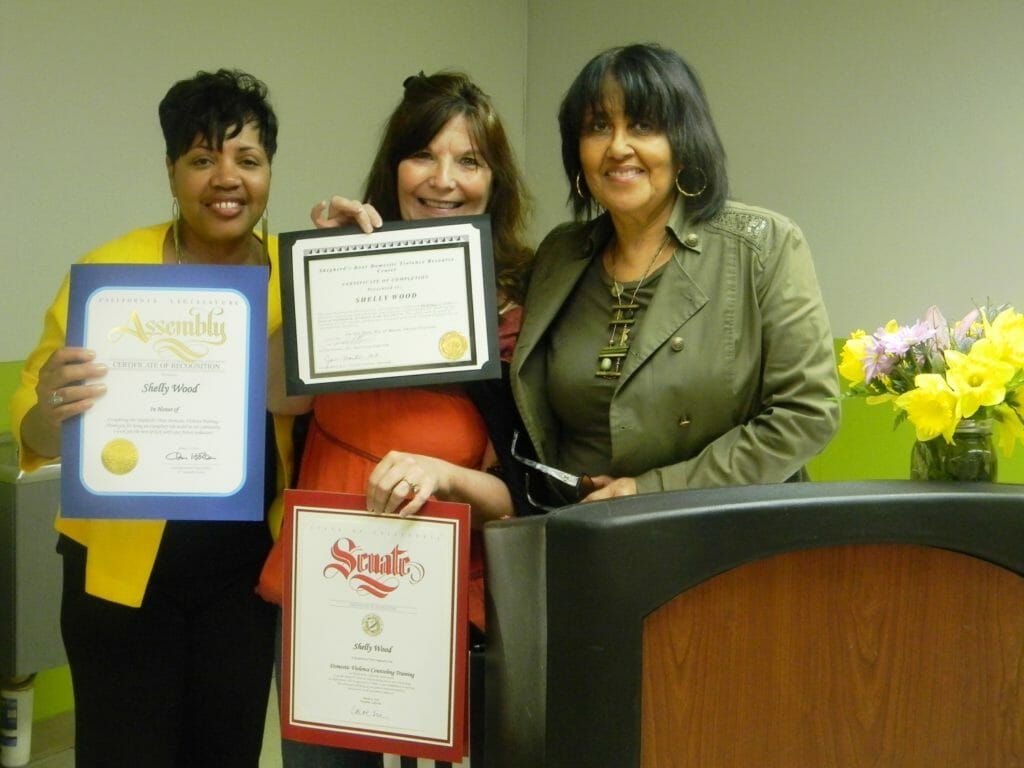 Offray, right, with Shelly Wood, a graduate of one of the 40-hour domestic violence counseling training, and Jan Martin.
 The organization also offers free cell phones to victims who participate in educational programming through a Verizon partnership, bus tokens and taxi vouchers to help with any needed travel, and financial literacy and artistic healing programs. They also offer 40 hours of domestic violence counseling training.
All these programs are designed to help women reclaim their strength and their lives.
“Over the years, I’ve seen women through our support groups because they’ve begun to form bonds with each other,” Offray says. “Some women offer their homes to each other when someone doesn’t have a place to stay. I’ve seen women go back to school and get their GEDs, their associate’s degrees, bachelor’s or master’s. One even went on to become Miss Pasadena.”
It’s successes like these that prompt Offray to pursue big goals over the next five years. She is looking to extend the school education programs into the Los Angeles Unified School District in the near future.
Dan Mills
Despite laws and age regulations, there are still far too many teens dabbling in drug and alcohol use. While this is an issue all across the country, it has become very alarming in Lee County, Florida. According to a 2014 Florida Youth Substance Abuse Survey, 20% of Lee County teens used alcohol in the past 30 days – a figure that is way too high.
The Lee County Coalition for a Drug-Free Southwest Florida is working to lower such numbers. Dan Mills, a volunteer for the Coalition works closely with children to keep them on a positive path. Mills, who serves as the Vice Chair of the Coalition, has spent the last three years developing and implementing strategies to help teens make good decisions about alcohol and drug use.
The Lee County Coalition hosts a number of educational events throughout the year advocating for the prevention of drug and alcohol abuse. Mills’ devotion and problem solving skills is essential in the operations of these events. From his work with the #refuse campaign, aiming to make prevention accessible to Lee County families, to his work with the Busy Bank Run for Prevention, a fundraiser for those in need, Mills’ volunteer efforts is helping make a difference.
Though he balances a full-time job, helps raise a family, as well as volunteer with the Little League and coach a softball team, Mills still finds time to give back. His dedication toward youth alcohol and drug prevention is helping shape a better Lee County.
Donna M. Gatcha Hines
When she volunteers at an organization like Al Beech West Side Food Bank, Donna Gatcha Hines doesn’t have to try hard to imagine how folks can get into a tough spot and need some extra help.
Hines, 42, who lives in Wilkes Barre, PA, has been there. In fact in some ways, she’s still there. The mother of three children ages 9, 12 and 15 was a stay at home mom when she divorced her abusive husband in 2013. “We lost everything, our source of income, home, all assets,” she explained. “I couldn’t believe somebody with two masters’ degrees could end up in this situation. I had been out of the job market taking care of my kids. I was overqualified to work most jobs and the cost of childcare made going to work at minimum wage a losing proposition.”
Yet despite her struggles, Hines continued to do something she’d been doing since her oldest boy was an infant – she volunteers. Her oldest was born medically disabled and as soon as his condition was stable, she started volunteering with the Children’s Miracle Network. These days, Hines gives back to 12 nonprofits in all, each with a special meaning to her and her family. She’s lost people close to her to lung cancer, so she volunteers for the American Lung Association. Her brush with homelessness inspires her to walk to raise community awareness for homeless women and families. “There were times when I’ve been accepting help from the same organization where I was volunteering,” she said.
Hines has also reached out to other women who have experienced abusive relationships through her Facebook page The Lost Self – Life After Narcissism. “In the beginning I felt so alone, but there are so many other women out there who need to share their stories,” she said. “We can’t listen to the naysayers – if nobody applauds us, we have to applaud ourselves.” Her message resonates – in one year’s time the page has more than 15,000 followers.
Awarded the Cabot Creamery Cooperative Award in June 2015 for her impressive public service hours, Hines feels strongly about changing public stereotypes about poverty and homelessness. “My life didn’t go as planned. I didn’t plan on becoming divorced, bankrupt, homeless, and living daily in survival mode,” she said. “But I’m not lazy, I’m not looking for handouts. I never said, “Why Me?” I know things are going to turn around for us, as long as I stay focused on helping others.”
Kimberly Fink
Kimberly Fink founded Treatmint Box and Fuel for the Fight Foundation, with a mission to connect friends and family to people with cancer. To date, Treatmint Box has helped thousands of families connect and has provided a little comfort and love to patients in the middle of their fight with cancer.
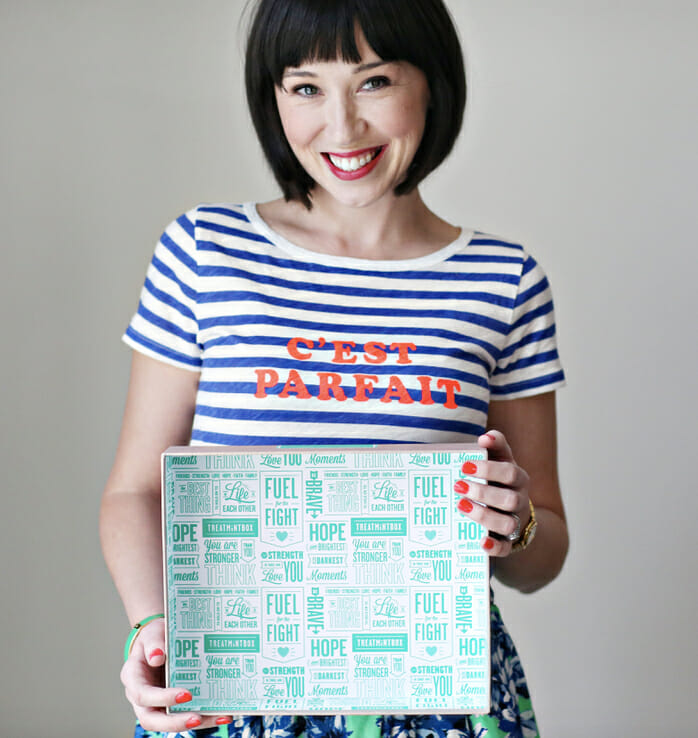 Kimberly Fink
A young adult cancer survivor, Fink has taken her own struggle with cancer and used it to bring comfort to other people in the same position. During her fight with cancer, she saw how people wanted to help, but just weren’t sure how to continue that support after the initial phone call or card. It’s a common cancer experience to find yourself in the middle of your battle and suddenly having less people around to lean on.
These boxes provide comfort, but most importantly they connect the friend or family member that sends the box to the person who receives the box. These boxes help patients feel less alone. They are filled with comfort and inspirational support.
Treatmint Box provides a unique approach to the problem that many cancer patients face: loneliness. Each unique monthly box contains a curated selection of items chosen for comfort and inspiration. Friends and family leave a personalized message of encouragement and the boxes are delivered right to the loved one’s door.
Fink is an innovator and has a deep passion and commitment to the cancer community. She’s found a way to harness the power of family and friends to support struggling patients. Her work with Fuel for the Fight donates resources to those who cannot afford such luxuries and makes sure that no matter who you are that you aren’t fighting alone.
DPOL -Julie Davis and Cheryl Hays
After interior designer Julie Davis completed a mission trip to Africa five years ago, she knew that she would want to continue helping women and children once back home to Nashville. Thinking about her own expertise and the fact that many of her clients, because they were re-decorating, often found themselves with extra furniture and home furnishings, she hit upon an idea.
“I thought I could operate as a connector between them and those that might need their extra items,” she says.
Another lightbulb went off, though, when a mutual friend introduced her to the CEO of the local YWCA. Davis learned how the organization was taking in women who had been domestically abused to help them on the road to healing. As part of that process, the women could apply for subsidized transitional housing — moving them from the save haven of the Y to new lives on their own.
“At that point, the Y could only provide an inflatable mattress and a few basics to set them up in their new homes,” says Davis. “So a partnership that would take advantage of my access to extra furniture seemed like the perfect marriage.”
Soon, Davis and another friend, Cheryl Hays, a registered nurse, were operating Re-New, a furnishing service that’s became an official program at the YWCA of Nashville and Middle Tennessee. “When these women leave their abusive situations, they don’t take anything with them but their children and the clothes on their back,” says Hays. “We thought they deserved so much more.”
Davis, who still maintains her interior design practice, chooses from an inventory of gently used furniture and all the trimmings — from artwork to lamps, from bedding to dishware — to match the ages and genders of the people who will be living in the space. Meanwhile, Hays works almost full-time on the effort, managing the stock and coordinating donation pickups and the schedules of some 65 volunteers. Together, they all work to shower more than two dozen women and their children each year with the hope and love of a warmly outfitted home.
“Most of our volunteers are women because I think there’s a commonality there that has to do with nesting,” says Hays. “Put eight to ten women in an apartment, give them two hours — and you’re done. There’s flowers on the table, food in the fridge, and dinner on the stove. It’s a gift of unconditional love but I feel that we and the volunteers get even more out of it than these women do.
“We’re honored to be part of their brave journey.”
Adds Davis, “when they first see what we’ve done, from the welcome mat at the door onward, they are just blown away. The things that people donate have been phenomenal. It’s shown me that although a lot of people think that the problem of abused women is so big,” she continues, “if you give them the avenue to help they’ll see that they can make a difference one home at a time. They see their contribution go out the door and immediately enter back into the community.”



