Volunteer Uses Fashion As a Tool to Help Girls Succeed
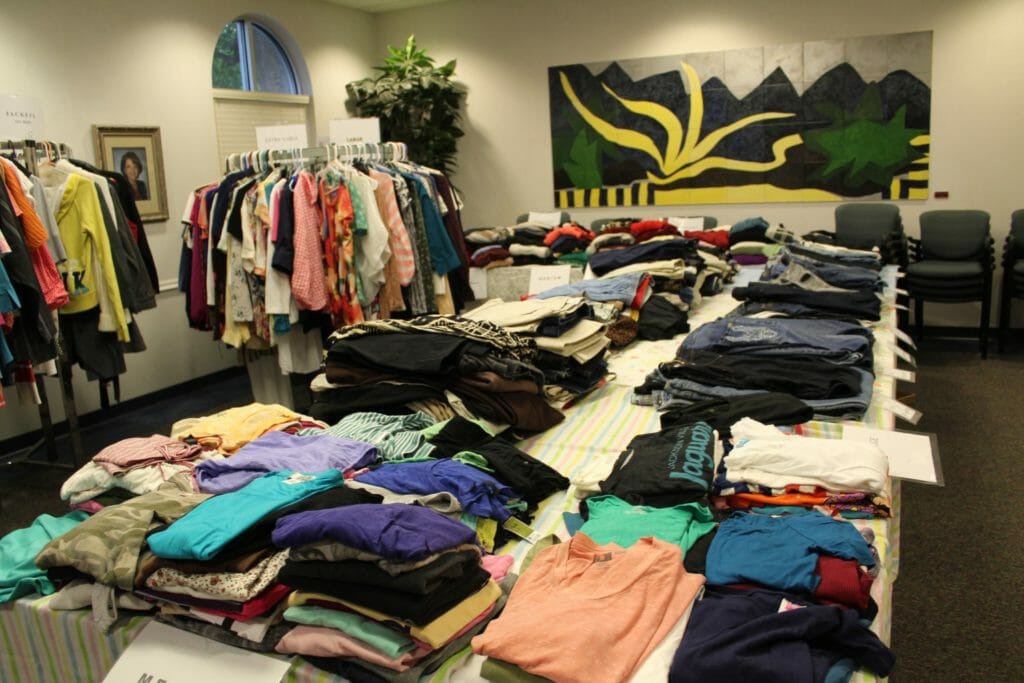
Mary Warner is a super volunteer that runs Ms. Mary’s Boutique, a “shopping event” that’s named after her. It allows the girls at PACE Center for Girls of Jacksonville, Florida to shop for new or gently used clothes and accessories, through an incentive point system. Mary is today’s daily Point of Light award honoree, and Points of Light spoke to her to learn more about Ms. Mary’s Boutique and why her work is so important.
You are heavy involved with Ms. Mary’s Boutique, formerly known as the Clothes Closet, at PACE Center for Girls of Jacksonville. Can you tell me how you got involved with this?
About 14 years ago, a man at work [suggested an idea.] I was president of the local chapter of NARBW, National Association of Railway Business Women, at the time. And he recommended that since we were a women’s organization and this school [PACE Center for Girls] was for girls that I might want to learn more about it. We were quite impressed [with the school] and one of the handouts that they gave us was a “wish list.” And one of the things was to run Clothes Closet.
Can you tell us more about the program, when you were first introduced to it?
It was not what I anticipated. I thought I’d go straighten up some clothes for them or something.
But they had half a dozen black trash bags of clothes, which they laid out on tables and the girls could come and “buy” them, with points they earned for positive behavior. So, I said to several of my friends, “This is not exceptional. This is not acceptable.” And so we started putting out the word to all our friends at church and at my company, if their kids had new or gently used clothes in their closet, “Could I please have them?”
We used to do it, 14 years ago, in one day. We’d set-up in the morning and the girls shopped in the afternoon.
Through your service, how has this program changed?
We grew so large!
I went to a store going out of business and bought some racks and instead of just laying the things on tables, we started sorting them by size and hanging them up. And it would take the better part of a day to set-up and the next day the girls would come in.
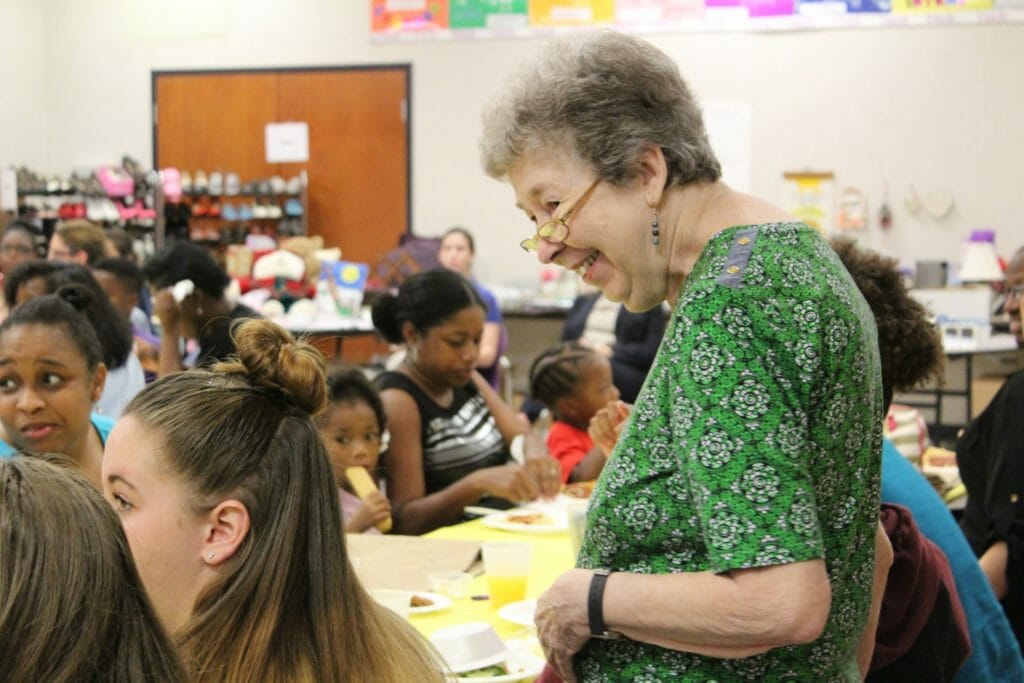
Anything that’s free has no value. So, they earn them with their points. So, it’s an incentive program. We’ve grown from just some slacks and jeans and shirts to… jewelry, shoes and all kinds of things that young girls like. We do it quarterly now. You want to offer them appropriate seasonal clothes. It has also grown that I help [the girls] get prom dresses and we do the same thing. We set-up by sizes and then the girls come and get prom dresses, shoes and purses.Another thing that I did, I put out the word that anyone who has high end shopping bags or any other nice store bags to please bring them to me. I wanted the girls to carry their things on the bus looking like every teenager!
Can explain a bit more about the points system used to help the girls “purchase” these items?
Things like maybe a girl has been habitually late…and when she shows improvement, either her teacher or her counselor will award her points. And also, as they improve, they will move up in levels, not grade levels…this is in their level of improvement. The higher they go in their levels, the more that they get to come and get first choice to purchase items. These girls are 12-18 years old.
Can you explain what it’s like on the shopping days?
(Laughs) It’s so exciting. They just can’t stop talking “Oh, look at this blouse. Oh, look at this shirt. Oh I want this.” But also I saw one youngster who looked like she was probably a [size] four standing over my extra-large rack. And I very quietly went over to her and said, “Sweetheart, do you realize that you are looking at the extra-large clothes? And she said, “Yes, Ms. Mary I do. But I’m looking for something for my grandmother that I live with. Now, when they reach a point [like this]… I know that’s self-improvement.”
Why do you think this work so important?
I have a daughter, a granddaughter and a great granddaughter who have had very good lives. And I think that every child, and especially young girls, deserve the same kind of life. And if there’s anything that I can do to improve their quality, I want to do that. I want these girls to have hope. I want them to have a future. I have had heard some stories from some of these girls that are heart breaking. But then you see them — because some of them come back later after they’re in college or doing other programs and come help me — which gives me an idea that we have improved their lives.
Do you see yourself continuing this work for as long as you can?
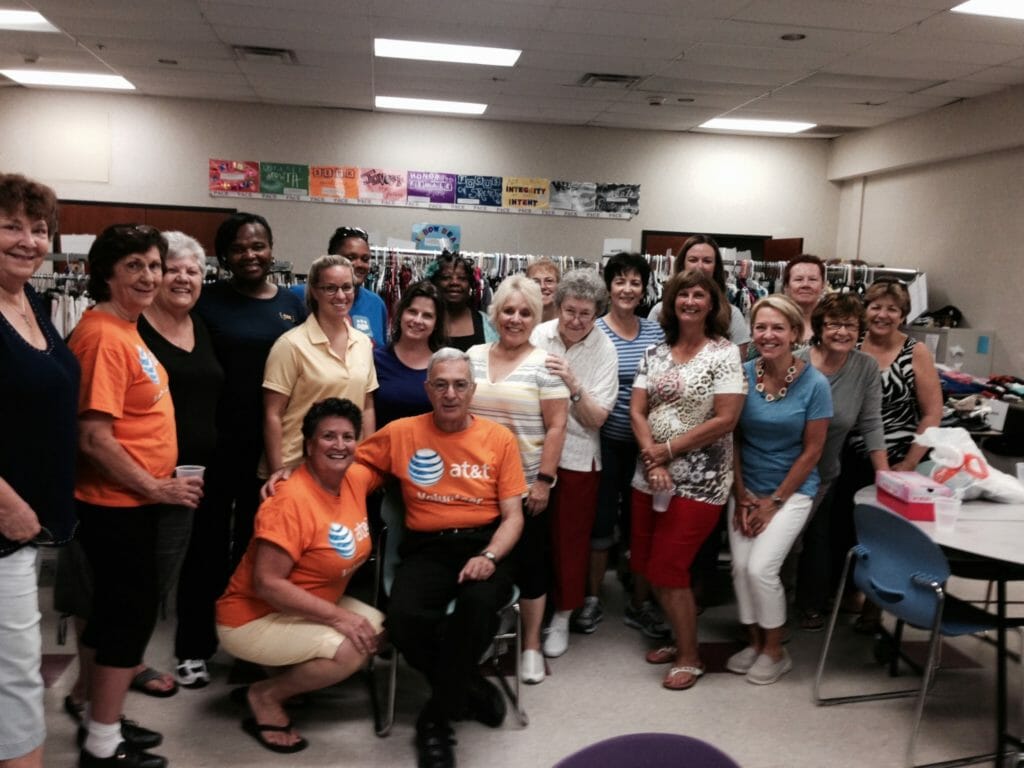
Absolutely. Also, I am training a couple of ladies to take over for me when I can no longer do it. I don’t want it to stop. I don’t want it to change. I want it to keep advancing in the way that we display the clothes and help the girls. Because not only are we helping find items to wear, but we are showing them good role models. I’ve had young career women come and volunteer and they get into conversations with the girls and so they look to them and think, “That could be me. I could do that.”
What do you hope that people reading this will be inspired to do?
I hope they would realize that there are many, many ways to give back to the community and to improve the lives of our future generations. You never know how this impacts other people.
Mary strongly believes that people can volunteering, doing what their passionate about, to helps others. To follow Mary’s inspiring lead, check out All for Good, to find a service project in your area.
Putting One Foot in Front of the Other to Guide Others to Success
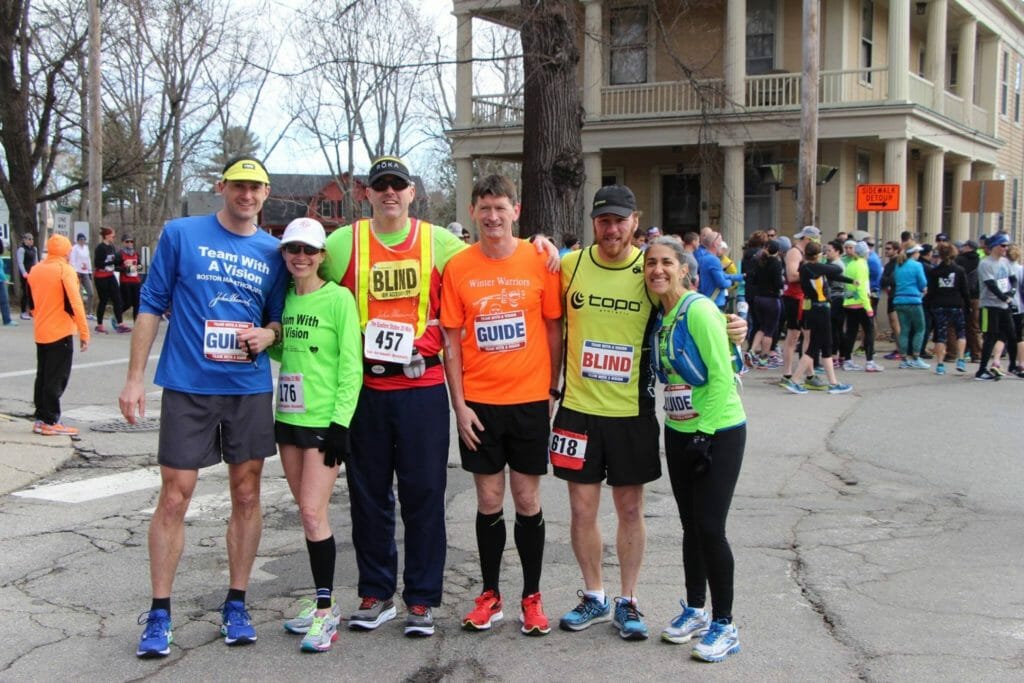
Putting one foot in front of the other is a mantra that a plethora of people use to literally put their best foot forward in life. It is a statement of encouragement and perseverance, to continue on whatever path leads to success. For Seth Waterman, it means running in marathons and leading others to much more than just a finish line.
Seth, who took up running as a pastime after college, did so for most of the reasons others do. It was an activity and a sport that was on his own time, that kept him in shape and satiated his competitiveness. And he had thought to spread his love of running to help others through volunteering. It wasn’t until friends of his pointed him to volunteer work directly regarding visually impaired people – who loved to run just as much as he did.
Seth joined MABVI, the Massachusetts Association for the Blind and Visually Impaired, and became a guide for their runners.
“They reached out to me and I decided I wanted to run a marathon,” he said. Seth ran in Boston’s 2015 marathon as the most recent guide. “It’s being able to share the joys of running with someone else that enables them to essentially do it on their own,” Seth said. “Having that experience and enabling them to experience it on their own.”
Seth values his role in building moments with the runners he guides. He recalled a moment in a Boston race in 2015, where the woman that he guided thought she wasn’t going to make it to the end.
“Joyce and I had a set goal time and [we] hit a rough patch,” Seth said. “Joyce thought we weren’t going to make it, but we got through that. We hit the time exactly. It was such an accomplishment.”
Seth recalled what a friend told him. “I’m never going to compete in the World Series or the Superbowl but to be part of the Boston Marathon, sort of the pinnacle of the running world, is really cool to experience and then to share.”
Seth’s time volunteering has clearly helped others, but it has also enlightened him.
“[This experience] has changed my outlook where originally I said that sports was the place where I would compete,” Seth said. “But now it’s much more than that; it’s a community, it’s a team. It’s something that I’m part of that I can’t see myself getting away from!”
Seth, who guides for MABVI in Boston Marathons every year, also runs various other races for different organizations and charities like the New York City marathon, taking place in the first weekend for November. He’s running for Back on My Feet which is an organization that advocates for homelessness coast to coast and how society views it.
The number one thing he wants people to know about volunteering is here or anywhere, for any organization is that it is not difficult.
“Anyone can do it,” said Seth. “Give it a try. There are opportunities everywhere.”
To find volunteer opportunities in your area, check out All For Good.
Virginia Woman Uses Four Wheels to Help Residents in Need
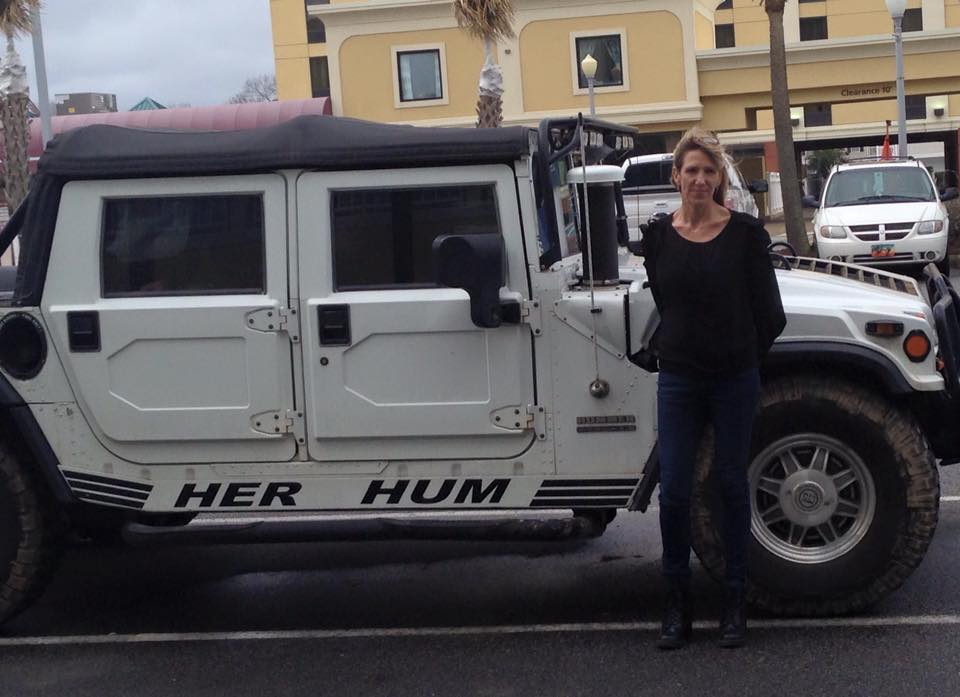
Gotham may have Batman and his Batmobile, but Manassas, Virginia has their own hero — Debra Bobbitt and her Hummer.
For the past seven years, Debra has been volunteering her time, effort and gas to help Manassas residents get to critical medical care during severe snowstorms.
Her passion for service and sacrifice came into full force this past January when winter storm Jonas brought three feet of snow to Prince William County. In the span of three days, Debra volunteered 36 hours to transport 18 patients and medical staff back and forth from three dialysis centers for a total of 36 trips.
“The first night, I didn’t get home until midnight and then at 5 a.m., I left my house and picked up the nurse,” Debra said. “It was tiring and I was cold, but what makes you push through it is just that if it’s not you, what are these people going to do? There’s nobody else that can do it.”
With a list of patient names and addresses, Debra drove to the patients’ homes, picked them up, drove them to the dialysis center, waited for them and then drove them back. While it may sound simple, Debra faced constant obstacles along the way.
An example of this was when Debra had to pick up an older man from his townhouse to get him to dialysis. However, the snowplows had plowed a huge mound of snow in front of his home. So Debra did the only thing she could do. With the help of her son Zachary, they shoveled at least 30 yards through 35 inches of snow and salted the pathway so that the man could get to her vehicle.
“Those people, his adult children, were just crying and they were so thankful,” Debra recalled. “It was just amazing, the sense of community and family and God.”
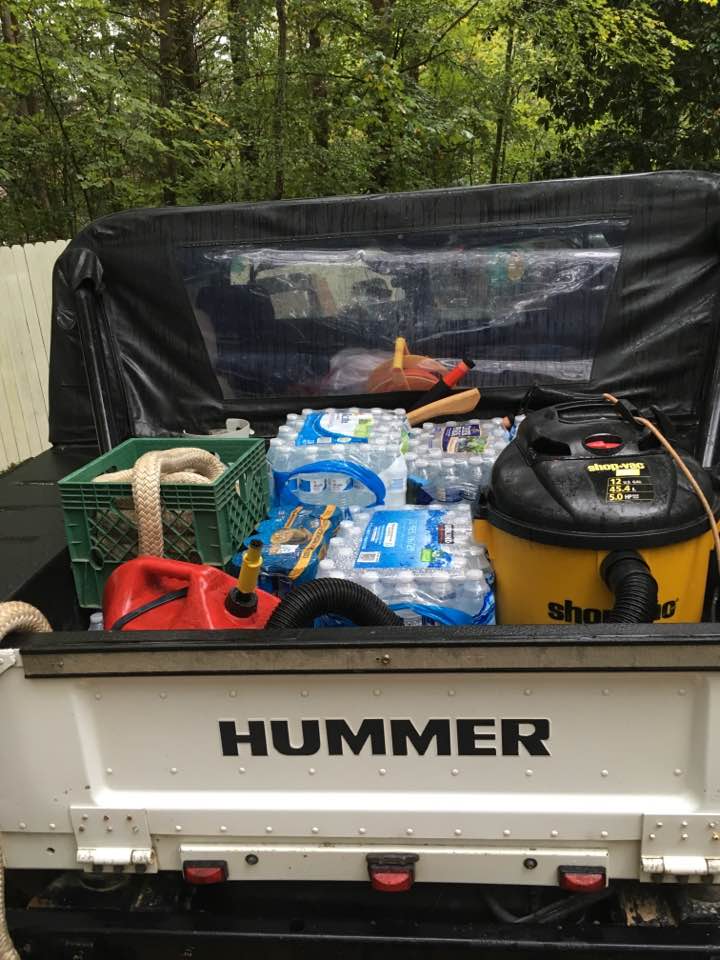
Debra even pulled out three snowplows that had gotten stuck, using rope and equipment she keeps stocked in her sports utility vehicle at all times.
While Debra’s experience driving large vehicles in harsh conditions comes from her time in the military, she said her passion for helping others comes from her upbringing and especially her father.
“My dad, he had a truck and when there was trash in our town, he would load up all of us kids in the back of the truck and say ‘I’m going to drive really slow and you kids, just pick up all the trash and put it in the back of the truck and we’ll take it to the dump.’ Just the nature, I guess, growing up, that’s just what I learned to do.”
Debra is currently in Florida repairing her house from the damage Hurricane Matthew caused. But even while she was driving to Florida, Debra loaded up her Hummer with food, water and all sorts of vehicle fluids and equipment. When she found several families stranded at a truck stop in North Carolina, Debra didn’t hesitate to give out her supplies.
“Even if I move and there’s no snow somewhere else, I think I will never sell this Humvee because I can help people and I absolutely love to help people,” Debra said.
Check out All For Good to find ways you can make a difference in your community.
Jacksonville Native Uses Handyman Skills to Bring Joy to Fellow Nursuing Home Residents
At age 65, Mike Probst never expected to be living in a skilled nursing facility. But when aggressive treatment for stage four lymphoma left the former real estate appraiser unable to walk and in chronic pain, giving up independent living for a room in Regents Park in his native Jacksonville was the only option.
Decades younger than most of his fellow residents, some of whom are bed ridden and suffering from varying degrees of dementia, Probst found the change beyond challenging. “Truthfully it took me about a year to figure out where I was and who I was,” he recalled. Although thankfully cancer free, chemo left him with profound arthritis in his back and joints, wheelchair bound and reliant on a morphine pump to manage the pain. “Thankfully my family was there for me,” he said. “One day I just woke up thinking, God must have put me here for a reason.”
That reason turns out to be very good news for the 60 other residents in the skilled nursing area of Regents Park of Jacksonville. Probst started noticing electric wheelchairs left outside of rooms, in need of new batteries or repair, assistance not offered by Medicare. “So because they couldn’t afford it, these people couldn’t get around anymore. That just wasn’t right.” Now Probst makes it his business to keep the chairs in motion, powered by batteries he raises money to buy. He runs the bingo games and delivers the mail, visiting with residents every day. “There are people here with local family that never visit them – I try to brighten their days.”
Being helpful, showing empathy, supporting the facility’s hard-working staff, making people smile and feel cared for — it all adds up to giving Probst’s life meaning and purpose. “There’s always somebody worse off to make you realize that it’s not just about you. It’s a big world out there. I feel lucky to be on this earth and wake up everyday. Really, the way I see it, I’m very fortunate to be living here. These folks are like my little family.
Answering the Call: Retiree Turns to Service for Her Second Act
When President Barack Obama took office, the former community organizer urged Americans to reach into their communities to solve problems in a “spirit of service.”
Millicent Jackson took his words to heart. Jackson, a New York native who lives in West Orange, NJ, was getting ready to retire from her career at Verizon. “I didn’t know how I was going to go about doing that, but his words resonated with me.” The summer after she retired, Jackson did some noodling on the Internet and came across Jersey Cares, a non-profit that matches volunteers with all kinds of community projects. “You can search by your location, by the interests you have, the time you have available – it was very easy to navigate.”
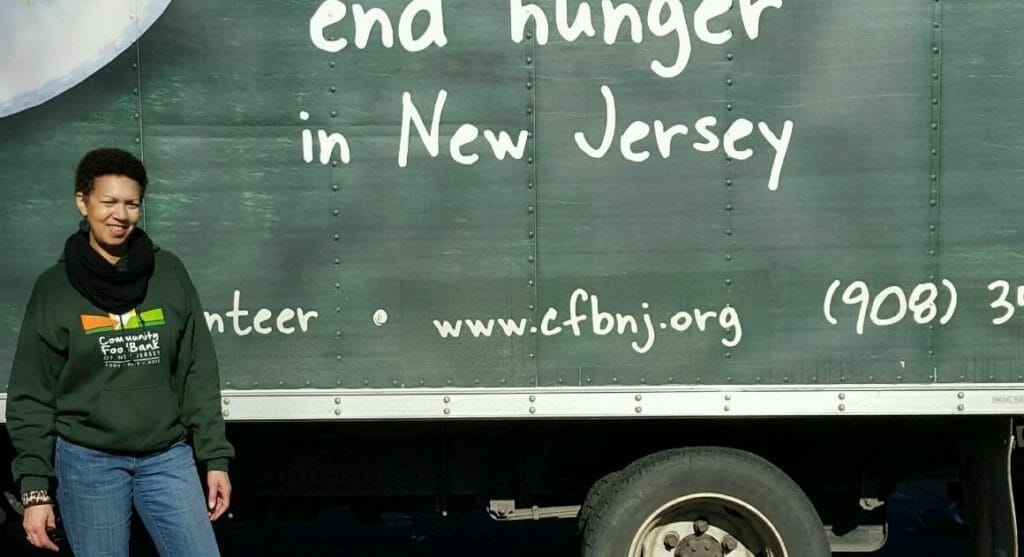
The first thing Jackson tried was joining a tree-planting project in Newark. “It was fulfilling, to be out and doing something that you could see an immediate benefit,” she said. Jackson realized that she liked working outside after a career spent in an office, so her next project was working with a food bank to deliver commodities in an outdoor setting in downtown Newark. That was almost four years ago, and Jackson is now the coordinator for the Newark site.
“We have staples and fresh and frozen food that’s been donated to us from local supermarkets and stores,” she explained. “Folks line up and get what they need.”
Jackson has gotten to know a lot of the regulars who frequent the project, an interaction that gives her an important sense of satisfaction. “It gives me a warm feeling, to be able to help these folks. There aren’t necessarily homeless people, but people who just need a little help. You don’t know what a person’s situation is just by looking at them. Everybody can use a little help now and then.”
Whether it’s 20 degrees or 95, every Monday you can find Jackson managing the food distribution, working with her volunteers and chatting with the folks who pass through the line. “I definitely would encourage anybody at any time to experience what it feels like to just be able to help another person, to do a kind deed. Once you see how it makes you feel when you see the smile on their faces, that’s reason enough to show up every week.”
Arkansas Woman Fights Hunger by Using Employee Per Diems as Funding Source
Growing up in western Arkansas, near the Oklahoma border, Jennifer Barker and her cousin, Brittany Hodak, were as close as sisters. As children, they vowed to “make a difference” when they became adults.
“We were fortunate growing up and never struggled with hunger, but it was all around us,” Jennifer said. “My mom was a case worker and my parents became foster parents when I was in my teens. For some kids, the meal they get at school is their only one, and they’re on their own on the weekends. Having seen that firsthand is something I’ll never forget.”
Besides sharing a desire to give-back, the cousins both have an entrepreneurial spirit. Jennifer studied business administration at Oklahoma State University and worked in corporate and nonprofit environments. Brittany started her own company, ZinePak, a successful New York City–based entertainment marketing company.
It was an invitation from the ABC TV series Shark Tank to present ZinePak to the show’s notorious investors that changed the course of their lives in an unexpected way. Brittany was amazed when she was later reimbursed by the show for a generous amount of “per diem expenses” to cover meals and expenses during the show’s taping.
“She was shocked at how much it was,” said Jennifer. “We started doing some research and discovered that professional athletes, entertainers, and corporate executives are routinely paid ‘per diem’ expenses, whether or not they actually need money for food.” An idea was born: the women would create a nonprofit agency that would collect per diem sums from recipients who were willing to redirect the money to food pantries.
Founded in May 2015, Per Diems Against Poverty successfully partnered with Feeding America, an established, nationwide network of 200 food banks, so that money collected could reliably be distributed where most needed.
After coming up with the idea, Brittany and Jennifer dived into researching food insecurity and learned some disturbing truths about the staggering scope of poverty. “At the time, we didn’t realize how pervasive the issue of hunger is across America,” said Jennifer. “Almost 49 million people depend on food banks every year. The more research we did, we found that no such organization existed, so per diems were an untapped resource.”
Jennifer also was intrigued to learn how widespread the practice of granting per diems has become. It’s common among sports teams that travel throughout the season, but similar sums are also given to many business professionals who travel.
After Per Diems Against Poverty was featured in a September 2015 article in Forbes, a film production company reached out to Jennifer to see if it, too, could join the movement.
“When they film on location for any TV show, movie, etc., everyone—from the camera crew to the producer to the director to all the actors—receives a minimum $60 per diem each day, and the amount goes up from there,” says Jennifer. “You can imagine how, with a 100-person crew, or on huge sets, it could be 250 people. That could add up really quickly.”
Every dollar collected from an otherwise unused per diem allowance translates to 100 meals that can be distributed through food banks, Jennifer says.
That kind of impact is truly needed. Jennifer Kovacs, director of new partnerships for Feeding America, says the nation’s initial recovery from the Great Recession hasn’t yet reduced the need for food assistance. “A lot of people assume our clients are homeless and jobless,” says Kovacs. “But in many cases, our clients are underemployed, working two and three jobs, to make ends meet. It looks different in every community across the country; however, the need is so great.”
“I work on our new partners, and we’re always looking for unique and innovative ways to help people,” Kovacs explained. “…[with] the passion that Jennifer had for the cause and their commitment to be successful—and with their plan’s potential, we couldn’t not partner with them.”
Jennifer combined the business education she got in college and her past working experience in marketing, public relations, sales, and management to put together a solid business plan. “My background in business administration came in very handy in starting and running this business over the past year,” says Jennifer. “Whether you like to think about it or not, a nonprofit is a business, so there’s a lot to think about and there’s even more red tape to get there.”
While the pair has no previous per-diem program on which to model their start-up, Jennifer says a key to their success is their openness to change.
“As a new nonprofit, we’re very flexible and creative in the way we approach teams and other participants,” she says. For example, professional athletes can choose to donate an entire season’s per diems up front—as New York Mets outfielder Curtis Granderson chose to do in a lump sum of $10,000.
Christina Coleman, spokeswoman for the All-Star ballplayer, says Per Diems Against Poverty also helps athletes—like Curtis—many of whom are already generous donors to causes, to latch onto an ideal way to address hunger. “Curtis is very passionate about the food insecurity issue in this country,” says Christina. Although his charitable foundation has long supported education and youth athletics, “what he saw was, you can create educational opportunities, but if kids aren’t eating, they’re not performing in the classroom and they’re not performing in the field.”
Because Feeding America operates such a large network, players are given the option to choose specific food banks—perhaps one in their hometown, or the team’s city—or both. “Granderson actually split his $10,000 donation among five different food banks,” says Jennifer.
Jennifer says her organization is already brainstorming creative ideas to generate donations from business professionals.
The amount allowed for meals is usually much more than most people would normally eat,” notes Jennifer. “So you could do it a couple of different ways. The employee could waive the per diems and they could go to the local food bank. Or you could have a company matching program, which we’re talking about with a couple companies. We also have talked with a company that if an employee does not spend the entire amount of his or her allotment for that day, the company would donate the remainder.”
Jennifer and Brittany are committed to maintaining a “100 percent giving model.” “One hundred percent of our donations go to our cause to help fight hunger. That’s one thing we’re 100 percent committed to,” says Jennifer.
To achieve this, Jennifer has solicited in-kind donations to cover some services. But expenses such as domain fees, marketing materials, travel expenses, and child care—Jennifer has two young children—are entirely out of pocket. Jennifer says her husband, Joseph, works two full-time jobs, as a firefighter and as a patient services coordinator, to pay the bills, freeing Jennifer to spend her days as a volunteer, making calls, updating the website, and coordinating donations.
“It helps that one of our core values is frugality,” says Jennifer.
Since its founding in May 2015, Per Diems Against Poverty collected enough to provide more than 150,000 meals through the end of that year. The organization is on pace to help provide nearly 1 million meals by the end of 2016.
Doing Good from the Sidelines: How One Corporate Citizen Leads for Change
Jack Fox isn’t a guy who likes the limelight. The 52-year-old Denver native and commercial real estate developer has spent his entire career with an eye toward making a difference. And, doing it his way means setting up other people for success and recognition, a style that makes its own powerful statement.
Service has always been on Jack’s radar. “It’s pretty simple,” he explained. “My folks are the role models. I grew up in a household where we were all expected to give back and be part of the community. But most of what I do now is without finger prints – I get the most satisfaction out of being in the shadows and seeing things get done.”
Jack takes a shotgun approach to which causes he supports. “There are a lot of causes close to my heart,” he said. “Early childhood education, helping at risk kids in the public school system, affordable housing, those are a few places I put my efforts.”
Those efforts are considerable. Although he’s a mover and shaker in the Denver corporate world, Fox makes it his business to use that hard-earned acumen to benefit non-profits. He’s served in executive and board positions for the 2% Club, a CEO philanthropic group; The Denver Foundation, a community foundation with more than $600 million in assets; and the selection committees for National Philanthropy Day and the Colorado Collaboration Award. Add in numerous other civic, charitable and education non-profits ranging from Denver Kids, Inc. to Habitat for Humanity and his time is well accounted for.
Jack believes that one mark of a good CEO is being nimble and open to change. When the model for the 2% Club became outdated – “We are no longer a small collection of business leaders in a centralized location,” a move towards more diversity and inclusion was in order. Jack is one of the founding members of B:Civic, a non-profit that promotes and advances business philanthropy and community involvement for the betterment of communities across the State of Colorado.
“Our goal is to develop a culture in which all businesses and business associations know that investing in the community is a smart, viable business strategy,” he explained. “We have broadened our reach beyond just the CEOs to anybody involved in corporate philanthropy. And that approach has taken off like wildfire.”
As engagement grows, giving isn’t about simply writing a check at a charity event, Jack added. “The strength of a company’s service program has a direct effect on attracting and retaining the best and the brightest employees,” he said. “Doing good is simply good for business. The days of it happening from the top, down are over. Employees want that kind of involvement and engagement and we work to make that happen for companies across the state.”
Mother-Daughter Volunteer Duo Share a Passion for Making a Difference
In honor of Family Volunteer Day, Nov. 19, Points of Light and Disney are recognizing families with the Daily Point of Light Award. Meet today’s winning family, the Dobson family of Atlanta, Georgia, and nominate someone in your community.

Courtesy: ReGina Dobson
ReGina and Jamie Dobson
People say the apple doesn’t fall far from the tree, and that is especially true for ReGina and Jamie Dobson, a mother and daughter duo that takes every chance to volunteer in their community of Atlanta.
ReGina, 57, has been volunteering for about 25 years, but her passion for volunteerism doesn’t stop with her. She has instilled that same passion into her daughter, Jamie.
“My mom brought me along when I was about 6 or 7; so from that age, I knew that volunteer work was important,” Jamie said.
ReGina began volunteering after reading a newspaper article about a small group of professionals who volunteered in their community by cleaning up neighborhoods and schools. These professionals happened to be the founding members of Hands On Atlanta. The story sparked ReGina’s interest, and her first project was at an elementary school in downtown Atlanta.
“It was very enjoyable,” ReGina said. “You just felt like you made a difference. I’ve been hooked ever since.”
Since then, her role has changed from volunteer, to volunteer leader, to project coordinator and now task leader. She also sits on the Hands On Atlanta committee.
Genora Crooke, volunteer relations manager at Hands On Atlanta, described ReGina as a bubbly, warm and friendly person who always goes out of her way to make sure needs are met.
“She’s there if we call. Even if we don’t call, she calls us to find out if we need anything,” Genora said. “She’s one of the best, the very best.”
Together, ReGina and Jamie have organized and led volunteer projects, built picnic tables, painted classrooms, planted trees, repaired fences and more.
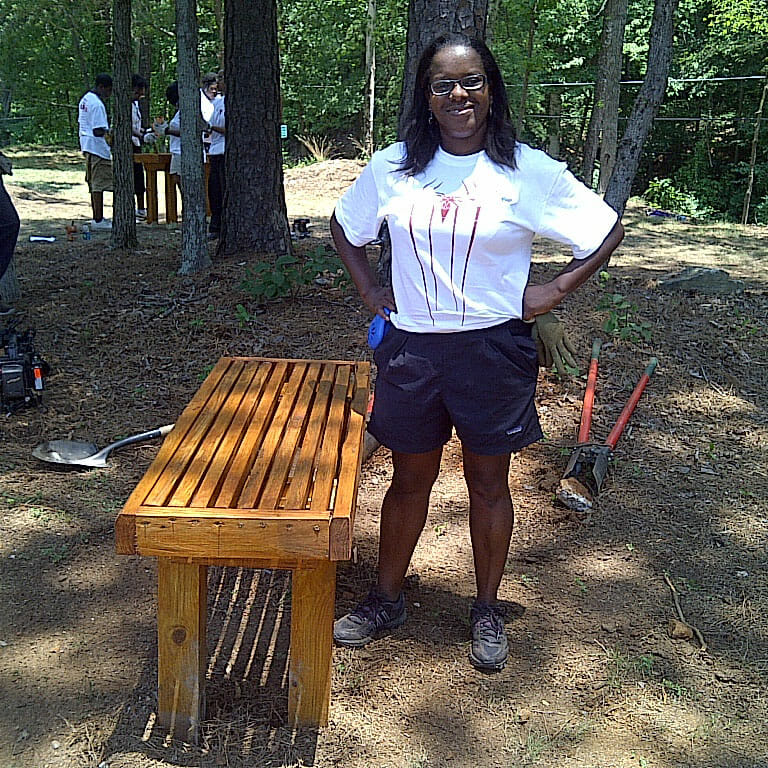
Courtesy: ReGina Dobson
ReGina standing in front of her completed bench at a Hands On Atlanta event.
“I get in there and get my hands dirty because I enjoy that,” ReGina said. “Sometimes people just write a check and give out money. They don’t know what it’s doing, what effort it’s going into. When you work with Hands On Atlanta, it makes a difference.”
Being a military child, ReGina has been around the world and knows the importance of exposing children to “more than just their little neighborhood or their little street corner.”
She believes getting young people to volunteer, as she did with Jamie, will help prepare them for the future and let them know that “you can go wherever you want to go, be whatever you want to be and not let anything hold you back.”
Now that Jamie is in college, this mother-daughter team is separated, but they don’t plan on stopping their volunteer work.
“It’s just the little things and doing a bunch of little things, that will make a difference,” ReGina said.
See how your family can get involved on Family Volunteer Day.
Female Entrepreneur Employs the Power of Technology to Detect and Prevent Child Abuse
Each year L’Oreal Paris and Points of Light recognize, celebrate and support Women of Worth who make a beautiful difference in their communities. For exceptional commitment to service, 10 honorees each receive a $10,000 grant to support their most cherished cause. One honoree, selected during the open online vote, receives an additional $25,000 grant.
“We exist for one simple, critical reason,” said Carly Yoost, a dynamic entrepreneur who worked fearlessly to co-create the Child Rescue Coalition. “To protect children from sexual abuse and emotional suffering, and rescue them from harm’s way.”
Looking at a pin map from the Child Rescue Coalition is alarming. Thousands of virtual pins dot an international map identifying locales where child pornography is, at that very moment, being viewed and traded by sexual predators. Robust technology developed by the CRC in Boca Raton, Florida, is allowing law enforcement to track predators, monitor their activities, thwart potential assaults, and make important arrests. In the last three years, the data provided by the CRC has led to the arrest of 7,776 child predators and the rescue of 1,788 children who were targets of potential sexual attacks.
Yoost is the former co-CEO of TLO, LLC, a data solutions provider founded by her father that specializes in investigative and risk management tools and child protection technology. After their father’s passing in 2013, Yoost and her sister kept ownership of the child protection technology portion of the company and founded the nonprofit Child Rescue Coalition to continue their father’s legacy of protecting children. Yoost serves as the full-time CEO for no pay.
At the core of the program is leading-edge technology that identifies, monitors, and ranks the online criminal behavior of child predators on file sharing and chat networks. “We compile and curate millions of records that are indexed and immediately retrievable by police 24 hours a day, seven days a week, 365 days a year,” said Yoost. “We are rigorous in our efforts to ensure that our data is accurate and irrefutable.”
Approximately 44 million viewers of child pornography are currently being tracked by CRC, which has provided technology to participating law enforcement agencies in all 50 states and 63 nations worldwide.
CRC partners with child exploitation investigators, police officers, digital forensic experts, prosecutors, child welfare agencies, and corporate and private philanthropy. Providing this technology free of charge, Yoost and CRC have trained more than 8,000 law enforcement officials worldwide so that perpetrators can be apprehended before they harm their next victims.
The prevalence of child abuse material on the internet in the world today has reached pandemic proportions. Even more alarming is that 85 percent of online offenders are already hands-on abusers of children. Sadly, the number of victims continues to escalate.
Approximately 300,000 children are abused every year in the United States, and in the course of their lives, 28 percent of adolescents, ages 14 to 17, will have been sexually victimized.
“That’s why the information we provide is so critical,” said Yoost. “Our technology gives law enforcement access to information about abuse in their area that they may not know even exists. We are able to paint a complete picture of predatory behavior and use historical data to reveal trends that would be impossible for any agency to track on its own. With almost 7,800 arrests directly attributed to our system, we know we are protecting innocent children and countless more who might have otherwise become victims.”
The Child Rescue Coalition is innovative in that it is the most advanced and comprehensive tool for thwarting the illicit activity of child predators: 1) CRC monitors and streamlines seven different networks into one cohesive tool for law enforcement; predators would have unfettered access to child abuse material on these areas of the internet if it were not for CRC; 2) the group is steadfast in its commitment to thoroughly train law enforcement officials around the world; 3) CRC has developed a revolutionary new forensic tool, which automates retrieval of deleted abuse files from offender devices.
Yoost has received numerous accolades for her work. She received the Broward County 2-1-1 Child Abuse Prevention Award, was named an Unsung Hero by the Broward County Sun Sentinel, and one of the M&A Advisors 40 Under 40 Emerging Leaders. Yoost is also a recipient of the Daily Point of Light Award. Yoost and the Child Rescue Coalition are members of the Virtual Global Taskforce.
Yoost said that if she receives additional funding through L’Oréal Paris Women of Worth, the Child Rescue Coalition will be able to train more law enforcement to protect more children. One trained officer saves three children a year from abuse. “In addition, resources are needed toward system upgrades. The bad guys don’t take a day off; we need to stay one step ahead of them,” said Yoost.
The reaction of law enforcement officials who use the Child Rescue Coalition system has been overwhelming. A detective from Georgia said, “[The system] allowed us to find a perpetrator that had flown under the radar for as long as 10 years and now has been tied to countless victims.” Another law enforcement official from the United Kingdom reports, “[The suspect] went on to admit that he had been sexually abusing his two nieces, ages 7 and 10, and had recorded the abuse. The nieces had never told anyone, and these offenses were discovered as a direct result of the system. A very dangerous man is off the streets.”
Show your support for Carly Yoost by voting for her, and learn more about the other extraordinary L’Oréal Women of Worth honorees.
Filling in the Gaps to Helps Homeless Youth Build Better Futures
Each year, L’Oréal Paris and Points of Light recognize, celebrate and support Women of Worth who make a beautiful difference in their communities. For exceptional commitment to service, 10 honorees each receive a $10,000 grant to support their most cherished cause. One honoree, selected during the open online vote, receives an additional $25,000 grant.
“If you have a kid on the street who knows for a fact that there is no one in the whole world who cares, that he or she could disappear and no one would know or care – that to me is the saddest thing,” said Kathy Tillotson. “In terms of any difficulties they present, that doesn’t bother me, because honestly, for those kids to have survived is just a testament to them, given the conditions they’ve had to endure.”
Tillotson never expected she’d be working 45 hours or more per week without pay – and loving it – when she and her husband retired and moved to sunny California. She simply wanted to continue her long habit of volunteering and was asked to help two homeless teens.
“I literally went around all of Orange County to try to find some help,” she says. “I spent a whole year looking at every nonprofit to see if there were any that could help 18- to 24-year-olds and there were not.”
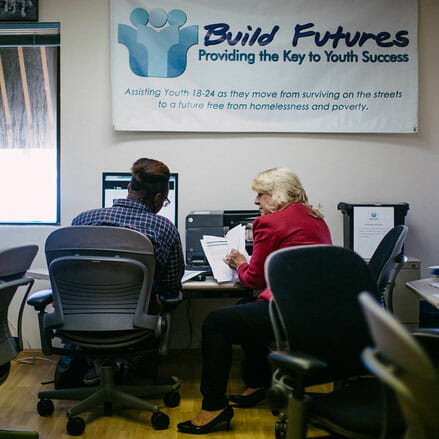
Tillotson founded Build Futures, an organization that gets homeless kids off the streets quickly, not only finding them permanent housing, but helping them become self-sufficient – often within months – by finishing school, finding jobs, and breaking bad habits like substance abuse or reckless spending.
The young adults are referred to Tillotson by police, churches, and social agencies. Some find Build Futures on their own, after stumbling upon its website or Facebook page.
The youth arrive hungry, scared and desperate – Tillotson’s first priority is to get them somewhere safe within 24 hours. She coordinates with existing social services and agencies to get them clothing, food, IDs, bus passes, job-hunting assistance, help with schooling, medical care, and mental health treatment.
As part of the deal, youth have to remain sober and well behaved. They must meet regularly with Tillotson and follow up with the resources she recommends. She makes sure they have phones so she can keep in touch via email and text message.
With more than 3 million people, Orange County, California, is one of the most populous counties in the United States. It contains three cities with more than 300,000 residents each – Anaheim, Santa Ana, and Irvine – and Huntington Beach, which has more than 200,000.
But not all residents have homes, and a growing number of homeless individuals are ages 18 to 24. “About half of them are runaways, often running from some sort of abuse,” said Tillotson. Others are “throwaways,” or kids whose parents have kicked them out. Less than 10 percent of the young adults helped by Build Futures are graduates of the foster care system. “Those kids usually have support and housing options in place as they transition out of foster homes,” she said. “These kids get zero, zip, nothing.” Last year, nearly 3,000 seniors in Orange County public schools were homeless.
Most emergency shelters are geared toward families or veterans, said Tillotson. Yet it’s especially dangerous for naïve young people – particularly girls, who are vulnerable to human trafficking – to live on the streets.
Compounding the problem is Orange County’s high cost of living. Rental units are expensive and have low vacancy. Build Futures has seen a continuous increase in requests for its services. Last year, the number of clients jumped by 40 percent, and Tillotson expects a future increase of at least 25 percent this year.
Since its founding in 2009, Build Futures has helped more than 1,000 homeless youth. Last year, 240 kids received help, including 110 who were housed. Of those who cooperate with her interventions, Tillotson estimates 75 percent have gotten jobs and become financially self-sufficient.
Elizabeth Vasquez, 24, credits Tillotson for helping her turn her life around. “I was incarcerated for substance abuse,” said Vasquez, who lost custody of her young daughter to her parents. She quit drugs but lacked a high school diploma, a job, and social skills. “I didn’t even know how to do email,” Vasquez said. “I didn’t speak clearly, and I couldn’t even look somebody straight in the face.” Vasquez learned about Build Futures by calling the 211 helpline. At first, [Kathy] was really strict,” said Vasquez. “She told me to go to classes, to do mock interviews, and stuff like that.”
Vasquez is now close to finishing her diploma and has a steady job at Walgreens. She’s acquired practical skills, such as operating a forklift truck, but has set her sights on a nine-month college program to learn medical billing and coding. She’s been paying off her court fees and rent. “I’m always moving forward,” Vasquez said. “I have self-esteem now.”
Michelle Harding, 18, found Build Futures by scouring the internet. She’d been seeking the courage to leave a dysfunctional home. “Kathy emailed a response within 24 hours,” Harding said. “She said she could find housing within a week. She was very proactive. She told me to sign up for different programs, including food stamps and medical insurance. Every week, she religiously sends emails to all the kids about job openings.”
Harding now works two jobs and has been accepted to the University of California, Santa Cruz, where she plans to major in science. Without Tillotson’s help, Harding said she would have remained too stressed out to pursue college or anything beyond a minimum-wage job.
Tillotson believes she’s the only resource dedicated to homeless people ages 18 to 24 in all of Orange County, and she knows similar programs are exceedingly rare elsewhere.
Ron Garland, who runs four transitional sober living homes in Orange County, agrees. He’s rented rooms to dozens of kids referred by Build Futures. “These kids have nowhere to turn,” he says. “She pays the rent at first, but she works with these kids almost like 24-7. She’s really tough. She demands them to do what they need to do – usually it’s about three months of classes and all that. They have to text her every day with their schedules, and if they don’t follow them, she wants to know why. She has them come to her office each week to pick up the rent check so she can talk to them. But afterward, they love her. I’d say 70 percent of them are success stories. They have jobs, cars, pay their rent.”
Tillotson credits her previous career in business with the program’s successful, cost-efficient strategy.
“Look at my website,” she said. “You’ll see we have a … list of over 1,300 resources. We don’t duplicate anything that’s being done by somebody else. For example, for clothes, we have a relationship with the Assistance League; they’ll give us vouchers for $50 for each kid, and that buys a lot. We have an Excel spreadsheet for food and groceries. There are organizations that do resume building and interviewing. Our main thing is to fill gaps, not to duplicate anything.”
Tillotson was honored to receive California State Sen. Lou Correa’s Women Making a Difference Award in 2011, and in 2013 she was a National Philanthropy Day, Orange County honoree. She has also been recognized with a Daily Point of Light Award.
If Tillotson were to receive further funding from the L’Oréal Paris Women of Worth competition, she’d put all of it toward finding more housing options for homeless young adults. As homelessness grows and word spreads of her organization, there are times it’s difficult to find openings. “We’re committed to ‘rapid re-housing,’” she said. “We need permanent homes, not temporary shelters, so that they can get jobs.”
Tillotson knows the problem of young homeless adults isn’t limited to Orange County, so she’s developed a 21-step plan that could be used to start similar programs elsewhere. “The model I’ve developed can be replicated nationally,” she said. “We do have a very unique and innovative program.”
For all her toughness with young adults in need, Tillotson feels a great deal of compassion for them. Her own daughters, now 26 and 27, had privileged backgrounds and became highly successful. “My kids went to the best schools and everything,” she said. “But even they went through phases and made bad choices. You can’t expect kids who’ve had horrible lives amid dysfunction, who’ve never even seen someone make a good choice, to do otherwise. It’s easy for me to understand.”
Tillotson’s daughter, Kelly, a country singer who now lives in Nashville, said, “I’ve seen some of these kids. They have no one to be a parent to them and my mom stepped into that role. Every time I call her, she’s picking up a kid or looking for housing or applying for grants. She literally gets no money for this; she does it out of love.”
Show your support for Kathy Tillotson by voting for her, and learn more about the other extraordinary L’Oréal Women of Worth honorees.
Some names have been changed to protect Build Future client’s identities.