Americorps Member Helps Beautify Pittsburgh
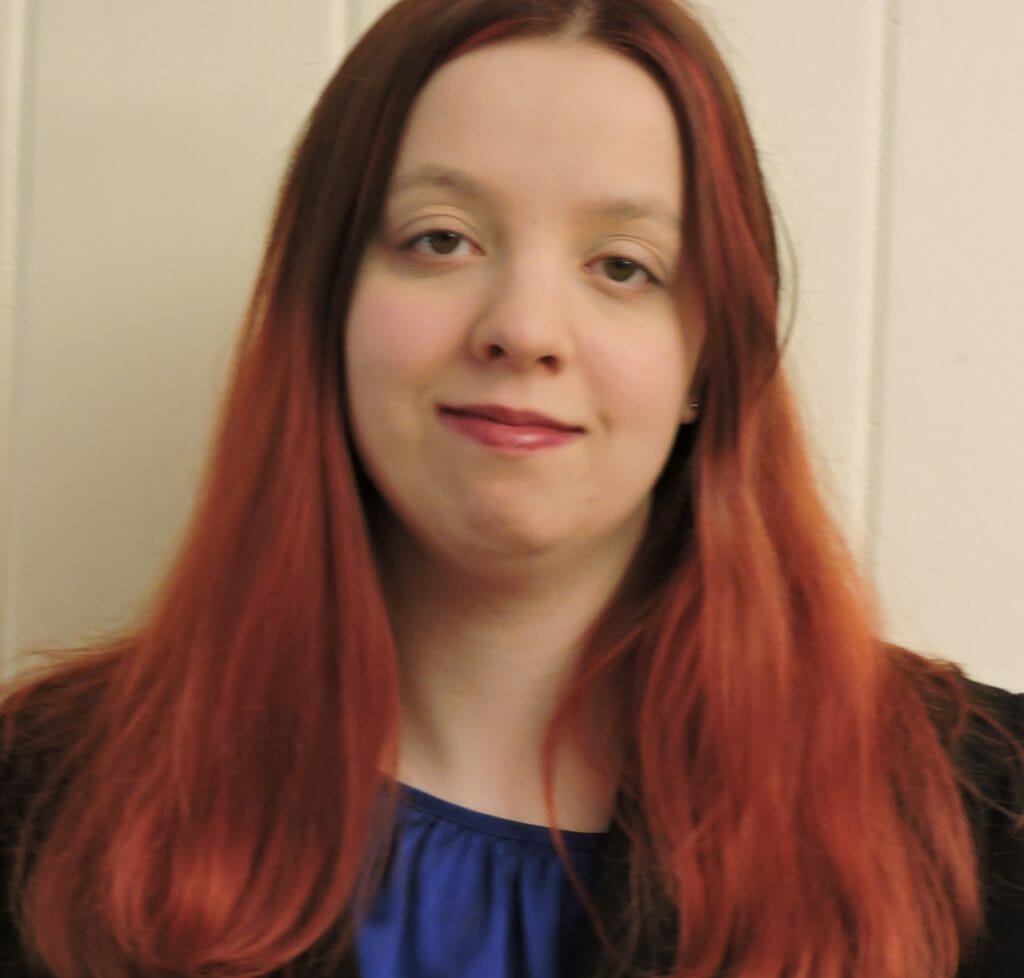
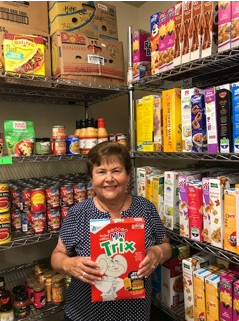
Americorps VISTA member Bonnie Taylor serves as a Project Communications Coordinator for Community Action Southwest. During her time in Americorps, she has worked on numerous projects with Frontline Families to benefit her local Pittsburgh community – including assisting with planning and executing the beautification project for the historic Arsenal Park. More than 250 volunteers participated in the project, which took place on 9/11 last year. Additionally, Bonnie helps with volunteer recruitment, trainings and grant-writing. She was also part of the team that produced a video spotlighting the impact Frontline Families has had in the Pittsburgh area.
Kentucky Teen Starts Organization for Special Needs Students
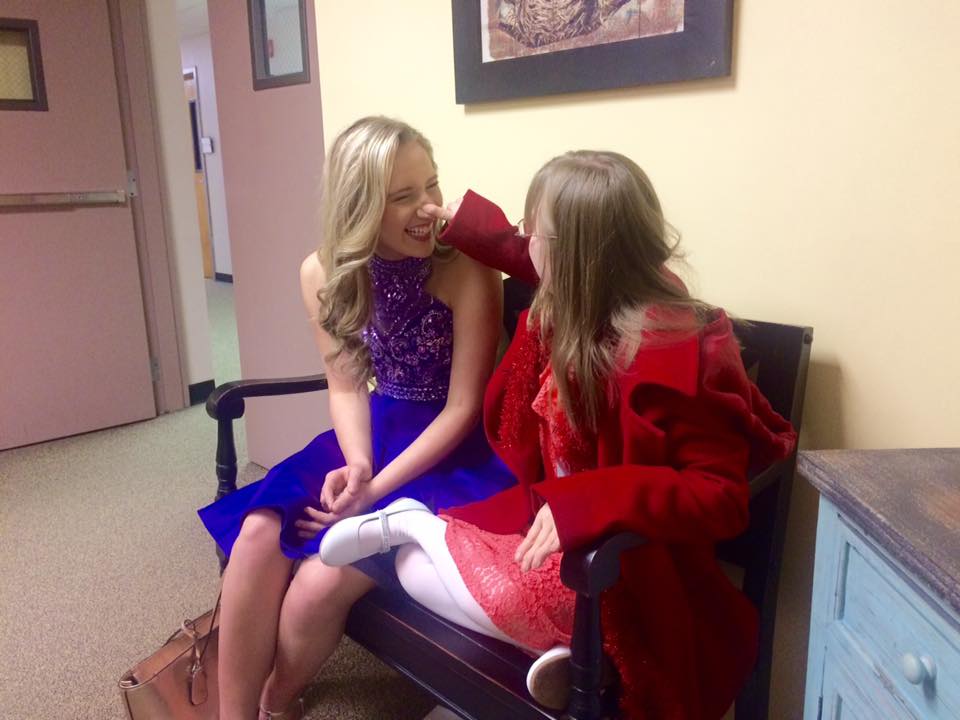
Noelle Thompson, a 16-year-old from Simpsonville, Kentucky, is on a mission to promote the social inclusion of people with intellectual disabilities. Two years ago, she started her own nonprofit, Break Through 4 a Buddy at Martha Layne Collins High School. Each month, she plans activities to give special needs students an opportunity to interact with the general student population.
“Every student needs opportunities for one-on-one friendships and leadership development to transition successfully into higher education or [future] careers…” Noelle said. “It can be challenging for students with intellectual and physical disabilities to find these opportunities within their classrooms and community environment.”
Noelle got the idea to start Break through 4 a Buddy after interacting with her Sunday school teacher’s adopted daughters. After witnessing the difference that socialization made in the intellectual and medical progress of the two girls, who both have Down Syndrome, Noelle felt compelled to help others in her community.
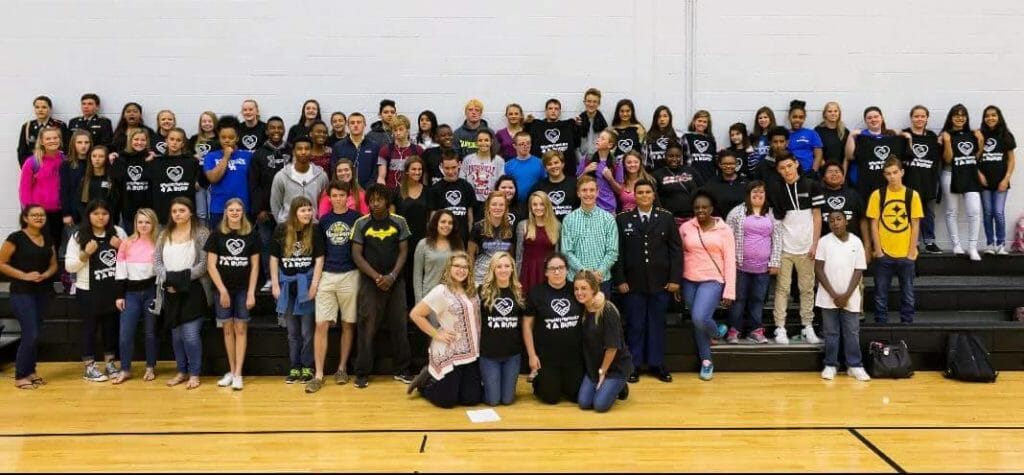
“There are two major areas in the [Break Through 4 a Buddy] initiative. First the school and secondly the community at large,” Noelle said. “I developed a plan to implement a Titan Buddy Club in my high school, presented it to my principal and recruited friends to become offices of the club.” Next, Noelle successfully signed up more than 150 of her peers to be a Titan Buddy, a program that encourages relationship building between special and general education students.
Some of the monthly activities that Noelle’s group organizes are game days, Christmas parties, sing-a-longs, animal shows and special guest presentations. To raise funds for her events, Noelle has hosted a prom fashion show with ticket proceeds going to Break Through 4 a Buddy. She has also raised $3,000 to support Children’s Miracle Network and coordinates volunteers to participate in activities at two area living facilities for adults with disabilities.
Do you want to make a difference in your community like Noelle? Visit All For Good to find local volunteer opportunities.
Former VISTA with Persistent Passion for Service Helps Feed Denver’s Hungry
Meet Daily Point of Light Award honoree Barbara Motichka. Read her story and nominate an outstanding volunteer, family or organization as a Point of Light.
Barbara Motichka has spent the majority of her life giving back to the communities where she’s lived, not just through volunteerism, but also by helping those around her become stronger and more successful volunteers.
In her 20s, Barbara left her home in New York to become a VISTA, now AmeriCorps VISTA, helping migrants in Utah before eventually moving to Colorado. Volunteering has always been Barbara’s passion and it only made sense for her to return to it full force after she retired.
Barbara says she began volunteering “to get out and learn and be with people, see how people dealt with things, how people compromised, and how people work things out.”
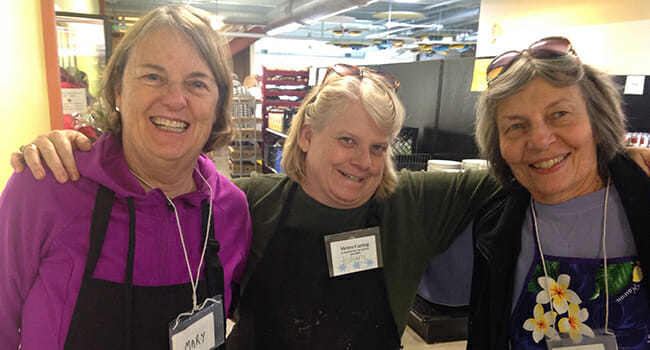
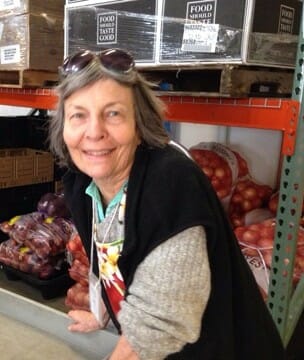
Over the past three years, Barbara has spent three days of her week ensuring that the shelves of Metro Caring’s pantry are full and that those experiencing food insecurity receive an experience that is dignified and respectful. Since she started, Barbara has volunteered more than 1,400 hours – giving more hours in 2016 than any other volunteer at the pantry.
“Barbara takes the time to interact with our participants, asking them how they are and how their experience has been, checking to see if she can do anything to help or improve their experience – and often spending time trying to help participants find what they are looking for on the shelves,” says Heidi Vielhaber, volunteer manager and service learning professional at Metro Caring.
Barbara says she does this because “it’s about respect and making people feel comfortable,” adding, “I’ve gotten to know a broad spectrum of people, younger people, people with families, people with handicaps, people with health issues. It’s just a treat.”
Barbara loves to not only help participants shop the pantry but also teach them about the need for nutritious meals. This goes hand in hand with Metro Caring’s mission to offer access to healthy foods, nutritional education, and self-sufficiency.
In addition to her work for Metro Caring, Barbara volunteers with the Women’s Homeless Initiative, a coalition of churches and organizations in Denver that work with Capitol Hill United Ministry to give sanctuary and hospitality every night to women who would otherwise be on the street. Barbara helps out at St. Johns, her local WHI location, by helping them get things set up every Monday night and picking up overnight shifts when other volunteers cancel.
Barbara’s advice for people wanting to volunteer is to find something that they’re interested in and that works with their schedule.
Metro Volunteers, a Points of Light affiliate, honored Barbara with its monthly Heart of Volunteerism Award in recognition of her passion and dedication. For volunteer opportunities in your area, find your local Points of Light affiliate or search All for Good.
Retired Doctor and His Furry Sidekick Lift the Spirits of Hospital Patients
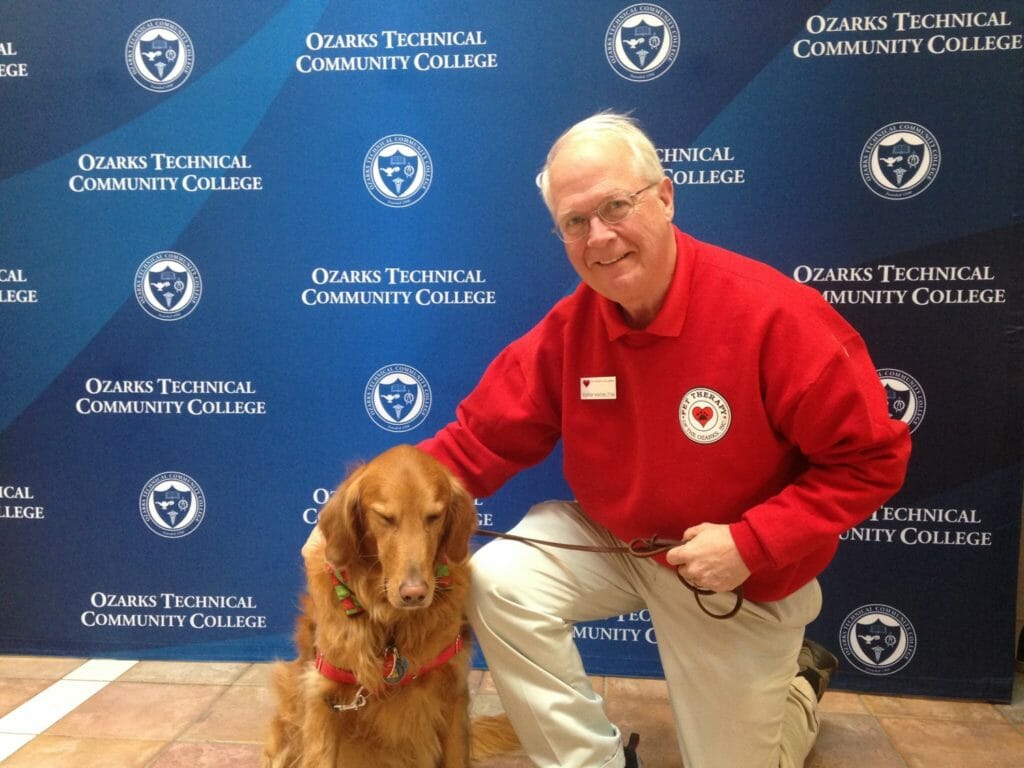
In 2013, Dr. Norman Knowlton III retired from his almost four-decade career in internal medicine. Though he no longer saw patients as a doctor, he still wanted to give back to people facing illness or health crises. His desire to make a difference in the lives of others led to his volunteer role at Cox Health Systems – alongside his trusty sidekick, Lucy. Norm and his golden retriever, who is a certified therapy dog, bring much needed sunshine, smiles and laughter to the corridors of Cox Health and its patients.
Norman is today’s Daily Point of Light, and he spoke with Points of Light about his service work with Lucy.
What led you to your volunteer role with Lucy at Cox Health?
My wife and our 8-year-old red golden retriever, Lucy, were already involved with Pet Therapy of the Ozarks before I retired [from internal medicine], but I decided to continue with Lucy and give back to Cox Health Systems.
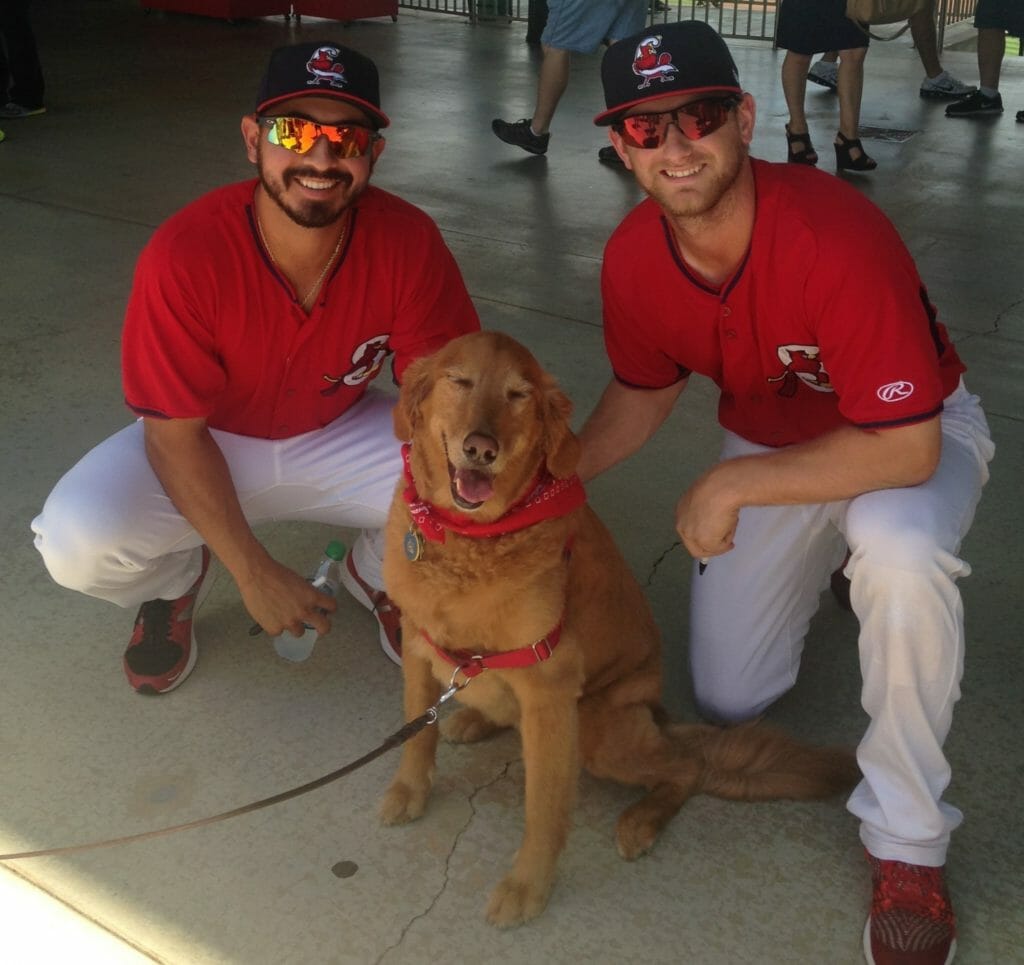
Lucy and I became a team and were certified and titled, not only in pet therapy, but also in nosework. Lucy is an American Kennel Club titled “therapy dog advanced.” We visit patients at Cox Regional Hospital in oncology, neurology, radiation therapy, chemotherapy, infusion, rehabilitation, medical and surgical units. We also visit nursing homes. At those facilities we try to assist, please and comfort patients in all stages of their health. Lucy and I make patients, family members, friends, hospital staff and employees feel warm and fuzzy and elicits smiles from all. We have [also] been greeters for the Springfield Cardinal Baseball games, participated with the Children’s Miracle Network and assisted children in their reading skills at the local library.
Can you recall a defining moment when you truly understood the impact of the service work that you do?
Lucy and I visited with a 38-year-old gentleman in a comforting and supporting role who had recently been told that his case was terminal and hospice was going to see him later that day. Lucy startled several times and stared at a blank wall above this patient’s head. The patient quickly recognized her attitude and exclaimed that she had just seen his Angel. The nursing staff and all assumed that the patient was correct.
Why do you think it’s important to volunteer?
I have always felt volunteering is my duty to serve my community, hospital, and especially patients and because it is the right thing to do.
In five words or less, describe how giving back to others makes you feel.
Fulfilled, useful, worthwhile, pleased, proud.
Do you want to make a difference like Dr. Knowlton? Visit All For Good to find local volunteer opportunities.
Teen Starts Nonprofit to Help Vulnerable Ugandan Children
In 2011, at 11 years old, Mallory Fundora sat down to write her Christmas list for her parents. After careful consideration, she decided there was only one thing she wanted – to give back to others. Inspired by a meeting with members of the Ugandan Orphan Children’s Choir after a performance at her church the year before, she focused her service work on helping children in Africa.
With guidance from her parents, Mallory reached out to Amazina Ministries and Project Have Hope to find out the best way to help, which resulted in the launch of her nonprofit Project Yesu. The organization provides food, medicine and education to orphaned and vulnerable children in Uganda, Africa. Over the past six years, Mallory, now a junior in high school, has raised more than $200,000, built a playground and suite a pit latrine bathrooms in the village of Musima and is serving over 250 children through her education sponsorship program. Her Acholi Quarter Feeding program provides a hot porridge breakfast to more than 350 children each weekday.
South Dakota Woman Steps Up to Help Her Community as a Volunteer Firefighter
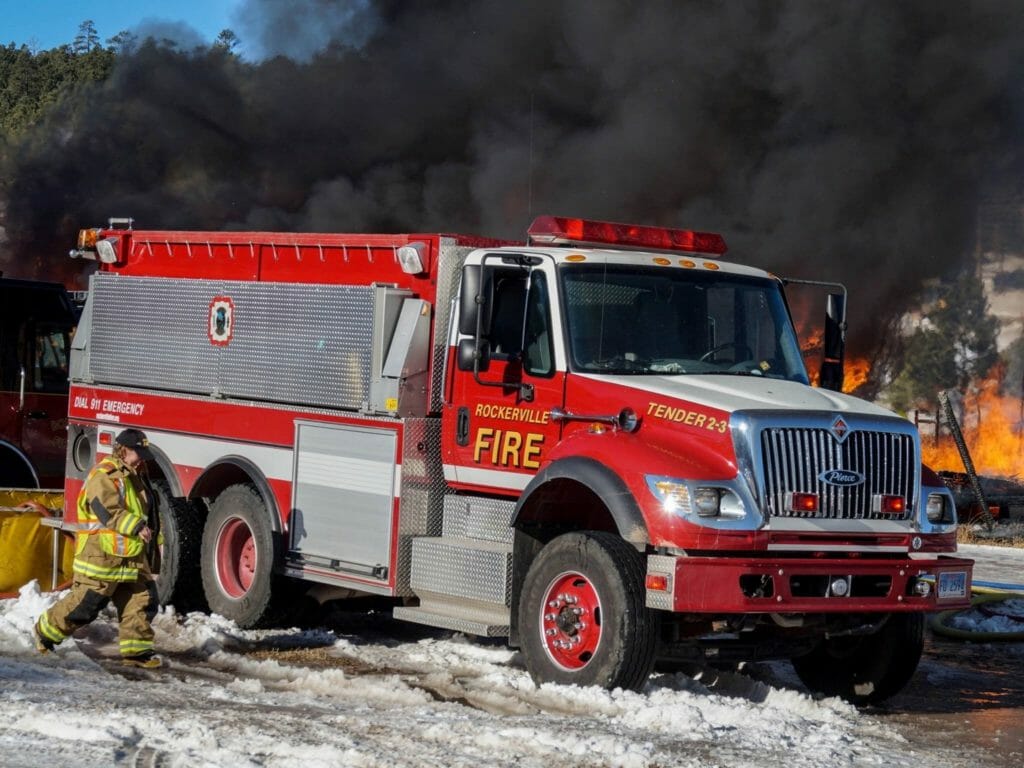
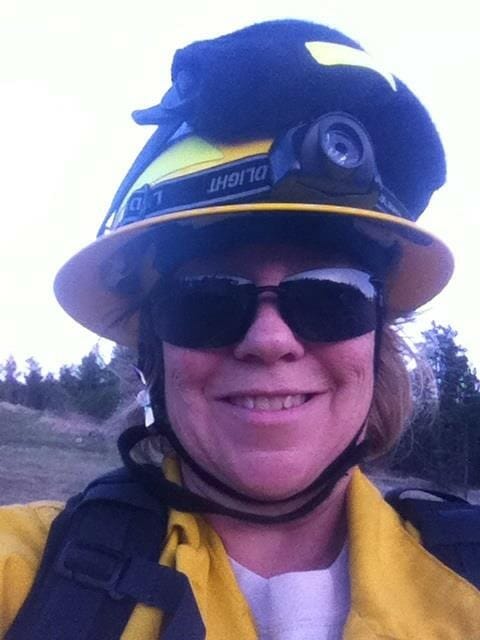
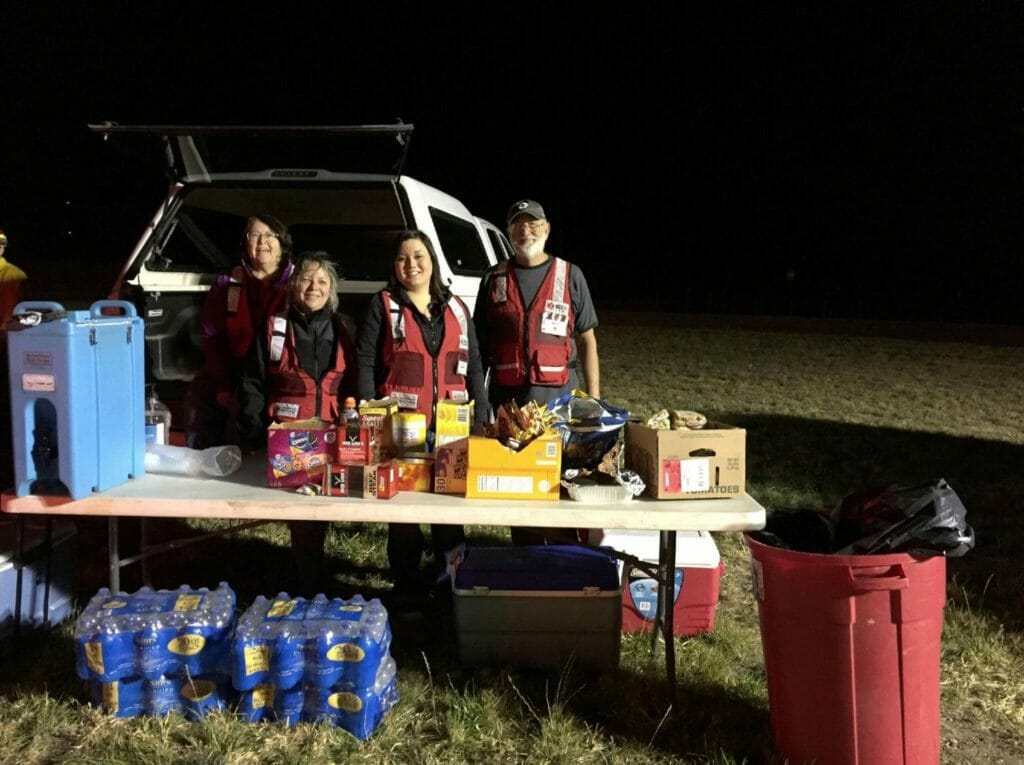
Kathy Deml’s life has changed tectonically in the past 10 years. A long time single mom, she saw her son off to college and her life took a welcome turn. She met her now husband, Tim Deml, eight years ago and the couple moved to Rockerville, South Dakota, a Black Hills community just outside of Rapid City. Wanting to get to know their new community and give back, Kathy and Tim joined the Rockerville Volunteer Fire Department in March, 2009, spending months training to become a certified fire fighter and medical responder. While her husband is on the front lines of firefighting, Deml, now 61, serves as supply officer and often acts as mentor to assist newer members in learning about the fire department, the training and the equipment. She also volunteers for the American Red Cross in the Black Hills.
What inspires you to volunteer?
It doesn’t feel like I’m doing anything different than what should be done without expecting any rewards or compensation. If you notice someone is hurt, you try to help. If their house is on fire, it needs to be put out. It’s just doing the right thing. I would want to be treated the same way if the situation was reversed.
Describe your volunteer role with the Rockerville VFD, an all-volunteer organization. How do you fit it?
I am a volunteer firefighter with Rockerville VFD – both certified as a structure firefighter and a wildland firefighter, and also an Emergency Medical Responder so I am able to respond to most of the calls that we receive. In the day-to-day world outside of the emergencies, I am the supply officer and a truck captain for one of our response vehicles. The Supply Officer keeps gear, equipment, tools, snacks and water on hand. As a truck captain, it is my responsibility to keep my vehicle stocked, clean and ready to respond at all times.
Where does the Red Cross come in?
I volunteer with Red Cross with the DAT (Disaster Action Team) Response as a team captain, dispatch and a caseworker. We are typically called to scenes of disasters, mainly fires, where people may be displaced from their home temporarily or long term. We are able to assist with immediate needs such as lodging, food, clothing, medicines and other miscellaneous items as necessary. Caseworkers follow up with the families and assist with the recovery process.
What’s the most challenging aspect of your volunteer service? We understand you helped support families who lost children in a fire recently?
Each call is unique and needs to be handled as an individual case. Often, the reason you are called to a scene is not what you end up addressing. One instance is a tragic fire in a small town about 50 miles from Rapid City. As Red Cross DAT, we were called to a structure fire and we knew before we got there that there were fatalities. What we found out later was there were 5 young children that were trapped in the fire. Some of the children lived there, two were spending the night for a birthday celebration. Even though we were there for the families that lived in this dwelling, we were also very involved with families and friends of the deceased children. New firefighters who were on their first fire needed assistance dealing with the tragedy as well as the auxiliary members and their families. The community was devastated by the loss and we were there to listen and comfort if nothing else that day. Red Cross had mental health professionals on scene to provide additional assistance.
With the fire department, I’m not the person who will rush into the building and put out the fire, I may be the one bringing the tender full of water, or the bottled water for the hot, tired people who come out after fighting the fire, or making sure their equipment is on appropriately.
Why do you think it’s important for others to give back?
There is no feeling equal to knowing that somehow, you made a difference in someone’s life. Even if it’s not acknowledged, you know you did your best to assist them.
What’s been the most rewarding part of your work?
The most rewarding part is working with the teams from the fire department and Red Cross, knowing you are there together, dealing with the same obstacles, and doing the best you can to assist as a team.
What have you learned through your experiences as a volunteer?
I’ve learned that it doesn’t matter your age or gender, there is always something that you can do. Pick something that you are passionate about and put your heart into it.
What do you want people to learn from your story?
That I’m just a very small cog in this big wheel! I would not be as involved without the great leaders, especially my husband, who have encouraged me to push myself so I could be involved in these different areas of volunteerism. If you are a leader in your group, pull the new people in. Get them involved with something meaningful, ask them how they want to help, be a sounding board for them when things get difficult, or they won’t continue to show up. Volunteers are hard to find and hard to keep.
Do you want to make a difference in your community like Kathy? Visit All For Good to discover local volunteer opportunities.
Brooklyn Youth Team Up With NYPD to Create Community Mural
Throughout the country, relationships between police and community members has been strained and contentious. But in one Brooklyn community, police and youth are working together to bridge the gap, better understand one another, and beautify the community through service.
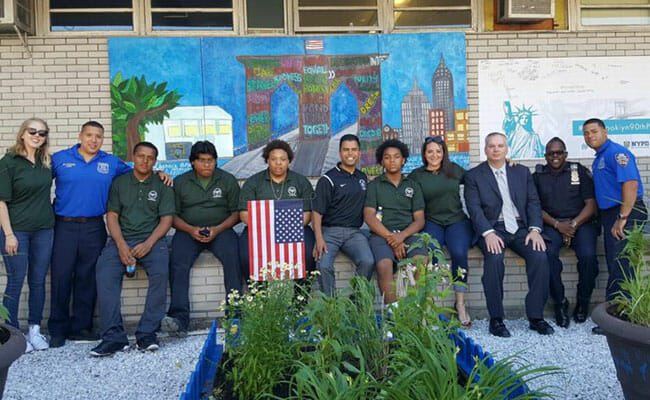
Teens from the Usher’s New Look foundation and NYC Together partnered with police from the 90th precinct in the Williamsburg neighborhood of Brooklyn, New York, to plan and create a mural to beautify the precinct house.
Over the course of 10 weeks, the teens and police attended interactive workshops to facilitate conversation and learning from each other in an informal setting. They also spent time planning the mural, learning about service work, project planning and community beautification.
“Often times these kids feel voiceless, especially with police,” said Dana Rachlin, founder of NYC Together, an alternative-to-suspension program for students facing school disciplinary action in North Brooklyn. “These workshops and conversations helped the teens feel heard by people who they often feel dismissed by.”
“Usher’s New Look focuses on students using spark to bring change in their community,” said Careshia Moore, national program director for Usher’s New Look, which seeks to equip young leaders with the tools to shape their own future. “For the teens to see they could use words and art, could come together and create change, it empowers them. They realize you don’t have to have millions of dollars to bring change in your community, it starts with using the gifts and talents you have.”
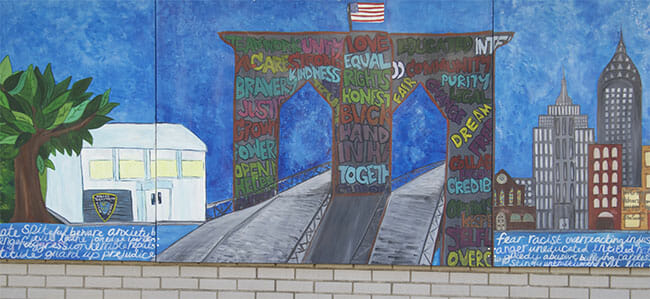
The mural depicts the Brooklyn Bridge – an iconic New York City landmark – covered in words of positivity, while negative words float away in the river below. This joint project has helped to foster trust and understanding on both sides.
“This experience changed my judgement of cops and allowed me to realize not all cops are bad,” said Kayah Phillips, an Usher’s New Look student.
NYC Together member, Keith Williams, agrees. “I learned there are people like Dana, Officer Posada, Officer Melendez and the chief that want to see you make your life the best it can be,” he said.
This experience has improved the community immensely, by helping community members to see the precinct as a community space. Additionally, it has inspired the teens to continue engaging other teens in service.
“I hope to create a youth group and connect them with other organizations like Usher’s New Look,” said Kayah.
“I hope to help the community by doing the same thing this program did for me,” said Keith. “I want to help other kids who may not have the opportunity to be the best they can be.”
To recognize their incredible efforts, the teens were given the Daily Point of Light Award, which was presented in Atlanta at the inaugural Disruptive Innovation Summit, hosted by Usher’s New Look.
College-Bound Girl Scout Starts Nonprofit to Save the Bees
Meet Daily Point of Light Award honoree Elizabeth Klosky. Read her story and nominate an outstanding volunteer, family or organization as a Point of Light.
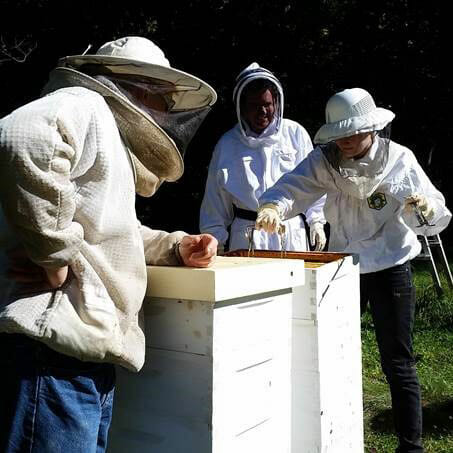
Two years ago, Elizabeth Klosky was brainstorming ideas with her father on what to do for her Girl Scouts Gold Award project when she had the idea to do something to protect bees. She and her father had just begun to keep bees in the yard, but when she realized how important they were to the environment – and that certain bee populations around the world were struggling – she wanted to help.
Initially, her idea was to go to events focused on nature and environmental issues, reach out to people there and set up a few native bee houses.
“It ended up getting a lot bigger than that,” said Elizabeth.
She ended up presenting at a lot more events, setting up eight native bee houses and reaching more than 8,000 people who supported bee-friendly legislation in New York State through change.org.
Once the Gold Award project was complete, Elizabeth saw how big it had become. With the help of her parents and some “worker bees” (her volunteers), she set off on the path toward turning her project into a nonprofit – New York is a Great Place to Bee.
Through the organization, Elizabeth worked with New York Assemblyman James Skoufis in an attempt to secure a grant to help beekeepers start new hives in the city. Though that didn’t pass, it created room for future bee-friendly legislation that finally did go through.
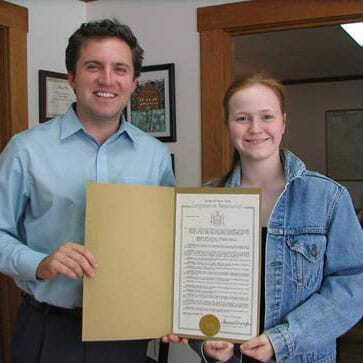
Working with the mayors and supervisors of several towns in her community of Orange County, New York, Elizabeth helped establish a Proclamation of Pollinator Week, a week at the end of June that honors pollinators and celebrates all the work that they do, which was signed by Gov. Andrew Cuomo.
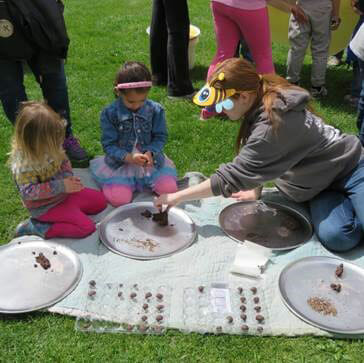
Her organization also promotes environmental education for children. Elizabeth, with the help of her worker bees, holds events with hands-on activities to help kids understand what bees do and how vital they are to the world. While the projects are mainly geared toward younger audiences, Elizabeth says that volunteers of all ages enjoy making wildflower seed bonbons, small candy-like balls that people can plant in their gardens to help regrow wildflowers that bees depend on for food.
In the fall, Elizabeth will attend Cornell University, where she plans to continue her studies at the Dyce Lab for Honey Bee Research. While she’s away, she has high hopes that the organization will thrive in her worker bees’ capable hands.
Whether it be for bees or another cause, Elizabeth has advice for anyone who is interested in volunteering.
“Do a lot of research and just find out as much as you can about whatever it is you’re interested in. Use that research to find a place to get involved, and then just go for it!”
To find volunteer opportunities in your area, search All for Good.
West Virginia Woman Aids Disaster Victims After Historic Flood
When it comes to helping others, Angela Brown consistently steps up to the plate – even in the midst of a disaster. In 2016, West Virginia experienced one of the deadlist floods in its history, and Angela responded by working with her church to organize a group of volunteers to help flood victims.
Angela is today’s Daily Point of Light honoree, and she spoke with Points of Light about why it’s important for her to give back.
Last June, you responded to a major disaster in West Virginia by volunteering to help flood victims. What did you do to support your local community through your volunteer efforts?
My family was one of the lucky ones; we were not directly affected by the flood. But, during the next day we were unable to get out as both roads out of Pinch were blocked by the flood waters. Several of our friends were flooded and lost everything. I just could not sit and do nothing… I contacted our pastor and the youth pastor at another church here in Pinch, and we had a meeting the very next day and started making a list of what we knew were bound to be immediate needs. When the waters started receding, I coordinated a group of about 20 volunteers who would go out and take items to families who were trapped. We fed people at the church, coordinated with the Red Cross and passed out water and cleaning supplies. Our center was open for two weeks. We met so many families. The devastation was real.
Can you recall a defining moment when you truly understood the impact of the service work you were doing while helping flood victims?
At one point, once the roads were open, the larger churches opened and started working with the victims of the flood. So, my group considered closing our center as we were smaller. My volunteers did not want to stop , but I wanted to make sure we were being effective and doing God’s work. That evening we made a list of the items that were needed. Tents were on the list, as well as tarps and storage totes. These were expensive items, and I was not sure how we were going to secure them. Prior to leaving that evening our group prayed and went home. The next morning, a truck from out-of-state pulled in with a bed full of tents, tarps and totes. [That showed] us that what we were doing was what we were supposed to be doing. We continued working with 20 families through the end of the year. Initially, each family received a new family bible, new dishes, linens and other assorted household items. We supplied the kids with backpacks, school shoes, socks, underwear and a new outfit. Also, at Halloween we supplied the little ones with costumes. At Thanksgiving each family received a gift card to help with Thanksgiving dinner, and for Christmas each family received a turkey and gifts.
Do you want to make a difference in your community like Angela? Visit All For Good to find local volunteer opportunities.
Tina Haeussler
For Tina Haeussler, volunteering has been a way of life. Until her most recent volunteer efforts, much of her time was devoted to helping Hispanic immigrants learn to speak English. It was an effort, she said, aimed at helping them better integrate into American culture and secure gainful employment.
But, her language services dovetailed into helping families at high-risk for hunger. Through her work, helping individuals and families improve their English communication, Tina became involved with her local food pantry. Today, she runs the program.
Points of Light spoke with Tina about why she volunteers and how her efforts improve the lives of those who come to the food pantry for help.
Why do you volunteer?
It’s what I do. All my life, I’ve volunteered. When my husband and I retired, I decided I wanted to volunteer besides travel. I’ve taught English to Hispanics in San Juan Capistrano, and now I’m involved with the St. Timothy Church Food Pantry.
What do you find to be the most rewarding?
I think it’s making a difference in people’s lives. I think I’ve made a pretty good impact when teaching English. I had a few men who came, and they weren’t fluent at all. I taught them English, and after two years, they got jobs. One has been promoted to the supervisor of a bakery. I felt this was a really wonderful thing that we accomplished.
Why did you decide to get involved with the Catholic Parrish Food Pantry?
It came about by accident. I would once-in-a-while go in and help. I was helping to teach English, but they needed someone to help stock the shelves. I was familiar with the lady that was the head of the pantry at the time. She and her husband were elderly, and he got ill. I told her if she wanted to take a break to be with her husband, I would take over until she came back. And, she just never came back. That was about 9 years ago. We basically run it like a pretend grocery store.
Describe what you do and how it benefits those who come to the pantry?
I manage the food pantry. I order the food from the Second Harvest Food Bank. It’s the county-wide food bank, and because our church is non-profit, we can purchase food at a low cost. I also coordinate donations from parishioners. Five teams of volunteers go to the local farmer’s market on Sundays to go and pick up what’s left over after the farmers make their sales for the day. I direct all the activities. I’m at the food pantry around 10 hours a day. Normally, we serve 80 families a week. So, that’s about 250 people a month. Basically, it’s the same families, but we’re constantly getting new ones. We, maybe, see about 10 new families each month. I also coordinate a program that sends food home with schoolchildren over the weekend so they have something to eat when they’re not at school.
Most of the people are the working poor. They have illnesses and high doctor bills. Some have high utility bills. They don’t have enough money for food, so the Pantry easily supplements their food intake. Where we live is a high-rent area — it’s expensive to live here. Some are just barely making enough to pay rent.
What have you learned through your volunteer experience?
I’ve learned that we’re all created by God, and we’re all the same. We should treat everyone the same. I think about the people that come into the pantry. It takes a lot to go to a food pantry. We try to treat them with as much dignity as we can. We try to call them by name and greet them every week, making the environment as pleasant as possible.
What do you want people to take away from your story?
I know all my volunteers have been volunteers for at least five years. They do it because they love the people. We all feel the same – that we’re really helping people. It makes us feel good, but you don’t volunteer because it makes you feel good. You do it because you want to make others feel like they’re important. No matter the circumstances, other people do care about them and their situations. And, I think everyone I work with feels the same.
Do you want to make a difference in your community like Tina? Visit All For Good to find local volunteer opportunities.