Father’s Cancer Battle Inspires Alabama Teen to Raise Awareness for Colorectal Cancer
Merrill Ann Culverhouse was named for her father, Merrill. When the Opp, Alabama, man was diagnosed at age 43 with colorectal cancer in 2013, she was shaken to the core. But instead of giving in to her fears, Merrill Ann used the experience to become an advocate for families facing the same diagnosis. Ultimately, her dad was one of the lucky ones who beat cancer, and his fight inspired his daughter to give back.
What inspires you to volunteer?
My parents are both pharmacists and own a small hometown pharmacy. For the business to stay open there must be a pharmacist present. They contemplated selling their business after my dad’s diagnosis. I saw how quickly my life could change in an instant — from having a stable home life to almost instantly having both parents unemployed and jobs gone. Thankfully pharmacists who had full time jobs elsewhere started working on their day off (many without pay) just so my parents could keep their business open. I knew then that I wanted to help others and that I too could serve others no matter my age or circumstances.
Describe your volunteer role.
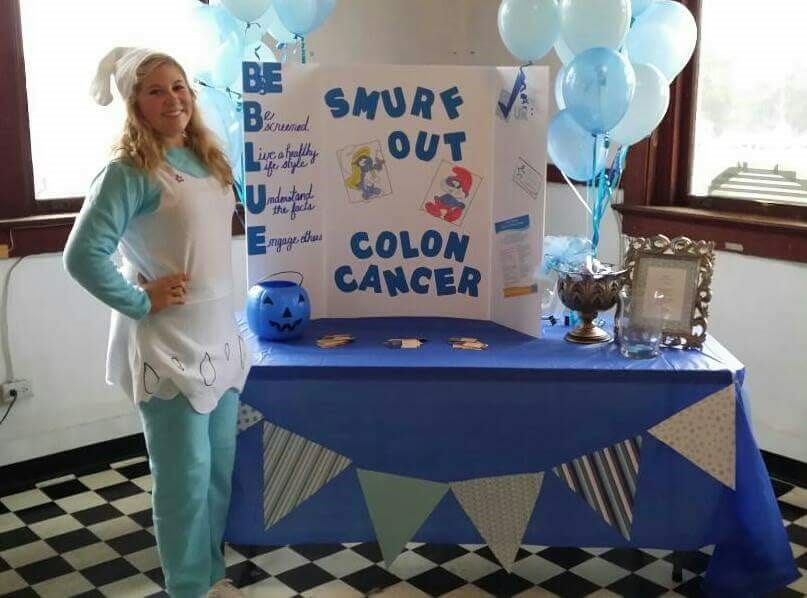
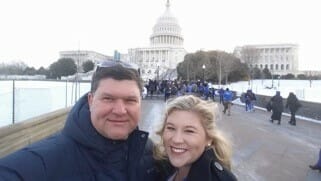
I made the personal decision when my dad was diagnosed that I would not sit silently. I knew that I had a voice and though it might be small it could be heard. I volunteer by distributing cancer related materials to doctor’s offices in my community. I also have lobbied in my state to have March declared Colon Cancer Awareness month and on Capitol Hill to increase awareness and funding for colon cancer. I also manage social media sites in which I post statistics and facts about colon cancer. I have come up with some creative ways to get my message across. One year I dressed up as Smurfette to “Smurf” out colon cancer at my town’s trick-or-treat [event] at the Depot. I also have a yearly “Dress in Blue Day” in which my town dresses in blue to bring awareness to colon cancer.
Why is it important to you to support your community in this way?
Colon cancer is the second leading cause of death in America. However, if detected early it can be treated. It is so important that people have a good relationship with their doctor and get screened at the recommended age or earlier if they are having problems.
You are a young volunteer for this cause – is that an asset or does it not really figure in?
I think my age is an advantage. Colon cancer is being diagnosed at younger and younger ages. I think people will remember the 15-year-old that went to lobby on Capitol Hill. I think it is also important to remember that colon cancer has no specific age. It can happen to anyone.
What’s been the most rewarding part of your work?
Meeting survivors or family members of loved ones who have died and have them thank me for taking a stand and trying to educate others about colon cancer
Are there any future partnerships, programs, or events that you are excited about?
I am partnering with Rumpshaker Inc., the only colon cancer non-profit in Alabama to get a colon cancer awareness vanity car tag for the state of Alabama, only the second state in the nation to do so. With the car tag there will be a permanent source of funding yearly that will go to families affected by colon cancer. I also am looking forward to March, which is Colon Cancer Awareness month. I will be going back to DC to lobby with Fight CRC for awareness and funds for colon cancer. I also will be working at the annual Rumpshaker 5k. My goal is that one day the color blue will be associated with colon cancer as the color pink is with breast cancer.
What do you want people to learn from your story?
You can make a difference, No matter your circumstances. Who would have thought that a small town girl from rural south Alabama would have an audience listen to her?
Do you want to make a difference in your community like Merrill Ann? Visit All For Good to find local volunteer opportunities.
New York Mentor Lights the Way to Hope and Healing for At-Risk Youth
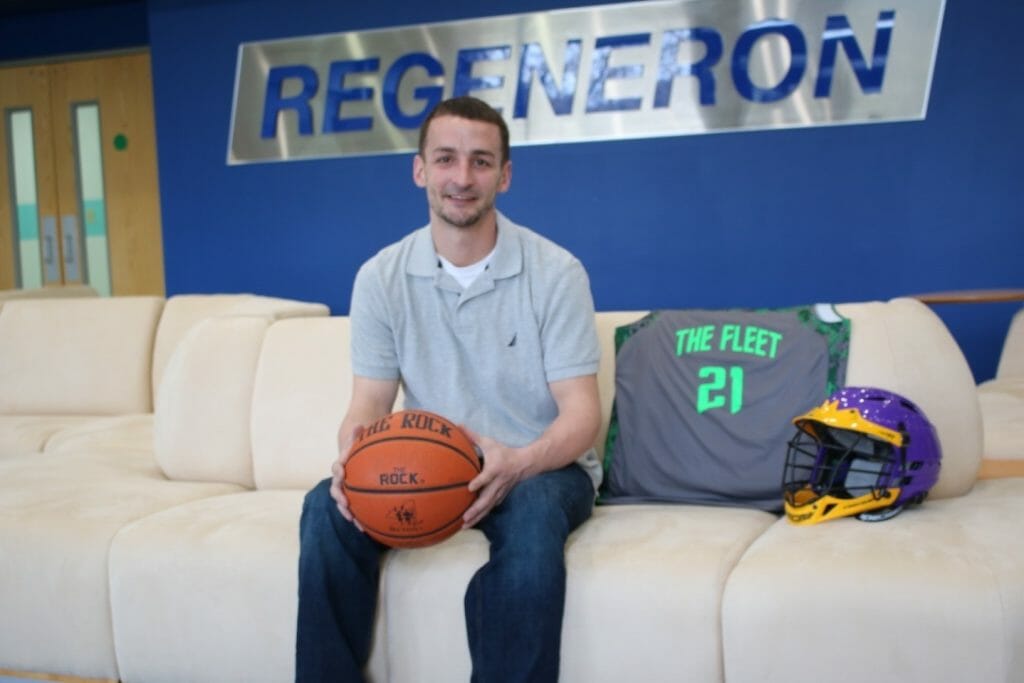
It was a hot summer day in mid-July 2012, nearing 100 degrees, when two Amsterdam, New York, teens took the lives of two of their friends in a shooting provoked by an alleged robbery. The incident stunned the small community, located just northwest of Albany, and Matt Moller knew he had to do something to help his hometown. Joining forces with a few friends he’d grown up with, Matt organized a basketball tournament. The turnout was so overwhelming, the friends started the Wishful Thinking Foundation, an organization offering year-round activities to keep kids off the streets. Since its inception, Matt has made a difference by engaging thousands of youths in his community through coaching sports leagues, homework tutoring, mentorship and even helping dozens apply to college, and is today’s Daily Point of Light Award honoree. Points of Light spoke with him to learn more about his community support.
You moved away from home after college, working in several major cities. When you came back, what prompted you to commit to your community like this?
After the murders, there were a couple of city task force meetings that I went to with some with my friends. We started noticing all the youth programs that were around when I was a kid were gone. We had a huge turnout the first year of the basketball tournament, hundreds of kids showed up. After that, the school and city came back asking if we could do it again. We organized a winter basketball league for 50 kids, then started a summer basketball league. It just started snowballing, and we realized, we have something here, so we created our own nonprofit, the Wishful Thinking Foundation, which could serve as a recreational outlet for kids that filled the gaps left by school and city programs that weren’t around anymore.
You have a full-time job outside of your volunteerism. In a world where all time is precious, what inspires you to continue to give back?
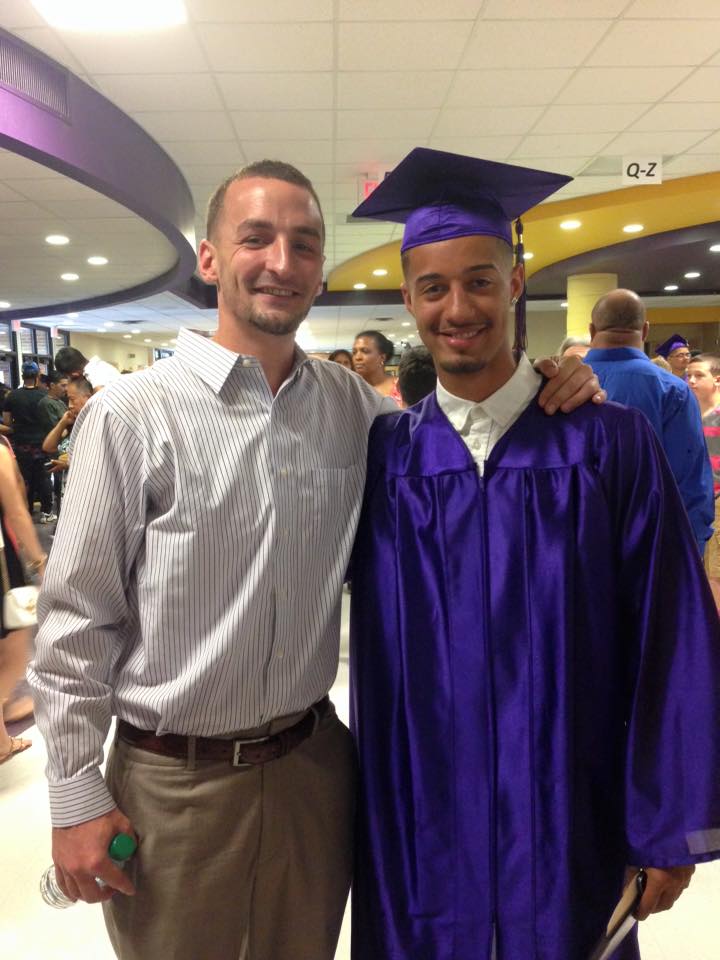
The first few years, I volunteered 1500 hours annually. I was volunteering just as many hours outside of work as I was doing for work. Really, the kids I’ve met have made me want to commit. Some were labeled as “bad” kids, and to be completely honest, when I first started the organization, I was intimidated, I wasn’t sure what the kids would think about me. I didn’t know if the kids would want to participate. But when I got to know them, I realized how great these kids are. They’re funny, they’re caring, they just don’t get any privileged situation to show people how special they are. I started seeing kids that needed someone to look up to in their life, and every kid I’ve coached I’ve have a personal relationship with. Kids that have graduated, kids I’ve helped get into college. Just by laying out that platform for them, it gives me chills to think about how they’ve moved on. The “bad” kids are now student council members, or they’re volunteering for their school and giving back themselves.
People value you. What does that mean to hear that?
I never really (volunteered) for any reward or any pat on the back, so when I hear that, that makes everything that I’ve done worth doing. Whether it’s a kid telling me he’s really glad I was able to help him make the basketball team, or something else. That’s the whole point of being a contributing society member, help thy neighbor.
You’ve made an impact in your community, but how has volunteering changed you?
Volunteering has made me a better person, and I want to make sure I set a great example for these kids. It’s hard to say, ‘I’m going to go out and do this,’ but once you do it, the rewards start coming in. It’s how this country was built, everyone helped each other and lended a hand. If people get back to that – more of these programs and volunteering, it would be more normal. Go out and give yourself back to your community.
In 10 words or less, explain what volunteering means to you.
Pay it forward and watch what happens.
How would you encourage others to give back in their own communities?
I think we all have a responsibility to give back to our communities and society. At least in my experience, when one person steps up, the program just snowballs. Lending a hand is a contagious attitude, I always tell people – if you give of yourself, and show selflessness and that you care about other people, and you’re willing to put a bunch of kids before yourself, the rewards that come back from it are tenfold than the time you put into it.
Do you want to make a difference in your community like Matt? Visit All For Good to find local volunteer opportunties.
Sociology Professor Helps Students Bridge the Generation Gap With Service
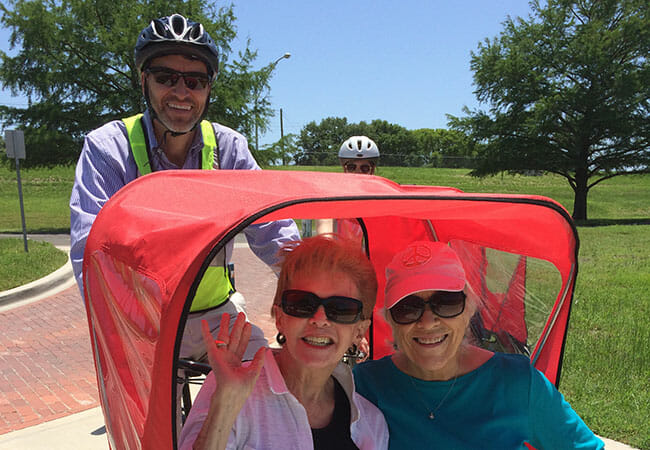
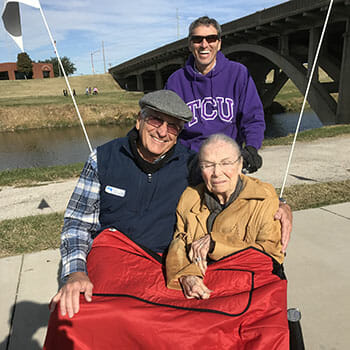
Finding a common thread between generations can sometimes be difficult these days. So, when one of Dr. Keith Whitworth’s students brought Cycling Without Age to his attention, he immediately jumped at the opportunity to bring the program to Texas Christian University.
With roots in Copenhagen, Denmark, Cycling Without Age got its start in 2012 when co-founder Ole Kassow identified a need in his community. Riding his bike past a nursing home every day, Ole always saw the same elderly man sitting outside. Because biking is an important part of Danish culture, Ole wanted to give the man the opportunity to share the experience with him; so he rented a rickshaw and took him for a ride. What started as one ride eventually turned into an international program, which has now been adopted in 34 countries.
A sociology professor at TCU in Fort Worth, Texas, Dr. Whitworth is an avid cyclist and holds a master’s degree in gerontology. A program that combines cycling and working with the elderly seemed like the perfect match for him. He also saw the program as an opportunity for his students to get involved in the community and engaged in service.
adoption of Cycling Without Age at TCU was the first in Texas. For the past three semesters, Dr. Whitworth’s program has been incorporated in two of his classes: Introduction to Sociology, and Sustainability and Social Justice. Students visit the Trinity Terrace retirement community each week to meet with the seniors they’ll be partnering with, and they take turns piloting the rickshaws and riding with the seniors.
“I see the students and how engaged they are, and how giving they are with the residents, and that brings a lot of fulfillment and joy,” said Dr. Whitworth, noting that the students thoroughly enjoy the experience and get a lot out of the program as well.
For Dr. Whitworth, one of the biggest benefits of volunteering with the elderly is helping them feel they are still valuable to society. “[I love] seeing the residents light up and glow while they’re having a conversation with the students, because I think what that says to the residents is ‘I’m valued. Someone values my conversation and likes spending time with me,’” he said.
Cycling Without Age has also offered some lessons in sociology. “We have these labels of the elderly — they’re senile, they’re not as sharp as they once were, they’re outdated, they don’t have anything to offer someone who’s 20 years old — but the students see that these are just stereotypes,” said Dr. Whitworth. “As a sociology student, we look at how we label individuals in society, we look at stereotypes and biases, so [the program] reinforces what they’re learning.”
When it comes to volunteering, Dr. Whitworth believes that once you find an opportunity that aligns with your interests, the benefits will be endless. “I would encourage students to volunteer because you will find that you will receive more than you can possibly give,” he said. “You may not see that initially, but if you’re in the right situation and the right placement that matches your skillset, abilities, and constitution, you will be giving a lot but you will end up gaining a lot more than you’d ever give, without even trying.”
Find opportunities to get involved in your community at www.allforgood.org.
Military Wife Joins AmeriCorps to Help Battle Opioid Epidemic
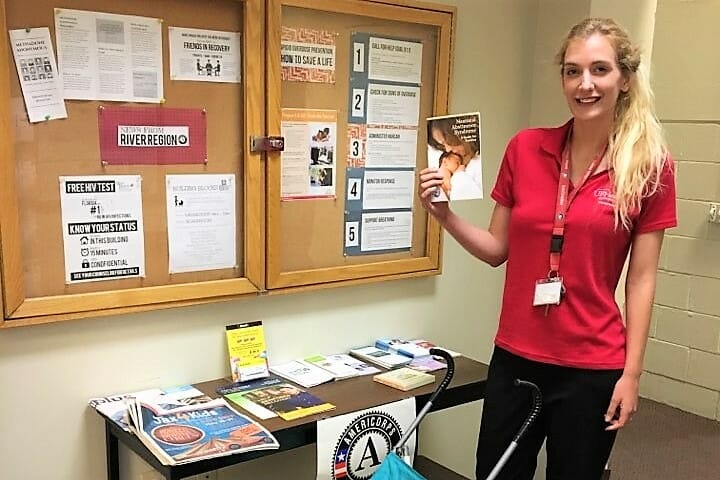
When Alicia Nelson relocated to Naval Submarine Base Kings Bay with her husband, she discovered the Jacksonville, Florida, job market wasn’t an ideal place to continue her career in international policy and health. Rather than admitting defeat with this setback, Alicia moved forward, determined to use her skills for good in her new community, and committed to a year of service with National Health Corps Florida, an AmeriCorps program which fosters healthy communities by focusing on improving health education and access to benefits and services. Dedicating her time to a local substance abuse clinic, primarily working on maternal health, Alicia is battling the opioid epidemic the U.S. is currently facing by offering resources to those in the throes of addiction. Through her commitment, Alicia has become a compassionate health leader and recently celebrated 1500 hours of volunteer service.
How are you helping women who have families and are dealing with addiction?
I designed curriculum for weekly health education classes at a local substance abuse clinic called “Building Blocks”, and taught these classes over 26 weeks. The classes teach moms battling with addiction coping and recovery skills. I also volunteer as an Infant Cuddler at a local hospital where many of my clients deliver.
How did you decide to commit to this year of service?
I’d previously worked abroad in South Korea, and I was very interested in international policy and health, then, when my husband got orders to Jacksonville, I decided I really wanted to work and do something that was actually related to improving American lives. My family has always been committed to service, growing up my dad was really involved in the Hunger Task Force in Milwaukee. My husband is in the Navy and it was just a natural step for me to get involved in service too.
The country is facing an opioid crisis. Do communities need more help from volunteers like you?
They definitely do. Opioids are not just affecting individuals, they’re affecting families. So, if someone is struggling with addiction, it’s probably a mother, or a teacher, or an employee, and the health burden that this is putting on our communities is just so massive, and it’s really getting bigger. People feel like they can’t volunteer because they don’t have direct experience themselves with addiction, but you don’t need any experience with addiction, you just need compassion and the ability to volunteer.
You’ve been called an inspiration. What does that mean to you?
I feel like I was just given this opportunity and I did it. It means a lot that people think that, but I would really want them to look at some of my clients, who have taken my Building Blocks class, because they’re much more of an inspiration. They really manage to get past all this stigma and judgment from society and they’ve managed to deliver healthy children and they’re committed to raising them in a healthy way. And I think that’s so awesome, because addiction is such a challenge.
Why is it so important to give back to the community?
I wrote in applying to AmeriCorps about Sargent Shriver, known for his leadership of public service and social programs, who said “Of all our ideals none surpasses the importance of service” and I believe in that. Out of all of the qualities that a human being can have, if they are committed to serving others, I think that stands above the rest.
In 5 words or less, explain what volunteering means to you.
Serving my country.
How would you encourage others to give back in their own communities?
It’s important to really get in at the local level and have people recognize what their individual power is. It can mean a lot more than sending money to a national organization. If somebody sees a need in their community, they don’t need to be affiliated or they don’t need the support of an organization or a bunch of other people who are volunteering, they can really step up on their own and contribute as an individual.
What’s the one thing you want people to know about your volunteerism?
I want other military spouses and other Americans who are moving around a lot to know there are volunteering options available. A lot of times we can’t find good jobs, or stay with the same childcare provider, and everything is changing. But you need to take a sense volunteerism wherever you go because there are opportunities in every community, and you don’t have to explain why you’ve moved around, or why your resume is so spotty. They’re welcoming and they need your help. Specifically to what I’ve been involved with, opioids are everywhere. It’s not just Florida.
Do you want to make a difference in your community like Alicia? Visit All For Good to find local volunteer opportunities.
Military Educator Living “Whole Airman Concept” by Helping Children from Low-Income Families
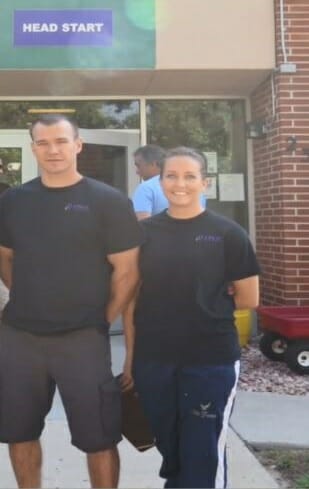
Technical Sgt. Airica Harms-Colby is a professional military educator at the Peterson Air Force Base by day, but her volunteerism with the Colorado Springs, Colorado chapter of Head Start (CPCD) is one that she says is a personal passion and natural extension of humanitarianism promoted by the U.S. Air Force. According to Head Start, nearly 11,000 children under the age of 6 are living in poverty in Colorado Springs and the surrounding area. These children face higher rates of committing crimes, dropping out of school, becoming teen parents and depending upon public assistance. Through Head Start, early childhood education combined with family support is provided to ensure brighter futures for these children — an initiative that is personal for Airica, who grew up in a low-income home. Wanting to give back to her community beyond the base she calls home, Airica is making a difference by serving as a leader for her military family and making an impact on those most in need in the community, and is today’s Daily Point of Light Award honoree. Points of Light spoke to her to learn more about her work with CPCD.
How did you decide to support Head Start?
When I was stationed in Texas, I was heavily involved in the community. We move frequently, and when I moved to Colorado, I was trying to figure out how to get involved. We try to give our students as many opportunities to volunteer across the military bases as we can. My (Air Force class) was so on board with the idea of volunteering with CPCD, they suggested we get the whole class of airmen involved, and we sure the heck did. Between staff and class, we have 120 people, and we refreshed both buildings, did landscaping. It was a pretty big venture, but that’s how we first built the relationship.
This is a personal cause for you. Explain.
My husband and I both came from very low-income families. Our parents did the best they could, my mom taught for Head Start. These organizations do so much for families that really just don’t have a lot. I would have actually never known that I came from a low-income family, I didn’t realize until I was an adult, because these organizations are just so rich, they provide everything for families that really just don’t have a whole lot.
You’re not just an individual contributor. How did you get so many others to help?
This is a personal passion, but community relations is also part of something the Air Force breeds. It is paramount for us to be a whole airman – it’s called the “Whole Airman Concept.” It’s something that our leadership really drives home, from the top, down. This is something we do to build relationships through the communities we live in. We want to make sure that there is a relationship with the community outside of the bases we live and work at, and that they understand we have a mission. We take care of the people within our walls, but we also want to make sure we are taking care of people outside of the base. It’s about taking care of people, it’s about humanitarianism, it’s about community.
You’ve been called a “champion” for the Head Start families and an example of “true military leadership.” What does it mean to you, to hear that?
Wow (laughing). A champion for Head Start…I mean…it’s very humbling. You tell me to do it, and I will make it happen. It’s just the challenge of these grand projects – I had support from the whole team of people from Head Start and my school the whole time, and it definitely wasn’t just me. Everybody came together to make this happen, we just had a fantastic attitude from everybody, including leadership. This is something that the Air Force has instilled and taught, so I’m fulfilling something that I believe in, absolutely.
Why is it so important to give back to the community?
I’m not going to stay here (in Colorado Springs), I leave in February, and it’s important that the relationship that I leave behind is great for the people that I leave here. It’s great for my institution, if you consider those second and third order effects of what you do today. So, if I build relationships today, if I have a fantastic attitude today, then what kind of relationship can I build for my institution and my base tomorrow? When things get hard in the future, we can always go back and we can remember the awesome relationship that was built a few years ago. It’s always about ‘how can I leave things better?’
Where does your dedication to help others come from?
I definitely have to applaud my parents, they’re both servant leaders. My mom is a teacher, I remember her finishing her student teaching when I was in grade school, and then my father is a retired police officer, he’s now a farmer. So that servant leadership has always been instilled with me, we’ve always been involved with community, whether it was church, or school, or 4-H. And then after joining the Air Force, I’ve just always volunteered, it was always something that was a drive in my belly.
How would you encourage others to give back in their own communities?
It isn’t always about showing up for giant projects, sometimes it’s even about helping people carry their groceries out of the grocery store that just look like they are struggling, or, picking up something for someone who just dropped something at the gas station. Honest to gosh, it’s just about helping people who might be having a hard day, or smiling, or asking someone how they’re doing today, it really is, just about that. And then, when you do have time, volunteering at your soup kitchen, helping out with Meals on Wheels, and giving back as much as you can.
Do you want to make a difference in your community like Airica? Visit All For Good to find local volunteer opportunities.
California Woman Uses Her Quilting Skills to Offer Warmth and Thanks to Veterans
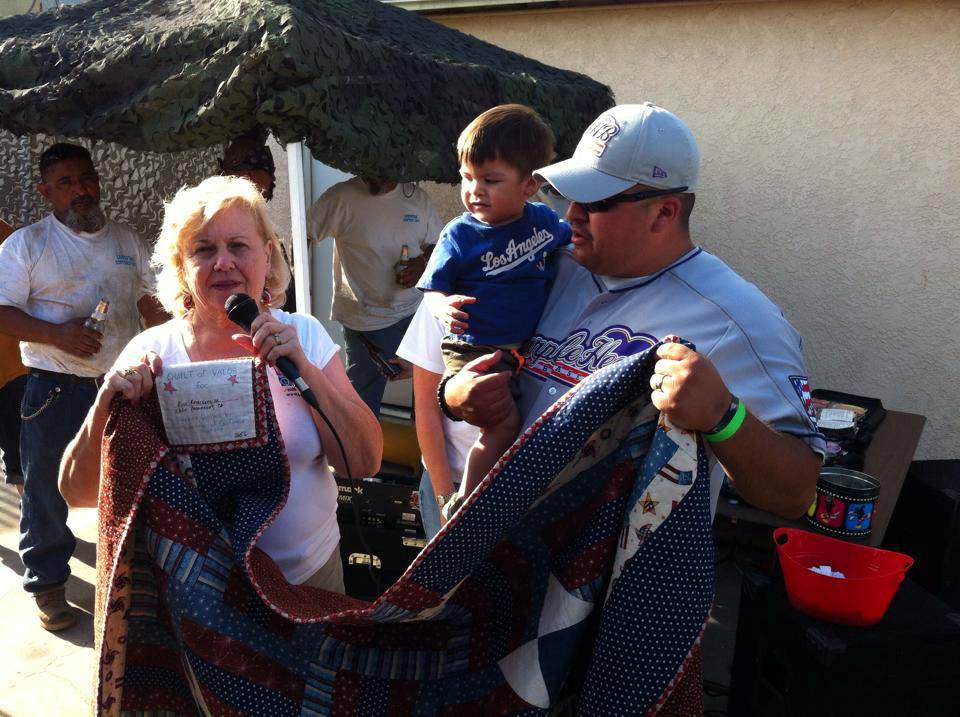
A stitch in time can make all the difference. Just ask Barbara Winkler, who heads up a group called SoCal Quilts of Valor, a Long Beach, California-based nonprofit that makes and presents quilts to U.S. service veterans.
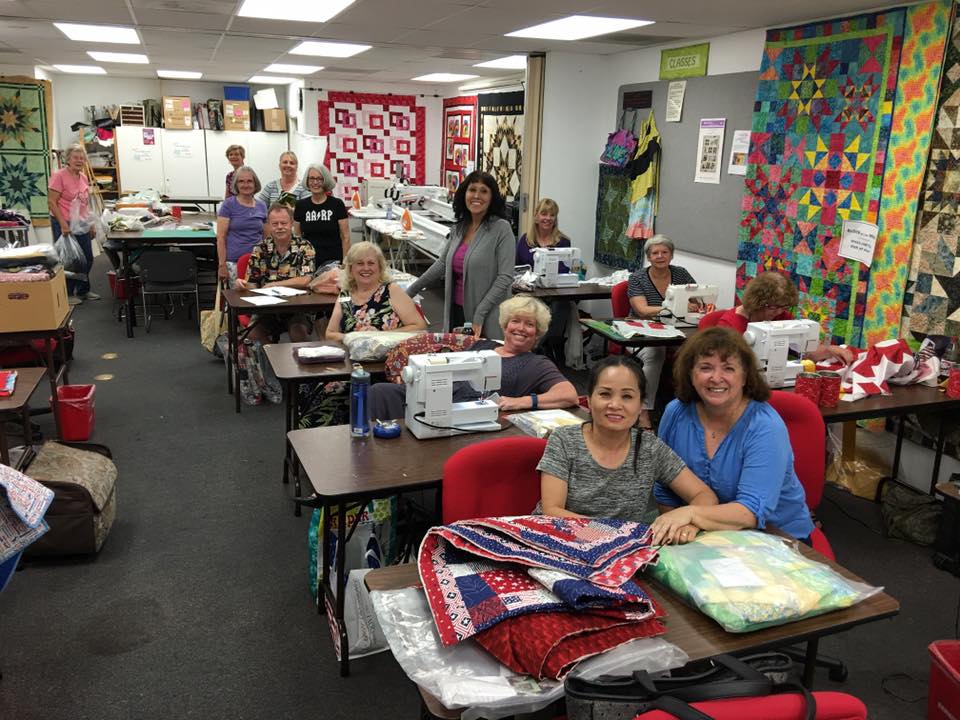
Inspired to show these service men and women a tangible sign of thanks, Winkler has singlehandedly sewn some 600 quilts. She didn’t come to quilting by way of family tradition, at least that’s what she thought until a few years ago, when several long forgotten quilts were discovered in storage made by her aunt and grandmother. Despite some health challenges, Winkler remains active in the group, which has made more than 4,400 quilts to date, presenting 651 to returning veterans last year.
What inspires you to volunteer?
The smiles and appreciation from the veterans who receive our quilts and get a ‘Welcome Home” along with our thanks for their service.
Describe your volunteer role with SoCal Quilts of Valor?
I am the organizer as well as do most of the presenting of quilts. Today we awarded the 355th so far this year. I handle all the requests and scheduling as well as storing fabric, kits, quilts to be quilted and the finished product waiting to be awarded. I find quilters to volunteer and make arrangements to get the quilts delivered or shipped to them to do their magic. I actually make quilts, too. I am working on my 50th quilt this year (more than one per week), even though I had shoulder surgery in February. I orchestrate our sew days and bring supplies for everyone. I also got us authorized through the Long Beach Unified School District to have students work with us to earn community service hours. I work with the Long Beach VA to provide quilts for the veterans in various programs. One of my volunteers has now taken over my job of cutting kits, so those who have trouble choosing colors or cutting properly can just sit down and sew.
Why is it important to you to support your community in this way?
Our veterans put their lives on hold and put their life on the line; they take time away from school, jobs and family to serve our country. It’s the least we can do to say thanks in our small way. As they use their quilt they can ‘feel’ the love we stitch in.
What’s the most challenging aspect of your volunteer service?
Finding sponsors and finding volunteer long-arm quilters.
What do you think it means to these veterans to get a quilt from your organization?
We had a Korean veteran who told us he had waited 62 years for someone to say thanks. Then there was the Vietnam veteran who was disgruntled about the way he was treated when he returned home and held a grudge because the new veterans were being treated better. He said after receiving our quilt he was able to let go of the anger he held for 50 years! We’ve heard that medals are manufactured and only sit on a shelf, where our quilts can be used and cuddled and are handmade with love.
Why do you think it’s important to give back?
If we don’t, who will?
What’s been the most rewarding part of your work?
Running into a previous recipient who says that they use their quilt daily and love to show it off to visitors.
What do you want people to learn from your story?
Anyone can volunteer, no matter what their skill set, no matter what their age. Many of my volunteers come for the camaraderie as well as the focus of our project. Many who said they were quilters or seamstresses when they started with me have learned new things, which keeps us seniors on our toes. There are so many steps needed in making a quilt, even if you don’t sew, you can assist. There are Quilts of Valor groups nationwide and worldwide. Go to the national website www.QOVF.org to find a location near you, If there isn’t one, start one like I did.
Virginia Youth Raises Money for Women and Children’s Shelter
From a very young age, Emma Grace Stelljes knew she wanted to leave an indelible imprint on those around her. She soon realized volunteering her time and energy was the best way to reach that goal. So, with a little help from her parents, she began supporting multiple organizations.
When did you decide to become a volunteer?
Ever since I was about 8, I knew that I wanted to make an impact on the world. So, I talked to my parents about what I could do in my community. After talking to them I found out about some opportunities through my school and about organizations in my town. I knew, then, that volunteering would be my way to make an impact and help people in need.
How did you pick Avalon as the organization you wanted to work with?
I decided to work with Avalon the summer I started volunteering. It’s a shelter for abused women and their children. I choose it because I wanted to support the nonprofit. My heart felt for the children there, and I decided to raise money to give to them to rebuild their lives and help the people at Avalon run the shelter.
What did you do when you worked with Avalon?
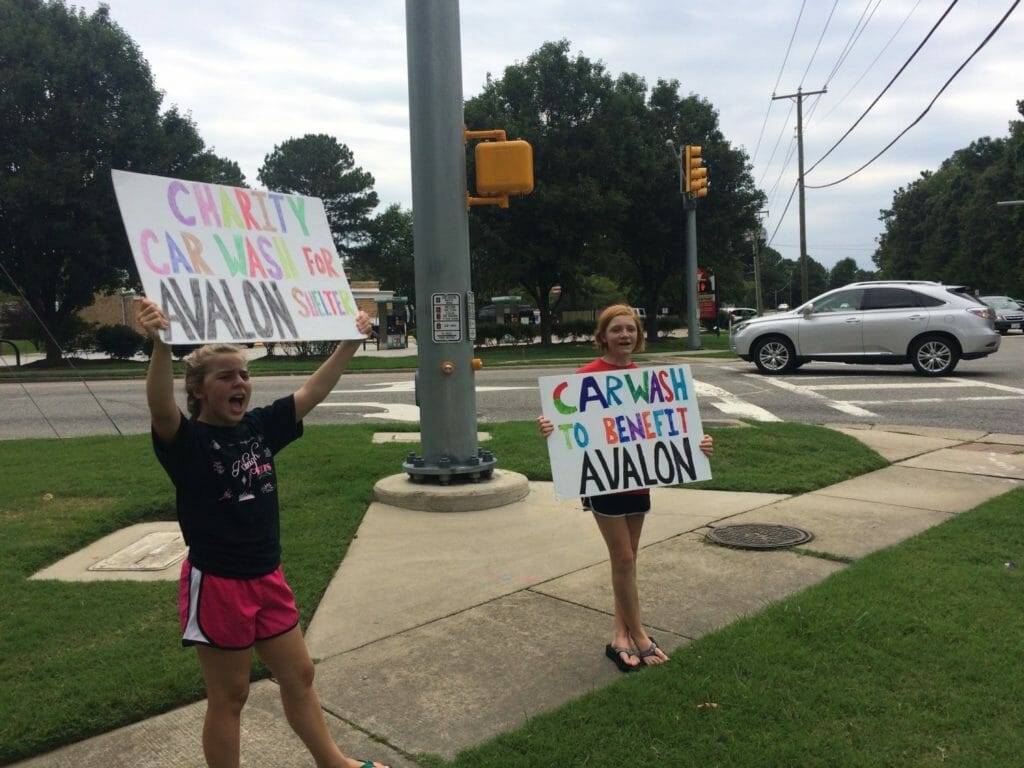
Before I raised the funds, I met with staff at Avalon and helped out in the main office. As I got to know them, I asked if I could organize a car wash. We raised about $850 and met many people who donated because they care about the agency or were supported by it over the years. After the carwash, we decided to spend the money on new toys for the kids. We drove to the store together and picked out the toys. With the money left over we organized a trip to the movies for the kids and another outing. I learned a lot about leadership by developing the project, seeking volunteers, advertising, deciding on what was the best use for the money and talking with community members about Avalon’s mission.
The second carwash I did a year later, I got help from students at William & Mary. We had more volunteers for the car wash, and we added exciting projects to the overall event. All summer, I made bracelets to raise awareness for Avalon, and the college students helped me sell the bracelets. We raised over $1,000 this summer.
How did you get involved with the assisted living center?
I got involved with the assisted living center through my school. After school, every Thursday, a staff person at my school would take a group of kids there. I heard about it from some of my friends and teachers. I was lucky that I got to go every Thursday for the next two years, and I loved every minute of my time there. Getting to know the residents who told me about their lives and their families and bringing joy to their lives were the best parts.
What activities do you participate in with the residents there?
At the assisted living center, I participated in crafts with the residents, as well as games. We did art, bowling and, occasionally, bingo. We also went and visited residents that could not leave their rooms. It was always wonderful seeing the residents and talking to them. One day, my dad and I went to a pottery store where you make your own pottery. They had a lot that people did not pick up, so we asked if we could take them to give the residents at the assisted living center. They said yes. So, the next day we delivered two boxes to the residents.
What type of impact do you think you were able to make on others’ lives through volunteering?
Through volunteering, I feel that I have brought joy into the lives of people who need it. I hope I was able to make my community a better place to live. I believe that I was able to bring joy to the kids at Avalon through the toys and fun outings. I hope that I was able to help Avalon to continue to keep running and maintain the buildings through the money I donated to them. Volunteering impacted my own life, as well. It has brought joy into my life and given me a greater outlook on life. I feel I was able to make a difference in the lives of others, and I hope I can continue to have that effect. I feel like this is the beginning of a lifetime of volunteering.
I am going on a mission trip this summer, and I hope that opens many new doors for volunteering opportunities. For my life, I hope that I can spread happiness and kindness to others.
Do you want to make a difference in your community like Emma Grace? Visit All For Good to find local volunteer opportunities.
Retiree Finds Joy in Delivering Hot Meals to Florida Residents
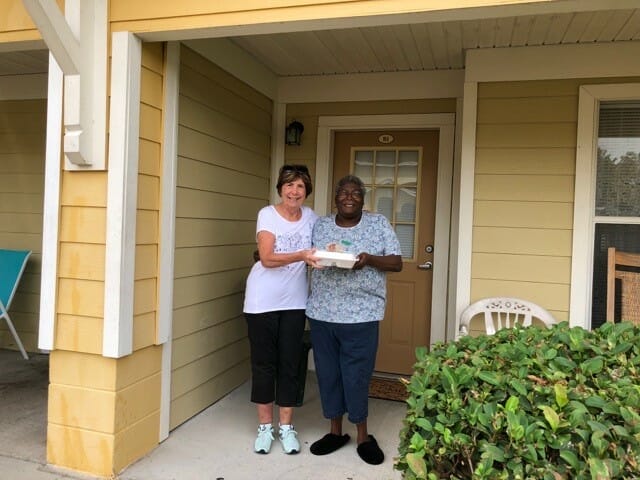
Being a volunteer is about more than simply donating time for Florida resident Victoria Frisk. For her, it’s about soul enrichment — hers and the ones she serves.
Since her teenage years, Victoria has given back to others through service. Most recently, she’s helped others as a driver for the Wildwood Soup Kitchen, delivering meals to recipients who are homebound. It’s an effort that not only nourishes their bodies, but it fulfills emotional and social needs, as well.
Points of Light talked with Victoria about why she volunteers and the impact she’s made.
Why did you get involved with the Wildwood Soup Kitchen?
I have always volunteered. I love working with people and doing something for them that they cannot do for themselves. I’ve never known a time when I didn’t volunteer doing something. At 15 years old, I worked at the hospital as a candy striper. I’ve worked with adults and children over the years, and I have always felt an obligation to volunteer. It’s enriched my soul.
I started working at Wildwood in 2006 when I saw an article on the soup kitchen in the local paper. I went down to visit and thought I’d like to work in the kitchen. But, when they said they really needed drivers, I said, “No problem.” And, after my first delivery, I was hooked.
The people are very friendly and welcoming.
How often do you volunteer?
I drive for Wildwood every other Thursday morning from 9 a.m. to noon. The drivers work in twos, and over the years, I’ve had three co-drivers. My current one, Pat Gable, is very dependable, and I enjoy our day together.
I’ve had the same route for 10 to 11 years, but the number of deliveries fluctuates. We always check the route board to see how many people we’ll be delivering to that day. Generally, we have between 30 and 40 meals delivered, depending on people moving in, moving out, hospitalizations, etc. If they’re gone for several weeks, we can resume delivering to them when they return.
What impact do you feel you’ve made?
Overall, I believe Wildwood delivers about 1,600 meals a week. The people we deliver to are just wonderful. For me, it’s a privilege to share myself with others. We deliver to people who cannot come to the soup kitchen. Therefore, we’re providing something they need or want. We have one lady on our route who loves croissants, and when they’re available, we make sure she gets them.
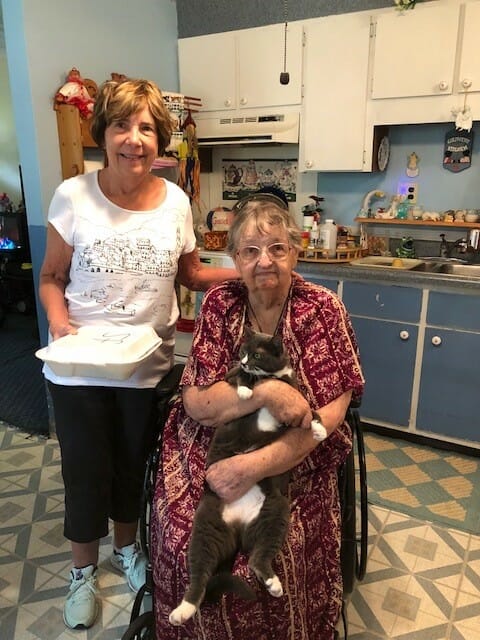
Also, everyone needs a visitor — someone who listens to their stories and enjoys them for being the special person they are. In particular, I have long conversations with one of the women I deliver to. She’s in a wheelchair and has been for a long time. She’s 88, sharp as a tack, and always has classical music playing and plays beautifully herself. It’s a pleasure to speak with her about her life.
What does Wildwood provide for its recipients?
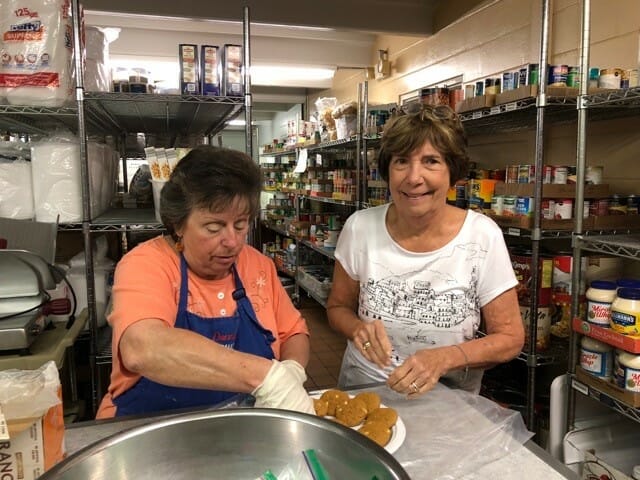
Although it’s called a soup kitchen, the majority of meals are hot — meat loaf, baked potatoes, green beans, or spaghetti, bread, salad and a dessert. For some of the clients, it’s the only hot meal they get all day.
As drivers, we get the appropriate number of coolers to hold the containers the cooks put the food in. We load those in the car, and off we go to deliver the food and talk with people. Then, we return the empty coolers to the kitchen, clean them and get them ready for the next day.
What do you find fulfilling about volunteering for Wildwood?
Personally, I want the people on my route to know that they’re respected and cared about. My partner and I do lots of different things for some people. If they need help with their cats or help putting a faucet together, we help them with that. I think you need to be able to provide what the person needs.
We have a couple of single mothers with children on our route. We help them as much as we can. When we have baked goods, we make sure to bring cookies for the kids. Another of our clients is always looking out for us and telling us to hydrate because it’s hot in Florida. There’s another little lady who lives by herself, and we always talk about her plants. She’s a dear. One woman usually sits outside, waiting for us to “chit-chat.” And, we have a big bond with the woman who plays the classical music. She volunteers, too, and she’s really bright and very interesting. We will do anything for her. She’s called me at home to see if I could help her with things. I think that’s how you have to look at the people you serve — they are worth whatever you can do for them.
Why do you feel volunteering in general is so important?
I don’t believe you can save the whole world, but I do believe I can do something for my part of the world. This is what I love, and I plan to do this as long as possible. In my volunteer service, I’ve met some of the most wonderful people from all walks of life. Some are in difficult situations, but they all have stories to tell. All of them want to be heard and treated like a human being. We all need to be appreciated for who we are.
Not all of these things from my service with the soup kitchen seem huge. I feel I am just a spoke in the wheel. But, doing this enriches my soul, and I hope it enriches others. Volunteering offers you an opportunity to meet people from all walks of life, and by volunteering, you bring a little joy to someone. In that way, I think you’ve succeeded.
Do you want to make a difference in your community like Victoria? Visit All For Good to find local volunteer opportunities.
With Growing Community Garden Initiative, Teen Tackles Hunger and Obesity in Missouri
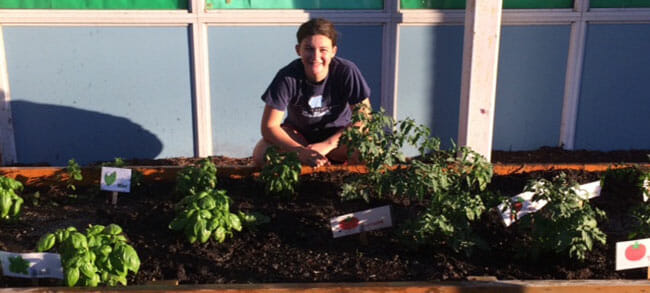
Sophie Bernstein always wanted to grow her own garden. At 12 years old, she was looking for a meaningful project to complete for her bat mitzvah – something that would serve a larger purpose and help the community. Sophie realized she had the perfect opportunity to start her garden, while also benefitting others by donating the crops that her garden produced to the local food bank. She had no idea where that project would take her.
After delivering her first harvest of fruits and vegetables to the food bank, Sophie was surprised by the absence of produce available to shoppers. Many of the shelves were stocked with items like potato chips, candy and sodas. Sophie took some time to educate herself on the prevalence of hunger and obesity in her home state of Missouri—finding that is the state has a high rate of childhood and adult obesity, as well as a high rate of families that have a hard time providing healthy options for their children. She realized she could make a difference by promoting healthier choices at food banks.
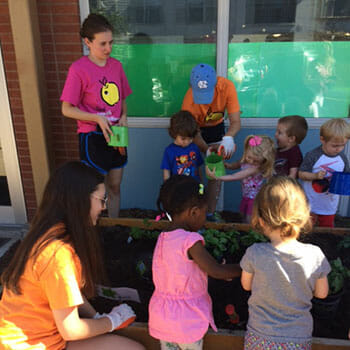
Since starting the garden in 2012, Sophie’s efforts have broadened exponentially. What started as one garden eventually grew into an entire movement, called Grow Healthy. “I started expanding my garden project to local daycares that were low-income, so that the families in need, if they wanted to, could use the produce,” said Sophie. “We also have an emergency shelter for children in our communities who are homeless or whose parents are in the hospital or in prison, so I donated and built gardens there.”
After the events in Ferguson took place in 2014, Sophie knew she wanted to help. “We are only a few miles away from Ferguson, Missouri, so I wanted to do more” she said. “I reached out to low-income daycares in that region and there was also a shelter for teens and at-risk youth. So we built gardens at those sites as well.”
Based on need, and the fact that her efforts have been so well received, Grow Healthy gardens continue to grow and expand. “We’re up to now 35 gardens and over 750 volunteers have helped,” Sophie said. The project has also helped bring people together from all walks of life.
“We’re a group of kids that are diverse, we have people from seven different countries, every religion, different sexual orientations, we have at-risk youth, we have youth with special needs that are all volunteering,” she said. “I think it’s that unity and understanding, and bringing that group of people together for a common goal.”
What Sophie wants people to know about her success is that everyone holds the same abilities within them, and everyone can make a difference, regardless of age — all you have to do is find your passion. “It’s finding out what your passion is, and finding a way to give back within that.”
Find opportunities to get involved in your community at www.allforgood.org.
Animal Lover Helps Special Needs Dogs Find Forever Homes
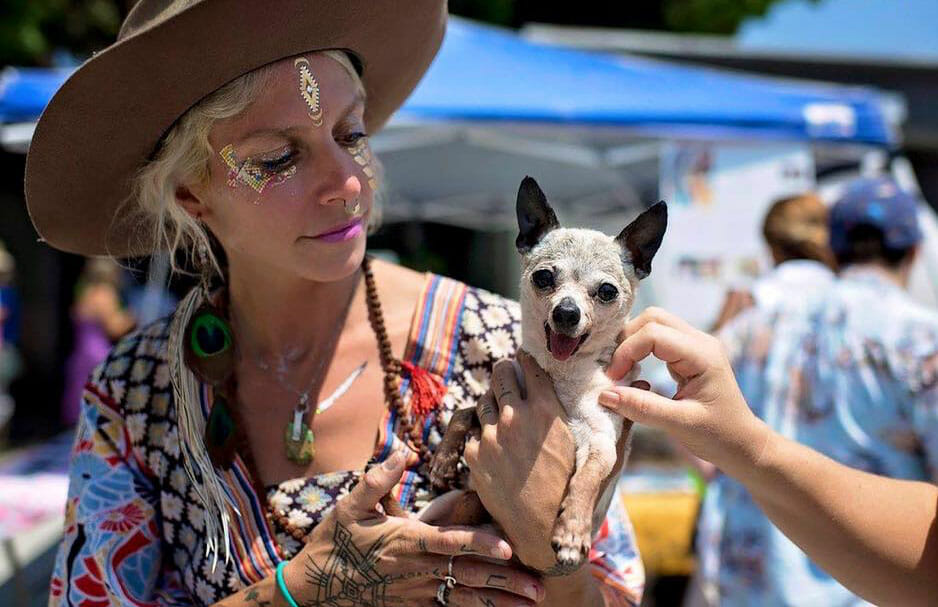
When Carla Naden sees a dog with special needs, a pup that’s blind or deaf, hobbling on three legs or feeble, she doesn’t get sad. She gets busy. Naden, 38, a San Diego-based artist, is a lifelong animal lover and regular volunteer with Animal Balance global welfare group. In 2013, when she was touring a local animal shelter, Naden had an “aha” moment. That was the day she met Nugget, a homely mutt just a day away from being euthanized. That was also the day she founded Animal Synergy, a rescue, rehab and sanctuary organization that to date has cared for more than 100 dogs. Using her hard-earned network of animal loving professionals, these critters get the help they need, as well as a foster home, or a spot in Naden’s own abode, where there is love enough for all.
Describe your role with Animal Synergy – how has it grown and evolved?
I am the director of the Synergy community, a means to help animals more fully. There is help for young and “prettier” animals, but the ones we affectionately call “busted love nuggets” are the ones who spurred us to action. Synergy has saved more than 100 animals from being euthanized, and we have helped individuals, rescues, and shelters work together – helping hundreds of animals this way.
Why is it important to you to support your community in this way?
Doesn’t everyone want to feel inspired to make the world a better place? I felt that the animals need us because they have no voice. They offer us a boundless supply of love, and all they ask is that we show up – plain and simple.
What’s the most challenging aspect of your volunteer service?
I’m often asked “Isn’t it hard to let the animals go after you’ve nurtured and loved them, particularly when they come to you so broken?” The answer is “yes.” But it’s not about me. We must love these animals deeply to undo the damage that has been done both physically and mentally to them. To see them embark on their new journey is always bittersweet and a complete privilege.
Why is it important to you to support shelter animals in this way?
The shelter system can improve with help from volunteering, advocating, adopting, rescuing etc. No animal should be euthanized without a real opportunity at life.
What’s been the most rewarding part of your work?
The love, the love, the love. Every moment with these animals is a reward. They teach us to slow down, to enjoy the present moment – that’s all that exists for these nuggets. They teach us to love fully and to be compassionate. And seeing the joy they bring their forever families is beyond gratifying.
What have you learned through your experiences as a volunteer?
I have learned to truly listen – to an animal who wants to live, or whose time it is to let go. To listen to what volunteers and foster families are able to offer. To listen to shelters, their hopes and their limitations. I’ve learned to listen more closely to my own gut.
Are there any future partnerships, programs, or events that you are excited about?
Yes! I’m leaving for Nepal shortly for a conference called ‘Changing Human Behavior’ because most animal suffering is caused by humans doing, or not doing, something. To help animals, we must change the hearts and minds of humans.
What do you want people to learn from your story?
Do the best you can until you know better. Then when you know better, do better. [That’s a] Maya Angelou [quote]. “I did then what I knew how to do. Now that I know better, I do better”
Isn’t it amazing that we have the power to change, simply by our choices? That is pretty incredible.
Do you want to make a difference in your community like Carla? Visit All For Good to find local volunteer opportunities.