Bank VP Empowers Struggling Families as a United Way Financial Coach
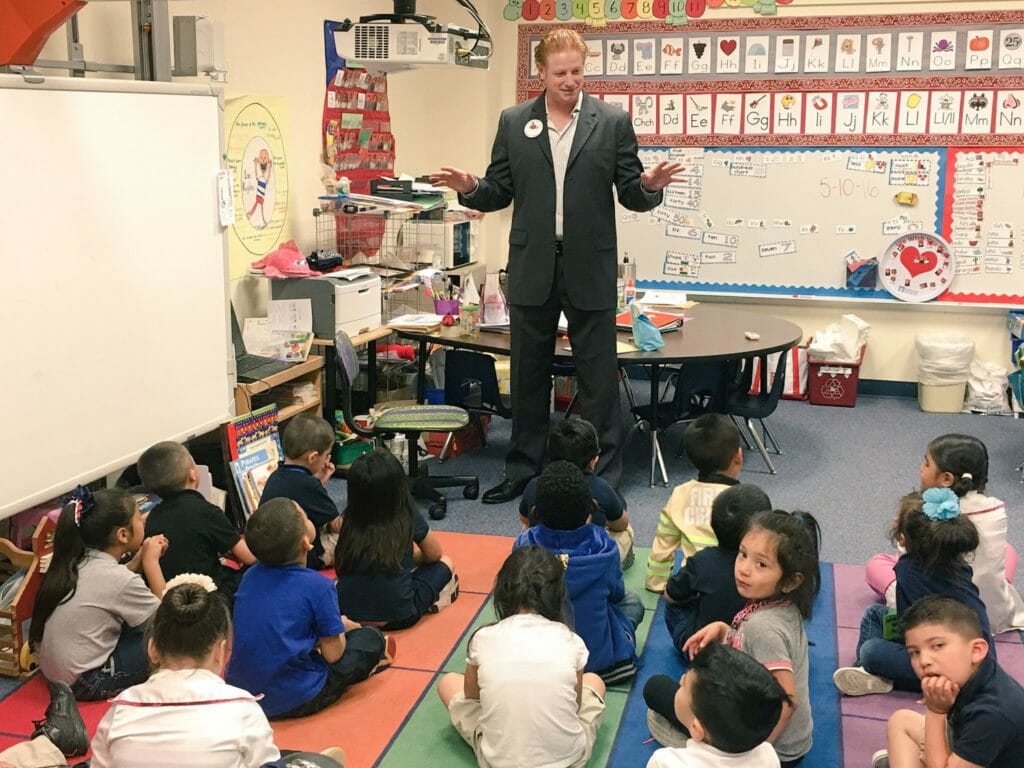
Ask Tisha Rodgers how she feels about Bill Kresser, and you’d better have more than a minute. The college educated single mother of five met Bill when he was volunteering as a Financial Coach at United Way of Tarrant County. As someone who grew up in a low-income home, Tisha was intent on breaking that cycle, doing whatever it took to provide a better life for her children. She turned to the free coaching program for help.
“Bill has gone above and beyond to help me,” she said. “He was been a mentor, a coach and a friend. It feels so good to know I have someone in my corner who believes in me.” Tisha’s immediate goal was to increase her income. Working over six months and beyond with Bill gave her the impetus and the skills to finally achieve her goal. She took a new job making $9,000 more a year, and became trained herself as a financial coach. “I want to give back to help somebody else like me achieve her goals.”
Bill, a Vice President at BBVA Compass Bank in Fort Worth, has found that utilizing his experience as a community banker is the most impactful way for him to give back. “I previously volunteered with YMCA, but when my wife started working for United Way, that allowed a new door to open,” he said. “Financial coaching is what I do every day as a community banker. I was a branch manager for most of my career and that is about listening to clients and helping them get to a better place. I’m driven to help people in need and realize that my skills can make a huge difference.”
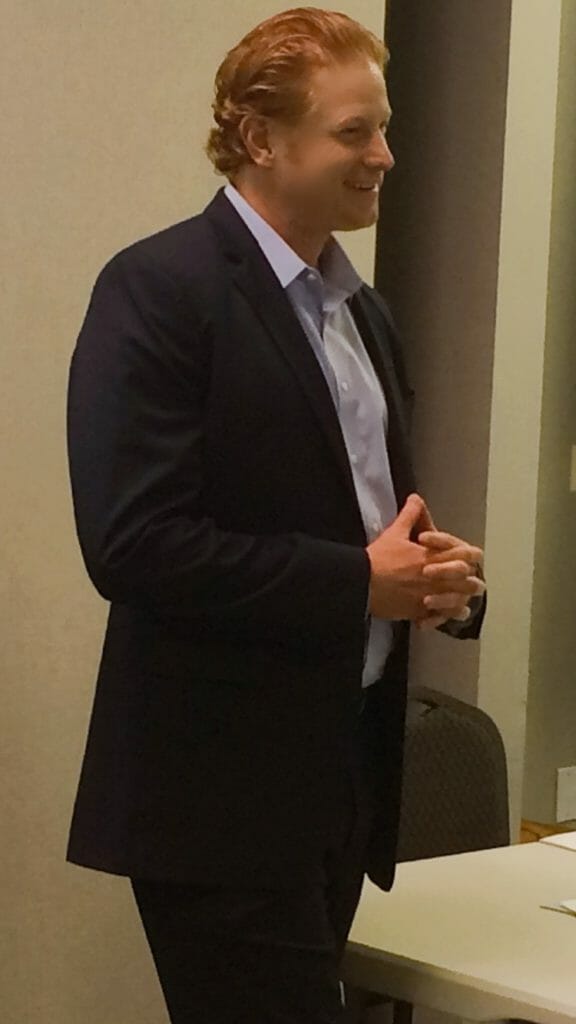
As a volunteer coach for United Way Financial Coaching, Bill starts with being a good listener. “I want to find out what the person’s financial goals are. Do they want to increase their income, change their spending habits, improve their credit? Tisha was doing a great job managing her finances, but she needed help harnessing her degree and experience to get a better paying position. The client is the driver of what they want to do, I help them navigate.”
Navigating the sometimes confusing world of personal financial management isn’t in everybody’s automatic skill set. Bill knows from experience that acquiring that skill can be a game changer. “If we can improve a client’s credit, for example, then she may be able to get a loan from the bank at 12 percent interest rather than the 30 percent or higher at a payday loan place. With Tisha we worked on putting a resume together that would get more looks from a potential employer. Then we went through the interview process, practicing with tough questions. Not everybody has someone in her life that can help with this. Coaching can make a real difference in outcome.”
For Bill, the biggest challenge in financial coaching is getting the person he’s working with to truly buy into the process, to own it. “The toughest aspect is reaching people who are serious about making changes,” he said. “Once that is established, then it’s easy to develop a relationship with them. It takes patience on both sides, not giving up and trusting that if we stay focused on the end game, we will accomplish our goals.”
Working with folks who are struggling has been an eye opener for the banker, who was honored as United Way’s volunteer of the year in Fort Worth for his service. “Just getting to see how other people live, and the challenges they have makes me appreciate what I have in my life. I also really value the friendships and relationships that have grown past the six-month coaching period. I like the sense of community I feel from this work.”
Like in any job banking has its day-to-day tasks and it’s easy to fall into a rut. For Bill, bringing his employees into the coaching process breaks the usual routine with a slice of the real world. “It is encouraging for us as bankers, and for our employees, to have the opportunity to really help people, to see the big picture beyond the day to day problem solving.”
Supporting his community in this way has become an important part of Bill’s personal mission. “Empowering someone like Tisha, seeing her face and her smile light up, is incredibly rewarding. There is great satisfaction that comes from making a difference, helping people less fortunate improve their lives.”
If there’s one thing he’d like to share with other potential volunteers is that maximizing your existing skill set can sometimes have the greatest impact in a volunteer setting. “If they can take whatever their skill set is and use it to make a difference, that’s the key. As bankers, we have a responsibility to help not just our clients but our community. Financial coaching gives us that chance.”
Do you want to make a difference in your community like Bill? Visit All For Good to find local volunteer opportunities.
With Donated Laundry Supplies and Quarters, 12-Year-Old Lightens the Load for Families in Need
Maggie Leach is today’s Daily Point of Light Award honoree, and one of the winners of the 2016 Make A Difference Day Awards. Each year, TEGNA recognizes 14 outstanding leaders of Make A Difference Day projects, awarding $140,000 in grants that are donated to the charities related to the winning projects. Learn more about Make A Difference Day and register a 2017 project at www.makeadifferenceday.com.
When she was 8 years old, Maggie Leach lived with her family in a hotel for six weeks as they waited for their new home to be built. While washing clothes with her family at the local laundromat, Maggie met several homeless families who could not afford to do their laundry more than once a month – and who sometimes had to make the choice between clean clothes or food. She wanted to do something to help.
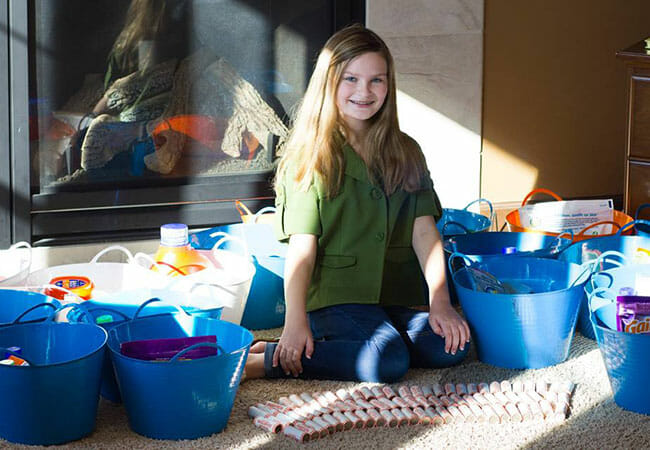
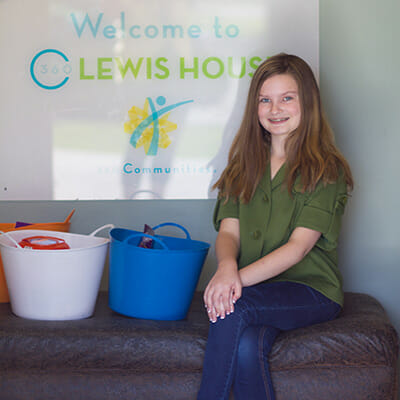
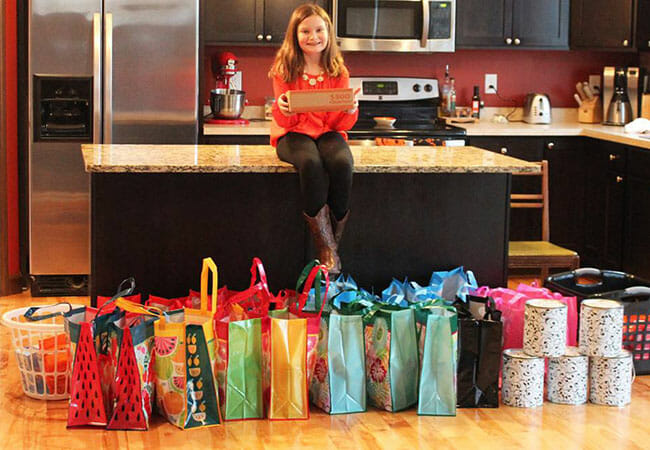
Maggie launched Operation Share the Load as a Make A Difference Day project in 2012, collecting rolls of quarters and laundry supplies to be donated to families in need. And on Make A Difference Day 2016, she brought in her largest collection yet. Maggie, now 12, collected 81 rolls of quarters, a total of $810, and 21 baskets of laundry supplies – enough to lighten the load of dozens of families served by nearby Lewis House, which shelters women and families fleeing domestic violence.
In recognition of her efforts on Make A Difference Day, Maggie was awarded a $10,000 grant that she donated to 360 Communities – a little extra money to do a lot more good for the nearly 18,000 individuals served by the nonprofit’s community programs. We asked Maggie to tell us more about last year’s project and what’s next for Operation Share the Load.
What inspired you to start Operation Share the Load?
When my family decided to build a new home in 2012, we sold our old home about six weeks before we could move into the new one. We lived at an Extended Stay hotel, and had to wash our clothes at the laundromat. We met many families who worked full time and lived in their cars, and who could only afford to wash their clothing once a month. Some families could only wash some of their clothing, because they had to choose between clean clothes or food.
Tell us a little more about your Make A Difference Day 2016 project.
I started Operation Share the Load in 2012 as a Make A Difference Day project. Since then it has grown and by 2016 I was able to raise more than $800 in rolls of quarters and hundreds more dollars in laundry supplies. Each Make A Difference Day, I take my donations to a charity that helps families in need. Last year I donated to 360 Communities in Minnesota. Now that my family has moved to Iowa, I have already met my next partner and will be donating on Make A Difference Day to IMPACT! In Marion County.
What was the most rewarding part of the experience? A favorite memory?
My favorite memory was my first year doing my program. That year we went to the laundromat and surprised people with free laundry services. One lady asked if she was on “Candid Camera” and when I told her no, she started to cry and said it was the nicest thing anyone had ever done for her.
Why do you think it’s important for others to get involved and make a difference in their community?
I think it’s important because helping others brings communities together. You understand each other more, and you make new friends along the way. You also may never know if you will be the one who needs help someday.
As a 2016 Make A Difference Day Award Winner, you were awarded a $10,000 grant to donate to a charity connected to your project. What will that money go toward?
I donated my grant to 360 Communities because I have partnered with them since 2013. They are very supportive of the community with food, shelter, parenting classes and two shelters for women and children escaping domestic violence. My donations always went to these homes and it felt good to help the families.
What do you want people to learn from your story?
I want people to learn that just because you are a kid – I was 8 when I started my program – that you can still make a difference in the world. With the help of your family, friends, and a community that believes in you, you can make big things happen.
What are your plans for Make A Difference Day 2017?
I am working with a program in Iowa to donate my laundry supplies and quarter collections to on Make A Difference Day. I plan to have my new school help me collect laundry supplies, and my annual Go Fund Me page is up and running. My mom and I have also contacted the Tide Loads of Hope program to see if we can do a separate donation to help families impacted by all of the recent hurricanes. This collection may take place after Make A Difference Day 2017, as power needs to be restored in order for washers and dryers to run.
Volunteers across the nation will come together again on Saturday, Oct. 28, to improve their communities for Make A Difference Day. Project organizers are encouraged to register at www.makeadifferenceday.com to be eligible to win a $10,000 grant to donate to a charity related to their Make A Difference Day project.
Bay Area Teen Aims to Rewrite the Story of Underprivileged Youth Through Literacy
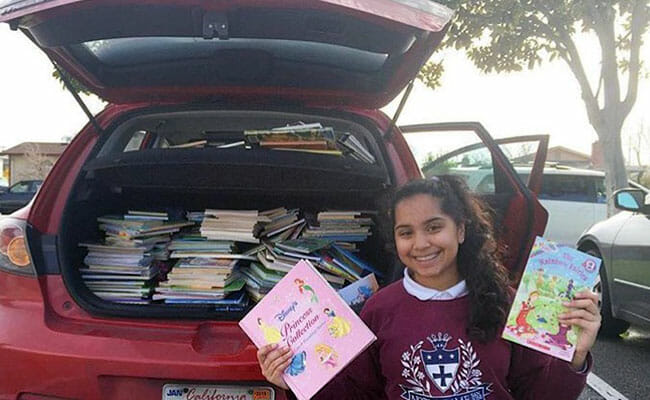
“The single biggest indicator for academic success is having books at home,” said Fatima Yousef, the 16-year-old founder of the nonprofit Stories for a Future.
While it’s a statistic she knows by heart, she also knows that having books may not be a reality for many low-income youth. At a young age, she recognized the wide educational disparity in the San Francisco Bay Area, where she lives.
“The Bay Area is small,” said Fatima. “You know how all the kids live. Kids in my school had torn backpacks, the quality of our schools was way below those on the other side of the bay.”
Fatima, then just 14 years old, decided to take matters into her own hands to advance literacy of underprivileged children in the community. She recruited friends to help her hold a book drive in the middle school and distribute them to younger children.
Two years later, she has grown her book drive initiative into a nonprofit with multiple literacy and education programs, including summer literacy programs serving more than 75 children at two local libraries. She also started a new program called Little Library, in which she fills a shelf with books at foster care centers.
“Literacy is so important in raising your socioeconomic status,” said Fatima. “When I was younger, my mom brought me to volunteer with an organization called Give Light, which helped orphans. It was heartbreaking to see some of the conditions they lived in. I wanted to give them a book and change their lives.”
Fatima credits her mom for inspiring her to get involved as a child. They would work with orphans and foster kids, support fundraising efforts and participate in service through her Girl Scout troop.
“My mom has always encouraged me to give back” said Fatima. “I think when I told her I wanted to start my own nonprofit she was a bit dubious, but when she saw how committed I was she was really supportive.”
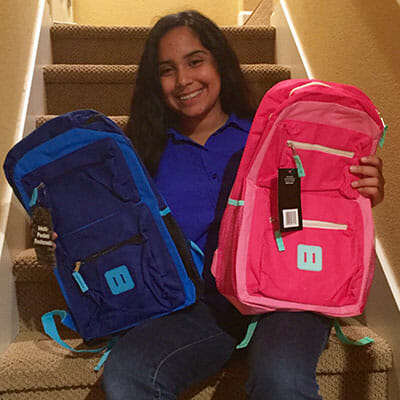
Her next big project is called Backpacks for a Future, which aims to provide low-income minority children with backpacks and school supplies before the school year starts. She applied for a grant and received $1,000 to buy backpacks and program supplies, which she distributed to 100 students.
“Some kids don’t even have pencils to do homework assignments,” Fatima said. “I want to make this an annual program so kids can start their school year with confidence.”
As she looks toward the future, Fatima hopes to get involved in legal work around education policy, and continue inspiring others.
“If you find something you’re really passionate about and you make the time to do it, it’s so rewarding,” she said. “I think that every kid should do it. Just go for it.”
Mother of Cancer Survivor Creates “Comfort Kits” to Help Parents Get Through the First Hospital Stay
Sarah Strang is today’s Daily Point of Light Award honoree, and one of the winners of the 2016 Make A Difference Day Awards. Each year, TEGNA recognizes 14 outstanding leaders of Make A Difference Day projects, awarding $140,000 in grants that are donated to the charities related to the winning projects. Learn more about Make A Difference Day and register a 2017 project at www.makeadifferenceday.com.
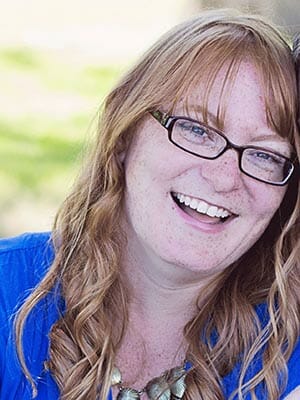
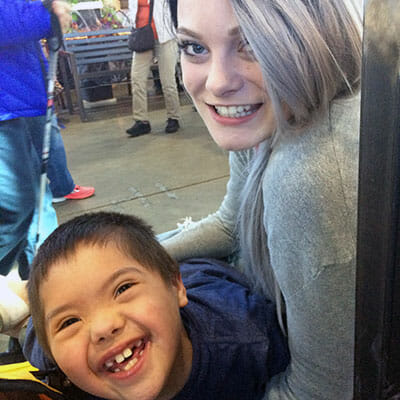
Sarah Strang is a mom who knows that a child’s battle with cancer is filled with emergency trips to care centers. Seattle Children’s Hospital is three hours away from her home in Wenatchee, Washington – a long trip she made countless times while her son Anthony, who has Down syndrome and a congenital heart defect, was battling leukemia. Often, there was no time to pack a bag. After comparing her experiences with another mom, Sarah Hastings, the two women launched Gold-n-Plum in 2011 with a mission to create pre-assembled “comfort kits” to donate to local ERs. The kits are given to parents who had no time to pack a bag as they rushed to get in an ambulance or Seattle Life Flight, to help get them through their first hospital stay.
On Make A Difference Day, Sarah collected enough items to make 80 kits for Confluence Health Central Washington Hospital and Clinics in Wenatchee. With items donated by local businesses, hotels, doctors, orthodontists and local Wenatchee residents, each kit includes: a toothbrush, toothpaste and dental floss, a comb, a razor, lotion, tissues, hand sanitizer, shampoo and conditioner, socks, two dryer sheets, a pen and pad of paper, gum, small chocolates, a crossword/puzzle book, $4 in $1 bills for vending machines, and a note about why the kit is there.
Sarah was awarded a $10,000 grant for her Gold-n-Plum comfort kits project on Make A Difference Day, which she donated to Strong Against Cancer at Seattle Children’s Hospital – a little extra money to do a lot more good in childhood cancer research. We asked Sarah to tell us more about the project and the cause that’s so close to her heart.
What inspired you to start the Gold-n-Plum initiative?
After my son had completed his first 14 months of intensive chemotherapy for leukemia in Seattle, another cancer mom and I were trying to figure out how we could “repay” all the kindnesses that had been done for us in our respective communities. We compared notes, and realized that parents are not always able to fend for themselves very well in scary situations regarding their child’s illness or injury. When Anthony was diagnosed with leukemia, we were given 15 minutes to be ready for the three-hour ambulance ride to Seattle. When in disbelief and shock, it is near impossible for a parent to pack what they will actually need to survive in the hospital for a few days.
Gold is the color for childhood cancer, and plum is the color for caregiver awareness. Although this project was born out of situations with cancer, the kits are meant for any parent or caregiver who accompanies their child on an ambulance or a life-flight to a larger city for treatment for illness or injury.
Tell us a little more about your Make A Difference Day 2016 project.
On Make A Difference Day 2016, my daughter, son and I collected donations at Pybus Market in Wenatchee. This is a gathering place for our local farmer’s market, and is similar to Pike Place Market in Seattle. We assemble the kits throughout the year, and not just on one day. So, receiving donations this day was helpful for an entire year of making kits. Some people brought a bag of kit ingredients from the Dollar Tree, some brought one or two items, and some brought a little bit of money.
What was the most rewarding part of the experience? A favorite memory?
One woman comes each year to donate items for kits, plus she always has an envelope with about $20 in $1 bills. She keeps the envelope on her refrigerator throughout the year, and when she has an extra dollar or two, she’ll put it in there for the project!The most rewarding part of the experience is knowing that I am able to help someone who is in a very high stress situation like we’ve been in. They are made aware that they are not alone, and they can get through their crisis. Three of my favorite memories so far:
- Each year, another woman and her middle-school age daughter go through the flier in our local newspaper to see what projects they want to help with. They go shopping together for items on my list of ingredients, BUT they also add things they feel would be a comfort if they were in a caregiver’s shoes.
- I met a mom earlier this summer at a playground whose son had a brain injury last year and had to be life-flighted to Seattle. When someone on Facebook said something about the 2016 award my project won, she was so excited, telling me that her husband had received a kit when they were flown in. She was in the hospital herself, having a baby, at the time of the flight, and so could not help her husband get things ready.
Why do you think it’s important for others to get involved and make a difference in their community?
It helps develop empathy and less hate for others who are different or who are going through tough situations. I LOVE the kind of future citizen that the middle-schooler is, who discusses projects with her mom then acts on the needs of the chosen projects. This ensures a more loving, kind future for every community!
As a 2016 Make A Difference Day Award Winner, you were awarded a $10,000 grant to donate to a charity of your choice. What will that money go toward?
The grant money was donated to Strong Against Cancer, an organization based at Seattle Children’s Hospital. The money will go toward finding a cure for children who are afflicted with cancer. My son is so lucky to have had the cancer he did, leukemia. His type of leukemia has the best cure rate, and he is doing great! Other children, far too many children, are not that lucky. I can’t even count how many children we have grown to love as part of our family, who have passed away from cancer. Children who will be diagnosed with cancer in the future deserve a cure like my son had.
What do you want people to learn from your story?
Be so very grateful for your child’s health! I hope you never have to be in our shoes, of being ready for an ambulance ride in 15 minutes or a life flight in five minutes, but if you do, hopefully you will have the support of your community lifting you at the same time.
What are your plans for Make A Difference Day 2017?
I plan to do the same for Make A Difference Day 2017, sitting at the table in Pybus Market, collecting items for future kits. My survivor son and my youngest daughter (his big sister) will be with me, and we will see love in action!
Volunteers across the nation will come together again on Saturday, Oct. 28, to improve their communities for Make A Difference Day. Project organizers are encouraged to register at www.makeadifferenceday.com to be eligible to win a $10,000 grant to donate to a charity related to their Make A Difference Day project.
Idaho Teen Finds Value in Giving Back as a Hospital and Zoo Volunteer
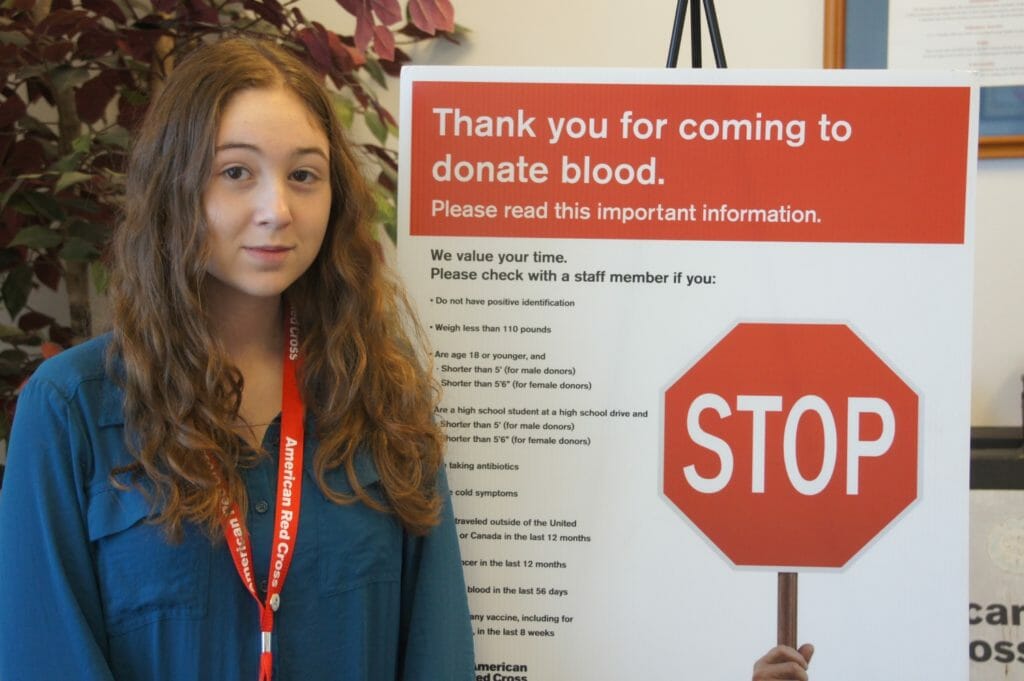
Idaho Falls, Idaho teen Jenna Bauer fell in love with volunteering at an early age. The high school student keeps busy in her community helping both humans and animals as a volunteer for the local hospital, the Red Cross and the Idaho Falls Zoo. Jenna is today’s Daily Point of Light, and she spoke to Points of Light about why she feels it’s important to give back.
What inspires you to volunteer?
I am inspired by the volunteers that I work with. There are people who have been volunteering for decades in some of the places I work. I find their commitment and passion for what they do a good model for me. I too want to be an active member of my community.
Describe your volunteer roles.
I volunteer regularly at the Eastern Idaho Regional Medical Center (EIRMC), the Snake River Animal Shelter, the Red Cross Blood Donor Center and the Idaho Falls Zoo.
At EIRMC, I work at the information desk, and I help visitors find patient room numbers, escort patients and visitors around the hospital and other duties. I enjoy taking an active part in the recovery of others.
At the Red Cross, I work at registration or the refreshment table. I have also been the coordinator for two blood drives, and plan to run many more. Since I’m not yet 16, and therefore unable to donate myself, this is one way I can help my community.
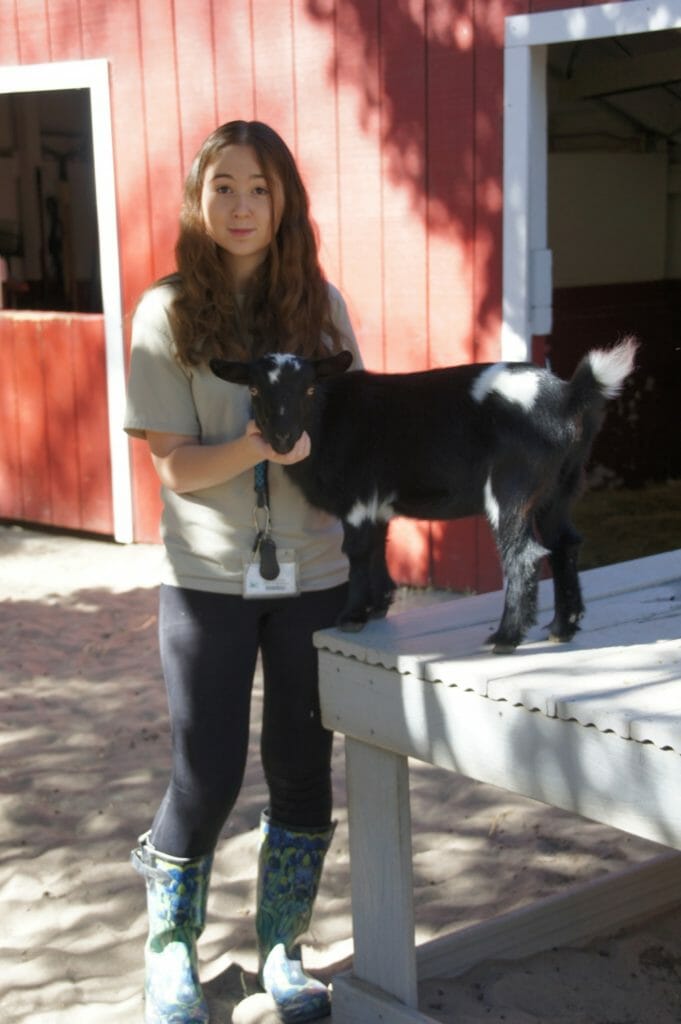
At the Idaho Falls Zoo, I’m a Junior Zoo Crew volunteer and spend most of my time in the petting zoo where we feed, water, clean up after and walk the animals. I also work in education outreach, where we work to educate the public about our animals, as well as monitor the safety of our visitors.
I also volunteer at the animal shelter Sunday mornings, helping with care, feeding and providing comfort to these animals until they find their forever home.
Why is it important to you to support your community in this way?
I believe that to take without giving back is selfish and thoughtless. I wouldn’t feel right about myself if I walked through life and accepted every door held open for me without holding the door open for someone else. It is the giving that makes a community.
What’s the most challenging aspect of your volunteer service?
Sometimes it’s the seemingly easiest things that challenge me the most. When I’ve had a difficult day, I need to remember that what I’m doing is for the benefit of others, and to relax, smile, and enjoy the volunteer work I’m doing. Because I work with animals and people, I see some suffering too. I feel for the animals stuck in a cage, waiting for a loving family. And for every donor who walks into the Red Cross, I know there is a recipient who is going through a life-threatening crisis.
Why do you think it’s important to give back?
Society would not function very well if people worked only for themselves. For everyone who needs blood, there must be a donor. For every patient, there must be a caregiver. I admire those who give of themselves, without wanting anything in return. And I want to pay it forward. Someday, I may be the one in need of a helping hand.
What’s been the most rewarding part of your service work?
I really enjoy seeing things through to completion. The happiness I feel when another person smiles is contagious. The pride I feel at the end of the day when I’ve reached a personal goal is a feeling second to none. And in sharing my experiences in volunteering to improve the lives of others I hope to encourage others to do the same.
What do you want people to learn from your story?
The beauty of volunteerism is working to make improvements without expecting anything in return. But that isn’t to say that there aren’t rewards. Everyone can make a difference, and there are endless opportunities in every community. I would tell people to find something you love and run with it. Volunteerism is a great way to try out a career and fuel a passion.
Do you want to make a difference in your community like Jenna? Visit All For Good to find local volunteer opportunities.
Community Leader Helps Opportunity Youth and Adults Realize Their Dreams Through Mentorship Program
As the Executive Director and CEO of the Fountain of Life Community Development Corporation (CDC) in Huntsville, Dr. Strong has spent the past 10 years inspiring hope and empowerment for both young people and adults in his community. His mentoring has encouraged people to complete degrees, open businesses and advance their careers, bettering their families in the process. This kind of grassroots commitment builds better communities, one individual at a time.
What inspires you to volunteer?
I just want to give back to the community. I saw children struggling in school, needing help to get better grades, creating a tide of despair that contributes directly to high dropout rates. These young people need help and encouragement.
Describe your volunteer role with the Fountain of Life CDC.
We try to target at risk individuals who don’t have sufficient means to get the help they need. We run an afterschool facility in rented space from our church. CDC is a wing of the Fountain of Life Ministry, where I am the pastor. But the people we help don’t have to be involved in the church. They come from all backgrounds and religions. We give annual scholarships to at risk seniors going into college. We have an annual Thanksgiving feeding program, and we have a Christmas party with gifts for children whose parents are incarcerated. As executive director I try to encourage everyone and help us all stay on target.
Why is it important to you to support your community in this way?
It’s important because I remember what it was like growing up and not having, not being able to do some things I wish I could have done. My father died when I was 11-years-old and my mother just didn’t have the means. It touches my heart to see children, anybody really, in need of the basics, [receive] the necessary things for a good quality of life.
What’s the most challenging aspect of your volunteer service?
We are always challenged by not having the funds available to really do what we want to do. We’d like to give out more scholarships, help more kids after school, but sometimes we hit obstacles.
How have you grown personally through your service?
I think it has helped me to continue to focus and understand what Jesus said at Matthew 25:40. “When you did it to one of the least of these my brothers, you did it to me.” That’s what it means to be a servant to the community.
Share a rewarding moment with us.
The joy I feel when I see a child, who came to us with challenged reading skills, walk across the stage at their school to receive a certificate for the most improved reader. That’s a proud moment.
Why do you think it’s important for others to give back?
I would say to anybody whatever background, don’t be selfish. Don’t just think about yourself. Helping somebody else to be successful is powerful. We live in a country that has more than enough. There shouldn’t be anybody hungry and without life’s basic needs.
What have you learned through your experiences as a volunteer?
I think I’ve learned that the more you give the more you get back. It’s almost like an investment. If you give love, love will come back to you. If you give joy, joy will come back to you. These things help mold our character.
Are there any future partnerships, programs, or events that you are excited about?
We’re starting a building program for the church, so eventually the CDC will have a bigger facility and more opportunity to expand our outreach in the community. We are in the process of negotiating and hope to get started next month.
What do you want people to learn from your story?
Get started. Don’t wait to get all you need, start with what you got.
Do you want to make a difference in your community like Dr. Strong? Visit All For Good to find local volunteer opportunities.
College Student Finds Her True Calling While Volunteering at Center for People with Special Needs
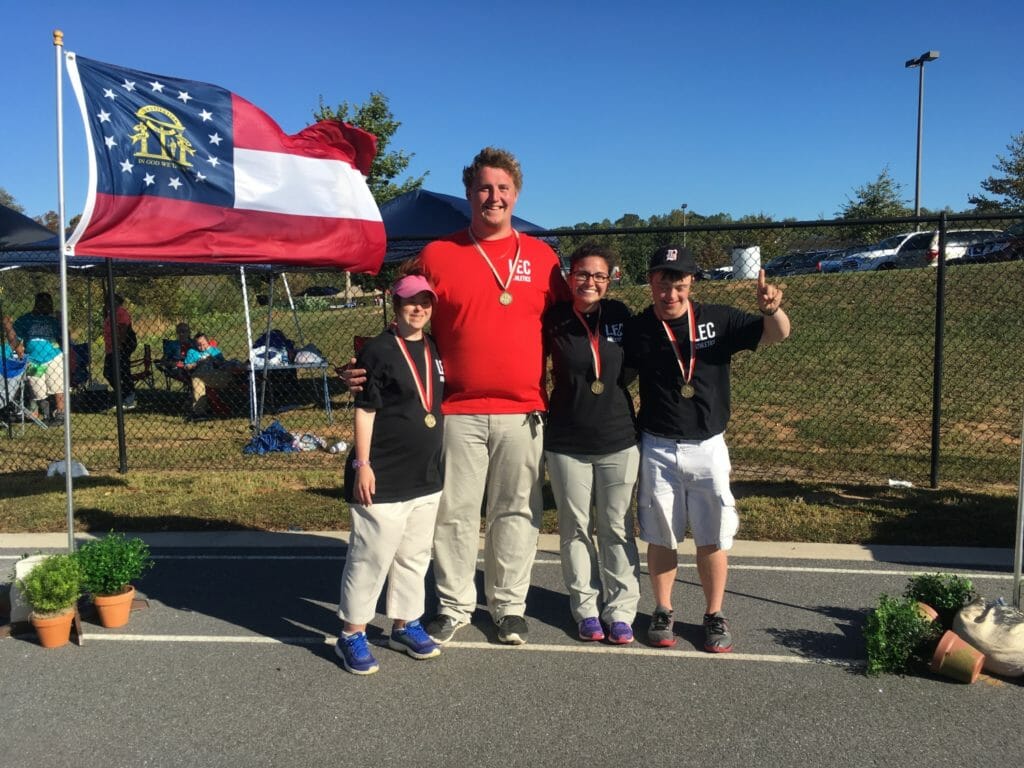
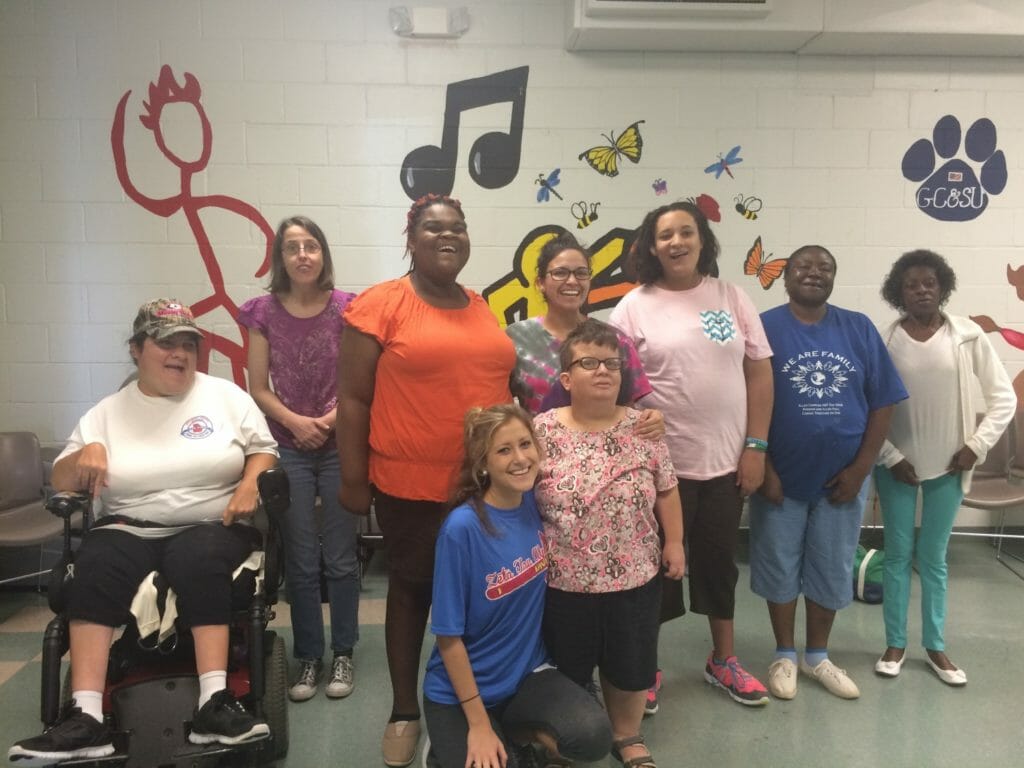
Natalia Jones, 23, is a woman with a plan. Close to completing her masters’ degree in health promotion from Georgia College, she has volunteered since her freshman year at the Life Enrichment Center (LEC) a private nonprofit program for adults with intellectual disabilities living in and around the Baldwin County area. From the moment she walked in the LEC door, she felt at home. The point of getting her masters was to work at LEC full time and in five years, under the mentoring wing of the current executive director, she hopes to step into her shoes.
What inspires you to volunteer?
I’m the type of person who really enjoys helping others. Most of my volunteer time has been with special needs people. I think it goes back to when I was five years old and became friends with my neighbor Sue Wilder, who was 19 years older than me. To me she was my friend. I didn’t understand that she was “different.” Even as a little girl I felt drawn to these special people.
Describe your volunteer role with the LEC.
At first I got involved with Best Buddies and was paired with Ashley. We would go bowling, go shopping, go to dinner, just hang out. I led exercise classes and a women’s health class. Then I started going to the Center to have lunch with the folks, help out as needed. If they had any kind of parties, I’d help. Then when I did a service-learning project in school I really got involved. I was on a unified team for bocce ball in the Special Olympics. We recently received a grant for an after-hours program, which is what I’ll be focusing on this coming semester. We’re planning a St. Patrick’s Day party, fun things like that.
Why is it important to you to support your community in this way?
I want the individuals at the center to feel important. They really can do whatever they want to do. It takes them a little longer and they need help, but then they can accomplish anything. I want them to feel appreciated. So many people don’t know how to react to someone who is different. Start with a smile and hello and you’ll see how easy it is.
What’s the most challenging aspect of your volunteer service?
Because some of the people I work with are non-verbal, there are communication barriers and articulation difficulties. This can be frustrating for them, so it’s important to understand triggers and develop a relationship over time.
How have you grown personally through your service?
I feel like I’ve gained a lot more respect for people with special needs. My passion for working with them has grown. I’m more aware of how I treat them. I’m also more aware of how others look at them, and I try spreading that awareness.
Are there any future partnerships, programs, or events that you are excited about?
I’m going to be getting my masters’ in health promotion and I look forward to promoting a healthy lifestyle at LEC and implementing new health programs.
What do you want people to learn from your story?
The main thing I learned from volunteering at the life enrichment center is that we are more alike than we are different. Because they have this disability doesn’t make them weird. No one is perfect. They have feelings just like us. There are things they can do that I can’t do. If we just dismiss them…then nothing is going to get fixed.
Do you want to make a difference in your community like Natalia? Visit All For Good to find local volunteer opportunties.
California Teen Constructs Traveling Library to Promote Literacy
For Zachery Ramos, books and literacy are a way to spread happiness and adventure. To accomplish that goal, he volunteers with the Gustine Library in Merced County, California, encouraging other teenagers to get involved with the organization. He also constructed a Traveling Library to bring free books to children and elderly individuals who have limited access to books.
Points of Light talked with Zachery about his work with the Gustine Library and the Traveling Library he created.
How did you get involved with the Gustine Library?
It was during Read Across America, and it was Dr. Seuss week. I love literacy and reading, and I thought I’ll make something to help out with getting books to kids who can’t get books from the library. I started that month, and it took four days to build the Traveling Library that I use now to give out books to kids and to elderly people.
What are your responsibilities as the youth leader?
It’s my job to get the kids in the Gustine High School and Middle School to get out into the community more and help out at the library. Recently, some other youths and I helped repaint the library and helped take care of the Gustine Library Book Sale.
What went into creating the Traveling Library?
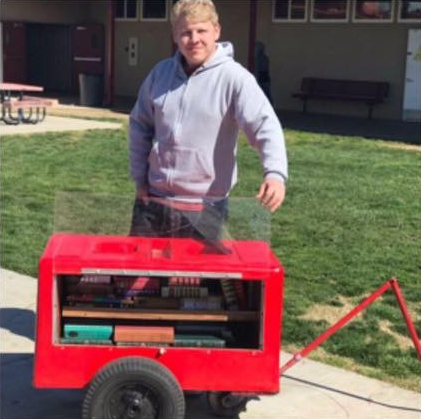
First, I spent the weekend before I built it trying to find a cart that would work. There was an antique shop called Pluckers Paradise that had an old ice cream cart they were trying to sell. I asked if I could buy it. I went to my grandfather’s house and used his tools. My grandfather, uncle and myself worked day and night to cut into the cart and take out a wall. We started adding shelving into it to put in a bookshelf. I used Plexiglass for the window and door. After that, the cart was done, and I painted it red. I got books for the library from people all over Merced County. At first, people in town were hearing little rumors that I was building something, and, then, they finally saw the finished product. They called and said they had books for me or told me to call them if I ever needed any books. I also posted an ad on Facebook, and people have swarmed to it.
I take the cart out, and I go through my town and many other neighborhood areas to schools and elderly centers. Sometimes, I walk into the park, sit on a bench, and have the cart open. Kids see the books, and they walk up to it. I let them pick one or two books out of it. They can read them there and put the book back or they can take the book home.
What type of impact do you feel you’ve been able to make?
I’ve been doing this for six months, and the impact I’ve been able to make is to get a Traveling Library in Oklahoma. I’ve been recognized by President George Bush, Sr., Vice President Joe Biden and by California Assemblymen.
Last time I checked on the books, I’ve been given more than 5,000.
Can you remember instances where you’ve positively impacted individuals?
One day I went, with the Traveling Library, to an elderly center in town of Los Banos with the president of the Gustine Library Group. We went there, and the people’s faces lit up. They were so happy that someone came to see them. It was a fun time watching them pick books they liked. People were telling us how happy they were that we came down. It was nice to sit and talk with them. They wanted us to come back and do a reading with them.
What lessons do you hope others will take away from seeing your volunteer service?
From my freshman to sophomore years, I didn’t do much volunteering. I’d do something when my teachers mentioned it, but it was never full blown. It wasn’t until my senior year that it hit me how things are going on in the world. I knew that if people don’t try [to do] something, things don’t get gone. I realized […] that volunteering is all about making a difference in other people’s lives.
What are your goals for the future?
My plan by 2020 is to have more states with Traveling Libraries. The plan is, after having Traveling Libraries in almost all states, to branch out to other countries, such as India, Egypt, and the Philippines. The Traveling Libraries are very easy to make. They’re very efficient. Once I get the carts to the countries, I hope to spread literacy.
Mesa Residents Come Together to Keep Their Community Clean, Vibrant and Beautiful
The City of Mesa Neighborhood Outreach Office is today’s Daily Point of Light Award honoree, and one of the winners of the 2016 Make A Difference Day Awards. Each year, TEGNA recognizes 14 outstanding leaders of Make A Difference Day projects, awarding $140,000 in grants that are donated to the charities related to the winning projects. Learn more about Make A Difference Day and register a 2017 project at www.makeadifferenceday.com.
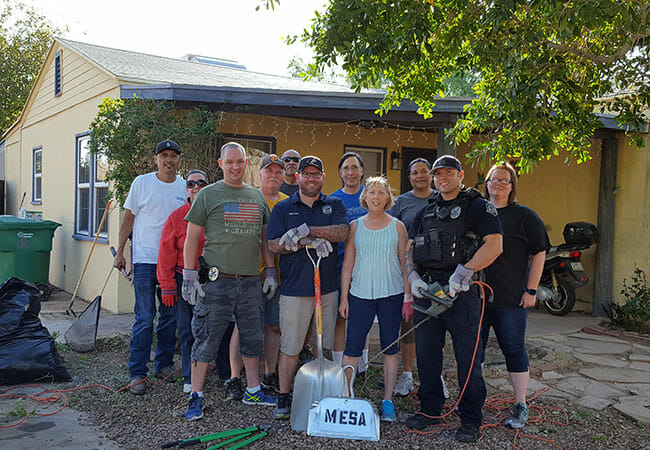
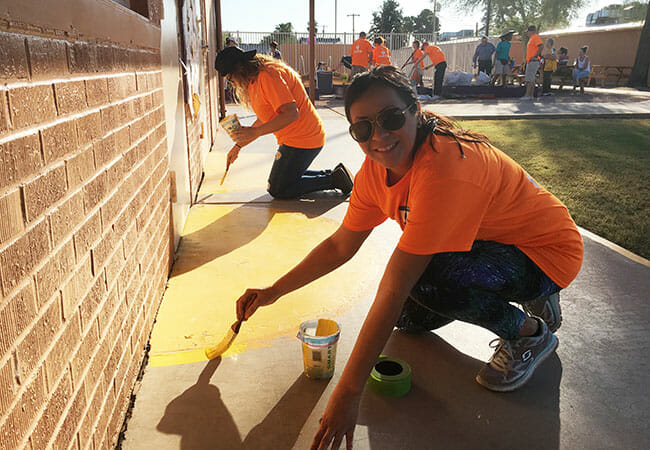
Nearly 3,000 Mesa, Arizona, residents of all ages came together on Make A Difference Day 2016 to improve their community – and make a difference they did! Volunteers participated in in 36 different projects across the city, helping 2,650 members of the Mesa community. Throughout the day, volunteers engaged in painting walls and houses, assisted elderly and low-income neighbors with yard projects, removed 47 tons of debris from city neighborhoods, and more, benefitting several groups including elementary schools, local veterans and homeowners, residents of Mesa’s first Heritage Neighborhood, and the City of Mesa as a whole. The citywide Make A Difference Day effort – the biggest in three years for Mesa – was orchestrated by the Neighborhood Outreach Office. “By engaging more volunteers in this year’s event, we educated more people about important needs in the community,” said Lindsey Balinkie, neighborhood outreach coordinator for City of Mesa Community Services.
The City of Mesa Neighborhood Outreach Office was awarded a $10,000 grant for this effort on Make A Difference Day, which they donated to Mesa Urban Garden – a little extra money to do a lot more good for the city and its residents. We asked Lindsey to tell us more about the projects and the city’s ongoing dedication to keeping Mesa a clean, vibrant and beautiful place to live.
What was the inspiration behind the City of Mesa’s 2016 Make A Difference Day project?
Every Make A Difference Day, Mesa residents, neighborhood groups, local businesses, faith-based groups and City of Mesa staff volunteer for a variety of beautification and cleanup projects. Our 2016 projects were inspired by a desire to engage volunteers in the most encompassing national day of helping others and to spread that service citywide to make an impact in every council district in the city.
Michelle Alvis-White, citywide volunteer coordinator, and Laura Rodriguez, volunteer coordinator, were the dynamic team that orchestrated this event. Michelle’s commitment to excellence in managing volunteer projects and events that impacted the community were ever-present throughout the creation and implementation of our Make A Difference Day event. In January 2017, Michelle was in a car accident and did not survive.
Laura has also become an excellent volunteer manager and contributor to our team and often credits Michelle for the skills, knowledge and commitment to excellence she imparts on all of her work. Michelle was an amazing mentor, who cared deeply about her staff and how they showed up in the world. She has left an undeniable mark on Laura. Part of Michelle’s legacy will be all of those she mentored to be amazing volunteer managers and community stewards, to carry on her work now that she is no longer able to. Her passing has left a giant hole in our hearts and in our team, but we are blessed to see her impact and her commitment to service in neighborhoods, parks and community organizations throughout Mesa.
Tell us a little more about what your volunteers did that day.
Our 3,000 volunteers participated in 36 volunteer projects, including:
- Painting long sections of walls in parks and retention basins used by neighborhoods for recreation. Walls had been previously graffitied and had a patchwork of colors on them from graffiti removal (prior to when the city started matching the wall color when removing the graffiti). Volunteers contributed to reducing blight in these areas by painting one consistent color over thousands of square feet.
- Painting a mural to honor the service of veterans.
- Removing illegal dumping from alleys and other neighborhood common areas, assisted residents in removing debris, appliances and trash from their yards into city dumpsters, contributing to the overall well-being of the neighborhoods.
- Walking neighborhoods and reporting graffiti via their smart phones to the Mesa CityLink app, greatly assisting the city in combating graffiti and removing it quickly. The city contractor was then able to visit each site and color-match each area that was tagged to remove the graffiti.
- Painting the homes of several individuals, including veterans and low-income elderly residents.
- Providing yard clean-up assistance to elderly residents who are physically and financially unable to take care of their yards.
- Distributing neighborhood resource bags, which included valuable information on recycling, smoke detectors and city services.
- Painting address numbers on curbs to enhance the safety of neighborhoods, and to improve response times for emergency services by making it easier to verify addresses.
What was the most rewarding part of the experience? A favorite memory?
For those of us who worked closely with Michelle every day, the most rewarding part of Make A Difference Day was being part of a dynamic team of people led by her, seeing her in her element and working together to make an impact on the community. Michelle lived a life of service and did an amazing job of enriching the City of Mesa’s volunteer programs with a commitment to excellence.
Why do you think it’s important for others to get involved and make a difference in their community?
When you give, whether it is a large or small project, for days on end or just a few hours, it sticks with you. Serving makes people more compassionate and helps to break down barriers, helps volunteers get outside of themselves and learn more about causes and help individuals that they may not normally connect with.
As a 2016 Make A Difference Day Award Winner, you were awarded a $10,000 grant to donate to a charity of your choice. What will that money go toward?
We chose to donate the $10,000 grant to the Mesa Urban Garden, a community organization that provides fresh produce directly to the community and local food banks. The public can sponsor plots for communal or individual use. Michelle organized the first group of volunteers who helped to build the original garden beds and break ground at the garden five years ago.
The garden’s annual budget is $3,000, so a donation of this size will have a great impact on their operations for several years to come. (The Foundation for Mesa Parks and Recreation received the check on behalf of the Mesa Urban Garden.)
What do you want people to learn from your story?
Your actions and desire to do good can have a lasting impact on those around you.
What are your plans for Make A Difference Day 2017?
We are currently recruiting volunteers and getting new projects ready for the October 2017 event. Details are forming as we go out into the community to ensure we have meaningful projects that meet the needs of our residents.
Volunteers across the nation will come together again on Saturday, Oct. 28, to improve their communities for Make A Difference Day. Project organizers are encouraged to register at www.makeadifferenceday.com to be eligible to win a $10,000 grant to donate to a charity related to their Make A Difference Day project.
Helping Wounded Veterans and Their Caregivers Find Support and Healing
There is a consequence of war so huge and powerful that it can envelop a veteran’s entire life and dreams, upending his or her family’s lives as well. The internal anguish of post-traumatic stress and brain injury doesn’t always show on the outside. But it can be as difficult and frustrating – to both veterans and caregivers – as physical battle injuries, simmering relentlessly for decades and sometimes exploding at unexpected times.
And yet, it’s the smallest and simplest of gestures – a supportive text message, a listening ear on the phone, or tracking down a hard-to-find phone number that leads to new therapy or financial assistance that can do so much.
Joey Caswell completely gets this. She’s being honored with the Daily Point of Light Award not because she runs a nationwide, million-dollar charity, but because she reaches out – moment by moment, phone call by phone call, message by message – to help disabled veterans like her husband, as well as military caregivers grasping for straws of help and advice.
Joey’s husband, Charles, was wounded by an IED blast in Iraq in 2005. Although he looks healthy now on the outside – and he has all of his limbs – he’s considered 100 percent disabled by the military. The blast caused permanent brain injuries that affect his memory and judgement. His post-traumatic stress affects his mood and behavior.
After he was medically retired from the Army, the couple returned to a small town in their home state of Michigan, where, Joey said, “we felt alone with no support or help.”
“Charlie struggled with life in general,” she said. “Things got rough and rocky between us and our marriage and daily life. I was just not understanding what was going on and how to help him.”
Military caregivers – there are nearly 5.5. million in the United States – are hidden heroes, serving in a role that receives little recognition and acknowledgement. Being a caregiver can affect an individual’s health, relationships and career, and many in this role face their own emotional, physical and mental challenges.
It wasn’t until 2013 that the couple learned about a wounded warrior retreat, which they attended. “It was first time we met other families like ours that had a warrior wounded in combat who suffered from not just physical wounds but mental wounds,” said Joey. “It just sent us into a good place. We started to heal and recover. It got us both on the path of realizing we needed to raise more awareness for veterans with invisible wounds and also people like me who’ve been dealing with and caring for him.”
Filled with new hope, Joey began stepping up her networking and learned about resources “that I never knew about because nobody showed me or told me.”
She co-founded Warriors and Caregivers United, a local all-volunteer organization that spreads information about resources to families in Michigan. It also hosts fun social events to bring families together. Through social media, Joey has been able to connect with and help families in other states as well.
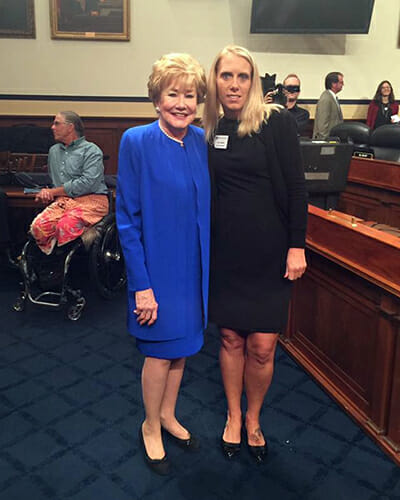
In 2015, she was named a fellow with the Elizabeth Dole Foundation, a national organization dedicated to helping military caregivers. It’s named for former U.S. Sen. Elizabeth Dole, who’s married to former U.S. senator and presidential nominee Bob Dole, who was seriously wounded in combat during World War II.
The two-year position “skyrocketed me into a whole new realm of things on a national level, such as advocating on Capitol Hill,” said Joey.
In the meantime, it’s the small, private gestures that Joey continued to do during her fellowship and embraces going forward that make a difference for wounded warrior families.
“She will just reach out at random times,” said Kristie Harris, who lives in Colorado and leans on Joey for long-distance emotional support as she helps a close friend who has brain injuries and PTSD following seven tours in Iraq and Afghanistan. “Sometimes you don’t realize you need that support in the moment and we’re not always good at asking for it, but she would just reach out and say, ‘Hey chica’ – that’s her favorite line – ‘Hey chica, how are you doing? I’m just checking on you,’ and I would unload on her at that moment. She’s been an ear to listen to when I’m on the edge.”
“My friend needs a lot of emotional support and help making good decisions, such as getting him into the right doctors’ care,” explains Kristie. “He’s not very good at advocating for himself, and he gets frustrated easily and gives up if things don’t happen right with the first phone call. Sometimes it gets frustrating (for me) because he gets angry about it and Joey’s just a phone call away to say, ‘This is expected. Give it some time and he’ll come around’ – because she’s been there before me.”
Connie Tonsor, of Port Huron, Michigan, describes her fiancé, a former Air Force airplane mechanic, as someone who “looks totally normal” unless “you see the hard days.” She recalled one recent instance when it took him all day to cut the grass because he couldn’t concentrate on the task. “His mind goes into a tailspin,” said Connie, a teacher. Through Joey’s support, Connie has found a place that she’s hoping with work with to obtain a service dog for her fiancé, who spends a lot of hours by himself while she works.
John Kinzinger, a Michigan Vietnam veteran who helped found Warriors and Caregivers United, is convinced that Joey’s quiet but persistent support has saved lives. John has been working veterans for the past 30 years, since retiring from Ford Motor Company. He said the connection between helping spouses and caretakers and preventing suicide among veterans in underestimated.
“When meeting with veterans groups, the word ‘suicide’ is never mentioned,” said John. “But it’s the big elephant in the room.
“Post-traumatic stress is hard for even mental health experts to understand, if they haven’t lived it. They know the textbook version. But these warriors have episodes, and they’re catastrophic and they’re immediate. It’s not something that warms up and gradually develops. Things can set them off very easily. You just try to keep the embers as cool as you can,” said John, of the never-ending reality of PTSD.
Helping military caregivers is one of the best ways to help, he’s found. “We’re kind of coming in the back door through the caregiver and the children to bring the warrior out of his bunker. Maybe we can save a life.”
John said his longtime efforts to work with veterans have been enhanced by Joey’s ability to track resources. “If she can’t find it, she calls people in other states, even other Elizabeth Dole fellows. She will drop everything in the middle of making a meal to make some calls to try to get somebody connected with something,” he said. “I send people to Joey. I get all these calls and if I send them on to Joey, she handles them.”
“I wish every guy who’s trying to help out like I am had someone like Joey,” John said.
For now, Joey has stepped down as president of Warriors and Caregivers United, now serving as the organization’s vice president instead. But that’s a positive sign of a busier home life – Charlie’s functioning better and is involved in volunteer work of his own, as a photographer for the Semper Fi Fund, a California-based organization that helps wounded veterans. Since his injury in 2005, the couple has added two sons, now 5 and 7, to the family, and their daughter is now 17 and a senior in high school.
Knowing that the struggles of caring for a disabled veteran never end, Joey continues to volunteer on behalf of families – holding fundraisers, planning social events, lobbying lawmakers for veteran benefits, and making those endless phone calls.
“It’s my life,” Joey said. “I’m not sure it will ever not be my life.”
Do you know an outstanding military caregiver? By recognizing the heroism and sacrifice of our military caregivers, we create stronger communities and provide opportunities for learning, reflection and continued inspiration. Nominate a Daily Point of Light.