New York Woman Answers the Call to Aid Communities Devastated by Disasters
Janelle Colon learned the effects of being a good volunteer early in life. Her Big Sister in the Big Brother/Big Sister program helped her break out of her shell and set her on a life-long course for helping others.
Today, Janelle devotes her time to working with those who suffer natural disasters or other hardships, as well as young children who need a positive influence and mentor. To her, giving of her time is an automatic response to seeing those who are in need. Points of Light talked with Janelle about her volunteer service and her plans for the future.
Tell me about your work with Team Rubicon. What is it, and why did you get involved?
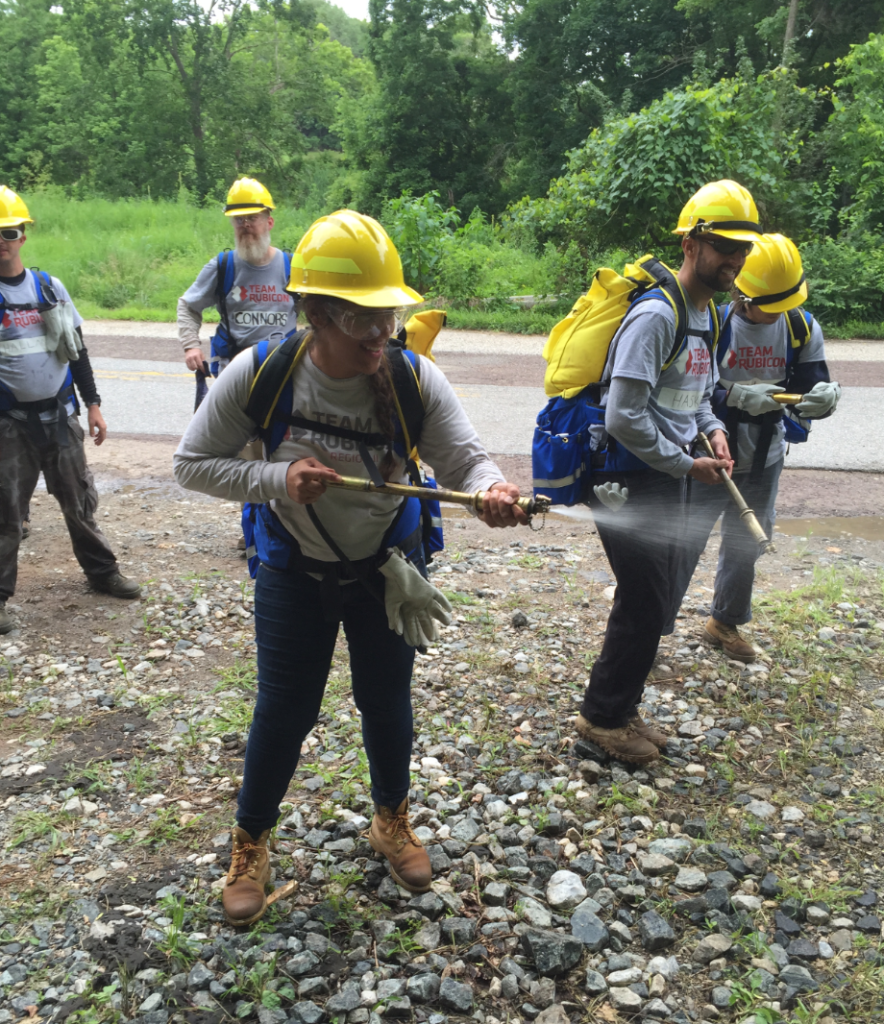
I got involved with Team Rubicon by watching a moving video about people whose home was devastated when they lost everything to Hurricane Sandy. They’re an organization that goes in and helps provide services to people who’ve been the victims of natural disasters. I was inspired by it because it was a group of primarily military veterans, and my mom is an Army veteran. As soon as I left that meeting, I signed up.
What are your activities there? Why is this so important?
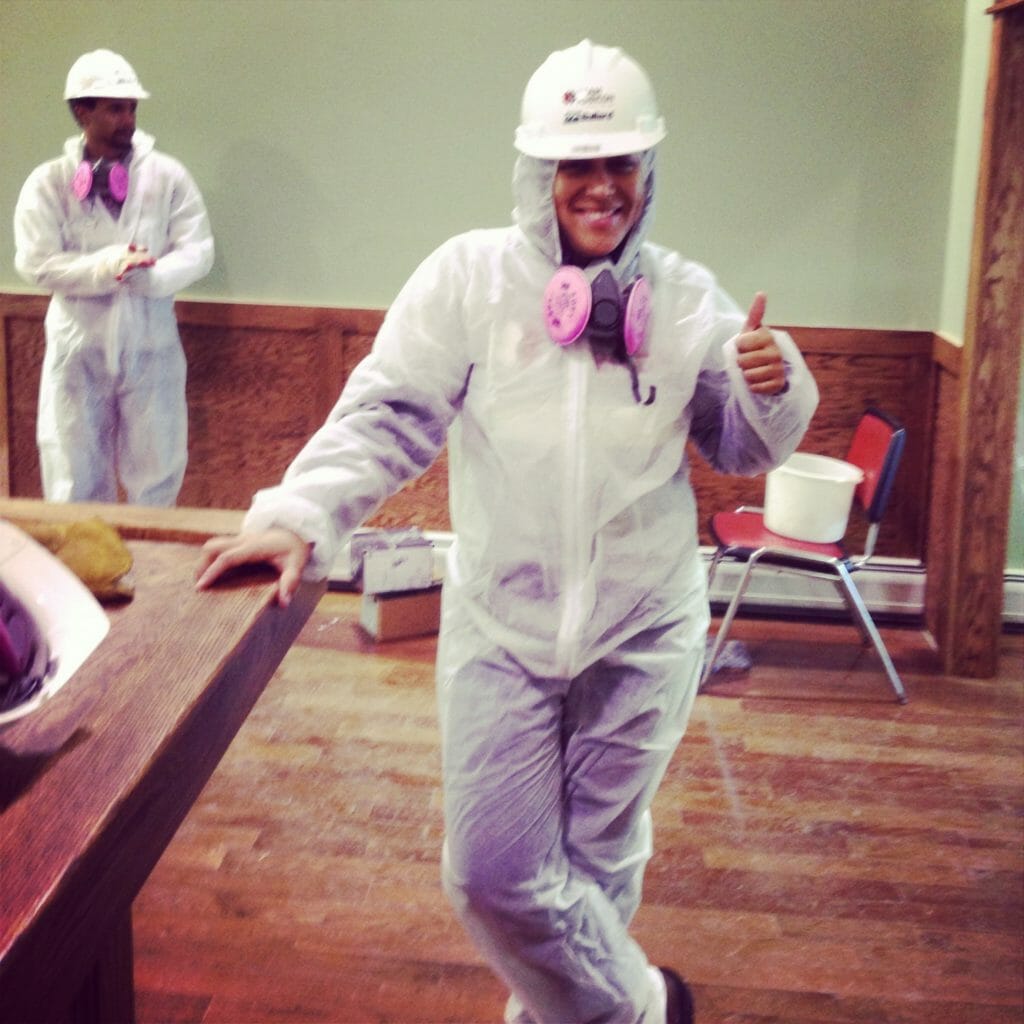
I am the New York State Engagement Coordinator. I pretty much look for events and stuff that we can have in communities so we can get things going to offer help. For example, we’ve worked with Habitat for Humanity to build for veterans. We found homes that were recently flooded and helped them gut out the area that was damaged so they can start the process of rebuilding sooner. We also helped a Marine veteran out on Long Island. He was moving, so we helped him because he was disabled. We packed him and moved it all. We do things like that where we’re not directly responding to immediate disasters, but we’re still helping out in the veteran community in some way or just helping the community at large.
It doesn’t have to be a veteran. It can be a civilian. If there’s major flooding, but it’s not considered a disaster along the magnitude of Hurricane Sandy, but it affects a lot of people, then we’ll go out and help people in their homes. It’s really anyone who requires assistance. In Team Rubicon, we have a large amount of civilian volunteers, but we also have many more that are veterans or first responders.
The reason why the organization is based on veterans is because they realize that after serving in the military, our veterans have this need that doesn’t always get fulfilled. When they reintegrate into the community, they sometimes have a tough time because they don’t feel they’re fulfilling the same needs as they were in the military. So, we actually call our missions Ops – it gives them the same structure from the military, and they feel the same fulfillment of giving back and serving. I have zero military experience myself, but my family is very military-oriented. It’s always been something that my parents have raised me around, and I have a great appreciation for it. When I saw the video about what these veterans do, I wanted to give back.
What prompted you to first get involved with the Big Brother/Big Sister program?
Actually, I was a Little Sister in elementary school. I had a mentor named Courtney. I was really shy and not too talkative. It helped me to have a Big Sister of my own. So, I knew the impact for me, and I knew that I wanted to pay it forward. I decided to sign up when I got older.
What do you do as a Big Sister?
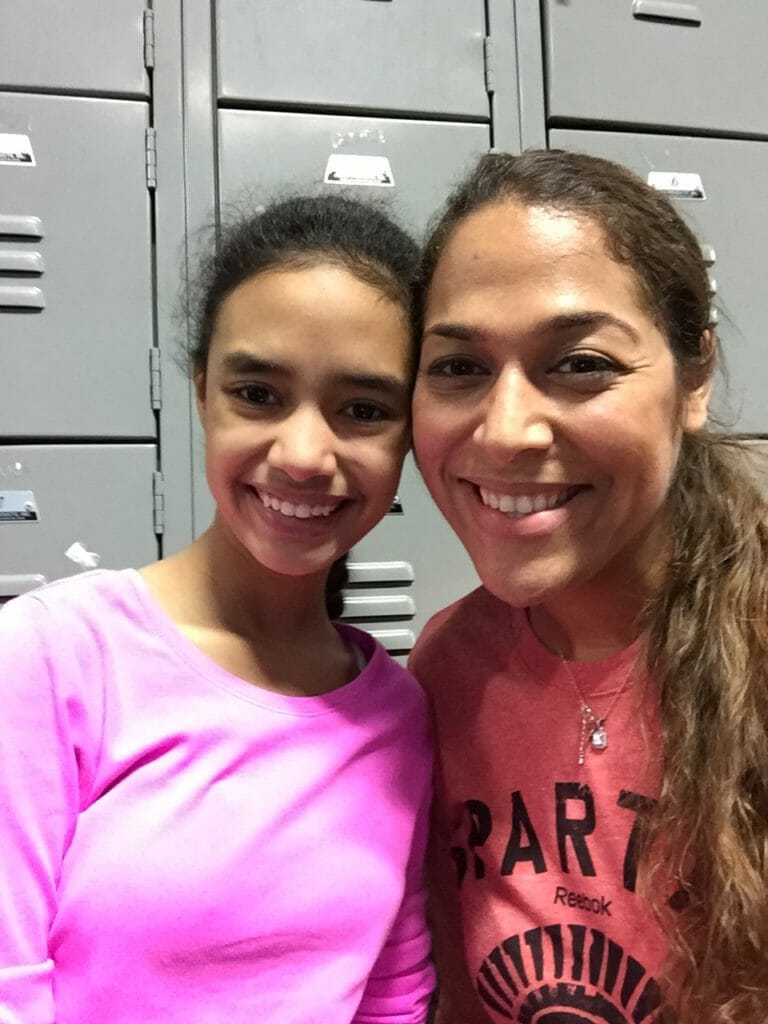
I’ve been involved ever since college. There’s a program at the local community center for at-risk youth. I started going there as a mentor, but I was a mentor to a large group. It wasn’t one-on-one. I started doing that every Tuesday night with the kids, and, then, eventually the director reached out to me. She said she wanted me to consider being a one-on one mentor. I signed up and was matched with my Little Sister Nicole. We’ve been matched for one to two years this past December.
What type of impact have you had?
One of the most important things is building up their self-confidence – especially if they’re shy and not outgoing. They might hold back in situations where they should put themselves out there. It’s all about building their self-confidence and helping them believe in themselves. That’s one of the most important things. One thing Nicole really loves is going to the park with my dogs. Everyone always approaches me to pet my dogs, and I turn to her and ask her to tell them the dogs’ names. I help guide her through a situation where she might normally be more reserved. I’m gently trying to get her to speak up a little more and make the first attempt in talking with someone she wouldn’t otherwise talk with.
I’ve seen definitely how much more willing she is to make the initial step of talking with someone she wouldn’t have beforehand just in how she carries herself even now.
When we first matched, she was very quiet. She didn’t have her own opinions. When I asked her what she wanted to do, she would say, “Anything you want to do.” I wanted her to know it was okay for her to say what she was interested in. I want her to do something she really likes and to form her own opinions – to not take a back seat on things.
Why do you think it’s important to volunteer?
There’s actually a quote that’s my mantra –- it’s how I live my daily life. It’s from Ghandi: “You must be the change you wish to see in the world.” It’s particularly important with all the things going on today. We can point out the things we don’t like, but if we don’t start that change within ourselves, how can we expect to change the world? We have to take that first step. I see an area in need, and instead of waiting for someone else to fix it, let me be the one to try to change it.
Do you want to make a difference in your community like Janelle? Visit All For Good to find local volunteer opportunities.
College Student Uses Dance to Inspire Others to Give Back
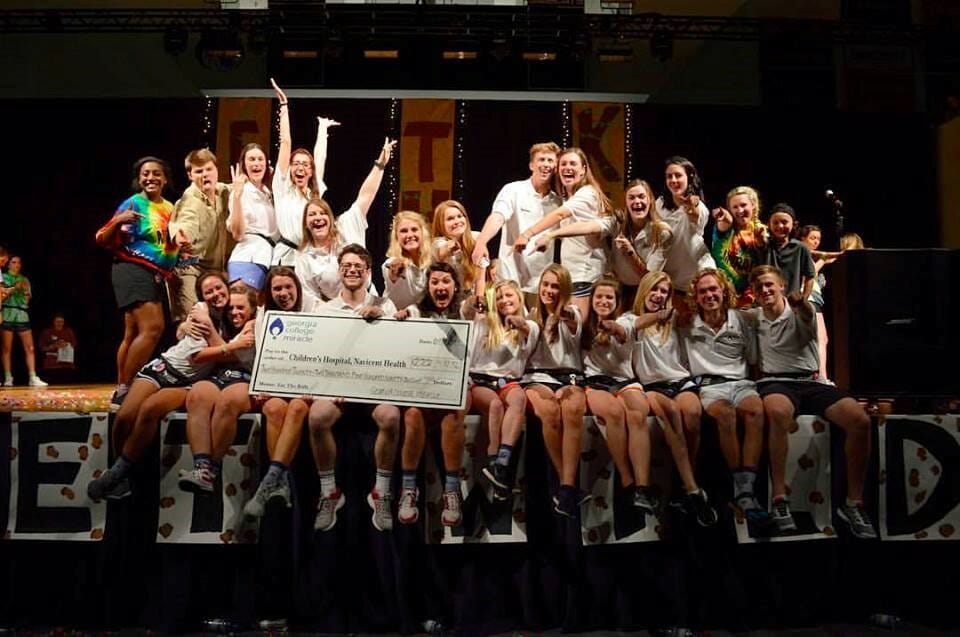
Jacob Zawoysky never considered himself an especially great dancer but that didn’t stop him from signing on for a 12-hour dance marathon to raise money for sick kids. His volunteer service with Georgia College Miracle, the largest student-led fundraiser on the Georgia College & State University campus, grew from raising funds and dancing into a leadership role that helped transform the marathon into a year-long movement to make miracles. He served as executive director during his senior year, helping to inspire 500 students to make miracles. Since 2005, Georgia College Miracle has raised more than $690,598.68 for Children’s Hospital, Navicent Health.
Describe your volunteer role with the Georgia College Miracle?
I served on the Executive Board of Georgia College Miracle for 3 years. My sophomore year, I was Director of Alumni Relations. My junior year, I was the Director of External Relations. And my senior year, I was the Executive Director. I ended volunteering more than 600 hours in those 3 years to Children’s Miracle Network.
Why is it important to you to support your community in this way?
Because at the end of the day, your community is your home and should be treated with respect, love and care. Ever impact, every dollar donated, every hour volunteered allows others to feel safe and protected. Before I joined Georgia College Miracle, I visited the Children’s Hospital. I spent hours playing in the game room with these Miracle Kids. We were laughing, smiling, and having an awesome time. I realized that just by taking time out of my day to play a video game with a Miracle Kid, I was helping him feel like a regular kid again. He wasn’t thinking about his sickness, but thinking about the support he was getting from a complete stranger. It was that moment that allowed me to see that supporting your community could go so much farther than just donating.
What’s the most challenging aspect of your volunteer service?
It was trying to get students to buy into and join Dance Marathon. At first glance, Dance Marathon may just seem like a 12-hour dance event on a Saturday. We knew we had to change this culture and treat Dance Marathon as a celebration. It was so much more than just a one-day dance event, it was a 365-day movement. We started focusing less on the dance aspect, and more on the Miracle Kids. We focused less on asking people for money, and focused more on asking people to make miracles with us. We allowed the students to feel like they were a part of something bigger than themselves.
Why do you think it’s important for college students to give back?
The bigger question is why shouldn’t students get involved and give back? Why wouldn’t you want to raise money and awareness for important causes? Why wouldn’t you want to be able to impact not just the lives of others, but also your own life? Why wouldn’t you want to grow both intangible and tangible skills? Why wouldn’t you want to become the best version of yourself?
What’s been the most rewarding part of your work?
The smiles. Whether it’s seeing a Miracle Kid smile at Dance Marathon. Seeing a Miracle Family smile while watching their child live a healthy life. Seeing the Executive Board smile when seeing the total reveal at Dance Marathon. Or seeing hundreds of students smile while celebrating the lives of the Miracle Kids at Dance Marathon. Smiles and that pure happiness they bring was the most important thing I wanted to see at the end of this experience.
What have you learned through your experiences as a volunteer?
Just the incredible impact that you can have on someone’s life. I think it’s hard for us to fully grasp the magnitude of support and hopefulness that we give while volunteering. The moment that you take a minute to step back from it all and realize that you’re impacting others in a positive way, is one of the best feelings in the world. For the longest time I felt that I could never have that type of impact on someone’s life, but through volunteering I have learned that through selflessness I can truly have that impact.
What do you want people to learn from your story?
Just the idea that passion is contagious. I didn’t have a lot of leadership experience when I joined Georgia College Miracle, but I did have a passion for the cause and the motivation to learn. Many people use lack of experience as an excuse not to take action, and that’s a shame. Even when applying for Executive Director, I didn’t have a big strategic plan when interviewing. I simply wanted to turn Dance Marathon into a movement and Georgia College Miracle into a family. The passion that we all shared ultimately helped us reach incredible feats.
Do you want to make a difference in you community like Jacob? Visit All For Good to find local volunteer opportunities.
Kaitlyn Martinez
When Kaitlyn Martinez heard that one of her friends failed a homework assignment because she didn’t have the simple school supplies of a pencil and paper at home, she wanted to do something to help.
“At first, I didn’t really think that there was anything I could do,” Kaitlyn said. “[My friend] didn’t feel comfortable asking for that help.”
But now, two years later, 14-year-old Kaitlyn is CEO of nonprofit Backpacks 4 Kids AZ, providing students across Arizona with backpacks full of the school supplies they need to succeed.
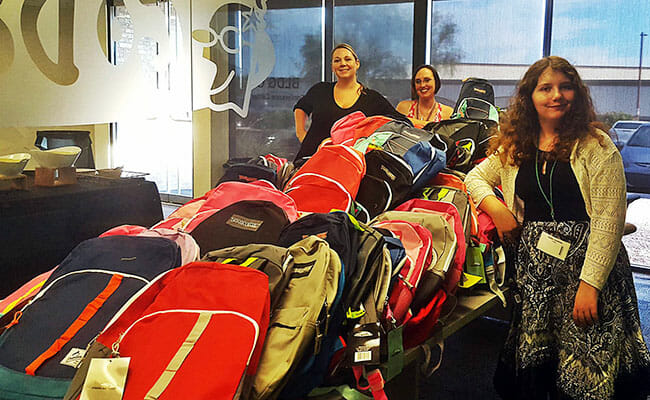
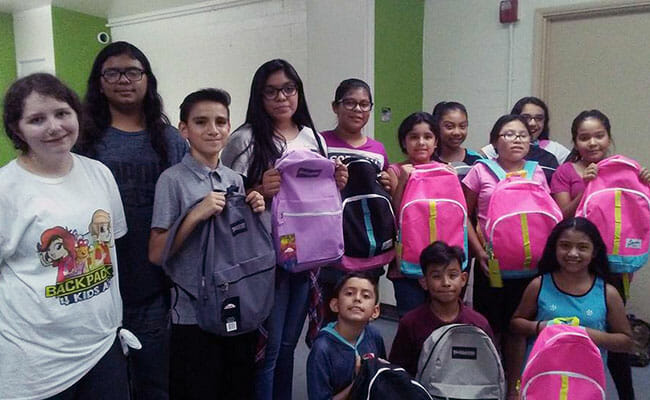
With the help of her mom, Kaitlyn started collecting supplies and backpacks by setting up donation boxes around her school and church. In the first year, she was able to provide school supplies to 175 students. This year, Kaitlyn is working with local businesses, schools and organizations, and has already collected 1,000 backpacks to be given out for the school year.
Backpacks 4 Kids AZ focuses on giving backpacks and supplies to students enrolled in Title 1 schools, which have high numbers of children from low-income families.
“There are a lot of single parents here,” said Michele, Kaitlyn’s mom. “When you’re trying to live off one paycheck and support a family, it makes it really difficult.”
Kaitlyn and her team deliver backpacks to schools, other organizations and even directly to students’ homes. But wherever they are, they make sure that the students get the chance to choose their own backpack, rather than being handed one.
“They get to shop, you know?” Michele said. “They get to feel like any other kid and not like they’re getting a handout.”
Backpacks 4 Kids AZ also runs a program to deliver “Love Bundles” – bags filled with a blanket, toy and basic hygiene supplies for children entering the foster care system.
Kaitlyn is not only CEO of her own nonprofit, but also sits on the board of the Phoenix Youth and Education Commission where she is creating a youth task force to empower other children and young adults to become entrepreneurs.
“People tend to forget her age,” Michele said. “She’ll get invited to events and I’m like, ‘She has school. She can’t go.’”
Even with all her accomplishments, Kaitlyn stays humble.
“When I started, I didn’t think this was going to become what it is now,” Kaitlyn said. “But because we were able to talk to so many people and meet so many new people, it kind of snowballed just because of everyone who was willing to help.”
Kaitlyn’s goal now is to have a branch of Backpacks 4 Kids in every state, and to grow the number of backpacks given out every year.
To help Kaitlyn and Backpacks 4 Kids AZ, visit their website to purchase supplies that will be donated to local disadvantaged children throughout the school year.
For volunteer opportunities in your area, search All for Good.
Teens Curate Music Playlists to Bring Joy to the Elderly
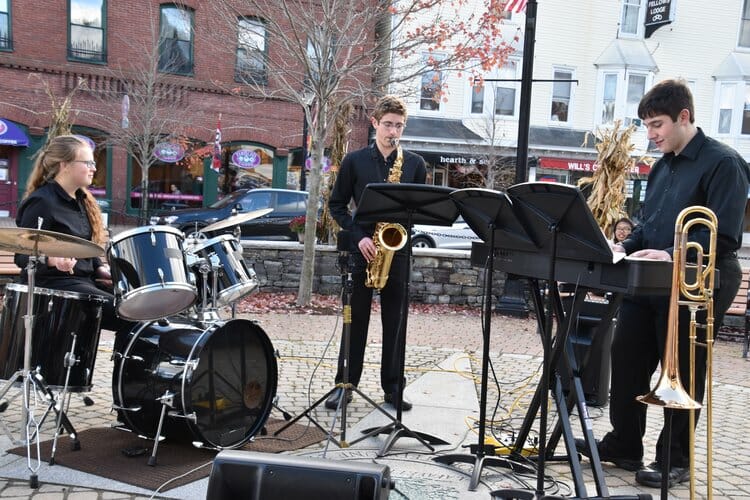
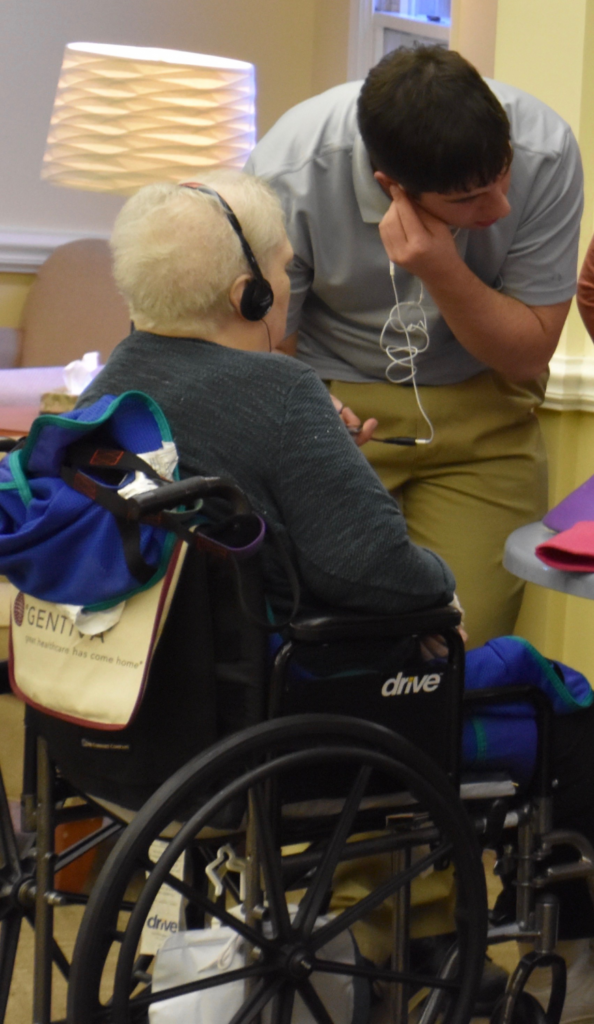
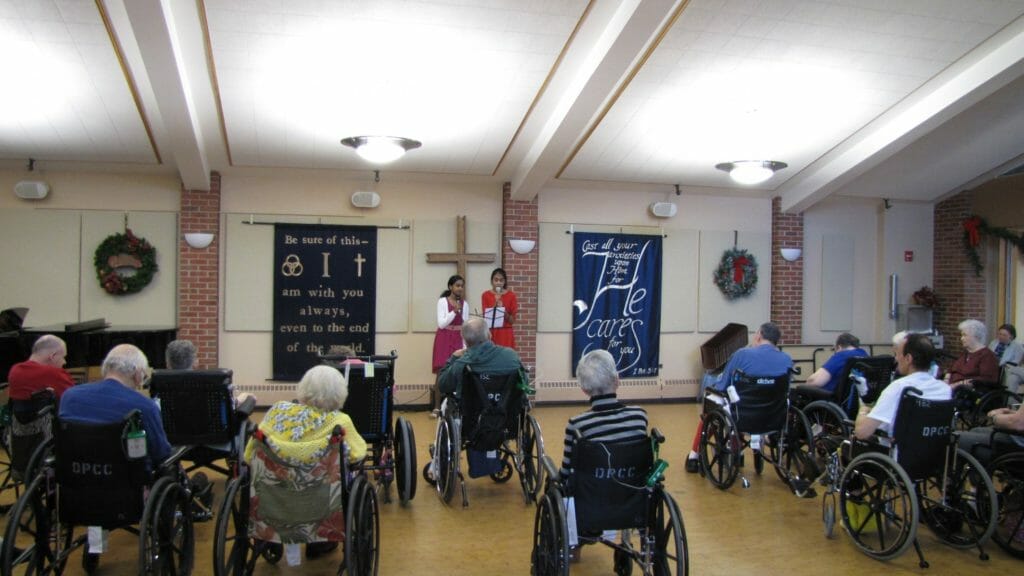
High school students Juli Ennis, Colby Ellis and Jason Albaum are the founders of Project Playback, an group that provides music therapy to seniors. Juli, Colby and Jason initially got the idea to start Project Playback as eight graders at The Middle School of the Kennebunks. When given an assignment to develop a project that benefitted the community, the kids–who were all school band members–naturally joined together out of a shared love of music. They decided to curate song lists for local seniors residing at Kennebunk Center for Health and Rehabilitation as their project. The music helps patients with Alzheimer’s or dementia, in particular, by triggering memories and emotions from the past. In a way, according the Project Playback, “the music can act as a passageway back to the patient’s youth.”
Project Playback is today’s Daily Point of Light, and Points of Light spoke to co-founder Juli Ennis to find out more about their work in the Kennebunk community.
What inspires you to volunteer?
I’m inspired to volunteer in my local community because I know it’s important to give back. By volunteering, I am creating a more positive environment and bettering the community overall. It inspires me to keep volunteering when I see how much joy the music brings to the residents at the local nursing home. When they are singing, dancing and having fun, I know that I am making a difference. When I see the positive effects of our work it inspires me to keep volunteering and to continue with the project.
What’s been the most rewarding part of your volunteer work?
The most rewarding part of volunteering is seeing the positive effects that our project has on the residents. When we walk into the nursing home the residents are happy to see us, and they are excited to listen to the music. When we see them dancing or singing along to the music it brings us so much joy. It is very rewarding seeing a resident react this way because it shows that we are making a positive difference in their lives. It is also very rewarding when a resident who has Alzheimer’s or can’t remember things well recalls a certain song or artist. This means that we are not only brightening their days, but also helping the residents remember information from their past.
What have you learned through your experiences as a volunteer?
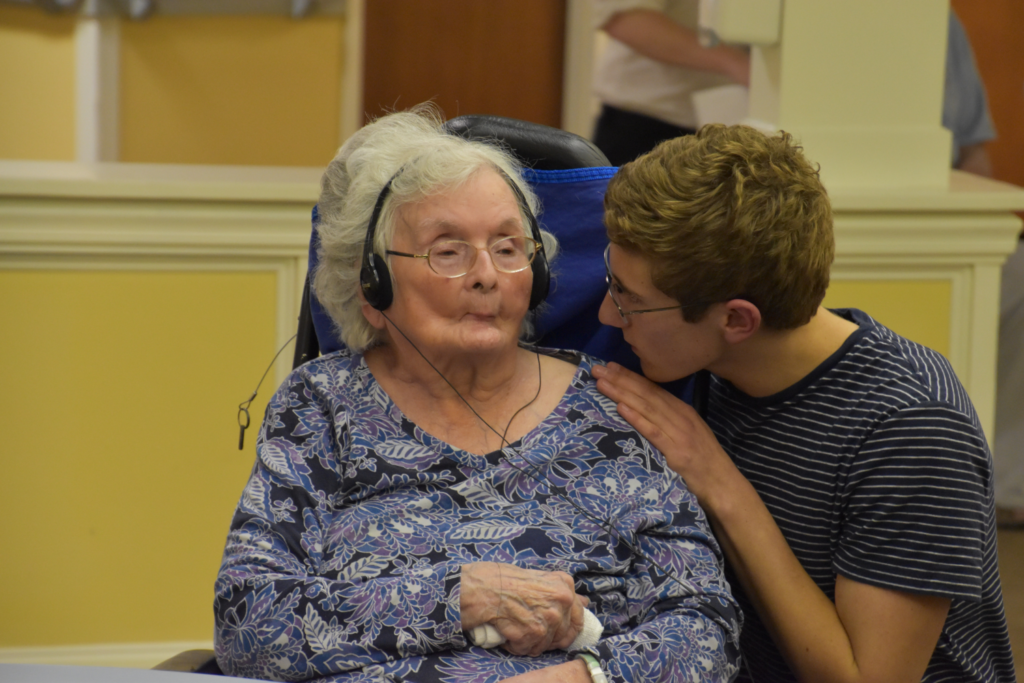
Colby and I were working with the residents one day, sitting in the dining room. The two of us were sitting, one on each side, of Phyllis, whom we’ve worked with for about three years. One of the activities directors had recommended that we played “Take Me Out to the Ball Game” for Phyllis, as she had been a lifelong Red Sox fan. As the music began to play through her headphones, we watched Phyllis light up. Colby and I began to sing along to the music, encouraging her to join us. And so, once withdrawn, non-communicative, and introverted, Phyllis had now begun to sing along with us. We sat in that little circle and sang through the whole song two or three times. Phyllis was happier, more verbal, and more relaxed than we’d ever seen her. She told us about her youth and how she would play baseball in the backyard with her brothers. She told us that she used to attend Red Sox games with her family. And for that short afternoon, Colby and I got a glimpse into Phyllis’s life before Alzheimer’s had taken her captive.
Through that experience and countless others, I have learned that music can help us overcome Alzheimer’s, even if we can only do so for brief moments. Because that afternoon with Phyllis, it was as if she didn’t have Alzheimer’s at all.
It’s important that young adults give back so that they can experience the benefits of community service. Volunteering brings me so much joy, and I want other young adults to experience this joy. Through volunteering, young adults may also form connections with other people. With Project Playback, Jason, Colby and I are able to form intergenerational connections with the residents at the nursing home. Young adult volunteers can encourage kids to follow in their footsteps. Currently Project Playback is working on getting more kids to volunteer.
What do you want others to learn from your volunteer story?
One very important lesson that we want others to learn from our project is the value of service in one’s community. Many individuals in our generation have the reputation of being self-absorbed and preoccupied with our own needs. We hope that this project can inspire other people, both young and old, the intense feeling of joy and satisfaction that service can provide not only to those receiving the service, but to those giving the service as well. We like to think of this concept as a “two-way street,” in which both givers and receivers of service get to experience the same joy. To give an example, when I put headphones on a resident at the nursing home and see their face light up at the sound of their favorite music, I can immediately tell that I have brightened the day for that particular resident, and that brings me great happiness. Now this sort of experience is not limited to our project. Whether you are bringing food and supplies to victims of a natural disaster, or serving a meal to people in a homeless shelter, you can experience this same “two-way street” of joy. Whether it’s a larger-scale project like ours, or simply a simpler act of kindness or service, it can still make a great difference in someone else’s life.
Are there any future partnerships or events planned for Project Playback that you are excited about?
Project Playback has recently formed a partnership with the United Way of York County. With their support, we are looking to expand our program out to more retirement homes in the Southern Maine area. We have the equipment (headphones, music players, chargers, music, etc.) to expand to three more facilities, and are seeking motivated youth to volunteer in these facilities. Our goal is to pass down Project Playback to these volunteers once we graduate high school so that our program can continue to thrive even when we are no longer able to actively participate in it. Much of our focus will be directed toward recruiting teenage volunteers and implementing programs in local communities during our last two years of high school.
Do you want to make a difference in your community like Juli, Colby and Jason? Visit All For Good to learn more about local volunteer opportunities.
Camp Volunteer Helps Sick Kids and Their Families Let the Sunshine In
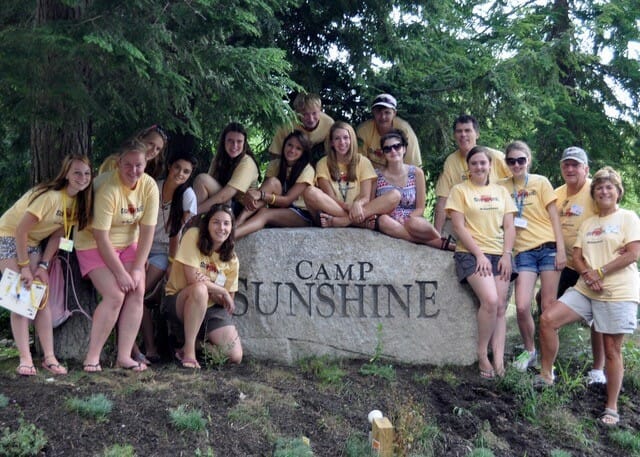
Since 2010, Carol Tonge has volunteered with Camp Sunshine, a 5-day camp for sick children and their families. While there, parents receive support services, and children enjoy many activities and fun interactions with peers. It’s an endeavor close to Carol’s heart because it’s an opportunity to fully focus on meeting others’ needs. Points of Light talked with her about her volunteer service and the impact she’s made.
How did you first get involved with Camp Sunshine?
It was 2010 when I was asked if I would take teen-agers to a program in Maine for children with life-threatening illness. I received permission to do two sessions. The first summer, I took 18 terrified teens and two terrified adults to a camp that might be very sad and very difficult, but we were willing to do it because we felt it was an important thing to do. As it turned out, focusing on someone else gives you a new perspective. You realize you’re giving back.
At first, I was terrified. I ran into a family from New Jersey and chatted with them. This very amiable gentleman introduced me to his sons. They had an easy humor, and I wondered which one was the sick one. Then, I saw the youngest with a do-rag on his head that said, “Cancer sucks.” I knew they were willing to talk about it. This is a place where children with life-threatening illnesses are the cool ones. They’re the group — they get all the attention. Despite the fact the whole family comes, the child is the one we fuss over. Instead of diverting our eyes and looking away, we turn toward them and make a conscious attempt to meet and talk with them.
That first night, I asked my 18 teens how they were doing. They said it wasn’t hard at all. That it was really fun. I was amazed at how beautifully teenagers can adjust.
What are your overall activities with the camp?
I do the coordination for all the kids who apply. I started by just taking care of my own weeks, but that expanded to a third week. Then, I took it all over. I keep all the records and disseminate all the information. I collect the applications, review them, and send them in. I also run all the fundraising events. It takes a lot of time, but it’s a lot of fun.
My husband and I also work in the kitchen, so at any given time we’re providing food for between 200-350 people.
What is the camp experience like?
Camp Sunshine started in 1984. You think of tents and camp fires, but this is a magnificent campus that offers children the opportunity to experience a wide variety of activities. At Camp Sunshine, families are important, not just the children with the life-threatening illness. On a typical day, everyone has breakfast in a brightly-lit, well-appointed cafeteria. They sit together, and our volunteers mix with the families. You look at this dining room full of people, sitting and joking. Everyone is having a good time.
At 9 a.m., the programming starts, and this is where the camp is helpful for the family. The children separate into age groups — nursery, Tot Lot, all the way up to teens. While the children go to their groups, the parents go to groups led by psychosocial directors and doctors. Families who have never met another family with their same issues — having a child with rare blood diseases — are now sitting together in the same room.
The children swim or play outside. They paddle board, canoe and swing. On rainy days, they’re equipped for carnivals or indoor hockey. The teens are assigned to specific age groups. Some want to work with babies or toddlers. Many want to be with the 9-12 age group. They get very attached to the families and often connect with them on Facebook, email, or text.
How do you get teenagers involved, and why do you think it’s important to do so?
I’ve been told by parents that in our community, Camp Sunshine is a household word, so it’s not hard for me to get the word out. That’s what happens when kids spread the word. That first group went back to their high school in their volunteer t-shirts and talked about the amazing time they had.
The hard part now is getting everyone into the program. Other schools are involved. Camp is well loved enough that they have too many volunteers. We have to limit groups. I brought 18 teenagers the first time. I can only bring 10 now. It’s very hard to screen them, but over the years we’ve learned to identify the right ones who can put others in front of themselves. We include an expectation sheet with the applications to impress upon the kids that they’re not there for themselves.
We’ve also added in that kids do a fundraiser. You don’t have to pay to work there, but we hand them opportunities for fundraisers. They’re required to raise $250 to accompany their application. They can choose how they fundraise.
What types of activities do you plan with them?
This year is the 6th fundraising year. Between our two towns, Harvard and Bolton, we’ve just raised $100,000. This fall, I’m going to a meeting where representatives from the camp will present us with a plaque. I’m going to try to get eight years’ worth of kids to attend.
Our kids have several fundraising opportunities. They’re invited to speak at the local Catholic Church. Parishioners donate a lot of money, and the kids also serve a pancake supper at the church, with the blessing of the priest who supports Camp Sunshine, the night before Lent. In the winter, they participate in the Polar Plunge at a local ski resort. Up to two dozen kids voluntarily jump into an icy pool. They play it up really well, and many of them raise every bit of money they need by jumping into the icy waters. And, new this year, the Epilepsy Foundation is partnering with us for a clothing drive. You have to collect at least 800 bags of clothing, and they will donate $0.20 per pound of clothing you collect to your organization. Kids also do the obligatory bake sales and car washes. Our kids use Camp Sunshine as their community service, and I’m really proud of the fact that I have 10 kids doing their senior projects on the camp, too.
Why do you think volunteering, overall, is important?
Nothing else matters as much as reaching out to others, knowing you’re making a difference. I met a family from Canada several years back who wrote their joy of being at Camp Sunshine started with me because I opened up and talked with them about having an adopted child. They had originally been denied adoption, and we talked about rejection and being judged. That conversation meant everything to them. That’s why you volunteer — to make a difference for others.
Do you want to make a difference in your community like Carol? Visit All For Good to find local volunteer opportunities.
Great Schools Partnership Creates a Unique Outdoor Classroom for Underserved Students at Tennessee Elementary School
The Great Schools Partnership is today’s Daily Point of Light Award honoree, and one of the winners of the 2016 Make A Difference Day Awards. Each year, TEGNA recognizes 14 outstanding leaders of Make A Difference Day projects, awarding $140,000 in grants that are donated to the charities related to the winning projects. Learn more about Make A Difference Day and register a 2017 project at www.makeadifferenceday.com.
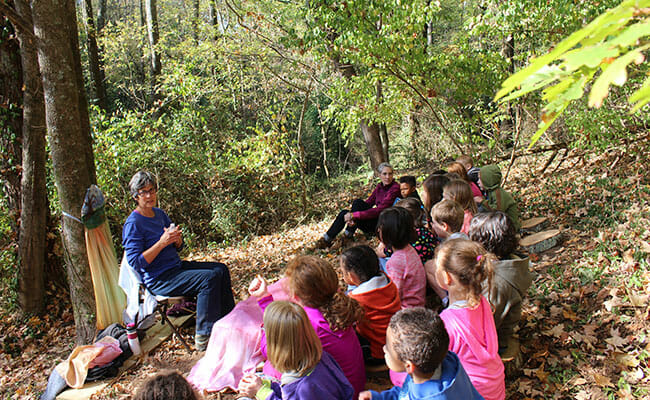
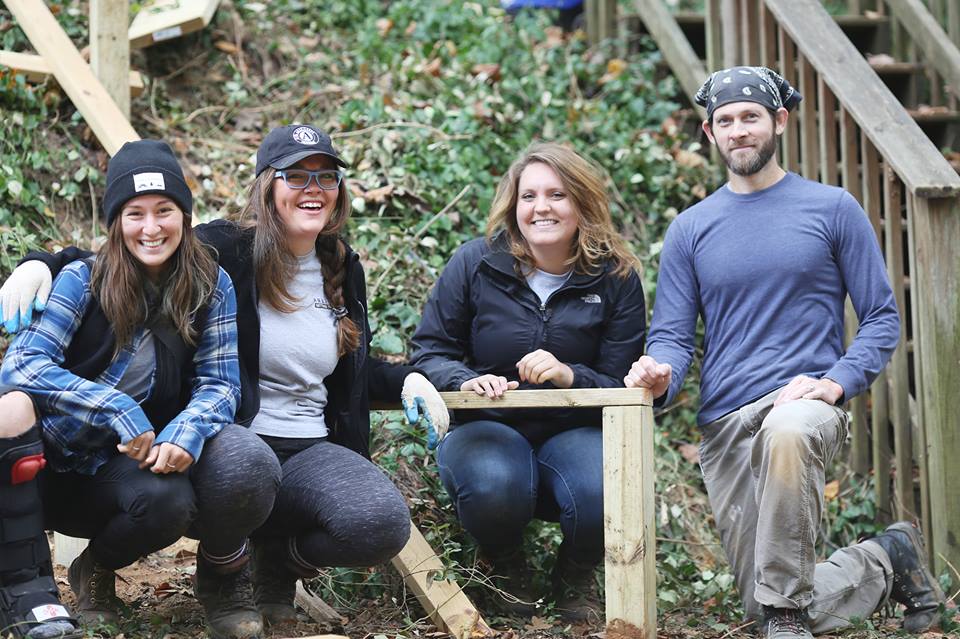
Resources are stretched thin at Dogwood Elementary, a low-income school in South Knoxville, Tennessee. Nearly half of the school’s 750 students are eligible for free lunch, and the school is among the poorest in the county. With leadership from Great Schools Partnership’s Adam Fritts, site coordinator for Dogwood, and guidance from the local CAC AmeriCorps program, a dedicated group of 58 volunteers from all walks of life joined forces on Make A Difference Day 2016 to transform the overgrown wooded area behind the school into a unique outdoor classroom – providing students a hands-on opportunity in which to learn about environmental conservation. That day, volunteers also began to clear a trail in the woods behind the school, with the goal of connecting it to the 12-mile Urban Wilderness Trail system along the Tennessee River. In addition, they began work on a nature observation deck and seating area cut from nearby fallen trees.
The Great Schools Partnership was awarded a $10,000 grant for this effort on Make A Difference Day – a little extra money to do a lot more good for the 750 families of Dogwood Elementary. We asked Ariel Allen, CAC AmeriCorps program specialist at Knoxville – Knox County Community Action Committee, to tell us more about the project and the continued work taking place to further improve this incredible outdoor learning experience.
What inspired the “Classroom with a View” project?
Mac Post, a volunteer with the Sierra Club, was exploring behind the school one day with students in his Outdoors Club and noticed an overlooked and overgrown trailhead which led into the woods. Once he followed it in, he noticed a deserted observation deck, staircase, amphitheater stage and started asking questions. Faculty soon realized the great opportunity to teach their students about the rich biodiversity in their own backyard. Not only could they teach this but they could bring their students to the space and have them interact with the outdoors in an immersive way. This location is also central to the already expanding Urban Wilderness trail system in South Knoxville. We knew that we could connect students to the outdoors but also much more literally connect this educational space to the growing trail system and greater South Knox community.
Tell us a little more about what your volunteers did on that day.
Volunteers included community members, school faculty and students, and AmeriCorps members from CAC AmeriCorps – which focuses on environmental education, stewardship and service – and Emerald Youth Foundation, totaling 58 volunteers and 232 volunteer hours. On that day, we completed clearing out the remainder of the trail of invasive species plants to ensure the health of native plants in area and trail visibility, built seating for kids made out of tree cookies and logs, and started building new observation deck (which is now complete!).
What was the most rewarding part of the experience? A favorite memory?
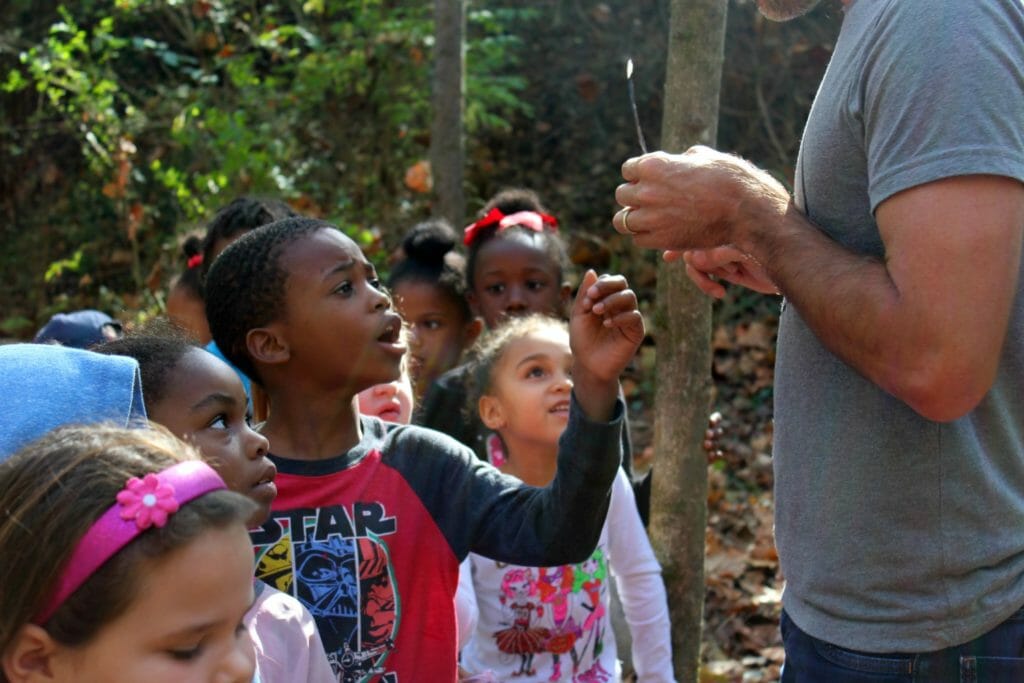
The very next week after we completed the project, the entire first grade at Dogwood Elementary came to the newly finished Dogwood Nature Trail for a field trip. There were six stations, including information about native animals in Eastern Tennessee, a “Forest Theater,” a re-enactment of real East Tennessee homesteaders – the Walker Sisters (students even got to make their own homemade applesauce!), a DIY bird-feeders station, a talk with a local entomologist, and a water quality demonstration. The students were SO excited be outside and had a truly wonderful experience learning the natural history of the area by exploring the trail. To see a child connect with the outdoors truly makes them aware of the balance of our ecosystem and the importance of preservation.
Why do you think it’s important for others to get involved and make a difference in their community?
Once you follow through and make that first difference, no matter how small, it gives you the confidence, knowledge and skill to continue to make change or improvements in your community. It teaches you that you don’t have to watch from the sidelines. You can be the changemaker.
As a 2016 Make A Difference Day Award Winner, Great Schools Partnership was awarded a $10,000 grant for this project. What will that money go toward?
We really want to create a space that has creative input based on needs and opinions of those who will use it the most: the community! Currently, Dogwood Elementary staff is surveying students, faculty and parents about what they want for this new community space. Their wish list will directly determine how to best spend this money. Ideas so far: a slack line course, interpretive signage, and even a restroom and water access for students during excursions.
What do you want people to learn from this story?
The power of leveraging your network. It took one person who stumbled upon the space to be inspired enough to reach out to one other person, who then turned around and contacted three more people who eventually contacted me, and so on and so forth. A task can be daunting at first glance, but once you have a handful of inspired people with various skills and backgrounds, the task quickly becomes more feasible.
What are your plans for Make A Difference Day 2017?
We are planning on teaming up with Dogwood Elementary and Great Schools Partnership again and completing even more on our wish list for the space including clearing and widening the trails to make them more ADA accessible, creating more seating for class trips, installing signage and building an archway for the entrance of the trail system.
Volunteers across the nation will come together again on Saturday, Oct. 28, to improve their communities for Make A Difference Day. Project organizers are encouraged to register at www.makeadifferenceday.com to be eligible to win a $10,000 grant to donate to a charity related to their Make A Difference Day project.
North Carolina Woman Finds Joy in Crafting for Good
Linda Cline leads the Handicrafters Group of Ardmore Baptist Church, who have gathered together regularly for the past 15 years in service. The group hand sews a variety of urgently needed items for patients at Hospice and Palliative CareCenter, including pressure point pillows, emotional-support dolls and catheter bag covers. All of these items help ensure the patients’ sense of worth and dignity, letting them know that they are loved and cared for by the community. Giving more than 2,000 hours of time per year, the group delivers gifts to patients once a month. The items are marked by the highest quality, with obvious care taken with every detail.
Passion for Public Health and Commitment to Service Helps One Volunteer Find Her Fit
Sydney Lawrence graduated from University of Colorado at Denver in 2013 with a degree in biology. She was working as a scribe in the emergency department of a hospital and just about to begin graduate school to pursue a certificate in public health when, in a chance meeting, she heard about an organization called HOLA.
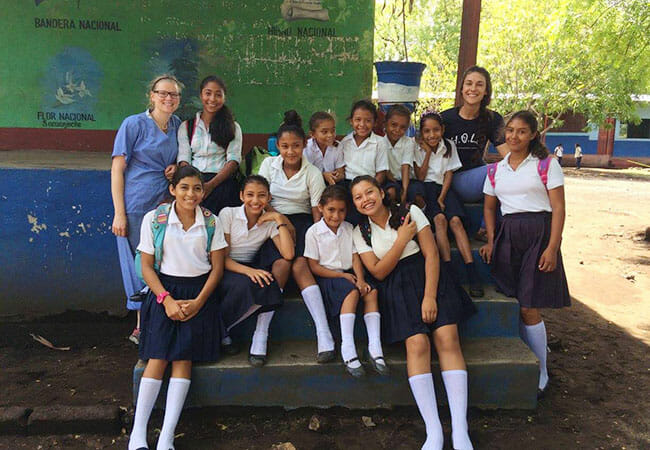
Health Outreach for Latin America began as a week-long alternative spring break trip in 2004, with a mission to address the medical needs of a rural community in Nicaragua. In its first year, four students from the University of Colorado traveled to Nicaragua and worked with local officials to identify those in need of medical care. The students, James Byers, Britt Severson, Brian Morgan, and Anthony Ross, then facilitated transportation and care from physicians in the larger city of León – covering all costs incurred. By 2008, their initiative had grown into an established nonprofit, broadening its mission to provide sustainable healthcare solutions to developing countries in Latin America.
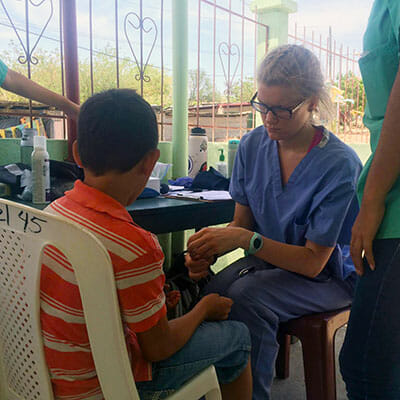
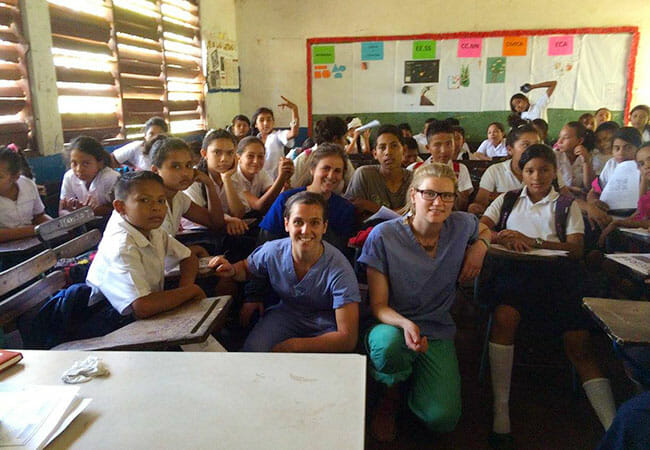
By the time Sydney joined, the mostly student-run organization had grown significantly and expanded the services offered during its annual trips. Building on its network of medical care clinics, the group now also provided veterinary care clinics and various public health services. On Sydney’s first mission trip, she helped lead sexual health classes for local teens.
“Because of the taboos down there on sexual education and sex in general, their course for anatomy is called natural science class and they learn the bare minimum,” said Sydney. “They talk about anything else besides that. Abortion is illegal and contraception is hard to come by.”
Due to these circumstances, teen pregnancy and rates of sexually transmitted infections are very high. Educating teens in prevention and care became a passion project for Sydney, and on her second mission trip she was able to see proof that their efforts were working.
“It was inspiring to see all these kids – as soon as we busted out the materials, they were whipping out answers,” said Sydney. “Seeing these kids again the second time around, and them actually retaining the information and being able to relay it back to us was super cool. It showed us, this is working. We are doing something down here.”
In her second year with HOLA, Sydney was asked to step up as executive director Sydney. She has held the position for the last three years, while also working in a pre-school and completing her master’s degree in public health.
“I know a lot of nonprofits usually have paid positions for this kind of work, but I have always been a humanitarian. I’ve always wanted to give back,” she said.
Sydney equates her commitment to community service to something akin to church for her. She attended church with her family when she was younger but, she said, as an adult she struggled to find a church where she felt she fit.
“But when I volunteered, I felt that piece was put back again,” Sydney said. “Being a part of something else that has nothing to do with you makes me feel a lot better.”
Illinois Teen Uses Song to Brighten the Days of Local Seniors
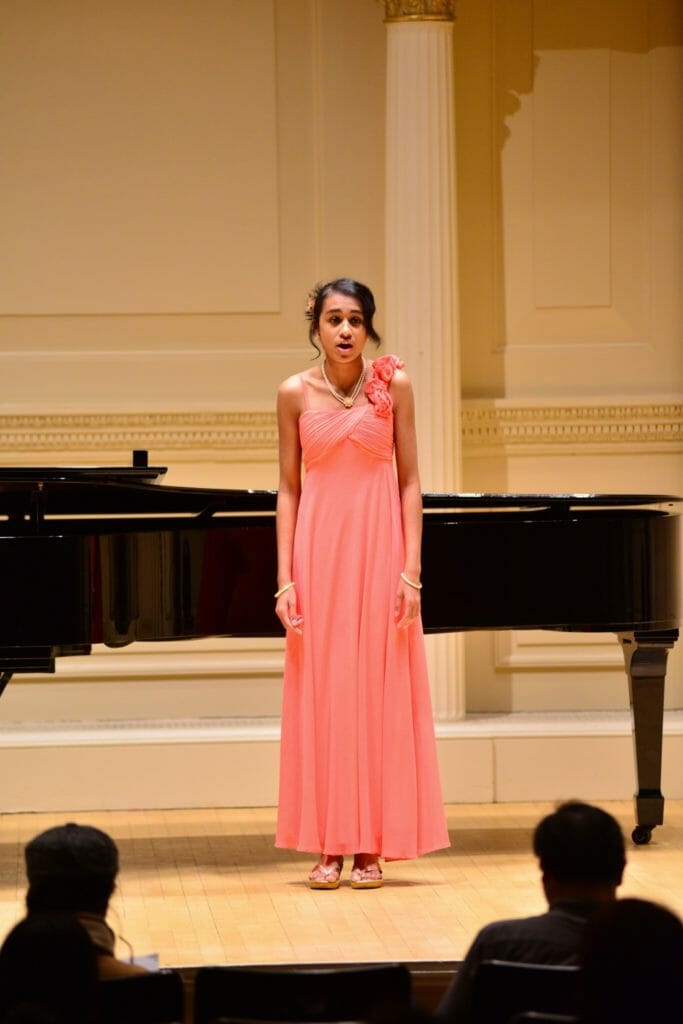
Sanjana Ramrajvel is a high school student and founder of Two Girls and a Song, an organization she started with her sister in Naperville, Illinois. An accomplished musician who has performed solo at Carnegie Hall, Sanjana takes music beyond the concert hall, performing for free at events for non-profit organizations, hospitals, nursing homes and more where music can sometimes speak louder than words.
Sanjana, who balances a heavy school course load in addition to scheduling 1-3 performances each month, has touched the lives of many who cannot afford to go see professional musicians and events. Sanjana is making a difference in her community by sharing her love for singing and is today’s Daily Point of Light Award honoree. Points of Light spoke to her to learn more about her work through Two Girls and a Song.
How are you giving back to your community?
I have always enjoyed singing from a young age, but I really only was performing for big events. I wanted to give back to my community. I wanted to use what I like doing and help people in some way. I founded Two Girls and a Song and that let me do that.
What does volunteering mean to you?
I remember one time in middle school, we had a special needs class with us. And sometimes the kids will come in and sit with our classes. I was in choir at that time, a couple of the special needs kids were sitting in the choir class. I noticed that they really responded to music more than other things. I think that was one of the times where I realized that music really has a healing power on people, and it can really reach people in ways that I guess, words can’t or other activities can’t. Since I really connect with music, I realized that there are ways for to me to help other people there.
What’s the most rewarding part of your work?
I would say seeing the smiles on people’s faces. Music helps people connect. I’ve performed at retirement homes, the people, after I’ve performed, they’ll come up and start talking to me. They’ll tell me it was really beautiful, and then they’ll start talking about their life and I just think that music helps people connect.
Does performing at retirement homes feel just as good as performing at Carnegie Hall?
I say [at] Carnegie Hall, I definitely was nervous. It feels more like – like, I definitely earned that performance, but it felt more like a duty rather than… performing for retirement homes, I never feel nervous. Even though it’s a smaller audience, it’s more comfortable and it’s easier. My purpose there (at a retirement home), is not to deliver a perfect performance, it’s just to share what I have.
Tell me about your first performance with Two Girls and a Song.
The first performance that I did was at a foster care center. When I performed there, there was a person who said to me that she’s never seen anyone doing something like what I did, that it was unique and special. [That] gave me motivation to keep doing this.
Describe how giving back to others makes you feel.
Ever since I was young, helping other people has made me feel fulfilled. I see it as one of my biggest purposes in my life.
Why do you think it is important for others to volunteer?
Volunteering helps you realize the benefits that you were given that maybe you take for granted. Volunteering can help you see everything that you have and that maybe other people don’t have. It kind of helps you appreciate who you are and what you have.
What do you want people to learn from your story?
When I first had this idea, I thought it really seemed daunting and I saw other people who were starting amazing things, and, it seems like the average person can’t do it, but really you can. It really just takes hard work and you have to put your mind to it and stay focused. If you go at it step by step, you can achieve whatever results you desire.
Do you want to make a difference in your community like Sanjana? Visit All For Good to find local volunteer opportunities.
Animal Advocate Builds Kennels to Improve the Lives of Chained Dogs
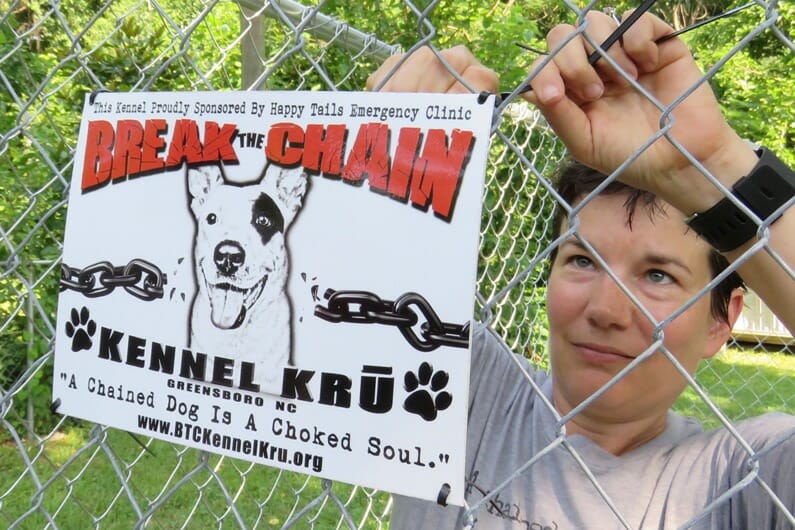
Sylvia Mayon, founder of Break the Chain Kennel Kru, has a soft spot for dogs and their humans.
For years, she had driven past homes around Greensboro, North Carolina, where dogs were chained. It always angered her to see the animals tethered, but she didn’t think she could do anything about it. Even after she began volunteering with the animal relief agency, Project B.A.R.K, she focused on fundraising and avoided outreach work.
“I didn’t think I could emotionally handle getting to involved directly with the animals,” Sylvia recalled. “And, here there are a lot of chained dogs.”
Sylvia slowly got past her reservations about field work, and began canvassing neighborhoods with Project B.A.R.K. to help educate people about spaying and neutering their pets. During one of those neighborhood visits she met William Jones and his energetic dog Ca$h.
William and his family were considering surrendering Ca$h because they didn’t have enough money to pay for a kennel – nor did they have enough funds to pay Guilford County’s $500 fine for tethering dogs.
“I said to William, what if [I] sent an email out to [my] friends and we raised enough money to build you a kennel?” Sylvia recalled. “His wife was in tears.”
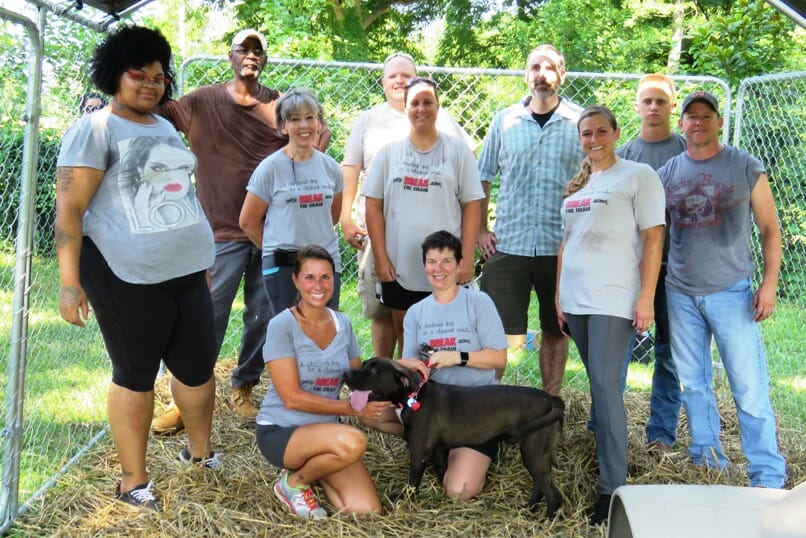
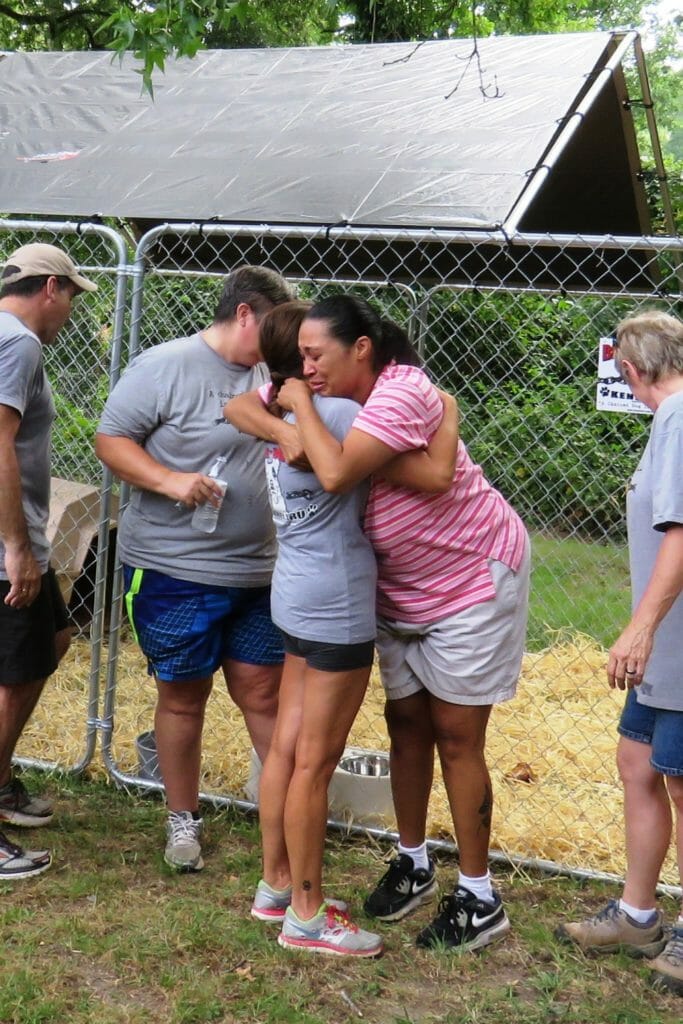
Though Sylvia and her husband Andrew had never attempted to construct a kennel before, they collected enough money in a few days and showed up in William’s yard with metal fencing, stakes, straw and plenty of elbow grease. Four hours later, Ca$h had a brand new enclosure and Sylvia had a new dream.
“When [Andrew and I] got in our car, we all had tears in our eyes. We said this is what we were meant to do, and that’s how Break the Chain Kennel Kru started.”
According to The Humane Society of the United States, the effects of tethering dogs include higher vulnerability to parasites, harassment by strays, and embedded collars that have to be surgically removed when dogs continue to grow unchecked by their owners.
Also, people are at a higher risk of being attacked by dogs that have become aggressive and territorial due to the isolation and confinement that comes from being tethered.
“Dogs aren’t meant to be chained,” said Sylvia. “Dogs are meant to be companion animals. They aren’t meant to be outside their whole lives. It’s not healthy.”
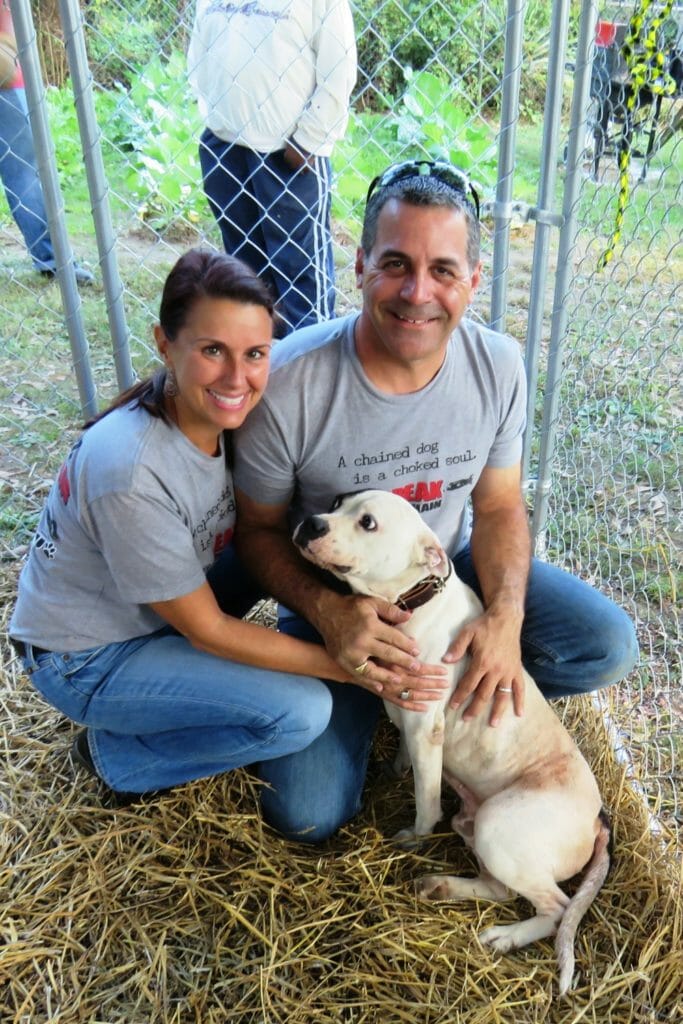
All of the dogs that receive kennels from BTCKK must be spayed or neutered prior to the build, and pet owners are asked to pay the help they receive from the organization forward by volunteering to build kennels for other families, if they are physically able. Ca$h’s owner, William, was one of the recipients who returned again and again to help out on future builds, and he is now a member of the organization’s board.
“Everyone that is volunteering […] they have a heart of compassion,” William said. “It goes beyond let’s help this dog or this family – it’s about connecting people and communities and being there for one another.
BTCKK’s kennels cost $600 to construct, and Sylvia and her volunteers have gotten their construction time down from 4 hours to just 30 minutes. The nonprofit limits its kennel builds to no more than two a month, so that they can maintain a high quality of care, and they often raise funds for builds by hosting ‘Paint Your Pet’ nights at a local studio.
“Our goal is not how many dogs can we unchain and how many kennels can we put up,” Sylvia said, of her unique 360-degree approach with BTCKK. “The goal is how many families can we help all the way through with everything.”
Sylvia’s desire to help humans as much as their pets stems from her own childhood. She was six-years-old when her mother abandoned the family, and Sylvia and her brother were sent away to foster care. When she returned home a few years later to live with her father, the family still struggled – many times not having enough to eat.
“If [people] have had a rough background, they [should try to] take that and turn it into something positive that will make a difference in someone’s life,” Sylvia said.
“I just went on a home visit three nights ago, and the kennel was in shambles. They have two little kids, and you can tell this family is really struggling financially. I had moved up this build to happen before school so we can surprise this little boy and girl with backpacks and school supplies and new outfits for school.”
“I just always want people to know that we are not just for the dogs. And, a lot of that comes from what I didn’t have. I didn’t have new school clothes and a backpack. So, that’s a very important part of what we do.”
Do you want to make a difference in your community like Sylvia? Visit All For Good to find local volunteer opportunities.