Florida Couple Spend Two Decades Building Habitat for Humanity Houses
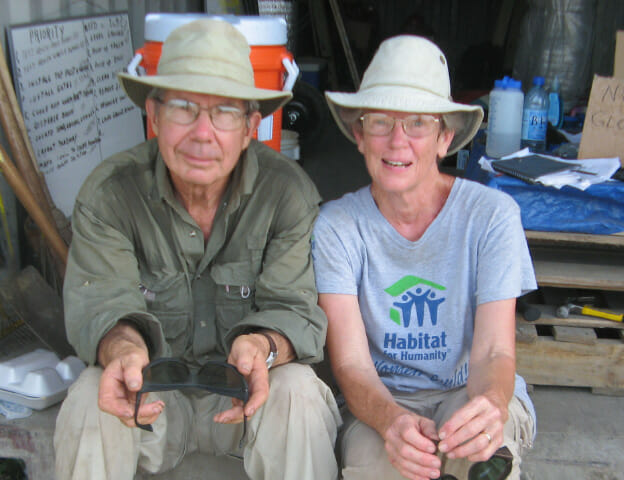
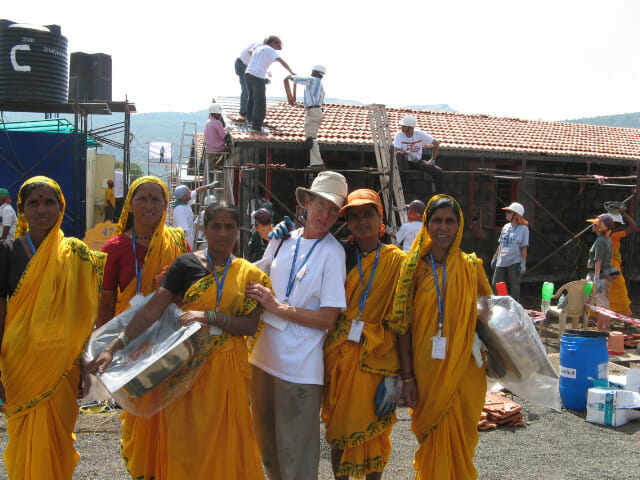
Bob and Joyce Daugherty were walking with their daughter around Baylor University campus when they noticed a house being built on a flatbed truck through Habitat for Humanity. They were so inspired by the cause that they signed on as Habitat for Humanity International volunteers.
For two decades now, they have provided leadership for Habitat for Humanity projects. They have participated in home builds in 21 states, as well as volunteering regularly for their local Jacksonville Habitat affiliate. “Our goal is to volunteer in all 50 states,” they shared.
The Florida couple has also built homes in eight different countries using a wide variety of materials. They have built homes in Northern Ireland, Mexico, Australia, India, Thailand, Romania, South Africa and Haiti.
Joyce is inspired when she sees women in male-dominated societies learn new skills that they can put to use to build their own houses. “Seeing these women feel empowered is enough to send me back again and again,” she said.
In addition to building homes, in 2008 Bob and Joyce became part of the disaster core team for Habitat for Humanity, have been lending a hand all over the world when disasters hits. They have responded to numerous disasters including Hurricanes Katrina, Sandy, Harvey and Irma totaling more than 5,000 hours of volunteer service.
They say the most rewarding part of their work has been the memories. “The joy we see can’t be bought. The people in the community we serve become our friends,” they said.
“Volunteers are happier people.”
They have learned the experience of volunteering is a win-win for everyone involved. “As a volunteer, we win because we learn new skills and it brings us happiness. It is also a win for the receiver, as they gain positive energy and a new home. We’ve also learned volunteering helps the community as a whole.”
As for their future Habitat for Humanity plans, they say you never know when or where a disaster will hit, but they are always ready to go help rebuild on a moment’s notice. And, when asked what their favorite build has been, they answer, “The next one.”
Bob and Joyce know not everyone has the skills required to build houses, but they hope others learn from their story to find one’s passion and to give back. “Everyone has a skill you can contribute; find something that is the best fit for you and volunteer.”
Want to make a difference like Bob and Joyce? Visit All For Good for local volunteer opportunities.
This post was written by Karen Cohen.
Building Community, Helping the Hungry
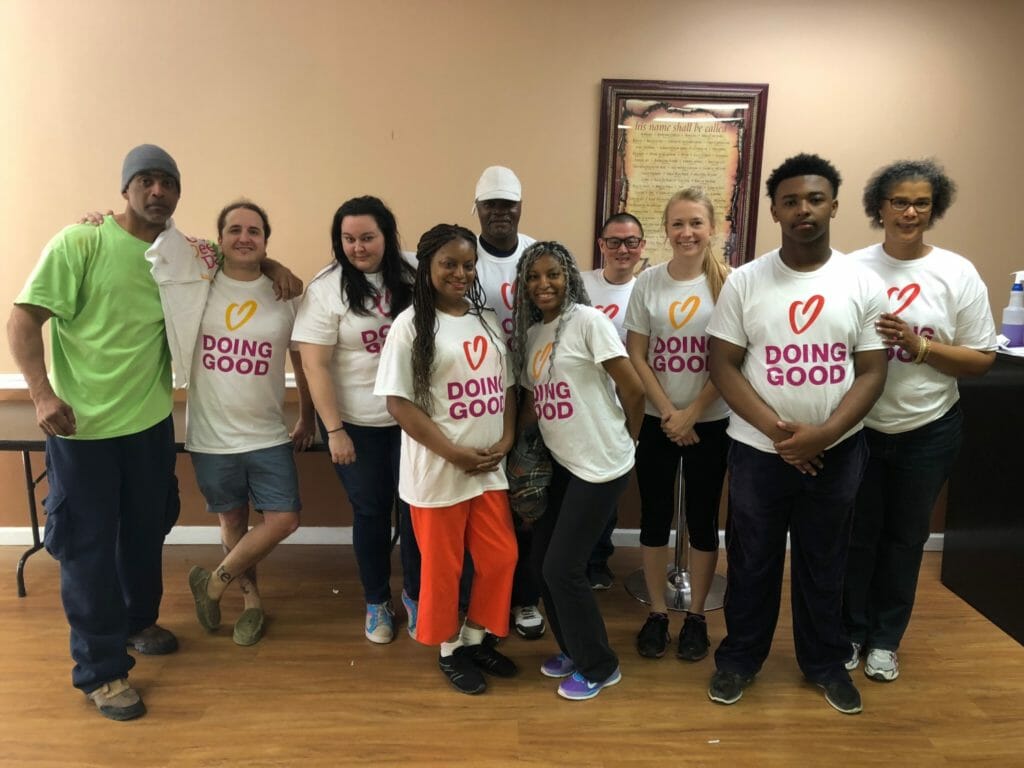
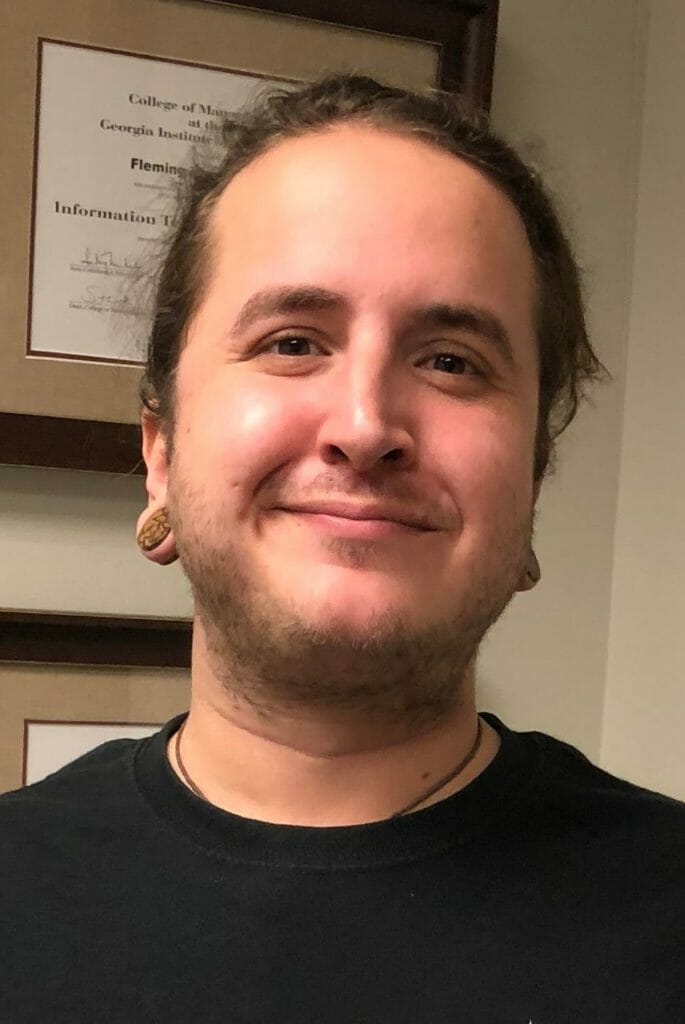
In 2017, Fleming Slone started volunteering as a way to get out and meet people in the community. Through HandsOn Atlanta, he began volunteering at the Atlanta Grace Community Food Pantry every Saturday. He became inspired to help solve the hunger issue within his Atlanta community.
He works with local grocery stores, as well as large corporations like Wal-Mart, Publix and Kroger to distribute groceries to feed hungry families. Last year, he helped serve more than 3,000 families.
In addition his volunteer work, he takes part in HandsOn Atlanta Civic Leadership, a year-long program to train non-profit leaders. Fleming participates in classroom learning on topics like fundraising and recruiting and then applies those skills to recruit and manage the volunteers for the project he is assigned to for the year.
We recently caught up with Fleming to find out why he thinks it is important for others to give back and what he has learned through his experience as a volunteer.
What inspired you to volunteer?
I signed up with HandsOn Atlanta as a way to meet new people and do new things. Through HandsOn Atlanta, I began to volunteer at the food pantry one Saturday. I enjoyed it so much; I kept going back every Saturday. Volunteering gave me a purpose.
Describe your volunteer role with Atlanta Grace Community Food Pantry.
Every Saturday, I lead the 20-30 volunteers involved in the distribution of the groceries. Depending on what types of food we have that day, we setup six plus stations and I manage each step of the process. One team signs in people receiving food, another gathers the cans for the order, then other teams handle stations for bread, desserts, vegetables, milk and the weighing of the orders for our records. I give each group an explanation of what they’ll be doing and answer any questions along the way, helping to make sure volunteers have what they need, ensure that the process is going smoothly and that those receiving food have gotten what they need.
Why do you think it’s important for others to give back?
I think it is important for others to give back because in the modern age we have lost a lot of connections to people who aren’t like us. For me personally, getting out and doing something in a different community and being exposed to new people and new perspectives is worthwhile. Also, I think a lot of us have needed help at some point in our lives and it compels me to give back.
What’s been the most rewarding part of your work?
The most rewarding part of my volunteer work has been the connections I have made. Not only are the connections with the volunteers at the food pantry special, but also the friendships I have developed with the people I am serving is doubly rewarding.
What have you learned through your experiences as a volunteer?
As a volunteer, I have learned how to adapt to hectic and unpredictable situations. We may plan to serve 50 people and then 95 show up. Sometimes we have volunteers who don’t show up or volunteers who bring an extra friend. I’ve learned to adapt to the changing variables.
Are there any future partnerships, programs, or events that you are excited about?
Grace Community Food Pantry is open every Saturday for volunteers. We also do a Thanksgiving meal in November. Last year, we served 500 plus a Thanksgiving lunch and had people on site to do haircuts, manicures, blood pressure and HIV checks, as well as distribute clothing and healthcare items.
What do you want people to learn from your story?
Above all, I hope more people come to realize how deeply rewarding the experience of volunteering can be. Helping others in the community and taking on challenging issues is a tremendously gratifying experience and broadens your perspective on the world. By pushing myself to get involved I’ve learned a lot about the problems facing my community, made some great friends and become a better person along the way.
Want to make a difference like Fleming? Visit All For Good for local volunteer opportunities.
This post was written by Karen Cohen.
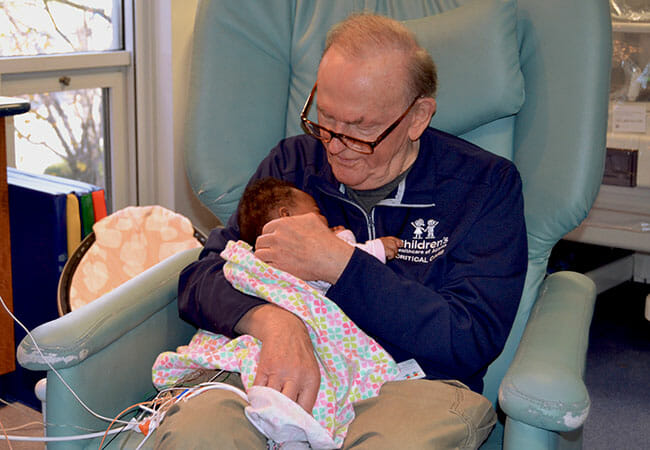
‘ICU Grandpa’ Shares Comfort, Hugs with Babies Who Need A Little Extra Love
Meet Daily Point of Light Award honoree David Deutchman. Read his story and nominate an outstanding volunteer or family as a Daily Point of Light.
After retiring in 2000, David Deutchman was giving guest lectures at colleges and universities around Atlanta — but found it didn’t occupy enough of his time.
He started volunteering at Children’s Healthcare of Atlanta at Scottish Rite, and was teaching in a classroom when he noticed a couple of moms who looked like they needed someone to talk to. “I sat down for 30 minutes and they poured their hearts out to me,” David said. “I realized I could fill a gap.”
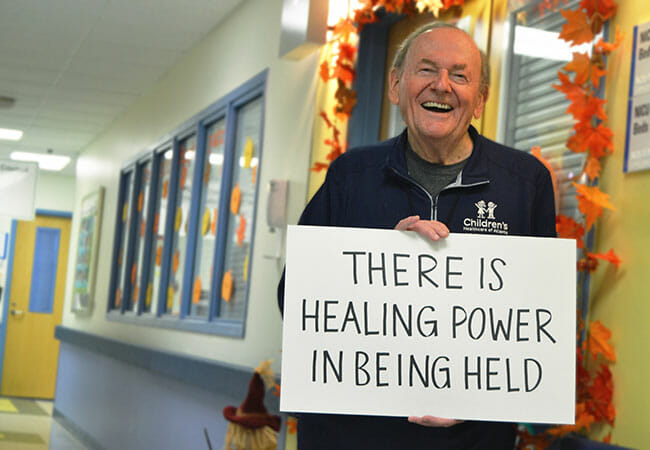
Before long, David carved out his niche volunteer role in the pediatric and neonatal intensive care units, offering comfort, support and hugs to parents and children. And he noticed that some patients, including those with Division of Family and Children Services, didn’t receive many visitors. “There were some babies no one was visiting or hugging, so I did,” he said.
The former marketing executive now goes by the title “ICU Grandpa,” and he spends two days a week at the hospital. On Tuesdays, he visits the pediatric ICU and on Thursdays, the neonatal ICU. “It is a wonderful atmosphere; I enjoy it so much,” said David, who has been volunteering at the hospital for more than 12 years now.
He says as a volunteer he has learned there are many children who are in need of kindness, and not just because they are sick or injured. Sadly, there are also kids who need a little more love. “That is a theme of mine — wanting to give as much to the kids who need it the most,” David said.
David’s role as ICU Grandpa became a viral sensation last September when Children’s Healthcare of Atlanta posted a photo of him holding a premature baby. He has since joined Facebook, which has led him to reconnect with many of the families he once knew in the ICU. While he says it is great to revive relationships and hear how he made an impact in their lives, not all the stories have had happy endings.
“Meeting many of the families again brought a new focus on some of the kids who haven’t done as well.” David makes a point of visiting with these kids and their parents when they’re back in hospital for treatment or because they’re sick. From his story, he wants other people to learn the importance of getting up to do something.
“I have made this a priority in my life,” says David, adding that he gets so much back from cuddling the babies. “I recommend everyone find a way to give back.”
Want to make a difference like David? Visit allforgood.org to find volunteer opportunities near you.
High School Student Brings the Healing Power of Art Therapy to Pediatric Hospital Patients
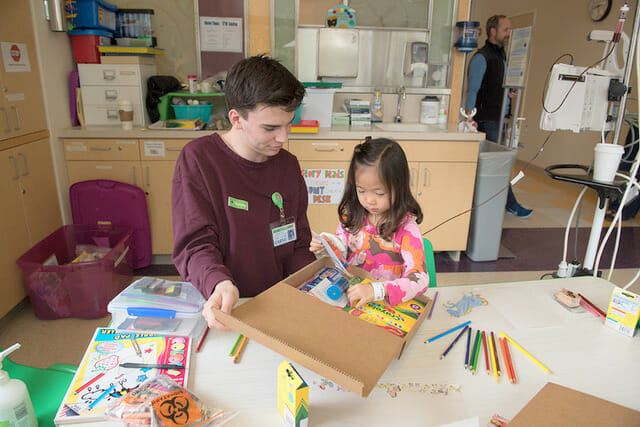
At the age of 14, Malcolm Asher was volunteering at Oregon Health and Science University’s Doernbecher Children’s Hospital oncology outpatient clinic. He would bring construction paper and markers for the kids in the oncology playroom.
There, he noticed one patient would give the pictures she had drawn to other oncology patients who were sitting alone. He then witnessed a mutual chain reaction of positive art therapy. The patient drawing and sharing the pictures saw increased confidence and the patients on the receiving end gained encouragement and love.
Malcolm did some research and found no other organization was focused on helping kids make and share art during their hospital stay, so he decided to start his own nonprofit, ArtPass. ArtPass is now a youth-led international nonprofit with 31 branches across four continents. Its vision is to change the way kids around the world perceive and experience the hospital through the power of art.
Malcolm is currently a junior at Cleveland High School in Portland, Oregon and still volunteers while acting as founder and executive director of ArtPass. We recently caught up with Malcolm to find out how he juggles being a student while running a nonprofit, and what he has learned through his experience as a volunteer.
What inspired you to volunteer?
As a kid, my grandma introduced my brother and me to volunteering by going downtown to feed the homeless. I would see how rewarding it was to give back to the community.
Describe your volunteer role with ArtPass.
I serve as the executive director and founder of ArtPass. My role with ArtPass is to develop new chapters, work on new initiatives, work to implement the curriculum in elementary schools and to partner with new hospitals.
Why do you think it’s important for others to give back?
It is important because there are so many people whose lives could improve from our little efforts.
What’s been the most rewarding part of your work?
The most rewarding part of ArtPass has been seeing the mindset of children during their hospital stay change. Seeing and hearing from kids from remote regions of the world that they feel less fearful and less anxious during their hospital stay is rewarding. We are changing lives every day.
Tell me about your volunteer work in Ghana and how that has impacted your work with ArtPass?
During my one month excursion, I discovered an issue there that was completely unaddressed. I went into the trip expecting to introduce art-sharing programs to the children in the pediatric wards, but I soon discovered there was an even larger need. In the hospital where I worked, monetary resources are incredibly scarce and they rely heavily on donations for essential medical supplies and equipment. Because all available resources are poured directly into medical treatment, the emotional well-being and hospital experience for young patients are often not addressed. I saw rooms where 15 kids were packed together in a space suited for 10 kids, all while enduring brutal 105 degree heat with no air conditioning. Children often conceal their symptoms from their parents to avoid being sent for treatment due to awareness of the miserable conditions in the pediatric wards. 5.4 million children a year die from preventable diseases like malaria, pneumonia and diarrhea. These easily treatable diseases can quickly become fatal if medical treatment isn’t sought in a timely manner, and many children do not receive medical attention until it is too late to treat. I saw there was this huge need that wasn’t being addressed and ArtPass evolved to meet that need. Our hope is to work toward a world where hospitalized youth in all 195 countries have access to art supplies.
What have you learned through your experiences as a volunteer?
I have learned there are many people willing to help you. I have had so much help for ArtPass from executives at other nonprofits, along with friends and family who have wanted to come together to support this goal.
Are there any future partnerships, programs, or events that you are excited about?
We are partnering with dozens of schools to implement our educational curriculum. This curriculum first goes over what symptoms to look out for in common, but lethal, diseases such as malaria and cholera. Then, it aims to encourage children to seek out medical attention and show that the hospital doesn’t have to be such an intimidating and scary place. After an extensive survey, we found our curriculum is 93% effective in changing kids’ perceptions and an increase in asking for medical help after participation in our program.
What do you want people to learn from your story?
I would like for people to learn when you see an issue in your community to take the initiative to make a change. You can take it further than you expect. Especially for young people, I would like them to learn change is possible and it is exciting to see.
How do you juggle going to school and your volunteering as executive director of ArtPass?
It has really been the support of our youth-led executive team, the help of our ArtPass global ambassadors, and countless nonprofit leaders, child life specialists, hospital administrators, friends and family. When I come home from school, I can work on the organization for four plus hours on a busy day. However, the incredible support I’ve received has definitely made everything possible.
This post was written by Karen Cohen.
Do you want to make a difference in your community like Malcolm? Visit All For Good to find local volunteer opportunities.
Breast Cancer Survivor Opens Shelter for Women and Children of Domestic Abuse
Julie Cravillion was the director of a local church ministry in 2007 when she heard that 300 families were seeking services regarding domestic violence. They were asking the faith community to help. She couldn’t get this out of her mind and felt God was calling her to get involved.
She contacted 11 different churches and put together personal care bags for the families. During all this, she was diagnosed with stage three breast cancer and underwent a mastectomy, chemotherapy and radiation.
However, despite her diagnosis, she felt called upon to do more, so she put an ad in the paper to find other people who were interested in helping start a domestic abuse shelter.
Quickly, Julie and her friend, Sue Poole, were able to form a steering committee. At each meeting more and more people showed up, allowing them to overcome any obstacles to opening the shelter. She did all this while continuing chemotherapy for a full year.
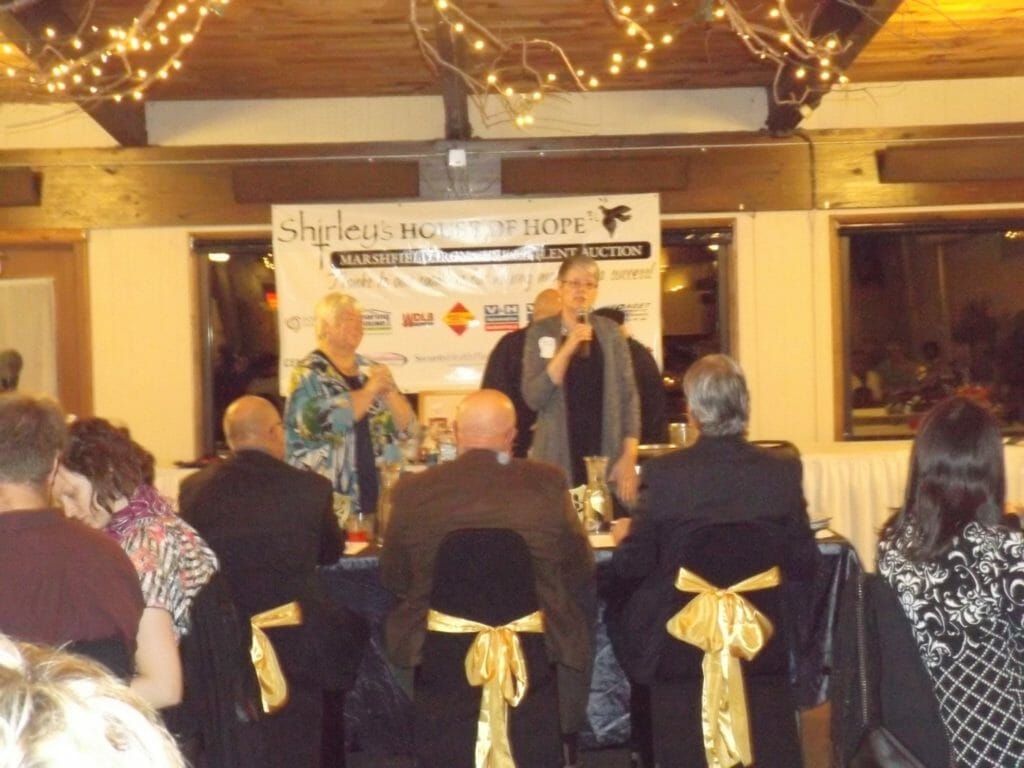
In 2009, Shirley’s House of Hope officially earned its nonprofit status and in 2010, the first shelter opened.
Julie now serves as the executive director and development director of Shirley’s House of Hope. She works full-time and receives no financial compensation. Her primary role is development and raising funds to support the shelter.
Her responsibilities with Shirley’s House of Hope includes overseeing operations, meeting with the board, overseeing fundraising, making appeals to the community, acquiring new donors, speaking engagements, developing relationships with major gift donors, grant writing, overseeing finances and writing the newsletter.
She also spearheaded the capital campaign that raised more than $375,000 to help women and children who are hurting from abuse.
Shirley’s House of Hope is expanding. A ribbon-cutting ceremony will take place on May 23, 2018 for a second building that will focus on transitional and recovery services. Residents in this building will have another year to be in school or work to save money until they can afford to be out on their own.
Shirley’s House of Hope will also have upcoming fundraising events such as Iron Chef and Striking Out Domestic Violence bowling.
Julie believes it is important for others to give back because she says when you give, you are the one who benefits. “I have never experienced more joy or walked closer with God than when at Shirley’s House of Hope – this place is a miracle.”
She says the most rewarding part of her work has been seeing these women set free from horrible situations.
She wants people to learn from her story to step out in faith and do what God is calling you to do. “We can stay in our comfort zone or we can step out and give back and find purpose in life.”
Today, Julie is cancer free and says her life is a miracle.
This post was written by Karen Cohen.
Do you want to make a difference in your community like Julie? Visit All For Good to find local volunteer opportunities.
Retired Psychologist Teaches Hard-to-Adopt Animals Social Skills to Help Them Find them Forever Homes
As a high school and college student, Elliot Weiner was always getting involved in organizations advocating for people who didn’t have a voice. He wanted to help speak for those who didn’t have enough power to speak for themselves.
Elliot’s professional career led him down a path as a clinical psychologist. He also volunteered in local animal shelters where he realized animals didn’t have anyone to speak for them. Every time Elliot moved to a new city, he would always find an animal shelter nearby at which he could volunteer. His professional skill set as a clinical psychologist to humans was similarly applicable to changing animal behaviors.
After he retired, he wanted to spend his time volunteering full-time at animal shelters and volunteered at the Tacoma Humane Society for 10 years. For the past four years, he has been volunteering 2,000 hours a year at the Asheville Humane Society.
He helps enrich the animals’ experience at the shelter and educate pet owners and potential pet owners on how to provide a safe and caring home to pets.
We talked to Elliot to find out what inspires him to volunteer and what he wants others to learn from his story.
What inspires you to volunteer?
It gives me the ability to move things in a different direction. I can remember when I was in graduate school and volunteered at a nursery school, on the first day. One of the students said I couldn’t be their teacher because I was a man and men aren’t teachers. That situation allowed me to impact kids’ views. I am inspired to make a slight direction change for the betterment of animals and kids and that is what keeps me inspired to volunteer.
Describe your volunteer role with Asheville Humane Society.
I am part of the behavior team that evaluates the animals and helps develop individual action plans for them. Some of our animals have been abused or living on the streets, and we evaluate each animal to determine the best plan to help. I run playgroups for the animals to get them out, socializing and enjoying life. Getting them exercise and relating to other animals can help make them feel safe. I am also involved in Asheville Humane Society’s Canine Good Citizen Readiness Program. This is a training program for veteran shelter dogs to help teach them social skills that helps make them more highly adoptable and ready to handle life outside of the shelter. I am also known as the MacGyver of the shelter – when problems come up, I like to find ways we can fix it.
Why do you think it’s important for others to give back?
I think it is important to give back because most of us didn’t get where we are today without others helping us. It is important to pay it forward. Sometimes we all need a little hand to lift us up.
What’s been the most rewarding part of your work?
At the end of the day, I may be tired, but I feel good. I think about an animal or home situation that is a little better because of what we did that day and I was a part of it. It is great to be part of a caring team making a little difference in the right direction.
What have you learned through your experiences as a volunteer?
I’ve learned that making little changes can create the butterfly effect. Making small changes a little at a time, down the road will create an impact that will blossom. You can start slow and will get to a better place when enough energy is pushing in that direction.
Are there any future partnerships, programs, or events that you are excited about?
The Asheville Humane Society is becoming a central place for other shelters to come for information. Other shelters are coming to us for help developing Good Citizen Readiness Programs and dog playgroups. Also, the ASPCA Behavior Rehabilitation Center is located approximately 15 miles from the Asheville Humane Society. We developed a relationship with them and worked to get some of its program graduate dogs adopted.
What do you want people to learn from your story?
Every individual can make a difference and it is our responsibility as humans to do it if you have the resources. We owe it to this planet to make a difference.
This post was written by Karen Cohen.
Do you want to make a difference in your community like Elliot? Visit All For Good to find local volunteer opportunities.
With Mentari, Human Trafficking Survivor Helps Victims Emerge from the Darkness into the Light
Meet Daily Point of Light Award honoree Shandra Woworuntu, who was a Top 10 finalist for the L’Oréal Paris Women of Worth Award in 2017. Each year L’Oréal Paris and Points of Light recognize and celebrate Women of Worth who make a beautiful difference in their communities. Ten honorees each receive a $10,000 grant to support their most cherished cause, and an online vote determines one honoree who will receive an additional $25,000 grant. Nominations for 2018 are now open! If you know a woman who works to create lasting and significant change in her community, nominate her to be one of the 2018 Women of Worth.
As a survivor of human trafficking and domestic violence, Shandra Woworuntu became an advocate to create change. After enduring months of abuse when she arrived in the United States from Indonesia in 2001, Shandra escaped from trafficking and began reaching out to other survivors, providing them with resources and support to find employment and shelter.
She founded Mentari – a word that means “sun” in her home country of Indonesia – to help bring human trafficking survivors out of the darkness and into the light. What began as a series of cooking classes taught out of her home, eventually grew into an organization where survivors could connect and learn culinary arts courses with a professional chef, and other mentoring opportunities.
“I just want to do good,” says Shandra. “It’s beautiful to see people safe, to (see them) have their own freedom — to eat, to have clothes, to go to school, to learn to speak what they like, to go to work, to visit the doctor if they want.
Southwest Florida Resident Files Taxes Free of Charge to Those in Need
Giancarlos Castano was attending an event with multiple nonprofit organizations when United Way asked him if he would be interested in volunteering with the Volunteer Income Tax Assistance program; he immediately accepted.
“I was waiting for an opportunity like this one to help my community,” said Giancarlos.
He has been a volunteer with United Way’s Volunteer Income Tax Assistance (VITA) program for several years now. He completed the IRS advanced level certification and additional training courses to become a Goodwill site coordinator. Through the program, he became certified to file taxes free of charge to those in need.
“I am inspired to volunteer because I love the Southwest Florida community. This is an amazing, diverse and inclusive community with a lot of need,” Giancarlos said. “We have people who come here from all over the world and they need to save money any way possible.”
This tax season, Giancarlos and his volunteer team spent their Saturdays filing more than 100 tax returns for Collier County residents. Their work returned nearly $100,000 for the low-to-moderate-income taxpayers. He also serves as a translator for five other tax sites.
“The most rewarding part of my volunteer work is seeing the expression in people’s faces when they get what they need,” he said. “They ask, ‘How can they pay me?’ I tell them seeing them happy is the most beneficial gift.”
He also spreads the word about the VITA program by interviewing with the local Spanish news station to help make the community aware of the service.
“I think it is important to give back in any way you can. Volunteering is the most beautiful decision a person can make for the community because it helps us grow,” Giancarlos shares. “It is important to do something meaningful for the community. I have been in need and others helped me, so the best thing I can do now is help others.”
He says his volunteer work has taught him to learn to have empathy for others. “It has helped me grow as a person, emotionally and spiritually. My volunteer work is not just about taxes, I have spent time talking to the people and they have opened their hearts and shared their stories.”
Giancarlos says he wants people to learn one of the greatest things a person can do is to help others. “Volunteering brings fulfillment and satisfaction. Using any skill you have, you should be giving back to the community.”
This post was written by Karen Cohen.
Do you want to make a difference in your community like Giancarlos? Visit All For Good to find local volunteer opportunities.
Kaupo Villager Turns Personal Tragedy into Mission to Help Others
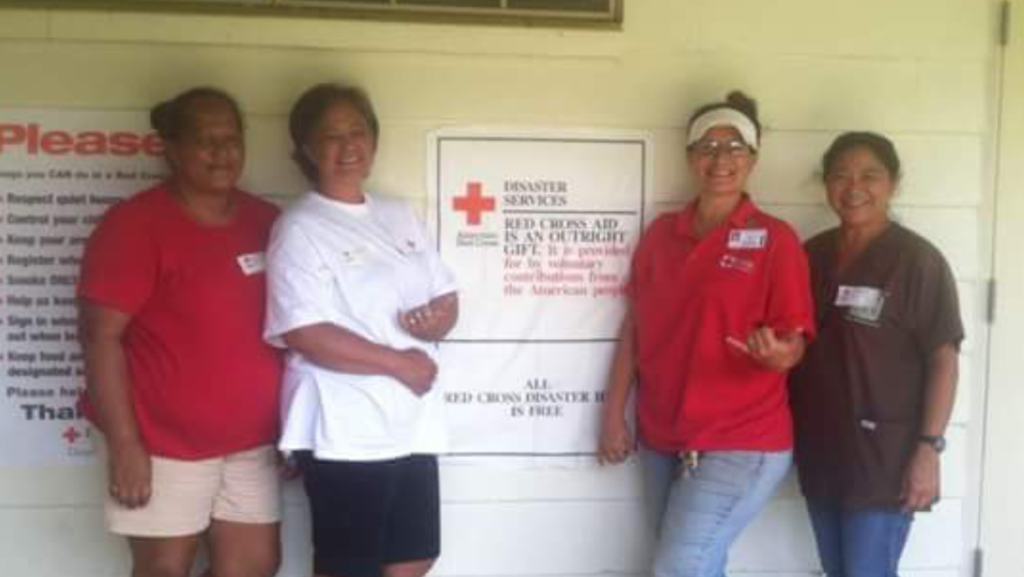
J. Alohalani Smith knows personal tragedy firsthand. Living in the remote Maui village of Kaupo, a faulty propane tank burned down her entire house in 2005. She and her husband had three small children at the time and needed to rely on others for help. “It gave me a greater appreciation for my community,” Alohalani said. The American Red Cross was also there to help with resources in addition to family and friends.
Alohalani’s family was slowly rebuilding their house when a 6.7 magnitude earthquake struck East Maui. The earthquake cut off access to Kaupo for two years.
Again, it was the Red Cross that came to help, was flying in fuel, water and food.
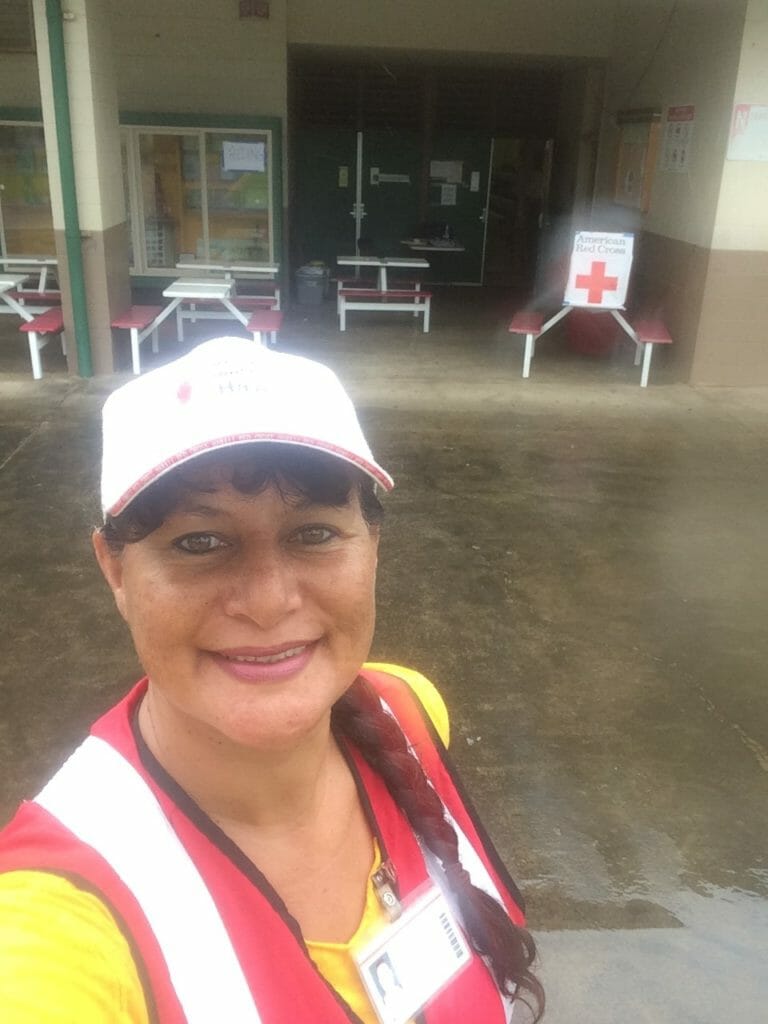
It was through her own personal tragedies that inspired her to volunteer with the Red Cross. Now as a seven-year Red Cross volunteer, Alohalani is a shelter lead coordinator for Molokai, Lanai and Maui. She helps to open shelters and leads logistical planning should a disaster hit the area.
She has also worked in shelters on disaster teams for Hurricane Harvey, Irma and Maria. In addition to offering a safe space and distributing resources, Alohalani provides comfort in time of need.
“I can remember at a Florida shelter walking past a woman in a wheelchair crying,” Alohalani said. “I stopped and talked to her. I told her I knew how she felt, as I had been there too. I listened to her and shared my story. Sometimes people just need someone to help push them forward. I am thankful I can help others, because I have been there.”
She says one of the most rewarding parts of her volunteer work is seeing people rebuild their lives.
Alohalani’s Red Cross volunteer role also involves sitting at the table with national and local agencies planning communications and services for future mass disasters. “It is not a matter of if a disaster hits, it is when a disaster hits.”
She says it is important for others to give back because life is so unpredictable and you never know when your life will come to the lowest point and you will need someone to help pick you up and move forward. “Giving back helps you be a better and stronger person,” she said.
Alohalani gets emotional as she recounts the early humanitarian work of Princess Ka’iulani and the Hawaii Red Cross that began as early as 1898, when 300 women cared for sick and wounded soldiers in route from the Philippines during the Spanish-American War. She is proud to be part of that heritage.
As she puts on her American Red Cross vest, she says it makes her proud to serve and work with others who have the same passion for helping others.
Alohalani has learned just how fragile life can be and how important it is to help service those in need. Just this month, she was deployed to help assist with the Hawaii volcano eruption, Kilauea.
She says when she looks at the American Red Cross flag, she remembers Queen Liliuokalani who sewed a Red Cross flag that soared above Iolani Palace during World War I while volunteers rolled bandages in the Throne Room. The Queen said, “The flag is an expression of my warm and hearty sympathy with the cause of humanity and an abiding faith in the work of the patriotic women in Hawaii.”
This description is an accurate representation of the warmth and sympathy Alohalani brings to her volunteer work every day.
This post was written by Karen Cohen.
Do you want to make a difference in your community like J.Alohalani? Visit All For Good to find local volunteer opportunities.
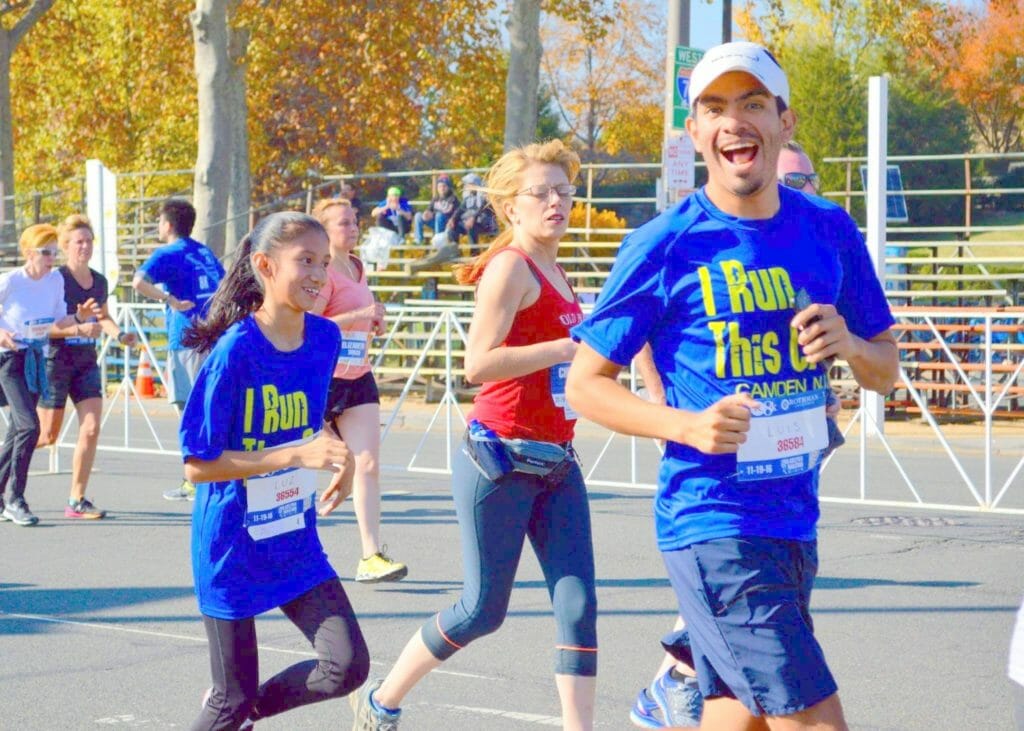
Engineer Uses Running to Provide Mentorship to Youth in his Hometown
Luis Gaitan grew up in a tough New Jersey neighborhood where there weren’t many organized extracurricular activities. However, he found his niche as a runner and ran on his high school cross country team and was a college athlete as well. “I enjoyed the competition,” said Gaitan.
After becoming a civil engineer officer in the Navy, he wanted to pass on his running passion to the next generation.
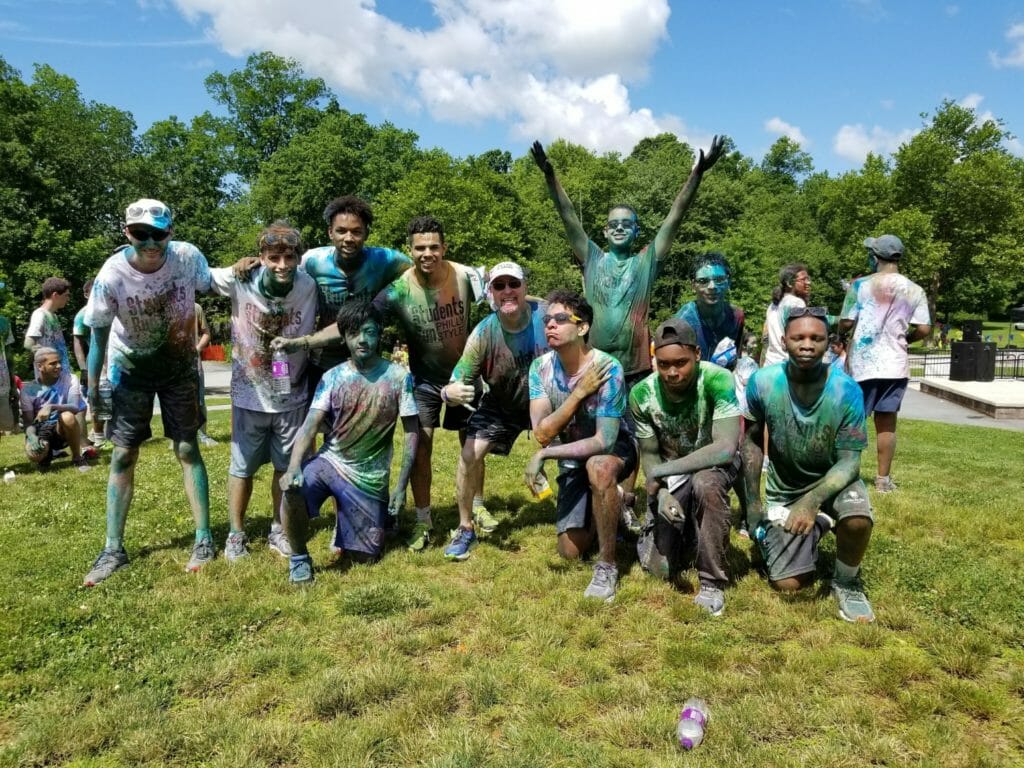
He started volunteering with Students Run Philly Style, a nonprofit providing free mentorship to teens through running. His volunteer duties included helping to train youth to run 10-miles, half or full marathons. “I am inspired to volunteer to help kids have better experiences than I had at their age,” Luis said.
After volunteering in Philadelphia for three years, Luis decided to bring the program to his hometown of Camden, New Jersey. Luis said, “it felt good to bring this new activity and camaraderie to my hometown. It helps fill a sports void for the community.”
To get the Camden program started he held practices at a park near his former middle school. As one of the only athletic activities offered nearby, the team grew to 25 kids, consisting of nearly the entire seventh and eighth grade classes. Luis’ work funded the program to allow for an expansion to 75 of Camden’s youths who have since been introduced to running and positive role models.
His volunteer role with the Camden program, “I Run This City,” includes serving as the lead volunteer and mentor with the partnered schools, organizing practice and training schedules, coordinating rosters and making sure transportation is arranged. In addition, he cheers on runners during practices and races and acts as a mentor. He has spent nearly 1,000 volunteer hours on this initiative.
Through the program, Luis and volunteers noticed the young participants have had increased academic success, confidence, determination and drive. “The most rewarding part of my volunteer work is seeing improvement in the kids,” Luis said.
He says it is great to hear the teachers and parents tell him how beneficial the program has been. “To see some kids start running on their own and say they don’t need us anymore is gratifying. To know we have helped them find an activity to live a healthier life as an adult is rewarding to me.”
The I Run This City group recently participated in the Broadstreet 10-miler on May 16, 2018. Luis’ group had 14 sixth and seventh graders run in the race. “My goal was to make sure all my runners crossed the finished line, and I was elated to see this group of middle schoolers accomplish something a lot of adults couldn’t imagine doing.”
Luis says his goal is to further expand the I Run This City program. “Life has treated me well; I want to treat other people well.”
This Post was written by Karen Cohen.
Do you want to make a difference in your community like Luis? Visit All For Good to find local volunteer opportunities.