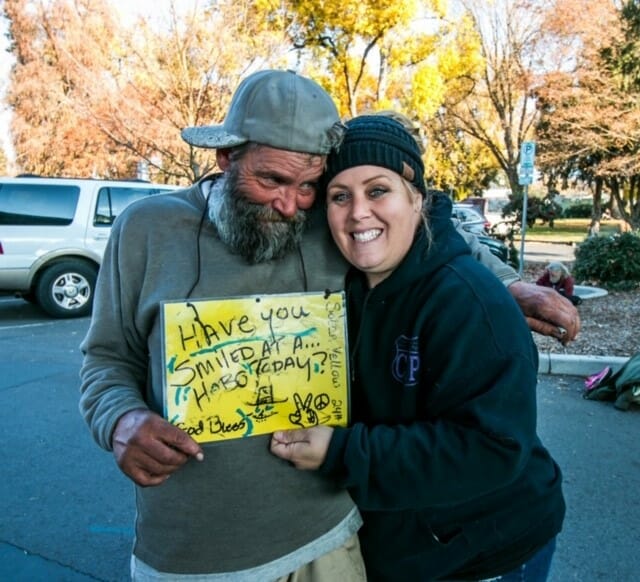
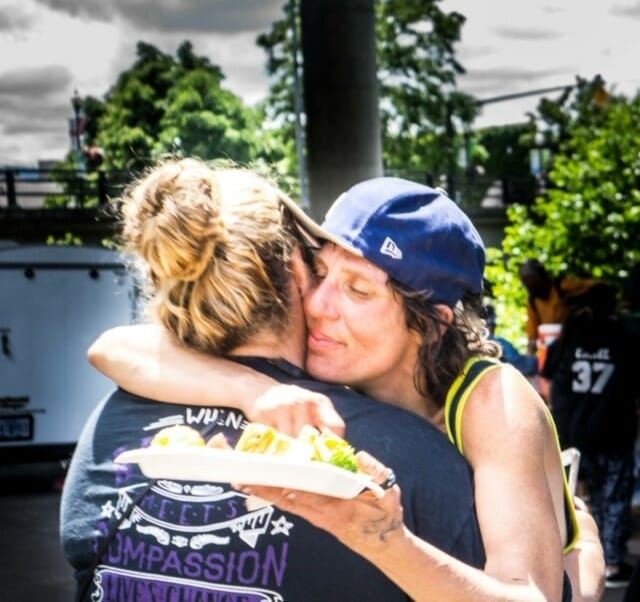
Highway overpasses too often serve as makeshift shelters for homeless men, women and children. Melissa Mayne has been there. A single mother of two in the Southern Oregon town of Medford, Melissa found her family homeless after a wrongful eviction. Her son was newborn at the time. Homeless for two months, Melissa eventually found somewhere to stay, but her family’s housing situation has only been truly stable for two years. The experience opened her eyes to just how easily anyone’s circumstances can become untenable. Her reaction to this knowledge was to serve. With the help of her board and many volunteers, Melissa founded Compassion Highway Project in 2013, an outreach project that serves food and provides clothing hygiene products to homeless people Sundays at Hawthorn Park and Tuesdays and Fridays at Alba Park. It became a non-profit in 2015. Working with dozens of volunteers and local donors like Starbucks, Franz Bakery Outlet, Little Caesars, Peruvian Point and Mary’s BBQ Place, CHP takes to the streets and serves folks where they live. Last winter she was able to partner with Rogue Retreat, a case management and housing non-profit, to secure a permanent warming shelter open from December through February.
Melissa is committed to making a difference in her community and she is today’s Daily Point of Light Award honoree. Points of Light spoke with her about her commitment to service.
What inspires you to volunteer?
The Whys in my life inspired me to volunteer. I didn’t understand why I was going through so much until I started giving back. It became clear to me it was because now I could relate to almost anyone. I can offer a listening ear because I have been there.
Describe your volunteer role.
My role is founder and executive director of Compassion Highway Project. I am able to be reached by anyone in our community who is in need. I hear from homeless people of all ages and low-income families. We provide basic needs and offer resources and guidance to help folks take steps to better their situation. We respond to calls and our volunteers are out with food, warm clothes, basic necessities, in all kinds of weather.
What’s been the most rewarding part of your work?
The most rewarding thing is seeing how lives can really change. People get clean and sober, families find housing, someone’s life is saved from freezing to death, someone who was starving has a full belly, and helping someone get employment! We see all of this.
What have you learned through your experiences as a volunteer?
To NEVER judge anyone. Show compassion at all times!
Are there any future partnerships, programs or events you are excited about?
We are constantly partnering with other nonprofits and organizations, which is always good because it helps bridge the gaps in care and brings a variety of expertise and resources to the table.
Why do you think it is important for others to give back?
Giving back is important because anyone can become homeless or in a tough situation. It’s good to give back when you are feeling down as well because it helps the heart.
What do you want people to learn from your story?
It is so simple to be kind. Just a smile can change someone’s life. It is so important to show kindness and love to others. When someone’s hurting and another person shows that kindness it is life altering for people! Once to know people their life stories are inspiring.
Do you want to make a difference in your community like Belinda? Visit All for Good for local volunteer opportunities.
Post written by Beth D’Addono.
Researcher Finds Her Niche Volunteering in Botanical Living Museum
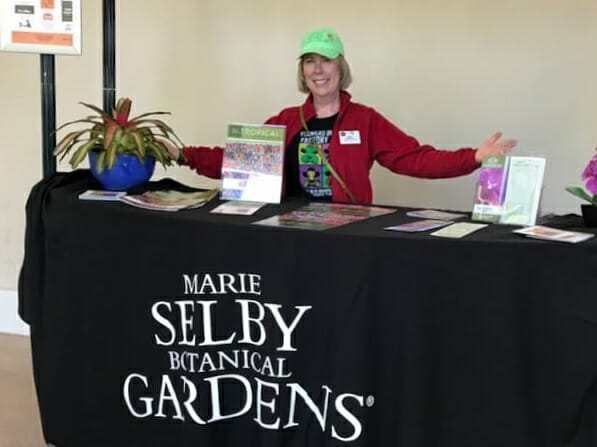
As a newcomer to Sarasota, Florida, Tracey Fletcher was looking to expand her social circle and cultivate her passion for gardening through service. Living in a condominium with no backyard to dig in, Tracey began volunteering at Marie Selby Botanical Gardens – an urban, bayfront oasis.
Connecting with like-minded people who work together to conserve and study plants, particularly epiphytes, which are plants adapted to live in the tree canopy, including orchids, bromeliads, gesneriads and ferns, appealed to Tracey, who is a clinical researcher in the pharmaceutical world by day. According to Tracey, learning more about these rare and beautiful tropical plants fed her researcher’s mind and curiosity, while also being able to help introduce the community to its beauty.
Having logged over 500 hours volunteering since 2015 by sharing the beauty of this oasis with her community, Tracey is known as a go-to person that the gardens can count on, and is today’s Daily Point of Light award honoree. Points of Light spoke to Tracey to learn more about her work with Marie Selby Botanical Gardens.
What inspires you to volunteer?
When I came to Sarasota and I really didn’t know anyone, volunteering was a way of expanding my friendship base and giving back. I’ve worked really hard in my life, and I thought that if I could give back, that would make my life better.
Describe your volunteer role with Marie Selby Botanical Gardens.
We are the friendly faces that greet the customer visiting and make their day great. Typically it’s just me out in the gardens answering questions from guests, helping them find things within the gardens. For our upcoming Lights and Bloom event, I generally help one of the staff members manage the volunteers because it’s a huge event and there can be up to 50 volunteers per night.
What sets Marie Selby Botanical Gardens apart from other gardens?
Selby is multifaceted. They are heavily involved in research with orchids, and that always intrigues me since research is my background. They have a beautiful spot in Sarasota that needs to be preserved, and it costs a lot to maintain a pristine spot like this amid the constant pressures from the environment including pollution and new building. To be able to keep it open to the public, where families can bring their children and experience the flowers and look out to the manatees in the water, it’s priceless.
For those who want to know: How do you keep orchids alive in your home?
(Laughs) From my experience, and from what I’ve heard at the gardens, most orchids die from overwatering. People think they’re tropical and then they get overwatered. Most orchids tend to have adapted to the climate they are living in, and they don’t need as much water.
You’ve been called a “go-to” for the gardens. What does that mean to hear someone say that?
It makes me feel great. It makes me feel like I’m accomplishing what I set out to do. Part of my purpose in life is to make people’s lives easier. As humans, we won’t survive being negative and contrary, my wish is for all to stop fighting and start finding common ground. If we all worked together, life would just be great.
What’s your favorite plant or flower in the gardens?
My favorite plant at the gardens is the Banyan Tree in the Children’s Rainforest Garden. It is a fun tree in that it looks like giraffes.
How has volunteering in Sarasota changed you?
I feel like a part of the community because I’m contributing to make our home a fun place to visit and live. Sarasota is a relatively happy place to be, and it puts you in contact with happy things. I’ve learned that you can make a difference anywhere, even if it just means you’re being nice to someone.
Why do you think it’s important for others to give back?
Sarasota has a wealth of opportunities for volunteers. There are smaller places that can’t afford the staff that’s required to run them. It’s a cycle that requires maintenance and people giving of themselves. If Selby didn’t have the 600+ volunteers, they couldn’t bring in the public, they couldn’t have the activities they have. They couldn’t support their research, and they couldn’t help to preserve epiphytes. That’s how I see it for Selby, but you need that human touch in many other organizations.
What future events do you have coming up that you’re excited about?
Lights in Bloom runs from December 20, 2018 to January 6, 2019. More than one million lights will illuminate the gardens and walkways. Visitors will have the opportunity to stroll through magical gardens filled with beautifully lit flowers, radiant rainforest butterflies, dragonflies and more. The tropical holiday paradise will also include nightly live entertainment, games, crafts, and food.
Additionally, beginning in February 2019, an exhibition at Selby Gardens will highlight the essential role of botanicals in achieving the artist’s vision of the savage, primitive and exotic. Together with lush displays of tropical plants in the conservatory and gardens, Gauguin: Voyage to Paradise will feature dramatic woodcuts and rarely seen works in other mediums by the artist. The imagined journey and focused art exhibition will be on display Feb. 10 through June 2019. Please check the website for more information: https://selby.org/.
Do you want to make a difference in your community like Tracey Fletcher? Visit All For Good for local volunteer opportunities.
Post written by Marlena Militana.
Helping at risk youth achieve their dreams through STEM
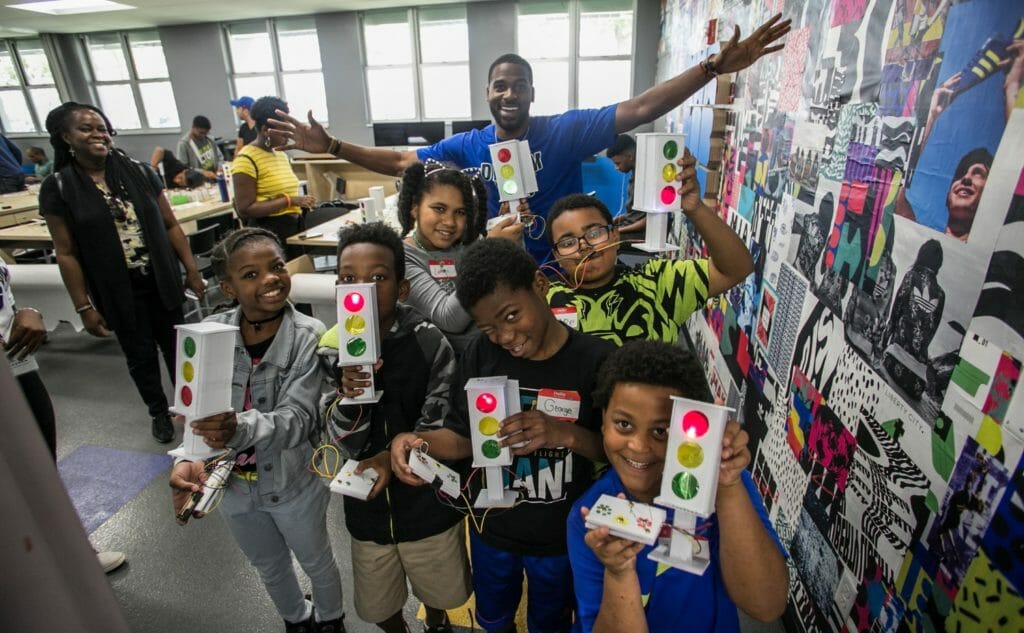
Brandon Okpolabi’s mission to reach out to underserved youth comes from a place close to his heart. The 36-year-old Miami resident was one of those kids. Born and raised in the rough and tumble Seventh Ward in New Orleans, Brandon did well in school but was full of angry energy that translated into behavior problems. He was so disruptive in school that he was kicked out of the second grade. When he was transferred to an art focused school in the French Quarter his energy was channeled into making art, t-shirt designs and eventually playing sports. Brandon knows from experience that if a child is afforded an opportunity, he or she can achieve anything. He founded Dibia DREAM in 2014 a non-profit dedicated to bringing mentorship and role modeling opportunities to young people of color and so far has helped more than 2,000 youth achieve through STEM education, scholarships, six-week STEM camp and after school programming. By partnering with other organizations, including BMe, an organization of African-American male community leaders and education focused non-profits, such as HoneyShine Inc. and Miami Dade College, Brandon has leveraged professional relationships with scholars and researchers to provide innovative projects and workshops for at risk students in Miami and his hometown of New Orleans.
Brandon is committed to making a difference in his community and he is today’s Daily Point of Light Award honoree. Points of Light spoke with him about his commitment to service.
What inspires you to volunteer?
When we provide STEM education and programming to kids who would not otherwise experience it – and they open up to possibilities, that inspires me. We might put kids in lab coats and get them dissecting in a lab – and you’ll hear somebody say they might want to be a doctor, or that they love science – that’s inspiring. After school programming from 3-6 fills up prime time for kids to get into trouble. That translates directly to affecting youth gun violence. It’s all about education and opportunity.
Describe your volunteer role with Dibia DREAM.
As founder and director of operations, I handle anything related to grants, development, accounting. As we grow, we outsource, but I oversee day to day. I’m a big visionary – my staff calls me the dream architect.
What’s been the most rewarding part of your work?
We recently partnered with the Miami Marlins and AutoNation to give a Miami single mother with three sons a 2019 Honda Odyssey, fully paid off, including taxes and title. That’s going to be a game changer for this family. Also, our after-school program in New Orleans provides kids with a full bag of food on Thursday – because a lot of kids don’t eat over the weekend. That’s rewarding.
What have you learned through your experiences as a volunteer?
I’ve learned that I don’t know everything – even though sometimes I think I do! I was raised, hard, non-empathetic, and by working in this community and with my wonderful staff, I’ve learned to be more understanding to the needs of other people. And I’ve learned that if we provide opportunities, a large percentage of the time these kids are going to be successful.
Are there any future partnerships, programs, or events that you are excited about?
We recently partnered with ATT to provide more STEM Saturdays in Miami. We’re excited to work with the Marlins and AutoNation. And our ongoing relationship with William R. Kenan Jr. Charitable Trust is helping us to really grow in Miami. In New Orleans we partner with the Hyatt Regency to provide food for the kids on the weekend.
Why do you think it’s important for others to give back?
We can’t forget where we came from. Whatever ladder we manage to climb, we have to put that ladder back so somebody else can climb too. It’s also important to use our own experience to help others not go through the same struggles we did.
What do you want people to learn from your story?
With perseverance, hard work, dedication and strong faith in God you can do anything. Never let someone tell you that you can’t do something!
Do you want to make a difference in your community like Brandon? Visit All For Good for local volunteer opportunities.
Post written by Beth D’Addono
Believing in Joy as a Fundamental Right, She Throws Birthday Parties for Children in Need
What do you do when a second grader tells you he doesn’t know his birthday? Or when that same little boy says he doesn’t even know what a birthday is?
Julia Warren was only 16-years-old when she had this heartbreaking conversation as a volunteer at a Title I elementary school in Richmond, Virginia. After she explained to the student, a little boy named Charles, what a birthday was, all he could muster for an answer was, “I think I was born when it was cold.”
“I couldn’t grasp how a child couldn’t know that,” Julia said. Coming from a family where birthdays were always a special event to be celebrated, she didn’t know what to do – but she knew she had to do something.
She went to the school’s principal to tell her what happened and ask for the school to do something for the child’s birthday. “When we have time, we’ll give them a pencil,” the school responded. She was shocked.
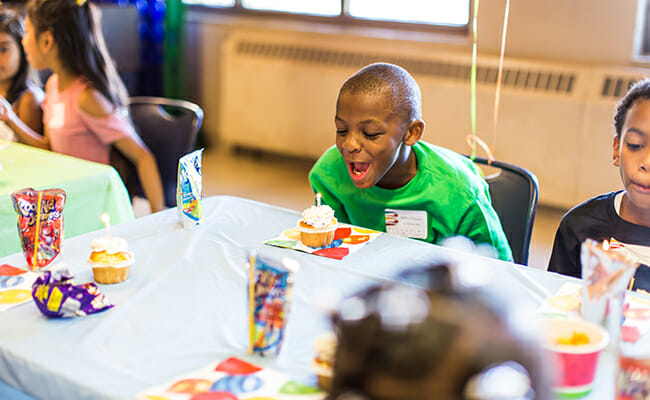
Six years later, now 22 years old, Julia is the executive director of celebrate! RVA, the nonprofit she founded to make sure disadvantaged children in Richmond are given a birthday party that makes them feel happy and special, no matter their circumstances.
Thanks to celebrate! RVA, more than 2,000 birthdays have been celebrated – some at Oak Grove Bellemeade Elementary, where her dream began, and some at other agencies in her community. From homeless shelters to children the pediatric oncology unit, celebrate! RVA has grown its mission to bring joy to children who need it most.
Halfway through her undergraduate double-major in business and economics at Randolph-Macon College, Julia met with a financial planner who could clearly see her passion for bringing love and joy to underserved children. She posed a critical question, “How important is it to you to finish college in four years?” Julia was already struggling to be a full-time student, an executive director and work multiple part-time jobs. Then she made a decision to put school on hold so she could focus on growing the impact of celebrate! RVA.
Julia has resumed her collegiate studies, this time at Virginia Commonwealth University, where she’ll double major in nonprofit management and business, and double minor in social work and child psychology.
Despite these transitions, Julia laughs at the concept of being an overachiever. She said wasn’t at all motivated in high school; she made good grades, but wasn’t really passionate about anything until that life – changing interaction with Charles.
After navigating through a difficult season of life, Julia sought help from a therapist. It was through therapy that she discovered that she’d been struggling with depression and anxiety, and had never been able to put a name to it until then. Behind those birthday parties, there was a broken person.
Having struggled with similar feelings, Julia recognizes that living in poverty can cause depression in children and she knows just how much they need joy and love. Providing that to them through birthday parties is all the motivation she needs.
“It’s a great privilege to work with these kids,” said Julia. “They have every reason to be angry, but to see them smile or blow out a candle is a great privilege. I get so much joy from doing it.”
That doesn’t mean there aren’t significant challenges. Earning the trust of the children she helps is tough until they realize she’s there for them in the long haul. No obstacle can stop Julia from her mission to bring as many birthday parties to as many children in need as possible. Celebrate! RVA is expanding across the city. The organization has recently made a commitment to a physical space, where children can experience joy and love each day through a specialized curriculum that has a focus on trauma-informed care.
“Our children were having trouble regulating joy and happiness,” said Julia. “Their brains were conditioned for trauma, so much so that they literally rejected the possibility of love. The celebrate! RVA curriculum finds ways to introduce that concept in developmentally, socially and culturally appropriate ways.”
Julia has big dreams for the organization, but also for children across the country. She continues to work towards making joy, smiles and laughter not a privilege, but a fundamental right for all.
For Julia, it comes down to one simple thing: “I get to tell a child they matter.”
Do you want to make a difference in your community like Julia? Visit All For Good for local volunteer opportunities.
On Board a Hospital Ship, a Family of Four has Dedicated Their Lives to Helping Those in Need
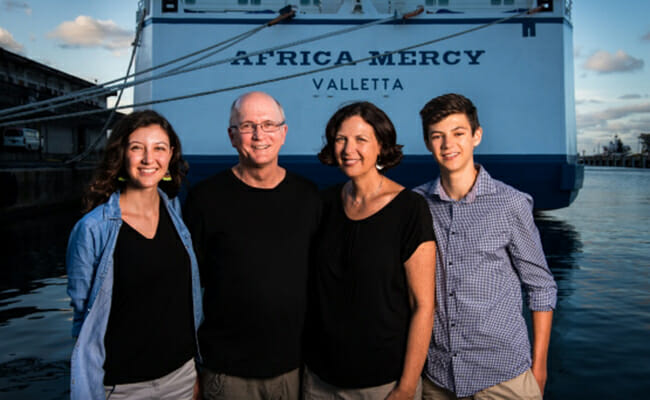
Dr. Gary Parker first volunteered aboard a Mercy Ships hospital ship thinking it would be a three-month journey. However, three months turned into 31 years, and Gary and his wife Susan, who he met on board, have devoted their lives to help those living without access to safe, timely and affordable surgical care.
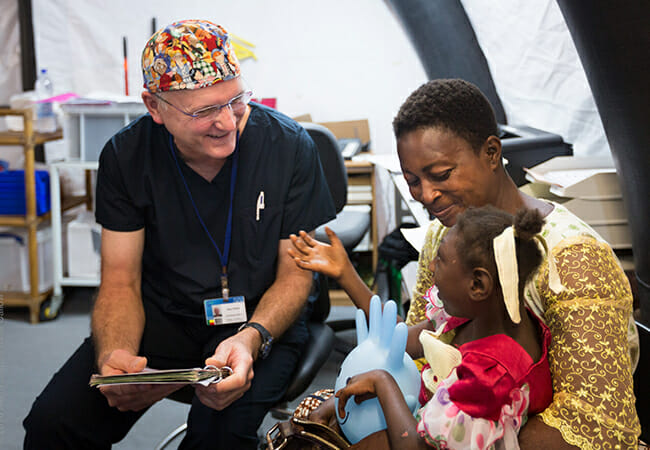
Gary, an oral and maxillofacial surgeon and chief medical officer, specializes in the treatment of tumors and other deformities of the face, head and neck – giving his African patients a second chance at life.
“I walked into the waiting room full of men, women and children all with advanced pathology that I had only seen in textbooks,” Gary said, recalling the first time he walked into a local hospital. “It was overwhelming to look into the eyes of a 30-year-old woman with an un-treated cleft lip that should have been repaired when she was three months old and feel her lifetime of shame and embarrassment that didn’t need to happen.”
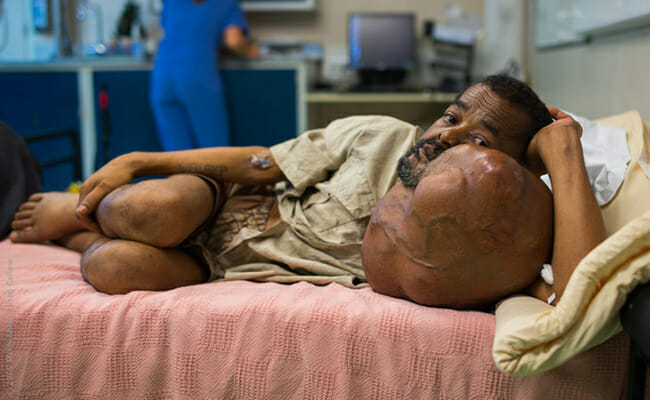
Sambany, a man from a remote village in Madagascar, is just one of the thousands of patients Gary has treated. With a 16-pound tumor weighing heavily on Sambany’s face and neck, he was unable to do anything except wake, eat and sleep in a mundane cycle.
“I could not do anything,” Sambany said, in a Mercy Ships blog post.“I was just waiting to die.”
One day, he received word that the Africa Mercy was sailing towards Madagascar and would be treating patients for free.
Seeing his desperation, his family sold a rice field to pay for his travel. Five people took turns carrying Sambany on their backs for two days to get him to the closest road. After a grueling six-hour ride in a bush-taxi, Sambany finally made it to Africa Mercy.
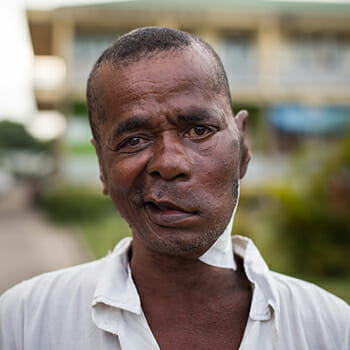
Dr. Gary Parker and his team operated on Sambany for more than 12 hours. When Sambany looked at himself in a mirror for the first time without his tumor, he said, “I like it. I am happy,” and later added, “I am free from my disease. I’ve got a new face. I am saved!”
Living on a ship with 400 crew from more than 35 nations has its challenges. As children, Carys and Wesley sometimes thought life in America might be more interesting or exciting, but their commitment to those who didn’t have the privileges they had helped them to persevere.
“I have a deep conviction that everyone deserves a seat at the table of the human race,” Gary said. “You need to be able to say to Koffi, ‘You’re three years old. Your face is deformed’ or ‘Hawa with your big tumor’ or ‘Fatimata with terrible burn scars that make it not possible to move your arms, legs or neck, you’re still a member of the human race. We honor you. We recognize you and we want you to have a seat at the table.’”
Susan Parker, who first boarded the ship when she was 25, has filled several key roles over the years, most recently as senior chaplain to the crew.
It’s no doubt that the Parker family and the rest of the Mercy Ships crew are changing the lives of their patients, but Susan said the patients have had an impact on her life as well.
“I can sometimes become preoccupied with situations in my life that aren’t going the way I’d like them to, or something I miss back in the States,” Susan said. “And yet when I take the time to walk down those three flights of stairs to the hospital ward and I see the conditions people are suffering with and I spend time talking to them and they’re smiling and thankful … I’m reminded about what’s really important in life and that happiness truly is an inside job. I’ve been given a gift by living here – it’s developed in me a lifestyle of gratitude.”
Carys, 24, and Wesley, 20, grew up on the ship and graduated from its school, the Mercy Ships Academy. Wesley is currently studying health sciences at Whitworth University and Carys, who graduated from Whitworth, returned to the ship last year as a crew chaplain. She is now back in the United States and working on her master’s degree at Fuller Seminary.
“Once you’ve been on the ship, once you’ve seen the transformation of the patients and the unity of this crew, it’s kind of addicting,” Carys said. “[I knew] that I wouldn’t be content until I got to come back full circle as an adult and give back to the community who helped shape me into who I am.”
Susan wants people to know that they’re no different than any other family.
“We’re not special. We’re not super humans,” Susan said. “We’re just normal people who have taken that step to use the skills we have to benefit others. We just happen to live on a Mercy Ship in Africa, but kindness is free and everyone has the opportunity to give it away no matter who or where they are.”
“We all have something to give whether it’s our time, our finances or our skills,” Susan continued. “When everyone does their little part, we’re going to see our world repaired.”
The Parkers and the rest of the Mercy Ships volunteers are able to live and work without salary because they are sponsored by generous donors. Those interested in supporting Mercy Ships can volunteer, donate or sponsor a crew member. For more information, visit mercyships.org.
Do you want to make a difference in your community? Visit All For Good for local volunteer opportunities.
Teaching At-Risk Youth to Make Every Move Count, with Chess Skills and Life Lessons
In a game where one wrong move can risk your path to victory, Orrin “Checkmate” Hudson encourages young adults and children to not focus on the chess pieces they have lost, but rather on what’s left on the board – and to never give up.
Preaching the power of thinking strategically and making better life decisions, Orrin, a 55-year-old from Stone Mountain, Georgia, teaches his students the game of chess through what he calls the six magic words: “Take time to think things through.” These words have connected Orrin with more than 55,000 children in 30 states nationwide and internationally, including trips to the Philippines, India and Canada.
Orrin has an intimate understanding of the real life adversity some of these children face because he was once one of them. His life experience has led him to commit to serving those most in need of guidance and support.
As a teen in Birmingham, Alabama, in the late 1970s, Orrin was in and out of foster homes. He vividly recalls running with a gang at the young age of 14.
Struggling through turbulent times in the deep south, a dedicated teacher named James Edge, a white man in an all-black school, helped Orrin turn his life around by teaching him to become a master chess player. Years earlier, Orrin’s brother had introduced the game to him, but it was James who fostered his passion for the game and taught him how to win – both at chess and life.
“I owe my life to James. He bought me a chess book, taught me chess,” said Orrin. “He took the time and believed in me, before my belief in myself kicked in.”
By using chess to teach him that each action has a consequence, James refocused Orrin’s life. By his senior year of high school, Orrin had moved from being an at-risk teen to being voted “Most Likely to Succeed.” In 1999, Orrin became the first African-American to win the Birmingham city chess championships, and has been a finalist in other major chess tournaments.
A former Alabama state trooper and Air Force veteran, Orrin said giving back to the community has been important to him for some time. But his outlook on how exactly he could contribute changed one day while watching the news. On May 24, 2000, five Wendy’s employees were killed in an armed robbery in New York, with $2,400 stolen from the cash register.
Distraught over the senseless crime, he founded Be Someone, a 501(c)(3) nonprofit foundation, with the goal to transfer his life lessons through the mastery of chess and break the cycle of crime and violence. Today, Orrin lectures on “brains before bullets,” and provides free workshops in schools and churches. His sole mission is to help troubled youth, just as his teacher once helped him.
“A lady called me at 1:30 a.m., and asked if I could help her son,” Orrin recalled. “When asked why I’d answer the phone in the middle of the night, I said ‘a full-time soldier sleeps with his boots on.’”
As a full-time volunteer, Orrin has touched many lives. Dontavious Jones is one. The 26-year-old Atlanta native said he first met Orrin as a fourth grader in the library at Benteen Elementary. Chess wasn’t the only thing he learned that day.
“What he taught us was not just chess,” Dontavious said. “He taught us key fundamental building blocks for life – realizing that every action that you take has an equal and opposite reaction, so you have to be careful and you have to think everything through.”
Orrin uses presentations centered on the strategies of chess as a metaphor for the game of life, teaching his at-risk youth how to think strategically and instilling skills such as focus, discipline and patience that are important in the game – and even more critical on the streets.
“A lot of those fundamental building blocks still guide my life to this day; I’m very diligent, very hard working, and I think through every situation,” Dontavious said. “I try to find the best solution. I use problem-solving and critical and analytical thinking in my everyday life. More than likely, that wouldn’t be to the extent with which I do it now if it wasn’t for the game of chess.”
Dontavious, who has a young son of his own, said Orrin was like a father to him.
“He had nothing but good expectations for you, and your future. He was always there to help and to motivate you. He was always positive, always upbeat and he’d find a lesson out of everything in life. He’s just all-around a great guy,” Dontavious said. “Giving back to the community in the way that he did, I appreciate it every day.”
Orrin’s motto, “It takes teamwork to make the dream work,” drives his daily work. “I get a kick out of helping people. I have no hidden agenda. My agenda is to help you win, period,” he said. “It’s not about me, it’s about we.”
How you can help: visit BeSomeone.org to help support at-risk youth around the country.
Retired Navy Officer Builds Volunteer-Led Program to Tackle Childhood Hunger in Her Community, and Beyond
When confronted with big societal problems, like hunger, it is easy to feel overwhelmed. Aside from sending a donation to a local nonprofit, or volunteering at a local soup kitchen – we often feel that, as just one person, we can’t possibly do enough to make a difference. But when Claire Bloom, a retired Navy lieutenant commander, was confronted with the issue of childhood hunger in her own community of Rochester, New Hampshire, she knew she had to take action.
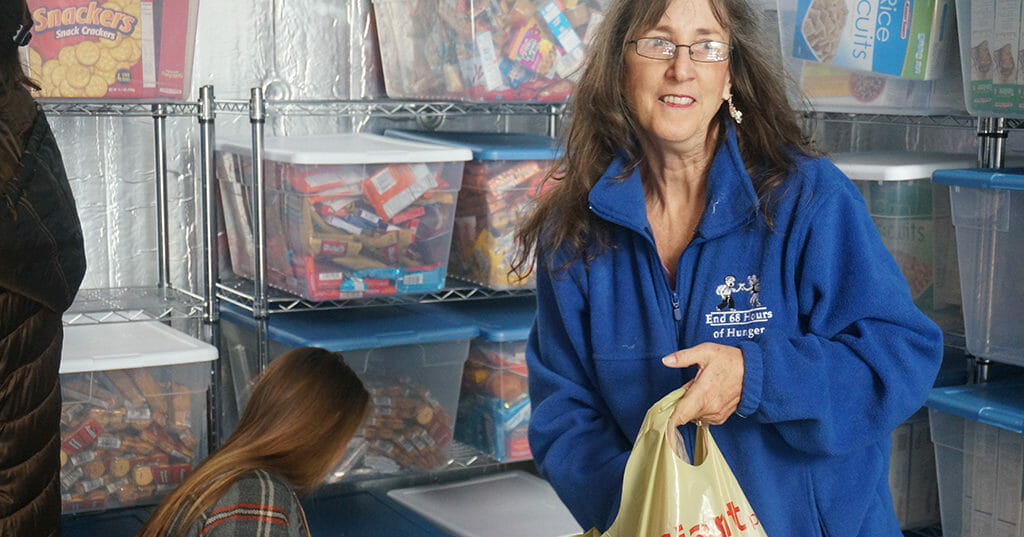
At a book club meeting in 2010, a teacher friend mentioned to Claire that many children in her district had little or nothing to eat for the 68 hours between their free school lunch on Fridays and free school breakfast on Mondays. Claire was shocked that any child in a tight-knit New Hampshire community could be hungry all weekend, and she had many questions. After a sleepless night, she called school officials, who confirmed that there were 73 district families in this situation.
“All I could think was I can’t know that these hungry children are out there and do nothing about it,” said Claire, who immediately started figuring out how she could arrange to send food home with children to carry them through the weekend.
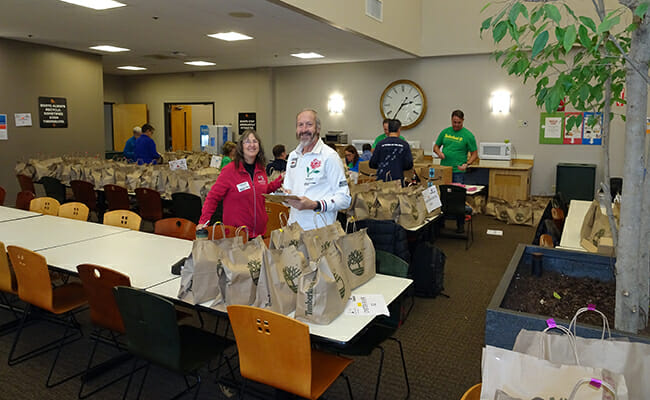
Over the course of the next year, Claire put everything in place. She acquired permissions, food donations and storage locations, and set up a nonprofit organization and a network of volunteers. On a Friday afternoon in October 2011, 19 students in Dover went home with a backpack full of donated food, and End 68 Hours of Hunger was born.
The system is simple. Volunteers pack backpacks with donated and purchased food, and deliver them to schools where staff members distribute them to children. At higher grades, where receiving donated food may carry a stigma, participating students can simply stop by a school nurse’s office to pick up food little by little through the week. Each weekly bag contains two breakfasts, two lunches and three dinners for a child, plus some food to share. Students return the empty backpacks to school on Mondays, volunteers pick them up, and the cycle begins again.
Claire and her volunteers never interact directly with the children, but she said she feels elated and invigorated over the positive feedback from schools – and “just astounded” by what’s transpired over the past five years. “It never occurred to me when I first started that we’d see such explosive growth.”
Her organization now sends more than 3,200 children home with food each weekend through 46 programs across seven states. More programs are being organized around the country, sparked in part by a short NBC Nightly News report in March 2014 about Claire’s efforts.
The wife, mother of four and proud grandmother, who was raised by two Army parents and earned master’s degrees in educational leadership and strategic intelligence, said she is humbled because she has simply laid the groundwork for a huge corps of volunteers. She describes herself as a “one-step-in-front-of-the-other” person who is not a visionary, but is well organized and detail-oriented.
Jeni Mosca, superintendent for SAU 56, which includes about 2,000 students from Somersworth and Rollinsford, New Hampshire, said End 68 Hours of Hunger has had a phenomenal impact on her district, allowing “so many grateful kids to come to school on Monday mornings energetic instead of lethargic and hungry.”
“Claire’s just the most giving woman. She’s been able to change lives,” said Jeni, who serves on the End 68 Hours of Hunger board. “She’s absolutely shown the world that one person can do great things.”
Board member Rob Eberle, CEO of global software company Bottomline Technologies, organized a donation of $68,000 from his company’s executive team to create a fund ensuring the longevity of End 68 Hours of Hunger. Claire also credits Rob with helping her to see the potential bigger picture for her initiative.
“It’s so straightforward and pure in its impact,” said Rob. “What impresses me most is that 100 percent goes to food for the kids, and everything is done by volunteers. Claire is addressing the problem of hunger in a very direct way that inspires others. It’ll be interesting to see how far this can grow.”
At the board’s urging, Claire created a detailed operations manual that lays out how to replicate the program elsewhere, as well as training videos that are available online.
“I don’t care if people follow this exactly. If someone can do what we’re doing a different way, I’m totally cool with that,” said Claire. “All I care about is that kids get fed.”
She Found a Way to Increase Access to STEM Education
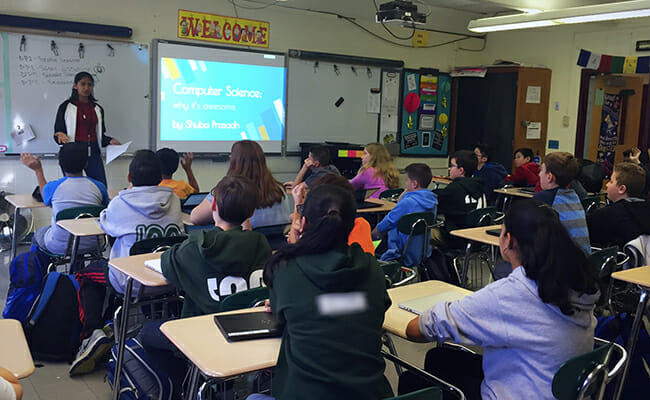
Shuba Prasadh says her story has a simple start: a mediocre computer science class in middle school. The class was “not as cool as it should have been,” said the 16-year-old – who is now the CEO of an international nonprofit organization that advances STEM education for youth.
Inspired by that un-inspiring class, Shuba had an idea – to find a way to increase access to STEM education and to help kids use the skills they learned for social impact. She founded STEMFuture to help ensure everyone has access to basic STEM knowledge in order to navigate today’s technology-filled world. With international reach, the organization’s mission is to make the future of STEM innovative, safe, diverse and impactful through education, events and online curriculum.
Now a high school junior, Shuba is combining her passion for STEM with a desire to make a positive social impact. We spoke with Shuba to learn more about her work with STEMFuture, and what motivates her to serve.
What inspires you to volunteer?
My desire to help solve the problems around me is the core reason for volunteering, and applying that service. I’ve been serving for as long as I can remember. It creates a positive difference in people’s lives, and the magnitude of that impact can be significant.
Describe the impact STEM has had on your life, and your reasons for sharing this passion:
STEM, especially computer science, has given me a really unique confidence in myself and my abilities. Especially being a woman in STEM, a minority group in the discipline, I am really proud of the progress that I have made on my STEM journey. This progress shows me that I can truly do anything that I put my mind to, all I need is determination and passion. I was shocked to learn that not everyone has access to STEM educations, and I wanted to help fellow youth who might not have that opportunity.
Describe your volunteer role with STEMFuture.
It started with a big idea. I just wanted to help kids gain more STEM skills and use them for social impact. I started teaching workshops at local elementary and middle schools. Once we got traction, I condensed all my curriculum and put it into an online platform, which we currently offer to anyone who is interested. I’ve formed partnerships with the Girl Scouts, Boys and Girls Clubs, CSforALL, the STEM Education Coalition and the Congressional App Challenge. Through our partnership with the Congressional App Challenge, we help promote their incredible mission of encouraging youth to learn to code, through the creation of their own apps, and inspiring them to pursue careers in computer science. In turn, they help promote STEMFuture’s mission and resources to their youth participants.
What’s your life motto?
“For youth, by youth.” To expand the reach of STEMFuture, I established national student chapters, and we now have five chapters across the country. Each chapter is made up of high school students who host workshops locally and share our curriculum. If youth are interested in applying and creating a STEMFuture chapter in their community, they can do so by visiting our website.
Why do you think it’s important for others to give back?
Because of another motto I live my life by: follow your passion. If you do, you’ll do your work better and when you do it better, the people you’re impacting are so much more positive and in turn, you’re happier. Especially considering my peers. It sometimes seems like our personal problems are our whole world; we can give so much importance to negative things in our lives. Service is a way to change your perspective and see that there are people in need.
What’s been the most rewarding part of your work?
I was teaching a basics of computer science class at a local elementary school and we did a coding project at end. One of the young girls in the workshop told me at the end of the class, “You just gave me a new idea of what I want to be when I grow up!” It made my year.
What future events do you have coming up that you’re excited about?
We are doing a series of workshops during December’s “Hour of Code” computer science education week. You can learn more about our events that week on our website.
Do you want to make a difference in your community like Shuba Prasadh? Visit All For Good for local volunteer opportunities.
Written by Marlena Militana.
Paying it Forward: Refugee Physician Invests in Youth, Giving Back to a Community That Invested in Him
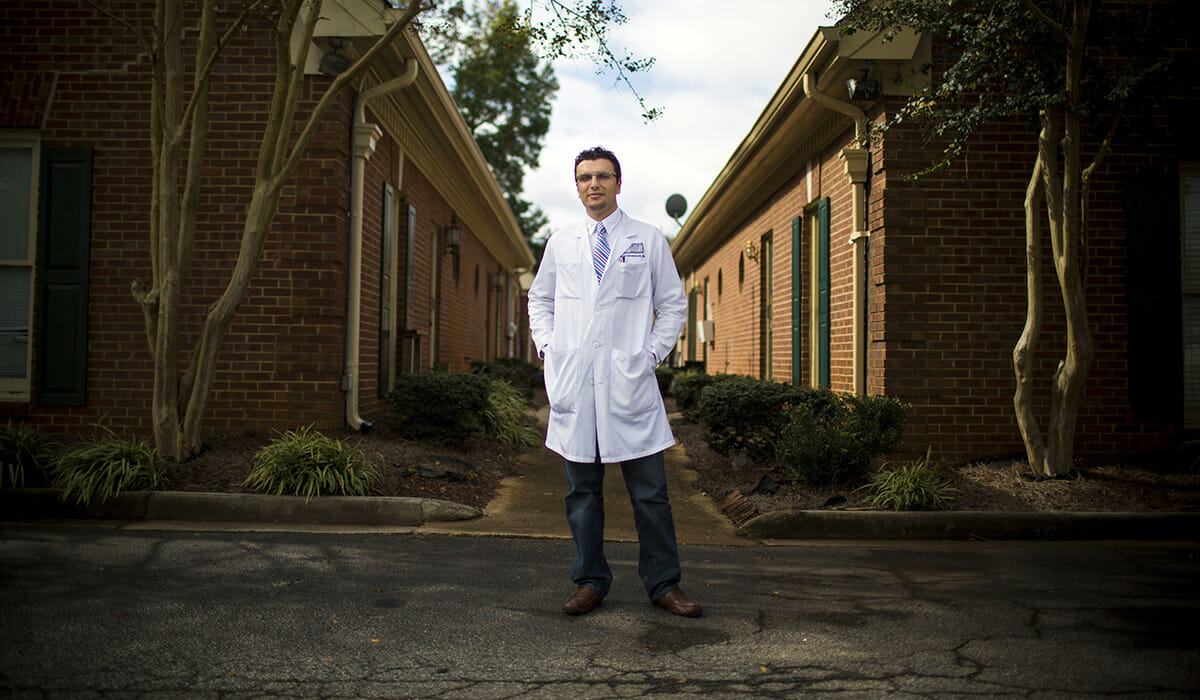
Having gone from dishwasher to cardiology fellow, Dr. Heval Kelli created the Young Physicians Initiative to ensure other young aspiring doctors can find the support and guidance he received in his youth. /Credit: Emory University
Heval Kelli’s family arrived in Clarkston, Georgia, on Sept. 25, 2001 – just two weeks after the devastating 9/11 terror attacks forever changed the United States, and the world. Newly arrived refugees from Syria, the Kelli family was weary but optimistic about their future.
Having grown up in a happy, middle-class home in Aleppo, Heval’s world had been turned upside down at age 11 when his family, in fear for their safety, fled the country. They spent the next six years in Germany on asylum status, which meant that his parents could not work and although Heval excelled in school, he could not attend college. But in America, they believed their dreams could come true.
In those first days after the Kelli family arrived in Georgia, the mood of the country was tense – especially for the Muslim community. The Kellis didn’t leave their home for those first few days, until there came an unexpected knock at the door.
“I thought, at first, it was the CIA or FBI coming to get us,” Heval recalled. Instead, the Kellis found that members of the All Saints Episcopal Church had come to welcome them to their new home. They brought new clothes and furniture, and shared a meal with the family.
“It made me feel, for the first time since we left Syria, that I belonged somewhere. That I was welcome,” said Heval.
The family faced a new set of challenges in their new country. Heval’s father had heart disease and could no longer work. His mother, who did not speak English, struggled to find a job. At just 18 years old, it was up to Heval to not only finish school, but also to support his family.
He began working as a dishwasher at a Mediterranean restaurant, balancing a 40-hour work week with his full-time school schedule. He made a deal with himself that for every dish he washed, he would read one page. If he washed four hundred dishes that week, he read four hundred pages. Using this method, he quickly learned English, finished and high school and got accepted to Georgia State University – all within 10 months of coming to America as a refugee.
“Failure was not an option,” he said. “If I failed, my entire family failed.”
His determination did not go unnoticed. When Dr. Omar Lattouf heard about Heval and his desire to go to medical school, he reached out.
“I felt that someone who has such determination to never take no for an answer and to work so diligently deserves that chance,” said Dr. Lattouf, who mentored Heval throughout college and medical school.
“Mentoring him lead to great value,” he said. “That investment in him brought tremendous societal return.”
Heval is now a cardiology fellow at Emory University, just one block away from the restaurant where he spent all of those hours washing dishes.
“People like to say, you went from a dishwasher to a doctor and achieved the American Dream. And I have to correct them,” Heval said. “I didn’t achieve the American Dream – all of the people who helped me, who helped my family, did. I achieved my dream of going from dishwasher to doctor, but what makes it the American Dream is the ability to re-create the same opportunities for everyone else.”
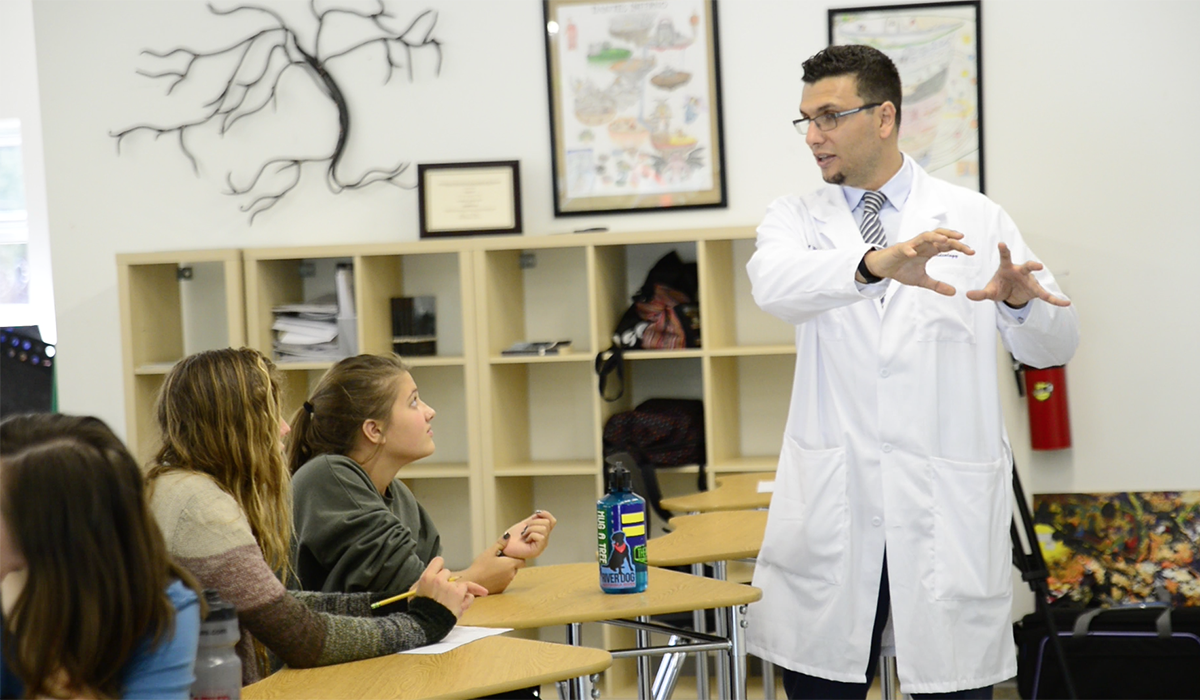
The Young Physicians Initiative provides an engaging mentorship experience to prepare high school and undergraduate students for a future in medicine. /Credit: Savannah Pratt
Dr. Lattouf’s commitment and mentorship really stuck with Heval. It lead him to start the Young Physicians Initiative, a “pre-medical” mentorship program that inspires and guides students with dreams of a career in the medical field – kids just like Heval. Through after-school programming, the organization teaches high school and undergraduate students – most of whom are also refugees – about what it’s like to practice medicine and what it takes to become a doctor.
“I don’t want to be the exception. I want to be the person to inspire other kids and provide ways for them to be like me some day, and better,” said Heval. “The whole goal of this is that these minority or low-income students have someone come to their home and say, you could be like me and here is how you do it. It’s based on the concept of being present in the community and providing role models.”
In addition to YPI, Heval created the Mentoring Initiative for New Americans, which helps young refugees and immigrants pursue admission to college and medical school. He also mentors medical students, who in turn help run the Young Physicians Initiative. Through his efforts, he has built a model that fosters a community of givers. By investing invests in these students, as Dr. Lattouf invest in him, he teaches them the value of investing in others.
“Anyone I help, the rule is down the road you must invest in two other people who reach out to you for help,” he said.
Hasib Amir is one such example. The 22-year-old came to America from Afghanistan three years ago, and is already paying his investment forward.
“Dr. Kelli motivated me to work hard for my dream and never give up. He is my inspiration,” said Hasib, who is now in college with dreams of medical school. He works with Heval to help other young refugees find their path to higher education.
Heval also invests back into the community that first took him in, by volunteering his medical services for free at the Clarkston Community Health Center.
“I think it’s very important for people to understand we all have the power to make a difference in someone’s life,” he said. “When I have a weekend off, I go to the clinic for a few hours. Even these few hours a month makes a huge difference. In four hours I can see twenty patients.”
Heval believes that his success story as a Syrian refugee can be a teaching tool on its own.
“I’m a heart doctor, and I take care of you and your family,” he said. “The reason I am here is because of this great country. You invested in me. I am investing back into the community. So when you look at a refugee, maybe you can see them as an opportunity for success; an investment in our country.”
Want to make a difference in your community? Visit www.allforgood.org to find local opportunities to get involved.
These Women Run Obstacle Courses to Help Children Facing Health Obstacles
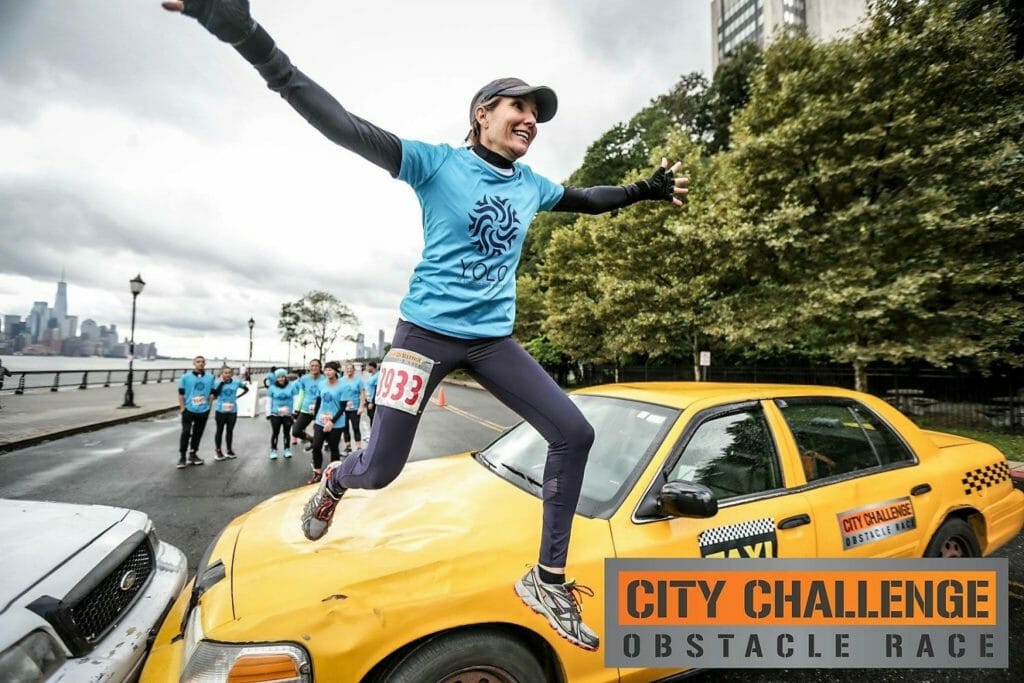
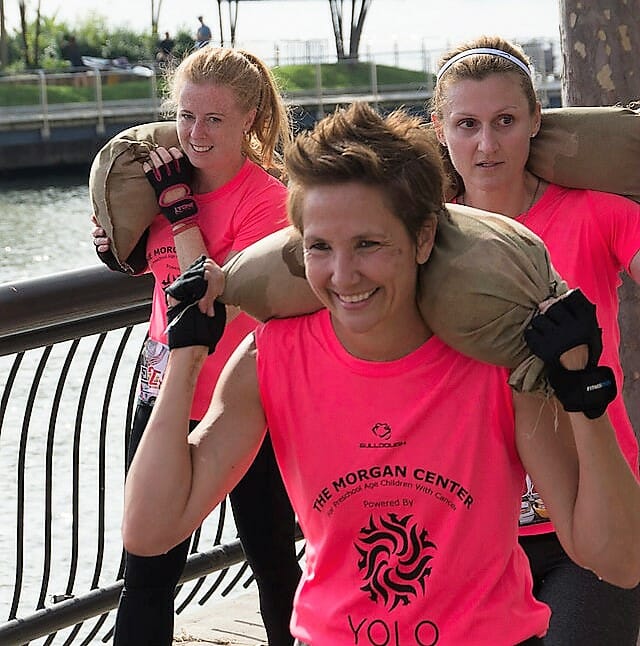
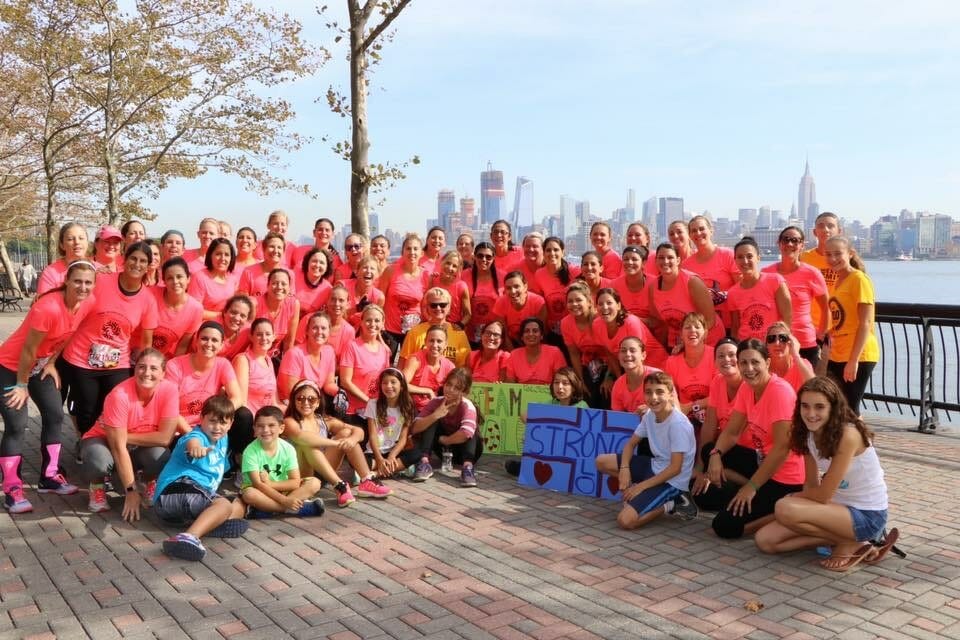
At the YOLO Strong Foundation, participants don’t simply walk or run to raise money for good causes. They climb over walls, dangle from ropes, carry other runners on their shoulders and surmount other challenging obstacles as they race. The money they raise goes to help young children with cancer attend school in a special setting that protects them from germs, and for other children with autism and other disabilities to receive tablets and other adaptive equipment. When Danielle Taylor, a busy mom and marketing businesswoman, wanted to do something to help others, she hardly chose an easy path to do it. But in just a few years, she’s persuaded more than 200 other women to join her.
What inspires you to volunteer?
“It’s simple. Because we’re lucky. We all have healthy children. Our families have not had to deal with the death of one of our children. I feel like it’s our obligation to give back to families who are not as lucky as we are. The only difference between us and them is luck. At any time, God forbid, this could be us or our families or our children and I just hope there would be families out there who would help us.”
“I started out with two friends, so there were just the three of us. I did research to find charities to help. I found out about the Morgan Center, (in Hicksville, N.Y.) which is the only preschool in the U.S. for children who are undergoing chemotherapy. Our support helps kids pay for tuition and is now helping the school with its plans to open up additional locations. We also help Danny’s Wish, where our donations have helped provide iPads to underprivileged children with autism to communicate with their loved ones. We also help Contractors for Kids, which assists families who are going through a difficult time due to the illness of a child; and Angela’s House, which provides help for medically fragile children.
How has YOLO Strong Foundation grown?
“We started with three of us six years ago. We did an obstacle course race and we set a goal of raising about $500. We ended up raising over $3,000. The next year we had 8 girls and we raised over $9,000; the year after that, we had 18 and we raised 19,000. Last year, we had 72 and raised 107,000. This year, we just finished our second race and to date, we’ve raised $65,000. We had 220 participants.”
What’s been the most rewarding part of your work?
“To look around and see all of these people who have come to help families that they don’t personally know. There’s so much ugliness and talk of what’s wrong with our society, but I think there is more good than bad. Our runners feel better off for doing the right thing. They almost immediately sign up for the next one. The second thing is that I never thought about the impact we’d have on our own children. We actually now have children who have asked to do a race, to compete also. We have children who are holding up signs and handing out water bottles. As a parent, we’re always telling our children to help out and make the right choices, but it’s a whole different thing when they see us doing it. When they see their moms out there, jumping over walls, jumping over fire, climbing up ropes, carrying sandbags, it really impacts them and they’re starting to want to be part of the movement also.”
How do you find women to participate?
“A lot of it is through social media. We’ve gone on local talk shows to raise awareness. We’ve been in the newspaper a couple of times. We’ve been on the radio. A past manager of the New York Yankees spoke about us at a press conference. We’ve been invited to be a part of Dr. Oz’s studio audience, so we’re hoping get up and speak with him on the show about what we’re trying to do here. It can be daunting to get people to compete in an obstacle course race, but we provide training sessions for them to help get them get up to speed and then we help each other get through it.”
What have you learned through your experiences as a volunteer?
“That nothing is off limits. We talk and come up with ideas and we say, ‘Can you imagine if we did this?’ We’ve actually accomplished the ‘what if!’ ”
Are there any new partnerships, programs, or events that you are excited about?
“Our dream was always to catch the attention of a company called Spartan. They predominantly help military families and veterans. I really wanted to have our team compete in a Spartan race and become one of their charity partners. They are probably one of the most well-respected obstacle race companies out there. I’m honored to say they contacted us and asked us to become the charity partner for their first Long Island race, which we just did a few weeks ago.”
Why do you think it’s important for others to give back?
“We’re all busy and we’re all ‘time poor.’ We all have our own families and we’re trying to the best for our families. But I strongly believe that we should put ourselves in these people’s positions and think about medical bills and what it means to potentially cut your income in half to have to be there to physically take care of your children or take them to treatment. If we can help impact these families, we’ve done a good job.”
Do you want to make a difference like Danielle? Visit All for Good for local volunteer opportunities.