Passion for Political Activism Leads Teen to Volunteer Across Orange County
Meet Daily Point of Light Award honoree Jasmine Nguyen. Read her story and nominate an outstanding volunteer or family as a Daily Point of Light.
Jasmine discovered her interest in political activism when she entered high school, leading her to start her own chapter of a student-based political organization and run her school’s first voter registration drive. Now an incoming freshman at Stanford University, Jasmine has focused her political passion in three organizations: Orange County Congregation Community Organization [OCCCO], VietRISE and This Is Zero Hour. Through volunteering for these organizations, Jasmine is not only advocating for issues such as climate change and undocumented immigrants’ rights, but also working toward creating a more politically-aware community throughout Orange County, California.
Describe your volunteer roles.
I work with OCCCO, VietRISE and This Is Zero Hour, all of which are political organizations. I would say I do most work with OCCCO. I will come in as a youth representative to their various meetings with city council members and try to push for more youth funding, for internship programs and other things in Anaheim for youths specifically. I also go in for phone banking. It’s nonpartisan so we phone bank and tell people when their upcoming elections and where their nearest voting station is, where they can go vote relevant to their location. I would say my primary organization at the moment is OCCCO.
For VietRISE, I’ve attended a couple of their community-type events. For instance, about two or three weeks ago, I went to a town hall with [U.S. Representative] Katie Porter … We basically went to talk to them about their current policies on undocumented immigrants in Orange County and specifically Katie Porter and her stance. I did some work with them there and I also attend their community events where basically they all get together to discuss their experiences as Vietnamese Americans in Orange County.
For This Is Zero Hour, I’m on the partnership team as one of the partnership members so I contact various organizations and ask them to partner with us. We really recently had our Miami summit on July 10-12, which was basically where a bunch of youth were able to organize in Miami and go over how to be more environmentally aware and take climate action. I wasn’t able to go to that event but I did help with the organization of it because I was the representative for about seven or eight partners. I would basically coordinate with them to come speak at the summit or come table at the summit or even to put their organization on our official website as a partner.
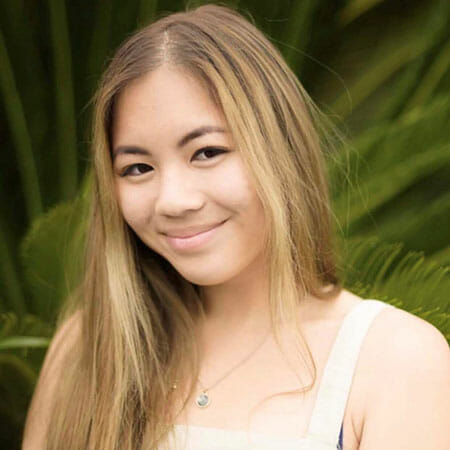
Jasmine volunteers for three different political organizations in her Orange County, CA community./Courtesy Jasmine Nguyen
Why were you interested in volunteering for these types of politically-active organizations?
I’m really interested in political science and I consider myself to be somewhat of an activist in my community. I have a pretty big focus on undocumented immigrants rights, women’s rights and healthcare issues, so those are all things that are something I feel like I’m very interested in. I wanted to get more involved in my community and fight for those issues.
Why do you think these issues and these specific organizations are important?
They’re incredibly important. People tend to not be interested in issues that don’t directly effect them, but I feel like there are so many issues out there. There are so many problems that are just waiting to be solved. Especially with This Is Zero Hour, it has a focus on climate action and climate awareness and global warming which I don’t think is given enough attention to. In regards to OCCCO, they specifically focus on undocumented immigrants and their rights. Even though I myself am a legal citizen, I have a lot of friends who are undocumented and I feel like to ignore that — it’s just something that if I have the power to fix something, I should be able to put myself out there and try to fight for it. That’s why I think these organizations are especially important, just because they’re making people aware of the fact that there are these issues out there, and people do have the ability to make change and — not necessarily fix [the issues], but try to push for them. That’s why I’m pretty involved with these organizations in particular.
When did you start getting involved in politically active organizations? Was there anything in particular that inspired you?
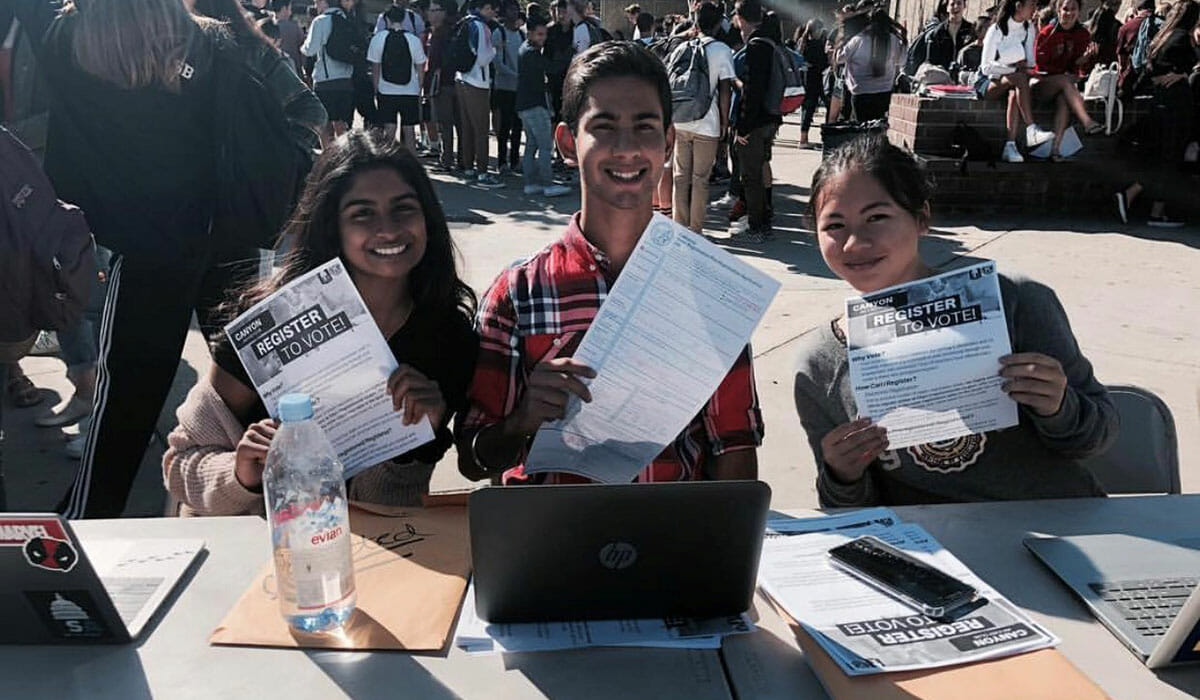
I used to have this one teacher when I was in my freshman year of high school and she was incredibly politically active. She would talk to us a lot and just have general discussions about the political climate. After that, I did join the Junior State of America, which is a political organization. I actually started a chapter of it at my school where we would have bipartisan discussions and debates throughout the campus. At my school, it was super half and half — I would say it was half conservative, half liberal. So it made it a really good place for debates to happen because we didn’t really have a lean in a specific direction. That was a really big thing, and I actually led the first voting drive at my school, where we registered about 185 students to vote.
Jasmine, right, holds her high school’s first-ever voter registration drive./Courtesy Jasmine Nguyen
What’s been the most rewarding part of your work?
Definitely seeing the outcomes. Specifically for OCCCO for instance, we went through this huge campaign where we were talking to folks from all over Orange County about their current beliefs on undocumented immigrants and why they felt that way. We actually found we could sway people to be more in favor of undocumented immigrants having certain rights, I guess being less inclined toward deportation, so more toward an undocumented immigrant-friendly stance. We found that it actually had a fair impact and it was something we could sway about eight percentage points in elections. I went to a conference at the California Immigration Center in L.A., we had a mini conference on it, and I thought it was really cool to see that it had actual results.
For This Is Zero Hour, the summit went really well. I think 150 trees were planted at the summit, because I helped coordinate with this one organization that helped with the tree planting. That was really cool to be involved, after all the hard work, seeing some results. It’s a really fulfilling thing to see.
What have you learned through your experiences as a volunteer?
A lot of the work I do has to do with having conversations with people I wouldn’t necessarily talk to. I think just having an open mind and learning from other people and understanding where they’re coming from rather than being close minded at the start. Especially understanding that everyone has a sort of connection with each other and I think open conversations with other people are a really good way to learn more about each other.
Turning Passion into Purpose, Texas Family Quilts to Give Children the Gift of Warmth
Meet Daily Point of Light Award honorees Charles Gilreath and June Goza. Read their story and nominate an outstanding volunteer or family as a Daily Point of Light.
When Charles Gilreath retired from his career as a university librarian, his wife, Ann, encouraged him to follow in his mother’s footsteps and quilt. His mother, known as Grandma June, has sewn for as long as she can remember, but in 2012, she began to lose her sight and could no longer accurately cut the pieces of fabric needed for quilt making. Charles took on that responsibility and shortly after he began assisting his mother, he started to cut fabric pieces for himself. Before he knew it, they were quilting together as a family.
That winter, the family met the dynamic duo (and Daily Point of Light honorees!) Harper and Maggie Cunningham, and their quilting hobby found a new purpose. At 10 and 12 years old, Harper and Maggie started Books and a Blanket to promote childhood literacy and well-being in their Brazos County, Texas, community by giving a collection of books and a warm blanket to children in need before the winter school break.
Harper and Maggie had set up a stand at the church’s alternative gift fair, which offered the community an opportunity to give Christmas gifts to people in need. The sisters were initially interested in gathering fleece blankets to add to their book collection, but when Charles showed them the quilts his family had made, they formed an impactful partnership. Inspired by Harper and Maggie, Charles and June turned their home into a quilt factory, and now donate 200-300 quilts to Books and a Blanket each year. The family has made thousands of quilts for the Cunninghams, and recruit others to join in on the creation of special, long-lasting gifts of warmth for children in the Brazos County community.
“We can’t solve all of the problems of the world, but we can help keep a kid warm in the winter with what we create,” said Charles. “And we can help do this by supporting Harper and Maggie, which is a true gift.”
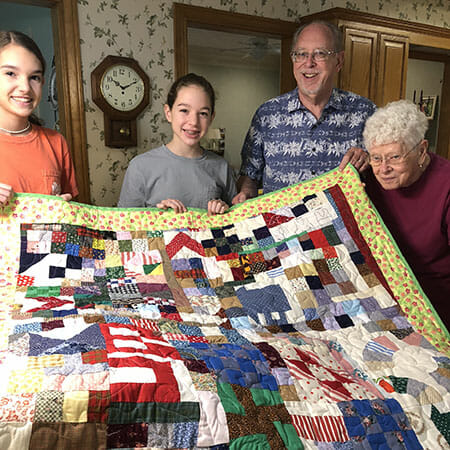
With Harper and Maggie Cunningham, Charles Gilreath and Grandma June display a quilt made for Books and a Blanket.
As a family, Charles and June host monthly quilt-making events for the community and members of the Brazos Bluebonnet Quilt Guild, where pre-cut fabric is displayed and pattern designs are prepared. People come to socialize and quilt, and their works of art are donated to Books and a Blanket once they are complete.
As a member of the quilt guild himself, Charles says that members are inspired by the impact of Books and a Blanket, and individually contribute to the organization after attending monthly quilt-making events.
“I’m so glad to know that what we’re doing is helping the kids in the area, and that it’s contagious,” Charles said.
It’s fun to have a creative outlet that produces something that’s useful to others, Charles says. With an infinite variety of patterns and design challenges, quilting quickly became an integral part of the family’s daily activities. Once the community knew that the family was creating quilts for Maggie and Harper, Charles has had no shortage in fabric donations. He says the experience has reinforced a sense of community, and it’s incredibly satisfying to see everyone wanting to contribute to a good cause.
Working as a team, the Gilreath family has been an important part of the Cunningham sisters’ success in distributing thousands of blankets and more than 103,820 books to 12,355 children, and they remain passionate about the cause. When Ann passed away in 2018, the family requested donations be made to Books in a Blanket in her name.
“You don’t have to do anything heroic to do good,” said Charles.
Teenager Starts Volunteer Project to Promote Childhood Literacy
Meet Daily Point of Light Award honoree Alexa Grabelle. Read her story and nominate an outstanding volunteer or family as a Daily Point of Light.
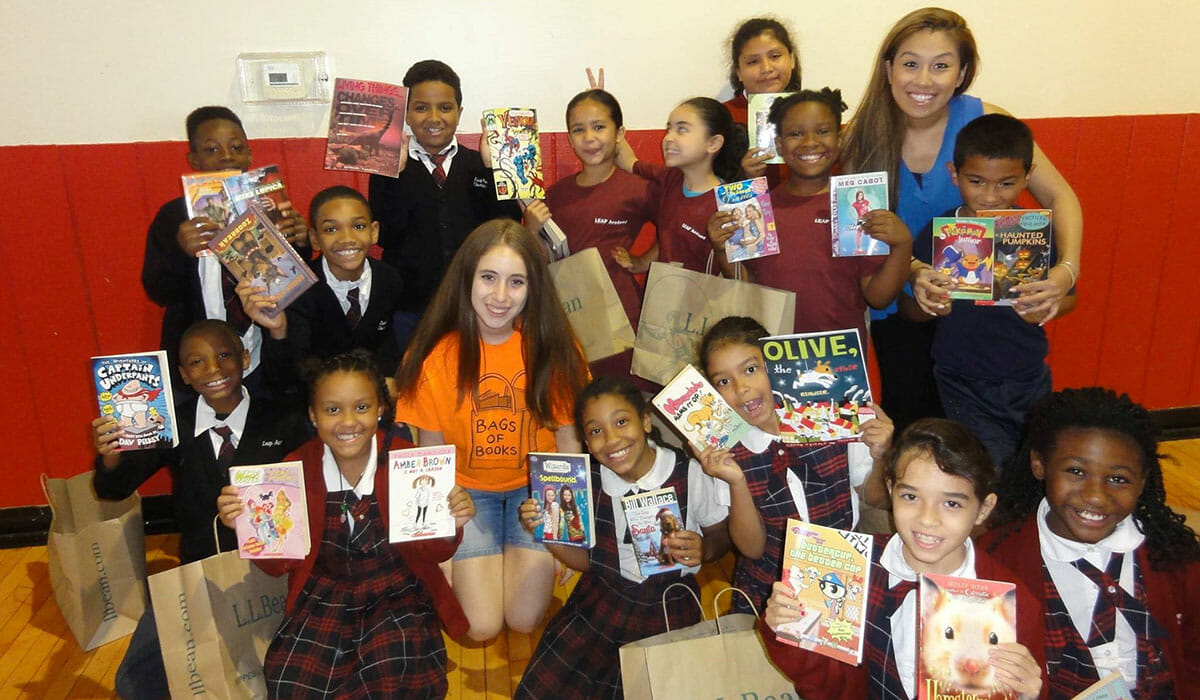
When Alexa was just ten years old, she was inspired to found her own organization, Bags of Books, in order to provide underprivileged kids in the Camden and Philadelphia areas with books of their own in order to promote childhood literacy. For almost a decade, she has held numerous book drives and fairs, donating 154,000 books to kids from kindergarten to high school. Alexa has engaged over 1,000 volunteers, and once she starts college at the University of Pennsylvania this fall, she plans on engaging even more by focusing on Bags of Books’ global ambassador program.
Describe your volunteer role with Bags of Books.
I am the founder and president of Bags of Books. I founded the organization when I was ten years old and I pretty much do all the different tasks required in planning and executing a book drive. I organize the book collections at different locations including college campuses, corporate offices, schools in more affluent communities, community centers, religious centers, really you name it. If it’s somewhere that people are going back to time after time again, it’s a great location to have a collection, but it also works to establish partnerships with the schools and organizations that are receiving the books whether that be a library at a community center, a shelter, soup kitchen-type place. Primarily we work with schools and after schools and summer programs to be able to reach our audience of preschool through high school students. I also work to train volunteers. In addition to having volunteers who collect books or help with sorting books, I run workshops with volunteers to write inspirational messages on the insides of the books, [and] create creative and pretty book marks that are distributed. I also arrange so that volunteers can directly attend the book distribution events. Now what I’ve been working on through our global ambassador program is training particularly dedicated volunteers so they can replicate collection efforts that I’ve been doing in New Jersey wherever they live. For example, we just had someone do this in Panama City, Panama.
Where do you primarily operate?
It’s always been emphasis on my area. I live about 20 minutes from Camden, New Jersey which is a very in need, underprivileged community, so it started off with trying to benefit that area and then it grew into the west Philadelphia neighborhood particularly as well. Most of the collection efforts have been done directly by me or by organizations that are within the tristate area with the goal of benefiting those schools and organizations in Camden and Philadelphia. However, now that I am going to college in two weeks, I plan to start shifting and focusing more on global ambassadors because as a college student, it’s not as feasible for me to manage inflow and outflow. Right now the books all go through my garage in my house, and I won’t be living at home anymore so I won’t be able to manage a collection like that. Not to say that a collection won’t be run in my community — I have lots of contacts from people who want to do the same thing. But my goal is going to shift a little as I begin to support people who are replicating my efforts in new communities or expanding them in communities who have already implemented Bags of Books before. That’s just because logistically it’s hard to run a project that physically handles so many books in flow and out flow on a daily basis. Literally this morning I got a donation of books dropped off at my house, and it’s just not as feasible in college.
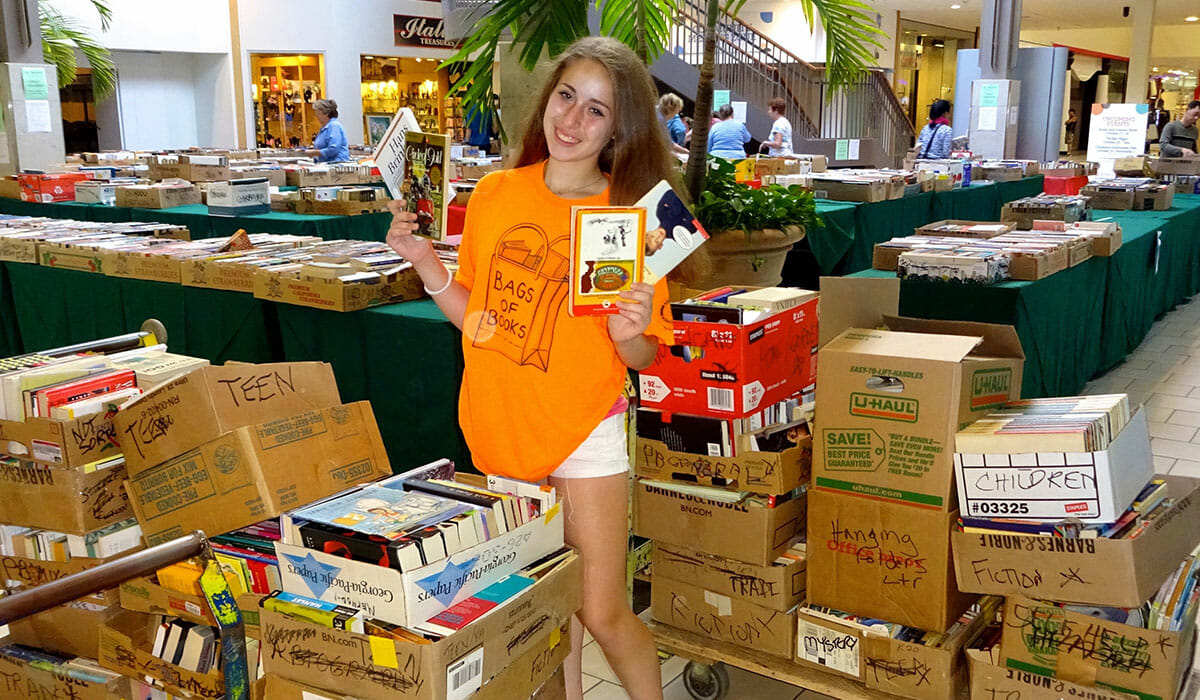
Alexa has organized book collections at numerous locations around her area./Courtesy Alexa Grabelle
What gave you the idea for Bags of Books?
When I was in elementary school, I absolutely loved reading. I was always really fortunate that I have what I like to call a personal library of books that I own at home that I go to whenever I wanted to read. At the same time, I was attending school in my suburban town outside of Philadelphia and oftentimes we do things to benefit schools in Camden. For us, Camden is just a few towns over. … I just really cared about reading at the time. There was a teacher I knew, a religious school teacher in my area, who during the day taught art at a school in Camden and I talked to her about her experiences there and I found out that the school barely even has a library and most of the students don’t have books of their own to read at home. That upset me. Right after that happened, it was the summer, and during the summer at my elementary school, we had a program where you had to read a certain number of books and you could get a prize. It was to prevent the educational summer slide. So the school sent us home with these packets about the summer slide that were supposed to be about the parents so the parents could learn what it is and make sure their kids don’t get it. I was a curious child and I read about it, and I started to put two and two together and I asked what happens when kids don’t have access to books. Research shows when students don’t read over the summer, their literacy skills drop and then they’re put at a disadvantage and this can be compounded year over year over year. So if the student doesn’t have books to read at home and they’re not reading on breaks from school, it ends up putting them years behind some of their peers of the same age in other neighborhoods.
So to try to combat this, when I was in fifth grade I started a book drive. My goal of the book drive was specifically to help combat the educational summer slide. I didn’t expect it to blow up and be such a huge collection effort. My goal was to collect enough books for one class of students, 30 students, five books a piece. I was trying to get 150 books here so that these students could go home during the summer and have enough keep their minds active and running. We collected 2,000 books the first year which way surpassed my expectations. We did a program at the end of the school year for an entire elementary school in Camden, [grades] K through eight, and all the students were able to have books to read over the summer. It’s turned into a year long, inflow-outflow effort of books. Because of that, we do distribution events for books, not just for summer break but year round, perhaps before winter break or any other time that students may leave school, but even just during an after-school program. Because when it comes down to it, these students don’t have books of their own to read at home and any way that we can get them books that they’re interested in, that they can take home and keep, it’s going to have a positive impact on their literacy abilities and strong literacy skills are connected with career choices and so many different possibilities in life. One of the things we really pride ourselves in is when students come to the book distribution events, they’re empowered to select books of their own choice. It’s often found students might be reluctant readers or they don’t like reading, but once you start accessing books that are related to topics you might be interested in, whether it be sports or history or science, the process just becomes so much more enjoyable and students’ reading skills quickly progress.
Can you describe a typical book distribution?
It varies a little bit depending on which school in particular and the age group, but generally speaking we go into the cafeteria of the school which has a ton of tables. We’ll put up these big signs that say which grade level is at which table. Volunteers, including teachers and other volunteers from the community and myself, take the books and spread them out on the table. We try to make it like a Scholastic book fair so kids can browse around and shop for the books they want. Once we have all the books spread out, we have volunteers hold donated bags. Sometimes they give them book bags but typically they’re canvas bags or shopping bags that we get donated in kind from different companies. Oftentimes what the school does is they have different classes come down at different times, so it might be like first grade comes down at 9 a.m. and then second grade at 9:30 a.m. … When the students come down, the volunteers greet them at the door, we provide them with their bag. We tell them this is where you go, this is where the books are and you’re able to take home whatever number we normally say, usually around five books of your own choice. You can fill up the bag, you can take them home and keep it. Then what we do is we place volunteers throughout the tables of books to provide assistance to the students. A lot of times the students have requests. … The volunteers really like to help students find a match with the book that they’re passionate about and find the books that are related to the genres they care about.
The students go first, they get the books they want, and then usually what we do is there are usually books leftover based on pure numbers. We allow teachers to take books for their classroom libraries if they’re interested. And beyond that, any remaining books get donated to the library at that school. Usually that process repeats for each of the grades. Sometimes the kids come in and they want to get a book for a sibling or a cousin or a friend that’s in a different grade and we usually let that go and let them do that if they would like. Sometimes we’ve had events at schools that get so enthusiastic about the day that they play music and they have a big cake and they have a poster on the wall and everyone signs their name. They turn it into this big deal and emphasize how important literacy is. … We’ve also brought events like family literacy night, which is an event we held at a school in Camden where they had reading and linguistic specialists on site and they had dinner. Parents could come in, they could shop around for books for all of their kids, they could get help on how to teach their kids how to read, and they could also get a free dinner for the night and music and different activities. That’s kind of similar to what I’ll be doing at Philadelphia Literacy Day in September. That event is actually going to include author visits and all kinds of games and fun for the kids. It does vary but generally the basic thing is that we have these fun pop-up stores where children are empowered to select bags of books of their own choice that they can then take home and keep.
What kind of feedback do you get from kids, parents and teachers?
Seeing the smiles on the students’ faces and the teachers’ faces has been the most meaningful to me. I really love to see stories that I get in thank you notes or in person of how the students go on to share the books. A book is donated to a student and that student gets to read it and enjoy it, but oftentimes does not only that one student get it, but because they want to share it because they loved it so much, they might swap it with a friend or a sibling. Also what’s been really meaningful and awesome about focusing in the south Jersey, Philadelphia area and being able to do so much work on my own, is that I’ve been able to return to the same schools year after year. It becomes a fixture at the school. They look forward to the event. One student told me it was their favorite day of the year, the ‘thousand books day,’ and seeing that impact is crazy to me. I never thought it would grow into such an established event.
Are there any future partnerships, programs, or events that you are excited about?
The biggest thing that I’m trying to focus on in the future is to launch a more organized, streamlined global ambassador program. As of now it’s been kind of case by case. I had a call … with someone who found me online, emailed me and wants to become an ambassador. People reach out all the time with all different needs and ideas and abilities. I think it could be really cool to create a program that focuses on middle and high school students to provide them with leadership and community service opportunities in the sense that each month, they could have designated tasks or things to do in order to develop the students into more effective leaders and teach them a lot of the skills that I learned while running this organization from the ground up since I began, like marketing skills, communication. All of those business non-profit type skill elements as well as just getting involved in the community, engaging with communities in need where you live, recruiting volunteers. I really want to create some step-by-step program so that Bags for Books can expand it’s reach through particularly passionate ambassadors who care about this to the degree that I do and have the capacity to create change in their own communities.
What’s been the most rewarding part of your work?
I really think the most rewarding part of the work for me is when I go into a school, especially when it’s not the first time I’ve been to that school, and how for the students that this is something that they’re enthusiastic about, that they look forward to. Seeing these students literally race into distribution events, grabbing the books, getting so excited, wishing they could take even more books than they’re already allowed to. Just reading the thank you notes afterward that are sometimes sent by students and how they rave about, ‘I’ve read this book five times already’ or something like that and knowing that these books are really appreciated and actually make a difference. That’s the first thing that’s really rewarding to me. But the second thing is knowing that simultaneously I’m helping to combat the illiteracy crisis and I’m helping these students develop skills that are really critical for their futures, for their future careers and education. Just knowing that I’m empowering them to pick books that they choose, they’re becoming more engaged and passionate readers.
Alexa, center, sits with some of the students who she has helped to donate books to./Courtesy Alexa Grabelle
Why do you think it’s important for others to give back?
I think it’s important because everybody has some kind of passion that can be associated with a need in the community. I think it’s great and wonderful that different people care about different things. It’s critical that we each focus on the element of service or the area of need that we are most passionate about because then we will fill in the gaps that others are not covering already. I actually do a lot of speaking engagements. I do engagements at schools of different ages and I do some motivational-type speeches. When I talk about the importance of giving back, I’m not always imploring people to join Bags for Books, to necessarily launch their own collection. It’s more about finding a need in your community and finding something you happen to care a lot about. For me it’s that I love reading. I’m taking an urban education class this seminar when I start off in college this fall, because it’s just something I care about so much. It’s okay if for someone else, what they care about a ton is climate change or eradicating poverty, literally the possibilities are endless. But the most important thing is to match your passion with the need.
What do you want people to learn from your story?
I started this organization when I was ten and I don’t think I even realized it was going to become an organization. It was something that felt natural, it was something that needed to be done in my community. And the biggest lesson that I’ve learned from my own work is never underestimate yourself. It doesn’t matter if you’re ten years old or 80 years old or anything in between. It doesn’t inhibit your ability to make a difference. If you care about something and you put in the work, the results will appear. I think that can be applied to anyone. … It always motivates me to see what other people can do and to know that you’re never too small and no effort is too small. It doesn’t matter how old you are, you can do something that can make a change.
Making Strides Against Cancer, Kansas Woman Serves as Leader for “Relay for Life”
Meet Daily Point of Light Award honoree Connie Johnson. Read her story and nominate an outstanding volunteer or family as a Daily Point of Light.
After losing her husband’s grandmother to cancer, Connie Johnson says she was spurred into action to support cancer survivors and caregivers.
Through a variety of events that benefit the American Cancer Society, Connie is a tireless volunteer in the fight for a world without cancer. The 46-year-old Burdick, Kansas resident organizes annual events to fundraise for ACS, including a golf tournament, annual soup and game night and year-round farm auctions. In addition, she serves as the chair of the Morris County Relay for Life, and team captain of the Burdick Bunch, helping to raise thousands of dollars for the ACS alongside her team members.
What inspires you to volunteer?
I always like to give back, and I like people to be proud of what I do. I knew that there was a need in the community to support cancer survivors and their family members, and so I decided to help.
Explain why you’ve committed to volunteer to fight cancer.
I’ve always been drawn towards the American Cancer Society and what they do. The closest person to me that had cancer was my husband’s grandma. We were really close with her. It was after her death from cancer that I really got involved with ACS. I realized how many other people there were just in my community alone that have cancer that I really wanted to do this service work for.
Describe your role supporting America Cancer Society.
I mostly organize, that’s the number one part of my job. I volunteer several hundred hours each year supporting ACS through different events.
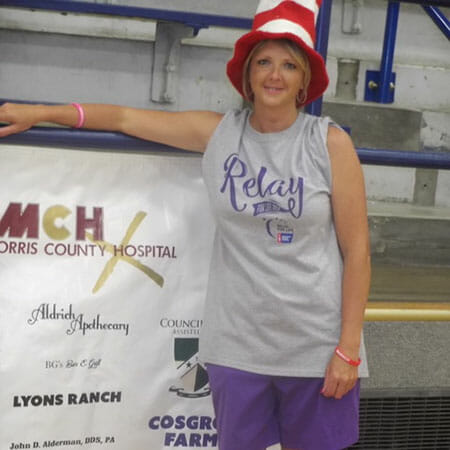
Connie Johnson pictured at the Relay for Life of Morris County in 2018, which featured a Dr. Seuss theme of “One Wish, Two Wish, You Wish, I Wish….for a Cure.”
What’s something that you’ve learned about American Cancer Society through your service?
People think American Cancer Society only fundraises for research, but they offer so much more. Hope Lodge is a service where cancer patients can stay for free while they’re receiving treatment. They have a program that provides wigs to women free of charge. ACS offers many services and programs within their support system for cancer patients and their families.
What’s been the most rewarding part of your service?
Knowing how many people are actually impacted by what I do. If I look at our impact beyond the county, and think about where the money we’ve fundraised goes and how many people it actually affects, that makes my heart happy.
What have you learned through your experiences as a volunteer?
That any time spent volunteering is valuable. Sometimes, I feel that I haven’t done a very good job or that I haven’t put enough time into a project, but everything always works out in the end. When you’re devoting time to volunteerism, I remind myself that it’s always going to work out, it’s always going to be ok.
You are described as always serving with a smile on your face. How does that make you feel?
It makes me smile so much bigger, and feel like crying, because I’m just so humbled to know that I’m helping other people. And that’s the thing that I like to do, I like to help other people.
Share one personal story with me from your volunteerism.
Several cancer survivors came up to speak with me at the Morris County Relay for Life and thanked me for the event. That makes me feel really good to know that I am a part of such an important event.
What do you want people to learn from your story?
I just volunteer, I don’t think about it. I didn’t have all of these different roles when I first started with serving with Relay for Life. The roles built on top of each other, once I got started, I just kept adding. You can start small with volunteering, and go from there.
How can readers help?
The Morris County Relay for Life will be held on September 1, 2019. Please check the website for more information on how you can give back.
As a medical student, Lara Gruye is dedicated to improving the health of those most in need, a passion she has combined with her volunteerism, as the 26-year-old serves to prevent deaths from malaria through education.
Through NETwork Against Malaria, bed nets are provided to vulnerable populations at risk for malaria in Uganda. According to NETwork, 93% of Uganda’s total population is at risk for the serious disease, caused by the bite of infected mosquitoes, impoverished children and pregnant women being the most susceptible. NETwork trains girls in schools how to use the nets, and those girls then bring the nets home to their families. Serving as a Global Giving Coordinator for NETwork, Lara promotes the organization to support fundraising as it works to save impoverished children and pregnant women from a preventable death, and promote education for young girls.
What inspires you to volunteer?
I’ve given back my entire life. As I started becoming interested in medicine, I wanted to continue to give back to different communities, and NETwork was my first foray into service that wasn’t based in the United States. Volunteering with this international demographic changed my perspective and got me out of the lens that I’d been looking in throughout my entire life.
Describe your role with NETwork Against Malaria.
As the NETwork Against Malaria Global Giving Coordinator, I raise money through GlobalGiving, a giving marketplace. The average Joe can select any cause they wish, and donate to any project all around the world. I leverage GlobalGiving to promote NETwork, and we’ve raised nearly $12,000, helping 20,000 Ugandan children thus far.
Lara Gruye serves as the Global Giving Coordinator for NETwork Against Malaria, where she spearheads online giving, raising $12,000 thus far./Courtesy Lara Gruye
What have you learned through your experiences as a volunteer?
I’ve realized that other cultures and populations don’t have the luxury of time that we do. As Americans, we are so lucky to have time to give to others. I appreciate everything I’ve been given in my life, and want to elevate the quality of life of those around me. NETwork’s mission is to foster good health, promote education and combat poverty, all in the name of fighting malaria, and I’m helping these people live their best lives.
How does your volunteerism intersect with your personal experiences?
NETwork partners with a priest in Uganda, Fr. Mujule, who has strongly supported education for girls in a culture that has not traditionally placed value on promoting female education. I’m lucky to have been born in the U.S., where we have pretty equal rights, and women have access to education. What I’ve learned is that that’s not the case throughout the world. By distributing nets in these schools, parents are motivated to continue to send their girls to schools.
Lara Gruye pictured at a Cornell University Fundraising Auction./Courtesy Lara Gruye
What do you want people to learn from your story?
You can find a million excuses not to help, but the way modern tech functions, it’s so easy to do something and make a big impact. There’s really no barrier to engaging, reporting and learning about how you can help others, even if you don’t have much time.
What’s your goal for future service?
We are creating another project to upgrade an existing health center in rural Uganda. We are hoping to raise money to better care for Ugandan children and adults there. Our fundraising goal is $92,000. Please visit our GlobalGiving website for more information about how you can help.
How can readers help?
Please check out NETwork’s website for more information about their mission and how you can give back.
Four-Legged Friendship: Couple Connects with Children and Seniors With Therapy Dogs
A dog is known as “man’s best friend”, but Mel and Joyce Grimm have magnified the benefits that result from a relationship between dog and owner, using their love for four-legged friends to give back to the community.
Self-described dog people, the New Mexico couple volunteers alongside their certified therapy dogs, David and Andrew, both Shih Tzus, connecting with others in need to provide comfort and healing. Helping abused and neglected children, lonely seniors, and school children that need special attention, the human and canine team is involved in various volunteering efforts across Northwest New Mexico.
Employing dog tricks, games, and sometimes just some peaceful quiet time with a pup, the retirees have impacted the lives of hundreds of children and adults, and are today’s Daily Point of Light award honorees. Points of Light spoke to Joyce and Mel to learn more about their volunteerism.
What inspires you to volunteer?
Mel: We see a lot of improvement in people’s attitudes when we visit, especially the senior citizens at the Cedar Ridge Inn, a nursing home and rehabilitation center. While at Cedar Ridge, these seniors miss being away from their animals. They like to see us, and they like to pet our dogs.
Joyce: Our community has been very good to us. We’re former school teachers and are now retired. When you have time on your hands, you should be giving back. What we do is civic-minded, because when we spend a part of our day giving a little bit back to our community, the city is able to use resources elsewhere to better the lives of everyone.
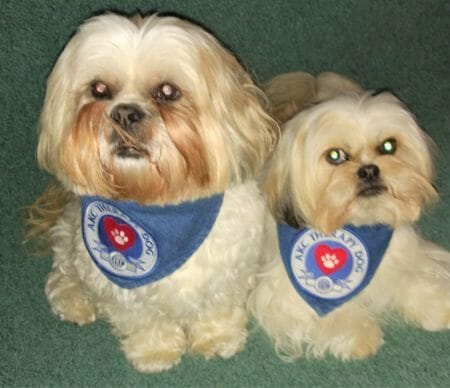
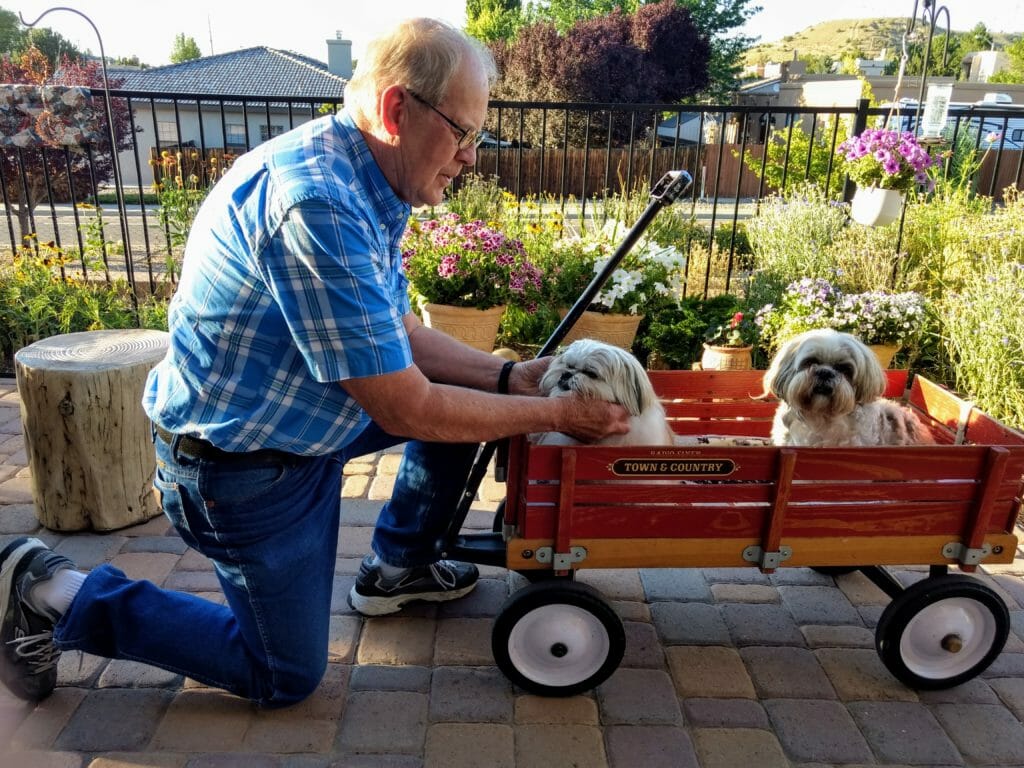
Shih Tzu, Andrew (left), and Shih Tzu, David (right) wearing their therapy dog bandanas./Courtesy Mel and Joyce Grimm
You volunteer with a number of different organizations. Explain.
There are many organizations within our community where we’re able to connect people with our therapy dogs. Some of those organizations include:
● Cedar Ridge Inn: We’ve volunteered at this nursing home and rehabilitation center since 2008. We take Andrew and David in a wagon, and we spend about an hour visiting elderly there. The residents get to love on the dogs, can put them in their laps, and the Shih Tzus even perform tricks.
● Welbrook Rehab Center: Each Tuesday, we visit this rehabilitation center, which is for residents going through short-term intensive physical therapy.
● Childhaven: We’ve volunteered at this organization, which serves abused and neglected children on a temporary basis, for 18 years. Our dogs were approved by the board to visit. These children often come in over the weekend, and so we visit on Monday’s, so that there is a little furry dog waiting to greet them. We do tricks with the dogs and we teach the children how to do tricks. Our certified therapy dogs provide a playful and loving interaction for the children.
● Sacred Heart School: We’ve volunteered with students that need special attention in reading and or practice in speaking English since 2004. The children will read to our dogs, or we’ll read together. It’s often successful when the children read to the dogs alone, because they are not judgemental and this helps to increase the child’s self-esteem.
Explain what this comfort means to the children at Childhaven.
Joyce: We provide emotional support and an emotional outlet for love through the children’s interaction with the dogs. Being teachers in the schools for many years, no child can hide inside their personal shell of darkness for long. We know how to brighten the esteem of every child. We want to provide them with positive, uplifting words of kindness and support to enhance their success in life. When the children learn how to command the dogs to perform tricks, this enhances their self-esteem.
Mel Grimm pictured getting Andrew and David ready to visit Cedar Ridge Inn. The seniors enjoy petting the Shih Tzus while they are away from their own pets.
What are your favorite tricks to do with the dogs?
Joyce: I will brag, each of my dogs have an advanced trick title with the American Kennel Club (AKC). I am the trick lady (laughs). David’s favorite trick, he has a little pink Barbie Doll convertible that we put a teddy bear in. David will pull the convertible around the room with a cord until the teddy bear falls out. When we are volunteering with children, all the kids will yell, “he lost his passenger!” Andrew dances when I sing, he will spin and twirl.
Mel: I work on agility with the dogs. We attend AKC trials with them, and both David and Andrew are at the masters level in agility and in rally, in addition to holding obedience titles.
Joyce: Mel will set up a rally course in Childhaven’s backyard later this summer, and we’ll show the children how a rally trial works. This is a form of obedience where dogs maneuver a course.
What have you learned through your experiences as a volunteer?
Mel: We’ve met a lot of people along the way (laughs). You become friends with people. Just the other day, we were in a store and we had our dogs in the cart. He happened to be a dog lover. We spent half an hour talking to that man.
Joyce: I can tell you how Mel has changed. When he was in high school, before my time, he was voted the quietest boy in the class. And now he could talk to a telephone pole. He’s thrown into places where there are people that he doesn’t know, and he’s learned that it’s quite fun to talk to them.
Share one personal story with me from your volunteerism.
Joyce: One our original dogs, our Kai-Lee, was the littlest of our dogs. We went in to work with one boy in 3rd grade whose parents demanded perfection from him. His teachers sent him to me to read to the dogs for some TLC. We realized he was reading way, way above grade level. As he sat down, Kai-Lee sat down beside him, and she knew that reading wasn’t what that boy needed. She would climb up into his lap, and she would kiss him. They would roll around on the floor together. I clued the principal in on what was going on with this child and dog, he needed to interact with a loving creature, he didn’t need to read more. The dogs are sometimes best able to tell what humans truly need.
What do you want people to learn from your story?
Joyce: You don’t have to conform. You don’t have to go to the hospital and pass out mail. There are so many ways to give back. Identify whatever your special ability is, and then share it. You can get back so much more than you give.
How can readers help?
Childhaven is celebrating their 50th anniversary in September. Please check their website for more information about how you can help: https://childhavennm.org/.
World-Traveling Teen Leads Nonprofit to Provide Supplies to Those in Need
Nora Moumane might be just 17 years old, but she’s already lived in five different countries. As the daughter of a father who works in the humanitarian NGO field and a mother who works as a consultant for UN agencies, traveling is the norm for this family. Her parents met while traveling and as Nora’s grandma would visit them in the different countries they lived in, she noticed different issues and needs of the locals living there. So the family started a charity group called Reach2Teach.
More than 20 years later, Nora’s grandma went into retirement, and Nora took on the role of president. She took Reach2Teach from more of a family project and grew it into an official nonprofit organization. Reach2Teach has done projects in Cameroon, Sudan, Burundi, Rwanda, Zimbabwe, Zambia and various states in the U.S. bringing school supplies to students or whatever supplies are needed for the locals who are most in need. At an orphanage in Cameroon, Nora led the effort to provide 250 orphans with 35 pounds of school supplies. At a health clinic in Sudan, her nonprofit provided over 200 toothbrushes, 30 scarves and 20 pairs of gloves to around 70 families.
Even at such a young age, Nora has shown leadership and a true passion to help those in need. She is today’s Daily Point of Light Award honoree and we spoke with her to learn more about her volunteerism.
Describe your volunteer role with Reach2Teach.
Our mission is to educate and help out with hygiene supplies of whatever is needed in specific countries. In Cameroon, we worked in local orphanages and we donated school supplies – basic things like pencils, things that they would need for education. In Sudan, we recently donated a bunch of hygiene supplies for women in rural areas because they needed a bit of an incentive to come to hospitals. Women don’t really prioritize health over their families or their husbands there so we gave out scarves and toothbrushes. In Charleston, we donated books. Reach2Teach is a need-based charity. We do one project at a time so we can focus and put all our effort in it. We like to do projects in the countries we’re living in at the time. So in Cameroon, I was actually the one that brought the school supplies to the orphanage so that I can make sure it got there.
Nora Moumane is president of Reach2Teach, a nonprofit that provides school and hygiene supplies to people in need around the world./Courtesy Nora Moumane
What’s one memorable project or moment that stuck with you?
In Cameroon with the orphanage, these are kids whose parents sometimes don’t have the ability to take care of them. They’re born with special needs and it’s really heartbreaking. We played games and basketball with them after giving them the donations. Their teachers and guardians were incredibly grateful as well so that really stuck with me to see the actual impact of what we’re doing. Getting to see them experience that joy really made an impact on me.
What inspires you to volunteer?
I’ve been moving around from place to place since I was six weeks old, as soon as my passport could be printed. So being someone from that point of privilege and going to a country where people don’t have anywhere close to the privilege that I do, it really is heart-wrenching and you want to do everything you can to make a difference.
How does it make you feel when you see these children receive their supplies?
Completely overjoyed. I find it very fulfilling and honestly, I’m considering pursuing humanitarian aid in the future specifically because of this. I enjoy it so much and I find it to be such a lasting impact on me.
What’s been the most rewarding part of your work?
The feeling of seeing a problem and doing the best you can and knowing that you can make something happen. You just feel a connection to people that I wouldn’t otherwise feel. It’s one thing to drive down the road and see people who need help but to go speak with them, go play games with them, to give them what they need, it’s a connection that I wouldn’t get anywhere else.
Are there any future partnerships, programs, or events that you are excited about?
The women’s clinic in Sudan was very grateful for our donations last time. We received some awesome pictures of them with the donations so we want to do that again and with even more donations if possible. Also, Ethiopia, it’s close to Sudan and we want to do a similar project there. The level of poverty there is honestly shocking. I think we could make a real positive difference there.
Why do you think it’s important for others to give back?
I think we have a responsibility to each other as humans. I don’t think it’s fair for one government to say these aren’t my people so I shouldn’t take care of them or for one person to say that’s not my family so I don’t care if they’re starving. I understand there aren’t enough resources to go around for everyone. I understand that you can’t take care of people all willy nilly because you won’t have enough to feed your family. But when you can take care of others, and you can do your best to make this a better place for as many people as you can, we have a responsibility to make that happen. It’s not right to look at someone suffering and have every opportunity to help them and still choose not to. That’s not humanity. We need to have the bravery to be able to sacrifice some things for the life of somebody else.
What do you want people to learn from your story?
I want them to learn that no matter if you’re not associated with any NGO, no matter if you have no idea how to help people or where to start, it’s possible. It doesn’t matter if you don’t know where to put your efforts, it’s possible for everyone to help and make a difference. Go online, look up charities in your area, do some fundraising. Do the best that you can because if enough people do that, it makes a difference for everyone.
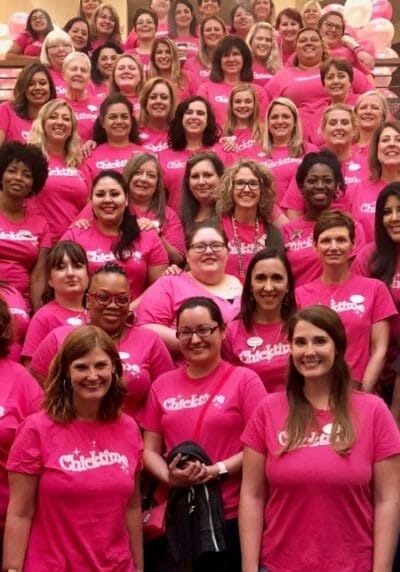
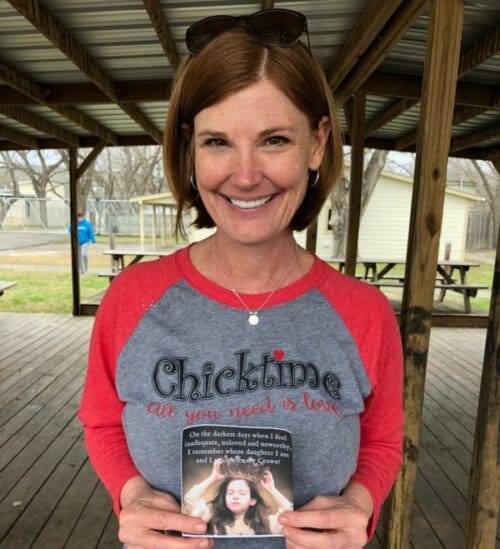
Lori Rhodes is a born organizer. A natural caregiver and an oasis of calm in a crisis, the busy wife and mother always knew that her own world was blessed. What concerned her was the need she saw in her community, especially relating to neglected and abused children. Because the cycle of abuse, left unchecked, can translate to an abusing adult, she founded Chicktime in 2009, a nonprofit that partners with local residential treatment centers and shelters to bring children into a caring circle of love and hope. What started as one chapter has grown into more than 50 volunteer groups from coast to coast. A leader in both her local Canyon Lake chapter and the national organization, for which she mentors and coaches, Lori has found her passion for passing on this story of hope and restoration from community to community.
Lori is committed to making a difference in her community and she is today’s Daily Point of Light Award honorees. Points of Light spoke with her about her commitment to service.
What inspires you to volunteer?
I believe we all have God-given talents and should use them to make a difference. I am passionate about children and want every child to feel loved and valued. Too many children are abused and neglected. Doing nothing about that is unacceptable to me. I can’t reach all children but there are women in every community across America who can organize volunteers and make a difference. Together we can stop the cycle of abuse by helping children understand how loved and valued they are. When a child truly believes they are loved their wounds will heal and they are less likely to lash out as adults and repeat the cycle of abuse. I am motivated to help women do their part in their own communities and I feel energized by helping women make a difference.
Describe your volunteer role?
I mentor women across America and help set up partnerships with shelters and organize women in their communities. I teach them the model I developed to bring fun activities to the children and bring new volunteers into the children’s lives to love and spend time with them. I coach the women to find out what the shelters need most and inspire their volunteers to meet those needs. I also organize ongoing support to ensure long term sustainability. My goal is to build a network across America offering meaningful opportunities to connect and love these children.
Lori mentoring young women across America./Courtesy Lori Rhodes
Why is it important to you to support your community in this way?
When I was in my 30s, I began volunteering with a local children’s shelter in my community. I realized how unloved and unvalued abused children feel. I shared stories with my friends and inspired them to come with me and teach the children activities and skills like cooking, gardening, art, crafts, sewing, budgeting, manicures, music, etc. I saw a remarkable difference as the children began to transform as volunteers spent time with them. The children’s downtrodden faces became filled with light, their slowly shuffling feet began to skip when they saw us coming, and the once quiet rooms began filling with giggles and happy conversation. If such a transformation was possible in my community it can could happen in others.
What’s the most challenging aspect of your volunteer service?
People are so busy these days making ends meet and keeping up with their responsibilities they often don’t believe they have time to make a difference. This is simply not true — it keeps them from getting involved. I find it challenging to keep the women I mentor engaged when their local communities don’t make time to volunteer.
Why do you think it’s important for others to give back?
People are overflowing with gifts and talents. If we would use these personal resources to help others not only would people experience a deeper sense of personal fulfillment, I believe we would live in a healthier and happier society.
Lori volunteering to make a difference for young women at the New Life Center/Courtesy Lori Rhodes
What’s been the most rewarding part of your work?
Seeing the joy in other people. The joy in the children we serve when we are with them and the joy in the women I mentor when they experience the difference they make. Most women have no idea the capacity they hold to make lives significantly better for others. When I get to witness that ah-ha moment a beautiful peace washes over me.
What have you learned through your experiences as a volunteer?
I want more. As each year goes by, I become more and more energized to help others take their place and make a difference. There are so many children just waiting to know they matter. We must go to them.
Are there any future partnerships, programs, or events that you are excited about?
Of course. I envision a partnership with every children’s shelter in America. I’m just waiting on the women in those communities to find me and so we can make it happen.
What do you want people to learn from your story?
They matter. And that others are waiting to help them take their place.
Woman Fights Human Trafficking through Fashion with “Dressember”
Your go-to black dress. Every woman has the staple hanging in her closet, ready for all seasons and occasions, but what makes RuthAnn Deveney’s special is the purpose it serves when she wears it: fighting human trafficking.
Fighting an epidemic that many may be surprised to know is taking place in their own communities, the 36-year-old Kennett Square, Pennsylvania resident wears a dress each day for the 31 days of December through Dressember, which is dedicated to raising funds and awareness about global human trafficking. The dress (or tie for men) serves as a conversation starter to fight back against modern slavery, efforts that have organization-wide resulted in millions of dollars of funding vital for anti-trafficking work in America and around the world.
Personally raising over $27,000 since 2014, RuthAnn is making a difference with fashion, and is today’s Daily Point of Light award honoree. Points of Light spoke to RuthAnn to learn more about her volunteerism with Dressember.
What inspires you to volunteer?
This is a cause that I really believe in, and I believe in Dressember’s ability to effectively confront the problem. I love seeing that we can all take action, even against an overwhelmingly sad problem.
Describe your role with Dressember:
I volunteer more than 40 hours during the month of December, as we are actively campaigning by wearing dresses or ties each day to raise awareness about human trafficking. In addition to dressing up, I have a fundraising campaign that includes team members from all around the country, and some international advocates as well. This fundraising is a part of strategic anti-trafficking grants that provide Dressember partners with the funds to move the needle toward change. Outside of my direct advocacy, I lead a Dressember Book Club to engage other advocates within my community year-round as we wrestle with the topic of modern slavery and how to fight it.
You mentioned ties. How can men help fight human trafficking?
In the past few years, Dressember has expanded. Men can wear a tie each day, or we encourage them to be dressy in other ways, by wearing a suit jacket or suspenders. As Dressember equips a community of advocates to fight for the dignity of all people, they are working towards the protection and freedom of millions.
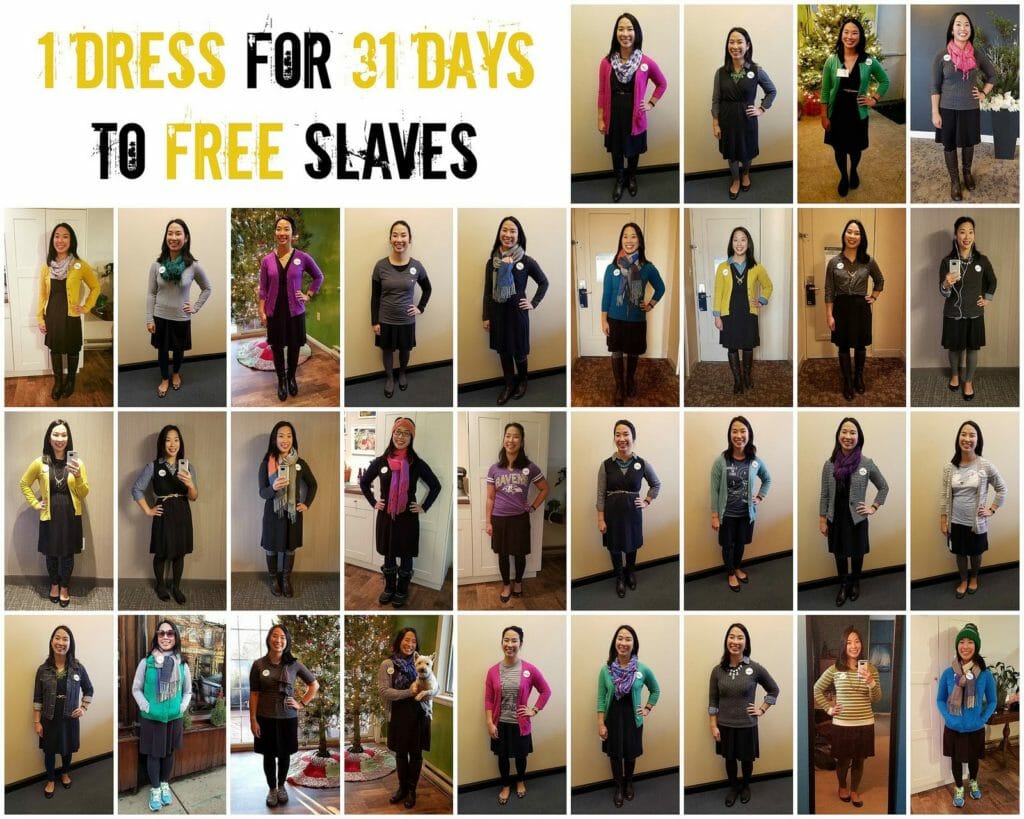
In 2016, RuthAnn Deveney wore the same black dress each day for the month of December as a Dressember volunteer./Courtesy Ruthann Deveney
Tell me about this black dress that you wore each day throughout December.
I wore the same black dress every day for my first month volunteering for Dressember. It’s a solid, sleeveless black dress, and since it was winter, I’d layer the dress in different ways with different cardigans or leggings. When people see me wearing the dress, they recognize it – it has this strange notoriety, because it sparks awareness. People remember that this dress has made an impact on people and that I am wearing the dress to fight human trafficking.
Explain why this crisis is so personal to you.
The saddest aspect of human trafficking is how women and children are disproportionately victimized. They are among the millions who are enslaved, and that really hits home for me. Here are women who don’t have education, they have debt that has been unfairly imposed, and they’re trapped in these situations. I am fighting a culture that makes women disposable.
What have you learned through your experiences as a volunteer?
I will stretch beyond my comfort zone for a cause I believe in. Last year was my 5th year as a volunteer for Dressember, and I wore a button each day that said, “ask me about my dress”. Sure enough, a stranger approached me and asked about my dress. Having conversations with strangers is much different than explaining the cause to a co-worker or friend, but I am I willing to have these conversations and inform people because I so believe in the cause.
What do you want people to learn from your story?
I want to encourage people to take small actions for the causes they believe in. Even though their small actions won’t solve the problem wholly, they’ll still be making a difference.
How can readers help?
Please check Dressember’s website for more information about how you can give back: https://www.dressember.org/. Additionally, please visit my 2018 team campaign page: https://dressember-2018.funraise.org/team/25-boats-for-freedom. I also share updates about my advocacy on my Instagram page: https://www.instagram.com/definitelyra/.
With High School Esports League, Student Helps Foster Friendships and STEM Learning Opportunities for Peers
Meet Daily Point of Light Award honoree Ben Tecker. Read his story and nominate an outstanding volunteer or family as a Daily Point of Light.
Ben Tecker is no ordinary high school graduate. His time at Esperanza High School in Anaheim, California, was spent creating a sense of belonging for his peers through technology. Intrigued by the idea of bringing esports – competitive video gaming – into school systems, Ben connected with the local director of educational services in Orange County two years ago, and his idea became a reality. Today, Ben helps provide opportunities for all students to use esports as a platform to acquire critical communication, collaboration and problem-solving skills needed to thrive in work and life.
For students who don’t participate in extracurricular activities on campus, it can be difficult to form solid connections with peers. By forming an esports club on his high school campus, Ben created a welcoming environment for students to find a sense of belonging and build lasting friendships.
“You see students who don’t usually connect to others in school form real bonds, and that’s why this movement is so important,” said Ben.
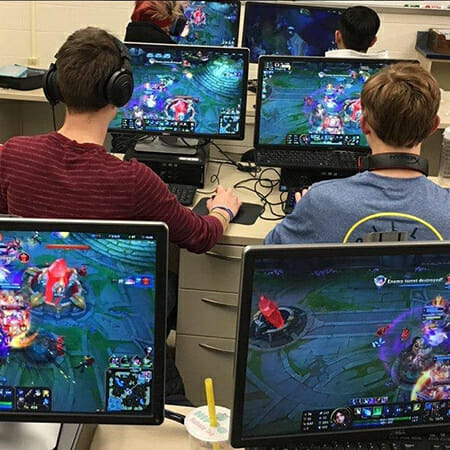
Students connect and play games at the Esperanza High School esports club.
As a form of competition that’s facilitated through computer gaming, esports is one of the fastest growing sports in the world. The Orange County High School Esports League was born out of the idea of exposing youth to the positive effects of technology. It began as a network of 36 schools, including Esperanza High School, in its inaugural year. Now, in its second year, the organization is moving forward as the North America Scholastic Esports Federation, a growing network of esports clubs on campuses across the United States and Canada.
NASEF has inspired students around the nation to start their own esports clubs. With support from local donors, the NASEF network provides league services like team organization, matchmaking, educational resources and face-to-face workshops at no cost. Ben says he’s just a small piece of the puzzle that brought the esports movement to his community, but his dedication provides students the opportunity to pursue their interests, develop a greater sense of community and grow their skills in leadership, teamwork, communication and problem-solving.
At Esperanza, Ben acted as club president, working closely with the school’s administration, principal and teachers to support the program and invest in relevant technology for the students. Now, in his role as a community board member and student adviser to NASEF, Ben contributes to decisions that help students feel more connected to their campus and community. He sees esports as an educational, interest-driven learning tool for students, and uses his voice and perspective to give students a sense of belonging through technology.
Ben attends monthly NASEF board member meetings to discuss how to improve the esports league. He provides student perspectives, and brings ideas from other students to life with help from league general managers.. Ben also travels to educational conferences, including the STEM Ecosystems conference, to promote NASEF’s positive effects on students.
According to Ben, there are two main avenues through which NASEF provides opportunities to students to build strong communities through esports. The most popular is creating an esports club on a high school campus. These clubs are run by a school faculty member, who acts as a general manager, and student leadership. Once a club is formed and approved by the school’s administration, it can be registered as a NASEF esports team at no cost, and the organization gives students access to resources and learning materials. Esports is also growing on high school campuses by being incorporated directly into curriculum. After partnering with the University of California system, NASEF created an approved language arts course for high school students. Although this option is not as widely used as esports clubs, it continues to grow and intertwine leadership, technology and communications skills with academics.
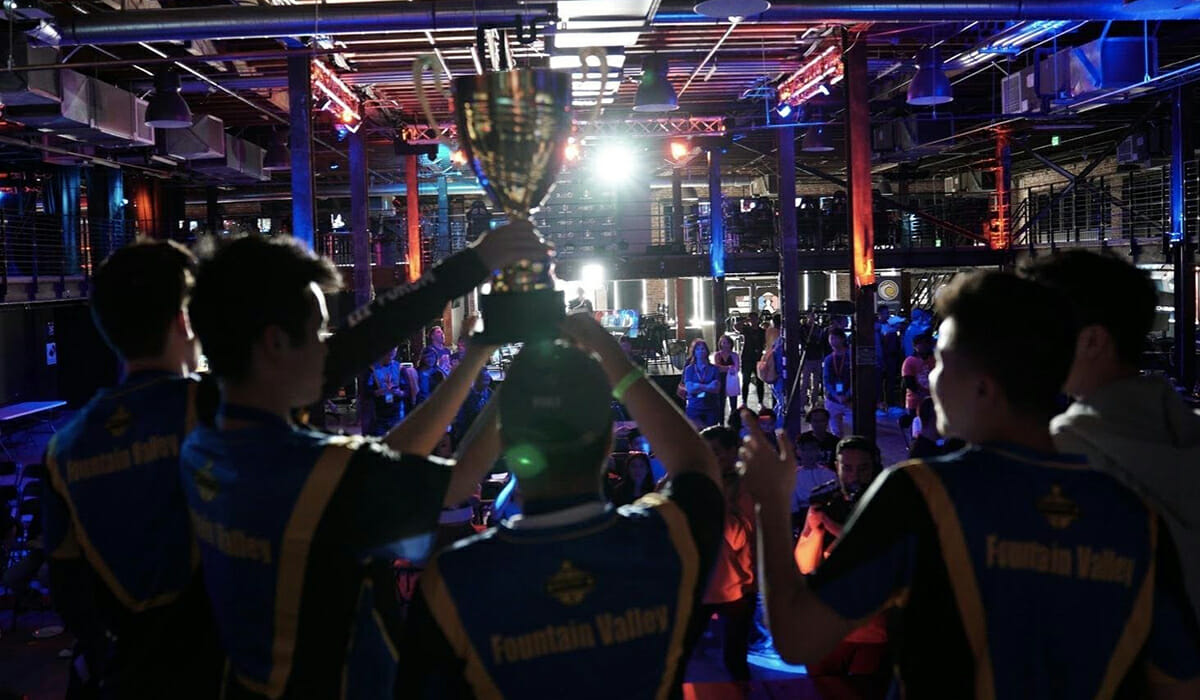
Esports teams from around the country compete at the annual North America Scholastic Esports Federation championships.
Reflecting on his four years at Esperanza, Ben finds it extremely rewarding to these the progress that has been made and what has evolved from the passion he had as a freshman. Seeing so many students come together, especially at the annual NASEF esports championship match, makes all of his hard work worth it.
“Every single year is different in high school. Your senior year is about leaving something behind for your community so you can leave it better than how you found it,” Ben said. “It was my personal goal to leave Esperanza and the community better, and that’s what this esports program is doing.”
And Ben’s dedication to improving his school and community has not gone unnoticed. During his senior year, he was recognized by Disneyland Resort’s Dreamers and Doers program, which led to a generous donation for new technology at Esperanza. Technology that, Ben said, will lead to more students joining the esports league and will leave a legacy of good for years to come.
“Be accepting of other people and their differences, because you can leave something good behind you no matter where you go,” he said.