Volunteer Cares for Shelter Dogs through Enrichment Services
Explaining that all dogs think the best of humans, Heather Pol says her mantra: “Try to be the person all dogs think we are,” is what drives her service to help shelter dogs, and is her way of encouraging others to help as well.
The 32-year-old returns that love she says dogs give so freely by providing enrichment to shelter dogs at Contra Costa Animal Services in California. As a volunteer on the Shelter Enrichment Team, Heather is providing normalcy through activities for a shelter animal that may be under stress due to unfamiliar experiences, including new sounds, sights or scents that they encounter at shelters.
Building trusting relationships with shelter dogs so that they may one day be ready for their forever home, Heather is today’s Daily Point of Light award honoree. Points of Light spoke to Heather to learn more about her volunteerism with Contra Costa Animal Services.
What inspires you to volunteer?
Volunteering is easy when it’s something you’re really passionate about. I love animals, and I easily fall in love with just about every dog. Service is inspiring and easy when you actually care, and love what you’re doing.
Describe your role with Contra Costa Animal Services:
I currently assist with fundraising for the shelter, as I have recently moved to Lillington, North Carolina for medical school. Funding is critical for the shelter, as it is used towards a variety of costs including medical visits and adoption fees. When I was a California resident and lived closer to the shelter, I’d walk the dogs at the shelter, also as a member of the running dog team, we would take some dogs out for longer distance running. In addition, if anyone was interested in adopting an animal, I’d facilitate a meet and greet for an adoption counseling session. Lastly, I fostered two different dogs from the shelter to train them and get them ready for adoption.
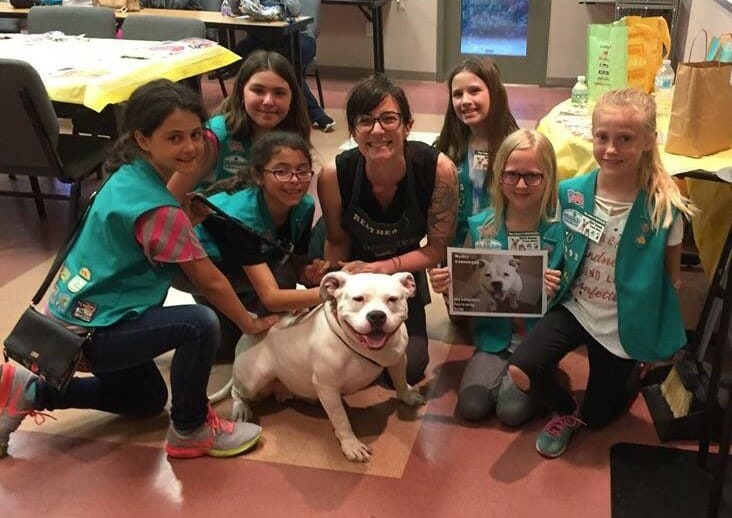
Heather Pol pictured, center, at Contra Costa Animal Services assisting with a tour for a Girl Scout troop./Courtesy Heather Pol
What have you learned through your experiences as a volunteer?
Working with dogs and building that trust as you prepare them to be adopted was one of the most rewarding parts of my service, because it felt a lot like matchmaking. People might see a picture of a dog on the internet, but it might not be the best fit. For me, getting a better sense of people’s needs and what they were looking for by listening and learning was very fulfilling.
Tell me about your favorite dog.
(Sighs). Kona Coffee. She was one of the first dogs I started running long distances with, I was able to train her to run up to 4 or 5 miles. It was really awesome to see her enjoy the run and get excited about going running with me. We would do events to promote the shelter dogs and hopefully get the attention of a prospective owner, and she ran a portion of the Redding Marathon in California with me. A woman saw pictures of us running together, and she came into shelter saying she’d dreamt about a dog that looked just like Kona Coffee. She ended up adopting her, and has maintained a relationship with the shelter since.
What do you want people to learn from your story?
Volunteering brings a sense of purpose to my life. I feel like not only am I helping these dogs, but I know that my work serves a purpose. My advice is to find something you’re passionate about, because then you’ll want to give your time and serve.
How can readers help?
The shelter always needs donations. Please visit my running dog team’s fundraising site for more information about how you can help: https://www.friendsofcontracostaanimalshelters.org/running-club.
Embracing “Different”, Man with Autism Cares for Abandoned and Mistreated Exotic Pets
As a 10-year-old, Alex Randall was recovering from severe trauma, and the autistic child begged his mother for a new pet, something unusual. At the pet store, turning away from the area where the baby animals were kept, Alex gravitated towards an older ferret that had been returned by a customer. Taking the unwanted pet home, Alex named him Ferret Ferri, and with Ferri, Alex was introduced to a new world of caring for unadopted, unusual pets.
Finding that caring for animals proved to be healing for Alex, his mother, Beth Randall, founded the Critter Camp Exotic Pet Sanctuary in 2004. Since then, Alex, now 27-years-old, and his mother have cared for thousands of abused, abandoned and otherwise homeless small exotic pets at their German Valley, Illinois farm. Animals ranging from guinea pigs, rabbits, tortoises and turtles, hedgehogs, lizards and even sugar gliders find their way to the sanctuary from all over the United States, as it is the only licensed pet sanctuary of its kind in the country.
Dedicated to the well-being of unwanted animals, Alex is proving that all animals, even the so-called different ones, are worthy of being cared for, and is today’s Daily Point of Light award honoree. Points of Light spoke to Alex and his mother, Beth, to learn more about his volunteerism with Critter Camp.
What inspires you to volunteer?
Alex: I’m inspired to help out the critters. I take care of them before I even eat breakfast. I’ve formed an attachment to some of the animals at the sanctuary, we have some pets from when we first started.
Beth: He likes to help take care of things that need him.
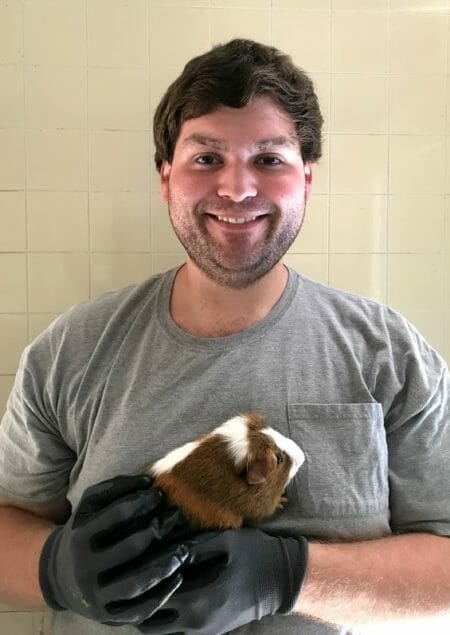
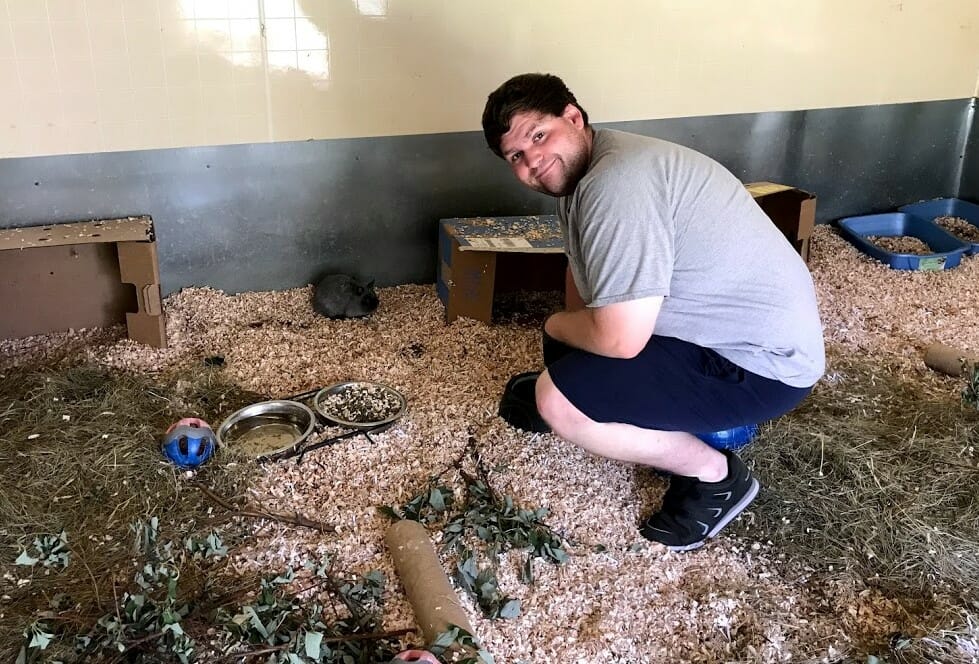
Through Critter Camp Exotic Pet Sanctuary, Alex Randall and his mom, Beth, have cared for over 2,000 animals. /Courtesy Alex Randall
Describe your role with Critter Camp Exotic Pet Sanctuary:
Alex: The sanctuary is on a farm where we live. I feed the animals, do their water, sometimes I feed Pearl, the pot-bellied pig. Sometimes I take the animals out when it’s nice. I lift and carry heavy supplies as I’m doing chores around the farm. I clean the barn.
Beth: We take in animals from the entire country, from as far away as New York, Texas, Florida. These animals are all pets, nothing is wild or caught – they’re the old, sick, aggressive – the unadoptables. We decided early on there was no place for the unusual pets other than cats and dogs to go, they’d often be euthanized, or someone would let them go, or they’d be mistreated. We felt a kinship with the “different” or “outcasts” in society. Having experienced what Alex did with his disability, we decided that different is fine, and that we would take care of the different ones.
What have you learned through your experiences as a volunteer?
Alex: I’ve learned responsibility. I’ve also learned about so many animal species, we’ve taken care of over 30 different species. Lastly, I’ve learned how to help people and animals.
Beth: I’m just amazed by his resilience and his ability to adapt to what needs to be done. Considering his diagnosis, this service should be extremely hard for him, but he’s just risen to every occasion. He sees things that need to be done and he just does them. He has this tremendous empathy for the animals and he wants them to be cared for and happy. I’m so proud of him that he thinks of the animals’ needs before his own, and because he wants to, not because he has to.
I know this might be hard, but which animal is your favorite at the sanctuary?
Alex: All of them (laughs).
Beth: He has no favorites, he honestly doesn’t. Out of the animals, Rambo the Sulcata Tortoise loves him a lot. She always goes out to him, probably because he’s the one who always takes her out when we have nice weather.
Share one personal story with me from your volunteerism.
Beth: Every one of the animals that comes in has a story. Some of them are starving to death, some of them have been abused. Some have illnesses that haven’t been treated. Each one, especially those with extra needs that we make a difference for, impacts our lives and makes us feel like we’re doing the right thing.
Animals ranging from guinea pigs, rabbits, tortoises and turtles, hedgehogs, lizards, sugar gliders – even one alligator – have been cared for at the sanctuary./Courtesy Alex Randall
Tell me about one of your more unusual pets.
Beth: We cared for an alligator for one week, he was 3.5 feet long, and a man from a neighboring town won the gator in a card game. The animal, named Ray, was living in the man’s living room in a giant tank, eating shrimp. His wife was terrified that the alligator would hurt her baby, and wanted it out of the house, so the alligator came to us. I went to pick Ray up at the house, the man tossed him in a plastic tub into my backseat. When I asked if the tub would hold the gator, he said, ‘well you’ll be the first to know if it doesn’t hold him!’ We found an alligator relocator who took Ray back to Florida.
What do you want people to learn from your story?
Alex: How to deal with challenges.
Beth: Our story is about helping someone or something, and how that also helps you personally get through a challenge. When Alex started taking care of the animals, it was a tremendous way to help him heal. By caring for these pets at the sanctuary, he was able to recover, grow and feel strong again. That’s a lesson we believe many people can empathize with.
How can readers help?
Please check our website for more information about how you can help: http://crittercamp.org. We also post regularly to our Facebook page: https://www.facebook.com/CritterCamp/, and you can find updates from Alex here: https://www.facebook.com/alex.randall.7543.
Detective Helps Bridge Gap Between Community and Law Enforcement
For Anthony Roberson, his job as a detective in Providence, Rhode Island doesn’t end when he clocks out of his shift, nor do his duties lie solely in police investigations and arrests. He believes his job is also to help build and maintain a positive relationship between his city’s law enforcement officers and community members.
This mentality toward his work has led to Roberson, who is a 17-year veteran in law enforcement, creating and implementing community initiatives focused on providing support for Providence’s youth. Several times a year, Roberson organizes events to provide deserving youth with everything from school supplies to bicycles and helmets, from mentorship to career advice. For over five years, Roberson has positively impacted the lives of hundreds of children, as well as their families, law enforcement and those living in the communities he serves.
For his dedication to going above and beyond his role in making his community a better and safer place to live, Anthony is today’s Daily Point of Light recipient. Points of Light spoke with him to learn more about how his initiatives help kids in his community.
Can you describe the initiatives you are involved in?
I have several initiatives that I do from all throughout the year, for the last five or six years now. One of my initiatives is the Handshake Initiative. I get all male role models and they come from all walks of life — college professors, police officers, detectives, correctional officers, educators, business owners, member of the community, you name it, and they make up my Handshake Initiative. A lot of times these young people, they see on the news a lot of negative media as it relates to people and on social media, and a lot of times they don’t have a positive male role model in their lives to look up to. So I came up with the idea to call upon who I think are role models and ask them if they can come to the school, with a suit and tie or in their uniform that they work in, to greet the kids in the morning. It sounds like a simple exercise but it comes off so great. We line the front of the doors before the kids go in. Two weeks prior to that the principal lets the student body know who all these men are. They get off the buses, their parents drop them off. They funnel in between us, so we’re talking anywhere between 500 to 1,500 students, and we give them high fives, applause, encouragement at the beginning of their school day. It goes off so well. Some of the guys are fathers, some aren’t, but they all turn into fathers that day. It’s really a sight to see. Even the parents who are dropping off their kids, they’re beaming from ear to ear, smiling to see such an image go on. As a follow up, one of those male role models, they get with the principal and the principal selects a group of students who the male role model continues to network with, build with, throughout the school year. I started out with 44 men and it’s grown to just about over 200. It goes off so well. When I think about it, first of all I tip my hat off to all the volunteers, because everybody is busy but I call them and they take the time. Some of the men come with their kids. When you see it, it is a sight to see.
From that one school I did that, so far I’ve done it 17 times in three different cities and I get calls all the time to bring the male role models there.
What inspired you to start the Handshake Initiative?
I’m a detective for my profession, and I often encounter households whether there are either no male role models for the young boys to look up to, or they gravitate toward maybe some local male who happens to not be doing the right thing. Sometimes they feel they have no alternative to turn to, and this is not an isolated incident. In my community, I see it a lot and I know it’s all throughout the country. I wanted these young boys to see there are positive role models, that you’re able to come into law enforcement, education, the criminal justice system, own your own business, to get into governmental affairs. You’re able to become all these things. So once they saw us and interacted with us on a number of levels, I think it really gave them a new perspective. I know if I would have seen that at that age, I would have have been like, woah, what is this? I just never knew.
Roberson high-fives a student during his Handshake Initiative which aims to start students’ days with positive reenforcement./Courtesy Anthony Roberson
Can you talk to me about your other initiatives?
My next one is my Shop with a Cop Initiative. I think in order to reach short-term objectives and long-term goals for the community at large, they have to be done together. So in addressing community relations, I wanted to strengthen the relationship between law enforcement and the communities they serve. So I had an idea. I went to a small business, because small businesses are a part of the community. I told them I wanted to pair up police officers with kids from all around the city and engage in a shopping spree, and if they were willing to offer a dinner for two for me to raffle off. They said absolutely yes, so that way I got the small business involved. Then I went to a large business because they’re also a stakeholder. I’ve done this at Walmart and Old Navy, but the first time was at Walmart. So I went to Walmart, I sat down with the people in charger over there, and I told them exactly what I wanted to do. I wanted to have that shopping spree at Walmart. They were like woah, we’re in, absolutely. They even threw in a little grant money. So my next steps were to raffle off the dinner. I went everywhere and raised enough funds in order to give approximately 25 kids — this is the first time — 150 dollars each to go on a shopping spree. When it came to the police officers, I called them one by one, ‘Hey, what are you doing Saturday? Do you mind pairing up with a kid, take him shopping, talk to him, give him some advice?’ They said absolutely. My next step was to go to every school within the city of Providence. When I went to every school I asked the principal or the guidance counselor to elect kids, not necessarily with the highest grades, but kids really doing their thing. They’re coming to school everyday and they’re putting in the work. I taxed them with selecting those children. So that way I got another stakeholder involved, and that was the schools. Of course when they selected the kids, they have the legal guardian or parent come with the kid.
My thought process was — the shopping spree, absolutely great, it was needed, because Providence is a poor community. It was needed. My mission and goal was to have all these stakeholders in the same place and at the same time interacting with each other. The day of, at Walmart we had almost 200 people. The teachers came, the small business owners came, we had 30 police officers, dozens of kids, and I paired them all up. The shopping spree was great but it was that interaction. I wanted the kid to humanize the police officer as much as I wanted the police officer to meet that kid, and meet him when something is not happening, he’s not responding to some call for service or type of emergency. It went off great, it went excellent. My first one was about six years ago. I’ve done it every year since, twice a year, over at Walmart and Old Navy. Those relationships with those police officers, to this day, they say ‘Oh, I keep in touch with this kid, I keep in touch with that kid.’ I think the takeaways are beneficial for everyone.
I have my Leading Ladies Initiative. I thought attention is needed everywhere, and I thought, man, not that it’s not needed, but a lot of the attention goes to the boys. I thought, you know what, I want to do something for the young ladies out there. So with my Leading Ladies Initiative, I selected women from several professions, 12 all in all. Real estate, banking, education. I partnered these women up with the nonprofit world. Then I in turn partnered those women up with young ladies roughly around 16 years of age. I called New York & Company and I told them I wanted to pair up professional women with young ladies to take them shopping in order to know what to wear in a job setting versus maybe going out to have fun. How to conduct yourself, how to speak, how to address people when you’re on a job interview. New York & Company said that’s great, so I got 12 gift certificates from New York & Company and they in part gave somewhat of discount. The day came, I partnered up these women with the young ladies, and they gave them tips on interviewing skills, how to conduct yourself in the work setting, how to speak properly, eye contact, and then they proceeded to both go shopping for professional clothing for the young ladies. That was fun. That was the only one I stepped out because I don’t know anything about the shopping. I said ‘I’ll step back here in the corner.’ But that was fun.
And my last initiative that I do is my Summer Safety Initiative. So with my Summer Safety Initiative, I was able to get some grant money where I selected kids who might not necessarily be able to afford a bike and helmet. I was able to get enough grant money where I got 25 kids from around the city, and we went to a department store where they were able to pick out their own bikes and helmets. In addition to that, I had each child go with a police officer again, because I thought it was a great opportunity to build and mend and strengthen those bridges in law enforcement and the community they serve.
What inspires you to create all these initiatives related to younger kids?
I’ve got to say, when I see these younger kids, teenagers and so forth, inside the community I serve, I see myself. I see myself and I think what could have benefited me during those years of growing up. Not just me, but other people who I grew up with inside those neighborhoods. As I entered law enforcement, I felt I wanted to strengthen those relationships. I’m back in the community, but I’m back in a law official capacity. Of course arrests and investigations are a part of my job, that goes hand in hand. But in the bigger picture, I envision my role as improving the quality of life for others. That’s my role. Those are the tools on my belt. I work for the communities I serve. When the clock ends and I get out of work, I engage in my service. I almost feel like it’s selfish because of the gratification I get out of it. When you help someone and [you see] the joy on their face, it’s invaluable.
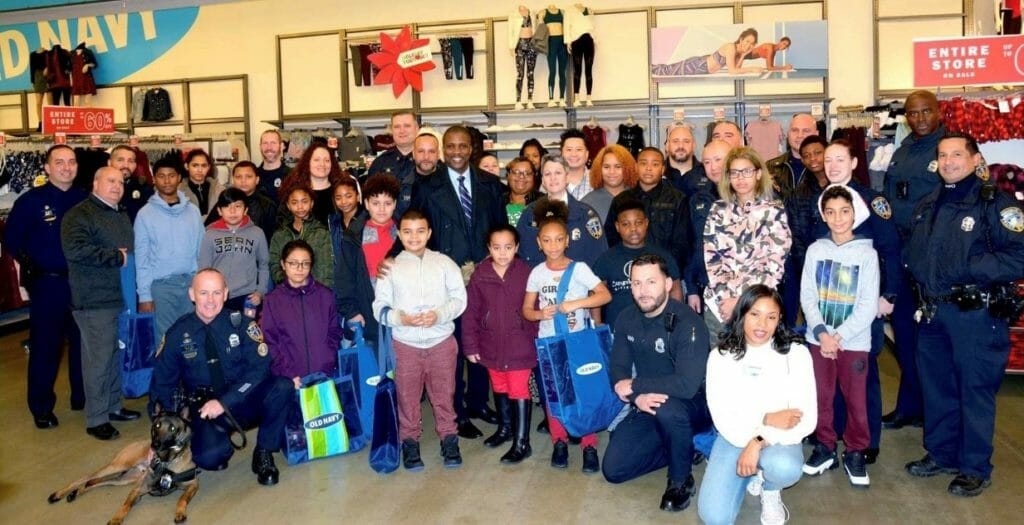
Roberson stands with kids at his Shop with a Cop Initiative event, where outstanding students are sponsored to go on a shopping spree with members of local law enforcement.
Have you seen a longterm impact on the kids who have been a part of these initiatives?
Absolutely. It’s so great. At least every couple weeks I’m bumping into both the kids and their parents who are 10 year olds who are now 15, 15 year olds now in their 20s. They’re coming up to me and, to be honest, I may not necessarily remember them all because you’re dealing with a lot of people and it’s me doing all the organizing of getting everyone together, it kind of goes by quick. But it feels really good when they’re saying thank you for doing that, and just randomly. On another front, these are long term, so we’re talking about months and years later, the families and the mothers and fathers are thanking me as well. I think it lends itself to improving the relationship between law enforcement and the communities they serve as well.
The police officers tell me months and years later that they’re still in contact with these young people and they’re doing good. It’s really amazing.
What’s been the most rewarding part of your work?
The relationships that are built between law enforcement and the community. It’s an intangible result that you can’t quantify, but you see it. It feels like it slightly changes the world’s view in this sense of even some of the officers and definitely the kids and, fortunately enough, their parents as well.
What have you learned through your experiences as a volunteer?
I’ve learned that interaction breaks down barriers. Proximity, although a simple exercise, is not done often enough. When it is facilitated, all those preconceived notions people have of each other fall to the wayside.
What do you want people to learn from your story?
I would want people to learn from my story that helping others is truly a treasure. We all want to do different things in our different professions but at the end of the day, I think during that journey or perhaps toward the end, we want to circle back around and help others. Once you do that, I think you become richer for it.
Husband-Wife Volunteer Duo Commit to Child Safety with Fingerprint ID Kits
Married for 50 years, Al and Lynda Uva finish each other’s sentences, and cheer on each other’s respective successes. After long careers in public safety and banking, this dynamic duo has dedicated their time to keeping their community safe.
The couple volunteer together through the Lee County Sheriff’s Office in southwest Florida to keep kids in their community safe through ID kits. Recording fingerprints, key identifying information that parents can keep as a precaution in case of a missing child or an emergency, Lynda and Al have fingerprinted over 1,000 children in their community thus far. In addition, the two serve on MADD Victim Impact Panels once a month, helping drunk and drugged driving offenders understand the lasting and long-term effects of substance impaired driving. In addition to their joint service, the two both volunteer for their community in additional capacities.
Keeping their community safe, Al and Lynda are positively impacting their fellow neighbors, and are today’s Daily Point of Light award honorees. Points of Light spoke to Lynda and Al to learn more about their volunteerism.
What inspires you to volunteer?
Lynda: Just the idea of helping people. I’ve always worked in customer service (laughs), so people are my thing. Al started volunteering first, and I thought it was a worthwhile project, so I joined. We enjoy ourselves, especially doing these special assignments like child fingerprinting.
Al, you are part of a volunteer group called V.O.I.C.E. Tell me more about it.
In addition to our joint service, I serve as a member of V.O.I.C.E., an initiative designed to help the Lee County Sheriff’s Office provide a higher level of service to its citizens and visitors. V.O.I.C.E., which stands for Volunteer Observers Impacting Community Effort, allows citizens to patrol as extra eyes and ears in community neighborhoods, and enables law enforcement details to respond to more serious calls for service. I am a retired firefighter, and I wanted to get back into the action. I’m on the air all day, so if there’s a crash, I respond to the crash. I help with traffic control at fires, crime scenes, parades and events.
Describe your role with MADD:
Lynda: We serve on MADD Victim Impact Panels at the justice center in Fort Myers. Al oversees things for the panels to support staff, and I help out with registering attendees. These are the people who get DUIs, ect. and they want to get their licenses back. In order to do so, they are court ordered to attend the victim impact panels.
Al and Lynda Uva standing at home plate at JetBlue Park for a MADD function./Courtesy Al & Lynda Uva
What have you learned through your experiences as a volunteer?
Al: I didn’t think we’d ever volunteer like this. People look at you and say, you’re not getting paid? What are you doing this for? I do it because I wanted to help people. And we are doing just that.
Share one personal story with me from your volunteerism.
Lynda: I enjoy fingerprinting the children for their ID kits. We have so much fun with that.
Al: There was one event at JetBlue Park in Fort Myers, and Lynda fingerprinted Red Sox mascot Wally the Green Monster’s sister, Tessie. We believe in fingerprinting because it keeps kids safe. I’ll fingerprint anything. I will fingerprint a paw if a dog is walking by. When we go out, and we’re doing something like this, we get five times as many fingerprints as what anyone else gets.
Lynda: Al explains everything to people. A lot of people don’t understand that the child fingerprinting is for their information. You take this ID kit home, and you have it in case your child gets lost.
What do you want people to learn from your story?
Lynda: The importance of giving back to the community. In the past, we’ve done volunteer work here and there. But this, and our impact, to me, is astronomical. It makes you feel good, being able to do these things. It’s also given me a completely new outlook on our community and how to help people.
Al: I would never think I would have done something like this, but we are, and other people are joining us. We have people retiring from the sheriff’s department, and joining V.O.I.C.E., because of the difference we are making.
How can readers help?
Lee County Sheriff’s Office is always looking for more V.O.I.C.E. volunteers. Please visit their website for more information about how you can help: https://www.sheriffleefl.org/join_us/positions/v_o_i_c_e_volunteers.php.
Texas Woman Celebrates Over Thirty Years of Service
Lucy Gonzales says she feels the best medicine in the world is serving others. If that’s true, she may be the healthiest woman in Texas.
With over 30 years of service under her belt, Lucy was so ingrained into volunteerism throughout her Texas community that it was a no-brainer when it came to her joining the Houston Lady Lions. The Lady Lions are part of the Lions Club, an international nonprofit
organization that connects volunteers throughout their communities, and is run by women who are invited to join on inclusive invitation based on their volunteerism. After spending several years working on behalf of veterans — she is currently the Director of Government Affairs for the Veterans’ Association of Real Estate Professionals’ Houston chapter— as well as volunteering for the Ronald McDonald House, Lucy was asked to join the Lady Lions just two years ago and is currently serving as their President. The Lions’ motto is “Where there’s a need, there’s a Lion”— and that need has brought them to feed the homeless, gather school supplies for underprivileged children, raise money for the blind, pay tribute to veterans, serve families staying at the Ronald McDonald House, ‘adopt’ those in need from a sick child to a homeless WWII veteran, and so much more.
There are currently 40 members of the Houston Lady Lions, but Lucy’s goal for this year is to expand to 100. If you are interested in learning more or want to get involved, contact Lucy for more information.
For the countless ways she has dedicated herself to her community over the past three decades, Lucy is today’s Daily Point of Light Award recipient. Points of Light spoke to her to learn more about the many ways in which she volunteers.
Describe your volunteer role with Houston Lady Lions.
I got my passion for serving when I was very young. My dad was military, World War II and Korea vet, and my mom was from Italy. She did a lot of volunteer and mission work in Italy. As of right now, I am currently serving as the president of the Houston Lady Lions, I am serving
as the [director of] government affairs [for] VAREP for the veterans, so I go to Washington and speak on behalf of the veterans, and then also serve on the board for a different educational piece where we go out and teach homeowner education to … people who think maybe they can never afford a home. But the passion really from being president of Houston Lady Lions last year — I just got reelected to another term this year — was partnering with other organizations in the community to bridge them together in order to serve more people. That’s been something thats been very dear to my heart.
Just to give you an example, I was serving the Ronald McDonald House. This was my 17th year, I do it every month of May for my birthday ever year … I get stuff collected for the house and then me and my group go cook food in the house, depending on what group I’m in. I
was able to get the Houston Lady Lions to adopt that project so now there is more of us serving that house. We just went there in May and cooked for the kids and their families that are staying there, which was 65 of them. We donate all the food, we go over there, we cook, we get to visit with them, we had over 150 toys donated to the house where all the kids get toys and all the leftovers got donated to their store so that other kids can go pick up a free toy [when they are] visiting the house. Also, our 94-year-old World War II veteran’s home got flooded out in [2017’s Hurricane] Harvey. FEMA came in and gave him money and a contractor came and took the money. So we partnered with several veterans organizations. We were able to get his home rebuilt to the condition where it was livable again, safe, sound and sanitary. People came in and gave us free room, gave us free electrical throughout the house, another group donated 5,000 dollars. We’re just in awe of all the partnership and how it was able to work and it took us approximately three months to do.
We do so much with the Houston Lady Lions but all the stuff I brought to Houston Lady Lions, I was doing before I became a Lady Lion. That’s why they reached out to me. They said, ‘Hey, we see you out in the community, you’re doing all this, why don’t you become a Lion and now you’ll get a group with you?’ And I’m like, that sounds great. So I have been able to increase membership in Lionism because of my service. Now women want to join our group everywhere so they can be a part of our platform. When the [20180 Santa Fe shooting happened, we were there to set up a memorial, we got wooden roses carved for each of the families, we had over 5 million views from CNN throughout the country on their web, just from us being there trying to do that. It just speaks volumes on how smaller people can go and extend worldwide just with an act of kindness. And that’s the message that we want to send, that every little thing that
you could do to help someone is an act of kindness that can be contagious for others to want to do.
We’re part of Team Mason, who is a little boy who is five-years-old. He was born very sick. He’s already had over 16 surgeries, he’s going to have another one in August. We rally around him at every surgery, after surgery, with his family and all that. These things are really
happening right now and my only goal is [to explain] that kindness matters. And today’s world, when all you hear about is the heartache, there’s really good things going on in the world. Together, no matter what group you join, or where you want to be, you can make a difference and it doesn’t cost much.
How do the Lady Lions decide what areas to volunteer in?
As the Lady Lions, our motto is, ‘Where there’s a need, there’s a Lion.’ We serve. Lions have been around for 102 years. We just had our first woman international president last year. She came up with the new initiative called New Voices, which meant women in Lionism have a
voice to show that we too can do more in the community if we champion one another. We can make the world a brighter place. So what we do is we have our Facebook page — our website is being renewed right now — where the community actually can come to us and tell us of an event or something out there that’s happening and then we vote to take it on. Automatically as Lions, we do something for diabetes, for the environment, for childhood cancer and for the blind every year. Those are our four major focuses. But as president of the Houston Lady Lions, I wanted to not only do just those four main events, that was our core, but I wanted to know from the board and from the community what was it that we could do to bring change into the community.
For example, we just built over 50 purses with personal hygiene items for the homeless women so they could pick up a purse and there would be their womanly needs from toothbrush to toothpaste, to hairspray, to brushes, to feminine hygiene products and so forth, so that they have something they can at least start out with. We also partner with the schools where maybe they come in and say, ‘Hey, we need our kids read to during story time,’ or ‘Hey, these kids are really need of supplies,’ so we go out there and partner with our other Lions’ clubs to sponsor.
Right now we’ve done it for the last three years, where they fill over 10,000 backpacks for kids. The Lady Lions go and support them by stuffing the backpacks, by handing out the backpacks to all the underprivileged kids before school starts. We adopted a home where the parents are not with the kids but say their grandparents are, or their aunts are that are elderly, and these kids need underwear, socks, pens, papers, just whatever it is, haircuts, and we go partner with that group so we can provide the stuff that they need.
When Harvey hit, we were in the streets as soon as we were allowed to go through, donating food, water, whatever they needed for the kids, pampers, milk. We actually adopted families where we took families on shopping sprees during Harvey so they could have
something, the necessities of shoes, a shirt. A lot of these people lost everything. I really was in awe to see these little kids. When we’re like ‘Hey, what do you all want?’ and they’re looking for shoes or underwear, not toys, not games, but something that necessity-wise they need to get by. When you see all of that, it just makes you want to do more and we just feel like ‘stop’ is not in our vocabulary. I tell my women, we may not all be able to go to one event, but together we can make an impact. Some of us go to all events … like for the environment one, we pick a beach and we clean the beach for that day. And somedays when we go, we pick up 10, 15, 20 bags of garbage just along the beach.
Can you talk about what you do for veterans?
I got involved with the veterans because my dad was a World War II vet and Korean vet and at a very young age, he taught me how to respect our veterans by always shaking their hand, acknowledging them. As I got older, we would always go out to an appreciation veterans thing when it was Memorial Day, when it was Veterans Day, or even Wreaths Across America. On Christmas we go and lay wreaths across the veterans’ graves and Veterans Day we go put flags on their graves. So it was very young that I learned how to respect our military and I was able to bring that to the Houston Lady Lions. We do the Wreaths Across America, we go out and put the flags up. This past Fourth of July, the Lady Lions were at the Fourth of July parade, in the parade, sitting with the World War II veterans, thanking them for their service, being a part of the community, handing out the flags and candy to the kids, always making sure that people understand how important it was for our military. Even today, the ones that are serving, we donate time to put packages together to help another organization send to our military overseas.
We’re really big on our women veterans. They kind of get overlooked a lot, so this year we just now got three military veterans to join our Houston Lady Lions. So we’re excited about that. One of them just became the director of our veteran project, so we actually go out there, find out what projects are being done for our veterans, where the need is, and then we help them do that. Mental health isn’t really a big thing that people talk about with veterans, they don’t want to talk about it. So me and my vice president just signed up to take a course called mental health awareness assessment, so that when we’re dealing with our veterans, we’re learning about who we may need to refer them to. We believe through education, we become a more powerful team and we are able to help that many more people. We are trying to raise awareness from veteran homelessness, to mental health is good health, meaning that we have people that can help you. We know that veteran suicide is on the rise and right now the suicide rates are higher in women vets than men vets. We also learned that if they get a service dog, their chances of contemplating suicide go down tremendously so we’re working with and partnering up with …different organizations to try to identify veterans who can use the service dogs because they’re
really expensive.
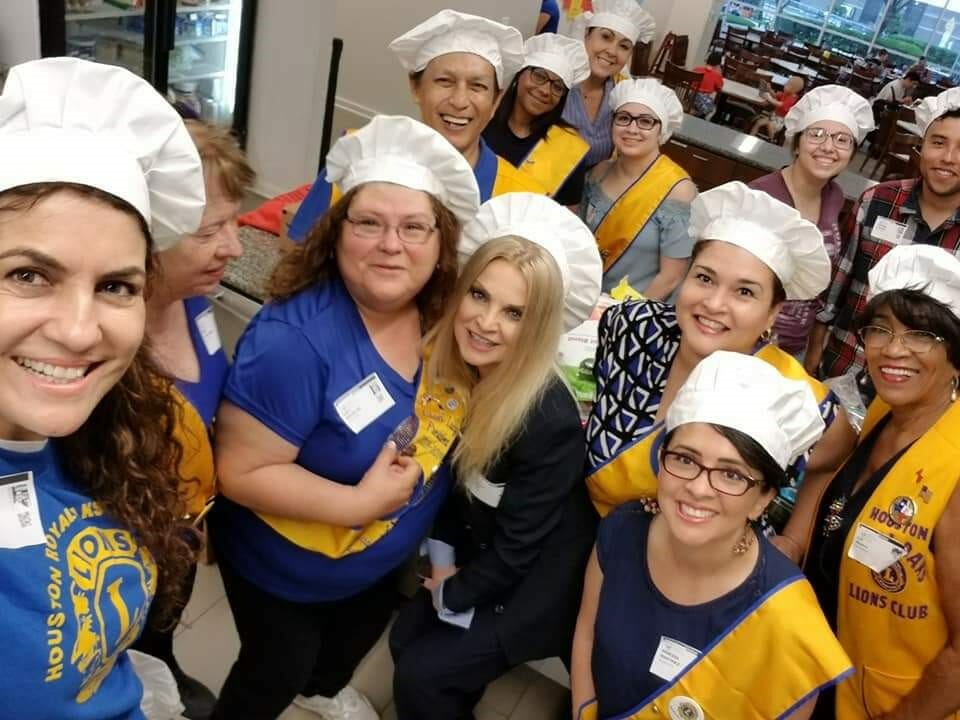
Lucy, third from left, stands with her fellow Houston Lady Lions at the Ronald McDonald House where they serve food to the families staying there. This was the 17th year that she used her birthday month to serve at and raise awareness for the charity./Courtesy Lucy Gonzales
Can you talk about the advocacy work you do for veterans?
I’m actually the Director of Government Affairs with VAREP, which is Veterans Association of Real Estate Professionals. We are an organization that will go and champion on behalf of veterans in order to change policy that would be in their best interest. For example, a
lot of the lenders and the real estate professionals try to tell the veterans not to use their VA benefits or they don’t even discuss their VA benefits. So the veterans, instead of going in with zero move-in, they’re bringing money to the closing table. They’re putting money down because a lot of people believe that the VA lending is a harder loan to do, so instead of offering what is rightfully theirs, they choose to say ‘hey, lets look at an FHA or Conventional [loan].’ We’re trying to change policy now that would put light on the lending institution, the real estate professionals, to where they gather that information if that buyer was a veteran at that closing. And if they were, they’re going to document it, and if they didn’t use their VA finances, they’re going to want to know why. And if it wasn’t explained tot them, then our people go back out there to find out hey, why wasn’t this veteran offered these benefits, because we’re trying to make them become a protected class. That’s what we’re working on now.
Are there any future partnerships, programs, or events that you are excited about?
Absolutely. Right now what we’re doing is we partnered up with the Harris County Sheriff’s Department. They are hosting a Sweat IV Vets run for October 27th that people need to start singing up now so they can do the run. It’s the sixth annual run, and veterans and law enforcement and even the community can go and sign up for this run where they’re raising money for nonprofit organizations that go out and champion the vets, which is what we do.
The other thing that we’re going to be doing July 20th … is we’re going to be serving the homeless at the Loaves & Fishes Soup Kitchen. We’re really excited about that because our newest Lion brought that to our attention last week and we have so many responses where people want to do that. We’re so excited because we had never done that before and now they’ve brought this to our attention so now we’re going to be doing that with them.
Another thing that is going to be coming up in September and October is our annual Hats and High Tea. Last year, the money we raised went to the National Federation of the Blind, The Rose and Camp Hope and we gave each of them 2,100 dollars. This year we’re trying to expand the people that were giving to and we’re also trying to increase the amount that we give them. The Hats and High Tea event is where everyone gets dolled up as if they’re going to high tea, we have raffle tickets that we sell, we have silent auctions, just to raise money for these events. The people we give the money to, the ones that we vote on [to raise money] for the nonprofits, normally are present, they have a representative there. We have a lot of fun things, we have a photo booth, we have different baskets that have been donated and then we do recognitions there throughout. It’s a real fun event that’s normally on a Saturday afternoon or early evening that everyone comes and participates in. We ask all the community to come support us. We’re normally on Deborah Duncan’s [KHOU] show, because she’s a real big supporter of us that
always talks about the Hats and High Teas.
What’s been the most rewarding part of your work?
The most rewarding part is just seeing the smiles on the faces of the people we help. To give you an example, I was notified about the jacket drive the night before the jackets needed to be delivered. There were, I want to say, 50 kids in need. I put out a call to action, got 55 jackets
donated, and gave them to the lady who really needed them for the school. She goes and gives out the jackets to these kids and she’s texting me, ‘I’m crying so much,’ and I’m like ‘What’s wrong?’ I thought we got the wrong sizes. And she’s like, ‘These kids are asking me, do they give them back to me at the end of the day? And I’m telling them no, you get to keep them, and they’re just in tears.’ Some of them we asked, ‘Hey, for Christmas, what do you want?’ And they said, ‘My only want was a jacket.’ You know, we’re talking about eight-, nine- and ten-year-old kids and all all they want for Christmas is a jacket? You can’t help but be moved, because what you’ve done is give them something they’ll remember and one day they’ll want to pass that down and pay it forward.
What have you learned through your experiences as a volunteer?
I learned that through volunteer work, it can make you become a better version of yourself. When you thought or think you have no more energy or time left when you’re serving and volunteering, you always manage to find the time. I don’t know how to explain that. Before I
used to think, well I’ll always been volunteering, [but] I think I’ve taken it to the 10th level if you will. You always think alright, I can’t go to a meeting, I’m too tired, or I’m not going to make it or I’ve got this to do. We have brought on so many activities that the Lions in our group
are like, ‘Oh my God, you make it so easy to serve.’ And I think the key important thing is that people have work everyday, they’re moms, they’re wives, they’re families, everything — but if you say, ‘Hey, you can be a part of our group and if you can’t make it to that event, don’t worry, we’re having another event tomorrow, one next week.’ There is always something for someone to be doing and I think that’s the most beautiful thing of it all, is being able to redefine who you are when you’re helping other people.
I’ve been doing home loans for veterans and first-time home buyers, single parents, people going through bankruptcy, and foreclosures for 36 years. But … when you go into Ronald McDonald House and you see those kids that need a liver transplant or a lung, brain surgery, there’s nothing in the world that’s more urgent than praying for someone to get through what they’re going through. It kind of brings you back into reality. So many people today are like ‘Oh, this has to be done, that’s going to be done, it’s all urgent,’ but there’s nothing more urgent than championing these little people for survival. And that’s what I’ve learned and I use that in my everyday life. I don’t let everyday things get to me because I have to put it in perspective. When you keep your life in perspective to make it a reality of what others don’t see on a day-to-day basis, it’s easier for me to tell someone that’s upset, ‘Look, I get it, you’re frustrated, but I just got back from serving kids who are waiting to go through brain surgery or have a hole in their heart.’ And you know what they say? They say, ‘Lucy, you’re right, how can we help you?’ So I think it’s important that we deliver a message to others that you don’t have to be rich to give. You don’t have to be a millionaire. You have to just have to have an ounce of care to want to do things for others, whether it’s [giving] time, whether it’s [giving] money, or whether it’s just picking up a book and going to read at the library to kids who don’t have anyone to do that.
Alaska Woman Serves Vulnerable Youth through Fun Activities
Christina Young says the young adults who end up on the streets in her community aren’t degenerates, and they aren’t someone else’s problem. The community shares responsibility, she says, for supporting them in any way possible.
Not willing to write these vulnerable young adults off, the 55-year-old Anchorage, Alaska resident has volunteered with Covenant House Alaska (CHA) since 2014, where she supports staff in offering fun activities for homeless kids in crisis. A safe place offering compassionate, sustainable services and shelter, CHA gives homeless or at-risk youth respite from concerns in their lives that no child that age should have to deal with, Christina says.
Fostering meaningful connections and serving as a support system, Christina is encouraging young people to believe in themselves and make smart choices for their lives, and is today’s Daily Point of Light award honoree. Points of Light spoke to Christina to learn more about her volunteerism with CHA.
What inspires you to volunteer?
I strongly believe that volunteers are what move our world forward on so many fronts. Whether it be the environment, political process, helping the homeless or in this case, vulnerable teens. I was raised in Alaska, and had a good friend who could have ended up in a shelter, was it not for a family member who stepped in. I think of her when I volunteer, because this is a population that so desperately needs our support.
Describe your role with Covenant House Alaska (CHA):
I attend their evening activities, and am currently assigned to support the staff in the art room. CHA offers activities in the evenings for youth, including art, gym, guitar, and more. While I’m there, I’m cleaning up the art room, sorting through donations, answering questions from youth about our supply. I let the young adults initiate a conversation with me, if they’d like to talk, I’m there to listen.
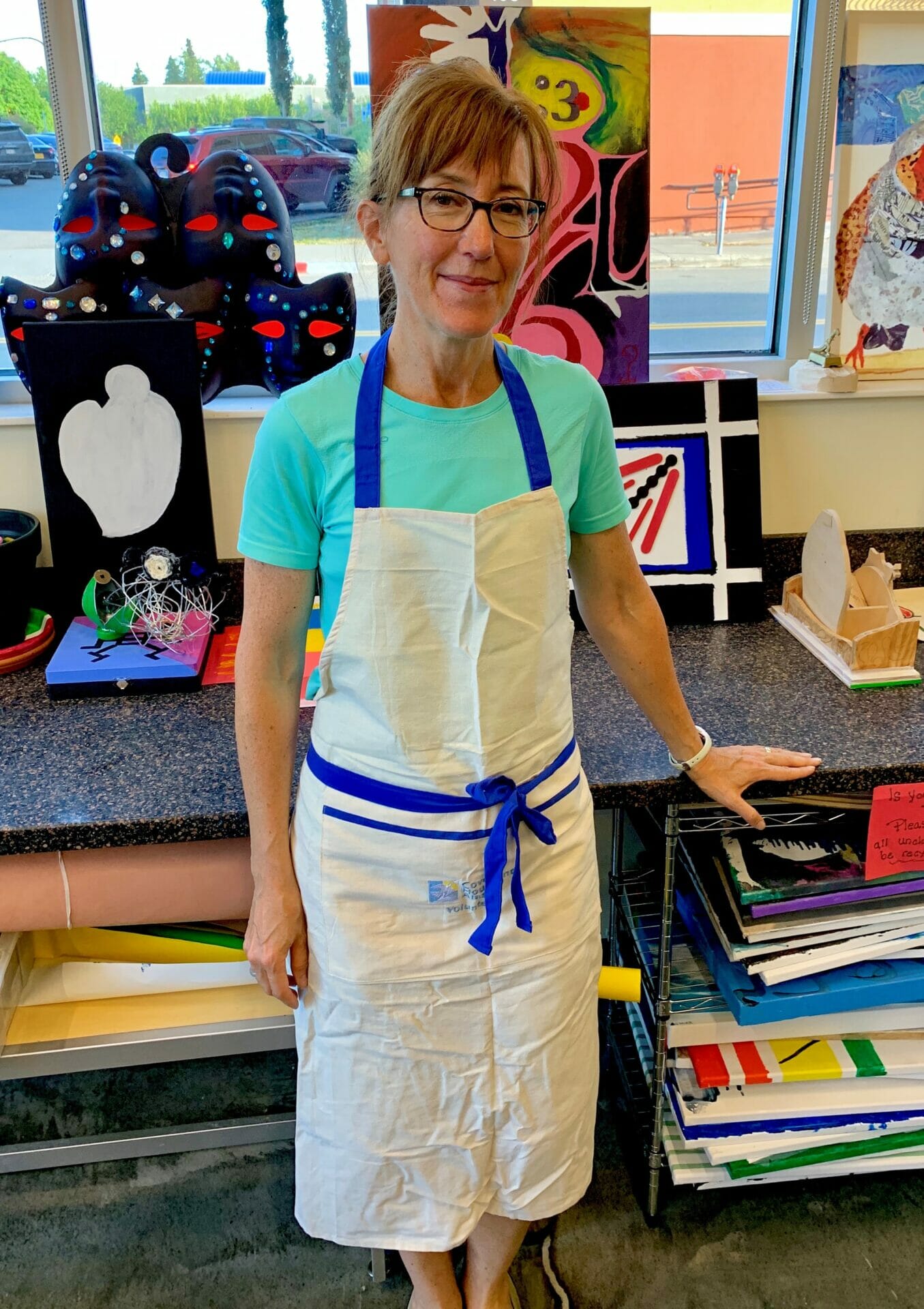
Christina Young has been volunteering with Covenant House Alaska since 2014, and currently supports staff during their art room activity. /Courtesy Christina Young
What’s your personal motto?
A quote often attributed to Mahatma Gandhi: “Be the change you want to see in the world.” Whether it’s two hours, four hours, or more, physically volunteering and giving your time is important.
What have you learned through your experiences as a volunteer?
Consistency is key. Showing up, offering your help and participating in service is so valuable.
Share one personal story with me from your volunteerism.
Sometimes there are canvases in the art room that are halfway done, or discarded. Last month, I found a really high-quality canvas that hadn’t been used. One of the young adults that attends many of our activities is a fabulous, young, budding artist. I pulled out the canvas for him, and said I thought they could really do something with it. It was so exciting because the piece of art was manifesting into something they really loved. This is a vulnerable population, they are people that want to really be seen. This is the prime of their adolescence, they should be worrying about what color shorts to wear to go play ultimate frisbee. Instead, they’re worrying about not being able to go home.
What do you want people to learn from your story?
Be present. Be aware and engaged in what conversation is happening in your community. Identifying and recognizing vulnerable populations in your community is critical. I’ve really been enlightened by some of the young adults I’ve met through my service.
How can readers help?
The most valuable asset is people’s time. CHA offers evening programs for young adults, but even more could be provided if they had more volunteer support. Please check their website for more information about how you can give back: https://covenanthouseak.org/.
New York Native Paying it Forward By Mentoring At-Risk Youth
Willie Herrera says he grew up poor in a community on Long Island, but was shielded from the dangers of the New York streets because of strong role models in his life. His dad, a first-generation American, counseled Willie to never forget where he came from, and help those in need.
Today, the Winston-Salem, North Carolina resident is keeping that promise to his father, by serving at-risk children through the Hispanic League ESL Middle School Achievers program. Originally created to motivate Hispanic children in academic settings, the program now targets all students in middle schools across Forsyth County, North Carolina who speak English as a second language. Regardless of what country they are from, these children are receiving crucial support from positive and influential adult role models, which promotes higher graduation rates and future success.
In addition to his service as a mentor and board member for the Middle School Achievers, Willie works with other organizations to keep kids in his community off the streets and on a positive path, and is today’s Daily Point of Light award honoree. Points of Light spoke to Willie to learn more about his volunteerism.
What inspires you to volunteer?
I support our kids because I see myself in them. I grew up in an impoverished community on Long Island, New York, which was riddled with crime, gang activity and drugs, except, I didn’t realize until I was older that I lived in a bad area. I had positive role models around me that kept me out of trouble. I look at the kids in my community now and think, that could have been me. I went on to have a long career as a police officer and a volunteer firefighter, and I was lucky that I stayed on the right path because of the mentors in my life.
Willie Herrera is a volunteer driver on Sundays with H.O.P.E. (Helping Our People Eat) of Winston-Salem, where he delivers healthy meals to kids who live in food deserts./Courtesy William Herrera
Describe your role with the Middle School Achievers program:
We transition middle school students into high school, and continue to mentor them and offer support through high school. The program is designed to show these kids that they can succeed in the community despite language and cultural differences.
You support kids in your community through other efforts as well. Explain.
I was selected to serve on the Winston-Salem/Forsyth County Gang Steering Committee, which targets youth at risk for joining gangs, and steer them into productive activities. I mentor and work with youth to teach them the struggles I went through, so that they can hopefully learn from my experiences. Through my volunteerism, I’ve helped over 200 kids between North Carolina and New York.
What have you learned through your experiences as a volunteer?
Like they say, “It takes a village to raise a child”. Everyone has to be on the same page to work together and support these kids, and help to connect them with available opportunities. We are here to show them there’s more out there than just the streets.
Share one personal story with me from your volunteerism.
Just as much as children need positive female role models, they need male role models too. A kid that I worked with was a hard core gang member, and I never gave up on him. It took seeing a close friend killed to open his eyes to what his life would be if he didn’t change course. He went back to school, became a social worker, and while in college, he started a youth organization called S.T.R.O.N.G. Youth. I serve on the board of directors for this organization, which specializes in youth and gang violence prevention and intervention. This man could be working in the private sector, making good money, but instead, he’s giving back to his community, and helping others.
What do you want people to learn from your story?
Always pay it forward. Remember that it’s your community, and whether it’s gangs, or homelessness, food deserts or elderly citizens that don’t have support, we need to be there for them. For example, every Sunday I drive a food truck to the food deserts we have in our community, through H.O.P.E. (Helping Our People Eat) of Winston-Salem. There are so many different problems that are going on in our communities, you must get involved and help out wherever you can.
How can readers help?
In September, the Hispanic League will hold its annual fiesta. Please check our website for more information about how you can help: https://www.hispanicleague.org/.
Texan Woman Gives Back After Facing Her Own Hardships
Charbra Richardson knows what it’s like to fall on hard times. The DeSoto, Texas resident and mother of two found herself living in one of Buckner International’s transitional programs not long ago. After struggling with figuring out what to do next Charbra received a phone call from Buckner, a ministry dedicated to the transformation and restoration of the lives, offering to help and essentially changing her life.
Today, Charbra gives back to her community as a childcare provider with Bucker,in addition to volunteering with a local artist once a month. Charbra helps watch children while their parents are in training. Parents who like her, may be going through difficult times and are getting back on their feet.
For her dedication to service and commitment to her community, Charbra is today’s Daily Point of Light award honoree. Point of Light spoke with Charbra to learn more about her volunteerism and her service work with Buckner.
What inspires you to volunteer?
I love ministering to others. When people see the love of God in you when they have no hope that He is even listening to them, brings me joy. My reason for volunteering for Buckner, however, is a personal one. I have received lifesaving and life changing help from Buckner when I was at my lowest point as a single displaced mother of 2. I made it my own personal promise to do whatever was needed in order to give back, be a service, and to lighten the load in any way I can.
Describe your volunteer role
I am a childcare provider. I assist the Buckner staff in caring for the children of the programs that provide much needed training to enrich the lives of the parents and family members that care for them.
The most rewarding part of your work?
I get to work with the babies! I also provide the Buckner staff with a level of comfort that is needed and not always given. They have to count on the generosity and time of other people. It’s my pleasure to serve them with dependability, knowledge, and love. I love that I can serve as well as lead. I get to see panicky parents and children calm down and form new friendships, share experiences and enjoy the loving environment that we provide.
What have I learned through your experiences as a volunteer?
I would say patience, value, and dependability. I have worked with children for over 30 years and most people would think the patience is for them, but it’s for me. I always feel the need to be perfect, be a superwoman, and never let anyone down, that I put a lot of pressure on myself, and when it doesn’t go right I feel great disappointment. I have to tell myself that I can only give myself and it will always be enough. I value the friendships, strong bonds and the love of the smiles that I minister to. I value myself as well, my time and heart are the 2 commodities that are unique to me, and because I value them, I make sure that the ones I share it with value it just as much. Dependable is such a boring word… but not in volunteerism. I pride myself in being dependable in all things. If I don’t show up the load just got heavier for everyone else involved.
Are there any future partnerships, programs or events that you are excited about?
I also volunteer with a local artist once a month. After set up and making sure everyone has been served I get to create my own art and fellowship with others in the class. I look forward to these classes, it provides another avenue to learn patience with myself.
Why do you think it’s important for others to give back?
The cliché answer to help those in need, or which came first giving back or paying forward? Giving back is really not as important as paying forward in my opinion. When I fell on hard times I felt lost and confused. I refused to ask for help and when I had no other option, I didn’t know who to ask without strings attached, demands to pay it back, and the guilt and shame for needing the help. Buckner made it a natural exchange. They gave to me and my family and I give to them and their families. Giving back helped me to remember and paying forward made me a better person. I positioned myself to give back by applying; I’m paying it forward every time I come back and give of myself.
What I would love for people to learn from your story?
Be your own Super Hero and go out and save the world. We all need your brand of you to make us better.
Bookworm Launches Student-Run Organization Committed to Global Youth Literacy
From a young age, Andrea Liao says she was raised between the pages of her favorite books, experiencing vast literary worlds alongside protagonists from “Harry Potter” and “Wuthering Heights”, the voracious reader satiating her appetite at her second home, the library.
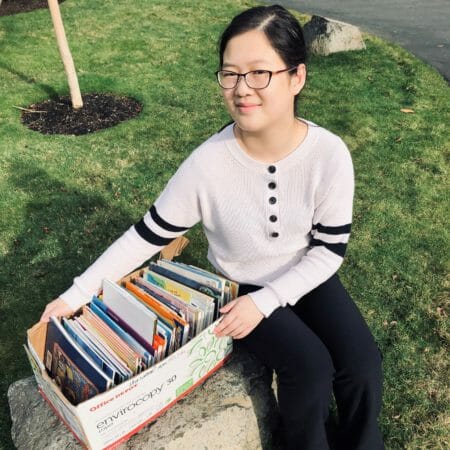
After learning that not all kids had access to books like she did, Andrea committed to providing reading opportunities for children worldwide, launching Book the Future as a freshman in high school. The now 16-year-old Bellevue, Washington resident serves as president of the organization, which is dedicated to global youth literacy. Through book drives, literacy campaigns, read-a-thons and more, Andrea is providing disadvantaged children the resources to achieve literacy proficiency, and giving them the agency to improve their futures.
Committing to service through a personal passion, Andrea is sharing hope with thousands of children around the world that experience low literacy rates, and is today’s Daily Point of Light award honoree. Points of Light spoke to Andrea to learn more about her volunteerism with Book the Future.
What inspires you to volunteer?
I am trying to reach as many kids as possible to provide them more reading access. Books have always been an escape for me. It makes me really happy that I get to impact so many children, and I hope they come to appreciate books as much as I did growing up.
Explain What “Book the Future” Means.
It’s a play on words. “Book the Future” will give youth the agency to shape their own futures by providing literature. I believe that every child should be able to grow up in an environment with ample access to reading resources.
Describe your role with Book the Future.
As founder and current president of Book the Future, my main initiative is facilitating book drives for donations. We have donated over 4,000 books to various charities worldwide, and impacted over 7,000 children thus far. I work with organizations around the world to determine their needs, and identify what books they are looking for. I also conduct summer read-a-thons, writing workshops and summer literacy camps to provide access to reading resources in my own community. We also produce a digital-format magazine featuring pieces submitted by teen activists.
Andrea Liao pictured making a book donation delivery. /Courtesy Andrea Liao
What have you learned through your experiences as a volunteer?
It’s really important to take initiative, that’s how I got started. Go out in your community and see what you can do to make a difference. Through my passion for reading, I am giving back to my community and beyond, and advocating for change. I believe that youth advocacy is crucial in effecting social change, especially in today’s political climate.
Share one personal story with me from your volunteerism.
I was shocked during my first day at our summer literacy camp. The kids hated reading the instructional books we had from school, and they were reading below grade level. Most didn’t even have their own library card. In comparison, I’ve had one since I was 6-years-old. I decided we needed to make a major change. I went to the library and looked for books that would be more interesting to these kids, ones full of adventure like the books I fell in love with as a child. We coordinated a trip to the public library. As we identified different ways to make reading more entertaining, I noticed the kids became more interested.
What’s the motto for Book the Future?
“A book for every child, a story for every student.”
You recently helped to start a library for children in Ghana. Explain.
I reached out to the African Library Project to see how Book the Future could help with our book donations. I asked to support a primary school because I think all kids should be reading at a young age, and St. Peter’s Primary School in Gbefi, Ghana was selected. We collected books and fundraised to cover shipping costs, and we put personalized notes in the boxes for the kids to read once they received the books. In total, we shipped 1,000 books to start this library.
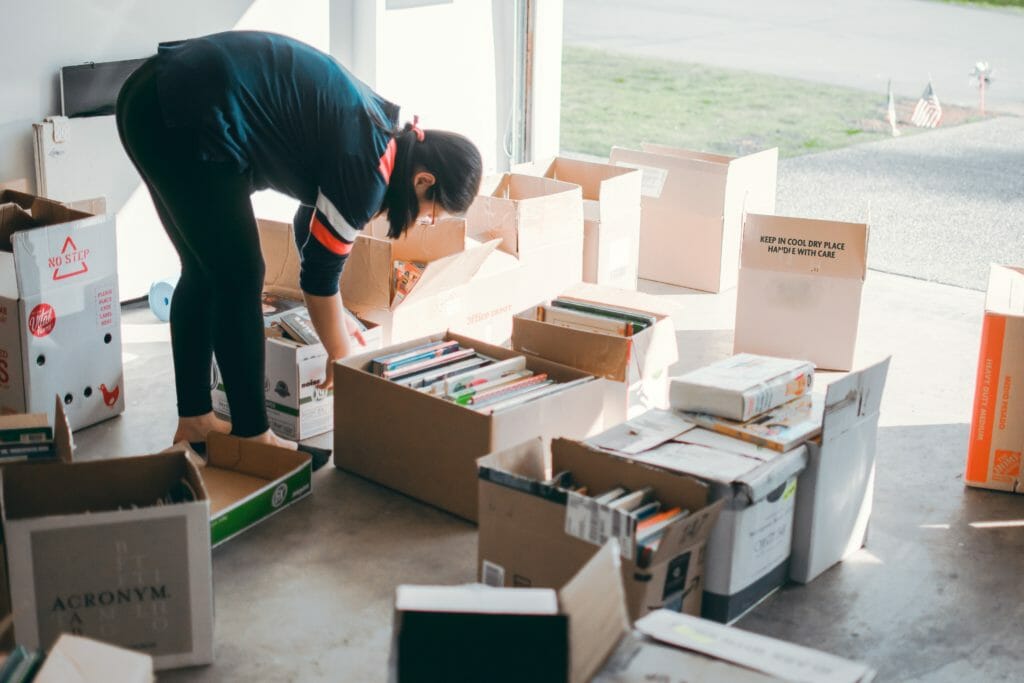
Andrea Liao collects, organizes, and packs books for bimonthly book drives. /Courtesy Andrea Liao
What do you want people to learn from your story?
For other teens and kids who are hoping to advocate for things they care about, know that it’s really important to take initiative and express yourself. I want them to take action and give back to their community.
You’re a busy 16-year-old. What do you do besides volunteering and attending school?
Obviously, I like to read, I also like to write. I write poetry and short stories. I’m a piano player, and I design – I enjoy the arts in general. I am a leader of my city arts council. It’s cathartic for me to be involved in community work while expressing myself through the arts.
How can readers help?
Please visit our website for more information about how you can help: https://bookthefuture.wixsite.com/website.
Do you want to make a difference in your community like Andrea Liao? Visit All For Good for local volunteer opportunities.
New Jersey Woman Helps Preserve Town’s History
Getting back on her feet after experiencing homelessness at the age of 19, Jeanette Iurato decided to honor those who had helped her during those incredibly difficult times by giving back. The 39-year-old Blairstown, New jersey resident volunteered in soup kitchens, toy drives and even transporting hurricane evacuees. She eventually left her career and was able to dedicate more of her time to volunteering and has since given back to her community in more ways than one.
For the past four years, she has dedicated every waking moment to improving and revitalizing Blairstown’s Historic District. She continuously develops events and programs designed to benefit the small business community. She raises funds for individuals who are less fortunate and offers support to local fire victims. While her schedule is planned nearly one-year in advance, she never says no to someone in need, whether they are a friend or strange.
Because of commitment and dedication to service, Jeanette is today’s Daily Point of Light Award honoree. Points of Light spoke to her to learn more about her service work.
What inspires you to volunteer?
While I had helped others throughout my life, it was never in a profound way. However, at the age of 19 years old, I found myself alone and homeless. It was through the grace of strangers that I was provided with food, housing, and eventually employment opportunities which enabled me to work my way towards a better life. This experience was an awakening for me and I vowed to honor the individuals who helped me during the lowest and hardest days of my life by dedicating whatever time I had left on this earth to serving others. When my schedule would allow, I would volunteer — from soup kitchens, to toy collections, and even transporting hurricane evacuees. At the age of 39 years old, I was fortunate to be able to leave my career, and dedicate a substantial portion of my time to volunteering. My husband has been unwavering in his support of my various pursuits. Every day, I seek new opportunities to give back — whether it is improving the lives of individuals in my community, enhancing and preserving our historic district, or supporting local businesses and budding entrepreneurs. My commitment to honor the individuals who helped me inspires me daily.
Describe your volunteer duties:
Many of my volunteer opportunities are through the Blairstown Museum, where I help to organize the organization’s exhibits, events, programs, tours; as well as our beautification and preservation projects. In addition to those responsibilities, I am also the Curator of the Blairstown Museum and available to the public during the Museum’s hours of operation. However, I also volunteer for other community organizations as needed, and sometimes I take it upon myself to volunteer independently of any group – fundraisers for fire victims, toy collections, and assisting local businesses with their advertising.
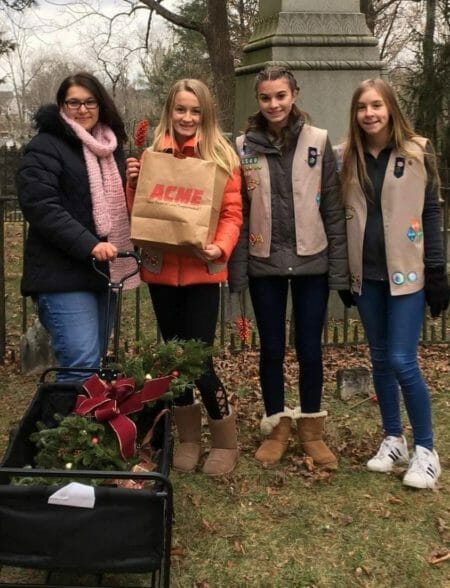
Every winter, Jeanette organizes the laying of wreaths at the abandoned Blairstown (Gravel Hill) Cemetery. Recently, she has initiated a preservation project to clean and restore broken headstones and beautify the grounds for those interned and forgotten. /Courtesy Jeanette Iurato
What has been the most rewarding part of your work?
It’s difficult to pinpoint the most rewarding part of my work. From putting smiles on the faces of those less fortunate to breathing new life into the historic district and even sharing the story of someone who is long gone — it is all rewarding. However, if I had to select one thing, I would say it is inspiring others to volunteer. In the beginning, I was doing most of this alone. After I established the Blairstown Museum, an all-volunteer, 501(c)(3) non-profit organization, I was able to create a network of individuals and businesses who volunteer along side me. In ways large and small, they too serve our community and preserve our history. It’s very rewarding to inspire and be inspired by others.
What have you learned through your experiences as a volunteer?
I have learned that human beings are inherently suspicious. Many people spend their days looking for the “ah-ha, I knew it was too good to be true” moment to justify their jadedness. While it is important to listen and learn from your critics, it’s equally, if not more so, important to not let them deter or stifle your volunteer spirit. Volunteering isn’t about them or you. It’s about doing the right thing. It’s about service to others. It’s about making and leaving the world a better place.
Are there any future partnerships, programs, or events that you are excited about?
At the moment, I am excited about the Blairstown Museum’s future. By way of donors, supporters, and volunteers, we have grown every year exponentially. We currently manage or participate in over 100 programs, events, and tours every year. Now that we have more volunteers, we are eager to increase that number. In fact, this September we are opening a Friday the 13th Museum (the 1980 movie was filmed in our town), which will undoubtedly improve the local economy and give much needed exposure to all of our local mom-and-pop shops.
On April 22, 2017, The Official Proclamation making Blairstown New Jersey’s first Appalachian Trail Community was read and signed by Jeanette Iurato (Appalachian Trail Community Advisory Committee), Richard Gardner (Warren County Freeholder Director), and Karen Lutz (Regional Director of ATC). A street fair, organized by Jeanette, celebrating the achievement was held following the ceremony. /Courtesy Jeanette Iurato
Why do you think it’s important for others to give back?
It’s important for everyone to sit down and list their strengths, assess what is needed in their community, and then apply those strengths to addressing those needs. It is my firm belief that society’s best safety nets are created by volunteers, particularly those associated with non-profit organizations. While we certainly need a strong government, we also can’t rely on government to solve all of our problems or meet all of our needs. My advise to others is, the best way to improve your community is to get involved in your community. One of my favorite quotes is by Marjorie Moore. She said, “You vote in elections once a year, but when you volunteer, you vote every day about the kind of community you want to live in.” It’s not only a great quote and my email signature, it’s also how I live my life.
What do you want people to learn from your story?
I want people to learn that volunteering isn’t easy, but it is worth it. Out of all of the things you will see, do, and experience in your life, giving back to others, particularly to those who cannot repay you, is single-handedly the greatest gift you can give society and yourself. Your community most likely has numerous ways for you to volunteer and get involved. If you’re really adventurous, establish your own non-profit organization and implement projects that meet the organization’s mission. Whether you donate one hour or one day every week, find a way to help others. You won’t regret it. I certainly don’t.