Dani Frappier worries about young people. The retired nurse, mother and grandmother feels that it’s her duty to try to make the world a safer place right now for youth facing pressures from all sides.
A life-long volunteer, in a range of venues from school and church to local soup kitchens, Dani is most passionate about volunteering with Maximum Freedom, Inc, an education non-profit that empowers teens to reach their maximum potential through risk avoidance. She spends up to four days a week with the program, which focuses on issues including reducing risky behaviors like using drugs and alcohol, exposure to violence and decreasing unwanted pregnancy and STDs. By volunteering with MFI, Dani feels she is helping to shape the future citizens and leaders of America into their best selves.
Dani is committed to making a difference in her community and she is today’s Daily Point of Light Award honoree. Points of Light spoke with her about her commitment to service.
What inspires you to volunteer?
I have a strong desire to help others. I grew up in a multi-generational home — my mom was widowed before I was born, so we lived with her family until I was eight. Kindness, helpfulness, friendliness and Christian beliefs were practiced and supported. I am a registered nurse with a background in pediatrics and geriatrics and I’ve taught pre-school Sunday school for decades. want America’s future to be shaped by citizens and leaders who have high self-respect – not a high self-serving attitude, as well as skills to make solid, important decisions.
Describe your volunteer role?
I started with MFI as a t-shirt delivery person. The students who finished the online self-reflection quiz and completed a course offered through the school’s health education classes get t-shirts. I’d pick them up from a volunteer’s home and deliver them to the schools. I also helped with fundraising banquets, getting donations for the silent auction and working the event. In 2018 I attended an all-day workshop in Columbus, Ohio (about 90 minutes away) so I would be better educated on the type of issues that school children in Ohio are exposed to and how we can help them.
Why is it important to you to support your community in this way?
Sadly, America as a whole has seen a decline in the family unit and family values. I want future generations to grow up feeling loved and valued; to thrive and become prosperous, responsible adults. Young people miss out on opportunities when they have an unwed pregnancy, sexually transmitted disease, are the victim of violence, suffer emotional turmoil from poor choices, or abuse drugs. An entire community profits from productive citizens and suffers when their members cannot help or support themselves.
What’s the most challenging aspect of your volunteer service?
The most challenging aspect is time management and logistics. Since I also volunteer for other organizations plus provide childcare for my grandchildren several days per week, I often am juggling a crazy schedule!
Why do you think it’s important for others to give back?
Giving back helps a person keep learning. Giving back helps improve the community you are a part of. Giving back will let you meet new people- whether it is those you are serving alongside, or those who are being served by you. The best part is that you will feel like you were lifted up.
What’s been the most rewarding part of your work?
For me, the most rewarding part is learning about and connecting with young people. My own children are 24-34, so I am out of touch with what happens in schools, social media and peer pressure. Today, with less parents being the direct caregiver for their children and the influence of the internet and TV, it becomes a new playing field.
What have you learned through your experiences as a volunteer?
Through it all, I learned that while it develops leadership skills, requires organizational skills, interpersonal skills, time management, and being a team player, the best part is the I often feel I have been the one BEING served! Sometimes it was simply a kind word or a sincere thank you that made the difference and brightened my day.
What do you want people to learn from your story?
We can all make an impact! And that the old adage “you only get back what you put in” is partially true – usually you get back MORE than you put in. Whatever you are passionate about is out there and in need of your volunteering hours.
“Chemo Pal for Life”: Oregon Woman Brings Joy to Child’s Hospital Room
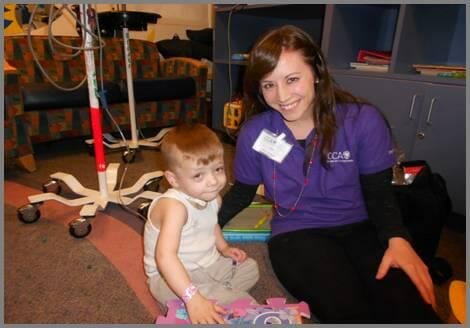
With a title like Interim Vice President for Quality and Patient Safety at a Portland non-profit hospital system, one would think that Jana Brott would only have time for business and no time for fun. But for the past eight years, she’s brought nothing but fun and joy to the life of 11-year-old David as his Chemo Pal as a part of the Children’s Cancer Association’s Chemo Pal Mentor Program.
David was diagnosed with severe combined immunodeficiency or SCID, and while he doesn’t receive chemotherapy, he does receive regular infusions. Jana sits next to him while he receives his infusions and does whatever she can to take his mind off of it and make his hospital room a warmer place.
Driven by a life mission to serve others, Jana’s volunteerism has changed the life of David and his family. Jana is today’s Daily Point of Light award honoree and we spoke with her to learn more about her passion to bring others joy.
Describe your volunteer role with CCA’s Chemo Pal Mentor Program.
I work in healthcare now and I have all my life. I wanted to find a volunteer opportunity that helped me see healthcare through the eyes of a patient and their family. It was sort of a dream come true to find the CCA because I realized that I could make a difference in the life of a child receiving healthcare and that my mission was to just bring them joy in a place that was otherwise not very fun. The CCA matched me with David because they thought we’d be a good fit. We both loved Disney and Legos and eight years later, we still do.
What was David like when you first met him?
David doesn’t have cancer, but faces the same immune challenges that require regular infusions and his condition has led to surgeries. When I met him at the hospital, he was 3 years old. He couldn’t talk at the time because he had a [tracheostomy tube] and he hadn’t learned to talk with it so he could only do sign language, which I didn’t know very much of, but learned a lot through him. I’ll never forget, but when we were done for that day, he sat down his teddy bear and goldfish and said “nice to meet you” in sign language. It was so cute.
What is David like now, eight years later?
He’s able to talk now without signing. I’ll never forget the first day he said my name. He still had that trach, but he was maybe 5. It was the best day ever when he said my name. He’s also one of the funniest persons I know. He has the biggest heart. I’ll show up to the hospital and my only goal is to help him have the best experience while having an infusion, but he really ends up bringing in all the kids around us and makes sure that everyone else is having fun too. I’ll never forget on my birthday, I went and bought a ton of Legos and I knew that he would love if we went around and gave Legos to all the kids that were getting infusions that day. He had the best time of his life because he just loves giving away Legos to kids who were having a tough day and loved making everyone around him smile. That’s really the kind of kid he is.
What’s his reaction like when you enter the room?
He sort of lights up because he knows that I’m a big kid and when I show up, we’re just going to have fun. He thinks of all the games that we could play that wouldn’t happen if I weren’t there. When he was little, I think I was also an emotional support to him and his family, without really intending to be. There were times when he had really difficult operations and everyone was tearful and going through a hard time. I would just be there and be the one smiling for them so he could always count on me and have fun in any situation with him.
Jana and David eight years ago when they first met./ Courtesy Jana Brott
How does it make you feel when you see David and young children with these life-threatening diseases?
It’s really tough. I didn’t realize how tough it would be to see it from the patient and family’s perspective because there’s so many emotions that you’re dealing with. When you’re listening to your healthcare team talk through scenarios, it sounds like a foreign language. The language was always familiar to me, but to be sitting with them and hearing it too, I understand how complex and challenging it is to be on the receiving side of a situation like that. I’m in healthcare because I want to help people live their life to the fullest. I have so much empathy for our patients and their families. I’ve learned a lot from seeing things through their eyes.
How do you make time to volunteer with your busy work schedule?
I do have a schedule that’s booked months in advance because I have so many meetings and my role spans a lot of hospitals. But I think that even if I can only be there for an hour in between meetings, I will go because the most important thing is showing up and letting David know that even though I’ve got a crazy schedule, I’m going to show up no matter what even if it’s not for the whole time. So I always try to figure out a way to make it work.
What’s been the most rewarding part of your work?
For me, the most rewarding part is seeing that I can make a difference in David’s life and also his courage is a reminder to me that it’s possible to get through anything with joy. That’s the mission of the Children’s Cancer Association and I feel like that’s a lifelong lesson not just for children receiving healthcare treatment, but for adults and the rest of us as we go through our lives day by day.
Why do you think it’s important for others to give back?
I think it’s important to volunteer to gain a different perspective on life. It’s a really important part of life to be of service to others. It’s part of my life mission to serve others and to collaborate with others in our community. I think there are so many benefits when you step outside of your own shoes.
What do you want people to learn from your story?
It’s possible to get through any tough experience in life with joy. It’s important to surround yourself with people that bring you joy. It’s the mission of CCA and it really resonates with me.
Do you plan to keep on volunteering for the foreseeable future?
Yeah, definitely. I think David and I will be Chemo Pals for life.
Young Woman Helps Support Children and Families in Need Throughout Atlanta
Not many people can say they helped to found and run a nonprofit organization for over a decade. Even less people can say that at just 22-years-old. However, with the inspiration of a friend in need, the help of her mother, and a lot of passion, Jasmine Durden is one of those people.
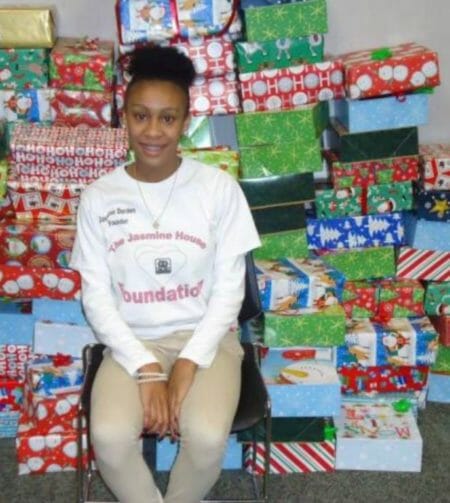
At just age nine, the Georgia woman started the Jasmine House Foundation, a nonprofit that provides outreach and support to children and families throughout Atlanta. Throughout the year, the Jasmine House Foundation holds about eight events, from toy drives for the less fortunate to birthday bashes for foster children who wouldn’t be celebrating otherwise. In addition to the events, the foundation also provides resources such as toiletries and school supplies all throughout the year to those in need. Jasmine, who recently graduated Georgia State with a degree in kinesiology, said almost every decision she makes is framed around how it can impact and benefit her nonprofit. Her goal is to open up an outreach center in metro Atlanta that will be able to more directly impact families in the area by providing tutoring, job assistance, food and clothing, and more.
For the years of support and love she has shown those in need within her community, Jasmine is today’s Daily Point of Light Award recipient. Points of Light spoke with her to learn more about the Jasmine House Foundation.
Describe your volunteer role with the Jasmine House Foundation.
I started my foundation when I was nine. I’m the founder of the foundation and we do outreach throughout the year like coat drives, school supplies drives, feeding the less fortunate, mentoring children in shelters, sponsoring girls for prom, mainly helping out the community. The goal for my nonprofit one day is to open up an outreach center so I can give resources to families in Georgia who are in need.
What would the outreach center do for children in the area?
Provide them with tutoring, incorporate music for stress relief, being able to get clothing, food pantry, and just that compassion they may need and their families need. We also want incorporate job/work thing, so they can come and try to find work for themselves and so they can get back on their feet, so their kids can see that they’re trying, that there is somebody that cares.
What inspired you to create this foundation?
It started when I was in the third grade. There was a girl in my class who was a foster child and she came to school one day telling me about how she would have to move and was going to be separated from her sibling. That really touched me so I went home and told my mom about it and, being so young, she was saying there’s ways I could help. I started going around to the community and collecting coats and taking them to children’s shelters. So I would say that girl inspired me to want to start my foundation.
Once I started to go around collecting coats and taking them to the children’s shelters, I saw the impact that it made. More people started wanting to volunteer and help so that’s when my mom said that this is becoming something she likes to do, and we just said we’re going to take it to the next level. We started going downtown and feeding the less fortunate and from there it started to be more and more. We started escalating and started helping more.
What kind of impact has the Jasmine House Foundation had on those it is helping?
I think it’s had a big impact. I think a lot of people, knowing that I’m such a young adult, that somebody my age is able to make an impact and wants to love on others, I feel like it has a great impact. I love seeing people smile and be amazed when I tell them about at all the things I’m trying to do, even some of the kids we help. We do a birthday bash for foster children because they don’t really get to celebrate their birthday. We did this about a month ago and got toys for them, set up stations for them to play games, karaoke, and just seeing the kids have that break for four hours and having a good time and smiling and hugging me and saying this is amazing, it makes me feel good inside.
Have you seen the Jasmine House Foundation have an effect on the community as a whole, aside from those you’re directly helping?
Yes, I think it has had an effect on the community. As far as even the people I know that help or volunteer, even peers my age, they’re just amazed by what I do and they want to help and they want to give back. I feel like it’s also getting the young adults to be able to have an impact and knowing that everything is not green, there are people out there that are really in need, especially kids. When I’m able to be around the kids and talk to them, they’re just so excited, they hug me. Even adults sometimes when we go downtown, they just want to hug me, they really appreciate it, so I think it makes a big impact to show them that somebody actually does care. People are doing a lot but when we sit down and talk to them and get that type of personal relationship, I feel like it shows you care.
Every year, the Jasmine House Foundation helps to collect toys with Toys for Tots, as well as wrap and distribute them to those in need./Courtesy Jasmine Durden
Are there any future partnerships, programs, or events that you are excited about?
I would say when we have our silent auction. We usually do that in September and that will probably be our next thing that we do. It’s an opportunity for the community to come out and see what we do for the community and an opportunity for us to be able to get funds and donations to be able to keep helping others. I feel like that’s my favorite event. I can express what I want to do with my foundation and what my goal is.
What inspires the different events you do? How do you find that need within the community?
I have a board so basically we come together, we brainstorm different issues or things we may see that we feel like is a need. We come together and try to brainstorm different ideas and that’s how we come up with most of our things. The Open Heart Campaign was actually something my mom came up with. … So I feel like it’s just a group decision. I don’t want to take the credit for everything, I feel like it’s an effort from everyone, to just come up with different things we think are smart to move for the community without trying to do too much. And being able to get donations and stuff and having the volunteers helps us out too.
Can you describe what the Open Heart Campaign is?
Toys for Tots is one of my sponsors, so we go to Toys for Tots and we get all the toys and if we have to, we buy more toys to add to that. We allow the community to come in, we open the doors and tell people we’re giving out Christmas toys. We have music, entertainment, food, and when they come in, they choose the gifts they want for their children and we wrap them for them and we give them to them. It’s kind of like a secret Santa, just come get your toys, wrap it, enjoy some music, food, and we give it out to the community. We changed it up actually about two years ago. It started out with us getting the toys, wrapping them, and taking them to children’s shelters but now we allow some of the foster children or families to come in and get the toys.
What have you learned through your experiences as a volunteer?
I learned a lot. I learned to just have patience, and know that everything doesn’t happen right away. Take time and have compassion for what your heart wants to do and your desires. Because I’ve been doing it for awhile and I think it’s just been kind of a test for me. You want things to happen fast — ‘I need this, I want my resource center now, I want this,’ and I know everything doesn’t need to happen right away. I learned to be patient and appreciate what I can do for the community right now.
Why do you think it’s important for others to give back?
I think it’s important for others to give back because you know you’re helping someone, it makes you feel good inside, and we all have to help each other, we all have to have a helping hand. One person helping another person, then they help somebody else, creates a circle of compassion and love, so I feel it’s very important to help each other.
Inspired by Own Experience, Teenager Donates Hundreds of Blankets to Hispanic Children In Need
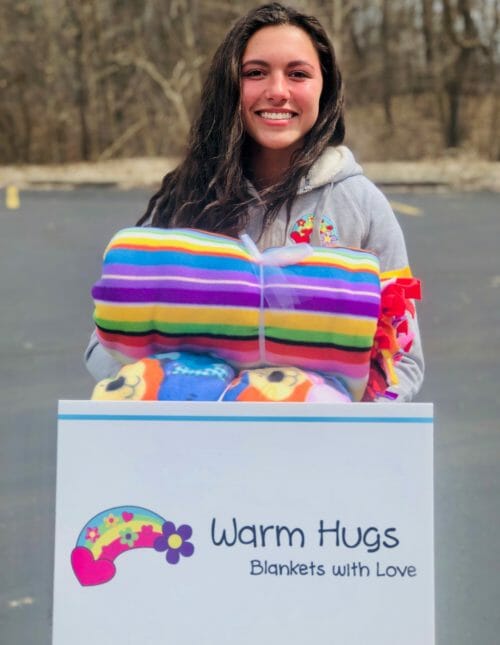
Moving to a new home can be a nerve-racking change for any child, but moving to a place where you don’t speak the language and don’t recognize anything from your neighbors’ faces to the climate is especially terrifying. Cecille Figueroa Narvaez experienced that herself at just six years old when she and her family moved from Puerto Rico to Ohio. Years later, while volunteering with her mother at the Hispanic Outreach Program in Springfield, Ohio, she felt a connection with some of the children who described being cold and scared when they first moved to the United States. After some brainstorming with her mother about how to help comfort the children, Cecille founded Warm Hugs, a nonprofit that provides blankets to Hispanic children in need in Ohio, Missouri and near the U.S.-Mexico border.
Since founding the organization three years ago, the fifteen-year-old has helped to donate over 1,000 blankets to children dealing with the sometimes scary and stressful process of coming to the United States. Throughout the year, Warm Hugs holds several fundraisers at schools and businesses to collect blankets and monetary donations, which are then distributed to children through churches. Cecille said the children react immediately with smiles, thrilled to have a blanket that is just theirs to keep.
For helping to put a smile on children’s faces during a very frightening period of their lives, Cecille is today’s Daily Point of Light Award recipient. Points of Light spoke with her to learn more about Warm Hugs.
Describe your volunteer role with Warm Hugs.
I am the founder of Warm Hugs. I started it back when I was 12 years old, so about three years ago. We raise blankets for Hispanic children in need and refugees in need. We distribute it around the Dayton area, we went to Cincinnati, we go around to as many places as we can. We have an alliance at the border now where we send blankets over there and they distribute it to children who have newly come to the United States. We are starting new places in Indiana where I go to school and also in St. Louis where my brother goes to school. We raise blankets and funds to get blankets and we distribute it to children in need.
What gave you the idea to create Warm Hugs?
My mom works at the Hispanic Outreach Program in Springfield, Ohio, and I used to volunteer with her. I would talk to the kids who told me some of their stories about coming across the border and asked them what they felt. A lot of them said they were cold and very homesick and scared. Whenever I’m scared or very cold, I always like to use a blanket. Me and my mom were like, you know what, getting a blanket is a small thing but it could make a big impact, so we started brainstorming about ways to get blankets and money to see if we can make this into an idea and it kind of just took off from there.
Within three years, Cecille has donated over 1,000 blankets to Hispanic children in need./Courtesy Cecille Figueroa Narvaez
What drew you to specifically help children who are new to the country?
I’m Puerto Rican and I moved to Ohio when I was about six years old. I didn’t know any English when I came here and I learned it here within a year with the help of the community and the school. I remember coming here and I didn’t know the language, I was very cold, very confused. Of course I had my parents and my brother with me, but it was still very shocking to move all the sudden and to such a different place with completely different people and different ways of life. So when I wanted to help out people, I wanted to help Hispanic children because I speak Spanish, I can connect to them, and I had gone through some of the things they had gone through. I can relate to them very easily and I can communicate with them because most of them don’t know English very well and finding someone who speaks Spanish, to them, is more comforting and makes them more at home. I definitely wanted to help out Hispanic children and then we started [helping] refugees because we saw a need with the refugee children as well, so we crossed over to both of the groups so as many children could be helped as possible.
Can you describe what a drop off is like?
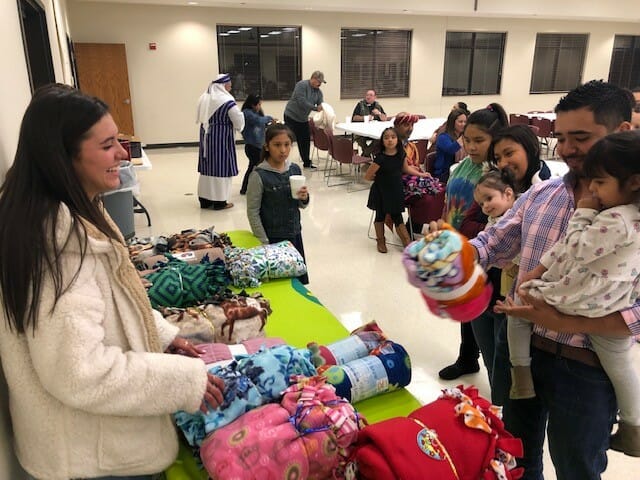
We have an event usually at a church. We get a rough estimate of how many girls, what ages, how many boys, what ages, and we take blankets accordingly. We pack them up the day before and we take it over, and we basically set up a little table so when the kids get done doing a mass or doing a service or something like that, they come by and pick it up. What usually happens, I stand at the front of the table and they say which one they want and I grab it for them. I give it to them and sometimes they give me a hug. It’s kind of a quick little grabbing of the blankets but it’s so cute just watching them walk away really happy and go to their parents and jump up and down. It’s one of the best things in the world.
What would you want people to know about the children you are helping?
I want them to know that they are children no matter what. It doesn’t matter their ethnicity or where they come from, they’re children. They’re here to have a better life and they need as much help as any other child. A lot of people think that politics get in the way but the bottom line is that they’re children and they need help and we should do the most we can to help anyone, including people who are new to our country.
Cecille said she was drawn to helping Hispanic children and refugees new to the United States based on her own experiences of feeling homesick and scared when she moved from Puerto Rico to Ohio./Courtesy Cecille Figueroa
Are there any future partnerships, programs, or events that you are excited about?
My brother is starting a chapter in Missouri for Warm Hugs so we’re very excited for that because we really want to start permanent places where we can have people volunteering. So my brother is starting that off and I’m going to continue it. We have some friends who want to do the same at different schools, so building branches of Warm Hugs in different places like schools or different organizations that we’re starting. It’s very exciting because it’s more permanent and it can have a lasting impression on the organization.
What’s been the most rewarding part of your work?
The most rewarding has to be knowing that I’m making a difference in a kid’s life. Even if it’s giving them a small thing like a blanket, knowing that can change their aspect on life or their mood if even for a week, that makes everything worth it. These kids, they really need support and just a small blanket makes them so happy. The most rewarding [part] is knowing that if I’m helping even one kid, it’s enough.
Why do you think it’s important for others to give back?
I believe there can be a lot of positive change in the world, and a start to changing the world in a more positive way is volunteering and getting people to help other people out of the goodness of their heart. If people started volunteering more, there’s more people that are going to get help and it will be an overall better world because people are taking care of each other and caring.
California Teen Translates Passion for Healthcare into Compassionate Care for Alzheimer’s Patients
Chinmayi Balusu talks to her friends about their hobbies and interests. They share a love for the oldies from the 1950s and 60s. The 16-year-old Union City, California student, who heads off to college on the East Coast this fall, often will ask about their careers and life stories.
These friends aren’t your typical teenage friends, however. Chinmayi has fostered relationships with seniors living with dementia, brightening their days by treating them with compassion and dignity. Serving as a youth volunteer at Empire Ranch Alzheimer’s Special Care Center in Folsom, California, Chinmayi spends up to 12 hours each month visiting with seniors at the center. While many at the center are dealing with dementia and related memory loss, Chinmayi spends valuable time making patients comfortable, connecting in ways that make seniors smile.
Connecting with a couple dozen seniors in her community through her volunteerism over the last two years, Chinmayi is bringing comfort to those in the final stages of their lives, and is today’s Daily Point of Light award honoree. Points of Light spoke to Chinmayi to learn more about her volunteerism with Empire Ranch.
What inspires you to volunteer?
I enjoy the aspect of giving back. I’m close with people in my community, they’ve given so much to me as I’ve grown up, and volunteering is a way for me to reciprocate that support in a different way.
Describe your role with Empire Ranch Alzheimer’s Special Care Center.
I try to create as much fun as I can for the seniors. I help to conduct group games and activities like Bingo and Pictionary. I help serve snacks and meals, and we’ll go for walks around the courtyard for fresh air. We listen to music and sing together, and I try to make the seniors smile with my jokes. Additionally, I’ve been involved with Alive Inside at Empire Ranch, which is an event for youths to connect with seniors through music. I have served as the student volunteer coordinator at the movie screening event for Alive Inside, and organize the schedules and responsibilities for about 60 student volunteers.
Explain how you’ve connected with seniors through music.
I’ve always been interested in oldies music from the 1950s and 60s, and so I connected with many of the seniors that way. We found songs together that we loved. I created headsets with customized music playlists for local seniors, and personally delivered the headsets to them at their homes.
You’re serving seniors in the final stages of their lives. What does that mean to you?
It really makes my day to go talk to my friends. It’s always amazing to see how happy they are when I say that I’ll come again and see them later. In a way, all my friends at Empire Ranch are kind of like my grandparents. We know each other that well and I’ve formed that emotional bond with them over the years. I absolutely love them, and love seeing the smiles on their faces.
What have you learned through your experiences as a volunteer?
If volunteering, when you first meet some seniors, they may be guarded because they are unsure of who you are. In my experience, learning to actively listen was so important. By being empathetic, having an open mind and understanding that they’ve had a different journey than someone my age, I was able to better connect with them and help them.
Share one lesson with me that you learned from a senior while volunteering.
I met this one lady who had been a kindergarten teacher. She overcame a number of hurdles to become a teacher, because the profession wasn’t one her family had picked for her. Because she was passionate about her career, she was successful. Fast forward fifty years, and that same struggle of overcoming obstacles to follow your dreams still exists today. I learned that if you want to do something, you should definitely go for it.
What do you want people to learn from your story?
Finding a way to connect with people through common ground is really important. By digging deeper, you can find common ground. I realized that I enjoy oldies music just like many of the seniors, but that discovery took many months of listening and patience.
“Visiting Wizard” Encourages Future Generation of STEM Lovers
Over 80,000 students and adults have witnessed the power of Jeff Payne’s “wizard”-ry, a magical fusion of cryogenics, liquid nitrogen and countless other science and technology experiments. And this “Visiting Wizard” is looking to put even more under his STEM spell.
Through the 3M Visiting Wizards program, which is a 3M science encouragement program, volunteers visit local schools, community events and other groups to conduct STEM-related demonstrations. Jeff, a St. Paul, Minnesota resident and 3M employee, is one of those wizards. The 58-year-old, who has been chair of the program since 2005, is an analytical chemist by day, and a STEM wizard by service, encouraging children and adults to become interested in science and technology, and raising interest in STEM.
Through fun and interesting science demonstrations and hands-on experiments on a variety of topics, Jeff is helping people understand how science impacts daily life, and is today’s Daily Point of Light award honoree. Points of Light spoke to Jeff to learn more about his volunteerism with 3M Visiting Wizards.
What inspires you to volunteer?
I really believe that science is important, and companies like 3M need to be out in the community giving back. I started working for 3M in 1987, and that need for community outreach resonated with me even back then. We’ve all had mentors over the years that have been impactful, and I am looking to do the same.
Describe your role with Visiting Wizards.
The program started in 1985, and I began my career at 3M shortly after that. I currently serve as the chair for the organization, so day-to-day, I am planning for our bigger activities, recruiting volunteers, and handling budget items. The program’s main initiative is to visit students, so I put on demonstrations at schools, community events, even museums. I average about 100 presentations annually to local schools and public venues, and have presented to over 80,000 students and adults since 1998, when our electronic recording started.
You’re training the next generation of STEM educators, too. Explain.
The 3M Visiting Wizards have partnered with the University of Wisconsin-River Falls to facilitate a STEMteach program, which enables people with STEM-based educations to qualify for teaching licenses after taking a one-year program. I organize 3M volunteers for this program, in addition to coordinating and delivering presentations. The 3M Visiting Wizards pair up with future teachers to put on science demonstrations in the local schools. Through my volunteerism, I am helping kids and adults become the next generation of STEM educators.
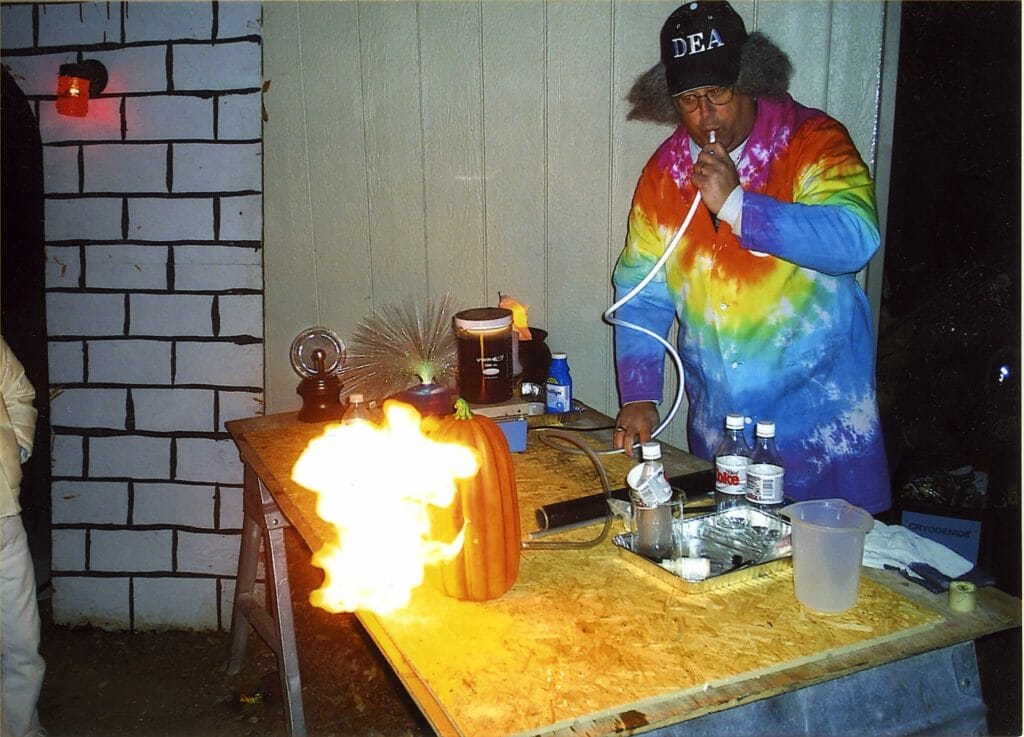
Jeff Payne conducting the dust explosion as the Mad Scientist at a friend’s Halloween Haunted Yard./Courtesy Jeff Payne
What’s your life motto?
My first motto is “willing to do a presentation at any place, at any time! But beyond our presentations, I believe it’s very important to give back. Nobody gets where they get without help from somebody at some certain level. When you’ve got skills to help someone improve, or show someone something they wouldn’t see otherwise, I think it’s important to do that.
Share some of your favorite STEM experiments with me.
Our cryogenics demonstration is the one I do the most. It’s the science of the ultra cold. We conduct experiments with liquid nitrogen. We can deflate a balloon by cooling it off. We can make a hammer out of a banana. We’re up to 27 different kit topics now, people will get a great idea and put it into a box for teaching.
What have you learned through your experiences as a volunteer?
You take for granted that a lot of the things we were exposed to as kids are happening in schools today. That may or may not be the case. It’s even fun when we put on public demonstrations, because there will be adults that haven’t seen the experiment before. It’s fun to watch their reactions as well as the children.
What does it mean to know that you are having an impact?
Part of the reason why our experiments are so fun is because you see the instant feedback. The students are smiling and the experiment is resonating with them. The kids will give the volunteers a hug once you’re done, and you know you’ve made an impact. It’s great.
What do you want people to learn from your story?
You don’t have to reinvent the wheel. There are lots of organizations out there that need help. If you like to do carpentry, you can volunteer with Habitat for Humanity. Once you jump into an organization, you can let your skills get right to work.
How can readers help?
We sponsor a Teachers Workshop and Super Science Saturday weekend held every fall at 3M’s world headquarters. About 400 teachers attend the Teachers Workshop on Friday afternoon and a similar number of 3M volunteers and their families attend the event on Saturday. The events consist of 3M exhibits and other community resources exhibiting STEM related activities. Check our website for more information: https://www.3m.com/3M/en_US/gives-us/education/visiting-wizards/.
After Wife’s Battle with Cancer, Minnesota Man Offers Care and Compassion as Senior Volunteer
Married for 54 years, Dan Cunningham says he learned a great deal from his wife Sharon, chief among her attributes he says was her caring nature. When the roles were reversed and Dan became the caretaker, he stepped in without hesitation, devoting himself to Sharon as she battled, and then lost her fight to cancer.
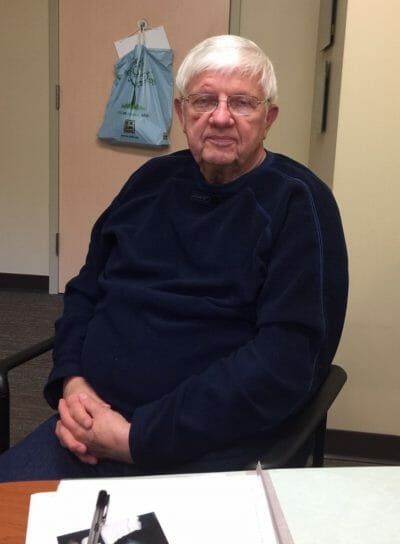
In the wake of her passing, Dan has dedicated his time to helping other caregivers. Volunteering as a Respite Volunteer for FamilyMeans Caregiving & Aging Services in Stillwater, Minnesota, 77-year-old Dan gives caretakers the break they so desperately need. Supporting caregivers who are caring for someone with a chronic illness, disability or frailty, Dan serves as a compassionate listener, caring and safe presence and sometimes, joyous distraction, for sick or frail individuals. In addition to his volunteerism with FamilyMeans, Dan volunteers with his local Meals on Wheels and Community Thread’s transportation program, which provides door-to-door transportation service for older adults and others who are unable to drive to medical appointments.
Providing non-medical companionship, supervision and serving as a friendly new face, Dan is helping those who need special care and attention most in his community, and is today’s Daily Point of Light award honoree. Points of Light spoke to Dan to learn more about his volunteerism.
What inspires you to volunteer?
I enjoy making people happy, and I enjoy making people laugh. I get a tremendous amount of satisfaction when I see in their eyes an appreciation for whatever small thing I have done. It’s a magical feeling.
Describe your role as a Respite Volunteer.
I will visit a home and allow the caregiver a chance to take time away for errands or just to have a break. I will play games with the individual, we sing songs, or we sometimes – (don’t tell anybody) – both take a nap, only I have to keep my eyes open (laughs)! We talk about family issues and so forth, the individual will confide in me. It’s a wonderful experience for these people to be able to share their lives with you, and it keeps me going.
Dan Cunningham creates friendships and supports caregivers as a FamilyMeans volunteer./Courtesy Dan Cunningham
In a way, you’re caring for some individuals like you cared for your wife. What does that feel like?
It’s the greatest feeling in the world. When you start to volunteer, you receive almost as much as you give. These people look forward to my arrival, and you know what? I look forward to seeing them again. Some of these people are lonely or isolated, so you give them conversation that they probably don’t have a lot of in their everyday lives. You become friends with these people, whether you want to or not (laughs). It’s very therapeutic for me, and certainly for some of them, to see in their eyes the enjoyment they receive when you bring them a meal, visit them, or bring them to appointments.
What would your wife say about your volunteerism?
She’d tell me that, number one, the lawn needs mowing. Secondly, she was such a caregiver to her family and friends. I learned a lot from her. She was a wonderful cook and a wonderful companion. I am very fortunate to have been a part of her life. So she would have been proud about my service. She would be proud of her children. And she would express that in so many ways.
What’s your life motto?
This was one of the very first things I learned about life when I joined the Scouts as a young whippersnapper: Always be helpful, friendly. Be courteous, be kind. Always be cheerful. Be thrifty, brave, try to be clean, and reverent in your own way. But also, enjoy people. We only have so much time in our lives. Take advantage of being helpful to others and that will make you a very happy person.
What have you learned through your experiences as a volunteer?
I see some other people that have been volunteers and have performed service to others that is simply overwhelming. Their whole lifetime, they’ve volunteered. People that have gone above and beyond the call of duty to help others. That’s always impressed me.
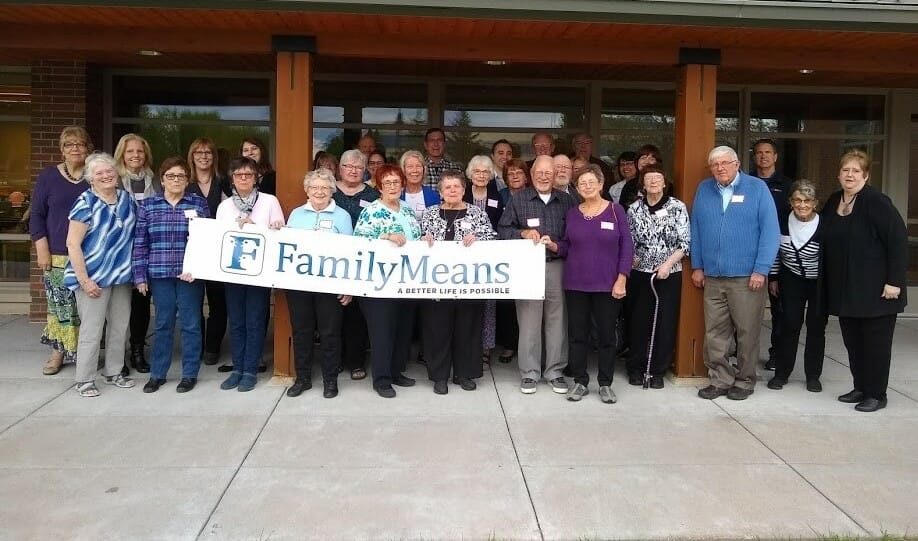
The FamilyMeans 2019 Volunteer Recognition Event. FamilyMeans volunteers support caregivers who are caring for someone with a chronic illness, disability or frailty./Courtesy Dan Cunningham
Share one personal story with me from your volunteerism.
One individual with FamilyMeans who I volunteered with was approximately my age, so I identified with his situation. He was going through a dementia situation, but he had this amazing skill, he loved to play pool. You’ve heard of Rudolf Walter Wanderone Jr., an American professional billiards player, who was known as “Minnesota Fats”? This man was “Minnesota Skinny” (laughs). He had the complete mastery of the cue ball and a knowledge of pool that I’ve never seen before. I’ve always wanted to be a good pool player, so I learned from him. I was looking forward to him improving my skills as I volunteered. He beat me in pool over 160 times, no, make that 180 times. He allowed me to win maybe a couple of times, I think he began to feel sorry for me (laughs). I so enjoyed him, and he and his wife welcomed me in their home. We had such a wonderful time together. I’ll always remember him.
What do you want people to learn from your story?
Each one of us have a sense of what’s right and what’s wrong and what we should do and what we should not do. If we just take the higher, loftier aspects of our contribution to other people I think it would make a better world, better communities, neighborhoods, relationships. I think we all can do that if we put our minds to it. In return, you get so much satisfaction out of participating and getting involved with other people’s lives and concerns. So many people need help. I’m very proud to be a member of the FamilyMeans group.
How can readers help?
Please check the FamilyMeans website for more information about how you can help: https://www.familymeans.org/.
Through Volunteerism, Minnesota Woman Builds Healthier Communities and Next Generation of Leaders
Meet Daily Point of Light Award honoree Susan Schuster. Read her story and nominate an outstanding volunteer or family as a Daily Point of Light.
Raised on the gritty and fast-paced streets of the Bronx in New York City, and then moving to unassuming Fargo, North Dakota, Susan Schuster’s childhood was a study in contrasts. Cultivating experiences during her most formative years in two disparate worlds, Susan says she gained great empathy for others.
“Because I didn’t have a state or city to call my home or who I am, I had more empathy for those who were new, or had more challenges than the average,” Susan said.
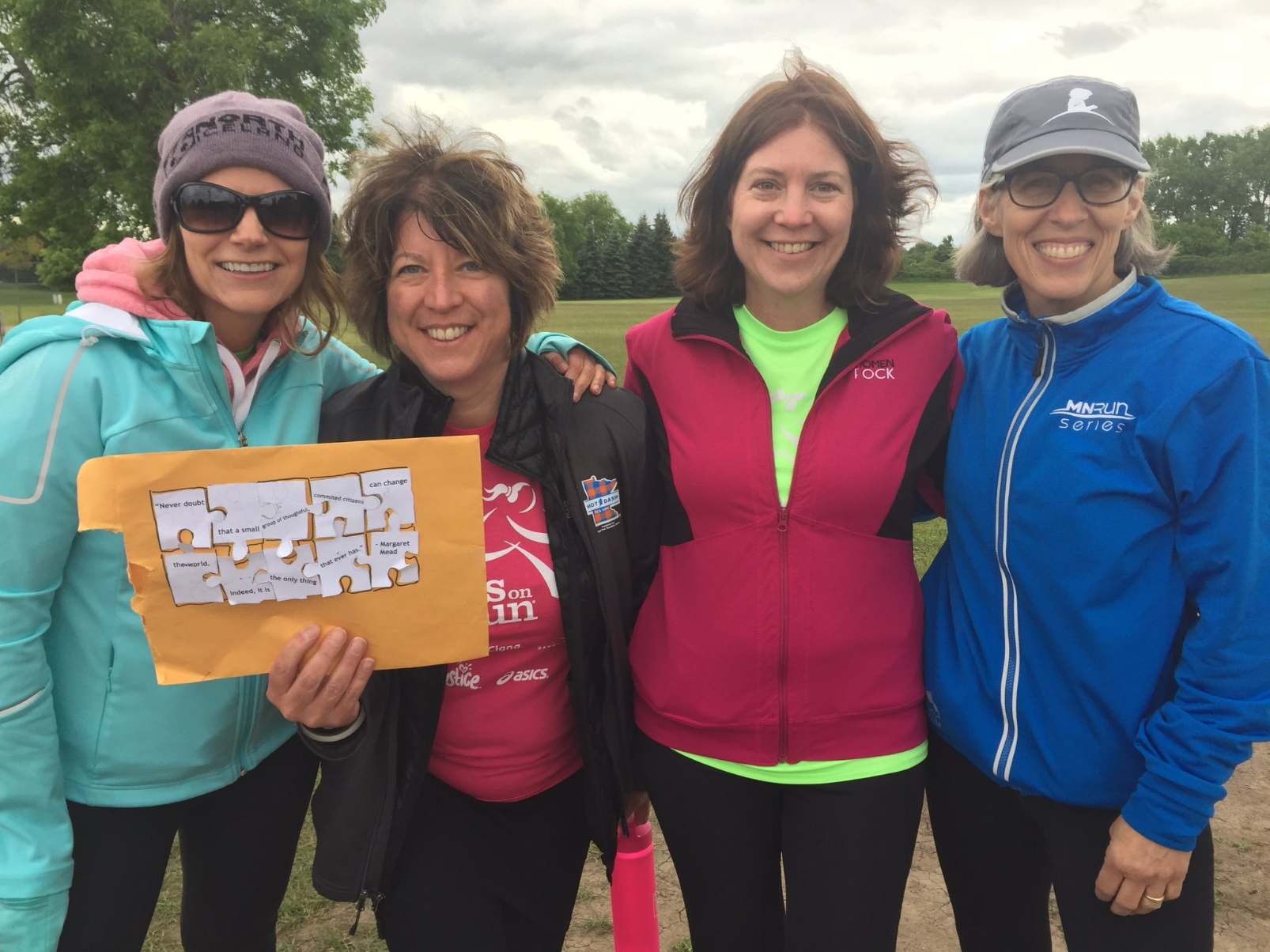
Susan Schuster serves many organizations around her community, and is a member of the HandsOn Twin Cities Board of Directors and volunteer with Girls on the Run Twin Cities. / Courtesy Susan Schuster
What the 54-year-old St. Paul, Minnesota resident couldn’t have told you in those early years, however, was the impact she’d make across many fabrics of society as a result of these rich experiences. As a member of the HandsOn Twin Cities Board of Directors, Susan promotes and facilitates volunteerism while improving the community’s ability to enhance the impact of volunteers. Driving civic engagement amongst all types of volunteers across all sectors, Susan’s volunteerism ensures that every service hour spent in the community is valuable.
Connecting and educating people about opportunities to get involved and give back, Tracy Nielsen, executive director of HandsOn Twin Cities, says Susan’s leadership has ignited a passion amongst others for volunteerism. One critical component of her leadership, getting millennials involved in service early on through HandsOn’s “Find Your Cause” initiative, will have a lasting effect, according to Tracy.
“It’s empowering the next generation. People have a lot of ownership over the organization they’re most deeply embedded with. Understanding the complexities of the non-profit work we do continues to enhance the ability within an organization in our community to deliver exceptional services and build the next generation of leaders.”
Susan Schuster supports Special Olympics Minnesota, which offers sports training and competition for people with and without intellectual disabilities of all ages./ Courtesy Special Olympics Minnesota
The power of Susan’s advocacy can be traced back to her roots, where she hoed sugar beets with migrant workers for two summers in her early teens, and later, early in her career, as she rode in limos with healthcare CEOs across the country advising them on strategy.
“I can relate to people and understand their circumstances. Every day now, I work with people from the mailroom to the CEO, to people throughout the community. Each has their challenges and I get that and can see it. Just like everyone served by a non-profit has their own story. I see you. I can work with you to understand what you need.”
Involved in service across her community, Susan also serves as a board adviser to the Karen Organization of Minnesota, which supports Myanmar refugees, one of the most recent and fastest growing immigrant populations in St. Paul. In this instance, the very fabric of the community is being shaped by people volunteering, and Susan’s leadership has helped to strengthen the impact.
“I really lead with my heart in terms of what I’m inspired by and where I see impact possible. I saw (Karen Organization) as a real opportunity to support the new residents in my community. Seeing the families that were arriving, hearing their stories about what their particular issues were. Once you get to know them, you discover the great adversities these refugees have faced. Now, in establishing themselves in a new community, they face the newest in a whole series of challenges. Once you hear someone’s story you can’t not care about their well being.”
This experience, Susan says, cemented her feelings that volunteering is truly a tool for community connecting. Extending a hand and helping others is a life’s mission for Susan, whose energetic approach to helping others is reflective of her contrasting childhood — a “Get it done” attitude and a “Midwestern nice” desire to build communities through inclusion.
“She’s a direct New Yorker,” Tracy said. “She gets in and get things done. She loves championing work for people who are building within the community and amplifying their voices. In connecting people, she’s really making a difference.”
Susan Schuster is a Girls on the Run Twin Cities volunteer, and former GOTR coach./Courtesy Susan Schuster
Susan says her volunteerism, which has evolved since those early days in her childhood, is her secret to a good life. Susan, who says she’s been told that she is the “spark” that drives people to think a little differently and try something new, says that a gusto for service can be infectious, and encourages others to be that “spark” for their fellow neighbor.
“Volunteering connects us in a way that really nothing else does. Volunteering helps us understand each other in a way that nothing else does. People think volunteering is doing something for someone else, but I think it’s deeper and wider than that. We’re all part of the fabric of the world, and we all need to do our part. If we do, we’re going to have a bigger, richer life.”
Maryland Man Dedicates 28 Years of Service and Thousands of Dollars to Volunteer Fire Department
Brian Ficke doesn’t really know what first drew him to volunteer firefighting. Unlike many firefighters, he had no friends or family working for a department. He said one day 30 years ago, he drove by a volunteer fire department near the Exelon power plant he worked at and just decided to stop in and see what the organization was all about. That fateful decision led to decades of volunteer firefighting, several leadership positions, numerous awards, thousands of dollars in donations, and an unmeasurable number of lives affected by the dedication Brian has shown.
For the past 28 years, Brian has been with his current department, Prince Frederick Volunteer Fire Department, which services Calvert County, Maryland. He is currently a senior firefighter there, as well as a member of the leadership board of directors, but has over the years held the positions ranging from sergeant to fire chief. Through Exelon’s volunteer program, he received their 2018 Excellence Award along with a $20,000 grant for the fire department. The money will be used to fund a new computer-based training facility, one of the numerous innovations that Brian has helped to implement over the years to better the department.
While Brian says he is unsure if he wants to return to one of his previous leadership roles with the fire department, he said he knows he will always be a volunteer firefighter. On top of his work at Exelon, he spends four to five days a week at the fire department and answering calls. He downplays his dedication, however, saying the commitment he has to the fire department is “not hard to do when you love to help your community and have a passion to be there.”
For the undeniable mark he has left on Prince Frederick Volunteer Fire Department and the citizens of Calvert County, Brian is today’s Daily Point of Light Award recipient. Points of Light spoke with him to learn more about his time as a volunteer firefighter.
Describe your volunteer role with Prince Frederick Volunteer Fire Department, and what you’ve done to help innovate the department.
In 2019, I am currently just an active life member. It’s an official bylaws title, so just a senior firefighter but I have life membership status.
I started out just as a firefighter and then I throughout the years worked my way up the ranks to firefighter, to sergeant, all the way up to fire chief. How that happened, you take a series of classes and courses along the way, developing your skills and abilities and getting knowledge from running calls. As I developed in the volunteer world, I also developed my skills at my work company, which is Exelon Generation at the nuclear power plant. So a lot of it linked back and forth. A lot of the skills and abilities I learned here as being a business professional, kind of work in my favor [at the fire department]. At Exelon, training or programs and the way you manage meetings and stuff are, I guess, imbedded into you and become a part of your personality. So a lot of those traits are transferred to be of use to the fire department. When it comes to developing programs, it’s basically a project I would do here.
Some of those included training. Training is big in the nuclear world and training is a big thing at the fire department. We’re just looking for innovative ways to make that easier for folks to get that training. Folks come from home or they’re there sporadic times throughout the day, night, week and weekend. Then you have required training, stuff you have to do on an annual basis. It’s pretty hard for you or me as an instructor to get all 75 people at one time. It’s just not possible to all come to a mandatory training class, so you have to work through that and do something multiple times or have classroom sessions. It just becomes very difficult and some people fall through the cracks. So [we developed] a CBT, a computer based training program, for a lot of our re-certifications. It’s one of the processes we started. For the grant that we’re receiving from Exelon, we’re building a new firehouse and we’re going to be using money that was donated to the organization to basically build that computer lab so we can do annual things like EMT protocols, updates, drivers training refreshers, blood pathogens, all that stuff you have to check off on the box annually. We’re going to use that enhanced training room to do that. The big advantage is that we can track training. Guys can sign in with username and password. From a leadership role, when you want to go see who’s done and who’s not done, its very easy to track and you can just ping those guys you need to get trained versus having to schedule a class that fits them and fits your schedule. So that was a big one.
We had a very immature website when websites first came around, it just basically promoted the cause we run. …When we first did it, it was really just a social media site that let the public know when the firetruck ran down the road — ‘Oh, what was that fire? Let me see some pictures.’ And basically bragged on the fire department when we had a fire and that kind of thing. Well now we’ve taken it to the next level where everybody is getting their own individual emails, we have chat groups, we have members’ pages so we can post minutes and different expectations for the fire department, we have a fire prevention [page], a recruitment page, and one of the coolest parts is about fundraising efforts. We can now say if we’re having a crab feast or a concert or something like that, now you can order the tickets online right through our website versus trying to go to the firehouse or somebody bringing you tickets and that kind of thing. We worked to develop that website and it’s become a tool for us to use as versus just an advertisement to the public about what cause we’re running or what events are upcoming and that kind of thing. Taking it to the next level to really make it a resource tool to work both internally and externally with the department.
And just tons of things on a normal everyday basis. [I] helped developed a county hazmat team. There’s a joint hazmat team with the local law enforcement and the volunteers. I was in that program as a hazmat team leader and helped manage. All the stations have their own fire chiefs and we come to a meeting once a month called the chief’s council, so I facilitated that meeting as a chief council’s chairman for three years. Basically just lead that meeting, hold people accountable for actions, approving documents and decisions that had to go through the fire commission to the board of county commissioners, those kind of things. The normal every day-to-day operations of the fire department. So that’s all extra stuff, and you really have 75 men and women that are all volunteers that have their own vision and ideas of what’s best for the fire department, what’s best for them. You do a lot of that people resource stuff, discipline action, coaching, recognition, that kind of stuff, so a lot of that day-to-day administration stuff as well. And then just the series of routine to very traumatic fire rescue or EMS calls throughout the county and tri-county area.
What made you want to start volunteering?
I don’t really know. I came back from college and I was working at the power plant one day as a contractor and I drove by the local fire department and I just happened to stop in to see what that was about. I really didn’t know anybody that volunteered in there and I didn’t know what I was getting into, but I just had an urge to pull in and volunteer, and it’s really all it was. Quite simple. Where a lot of people get recruited with friends or family or different things, that wasn’t the case.
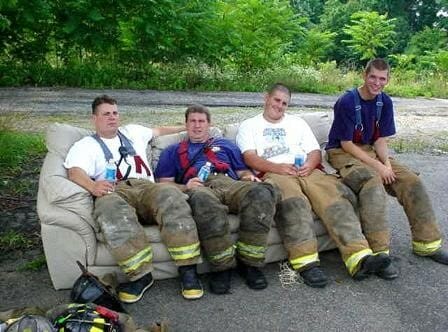
Brian, second from left, takes a break with his fellow firefighters while on site of an acquired structure burn used to train volunteers on the proper procedure for a house fire./ Courtesy Brian Ficke
Can you describe the Exelon Awards?
All the corporation Exelons — I work at a nuclear fleet, but we also … have all these smaller companies that are in the Exelon network — and we submit our hours we donate every year to our volunteer organization into an electronic form. They collect our hours and then for a series of 10, 20 or 40 hours, you get rewarded a monetary value for your local organization that you choose, if they’re a 501(c), to get the money. I could say I did ten hours at the firehouse and when they say congratulations, your monetary award for a charity is $100, I can pick any 501(c) organization to donate that to, so I could say Humane Society, I could say United Way, I could say anything that’s registered to a 501(c) in Maryland to give that money to. We do that for a series of things and then at the end of the year, they said with my hours and stuff, … there’s an application for these higher-recognized volunteer awards for Exelon. I filled out that application, said if I won an award, what would I do with it … And I was awarded the top award of Exelon for volunteer of the year for the whole company in this region here, and I received $20,000 to donate to a charity of my choice. So I donated $20,000 in my name to the firehouse and like I said, we’re going to build our training room infrastructure with that money, the computer based programming training center.
How did you feel to win this award?
Very humbled. I was very shocked. I don’t look at what I do as that amazing, it’s just helping my community and it’s something I enjoy doing. I don’t look at it as a sacrifice even though people say, ‘You give up so much of your time, your family time and your personal life.’ I’ve jumped out of bed or I’ve not gotten a lot of sleep before coming up to work the next day, gotten up from the dinner table, left on holidays, different times when I’ve had a responsibility. I don’t look at it as a chore, which I think when you find the right volunteer thing, I think that’s what makes it easy and you can commit all those hours. I don’t know what I would be most proud of. I guess just being recognized throughout my years as a volunteer, being recognized from others within the fire department. I’m doing the right thing and I’m committed and dedicated, so I’ve won life saving awards, I’ve won chiefs awards, I’m in the Southern Maryland Fireman Hall of Fame, I’m in the Calvert County Hall of Fame, all of these different organizations, I’ve won the Governor of Maryland citation. So it’s pretty satisfying to know all the hard work and the accomplishments … but that’s not why we do it, we do it for the love of helping a community. I guess that’s the part in my reduced role that I miss the most, that I’m not interfacing necessarily as a head of the organization with local businesses or community members and stuff which is where I have a lot of relationships, developed a lot of friendships over the years.
When you first walked into the fire department to volunteer all those years ago, do you think you could have ever imagined being where you are now?
No, I didn’t know anything. The fire department has a tradition called brotherhood and a lot of the times, like if you talk about New York City or those big departments in a city, you have my uncle and my brother and my nephew and all that. I didn’t have any of that. Ironically, I lived in Saint Leonard [Maryland], which is a small community right next to the power plant, and that’s where I joined my first year, in the fall. I was there one more year and I moved on to Prince Frederick … But before I did leave, my dad had followed in my foot steps and actually joined that department. And so my first year in that first department, back in ’89, I joined … and won Rookie of the Year and in ’90, I won Firefighter of the Year. The same year at the podium, my dad won Rookie of the Year, so it’s kind of funny, it seems backwards.
So I didn’t know anything, I didn’t know what I was getting into. I didn’t realize, in Maryland, all the [training] courses are college-accredited courses. You can’t just jump on a firetruck and go in a burning building. There’s a certification that you have to earn through skills and tests, written tests and then physical tests of putting fires out. They have a whole program through the University of Maryland, it’s called the Fire and Rescue Institute. I had no idea what I was getting into. Then when you start to go to those courses and you start to like it, you realize if you want to get promoted or anything, there’s a series of classes you have to have to move on to the different levels. So as you start to get interested and realize this is something you might want to do or be considered for, you take more of those classes. And then a ton of our calls are EMS-related calls. When you’re young, you want to help, but you don’t know a lot. I didn’t know a lot other than the basic CPR and first aid. So then first you take an emergency medical technician, EMT class. Did I ever think I’d be riding in an ambulance? No, I didn’t really know that’s what I was getting into when I first started, that all that would be included. But it’s very rewarding and I’m better prepared for an emergency at home or in my community, and anywhere in the state of Maryland or when I’m on travel, to help people.
Brian, left, has held several leadership positions with the Prince Frederick Volunteer Fire Department, but currently is a senior firefighter with the organization./ Courtesy Brian Ficke
What are you most proud of related to your work with the fire department?
I would say the relationships that I’ve developed both internally with the fire house and externally with the public citizens within the local community. I know there’s people out there that when I’ve arrived or the fire department’s arrived, that we try to make the worst day of their life a little better. Nobody calls us unless it’s something serious and it’s probably a pretty big deal to them. So where I may see a dog stuck in the fence and not feel like it’s a big deal, to that family, it’s a huge deal. Several years ago a blind dog fell in a well that was way down so we arrived and had to do technical rescue to get the dog out of the well. It was a big call and made a big difference to that family. I remember some of those calls, and then there’s other ones that I don’t remember. One time I was in a local restaurant in the evening, probably four years ago. A teenage girl came up to me with her mom and said ‘Hi, do you remember me?’ And I really did not. She explained to me that her and her mom had pulled over and their vehicle was on fire, they called 911 and I arrived first and helped them get out of the car and helped them get away from the car. Not like I had to do the Hollywood rescue thing where I had to smash windows and drag them out as soon as I got there, but I don’t remember the call at all. She said ‘I just wanted to thank you for all your help that day’ when she was a young girl. And I don’t remember anything about that call and yet to that young girl, I touched her life. It’s those kind of things that make you want to help your neighbors and your local community.
What inspires you to donate so much of your time to the fire department?
This year I am not a chief officer. Since I’ve been in the fire department since probably the mid ‘90s, I’ve been moving through the ranks and I was branching to more and more responsibilities until last year. Last year, I had a small child and felt like it was time to take a step back. You know how you have a manager for so long, it just feels stale? Our mission is what it is, the ideas we’ve implemented are out there and it’s just time for a fresh set of eyes, a new voice. So I made a decision I was not going to run with my personal life, and I felt it was in the best interest of the fire department. But boy was I really shocked at how much I missed that role and responsibility. I often say that volunteering, you may say the organization or the charity I’m volunteering with really gets a lot out of me and they cherish me … but you don’t realize how much of an impact the volunteering does on you personally and internally. So now I’m taking a step back, I really struggle with not being in the role I am to volunteer as often, or have the responsibility to be there a lot, lot more than I am now. … It’s very gratifying and very rewarding to yourself and you don’t realize that it is until you walk away. It became part of my routine and then I was just like, I’ll walk away, take a step back, just go for calls and don’t have to get all these phone calls in the night about something broke or somebody hurt or somebody upset about something. Thinking it would be a great relief not have to do that, and yet it’s affected me in a negative way. I’ve been telling people now, once you start volunteering, you’ll get a lot more out of it than you’ll realize until you walk away.
What do you want people to learn from your story?
Everybody and anybody can volunteer and we all have the ability to help neighbors, friends, local communities and be a part of an organization that really, truly could use folks. … When you work full time and you go to volunteer, you bring a lot to the table that the organization can’t really develop. You think about all these people, and everybody has a different job and has different skills and abilities, and that local organization cannot develop those people professionally through the organization just as a matter of resourcing. If people recognize that if they volunteer, they’ll bring a lot of things that can help an organization. Look at firefighting, let’s say you want to join the fire department but you don’t want to do the fire, ‘I don’t want to go into a burning building and do all that stuff.’ There’s plenty of things people can bring to a volunteer organization that may not be their primary mission, but there’s so many roles and different things that people can do to help it. They just don’t realize it. If you think of the food bank and say, ‘I have to go door to door to collect cans’ — not necessarily. If that’s not your thing or you’re not going around collecting boxes, there’s just a ton of different responsibilities that they’ve got to do. Anybody, if you walk into an organization, there’s something you can do to help them. I just challenge everybody to find that volunteer organization that you feel like you want to help and once you get into it, I just know people will really enjoy it and find that passion to make a difference.
Colorado Senior Ensures Teen Moms Have the Best Chance at a Bright Future
Betty Haligas isn’t your average 87-year-old. For over 15 years, Betty has volunteered with the Hope House of Colorado, an organization that provides free programs to teen moms who are homeless or living in unsafe environments. They provide housing, GED, college and career programs so these young mothers have the best chance at leading a self-sufficient life for them and their children.
Betty was never in that kind of circumstance when she was a teenager, but she says that when she read the bios of these teen moms, her heart went out to them.
“I couldn’t fault them from the backgrounds they came from, from the home life they came from, from drugs, abusive homes,” Betty said. “One of them I read was living in a dumpster, close to a dumpster as a child.”
Betty drives in every week and does whatever task is needed at Hope House, whether it’s sorting through donations, sending out thank you notes, taking out the trash, or office work. She never misses a major event and even walked across the finish line in the organization’s annual 5K last year.
But the task that lets Betty really connect with the teen moms is when she gets to take them out shopping for professional clothes so that they would be well-dressed for job interviews.
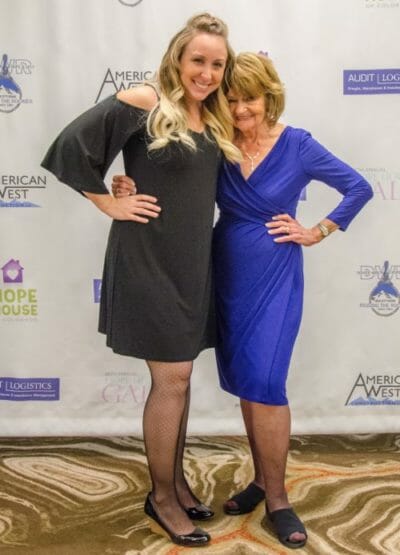
Betty (center) at the organization’s annual gala with Ariel (right), a teen mom she helped become a “success story”/ Courtesy Betty Haligas
Ariel is one of these girls that Betty took out shopping, not for a professional suit, but for shoes that she could wear to the annual gala held by Hope House. Through that shopping experience, Betty was able to get close to Ariel.
Ariel dropped out of high school after her daughter came into her life, but through Hope House, Ariel received her GED. Now, she has a professional job, a car, and her own apartment. Betty and Ariel keep in touch.
“It’s good to know success stories,” Betty said. “It makes you feel very good that you’re involved, that you’re a part of it.”
Betty says that it is her Christian faith that inspires her to volunteer at Hope House and now she’s inspired her entire family to help support the cause. One of her grandsons is the organization’s financial director, and her two daughters and son all support Hope House financially.
Hope House will be opening a new resource center soon and Betty is excited that it will allow them to triple the number of teen moms they serve each year.
Betty’s humility leads her to believe that she is undeserving of this award, but if there is one thing she wants others to learn from her story it is “not to judge others and their circumstances” and to “be grateful for my blessings.”