South Carolina Couple Brings Joy and Support to Hospice Patients
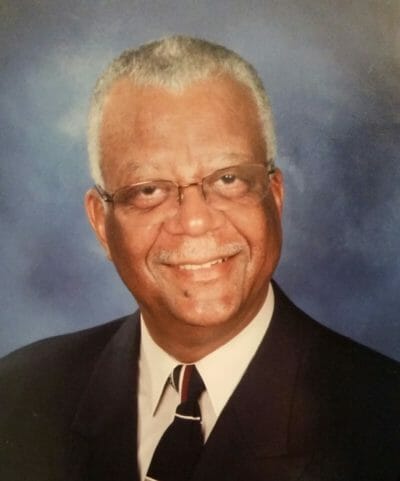
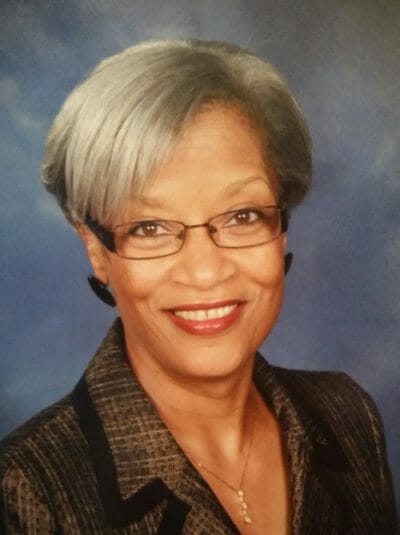
Paulette and Gene Owens first moved to South Carolina sixteen years ago, knowing no one in the area. But the couple quickly immersed themselves into their community, actively participating in their church and leading a grief ministry together. They said this naturally led to them volunteering for Encompass Hospice, beginning about five years ago. Paulette and Gene travel to the homes or nursing homes of patients nearing the end of their life to spend time with them and offer a relief to any caregivers the patient may have. The goal is to support the families of the clients as well as offer comfort, support and companionship to the clients themselves.
The couple meet with their clients once a twice a week, with Gene sometimes driving almost an hour away to meet with his. Gene has also set up a weekly bingo game at the nursing home where he visits his current patient, and helped to create a “Bingo Bucks” store where the patients playing can spend their winnings.
“We just think it’s critical and it’s important that we give to each other and care for each other,” Gene said of their volunteer work.
For sharing their love and compassion with countless patients and families in need of support, Paulette and Gene are today’s Daily Point of Light award recipients. Points of Light spoke with them to hear more about what they do with Encompass Hospice.
Describe your volunteer role with the Encompass Hospice. Paulette: What I’m doing right now is going to a nursing home and visiting with a patient who turned 98 in April. I’ve been seeing her for over a year now. I basically am just sitting and talking and chatting with her and that’s basically all we can do, we’re not nurses or aides or anything like that, we’re just volunteers. So we get to conversation and just chat and laugh a little. She has her good days and bad days. That’s what I’m doing right now.
This one that I have right now is over at the nursing home, but we’ve gone to homes and sat with some, we’ve given respite for the caregiver so they can go out and do what they need to do and we sit with the client at the home. If they’re talking to you, we’ll talk, if not, we just make sure they’re ok. I’ve had some that weren’t really speaking or awake most of the time, so mostly just to sit and make sure everything is going ok so they won’t be alone.
Gene: We’ve only had two cases where we’ve worked together. I got the first case, and it was a respite case, a lady with cancer. She was very heavily sedated but her son had quit his job and everything in Chicago and came back to Johnstown, South Carolina. I would go in and just relieve him, let him go. I would just sit with his mom. It’s the first time we had ever worked in a nursing home. We have been around for quite some time because we started out with one company and its got purchased by another company and its gone through reorganizations and we’ve probably had five or six coordinators. We had just gone from [the patients’] home to home. You build relationships with the family, you’re not only with the patient. I love that even now in the nursing home, we call [his patient] King Arthur. Arthur loves to say, ‘Oh, my friend Gene is coming.’ They look forward to you showing up. … They were playing bingo when I first got there and then they stopped playing, so I started I back up again, so it’s not just the one client I go see. Now I see a whole bunch of them. Call them all over to bingo, they win a game and we pay them off in bingo bucks. They won the bingo bucks, but they had nothing to do with it, so people kind of fell off from that. So now I got them going again I have about ten plus folks coming back. They look forward to it on Thursdays when I roll them all up in wheelchairs. I talk with the company, and we’ve gotten to the point and now we’re opening up a bingo bucks store and we’re going to do that once a month. The employees have made contributions and the coordinator went out and got a whole bunch of stuff. We let them buy from toothpaste to combs, to brushes, mirrors, candy, cookies. Spend their bingo bucks on whatever, so it’s kind of activated it all over again.
We do what we can do and it’s kind of nice. I guess the families after awhile kind of suck us all in as being a part of the families. We have gone to several funerals and all, when our clients have passed. We’re just there to support the family and help the transition and build relationships with those who are going through their last phases of life.
Gene has traveled almost an hour away to visit with his clients each week.
How and when did you first become involved with the hospice? Gene: About five, six years ago. Paulette and I also co-lead the church’s pastoral care or grief ministry. This just seemed like a natural take off from it. After the person dies, getting involved with helping to restore the family and getting them through, we help them with the funeral and arrangement and everything else. But now … the hospice allows us to be involved with the client, the people before they pass. So we become a part of the family and everybody looks forward to us coming in there. I guess we’ve been doing pastoral care at the grief ministry for our church since 2004. Then almost ten years later, you start it back up with the hospice. It just seemed so natural, like a natural extension.
Paulette: I think if we hadn’t been doing the pastoral care at church, I probably wouldn’t have even considered it, but that helped me to grow where I thought that I could handle being with someone that we know will ultimately pass and just try to make their time more comfortable and at ease.
How does it help those who are in their last stages of their life to have someone there to talk to and interact with them? Gene: It takes them to a state of ‘you know what, I’m going to be fine until I leave here.’ … When their children come through, they’re so effusive with thanks, but for the individual clients — Arthur says, ‘Oh, my friend Gene is coming.’ Everybody knows his friend Gene is coming, it’s just the social event. It kind of distracts him from all the other thoughts. They’re all on some kind of medication, they know their bodies are failing and not servicing them the way they used to. We do all kinds of things like reminisce with them. Paulette found Arthur’s high school year book. He graduated the year we were born. So I just went through his yearbook, ‘hey man, you know you were the most outstanding athlete?’ It gives him a chance to relive, and it’s conversations that folks probably wouldn’t have with him. We talk about his military time, we talk about his children right down to his grandchildren. We just sit there and have general conversations with them, and sometimes we’ve heard the stories about six, seven, eight, nine, ten times…
Paulette: This lady that I have, I go there sometimes and she doesn’t look like she wants to talk. The nurse will tell me, ‘Oh, she’s in a mood today,’ stuff like that. I kind of tiptoe in and I can see she’s looking kinda like maybe she doesn’t want anybody there. But I talk with her sometimes and she starts to perk up and starts speaking and we talk about her family and when she was young. A lot of times lately, I noticed she doesn’t realize she’s in a nursing home because she got quiet and said, ‘Oh, you’re still here, you could go to the other room and lay down for a little bit if you want.’ And I say, ‘Oh, do you know where you are my dear?’ First she said ‘home,’ and I say, ‘Are you home?’ She looks around and said, ‘Oh, no I’m not, I guess you can’t go down to the other room to lay down.’ So she repeats herself a lot, but it’s all new to me. Yesterday I was surprised, I told her a couple funny little stories about when I was young and doing crazy stuff, and we get talking about that and she’d giggle. Then we changed the subject and then a few minutes she starts giggling again and says ‘Oh, I can just see you doing so and so,’ because of what I had told her. It stayed on her mind somehow and she would go back to it and just laugh and laugh and laugh. And those times are really good. … She doesn’t remember my name, but she said ‘I knew my friend was going to come back and water my plants.’ She has a plant that I bought her and the flowers are all gone but the greenery is really growing nice. She said, ‘I knew you would be coming in to water and take care of my plant and it looks so beautiful.’ She says, ‘I may not go home but that’s ok, that’s alright.’ So it’s times like that where you enjoy the company and know that you were kinda helping them along. That’s the kind of satisfaction I get from doing it. I know there’s another one we talked about trying to do in the same facility but he was one who did not want anybody. I went in there and I said, ‘How are you doing, I just thought I would come and check on you.’ He said, ‘I really don’t want anybody here, I just want to be left alone so I can die, please go.’ He wasn’t really accepting the way he was then, and I believe he died a couple days later. It’s bittersweet sometimes when you know you really can’t help someone in that final stage of their life. But the rewards are greater.
Gene: We only knew [one patient] for less than a week. That was one we did jointly. … He ate all the spicy food, and then he would top it off with some ice cream and be like, ‘You all want some of this? Just make yourself at home.’ He was so funny. Then his sister and his wife and his children came in and we all stayed around and had a wonderful time with him. We told him we would see him the following week and then we got a phone call about three days later that he had passed. But I will never forget, his son followed us out to the car and he goes, ‘Where do they find people like you?’ He was just so happy we had given his dad a great time. It’s not about them focusing on the end of life. There’s a lot of good memories and a lot of good things we reminisce through and put them at ease and it’s kinda like, I don’t have to focus on death, I can focus on life. Let’s talk about life and living and the lives we’ve lived. That’s very different than being morose and focused and being like the gentleman you were talking about, Paulette, ‘I don’t want anybody, just let me die.’ It doesn’t seem quite right for the way to leave. We all know we’re going to come to an end but folks are kind of giving us some comfort. And I guess still keep us connected because so often the family members are with the workers, all they ever see is a doctor or a nurse or an attendant, but where’s the relationships? I think that’s what we do.
What’s been the most rewarding part of your work?
Paulette: Seeing that somebody who supposedly is getting ready to leave this world is able to smile and still relate to us in a positive way. This lady that I see right now is like, ‘Yeah, God’s will, whatever happens.’ She would still be talking about going home to her house, which she’ll never do, but she says ‘That’s ok, that’s ok.’ … So it’s rewarding to know that they’re coping. They’re not just wanting to lay down and just die. They’re living the best they can in the position they are in, and accepting visits and talking, and even if they don’t want to talk, they’ll listen.
Gene: It’s like not being forgotten. And I’m sure in a lot of cases, family members are working. A lady, she’s not even a client of ours, but she comes in and she asks me every week, ‘Do you know my son? He teaches school.’ And every week I have to say, ‘No, ma’am, I don’t think I know him.’ … But I’ve never seen her son, and so many folks, you don’t see their relatives very often. And most of the workers that come through don’t have a lot of time to spend with them. … The difference is the relationships you build with not only the folks we go to be with, but their children and sometimes grandchildren. You build a relationship with them and it seems like they’re even more relieved knowing that their parents, even when they passed, were feeling more fulfilled, not lost or destitute. It is surprising when you come and meet the family members and you know they’ve had a conversation about you, like ‘You know my friend Gene who comes? He’s a reverend.’ It’s just a relationship that they need, that I think everybody needs. You never want to feel alone. Especially at those moments.
Paulette said doing pastoral care at their church allowed her to feel comfortable enough to volunteer for a hospice./Courtesy Paulette Owens
What do you want people to learn from your story? Paulette: Learn that it’s where your heart is, as far as trying to decide if you want to be in hospice or not. We think about one day we’ll be there, one way or another. How would we want to be treated? Would we want someone who is willing to give up some time to sit with them and seems like they enjoy it? But we do need a lot more people to be able to do stuff like this. There are a lot of people that don’t have family to come see them. If they are in a [nursing] home, they have their own little room and they may not be able to have company where they are. So I just want people to know that this is a need and they should search their hearts and see if this is something they can do.
Gene: Mine would be spiritual. Galatians 6:2 — ‘Carry one another’s burdens and in doing so, you will fulfill the law of Christ Jesus.’ I know we get really involved in our own selves, but give, give to others. It just seems like a natural outreach. You hear stories enough about folks feeling destitute and left alone.
Paulette: And also being mistreated. Being mistreated because no one is there checking on them to make sure they’re being treated well.
Why do you think it’s important for others to give back to their community? Gene: You just used the right word, community. [If] you’re not giving back, what community is there? We’re all individuals, we already knew that. But the fellowship, the giving back, is what binds and ties what’s really called a community.
Paulette: ‘I’m my brothers keeper’ is another thing you hear. We are, and we should care for one another, giving back to the community and those in need. Some you may see often, some you may not, but you know that they’re there. We need to let people know that we care about them. I think that would create a community of love which is needed so badly. With this technology stuff going on, we don’t even look at one another passing on the street. We don’t even converse with one another because we’re so into the technology, the smart phones and all the stuff they have created right now. So it’s a lot less community going on than ever before because of this technology. So it’s really, really important we connect with one another.
Do you want to make a difference in your community like Paulette and Gene? Click here for local volunteer opportunities.
Washington Woman Disrupts Service Dog Training to Improve Lives for Owner, Companion
A well-trained service dog can make a true difference in the life of a disabled individual, but according to Jennifer Kolar, there are too few service dogs available, lacking quality training, to serve the many who qualify under the Americans with Disabilities Act to obtain a certified assistance dog.
Co-founding Atlas Assistance Dogs in 2016, the 46-year-old Seattle, Washington resident helps individuals who want to play an active role in training their service dog, a four-legged friend who often becomes one of the most important partners in their lives. Working against challenges like waiting lists and too few resources, Jennifer assists clients, including military veterans, through training their own dog, teaching specific service dog skills to mitigate the client’s disabilities and in the future hopes to gain accreditation through Assistance Dogs International (ADI).
Volunteering up to 20 hours each week to implement programs and operations that build critical relationships between disabled individuals and their service dogs, Jennifer is helping to transform lives through ethical, positive training of service dogs, and is today’s Daily Point of Light award honoree. Points of Light spoke to Jennifer to learn more about her volunteerism with Atlas Assistance Dogs.
What inspires you to volunteer?
As children, we were always taking care of animals and working to support our neighbors. I’ve been a volunteer with many different organizations including literacy, STEM, education, animals, people with disabilities. It’s part of what I believe in. I make my living doing something that I know does no harm, and then I feed my soul doing something I know makes the world a better place.
Describe your role with Atlas Assistance Dogs.
I am vice president and a founding board member at Atlas. Day to day, I recruit and motivate people as the chief trainer, working alongside our 58 volunteers. I am responsible for all curriculum development for clients, volunteers and trainers. I’m also responsible for all of our technology in the program.
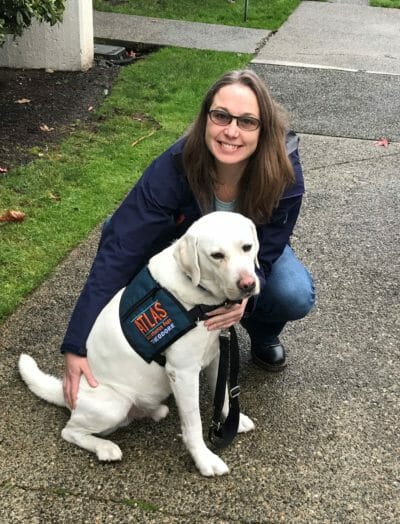
Jennifer Kolar pictured with her own service dog, Theodore./Courtesy Jennifer Kolar
What’s your life motto?
Do no harm.
What have you learned through your experiences as a volunteer?
It’s really humbling to have the trust of these individuals, and to see how much they’re willing to open up because of the relationship we’re forming with them. People always think volunteers are giving so much, but we get so much back.
Share one personal story with me from your volunteerism.
My first client was a retired Army colonel who had served in Vietnam. He had suffered physical injuries and was exposed to Agent Orange. We’ve remained friends after I worked with him to train a dog, and the relationship we formed has opened my mind to the absolute intense power, resilience and determination that these military veterans with disabilities manage, and the stigmatism that exists in the military of having a psychiatric disability or PTSD.
Explain how volunteerism with service dogs makes you feel.
Within owner-based training, you’re not just handing them a tool, you’re helping them form a bond and partnership with the skills to carry forward on their own. One of the wonderful things about service dogs is that they’re dogs. They’re playful companions who are your teammates. It’s the best friend that licks your face and plays ball. You can see the absolute joy and happiness in the training, reminding people that they get to play with and love their dog. It’s great therapy.
What do you want people to learn from your story?
Disabilities aren’t something to be ashamed of. Recognize that people don’t live in spite of their disabilities, they thrive as a result of them. It’s part of who they are. I’d like people to shift their notions and recognize how much strength we all have, collectively.
How can readers help?
Atlas Assistance Dogs will host a local event in October 2019, and we are continually fundraising through an ongoing CrowdRise campaign. Please check out our website for more information and how you can help: https://www.atlasdog.org/.
Teen Tech Star Democratizes Technology for All Through Volunteerism
An emerging tech wiz, Zahra Baxi is sharing her passion with others in her community, committed to making technology more user-friendly and accessible to people of all ages.
Launching the Davis Teen Animators Club in 2016, the now 16-year-old Davis, California resident is teaching young children how to use their imaginations and make animation in simple ways, but her service doesn’t stop there. Opening up a new world to many in her community, Zahra serves as a co-facilitator at the Davis Girls Who Code Club, a volunteer at Davis Media Access and a tech tutor at Connections Café at the Davis Senior Center.
Identifying and developing ways to make it easier for people of ages to use technology effectively, Zahra is using her skills to enhance the lives of others, and is today’s Daily Point of Light award honoree. Points of Light spoke to Zahra to learn more about her volunteerism.
Describe your role with Davis Teen Animators Club.
I’m the founder and president of the club, which is for local teens. I develop the curriculum, run workshops, and help participants submit to nearby competitions to improve their skills. I’ve volunteered hundreds of hours to the club, where we’ve assisted a couple dozen teens to help them work with media and technology. The Davis Teen Animators Club is operated through Davis Media Access, where I’ve also volunteered as a teaching assistant at their Summer Youth Media Camps.
What’s your life motto?
‘Don’t give up.’ Before committing to this volunteerism, if I got into a corner that I didn’t know how to get out of, I used to stop and give up. Now with the skills I’ve acquired, I’ve learned to keep on going and trying, a spirit exemplified through my volunteerism. For example, as a co-facilitator for the Davis Girls Who Code Club, I’m teaching groups of elementary school girls how to code, and encouraging the expansion of a field that has historically been male-dominated.
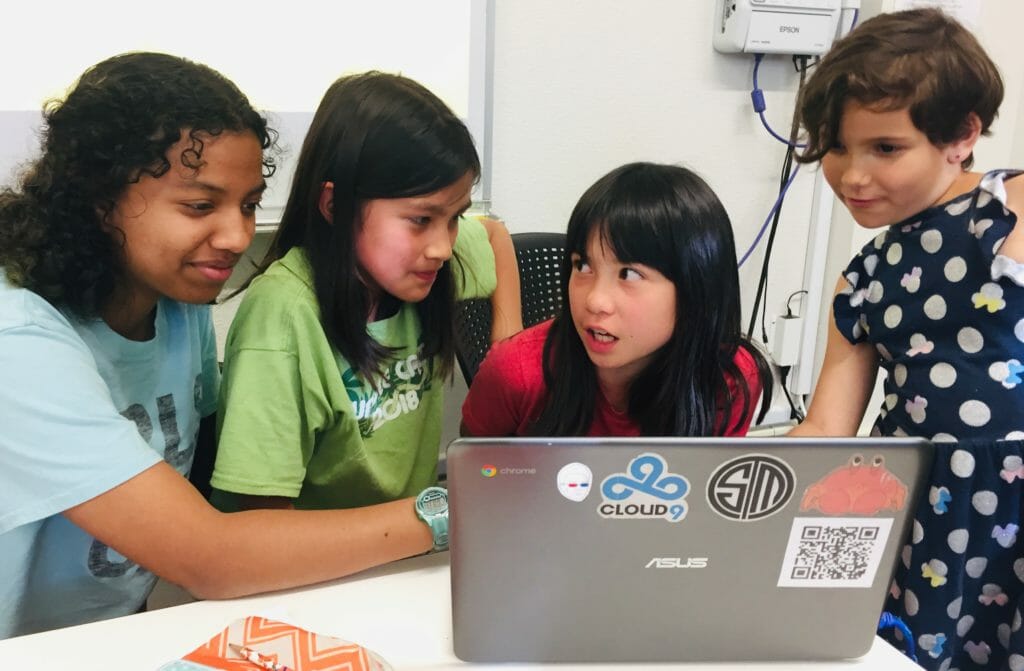
Zahra Baxi pictured (left) at a Davis Girls Who Code club meeting, alongside the 3rd – 5th grade girls group./Courtesy Zahra Baxi
What have you learned through your experiences as a volunteer?
I have learned how to interact with different types of people and learn new skills. I’m also proud that I’m able to teach someone something new, because they’re receiving information they need.
Share one personal story with me from your volunteerism.
I’m a tech tutor at Connections Café at the Davis Senior Center, where I assist seniors in understanding technology, mobile devices, social media, and basic internet safety. I’ve been able to help over 100 seniors as a tech tutor thus far. One time a woman came up to me, she had a brand new device, but had no idea how to use it. Each time I volunteered at the senior center, we’d sit down together, and I helped teach her how to use the device. She told the organization that I was a ‘life saver’. I felt happy that someone thought I was helping them in a really positive way.
How do you spend your free time when you’re not busy with school or volunteering?
I like to draw, I also take photos. I work with my hands a lot and create things for myself or for friends. I also like to travel to new places with my family. I also like to code, and create my own websites. One day, I hope to pursue a career that revolves around digital media, web, graphic or video game design.
What do you want people to learn from your story?
You don’t have to volunteer with an already existing, established organization. You can give back in your own community in a way that you feel passionate about. As a teen, I didn’t want to just follow what everyone else did. I was able to find my own way to give back, in a really meaningful way.
How can readers help?
Please check the Davis Media Access website for more information about how you can help, and get involved: https://davismedia.org/.
Changing Babies and Changing Lives, Washington D.C. Woman Helps Families Thrive Through Diaper Donations
As an ambassador and advocate for the Greater DC Diaper Bank, Rachel Vladimer helps to provide diapers to families that need them most.
Through the Greater DC Diaper Bank, an average of 175,000 diapers are distributed to 4,000 families each month via social service organizations throughout Washington, D.C., Maryland and Virginia, and Rachel’s volunteerism is a vital part of that effort. Serving as a leader for volunteer efforts in addition to designating her home as a diaper drop-off site, Rachel, who works full-time in the financial industry, dedicates up to ten hours each month to benefit infants, babies and families in need.
Providing families with essentials to thrive, Rachel is changing babies and changing lives, and is today’s Daily Point of Light award honoree. Points of Light spoke to Rachel to learn more about her volunteerism.
What inspires you to volunteer?
When I moved to Washington D.C., I knew I could make a difference in my community, and where I live. I’m actively involved in volunteering for four organizations in my community, including Greater DC Diaper Bank, and volunteer up to 25 hours each month in total.
Describe your volunteer roles.
I have many roles across the organizations I volunteer for, including:
● Greater DC Diaper Bank: I solicit diaper donations at my home, and then drop the donations off at the diaper bank. In addition to being an ambassador and advocate for the organization, I’m also a leader at the diaper bank, where we’ll get together in a group and bundle diapers, organize inventory and then send the bundles off. In one volunteer session, we can bundle over 10,000 diapers!
● Everyone Home DC: I volunteer with this organization twice a month, and do homeless outreach. Everyone Home D.C.’s mission is to support the holistic needs of individuals and families at risk of, or experiencing, homelessness.
● Martha’s Table: This organization provides meals for homeless and low-income families, and I volunteer here as often as I am able. In 2018, Martha’s Table distributed over 1.6 million meals through healthy food markets.
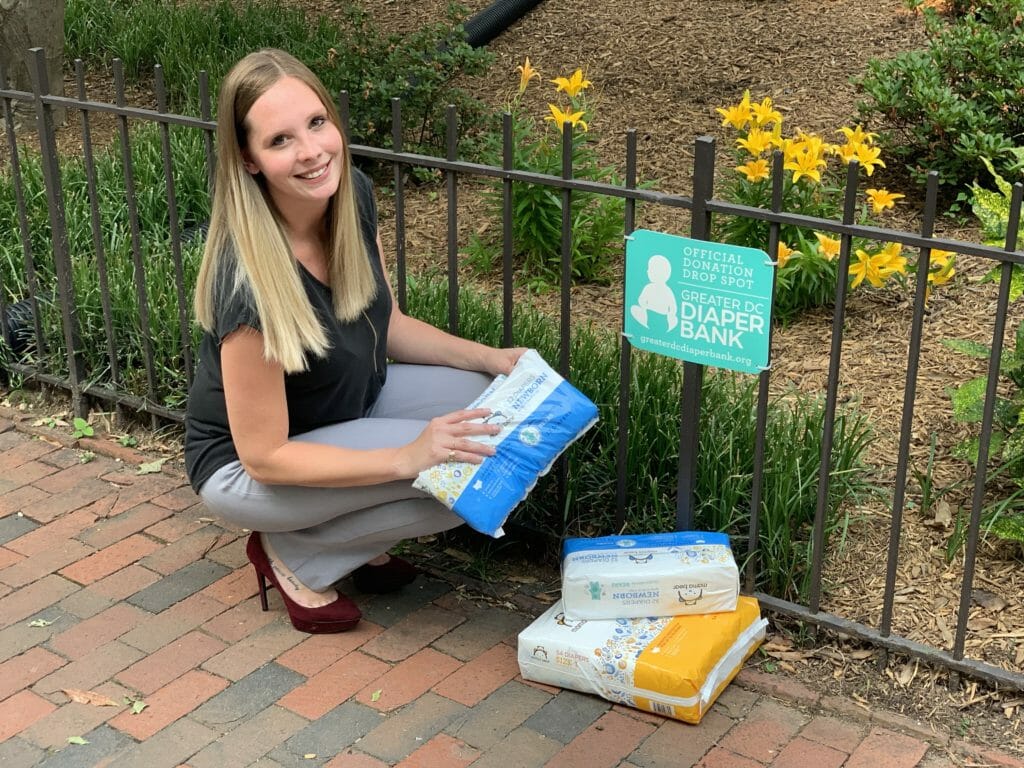
Rachel Vladimer pictured at her home, which is a diaper donation drop off for Greater DC Diaper Bank. She also serves as an ambassador and advocate for the organization./Rachel Vladimer
You’re helping families in your own backyard. What drives your service?
My mom died in December. These last few months have just been a whirlwind of me trying to deal with that loss. My mom was always so proud of me for my volunteering, she would always ask me about it. I keep her in my thoughts throughout my volunteering, because this is for her now. Everything I do is for a reason, and I’m volunteering just to be a better person, because I know it all leads to the greater good.
What have you learned through your experiences as a volunteer?
How willing people are to help once you give them a chance to pitch in. I have friends that are interested in volunteering because they know I volunteer. People love to help, and seeing them care about giving back has meant more to me than I ever realized it would.
What does it mean to know that you are helping families, and the littlest ones amongst us?
I’ve seen the impact of living below the poverty level with friends and family members, they need the help. Being able to make a difference in my neighbors’ lives means a lot to me.
Share one personal story with me from your volunteerism.
As a volunteer with Everyone Home DC, I’m seeing the people I’m helping. There was one man I would see each time I volunteered, but one day, he was gone. I mentioned his absence to the organization, and asked where he was. Turns out, he was off the streets, and he had gotten a home. That was the biggest moment where I was like, ‘wow,’ it was really good to see that I made a direct difference in someone’s life. I volunteer in the same neighborhood I live in, and it felt really good to see how he’d been helped.
What do you want people to learn from your story?
Any small gesture or good deed makes a difference. General awareness of the challenges others face is so important. Smiling at the person on the street instead of ignoring them like you don’t hear them makes their day. Bringing someone a coffee makes their day. Realizing how expensive diapers are, and that not all families can afford diapers. You can get others involved in service, too. Take your family to the diaper bank and teach your children about the importance of volunteering.
Do you want to make a difference in your community like Rachel Vladimer? Click here for local volunteer opportunities.
North Carolina Teen Helps Those in Need with “Care” and “Blessings”
Kena Vaughn-Grindstaff says the unwavering commitment Mother Teresa devoted to others in need has served as the wellspring for her own desire to serve people in her community.
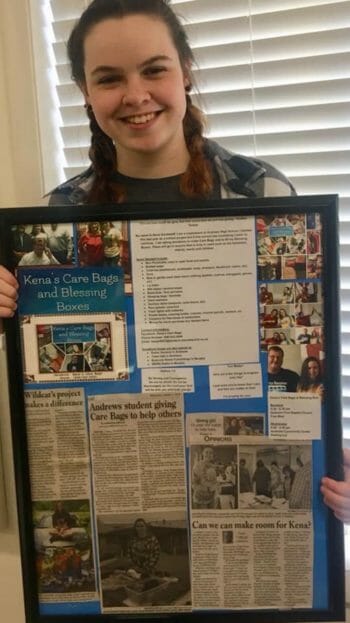
What started as a project inspired by the Roman Catholic nun and missionary’s work for her high school world history class has turned into an organization called Kena’s Care Bags and Blessings Box, dedicated to providing essentials to the homeless, those battling substance abuse issues, the elderly and children and families in need. Blending this assistance with compassion, the 15-year-old Andrews, North Carolina teen personally hands these items out to those in need, and facilitates conversations and relationships with individuals so that they know she cares.
Making a difference in her community through care and compassion, Kena is today’s Daily Point of Light award honoree. Points of Light spoke to Kena to learn more about her volunteerism with Kena’s Care Bags and Blessings Box.
What inspires you to volunteer?
I get a really good feeling from volunteering, and I’m humbled by it. I’m helping people who sometimes feel left out, and may feel like no one cares about them. It makes me feel good to let them know that I care, I love knowing I made someone’s day better.
Explain why you selected Mother Teresa for your school project.
My mother always looked up to Mother Teresa. When I was younger, she’d tell me about sacrifices Mother Teresa had made. When we were working on our class projects, our teacher gave us a list of notable figures in history that influenced the world, and I realized that Mother Teresa was the inspirational figure that I wanted to be like. Most of my classmates stuck with more traditional creative projects for the assignment, but since Mother Teresa helped people, I decided I wanted to help people too. That is how Kena’s Care Bags and Blessings Box began.
Care Bags are handed out to people in need, and include basic essentials and non-perishable food.
Describe your role with Kena’s Care Bags and Blessings Box.
Day to day, I work on collecting supplies, both purchased and donated, and I hand out Care Bags about once a week. Care Bags can be handed out to groups in need, whether it’s at our local church, or other places in surrounding communities. I also reach out to local businesses for donations, and I have donation boxes set up around the community.
Tell me more about your Care Bags and Blessings Boxes.
We fill the bags with non-perishable food and snacks, hygiene and essential items. Some items include first aid supplies, band-aids, toothbrushes, deodorant, shampoo and conditioner. During the winter we hand out warmer clothes, and in the summer, we’ll provide shorts and tank tops. I’ve handed out several hundred bags thus far. We’ve set up a handful of Blessings Boxes around schools in our community, and they are filled with supplies for students in need: clothes by season and snacks for children that are hungry.
Is there a saying that you live your life by?
Mother Teresa once said, ‘It’s not how much we give but how much love we put into giving.’ This belief stays with me a lot.
What have you learned through your experiences as a volunteer?
Oh man, I’ve learned a lot. I’ve learned not to judge others on their appearances. A lot of the people that I help may look like somebody that my mother wouldn’t want me to be around, but because of my service, I am able to walk up to these people, give them hugs, and help them. Drug use and homelessness is a real problem around our community, but since starting this organization, I’ve started to see a real change in our community. The people I meet are almost always the sweetest people, and I truly hope that if the roles were reversed, there would be someone helping me in a time of need.
Share one personal story with me from your volunteerism.
An older lady approached me once as I was handing out items, and as we had a conversation, she told me her feet hurt because she walks everywhere she goes. I asked her what size shoe she wore, and she happened to be the same size shoe as a pair of Nikes I’d just received as a donation. The next time I saw her, she told me how well they fit, and she broke down in tears, explaining how helpful the shoes were and how her feet didn’t hurt anymore. It was something little to give her those shoes, but their impact has stuck in my mind.
What do you want people to learn from your story?
I want people to learn that life isn’t all about yourself, and you need to help others while you can.
You’re a rising high school junior. What do you do in your free time, when you’re not in school or volunteering?
I don’t have much free time but whenever I do, I work on playing volleyball. I also enjoy rock and heavy metal music, so whenever I have the opportunity, I go to concerts and music festivals.
How can readers help?
Please check my Facebook page for more information about how you can help our cause and give back: https://www.facebook.com/Kenas-Care-Bags-2419162511646887/.
Youth Scientist Brings Hope to the Next Generation through Education, Science Kits and Fun
Meet Daily Point of Light Award honoree Angelica Krubeck. Read her story and nominate an outstanding volunteer or family as a Daily Point of Light.
Angelica Krubeck is no ordinary 12-year-old. She is on a mission to show kids that they have power within themselves, and to empower at risk youth around the world, using the field of science to inspire them to shoot for the stars. At the age of eight, Angelica was asked what kind of nonprofit she would create if given the chance. She knew it would be science related, but the bigger idea was to get kids and teens to believe in themselves. She wanted to create a ripple effect of inspiration and education, so one year later at the age of nine, Angelica created Super Science Kids.
Angelica and her team of volunteers provide materials in the fields of mathematics, engineering and science to kids across communities in the United States and abroad. Angelica partners with science professionals, mentors, organizations, universities and teachers, and has impacted more than 3,500 youth with Super Science Kids. From foster children, refugees, kids that live in low-income housing, children of immigrants and kids that live in shelters, Angelica inspires youth to search for their passion, and believe that they are worthy of turning their dream into a reality.
How did you become passionate about using science for good through Super Science Kids?
When I was younger, a friend opened up to me about how she lived in a shelter and how hard every day was. I wanted to help people like her in some way, but I wasn’t sure how. One day I was talking with my grandpa about wanting to help people, and he challenged me with the question, “If you were able to create a nonprofit, what would it be about?” I knew that I wanted to combine science and helping kids, and decided that day that we should make it a reality.
I came up with the idea of Super Science Kids when I was eight-years-old and the idea became a nonprofit when I was nine with the help from my family. At Super Science Kids, we create kits that have instructional pamphlets, activities for kids and creative ways for kids to understand different types of science. We also host science station events where six to eight stations are set up for kids, and at each station there are volunteers who help groups of participants learn. We provide backpacks and other fun things to the kids so they have a place to put everything they create with the science kits.
How has Super Science Kids evolved over time?
It really was just an idea and a small, local service project. Four years have passed and I’m now focused on the organization’s main goal of inspiring youth to learn more about science, and discover that they can do whatever they put their minds to.
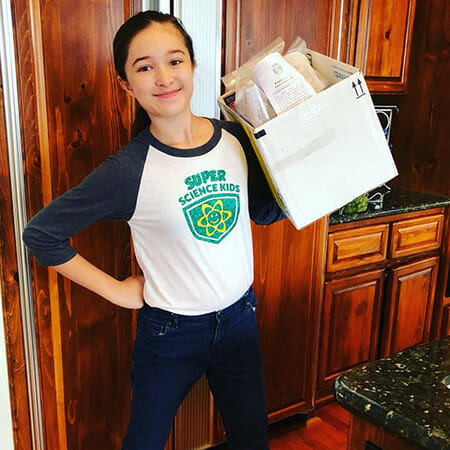
Angelica Krubeck prepares science kits for Super Science Kids events across the United States and abroad.
Describe how your nonprofit has reached youth on an international scale.
We have a network of other nonprofits and volunteers here in Cumming, Georgia, which we activate and team up with, to find contacts who do work outside of the country. We were able to host a science class for youth in China over Skype, and hosted lessons for them once a week. If we find an organization we want to partner with, but can’t reach them online, we send boxes of science kits to them.
Do you have any favorite memories from creating Super Science Kids?
Yes, our very first science station event! We handed out science kits and a little girl came up to me because she needed help creating her sound sandwich project. Once we finished her project, her eyes were huge because she actually completed it. She knew she could build whatever she wanted, and this is how kids figure out that they can do amazing things.
What’s been the most rewarding part of your work?
I think being able to give these kids an escape from whatever hard time they’re going through. I love getting to see them smile. At one after school program that we participated in, we were warned that one kid in particular was having a hard time and that he most likely would not engage in our activities. We started an activity with hot wheel race cars and race tracks, and his face lit up. We get to give kids like him an escape and see them smile.
Why do you think it’s important for others to give back?
It’s important for all of us to work together and help the community. The people we are helping, and the people that others will help because of volunteering, may not have many opportunities to learn. You can give them the hope that they can also do amazing things.
What do you want people to learn from your story?
I want people to know that no matter what your age is or where you come from, you should always believe in yourself. Push through the hard times and try to keep a smile on your face because you can do amazing things.
Virginia Teen Uses Own Trauma as Catalyst to Educate Youth on Sex and Mental Health
When she was younger, Odalis Del Cid Reyes had to live through one of the most terrifying and traumatic experiences a child could ever face. Odalis was sexually abused, and not just once, but for a long period of time. Her mental health crumpled because of it and she felt as if she was alone in her battles. However, with some professional help and her own strong determination, she overcame her depression and is now a leader in bringing sex education and mental health awareness to youth, especially in the Latino community.
Odalis, now 17, has volunteered with the Alexandria Campaign on Adolescent Pregnancy (APAC) for the past three years and facilitates workshops and events to educate teens in her community about safe sex, pregnancy, and other sex education topics. And knowing firsthand how much sex impacts mental health, she guides the teens to mental health professionals at the Teen Wellness Center.
Odalis is today’s Daily Point of Light award honoree and we spoke with her to learn more about her volunteerism with ACAP.
Describe your volunteer role with APAC.
I started volunteering in 9th grade, which is around three years ago. I started off as youth input and I was really shy at first because I didn’t know anyone there. I was really nervous, but then they started really appreciating my advice on what to do when it comes to reaching youth, especially in terms of subjects like teen pregnancy, substance abuse and things like that. We provide mostly information on sex education, but also more information about the Teen Wellness Center, which I feel the Latino community doesn’t know about. A lot of the services are free and if you want to see a therapist without your parents knowing, you can do that. In June, we’re doing community days where we’ll be reaching out to more undervalued areas in Alexandria. I’m going to be the main focal point for the Chirilagua area, which where most Latinos live. I’ll be translating a lot of the pamphlets and I’ll be connecting them to resources, but making sure that they can understand it in their native tongue.
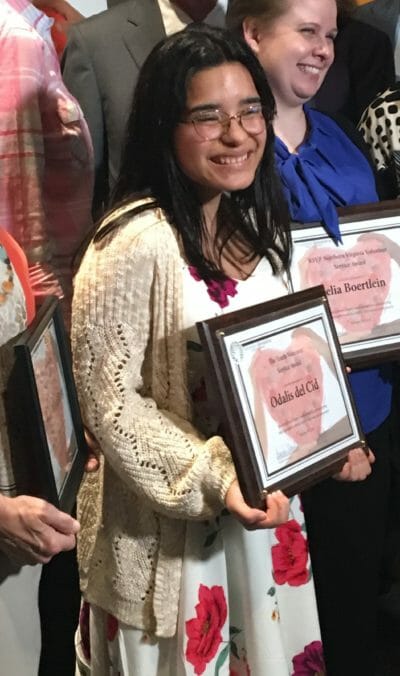
Odalis receiving an award for completing over 100 hours of volunteer service/Courtesy Odalis Del Cid Reyes
Why are you so passionate about reaching the Latino community?
I feel like it’s normalized for young Latinas to be pregnant at a young age. It’s kind of seen that Latinas should be able to have a kid at a young age, support their kid, support their husband, but I don’t really agree with that. Latinas should be able to have their own opinion on what they want to do.
What about with mental health?
[Therapy] is something that Hispanics don’t seek out. It’s something that’s seen as something you shouldn’t do. My dad was in the military before I was born and he served for many years. He went through PTSD, but he was like “Oh, I don’t need a therapist. I just have God and God helps me get through it.” My mom also went through sexual assault and rape, but she also said that she didn’t need a therapist. In the Hispanic community, religion overcomes, in their perspective, trauma. So therapy and seeking someone to talk about your experiences you went through is just not advocated.
Why do you think mental health awareness is so important?
When I was younger, I went through a very traumatic experience for many years. I was sexually abused for a very long portion of my life and my mental health really crumpled around it because I wasn’t receiving that much support from my parents and I felt very alone in the situation. So I want to advocate for youth to learn more about mental health and let them know that they aren’t alone in their battles. I feel like if they hear it from my own voice, from my own experience, they’ll take advantage of it.
What’s been the most rewarding part of your work?
Seeing people come up to me and telling me that I’m the reason they went to go see a therapist, that I’m the reason that they took the step forward to see someone about their problems. Also, when they were scared to talk about sex, they saw that I was really open to talk about it and I didn’t feel that it was such a big deal to talk about it so they took that step forward to seek help when it comes to contraceptives, STDs, birth control, things like that.
Is there a story of a person that you helped that sticks out to you?
One of my friends, she also went through some trauma as well and I’ve known her for a very long time. She asked me about the Teen Wellness Center and I told her that it was free, that your parents don’t have to know about it, that no one is going to judge you for what you tell them. Then she told me that she went to go see them and that she was really thankful that I told her about it. She told me that if I hadn’t told her, she felt that she would’ve committed suicide so I was really thankful that she told me.
What inspires you to volunteer?
My family. Although they haven’t been there for me in a lot of things I’ve been through, I feel that if I keep volunteering, I’ll be a role model for my siblings and I want to be that person they can turn to when they have questions.
What do you want people to learn from your story?
That they do have a voice in our big society. They shouldn’t be ashamed of their heritage because it’s something they should be proud of. Volunteering gives you a voice. Just push forward, volunteer and be proud of who you are.
Texas Woman Making the World a Better Place Through Mission Trips, Disaster Relief
Christie Warren lives her life through the simple Golden Rule: “Do unto others as you would have them do unto you.”
The 48-year-old Valley View, Texan pitches in wherever and whenever there is a need, counting mission trips, disaster relief and community service amongst her efforts. Committing the majority of her time to service projects through Twenty-Six: Twelve, an organization dedicated to serving others across the street and around the globe, Christie is described as a cheerleader for any activity that makes the world a better place.
Driven by a belief that neighbors should give back to others in need, Christie’s volunteerism has resulted in positive changes across communities near and far, and is today’s Daily Point of Light award honoree. Points of Light spoke to Christie to learn more about her volunteerism.
What inspires you to volunteer?
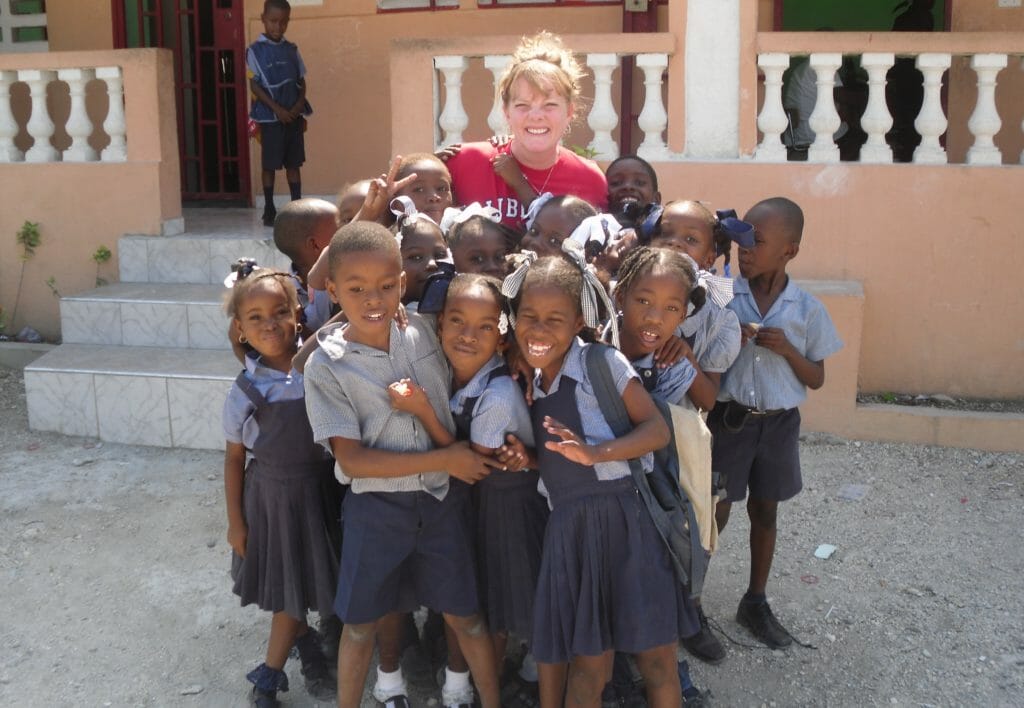
I grew up in a church with the idea that the Lord called us to serve the least of these, and to give back. This idea truly hit home during a service trip in Haiti. I witnessed mothers in Haiti that couldn’t take care of their own kids. As a mom, I understood the value of what our help meant, realizing that if I were in their situation, I hoped that someone would help me.
Describe your volunteerism with Twenty-Six Twelve, and other service projects you are involved in.
I started volunteering with Twenty-Six Twelve through my employer, and have participated in community service, mission trips and disaster relief. Some of my volunteerism includes:
Haiti service: I’ve traveled to Haiti for the last eight years to provide free medical clinics to the people of Onaville in Port au Prince.
Keep Denton Beautiful (KDB): I’ve been able to serve my local community through KDB, which engages Denton, Texas neighborhoods, businesses and residents of all ages in creating a clean and beautiful town.
Disaster Relief: I have done disaster relief with Samaritan’s Purse and Mission Discovery in Joplin, Missouri, New Orleans, and Rockport, Texas following major storms and hurricanes.
YoungLives: I’ve put Christmas gifts for teen moms together through YoungLives, an organization within Young Life, and provide child care at the YoungLives camp so that teen moms can enjoy camp activities and learn about the gospel.
Various service projects: From leading backpack drives for kids in need, serving as a project leader for Operation Christmas Child, to walking the nearby pond to pick up trash, we often will work hand in hand with family and friends to pitch in wherever we can.
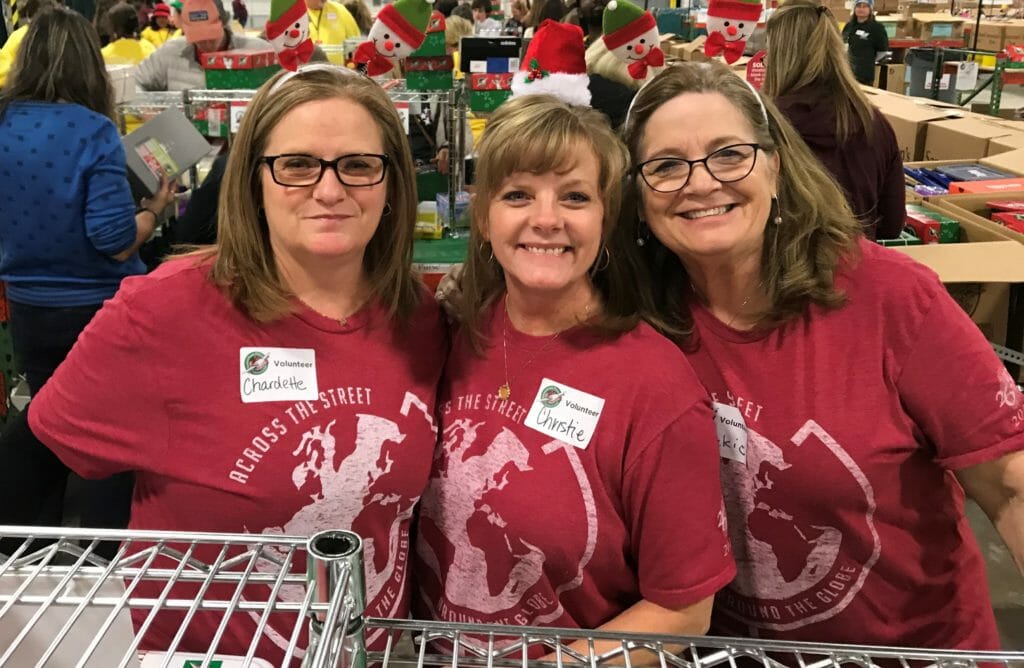
Christie Warren pictured in the middle. On the left is her sister, Charolette, and on her right is Beckie Hinze, Executive Director of Twenty-Six: Twelve. The three are pictured at the Dallas Distribution Center for Operation Christmas Child inspecting Shoebox gifts before they are distributed to children all over the world./Christie Warren
Tell me about your “Blessing Bags” Project, which helps the homeless.
I worked with my co-workers to assemble 130 “Blessing Bags” to give to the homeless in our community, some of whom are veterans who really need our help. We gathered hygiene products, quarters, prepaid phone cards, socks, chapsticks and more essentials for those without shelter. We also put scripture in their bags and a note that says ‘someone loves you, Jesus is looking out for you.’ You would not believe the tears these bags brought to people’s eyes when they received them.
What’s your life motto?
“Be the good you want to see in the world”.
You’re described as a light to all around you. What does it mean to hear that?
You’re going to make me cry (laughs). I think about my kids, and I think about the example I want to be for my children. To know that someone says that about me, I hope my kids recognize my efforts and try to emulate my service. I would encourage readers to get their kids involved in service if they are able to. Don’t ever think your kids are too young to learn about giving back,.
What have you learned through your experiences as a volunteer?
I’m stronger than I think and I can handle a lot more than I thought I could. You don’t know what you’re capable of until you put yourself out there. We first went to Haiti in 2012 following the earthquake, and we’d been warned of looting and other scary stories. I remember getting off the airplane and being terrified about not knowing what I was walking into, but I felt called to go help. They Haitians are the most beautiful, joyous and appreciative people you’ll ever meet. They have nothing, but they were so grateful that we were there.
Christie Warren pictured during her 2013 trip to Haiti, where she conducted a medical clinic that served school children during the day./ Courtesy Christie Warren
Share one personal story with me from your volunteerism.
I met a woman who was living in a tent on the corner of the property where her home once was after the 2017 hurricane in Rockport, Texas. My sister and I were there volunteering for disaster relief. This woman spent each day trying to piece together her life – her belongings scattered, her clothes in trees for as far as the eye could see. While she was waiting on FEMA assistance, she was so appreciative for any little bit of help we could provide. It’s situations like that those I think, it could have easily been me or my family that lost everything to the hurricane, and how great would it be to have people help me that didn’t expect anything in return.
What do you want people to learn from your story?
Commit to service if you hear of a need, no matter how big or small. Giving to others without any expectations in return fills your tank. The first time we went to Haiti, we were handing out a 10-day supply of Tylenol. We felt like we weren’t fixing anything. But you have to step back and think, these people will not have a headache for the next ten days. You’ve done something for them to help make their lives easier.
How can readers help?
Some of the organizations I volunteer for, including Young Life and Samaritan’s Purse, are always looking for donations and volunteers. Please check out their website for more information.
Inspired by Her Parents, Woman Volunteers Countless Hours at Organizations Throughout Atlanta Area
Eight years ago, Mary Stockstill had what she called an “aha” moment. She had just experienced the death of her parents, lifelong volunteers who instilled in her an attitude to always give back. While she hadn’t done much volunteering before, Mary was inspired to carry on her parents’ legacy by getting involved in her own community within the Atlanta area. That inspiration would carry on to not one, but four different volunteer organizations where Mary passionately dedicates her time to serve.
She leads a team of about 70 of her coworkers at Novelis, an industrial aluminum company, in cooking meals for the Ronald McDonald House, a nonprofit organization which provides housing to families with children receiving treatment at nearby hospitals. Twice a month, she and her coworkers buy, cook and serve meals for the families who reside at Atlanta’s Ronald McDonald House. With Novelis, she also participates in their Recycle for Good program, which collects cans to raise money for Habitat for Humanity, a nonprofit which helps to build and provide affordable housing across the country. She and her coworkers have built five houses so far, and plan on building three more this year.
Outside of volunteering with Novelis, Mary also donates her time to the Homeless Pets Foundation, which takes care of homeless cats and dogs in the Atlanta area and helps to find them a home. Additionally, Mary raises money each year for Special Olympics Georgia through two major fundraisers — polar plunges in Georgia and New Jersey, and by repelling down a 24-story building in Atlanta.
For not only the countless hours she spends dedicates to bettering her community, but also for her constant recruitment of others to live a life of volunteering, Mary is today’s Daily Point of Light recipient. Points of Light spoke with her to learn more about all Mary does for these organizations.
Describe your volunteer role with the Ronald McDonald House.
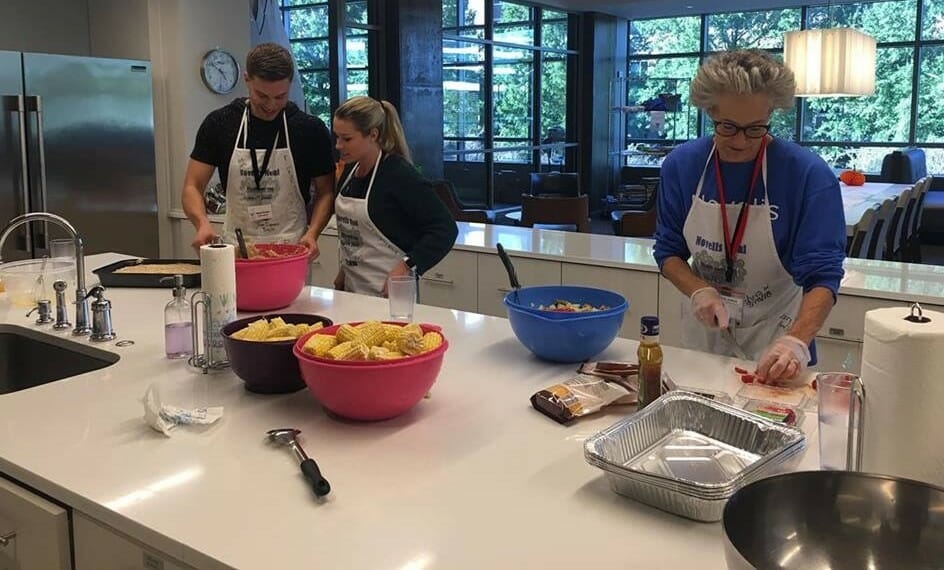
We started a grassroots coordination of volunteers, ten per meal, to basically plan, buy, prep and serve the families at the Ronald McDonald House twice a month. I did this for about six years for Coca Cola and then I came to Novelis and they were kind enough to let me start the group here. We built the team up to about 70 volunteers who take turns serving brunches on the weekend or dinners during the weeknights. We all gather, plan a meal — our last one was a German theme, or good old meatloaf or grilling, whatever it might be — and everybody goes out and buys the supplies and then we show up at the house and prepare the meal and serve all the residents who, poor things, are stuck at the house, really.
I was invited to one meal and I just enjoyed it. It was so much fun and to see the joy on the families faces. They’re away from home, this is their opportunity to have a good old home cooked meal and it saves them a lot of money from having to buy lunches or dinners at the cafeteria at the hospital. They have enough bills. So once I went to that one meal, I was really excited and I just talked it up with all my other colleagues and we designed an apron for our team and then started scheduling out two meals a month. So my part was basically just to get a lot of volunteers interested and signed up and make sure we had teams that could staff each of the meals.
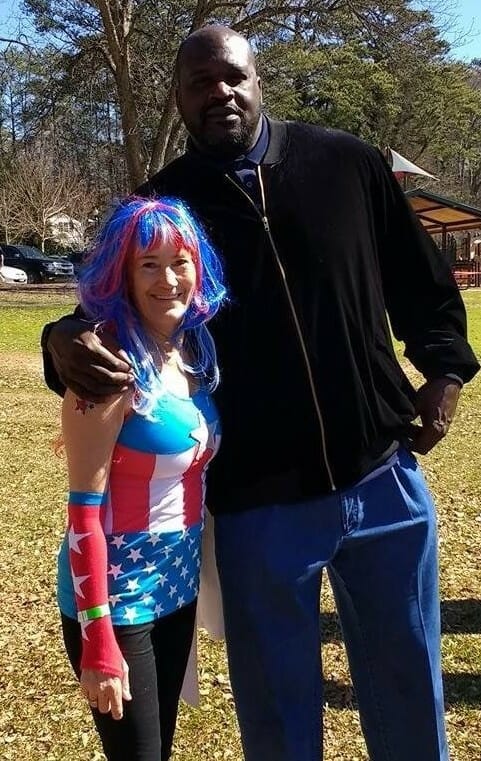
Mary stands with Shaquille O’Neal at the Georgia Polar Plunge fundraiser, where she helped to raise money for Special Olympics Georgia by running into icy waters. O’Neal helped judge the costumes of the participants. /Courtesy Mary Stockstill
Describe your volunteer role with Special Olympics Georgia.
I started actually with Special Olympics New Jersey, and that I was just carrying my father’s legacy with doing polar plunges [fundraisers] and volunteering. My sister does a lot of work with the one in New Jersey. So I looked into Special Olympics Georgia and my daughter and I would go and, they’re called ‘fans in the stands,’ basically you just show up at the events and rally the athletes and cheer them on. We would also hand out the medals, the awards to the winners. But mainly my primary focus, since I’m kinda spread thin, is basically to fundraise for them. For the Georgia one, I do two different primary fundraisers, and I’ve raised a good chunk of change. We repel 22 stories each year and raise money for them. We also do a polar plunge each year, and that’s basically just running into the icy water.
Describe your volunteer role with Recycle for Good and Habitat for Humanity.
That’s been since I’ve joined Novelis, three or four years ago. Recycle for Good is the company’s sponsored program, which basically says three million cans equals a Habitat for Humanity build. Three million cans equals $84,000 roughly, and that’s the cost of building a house. We’re doing it down on the westside of Atlanta. The Recycle for Good piece of it is me just going around, going to festivals, going to schools or my neighbors, collecting aluminum cans. We’ll collect a good amount, 40-50 pounds weight wise. Then we turn them in. We’re going to be doing I think three houses this year. We just started last Wednesday building the walls at the warehouse. We go to, for example, the Mercedes Benz Stadium, up to the Atlanta United games and the Falcons games — and collect all the cans from the vendors at the stadium … then as well as in neighborhoods and all that. And then that’s the money that gets used to sponsor our build. We’ve done five already. We pre-build the walls at the warehouse, the exterior and interiors, and then we put them on a truck and they take them out to the site and just kind of pop them up. And then we start painting and plumbing, and all that good stuff. I got to do roofing, which was fun.
Describe your volunteer role with the Homeless Pets Foundation.
It’s a no-kill shelter and I coordinate the volunteers, so I will try to recruit volunteers. We’ll go out to adoption events, at Petsmart or we’ll go out to the Gwinnett Strikers [baseball] games. We take our homeless pets, our rescue dogs. We have about 40 of them at any time, we’ve had as many as 70 at a time. I do about 40 hours a month volunteering and doing adoption weekends and being the voice of the animals, describing the dogs, saying this one’s good with others, this one doesn’t like cats, yada yada.
What made you want to get involved in so many areas?
Basically the life changing moment was my parents passed away within three weeks of each other, eight years ago, and they were always volunteering for everything. They were the den mothers, the Boy Scout leaders, the coaches, all those kinds of things. My parents instilled in me all of this give back type of thing. I was basically not that active and then when they passed away, I realized the world had lost some really wonderful volunteers so I just started signing up for things, probably to help the pain. I just enjoyed it so much, it brought me out of a bad place. It’s just taken off. The Ronald McDonald House was just, ok, a few people — ‘hey, you want to go cook a dinner once in a while?’ To ‘hey, we’ve got a dedicated team of 70 people and we’re doing this twice a month.’ It just bloomed. And then the dogs, my parents always did animal [volunteer work], and so I’m a huge dog person. And Special Olympics, my father and my sister, my sister is a huge volunteer for Special Olympics, so as a tribute to him and her I do the Special Olympics. Basically just about eight years ago I had an ‘aha’ moment of ok, I have to give back. And I guess I enjoy being with people and volunteering is a huge way to meet new people.
What made you want to get so many others, including your coworkers and daughter, involved in your volunteer work?
We’re all connected. We have a fun time doing these things. It’s a great way to get people out. Some people don’t come out of their shell until they do a volunteer event and then all of a sudden they’re excited about it, they’re out doing things. It’s a way of connecting with people. Especially with kids, I do a lot with middle schoolers and high schoolers, and they’re bored and it’s like, I have plenty of opportunities. I think that’s the biggest thing for me, there’s never a lack of opportunity to volunteer. So I think that’s probably why I have a variety of different ones, because I try to help people get connected to different activities. And the kids love it. The kids are absolutely amazing. The middle schoolers, you give them something important like that to do, and they’re just totally engaged. They call me up all the time, ‘is there something going on this weekend, what’s going on?’ It’s good to connect. If you go to a Ronald McDonald House meal … our vice presidents, the basic clerks, the temporaries, all of us, we all cook together and everybody’s on the same team and everybody is on an even level helping others. It’s just fabulous.
Mary, right, started a team first at her original employer, Coca Cola, and then at her current company, Novelis, to make sure the Ronald McDonald House had at least two meals provided for the families each month./ Courtesy Mary Stockstill
What’s been the most rewarding part of your work?
Making it easier for others. The kids, the special athletes, it takes a lot of money for them to go out and feel like champions. The kids can go out and compete get medals and feel like champions with the funding that we give for the games. The dogs get adopted into homes and I get follow-up pictures for years — ‘the dogs saved me,’ the families are now happy and playing with the dogs. The Habitat build, I’ve been back and seen some of the families at their homes. They’re all so happy. Because they work so hard to get into those homes. It’s not like a handout, it’s definitely a hand up. The Ronald McDonald House meal, several times we’ve had families come up and just thank us for a home cooked meal. Because when my teams cook, they cook with heart. I pitch it to them, ‘this is a big family reunion guys, you got your family here, this is how you’re cooking.’ And the families there at the Ronald McDonald House are just so grateful to have a home cooked meal while their patients are in there being treated or getting transplants. And it also saves them money, they have enough expenses.
What have you learned through your experiences as a volunteer?
Just tell the story. Be the voice. Talk to everybody. You never know how you can be connected. I can connect with a lot of people because of all the different activities I’m in, or I can recruit a lot of people because of all the activities. Maybe you don’t want to cook, that’s fine. Maybe you want to go walk dogs, that’s fine, there you go. So having a variety of connections with people and just being the voice for whatever cause it is. I can talk up Ronald McDonald House all day long and I can talk up the dogs all day long and Special Olympics, any of that stuff.
What do you want people to learn from your story?
You can always be a positive impact to someone else. There’s so many ways to do it. The biggest message is to go out and be a voice. It comes around. The joy you get, it’s huge.
Feeding Migrants Far from Home, Mother, Daughters Make Over 500 Burritos
33-year-old Dianna Medina says that her grandmother used to tell her, ‘if you see someone that needs a burrito, give them one.’ Dianna is now sharing that sentiment of goodwill through her service, by making food for immigrants far from home and in need of food and care.
The McAllen, Texas young mother and first-generation American says she recognized her family in the faces of immigrants passing through McAllen, and knew she had to do something to help. Cooking two dozen burritos each week alongside her two little girls, the family brings the fruits of their labor to Catholic Charities of Rio Grande Valley each Friday, where immigrants are sometimes in limbo due to the crisis at the border, their futures uncertain.
Originally starting project “Burritos Sabaneros” as a Christmas service project, Dianna and her children have hand-made and delivered more than 500 burritos since December 2018. Dianna is helping to put food in the mouths of those in need in her community, and is today’s Daily Point of Light award honoree. Points of Light spoke to Dianna to learn more about her volunteerism.
What inspires you to volunteer?
My parents and grandparents immigrated to the U.S. from Mexico. I see myself in the faces of the people that we are feeding. I see my girls in the children we pass at the immigration center when we deliver the food, and I feel blessed that we’re able to help and share what we have.
Describe what you call Project “Burritos Sabaneros”
We started Project “Burritos Sabaneros” as a way to connect service, our religion and our family life. “Mi burrito sabanero” is a popular Spanish Christmas carol, and I’d play it for my children, 4-year-old Gema and 19-month-old Ely. My girls are young, we decided that this project would be our gift to Jesus during the holiday, as my children are familiar with Christmas. We committed to making two dozen burritos each Friday, and used social media to spread awareness of our initiative to drive monetary, food, clothing and other donations to the Catholic Charities center. Starting on Wednesday night, we’ll begin the process of cleaning, soaking and cooking the beans. Then, we start the mix for the homemade tortillas. We make 3 dozen in total, and our family keeps 1 dozen – I joke that I feed my workers with peanut butter tortillas (laughs). When we go to the center to drop off the burritos, we see the families who will be eating the food we’ve made.
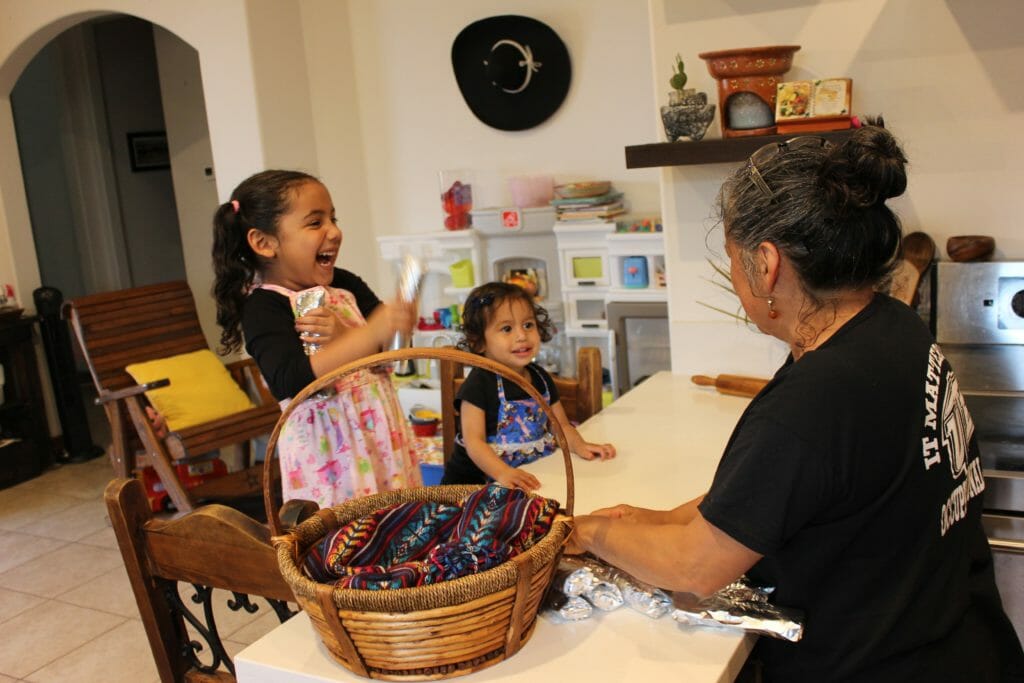
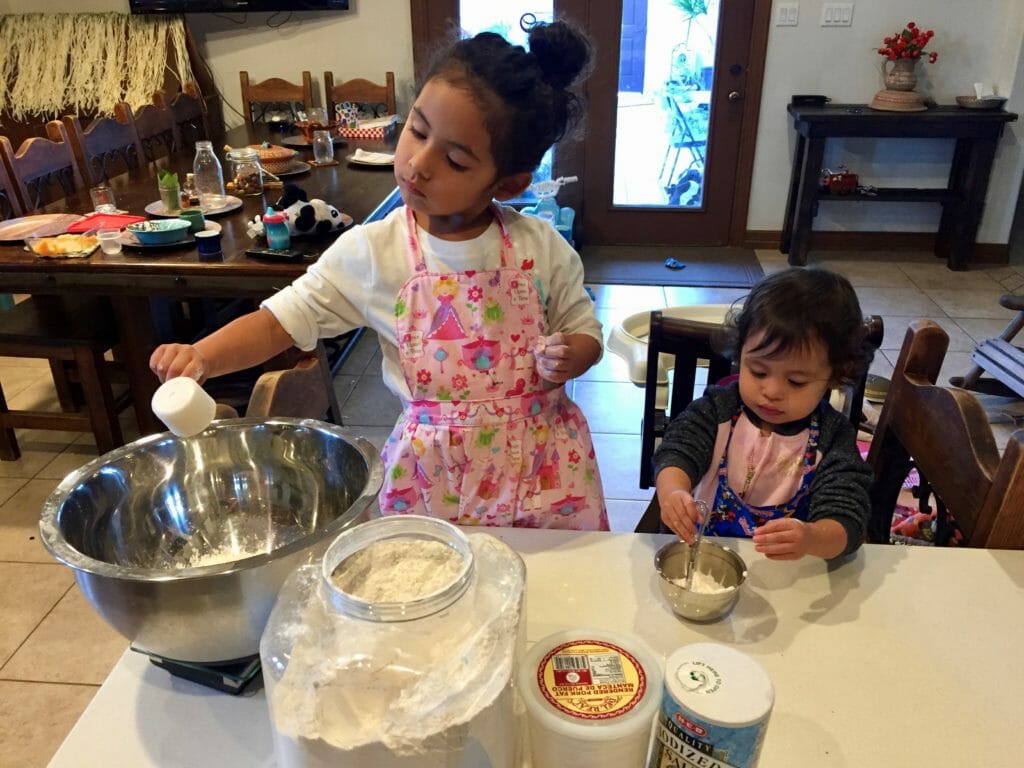
Dianna Medina’s children, Gema (left) and Ely (center) make burritos with her as part of the family’s service./Courtesy Dianna Medina
What have you learned through your experiences as a volunteer?
How our efforts have multiplied. We started with this humble goal thinking that maybe one day, we could feed 200 people. It’s so much bigger than that now. We’ve learned that we didn’t need to feed 200 at once, we’ve been doing it slowly. It’s become bigger than us. It’s a multi-family project. We’ve gotten donations from friends, they want to help support our community. It takes just a $50 donation to make 300 burritos.
Can you share your tortilla recipe?
It’s been evolving. I took a recipe from my mom, then incorporated some changes from a cookbook that I really love. The below “Burritos Sabaneros” recipe makes a dozen tortillas.
2 ¾ cup flour
2 tbsp lard
¾ tsp salt
¾ cup warm water
½ tsp baking powder
Combine flour and baking powder. Add lard and break it into the flour. Add salt to warm water, then add to dry ingredients. Blend this all together with your hand, the mixture will become a large ball, it should be moist but not sticky. Then you cover the dough and let it rest for 30 minutes. After 30 minutes, If the dough is sticky, use a little extra flour to shape the dough into small ball shapes, approx. ¼ cup size balls. Sprinkle some flour on a flat surface, then start rolling the dough out to make a flat, circular shape. Put each tortilla on a hot griddle, allow each side to fry for 30 seconds then flip. Enjoy!
What does it mean to know that you are making an impact on these people?
When I was in college, my grandma would say, ‘if you see someone that needs a burrito, give them one.’ She’d watch television and see people working so hard to cross the border to make a better life for their family in the U.S. As a young adult, I didn’t ‘see’ these people in need…everyone that age tends to be in their own personal zone. When I saw my grandma this Easter, I told her that I finally found the people who needed a burrito. It took a few years to find my calling, and it’s so meaningful to me that I can share my faith and experience God’s love with my daughters as we serve others.
Share one personal story with me from your volunteerism.
As these individuals go through the immigration process, shoelaces are one of the items confiscated at the border. While we were at the immigration center in McAllen, I noticed a mother putting her son’s shoes on, without laces. This is a basic thing to do for your child, lacing up their shoes, but yet, these people are away from their families, and many people don’t even know this is what immigrants are going through. What we are doing is restoring dignity to these people, as they are separated from a lot of things we take for granted.
What do you want people to learn from your story?
I felt overwhelmed by the whole political situation and negative news, and it took awhile for me to realize I didn’t have to take on a large scale problem to make an impact. As a family, we decided we could spend 3 hours per week giving back, and we could gain a lot. We’ve gained peace, and my daughters have a better understanding of the world. This service has been full of life lessons for our daughters and a blessing for our family.
How can readers help?
We give back to Catholic Charities of Rio Grande Valley, however Catholic Charities has chapters across the country, and in your community. Please visit their website for more information on how you can help: https://www.catholiccharitiesusa.org/.