Giving a Voice to the Homeless, One Small Act of Kindness at a Time
John Shafer is on a mission to become a voice for the homeless. On a cold October night in Chicago, he noticed numerous homeless people trying to sleep on city sidewalks, without coats or jackets; they seemed to be invisible to the hundreds of people passing by. That night, it was difficult for John to sleep. He could not stop thinking about the people he’d left behind in the cold while he came home to a warm bed. Reflecting on whether he would survive under those conditions, John made a commitment to return to Chicago with supplies for those in need. Two weeks later, he made the two-hour drive back to Chicago from his hometown of South Bend, Indiana, to deliver 25 new fleece blankets to some of the people he encountered on the street — one small act of kindness that would grow to become Michiana Five for the Homeless.
John initially thought this one good deed would bring him peace. Yet, the overwhelming gratitude he received from the first blanket recipients changed everything. Knowing he didn’t have enough blankets to help the city’s entire homeless population, he was determined to find a way to do more. He learned that a large portion of the homeless population can’t get into Chicago’s shelters, which often have to turn away more people than they are able to accept. He created a Facebook page, invited everyone he knew to join it, and asked them for donations and supplies such as blankets, food and winter clothing. Soon, pickup trucks full of items poured in, and the volume of donations collected by the community was so large that John had to rent outdoor storage.
With so many donations coming in, John began giving to the homeless population in his community as well, and he began to shift his focus locally. Soon, Michiana Five for the Homeless came to life, focused on providing basic needs to the homeless, educating the public about homelessness, and advocating on behalf of homeless people in the Michiana community. By the time he discontinued service in Chicago, John had helped more than 2,500 people in need, and he continues to transform lives locally through small acts of kindness.
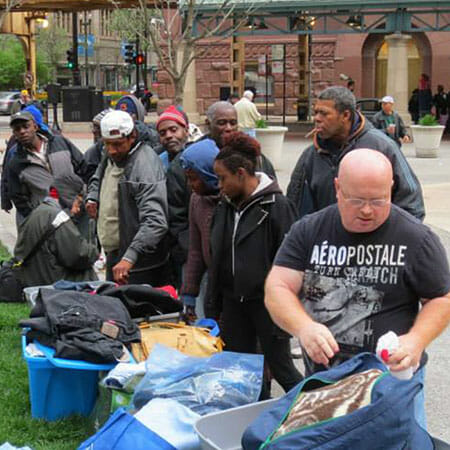
John Shafer helps people experiencing homelessness by hosting weekly hot meals, cooking in parks, distributing food, clothing and blankets.
John and his organization’s volunteers help people experiencing homelessness by hosting weekly hot meals, cooking in parks, distributing food, clothing and blankets once a month – twice a month in the winter – and hand out cold water on hot summer days. He also applies for grants that help people pull themselves out of homelessness and find permanent housing solutions.
“I never saw it turning into what it is now. It’s 2019 and I’m still handing out blankets,” said John. “One act of kindness can have such a ripple effect, and now we’ve become a voice for the homeless, because someone has to be.”
In 2015, tragedy struck John’s community when a missing teenage boy was found dead in an abandoned home, from an apparent overdose in extremely cold temperatures. It seemed the boy had nowhere else to go, since the local homeless shelters did not accept youth under age 18. John didn’t want this to happen ever again, so he advocated for a homeless youth shelter in their community – one of his proudest moments of service, he says.
After a series of public gatherings and presentations, Bashor Children’s Home agreed to open a youth shelter facility on their grounds. In just two weeks after opening in 2016, the shelter was full. A photo of that teenage boy hangs inside the building as a reminder to youth that their life is valued and there are those who are willing to help.
North Carolina Woman Fights Student Hunger By Feeding Hungry Mouths and Minds
In 2017, an estimated 1 in 8 Americans were food insecure, including more than 12 million children. Food insecurity amongst children can sometimes go unnoticed until it is too late, as families struggling to avoid hunger are vulnerable to malnutrition and poor general health. This is why Lori Smith has decided to fight hunger in her community by feeding students and their families.
While eligible students are able to receive meals during the school day, the 44-year-old Advance, North Carolina resident says they’re often left to fend for themselves outside of school. Through Davie High Hunger Fighters, students and their families receive weekly food deliveries to help supplement their meals. Packaged by volunteers and delivered by teachers, these food deliveries are so much more than just a few items for the next meal, according to Lori. They represent a commitment to students and their families that their community is invested in the student’s education, health and safety.
Volunteering several hours weekly, Lori is feeding more than 30 families each week, and is today’s Daily Point of Light award honoree. Points of Light spoke to Lori to learn more about her volunteerism with Davie High Hunger Fighters.
What inspires you to volunteer?
God has blessed me with a servant heart and a “get it done” attitude. When I learned about the hunger in our community, I decided to go out and deliver food instead of writing a check. I’m passionate about kids and feeding these students means we’re helping them to develop, fulfill their goals, and do well in school. They can’t learn if their bodies and minds aren’t being fed.
Lori Smith pictured inside the food pantry at the Davie High School. Lori is helping to feed more than 30 families each week through her volunteerism with David High Hunger Fighters./ Courtesy Lori Smith
Describe your role with Davie High Hunger Fighters.
I pick up canned and shelf items from the food bank about twice a month. Those items may be donated or overstock from grocery stores. We have a food pantry at the Davie High School, which we created to reach more students. Students will come help us sort and pack the food bags, and then we hand them off to teachers for delivery. We’re not just feeding the student, we’re feeding the student’s family as well, and we’re reaching more than 30 families per week. I also started a summer food program in 2018, which we’re planning on extending to summer 2019.
What kind of items are being delivered to students and their families?
Food items include cereal, shelf milk, spaghetti, mac and cheese, peanut butter and jelly. But we also have discovered that paper products aren’t covered for families who are on food stamps. So we deliver toilet paper, paper towels, hygiene items. Recently, we received a grant and got laundry detergent to send to families. Whatever someone might need, we’re hoping to provide.
Describe a challenge you’ve faced in feeding students?
We found that some students were coming to school on exam days when they knew they didn’t have exams, just so they could get a meal. Teachers deliver the food bags because of the need for privacy, and sometimes, these kids are embarrassed or ashamed and don’t want others knowing about their food insecurity. We’re also working to raise awareness about our program, and find those students who need to be served within the school. A lot of students who could take advantage of the program just aren’t aware that we’re there to help.
You’re being recognized for your love, passion and perseverance for those in need in the community. How does that make you feel?
(Laughs) It’s very humbling. It’s just something I enjoy doing. I love to help others, I wish I could do this every day of the week. I take my service for granted, it’s just who I am. I’m not doing it for the recognition, I do it because I love these students.
What powers your service?
Mother Teresa wisely said, “If you can’t feed a hundred people, then feed just one.”
Share one personal story with me from your volunteerism.
When I first started volunteering with Davie High Hunger Fighters in November 2018, I met a student named Nyasha who was a high school senior. This girl and her older sister had recently lost their mom to a massive heart attack, and they were on their own, just trying to survive and pay the bills. I delivered Thanksgiving dinner to the two girls. When we realized they weren’t going to have a Christmas, we raised money for a meal and gifts. Nyasha has since graduated from high school, and is now attending community college. She doesn’t have a mom or a role model, and yet she is the sweetest girl with a great attitude. I have helped make her life a little better, but she doesn’t realize that she has blessed me even more. She has inspired me to give more and be grateful daily for the little things in life.
What’s your message to others who want to give back to their community?
There’s so much need in the community and I do think there are a lot of people out there who are willing to help. For me, it’s providing a way to put those two together. The opportunities and the needs that are there and to fill that need. Take that step out of your comfort zone, find something you’re passionate about, and go do it.
Promoting Acceptance, Autistic Man Advocates for Others on the Spectrum
Dalton Letta is a skilled speaker and also, he says, a very good listener. Another way Dalton introduces himself to the audiences he routinely speaks to? He is autistic.
The 23-year-old Rochester, New York man was diagnosed with autism spectrum disorder (ASD) as a child, at a time when the abundant resources and services that exist today just weren’t available for those with autism. Today, by improving education, promoting services and creating opportunities for people with autism, Dalton is on a mission to build an inclusive community where people with and without autism can understand, support and learn from one another.
Advocating for himself and others like him, Dalton has started a dialogue within his community about how each individual can give back, and is today’s Daily Point of Light award honoree. Points of Light spoke to Dalton to learn more about his volunteerism.
What inspires you to volunteer?
It all started when I realized I wanted to learn more about myself as a person with autism. For many with autism, there are obstacles that other individuals may not go through. My goal was for people with autism to be recognized for who we are, and our different skills.
You’re an advocate within your community. Describe your different roles.
I served as ambassador with The Autism Council of Rochester, New York in 2018. In addition, I launched Campaign D through a partnership with The BELL Program at Roberts Wesleyan College in Rochester, and also became the Special Community Liaison. I’m currently the Autism Ambassador for the town of Gates, NY and the Monroe County Face of Autism where I have partnered with New York Senator Joe Robach and Legislator Frank Alkoefer (4th Legislative District) to raise awareness about autism.
Dalton Letta serves as an Autism Ambassador for the town of Gates, NY and the Monroe County Face of Autism./Courtesy Dalton Letta
Explain how you’re connecting with others through your service?
Two of my programs, No One Eats Lunch Alone and Campaign D, are examples of how I use my own experiences to connect with others and raise autism awareness.
● No One Eats Lunch Alone: Personally, as a high school student, sitting alone at lunch could feel like rejection. I connect athletes to students who have special needs to combat isolation and bullying in lunchrooms so that no student sits alone during lunch.
● Campaign D: I facilitate community education focused on autism through these community forums and panels locally at companies and other organizations. I share struggles and successes about certain obstacles a person with autism has to overcome. This can include everything from depression to access to transportation.
Share one personal story with me from your volunteerism.
Recently, I met a little boy named Danny who is 10-years-old, autistic, and is non-verbal. I accompanied him to go get his haircut, which can be a scary experience for some on the spectrum. He gave me high fives throughout the haircut, and then a hug. I know me being there made the experience easier for him. I posted a story on my Facebook page about our experience, and now others with autism want to meet me. By focusing on the person, I’m able to touch more people with autism and hopefully, teach others as well.
You volunteer to raise autism awareness within your community. What’s your message to your community?
I ask that people don’t judge a person before they know them, but instead, judge us for our hearts. We are all capable and all have special gifts. Yes, people on the spectrum are complex, but every individual is complex. I volunteer to increase understanding of one another.
What does it feel like to know you’re helping?
It makes me feel better that people are starting to understand, and that they want to learn more. When people are more accepting, they can make a better world for other people. You’ve got to understand the person first, and that starts with me, by giving my community a window into real day to day life living with autism.
You’re busy with your advocacy. But what do you do for fun?
I’m a big bookworm, you should see my collection. I have 700 books and I’m still collecting. I collect comic books and graphic novels, and organize them in alphabetical order. My dream is to act professionally one day. My hope is that eventually, I’ll have a bigger platform to raise autism awareness as an actor. I’ll get there by taking one day at a time and I count my blessings.
Domestic Violence Survivor Dedicates Life to Advocating for Her Community
It’s both honorable and greatly appreciated whenever someone volunteers their time to make a positive outcome on their community. However, Melina Markos takes that appreciation to the next level by spending essentially all of her free time as a peer advocate in her community of Broward County, Florida. The mother of six and grandmother of four actively volunteers on ten councils within her school district or local mental health and behavioral health community. She travels to Washington to advocate to Congress on behalf of For the Children, gathers donated items for struggling parents, cooks meals to hand out to the homeless, and offers peer services and advocacy to anyone she meets who is in need.
Markos is inspired to advocate for families in need due to being a survivor of domestic violence and dealing with the court system, which at one point ordered her children into foster care temporarily. When her kids were returned to her, Markos said they dealt with mental health issues, and she herself struggled with overcoming the ordeal. It was these experiences that inspired her to try to make positive improvements to her community. With all of the areas she involves herself in, it’s no wonder Markos describes herself as a worker bee.
“I’m queen bee at home. I have six girls so someone has to be,” Markos said with a laugh. “But out in the world, that’s what I consider myself — just that worker bee trying to help move this life along and leave it better than when I found it.”
For the countless ways she volunteers her time to helping others, Melina is today’s Daily Point of Light Award honoree. Points of Light spoke with her to learn more about her various volunteer roles.
One of the several councils Melina volunteers with is Families Against Court Travesties, which works to improve the family court system./Courtesy Melina Markos
You volunteer in a few different ways — describe some of your volunteer roles.
So I do several levels of volunteering because I am a survivor of domestic violence with my second marriage. I have overcome a lot of personal struggles as well as life struggles. One thing I learned through my steps in recovery as a mom, as a human and as a woman, is that when you give back, you also receive greatly. I took two years to work on my self and rehabilitate my family to the best of my ability, get my girls and I back on track. And then after that, for the last ten years, I’ve been putting efforts back into the community. As a mom who went to through these things, I started noticing once my kids and I were resettling, there’s not a lot of opportunities for families who are in any capacity of recovery, to have the ability to be as involved in the school setting, at least in the county where we live. … So with that said, I approached the superintendent. He was new to our community and I met with him and I said, ‘Hey, I worked to rehabilitate my own life and my children, and you know, we had custody issues, and things like that, but now I am being denied access to my children through volunteering in the school day.’ And he’s like, ‘Over what?’ So I showed him my information and he was like, ‘Really? We have to change this.’ So that’s where my advocacy platform kind of started. My foundation was in the school access for family or parent members who had life upsets, things that have happened in their life, that it should not after a time period affect their ability to be a parent and be involved in the school setting.
I do have a daughter who has some mental health issues. At one point some of my children were separated from me and my husband. When they came home, that particular child had sustained some trauma. So she was getting mental health services that diagnosed her with autism as well as other issues like post traumatic stress, and so I was dealing with that. That put me in another level of wanting to look at mental health, so I started advocating in that area and I found there were a lot of levels of, again, not having places or resources for families who’ve been through our circumstances. So I joined the Consumer Advisory Council which is for Broward County. It’s part of the Behavioral Health Coalition which funds most of the mental health and behavioral health systems in our county. I started joining these councils as a volunteer to advocate for mental health and behavioral health changes as well as integrating, or building the bridge as I say, between the mental health community as well as the school system. I have really been digging my heels in the last six years, where I’ve gained the respect of the district of Broward County public schools. I sit on several levels of councils to give my input, give a fresh perspective, and again be looking out for children as a whole, not just my children.
So I moved into South Florida Wellness Network which is a peer community. One of my friends in a different type of recovery as well — because we look at recovery as all types of recovery, anything that you’re overcoming — about five years ago she came to me and she was like, ‘Listen, I know you do advocacy in this area and that area, so we’re a peer movement where you can actually become certified to be a peer advocate and volunteer in that realm.’ So of course I jumped aboard with that. I’ve been with Federations of Families. It’s another place where it’s families who come in with children who have mental health or behavioral health issues. I have six children and they all have gone through this circumstance so all of them have sustained some mental health issues with that, so this gave another platform for advocacy where I volunteer my time. I go out in the community, I go to conferences, I go to workshops. So it’s kind of connected me throughout the entire county.
I’m also recently in that last two years connected with … Families Against Court Travesties, because again I’m personally affected by the court system and how they handled our family. They uprooted my children and we went through a lot of trauma from 2004-2008. So those types of things we went through, I want to make sure that there’s voices that are heard. … They go to court, observe these court hearings that families are going through in the family and dependency courts, and just observe to make sure justice is being held. That things aren’t shady. And then we make recommendations for the upcoming judges or the judges when they come up for reelection. [We also have] a platform for making sure that all court hearings are recorded. Did you know that they’re not, at least in Florida state? … I mean for my children … they were involved in those court hearings back in 2004-08. They may have been minors and children, but they’re still humans and they can grow up. My 19-year-old wanted to go back and get some of the transcripts to know for herself what exactly happened, because she’s learning how to advocate. She wants to know that when she spoke to the judge she was heard, and where is that document? Well, none of that stuff is recorded, so none of it’s kept. It’s just whoever can remember what happened and their version of it. This doesn’t help our society gain momentum and move forward when there’s maybe un-left questions. She’s now become a mother herself and she wants to be the best mother, make healthy choices, but she has missing pieces of mom and dad separating. She knew what all was happening and she was old enough but nobody listened to her. These are things I advocate for, the importance of something as simple as turn on the recording. That child may grow up one day and want to know why they were removed from their parent for six months or a year or permanently.
That’s the core of where it came from. I love doing it and sometimes my girls tell me if I didn’t have to do the real job, I would just do this all the time. And I said I would, because this is rewarding. When I go home at night and I just spent two or three hours of my own time talking to a mom going through her own circumstance — and I’m not fixing her problem, I’m not making the law change itself for her, but I’m just there for her. And then I watch that person grow and become able to do what they need to do to remedy and fix their own world. So that to me is an honor.
I also go to Washington. This year will be my third year that I go and volunteer a week’s worth of time to go up there and advocate for For the Children. I go up there and give my time for that week to meet with congress people to make changes in the system as one of the advocates for Florida. We’re trying to make legislative changes. In 1997, a bill [Adoption and Safe Families Act] was put in place by President Clinton at that time. The [bill’s] incentive was, when a family went into crisis, to remove the children from both parents, foster the children. If they adopted the children out, there was an actual incentive that was paid to that entity, the child welfare system. So for that last 21 years, nobody has touched that bill. When my children and I went through the system, they quickly tried to put my children up for the adoption and I didn’t know what was going on at the time. I have since learned that the system were going to make several hundreds thousands of dollars off of adopting my children out, not giving them back to me or my husband, but actually severing those ties. I didn’t know that at the time, I thought they were just pointing fingers at me, but it had nothing to do with me at all. … I wanted to make sure I went up there on countless occasions to advocate to make sure that this system didn’t take the children away from both of the parents.
With our advocacy for For the Children, last year the president signed a bill for the Families First Prevention Services Act … to try to make sure there is money to not always remove children when a crisis happens, whatever that crisis may be. So it’s a step, but for 21 years for it to be one way, for us to make a step, that’s huge. So that was pretty big, to be a part of that, and hopefully you’ll see more changes in that area in the future as well.
Are there any future partnerships, programs, or events that you are excited about?
Wellness Day is coming up on May 11. Wellness Day is a huge day in our county with South Florida Wellness Network and the Federation of Families [councils] that I sit on. I’ll be volunteering an entire Saturday to just being there and welcoming new people and families in who are looking for their own wellness, whatever that may mean. We don’t narrow down that topic down, whether it’s behavioral, whether it’s substance. Recovery is recovery of any kind of hurt, habit, hang up, or physical circumstance that you may be overcoming. When you’re having a Wellness Day, you have activities of all kinds going on, things for the kids, things for the adults, and it is a way for having people come who don’t really know what it is.
And then with the Families Against Court Travesties, because it’s in Palm Beach County and I’m in Broward County and it’s been a smaller group for Broward County, they kind of made me the Vice President of Advocacy for Broward. At first I was a member, and then I was doing court watches, attending meetings, doing what I can do, so now they’ve stepped my role up. In the last couple of months, I’ve encouraged other people who have either been through something or want to join what that group is doing. So to see it growing and thriving and more awareness coming to what’s happening in the court system, that is real exciting. Especially the ladies [who] that’s been their passion and niche for eight to ten years. For them to say it’s really growing in the last year or two, that makes me feel good, that they helped me and now I can give back to them. Things are moving in the right direction so that’s a big honor.
How much time are you donating to volunteering on average?
Most all of these advocacy areas I go to — the Consumer Advisor Council, FACTS, School Advisory Forum, School Advisory Council, District Area Advisory Council, Central Area Advisory Council, Title 1 Advisory, Exceptional Parent Advisory Council — each one of those meets roughly once a month. There’s roughly 10 or 12 of those areas that I’m involved in. But then once I meet one of these people at the court watches or I meet them through one of these systems that I go to, then I tend to reach out to that person to help encourage them to continue to come and get themselves involved in these wellness days, in the free trainings they have here. They offer a lot of these free services now, so if they ask me to continue to be like a mentor to them, then I do that out of my own abilities, just to do that as a certified peer. I could work for an agency that would pay me to do that, but then that limits me to the different areas that I can advocate in. I stay as a volunteer so I can clearly move between the school system, the mental health system and the behavioral health. So out of the hours that I spend just at the meetings, if you’re averaging, that itself is 20 hours a month.
And then there’s every week. For Easter, in the evening I went for two hours to visit with a lady because she doesn’t have any kids with her, there’s a lot going on, she lost a set of twins a year ago. So I just went to be with her for her Easter, talk to her, take her a few little things. Everyone tells me I should do a nonprofit because people will give me stuff and I’ll know a mom or a dad, a single parent or somebody going through something, and I’ll gather up a box of whatever they may need. I always have something for someone coming out of treatment, someone coming out of domestic shelters, those types of things. So I give another probably 10-20 hours just depending on the month, of just advocacy and peer support in the community.
Can you describe what being a certified peer means?
A certified peer is a person who has lived experience in either behavioral, mental and/or substance [issues]. So having some PTSD qualifies me, and having some lived experience through my circumstances with my family. What happens is in the state of Florida, it’s a 40 hour training, and you have to have a certain amount of [volunteer] hours … of working in those settings, mental health, behavioral health, recovery systems. I volunteer in all these areas, and I do on occasion contract out to do peer groups for intensive outpatient, people who are coming out of treatment. To become certified, you have to do those hours, those credentials, they do a background check, and then you have to take a Florida board certified exam. When you pass the exam, then you have a certification in being a certified peer. So it’s essentially, you’re going through trainings, and I’ve done countless hours. That 40 hours, that was just the cusp of the iceberg. You have to do ten hours a year of return credit trainings, mental health, first aid, there’s so many trainings you have to keep up with, and those are all me volunteering my time to go and stay above with what’s happening in the community. Most all of our mental health organizations here that are provided by the Broward Behavioral Health Coalition, who funds our systems of care, require that a certified peer works at the office.
What’s been the most rewarding part of your work?
Watching my children grow and become advocates and become promising volunteers in our community. Because at first it was my mission and I drug them around to everything. When they were smaller, I took them here and took them there. To watch my own children, even my older ones who went through some of the stuff, now [become] better advocates in their communities. It’s helped them to become more promising parents themselves. I think that’s the most rewarding, is when I say, ‘Ok, we have this thing to do,’ that it’s not, ‘Oh, mom, you’re going to another thing,’ but ‘Oh, mom, what are we doing now?’ So to see me help another generation of children to become empowered, to see them volunteer and be excited about giving back, that’s priceless.
Why do you think it’s important for others to give back?
Because it’s part of humanity. It’s part of what we are designed to do. … I think we all, as humans, can find the most rewards when we just help another person. When we find a healthy place for us to be in, then we help bring someone else up just by donating a little bit of our time. It’s a different reward than when you earn a paycheck. I don’t know how to really verbalize the feeling that I get. I guess it’s a feeling of peaceful satisfaction that I get from when I give selflessly. It’s a really cool feeling. … That refresher that you get from doing something for someone else, it’s rejuvenating, internally. It rejuvenates your soul. Sometimes people don’t thank you. I’ve given food to a homeless person, my kids and I go out in the community during Christmas time, and we try to go every three months. I make a big pot of either chili or something and then we go out. To feed someone else’s soul, whether it be with food or your time or your care, internally feeds mine as well. I don’t seek to get that reward. I’ve had people who grabbed the box of food and walked away. But at the end of the day, it wasn’t about me getting some kind of praise, it was that fact that I fed someone. Whether you fed them with a kind word, a smile or food or tangible item — it was for them, it wasn’t for me. But still, I do receive from it. It’s a great feeling for my soul.
What do you want people to learn from your story?
That everyone has the ability to persevere through their circumstances and has the ability through that to give back to another person. Even if it’s one other person in their lifetime. That knowledge and that experience has value. It is valuable to go through something and to come out on the other side.
Katelyn King is what some people call an old soul. Wise beyond her years, she took a shine to American history at a young age and has a strong sense of community that belies her years. After winning an essay contest sponsored by her local VFW Post, Katelyn has worked tirelessly to advocate for veterans and their families and raise her voice of support at her school, Butterfield Trail Middle School. Patriotism doesn’t have an age bracket, neither does pride of place. Katelyn believes that understanding where we’ve come from informs where we are going and shows that by supporting local history sites and organizations. She also works with local and statewide organizations to educate youth on the dangers of human trafficking. She believes everyone can help make a difference at any age, and she walks that walk.
Katelyn is committed to making a difference in her community and she is today’s Daily Point of Light Award honoree. Points of Light spoke with her about her commitment to service.
What inspires you to volunteer?
It’s inspiring to see how very little it takes to make a difference. When I was seven I started volunteering at local historical sites in my community. The fact that people were excited to let me help at such a young age gave me confidence. My love for history set a course that opened many doors to help in small, unexpected ways in my hometown
Describe your volunteer role.
I make informational videos promoting youth and education opportunities for the Robert Jack VFW Post. I speak to schools and youth groups on the importance of patriotism, volunteerism, and veterans’ services. I also work with the Auxiliary on special events. So far this year I have participated in the Buddy Poppy program, the tea party for children with Down Syndrome, the Run for a Vet 5K and attended monthly meetings. I also recruit volunteers at my school to work with the VFW on their Vision 2023 program.
I also volunteer with local historical sites in my hometown. I portray Caroline Scott (granddaughter of Van Buren town founder John Drennen), during tours of the family home, a registered historical site. For the historical Fairview Cemetery, I guide a tour called Tales of the Crypt that recounts the lives of local heroes that are buried there.
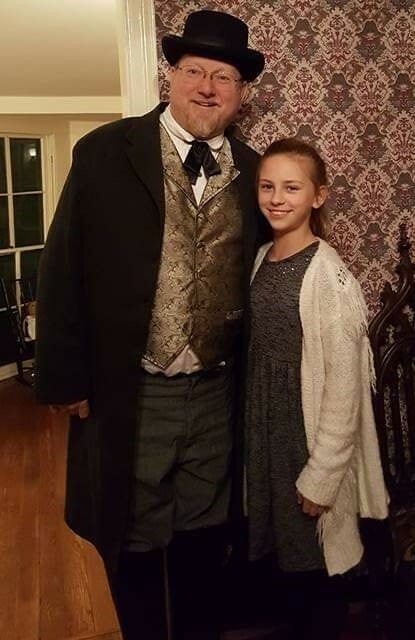
Katelyn as Carolyn Scott, with Professor Tom Wing portraying founding father of Van Buren, John Drennen./ Courtesy Katelyn King
What’s been the most rewarding part of your work?
I think the most rewarding thing about volunteering is when I really feel like I made a difference. Even if it’s a little thing that’s not important to everyone, if it makes a difference to just one person that makes me happy. I always leave feeling better than when I went and feeling like I am more blessed.
What have you learned through your experiences as a volunteer?
I have learned so much! I have learned that EVERYONE matters, EVERYONE has a voice, and that no matter your age or beliefs or wealth you can make a difference in the lives of others.
Are there any future partnerships, programs, or events that you are excited about?
I have some very exciting plans coming up! I am partnering with the VFW Auxiliary and the local police department to hold a safety seminar. My service platform is human trafficking awareness, and I am so excited to bring together leadership and youth to educate them about real life situations and risks that youth face every day. I am also working on partnering with the VFW post and the Veterans Against Trafficking organization for a 5K freedom run to help raise money for local organizations that work with at-risk youth and recovered victims of trafficking.
Why do you think it’s important for others to give back?
It takes everyone working together to create a safe and successful community. If I mentor and speak to kids my age and younger then I help promote the community for us. Our teachers mentor and support us; our churches and civic leader provide them with places to bring concerns; our police department and first responders provide services to keep us safe. Everyone has a place, and a very important role, and together we can live in a community that grows and thrives.
What would you like people to learn from your experience?
When volunteering is motivated by a love of something, it’s not work at all. My love for history started my love for volunteering. If you pick something you are passionate about, it isn’t a job, it becomes part of your life. Wake up every day and put on the best shoes for the job you have planned. Then just start walking the path set before you.
Sometimes it’s the small things that can make the biggest impact. Take socks, for instance. They aren’t something you think much about unless the laundry piles up and your sock drawer is empty. But Caroline Sanders, 14, has thought a lot about socks. The high school student collects new socks for a NPH USA orphanage in Guatemala. After learning in school about NPH USA and its mission to transform the lives of vulnerable children in Latin America and the Caribbean with homes, healthcare and educational programs, Caroline wanted to help. When she learned how little these children had in the way of resources, she offered to start a sock drive. After hosting a successful Christmas party sock drive, Caroline wasn’t one and done. Instead of making it a one-time project, she made it a part of her lifestyle, encouraging other teens to get involved, working to get sponsors and orchestrating the successful delivery of the new socks to the orphanage. From socks, she added crayons and coloring books, and hopes to source toothbrushes for the kids this summer. For Caroline, giving simple things and small comforts matter.
Caroline is committed to making a difference in her community and she is today’s Daily Point of Light Award honoree. Points of Light spoke with her about her commitment to service.
What inspires you to volunteer?
It makes me feel good to do something for someone else. It makes me happy to see someone smile and have joy when things go better for them. We learn a lot about giving back at school so turning that into action is a positive thing.
Describe your volunteer role.
On this project, my role is to help collect new socks from whoever is willing to donate them. It is also my role to send communications to groups and individuals to see if they would be willing to donate. In addition, my role is to find individuals to help deliver the goods to the small village in Guatemala. The children at a local orphanage are the ones that receive the socks. I have also recently collected coloring books and crayons to be delivered on the next shipment. I have partnered with a teacher who is working at the orphanage to find a way to get the goods delivered. It is a small village and transportation of items requires some effort. My goal for summer collection is toothbrushes.
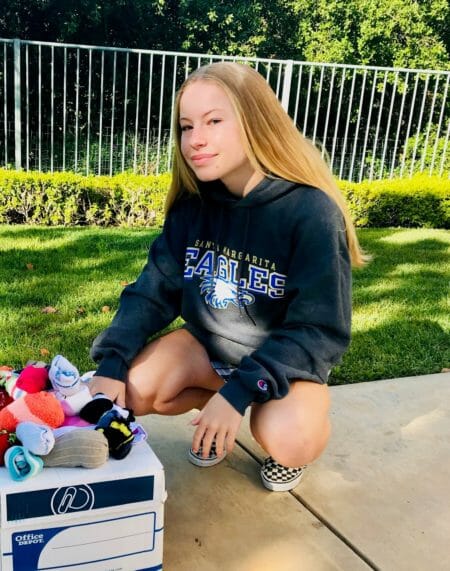
Caroline Sanders collects new socks to send to an orphanage in Guatemala. /Courtesy Caroline Sanders
What’s been the most rewarding part of your work?
I have received a few photos of the kids at the orphanage. It makes me very happy to see the kids and know they are the ones benefitting. They do not have a lot of services and this small thing helps.
What have you learned through your experiences as a volunteer?
People tend to think you must do “something big” to make a difference. You don’t. You can find small meaningful ways to make an impact if you do them consistently over time. All these small things turn out to be big things if you do them with commitment.
Are there any future partnerships, programs, or events that you are excited about?
I have been donating my time periodically at a Senior Center for Bingo night and the center said I may be able to take on doing some additional projects such as ladies nail painting or trivia night. In addition, my school sponsors Special Olympics. We just hosted this and I got to be a buddy to a participant. I hope to get more involved with this project next year and take on a leadership role in planning.
Why do you think it’s important for others to give back?
You don’t just give something to others. You get back something that is not money or goods. You get back a positive feeling that you made a difference. I encourage others to do something be it small or large.
What do you want people to learn from your story?
I am just a regular teenager involved in daily school activities and tasks. You can make time to have an impact. Prioritize it and you will benefit more than those you help.
Seeing a Need in Her Community, She Created a Safe Space for Kids and Families to Shine
Meet Daily Point of Light Award honoree Jennifer Maddox, who was a Top 10 finalist for the L’Oréal Paris Women of Worth Award in 2018. Each year L’Oréal Paris and Points of Light recognize and celebrate Women of Worth who make a beautiful difference in their communities. Ten honorees each receive a $10,000 grant to support their most cherished cause, and an online vote determines one honoree who will receive an additional $25,000 grant. Nominations for 2019 are now open! If you know a woman who works to create lasting and significant change in her community, nominate her to be one of the 2019 Women of Worth.
“You can’t put a Band-Aid on just the children who are living in a challenging situation,” said Jennifer Maddox. “You have to nurture the parents as well. Getting the parents involved in our organization has been key to our success.”
The statistics are alarming: In South Side Chicago, the overall crime rate is triple the national average, and violent crimes are astronomical – 100 times the overall rate in the country. The adage, “it takes a village,” may work to decrease crime rates, but in the case of the Parkway Gardens community, a low-income project that spans only three blocks yet has 694 units housing more than 3,000 people, it took Jennifer Maddox.
Jennifer knew she had to do something. As a Chicago police officer whose beat included Parkway Gardens, once home to a young Michelle Obama, she noticed that there was nothing for the area’s children and youth to do after school – which is when a majority of crimes were being committed and gang-related activities were taking place. Desiring to gain the trust of the residents so that she could be a change agent for this community, Jennifer took a second job as a security officer in Parkway and began her quest to forge relationships. During her security patrol one evening, she noticed an empty basement, and began formulating the idea to start an after-school safe-space program. The property management company agreed to her concept, so using her own resources for supplies and snacks, she started the venture in 2009.
Despite slow participation to start, her initiative soon began to grow. Young people came every afternoon, and at some point, Jennifer was asked to help with homework and academics. Again reaching into her own pocket, the single mother purchased computers, printers and other needed school supplies. As participation grew, she sought out Parkway parents to assist with chaperoning and tutoring. Soon, more than 100 young people were attending Jennifer’s program, and in 2011, she dubbed the program Future Ties.
Through the years, Future Ties has evolved to be much more than just an afterschool activity for children, thanks to Jennifer’s laser focus on what these young people and their families need. Five days a week, elementary, middle and high school students participate in life-skills training, mentoring, academic support, field trips, conflict resolution, résumé building, community volunteerism, workshops and more, with parents playing a key role in overseeing the activities. In addition, parents are able to participate in programs covering financial management, child rearing and mentorship. Recognizing a need to provide programs during the summer months, Jennifer instituted a summer camp for smaller children and a camp for teenagers that included recreational outlets for all. In all programs, Jennifer says she does her best to involve the whole family.
Her ultimate goal? “I want to reach all 1,200 children and youth in the Parkway community so that they can be the best version of themselves. And I want their parents to play a role so that they can be the best version of themselves, too,” said Jennifer.
Jennifer has a wide range of community support. Parkway Christian Church, a neighboring house of worship, provides additional space for Future Ties’ programs. She has received several grants and sponsorships through such groups and individuals as the Aigner Foundation, the University of Chicago, Chicago Cubs player, Jason Heyward, and the Urban League. Through it all, Jennifer says her greatest partnerships come from the Parkway families and parents who are helping to make a difference.
Jennifer Maddox helps elementary, middle and high school students participate in life-skills training, mentoring, academic support, field trips, community volunteerism, and more with Future Ties.
Since realizing her vision for the Parkway Garden community, Jennifer estimates that 800 children and youth have been served by Future Ties, but the residual effects are nothing short of amazing. Crime has decreased in the area within and around the neighborhood by an overwhelming 50 percent since Future Ties was founded. Six parents are now part-time employees of the venture, which means they are receiving minimal government assistance. Damage to the housing complex has greatly decreased, and so has gang activity. Several of the youngsters who participated in the program throughout the years are now attending college, planning to attend college or are gainfully employed.
Shaquita Wells was receiving government assistance and had a dream to provide a better life for herself and for her daughter. A Parkway parent, Shaquita began helping out at the Future Ties afterschool program, and today, she is a part-time supervisor who needs only minimal government assistance. “I wouldn’t be where I am today without Jennifer. She encouraged and pushed me to get my associate’s degree, and I’m looking forward to getting a bachelor’s degree next,” Shaquita said. “She is the very definition of strength, courage and ambition. She is a woman that stops at nothing to see that the world we live in is a better place. She’s victorious in all angles.”
Another parent volunteer-turned-employee is Tenesha Payne, who credits Jennifer’s mentorship of her four children. “She takes time with them to encourage and support them. She attends our young people’s graduations. She attends sporting events and tournaments of our children; she’s available for anything she can attend. We love her so much for that,” said Tenesha.
New York Mom Takes the Learning Outdoors with School Gardening Program
With the prevalence of technology in our homes and classrooms, it’s getting harder and harder to see our children outside. According to the Washington Post, the average American child spends five to eight hours a day in front of a digital screen, and according to The Guardian, children today spend just over four hours a week playing outside, compared to 8.2 hours a week their parents spent outside when they were children.
Wing Kong of New York hopes to change that with her “Activate our Garden” program she started at her children’s school. With the help of teachers and other parents, Wing turned an empty space in the school yard into a garden, blooming with various flowers, plants, and even fruits and vegetables. Every week, she brings students out into the garden to teach them about gardening, the different parts of plants, and even healthy eating by getting the children to harvest and eat the vegetables that they helped grow.
She connects her lesson plans and projects to more than just gardening, however. By teaching her students how to reduce, reuse and recycle materials, she instills in them a sense of environmental stewardship and gets them thinking about larger concepts such as sustainability.
Wing is today’s Daily Point of Light award honoree and we spoke with her to learn more about her volunteerism with Activate our Garden.
Describe your volunteer role with “Activate Our Garden”
I started about five years ago, when my son was in first grade. Now he’s graduating this year. In New York City, there’s not a lot of space and our school is lucky in that there’s some space. I looked around and saw that no one really did anything with it. There were just evergreen spaces here and there. I saw the potential and how much we could utilize this into something more like a learning garden program that could help gather the community together and make this place a lot more welcoming. So that’s how I started. I wrote down an initial plan on what I would like to do and I designed it in a way so that it would be self-sustaining, so that we would be able to run this program through volunteering and fundraising.
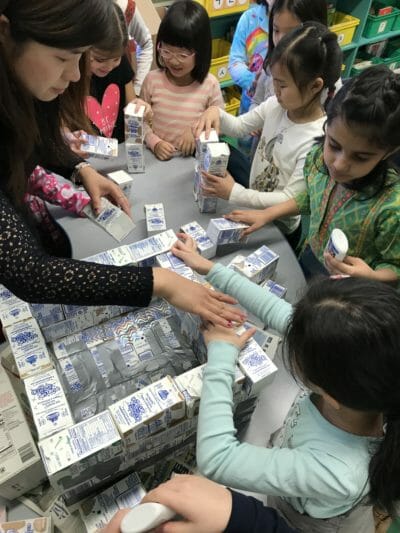
Wing teaches her students how to reuse materials by helping them build a worm bin out of milk cartons. This project helped them win a citywide clean-up contest last year./Courtesy Wing Kong
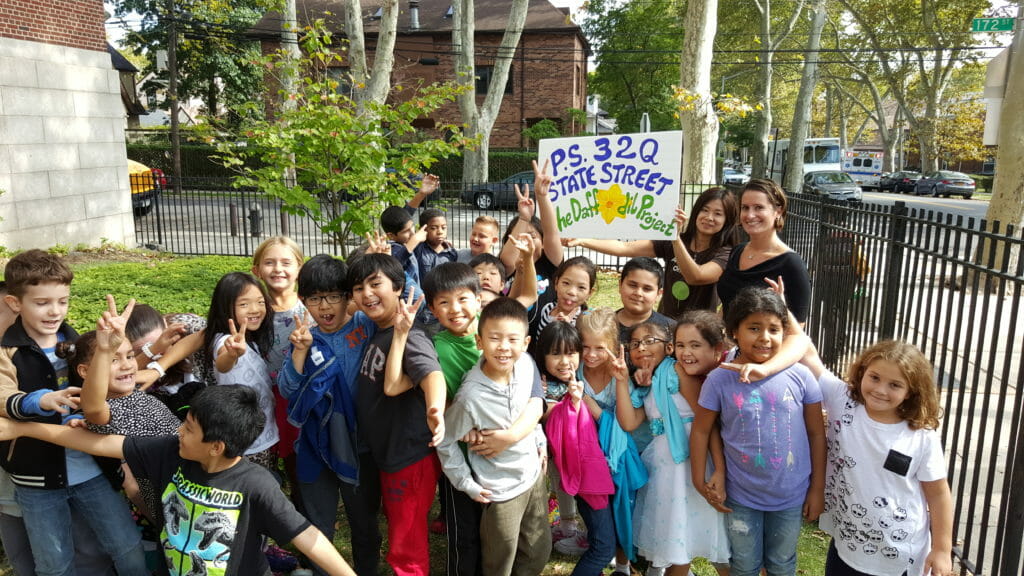
The first project that I did was the “Daffodil Project.” It’s a school-wide project where every single child and staff plant a [daffodil] bulb. I linked that to the history of New York City, how the World Trade Center came down and how we want to remember what happened. We’re from New York City and we should all know about it no matter how old you are. We plant the daffodils in the fall and they come up in the spring. They come back every year so I wanted that to symbolize how we should remember what happened before every year. Also, the way a daffodil stands, the head is kind of titled a little bit, almost like it resembles a person mourning. However, it’s a rebirth every year to show we’re not afraid. We know what happened, we’re not afraid, and we still bloom and blossom every year.
The parents and principal really loved the program so I started to roll out more programs. The next year, the principal and assistant principal said, “Let’s add a gardening club,” so every week, there are children that can go out to help and maintain the garden. So I started co-teaching with another teacher this whole gardening program for children who sign up. Every year, there are more and more children who want to get in.
I also have this summer program where the family can come in with the child to help with the gardening. It’s a time where not just the parents come out or just the child, but the child and parents come out together so they can feel more connected with the school and community.
What inspires you to volunteer?
Nowadays, people are so busy. Busy from this, busy from that. There’s no time for them to pause and look around. Nature is such a special thing that a lot of people don’t take the time to appreciate. There’s so much to learn from it. A lot of parents say, “The dirt’s dirty. Don’t touch it.” So the gardening club is such a great opportunity for children to come in and say, “Hey Ms. Wing! I’m not afraid to get my hands dirty.” Last year, we submitted a project we had done and we were the citywide winner of two awards. So that gave us a boost and we got some extra funding for the program to expand
What’s been the most rewarding part of your work?
Seeing the reactions from them when I do experiments with them and seeing how much they love it. They say, “I want to be in gardening club again next year,” or they’ll tell others, “Gardening club is the coolest club!” We’ll have presentations and science fairs and when people ask them questions, they’re able to answer them. Sometimes I get notes or emails or in person, parents telling me what their child learned or how this changed their eating habits.
How are you achieving the impossible of getting children to eat their vegetables?
We plant the vegetables and fruits, harvest them and then we do taste tests. We do salad testings. That part is really fun. The kids who don’t normally eat vegetables, they actually ate them and wanted more which is a really cool feeling. We lined up different parts of the fruit. For example, a tomato that we planted, that is the fruit part. Then lettuce, what part of the plant is that? Okay, that’s the leaf part. Celery? That’s the stem part. We used olive oil as a dressing. What part of the plant is the olive? That’s actually the fruit and there’s a seed inside. All these things, they see and they learn.
Wing and her students after they planted daffodil bulbs in their garden./Courtesy Wing Kong
What motivates you to keep volunteering and teaching these kids?
I feel that the next generation, if I expose them and teach them all these things, they will inspire other people. If I inspire them, they will learn something and inspire others or do something good out of it. Schools don’t necessarily have teachers to teach these specific themes or subjects. There is no funding for that. Since I started the program that already relates to it, and I’m able to create and roll out more programs, then why not?
Are there any future partnerships, programs, or events that you are excited about?
There’s an ongoing project right now called the Ocean Awareness Mural. It’s a really big mural that’s being placed inside our auditorium. The children collected all different kinds of plastic waste that we can reduce. For example, bottles and straws. So with these parts, we’re making an ocean awareness art mural that children in the school can see and realize that plastics are really taking over the world and think about what we can do to improve it.
Why do you think it’s important for others to give back?
It really doesn’t take much to help others, to inspire others. It feels so great to empower others and encourage others to do the same. Once you inspire one person, it spreads. Others will inspire others and that’s how everything spreads in a good way.
What do you want people to learn from your story?
When I first had this idea, people were like “You’re crazy. This is too big of a project.” And I said, “I wouldn’t suggest it if I couldn’t handle it.” There are many people who have ideas. When you have idea, start small and gain experience. Then once you get the hang of it, you can start to develop it and make it bigger and better.
Paying it Forward to Women with Cancer, She Created a National Wig Exchange Program
Meet Daily Point of Light Award honoree Carolyn Keller, who was a Top 10 finalist for the L’Oréal Paris Women of Worth Award in 2018. Each year L’Oréal Paris and Points of Light recognize and celebrate Women of Worth who make a beautiful difference in their communities. Ten honorees each receive a $10,000 grant to support their most cherished cause, and an online vote determines one honoree who will receive an additional $25,000 grant. Nominations for 2019 are now open! If you know a woman who works to create lasting and significant change in her community, nominate her to be one of the 2019 Women of Worth.
“The simple gesture of a woman donating a wig she once wore during chemotherapy treatment allows her to not only move past her cancer experience, but to bring joy and hope to someone newly diagnosed,” said Carolyn Keller. A cancer survivor herself, Carolyn know that for many women, their hair is a symbol of who they are – an integral part of their identity and an outward symbol of their femininity. Losing it during chemotherapy can sometimes feel like losing a part of who you are.
This year, an estimated 330,000 new cases of breast cancer will be diagnosed in the United States. During the course of her lifetime, one in eight women in our country, or 12.4 percent of the female population, will be diagnosed with the disease.
Carolyn was the unlucky one in the group of eight. In 2002, she heard those dreaded four words: “You have breast cancer.” In the early stages of the disease, she required a double mastectomy. Fortunately, her lymph nodes were deemed clear, so no further treatment was necessary. However, in 2005, her doctor discovered a 3.5-mm nodule in a lymph node, and Carolyn learned that she would require chemotherapy. “When I heard this new diagnosis, my first question was, ‘Am I going to lose my hair?’” she said. “It seemed like such a trivial concern, but it meant my cancer was real and that others would see it as real, too.” She did lose her hair, so she purchased two wigs that would conceal the effects of her treatment. Following eight rounds of chemotherapy and new hair growth, she stored her wigs away.
It wasn’t long before cancer struck her family again, this time involving her sister-in-law, Laura. Carolyn donated one of her wigs to Laura with instructions to “… give it forward to someone else who might need it when your treatments are over.” That opportunity came sooner rather than later, when another sister-in-law, Karen, was diagnosed. At that point, Carolyn had an a-ha moment. “I realized this wig exchange thing could be something,” she said.
In 2011, Carolyn assembled a group of like-minded women who took to the Internet and social media in search of wigs to donate to women in need going through cancer treatment, and EBeauty became the clearinghouse for the project. “I thought if we helped just one person, we would be a success,” said Carolyn. The power of women helping women knows no bounds, however, and neither did Carolyn. In the first year, more than 2,500 hairpieces were refurbished and distributed to women who could not afford wigs, which can cost in excess of $5,000.
Initially, EBeauty received used wigs via mail and at drop-off locations in the Washington, D.C., metro area. These locations quickly expanded into other areas of the country, including New York, Florida and Texas. Experiencing growing pains, the company moved from Carolyn’s home to a 4,000-square-foot office space in Washington, D.C., which was donated by her husband, Mark. Along with EBeauty’s online exchange program, in the past year, Carolyn and her group have partnered with 10 hospitals – including Johns Hopkins Medical Center in Maryland, Sylvester Comprehensive Cancer Center in Florida, and Houston Methodist Hospital in Texas, to distribute the wigs. Carolyn’s good work continues today, with almost 10,000 wigs collected, refurbished and distributed annually to women across the country.
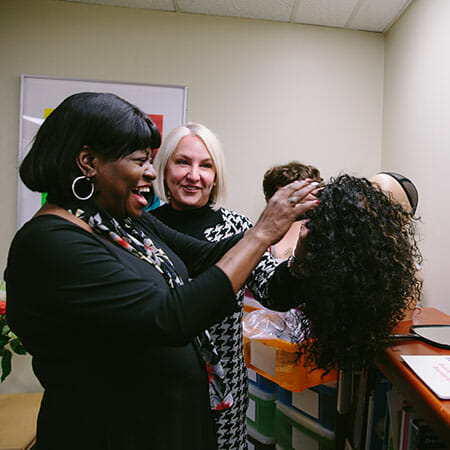
Carolyn assembled a community of individuals who work tirelessly to ensure the program’s success. Every two weeks, approximately 20 volunteers gather to sort through the wigs that have been donated and ship out clean wigs to one of the 10 hospitals that serve as distribution centers. The American Cancer Society, another partner, provides national exposure for EBeauty, soliciting wigs for the organization, as well as connecting women who need them. In addition, Carolyn has teamed up with Eivind and Hans Salon of Georgetown, as well as the Paul Mitchell Schools, to clean and refurbish the wigs before they are gifted. There are 100 schools across the country and this partnership, along with the growing Hospital Partnership Program, will allow Ebeauty to clean and distribute wigs more efficiently. This will help the organization reach an even greater number of women in the coming years.
To date, more than 25,000 women have received and donated wigs through EBeauty and Carolyn Keller.
The work of Carolyn and EBeauty has been nothing short of astounding. To date, more than 25,000 women have received and donated wigs. Because of the sheer volume of hairpieces collected and distributed, EBeauty is considered the largest wig exchange program for women with cancer in the country.
The grassroots nature of EBeauty is what makes the program unique and successful. Carolyn’s mantra of “women helping women” has allowed the program to realize its mission “to provide all women, regardless of economic status, access to wigs in order to restore their self-image and confidence during cancer treatment.”
Last year, Carolyn was honored by the American Cancer Society’s Circle of 12 in Miami, Florida, in recognition of her work. Her vision for EBeauty’s potential is extraordinary, but she shies away from credit – she prefers that the focus to be on how other women will benefit. Women like Michelle Schoenfeld of Washington, D.C., who shared EBeauty’s significance on her road to recovery from breast cancer:
“Donating my wig to EBeauty was a symbol of love for someone I didn’t even know. I would ask anyone who has chosen to wear a wig, that when the time comes to take it off for the last time, to give it forward to someone else through EBeauty.” Michelle said. “Wearing a wig is a personal decision. It’s not about vanity; it’s about identity and dignity when everything else in your life feels out of control. Looking ‘normal’ can be a real comfort. You can’t imagine the joy and closure donating your wig will bring you and the hope it will offer a fellow cancer survivor.”
Teen Sends Care Packages to Children Diagnosed with Rare Diseases
Jena Delaney says sitting with her sick 8-year-old younger brother while he was poked and prodded with needles made her decide he needed a fun distraction that would put a smile on his face while receiving treatment.
What the then high school sophomore came up with: a basket filled with games and snacks to keep her brother and older sister, both undergoing treatment for similar immune deficiency issues, busy while they spent hours and hours receiving medical infusions that were critical for their well-being. Realizing the delight her gift had brought, Jena decided to share that experience with other children fighting rare diseases.
Launching GotStripes for Kids Inc. in 2017, Jena has assembled hundreds of “Zebra to Zebra Infusion Day Care Packages” for children fighting rare diseases that require infusions across the country, and the 18-year-old Palm Beach Gardens, Florida resident is today’s Daily Point of Light award honoree. Points of Light spoke to Jena to learn more about her volunteerism with GotStripes for Kids.
What inspires you to volunteer?
I get so much out of volunteering – my service benefits me just as much as it helps other people. Through volunteering with GotStripes for Kids and being exposed to children facing really tough health situations, I’ve been inspired pursue a career in the medical field. You meet different people, fighting different diseases, you don’t always know their background or what they’re dealing with. My service has shaped me into who I am today, and it’s changed my whole perspective.
Jena has sent 300 care packages nationwide since starting her organization./Courtesy Jena Delaney
Explain your organization’s name, “GotStripes For Kids”.
The saying goes that doctors are trained to think “horses” when they hear hooves, because they’re trained to think of the most logical diagnosis. We work with children that are facing rare diseases, and these kids are the zebras, their diagnoses are not what doctors would expect when they first hear hooves. That’s what makes our care packages even more important, because these kids need some real kindness in their lives. We send care packages to kids under 18, and they all receive lengthy drug infusions.
Describe your role at GotStripes For Kids.
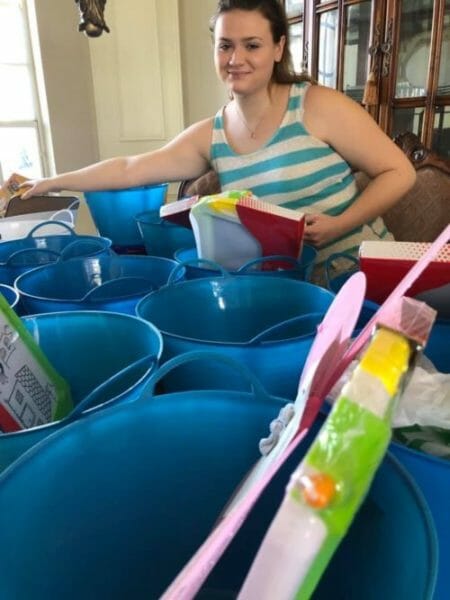
I receive emails from parents requesting baskets for their children about every other day. Once, I received 60 requests for baskets in one day alone. I’ll select which candidates are going to receive care packages that month, and then contact the parents to let them know that a basket is headed their way! Parents are usually so excited when they hear from me. Some kids are on the waitlist for a couple of months before receiving a care package, just because we’ve had so many requests. I also manage donations, fundraising and gathering supplies for the baskets.
What’s in these care packages?
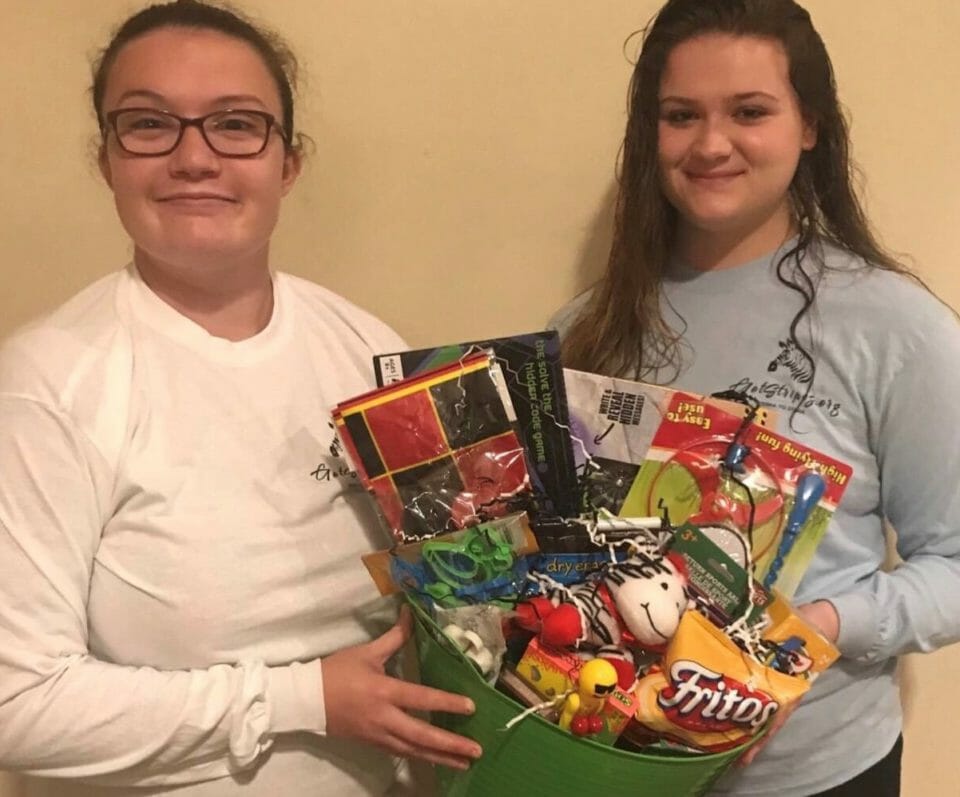
We’ve sent 300 boxes across the country thus far, and I assemble them and send them out as fast as I can, because demand is high. Usually, there’s 1 or 2 big toys like a board game or stuffed animal. We include some snacks, candy, chips. Always Play-Doh (laughs). Little toys and activities that keep their hands busy while they have to sit and receive treatment.
What does it feel like to know you’re helping put a smile on a sick child’s face?
It’s awesome. I never thought I’d be able to impact so many people in such a small little way. To me it seems so simple, but to these children, who are often stuck in a chair for hours while being infused, receiving this surprise might change their entire day.
Jena Delaney pictured with her sister, who was the first recipient of Jena’s care package along with their younger brother. The two are holding GotStripes for Kids’ 100th care package./Courtesy Jena Delaney
Share one personal story with me from your volunteerism.
When I first started the program, I received a thank you letter, which I’ve kept to this day, from a child who received our care package. The child was suffering from a disease that made it difficult for them to write, but they took the time to hand-write the thank you letter to me. Receiving that note was incredible, because I knew how much the basket meant to them.
What’s your message to others who want to give back to their community?
I was so young when I started my organization, it was born from a really simple idea. Wanting to care for my siblings and make their lives easier and happier was a very emotional experience for me. Finding the passion behind that experience really changed me, and it’s an incredible way for others to give back and relate to other people better.
What do you do for fun?
(Laughs.) I hang out with my friends, that takes stress away from school and everything really. I also love paddleboarding. I go to see the movies sometimes.
How can readers help?
We have a PayPal account for donations for our baskets and supplies. Please visit our Facebook page for more information about how you can give back: https://www.facebook.com/gotstripes.org/