Maryland Woman Shares Love for Children by Helping Critically Ill Kids and their Families
Critically ill children and their families sometimes face seemingly insurmountable challenges as they fight for good health, which is why Tammy Conner has dedicated her time to provide ongoing support for sick children and their families through the Casey Cares Foundation.
A former federal employee, Tammy knew she wanted to help others once she retired. When that day came, she decided to focus her energy on a demographic closest to her heart: children. The Rosedale, Maryland resident volunteers hundreds of hours each year to help support sick children and their families year-round. Through planned events, program initiatives and even special requests – Casey Cares keeps families’ spirits high, and helps critically ill children and their families create lasting *good* memories during what is otherwise a stressful and complicated time.
Touching the lives of hundreds of children over the last five years through her service, Tammy is bringing joy to families that are going through some dark times, and is today’s Daily Point of Light award honoree. Points of Light spoke to Tammy to learn more about her volunteerism with Casey Cares Foundation.
What inspires you to volunteer?
In my family, children have always been the priority. My whole family just loves kids, so Casey Cares was an organization I was drawn to because of how they provide assistance to children and families on a consistent basis. In helping sick children and their families – I’m reminded every day how fortunate my family is that we have our health, and how lucky a lot of us are.
Describe your role at Casey Cares Foundation.
I manage the new applications for foundation candidates that we receive from social workers or doctors. We also help families renew with the program if they’d like their children to stay involved and continue to receive benefits and opportunities. Also, I assist at events for Casey Cares. We hold major fundraisers including 5Ks, galas, and I also represent the foundation at family events. Casey Cares tries to make life just a little bit easier for very sick children and their families, and they will do anything for anyone.
Describe how your service doesn’t just help the sick child, but the entire family.
I was drawn to Casey Cares because they focus on the child and the family of the child. We have a program that provides comfy pajamas to sick children to wear in place of hospital gowns while being cared for, and if that child has siblings – say four brothers and sisters, when we send pajamas, we send them for all of the kids. In helping these sick children create some good memories during tough times, we’re able to send them to special shows and events. For example, the entire family will go to see Disney on Ice. It’s not just the child struggling through illness – it’s the entire family. Casey Cares makes sure everyone involved feels special and receives some extra attention during this difficult time.
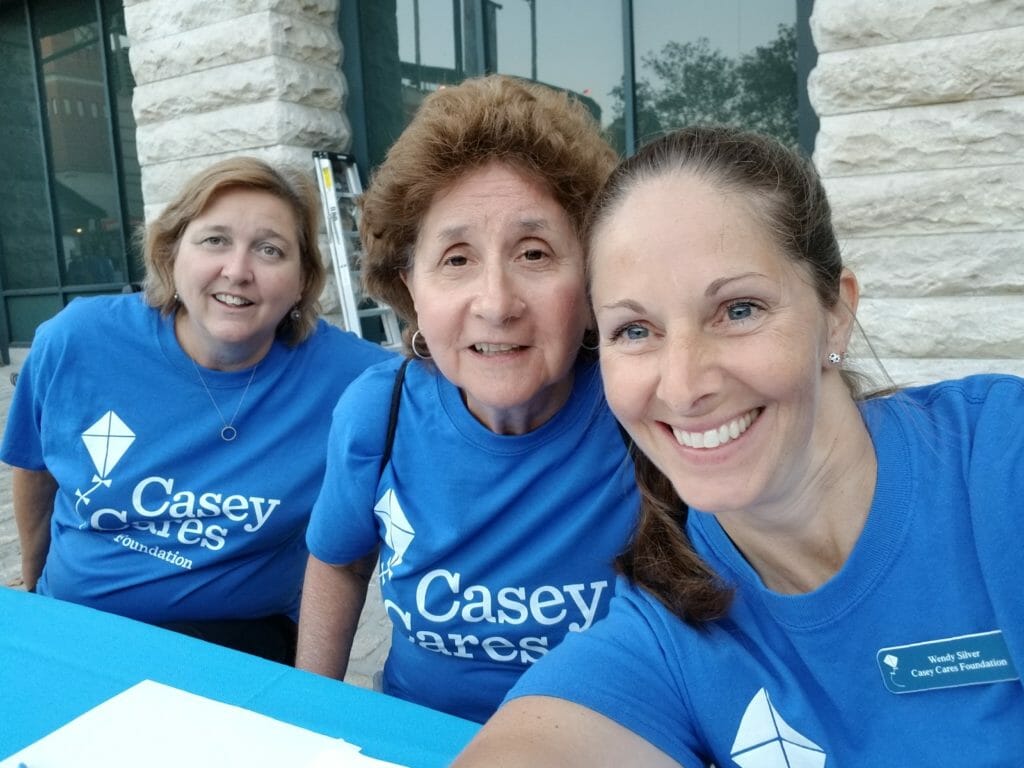
Casey Cares program volunteer Tammy Conner (left) helps participants register for the Casey Cares 5K with volunteer Charlotte Soracoe and executive program assistant Wendy Silver./Courtesy Tammy Conner
Share one personal story with me about your volunteerism.
A family once called us and explained that their granddaughter was sick, and was being treated at The Johns Hopkins Hospital in Baltimore. The grandmother had sole custody of the child, but had to go to work for the day, and asked if we had anyone to sit with the child for a few hours as she went through some testing at the hospital. I live about two miles from the hospital, and so I volunteered to go hang out with the girl. Her room buzzed with doctors and nurses coming in and out all day. What struck me most was how grown up and mature this girl was. Kids who are incredibly sick are often so mature and knowledgeable about their illness. I was so in awe of that kid that day, the experience was eye-opening. It made me realize what parents and sick children are going through.
Describe what it feels like to volunteer for critically ill children and their families.
By contributing to people’s lives, I feel like I’m doing something very important. Personally, I enjoy seeing the results of my efforts – and to know that a family is having a good time or their day is better because I helped in some way is really powerful.
What would you like to tell readers about your service?
Volunteerism brings out something in you that you might not have even known existed. Even if you help a month, a week, or an hour – there are many people out there that will benefit from even a small amount of your time, and they’re very appreciative. Your service makes everyone feel good, including yourself.
Do you have any upcoming events that you are excited about?
The Casey Cares Rockfish Tournament is coming up May 31st in Stevensville, Maryland. This annual event is a day of fishing and an evening of fundraising and celebrating. For more information or to see how you can help, please visit the website: http://caseycares.org/events/annual-casey-cares-rockfish-tournament.
After Experiencing Online Abuse, She Empowers Victims to Take a Stand
Meet Daily Point of Light Award honoree Holly Jacobs, who was a Top 10 finalist for the L’Oréal Paris Women of Worth Award in 2018. Each year L’Oréal Paris and Points of Light recognize and celebrate Women of Worth who make a beautiful difference in their communities. Ten honorees each receive a $10,000 grant to support their most cherished cause, and an online vote determines one honoree who will receive an additional $25,000 grant. Nominations for 2019 are now open! If you know a woman who works to create lasting and significant change in her community, nominate her to be one of the 2019 Women of Worth.
“I’m a smart, driven woman. When this happened to me, there was no one to help me. I was tired of running, of hiding. I saw thousands of other women becoming victims of revenge porn,” said Holly Jacobs. “Nobody was speaking up. Why shouldn’t it be me?”
Holly’s life was turned upside down when nude photographs of her surfaced on the Internet in 2011. The explicit images had been privately shared with someone she had been in a relationship with and were posted without her consent. Her contact information was included alongside many of the pictures. Holly’s first instinct was to run and hide from the world, but instead she chose to fight back—for herself and other victims of nonconsensual pornography, also known as revenge porn.
In 2012, Holly launched the End Revenge Porn campaign, which started as an effort to gather signatures in favor of creating a federal law against NCP. Her initiative evolved into the Cyber Civil Rights Initiative, a 501(c)(3) nonprofit organization serving thousands of victims around the world and advocating for technological, social and legal innovation to fight online abuse.
When she was victimized, Holly was desperate for resources, but none existed. She realized that other victims, the vast majority of who are women, needed legal representation, an affordable takedown service, mental health services and a support network. To meet these needs, Holly has focused the work of Cyber Civil Rights Initiative on four core program areas: Victim Services, Public Education and Research, Tech Outreach and Consulting, and Legislative Support and Legal Research.
In 2014, through the Victim Services program, Holly launched the CCRI Crisis Helpline, which is available free of charge, 24 hours a day. Through the Public Education and Research program, Holly took on the Herculean task of traveling the world to educate university students, domestic violence providers, city officials, and the general public on the issue. This involved telling and retelling her story hundreds of times, a courageous decision that came at great emotional risk and toll.
In 2017, the Cyber Civil Rights Initiative Crisis Helpline served 2,609 callers. Since Holly established the helpline in 2014, it has served an average of 100-200 victims of nonconsensual pornography or online harassment per month.
Holly has presented widely, including at Harvard University; the National Network to End Domestic Violence; major tech companies including Facebook, Twitter, Google, Microsoft and Yahoo; the Privacy and Data Protection Conference in Brussels, Belgium; the University of Miami School of Law; and George Washington University Law School.When she first became a victim of revenge porn, Holly felt alone. That is no longer the case thanks to her tireless consensus building and community outreach. Cyber Civil Rights Initiative’s leadership is made up of attorneys, law professors and community influencers who have been critical in accomplishing its mission.
In fact, it was through connection with law professors and members of the community that CCRI found its home and headquarters at the University of Miami’s School of Law in 2015. Through this partnership, CCRI has not only gained an office space to continue its important work, but also access to invaluable university resources that help drive its mission forward. These resources include an endless pool of law students eager to volunteer for the cause and apply what they learn in the classroom to the world outside of it.
Adaptability and vigilance are critical to Holly’s work because technology is constantly evolving and predators are always finding new ways to exploit victims. Cyber Civil Rights Initiative collaborates with tech companies to test technology that prevents images from being posted on their sites and refine takedown policies, as well as encouraging them to work with legislators. Additionally, the Cyber Civil Rights Initiative Crisis Helpline is the only helpline in the country dedicated specifically to the needs of nonconsensual pornography victims.
Holly believes that partnering with tech companies to develop design-based solutions is vital to stemming the tide of abuse. Cyber Civil Rights Initiative serves as a Trusted Partner on Twitter’s Trust and Safety Council and works closely with Facebook, advising it on everything from the reporting tools it implements to enable expeditious removal of nonconsensual pornography to Help Center articles and advertisements that educate Facebook’s community about this issue and direct victims to support.
Holly Jacobs believes that partnering with tech companies to develop design-based solutions is vital to stemming the tide of abuse.
In addition to her partnerships with Facebook and Twitter, Holly has also collaborated with companies across the tech industry to develop and implement policies and procedures against nonconsensual pornography, which were announced in 2015 alongside Cyber Civil Rights Initiative’s Online Removal Guide.
According to a nationwide study at Holly’s alma mater, Florida International University, one in eight social media users have been targets of nonconsensual pornography, and women are 1.7 times more likely to be targeted than men. The data resulting from this first ever national study of nonconsensual pornography are a critical tool for public officials and community leaders trying to craft policy and outreach surrounding nonconsensual pornography. When Holly was first victimized, only three states in the United States addressed revenge porn. Now, thanks to her efforts and her work with Cyber Civil Rights Initiative, laws can be found in 43 states and the District of Columbia.
Every step of Holly’s journey has been through uncharted territory. In 2012, the general public was uninformed about nonconsensual pornography, so education was her first priority. She not only had to face down her personal trauma, but also tell the story of that trauma to thousands of people, something she continues to do to this day.
Everything about Holly Jacobs is extraordinary, according to Dr. Mary Anne Franks, a law professor at the University of the Miami School of Law, who now serves as president and the legislative and tech policy director for CCRI. The two met at the beginning of Holly’s difficult journey, and Mary Anne was blown away by her determination and courage.
“I had never met a victim of revenge porn personally,” said Mary Anne. “Holly’s narrative was so compelling. She was being told what happened to her wasn’t a crime, that it was her fault. She said to me, ‘We have to change the law.’ And she stopped at nothing to do that.”
Senior Sews Items for Premies Using “Threads of Love”
Jackie McPheeters says empathy is what led her to Threads of Love, a national organization that provides clothing, blankets and other handmade articles for tiny premature and sick infants.
Nearly two decades ago, the now 80-year-old Placentia, California resident had retired from a career in the pharmacy industry, but still wanted to help others. Responding to an ad in the newspaper, Jackie learned she could sew items of comfort for premature babies fighting for their lives and their families. Today, as the Orange County Director for Threads of Love, Jackie and other volunteers make everything from items that help babies bond with their parents, covers for their isolettes, to burial gowns.
Handcrafting items for infants being treated in neonatal intensive care units across 16 Southern California hospitals, Jackie is supporting the tiniest members of her community, and is today’s Daily Point of Light award honoree. Points of Light spoke to Jackie to learn more about her volunteerism with Threads of Love.
What inspires you to volunteer?
I volunteer because I understand the impact we’re able to have. We’ve helped thousands of babies and their families in the years I’ve volunteered with Threads of Love. I’ve learned to accept the struggles of these families, I don’t judge what they’re going through. I’ve gotten so much out of this organization that has helped so many.
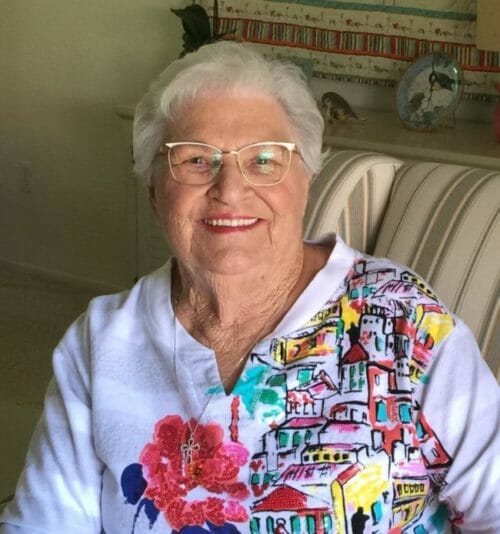
Jackie McPheeters is Orange County Director for Threads of Love, and has helped thousands of premature babies and their families over her years of service./Courtesy Jackie McPheeters
Describe the idea of “scent bonding” and your Lovie Dolls.
We make Lovie Dolls which are given in pairs to the preemie baby and the child’s mom and dad for scent bonding. Oftentimes, these babies are in isolettes and sometimes can’t be touched, they’re so sick. The doll can be slept with, and then swapped out so that the baby picks up the scent of its parent, which calms and reassures the infant. When the mother picks up the baby’s scent, it helps bring her milk in. This scent bonding helps to connect baby and parent – I’ve seen the telemetry quiet right down when the baby gets that Lovie Doll back from its mother or father.
How do these handcrafted items help struggling parents and babies?
When a parent is faced with the death of an infant through miscarriage, infant death or stillbirth, we provide them with a packet containing a sewn and crocheted bonnet, dress, blanket and a prayer for healing of a broken heart. We have a vest for the babies made of velcro, which makes access easier for medical professionals, but allows parents to look past the tubes and wires attached to their baby. Our over 50 volunteers, mostly senior citizens, cut, sew and crochet items made with love and compassion during this time of uncertainty.
Share one personal story with me from your volunteerism.
I don’t generally go into the NICUs, but this particular parent wanted me to see their baby. They loved the Lovie Doll we’d made, but they didn’t see any difference in their baby’s condition, and the parents didn’t smell the baby on the scent pad yet. I told the mother to keep putting the pad in her shirt and also have the baby’s father do the same so the baby could smell both parents. Afterwards, the nurses came over and tucked the baby in with the Lovie Doll, and sure enough we saw telemetry quiet right down. All three of us were crying. Just to see the Lovie Doll work that one time meant everything to me.
Are there any new innovations you are working on for your volunteerism?
We made over 13,000 pieces for premature babies and their families last year. We recently developed an eye shade for the tiniest of preemies. These babies stay in a special unit with no lights or sound, and they must be kept in total darkness. We make the shades out of specific fabric that is ok for the baby’s sensitive skin, and allows medical professionals to still evaluate the baby. One of the hospitals we work with asked us to come up with an item like this, so I designed the shade and made samples.
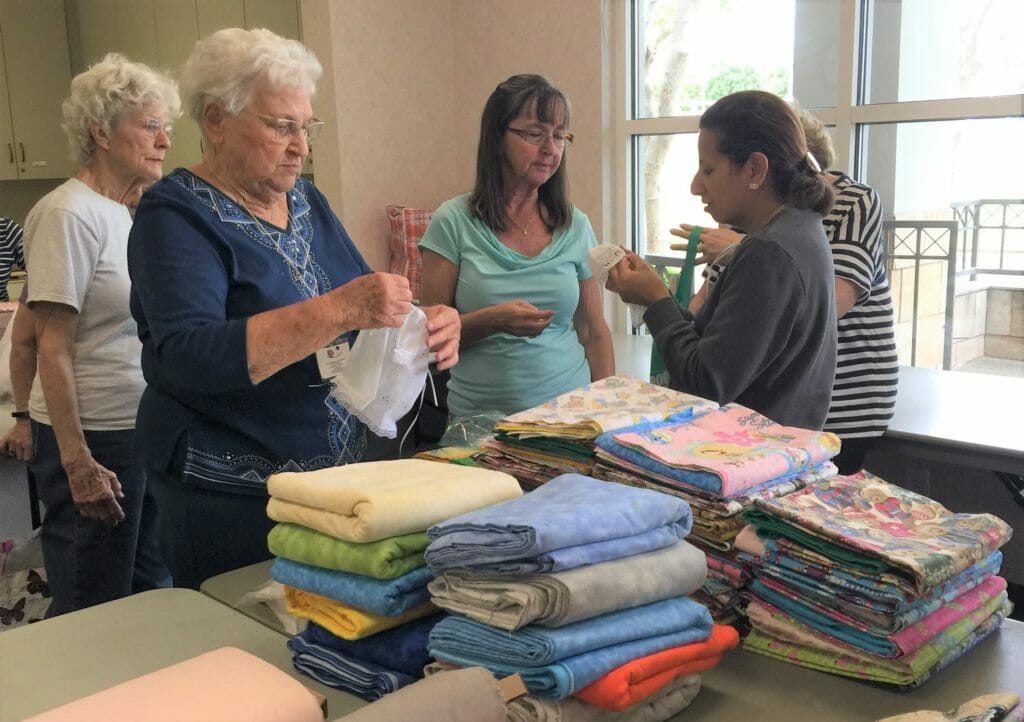
Last year, Orange County Threads of Love made over 13,000 pieces for premature babies and their families./ Courtesy Jackie McPheeters
Your volunteerism doesn’t just involve babies. Share an impactful story of how you’ve helped others in your community.
For many years, I drove to a Navajo reservation in Klagetoh, Arizona with my van loaded up with food and clothing, warm blankets and linens, giving back through the Yorba Linda Women’s Club. One year, before Halloween, my dental hygienist gave me cases and cases of travel-sized toothpaste and toothbrushes and we handed those out for Halloween. This little child had been in line for hours waiting for a tube of toothpaste and toothbrush. Once he got to the front, he asked if he could get in line again for his siblings, because all six children shared one toothbrush.
How can readers help Threads of Love?
Contact Jackie for more information about how you can help: http://threadsoflovesouthoc.org/contact-us/.
California Woman Spends Decades Helping to Save Thousands of Rabbits From Euthanasia
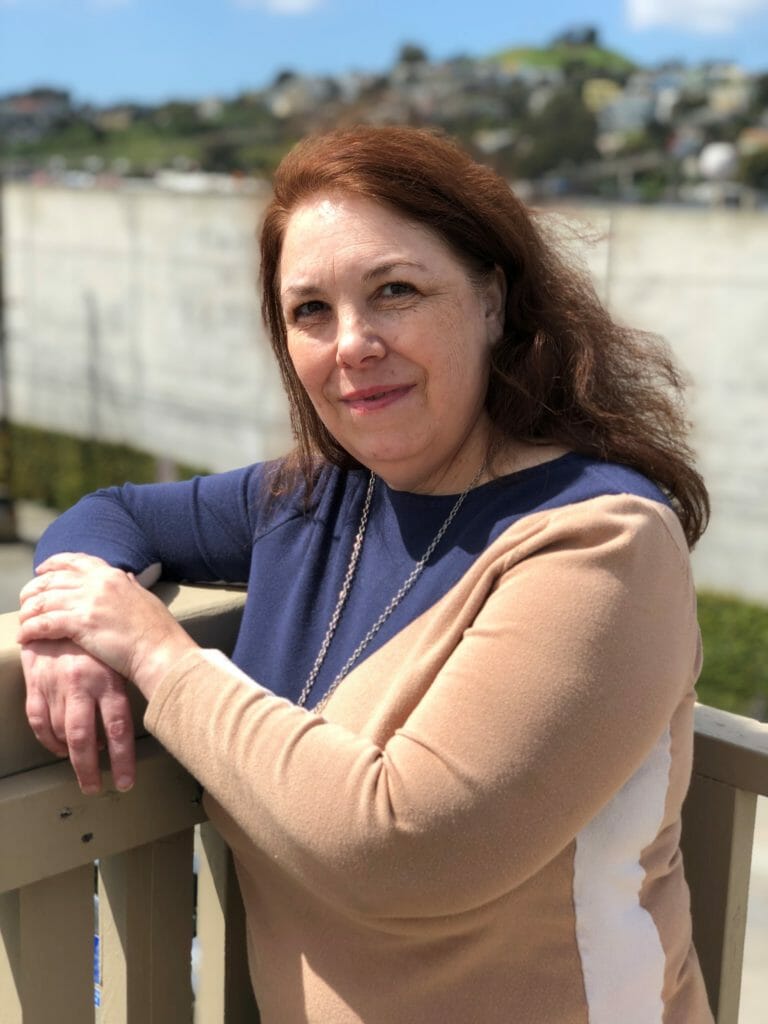
Although Beth Woolbright has always been an animal lover, she didn’t have a great relationship with her first rabbit. She adopted him in college and struggled to bond with him until she decided to stop treating her pet the way she assumed rabbits wanted to be treated, and instead started treating him like a roommate.
“When I opened my eyes to what a rabbit really was like and stopped trying to hold him and cuddle him, and [instead] let him show me what it was like to hop around my room and explore the world through his eyes,” Beth said, “that’s when I found out what a fabulous animal a rabbit was.”
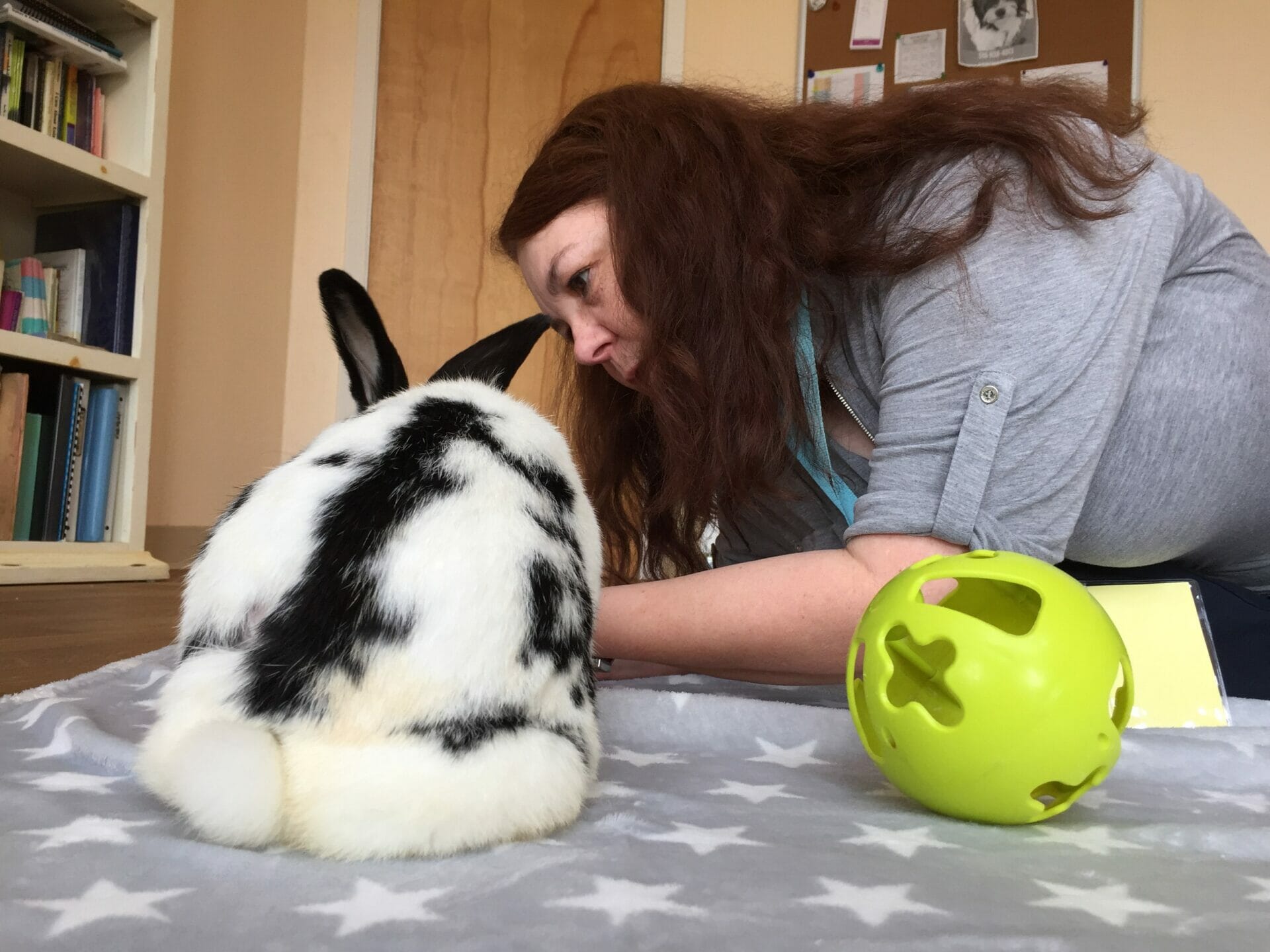
But not all rabbit owners come to this realization, and instead are left disappointed that their pets aren’t what they hoped they would be and decide to drop their rabbit off at a shelter. The issue surrounding miseducation around rabbits is what inspired Beth over 30 years ago to help co-found The House Rabbit Society, an international organization that has found permanent homes for over 40,000 rabbits that had been scheduled to be euthanized. Beth is now a national board member for the organization as well as an adoption counselor at a local House Rabbit Society shelter — as well as the proud owner of three rescued rabbits who she helped bond, which she described as one of the most rewarding activities she does as a volunteer.
For decades of dedication to providing better lives for both rabbits across the world, Beth is today’s Daily Point of Light award honoree. Points of Light spoke with her to learn more about her journey from uncertain rabbit owner to determined rescuer.
What exactly does the House Rabbit Society do?
The House Rabbit Society is an international rescue organization that rescues rabbits scheduled to be euthanized at shelters and finds permanent homes for them; and provides education, rescue and adoption services, primarily through volunteers. There are chapters around the world and there are several rabbits-only shelters in several large cities in the United States and in a few countries.
Longtime rabbit-lover Beth Woolbright helped to cofound The House Rabbit Society in 1988./Courtesy Beth Woolbright
Can you describe your volunteer position with The House Rabbit Society?
I’m currently a national board member with the House Rabbit Society as well as an adoption counselor at the House Rabbit Society’s national headquarters in Richmond, California.
As an adoption counselor, I work at the shelter once a month. I put in about a five-hour shift and I work with people who are new to the concept of having a rabbit as a potential family member. I help them figure out if they are what I call “rabbit people.” There are people with rabbits and there are rabbit people. People with rabbits may not keep a rabbit for more than a year whereas rabbit people understand that rabbits are a ten-year commitment and they enjoy all of the things a rabbit has to teach them about being a rabbit. Rabbits are quite different from their reputation and often are a disappointment because of that. For that reason, they are often surrendered to shelters. What we try to do is educate people about what rabbits are really like, help people understand them and appreciate them, and help people who would understand and appreciate them bring them into their homes and be part of their lives, and be a part of that ten- to thirteen-year commitment.
As a board member, I am the secretary for the board, as well as on the national licensing committee which works with the chapters and educators at large. I work on different projects related at the national level.
How did you first get involved in this organization?
I am actually one of the founders of the organization. It began in 1988 when seven off us sat around the table. We were working with two fabulous people who were fostering at the time and they realized there was a need to have a national outreach to help pet rabbits and spread the word about rabbits as indoor companions. Because back in the 80s, it was uncommon to have rabbits indoors as part of the family. They were usually outdoors.
From the time that [the people they were working with] stated fostering to the time we incorporated was only about a year. It went hand in hand with a book they had written called House Rabbit Handbook. The response to the book was phenomenal. People were so excited by the concept of the book. In the process of researching the book, there had been no mention of rabbits as the third most common euthanized animal at shelters. So that came out after the book was printed and that’s when [they] began rescuing the rabbits and fostering. And they also discovered there was an ongoing need for educational information about rabbits and their health and behavior needs. So the education and behavior information go hand in hand with the rescues information, which is the catalyst for the organization being founded.
What inspires you to continuing volunteering with this organization for the past 30 years?
The fact that rabbits are so unrepresented and they don’t have their own voice. They are a fascinating, curious, unique animal, which you can say about every animal. Every animal is unique. But they hold a special place in our culture in that there is no other animal that is pet, meat, laboratory experiment, entertainment, children’s toy — all those things at the same time. They hold such a contradictory place in our society. They’re valued as being cute but they’re also used in so many ways. It’s been my advocation to go out there and try to speak on behalf of the rabbits. Try to show people that they are not what people think they are, that they’re so much more than that. They’re not just cute toys with batteries to operate their noises.
Aside from being a co-founder and national board member of The House Rabbit Society, Beth also takes time each month to volunteer at her local shelter./Courtesy Beth Woolbright
What’s been the most rewarding part of your work?
Seeing the changes over the years. The difference in how rabbits are treated from 1988 to now is tremendous. The fact that in certain parts of the country when you say “I have a rabbit,” people will say “Oh, does it live in the house?” Where as it used to be, you used to say you have a house rabbit and people would look at you cross eyed. That’s been a major change in parts of the country. In other parts of the country it’s still an unusual concept to have a house rabbit. One of the most telling differences between a house rabbit and a backyard rabbit is that a backyard rabbit on average lives one to two years. An indoor rabbit can live up to 13 years. When we started many years ago, an indoor rabbit, you would be lucky if you got seven years. Because of medicine, and learning how to take care of them and what to feed them, they’re living ten to 13 or older. So that’s been a huge advancement. They’re fabulous animals … Their personalities are all very different. They’re quite mischievous in their own right and they’re all curious in their own right if they feel secure.
Are there any future partnerships, programs, or events that you are excited about?
There are lots of events around the country, lots of festivals related to rabbits on our website. We’ve been looking at some opportunities for funding non-exploitative research papers where, for instance, someone could study the effects of wood pellets and what phonemes they put off, because wood stove pellets are often used as a litter for rabbits because they’re very inexpensive. It would be great to confirm that they don’t put off any phonemes that are dangerous to rabbits the way cedar shavings do. That’s the type of research project that we’re interested in. Something that is non-invasive to rabbits and doesn’t exploit rabbits the way traditional research has in the past. We’re looking at finding new things that way.
Why do you think it’s important for others to give back?
It feels good and it makes the world a better place. It’s only by helping each other that we can make this world a cooperative place that’s worth living.
What do you want people to learn from your story?
There are two things. One is that rabbits are fabulous and not what you think they are. They’re incredible creatures who have much to teach people. The second thing I want people to know is that this organization is run by volunteers. We have a very small staff for an international organization and if by people reading about this organization, saying that I can do that too, then we’ve been able to make such an impact.
‘Cat Grandpa’ Shares Love, Companionship and Naps with Shelter Cats with Special Needs
During National Volunteer Week, we celebrate the impact of volunteer service in our communities, and recognize extraordinary individuals who are at the center of social change – like Daily Point of Light Award honoree Terry Lauerman. Read his story and nominate an outstanding volunteer or family as a Daily Point of Light.
Terry Lauerman never expected to become internet famous. But when a few photos of the retired teacher taking naps with shelter cats were shared on Facebook last fall, that’s exactly what happened.
Nicknamed “Cat Grandpa,” the 75-year-old volunteer spends about 20 hours per week brushing and caring for cats at Safe Haven Pet Sanctuary, a no-kill shelter and adoption center in Green Bay, Wisconsin.
“We are so lucky to have a human like Terry. Terry just came along one day and introduced himself. He said he’d like to brush cats. Eventually it became every day,” Safe Haven shared in a Facebook post last September. “He brushes all of the cats, and can tell you about all of their likes and dislikes. He also accidentally falls asleep most days. We don’t mind – cats need this! Terry is a wonderful volunteer.” The shelter’s Facebook post received nearly 100,000 likes and was shared more than 26,000 times. Terry’s story caught the attention of local and national news outlets, making headlines in The Huffington Post, BuzzFeed, USA Today, The Today Show, People.com, and many more.
Terry was initially drawn to the Safe Haven Pet Sanctuary because of the freedom the shelter gives to its animals. All cats and kittens are free to roam the space, and he is free to lounge and nap with the cats. Safe Haven specializes in rescuing kitties with physical or psychological disabilities, so many of their furry residents have special needs, such as diabetes, missing limbs, blindness, asthma or behavioral problems. Yet, all of the animals are up for adoption and Terry is dedicated to caring for each of them until they find a forever home. He spends extra time socializing the shy cats, and has become an expert in learning and communicating their likes and dislikes to other volunteers.
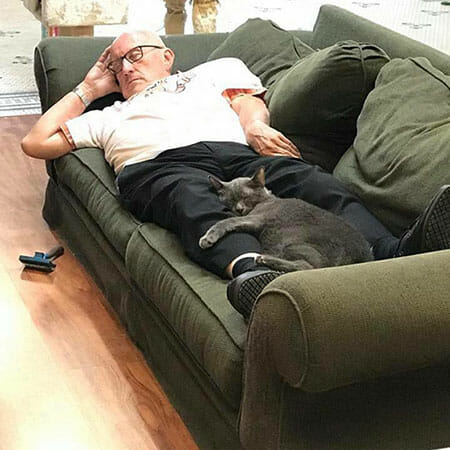
Terry takes a cat nap with Buckhorn, a shy cat who has begun to come out of his shell thanks to Terry’s caring companionship. (Photo courtesy of Safe Haven Pet Sanctuary)
Terry has grown particularly fond of one cat, named Buckhorn. For weeks, he didn’t know Buckhorn was roaming the shelter because the timid cat always hid behind counters. Now, the cat sees Terry as his best friend, and finds him every day on the couch when he’s ready to be brushed and loved on – or when he’s ready for a nap.
“I’m not the only one, I’m inspired by other people. I just want to be there to nourish them back to health,” said Terry. “You can do something fun and useful with your retirement. You don’t have to sit at home. Volunteer time to share what you love with other people for a good cause.”
THE DIFFERENCE HE MAKES
Elizabeth Feldhausen met Terry on the day he first visited the Safe Haven Pet Sanctuary, a little more than a year ago. As the shelter’s founder, she shares Terry’s love for every single animal and has been happy to welcome him into the Safe Haven family.
After Safe Haven’s photos of Terry taking cat naps went viral, the organization received more than $20,000 in donations in just two days. “I could never have imagined that so much money would be raised by simple photos,” Terry said.
Elizabeth says he money Terry helped Safe Haven raise has allowed them to bring in even more cats with special needs. They also added more rooms, and renovated other parts of the building that had previously been used for storage.
Terry continues to volunteer at the shelter five days per week, and his ability to uniquely care for and understand the animals has not gone unnoticed.
“Terry takes his volunteer time very seriously,” said Elizabeth. “He goes into every room and visits every single cat to give them a treat. You can hear him talking to the cats, he’s very dedicated.”
With a Passion for Revitalizing Under-Resourced Communities, She Empowers Young Advocates for Change
During National Volunteer Week, we celebrate the impact of volunteer service in our communities, and recognize extraordinary individuals who are at the center of social change – like Daily Point of Light Award honoree Alicia White. Read her story and nominate an outstanding volunteer or family as a Daily Point of Light.
With a passion and skill set for identifying and redistributing resources, Alicia White works around the clock to connect people with the tools, funding and connections they need to transform their communities. She created Project Petals, a community development organization focused on lifting up under-resourced communities in New York City by improving their environments, and empowering young people to become leaders who sustain change.
Five years ago, one experience helped Alicia became more aware of her own environment and inspired her to do something to help improve her Jamaica, Queens, neighborhood. While walking through a community park, she noticed piles of untouched garbage and realized that there were no usable pedestrian pathways. She saw a community member cleaning up the area by herself, and stopped to ask if she needed any help. And as Alicia began cleaning, other neighbors stopped and wanted to help.
That moment in the park was the catalyst for her first development project, which eventually grew into Project Petals. Alicia began to brainstorm ways to revitalize this community space, using her community development skills to give back to the place she grew up in.
She organized meetings with government officials, council members and city agency affiliates to initiate improvements for the park. After they agreed to make a formal commuter path, create a garden and schedule cleanup operations, Alicia realized that community revitalization was something she could actually accomplish.
Receiving requests to take on additional development projects, Project Petals was set in motion. The nonprofit organization brings awareness to community and environmental justice problems that may hinder a neighborhood’s development. Alicia makes it her mission to not only revitalize communities, but to also build sustainable leadership, ensuring these projects can continue for generations to come.
To foster new community leaders, she helps young people reimagine and rediscover the community environments they live in through Project Petal’s Youth Builders Program. The annual leadership program brings participating youth to the five boroughs of New York City, and, after working with volunteer mentors, they brainstorm what changes they would want to make.
Now, she is taking her passion for community development and youth empowerment beyond New York City and the United States. Partnering with Youth Grow, an agricultural and youth development nonprofit, she has designed a leadership program similar to Youth Builders, which brings together more than 200 15- to 35-year-olds each year in Uganda to gain leadership skills.
Alicia helps people see that they are capable of being their own champion and advocate. She builds bridges for community members so that their voices are heard and their knowledge contributes to intentional impact.
“You can be a catalyst for change. You don’t have to start with something huge. Starting small and with one simple act could spiral and snowball into making a huge impact,” said Alicia. “Taking that one step to volunteer can change the lives of so many people.”
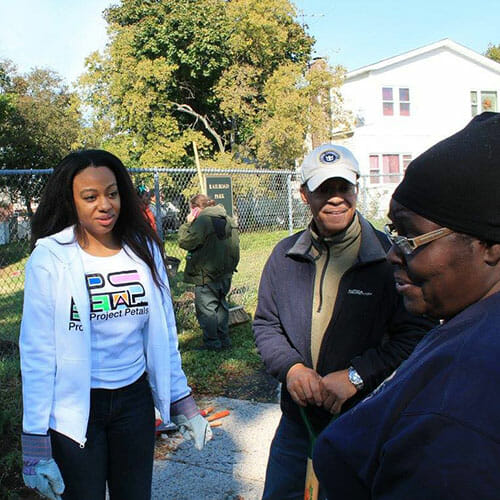
Alicia White works on an environmental improvement project alongside community members in a New York City park.
THE DIFFERENCE SHE MAKES
Tiffany White, Alicia’s younger sister, has been a part of Project Petals since it was just an idea. She is inspired by Alicia’s dedication to building stronger, more vibrant communities and giving thousands of citizens a voice.
“Alicia has helped so many in New York City and abroad. She works tirelessly and is such an inspiration to us in the community,” said Tiffany. “Her goal is not only to revitalize communities, but create capacity and build internal leadership.”
“She has always been an inspiration to me. She has shown what true leadership looks like. She dedicates all of her time and resources to ensuring that communities and under resources areas in need not only look beautiful but that they are advocated for and have the resources they need for success on a 360 scale. Alicia really cares about being in the service of others in need, in it being the right thing to do and absolutely necessary to act upon.”
Driven by Desire to Create Change, High School Student Helps Classmates Become Civically Engaged
During National Volunteer Week, we celebrate the impact of volunteer service in our communities, and recognize extraordinary individuals who are at the center of social change – like Daily Point of Light Award honoree Ted Chai. Read his story and nominate an outstanding volunteer or family as a Daily Point of Light.
Noticing the discrepancy of privilege between different communities in California’s San Francisco Bay Area, Ted Chai has spent the past three years working to increase the standard of living in south and east San Jose. Now a junior in high school, he partners with the Second Harvest Food Bank, collects and donates books to elementary schools – and he is the founder of the Youth Policy Alliance program, aimed at helping other students become civically active and contribute to the community through long-term service projects.
Ted began volunteering during his freshman year of high school when he found the Monta Vista Leo Club, a branch of the Lions Club international service organization. At first, he saw volunteering as a social experience with his friends, but it grew into something more. Volunteering became something he genuinely cared about, and Ted found an escape from the self-focused realities of everyday life.
Dedicated to service and to his community, Ted became vice president of the Leo Club, where he oversees project teams and logistics. While focusing on food and hunger initiatives, Ted led a partnership with the Second Harvest School Bank to provide food to hundreds of families through food drives, fundraisers and volunteer events. He has also collected and donated more than 400 books to underfunded schools within the San Jose school district, with the intent of improving education programs in his community.
Ted’s principal interests coming into high school were service, making an impact, business and politics. As he looked more into current events and politics, he was inspired to create the California Youth Policy Alliance. As the organization’s president, he helps other passionate students plan and execute civic projects targeting political, social or economic issues. He helps students come together to discuss policy issues and organize meetings with legislators to advocate for the issues they care about.
Ted Chai works on a service project with the Monta Vista Leo Club.
He encourages his fellow students to see volunteering as a collective. With people to stand beside in community service, tangible impact is possible.
“At the end of the day, we all want to create change. That is why we work so hard on projects that are impact-oriented. It’s not about just collecting hours,” said Ted. “When you join something, and you do your research on the cause you care about, it’s not that hard to come together and make a change.”
THE DIFFERENCE HE MAKES
Mr. Kenneth Gan met Ted two years ago, when he stepped in as the adviser for the Monta Vista Leo Club. Working with kids who are dedicated to giving back, the Monta Vista High School biology teacher knows that being young is not a limitation on the impact you are able to make. Ted exemplifies this and, Mr. Gan says, is an inspiration to his fellow classmates.
“He holds himself to a very high standard, and it is obvious that he commits that level of excellence to everything he does,” said Mr. Gan. “He is consistently one of the top students when it comes to the number of community service hours logged, which is a big feat considering his workload in and outside of school.”
Serving at Mobile Health Clinics, Retired Nurse is Dedicated to Helping the Medically Underserved
During National Volunteer Week, we celebrate the impact of volunteer service in our communities, and recognize extraordinary individuals who are at the center of social change – like Daily Point of Light Award honoree Linda Horne. Read her story and nominate an outstanding volunteer or family as a Daily Point of Light.
After a 30-year career as a nurse, Linda Horne wasn’t ready to stop serving her community. In her retirement, Linda has dedicated her time to helping thousands of patients receive access to medical care at no cost. From working alongside the Health Wagon, to participating in other Remote Area Medical events and health fairs across southern Virginia, she uses her professional skills and passion for helping people to change lives.
Linda has served more than 10 years as a volunteer with the Health Wagon, a nonprofit organization that provides mobile health services to the medically underserved. It takes all year to prepare for the annual arrival of the Health Wagon clinic in her community of Wise County, and Linda is responsible for contacting and mobilizing doctors to participate. Doctors, nurses, dentists and optometrists come from across the United States to provide medical care to those in need. Patients also travel great distances to receive care, and will often camp near the event to ensure an appointment.
She fundraises year-round for this event, which is put on in partnership with Remote Area Medical. During the clinic, Linda personally collects and distributes food to patients waiting to receive medical care. For many of the people who attend, this is the only time each year that they are able to see a medical professional, and Linda has met several patients who received a diagnosis just in time to prevent life-threatening health issues.
A simple surgery can cost up to $1,000 or more for people who don’t have access to health insurance. Linda often meets individuals who are struggling with medical problems, and who believe they will never be able to afford the care they need. She finds joy in being able to refer them to doctors in the RAM network to receive life-changing medical care, free of charge.
“I know I can still give back and use my skills from my past to help people now,” said Linda. “I want people to know that they can be helpful and respectful, especially to those who don’t have money or resources.”
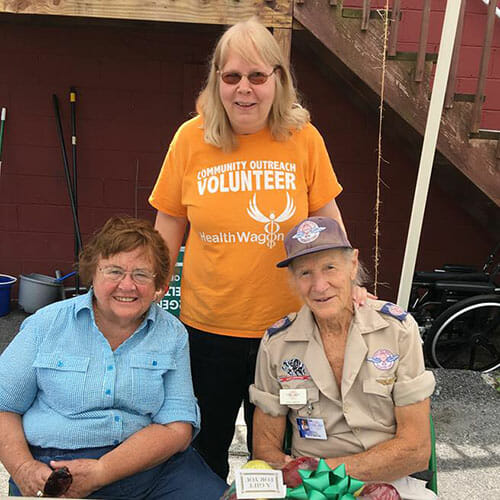
Linda Horne serves alongside fellow Remote Area Medical and Health Wagon volunteers in Wise County.
THE DIFFERENCE SHE MAKES
As a fellow member of the Health Wagon, Alana Yates has witnessed Linda’s dedication to giving back to those in need. Whatever is needed at the medical clinic, she knows that Linda will step in with humility and strength to help thousands of patients.
“When it comes to taking care of patients, Mrs. Horne is always pleased to assist,” said Alana. “She is selfless in all aspects when it comes to volunteering to help those who are in need. All who meet Mrs. Horne love her and will never forget what she has done for them.”
Linda has become a friend to all at the Remote Area Medical clinic, and her compassionate, hardworking and reliable presence has become integral to the Health Wagon community.
Shocked by Amounts of Discarded Excess Food, She Invented an Innovative Food Rescue System
During National Volunteer Week, we celebrate the impact of volunteer service in our communities, and recognize extraordinary individuals who are at the center of social change – like Daily Point of Light Award honoree Hannah Dehradunwala. Read her story and nominate an outstanding volunteer or family as a Daily Point of Light.
“What stuck out [in Pakistan] was the way that people made use of things that would otherwise be considered waste,” said Hannah Dehradunwala. “I lived with my grandmother for five years, and everything in her house had a double use.”
After spending her first 11 years in the United States, Hannah moved to Pakistan and was deeply impacted by the cultural dedication to reuse. She remembers how items that elsewhere might have been thrown away circulated throughout the community, finding a second or third life after their original owner had finished with them.
Upon her return to the United States, Hannah enrolled at New York University where she became involved in organizing student events on campus. She was struck by the amount of excess food that was discarded after catered events. After an unsuccessful search for organizations that would help her donate this excess food, and storing as much as she could in her tiny dorm room to donate herself, Transfernation was born.
Transfernation provides a platform for companies and corporate hospitality groups to donate extra food through on-demand pickups. Trusted independent contractors, including ride-share drivers and bike messengers, pick up leftover catering and deliver it to community-based organizations that then feed hungry New Yorkers.
While the model seems simple, just a few years ago there were few sustainable options for the donation of catered food in New York City. The logistics of transporting and storing leftover food are complicated, and shelters and soup kitchens typically lack the capacity to handle them on their own. Transfernation has created a new pipeline for the rescue and use of much-needed food, empowering community organizations and reducing the overall environmental footprint by reducing food waste in the process.
One of the hallmarks of Transfernation is the use of technology, most notably with its mobile app, which streamlines the process for donors. “We take care of all the messy logistics,” the Transfernation website states. “Because half your day should not be spent trying to figure out who wants your extra food and how to get it to them.”
Transfernation is always looking to improve its model and develop new partnerships. This year, Hannah and Transfernation will launch a new collaboration with DoorDash, a national food delivery platform. Through this partnership, Transfernation will be able to significantly expand its reach in New York City, and to two additional cities by the end of 2019. Hannah, who has helped with more than 500 pickups and deliveries herself, knows firsthand what a logistical undertaking this will be.
Hannah strives to build and support community wherever possible. The independent contractors who work with Transfernation make between 30 percent and 35 percent of their annual income through food pickups, and Hannah is committed to paying them a living wage. “A lot of [our contractors] come from financially insecure backgrounds,” she said. “A lot of them also eat at the shelters. Being able to do this, they’re getting paid to do work that is meaningful that they don’t have to give up other paid work to do.”
Recently, one of Transfernation’s transporters shared that he was able to pay back 20 percent of his student loans using funds he had made through his partnership with the organization.
Through partnerships with more than 200 contractors and 16 community organizations, Transfernation has rescued 600,000 pounds of food and provided 580,000 meals to those without reliable access to food sources. These meals, often leftovers from corporate cafeterias, are healthy and full of fresh fruits and vegetables, lean meats, and protein, which are essential to a balanced diet yet often the most difficult foods for clients requiring food assistance to access.
Alonda Myers, who runs the kitchen at Grace United Methodist Church in Manhattan, is a longtime partner of Transfernation. She says that the donations have helped her to “expand services considerably, from 60-70 meals a week to well over 400 meals a week.” When construction at the church rendered the kitchen inaccessible for nearly two years, the prepared food from Transfernation allowed Alonda and her team to continue providing critical services to clients and neighbors.
“Back when I was still doing quite a few of our pickups myself, I was bringing food from one of our corporate partners to Crossroads Community Service Center, and a line was already forming outside with people waiting for their dinner program to start,” Hannah said. “As I was bringing the food inside, there was a lady on line that called out, ‘Hey! You’re the people that bring the good stuff!’ It’s one of my favorite memories, mostly because it showed me that people were really noticing the change in the quality of food.”
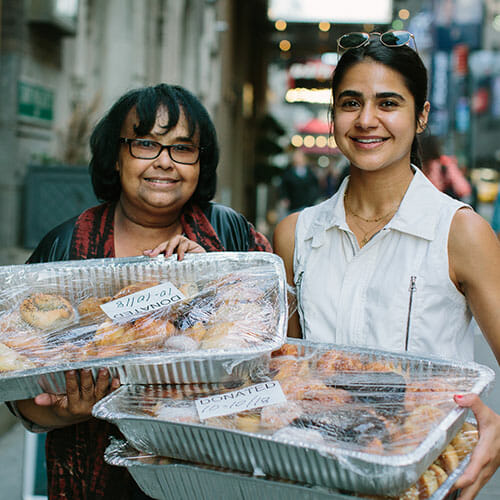
Hannah Dehradunwala prepares food to be be transferred to a local shelter in New York City.
THE DIFFERENCE SHE MAKES
Diego Gerena-Quinones partnered with Hannah in the summer of 2017, and works alongside her and the Transfernation team as a cargo bike rider. He has seen first-hand how much of Hannah’s heart is in the work she is doing.
“Hannah is a true leader,” said Diego. “She is out there doing work on the ground and she shows up to solve the big problems, starting small and seeing it through.”
He believes that Trasnfernation is not just a hobby for Hannah. She is dedicated to addressing food waste, creating jobs, and bringing together talented people to make a difference in the world.
Hannah Dehradunwala was a Top 10 finalist for the L’Oréal Paris Women of Worth Award in 2018. Each year L’Oréal Paris and Points of Light recognize and celebrate Women of Worth who make a beautiful difference in their communities. Ten honorees each receive a $10,000 grant to support their most cherished cause, and an online vote determines one honoree who will receive an additional $25,000 grant. Nominations for 2019 are now open! If you know a woman who works to create lasting and significant change in her community, nominate her to be one of the 2019 Women of Worth.
Chicago Teen Fights Hunger, Builds Community in Hyde Park
Chicago’s Hyde Park neighborhood lies a few miles south of the central business district, nestled on the shores of Lake Michigan. It is home to the renowned University of Chicago and many Chicago landmarks, including Frank Lloyd Wright’s historic Robie House. At the same time, it is also home to many neighbors who aren’t always sure where their next meal will come from. According to the American Community Survey, close to 30 percent of children under age 11 in Hyde Park live in poverty. Across the county, one in seven people will experience food insecurity this year.
Riya Chadha, now a junior at the University of Chicago Lab School in Hyde Park, decided to take action. Last year, she launched the Food Surplus Project to reduce food waste and food insecurity by collecting excess food from her school cafeteria and donating it to local organizations serving food insecure Chicagoans. The project has found enthusiastic support from both the school and nearby shelters, and rescues nearly ten crates of food every week.
Riya Chadha is strengthening her community by connecting food that would otherwise be wasted with neighbors in need, and is today’s Daily Point of Light Award honoree. Points of Light spoke with Riya about her commitment to service.
This interview has been lightly edited for clarity.
What inspired you to start volunteering?
Essentially, the Food Surplus Project takes extra food from [our] cafeteria and takes it over to a shelter. I saw this type of operation work really, really well at different hospitals in my area – like the Rush University Hospital, the Palos Community Hospital – and I kind of loved how enthusiastic so many people were about this project. It brought a lot of cafeteria workers together, a lot of hospital workers, and it connected the hospital cafeteria to different shelters. That’s just something I loved, and something I felt would be amazing in my high school community. I go to the University of Chicago Lab School. It’s in Hyde Park, and it’s kind of known to be a private school that’s a bit disconnected from the community around it, so I felt this would be a good way to build bridges and definitely a good way to use some of the resources at Lab to make an impact in our community.
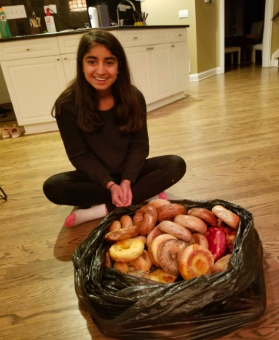
Riya with excess bagels from her school cafeteria ready for donation./Courtesy Riya Chadha
How has the community responded?
I have definitely felt that people have been really enthusiastic. I’ve made some amazing connections to people. One of my favorite memories is bringing over food, and giving the founder of the shelter I was donating to a giant hug and talking to her for a while.
Tell me a bit more about the food donation process.
It’s kind of a weekly thing. Every Tuesday morning, [a local reverend] takes a lot of different food that would originally be wasted at Lab cafeteria and brings it over to Door of Hope. There’s maybe 8-10 crates of food every week, and there’s a lot of different sandwiches and salads – just food of all kinds. Sometimes I load up the food myself, but if I’m a bit rushed with school then cafeteria workers, or other people involved with this project, take it outside and take it over to the reverend’s car and load it up there.
Were there any challenges in starting this project at your school?
Definitely. I had to pitch it to a lot of different administrators. I made a presentation about the information and what I hoped to do with the Food Surplus Project, and pitched it to administrators and people around the Lab community. I was met with a couple “no’s” at first, because people were a little bit nervous about what would come out of it, but, eventually, everybody came around and has become really excited about seeing this project through.
What has been the most rewarding part of your work?
One of the most rewarding things has been seeing how enthusiastic people at Lab are about this project. Seeing everybody super happy and eager to help out, coming together for a good cause, to help build bridges and connect with the community. Also, getting in touch with a lot of the people that we’re helping: talking to them for a bit and getting more insight into what we’re doing, how we’re helping.
I also started a club based around this project. It’s called the Food Surplus Club, and it kind of goes into the problem of food insecurity. It’s pretty cool, because we’re learning about some of the issues behind food insecurity, especially in the Chicagoland area. That’s definitely been pretty rewarding and has opened my eyes to problems people face. One thing we learned is that food insecurity is often a situational problem, and people get stuck in a situation because of different circumstances – medical bills, or [they lose] their job, or [there’s an] accident – and it’s hard for them to get the help that they need.
What is the Food Surplus Club’s format? Do you bring in guest speakers?
A lot of times it’s pretty discussion based. Occasionally we do some fundraisers, or host different events. Right now we’re trying to get a speaker in from the Greater Chicago Food Depository so we can learn about how a lot of the organizations that combat food insecurity operate.
What are your future plans for this project? Are there any upcoming programs or events that you’re particularly looking forward to?
Right now, we’re looking to expand the project to a lot of different cafeterias around Hyde Park. The school I go to is affiliated with the University of Chicago, so it would be amazing if we could get their school cafeterias on board. University of Chicago has a lot of different cafeterias, so [getting it on board] would be a pretty cool expansion of the project.
I’m definitely looking forward to the speaker event. Right now, it’s a consistent, ongoing thing that happens every week, and it’s pretty rewarding every week. But, if we can get it a little bigger and just help a few more people in the Chicagoland area, that would definitely be amazingly rewarding.
Why do you think that it’s important for others to give back?
Because it’s kind of an amazing feeling to get insight into somebody else’s perspective and learn about different circumstances that have affected them, and about different ways that we can help people out. Having empathy for other people and learning about their lives, and learning about the ways that they were affected by different out-of-control circumstances and ways that we can give back is something that’s incredibly rewarding for everybody.