Bank of America Employee Teaches Financial Literacy to Hundreds Across San Francisco
Erica Jones says volunteerism is in her blood. Growing up, she watched her father do a lot of fundraising through the theater and drag community. She says her dad’s example, along with watching family members go through their own difficulties in life, led her to develop a lifelong value that if you receive then you need to give, and if you learn then you need to teach.
This value is what drives the Bank of America employee to spend roughly 20 hours each month volunteering with Better Money Habits, which provides free tools and information about personal finance. After having worked for Bank of America for 20 years, currently as a Treasury Solutions Analyst Assistant Vice President and Financial Literacy Officer, Erica stepped up to join Better Money Habits Volunteer Champions, a cohort of employees who deliver financial wellness resources to their local communities. Since first becoming involved with the volunteer program three years ago, Erica has brought the financial information she has learned throughout her career to San Francisco and East Bay, teaching financial literacy sessions and helping to coordinate the education for community members ranging from formerly incarcerated individuals to college students.
“When it comes to things like money and economic mobility and progress, I want to see my community and my family and the underserved sort of populations prosper,” Erica said, “because we all prosper when that happens.”
For going above and beyond her job to help spread financial knowledge and prosperity to all walks of her community, Erica is today’s Daily Point of Light award honoree. Points of Light spoke with Erica to learn more about what Better Money Habits does for its community.
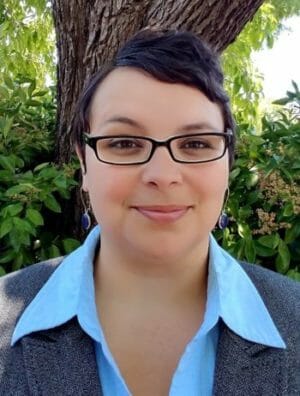
Along with Better Money Habits, Erica helps coordinate Bank of America’s other local volunteer projects as the Bank of America Community Volunteers San Francisco co-chair./Courtesy Erica Jones
Describe your volunteer role with Better Money Habits.
So maybe two or three years ago, the bank promoted their Better Money Habits Champions cohort and I jumped on it because I currently am, [and] at the time was, the Financial Literacy Officer for our community volunteers organization. So any financial literacy event that we had, I would help coordinate, made sure we had enough people, make sure the volunteers knew what to do. Then as Better Money Habits really grew and became more robust, I joined a cohort of folks that are on the team to learn about upcoming developments in the program and new curriculum we offer. I was really working closely with our junior achievement partners as well, so there are several nonprofits that I have presented to. We do a couple different ways that we can get involved with Better Money Habits, [including] going out to actually deliver the curriculum directly to the population. For example, Bank of America funded the first internship at the San Francisco Museum of Modern Art, so I went out to present these Better Money Habits tools to their newest intern group. Another option we have is our train-the-trainer session. So with organizations that already have some element of financial literacy in their program set up, I will teach the nonprofit how to use our materials and really address the sort of nitty gritty questions that come up in financial literacy training, versus sort of, if you just have a budget, you can do better. It’s more like, ok, what do you if you’re living paycheck to paycheck? How do you set up an emergency fund when you don’t feel like you have a lot of money to spread around? We give them the tools to really make their financial literacy programs robust. So again any sort of financial literacy opportunity that comes up in San Francisco, and some in the East Bay as well, I help to coordinate and I get connected with the nonprofit community partner that we have and really make sure that we have people show up.
I am now the [Bank of America Community Volunteers San Fransisco] co-chair, so along with financial literacy, I’m also helping to coordinate and improve our volunteer shift in San Fransisco among many other topics. But my heart is in Better Money Habits. For example, [the week of March 25th], I’m doing a dry run with an organization called Corrections to College in Berkley. What they do is help focus their formerly incarcerated to begin a path of sustainable life progress, so whether that’s going back to school, getting full time work, etc. So I will be presenting to state-wide students in community colleges that are part of the Corrections to College program, and we will be doing a Better Money Habits session for them and then as the program goes on I’ll probably be doing a second one later this year.
Why is financial literacy important to you?
I’ve been with Bank of America for 20 years. I grew up very much in a working class family. We didn’t have a lot, but we made do. I worked 15 of my 20 years in our local branches, so I was able to work with folks that were living paycheck to paycheck, that were really struggling with any bank fees or were really struggling with making ends meet. They would ask the questions, what can I do? How can I get better at this? And I feel like it’s really my duty to bring the access and the knowledge that I have working for a financial institution at a bank, to bring that back to my community, to bring that back to the customers that are really struggling, to bring it back to my family, bring it to my friends. To me it’s important that as I learn and I gain more access and knowledge and skills, that I turn around and share that information. Even if it means that I learned something really simple and basic, it’s important for me to spread that knowledge because it doesn’t do any good if it just stays within the institution.
What kind of feedback to you receive from people who attend the Better Money Habits sessions?
The feedback is that it is accessible, it’s really easy to use, it makes a difference. It gives folks really a tangible thing to either take with them back to their everyday lives or give them a real sense of, ok, I think I can do this, versus it being this sort of high-level, theoretical idea of financially literacy. It really helps people refocus their time. One of the other nonprofits we work with is the Justice and Diversity Center here in San Francisco. They partner with the San Francisco Bar Association, and the bar association offers pro bono attorney work for folks that have run into financial difficulties, whether they’re being sued, whether they’re facing foreclosure, whatever that is and they need legal assistance. As part of that program, they ask us to come in monthly to deliver financial literacy curriculum that’s based around recovering from financial loss or difficulties and repairing your credit. The folks that leave out of that session, they say things like they had no idea that some of this information was out there. These are folks that tend to be sort of technologically disadvantaged or maybe they don’t have access, so the information isn’t just readily available at people’s fingertips. They’re really grateful for a starting point for information they probably would not have come across. So gratitude and just really motivation is the feedback I get.
Are there any future partnerships, programs, or events that you are excited about?
There are some nonprofits that we partner with that I’m going to be reaching out to. But I think what’s important to me is to not only spread it just to the nonprofits but to really get our employees out there to the nonprofits and to the community generally. A1 Community Housing Services in Hayward, they are one that really wants to partner with us. And St. Marys College, we’re about to start next month an ongoing partnership with their low-to-moderate student base. We’ll be delivering monthly Better Money Habit sessions to that cohort of students who are in school but maybe had a difficult road getting there financially.
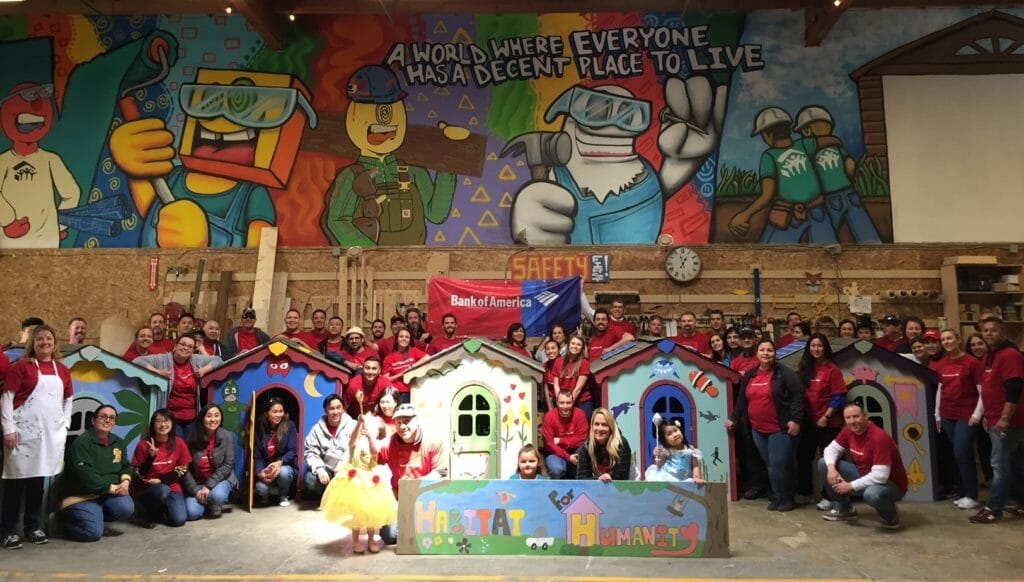
Erica stands with some of her fellow Bank of America employees at a Habitat for Humanity build they did together last year./Courtesy Erica Jones
What’s been the most rewarding part of your work?
I’ve had my own personal financial difficulties and like I said, I grew up in a pretty working class family so I know what it’s like to struggle, and to be especially in an area like San Francisco, where it’s so astronomically expensive to live that you’re really desperate for some relief. So what’s most rewarding is that I can take some knowledge that I have access to — and I am no means an expert — but I can take someone’s story, hear it, and really relate to it and be able to then say, ‘Here’s what I’ve been able to learn from doing these sessions but also from my personal life, and I want to give you as much knowledge as I have to help you.’ Seeing the impact that has and making it a human connection has been really rewarding and important to me.
What have you learned through your experiences as a volunteer?
No one situation or experience is the same. If you aren’t able to meet someone at their level and at their starting point, then we’re doing them a disservice, so it’s important to understand the challenges that an individual has faced and where they want to go and start with them there. There’s no magic wand, there’s no special formula that will make you rich, right? But understanding what people need and meeting them there versus having a set script that you want to give someone is the most impactful version of volunteering to me.
What do you want people to learn from your story?
The opportunity is there and the need is there. All we have to do is really just take one step into it. All we have to do is start somewhere and you turn around, and like me, three years later I have worked with hundreds of volunteers on tons of different projects. It’s really amazing the impact we can make. So just start somewhere, anywhere, giving back, and the sort of impact you can make will be exponential down the road. That’s what my lesson is — I was afraid to start and once I did, it just took off.
Through Crafting, Georgia Woman Helps Homeless Get a Good Night’s Sleep
An avid quilter, Cheryl Milton says she wanted to find a use for the fabric scraps she had on hand after completing one blanket after another, sewn with love, for organizations serving the homeless.
Realizing that pillows are one of the most expensive items for homeless shelters to purchase, the Warner Robins, Georgia resident says she made it her mission to provide easily portable and washable pillows for those most in need of a soft place to lay their head at night.
Impacting her community by identifying a gap in needs, and filling it with an item of comfort, Cheryl has donated over 2,000 handmade pillows for underserved in her area to date, and is today’s Daily Point of Light award honoree. Points of Light spoke to Cheryl to learn more about her volunteerism.
What inspires you to volunteer?
I get a lot of satisfaction out of volunteering. I tell people all the time that you get more from giving than you do from getting. By day, I am the Mental Health Division Chief at the Office of the Circuit Public Defender in Macon, Georgia, so my volunteerism at times intersects with my day job. I’m seeing people who are mentally ill or poor each day who need way more help than just legal assistance. And there are so many ways to help an individual that doesn’t cost any money.
You’ve made quilts and pillows for numerous organizations in your area. Tell me more.
I started quilting about ten years ago because my job is pretty stressful, and quilting relaxes me. I craft for my satisfaction, but also as a ministry. I give to many organizations in my area, but had asked our local Salvation Army what items they were in need of, and they’d mentioned that pillows were one of the most expensive items to buy for homeless individuals. Using fabric scraps from my quilting, I’ll make a few pillows every weekend. These pillows and quilts are going to veterans or recovering substance abusers, children in foster care or at-risk youth.
Cheryl Milton has donated over 2,000 handmade pillows for the homeless./Courtesy Cheryl Milton
Share one impactful story with me from your volunteerism.
Last year I made “pillow case dresses” – literally, dresses made out of pillow cases, for an upcoming medical mission trip my friends were going on. Fast and easy to make – these dresses were another way for me to recycle material and donate items to people in need. I met a lady online who makes dresses, it was by divine intervention. I told her I wanted to make 700 dresses to send to Jamaica and Uganda. Keep in mind, I’ve never met this woman – but she rounded up a group of friends in her home state of Washington, and I had friends sewing to help as well. We made 750 dresses to send for that medical mission trip. I find that when you ask people to help, they’re usually more than happy to lend a hand.
How did you decide quilts and pillows were the way you’d help underserved in your community?
I believe everyone has an artistic talent of some kind. This was a way for me to calm down, turn off electronics and just think about the task at hand. People that you donate things to, they’re so grateful that you took the time to give them something that’s just for them. They’re not looking at my quilt to see if any stitches are off or anything like that.
Tell me more about these pillows.
I was looking for a charitable project and pillows came about because quilters have so many scraps when they make quilts. I thought homeless people could probably use pillows in a size that could fit in their sleeping bag. The pillows are made of scraps that are totally washable, and it’s an item that the individual can take with them when they leave the shelter.
What’s your life’s motto?
Everyday, do something nice for somebody. And it’s not even hard. It can be something as easy as a smile.
What’s one thing you want readers to take away from your service?
That we all matter. We all have a gift that we can share. Even people who don’t have money. My clients who are mentally ill, they are the most generous people in the world. They’ll share anything they have. We all can make a difference in the world, no matter your talent or treasure.
Tell me about an upcoming event that you are excited about.
Genesis Joy House in Georgia is an organization that I’ve donated handmade quilts to. Please check their website for upcoming events, and how you can help: http://www.genesisjoyhouse.com/.
Retiree Supports Disaster Relief Efforts in Rural Areas
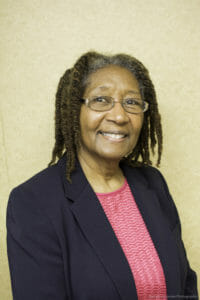
At 67, Judi Leonard has become a pro at handling disaster. Judi, who retired in 2014 from her job as an inventory manager for the Department of Defense, found her way to service once her 50- and 60-hour work weeks were in the rear-view mirror. When flooding struck her community in Minot, she showed up at the local Red Cross office ready to help. Since then, Judi has become a trusted volunteer, managing the satellite office in Minot and taking care of the building and fleet of response vehicles. Judi is a go-to volunteer who always gets the job done, whether it’s hosting a monthly volunteer meeting or traveling the 28 counties of Western North Dakota to inventory Red Cross disaster trailers. Judi’s dedication, commitment and empathy reaches beyond North Dakota – she was deployed to help folks after a major hurricane in North Carolina and she spent three weeks assisting victims of the California Camp Fire last fall.
Judi is committed to making a difference in her community and she is today’s Daily Point of Light Award honoree. Points of Light spoke with her about her commitment to service.
What inspires you to volunteer?
It started with the flood we had here in Minot. The Red Cross was advertising for volunteers and I knew that was something I’d like to do. When hurricane season came around, my friend and I traveled to Texas to help on the ground. That turned into traveling to other disaster sites where we really can make a big difference.
Describe your volunteer role.
I’m part of the Regional Volunteer Services Team, which involves a lot of community outreach. We go to people’s homes and install smoke alarms and staff booths at the local college during special events. We also are onsite if there is a house fire or some other disaster that displaces families. We hand out blankets, offer comfort, toys for the kids. We set up shelters when there is a need, feed folks, really anything that needs getting done.
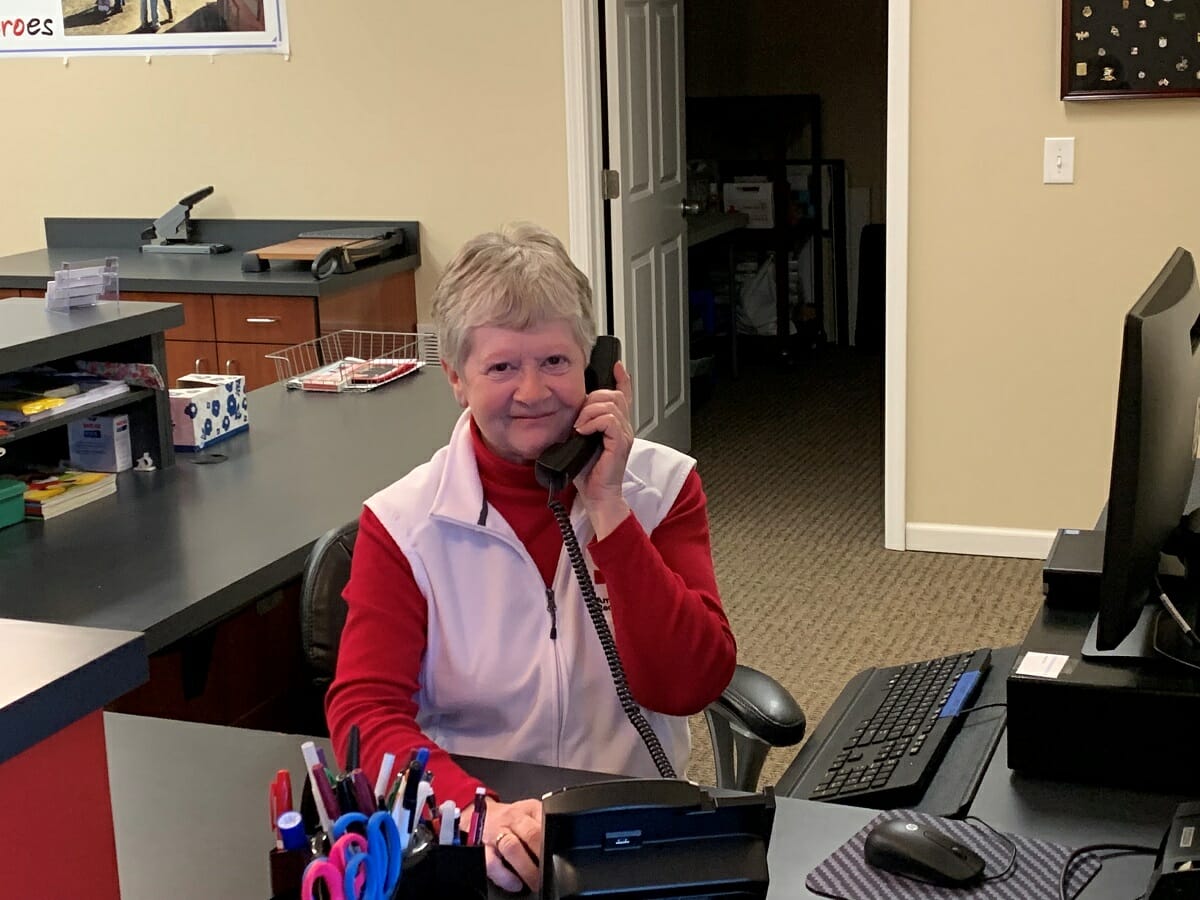
Handling office work is one of the jobs Judi Leonard takes on for the Red Cross office in Minot, ND.
What’s been the most rewarding part of your work?
Helping people pure and simple. I’ve learned to listen more and show more compassion. To be very flexible when I’m deployed – you just never know what you might be doing. Working with other volunteers is also such a gift. I’ve met some really fantastic people who inspire me all the time.
What have you learned through your experiences as a volunteer?
It takes a lot of patience. People are understandably upset and are desperate for answers. They are trying to control something when their lives are so out of control. It’s our job to really try to calm them and help them every step of the way.
Are there any future partnerships, programs, or events that you are excited about?
I’m excited to take some training classes at The Institute, the three-day training offered to Red Cross Volunteers. This year I’m going to take a Next Gen ERV driving class to drive emergency response vehicles. I continue to be involved with the Pillowcase Project, which takes us to schools to help the kids know what personal items to take with them in the case of an emergency. Same for Sound the Alarm, which brings smoke alarms into people’s homes. And I want to volunteer more with the Men’s Winter Refuge Shelter, which is open to homeless men from November through April 30. And to answer the call for deployments when that comes up.
Why do you think it’s important for others to give back?
It’s very rewarding to help others in need. It truly energizes you.
What do you want people to learn from your story?
Just do it! Make it happen – if you feel that you would like to – take that step. It took me years to finally do it and I’m so happy I did.
Child and Education Advocate Works Tirelessly to Support Community
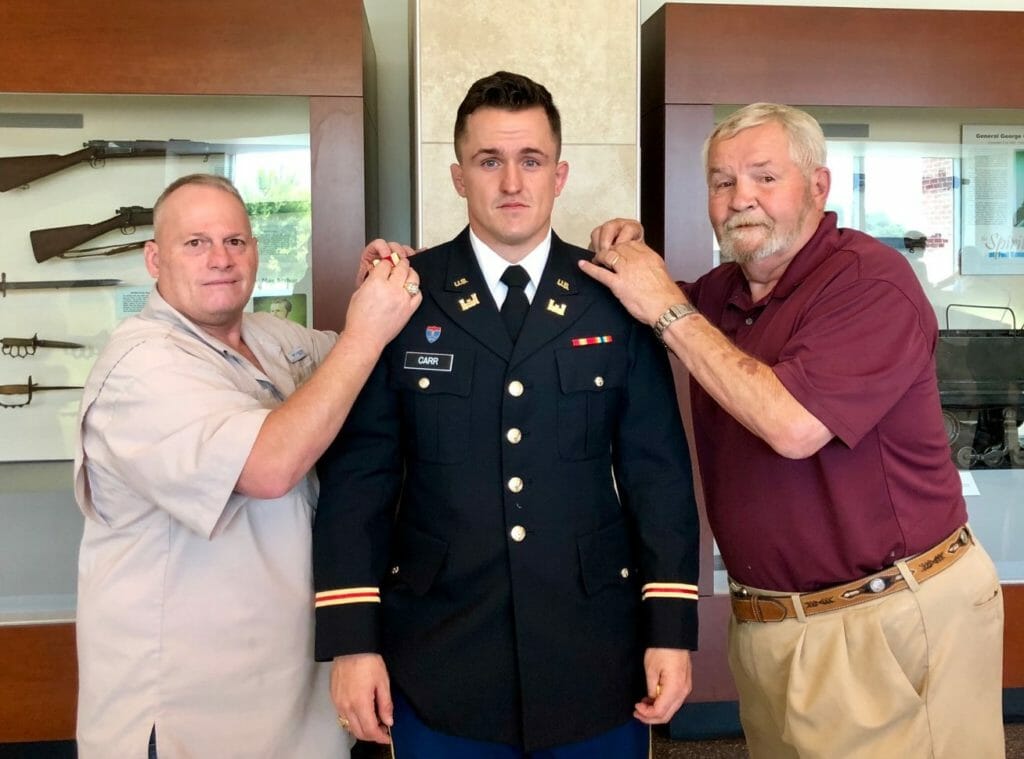
Pete Wahl (right) pictured with JJ Carr, a former student he mentored through the Take Stock in Children organization. /Courtesy Pete Wahl
Pete Wahl’s philosophy in life: “If I don’t do it, who will,” is a commitment that the The Villages, Florida resident has taken seriously throughout his life, and is now dedicated to in retirement.
Acting as a mentor to students, working to support abused children and promoting education, the 73-year-old has served as a champion for some of the most vulnerable in his state through his volunteerism, and is today’s Daily Point of Light award honoree. Points of Light spoke to Pete to learn more about his volunteerism.
What inspires you to volunteer?
I was raised in a very small town in Minnesota. My mother was a school teacher and my dad sold farm equipment. Leading by example, my dad instilled in me a desire to be of service to people. As an adult, I recognized all kinds of unmet needs that necessitated support, and I either found them or they found me.
You mentor students through the organization Take Stock in Children. Describe your role as a mentor. Take Stock in Children works in conjunction with schools across Florida to transform the state one student at a time by mentoring children that are identified as at-risk. That could mean they live in single parent, or low-income homes, or any variety of things. I am teamed up with a student when they are a freshman in high school, and you mentor them through high school, if not longer. My mentorship caters to the student’s needs – whether they need help reading or in some other subject. But my time is more than education, because these kids know they’ve got somebody that cares about them no matter what happens at home.
Share one impactful story with me from your volunteerism.
Probably my biggest success story is a young man named JJ who I mentored. JJ was raised by his mother in a single parent home, was the shyest kid I’ve ever met, and he had no positive self-image. We met in his school lunchroom every week all throughout the school year, and I kept in contact with him throughout the school year. We ended up helping him get into The Citadel, and more recently, I was on hand to pin his lieutenant bars on his uniform as he serves as a soldier at Fort Bennington.
You’re a champion of service within education. Why?
My first mentee – he’s now married, holds down a full-time job and is starting his own family. When I got him as a freshman in high school, he couldn’t read. We spent most of his freshman year reading to one another. We got him through high school by the skin of his teeth. He wouldn’t be where he was today if he hadn’t learned to read. And I was there every step of the way, helping him.
Tell me a little bit about your volunteerism within child advocacy.
I helped to found the Lake Sumter Children’s Advocacy Center in 1996 after several cases of child abuse in our community came to light. We found that abused children were being tossed in the back of a squad car and driven far from their homes to undergo examinations and treatment at an unfamiliar hospital. CAC is a collaborative effort between local government and community agencies starting with support services all the way through prosecutorial work against the offenders. Its mission is to provide a child-friendly, community-based facility where a child victim can be safely interviewed, provided with crisis counseling, receive medical exams and long-term specialized therapy, when needed. We’re there to support the child and family in one specialized location, so those who have been victimized don’t undergo any additional needless stress. I help to raised money for the organization, and serve as the auctioneer for our annual fundraiser. We help about 300-400 kids each year.
You’ve been called a leader within the volunteer world in your community. What does that mean to you?
I’m proud of it, but I don’t volunteer for the recognition. I never have and I never will. It’s just something I feel called to do. I tease my wife about the fact that I volunteer because I don’t do athletics (laughs).
What’s one thing you want readers to take away from your service?
The recognition that if you don’t step up and do something, it’s either not going to get done, or it’s not going to get done as well as you could do it. Everybody can volunteer. Everybody can be important to somebody else.
Tell me about an upcoming event that you are excited about.
Our Rotary Club of The Villages will host a golf tournament early in the spring. Please check their website for more information about upcoming events, and how you can help: http://rotaryclubofthevillages.homestead.com/.
There were an estimated 2 million new cases of cancer diagnosed in the United States last year, according to the National Institute of Health – more than the entire population of Philadelphia. As widespread as the disease is, a cancer diagnosis can be incredibly isolating: studies have found that 23 percent of cancer patients lack support from family and friends during their treatment, and nearly 20 percent of people living with cancer have lost touch with their family and friends as a direct result of their diagnosis.
Monique Brigham is deeply aware of the impact that cancer can have on relationships and communities, having lost numerous friends and loved ones to the disease and knowing many others who are survivors. Inspired by the positive impact of the American Cancer Society, she joined the planning committee of Relay for Life of Skagit County. At the time, the community, just north of Seattle, had almost forgotten about the event, so Monique set out to revive the Relay, creating a space for the community to come together, celebrate, and remember.
Since becoming the event lead three years ago, Monique has revitalized Relay for Life of Skagit County, nearly doubling participation and donations. For her work raising funds and awareness for cancer, Monique is today’s Daily Point of Light Award honoree. Points of Light spoke with her to learn more about her commitment to service.
This interview has been lightly edited for clarity.
What inspires you to volunteer?
I’ve lost a lot of people to cancer. I showed up at our first Relay for Life that I attended, and the numbers were down. People just weren’t coming, and they didn’t know about it anymore. I had just lost two friends to cancer that year. I’ve also seen the good work that the American Cancer Society is doing. My uncle is a survivor, he’s 80 years old and he’s been cancer free for two years now. I see the difference that they’re making, and it inspired me to not let the Relay for Life die in our community and do something about it.
I learned exactly what our money goes for, and I ended up becoming a volunteer driver [with Road to Recovery, an American Cancer Society program offering free rides to treatment for qualifying cancer patients] as well, because I can’t imagine going through cancer treatment and then trying to figure out how to get myself to treatment.
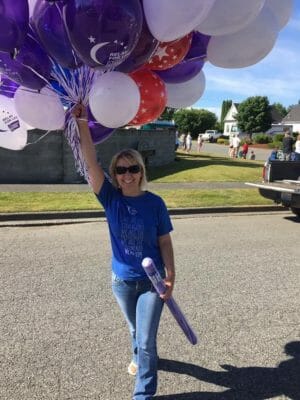
Monique Brigham getting ready for the 4th of July outreach event to raise awareness for Relay for Life./Courtesy Monique Brigham
Describe the Relay for Life event.
It’s a camp out at one of our local high schools. It’s a fun festival where people walk the track. We start out by honoring our cancer survivors with a celebration, and they walk a lap of the track by themselves and caregivers walk with them. We have veterans and first responders walking after that. Then we have different laps for different hours. We’ve got live music, lots of food – all kinds of fun community engagement. At 10:00 p.m., we have a Remembrance Ceremony where we light paper luminaria bags that have been decorated in honor and memory of people who have died from cancer or are survivors. We light the luminaria and have a ceremony – a song or a speaker, usually – and then we walk the track together with lit candles and remember the people that we’ve lost and why we’re walking. We walk through the night and have a few different things going on overnight, to motivate people to be there [laughs]. The music stays on all night, and we’ve got movies that play for the kids – the ones who want to be diehards and stay up all night.
We have a breakfast in the morning. This year it will be a Father’s Day breakfast, and we’ll have a Dad and I lap, because [the relay will be on] Father’s Day. Afterwards, we have a Fight Back ceremony, where we have an inspiring speaker and talk about the good work that’s being done to fight back against cancer.
How many Relays for Life have you organized?
This is the third that I’ve been the lead on. Because it had kind of gotten forgotten about in our community, we decided to find different unique ways to get the community involved. We have outreach, where we’ll go to a festival street fair and have our booth set up with information on cancer and pamphlets that say, “You’ve been diagnosed with cancer, now what?” We get people in touch with people that can give them support, get them rides to treatment and teach them that there’s more to your diagnosis than “Okay, so you’re sick.”
Are there any upcoming events that you’re looking forward to?
We have a couple of really fun kid events. Next month, we have an illuminated Easter egg hunt. It goes from 6:00 p.m. to 9:00 p.m., so it’s kids of all ages – we have four different times, for little kids on up to 18 year olds. We also have a Halloween party. That one isn’t a fundraiser, it’s basically just for fun. Come, have fun, hang out and learn more about Relay for Life.
One of my favorite events is a spa day. Spero Skin and Spa [a local salon] does a spa day, where they treat cancer survivors to a spa day. The survivors get scalp massages, facials, chair massages, and – if they have hair – they get hair treatment. It’s just one of the most special things. That individual event has probably been the most special thing that I’ve done, because of the survivors. They sit and they talk, and they tell their stories. I have a picture of a mom and her daughter, and their both cancer survivors. The daughter’s probably in her 50’s or 60’s, and they’re holding hands. That kind of stuff, it’s just “wow.”
You also volunteer as a driver with Road to Recovery.
Yeah, that is one of the rewarding things that we do. When I first started relaying, I didn’t know anything about the mission. I just thought the money went to research. Then I learned about this [American Cancer Society] Road to Recovery program. When a patient is diagnosed with cancer, they get some money for shuttles to and from treatment, or they have some taxis that will take them, and I hear that there were several patients being turned down because they didn’t have enough drivers and they didn’t have enough funds, so they have this volunteer program. Can you imagine going to your treatment and coming out, and your ride is gone because the taxi driver just couldn’t wait any longer?
So, we have a bunch of volunteers around the area that sign up to drive people. I drive here in my county, because we have a small community, and in Bellingham, which is just north of us. I have my own schedule, so I can drive and listen to the patients’ stories. One lady told me all about traveling all over the country in one of those old silver Airstream trailers. Last year we gave 197 rides in our county paid for from Relay for Life funds. I don’t know the numbers of who was turned down for rides, because there weren’t enough volunteers or enough funds, but it was quite a bit. So, I have some work to do [laughs].
What have you learned from your experiences as a volunteer?
That everybody’s story is different, and that cancer affects almost everybody in some way, shape, or form. I was working on some banners for our [Relay for Life] campsite, just our team names, why we are walking. I’m probably going to have to make two banners, one for the names of people in memory of and one in honor of people that are survivors, because my team is sending me new names every single day, of somebody that’s been diagnosed or somebody that they’ve lost.
Do these events help build a community of cancer survivors?
Yes, they do. And then you have people that come to surround them, and reach out and let them know that they’re not alone, that there’s people here for them.
Why do you think it’s important for others to give back?
Because there’s so much more out there than just us, you know? It’s just more rewarding when you give back.
What do you want people to learn from your story as a volunteer?
I want them to learn that there’s hope for people that have been diagnosed with cancer. It might be hard, but there’s people there that are helping them to get through it. There’s people that are cheering them on. People hear the words, “I’ve got cancer,” and it’s just hopeless. They feel alone. I don’t want anybody to feel like that.
New York Teenager Helps Spread Positivity to Families in Need
Alyssa Dass thinks everybody needs a little positivity in their lives — and she spreads much more than a little of her own positivity to the families at her local Ronald McDonald Houses. About once a week, the teenager visits the Long Island and Westchester-based houses, which are two of the hundreds of Ronald McDonald Houses across the world that provide housing and meals to families with children receiving medical treatment at nearby hospitals. During her visits, Dass cooks meals for about 100 people staying at the houses, bakes them desserts and offers a smile and an ear to the visiting families. Throughout the year, she also collects pop tabs to help the Ronald McDonald House with fundraising, as well as various other donations the families may need, from stuffed animals to socks to gift cards.
Despite the constant help she’s provided to the Ronald McDonald Houses since she began volunteering five years ago, Alyssa insists its the families that are the ones helping her. She says they’ve given her a brighter outlook on life, helped her mature as a person and even influenced what career she wants to one day pursue — robotic cardiology, so she can help save people and give them a second chance at life.
“[The Ronald McDonald families have] given me a second chance at enjoying life and a second chance at realizing who I am,” Alyssa said. “So I wanted to be able to share that with people when I get older.”
For providing meals, donations and joy to families when they need it the most, Alyssa is today’s Daily Point of Light Award recipient. Points of Light spoke with her to learn more about how she helps the Ronald McDonald House.
Describe your volunteer role with the Ronald McDonald House.
I started volunteering for the Ronald McDonald House about five years ago. I started volunteering there because one of my friends … got into a very bad car accident. Her family was admitted into the Ronald McDonald House. She lived all the way in Virginia and that’s where they were keeping her family and treating her, and I felt I couldn’t do anything so I wanted to give back in some way for everything the Ronald McDonald House was doing for her and her family. So about a couple weeks after that, I started volunteering for the Ronald McDonald House [in Long Island and Westchester, New York]. I went to all the fundraisers, I started baking and cooking. I also collect pop tabs for their Pop Tab Palooza. I just try to make sure that I’m involved in anyway that I can be, because I’m so thankful that the Ronald McDonald House does exist, because it does help many families, not only in New York but in many different states. And whether it’s people that I know or not, I’m just glad that people are still feeling like they have a home during their rough times.
I volunteer at the Ronald McDonald House maybe once every week, sometimes once every two weeks. I’m there a lot and whether I’m there or not, I’m always doing stuff outside. I do bake there and cook there, but I also do clothing drives or I collect pop tabs like I said before. The pop tabs just help to fundraise, they can recycle them. I am a Girl Scout as well, so I do different drives. I’m starting to do a gift card drive for the Ronald McDonald House because the ones I work with in Long Island and Westchester, they need gift cards, sometimes toiletries. During Christmas time I collect stuffed animals or socks. Just little things because I feel it’s really important to help in any way I can.
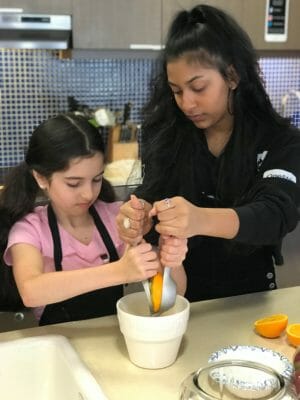
Alyssa likes to invite girls from other activities she’s involved in, such as Girl Scouts and pageants, to come cook with her./Courtesy Alyssa Dass
Who exactly does the Ronald McDonald House serve?
The Ronald McDonald House serves the families of children who are hurt or injured or have been in very traumatic injuries, accidents, [or] if babies were born with some kind of deficiency. The Ronald McDonald House is a building near children’s hospitals so they house families and they make them feel like they have a home and are comfortable. I find it really interesting because the Ronald McDonald House also suits the younger siblings, the older siblings, the moms, the dads. They have a lot of different rooms and comfortable places where they can just feel at home and feel comfortable. You’re at the hospital all day long worrying about the person who was hurt and your loved one who is trying to get treatment, and you can still come to a place that treats you well and gives you food — breakfast, dinner, lunch, snacks, desserts — and just makes you feel comfortable at all times.
What inspires you to make the time to volunteer when you also have school and other activities?
My parents definitely inspire me to do all these things. Just knowing everything that goes on in this world, I think everybody needs a little bit of positivity. My parents always raised me to have this mindset where it’s better to give than to want to receive. I think in this day and age there’s so many teens who have these negative mindsets because they’re going through so much and they think they’re the only ones going through stuff. I think that’s why the Ronald McDonald House hits so close to home, because not only does it help the children but it helps the families to feel happy in some way. It brings positivity to their life. I go in thinking that I’m helping so many families and I come out realizing they helped me more than they can realize. Because I learn so much from them when I get to talk to them. And I get to be more mature. I get to learn more about myself and other people that I don’t even know, and just the way the world works.
What are the families’ reactions when you come there to donate or cook a meal to them?
I truly believe that they are so thankful. Even when you just say ‘Good morning’ to them, or when you’re just plating the food, they look so happy and so grateful. That makes me feel so good because they’re going through so much and I think the least thing I can do is just cook something for them or bake cupcakes, and yet it cheers them up. When you just give them a big smile on your face and say ‘Hello, how are you doing,’ they automatically just feel so comfortable, so happy. They actually feel like someone wants to listen to what they have to say. And a lot of the conversations I’ve had with some of the families when they’re going through things, I see them again and again and they’re just like, ‘Oh my god, thank you, I’m so happy you keep coming back and I thank you for being so young.’ It makes me feel so good because I know I’m making a difference and I know that I’m helping more than one family, I’m helping so many.
What have you learned through your experiences as a volunteer?
I’ve learned to just live life the best way that I can. You just have to enjoy who you are and what you do because you don’t know how much more time you will have. And to just always keep your head high and have hope. I was talking to a mom, and her kid was in a bit of critical condition. She told me to just stay kind and keep my head high and always have hope and I think that’s always stuck with me.
Why do you think it’s important for others to give back?
I think it’s very important because you get to learn different things and you grow as a person and you also get to help people. I think that’s the most important thing. And that helps yourself, when you’re also helping others. I’ve always thought whether I’m helping one person, that the ripple effect will continue. You give one person a smile, they’ll feel good for the rest of the day, so then they’ll smile at everyone else. I think just the fact of spreading kindness, it sounds very cliche but it is so true. I think it’s very important for teenagers especially, kids who are my age, especially girls who are my age, to be more appreciative of who they are and what they have and volunteering really helps you to realize that.
What do you want people to learn from your story?
I would love for people to learn to just always give back. I believe I have a heart for service. And I want people to be able to spread kindness. I think there’s a lot of negativity in this world and I want people to realize that the smallest person with the biggest dream can spread the most kindness. Everyone has positivity in them, they’re just scared to share it and I think you shouldn’t be scared. You shouldn’t be scared to live life and a part of life is having kindness and positivity.
Creating Art to Make the World a Better Place for Children
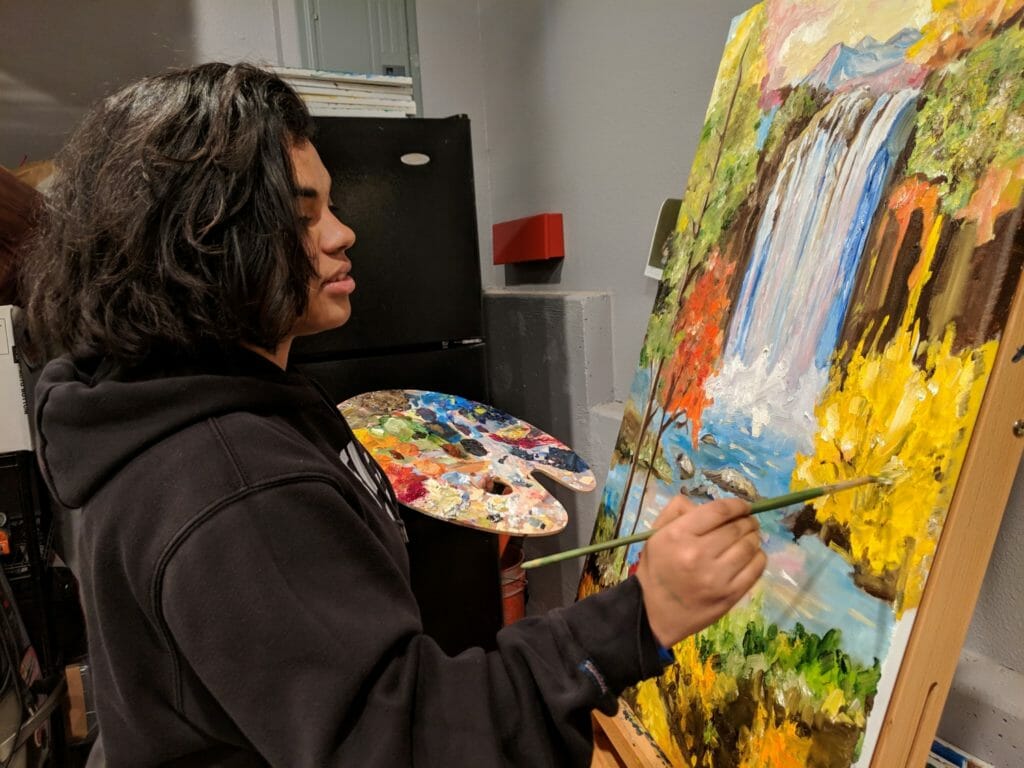
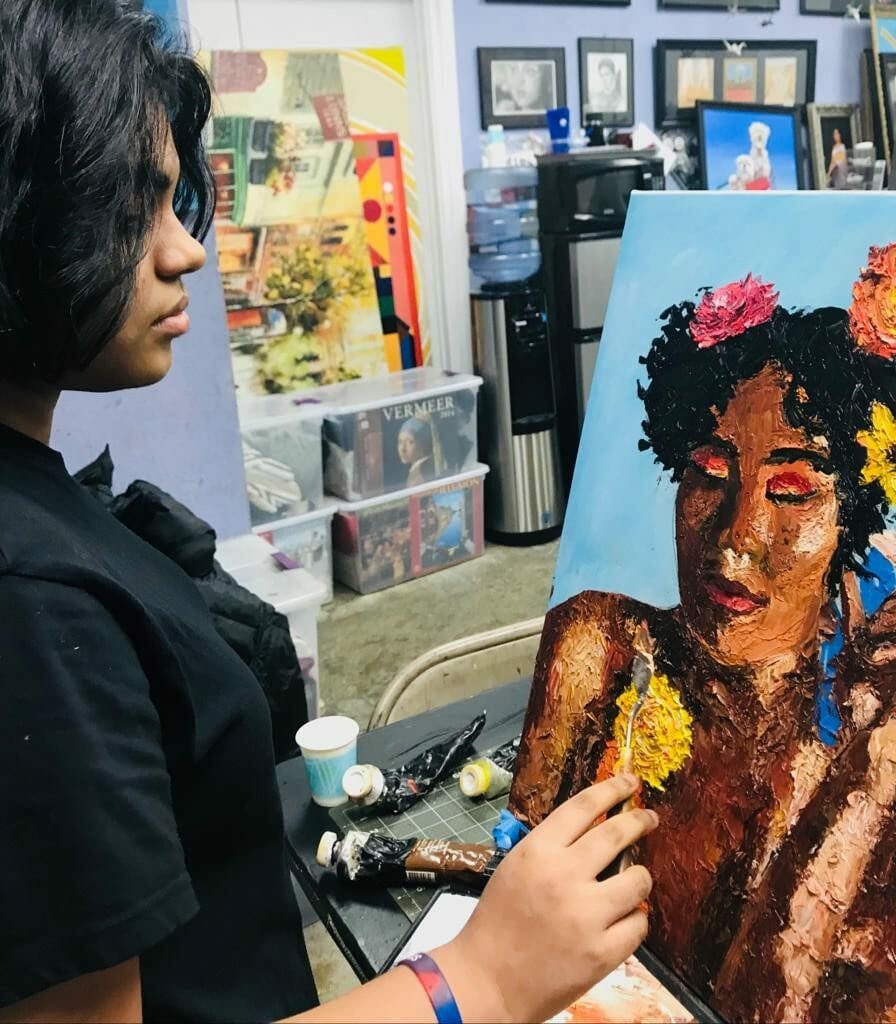
Eighth grader Apoorva Panidapu has many passions. A child of a loving, supportive family, Apoorva understands just how fortunate she is and never wants to take that for granted. So she turns two of her passions, art and math, into a way to make a huge difference for children on the other side of the globe. Apoorva is the founder of Apoorva Panidapu’s Art Gallery, an online platform to sell her artwork and raise funds for her charity, “Help Starving African Children“ (administered through Save the Children). All of the proceeds of the sales of her paintings and the money she earns tutoring younger kids in math go to her cause, so far more than $10,000 raised. Already the recipient of many awards for her art and charity work, Apoorva is a firm believer that one young person can help change the world.
Apoorva is committed to making a difference in her community and she is today’s Daily Point of Light Award honoree. Points of Light spoke with her about her commitment to service.
What inspires you to volunteer?
When I was in 4th grade, we raised money to buy goats for impoverished villages around the world. It was a global lesson to understand that goats provide milk, cheese, and butter to hungry families and can make a huge difference. I really loved that experience and wanted to do something like that again which led me to Save the Children. The idea that children face harsh conditions and lack basic access to clean water, food and shelter is just wrong and unfair. I want to use what I’ve been given to do good, to give back.
Describe your volunteer role.
I founded Apoorva Panidapu’s Art Gallery in 2017 to make money for the charity “Help Starving African Children“ (administered through Save the Children). I also use my math passion to give back. I tutor elementary and middle school kids for school and competition math and raise funds for Visually challenged kids in India (partnering with VT Seva non-profit). I also paint on commission as another way to raise money.
What’s been the most rewarding part of your work?
My charity is so meaningful to me because it allows me to both contribute to my community and support people continents away. Most importantly, my charity grounds me, reminding me not to take my family’s support for granted when so many people are less fortune. In doing commissioned paintings, I am honored to meet interesting people and paint for them. These include an art request from someone in Arkansas to celebrate her husband’s 87th birthday and a couple celebrating their 49th wedding anniversary.
What have you learned through your experiences as a volunteer?
That anyone can use their gifts to give back to the community. It’s also helped me develop as an artist and social entrepreneur. I’m learning marketing and publicity and also how to convey my emotions and thoughts through my speeches and artwork. I’m always looking for more opportunities to help and spread awareness.
Are there any future partnerships, programs, or events that you are excited about?
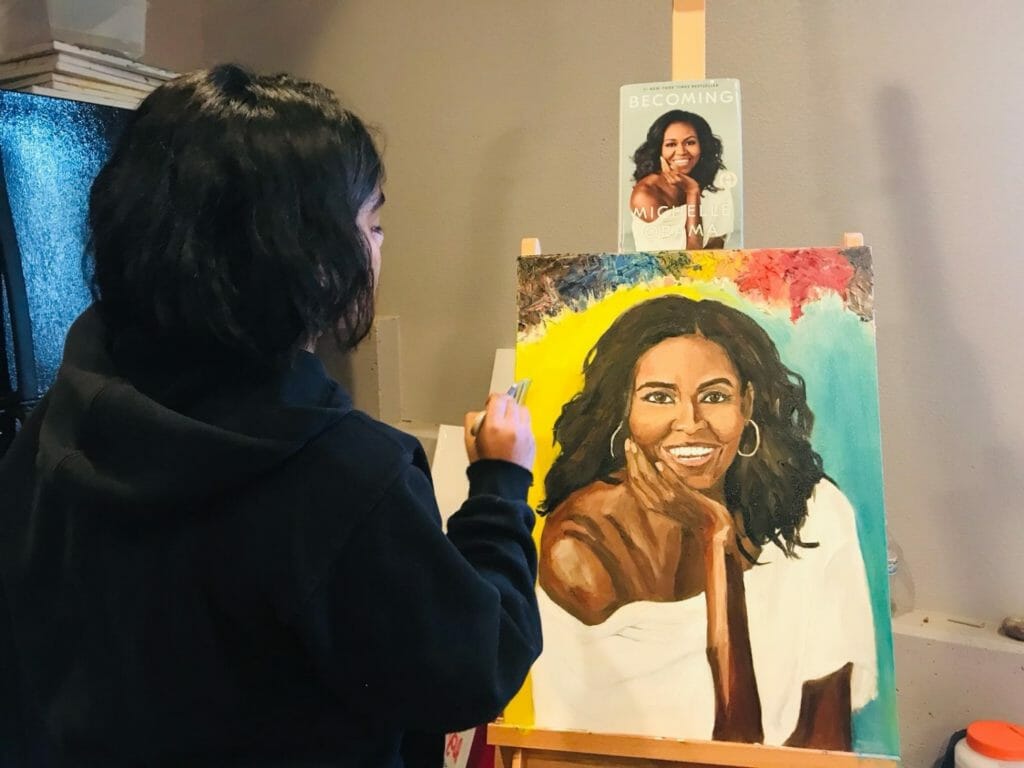
I love working with GLAM (Girls Leadership Academy Meetup) as a Global Ambassador. That allows me to be a mentor for young girls. Glam’s primary goal is for each girl to feel nurtured and empowered to define and articulate her dreams with the tools needed to create a vision and plan for the future. I’m also working on an art club for younger kids and developing an app to help artists to sell art for charity. I continue to sell on eBay – most recently I sold a portrait of Michelle Obama for $610.
Why do you think it’s important for others to give back?
If you’re in a position to help, there’s no reason not to. Use what you’re given to make a difference and help someone out. All help and support is appreciated, no matter how simple an act is. Many people who give back to society have been inspired by someone in their community or environment who had done so and the spirit of giving can begin at any age. When you are involved in philanthropic activities, your empathy increases, and your love and care for others is developed as you are exposed to new and different people,
What do you want people to learn from your story?
Anyone can make a difference! Before I thought, “I’m just a kid – how can I make a difference?” I’ve learned that there will always be a million excuses to not do something, but you just have to make a plan and take it step by step. Even if you cannot donate, take the time to volunteer in your community. There are many opportunities to provide a helping hand in the community
Do you want to make a difference in your community like Apoorva? Visit All for Good for local volunteer opportunities.
After Losing Her Son to Sudden Cardiac Arrest, She Creates Heart-Safe Communities for Youth
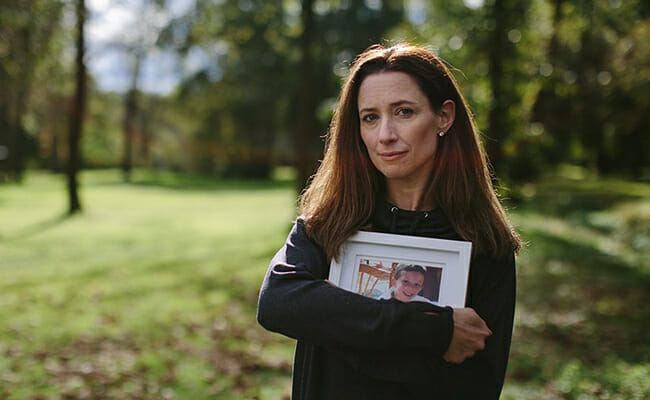
“Even though he is no longer physically with us, we will always be Aidan’s parents,” said Christy Silva, who lost her son to sudden cardiac arrest in 2010. “The work that we do through his foundation allows us to nurture his spirit and to sustain his legacy. It’s our way of assuring that his heart beats on.”
It was Labor Day in 2010, and Christy was dressing her children, 7-year-old Aidan and 4-year-old Devin, for a neighborhood picnic. Suddenly, Christy noticed that Aidan had left the room and was lying on the floor in the hallway. “I thought he was goofing around, playing the ‘sleeping game,’ so I walked over, leaned down, and tried to tickle him,” she remembers. “He was lifeless, and when I turned him over, he was blue.”
Christy started CPR, and at some point, she scooped up her oldest child and ran to the home of a neighbor, who was a nurse. Resuscitation efforts continued, and Christy called 911. Paramedics tried to shock Aidan’s heart back into rhythm, and he was transported to the local hospital. Christy and her husband, Steve, arrived behind the ambulance and soon were given the devastating news: Aidan had apparently died from sudden cardiac arrest.
Sudden cardiac arrest is the unexpected loss of heart function, breathing and consciousness. No warning signs or symptoms are usually present, and victims usually appear to be in perfect health just seconds before they collapse. SCA results from an electrical disturbance, or “short circuit,” in the heart that disrupts its pumping action, stopping blood flow to the brain and other vital organs. Not thought of as a major malady in children, SCA struck 7,037 youngsters in the United States last year, with only 10 percent of the victims surviving, according to the American Heart Association. It is the No. 1 killer of high school athletes on school grounds in the country, claiming the life of one young person every three days.
“It was so hard for us to grasp. He had just had his well-child visit at the pediatrician’s office six weeks before his death, and everything was fine,” said Christy Silva. “I vividly remember Aidan high-fiving our pediatrician. How could this have happened to our seemingly healthy child?” Even more disturbing for Christy and her family was the discovery that 70 percent of conditions that cause SCA in children can be detected by a simple, quick, non-invasive routine electrocardiogram, or EKG. But EKGs are not standard protocol in pediatric medicine, so it was not even considered as part of Aidan’s routine check-up.
During the months that followed Aidan’s death, Christy and her husband struggled with how to sustain his memory and put their overwhelming grief into some form of action. The following spring, the family held the first 5K for Aidan J., which raised nearly $20,000 to support efforts in providing free EKG screenings for children in local schools. Christy was determined to do much more than just provide free heart screenings, however. When she learned that the chances of survival decrease 10 percent every minute after a heart stops, and that the only way to restart a heart in arrest is with a small, easy-to-use machine, she became committed to increasing the availability of automated external defibrillators, or AEDs, in schools and other facilities frequented by children. She also aimed to make CPR training more available in her community.
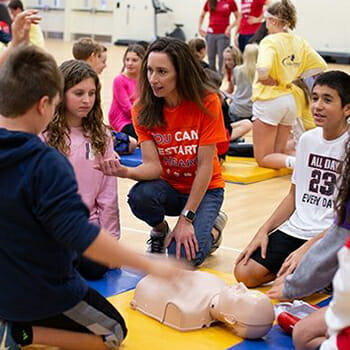
That first 5K fundraiser became the impetus for Aidan’s Heart Foundation, which was established in 2013 to provide awareness, education, and support to communities of the southeast Pennsylvania region and its surrounding area to create heart-safe communities for youth in the prevention of and response to sudden cardiac arrest. The organization partners with pediatric cardiologists to screen young hearts with EKG exams that can detect underlying heart issues. It continues to facilitate the placement of AEDs in schools, youth athletic organizations, and other public facilities, and coordinates with local medical professionals to provide free CPR-AED trainings to young people, parents, teachers, and coaches.
“Aidan has been gone now longer than he was alive,” said Christy. “Had it not been for the overwhelming support of our friends, family, community, and schools, none of our work would be possible.”
Christy’s work has had tremendous impact on the health and wellbeing of children in southeast Pennsylvania. Through the Aidan’s Heart Foundation, she has coordinated EKG screenings of 1,800 youth, detecting potentially life-threatening heart conditions that went previously undetected in 25 children, and facilitated the purchase and installation of more than 85 AED units across her community. She has also trained more than 5,000 sixth-grade students and 400 adults, including parents, teachers and coaches, in life-saving CPR-AED skills. And thanks to Christy’s determination, new state legislation known as Aiden’s Law now ensures that all schools in Pennsylvania are equipped with updated AED devices.
Christy took a very personal tragedy and turned it into a life-saving mission so that her son’s legacy could live on. Although she lost her own son, her efforts have led to an increased awareness of this critical health care concern, and to potentially saving the lives of an untold number of children in her community.
“Mrs. Silva is so special because not only is she teaching life-saving techniques to her community, but she empowers young teens like myself,” said Tiegan Brown, a student who went through CPR/AED training sponsored by Aidan’s Heart Foundation. “She has inspired me to make a positive impact on my community by taking a tragic loss and transforming it into something amazing.”
Christy took a very personal tragedy and turned it into a life-saving mission so that her son’s legacy could live on. Although she lost her own son, her efforts have led to an increased awareness of this critical health care concern, and to potentially saving the lives of an untold number of children in her community.
Do you want to make a difference in your community like Christy? Visit All For Good for local volunteer opportunities
Teen Creates Epilepsy Blankets to Bring Comfort During Unexpected Seizures
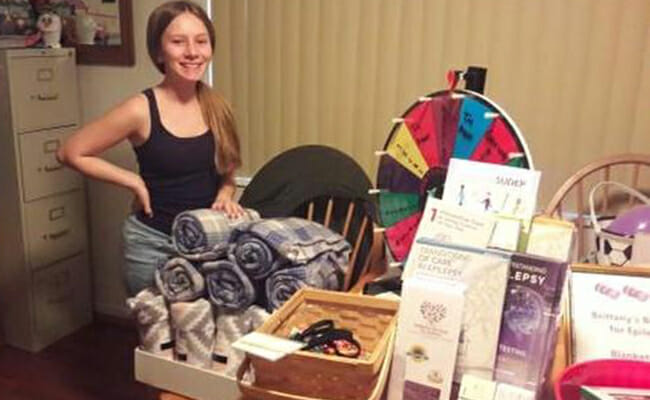
Brittany VanHook is no ordinary 15-year-old. After experiencing an epileptic seizure in a public mall, she was inspired to create something that would give peace and privacy to those who may face a similar circumstance. With help from her mother and father, Brittany created her first epilepsy blanket in her living room– and from there, she began giving back to those in need through Brittany’s Blankets for Epilepsy.
Brittany was diagnosed with epilepsy when she was 7 years old. Epilepsy is a common, yet serious neurological disorder that affects people of all ages. One of its main characteristics is unpredictable seizures, which Brittany has experienced firsthand. Every time Brittany seizes, diastat medicine must be inserted rectally – an invasive but necessary procedure. And when seizures occur in public places, like the mall in Tampa, Florida, where Brittany’s seizure occurred, an already traumatic experience can become even more difficult for the person involved.
Partnering with the Epilepsy Service Foundation, Brittany invented a five-in-one epilepsy blanket that can be worn as a backpack, used as a sleeping bag, has a specific pocket for medicine, is a pillow and has extra fabric that can cover someone receiving medication in public.
Brittany’s Blankets for Epilepsy takes in donated fabric to create epilepsy blankets, which have been mailed to kids and teens with epilepsy across the country. The organization also collects ordinary blankets to distribute to the homeless, troops overseas and hospitalized kids.
One of the organization’s biggest contributors has been Walmart, which donated blankets to be distributed at St. Joseph’s Hospital. As one of Brittany’s favorite memories, the Brittany’s Blankets for Epilepsy team got to see the reactions of recipients when the hospital brought together all of the kids to pass out blankets to.
“I’ve learned to serve others even if you aren’t getting anything back,” said Brittany. Her accomplishments even caught the attention of the Tampa Bay Lighting, which presented her with a $50,000 grant for the Epilepsy Foundation, made Brittany her own hockey jersey and named her a community hero.
Brittany is excited to celebrate the 2019 Purple Day, an annual international grassroots effort dedicated to increasing awareness about epilepsy. This year’s Purple Day will bring together people around the world on March 26 to wear purple and host community events. Brittany’s Blankets for Epilepsy has already experienced an increase in requests for the epilepsy blanket, and will continue to spread awareness throughout her community.
“I believe that we are put on Earth not for ourselves,” Brittany said. “You want to make sure that if you see someone who is not happy, you do something.”
Do you want to make a difference in your community like Brittany? Visit All For Good for local volunteer opportunities.
Kentucky Man Practices Inclusion in Building a Better Tomorrow
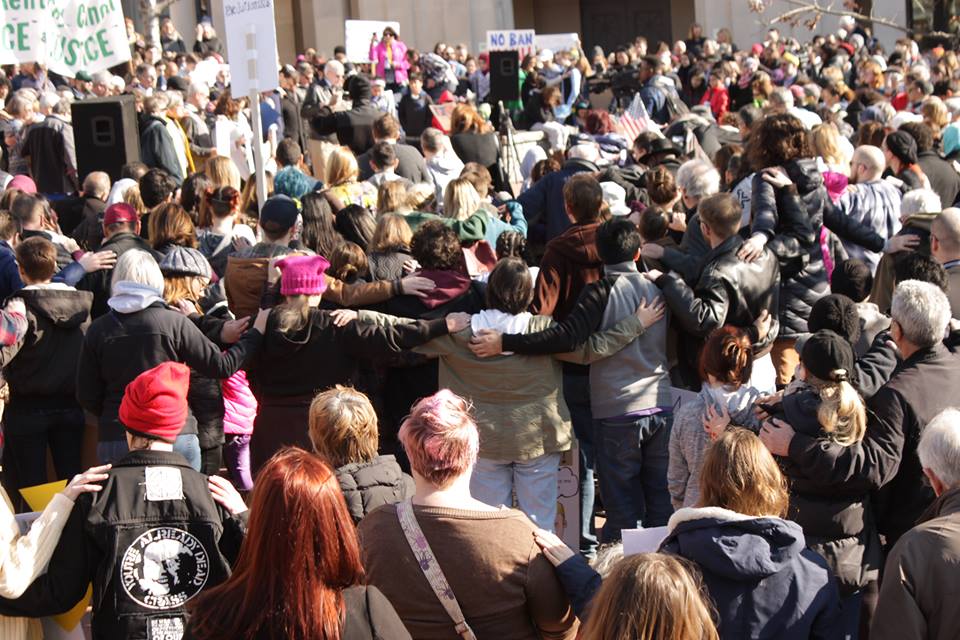
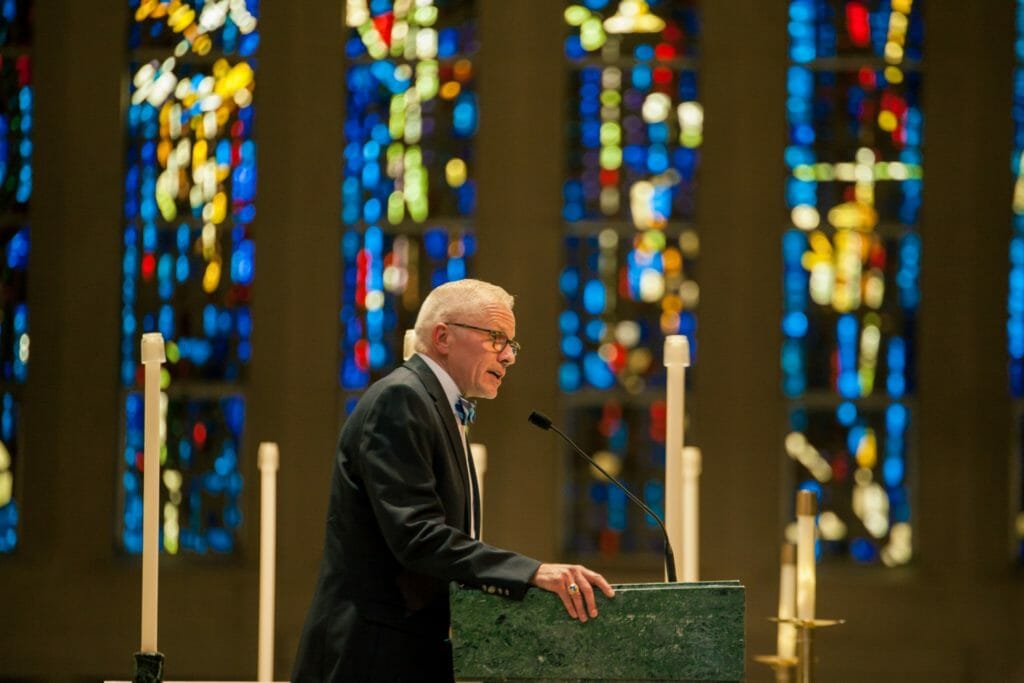
Stan “JR” Zerkowski’s mission is to unite those of varying faiths and beliefs – even non believers are welcome – behind one common goal. As the founder of Lexington UNITED Interfaith Encounters and Dialogues, it’s his message: inclusiveness and the power of unity, that is driving change in his community.
As our greater society encounters increasing divisiveness and barriers, the Lexington, Kentucky resident is confronting those challenges and extending his reach to serve the common good, celebrate diversity and facilitate productive conversations and encounters, regardless of an individual’s creed, color or preference.
Bettering his community by bridging the differences, Stan is today’s Daily Point of Light award honoree. Points of Light spoke to Stan to learn more about his volunteerism.
What inspires you to volunteer?
It was always instilled in me to give back to the community. The thing that compels me to continue volunteering is the tremendous hope that I have for a world where people can come together and celebrate each other’s differences and defend each other’s dignity. I firmly believe we can make that happen if we work together for the common good.
Describe your volunteer role at Lexington UNITED Interfaith Encounters and Dialogues
As the founder and director, I organize, plan, conceive, promote, and otherwise orchestrate our events and projects. I volunteer at least 8 – 10 hours each week, and alongside me are our many volunteers from every faith tradition and from the civic community. I happen to be the public face of the organization, however this is far bigger than me personally. This is about people building a better tomorrow by valuing our differences. To date, we’ve gotten 23 different communities of faith and civic leaders to come together to serve the common good and celebrate diversity and our common unity.
You celebrate diversity through your organization. Explain why.
Soon after the Pulse Nightclub tragedy in Orlando, in which 49 people were killed, I thought that we should be reaching out to the LGBTQ community here in Lexington. We held a memorial concert in honor of the victims, and I saw the power in all of the various interfaith leaders, civic leaders and others coming together for a specific cause. Through our Encounters program, we encourage individuals to share music, prayer, literature that is unique to their particular traditions, so that we can all grow from those experiences. The idea is that we’re standing together in solidarity and in public witness celebrating the uniqueness of each other and realizing that we don’t have to believe in the same thing to stand next to each other and respect the traditions of each other. To date, more than 6,000 people have come together for Encounters.
How has volunteerism changed you personally?
I have really learned the plight and the situation of folks that are often marginalized. We recently held a downtown pilgrimage, “Share the Journey” which was held in solidarity with immigrants and refugees. And in October of 2018, we stood in solidarity with our Jewish family members during the Tree of Life Memorial Service following the Pittsburgh shooting. I’ve become deeply aware that there is more that unites us – which sounds sort of corny, but it’s true, than our differences.
Explain how your service unites people.
This is one thing that everyone can do. We are creating opportunities for encounters. And anyone can do it. Ask someone that’s different from you to lunch or coffee, get together a group that might be different and someone that speaks very differently than you, or with someone who has a different outlook on community or life, and share your stories. Typically, ideologies are put aside because we realize that the person sitting in front of us is a sister or brother. We’re not trying to change anybody’s mind, we’re trying to understand and walk together to create a common world.
What’s one thing you want readers to take away from your service?
Despite our differences, also called uniqueness, we are united in something different. United in love, humanity and hope. How can we find ways to celebrate that and to encourage that? That really is what we’re here for.
Tell me about an upcoming event that you are excited about.
Please check our Facebook page for information about upcoming events: https://www.facebook.com/pages/category/Community-Organization/Lexington-United-Interfaith-Encounters-988661547920489/.
Do you want to make a difference in your community like Stan “JR” Zerkowski ? Visit All For Good for local volunteer opportunities.