Florida Siblings Volunteer Together to Save the Earth
Meet Daily Point of Light Award honorees the Angeletti siblings. Read their story and nominate an outstanding volunteer or family as a Daily Point of Light.
The Angeletti siblings say their family has always been environmentally conscious, but realized when it came to fighting climate change, they could make an even bigger impact. Volunteering together, the four siblings, Ugo, Emma, Anna and Mila have united to educate people about the environment and offer hands-on training to make a positive change in their community and beyond.
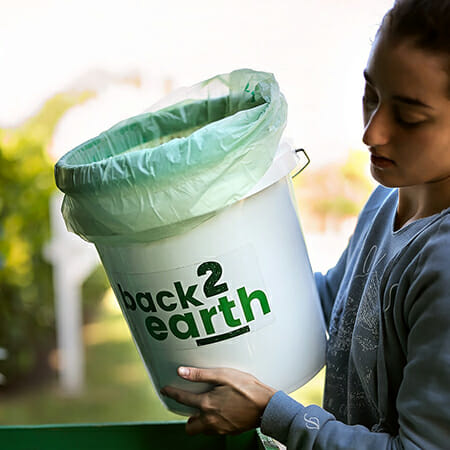
Launching back2earth in 2017, the siblings teach their neighbors how to compost and stop contributing food waste to landfills. Creating devastating effects on the environment, food waste can lead to potent greenhouse gases to toxic leachate to climate change. Climate change and rising oceans, both negative impacts of industrial waste collection service, can be eliminated through decentralized organic waste collection, and by harnessing the power of communities, the Angeletti siblings have diverted 17,500 pounds of food waste from landfills thus far.
What inspires you to volunteer?
Ugo: Around 175,000 pounds of food waste end up in landfills every day. We teach people how to turn their food waste into compost, a nutrient-rich fertilizer.
Emma: The environmental movement is so broad, but we stand out for our volunteerism because we’re doing this as a family. We’re promoting the idea that you can make a change at any age. Any family around the country can fight climate change, so through our volunteerism, we are serving as an example for other people.
Anna: We’re all really interested in the environment. We believe it’s good to educate other young people about the environment and how they might be able to serve and give back.
]: Through back2earth, the Angeletti siblings teach their neighbors how to compost and stop contributing food waste to landfills./Courtesy back2earth
Describe your role with back2earth:
Ugo: I am the president of the project so I reach out to organizations to partner with, in addition I solicit donations and grants as part of our fundraising efforts.
Emma: Every weekend a group of volunteers of all ages join us for hands-on composting and other activities.
Describe some of the hands-on activities you offer.
Emma: We teach young kids and adults about composting through workshops. We also visit local institutions like schools to teach children about composting, how to compost and how to start composting on their own. Our hope is that they bring that knowledge back to their own home, and get their family to start composting.
Explain how you encourage composting around your community.
Emma: We started this project solely based on a pickup composting service, but as our project grew we had to find a way to expand in a more efficient way. We’ve created a network of composting stations around Miami, and we provide people with free buckets to collect their food waste.
Share one personal story with me from your volunteerism.
Anna: The first time I held a presentation for preschool students, I wasn’t sure if I’d be able to keep their interest because they were so young. To my surprise, it was amazing to see kids at such a young age recognize that we were discussing something important. They were engaged, touching and smelling and feeling the compost I’d brought in for the demonstration. It turned out to be one of the best presentations I’ve ever done, and their reaction was so inspiring to me.
What’s one way you hope to inspire others in your service?
Mila: We want to inspire people to understand that it’s time to act now and there’s no minimum age to start contributing to the environment.
What’s your motto?
Emma: “Grow gardens and not landfills.”
What’s been the most rewarding part of your service?
Ugo: It’s a nice feeling to teach people about composting and it’s nice to get closer to my sisters as we volunteer on this project together, they’re my teammates.
Anna: We love changing people’s mindsets, because they start off not knowing what compost is, and then after spending time with us, they know how to contribute to it. Composting brings our community together in a way, because we all have something in common and we can all contribute to the movement.
Tell me what volunteering means to you in one word.
Ugo: Help Emma: Benevolence Anna: Integration Mila: Positivity
What have you learned through your experiences as a volunteer?
Emma: Young people follow young people. It’s nice to see people our age and younger engaging in something they’ve never heard about and actually want to make a difference in.
How can readers help?
Please visit our website for more information about how you can donate to our cause and give back.
Helping Girls Realize Their Potential Through Service, Sports and STEM
Meet Daily Point of Light Award honoree Dr. Kimberly Clay. Read her story and nominate an outstanding volunteer or family as a Daily Point of Light.
In 2004, Dr. Kimberly Clay founded Play Like a Girl, a 501(c)(3) nonprofit organization dedicated to advancing the health and empowerment of girls in the U.S. through sport, physical activity and active play. Through after-school clubs and its popular Play Like a Girl Games, the organization is leading the movement to educate, empower and equip girls to become active early and stay active for life.
Since its founding, Play Like a Girl has impacted over 10,000 girls and young women across 11 states in programs where they learn healthy habits, discover a love for sport, and develop the confidence to pursue their passions. In recent years, the organization has started bringing together sport and STEM education, focusing on the power of sport to help girls realize their potential. Through industry partnerships, mentorship from women in STEM fields and more, Play Like a Girl draws upon draws upon the power of volunteers to help girls develop pivotal professional skills and passion for STEM.
Prior to leading Play Like a Girl full-time as volunteer CEO, Dr. Kim previously served as a public health analyst at the Centers for Disease Control and Prevention and directed the Georgia Cancer Prevention and Control Program. She was named Toyota’s 2014 Everyday Hero, Xavier University’s 40 Under 40, and one of 50 People on the Move by the Nashville Business Journal.
What inspired you to launch Play Like a Girl?
For me, Play Like a Girl was the answer to the little girl in me, all of the opportunities that I didn’t have growing up in rural Mississippi. I wanted to provide for girls today and Play Like a Girl was my solution to that. When we started, we were largely focused on engaging girls in sport and physical activity for the health benefits. I grew up in rural Mississippi, where the opportunity to engage in organized sport was very limited, so early in my life I began experiencing and suffering with overweight and obesity, and have continued to fight the good fight around weight and health into my adulthood.
Initially, when the organization was founded it was really to help address the issue of overweight and obesity in children. As we know, there was a national epidemic around overweight and obesity at the time, in 2004. Since that time, we’ve evolved to really leveraging [sport] for academic outcome, namely preparing girls for careers in science, technology, engineering and mathematics. What we’ve recognized over the course of the first 12 years of our existence is that sport has the power to transform the lives of girls in many different ways. In 2015, espnW and Ernst & Young revealed in an international study that 92 percent of women in the C-Suite played sport, and 54 percent of them played through college. What they really focused on was the business value that women athletes bring to business – as natural leaders, as women who have the confidence and teamwork and sportsmanship required to work successfully on teams. There are innate and transferable skills that women who have participated in sport have that translate very well to the business environment. It was at that time that we reimagined our work at Play Like a Girl and began to integrate STEM education into our work, but more so harnessing those natural properties of sport to help prepare girls for careers in the STEM workforce.
What does the STEM component look like?
We’ve evolved into really focusing on keeping girls active in sport during the critical years of middle school. Girls drop out of sport at twice the rate of boys by age 14. There are these built-in benefits for ongoing participation in sport for girls, and if a girl drops out she forfeits the opportunity to really take advantage of those benefits. What we recognize is that dropout contributes to what we believe to be an intergenerational cycle of emotional health, physical health and wasted potential. Engagement on an ongoing basis for girls in sport has the ability to help develop potential in girls. In doing so, we recognize if we keep her active in sport, if we can draw out of her the transferrable skills that have benefit for the workplace, it is of great benefit for the girl to then pair that with an academic outcome that sets her on a lifelong path for success.
STEM outcomes for girls are very similar to what girls experience regarding dropout in sport. Women represent about 56 percent of the U.S. working population, but only represent about 27 percent of the STEM workforce. In middle school, while girls are dropping out of sport they’re also losing their interest in science, technology, engineering and mathematics. We’ve decided to pair the two in such a way that we focus on what science has said to us are reasons and contributing factors to girls dropping out of both sport and STEM. We know that girls have cited implicit biases and stereotypes based on gender, along with low representation of women who look like them in both STEM and sport. On the sports side of things, the decision to elevate their focus on academics, because they don’t necessarily see a future for themselves in sport. Part of what we do to combat these problems is to focus on increasing exposure and access to women in leading roles in both sport and STEM so the girls see themselves, because we know that representation matters.
We also work on engaging girls in the concept that STEM is everywhere and in everything – including sport. For instance, when we’re teaching volleyball or baseball or softball, we bring in actual STEM concepts to teach the game itself.
We also know that it is important for girls to see a future for themselves in a particular career, so we leverage our partnerships with industry – in particular big companies like Tesla, Gatorade, Bridgestone Americas, HCA. We take our girls into the work environment, where they see STEM careers come alive. Even in those work environments, one of our requirements is that women leading across various fields or disciplines in STEM have to be the individuals who organize and implement those STEM field trips for girls, so they not only get to see STEM come alive, but also to see women in STEM careers doing the work of STEM in their work environment.
What has the reception been?
It’s been quite well received. We are being asked right now to replicate our program nationally and are working with a number of partners to begin the process of creating a turnkey solution in the form of a workshop in a box that can be implemented by any woman, anywhere, in as short as an hour and as long as a full day, where she can also engage other women in her community or her company in creating the STEM field day trip for girls in her market.
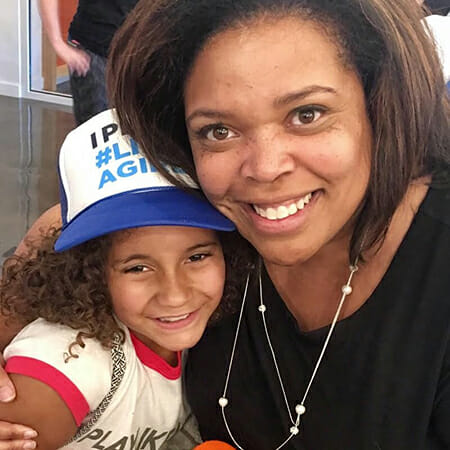
Dr. Kim with a Play Like a Girl participant./ Courtesy Dr. Kim S. Clay
Tell me about your role with Play Like a Girl.
I’m founder and Chief Executive Officer. I founded the organization while completing my doctoral training at the University of Alabama in 2004, and spent a portion of my time thereafter still as an academic researcher and faculty member, I was a tenure-track professor at the University of Georgia and Morehouse School of Medicine. For about five to eight years of our existence, I was still working a job and this was my volunteer service, which was really running on the shoulders of many volunteers who were holding the organization together. In 2010, I had the opportunity to make a shift in my career that afforded me the chance to come out of academics, where I was doing cancer survivorship research as a published researcher, to do Play Like a Girl full-time. I think what is unique about my situation is that I have now been leading the organization a full nine years, and in the history of our 15 years as an organization, we have until lately remained a fully volunteer-led organization. I have never taken a salary in the history of the organization, but last month, we actually brought on our first paid staff member. She is my new executive assistant and runs the day-to-day administrative operations of the organization.
What has been the most rewarding part of your work?
For me, now starting to realize true alumnae of the program – girls who are graduating from high school for the first time and going to college, girls who started with us eight years ago, for instance, who were at that time elementary school girls and now are preparing to graduate from high school. This will be one of our first high school graduation classes moving on to college. That for me is a huge success, because we now have the ability to truly measure our impact against our mission, because these girls will now be the population going into college pursuing STEM careers, and then going on to assume careers in the actual disciplines we’ve been promoting.
Over the years, we have evolved and grown, so therefore our headquarters has moved. Girls who have been through our program have also moved around, but we have a solid cohort of girls that we’ve been able to maintain relationships with. When appropriate, we would like to engage these girls in some type of alumnae program, in developing it as we think about programming toward the future around alumnae of our program.
What have you learned through your experiences as a volunteer?
The thing I’ve learned is to celebrate the small wins. In nonprofit work with such an ambitious mission and a spirited audience of persons that you are working with, it can sometimes become overwhelming and feel daunting, the work that’s before us. But I am learning, and it’s a constant evolution of learning to celebrate even the smallest of wins that we are able to pull off as an organization.
Tied to that is also celebrating the people who contribute to those wins. We’ve been fortunate to have fabulous boards over the course of Play Like a Girl’s existence, and to have volunteers who share my vision and my mission for the organization, and want to see our success as a whole should be celebrated. They should be elevated for the things they do.
Are there any partnerships or programs that you’re looking forward to?
Next year, we will be taking a spin on our tagline – “Inspiring play, unlocking potential” – to launch a new campaign titled Potential Realized, where we will focus on storytelling, sharing the stories of girls in our program and how they have been positively impacted by our programming, utilizing photo and video as a way to tell their stories, where the girls will be portraying their future careers. I’m very excited about that.
In concert with the new campaign, we will also be hosting a new summit called Play Like a Girl STEM+ Leadership Day, where we will bring our industry partners together under one roof to engage girls in a full day of experiential, hands-on, interactive STEM education lead by industry. Typically, we are taking our girls into industry environments. This allows us to bring industry into our environment. We will do everything, including our mentoring circles with the women leaders from those companies. The girls will engage in a hackathon-style STEM challenge, where they will be ideating and creating solutions using STEM, and technology in particular, to solve global issues that impact girls, and then pitch their ideas to an audience. We’ll be providing additional mentorship support and technology to the winners, and they will get the opportunity to further develop their ideas and to travel to Dallas in the spring to compete in our national hackathon, which will be the second iteration. We hosted the first one in Silicon Valley this summer, and this one will allow us to host another hackathon bringing girls into the Dallas-Fort Worth Area to compete against other girls in pitching their ideas and launching solutions into our environment, that perhaps make not only the future female, but make today female.
Play Like a Girl has such a huge impact on the girls, particularly on confidence and self-esteem. What impact has Play Like a Girl had on you, personally?
Interesting that you focus on the confidence piece, because that’s really been the greatest impact for me. In the work that I do, with my credentials in particular, people assume that I’m the most confident person, that I shine and show up in a room as a ball of energy. But, often I am exhausted because of the work that I do. Often, I lack the confidence necessary, I feel, even operating as a leader. Play Like a Girl refuels me. In particular, every encounter I have with a girl in our program really feeds my soul in such a way that it is the empowerment that I need to continue in the work that I do. It is the reassurance and the permission that I need to continue the work, but also to do it with confidence – to show up every day knowing that I am making an impact and that this is the work that I’ve been called to do. I’m a spiritual person and a believer, and I believe that the work that I do every day is my calling in life, but sometimes I need the reminder as well, and Play Like a Girl is my reminder.
Why is it important for others to give back?
“Our service here on earth is the rent we pay for being here.” I truly believe that service is an obligation, not a choice. But it is an obligation of a willing spirit. We all have capacity to give of ourselves to others. Whether it is in a long-term volunteer role, or in a one-off, we all have capacity to give of ourselves. If the world is going to be left better than we found it, it is required of us to give something of ourselves.
What do you want people to learn from your story?
If my life would tell any particular story, or give any particular message, I would say honoring oneself and one’s past, one’s journey. Lived experience is often not given the credit that it’s due, but it is because of what I did not have in my lived experience that I am now able to give to girls what I am able to give through Play Like a Girl.
Volunteer Changes Face of Corporate Accounting through Career Dedicated to Promoting Diversity
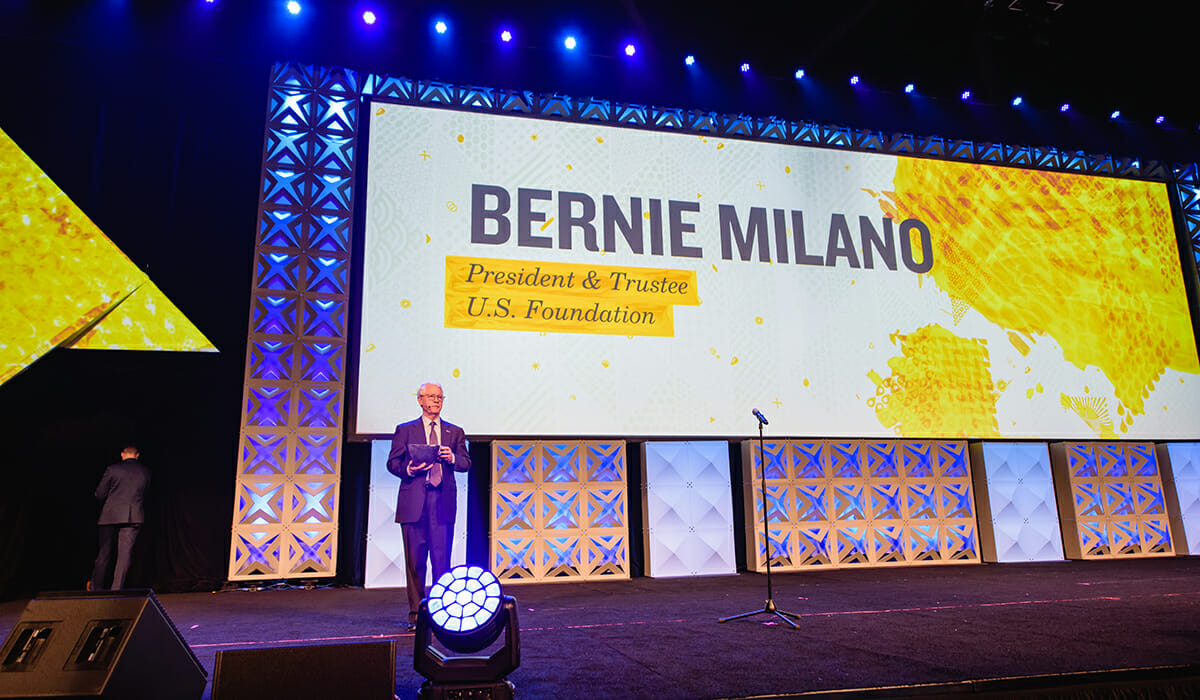
Meet Daily Point of Light Award honoree Bernie Milano. Read his story and nominate an outstanding volunteer or family as a Daily Point of Light.
Bernie Milano was raised in an apartment in Pennsaucken, New Jersey, a suburb of Philadelphia, above a dry cleaning business that his father, an Italian immigrant, owned and operated. Taking a risk by leaving his stable factory job to better support his family with his own business, Bernie’s father taught his children the importance of hard work, possessing a strong moral compass and encouraged them to be their best selves with an ethical commitment.
When Bernie, an accounting executive who will retire from KPMG in December after 58 years with the professional services firm, took his first business accounting class as a student at Temple University, he excelled, said Sharon Pierson, his wife of 34 years. That class then led to a lab assistant position, which led to an on-campus interview for his first job with a firm that would become KPMG, known as one of the Big Four accounting organizations. Bernie’s own experiences as a student finding his professional passion, coupled with a strong value system modeled by his father, have guided his desire to increase professional opportunities for minority students through The PhD Project and the KPMG Foundation.
“There were no other people of color in my program at University of Tennessee as I studied for a doctoral degree in accounting,” says Kevin James, a graduate of The PhD Project. “It was a challenging environment. I don’t know if anyone of color had ever graduated from that accounting program before I did.”
Recognizing that certain minorities were underrepresented in his line of work, Bernie co-founded The PhD Project in 1994 in part through the KPMG Foundation, and is its current president and a member of its board of directors. Its mission to propel advances in the workplace by increasing the diversity of business school faculty has allowed The PhD Project to provide a network for African-Americans, Hispanic/LatinX and Native Americans to attain their business PhDs and become the business professors who will mentor the next generation of leaders. By helping to quintuple the number of minority faculty members in university business programs since 1994, Bernie’s role in reshaping the business landscape through The PhD Project was critical for people like Kevin, who graduated from the program in 2000, and who currently serves as dean for the College of Business and Economics at North Carolina A&T State University.
“A number of our students are from rural areas, a lot of them are first-generation students and are coming from very underprivileged backgrounds. The PhD Project gives these students an opportunity to be a part of a profession with an income-earning potential that will change their lives dramatically.”
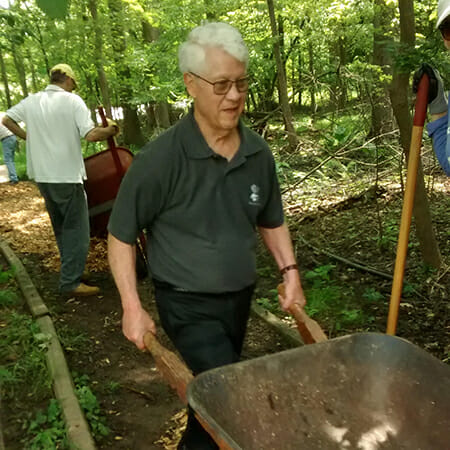
Bernie Milano pictured participating in Community Work Day./Sharon Pierson
Recognized as a volunteer leader, Bernie is known to roll up his sleeves and dedicate his time, energy and effort to support others aspiring to make their own impact in the world, said Bob Elliott, a retired senior partner with KPMG who worked alongside Bernie for the majority of their respective careers.
“He wasn’t just some guy in an office somewhere writing checks. He could call the right people, they would take his call and they would participate. His connections enabled him to do things that nobody else could have done. On top of that, he is a hard-working, innovative and a highly moral man, and he saw this lack of diversity in corporate America in moral terms. He knew that there’s a right and a wrong here, and he was supporting the right.”
Bernie’s tremendous business and personal network extends beyond The PhD Project and KPMG Foundation, including serving as a member of the Points of Light Foundation board of directors. His service showcases the great need many of our communities face, said Natalye Paquin, president and CEO, Points of Light.
“Bernie has been an exceptional board member, but more importantly a trusted advisor and an enthusiastic supporter of Points of Light. His extraordinary volunteer leadership impacts so many communities, from his work with The PhD Project, the HBCU Business Dean’s Roundtable Business Advisory Board, the Conference Board CSR Council and so many more. Bernie shares his light generously and finds the joy in working to improve the world for others.”
In addition to spotlighting these needs and effecting change, Bernie champions causes as a service leader that have strengthened communities and helped countless individuals.
“His list of board service and community involvement is lengthy, and his commitment to his community has been unwavering,” said Neil Bush, chairman of Points of Light. “He is a champion for diversity, equality and inclusion, and is always thinking of how he can help others.”
Bernie Milano, pictured at Enactus World Cup, of which he serves as the Chairman of the Rules Committee for Enactus./Sharon Pierson
By questioning the lack of diversity in his profession and then pursuing solutions, Bernie’s legacy of moral and ethical commitment, a lesson learned from his father all those years ago, represents systemic change in business and society, said Sharon.
“Bernie approached decades of cultural suppression of making accounting available to minorities from a systemic view. He believes that an individual can make the difference to step up and be that person that others can see. Bernie did it by modeling his best self. He reached out to clasp the hand of someone else and said, let’s do it together. Let’s lift up and make the world better.”
Thankful Texas Family Volunteers to Feed Bodies and Souls Across Homeless Community
Meet Daily Point of Light Award honorees, the Aguirre family. Read their story and nominate an outstanding volunteer or family as a Daily Point of Light.
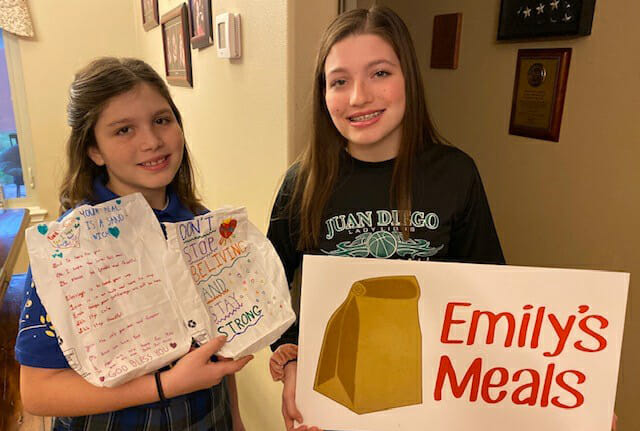
Rick Aguirre and his daughter Emily were out running errands on a cold and rainy Saturday morning five years ago, when a man walked in front of Rick’s truck. When Emily, then 6 years old, asked her father who the stranger was, Rick explained that he was homeless. The McAllen, Texas, father was then bombarded with questions from his youngest daughter.
“Emily started asking, ‘what does homeless mean?’ I explained to her it meant that he didn’t have a house, and that he lived on the street,” Rick said. “She started asking me all these questions about how he lived, where he was going to eat his food, what else he was going to do. I’m usually a person that has answers to everything, but that one kind of floored me.”
Instead of moving on with their day, the McAllen, Texas, family took action. Rick bought the man food and a cup of coffee at a local restaurant that morning, and then they decided their family’s service wouldn’t end there. The Aguirre family committed to feeding a homeless person every day for the 40 days leading up to Easter in place of giving something up for Lent. And they never stopped.
Launching Emily’s Meals in 2015, the Aguirres began to feed homeless individuals in their southern Texas community, preparing meals in their own home and delivering them to people in need. The momentum from their act of service grew steadily across their family, friends and networks, eventually becoming a large group of volunteers who prepare and distribute 40-50 meals to homeless individuals each day, with more than 10,000 meals served annually.
Sisters Emily and Erika Aguirre feed homeless individuals alongside their parents on Saturdays when they are not in school. Both say their volunteerism has made them thankful for their family and their blessings./Courtesy Aguirre Family
The meals include one main dish like a sandwich, spaghetti, lasagna or hamburgers, and additional snacks that sustain the individual throughout the day, all delivered with an accompanying blessing card, which are created by various community groups. Providing nourishment for their bodies and souls, sometimes, mom Coni Aguirre says, a person just needs a quick prayer and sometimes, the meal turns into something more lasting.
“As parents, you want to raise your children to see the needs around you, and teach them how to meet those needs,” Coni said. “When this experience first happened, we thought we were just doing this for Lent, but after the 40 days, the conversation with these people went from, ‘hey, are you hungry?’ to a real friendship. After 40 days, we just couldn’t stop. It’s our family’s mission and other families’ mission as well.”
Learning the names, the stories, needs, hopes and fears of the people they serve, the Aguirre family has led their community in extending a hand to their neighbors in need, promoting empathy and understanding and raising awareness of a population that oftentimes feels invisible, according to Sandra Martinez, an Emily’s Meals volunteer and Aguirre family friend.
“We didn’t know there were homeless in the valley. You see a few people, but it’s just not a big part of our culture. We’re Hispanics, we’re Catholics, we have big families and if you need something, somebody is going to take you in,” said Sandra. “When you see something outside of the norm and you start to question how or why that could happen, it really makes you start to think about your own life and your own family.”
Providing bus tickets to an abused homeless mom and her children, hosting seasonal picnics, offering personal hygiene and healthcare services and continuing to facilitate assistance as individuals seek help and get off the streets – sometimes even reconciling with family – are all ways in which Emily’s Meals has gone beyond food to provide help and hope for people who often have no one else to turn to, says the Aguirre’s oldest daughter, 15-year-old Erika.
“Before, I thought, it’s just a meal and everybody eats together as a family. Everybody has someplace to go and eat,” Erika said. “After I realized that there are people that go days without eating, or that some people haven’t spoken to their family in years, it opened my eyes, and I’m so thankful.”
Aguirre Family, Disney and Points of Light Volunteer Family of the Year
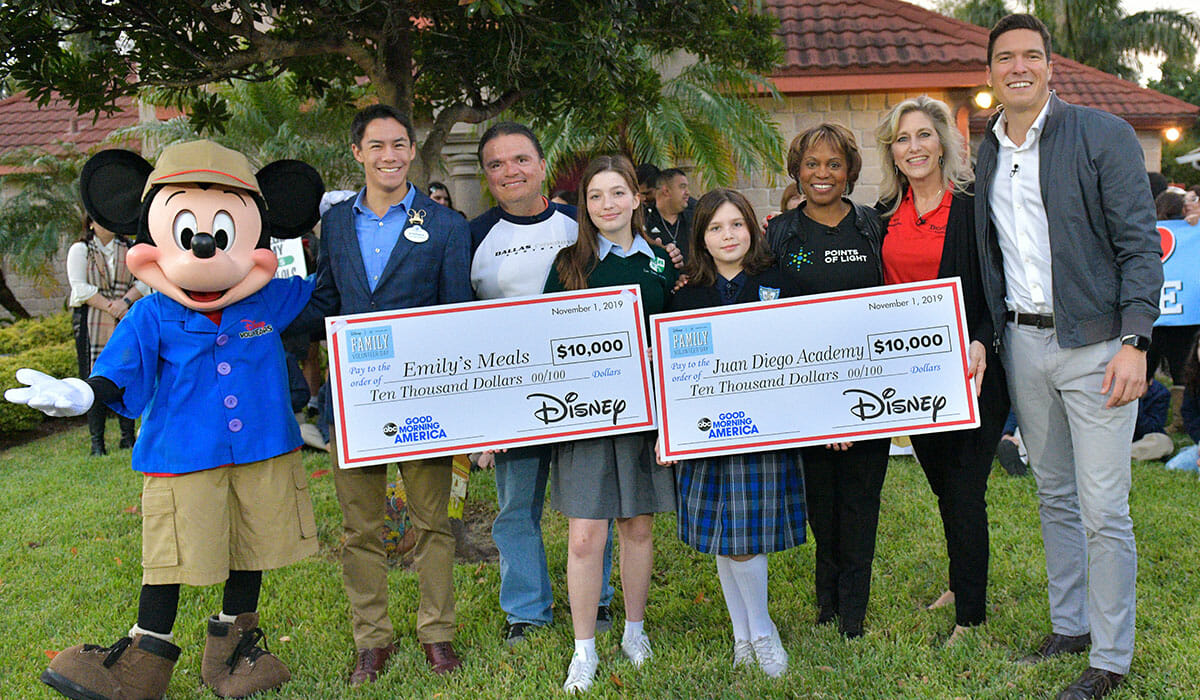
Because of their amazing work, the Aguirre family was recently named the very first Disney and Points of Light Volunteer Family of the Year, and were surprised on Good Morning America with a trip to Walt Disney World and a $10,000 grant to continue the amazing work they’re doing in their community.
And as this Texas family prepares for their own Thanksgiving meal, their volunteerism shines brightly and their impact is being felt deeply across the community as the namesake for the organization, 11-year-old Emily, continues to ask questions on behalf of this vulnerable population.
“If I were to put myself in their shoes, I would think, ‘why are these people helping me? Out of all these people, why me?’” Emily said. “It’s important to help them because they’re still our brothers and sisters in God’s eyes. Because of us, they’re not going to go hungry that day.”
A Son of Memphis, Daily Point of Light Jason Farmer is Devoted to a Cause That’s Close to Home — St. Jude Children’s Research Hospital
Meet Jason Farmer, Daily Point of Light No. 6,656, who is receiving his award on the 30th anniversary of the very first Daily Point of Light Award – presented to The Commercial Appeal in Memphis, Tennessee, on Nov. 22, 1989. Learn more about the 30th anniversary of the Daily Point of Light Award.
He was born in Memphis, Tennessee, in 1969, the year after Dr. Martin Luther King Jr. was assassinated in the city. He grew up in the Foote Homes public housing project, hearing his mother’s stories of tanks rolling through the streets in the wake of Dr. King’s death.
“A lot of the men who participated in the sanitation workers’ strike, they lived in that projects with us,” said Jason Farmer. “So it was just one of those teachable moments. Because we would see the men come home. I would see them get hosed off outside, not understanding why they came home so dirty every day.”
A teachable moment, not from a book but from life. And Jason learned it well, growing up to become a leading light of African-American support for a Memphis institution founded on the ideals of inclusion and equality — St. Jude Children’s Research Hospital.
“When you talk about space and time, Dr. King was assassinated here in 1968, and St. Jude was in its infancy. I think St. Jude was five or six years old,” said Jason. “And a lot of people just don’t really know how critical of a role St. Jude played in helping that healing process, after the assassination of Dr. King. Sometimes it makes you wonder where we would be, if St. Jude wasn’t here.”
That spirit of service burns bright in Jason, most notably through St. Jude Spirit of the Dream, an annual Black History Month event celebrating the achievements of African-Americans who embody the lifesaving work of St. Jude and its founder, Danny Thomas. He helped get the event established, playing an influencer role that encouraged others to get involved. That led to a leadership role, with Jason currently serving as vice chairman for the event.
Jason has also been a St. Jude donor and supporter all of his adult life, from his days in the Marine Corps serving in operations Desert Shield and Desert Storm, to twice running in the St. Jude Memphis Half-Marathon — one of the races in the hospital’s largest single-day fundraiser. He’s also volunteered at the annual Memphis PGA Tour event benefiting St. Jude.
“It’s a noble mission,” Jason said, evoking Danny Thomas’s belief that no child should die in the dawn of life. “It’s a doable mission.”
But this is more than a story of a generous Memphian supporting a worthy institution. Jason’s bond with St. Jude is deep, and personal. St. Jude opened in 1962 as the first fully integrated children’s hospital in the South. The original star-shaped hospital building was designed by an African-American architect. There weren’t just African-American patients being treated in the same rooms as white patients, but African-American researchers, doctors and nurses working alongside white colleagues.
And in the years following Dr. King’s assassination, one of St. Jude’s first African-American physicians, Dr. Rudolph Jackson, helped develop a hospital program to provide nutritional assistance and address common health problems in low-income households.
The program served as a prototype for WIC, the federal initiative for women, infants and children, and thousands of local families were enrolled — including the Farmers, who lived about two miles from the hospital.
Jason’s devotion to St. Jude? “I think the seed was planted early,” he said. “We always understood.”
In June 2018, while Jason was in a St. Jude-related meeting, he received a text that a young relative had been diagnosed with lymphoma and would be treated at St. Jude. By August, he said, the cancer had spread so rapidly the family was told to “prepare for her not being here.”
“But between August and Christmas, they really got it under control,” he said. “I think she was cleared by the spring of 2019. She returned to school this fall.”
Suddenly, the nearly 50-year bond between St. Jude and Jason Farmer was stronger than ever. And his desire to give back is growing, still. As the founder and CEO of a Memphis-based film production company, and with a son in film school, he envisions a film series that would raise awareness for the hospital.
“My family is greatly indebted for the things St. Jude has done for us over the years,” he said. “It doesn’t even really feel like volunteering. It’s just what we’re supposed to do.”
“It’s a noble mission,” says Jason Farmer, evoking St. Jude founder Danny Thomas’ belief that no child should die in the dawn of life. “It’s a doable mission.”
The Difference He Makes
From the beginning in 1962, St. Jude Children’s Research Hospital’s focus on treatment and research of catastrophic children’s diseases had a happy byproduct: it helped cure social ills, too, by welcoming children and employees of all races.
Jason Farmer’s volunteer work for St. Jude shines a light on that history — and reminds people that those same ideals are alive today, that St. Jude remains a place where children are treated, regardless of race, religion or a family’s economic station.
He says St. Jude Spirit of the Dream is designed to remind people that, “St. Jude is here, it’s real and it’s relevant in our community.” For those who might have forgotten, he wants to reignite the flame.
“With Spirit of the Dream, we have an opportunity to really drive home in the minority communities how important St. Jude is to the fabric of the city,” said Jason.
Verushka Wilson, who works with St. Jude Spirit of the Dream in her role as senior specialist at ALSAC, the fundraising and awareness organization of St. Jude, says Jason has been crucial to the cause.
“As we looked to expand our presence in the Memphis African-American community, it was important to connect with the right influencers,” she said. “From the beginning, Jason was one of them.”
Texas Teen serves overseas children in need by starting her own nonprofit
Meet Daily Point of Light Award honoree Melissa Khasbagan. Read her story and nominate an outstanding volunteer or family as a Daily Point of Light.
Melissa Khasbagan was 13 years old when she visited rural inner Mongolia with her parents. Her visit to the country opened her eyes to the lack of resources for the local children to learn the English language. Upon her return to the United States, Melissa set a goal of collecting 1000 books for the children back in Mongolia. Seeing the impact of her work and the opportunity to do so much more, the Texas teen officially established her nonprofit organization, 1000 Books For, in order to continue doing her service work long term. The organization helps provide education and resources to students, not only in Mongolia, but in other developing countries as well. Melissa is able to source these books through donations and book drives.
As of today, her youth-led organization is operating in 8 countries and impacting over 35,00 students. 1000 Book For is also working with 400 teachers worldwide and collaborating with teachers from Austin, Texas to develop an audio curriculum aimed at improving comprehension skills. Melissa’s hard work has garnered her numerous accolades and recognitions, such as the 2019 Global Teen Honoree, Princeton Prize, and the Gloria Barron Prize. In addition to this, she is a TEDx@Redmond, SXSW EDU, and LearnFestATX speaker, promoting education and diversity equity in youth.
Melissa is also the creator of “The Teen Entrepreneur Podcast”, where she interviews teen entrepreneurs and empowers youth to change the world for the better. The eighteen-year-old firmly believes that entrepreneurship and education is the pathway to achieving equal opportunity.
What inspires you to volunteer?
Five years ago, after visiting my cousin, Sorgog in Inner Mongolia, I noticed a discrepancy in our day-to-day life and education. In America I had world-class teachers and resources, but Sorgog and her classmates at Xilinhot Mongolian Middle School attended schools with few textbooks. I admired Sorgog’s resilience in making the most of her situation, but I had to do something to find a way to bring much needed programs to her and her community.
As a way of sharing what I love (novels) and what my cousins were missing (English teaching materials), I made a goal of providing one thousand English books for Mongolian students (five years ago).
Describe your volunteer role.
I am the Founder/President of 1000 Books For. With an emphasis on sustainability, we’ve collected 30,000 books, work in 9 countries, with 400 teachers, and impact 35,000 students. We’ve received supply donations worth over $75,000. Our ambassador program has grown to over twenty members from three continents. Through our English education projects (including book drives and workshops) across US, Mongolia, China, India, Tajikistan, Uzbekistan, Mexico, and Russia, we’ve set up libraries in orphanages in Ulaanbaatar, Mongolia and New Delhi. Our efforts in Mongolia have been commended by the Mongolian government.
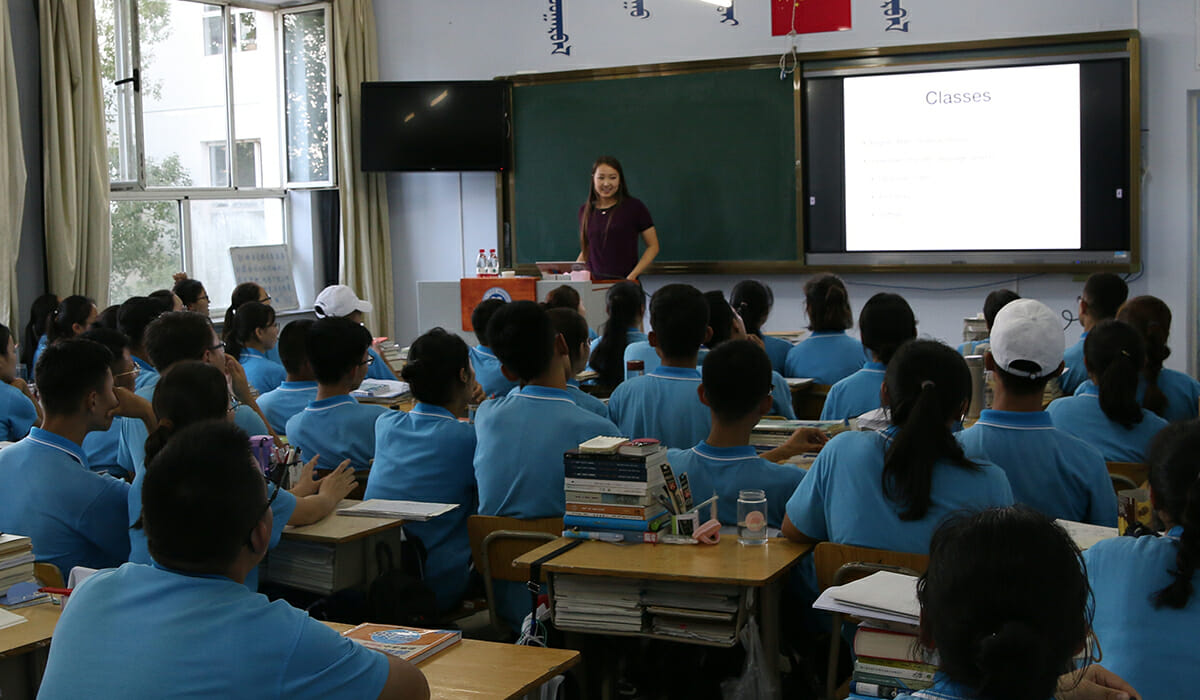
Melissa running an English workshop at a Mongolian High School/Courtesy Melissa Khasbagan
What has been the most rewarding part of your work?
My most memorable 1000 Books For initiative was creating the first-ever, community-organized conference in Liberia: the 2019 Global Youth Changemakers Summit. I developed skills in fundraising to finance the entire conference, selecting applicants myself, crafting a curriculum, and teaching social entrepreneurship to our 160+ West African attendees. After getting Founders Bootcamp to sponsor the conference and getting exposure from 12 Liberian media outlets, the event was free for our attendees.
The most rewarding part was learning. After speaking to conference attendees, I corrected my previously misinformed stereotypes about Africa. I witnessed my new friends turn into ambassadors of change, brainstorming solutions to implement in their communities. For example, one attendee Robert was inspired to create his own summit, held winter 2019.
What have you learned through your experiences as a volunteer?
The first time I pitched to potential partners, my hands trembled and voice stuttered as I cried on stage. But I learned that it’s okay to fail, treating each speaking engagement as a chance to grow. I’ve since become a youth entrepreneurship and equity advocate: giving a TEDx talk in Seattle, speaking at one of the most significant innovation conferences: SXSW and SXSW EDU, and presenting to educators at the LearnFestATX Conference.
Are there any future partnerships, programs, or events that you are excited about?
Within the next year, my biggest goal is to expand our #Project195 Initiative, a mentorship toolkit to teach youth entrepreneurship from all 195 countries. With partnerships with international organizations like the Diamond Challenge and Work for Life on curriculum development, I plan to create a consolidated community online for youth to network and access change-making materials (videos, worksheets, and podcasts).
In 2020, we’re partnering with a youth-led for Detroit youth to hold a conference there. And we’ll be in 9 countries in Africa, starting with Liberia and Ghana. Our partnerships with African universities and schools have helped to empower youth through entrepreneurship.
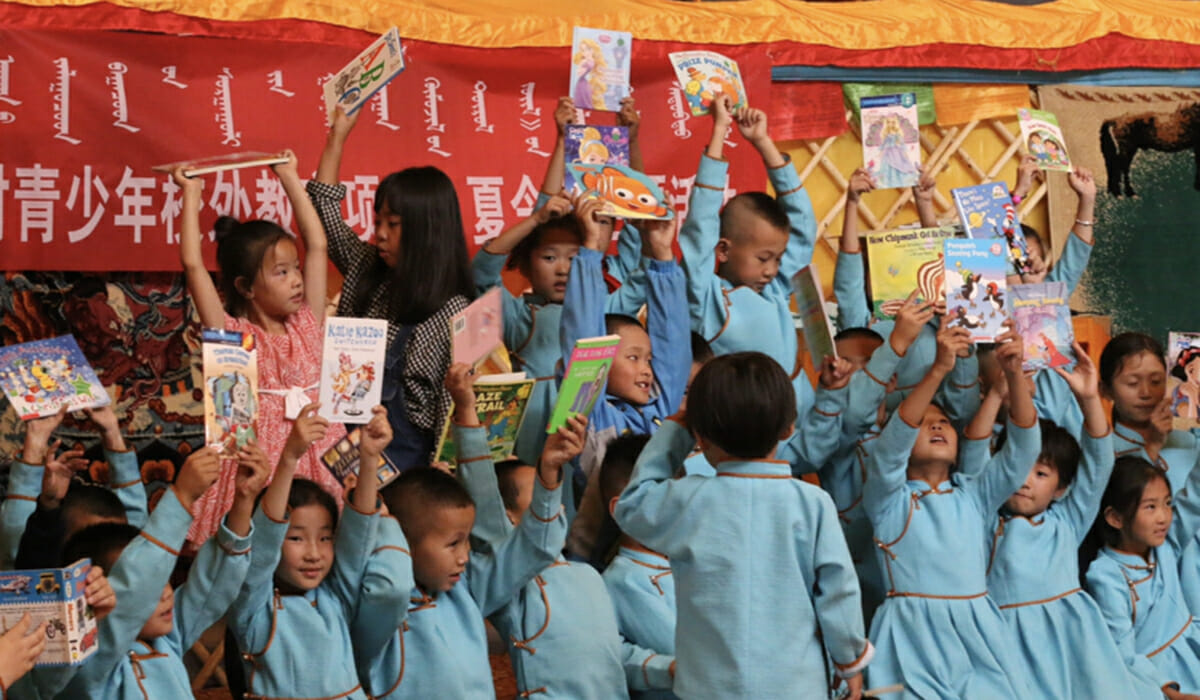
Melissa’s nonprofit distributing books to children in Inner Mongolia./Courtesy Melissa Khasbagan
Why do you think it’s important for others to give back?
I believe that it’s important for people to create the world they want to live in. People have the power to create change, so the next time you see something that is not what you stand for, make the change. Find solutions for things that need to be solved in your community.
What do you want people to learn from your story?
I want youth to know that they can make an impact. Your socioeconomic status or cultural background does not determine where you will be in life. Work together to find solutions for problems to solve in your community.
Massachusetts Teen Provides “Kare Kitz” for Children in need in her community
Meet Daily Point of Light Award honoree Kylee McCumber. Read her story and nominate an outstanding volunteer or family as a Daily Point of Light.
Kylee McCumber was 10 years old when she founded her nonprofit organization, Kylee’s Kare Kits for Kidz back in 2012. At the beginning of her service work, she was providing food for 10 children in her local community. Now, seven years after she started, the eighteen year old’s operations have expanded to more than 500 children a week.
With the help of her grandmother, they now have a volunteer group of over 30 people. Every week, her organization distributes kits containing food items to underprivileged kids in her area of Leominster, Massachusetts. In addition to the work that she does to provide food, Kylee also organizes annual school supply drives before the beginning of the school year and a similar one around the holidays which provides gifts for the children in her community.
Currently a senior in high school, Kylee continues to be of service by taking on the role as Secretary of the National Honor Society and President of Model United Nations at her school. She is also a fellow for the Boston based nonprofit, Peace First and has gone on service missions overseas to the Philippines and the Dominican Republic.
What inspires you to volunteer?
I believe that it is important to give back to others that are less fortunate than me because one never knows when you could find yourself in need and hope that someone would help you.
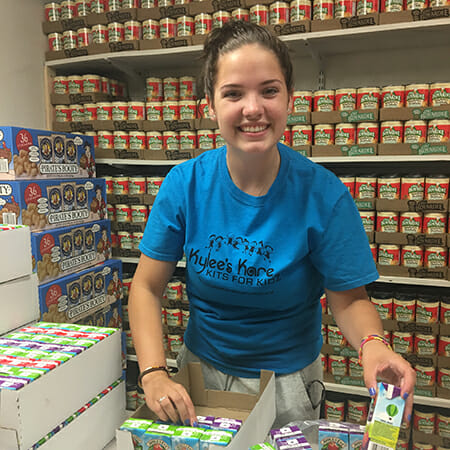
Kylee McCumber packing Kare kits./Courtesy Kylee McCumber
What has been the most rewarding part of your work?
The most rewarding part of my work is interacting with the children and their families and seeing the difference my team and I have made in the children’s lives.
What have you learned through your experiences as a volunteer?
Through my experiences as a volunteer I have learned the importance of not judging people for the circumstances they may be in. Until you have walked in someone’s shoes you have no right to judge them. Always be kind as you never know the difference your kindness can make in someone’s life.
Are there any future partnerships, programs, or events that you are excited about?
Our annual Holiday mission is approaching and I am very excited to see my community come together to make a difference in the holidays for our kids. Watching the children interact with Santa & Mrs. Claus and seeing the excitement on their faces when they receive a gift makes all the effort put into the mission so worth it.
Why do you think it’s important for others to give back?
I think it is important for others to give back because I have been taught that it is better to give than to receive and have learned how true that statement is. I always receive so much more than I give.
Special Olympics Volunteer Dedicates Over 30 Years of Service to Organization
Meet Daily Point of Light honoree Merry Jones. Read her story and nominate an outstanding volunteer or family as a Daily Point of Light.
When Merry Jones first tried to get her daughter Kim, who was born with Down Syndrome, involved in Special Olympics as a child, little did she know that she was leading herself down a path of volunteering with the organization for over 30 years, as well as leading a life of service through volunteering with other nonprofits as well.
The mother of three had only been trying to get a Special Olympics gymnastics team started at Kim’s school, because she herself had been a gymnast in high school. While Kim’s teacher was eager to help start the team, she wasn’t familiar with the sport and asked Merry to help her coach. Saying ‘yes’ led to Merry becoming a lifelong volunteer with Special Olympics Delaware, which offers training and competition in over 20 sports to athletes with intellectual disabilities. Throughout the years, Merry has coached bowling, served as an assistant or helped start several other sports, and is currently the tennis director and coach, as well as the registration manager for her community team, the Kent Wildcats.
Aside from Special Olympics, Merry has also spent almost two decades volunteering for The Arc of Delaware, a statewide nonprofit that advocates for those with intellectual and development disabilities and their families. She is currently on the Board of Directors and serves as President of the MidDel committee, and has also been Board Vice President in the past. Merry does this all while living with breast cancer, which metastasized in 2015. When she’s not volunteering for Special Olympics or The Arc, she offers her additional time to helping out the Delaware Breast Cancer Coalition and the Cancer Support Community Delaware.
Describe your volunteer role with Special Olympics Delaware.
I’ve had many over the years, but currently I am our registration manager for the Kent Wildcats, which is the community team that’s in central Delaware. I am also the tennis director for our team and the tennis coach.
[As registration manager], I’m responsible for making sure everybody has their physicals up to date and on time. Whenever a sport starts — and there are a number of sports currently, we just started the bowling season — before anybody can practice or be on the team to begin with, you have to have a current physical. Special Olympics has requirements that you have to attend 80 percent of the practices, but you also have to be current, so if you don’t have a current physicals you can’t practice until you get one. Special Olympics sends some of the forms out to everybody but it’s my job to follow up with everybody to make sure they are current, and if not to get them everything they need in order to get them to be current at the time the season starts.
When did you first get involved with Special Olympics?
Last summer with the Summer Games marked my 30th year. I’ve known for a long time that I think my calling on earth is to help other people, and my career was as a speech language pathologist. When my third daughter was born, she was born with Down Syndrome. … I had Kim in a program quite early and when she went to the level 5 school, which is one for those with more severe intellectual and development disabilities — at that time it was a separate school in a segregated-type setting — I was working as a speech pathologist in the district and one of the schools I had was next to hers. When she turned eight, she was eligible to compete in Special Olympics and I had gotten a notification that they were going to start a gymnastics team. That was something I did in high school and I thought maybe I can get in to doing something like that so that I could help her. I contacted her teacher at that time to see if she would be able to start a gymnastics team at Kim’s school, and she was a real go-getter and she said sure I can do that, but I don’t know anything about gymnastics. I said well, I can do the gymnastics part, but I’m not sure I can deal with a large number of those with special needs all at one time. … We set it up to have as an after-school practice and that’s how I got started with it. We both did it, but technically I knew more of the gymnastics moves and that kind of thing to work with the students on, so that’s how I got started.
After a number of years, they did away with [gymnastics] and they added tennis. Tennis was also a sport that my father had taught me years ago, and I hadn’t played it in years but I knew the basics and all of that, so I got Kim started on a tennis team. At that time I wasn’t coaching it, somebody else was, but three coaches later I became a tennis coach. Then we lost our bowling coach after awhile … we needed somebody to coach and I thought well, bowling is one of our biggest sports, I can at least by that time manage the group. And I’m pretty good with paperwork and that kind of stuff, so that’s why I ended up being the registration manager. I just tried to volunteer wherever there was a need, so I took on the bowling coach and I did that for a number of years. Eventually we lost a bocce coach and I got that one started, not as a coach but I was an assistant with a number of the sports and I always did whatever my daughter did. It’s just evolved over the years.
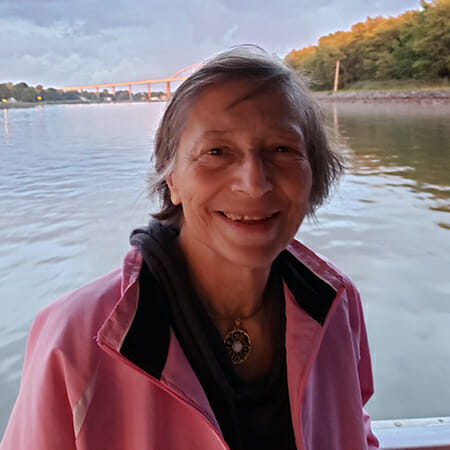
Merry Jones has spent just over three decades volunteering in her community, including with Special Olympics of Delaware and The Arc of Delaware./Courtesy Merry Jones
What about Special Olympics made you want to be so involved over decades?
Partly, it’s keeping my daughter active. Special Olympics has afforded her and many other athletes opportunities they may never have had. In her case, it’s not necessarily the sports. She’s not a strong athlete, but she likes being with her friends and doing what they do. It’s not only recreational, it’s also a social experience. She’s had the opportunity to actually train in a sport, compete, get medals. In Delaware, very little of that is of cost to the athlete. It’s absorbed by Special Olympics in Delaware, with the exception of bowling. We get our shoes free, but we pay minimal for games. Special Olympics Delaware has done a number of, over the years, amazing fundraisers so cost is not an issue. They can all compete because we’re such a small state, as long as they participate and put in the required amount of time. They can do an area competition, they can do a full state competition, many of our athletes have gone to nationals. We’ve had a few on our team who have gone to international games and won medals. Many of these kids would not have had the opportunity to do any of that if it weren’t for Special Olympics or our coaches, our volunteers and so forth.
We also have a sports camp called Camp Barnes. It’s run by the state police. They have usually two sessions of camp, three-day camp, where they can go and live in cabins and do camping activities. There’s a pool. The camp is on a creek, and we have volunteers that come in with big pontoon boats, so they can go out on the creek down to the bay in a pontoon boat. They can do archery, arts and crafts, they have campfires, we have a dance, we have a motorcycle club that comes in so they have a chance to sit on a motorcycle and blow the horns and do those kinds of things. It gives all of the individuals the chance to do something they probably never experienced ever before and might have never experienced if it weren’t for Special Olympics.
Describe your volunteer role with The Arc of Delaware.
The Arc of Delaware is another nonprofit and it’s also for those with intellectual and development disabilities. I haven’t been with them as long, I think it was about 2003 when I started with that. It varies a little bit, but I think we own about 83 group homes now. We’re responsible for providing maintenance and the oversight of those homes. I have been on the state Board of Directors for a number of years. I was Vice President a few years ago. I’m not an officer at this point, but I am the president of the MidDel Committee, which is responsible for the Kent and Sussex counties. It’s a statewide nonprofit.
Our major fundraiser down here is a Run, Walk and Roll. It’s a 5k fundraiser. We call it ‘Roll’ because it’s wheelchair-friendly as well as for more able-bodied athletes. This spring we will have done 20 years worth. I’ve been chairman of that for probably the last six or seven years. We have decided that this will be our last year, because pretty much everybody now is doing 5Ks and it’s hard to get people to come out when you can run five or six different ones within the same weekend. This will make 20 years in 2020 and we’re going to call it a celebration of our 20 years and then we’re looking toward other fundraisers that are in the works right now.
We have a strong recreation committee, so we provide nine monthly dances that are free of charge to those who participate. They’re dances for those with intellectual and development disabilities primarily, but families are welcome. There’s no cost to the participants, we have sponsors that provide meals for us, the Arc picks up the cost of the venue. … We’re also trying to get similar dances started in Sussex County and right now we’re doing about three or four a year. Any fundraisers or anything we have, the money funnels back to us to pay for the dances and that for the participants. Those dances, I haven’t been doing them for that long, but they’ve been going on for about 60 years or more, and started out on a small scale. Some of our bigger ones we’re getting between 200, 250-300 people, particularly Christmas and Valentine’s, some of the biggest holidays. We try to have it around a holiday time or holiday theme with decorations. We do provide a family picnic once a year and that’s at one of the local state parks. The Arc provides the meat and beverages. A lot is donated and what isn’t donated we pay for and then each person that comes is asked to bring a dish to share. It’s usually about two and a half hours on a Saturday in the end of September, the first of October. We introduced karaoke night and we’ve only done one but that took off quite well, so I think that’s what we’re going to be doing now in the summer when it’s too hot to be out for the picnic and outdoors things, but we can do karaoke inside.
It’s the same population served by the Arc and Special Olympics. Many of the people I know attend both, they’ll come the dances and they’re also on my team. … It just takes a lot of volunteering on everybody’s part. All of our board members and everything are volunteers. Special Olympics has a minimal amount of paid staff and it’s the same thing with the Arc. We rely on the volunteers to get the actual events up and running and that kind of thing, certainly with help from the central [organization] in both places, but largely it’s run by volunteers.
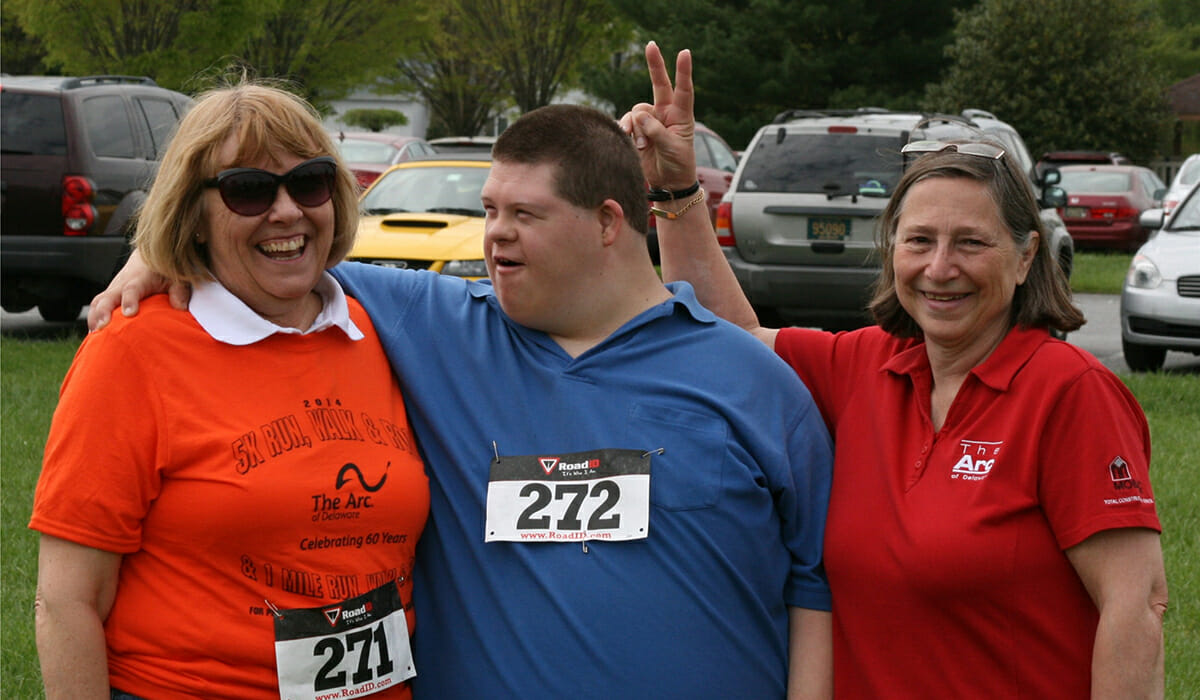
Merry Jones, left, helps prepare lunch for Special Olympics athletes at Camp Barnes, where they have summer camp each year./Courtesy Merry Jones
What’s been the most rewarding part of your work?
I think being around long enough to see athletes that I may have had as four-year-olds when they couldn’t talk and couldn’t do much of anything, and now they’re competing in sports, they’re talking, they’re on their cell phones. Just seeing the growth in everybody over the course of many years and how much they’ve improved in all aspects, even the ones who, similar to my daughter, will never be great athletes but she still has improved phenomenally. It’s taken her a much longer time to do it then a normal athlete would, but she still enjoys it and she’s got quite a collection of medals, that’s for sure. So I think seeing the growth in the athletes not just in the physical, but their communication skills, their social skills, their recreational abilities, all of that.
Why do you think it’s important for others to give back?
I was given a lot. I just feel the need to give back. I’ve gotten way more from it than I’ve ever given. If I have a skill that I can impart to somebody for whatever reason, I think it’s important that we all do it. We all are one. Even though we’re different races, different ethnicities, different religions, whatever it be, we’re still one people and everybody should be treated as one and included as one.
What do you want people to learn from your story?
I know it sounds cliche, but we all need to treat everyone as equals. There’s no difference between any of us. We’re a diverse world and everybody should be treated equally. If we were to treat others as we wish to be treated and include everybody in everything at whatever level they can handle — you learn so much more from the athletes. Nobody has more determination than they do to accomplish something. For some of them, it may be blowing a feather across the table, but they didn’t have breath control before and now they do and maybe that will work into eventually being able to roll the ball or a ping pong ball or something. Advancing everybody’s skills as much as possible, and living in a diverse world where everybody works together for the common good of all of us.
Ohio Teen Serves Children of Opioid-Addicted Parents through Education and Mentorship
Meet Daily Point of Light Award honoree Bryan Yan. Read his story and nominate an outstanding volunteer or family as a Daily Point of Light.
Bryan Yan’s childhood best friend lost his mother to the opioid epidemic while the two were still young. According to Bryan, after his mother’s death, his best friend was bounced from group home to group home for children without parents. When the Cincinnati, Ohio 18-year-old discovered that his home state had the second highest rate of drug overdose deaths involving opioids in the U.S., he decided to take action for the most vulnerable left behind in the wake of adult opioid deaths: children of addicted individuals.
Founding Behind Every Great Kid (BEGK) in 2015, Bryan dedicates his service to supporting children like his best friend through education, mentorship and raising awareness about opioid addiction. Realizing that many underprivileged children affected by the opioid epidemic must be in great need for academic support, Bryan connects children with caring teen and adult mentors and tutors to empower these so-called forgotten children. Offering resources and educating the public about the impact of adult addiction on children, Bryan and BEGK volunteers have connected with about 1,000 vulnerable children in Ohio thus far.
What inspires you to volunteer?
This volunteerism with (BEGK) has been different because it’s humbling seeing how kids that are being brought up in group homes without their biological parents and who have no materialistic belongings are still so happy in life. If they receive something small from us that other children would take for granted, for example a school supply like a calculator, they’re always so happy about it.
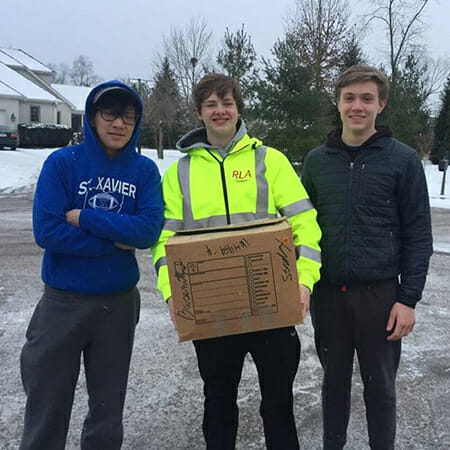
Bryan Yan and other volunteers (Brendan Sears and Patrick Gerard) pictured collecting books and school supplies for Behind Every Great Kid’s book drive. Since 2015, BEGK has connected with 1,000 underprivileged children./Courtesy Bryan Yan
Explain how Behind Every Great Kid (BEGK) works.
We offer children individualized support three times a week including academic support like help with homework or bettering their math and science skills. We also connect them with social offerings including mental health resources, college advice and job opportunities. We provide this academic assistance and mentoring at various locations including libraries, group homes and food banks.
Describe your role with BEGK.
As founder of BEGK, I help kids living with non-biological adults, either at group or foster homes. I also write grants to support our organization financially, I develop curriculum for the programs we offer these kids, and I volunteer one-on-one with some of our program participants. Our approximately 50 volunteers are mostly local high school and college students, so we are able to connect with these kids in a unique way as we have many similarities.
What’s been the most rewarding part of your service?
I volunteered with one kid named Joshua who was involved in gangs and got expelled for bringing a gun into school. The group home directors were trying to find a new school for him, but in the meantime, my mom, who is a school teacher, helped me to design a program so that he didn’t fall behind in school. Joshua stopped the gang activity and focused on school, and he’s currently applying to colleges.
What’s one way you hope to inspire others in your service?
I want to inspire others to not forget the groups or individuals that are left behind. With the opioid epidemic, you talk about the addicted and the deaths, but no one talks about the effects. No one talks about the children that have been left behind. By not forgetting about these children, we are changing their lives.
Why is your volunteerism with these vulnerable children so important?
In addition to raising awareness of parental drug addiction, BEGK focuses on prevention as this is such a vulnerable population. By educating these underprivileged children, we are working to prevent the next generation of drug addicts.
What have you learned through your experiences as a volunteer?
With all the bad stuff going on in the world, it’s amazing to see people come together for one joint cause.
How can readers help?
Please visit our website for more information about how you can help.
Teen Farmer Volunteers to Feed Hungry Mouths in Her Community
Meet Daily Point of Light Award honoree Addy Battel. Read her story and nominate an outstanding volunteer or family as a Daily Point of Light.
Growing up on a farm, Addy Battel had access to plentiful sources of animal protein: chicken, beef, pork. After the only grocery store in her city shut down, the 17-year-old Cass City, Michigan teen realized that the local food pantry wasn’t able to offer the types of high-quality sources of protein she’d been raised on. Alongside her friends, the teen decided to take action against food insecurity across low-income residents in their community.
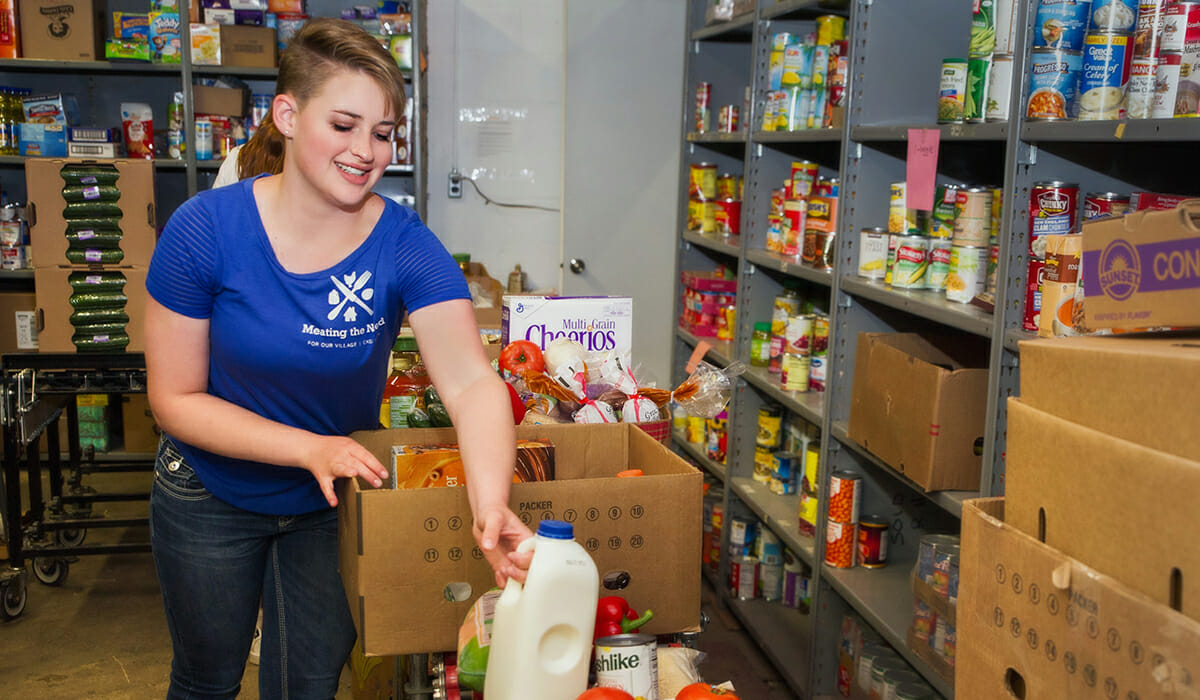
Co-founding Meating the Need for Our Village in 2014, Addy helps to “meat” needs of the hungry by raising livestock and poultry and donating milk and eggs. As part of her mission to provide high-quality protein, Addy, who is a member of the Cass City Future Farmers of America (FFA) chapter, is a part of the solution to local food insecurity, helping to donate more than $60,000 worth of food thus far including 10,000 pounds of youth-raised meat, 2,000 gallons of milk, 250 dozen eggs and 280 pounds of cheese.
What inspires you to volunteer?
At the beginning, seeing the injustice of what these low-income residents faced inspired me to volunteer. My family and friends had these freezers full of meat, and we saw these families eating canned tuna, beans and peanut butter for their sources of meat from the food pantry. I knew I had a skill and could use that skill to supplement nutrition for these families, and I’m very driven to do so. I enjoy having a farm full of animals and having a place for them to go to make a difference in my community.
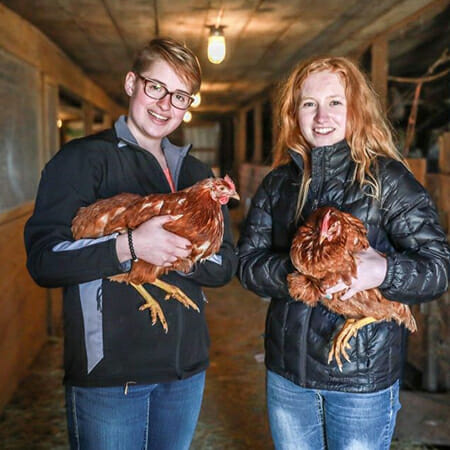
Addy Battel raises 50 – 100 chickens every calendar year for Meating the Need for Our Village./Courtesy Addy Battel
Describe your role with Meating the Need for Our Village.
Along with our other volunteers, I am regularly raising animals on my family farm, volunteering at the food pantry or making food pickups or deliveries. I am out in the barn every day taking care of the animals I am raising to donate. We have animals processed at licensed facilities and then the frozen meat is picked up for distribution and delivery to established food pantries in surrounding communities. Additionally – there’s always some sort of call I have to make to stores that provide us milk and cheese at market price, or writing grants for additional funding, or developing presentations along with my co-founder to raise awareness about our organization across the community.
Share one personal story with me from your volunteerism.
I occasionally see a father I know from our community at the food pantry. I know him because his child has autism and attends the same therapy school as my two younger brothers. He’s always really happy to see us, and occasionally I’ll help him load chickens into the back of their truck. I have a personal connection to him and his family, and I know that the high quality source of protein they are receiving from us is making a difference for his family.
How many animals do you personally raise for Meating the Need for Our Village annually?
I raise about 50 – 100 chickens every calendar year for the project, which equals a couple hundred dollars in market value. Depending on the year, I’ll raise some market goats or steers that are raised in our barn by me or my three younger siblings.
What’s one way you hope to inspire others in your service?
As soon as I realized what I was doing was impactful beyond our community, my goal has consistently been to inspire anyone through simply doing what I can personally to make a difference. Hopefully, when others see a need, my efforts and trying my very hardest inspires them to do the same.
What’s been the most rewarding part of your service?
We’re providing the youth in our community who volunteer through Meating the Need for Our Village with a whole different perspective. They are able to see how their hard work is impacting families who visit the food pantry.
What have you learned through your experiences as a volunteer?
I was pretty young when I started volunteering, but I’ve always been service-minded and grew up in a very service-minded family. Stumbling on to such a thing that made such a big difference has absolutely shaped who I am as a person and how I’m able to help others.
Alongside other Meating the Need for Our Village volunteers, co-founder Addy Battel has donated $60,000 worth of food for low-income individuals including 10,000 pounds of youth-raised meat, 2,000 gallons of milk, 250 dozen eggs and 280 pounds of cheese./Courtesy Addy Battel
What do you do for fun when you’re not volunteering or doing school work?
(Laughs.) I’m very deeply involved in 4-H and the Cass City FFA chapter, where I focus on agricultural-based leadership and personal development. Through 4-H, I enjoy raising and showing animals in the county fair, participating in leadership events and facilitating workshops for other members. I also enjoy competitive swimming, rowing and community theater.
How will service and farming fit into your future?
I just applied to Michigan State University and I‘m anxiously awaiting a reply. I hope to study animal science at MSU. I’ve been thinking more and more about policy work, and I’ve always told people that whether I end up in development assisting farmers or in Washington D.C. creating policy, as long as I’m getting food to people who need it, that’s what I’ll be doing.