New Jersey Teen Helps Preserve History Through Her Service Work
Meet Daily Point of Light Award honoree Sophia Lennox. Read her story and nominate an outstanding volunteer or family as a Daily Point of Light.
Sophia Lennox has always been interested in history, so when her mother asked her to attend a meeting of the historical society in her hometown of West Windsor, New Jersey, she didn’t hesitate.
Three years after attending her first meeting, Sophia, now a high school senior, has become an integral part of the Historical Society of West Windsor. As a volunteer, she leads tours, archives and catalogues historical documents, and manages social media. As the youngest member by several decades, she has brought a renewed burst of energy and hopes to further engage the younger residents of the Township, carrying on the legacy and work of the Historical Society.
By documenting, celebrating and sharing the history of West Windsor, Sophia is making a difference in her community.
This interview has been edited for length and clarity.
Describe your volunteer role.
I’m a part of the Historical Society of West Windsor, which is a really small town in New Jersey. I joined three years ago and I’m the youngest member by several decades. When I joined the Historical Society, they were open once every other month. When I came in, I started to propose things and try to get the museum open more. Three years later, we have a website, social media… We’re working on events to get more people involved. We’re starting a club at the high school next year.
How did you get started volunteering with the Historical Society?
My mom was going to join, because she is a part of the Affordable Housing Committee, but didn’t really have a lot of time, so she asked me to go to one of the meetings. I was like, “This is awesome!” So I joined instead and got started.
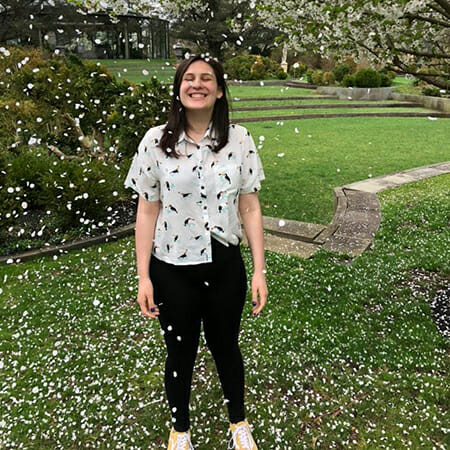
As a volunteer with the West Windsor Historical Society, Sophia Lennox hopes to get more young people involved in the Township’s history./Courtesy Sophia Lennox
Have you always been interested in history?
History has been the most interesting thing to me since I was little. When I was little, I was always like, “When I go to college, I’m going to study history.” Because my grandfather was really interested in history, and transferred that to me.
Describe a typical tour at the Historical Society.
We have a bunch of different things on the property they can see. We’ll take them to the schoolhouse, which is the exact schoolhouse that was on the grounds, but we had to move it. Then we’ll go to the barn, which has the environmental section and a bunch of old tools. Then they’ll go into the actual house and take them through all the rooms and explain anything if they have any questions. We’ll show them all the objects and explain to them what life was like from the 17th to the early 19th century.
What inspires you to volunteer?
The first thing that got me really involved was when I found a stack of death certificates [at the Township], which was crazy, because I had never heard of any of these people before, and they were apparently important figures. I felt something, and I wanted to figure out who these people were and why we didn’t know about them. I don’t want anyone’s story to go away. There’s so much information that we have at the Township that we don’t learn about in school, that we don’t have at the Historical Society, and I want everyone to be able to learn about these really important people or events.
What has been the most rewarding part of your volunteer role?
This man came in and he was looking for information on his childhood, trying to have sort of nostalgia. We took him into the room that we have all the children’s toys, and he found a copy of a book that he forgot the name of, but he loved as a kid. He wanted to send a copy to his mom. That was really great because we are actually helping someone connect with their parents. That happens all the time: people come in asking for information about their family and we’re able to find old documents about their family in West Windsor or we’re able to make actual impact in their lives, connect them with information about their family they haven’t had before.
The Historical Society is in the middle of West Windsor, so a lot of people who live here are like, “Oh! I didn’t know we had a historical society.” They’ll come in and find out that their house was owned by a really important person in history, or one person found out that George Washington stayed in what used to be their house.
Why do you think it’s important for young people to be involved with the Historical Society?
The people on the board are getting older, and we need more younger people to come in and learn. They’ve lived here all their lives, some of them are in their 90s, so they have really amazing stories. I think a lot of younger people should come in, learn from them, so that we can continue what they started 30 years ago. Without younger people learning, we’ll lose a lot of what we have and we’ll lose a lot of the stories of West Windsor.
What partnerships, programs, or events are you looking forward to?
We just partnered with the Arts Council of West Windsor, which is going to be amazing because we can have a lot of events with them and they have a really great following and we can combine them, which would be awesome. We’re also planning on talking to schools and planning field trips to the Historical Society, which would be amazing because it would get younger kids in, and they can bring their parents, and they would learn a lot on field trips.
What do you want people to learn from your story?
I guess, just getting involved as much as you can will have an impact. At the beginning, I was only able to go to the meetings, which was only every other month, and was only contributing a little bit. Over time, it became more and more important, and more and more of a priority in my life, and I was able to devote more time. I think if you are only able to give one hour of your time every other month, that’s okay, you’re contributing something. But little amounts of time add up and they’re not insignificant.
After a Double Amputation, Teen Finds Inspiration to Provide Prosthetic Limbs to Children in Need
Meet Daily Point of Light Award honoree Jordan Thomas. Read his story and nominate an outstanding volunteer or family as a Daily Point of Light.
Jordan Thomas was just 16 years old when his family’s annual boating trip went terribly wrong in 2005. After spending some time on the boat, Jordan jumped into the cool water, but his legs were no match for the strong ocean waves that took him straight into the boat’s spinning propellers. Jordan was airlifted to the hospital and underwent three surgeries resulting in the amputation of both his legs from the mid-calf down.
While this devastating situation could have caused Jordan to sink into a depression, he instead started visiting other children in the hospital who were also amputees and found that many of them weren’t as financially fortunate as he was.
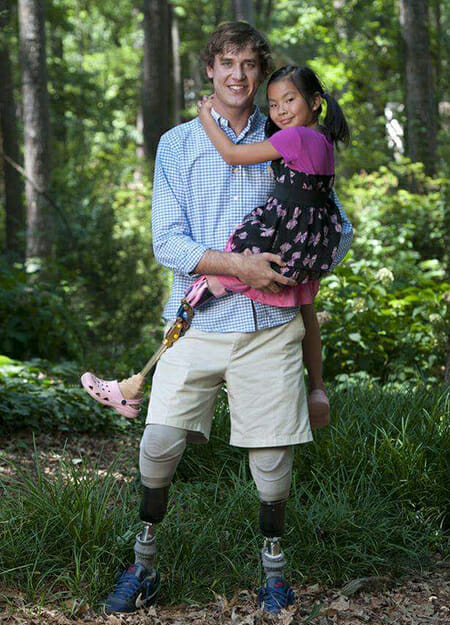
Jordan Thomas is founder of the Jordan Thomas Foundation, which provides prosthetic limbs for children of traumatic injury and limb loss./ Courtesy Jordan Thomas Foundation
“My prosthetics are about $25,000,” Jordan said. “Kids are outgrowing legs every 18 to 24 months so every year and a half to two years, they need new legs. Imagine the burden that puts on families, consistently having to shell out exorbitant amounts of money every 18 to 24 months in order to have their kids simply walk.”
So in the first week after Jordan lost his legs, he started the Jordan Thomas Foundation, a nonprofit providing children affected by limb loss with the prosthetic limbs they need until the age of 18. He began by asking his family members for donations, but Jordan’s foundation has now grown into a global mission, providing life-changing prosthetics to people from Colombia to Haiti, and gaining recognition – including being named one of CNN’s Top 10 Heroes in 2009.
Shannon McKnight can attest to the tremendous impact Jordan is having on families affected by limb loss, as his foundation provided her two daughters, Jun and Mae, with prosthetic legs. But Shannon says Jordan’s impact on her family goes even further than that – in fact, his story was what first inspired her to adopt her daughters.
While watching CNN Heroes, Jordan’s story touched her so much that it gave her the push to adopt Jun and Mae, who were born without fully formed legs. Shannon and Jun eventually met their hero unexpectedly at a prosthetist’s office in Florida, and Jordan brought on Jun and Mae as beneficiaries.
“What [the Jordan Thomas Foundation] has done is so far beyond [providing prosthetics] because what they are doing actually gave two kids life,” Shannon said. “It really gave them a family and it gave them a future, which is even bigger than what an active lifestyle is.”
On top of providing prosthetics, the Jordan Thomas Foundation also sends kids with prosthetic limbs to summer camp where they can learn to ride a horse, dance in hip hop classes and more, so they can realize their disability doesn’t define them.
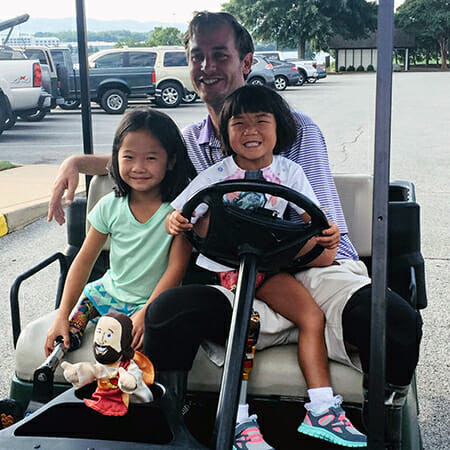
Jun (left) and Mae (right) are beneficiaries of the Jordan Thomas Foundation. Their mother adopted them after being inspired by Jordan’s story./ Courtesy Shannon McKnight
Jordan, now 30, also advocates on behalf of those in need of prosthetic limbs. He passionately speaks to lawmakers in hopes to help change the healthcare system and insurance plans that only cover a fraction of the cost of prosthetic limbs.
“Prosthetics are not a luxury. It’s absolutely a necessity,” Jordan said. “It is incumbent upon us to provide our children with the opportunity to live happy, successful lives.”
Despite all Jordan has accomplished, he remains incredibly humble and engages directly with the children, giving them words of encouragement during a scary moment in their lives.
“We’re 14 years down the line and [the foundation] has ramped up millions of dollars and helped hundreds of people and all that,” Jordan said. “But it still comes back to that one-to-one connection with people. … Walking into a hospital room after someone has lost a limb and saying, ‘You’re going to be okay,’ is the best thing that I do in my life.”
Jordan can clearly stand witness to the saying that “life happens.” But he says it’s our choice to decide if we’re going to be a victim of our circumstances or get out there and live our lives to the absolute fullest. And the biggest words of advice he gives to children who have lost their limbs, also applies to everyone:
“The only limitations that are there for you are the limitations you give yourself. There are no limitations in what you’ll be able to accomplish if you’re determined and willing to put the work in to do it all.”
California Teen Volunteers to Strengthen School Attendance for Underprivileged Kids Worldwide
Meet Daily Point of Light Award honoree Riya Hariharan. Read her story and nominate an outstanding volunteer or family as a Daily Point of Light.
Visiting family in India, 16-year-old Riya Hariharan says she’s experienced poverty and lack of access to education that is foreign to her hometown of Palo Alto, California.
Launching Giftkids in 2017, the current high school senior is providing critically needed educational and wellness supplies for underserved students around the world with the goal to motivate children to stay in school, be well, and change the trajectory of their future.
Making an impact worldwide and helping over one hundred children thus far, Riya has combined her passions for education and children, partnering with schools in Haiti, India and a refugee center in San Jose, California to better life for children in need.
What inspires you to volunteer?
I like to be involved in my community. I feel like volunteering is fun, and I’m using my time well by combining giving back to my community with helping children.
Describe your role with Giftkids.
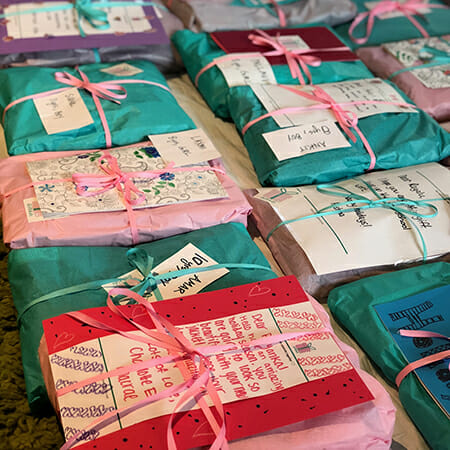
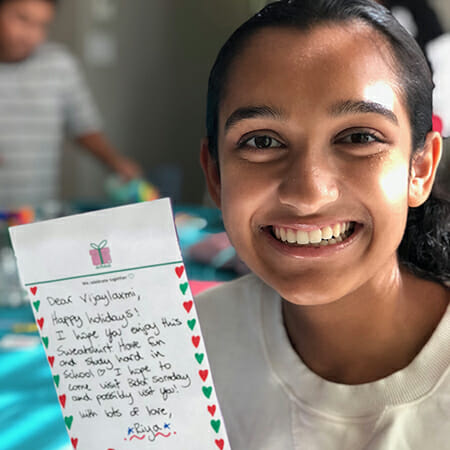
I am the co-founder of Giftkids and I handle our communications. Additionally, I connect with organizations that serve children to identify how we can best help them. We ask for donations and financial support to continue to provide supplies to children. Lastly but perhaps most importantly, we provide a personal connection through our gift-wrapping parties. Friends, family and our local community of kids will volunteer to write personalized cards and wrap gifts during the holiday season which are then sent to students in need around the world.
Giftkids volunteers write personalized cards and wrap gifts during the holiday season which are then sent to children in need around the world. /Courtesy Riya Hariharan
Explain how you help students.
Sometimes these schools don’t have enough supplies, or their curriculum is lacking experiences. Our donations mean that their education is enhanced, and the students are motivated to go to school.
Share one personal story with me from your volunteerism.
In December 2018, my family traveled to India to visit my grandparents. While visiting, we traveled to an orphanage in Bidar, which is in rural India. We brought the students backpacks and school supplies for their school year, and as we drove up to this small school, we saw that all the children had lined up in front of the building. They had all dressed up for our arrival, and performed for us. It was a big celebration. We got out of the car and they came running at our family, they were super excited and so welcoming. I was so overwhelmed to match the faces to the school children who we had been connecting with, and realizing that these were the kids I am getting to make a small impact on.
What’s been the most rewarding part of your service?
I sometimes overlook the opportunities I have had in my own life, but when you change your perspective, you realize that little things can make a big difference. In key moments, like visiting this school in India, you are there to feel the impact of your volunteerism. Making that small impact and connecting with children around the world is incredible.
Riya Hariharan has helped provide critically needed educational and wellness supplies for over one hundred children through Giftkids./Courtesy Riya Hariharan
What have you learned through your experiences as a volunteer?
Volunteering is like reaching out to a friend and asking them how you can help them. I want to continue volunteering in the future, and can hopefully connect what I‘m learning academically and combine that with service.
What do you want people to learn from your story?
No matter what age you are, you can always do something to help. It doesn’t have to be the biggest thing, or have this huge otherworldly impact, your service can start small and grow from there.
What do you do for fun when you’re not busy in school or volunteering?
Outside of school, I play piano, I love music. I love to read. I am really into fiction and memoirs.
How can readers help?
Please visit our website for more information about how you can help.
After a long career in the entertainment industry, Leo Bonamy knew he wanted to dedicate his time in retirement to serving his community. When the 70-year-old’s mother passed away in hospice, his desire to give back to individuals approaching end of life became personal.
As a volunteer for Hospice of Kona in Kailua-Kona, Hawaii, Leo serves in several different roles as the center provides respite, transitional or longer-term care for patients. Leo cooks meals for the residents at Nakamaru Hale, the hospice residential home, assists at the center’s thrift shop, and supports its annual bereavement camp for youth.
What inspires you to volunteer?
My mother is my inspiration for volunteering at a hospice center. She passed away in hospice in Michigan a few years before we moved to Hawaii, and when I was introduced to Hospice of Kona, I really liked the organization, its efficiency and the staff. Their mission spoke to me personally because of what I went through with my mom, and they do a lot of good here, there’s a real need for the services they provide.
Describe your role supporting Hospice of Kona.
I serve in a few different roles for Hospice of Kona, including patient care. Some of my responsibilities include:
Services at Nakamaru Hale: I cook meals at the hospice residential home for the patients. We serve people that are terminally ill who don’t have family, or the family needs respite. If I’m not cooking, I’m keeping the kitchen clean, I do chores and I help with patient care. Sometimes I’ll provide companionship and just sit and talk with a patient if they need some company.
Transportation: I will take patients on errands, or to doctor’s appointments.
Camp Erin: I serve as the “backstage guy” for the hospice’s annual camp for grieving children, so I take care of lighting, sound and audio for any shows or movies we have for the children. I also generally support maintenance.
Memory Lane Thrift Store: The hospice’s thrift shop is located in downtown Kailua-Kona, and it provides funding for the organization. When I first started volunteering, I told the hospice that I’m not a shopper, and I hate thrift stores (laughs). I’m in charge of anything donated that has a wire. I’ll test or plug the item, price it and then move on to the next.
What’s been the most rewarding part of your service?
Paying it forward. I enjoy working with the hospice patients because the service puts me in touch with my own reality. Three years ago I had a major cancer surgery, and while I’m in excellent health now, volunteering has connected me with the challenges others may face.
You cook for the hospice patients. What’s your favorite breakfast order?
Omelettes. I’ll use anything that’s in the refrigerator for ingredients. Vegetables, cheese and bacon, sausage and spam. But I’ll make whatever the patient wants: waffles, pancakes. The list goes on.
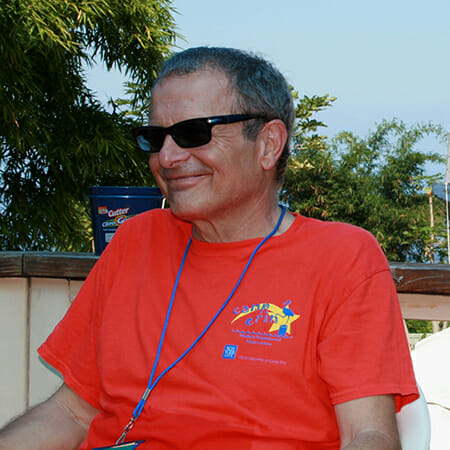
Leo Bonamy volunteers at Camp Erin, an annual free weekend bereavement camp for youth who are grieving the death of a significant person in their lives. /Courtesy Leo Bonamy
What have you learned through your experiences as a volunteer?
My volunteerism has put me more in touch with my mortality. As a cancer survivor, the surgery I had to undergo was pretty gnarly. Helping others has helped me and my wife deal with all of that resulting baggage from my own health issues. Some patients have families that come and visit, and they are well taken care of, and some don’t have anybody. It’s nice to be there for them.
Share one personal story with me from your volunteerism.
There was this homeless man who came in off the streets to the hospice a few years ago. He had a lot of health problems. When I would arrive to volunteer on Tuesdays, I’d drive this man to Walmart so that he could buy any items he needed. Most patients that stay in hospice might be there for a few days, but this guy was a resident for six to eight months, which is really unusual. As it turns out, he was from Michigan, where I grew up. We’d ride around on the cart at Walmart, he’d get the things that he could pay for that he needed. Then we’d stop at Taco Bell or KFC to get his fast food fix. I would also see him every Sunday at the hospice residential home, I’d cook him breakfast. We really got to know each other. He was very spiritual and very grateful for everything hospice was doing for him. He’s since passed away. He was a really loving man in spite of all of the challenges he faced in his life.
What do you want people to learn from your story?
When I was working, I was running my own company and I had two children to raise. The responsibilities of living and raising a family were all-consuming. I always knew in my heart that at some point I would have time to give back to my community. Paying it forward with hospice volunteering gives me more, I think, than I give of myself. I feel that I have benefitted from volunteering, and I think that everybody should take whatever time they have and volunteer in an organization that they’re interested in, whether the focus is on children, medicine or adults.
Woman Finds Second Family Through Serving in Kenyan Community
Meet Daily Point of Light Award honoree Emily Karr. Read her story and nominate an outstanding volunteer or family as a Daily Point of Light.
When Emily Karr first heard about her former colleague’s nonprofit organization, The Lemong’o Project, she was interested in how she could possibly help through donating. At the time, she would have never imagined that almost a decade later, she would be the vice president of the nonprofit and would visit the rural Kenyan community it serves almost every summer.
The Lemong’o Project is dedicated to empowering the people of Lemong’o through supporting their nutrition, education, healthcare and employment. The organization provides free lunch to all of the 500 students at Lemong’o’s school as well as the salary for four of its nine teachers, which has greatly improved both attendance and test scores. It offers a twice-yearly medical clinic, which last year served almost 800 members of the community. The Project also runs a women-operated market to create and sell goods like jewelry and baskets in the United States.
As vice president of the Lemong’o Project, Emily helps with fundraising, media and board operations. But she says the most rewarding part of her work is spending summers in Lemong’o, where she helps facilitate the women’s market as well as the medical clinics. Emily said she has found another family in the community of Lemong’o, who inspired her to become so much more involved in the Project in the first place.
Describe your volunteer role with The Lemong’o Project.
I am currently the vice president on a very small board. My roles for vice president are kind of all encompassing. I do a little bit of everything. When I am not in the village, I do mostly fundraising, so either generating fundraisers here in Saudi Arabia or Portland, Oregon, or spreading the word about fundraisers that other board members are doing because the board is spread out. I’m currently in Saudi Arabia, the president currently lives in Anchorage, Alaska and then we have other board members who are in Philadelphia. I assist in promoting fundraisers in their different locations. I’ve helped with creating crowdfunding fundraisers. I do a lot of the media stuff, so Facebook posts, newsletters, creating brochures or advertisements for upcoming events, posters and stuff like that. Then we have board meetings so I participate there and then if there are things within the meetings that come up that need to be done, we delegate who does those things.
I have been fortunate enough to go to Lemong’o, I think maybe seven out of nine summers since I’ve been involved with them. When I’m there, I help to facilitate the women’s market. The women bring their jewelry or baskets or their beaded work to sell and then we buy those things and bring them back to the states and sell them. With the money we raise from that, we send it back to the project. I help facilitate what the women will make for the markets. Each year, I pay close attention to what kind of merchandise sells, and then I have young business women there who I’m in contact with throughout the year. We talk about what the mommas should make and if there are new types of earrings or necklaces that we want to try out, then I communicate that with her and she communicates with the other women. We also just within the last year started doing workshops, so if there is new type of merchandise that I think might sell nicely, then I communicate that to my contact person there and then she hosts workshops to teach the women how to create the different things.
Also while I’m there we do two medical clinics. I help with setting that up, doing inventory of different medication we have and then on the day of the clinic, helping the clinic run. It runs pretty smoothly now but in years past when we just starting, there needed to be more assistance on my end. Now it runs super smooth. We have a local doctor and two nurses who come and then an eye doctor and a lab technician. They’re all local people so they come and then we just invite anybody within the Lemong’o community to come and they receive a free medical check up and then medication for anything they need. Then if our budget allows, the doctors refer them for further check ups or further procedures to be done and if we have the funds, we do that as well.
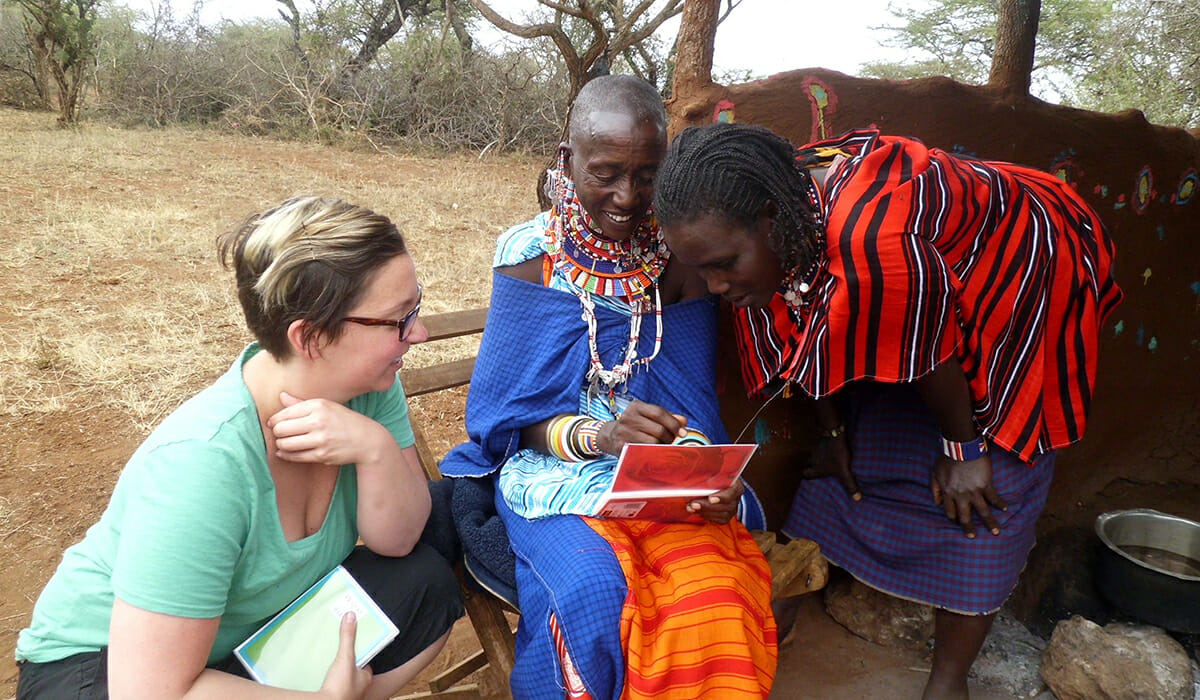
Emily, left, works with women in Lemong’o to operate a market for the women to sell their goods./Courtesy Emily Karr
How does the Lemong’o Project assist the community there?
It assists in several different areas. The first two are kind of our main areas, education and nutrition, and then we also assist in medical and employment. The first two areas, education and nutrition, our budget allows for us to provide lunches to children who go to the school in Lemong’o. The school hosts pre-kindergarten through eighth grade, so there are about 500 students. As long as students are attending the school, then they get a free lunch. That’s the nutrition part of the Lemong’o Project. The educational part of the Lemong’o Project comes with supporting, right now it’s four teachers at the school. The government only provides five teachers for 500 students and we understand that’s not enough for children to get a good education. In the past, before the Lemong’o Project started, they had what were called parent teachers, and the parent teachers would receive a salary that came from school fees that the parents would pay. But what really in reality happens is that parents are not able to pay the school fees. It’s about five dollars a year, but parents are not able to pay that, so the parent teachers do not get paid. In most cases, the parent teachers don’t stay and that disrupts education because you’ve got teachers coming in and teaching for awhile and then not teaching. It’s not a conducive learning environment. So the Lemong’o Project pays for four teachers, their full salary, so we can retain teachers and have more teachers at the school. That’s the educational part of the Lemong’o Project. The health part of it, the nutrition and serving children lunches kind of goes into that a little bit, but then we also do the two medical clinics each year that provide medical service. I think this last summer we served over 800 individuals providing them with some kind of medical care with those clinics. The employment part is what we do with the women’s market, so facilitating the women to make different things. We buy those goods at a fair price for the women and then we bring them back here to the U.S. to sell them and then that money we make goes directly back to the funds that we use for the food, the teachers’ salaries and the medical clinics.
When and how did you get involved?
I worked with Carolyn Tague, who is the founder of the nonprofit and also the president. I worked with her at a behavioral school in Anchorage, Alaska. She was just going to Africa when I met her and then we separated the schools we taught at, so I didn’t have contact with her for probably about five years. Then I got an email from her that she had started a nonprofit. I reached out to her because I was interested in what it was. We met and started talking and she told me about Lemong’o and the experiences that she had there for the past five summers. I decided to go with her to Lemong’o, and I think that was in 2010. I went and I spent three weeks in Lemong’o with her and I just completely fell in love with the people there. When we go, we stay in a traditional mud hut, meals are cooked over an open fire, there’s no running water. … I just kind of fell in love with it and I started going with her every summer. I went with her three or four summers in a row and then I moved to Saudi Arabia so I wasn’t able to go for the first year, and then I’ve continued to go back and meet her there for the summers.
I originally was just going with her, I didn’t really have any intentions of getting involved with the nonprofit other than maybe donating to it. But just having my experiences with the people that first visit that I had, and seeing the life they have — although to me it seems like a very simplistic way of life, they work very hard and life is very difficult for them. Despite the difficulties they face, they’re very positive, they laugh a lot and they’re very grateful for what they do have even though it’s very little. [I made] a personal connection with the people and I just kind of fell in love with them and it just became natural for me to work towards helping continuing to support the community. Each time that I go, I get to know the community more and individuals more, and continue to learn their stories of their life and the struggles they face. It makes me feel very fortunate for the life that I have and the different things that I have access to that they don’t, like clean water and electricity and things I kind of take for granted. I feel like I need to give back, I need to give because I can. They’ve opened my eyes to a lot and so I’m grateful to them and I feel like I need to give back to them for what they’ve given me.
What kind of change have you seen in the community since the Lemong’o Project began?
Before [Carolyn Tague] started the lunch program, there were about 200 students in the school. When the lunch program started, that number jumped to about 500. So because of the lunch program, more kids are coming to school which is a good thing. Specifically within the school, they have to take yearly assessments and then based on their school’s scores, that delegates a little bit what the government can provide for the school. So lower-scored schools essentially get less support and they have typically been a lower-scoring school. Since the lunch program and the consistency within the teachers, their scores have gone up, higher and higher each year. Then as far as the medical clinics, that’s a basic one where people have access to healthcare that they would not otherwise have access to. The closest hospital to Lemong’o is about 45 minutes away so you need some sort of transportation. A lot of times that transportation cost, which I think is about a dollar to get to the hospital, they don’t have that money so they aren’t able to get the medical assistance they need. Then the employment part, women, with the money they’re making by selling the jewelry, they’re able to provide for their family. A lot of times we see that money going towards school fees that they owe for their children or getting the basic necessities of food or medical care that their child might need.
Are there any future partnerships, programs, or events that you are excited about?
We’ve been trying to get grants for a long time and we have been struggling with that. We’ve come to the realization that maybe we’re not getting grants because grant holders see us as a hand-to-mouth organization. We understand that, and we want to be looked at as a nonprofit that provides some kind of sustainability within the community, so we don’t want to be a hand-to-mouth organization. We have started the process of looking for grants to start a voluntourism program. We have the facility already, we have a space where volunteers — which are me and Carolyn — where we stay, so we’re really excited about this voluntourism business we would be starting. We are looking for grants for the voluntourism business and we have an organization that has approached us, a TV show that’s called “The Fixers,” so we’re hoping that they will assist us in fixing up the volunteer location where we stay … so we could start this voluntourism business. That’s our big area we’re working on right now.
What have you learned through your experiences as a volunteer?
Everything I’ve been involved in, I’ve learned a lot. I’ve learned all the business side of running a nonprofit, little things like making a newsletter and doing a crowdfunding campaign. I didn’t know any of those basic, I guess you could call them office-type jobs. I’ve also learned more about Africa and how it runs and I’ve learned about people living in poverty, what that entails, and how to be supportive of that. I’ve learned a lot.
What’s been the most rewarding part of your work?
I would say the relationships that I’ve made with the people. I really consider them my African family. I have mothers and brothers and sisters and I’ve been able to see children growing up.
Man Perseveres Through Disability to Help Disadvantaged Population in Virginia
Meet Daily Point of Light Award honoree David Hill. Read his story and nominate an outstanding volunteer or family as a Daily Point of Light.
At the age of 17, David Hill was in a car accident that left him disabled, and he still struggles with a brain injury resulting from the crash. Persevering through his personal challenges, the now 46-year-old Coeburn, Virginia resident is dedicated to going out and doing good for others less fortunate.
As a volunteer with The Health Wagon, an organization which provides mobile health services to the medically underserved in Southwest Virginia, David always shares a smile and kindness with others. Despite his own struggles, David believes that tomorrow is just another day to perform acts of service. We spoke with David, his sister, Paula Hill-Collins, and Teresa Tyson, the executive director of The Health Wagon, about his volunteerism.
What inspires you to volunteer?
David: I volunteer because I want to help others and I don’t want them to not be informed about the proper things and how they can get help.
As a volunteer for The Health Wagon, David Hill greets patients, helps to maintain the property and helps to fundraise./Courtesy David Hill
Describe your role with The Health Wagon.
David: I do various things every now and then to help patients. I’ll buy flowers for people when they’re in season. I always greet people at the door, I offer them water or soda pop. I usually keep the backroom as clean as I can, and take out the trash.
Paula: He’s also worked in the community garden. The Health Wagon is a mobile unit that works to provide health care access to some of Virginia’s most disadvantaged populations, so David helps with fundraising for patients who are in need of dentures or scans they cannot afford. He has also helped develop a traumatic brain injury support group in the area to bring awareness to traumatic brain injuries. He always has a smile on his face and a nice joke to tell despite his struggles.
What’s your life motto?
David: Philippians 4:13, I can do all things through Christ who strengthens me.
What does it feel like to know that you’re helping others that are less fortunate?
David: It makes me feel like God expects me to help others. Our purpose is to help others. Our mother instilled that in us, to serve others.
Share one personal story with me from your volunteerism.
Paula: We had a patient that come in for fasting blood work, and she met David in the lobby. She told David that she was so hungry, because she’d not been able to eat ahead of the blood work. David had two Big Macs in his backpack, one for lunch and one for dinner, and he reached into backpack and tried to give her one of his hamburgers. She told us how much it meant to her that he saw someone in need and in a way, was giving his shirt to his brother.
What do you want people to learn from your story?
David: Get out and get involved in helping others.
Teresa: David has a traumatic brain injury, but he’s never given up. What people see in David is that he shows the fortitude of not giving up even though he’s personally experienced health issues. David has been so tough and so resilient, he inspires others.
How can readers help?
Please check The Health Wagon’s website for more information about how you can help.
Teen Volunteers to Bring Art to Sick Children, Young Adults & Seniors
Meet Daily Point of Light Award honoree Olivia Cuthbert. Read her story and nominate an outstanding volunteer or family as a Daily Point of Light.
The memories Olivia Cuthbert shares of her childhood friend, Katie, are joyful ones. The two took art lessons together, they went to the same church. On December 8, 2015, 7-year-old Katie passed away from brain cancer as a result of childhood ependymoma. While hospitalized, Katie did a lot of art work to pass the time, and Olivia decided that she’d honor her friend by giving other sick children, young adults and seniors the chance to express themselves creatively through art.
Establishing A Work of HeART in 2017, 18-year-old Olivia’s mission is to bring the joy of art to others facing critical illnesses and disabilities. Whether suffering from a temporary, long-term or terminal illness, the Dubach, Louisiana resident wants individuals to embrace creativity, and have an opportunity to forget about their serious health conditions for a time.
What inspires you to volunteer?
The response and gratitude that I receive back inspires me. Knowing that you can put a smile on somebody’s face for a fraction of their day, giving them a few hours of fun to take their mind off their illness. That service can change their whole concept for that day, and that inspires me to give back more.
Describe your role supporting A Work of HeART.
I am the founder and voluntary executive director of A Work of HeART. I recruit volunteers, purchase all the supplies we use for art projects, and run our social media. I also coordinate fundraising, and connect with hospitals and other organizations where we are interested in bringing our program to. Art is a stress reliever, and thus far, we’ve changed the lives of hundreds of children within Louisiana and across several other states by inspiring them through art, helping them to realize they are not their illness. We also volunteer with young adults and seniors in nursing homes.
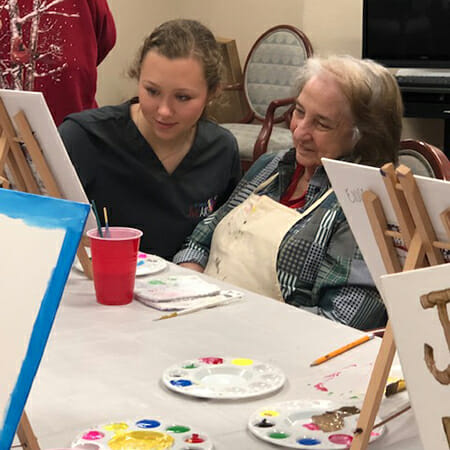
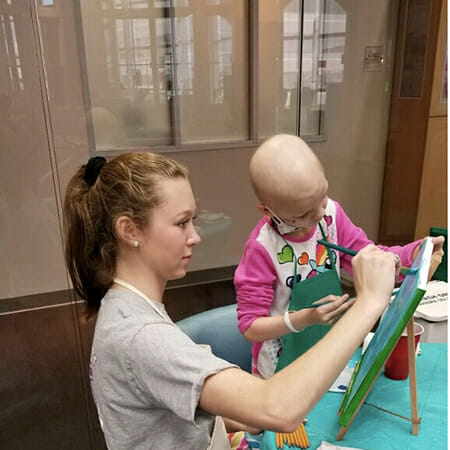
Using art as a stress reliever, Olivia Cuthbert volunteers with sick children, young adults and seniors in nursing homes./Courtesy Olivia Cuthbert
What’s been the most rewarding part of your service?
Hearing all the stories that people tell me about their experiences, and honoring Katie by sharing her story is the most rewarding part of my service. Katie was always super happy, so I know that she would be really supportive of our efforts, and I know she would want to be a part of it. She only lived for 7 years but she had such a big impact in the lives of so many others.
What have you learned through your experiences as a volunteer?
I’ve learned not to underestimate someone because of their age or disability. I’ve volunteered with kids who don’t really have use of their hands, but as a workaround, this one particular girl I visited in the hospital painted with her mouth. I didn’t think she’d be able to paint, but she did, and her work was amazing.
Olivia Cuthbert founded A Work of HeART in honor of her friend, Katie, who died at the age of 7 from brain cancer. /Courtesy Olivia Cuthbert
Share one personal story with me from your volunteerism.
One little girl was bedbound so she couldn’t participate in group activity. I went to her bedside, and she talked to me about her treatments and explained that she’d been battling a rare form of cancer for a very long time. After we completed her art work, she cried and asked if I would come back and visit her again. I felt really connected to her, and that really fun and really powerful moment is one that I think about as I continue my service.
What do you want people to learn from your story?
Get active in your community, no matter what your circumstance is. If you have one hour a week to volunteer, get out in your community and volunteer. You honestly receive more of the benefit from volunteering than some do receiving the service.
Running for Good, Los Angeles Man Serves Skid Row Community
Meet Daily Point of Light Award honoree Kit John. Read his story and nominate an outstanding volunteer or family as a Daily Point of Light.
Kit John’s mother used to set aside essentials each morning as the family ate breakfast before school, items she’d bring to people in need in the community. Explaining to her children that not everyone in Los Angeles was as fortunate, she encouraged them to give back.
Today, 39-year-old Kit is using movement to promote change, as the personal trainer by day gathers donations for “Movement Runners”, an organization that encourages a healthy, engaged and socially involved community. Motivating people to be active and to extend their hand to the homeless and others in need, Kit receives hundreds of essential items in donations each month, which he then is able to donate to people in need in Skid Row, an area of downtown L.A. plagued by homelessness and poverty.
What inspires you to volunteer?
The bigger picture: we are all in a position to give back a little something. If we come together and give back, we can help our community, little by little. When I was growing up, my mom would take extra bread, extra butter, and bring it to the people really hurting and struggling. Our society is always throwing stuff out, why not take that extra, and help someone in need?
Describe your role in Movement Runners.
I’m the founder and current president of Movement Runners. We motivate people to be active in the hopes of implementing a healthy lifestyle, and encourage people to help others less fortunate. We have an event every single day, which I promote and lead, whether it’s a run, workout, or a volunteering event. We gather donations for the community in south Los Angeles including essentials like water, toilet paper, hygiene products, clothing. We personally hand these essentials out to people in need, whether it’s children or adults.
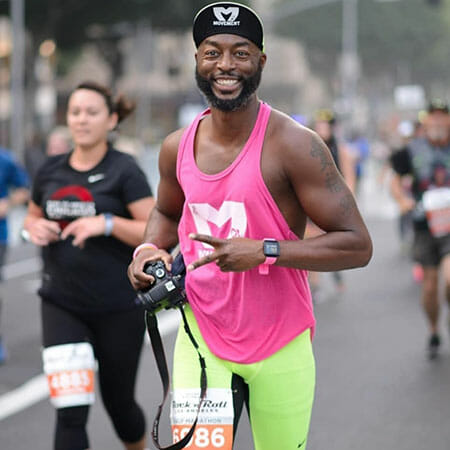
Kit John promotes change in downtown Los Angeles through his organization, Movement Runners, which encourages a healthy, engaged and socially involved community./Courtesy Kit John
What’s been the most rewarding part of your service?
Movement Runners is bigger than running. I helped some individuals who have reached out and said that I saved their lives. People who don’t have the will to live, they join us, they want to be a part of what we’re doing together. We’re a community making a positive impact.
What have you learned through your experiences as a volunteer?
I do more for others than for myself. Sitting down and having a conversation with someone could literally change their life. Everybody is always going through something, so put aside your problems, and dig into the next person by spending five minutes talking with someone you might not otherwise.
Share one personal story with me from your volunteerism.
We were donating shoes in Skid Row, which we do about twice each year. I had collected at least 200 pairs of shoes, and there was this guy literally out in the streets of Skid Row walking barefoot. He said he’d been trying to get shoes and something to eat. He had blisters on his feet, and so I asked him what size he was. We gave him some items and shoes. He busted out crying. It hit all of us emotionally. This is why we do this. It might not have seemed like a lot, but to this man, because of how we helped him, he could now get back on his feet and he wouldn’t have blisters anymore. These are the things we take for granted.
What’s your personal motto?
Train your mind to see the good in everything.
What do you want people to learn from your story?
We can’t do it alone. When we come together as a community, we can do a lot. We are in a position to give back, we should make the world be a better place.
How can readers help?
Please follow me on Instagram for updates on our events, and how you can help.
With Dapper Bow Ties, 12-Year-Old Entrepreneur Helps Shelter Animals Find Their Forever Homes
Meet Daily Point of Light Award honoree Darius Brown. Read his story and nominate an outstanding volunteer or family as a Daily Point of Light.
As Hurricanes Harvey and Irma ravaged communities across Texas and Florida in 2017, many Americans sat in front of their TVs, devastated by the scenes of damaged homes, flooded streets and tearful families unfolding before them. One of those Americans was Darius Brown, a young Newark, New Jersey, resident who was especially haunted by the ASPCA commercials showing homeless animals in dire need of help.
Darius learned that hundreds of dogs and cats displaced by the hurricanes were overcrowding local shelters, putting a strain on resources and leaving some homeless animals at risk of being euthanized if they weren’t adopted – and he wanted to find a way to help. With passion and skills for making bow ties, Darius started Beaux & Paws to donate his handmade bow ties to shelter animals. Looking cute and dapper in their stylish accoutrements, Darius hopes these animals in need will get a paw up in the adoption process.
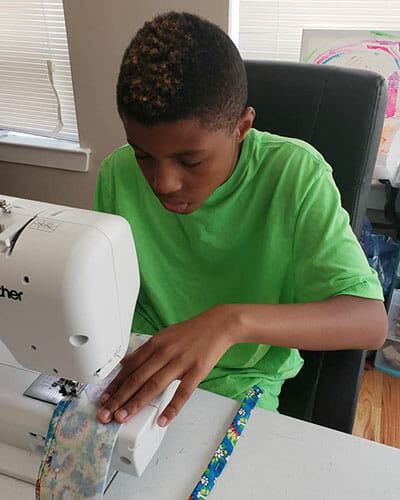
As a young child, Darius struggled with fine motor skills delay, but as his older sister taught him how to cut fabric and sew, he drastically improved. Now, passionate about his craft, Darius makes hundreds of bow ties a year. /Courtesy Darius Brown
“My hope was that I would help the animals get noticed and be fashionable so that I could help get them adopted faster, and find their safe, loving, forever homes,” Darius said.
The 12-year-old’s knack for creating bow ties initially began as a way to help himself. At age 2, Darius was diagnosed with speech delay, comprehension delay and fine motor skills delay, which made it difficult for him to make small movements with his fingers. But with the help of his sister, Dazhai, Darius learned how to cut and sew, and his fine motor skills drastically improved.
“I just feel like all this was God’s will,” said his mother, Joy. “Him learning how to sew and his hands making the bow ties, it developed his coordination and it’s like there’s no problem, like nothing was ever wrong.”
Joy says her son’s comprehension and speech have also improved because he’s been interviewed on so many TV shows, including CNN and the Rachel Ray Show. Darius and his bow ties have garnered attention and support from numerous celebrities. and from his more than 50K followers on Instagram, but no one can top the support given to Darius by former President Barack Obama. In 2018, President Obama sent Darius a letter, commending him on his commitment to community service. In part, the letter read: “As long as you stay engaged in the world around you, continue looking for ways to help others, and never give up on yourself, I’m confident our future will be bright. … Know that I’m rooting for you in all you do.”
Since founding Beaux & Paws in 2017, Darius has donated hundreds of bow ties to animal shelters across the United States. This summer, with the support he received from his Go Fund Me campaign, Darius traveled to animal shelters in five states to personally deliver bow ties and to volunteer at adoption events. Whenever he hears from an animal shelter that a dog or cat was adopted with the help of one of his bow ties, Darius says he feels overjoyed.
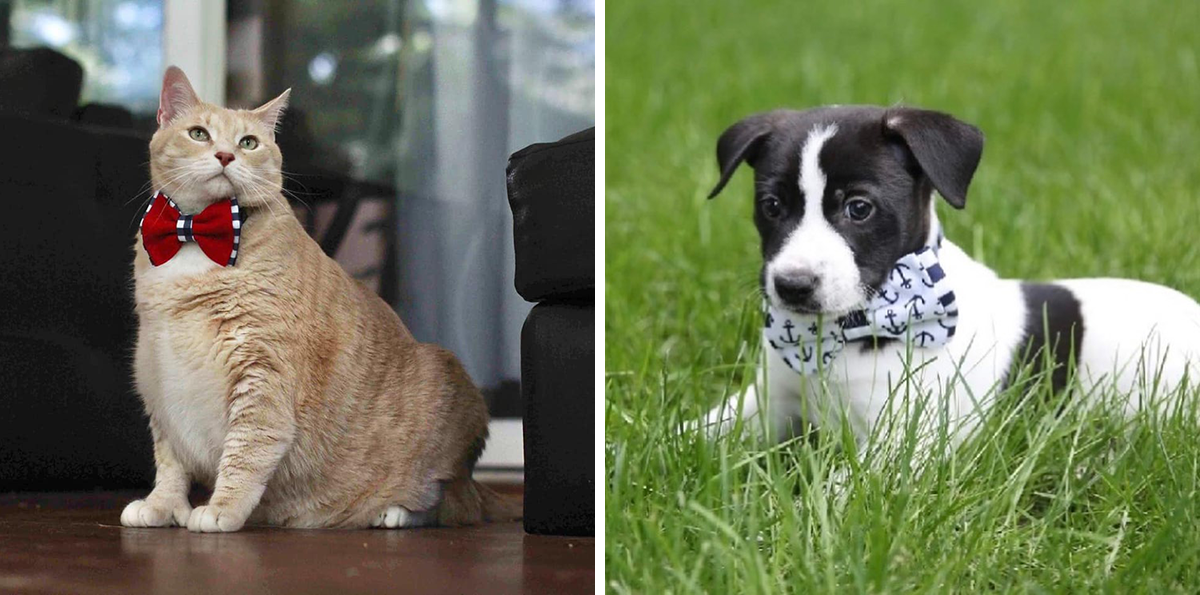
Darius says the bow ties make the animals look cute and dapper, so they will get adopted faster. /Courtesy Darius Brown
Darius is living proof that no one is too young to make a difference, and he hopes he can inspire other kids his age to give back to their communities and become entrepreneurs, too.
On top of being able to donate more bow ties to animal shelters, Darius’ next big goal is to own a dog of his own, which the building he lives in doesn’t allow. But for long term goals, Darius wants to go to Stanford University to become a business lawyer, and hopes to start his own fashion line.
“I want to have my own clothing line, such as blazers, vests, bow ties, shirts, everything. I hope that I can expand my business into an empire,” Darius said.
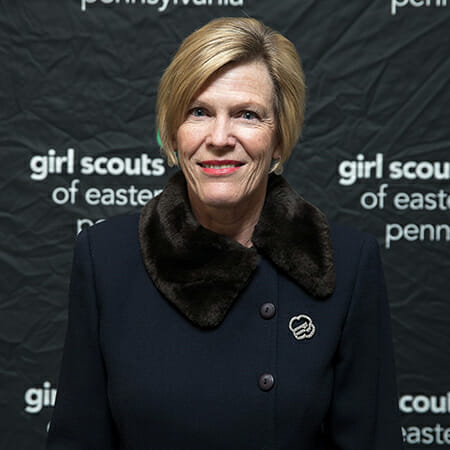
Pennsylvania Woman Helps Mentor Others Through Volunteering for Girl Scouts
Meet Daily Point of Light Award honoree Debbie Hassan. Read her story and nominate an outstanding volunteer or family as a Daily Point of Light.
Debbie was just in second grade when she first got involved with Girl Scouts, a girls’ youth organization she said provided her with mentorship and education that would positively impact her for the rest of her life, from her college education to her career in public accounting. Now retired, Debbie is fully giving back to the organization that helped shape her.
She is currently the Board Chair of Girl Scouts of Eastern Pennsylvania, presiding over the Board of Directors, Executive Committee and Delegate Council Meetings. She dedicates anywhere from four to sometimes 12 hours a week attending meetings, conference calls and fundraisers, along with multiple other operational duties. Debbie’s dedication comes from her desire to give back to the organization that motivated her.
“People need to know people care and that people are still willing to give a hand,” Debbie said. “And that they will share their time and talent and their experiences which may motivate another person — in this case, girls — to take a chance, take a risk, don’t be afraid, don’t give up.”
Describe to me your volunteer work with Girl Scouts.
I am the Chair of the Board of the Girl Scouts. As Chair, I work closely with the CEO who reports to me and I work with all the other board members. I run the board meetings, that includes executive committee if needed. We meet at least twice a year but typically not more unless there’s a need to do that. I run the Executive Committee, I’m also currently serving as chair of the HR Committee because we have newer board members and had some rotations so we’re trying to get some folks to take my place in that role. Prior to that, I served for several years as the Finance and Audit Committee Chair. I am the invited guest to all over committees because we do all our work, the bulk of our heavy lifting, in committees. We are our own 501(c)(3) not-for-profit. We have our own articles of incorporation, our own budget, our own board, and we operate under charter. Each Girl Scout council across the country has a charter under national Girl Scouts which are headquartered in New York.
It’s been a very busy two-year first term for me. I met for the first two years with our CEO every week, either by phone or in person, as we got to establish working relationships and cadence. Kim E. Fraites-Dow, our CEO, was also a new CEO, so plotting the strategy and being there to be a resource to her to bounce ideas. … Now that we’ve developed that relationship and cadence, we touch base every other week. At least an hour, upwards of two, because we’re in the process of starting to reset our strategic priorities. We just concluded our three-year strategic plan and we’ll be launching meetings of the board and others to come up with our next three-year strategic plan. In addition to that, I’m on committee calls. I go to most of the fundraisers. … I still try to attend finance audit committees by phone or in person.
When did you get involved with Girl Scouts?
When I was in second grade. I was a Girl Scout in this area over toward Fort Washington, PA and got involved at a very young age. We were Brownies. My mother agreed to be an assistant troop leader. Depending on the year, she was cookie mom, meaning taking inventory and keeping track of who had what so we could have successful cookie sales. I basically stayed in Brownie, Cadettes, Senior, Junior, etc., and earned my First Class Award which is now called Gold Award. Then I had a hiatus from the movement because I pursued my career coming out of college going into public accounting, which was the profession I chose and stayed with that my whole career. I raised three children. I did get involved in not-for-profits in Pittsburgh, which is where I started my career.
When we moved to Philadelphia, I had gone to a couple of the [Girl Scouts] fundraisers but had not actively participated as a board member. I was rolling off some other boards at the time because I knew this was going to be a working board and one I would want to give my all, so I didn’t want to take it on and not deliver. When they asked me, I went on as a non-board volunteer, I think that was 2012, 2013. That is an unusual arrangement where they have non-board volunteers working with the board members on committees. Our committee was called the development committee. We were the committee that does governance, assessment of board members, interviewing them on how they think it’s going, how the organization feels about their contributions and the like, so it was great. A great way to relearn the group, the organization and mission, and ultimately move on to the actual board.
Why did you want to get involved with Girl Scouts again after taking a hiatus?
As a partner at a firm like Deloitte … we’re precluded from doing paying boards. When you’re an equity partner in a firm, there’s SEC restrictions and all kinds of stuff. My usual focus was on women and girls’ organizations and I always had a passion for arts organizations as well. The Girl Scouts just weren’t on my radar largely [before] I had been recruited, probably because in Pittsburgh, it just wasn’t as visible to me at that point, between the two-career family, younger kids, and I traveled a lot. And I was already involved in these other groups like I said including the firm’s group, I was helping run our women’s initiative, mentoring younger people.
But when I moved to Philadelphia and was getting more involved here, it had always been in the back of my mind to reengage at some point [with Girl Scouts] when I could do justice to it. A friend approached me again after a fundraiser and as I was looking at my tenure on some other boards, it was like you know what, if you’re interested, I would do this non-[board] role and get re-acclimated with how it’s working in eastern PA at this time and whether I can contribute. From there I got reengaged, because I do attribute my growing up as a Girl Scout with all the volunteers who helped me, for giving me the courage to pursue my dreams despite adversity and make it happen. All that training, all those experiences, paid off for me to have the career I had and the desire to give back to other girls.
Debbie attends a Take the Lead fundraiser in Philadelphia, which honored prominent women within the community as well as raised money for Girl Scouts to attend camp./Courtesy Girl Scouts of Eastern Pennsylvania
How did Girl Scouts impact you when you were younger and how is it impacting your life today?
I started as a young girl at a time, we’re talking mid-60s. Being able to get out of that school environment, all girls working on projects, earning badges, going camping, the chance to learn how to use a compass and a map and just take chances, fail, have things not work out and pick yourself up. Learning things like resiliency, teaming, and not being afraid or embarrassed because people are making fun if you. We were helping each other learning to work as a unit and letting each person be successful. I have a CPA accounting background — well guess where I learned my first inventory? Counting all the cookies in my mother’s garage. I was the clipboard holder, doing inventory on a daily basis. Helping her keep track of the Samoas cookies versus the peanut butter patties. And I liked it. Not to mention, going door to door, helping me get over shyness, talking to adults and trying to convince them they should buy my cookies. I [was] in good standing for my future consulting part of the business at Deloitte where I had to meet strangers and convince them to hire us as their firm of choice, whether it was for an audit or a consulting project or IT assistance or whatever, it goes back to those early skills. Looking people in the eye, shaking hands, having a conversation with adults. It was great and it was fun which is why at the time, probably like most of us, I didn’t even think of it that way. I think it helped me do well in college as well. I was more prepared. The motto of Girl Scouts is be prepared. There was not one class I wasn’t always ahead on the notes, syllabus, organization, all of the things you learn in scouting.
Can you describe some different fundraisers and events you have been involved in or that are coming up?
There’s all sorts of exciting programs coming up. I actually just hosted some cookie winners at my home. I did a board challenge for girls who exceeded all the normal goals. So the most rewarding for me was actually hosting some girls and moms at [Girl Scout founder] Juliette Gordon Low’s house down south. I have a home on Hilton Head Island so they came and stayed with me, we saw Savannah. Juliette Gordon Low’s home is like Mecca for Girl Scouts since that’s our founder and where she had her home. We just had our board retreat, that took a lot of work and planning, was extremely gratifying. We have a number of exciting new board members joining us and got to acclimate everyone at [the Girl Scouts’] Camp Shelly Ridge.
I think the next biggie that I’m looking forward to is probably Take the Lead. That is our biggest fundraiser where we honor a number of prominent women in the area but also raise a lot of money for “camperships,” for girls who otherwise might not get to go to camp. One of my best memories is talking my parents into letting me go away. I’m the oldest of six and a girl and they didn’t want me to. Going away to camp for two weeks and hiking, cooking outside, just getting dirty, is still one of the highlights I remember. So that’s why Take the Lead is one of my favorite fundraisers, helping other girls get that opportunity.
We do three Take the Leads because of our geography. We do one in Lehigh Valley, we do one in Reading-Berks and we do the downtown Philadelphia one, because the communities obviously want to be able to help support the local communities in addition to the entire foot print. Philadelphia is the first in March and then the others follow.
I just came from adulting camping weekend at my old camp, it’s called Camp Laughing Waters in Gilbertsville, PA … We own beautiful acreage out there and I got to sleep in a platform tent like back in the day. We were raising money this past weekend with a lot of alumnae and friends interested in helping girls just to raise money for scholarships. Two of our board members and a committee of volunteers, they organized this whole thing and run it with all the proceeds going to girls who graduate and apply to scholarships this coming year. So it was a lot of fun.
This adult camping weekend is one we’re trying to spread the word about, because if you’ve ever been a Girl Scout or you just want to support them, you’re welcome to join that one. Right now there is only one of those a year and it just happened this past weekend. A lot of people don’t know about that, where you can come and have fun and know you don’t have to sleep in the platform tent, we actually have an air conditioned lodge for those that don’t want little critters running around or hear the bats and owls at night. There’s many that Kim E. Fraites-Dow, our CEO, do for current Girl Scout families, [but] I don’t go to everything.
The most special for me that I have not missed because I’ve tried desperately to keep my schedule so I can attend is when we honor our Gold Award Girl Scouts. That’s the highest reward you can receive in the movement. That is not so much as a fundraiser as it is an awareness-raiser with the community at large, celebrating their success and the hard work, because it’s not like other organizations. You can’t go to a park and paint a bench and earn [the award]. They have to identify a problem in their community and they have to come up with a sustainable solution to whatever that issue or challenge is. That awards ceremony is one I absolutely hold near and dear. We’re trying our level best to elevate and make sure our communities across all nine counties see who those girls are and see all the good things they’re doing everywhere.
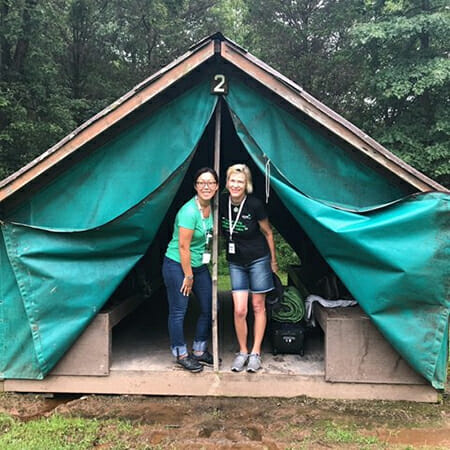
Debbie, right, stands with Girls Scouts of Eastern Pennsylvania CEO Kim Fraites-Dow in front of a tent during their Adult Camping Weekend event which raised money for scholarships./Courtesy Girl Scouts of Eastern Pennsylvania
What’s been the most rewarding part of your work?
Working with really smart, energized, committed people to help all of these talented, engaging young women find their way. Trying to aid them, support them in doing that, just like the way I got a helping hand back when I needed it. It’s not just raising money, it’s actually giving time and talent. We did start one new program along these lines which I was thrilled to participate in and help with the launch, although the credit again goes to Kim and her team. We started two years ago a leadership summit, because again we’re a volunteer organization, so many of our troop leaders, service center leaders, the ones who keep the machine running, they have jobs of their own, they have families and they’re not being paid. We started a leadership development conference where we take the lead awardees, past board members, business owners, some of our bank and other partners come, and we do leadership training based on the types of skills, topics that our members are telling us they’re interested in. Because many don’t have the luxury of a Deloitte where I got training from the time I walked in to the day I retired, paid for by them and flown all over the world. We’re bringing these opportunities to all our volunteers and folks so they can participate in all that too, whether their companies do it or not. That’s something I think is different and hopefully will grow and spread across the movement to other locations if they’re not already doing it.
Why do you think it’s important for others to give back?
Our girls are on a mission to make the world a better place and if you’ve watched any TV at all lately, we’re really in need of committed people who mean those words and will actually do something and not be passive. I’m party agnostic, I just want to give everybody the opportunity to find their passion and make it a better place. Our girls really, really do want to make it a better world. They’re doing amazing things, particularly with technology and all of the other opportunities that exist to make a far greater impact than back in my day. I’m kind of jealous, but I’m so thrilled to just be helping in whatever way I can. I think these girls are going to run the world someday.