Volunteer Helps Fight Period Poverty in Iowa Community
Meet Daily Point of Light honoree Megan Gustafson. Read her story and nominate an outstanding volunteer or family as a Daily Point of Light.
Like many women and girls throughout the country, Megan Gustafson never had an issue accessing period products, so she never thought much about what someone unable to afford pads or tampons might do. Then last year, while volunteering at the Loaves and Fishes Food Pantry with her church, the Story City, Iowa-native encountered a woman asking to take more than the allotted package of period products. The woman had four daughters, and the family often had to decide who would get to use that month’s package, and who would instead have to stay home from school or work. After some research, Megan discovered that one in five girls in the United States can’t afford period products, and one in four miss school because of it.
Believing no girl should have to go through that, Megan started a drive to collect period products to donate to area food pantries and local schools. She collected donations and assembled bags filled with pads, tampons, wipes, chocolate, menstrual cycle information, and for teens, makeup kits as well. So far, she has donated over 7,000 pads and tampons and 45 makeup bags. Aside from wanting to help girls who can’t afford them, she also wanted to make the topic of periods less taboo for all girls and make the experience less scary for girls getting them for the first time.
Aside from her continued collecting of the period products, Megan also volunteers at Loaves and Fishes whenever it is her church’s turn to run the pantry. Every other month or so, she helps pick up food donations and walks visitors through the pantry. She is also Chair of the Promotions Committee for the Story City Greater Chamber Connection, where she helps to plan family-friendly events for her community.
Can you describe your period kit project?
It started last year. Last year’s event, I didn’t really have too high of hopes, honestly, but I was just trying to collect mostly pads and tampons to donate to area food pantries and to local schools. Then from there, we also made some [kits] that are more specifically for teens and I had several people donate different makeup kits. We made these first period packs, which held two or three pads, two or three tampons in a couple different sizes, some information about what was going on with their bodies, a piece of chocolate, and some wipes and different things like that. Those all went to mostly the middle school, [and] we took some to the elementary school and high school, just to make a girl’s first period a little less scary perhaps. Those were available through the school nurse. I think some of them went to teachers as well, teachers who were known throughout the school to be good people to go talk to.
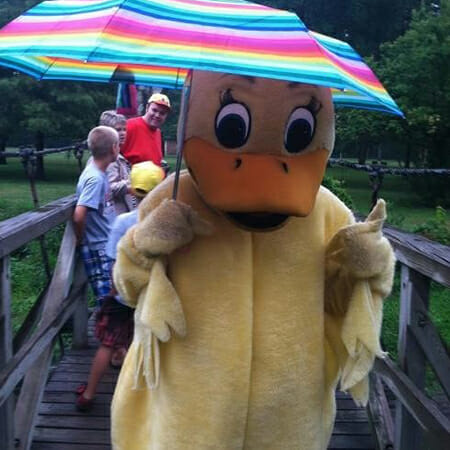
Megan Gustafson poses in her duck costume, which she dons each year at the Story City Greater Chamber Connection’s annual fundraiser.
What inspired you to do this?
We have a food pantry [Loaves & Fishes] here in town that’s co-run by all the area churches. The Saturday that my church was in charge, I was volunteering. The food pantry’s policy is for it to be sort of a way to tide you over until next month, as opposed to being a one-stop-shop sort of place. I had this mother come in and I was helping her through the food pantry. We got over to the hygiene product area and she asked if she could have a couple extra packages of pads and tampons, because the packages they gave out typically had maybe 12 to 15 in a pack of either pads or tampons. She said she has four daughters at home and some months they have to take turns on like, “Ok, I guess you’re going to have to miss school during this time,” or “I’ll miss work,” or something along those lines. That was a real eye-opener for me, so I went and did some more research and found one in five girls in our country can’t afford it, and one in four miss classes each school year because they don’t have access. I had no idea that that was happening here.
For someone who may not be aware that period poverty is an issue, can you describe the effect not being able to afford pads and tampons can have on women and girls?
I can’t speak for certain because I’ve never really been in a situation where I’ve never been able to afford them, but I know girls are missing school. Even if they’re only missing three or four days out of the school year because of the lack of access, that’s three or four days of education that they’re missing out on. We don’t really like talking about periods anyway, so I would imagine there’s some shame going into it as well, not being unable to afford these and having to tell friends, “I can’t go to school today because I’m on a period.” No girl should have to say that.
Do you have any longterm plans about continuing to do this or any ideas of where you would like to see this go?
It’s definitely something I want to continue in the future. I’m in school right now to become a pastor and I see this eventually becoming a part of my ministry at a church. In my ideal world, my church would have some sort of, kind of like a food pantry, but it would focus more on things that maybe don’t get as easily donated. I know from volunteering at the food pantry here in Story City, they get plenty of cans of food and pasta and cereal and different staples like that, but when it comes to bathroom products, especially like pads and tampons, that’s something a lot of people don’t think about. I think that’s something I would really like to continue to grow on and expand to a full-fledged ministry.
Can you discuss some of your other volunteer work?
The Chamber of Commerce in my hometown, [called] the Story City Greater Chamber Connection here, I’m the Chair of their Promotions Committee. With that, I do a lot of especially family-friendly events around town. We’re working on one right now that’s going to be a drive-thru barbecue in a couple of weeks. It’s been a weird year to be on it, because a lot of our events had to be cancelled this year. We also do things like the downtown trick-or-treating, a tree lighting around Thanksgiving, just different family-friendly events like that. … They have a duck race every year as part of a fundraiser, where we send a bunch of ducks over the bridge and into the river. For that, I’ve been wearing the duck costume that goes and meets little kids. Sometimes I volunteer in the office helping stuff mailers and different things like that. During the summers, my summer employment is through them, and I work at the Story City antique carousel. The Story City carousel is a merry-go-round that was built in 1913 and families come and take rides, and we do history tours and sometimes we do little parties.
What’s been the most rewarding part of your work?
I know one thing I found really rewarding, especially with the pad and tampon drive, is bringing awareness to it. Even now a year later, I still have people on Facebook who will ask me when’s the next one coming up, or they’ll find an article about [period poverty] and they’ll send it to me. That’s been really cool. Also how, at least some people in town, it seems like are more willing to talk about it, so it’s less of a taboo subject. With volunteering in general, I would say one of the more meaningful experiences has been with the duck races, and my dressing up in the duck costume and having little kids come up to me. They’ll give me drawings of themselves with the duck when they met the duck last year, and they’re just so excited to see them. The look on their faces when they get to see the duck in person again, that’s been a really rewarding experience.
Why do you think it’s important for others to give back?
I think it’s important for others to volunteer because it’s sort of this ‘we’re all in this together’ attitude. Especially volunteering around your local community, it’s your friends, it’s your neighbors, it’s people you pass on the street. If doing something, even taking an hour out of your time, makes someone else’s life that much better, then why not do it?
What do you want people to learn from your story?
I guess one thing that I would say is even if you think it’s kind of a weird thing to be passionate about, it’s still something that you are passionate about, and it’s something that you should really take and run with because you never know where it will end up.
California Teen Volunteer Provides Shoes and Hope for Kids in Need
Meet Daily Point of Light Award honoree Divya Mamidi. Read her story and nominate an outstanding volunteer or family as a Daily Point of Light.
Watching the blockbuster movie “Slumdog Millionaire”, Divya Mamidi was brought to tears witnessing the true perils of poverty. The 16-year-old Carmichael, California resident says her emotional reaction to the story was of both fear and anger. “The movie made me fear seeing how other people live compared to my lifestyle. Also a bit of anger, that I live such a privileged life and I never knew something as horrible as poverty to that extreme existed.”
Deciding to use her emotions productively, Divya launched Kicks4Keeps in 2018, an organization dedicated to changing and shaping the lives of impoverished children, and most recently, unaccompanied children in the United States. Distributing more than one-thousand pairs of lightly used donated shoes locally in the Sacramento area, and internationally including Honduras, Haiti and Sierra Leone, the rising high school junior is offering hope to children in need and changing the world, one pair of shoes at a time.
What inspires you to volunteer?
Observing the environment around me, and seeing key differences that I know shouldn’t exist, is what inspires me. If we don’t have compassion for strangers, then there’s no hope for society as a whole. You have to be willing to come together as a community.
Why did this movie resonate with you?
My parents were both born in India, so as a first-generation American, watching this movie, it represents a wound that runs deep through my culture which is why it was so close to me. When my parents first came to the U.S., my dad would donate blood to get $25 so that he could buy enough food to eat for the week. The movie was a connection of culture and experience for me, and made me more motivated to help others.
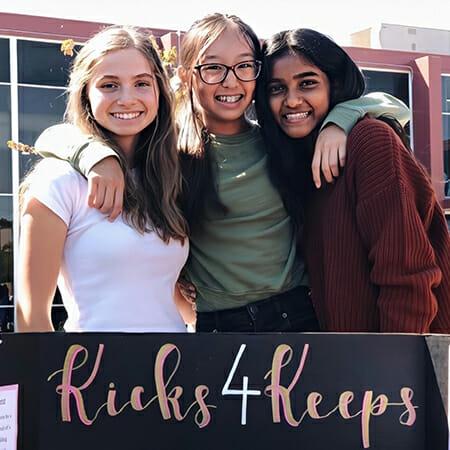
The Mira Loma High School branch of Kicks4Keeps advocates about the growing issue of youth homelessness and encourages students to join the representative club. As a student-run organization, Kicks4Keeps has about 50 volunteers./Courtesy Divya Mamidi
Describe your role with Kicks4Keeps.
As founder and CEO, I delegate tasks and oversee our numerous branches and 50 volunteers across the Sacramento area. We are student-run, and I structure every single project we offer, including our main initiatives: shoe collection / donation, advocating for impoverished children and most recently, providing resources for unaccompanied youth.
Share one personal story with me from your volunteerism.
We’d just formed a partnership with California Coalition for Youth, which advocates for homeless youth in the state. The founder heard about us and what we do, and he paused for a good five minutes, just standing there smiling, thinking about our work. He said that our service is an example of what restores hope in our generation, and I remember thinking, that’s true! This kind of work is going to help our generation get through millions of twisted occurrences that happen in our world.
What’s been the most rewarding part of your service?
When I first started high school, it was so divided. Some are in the advanced program, and come from financially supported households. The rest of the students, who are so much more diverse, with soul and passion, completely lack that financial status. People in the U.S. often regard these students as lower or lesser because of this difference. I wanted to advocate for these kids to help to improve their chance at success.
What have you learned through your experiences as a volunteer?
For any volunteer to do anything, you have a bit of hope. Nobody would do anything if you didn’t have hope for change. I was passionate about this topic and knew I could help other children.
In one word, what does volunteering mean to you?
Interconnectedness.
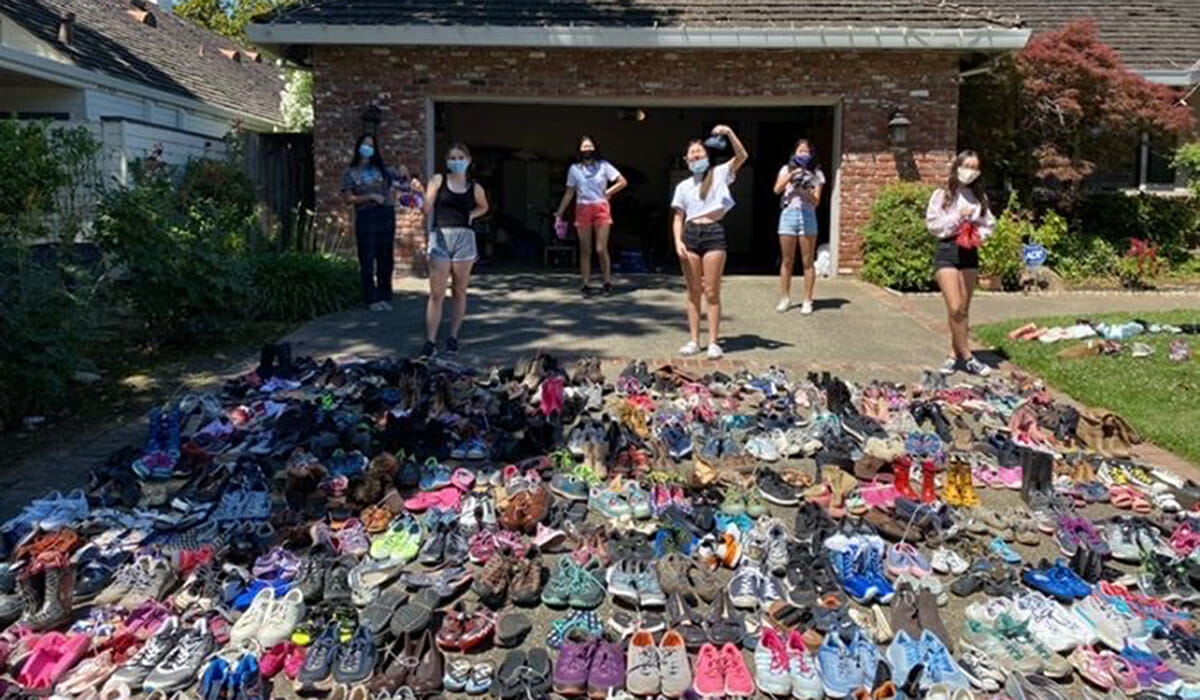
At one of Kicks4Keep’s service opportunities student volunteers stand by shoes that have been paired and are ready to be packaged and sent to Haiti, Honduras, and Sierra Leone. Kicks4Keeps has distributed more than one-thousand pairs of lightly used shoes since 2018./Courtesy Divya Mamidi
How has your service expanded during the Covid-19 pandemic?
We’ve donated 1,000 ear savers, which are little pieces of plastic that fit behind masks to make them more comfortable, to frontline hospital workers across the Sacramento area. We also conducted an Instagram interview with a doctor to inform and raise awareness with teens about the pandemic. We also continue to advocate for impoverished teens with our political leaders, as these teens are at greater risk during the pandemic because of a lack of resources.
When you’re not in school or volunteering, what do you do for fun?
I watch a lot of Netflix and I also play tennis.
How can readers help?
Please visit Kicks4Keeps website for more information about how you can help.
Connecting Youth with Community Leaders, Teen Volunteers to Increase Civic Engagement
Meet Daily Point of Light Award honoree Sameer Jain. Read his story and nominate an outstanding volunteer or family as a Daily Point of Light.
17-year-old Sameer Jain says that many underserved youth in Chicago Public Schools don’t have access to community resources, educational and civic opportunities. Volunteering to empower those stuck in impoverished or violence-ridden neighborhoods, Sameer is now making critical connections for students with community leaders, as he advocates for a better future for the children of greater Chicago.
Co-founding Our Safety USA in 2019 alongside other students in Naperville, Illinois, about 30 miles southwest of downtown Chicago, Sameer is working with Chicago Public Schools to facilitate classroom forums for youth and high school students to meet face-to-face with city authorities. Designed to foster opportunities for young people to talk to their elected officials and community leaders, these meetings are providing meaningful civic engagement for students. Most recently, leaning in to the dire need for educational support during the Covid-19 pandemic, the rising high school senior has held school book and supplies collections for students who lack adequate access to the internet, spreading opportunities for success to others.
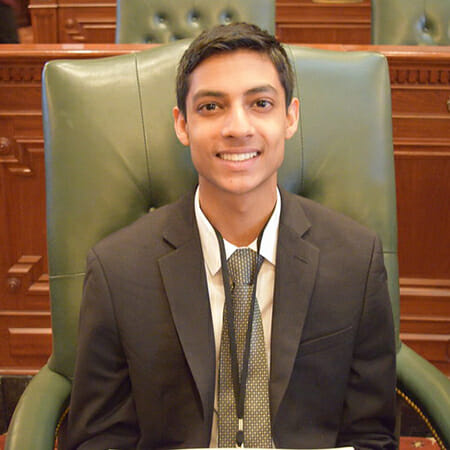
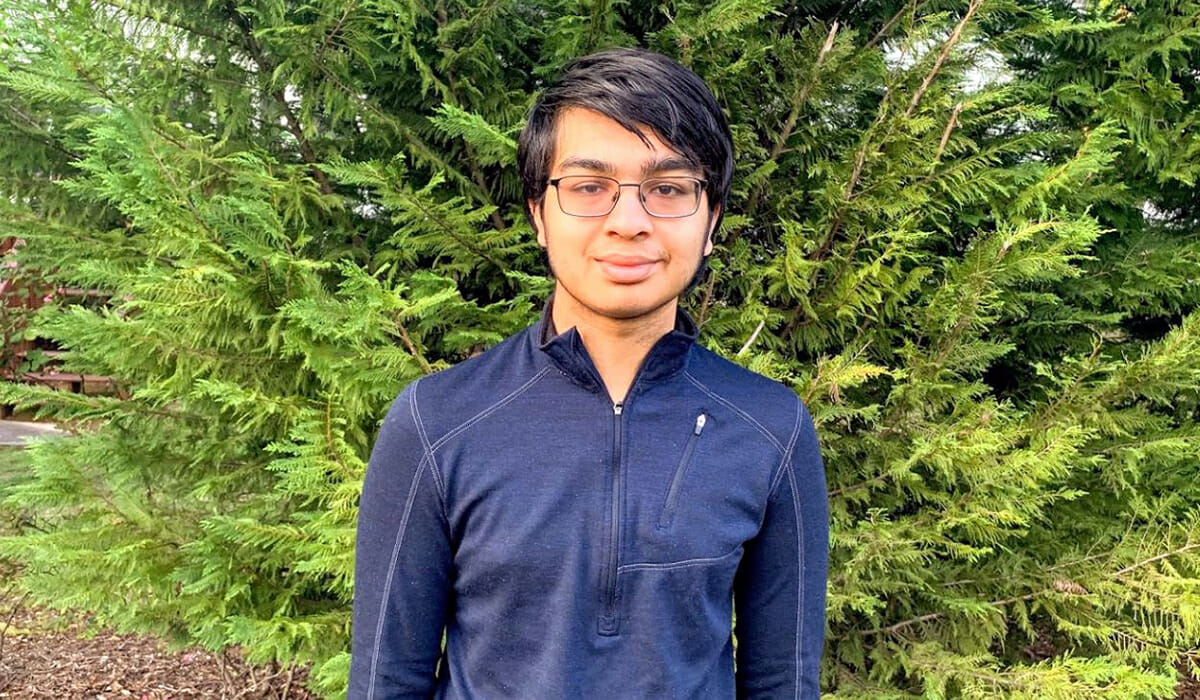
Our Safety USA founding member Sameer Jain is advocating for a better future for Chicago-area students stuck in impoverished or violence-ridden neighborhoods./Courtesy Sameer Jain
What inspires you to volunteer?
I started volunteering at the beginning of high school, and around same time developed an interest in civic engagement. As I started making an effort to get to know my local elected officials, I began showing up to community town halls and meet and greets, and time and time again, I noticed only one or a handful of people my age in attendance. I realized I was among a very small group of youth who even knew about how government functions and how young people can have a voice in that process. I decided to combine those two interests and make it my mission to increase youth civic engagement.
Describe your role with Our Safety USA.
As executive director and a founding member I manage projects and organizational initiatives. I check in with our student volunteers, and set up and maintain outside partnerships. Additionally, I work with Chicago Public Schools to organize our meetings and do regular field volunteer work on the ground.
Share one personal story with me from your volunteerism.
During the pandemic, we organized contactless pick-ups and collected hundreds of books and school supplies for donation drives for local schools in the West Aurora, Illinois school district. A good number of students there don’t have access to quality WiFi at home that was required for remote learning. On the day of the book drive, we stopped by the high school to deliver the books, and a woman came out and greeted us saying that our supplies were being delivered to students in low income housing and also, to students at a local homeless shelter that didn’t have any internet access. It was really cool to see how, even though it wasn’t originally our intention to help kids in shelters, our support was helping in more ways than one, helping to keep their education going and keep their minds off of the pandemic and other stressors.
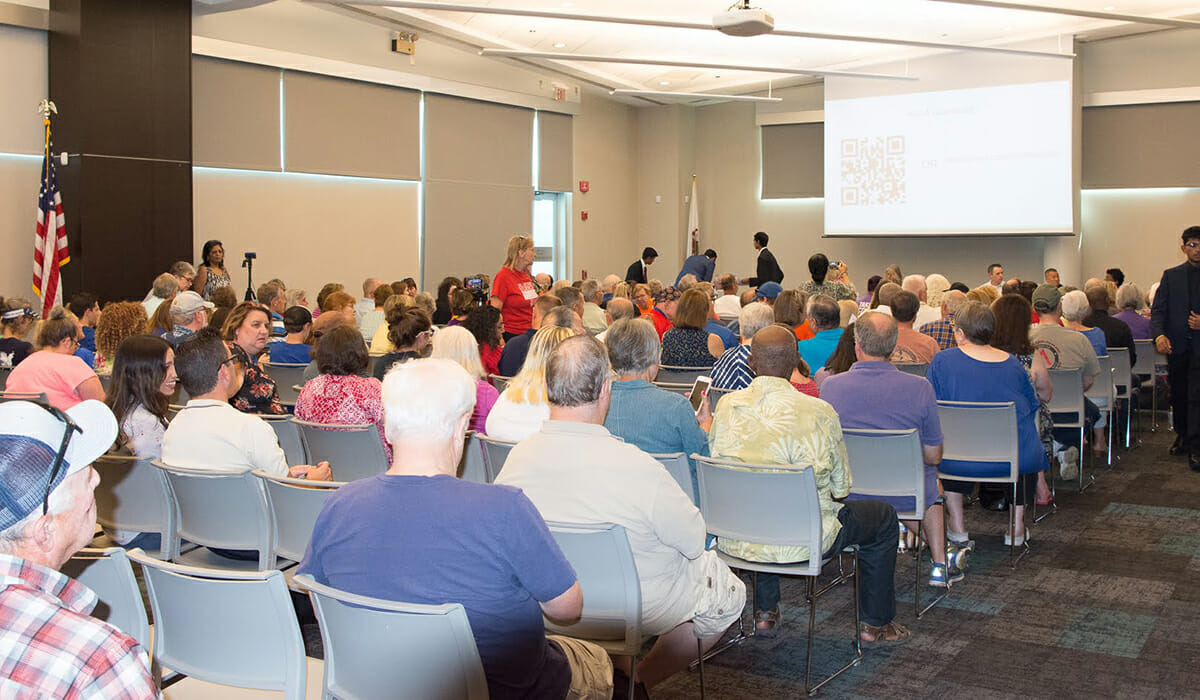
An Our Safety USA town hall, held in August. Sameer is working to increase youth civic engagement through his volunteerism./Courtesy Sameer Jain
Why do you think it’s important for others to give back?
We really tend to take for granted resources we have available to us all the time, something that is especially true in my community, whether it’s educational or civically-oriented. We are stuck inside our own bubbles and forget about the people whose lives look drastically different than ours. Service levels those differences and the playing field, and makes sure people have equal opportunities to succeed and make their voices heard.
In one word, what does volunteering mean to you?
Contribution.
When you’re not in school or volunteering, what do you do for fun?
Hanging out with my friends, playing music. I’m in a couple musical groups in my school.
How can readers help?
Please visit Our Safety USA’s Instagram for more information about how you can help.
First-Generation American Volunteers to Promote Inclusion for Refugee Youth Through Art
Meet Daily Point of Light Award honoree Manav Shah. Read his story and nominate an outstanding volunteer or family as a Daily Point of Light.
16-year-old Manav Shah is like any other American teen, spending his time outside of school taking photos, fulfilling his passion for photojournalism, and traveling to meet people from different cultures. What sets the Marietta, Georgia teen apart from some of his classmates are the racist attacks he’s faced, and the action he is now taking to help other minorities.
“Being told, ‘Go back home. Go back to your country’,” Manav says. “I feel like I also am an integral part of this community, and I want to help build this nation and help it succeed. Being told that really disheartens me. Racism is really disappointing.”
Fittingly, the rising high school senior was traveling when he discovered how he could help others. Visiting the city of Dharamshala in India in 2018, Manav stumbled upon a Tibetan refugee enclave and returned back home to the United States determined to help refugees in his own community.
“I was shocked to see the plight of the refugees. Self-immolation was occurring in the community, they had no home and they faced so much racism, especially the youth who felt torn between India and Tibet.”
Once home, Manav began having conversations with the large refugee community in nearby Clarkston, Georgia, often referred to as “the most diverse square mile in America”. Manav says speaking with Tibetan refugees there reaffirmed what he’d observed in India, and revealed the great need that existed.
Launching Liberated Voices in 2019, Manav uses protest art, inspired by his time spent with the Tibetan refugees, as a vehicle of communication in helping refugee youth express themselves. The art empowers refugees to build confidence in voicing their narratives of inequity, says Manav. Raising more than $10,000 and helping about 650 refugees thus far in Clarkston, Chicago, Omaha, Kenya and Nepal, Manav is looking to branch out even further in the future, hoping to connect with refugees as far away as Kenya, Jordan and Iraq. Manav says his innovative solution to creating a just and inclusive society can be applied across many different cultures and communities, just as it’s being used in the Clarkston community.
“Their experiences and what they had to face hampered their ability to get an education, receive career prospects and integrate into their communities. Without these opportunities, they couldn’t make their voices heard on a community and political level. Through our protest art workshops, we are combining cultural experience and art with the traditional elements of protest against Chinese oppression, racism, and being overlooked.”
Liberated Voices founder, Manav Shah, uses protest art to help refugee youth express themselves. /Courtesy Manav Shah
Holding workshops across the U.S. and internationally that advocate for change through diversity, Manav instructs weekly and monthly classes and workshops with free art supplies including oil, water paints and more for refugee youth participants along with more than 20 Liberated Voices volunteers. Creating community for refugees to meet each other and also offer positive reinforcement of their community, Manav notes that along with the creative expression his workshops encourage, their classes have some very practical applications.
“A lot of refugees don’t know how to speak English. Protest artwork is a really non-verbal form of communication which is impactful because the colors and images can be applied to many different cultures and many different people who really have no idea what the refugee experience it is.”
Offering several initiatives including Learn, Lead, Change, which promotes leadership and helps refugees create artwork that gives them a peek into a better future for themselves, Manav says this support can help refugees escape drug, alcohol addiction, crime and violence, all devastating side effects of the exclusion they face. Liberated Voices participants, from Tibetan to Somalian, Yazidi and Burmese, are encouraged to harness and embrace their varied life experiences.
“I sat down with a young Somalian girl at the Clarkston Community Center where we were holding a workshop,” Manav says. “She was previously bullied about wearing a hijab. The girl had left behind extreme poverty and traumatic situations in her home Somalia, and said she didn’t want to go back. As I was making artwork with her, she’d covered up the phrase “i’m proud of be Muslim” on her artwork. As I talked with her about the phrase, we uncovered it. She accepted both her culture, and she felt accepted by our community. It’s really an inspiration for me to see the work that I’m doing helps others really fit into their communities and make their voices heard.”
According to Hemali Gunt, who mentored Manav while he interned at Duke University, Liberated Voices has served as a ground-breaking impetus for refugees to open up about the issues they face, and draw those challenges out through art experiences.
“There are people from all over the world who are assimilating. Even if (refugees) are made to feel welcome (in their new countries), their past experiences can sometimes overshadow those open arms. It’s important they are able to express themselves and embrace who they really are to help them reach their fullest potential. Manav’s work is helping refugees not forget their roots, but also helping them to become a much more whole individual.”
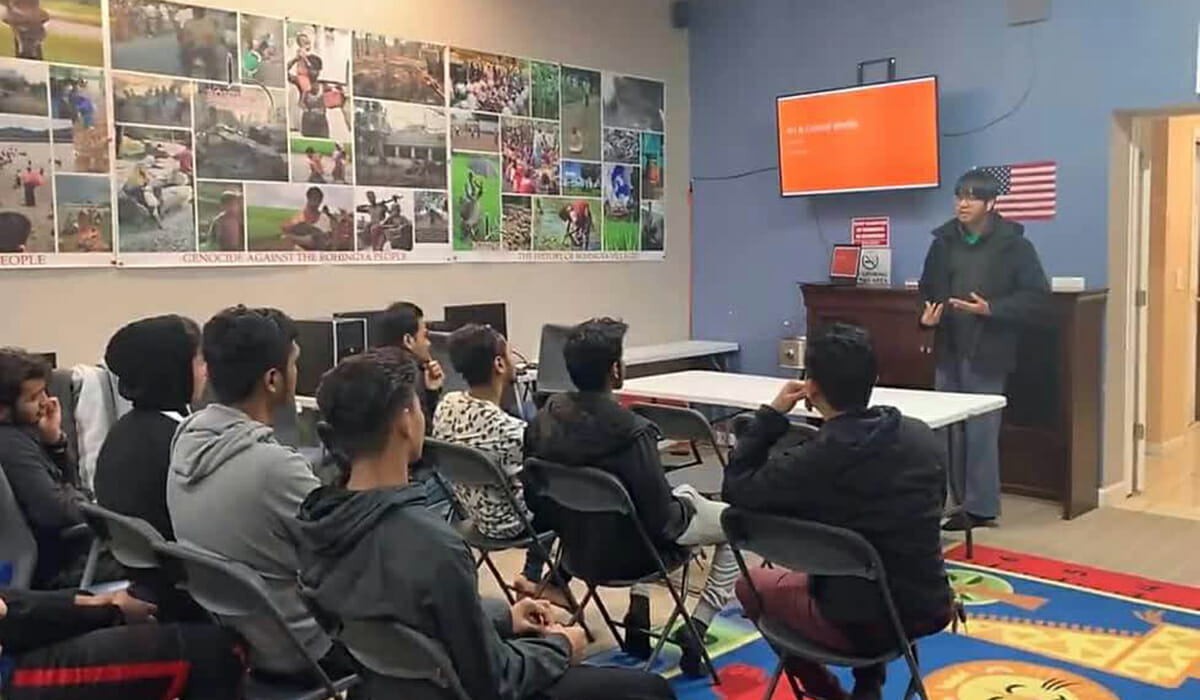
Manav pictured (right) conducting a workshop with Rohingya refugee high school students./Courtesy Manav Shah
As he continues his refugee outreach, Manav has been working with UNHCR Europe to create what he envisions to be a multilingual integration program, customized for various regions based on specific laws and policies. Additionally, Manav is advocating for state legislation in Georgia to recognize “Diversity Month”, in addition to approving diversity activities for public schools, work that he hopes can resume after being postponed due to Covid-19 pandemic stay at home orders. Liberated Voices will also have artwork featured in an exhibit at the High Museum of Art in Atlanta in Fall 2020.
“Seeing refugees being able to come to this country and not face discrimination would be amazing,” says Manav. “That’s our goal. We want to ensure that communities are more inclusive and aware of the experience that ethnic minorities face. By understanding the trauma they faced in leaving their homes and coming (to the U.S.), we can help them by providing support and welcoming them with open arms.
Thirteen-Year-Old Proves You’re Never Too Young to Make a Difference
Meet Daily Point of Light Award honoree Olivia Ohlson. Read her story and nominate an outstanding volunteer or family as a Daily Point of Light.
At just thirteen, Olivia Ohlson has made more of an impact in her community than many people do in their lifetimes. Over the past several years, the Evanston, Ill.-native has volunteered to help senior citizens, hospital patients, essential workers, low-income families, cancer patients, veterans, struggling students, and many more.
Olivia is an active volunteer with the Chicago nonprofit The Honeycomb Project, where she volunteers across a variety of projects ranging from organizing clothing and food donations, to sewing blankets and making cookies for kids in the hospital. After her mother was diagnosed with breast cancer, she started Olivia’s Pink Lemonade and Cookie Stands, which raised over $7,000 for the NorthShore Kellogg Cancer Center where her mother was treated. She is a pen pal to a handful of senior citizens, hand making cards to send to them every other week.
During the current pandemic, Olivia started offering free tutoring to her fellow students and also created a Youtube channel to post math tutoring and reading videos. She started Hygiene Kits for Evanston’s Underserved, where she fundraises, assembles and then distributes free hygiene kits to people in need. She will drop what she’s doing to help someone, including recently making coffee cake with her mother for 120 senior citizens immediately after having heard that their care facility would struggle to serve them breakfast the following morning due to employees catching Covid. Olivia has proven time and time again that she will do anything she can to lift up those in need.
Describe your volunteer role with the Honeycomb Project.
It’s a Chicago-run nonprofit. It was started a few years after I was born. You can go as an adult, but it’s mostly for families with all different-aged kids. I’ve been to 20 projects. They host indoor projects and outdoor projects for a range of different causes. The outdoor ones you help plant to help against global warming and things like that. We’ve done more of the indoor ones. … We’ve organized clothes for food drives and clothing donations multiple times. We made cookies for families with kids with cancer. We went three times to sew blankets for kids in hospitals. We made mats for homeless. We’ve written letters to veterans. We made posters for the Vietnam War memorial museum in Chicago. We’ve been there multiple times for projects. We wrote letters to Vietnam veterans. Two more recent ones that we’ve done is I helped practice with para-athletes who were kids. We helped them prepare for their soccer tournament later in the afternoon. Then we went to a wheelchair basketball tournament in which I photographed the players and ran the scoreboard.
Describe what Olivia’s Pink Lemonade and Cookie Stands does.
For that project, I hosted different stands. I hosted two the first year in the summer of 2017, and the following year I hosted two more. I sold lemonade and cookies and I gave all the money to the NorthShore Kellogg Cancer Center in Evanston. On their website, they also have a link we send people to where they could donate online. I raised $7,000 for breast cancer research. I would like to continue next year if it’s safe [from the Covid pandemic]. … The lemonade-cookie stands were because my mom had breast cancer the spring before I hosted the stand. I want to be a biomedical engineer, so I was really interested in the whole process of her surgery and the post recovery and all that, so I wanted to raise money for breast cancer research and really provide support for women like my mom who didn’t have family to help them.
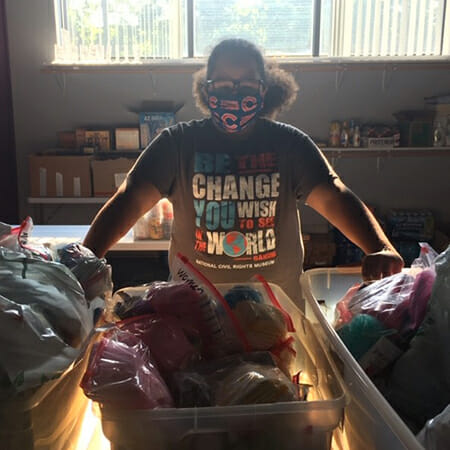
Olivia Ohlson stands in front of some of her completed hygiene kits that she has been assembling and distributing to those in need since June./Courtesy Olivia Ohlson
Can you talk to me about what you’re doing to help people during the pandemic?
One of the things I like to do is I chalk positive messages in my neighborhood. I often tutored kids throughout the pandemic of different ages in my district to help bring them up to grade level. It’s all been for free, and we just ask that if the families could afford to pay, then they donate to the NorthShore Kellogg Cancer Center. For my biggest project, I’m running Hygiene Kits for Evanston’s Underserved. We take in-kind donations and cash donations, and then with the cash we go to the store and buy all the hygiene products that are necessary to make the kits, and then I make the kits myself. We’ve made 300-400 kits about. Every first and third Wednesday of the month, we go to my church, which is Vineyard Church in Evanston. We go to their local food drive. On the first and third Wednesday, they also have diaper [distributions], so we go with the diaper people and we pass out the hygiene kits. Vineyard is associated with the Chicago Food Depository so they do [the food drive] every week but we only come every other week. … Next week we’re giving away kits to two former high school students at my future high school who have ran a successful food drive up there, where they got meals and groceries and passed it out to over 300 families two weeks ago. They’re doing it again so we wanted to offer the hygiene kits there.
There were two other projects that involved baking during Covid. One was my dad works for CPA, so we made a bag full of cookies, and I wrote letters on them, and I did little origami ninja stars and I wrote ‘Have a great day’ on them. I taped them to each of the bag of cookies. Then my dad brought them into work and he passed them out. He sent us pictures and there were these people throwing ninja stars around. He was like, it was crazy because there were adults throwing little toys around. It was just funny and it was nice to see. I’m glad we were able to support the essential workers in such an easy way.
The next one we did was for seniors. … My mom’s coworker’s daughter, Trish, found this senior home that needed breakfast because a lot of their workers were stressed to the bone. Some of them had gotten Covid, and they couldn’t find a way to serve everyone breakfast in the morning. They needed breakfast at 7 a.m. We found out the night before that my mom’s coworker needed help getting together breakfast, so we split it amongst my mom’s coworkers. She did the eggs, another coworker did fruit cups with her daughter, and my mom and I made my grandmother’s coffee cake recipe for 120 people. We found out about 4:30. We went to the grocery store, got all the supplies we needed. We were back by like 6:30, ate dinner, and then we were just baking until like 1 o’clock the next morning, bagging everything, putting it in a bin. I was asleep on the couch. I was exhausted. Then 6:30 the next morning, my mom’s coworker came and we gave the bin to her and she brought it to the nursing home. It was a pretty hectic day but it was really fun.
I heard you’ve also started a Youtube channel?
I read either chapter books or children books, or I have multiple books that discuss different heroes, sports icons, politicians, engineers, doctors, or mostly just famous people who are important, who people — kids especially — might not have heard of before. In the reading videos, I either read a chapter from a chapter book or I read two little biography paragraphs. I also do math videos where I do math by grade level. My most recent one, I did multiplication, and I’m going to do fractions, additions and subtractions. As I said earlier, I offer tutoring, and this is just a back up to that. If the parents can’t find a time every week to sit down because of their schedule or they have to work, or the kid is not going to sit down for a half hour for me to tutor with them, then they can come to this as an extra layer of support. It’s just like five minute videos that will give them a little bit of a nudge-up for the next school year.
What inspires you to volunteer in so many different ways?
My mom always instilled in me that need to help others, and my dad as well. They did service projects when they were older. They did all sorts of things to help the community, and I just wanted to be a part of that too. They always taught me to help other people and to support people in the best way you can without being too overbearing, so I was just trying to do as much as I possibly could, especially during the pandemic, to help out. Even before that, there would be moments in my life where I felt that people without their family would need more support, and I wanted to be that support for other people. When my grandpa two years ago had to go into a senior home … he absolutely hated it. He struggled there and said it was really lonely, to live with people you might not know or not have access to your family as much because they can’t live with you anymore. The year after that, we ran a service project that my mom and I totally organized at the nearby senior home, where I invited a lot of my friends. The home provided seniors that were interested in coming. We brought tons of cookie decorating kits. We made cookies ourselves. We brought frosting and sprinkles. We had about fifty people there and I invited my friends and my families and we decorated cookies with the seniors. We talked to them and we passed out the cookies. If they wanted a drink, we got them apple juice. It was really fun because I think it was the highlight of celebrating the holidays with people that might not have been able to celebrate with young people such as ourselves. It was a really good experience. Whenever I feel people are being undeserved — as is the title of my hygiene kits — I try to support that group as much as I can.
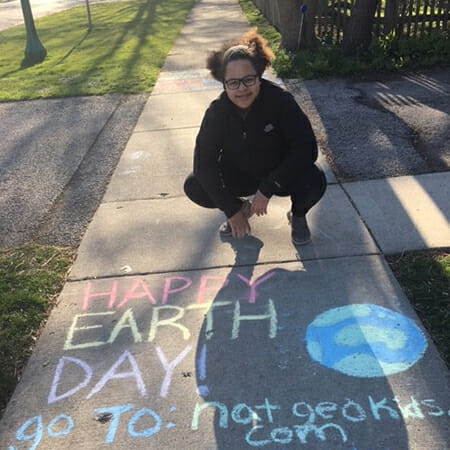
Olivia Ohlson stands in front of one of the many sidewalk chalk projects she puts around her neighborhood. She has recently begun writing various positive messages in order to uplift her community during the pandemic./Courtesy Olivia Olhson
What’s been the most rewarding part of your work?
I think the most rewarding thing is to see that people are just so grateful for what we’re doing. When we pass out the kits, I’ll be like “Would you like a hygiene kit?” and they’re like “Huh?” Then I’ll lift it up out of the car, because it’s a drive-in thing because of Covid, and … I used plastic bags, so they’ll see the items in there and they’ll be like, “Thank you so much!” like they didn’t know this was even an offered service. A lot of the times, families because they’re coming to get diapers for their children at home, they’ll be like, “Thank you so much, this is exactly what I needed.” I feel like that is a really rewarding part of what I do right now, just because I get to see there is a way to make people smile even during a pandemic. There’s ways you can support them or just bring ease about a certain thing. Now they don’t have to dish out that extra 20 dollars to go get supplies. They know they already have it. I think that’s the most rewarding part.
What do you want people to learn from your story?
I think I would like people to learn that you are never too young to help people. You’re never too old to help people. You’re never too inexperienced. You can just pick up somebody’s pencil that they dropped, or write them a short letter, or give them a sticky note that says ‘Have a great day,’ and that will make a difference in their lives. They’ll remember that small action and that little things mean a lot. Recently there was a gentleman who worked at my elementary school who everybody just loved and he made little impacts on everybody that really came [to light] because he died this week. Everyone was really sad and they really came out. There’s a poster that a lot of kids wrote on about the little things he did to make their day easier, or to make them laugh, or make them smile, that really made an impact on their life. I know they’ll remember that, and he did that for them even though they were so young when it happened. I think that is something that everyone should know. Little things matter and people will remember them.
For Over a Decade, New Jersey Woman Helps Feed and Clothe the Homeless
Meet Daily Point of Light Award honoree Barbara Gaines. Read her story and nominate an outstanding volunteer or family as a Daily Point of Light.
Over 15 years ago, Barbara Gaines was inspired by her late sister Mamie, a longtime volunteer at St. Joseph’s Social Service Center in Elizabeth, N.J., to come check out the nonprofit. From that day on, Barbara has been dedicating her time to St. Joseph’s, which provides food, clothing, medications and other services to the area’s low income and homeless communities.
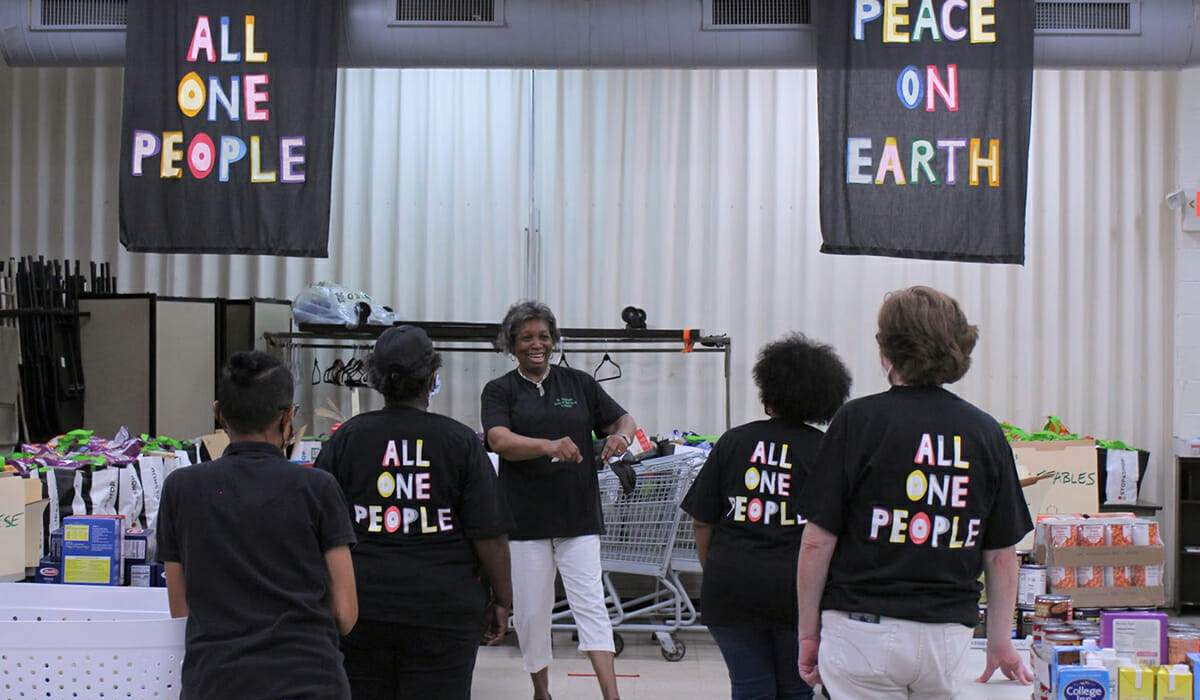
Five days a week, Barbara goes to the center to help sort, pack and distribute food and clothing. Each Saturday, she serves as St. Joseph’s soup kitchen’s maitre d, welcoming in and serving the roughly 100 attendees. She also participates in “Operation Warm Heart,” an emergency winter hospitality program for the homeless that is run by St. Joseph’s sister agency, the Elizabeth Coalition to House the Homeless.
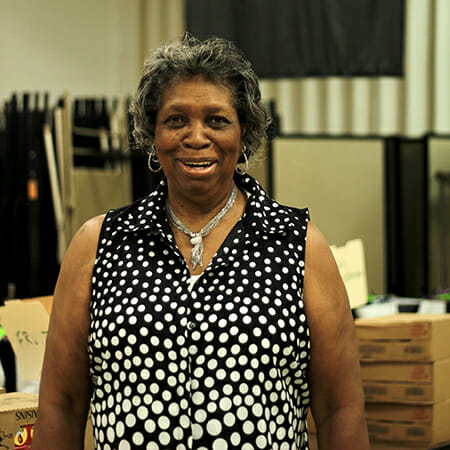
Barbara Gaines has spent over 15 years volunteering at the St. Jospeh’s Social Service Center, which provides food and clothing to the low income and homeless in the greater Elizabeth, N.J. area./Courtesy Barbara Gaines
Describe your volunteer role with St. Joseph Social Service Center.
I volunteer to sort and distribute food. I help pack food, and receive and sort the clothes and different things and distribute things to the clients who come in. I take care of their meals. I do the soup kitchen on Saturdays. Whenever they have the soup kitchen, I’m the maitre d. I make sure everyone is welcome and I serve food and do whatever I can.
What is your favorite part of volunteering there?
The most important part about volunteering is helping the clients when they come in, and laughing and having fun with them, and making sure they have food and making sure they have clothes. That’s my favorite part of it — making sure they’re well taken care of when they need something.
Are there any events you’ve done that have really stuck with you?
Yes. We have a program [called] Operation Warm Heart that’s part of St. Joseph. It’s at my church. We feed the homeless at church and stay overnight with them, too. We have a place and we go there at 6:30 in the afternoon, and we leave the next morning around 8:30. We give them cots to sleep on. We give them blankets to cover with. We give them a four course dinner, snacks, and we make sure that when they take a shower that they have clean clothes to put on. Then they leave the next day. Sometimes when they leave, we pack them a lunch or snack to take with them. … We do this from December 1 to March 31st, every other Saturday.
What’s it like for you to be able to interact with the clients and what kind of feedback do you get from them?
I love them. They’re always asking me questions, “Miss Barbara can I have this, can I have that?” I just want to be there to lift them up and laugh with them and talk with them. When they come in, I try to welcome them in with open arms. They always just come in with a smile.
Barbara Gaines, center, spends five days a week volunteering at St. Joseph’s Social Service Center./Courtesy Barbara Gaines
Why do you think it’s important for others to give back?
When you have been fortunate enough to have things, you feel people should give back to their community. If I have something that this person doesn’t have, I would like for this person to have it, too. It’s all on us to give to our community.
What’s been the most rewarding part of your work?
The most rewarding part of working at the center is to see a client come in, and we help them and can give them something, and they leave with a smile on their face.
California Volunteer Promotes Grade-Level Literacy Amongst Underserved Children
Meet Daily Point of Light Award honoree Maggie Callahan. Read her story and nominate an outstanding volunteer or family as a Daily Point of Light.
After sustaining an injury at work in 2018, Maggie Callahan was looking for a way to give back to her community. Employing her TESOL (Teachers of English to Speakers of Other Languages) training, the 59-year-old Sacramento, California resident is now volunteering with elementary students, teaching the youngest in her community how to read.
Serving as a volunteer for AARP’s Experience Corps Sacramento, an organization which pairs adults 50 and older with children who aren’t reading at grade level to help them become stronger readers by the end of third grade, Maggie says she’s become a part of the school community and gets just as much out of volunteering as she gives. Volunteering at a school where 9 out of 10 students are socioeconomically disadvantaged and less than half English learners, Maggie is making a lasting difference in the lives of vulnerable children in her community.
What inspires you to volunteer?
I started volunteering as a Girl Scout. Service is just something my family and religious upbringing encouraged from the start. To me, volunteering is being a part of your community.
Describe your role with Experience Corps Sacramento.
I’m known as Ms. Maggie in the classroom, and through our one-on-one sessions and also in the classroom, I’m helping students who are reading below grade level. I work with students on their reading skills twice a week.
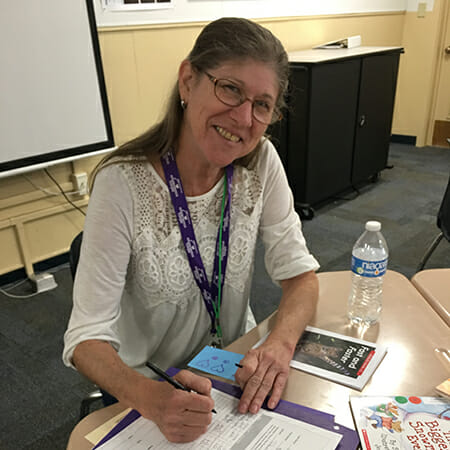
Experience Corps Sacramento volunteer, Maggie Callahan, helps elementary school students reach grade level reading through one-on-one tutoring./Courtesy Maggie Callahan
Share one personal story with me from your volunteerism.
My volunteerism isn’t limited to reading tutoring. I color with one girl and do food prep with another little boy. This one student, I started working with him in the 1st grade. I reconnected with him and tutored him again in the 2nd grade. When we restarted the school year, one of the boys in the group was a little nervous about school. The little boy I’d tutored said to the other, ‘Ms. Maggie is going to help you! She’s really nice.’ This child was easing another student’s hesitation by reassuring him that I was there to help.
Your volunteerism is helping to set these children up for future success. Explain.
The school system I’m working with is in an underserved area. Any little boost in confidence those kids can get to help them start off on a level playing field helps, because If somebody else believes in them, they should believe in themselves. My service also gives these students extra one-on-one time. I am showing these children that there’s somebody besides their parents and teacher that cares about them and is willing to spend time and come in and help them. I’ve gotten to know these kids, so I’ll come in for their award ceremonies and after-school programs.
Why do you think it’s important for others to give back?
As a part of a community, it’s incumbent on you to participate within the community. The small thank you’s I get from kids, or my past students that come up and hug me, you get back more than you ever give. I’m part of the school community.
What’s been the most rewarding part of your service?
It’s been rewarding to see the kids grow in their confidence. One little girl I worked with was always the last one to volunteer. I could see her, practicing what she was going to say in her mind before she’d open her mouth. I’d usually read a passage to the students first, but by the end of the school year she’d come in saying she was going to try it all by herself!
Maggie says she’s become a part of the school community as she sets underserved children up for future success./Courtesy Maggie Callahan
Name your favorite children’s and adult book.
‘Wednesday is Spaghetti Day’ by Maryann Cocca-Leffler is my favorite children’s book. ‘Dolores Claiborne’ by Stephen King is my favorite adult book.
In one word, what does volunteering mean to you?
Community.
How can readers help?
Experience Corps needs help more than ever because of the Covid-19 pandemic. We’ll start virtual volunteering in the fall when kids return to schools, and we’re going to need to triple up to help these kids as they get catched up. Please visit their website for more information about how you can help in your own community.
Certified Volunteer Naturalist Teaches Visitors about Rare Ecosystem
Meet Daily Point of Light Award honoree Randy Haar. Read his story and nominate an outstanding volunteer or family as a Daily Point of Light.
62-year-old Randy Haar says his wife, Chris, is the botanist in their family. “I’d say, ‘that’s a blue flower,” Randy says, “and she’d say, no, it’s from this family because of this (X, Y, Z).” A lifelong love for the outdoors meant the Haar family always did a lot of hiking, but Randy’s volunteerism has focused that appreciation for nature, as he promotes and safeguards one of the rarest ecosystems in the world, right in his own backyard.
As a volunteer with Metroparks Toledo, the Bowling Green, Ohio resident’s nature stewardship involves leading nature tours, conducting restoration and promoting conservation. Randy, an Ohio Certified Volunteer Naturalist (OCVN), is known as a dedicated volunteer who has interacted with more than one thousand park guests since 2011 to teach them about the region’s local wildlife, history, and culture.
What inspires you to volunteer?
Two things. First, I do some amount of sharing with our guests, including talks and leading walks. We hope that in sharing information about our environment, other people catch a little bit of our passion. Secondly, when I started volunteering, I learned how imperiled a lot of our natural areas are.
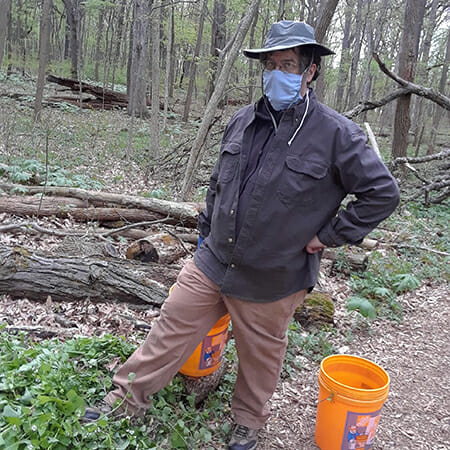
Randy pictured by a pile of Garlic Mustard that he pulled in Wintergarden Park in Bowling Green, Ohio./Courtesy Randy Haar
Why is your volunteerism so important?
You wouldn’t think so, but we happen to have a really globally rare ecosystem consisting of sand oak barrens in northwest Ohio. We’re rated a G2 on the global conservation status ranking, which means some of our plant life is at a high risk of extinction or elimination due to several factors. I work on our natural areas to keep them looking good, maintain plant diversity and eliminate invasive plants.
Describe your role with Metroparks Toledo.
As a volunteer, I conduct our wildflower walks each spring along with my wife, we also maintain an Adopt-A-Natural-Area to remove invasive plants from the rare habitat. I also do plant monitoring, presentations and other stewardship projects.
List some of the flowers you spot on your spring wildflower walks.
How does your volunteerism help to educate others?
Skunk cabbage is not a rare plant, it’s a very common plant. It’s a plant that most people would never say, ‘this looks like a flower’. It’s a very unusual flower because it’s the earliest plant that flowers in this part of the country. It generates enough of its own heat, if it happens to snow when the plant has come up, it’ll melt the snow around it. This is an example of how we share our expertise with our guests. Skunk cabbage is something people would probably ignore otherwise, but we always point it out because it’s certainly one of our favorite plants.
You’re an Adopt-A Natural-Area participant. Explain.
Along with my wife and another volunteer, we adopted a small portion of the Oak Openings Preserve Metropark in 2017, a conservation partnership between Metroparks and Green Ribbon Initiative. We mostly remove invasive plants from our rare habitat. As a country, we’ve brought in all these Asian, European and Eurasian plants because they look pretty, and they don’t have any competition or predators that want to eat them and they run through and push out other native plants. No park system ever has enough people to do everything they want, but you start seeing impacts of your work, you’ll go through an area you’ve visited before and you won’t find any invasive plants. Even though the job is never “done,” it’s knowing we are making a difference.
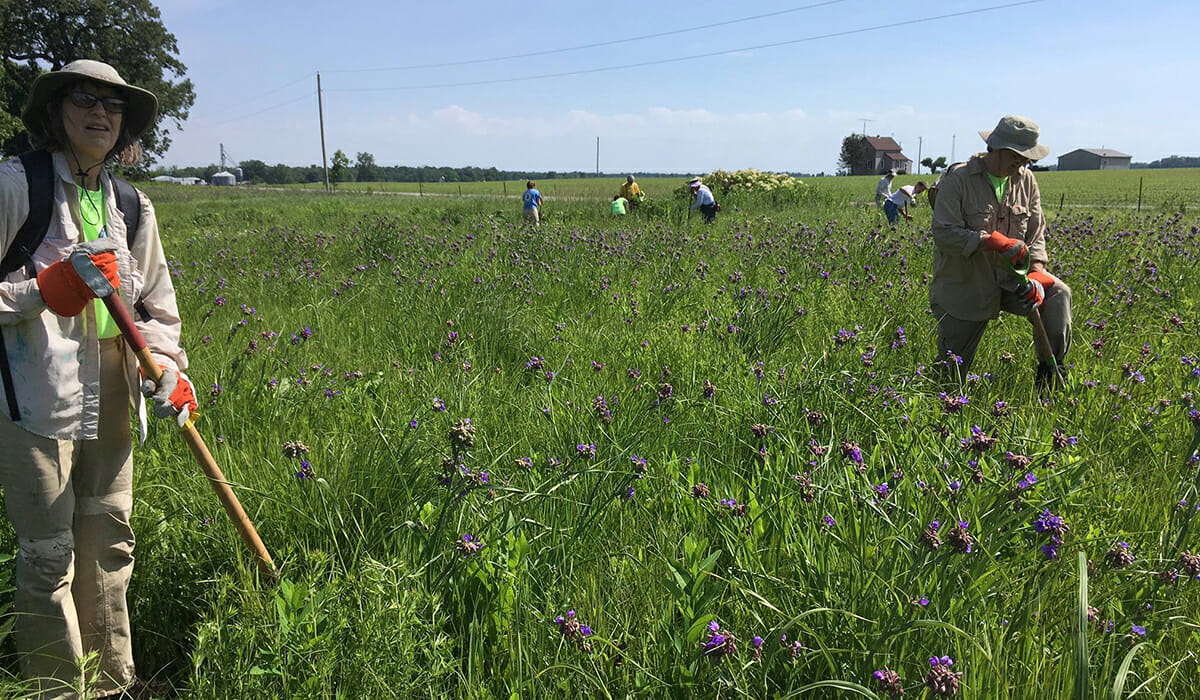
Randy Haar (pictured right) along with his wife at Daughmer Savannah State Nature preserve. Randy promotes and safeguards one of the rarest ecosystems in the world nearby his home in northwest Ohio. Randy pictured digging out Teasel, an invasive plant./Courtesy Randy Haar
Why do you think it’s important for others to give back?
If everybody gives a little or a lot, whatever they can, you do make a difference. I am fortunate that even though I’m not retired, I work at a community college and I have more time in the summertime for service. It is incredibly fun to volunteer leading walks. You’ll go out and there are 15 people waiting for you, they’re always excited.
You also volunteer for other nature organizations.
Native American Volunteer Fights Discrimination and Advocates for Indigenous Peoples’ Rights
Meet Daily Point of Light Award honoree Dylan Baca. Read his story and nominate an outstanding volunteer or family as a Daily Point of Light.
As a child, Dylan Baca learned about his rich Native American heritage by spending time with family. Visiting Cibecue, Arizona where his mother’s family is from, he’d walk with his beloved great-grandmother around her land, finding pottery pieces, beads, and arrow heads in the corn field. One day, walking with his grandmother, aunt and great-grandmother, his grandmother picked up a very beautiful shard of pottery beneath a huge black walnut tree. She handed it to small Dylan, saying ‘never forget where you came from.’ Dylan says these words have defined his life and secured his connection to his culture and history, as he struggled with his own identity as a interracial child, reaffirming his position belonging not just to one people, but to several.
It was as the Pinetop-Lakeside, Arizona teen, a member of the White Mountain Apache tribe and also part Navajo, now 18-years-old and a rising high school senior, grew in his community, that he noticed discrimination against his family, and inequities Native Americans face nationwide.
“Native Americans are an overlooked population within the U.S., vastly ignored for the most part. Personally, I’ve been shielded from the discrimination and stereotypes, but I have witnessed discrimination affect family members. It hurts. Why does one person feel that their race is more superior to another? We’re all people. It made no sense (at the time). It still doesn’t make sense.”
Determined to spotlight those disparities and erase stereotypes, Dylan founded Indigenous Peoples’ Initiative in 2019, advocating for Native Americans, raising awareness about the indigenous peoples’ experience and joining hands with others to promote change for marginalized groups experiencing adversity. His first priority, working to abolish Christopher Columbus Day, a national holiday that has transformed into a controversial celebration for some, as modern historians have exposed a legacy of brutality and violence committed by the explorer.
Dylan Baca: “Native Americans are an overlooked population within the U.S., vastly ignored for the most part. Personally, I’ve been shielded from the discrimination and stereotypes, but I have witnessed discrimination affect family members. It hurts. Why does one person feel that their race is more superior to another? We’re all people.”
“Since time immemorial, Native Americans have been seen as savages of the U.S., even referred to that in founding documents, the term ‘redskins’ was used. (Since then,) treaties have been broken with the U.S. government. These are important factors to understand. Native Americans were in the U.S. first before any settlers came. Our organization focuses on removing Columbus Day and replacing (the day) with Indigneous Peoples’ Day, because that heritage reflects colonization, something that is deeply painful for Native Americans.”
First lobbying and providing education for a more positive narrative for indigneous peoples to ensure that educated policy decisions are made by those in power, Dylan is also working to form partnerships with and share messages of organizations like National Congress of American Indians, Missing and Murdered Indigenous Women and the Indigenous Peoples’ Caucus. His volunteerism with Indigenous Peoples’ Initiative became a rapid response effort once the Covid-19 pandemic struck, as marginalized populations across the country were disproportionately devastated by the deadly virus.
Distributing donations for EMS, fire department, Whiteriver Police Department, jails, doctors, and people within the community in need of supplies, Dylan got life-saving PPE like N95 masks for the Johns Hopkins Center for American Indian Health and first responders, in addition to donated supplies for the White Mountain Apache tribe Covid-19 Distribution Center like food, toys, hand sanitizer, gloves and masks. Dylan is now helping to cut out gowns for first responders who are in need of them.
The assistance has been critical for populations who are often scraping by on the reservation where the virus has run rampant, says Indigenous Peoples’ Initiative vice president Madeline Jones, many living without running water or electricity. Madeline, a classmate of Dylan’s who lives in neighboring Lakeside, Arizona, says her own experiences with discrimination have motivated her desire to advocate for equality.
“We’re all in this together. We must stick together and help each other out so we can eventually be equal with everyone. I’m mixed with black and white. Seeing my family being called the N-word, having people hold their purse tighter when they walk past, is just horrible. For Native Americans, it’s almost the same. They were ripped off their land and had to move away from where they were living.”
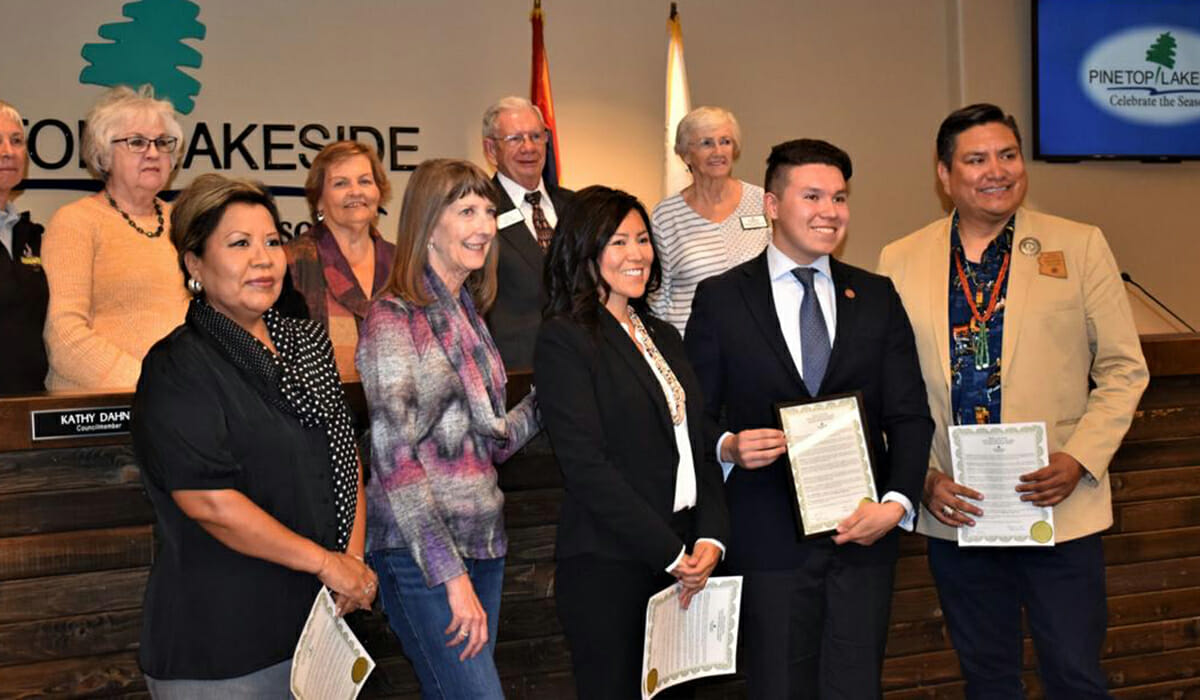
A resident of Pinetop-Lakeside, Arizona, Dylan (2nd from right) lobbied the town to pass a proclamation to recognize Indigenous Peoples’ Day in lieu of Columbus Day. /Courtesy Dylan Baca
Saying volunteerism is his way to do something bigger than himself, Dylan is working on the 2021 legislative session at both the state and federal level to continue his efforts on Indigenous Peoples’ Day, and remains committed to providing essential resources to his community during the pandemic. On recent nationwide protests against discriminatory policing, Dylan says while the fabric of the U.S. is changing at a rate we’ve not seen in recent history, the country still has much progress to make.
“While I have faith in the American people and it is my hope to be put out of a job, I do not believe that is realistic,” says Dylan. “While the United States has changed over many decades, there are still many different forms of systemic racism that still exist and affect minority communities daily. It is my hope that as a people, we can put our differences aside and work together with cooperation and mutual respect for one another to make this nation one that truly aligns with democratic principles. Until then, I will continue to work to end stereotypes and systemic racism within marginalized communities.”
Eagle Scout Uses Project to Create Herpetarium for His School
Meet Daily Point of Light Award honoree Vincent McKinney. Read his story and nominate an outstanding volunteer or family as a Daily Point of Light.
Vincent McKinney has been passionate about reptiles for as long as he can remember, as far back as to when he was only two years old. Now 14, Vincent has put that passion toward creating a herpetarium at his school, as well as a Herpetology Club, in order to help teach his fellow students about the animals and environmental conservation.
The Bluford, Ill.-native started work on the Wayne City School Herpetarium in January 2019 as part of his Eagle Scout project. He met with the school staff and board, worked on advertising, recruited volunteers, planned fundraisers, tracked donations and inventory, and spent a significant amount of time conducting research on the best reptiles to house in the herpetarium, including looking into the necessary tanks, diet, lighting and supplies. After months of hard work, Vincent was able to provide his school with a herpetarium containing 19 reptiles and amphibians, as well as four species of insect breeding colonies, all housed in vivariums set up as mini ecosystems.
Vincent now serves as the President of the Herpetology Club, which maintains the herpetarium, hosts reptile presentations for class tours, holds assemblies for schools within the area, and does public demonstrations. As Vincent enters high school this year, he plans on starting a club there, too. The club’s efforts have reached several thousand people with the message to love and protect the natural world.
Describe your volunteer role with the Wayne City School Herpetarium.
For my Eagle Scout project, I created the Wayne City School Herpetarium, which is a zoological exhibition space in a learning environment where students care for reptiles and amphibians. The herpetarium currently includes 19 reptiles and amphibians, as well as four species of insect breeding colonies, housed in vivariums set up as mini ecosystems. My project also allowed a new club to be formed, the Wayne City School Herpetology Club. I planned, developed and made this project from start to finish, and I now serve as the President of the Herpetology Club as we continue to maintain the herpetarium.
What inspired you to start this?
As a Scout for over half my life, there’s always been a heavy focus on community service and conservation. These ideals have become a part of me, so I was inspired to do this project because I’ve always loved reptiles and nature. Trying to come up with an Eagle Scout project, I brainstormed with my parents and they asked if I would be interested in doing a more typical Eagle project like a pavilion or a flag pole or a memorial prayer garden, but I’ve never really been much of a carpenter or gardener. They told me I better pick something that really interests me or the project might not ever get done. I came up with the idea to do a project involving reptiles at the school because I really enjoy taking care of my pet snake that I got for my tenth birthday. I’ve always loved the reptile exhibits while visiting zoos, aquariums, and nature centers. I also liked the idea of doing it at the school because it gave many people, especially other kids, the chance to enjoy them on a daily basis. So, we discussed how I could make this work as an Eagle project and how I should go about doing things.
What does your Herpetology Club do?
We have individual members, as well as zoo keepers and leadership positions like president and vice president. All of them help take care of the reptiles at the school individually whenever they’re called in during their free time at school. We also hosted a ‘Name the Reptile’ contest that allowed the whole school to participate even if they weren’t in the right grade. They submitted votes and we picked out the ones we liked and sounded the best, which eventually named all the reptiles. We also do assemblies at other schools where we talk about conservation education and things the people at the schools can do to help.
What kind of feedback have you gotten from your classmates about the herpetarium, the assemblies, and the other activities you’ve done?
There’s actually been a great turnout of how many people have joined the club and have helped with it. Along as with the assemblies, everyone said it was great. … A lot of people love the reptiles. There’s a few people who are afraid of the snakes, but they say they are actually getting over their fears because of all the animals being in there and positive feedback from other people, and also being able to handle [the snakes themselves], realizing it’s not actually dangerous or going to hurt them in anyway.
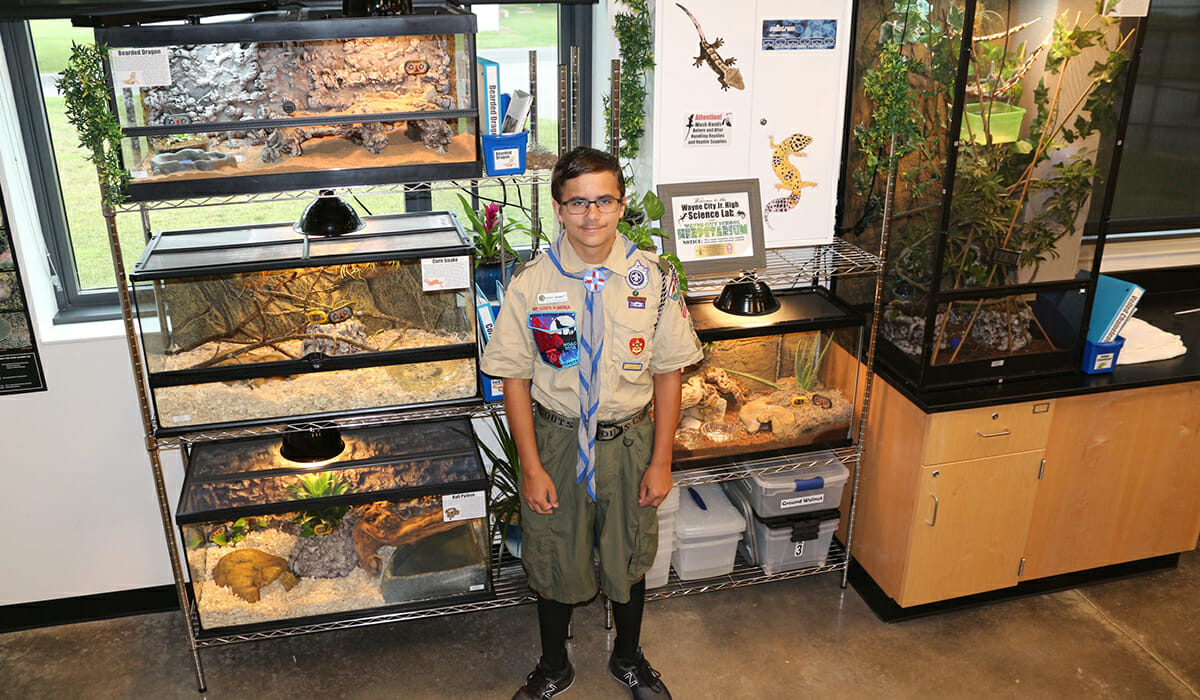
Vincent McKinney stands in the Wayne City School Herpetarium that he created as his Eagle Scout project./Courtesy Vincent McKinney
What’s been the most rewarding part of your work?
Through this project, I learned leadership skills and learned to help and serve others. I have also learned about time management, responsibility, budgeting, and to be prepared, which is the Boy Scout motto. I also learned more about reptiles and environmental conservation. I also saw the good in people because they went far beyond my expectations to contribute toward my project. It was rewarding seeing all the support, donations and appreciation everyone gave toward my project. I’m truly grateful for everyone who helped contribute toward it. If it weren’t for them, it wouldn’t have reached the level it achieved. I also saw that people were generous and inspired by my project. I feel I am a more grateful leader because of it.
Why do you think it’s important for others to give back?
Some of the most life-changing and world-changing positive events happen because people are passionate enough and care enough about a cause that they take the time to help others. Without the many dedicated volunteers who took the time to help me in my journey through scouting over the past eight years, as well as those outside of scouting that contributed toward this project, it wouldn’t have happened. Many of the kids would have missed out on this life-changing opportunity to learn about nature, helping others, responsibility, leadership, and knowing the important role that such delicate creatures have on our lives and the planet as a whole. I feel like I owe it to everyone else who took their time to help me and show my gratitude.
What do you want people to learn from your story?
I would like other people to learn that it takes a lot of training to effectively lead and teach. I also would like them to know to never stop working hard toward your goals, and success comes with a lot of work. Having a true passion for something good can encourage others to care too, and can impact far beyond your expectations.