Teen Volunteer Brings Hope & Curbs Violence to Help Kids “Bmore Safe”
Meet Daily Point of Light Award honoree Quintrell Reese. Read his story and nominate an outstanding volunteer or family as a Daily Point of Light.
He’s just 15, but Quintrell Reese has already suffered tremendous personal loss, counting his cousin and aunt amongst the hundreds who are killed each year in Baltimore as a result of gun violence. Describing the deep pain he felt with each loss, Quintrell has dedicated his time to curbing gun violence and keeping his community safe.
As a volunteer leader with the Bmore Safe Project, an initiative facilitated by Let’s Thrive Baltimore: Youth in Action., the rising high school sophomore says his younger brothers inspire him to make his community safer. “Cleaning and greening” his neighborhood to help drive violence and drug dealers out, Quintrell has led volunteers in more than 100 community cleanups and a handful of peace walks in the past two years, working to make sure residents in Baltimore don’t just survive, but they prosper.
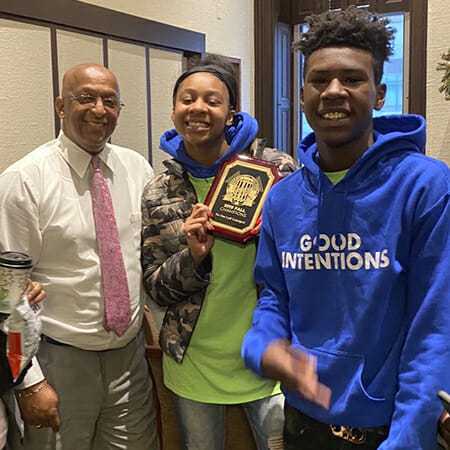
Quintrell pictured with Baltimore Mayor Bernard Young after winning 1st place in the Bmore Cleanup Cup./Courtesy Quintrell Reese
What inspires you to volunteer?
I lost a cousin, aunt, and a lot of people that I loved to gun violence. It hurt me real deep to lose these people, and I don’t want to see my little brothers go through the same pain I went through. I’m trying to help out in the community to stop the violence.
Describe your role with Bmore Safe Project.
As a volunteer for the youth-led Bmore Safe Project, I lead peace walks and help other kids and family members of gun violence victims out. We plant flowers and bushes for our cleanups, and also hold cookouts at block parties to bring the community together.
Share one personal story with me from your volunteerism.
At our peace walks, I see the expression on peoples’ faces. They tell me to keep up the good work. If I had somebody to be there for me when my aunt or cousin were killed, then maybe I’d have looked at their losses differently. I’m trying to help other kids not to have to suffer from the pain I did. These people see me in the streets, they’re following my lead.
Why do you think it’s important for others to give back?
I volunteer because I like helping out.
In one word, what does volunteering mean to you?
Peace.
When you’re not in school or volunteering, what do you do for fun?
I play basketball (point guard) or football (wide receiver and cornerback). I like Cam Newton, so I’m for the Patriots now.
How can readers help?
Please visit the Let’s Thrive Baltimore website for more information about how you can help.
Tampa Mom Helps Provide Thousands of Diapers to Community Members in Need
Meet Daily Point of Light Award honoree Lyndsey Siara. Read her story and nominate an outstanding volunteer or family as a Daily Point of Light.
One in three American families report experiencing diaper need, which can result in not only physical consequences for the baby, but also mental health consequences for the family or caregiver. Further, with most childcare centers requiring parents to provide a day’s supply of disposable diapers, the lack of this basic need can also prevent parents from working or going to school to further provide for their child. Along with her fellow volunteers at the Junior League of Tampa, Lyndsey Siara is looking to change that for her Hillsborough County, Fla. community.
Lyndsey serves as the Chair for the League’s Diaper Bank Project, which supplies diapers, wipes, diaper rash cream, and period products to nine community nonprofit agencies on a monthly basis, and many more on an as-needed basis. These community partners include organizations working toward preventing child abuse, supporting victims of domestic violence, and supporting teen parents balancing parenthood and completing school. Since its inception in 2018, the Diaper Bank has distributed over 454,000 diapers. Over 207,000 of those diapers have been distributed since March during Covid-19 relief. All while working full time and parenting her two small children, Lyndsey along with her team of volunteers help run the Diaper Bank by purchasing products, sorting donations, and packaging the products for the program’s partners.
“It is deeply important to me that I model for my children a servant’s heart, to care for their fellow humans, and to give selflessly to others,” Lyndsey said. “Every person can make a positive difference, and I’m just trying to make mine.”
Describe your volunteer role with the Junior League of Tampa Diaper Bank.
I am currently the Chair of the Junior League of Tampa Diaper Bank Project. It’s a project within the larger Junior League of Tampa organization. This is one of our many projects. This is going to be our third operational year. I’ve been involved since the inception. I first was a coordinator that was basically responsible for the operation, so purchasing and making sure we actually got the product out the door. Then last year I served as a Co-Chair with one of my fellow volunteers, and then this year I’m serving as the Chair of the Diaper Bank Committee.
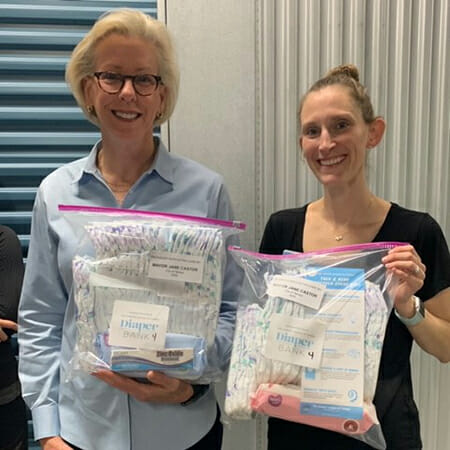
Lyndsey Siara, right, stands with Tampa Mayor Jane Castor with some of the products the Junior League of Tampa Diaper Bank has collected to help reduce diaper-need in Hillsborough County, Fla./Courtesy Lynsey Siara
Why was the Diaper Bank started?
We started the Diaper Bank after realizing there was not a diaper bank serving Hillsborough County. Hillsborough County is quite large. We have a population of nearly 1.5 million people, and approximately 15% live below the poverty line, so it was kind of shocking that there was not a bank servicing specifically our area. There is a diaper bank that services Pinellas County, which is across the bay from us, but there wasn’t a bank that was specifically servicing Hillsborough County. We realized the depth of the need after Hurricane Michael had come through and one of our League members had heard on the news the need for diapers and started researching where in this area she could donate diapers. That’s how we discovered there really wasn’t a diaper bank covering our area. That’s why it started, and it fits perfectly in line with the Junior League’s larger goals and missions.
For someone who may not be a parent or realize the seriousness of having access to diapers, can you talk about why having the Diaper Bank is so important to families in need in your area?
We’re a member of the National Diaper Bank Network, so we’re one of the member diaper banks. The network does a lot of advocacy and larger-scale education on diaper need. Based on their research, one in three American families report experiencing diaper need. Any parent knows how expensive diapers are — infants require up to 12 diapers a day and toddlers require up to eight, so it’s an average cost of $70-80 a month per child. Sadly there’s no state or federal child safety-net program that allocates dollars specifically for the purchase of diapers. WIC and food stamps, those don’t cover diapers, so any assistance that a family might be getting, the purchase for diapers goes in the same pot of what would be needed to pay for your rent or your utilities or your grocery bill, or whatever the case may be. … The babies need clean diapers. Without them, there’s all kinds of unfortunate consequences that can flow from not having clean diapers. Obviously there’s health consequences for the actual child, but there’s also documented research on the impacts of the caregiver and the feelings that are associated with not being able to provide what your child needs. It can be very damaging for the caregiver and the family unit. In addition, when families don’t have the diapers for the children, children can’t go to early childhood education programs or daycares because even the subsidized programs require parents to bring the diapers. You have to have a supply of diapers to drop your kid off at daycare so you can go to work or school to advance yourself. What you’re seeing is that diapers can be the linchpin in the cycle of poverty. If you don’t have them, then you can’t go to work, you can’t go to school to better yourself. They are a necessity, and they’re so expensive.
How do you distribute the diapers?
[The Diaper Bank] operates on a community-partner model, which means that we work with other nonprofit organizations within our community. We provide the diapers to those organizations that are running diaper programs, and they distribute them to their clients and users. For example, one of our organizations might have parenting classes, so the clients, the in-family user, would be coming to a parenting class and they would be provided a supply of diapers from our Diaper Bank in coming to those parenting programs. Some of our other partner organizations, they’re constantly visiting with their client families, so the case manager would bring diapers when they go visit with the family and when they’re otherwise providing services to the family. … Whenever we have a family in need, we direct them to one of our community partner agencies so that family can also be wrapped up in that service and any other services they may need that our partners offer.
Are there any future partnerships, programs, or events that you are excited about?
We are always pushing people to donate. … We adjusted our operations accordingly [due to Covid-19], but the fundraising piece, and the trying to get community donations and support, that piece is still in the development phase. I do know we’re going to be pushing out some campaigns around trying to get people to donate. We’ve been looking at some platforms almost like crowdsourcing where people can donate what they can donate and it all pools together to purchase a pallet of diapers or whatever the item is we put up there. We will have some campaigns that we will be pushing out on our website in the near future. People can donate at any time on our website or at our drop stops. We also have an Amazon wishlist, so we can be searched on Amazon and people can purchase the specific items they feel passionate about. They ship directly to our storage facility.
We’ve always provided period products as something our partners could order from us, but a couple months ago we officially became members of the Alliance for Period Supplies. That is an initiative of the National [Diaper Bank] Network, so that’s where the focus on the period products stemmed out of. We became members of APS and we’re going to be building out that arm of our operations this year. By doing that, we’re able to take on organizations and partners that maybe aren’t interested in diapers but they are into period products, so schools and populations that might not have children. We’ll be focusing heavily on combating period poverty in our area as well.
What’s been the most rewarding part of your work?
The most rewarding part is knowing that we’re making a difference. I have two children of my own and one is still in diapers. As a mom, I cannot imagine the feelings that you would feel if you could not provide such a basic need for your children. Our partners tell us all the time how thankful and grateful and life changing it is that we’re able to provide a basic need for their families. I think it’s just knowing that you are helping another family. You’re helping to keep a baby healthy and dry and safe, and you’re helping that family be able to go to work or go to school. You’re reducing the stress that is associated with not having clean diapers. It’s not just about a diaper. There’s so much more associated with diaper-need. And then for the relationships with our partners, we are huge help for them because they’re not having to allocate their own budget and dollars, which are often seriously lacking, or they otherwise just couldn’t provide diapers. It’s a great partnership because we’re able to support our partners in achieving their individual missions as well.
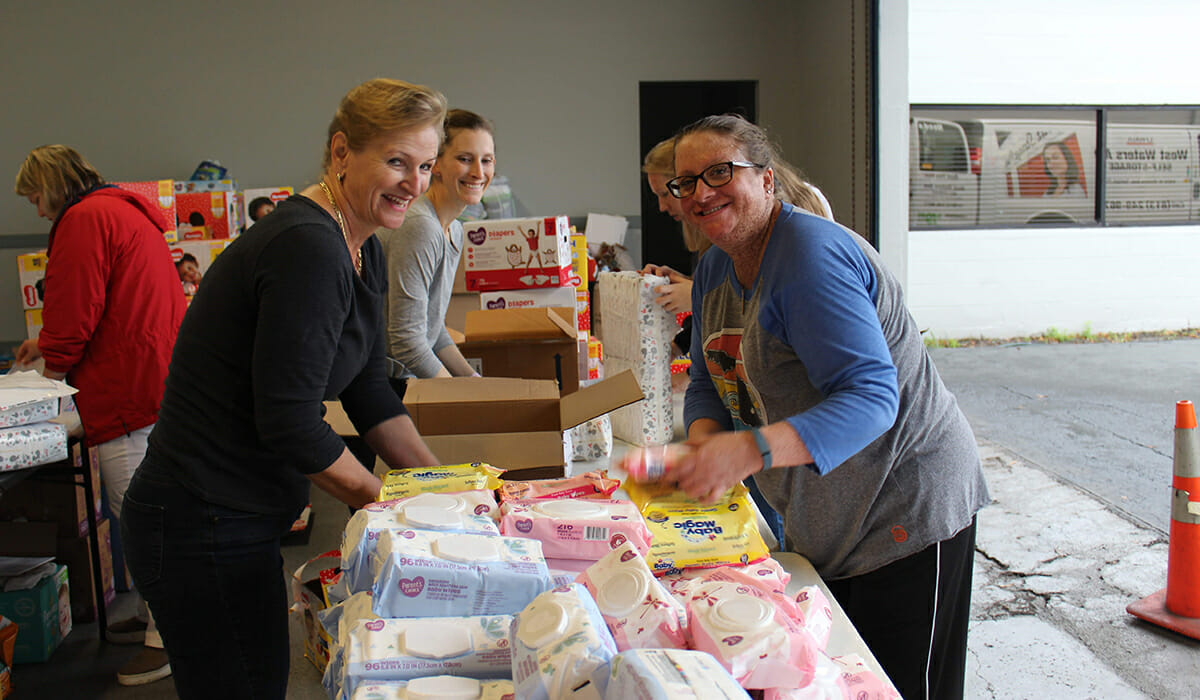
Lyndsey Siara, second from left, helps to sort products collected by the Junior League of Tampa Diaper Bank, which provides diapers, wipes, diaper rash cream, and period products./Courtesy Lyndsey Siara
What have you learned through your experiences as a volunteer?
Even though I am a mother and I was a mother when I got involved in this project, I don’t think you fully understand diaper-need, or realize it is such the deep social issue that it is and the sort of the spider effect it can have. It’s not just about the diaper. Without it, you can’t go to school, you can’t go to work, you can’t drop your kid off at daycare. Then the health consequences, both physical and mental consequences, that can flow from having to stretch diapers or leave a baby in a dirty diaper. I think I’ve learned a great deal about a social issue that most people don’t understand exists or don’t realize is out there. … Even though you put a diaper on you kid every day, you don’t necessarily realize that people can’t afford to do that. Once you realize that is the case, it’s shocking and it’s heartbreaking. I would never want another mom or caregiver to have to feel like that if they weren’t able to put a diaper on their baby.
Why do you think it’s important for others to give back?
To make it a better place. For me too, a lot of it with my kids is showing my kids that it’s a generational thing for me. I want my children to see that I spend a significant portion of my free time trying to help the community and make it a better place and help impact positively our fellow community members’ lives. I want them to see that spirit of giving and caring. You can do anything with your time — you can watch TV, you can read books, you can do things that are for you — but I want them to see that a lot of my free time is given selflessly and with a lot of compassion and care to others to try to make their lives better. I hope that by doing that — even though how young they are, they probably don’t totally understand — it’s ingrained in them from such a young age. I’m hopeful they’ll want to model that behavior. I know my five-year-old understands, because before this Covid thing happened, she would come with me and help me package up diapers. She recently asked me, “How come I can’t [help]? I want to go help you with the diapers,” so I know she does understand. I want to model for them how to be a good community member.
Saying “Bye Bye” to Plastic Pollution, Teen Volunteers to Help Underserved Communities
Meet Daily Point of Light Award honoree Karina Samuel. Read her story and nominate an outstanding volunteer or family as a Daily Point of Light.
As sea levels rise, chronic coastal flooding and increased storm surges due to global warming have become familiar concerns for South Florida residents, says 15-year-old Karina Samuel. The Coral Springs, Florida teenager adds that poorer communities have been disproportionately affected by climate issues, an inequity that she decided to address through service.
Launching the Florida chapter of Bye Bye Plastic Bags (BBPB) in 2019, a youth-led global organization whose mission is to raise awareness about the harmful impact of plastic on the environment, animals and health, the rising high school junior counts about 70 volunteers across Miami, Tampa and Key West – all working to make the Florida coast healthier. Helping to raise more than $10,000 for BBPB thus far, Karina is changing her community, one plastic bag at a time.
What inspires you to volunteer?
I have a passion for helping underrepresented voices and trying to make as much of a difference as possible when I can. I’ve always been invested in climate justice, and living in Florida, I’ve seen the effects of inequalities and how they disproportionately affect poorer communities.
Describe your role with Bye Bye Plastic bags.
As founder of the Florida chapter for BBPB, I fundraise, maintain communications with volunteers and other chapters across Florida and I participate in monthly meetings with our global heads. Also, we hold weekly organized beach cleanups and I’ve published research and articles in Green Zine.
Share one personal story with me from your volunteerism.
Everytime we go out for cleanups and see the trash and negative impact people make when they are careless, it’s a constant reminder that we need to do more. We always see plastic water bottles during the cleanups. Also, soda cans and plastic wrapping from food containers and take out.
Why do you think it’s important for others to give back?
I’m not the person who will feel the majority of the negative implications from climate change, and that’s why climate justice is so important. It disproportionately affects poorer communities, people who can’t go out and volunteer for change. Those who are capable of volunteering have the responsibility to go out and address these different community problems.
What’s been the most rewarding part of your service?
It’s rewarding seeing the community and bonding experience every time we complete a cleanup, and feeling accomplished when our area of the beach is clean.
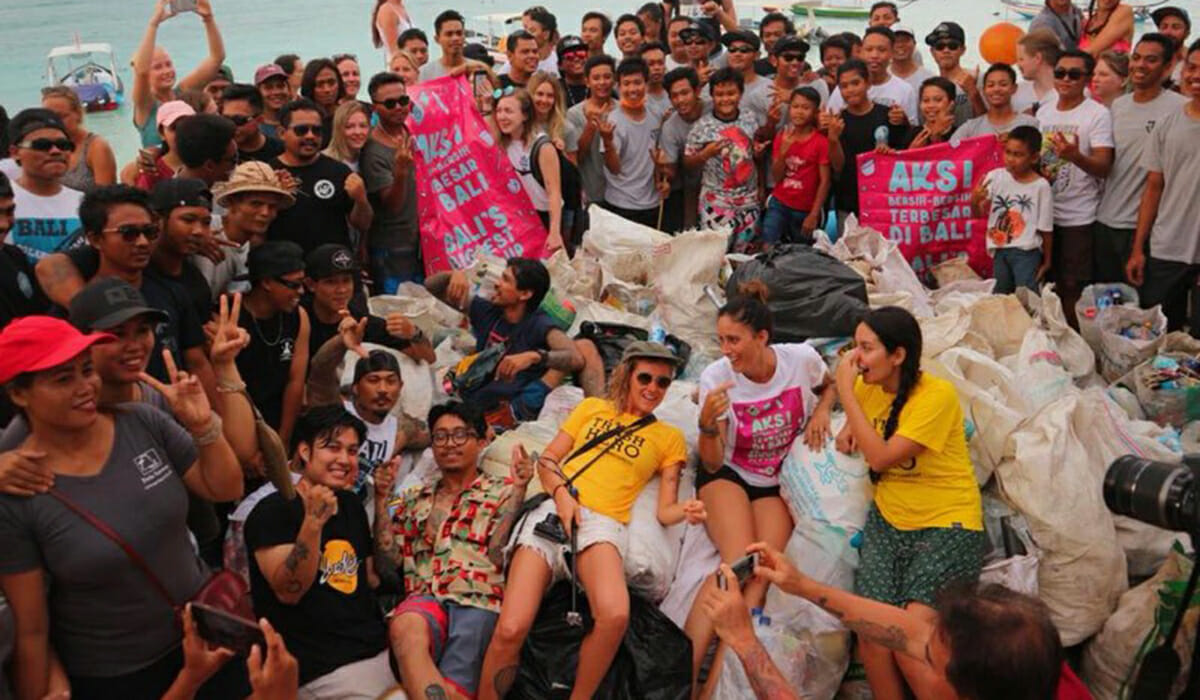
Bye Bye Plastic Bags international cleanup attendees in Bali, Indonesia./Courtesy Karina Samuel
In one word, what does volunteering mean to you?
Satisfaction. It’s a very satisfying feeling to know we worked together to accomplish a goal and it went well.
When you’re not in school or volunteering, what do you do for fun?
I play volleyball and tennis. I also go to the beach. My favorite beach to visit is South Beach in Miami.
How can readers help?
Please visit the Bye Bye Plastic Bags website for more information about how you can help.
Teen Recycles Art Supplies to Benefit Earth & Underprivileged Children
Meet Daily Point of Light Award honoree Anaisa Acharya. Read her story and nominate an outstanding volunteer or family as a Daily Point of Light.
17-year-old Anaisa Acharya says she’s always been interested in art, gravitating towards painting and coloring as a creative outlet in her life. The Naperville, Illinois rising high school senior, a first-generation American, is now providing that same opportunity to underprivileged children around the globe by providing them with recycled art supplies.
Founding Colors4Change in 2019, Anaisa donates art supplies ranging from colored pencils to crayons to children in need at local hospitals, homeless shelters, schools and partnering non-profits. The teen says not only is she able to help children with her recycled art supplies, but the environment as well, saving discarded, non-biodegradable crayons and giving them a second life. Helping hundreds of children across greater Naperville and internationally and donating more than 922 pounds of art supplies thus far, Anaisa is changing her community and beyond through her volunteerism.
What inspires you to volunteer?
I’m extremely privileged to have everything at my fingertips. I never had to worry about what colors I could buy for my artwork, or if I had the ability to go to school and have an education. I noticed nonprofit organizations provided basic necessities to underprivileged children, but I wanted to provide something creative and fun for those who don’t have as many opportunities.
What kind of art supplies are you recycling?
We donate crayons, colored pencils, markers, pens, pencils, paper, crafts, backpacks, book bags and pencil cases. One time, we got crayons that were melted into different Christmas designs. We assembled little Christmas crayon donation packages to bring to local homeless shelters. We are helping to preserve the environment by recycling these art supplies, as some – like crayons – can take anywhere from decades to a century to decompose.
Describe your role with Colors4Change.
As founder and CEO, I make sure that the entire organization is working together. I delegate tasks among my board members, organize fundraisers, work with volunteers and manage our publicity. I contact international and local organizations to solicit donations, and also manage our art supply package distribution. Lastly, I’ve helped train and head the New Jersey chapter of Colors4Change, which just launched in 2020. We donate to local facilities in Illinois and international organizations as far away as the Adibasi Welfare Society in India, Baileys Basic School in Jamaica, SOS Children’s Villages in Greece and ActionInAfrica in Uganda.
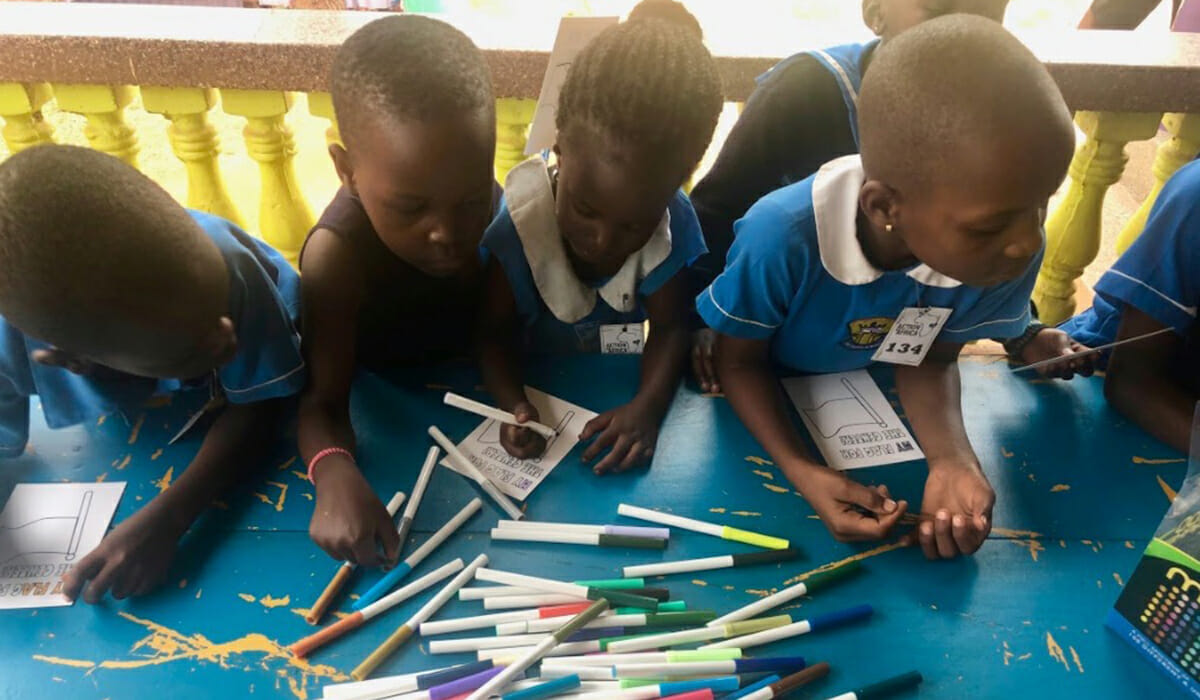
By partnering with ActionInAfrica, Colors4Change was able to send boxes of art supplies to children in Uganda. /Courtesy Anaisa Acharya
Share one personal story with me from your volunteerism.
The Lazarus House asked me to drop off art supplies at their women’s shelter, and when I walked in the door, there were three little kids sitting at the table. I was holding a box of crayons and colored pencils, and they got really excited. Many underserved facilities don’t have the luxury of purchasing art supplies because their priorities are food, clothing, shelter and education. We are helping organizations to foster creativity within children, which can in turn help children to develop mentally, socially, and emotionally, boosting young kids’ abilities to analyze, problem solve and improve their fine motor skills. That was a moment of feeling super grateful and so happy that I was able to make a difference for someone else.
Why do you think it’s important for others to give back?
It’s so important to give back and dedicate your time, efforts and money to help someone who really needs it. If you’re in the position where you’re able to give back, consider how important it is to help people who are in much worse living situations than us, and who don’t have the means to provide for themselves and their children.
Explain how your service has shifted due to the Covid-19 pandemic.
We’ve shifted focus to provide food and cleaning supplies to local homeless shelters. We’ve also raised over $5,000 to buy surgical masks for nursing homes. During the pandemic, I dropped off masks at Tabor Hills, a senior assisted living facility. The ladies at the front desk started crying because they hadn’t received any supplies. I was extremely touched, and I didn’t realize that so many people in my own town were going out and risking their own lives to help others. That was a really great volunteer moment for me, to realize how much of an impact I’m really making.
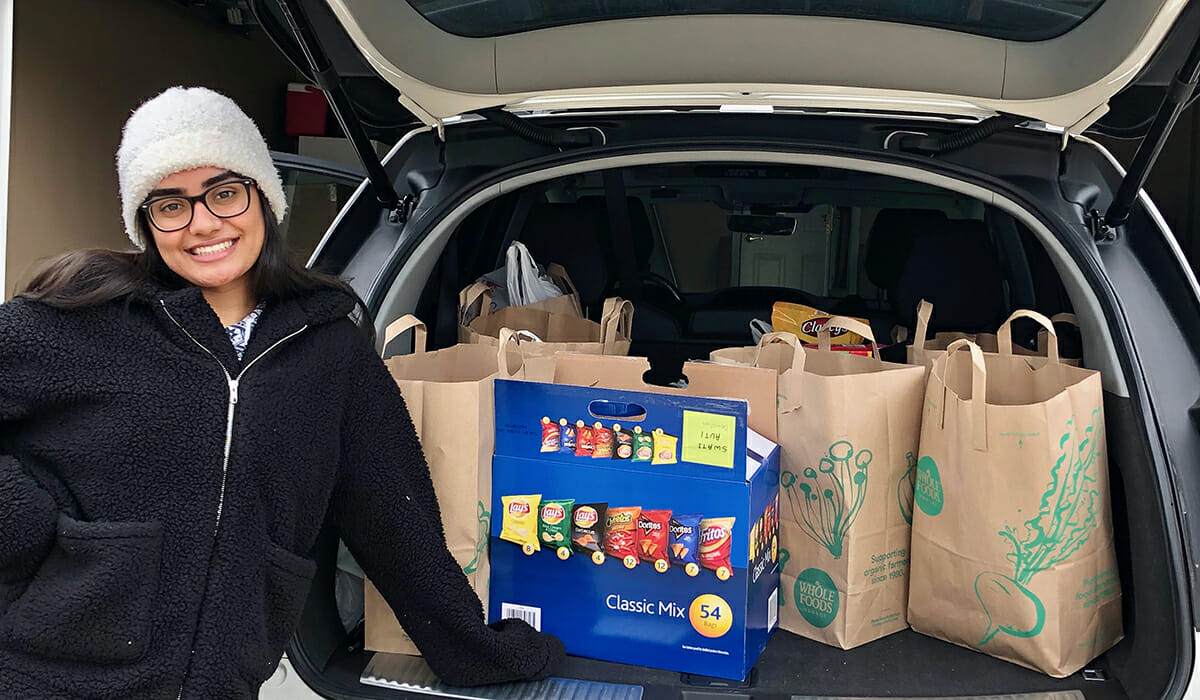
During the Covid-19 pandemic, Colors4Change collected and donated food supplies to local homeless shelters. Anaisa Acharya pictured with a donation shipment. /Courtesy Anaisa Acharya
In one word, what does volunteering mean to you?
Fulfillment.
When you’re not in school or volunteering, what do you do for fun?
I extremely love traveling, although it’s not possible in this moment. I love fashion and photography. I write about important social topics and lifestyle topics on my blog. I have photoshoots with my friends and hang out with them.
How can readers help?
Please visit Colors4Change’s website for more information about how you can help.
Decade After MS Diagnosis, Volunteer Moves Mountains to Ease Path for Others
Meet Daily Point of Light Award honoree Diane Kramer. Read her story and nominate an outstanding volunteer or family as a Daily Point of Light.
October 6, 2010 was the day Diane Kramer’s story began, the turning point for a young wife and mother of two who’d just received a devastating medical diagnosis of multiple sclerosis. “I wasn’t given any information outside of this MS diagnosis,” says the 36-year-old State College, Pennsylvania resident. “I had a neurologist who told me that I’d be in a wheelchair in a year. He sent me a catalog of wheelchairs and hospital beds so I could prepare.” In a twist of fate, an ad for the National Multiple Sclerosis Society in the back of that magazine prompted Diane to reach out for resources, a pivotal moment for Diane and the hundreds of other MS survivors who she’s gone on to help in the years since.
As a volunteer for the nationwide organization, dedicated to helping people affected by MS, Diane, a former nurse, has connected MS survivors to resources, served as a source of support and advocates for change for those moving every day in the fight for their lives. Most recently, joining the call for help in the immediate wake of the pandemic outbreak, Diane has extended her volunteerism by sewing thousands of masks for residents in 48 states across the country.
What inspires you to volunteer?
When I was initially diagnosed, all I had been handed was a diagnosis, nothing else. I felt completely alone. Even as a nurse, knowing a lot about a lot of different things, I had no idea what my next step was. Ten years later, the chaos of the day I was diagnosed is the fuel. I live for the day that we don’t do that anymore to people who are recently diagnosed.
Describe your role with the National Multiple Sclerosis Society.
As a volunteer, I wear a lot of hats. I am an MS activist, district activist leader, and I advocate for change at the state level. I serve as a trustee for the Pennsylvania Keystone Chapter for the National MS Society. I write articles for the MS Connection blog, and generally work to raise awareness. I am an MS support group leader here in State College and have interactions with people who are still having the same conversation I had when I was diagnosed. I’m there to help when there’s nowhere else for them to turn.
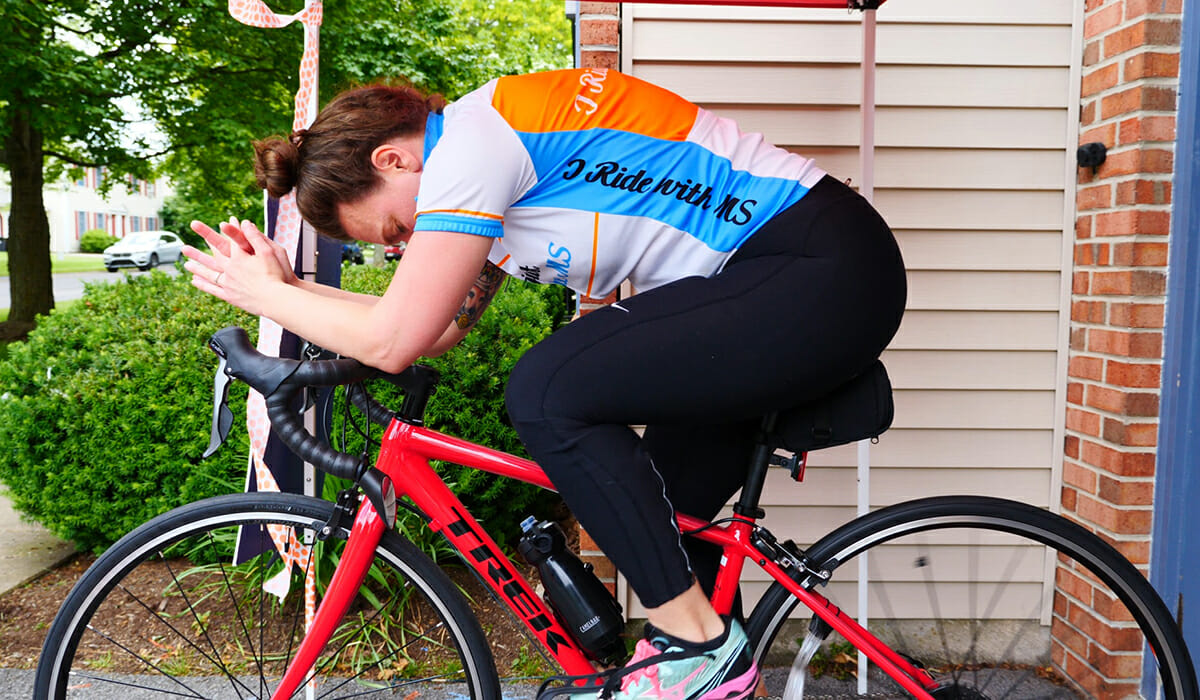
Diane leads a bike team to fundraise for Bike MS called the ‘Myelinators’, named for myelin, the protective sheath on nerve fibers. The team’s motto is ‘No one fights alone’. /Courtesy Diane Kramer
Share one personal story with me from your volunteerism.
I lead a bike team to fundraise for Bike MS called the ‘Myelinators’, named for myelin, the protective sheath on nerve fibers. Our motto is ‘No one fights alone’. My first ride as a part of the team was the Keystone Country Ride which is a 150-mile, two day event. I biked alongside 600 riders and throughout the day, riders would come alongside me and we’d swap stories, just connecting. As I’m riding up this hill in central Pennsylvania, I pass a father and daughter and we introduced ourselves, and then biked on. Seven years later, I was joining the MS Society as a board member, and this guy attending the meeting stands up and says, ‘Diane, I’ve been looking for you for the past seven years. You rode past my daughter and I your first year riding, and you told us you’d try as hard as you could (to fight for others.)” They had no personal connection to MS, and were just riding to support our cause, but this man said he’d thought of me every day the last seven years, hoping I was still fighting. He said, ‘here you are, still walking, still biking, still making those connections. Still showing up’.
Since the start of the pandemic, Diane has sewn and shipped 8,015 donated masks to 48 states across the country./Courtesy Diane Kramer
Why do you think it’s important for others to give back?
I don’t make a lot of money, I live on disability, I can’t give financially, I can only give my story and experience. When I was first diagnosed, people I knew who had MS didn’t look like me and I didn’t feel like they had the same experiences. Not long after, Jamie-Lynn Sigler (famously cast as Meadow Soprano in the HBO hit series, ‘The Sopranos’), was diagnosed with MS. This is an actress whose show I love, she’s the same age as me, her children were about the same age, that was the connection point for me. The more people who give back and share their story helps to build those connections.
What’s been the most rewarding part of your service?
Oh my gosh. Working yourself out of a job. I maintain my Pennsylvania nursing license in the belief I will have a life after MS. My most current project has been making masks during the pandemic. I learned how to sew from my grandmother, I sew and craft to help improve hand eye coordination. Between my local network and distributing across the national MakeMasks network, I’ve personally sewn and shipped 8,015 donated masks to 48 states across the country.
In one word, what does volunteering mean to you?
Everything. Being of service is something I can uniquely do.
How can readers help?
Please visit the National MS Society website for more information about how you can give back.
Military Wife Starts Nonprofit to Provide Service Animals to Veterans and Special Needs Children
Meet Daily Point of Light Award honoree Britnee Kinard. Read her story and nominate an outstanding volunteer or family as a Daily Point of Light.
Britnee Kinard operates on a phrase from one of her son’s cartoons — “see a need, fill a need.” That mentality has led the wife and mom of two to positively impact her community wherever she saw fit, helping military veterans, special needs children and teachers, essential workers and restaurants struggling due to COVID-19, and many more.
After dealing with the challenges that came with obtaining and paying for a service dog for her husband, who is a catastrophically-injured Purple Heart veteran, Britnee started the SD Gunner Fund. The nonprofit, named after her husband’s service dog Gunner, provides the financial means for obtaining and maintaining service animals for veterans and first responders. After her oldest son was diagnosed with autism, she expanded the nonprofit to provide service animals for special needs children and therapy animals for pediatric facilities as well. So far, the organization has provided 65 dogs to not only people in Britnee’s greater Savannah, Ga. area, but also to those in need across the country, from Vermont to California. SD Gunner Fund also provides education grants for teachers of special needs classrooms, pays for their field trips, and pays the past-due therapy bills at pediatric clinics before Christmas.
Britnee’s volunteerism doesn’t stop there. She is a lifetime member of the Ladies Auxiliary Military Order of the Purple Heart and Ladies Auxiliary Veterans of Foreign Wars. She serves as the local chapter leader for Hearts of Valor, an organization underneath Operation Homefront, where she mentors local caregivers of catastrophically-injured veterans. In light of the COVID-19 epidemic, she started Operation Restaurants and Responders, which purchases meals from struggling restaurants and sends them to essential workers. She is also in the process of starting an additional nonprofit, a Georgia chapter of SCUBAnaughts International, in order to teach local kids marine biology and how to protect the ecosystem through scuba diving.
Describe what SD Gunner Fund is and your role with it.
The SD Gunner Fund is an organization that was originally started to provide the financial means for obtaining and maintaining service animals for veterans, first responders and what we call exceptional children, which is special needs kids. We have now morphed into so much more than that. We do service dogs. We also train and provide therapy animals for facilities, many of which are pediatric facilities. We also provide education grants for teachers of special needs classrooms, where we provide them with any and all items they may need for the school year that’s not covered by the school or maybe a little bit out of their budget. We also pay for field trips for special needs classrooms. A lot of people don’t realize that within the state of Georgia, especially where we live, a lot of money raised by the PTO and other programs does not directly benefit the special needs program. We provide funds for those children to be able to take field trips because unlike our regular-setting classrooms, where field trips are really kind of educational and geared around fun or fall- or spring-themed, a lot of these field trips are used to teach these children their ADL’s [activities of daily living] — how to hand cash to a cashier, how to go to the movies and order popcorn and sit quietly, or a lot of skills that we often take for granted and don’t realize they need help assisting in. Also, in December, we partner with several pediatric therapy clinics here in the local area. We go in, usually about two to three weeks prior to Christmas, and we pay off all their past-due therapy bills so that parents don’t have to worry about covering a bill, and they can spend that money on getting Christmas presents for their children.
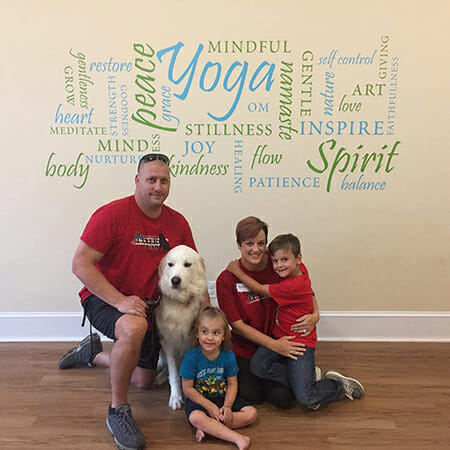
Britnee Kinard poses with her family including her husband’s service dog Gunner, who her nonprofit SD Gunner Fund is named after./Courtesy Britnee Kinard
Why did you want to start this organization?
In 2012, the Department of Veterans Affairs told me that my husband, who is considered a catastrophically-injured Purple Heart veteran, needed a service dog. So me being the go-getter that I was, I went out and got a service dog. I came back with the bill to the Department of Veterans Affairs, and they were like, “Oh yeah, we told you you needed one, but we’re not going to pay for it.” And I was like, “Hmm, yeah, that doesn’t really work for me.” It took about 18 months of me challenging the Department of Veterans Affairs, and we actually won. Gunner, who the organization is named after, is my husband’s service animal, and is actually the first approved mobility-service animal in the southeast coastal region by the Department of Veterans Affairs. But during that time, we had a friend who had a service animal and the service animal was, for lack of better terms, repossessed by the veterinarian because the veteran could not afford the treatment for the animal. Because the vet would not turn the dog loose, the veteran actually committed suicide two weeks later. We decided at that point in time, with as much trouble we had had with the Department of Veterans Affairs in covering our service animal, as well as seeing what our friend went through before he took his life, we decided that we wanted to form something that would assist people with obtaining and maintaining service animals.
How did the organization evolve to also help children with special needs?
After my husband got his service animal and we started SE Gunner Fund, by the time I got all my stuff from the IRS in, it was probably June of 2013 or ’14. Not long after that, our oldest son was diagnosed with autism and we began that whole realm of figuring out just exactly how much insurance does not cover. We’re military, so that usually means TRICARE, our insurance supplier, is usually one of the better insurances in comparison. They cover a lot more than other insurances. We got to talking to other families and we got to realizing, I know how much I was paying out of pocket, and that was after our insurance covered what they covered — I couldn’t imagine what some of these families were having to pay for that wasn’t covered by their insurance services. Autism is such a broad label and a broad spectrum that you could have one child on one end, and the other child on the other end, and they never need the same two services. That’s where it’s really difficult. So we added autism specifically to our program because of our son. Then as things slowly progressed, we would get phone calls from families in our community who were simply just needing help. There’s lots of programs out there to assist veterans, of which we’re well aware of because of my husband and his injuries, but when you get down to looking at it, there’s not a lot of organizations for special needs families that don’t come for a price or don’t come with an income limit. That makes it very hard, because you could very well have a family who does well for themselves financially, but they’re still struggling because they’re paying $3,000 a month in therapy fees. A lot of groups weren’t taking that into consideration, so we sat down and talked about it and were trying to see how we could serve our community. … After we added autism, we formed a relationship with the local pediatric therapy clinic. They were telling us how much they could use a therapy dog in their facility and we started testing it out and seeing how it benefited the children. Their programs have skyrocketed because of their use of therapy dogs in the facility. Every single thing we’ve added has come from a reason or a purpose, but it’s all been because of people in our community who have reached out and said we need help with this.
Can you describe how the service animals help veterans and special needs children?
A lot of people think that service animals are for, “I just want to take my dog out in public,” but what they don’t realize is that — and I use this particular one as an example because it’s one of my favorites and I think he is the first child to come through our program — but we have a young man who is now probably 12 and he has autism, epilepsy, fragile X syndrome, just a lot of stuff going on. His mom reached out to me and was like, “Hey, I need help.” “Ok, well what do you need?” “I need a seizure response dog.” That is where the dog alerts once the seizure has taken place. She was like, “Right now, he’s a larger kid. He’s tall. He sleeps in the bed with my husband and I, and I’m afraid to let him sleep in his own bed because I’m afraid he may have a seizure and pass away in his sleep and I will never know it.” That’s where service dogs come into play. His service dog’s name is Chip, and he’s had Chip going on four years. When you get those text messages and those phone calls that say, “My child had a seizure last night, I just want you to know the dog woke me up in my sleep,” or “For the first time in 12 years, I’m able to sleep by myself with confidence knowing he is safe” — those are the reasons behind service animals.
When you’re talking about veterans, for the first time in years, the veteran may actually be able to get a full night’s sleep, because he’s not waking up from night terrors caused by post traumatic stress disorder. Or for the first time he may be able to go to the ball park and watch his kids play soccer or T-ball because the dog allows him to feel comfortable and safe in large crowds or being around people, because his trust factor has gone out the window thanks to war. Hearing those comments, hearing those military members say thank you for reuniting me with my family, even though they’ve lived in the same household the whole time, that means something. … A service dog is truly there to serve life-changing circumstances. That is what makes them absolutely amazing.
Can you discuss the other programs you are currently working on?
We have Operation R&R, which was formed specially during COVID. It’s not a program I have had for awhile. That is where we have been asking for donations, we take that money, and we go to restaurants who are struggling and pay for-profit prices to go and feed our essential workers like firefighters, police departments, EMF, hospital staff, medical staff, jail personnel. Anybody who needs food, we have fed them. That way we’re not asking the restaurants for discounts. We don’t ask them for tax write-offs or anything. We pay for-profit prices so they can use that money to pay their staff and keep their doors open.
In the meantime, I am starting another nonprofit that is actually a subchapter. There is an actual head organization, it’s called SCUBAnaughts International. They’re based out of Florida. They did not have a Georgia chapter. We’re officially a chapter [now], but we’ll start opening up in August. That teaches children between the ages of 12 and 18 how to scuba dive, how to get their scuba diving PADI certifications, but there’s also a huge science portion to it. We teach them marine biology, how to grow coral, how to identify fish, how to identity algae. We take lots of data for local colleges, also Mote laboratories in Key West. We will partner with the Florida chapter and take lots of data on sea turtles, trash, pollution, anything and everything we can find that’s local to our shores and our area. In doing that, it allows those kids that maybe aren’t made for sports, maybe aren’t made for the band, but they really like fishing, they really like water — and we are an oceanfront community — and it allows them to understand what pollution does to our oceans and to our wildlife, our marine life, and gives them a good guidance pattern for anybody who may want to major in marine biology, anybody who may just want to help oceanography. We have partnered up with Mote and a couple of other very important marine entities. The students take four trips a year. They go to Key West and work directly with Mote laborites where they go down and, alongside veterans, they replant coral and help rebuild the coral beds for the wildlife after they’ve been damaged either due to pollution or by hurricanes. They take another trip up to North Carolina and they do another trip to Honduras. I think our chapter is currently looking at either the Virgin Islands or Hawaii to study marine life. It’s a great opportunity for students to be able to be part of something so much bigger than them that will effect their world as they get older and they just don’t realize it yet.
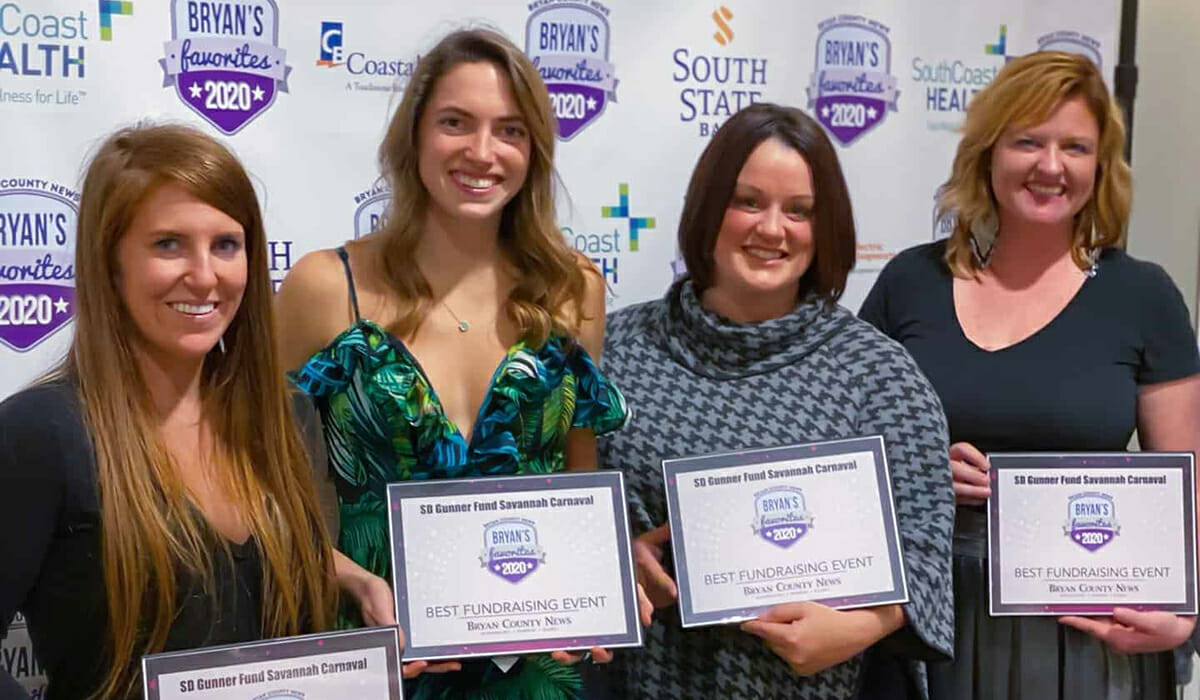
Britnee Kinard, second from right, attends a 2019 fundraiser to benefit her nonprofit SD Gunner Fund./Courtesy Britnee Kinard
Why do you think it’s important for others to give back?
I think some people think they know what’s going on in their communities, but until you volunteer, you truly don’t know. You don’t get to see those families or meet those families. Writing a check is easy. Writing a check, it’s beneficial for some because they honestly don’t have the time, and I totally understand that. But putting boots on the ground, you’re meeting the very families you’re helping. You’re seeing the struggles that are going on in your community. You’re hearing the stories from the families talking about their suffering and their hurting. I could tell to you so many times over the phone, and you’re going to say, “Ok, I got it,” but until you see that person, and until you have that mother in front of you crying, or until you have that kid hugging you because it’s the first meal they’ve eaten in a week, until you have a little girl come up to you and wrap her arms around you and tell you she feels safe, you truly do not understand the suffering that goes on in your community and the good you are doing by helping these individuals out. And how much more respect you have for everyone that’s involved in the community. You get that through volunteering. You get on a personal level.
What do you want people to learn from your story?
There’s probably a better way to say this, but life sucks, and never give up. If we would have given up, my husband and I wouldn’t be where we are. We kept pushing. We kept fighting. We kept standing up for anyone and everything that we thought was wrong. Somebody’s got to do it. I guess my ultimate phrase would be “never give up” because if you do, what do you get out of that?
Lifelong Buffalo Resident Helps Found Alliance to Improve and Grow Community
Meet Daily Point of Light Award honoree Mary Ann Kedron. Read her story and nominate an outstanding volunteer or family as a Daily Point of Light.
For almost a decade, Buffalo resident Mary Ann Kedron has been working to revitalize the community she has lived her entire life. As President, board member and co-founder of the Black Rock Riverside Alliance (BRRA), she has helped her northwest Buffalo neighborhood improve economically and environmentally, and helped boost local pride as she did it.
The BRRA has installed community gardens to help feed neighbors, many of whom are economically disadvantaged; certified neighborhoods as wildlife habitats to protect the environment as well as boost ecotourism; brought in grants and partnerships to increase jobs in the community and grow businesses; and hosted events, markets and various projects to increase community interaction — all driven by the desire to improve their neighbors’ quality of life.
Along with the BRRA, Mary Ann also helped found the Black Rock Historical Society, of which she serves on the board as well. The Society works to preserve historical buildings in the area, as well as educate residents on local history. Further, Mary Ann serves on the board of the Buffalo Niagara River Land Trust, which works to remediate contaminated waterfront property in order to return it the community.
Describe your volunteer role with the Black Rock Riverside Alliance.
The Black Rock Riverside Alliance is a community-based not-for-profit that serves four of our communities in northwest Buffalo. It’s Black Rock, Riverside, Grant Amherst and West Hertel. We were established in 2011, and we have been working on the quality-of-life issues in our community since that time. I was one of the individuals who helped start the organization. I’ve been pretty active as a board member. I am currently the president of the organization and worked on a number of committees and just serve whatever role is necessary to move things forward.
Mary Ann Kedron spends time with children from a local day care at one of the community gardens the Black Rock Riverside Alliance installed./Courtesy Mary Ann Kedron
What inspired you to start this organization?
The organization started because we went through a very in-depth community planning process. It actually took more than a year. As most people who have been involved in planning processes know, you end up with a lovely document and then that document goes and gets put on a shelf. What we very quickly recognized was there was very little structure within our community to do any type of the project implementations that we so desperately needed. When we did start this, the community was in a pretty unstable state. I think because we have been a part of it and have done so much, it’s become so much better than it once was.
Where have you seen the BRRA improve your community?
We’ve seen new businesses coming into the community. I think that is critically important. We’ve seen significant stability in our housing. There was a time when renters were moving in or out of our neighborhood on a regular basis. What we’re seeing now is a lot more investment in homes and renovations of our homes. We’ve also seen a significant pride within our community. I think pride of place through both education and historical awareness has been a big part of that. It’s really helped us kind of coalesce the community together.
What projects have you done that you are especially proud of?
We have a number of community gardens which are significant to us because it does two things. It gives the community their own green spaces and a place they can sit and either play with their children, or just sit and read a book. We don’t have a huge number of park structures within our community so these serve for that purpose. They also provide a significant amount of food for our community. We tend to be in a food desert. The average income in our community is around $20,000 a year for a family, which as you know, would be below the poverty level. Our people don’t think they are in poverty, per se, so they will come and work in the gardens. They can take anything out of the gardens.
We’ve evolved into a project that we’re talking about, certifying our neighborhoods as a wildlife habitat with the National Wildlife Federation. We’re doing it for the entire city of Buffalo. That brings an environmental awareness to our community. We happen to be a waterfront community along the Niagara River. We are a very significant environmental piece of property, if you will. We have bird ways. We have fishing in our community. We are a Ramsar-designated wetland. Our community needs to understand that it has the potential for a lot more ecotourism and environmental employment. We’re working really hard on educating our community on what they could have, as well as what they do have.
Can you describe your work with the Black Rock Historical Society?
I’m also on the board of the Historical Society and founding member of that. … We spun this organization off from [BRRA]. The Alliance is going in one direction, but the Historical Society remains an important part of our community. We are a very blue-collar community, but we’re a very culturally-diverse community, so telling the stories from the past has allowed us to build some bridges to our new immigrant communities. That’s become a very important conversation recently. I think if we all remember where we came from, life becomes a lot simpler.
We do a number of education series. We are continuously working on some preservation work, because we have a lot of historic homes in our community and historic structures. We’re working with our city on landmark status for a number of our churches and things like that. We use the Historical Society as a mechanism to show people who we are, and what we were, and what we now are. There’s not a lot of people who recognize our part of the city, so it’s a platform to educate others. We’re along the Erie Canal. We’re very much part of New York state’s history.
Can you describe your work on the board of the Buffalo Niagara River Land Trust?
That is a special land trust, because our community has a huge industrial past and there’s a lot of property along our waterfront that is considered contaminated. The land trust mission is take what would be considered contaminated property and actually remediate it and return it to the community. That is a very complex and tedious process, but it’s serving a mission that nobody else is really jumping up and down to serve. Once again, we’re trying to bring a higher quality of life to our community through these mechanisms.
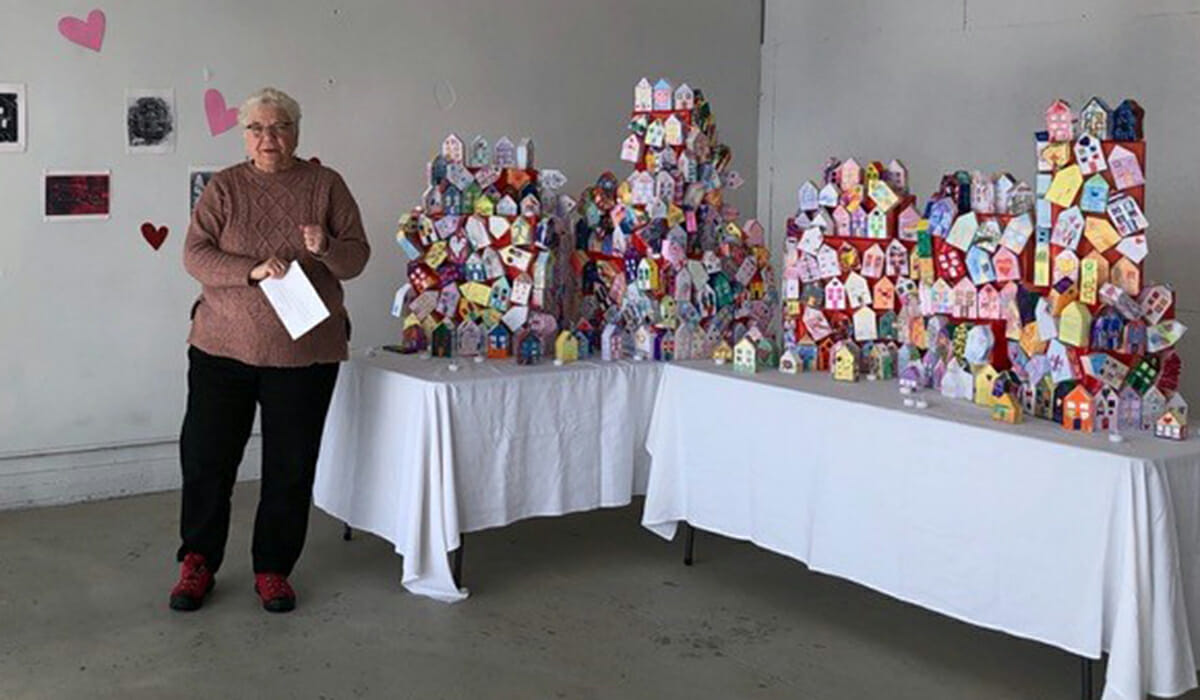
Mary Ann Kedron poses in front of a Black Rock Riverside Alliance project, titled “Love Black Rock,” where local children created houses to express what their neighborhood meant to them./Courtesy Mary Ann Kedron
What’s been the most rewarding part of your work?
Being an active part of the community. Spending time with the community members. Spending time with people who I would not normally spend time with. I see them on the streets, but actually working in the garden with someone and meeting your community is incredibly special. I have seen children who were three years old when we started in the gardens, to now be 14 years old and still wanting to participate with us. I can’t think of anything more important than those type of mentorships and relationships.
Why do you think it’s important for others to give back?
From a very, very personal experience, I think it allows you to continue to grow. I think otherwise people become stagnant. I think people misconstrue that they’re giving to an organization, when in reality the organization and community is giving back to them.
What do you want people to learn from your story?
I think I would say to have pride in the community from which you come. Sit down and really learn from the people who are in your community, because each one of them has a story to tell and I think presuming you know them is probably the biggest mistake you could make.
Covering Life’s Little Emergencies, Atlanta Teen Volunteer Safeguards Health of Refugees
Meet Daily Point of Light Award honoree Kennedy Walls. Read her story and nominate an outstanding volunteer or family as a Daily Point of Light.
The moment that spurred Kennedy Walls’ volunteerism was an ordinary incident, says the 18-year-old Atlanta, Georgia teen. Kennedy was tutoring a Syrian refugee student, and after the girl finished her homework, she suffered a minor cut while playing, but there were no first aid kit and no bandages to be found. Discovering the disparity in basic health resources within her greater community, Kennedy decided to take action to safeguard the health and safety of the most vulnerable.
Launching Aid the Journey, Inc. (ATJ) in 2017, the recent high school graduate provides medical kits and feminine products to refugees and asylum seekers in Clarkston, Georgia to “cover life’s little emergencies.” Working with community partners and receiving donations from organizations nationwide, Kennedy has donated more than 30,000 bandages, 2,000 sanitary napkins, 1,000 medical kits and 500 period packs to the most vulnerable in her community and she plans to offer resources at her second Aid the Journey location as a First-Year at Princeton University in the fall of 2020.
What inspires you to volunteer?
I performed a community health needs assessment online after this incident with the Syrian refugee girl, and discovered there was a lack of healthcare resources across the county. I have a 4-year-old brother named Wesley who gets cuts every day just being a little person (laughs). I felt like an older sister in that situation because I knew I could help in providing those basic resources, in the same way that I help my little brother.
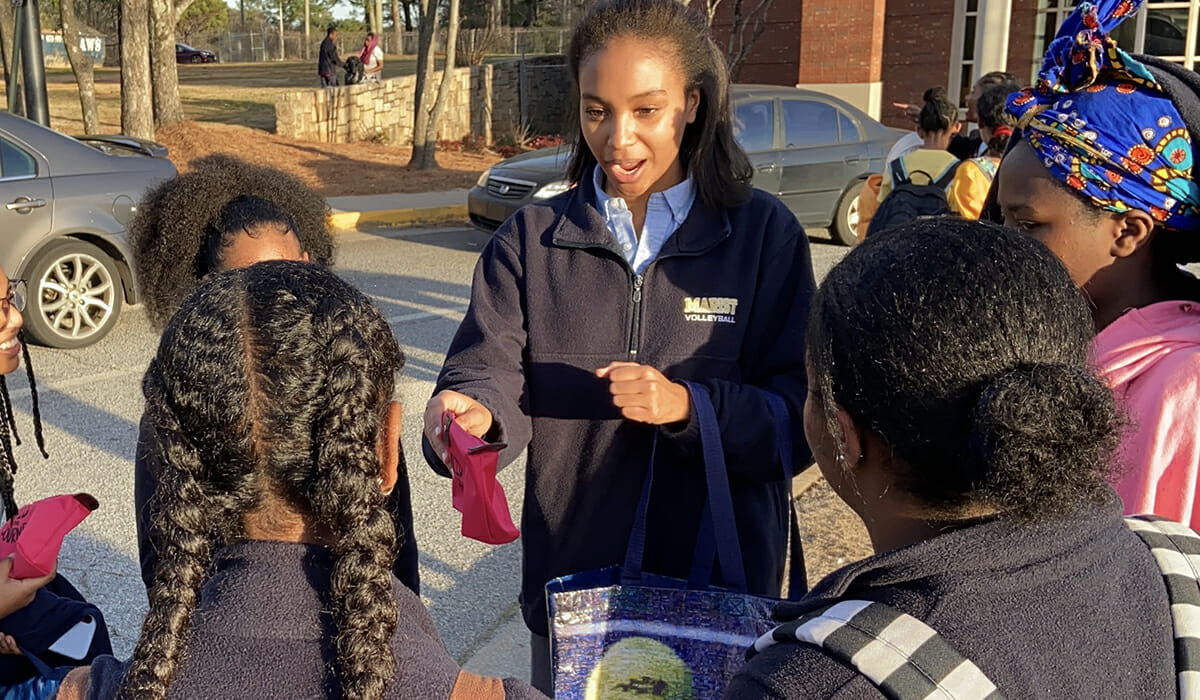
Kennedy pictured handing out ATJ feminine hygiene kits to girls after school. Kennedy Walls: “I strive to circle the girls, creating a safe space where talking about menstrual cycles and educating young refugees on how to use the products to support periods, is not taboo but instead encouraged and celebrated!”/Courtesy Kennedy Walls
Share one personal story with me from your volunteerism.
I’d brought first aid kits to the Fugees Academy, a school that provides education to refugee children in the greater Atlanta area. All the students play soccer as it’s a big part of their culture. One day, a student was playing soccer and he told me he’d gotten hurt during practice. He had a scrape on the side of his leg that he was going to let bleed out he said, ‘like it normally does’. He then remembered I’d given him a kit and antiseptic wipes just one week before. It’s the really small things that make me realize yes, my service is making a difference in their lives.
Why do you think it’s important for others to give back?
One of my favorite quotes is from Maya Angelou, ‘We are more alike, my friends, than we are unalike.” We are all one big human family, and we’re connected by our humanity. People should give back to show empathy towards other humans, because our desires and dreams are all the same.
What’s been the most rewarding part of your service?
It’s been rewarding connecting with the refugees and hearing their stories. For instance, the period packs make it known to refugees that it is ok to speak about these “girl things”, even though it might not be encouraged in their home life or when boys are around. I am helping to decrease stigma surrounding menstrual cycles and creating a safe space where educating young refugees on how to use the products to support periods is not taboo but instead encouraged and celebrated.
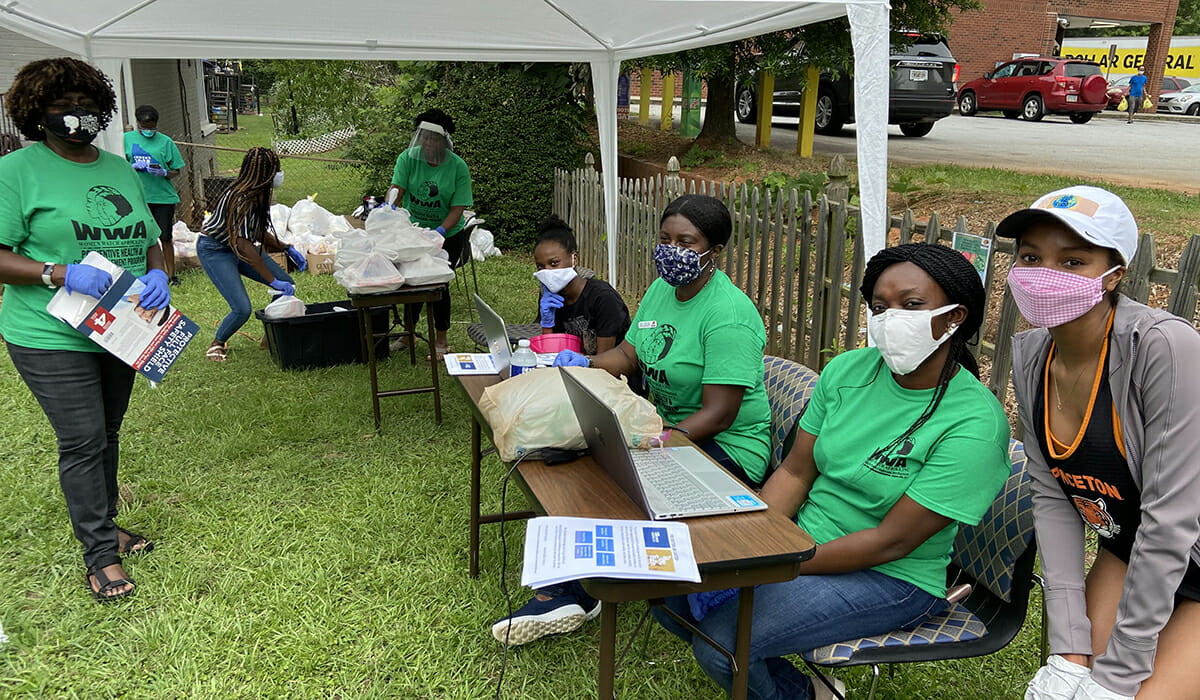
Aid the Journey (ATJ) teamed up with Women Watch Afrika to deliver Covid-19 essentials to over 100 refugee households. Kennedy pictured (right) handing out ATJ Covid-19 kits including a forehead thermometer, period packs, first aid kits and flashlights. /Courtesy Kennedy Walls
In one word, what does volunteering mean to you?
Empathy.
How have you adjusted your service amid Covid-19?
We have shifted gears to also provide Covid-19 supplies and resources to the refugee communities. I have provided forehead thermometers, hand sanitizer and reusable face masks since the pandemic began.
When you’re not in school or volunteering, what do you do for fun?
I love to walk around Ponce City Market and be outside. Being outside, window shopping and hanging out with friends. I used to row so I lived on the water, I am a bit outdoorsy.
How can readers help?
Please visit my website for more information on how you can help.
Teen Volunteer Changes Communities by Feeding Hungry and Inspiring Ripple Effect of Service
Meet Daily Point of Light Award honoree Sarah Ackels. Read her story and nominate an outstanding volunteer or family as a Daily Point of Light.
The sentiment often attributed to Mahatma Gandhi, ‘Be the change you wish to see in the world,’ is what drives 17-year-old Sarah Ackles as she serves food to vulnerable communities, changing the world one meal at a time.
“I used to think, oh, it’s so sad there are all these hungry people,” says Sarah. “I am now doing something about it. Since day one, when I realized feeding people was something I could do and I realized I could do something to make other people’s lives better.”
Launching Sarah Stops Hunger in 2014 while in middle school, the Simsbury, Connecticut teen says she begrudgingly attended her first meal making volunteer event as an adolescent, and quickly fell in love with the service. Helping to make an astounding 15,000 meals in just one hour, Sarah realized she could make a difference, and hasn’t stopped feeding people since. Distributing more than 125,000 bagged meals to women, children and others suffering from food insecurity thus far, Sarah is providing more than food, she’s opening the door to a better future for thousands of hungry individuals in her community and globally.
“A lot of our meals go into the Feeding Children Everywhere backpack program which sends meals home with students. I know if I’m hungry at school, I’m not paying attention, I’m not doing my best work, I’m not going to succeed as much as if I had a full stomach. Our meals help to kickstart education and help to break the cycle of poverty for kids.”
Fundraising money which is then sent to partner organizations to purchase meal supplies here in the U.S. and internationally, Sarah holds meal making events at her church, where hundreds will join to help assemble meals. Sarah has extended her reach across the globe by providing meals distributed by international hunger relief organizations that distribute food and life-changing aid to the world’s most vulnerable.
“Our meals are provided at workshops in Mozambique and eSwatini for Rise Against Hunger’s partnership with the Adventist Development and Relief Agency, and Burkina Faso for their partnership with the Catholic Relief Services, for women, children and people who wouldn’t necessarily receive the same opportunities as others in their communities. Hunger is the base issue that we’re fighting by providing a meal, and these workshops teach skills or help them get education in order to have a business and support themselves.”
Perhaps in small part due to her perspective as a youth founder, Sarah has worked to introduce service to others, old and young, by helping them to realize that volunteering can be fun.
“The stigma exists that volunteerism isn’t fun. I wanted to engage more youth in service for the same reasons why it was important that I attended that first meal making event. I got my whole varsity field hockey team to come volunteer with me as a fun, team building event. I’m changing the mindset of my community, because (this service), it’s not just one meal, it’s meals and inspiring others to help as well.
Sarah pictured with members of her church group volunteering in West Virginia. Rev. Kevin Weikel of First Church in Simsbury, CT says of Sarah: “She has a natural influence on others to act, inspires one to be their best self and to help others.” /Courtesy Sarah Ackels
Sarah’s pastor who has been by her side for many service projects, Rev. Kevin Weikel of First Church in Simsbury, says the teen is a beacon of light for the entire community, positively leading by example and inspiring others to commit to service.
“(Sarah) isn’t someone who just went along. She’s instrumental to those around her as far as their involvement. If Sarah was going, everyone else was going. She has a natural influence on others to act, inspires one to be their best self and to help others. It doesn’t matter your age, everybody in church and the community knows that Sarah is someone that is helping others.”
Continuing her service throughout the pandemic, Sarah and her family have been donning protective gear and distributing leftover produce and overstock groceries via a mobile food truck to people in need through Foodshare, as her in-person events with Sarah Stops Hunger have been postponed due to social distancing requirements. Hoping to pick up where she left off in the near future, Sarah’s volunteerism has spurred countless other meal making events hosted by fellow volunteers for hungry mouths around the globe. This “ripple effect of change”, inspiring others to serve, is an obligation Sarah says she feels to create a better world.
“At my first meal making event for Sarah Stops Hunger…we made 17,000 meals in one day. A woman came up to me and asked what was next. She said we had to do this again, that it was the most amazing thing she’d been a part of. Her words made me realize that we could do more of these events, and help more people. It makes me so happy when I give back and help others, and it’s my responsibility to induce this mindset in others.”
New York senior Volunteers to Raise Puppies Into Guide Dogs that Have Changed the Lives of the Blind
Meet Daily Point of Light Award honoree Carol Tepper. Read her story and nominate an outstanding volunteer or family as a Daily Point of Light.
Carol Tepper might have the best, or at least the most adorable, volunteer job in the world. For the past 20 years, she’s been helping raise puppies for the Guide Dog Foundation. As a puppy raiser, nursery volunteer, breeder caretaker, board member and puppy sponsor, Carol has volunteered with the foundation in almost every way possible.
Even before volunteering with the Guide Dog Foundation, Carol had spent much of her life helping others. After working for several years as a speech pathologist in Boston, she returned to New York, where she volunteered with various community groups, including the Rockville Centre Education Foundation and Rockville Centre Mercy League.
But her real passion of caring for dogs started because of her uncle, who had dedicated 20 years of his own life to the Guide Dog Foundation as a volunteer.
“It became a very important and worthwhile part of his life and retirement,” Carol recalled. “He loved the people, he loved the staff, and he loved the dogs. He always loved dogs.”
After her uncle passed away, Carol decided to continue his work to help raise puppies into the disciplined guide dogs that have changed the lives of countless people who are blind.
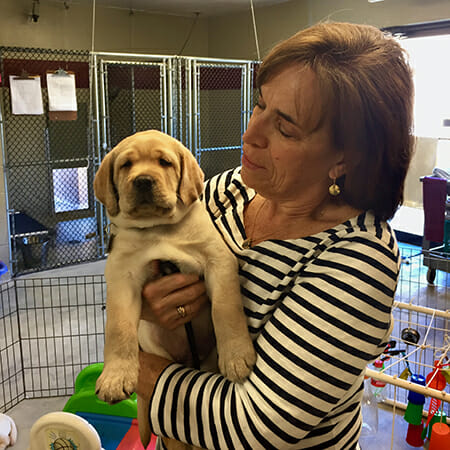
Carol holding a six-week-old puppy at the Guide Dog Foundation’s nursery./ Carol Tepper
Describe your volunteer role with the Guide Dog Foundation.
We got our first puppy (from the foundation) in 2000 and his name was Willie. We had puppies growing up, but Willie was special because we knew that we would be giving him back at a little over a year of age. It was important to follow the protocol for socialization and obedience to hopefully bring this dog to the point where he would be of assistance to a visually impaired or blind individual.
Puppy raising is a family proposition. We all, my husband, our son, our daughter, were participants and had to be on the same page with leash walking, basic commands and obedience protocols. Consistency was very important.
One of the big pluses of this job as well as physically having this adorable puppy in the house is that I was able to provide a lot of education to the public and let them know of our mission and what the puppy’s purpose was. I would speak at schools and organizations, even my grandchildren’s preschool, to answer people’s questions and educate them about the progression of how these dogs go through the beginnings and end up as a working guide. And of course, the bonus is that you usually bring a dog, like one of my current dogs, Hobbs, would be considered an ambassador and would go represent the foundation with me.
Another thing we’ve done is sponsored puppies. That is a financial contribution that enables you to cover the dog’s first part of their lives and training and you get to name the dog. I think we’ve sponsored seven puppies.
What’s been the most rewarding part of your work?
The people who are blind or visually impaired say that they are more than grateful to the staff and the volunteers at the foundation because their lives have been transformed in so many ways. It gives these people such independence. You will hear from people who have used canes in the past and then one they’ve been paired with a guide dog, they say it just opens up a whole new world for them.
Also, some of our dogs don’t make it as a guide, but they’re absolutely wonderful as an assistance dog for one of our veterans so then they would be considered through America’s VetDogs, our sister organization, and be of service to somebody who is in need. They might not be visually impaired, but they may have more physical challenges and need a dog to retrieve objects for them or to give them support when they’re walking.
Raising puppies, no matter how cute, is not an easy job. What pushes you to keep going?
I think it’s knowing what’s at the other end. That the outcome will be another team leaving our facility and going on to really have that confidence and trust in someone by their side. I’ve met such incredible people out there who will tell you their stories of how nothing holds them back once they have a guide dog by their side. To be able to put your trust into an animal that’s going to enable you to cross a busy intersection or hop on a busy crowded subway or get out at Penn Station in New York City or go on an airplane, they make tremendous changes for the better and let you live the life that you would like to live.
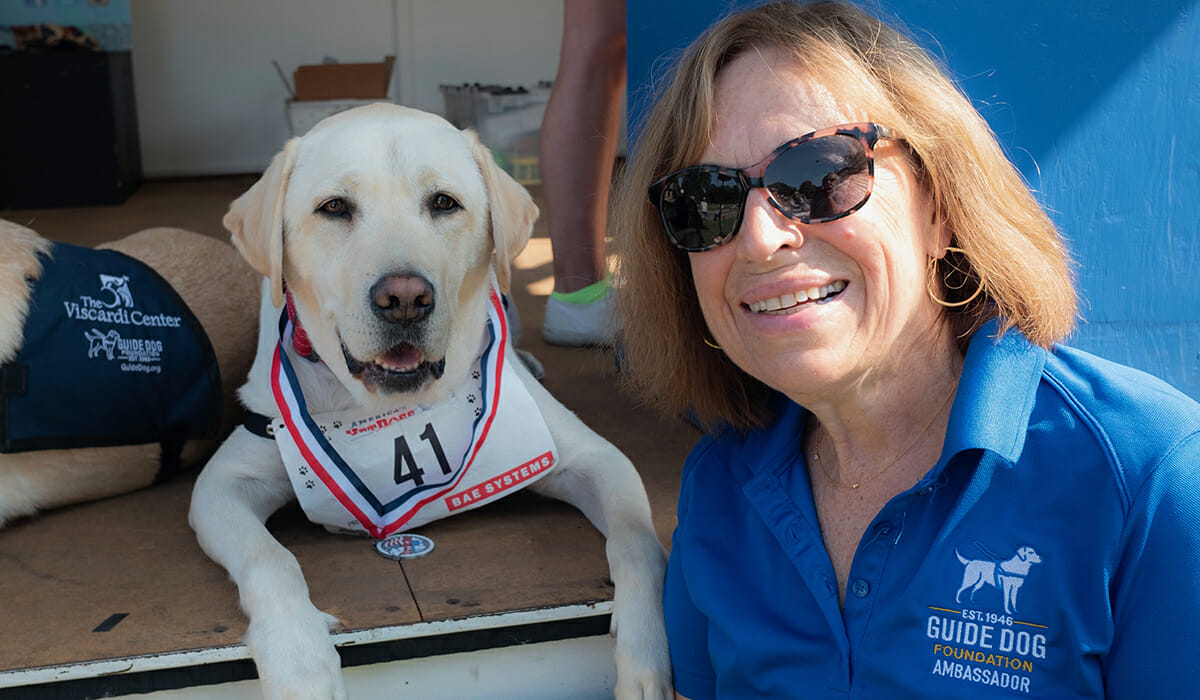
Carol at a veteran event last year with Sully, who served with former President George H.W. Bush during the last six months of his life./ Courtesy Carol Tepper
What inspires you to volunteer?
My parents instilled in me that you do for others as they’ve done for you. I just feel like I’ve had a good experience in my life so I would like to be able to give back to others and that maybe their lives could be improved or better, especially if they were in need of some special services.
What do you want people to learn from your story?
I would hope that people would be enlightened as to when you see somebody using a guide dog, it’s not as simple as just the dog getting someone down the street. It’s a very special life-changing moment process from the moment this dog is born and then the journey for them to become a guide dog. I would hope that people recognize the amount of work that goes into that dedication of the people that work with guide dogs, to enable them to become the guide that they will be and to also realize how amazingly important it is that they are able to transform someone’s life.