Volunteer Gives Back to Younger Generation of Girls, Advocates Purposeful Adulthood
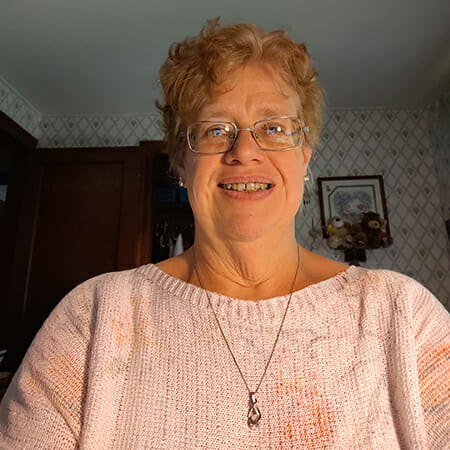
Meet Daily Point of Light Award honoree Becky Snyder. Read her story and nominate an outstanding volunteer or family as a Daily Point of Light.
Raised in a Masonic family, Becky Snyder was taught that volunteering is an integral part of life, service to her community, expected. Starting as an adolescent, Becky was a member of the International Order of the Rainbow for Girls (Rainbow), an organization which prepares girls for responsible and purposeful adulthood, encouraging service and promoting teamwork.
As an adult, the 54-year-old Charlton, Massachusetts resident has continued her service to her community and young girls, as a leader and mentor for Rainbow in addition to volunteering for a variety of other important causes. Through hundreds of hours of volunteerism annually, Becky is dedicated to supporting her local community, making an impact on hundreds of children and adults.
What inspires you to volunteer?
I’m inspired to volunteer because I like to give others the same opportunities I had. Through Rainbow, I learned about service. The girls come out of the organization better, well-rounded people. It’s neat to watch the whole process along the way, from the time they are 11-year-olds all the way to aged 21 and beyond, and they’ve turned into pretty awesome adults.
Describe your role with the International Order of the Rainbow for Girls.
As a volunteer leader and mentor for Rainbow, I serve as an Advisory Board member of the local assembly, and I sit on the Grand Executive Board for Massachusetts Rainbow. As volunteers, we help Rainbow girls with their meetings, projects, and travel with them for events. Rainbow helps to prepare girls for responsible and purposeful adulthood through character and leadership development, encouraging unselfish service and higher ideals in life, and promoting teamwork and effective interpersonal communications.
Becky Snyder has volunteered hundreds of hours annually, helping hundreds of children and adults in her community./Courtesy Becky Snyder
Share one personal story with me from your volunteerism.
I’ve maintained contact with a Rainbow girl even though she’s not with the organization anymore. As a former mother advisor of a local Rainbow assembly, you get a bigger dose of helping these girls. Whenever she was asked to travel, I’d often ferry her to local meetings, or help her with X, Y, Z. This service is hands on because you’re definitely helping them with their responsibilities, but you’re also giving these girls the tools to help themselves. This girl is now a young woman, she’s graduated from college and went on to be an eye doctor. I had a chance to see her develop and grow along the way, and I like to think that we had a small part of shaping her into a young woman, and I’ve had a sideline seat to the success she’s earned.
Why do you think it’s important for others to give back?
I was an extremely shy, very introverted child. Volunteering helped bring a lot of that out. I recognize what service has done for me, and I try to share that with the girls when they age out of Rainbow. They are given opportunities because there are people who care, and now it’s their turn to give back to others.
What’s your life motto?
The Rainbow Advisory Board takes part in an installation ritual, and we are asked: “To guard the welfare of our girls most cautiously, never to take a step that you would not ask one of the girls to follow and to always carry with you the thought that someone is looking to you.” Those are my ideals for serving as a mentor and advisor.
You volunteer for other organizations to help adults and children. Explain.
I also serve as the volunteer captain for SOLitude’s North office for the SOLution, a community-based volunteer program offered through the lake management company where I work in administrative and customer service. We do several volunteer initiatives throughout the year, including Little GOBBLERs and HOLiday Cheer, both initiatives which help families-in-need. I have also volunteered for Relay for Life.
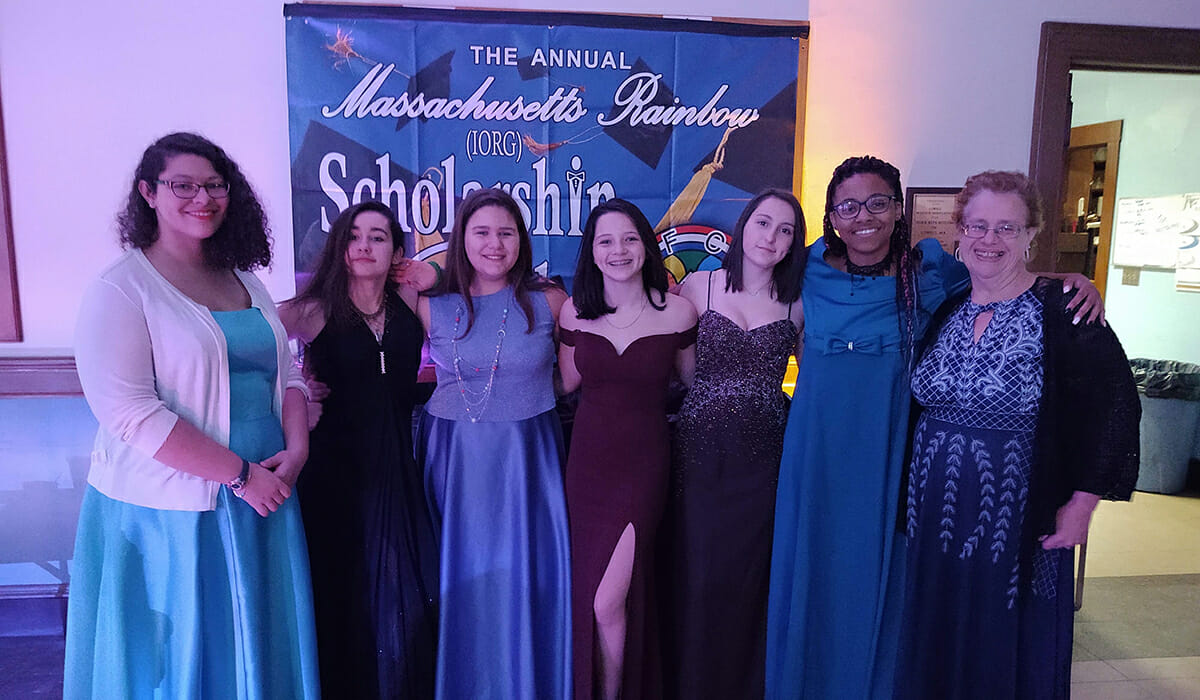
Becky (right) pictured chaperoning the annual Scholarship Ball for the International Order of the Rainbow for Girls./Courtesy Becky Snyder
What’s been the most rewarding part of your service?
It always feels good when you give back and see that you’ve made a difference.
How can readers help?
We are trying to do Rainbow events virtually because in-person meetings and events have been cancelled due to the Covid-19 pandemic. Some Rainbow volunteers have done drive arounds and dropped off care packages for the girls while we wait for things to open up. Not only have the girls missed each other, but we’ve missed them too. Please visit Rainbow’s website for more information about how you can help.
Volunteer Grandma Helps Take Care of Woman with Developmental Disabilities
Meet Daily Point of Light Award honoree Rosita Nicolas. Read her story and nominate an outstanding volunteer or family as a Daily Point of Light.
For the past nine years, Rosita Nicolas has been dedicating her time to serving adults with development disabilities. Five days a week, for several hours a day, she volunteers at the San Andreas Regional Center in San Jose, Calif. The 86-year-old is one of the only volunteers to serve in two different capacities, serving both at a vocational workshop where she helps individuals with developmental disabilities learn skills to improve their independence, as well as in the Senior Companion Program.
As part of the program, Rosita is paired with a young woman named Yvonne with developmental disabilities and special health needs, who at the time of entering the program had recently lost both of her parents. Rosita has stepped in to be a grandmother of sorts to Yvonne — talking to her, singing to her, painting her nails, doing her hair, and spending every birthday with her, even if it falls outside of her regular volunteer days. Rosita goes above and beyond as both a volunteer for the San Andreas Regional Center and as a companion to Yvonne, always bringing a smile to the young woman’s face.
Describe your volunteer role with the Senior Companion Program.
I really like the Companion Program very much. I’m so happy to help the client. Some people, they are expecting that you can’t help. I don’t believe that. I tell myself that even though the client cannot talk or what not, they respond to you when you say something they like, so I am so happy from that.
The client cannot talk, cannot stand, [they’re] in the wheelchair. The name of the client is Yvonne. She doesn’t know anything, so I try my best to talk to her and she can understand me. The longer the time that I work with her, [there is more] improvement. When I sing to her, she smiles. When I see her in the morning, I say “Good morning Yvonne, how are you?,” and her two hands grab very hard, she smiles, and her head is turning back and forth. That’s the answer of “how are you” and “good morning.” I am happy with that. Everyday I do that, the same, so it’s easy for her to understand. If she doesn’t know [how to respond] yet and I change the subject, she’s not going to learn something, so I change the subject when she knows already the subject that [I spoke to her about] the first time. That’s my idea for her. I like to help her.
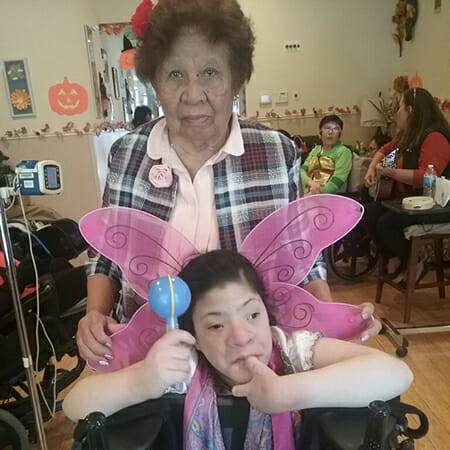
Rosita Nicolas, top, spends time with her client Yvonne weekly, stepping in as a surrogate grandma by talking to her, singing to her and even celebrating her birthday with her./Courtesy Mia Garza
What else do you do with Yvonne?
When I got there, Yvonne had no more relatives. The ones who adopted her already passed away, both of them. That’s why they needed a volunteer grandma. … They chose me, they put me [with Yvonne]. I’m now the one to handle Yvonne. I treat her like my little granddaughter. I do everything so that she learns something. I really care for her every morning. I read the same story to her, so she can [understand it]. I don’t change it. When I get there in the morning and I say “Good morning, Yvonne, how are you?” then she responds. I grab her hand and [she] smiles. Then after that, if [the nurse] doesn’t comb her hair, I fix it. She’s a little girl so I have to put in barrettes, something like that, to look good. Then after, I keep talking to her, any joke or saying, something like that.
Why did you want to start volunteering with this program?
I am a Legion of Mary [association of Catholics who serve the Church on a volunteer basis] and we have to make a mission to help anybody. That’s our job. … I put my application in and then they hired me. When I got to [the program], I said, “Oh my God, this is what I am looking for.” That’s why I’m happy. … I liked to read to her [to help Yvonne] improve, because if you teach them something and they respond to you, wouldn’t that make you happy? I like to help them.
Do you have any memories with Yvonne that stick out to you?
One time, she got sick in the hospital. The supervisor said, “Grandma, do you want to visit Yvonne in the hospital?” I said yes, so we went to the hospital. When I went there, she was really sleepy. Then I said, “Yvonne, I’m here, Grandma,” and she just opened only her eyes. Then I sang to her. She raised her hand high and she wanted to hold me. I cried, because she remembered the things that I say to her and sing to her. The nurse said, “Grandma, she remembers you,” and I said “Yes.” They’re lonely. I cried. I cried very much. I can’t sit with her because of everything happening right now [with COVID-19 restrictions], so I miss her already.
How are these adults helped by having someone like you spending time with them?
When I went there, [the caretakers] were so surprised because Yvonne was learning something. They said “Oh, Grandma, you’re good, look, Yvonne has improved.” Then one of the nurses come over and said “Grandma, let me see what Yvonne learned from you,” and I said “Ok, good morning Yvonne.” I raise my hand, and then her hand also was shaking. They brought in the walker and she was standing and I went forward. I said, “Yvonne, come here, follow me, come on,” and she came to me. They were like, “Wow, Grandma, she learned and she likes you.” That’s the improvement that I do for Yvonne.
What’s been the most rewarding part of your work?
I’m really happy to help somebody. That’s what I want, to help somebody improve a little bit. Plus, it helps me, also. I’m 86 years old, just in the house doing nothing, so it’s easy. It’s nice for me to get up in the morning, dress up, and then go out. Then when you get there, you meet some other people and talk to them. It’s helped myself also by not staying in the house and watching TV. Volunteering is good for me, also, and my body.
What do you want people to learn from your story?
What I can say is don’t judge the client who you see is not talking or cannot do anything. Don’t judge them for not improving anymore. For me, there is a little improvement. If you’re going to say “Hi, Yvonne,” and she looks at you and smiles, that’s already improvement, right? … Don’t judge that [the adults with developmental disabilities] cannot do anything. They can do something. It just might not be too much. As long as they are alive, they can respond, but in a different way. That’s what I can tell the others.
Kentucky Teen Changing the World One Blanket at a Time
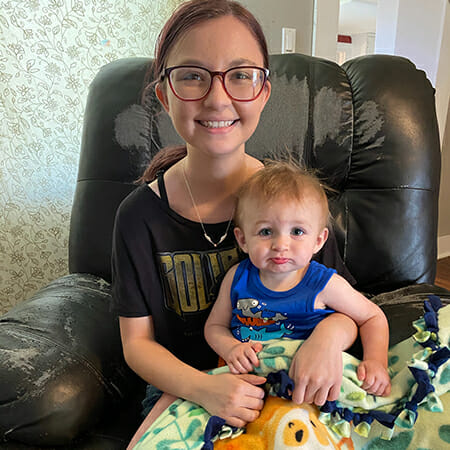
Meet Daily Point of Light Award honoree Katelyn Abney. Read her story and nominate an outstanding volunteer or family as a Daily Point of Light.
Katelyn Abney says spending time with her Paw-Paw, driving in his truck to the local store where he would buy her juice and candy, are some of her favorite memories with her great-grandfather. When Katelyn’s Paw-Paw died in 2016, she didn’t know how to handle her grief. “I locked myself away. I wouldn’t talk to anybody. I was hurting not only me, but my family.”
Katelyn says when she did finally open up to her family, she realized she wasn’t alone. Launching Blanketing the World with Love, the 15-year-old Elkton, Kentucky teen first hand-tied a blanket for her grandmother who was recovering after open-heart surgery, and hasn’t stopped. Since then, the rising high school junior has handmade 184 blankets, customizing blankets for people across the country and all over the world who are suffering from an illness, have lost a loved love or are going through a difficult time. Bringing comfort and smiles to those in need, Katelyn is changing the world, one blanket at a time.
What inspires you to volunteer?
After I made that first blanket, God told me it was time for me to make a difference in the world. I am bringing happiness and love to those in need, and giving comfort in darkness. I want others to know that no matter what they are going through, they are not alone and somewhere, someone is thinking about and praying for them. I like seeing all the happy faces, the smiles and laughs that these blankets bring.
Why have you decided to serve others with a handmade item?
Volunteerism served by hand is different because if you make it with a machine, then you’re just making it. If you make it by hand, you’re putting in hard work and love that a person is going to receive.
Katelyn Abney pictured with 1-year-old Levi, who has epilepsy. Katelyn handmade the baby a blanket and he would not let it go. /Courtesy Katelyn Abney
Describe your role with Blanketing the World with Love.
As founder of Blanketing the World with Love, I monitor social media because people will reach out to us asking for blankets. Sometimes we’ll notice a family member has posted on Facebook about an event or something that happened, and we’ll ask if we can make a blanket for that person. I hand-tie and deliver the fleece blankets, one side is a design and the other side is one color. We’ve shipped blankets all over the world, including as far away as Japan, Hawaii and Canada.
Share one personal story with me from your volunteerism.
There was a special needs boy that took the school bus with me. I’d always smile and talk to him. I made him a blanket and gave it to him on the bus. This boy’s mom worked at our middle school, and she called me up to the office to thank me. She was crying when I arrived. She said after her son came off the bus with the blanket, he laughed and cuddled with the blanket all night. I think to that boy, the blanket meant that someone cared and someone would be there for him.
Why do you think it’s important for others to give back?
We take so much from this world, and we don’t think that us taking hurts other people. Giving back not only helps us but sometimes helps the environment and others.
What’s been the most rewarding part of your service?
The smiles, the happiness.
In one word, what does volunteering mean to you?
Everything. I believe the smallest acts of kindness can make a change in the world.
When you’re not in school or volunteering, what do you do for fun?
I’m in the marching band so that takes up some of my time. I play the trumpet.
How can readers help?
Our volunteerism has continued through the pandemic and we’re still distributing blankets. We are dependent on donations and fundraising for blanket materials. Please visit our Facebook page for more information about how you can help.
This Teen Turned a School Project into a Full-Blown Volunteer Organization that Provides Washers and Dryers to Families in Need
Meet Daily Point of Light Award honoree Lilie Murray. Read her story and nominate an outstanding volunteer or family as a Daily Point of Light.
School projects might last for a week or maybe a couple months at most if it’s a big project. But for Lilie Murray, an 18-year-old from Rye, New Hampshire, a school project has continued for the past three years after it flourished into a volunteer organization that has helped improve the lives of numerous low-income families in the community.
It all started when Lilie was a sophomore in high school. She and her classmates were asked to create a project based on the United Nations’ Sustainable Development Goals.
“We decided to look at ‘No Poverty’ and ‘Sustainable Cities and Communities,’” Lilie said. “From there we developed a clothing drive, which my classmates and I named the Portsmouth Community Closet.”
Unfortunately, the class ended before any kind of clothing drive was able to take place, but Lilie decided to pick it back up with the help of her teacher, Kimberly McGlinchey, who then became her advisor.
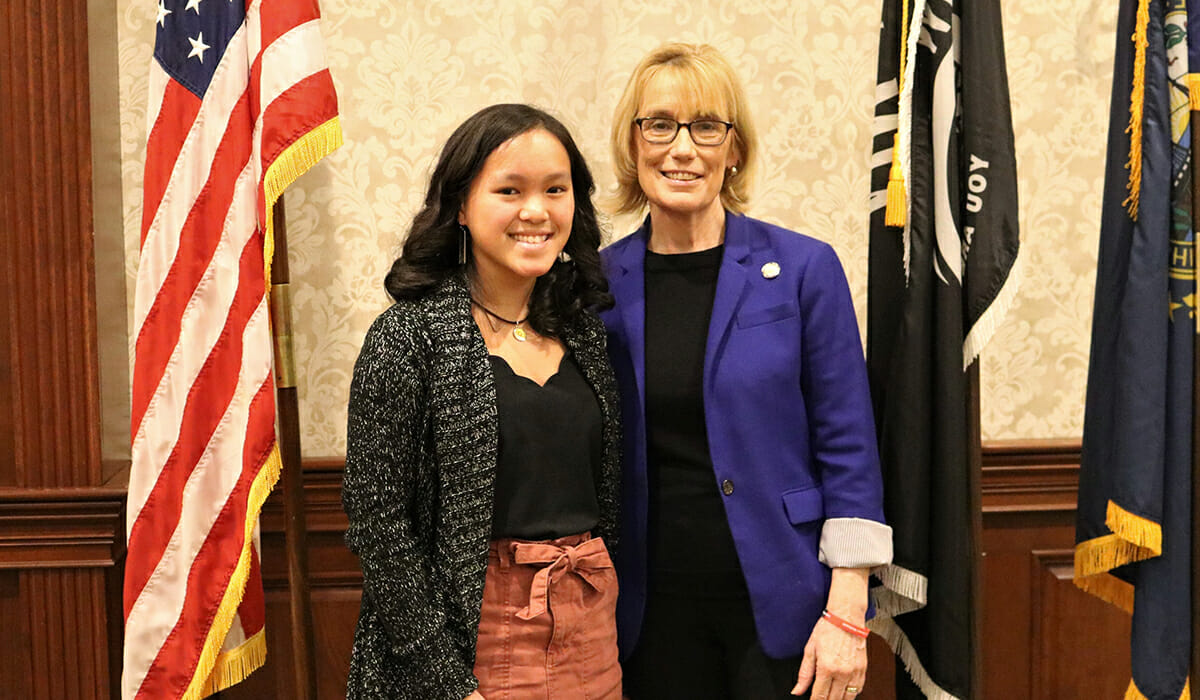
Lilie Murray (left) was awarded the “Granite Stater of the Month” last October by Senator Maggie Hassan (right) for her volunteer work./ Courtesy Lilie Murray
With the generosity of her community, Lilie received tons of clothing donations, which she then provided to low-income families in Portsmouth. But after Lilie realized how many families were living in public housing developments and didn’t have access to washer and dryer units, she wanted to do more than just a clothing drive.
“They were essentially living in what we like to call a laundry desert,” Lilie said. “Their local laundromat had been shut down and the nearest one was several miles away.”
So Lilie started fundraising money to buy families living in public housing their own washer and dryer. The first delivery went to a family with two children and a mother who had been living in a homeless shelter and had just secured housing.
“We arrived in the truck with the washer and dryer, and she was waiting outside with her kids and they immediately ran up to me and just, they all gave me a big hug,” Lilie recalled.
Since then, Lilie and her volunteers have helped donate washers and dryers to about a dozen families in the area. But again, Lilie didn’t stop there.
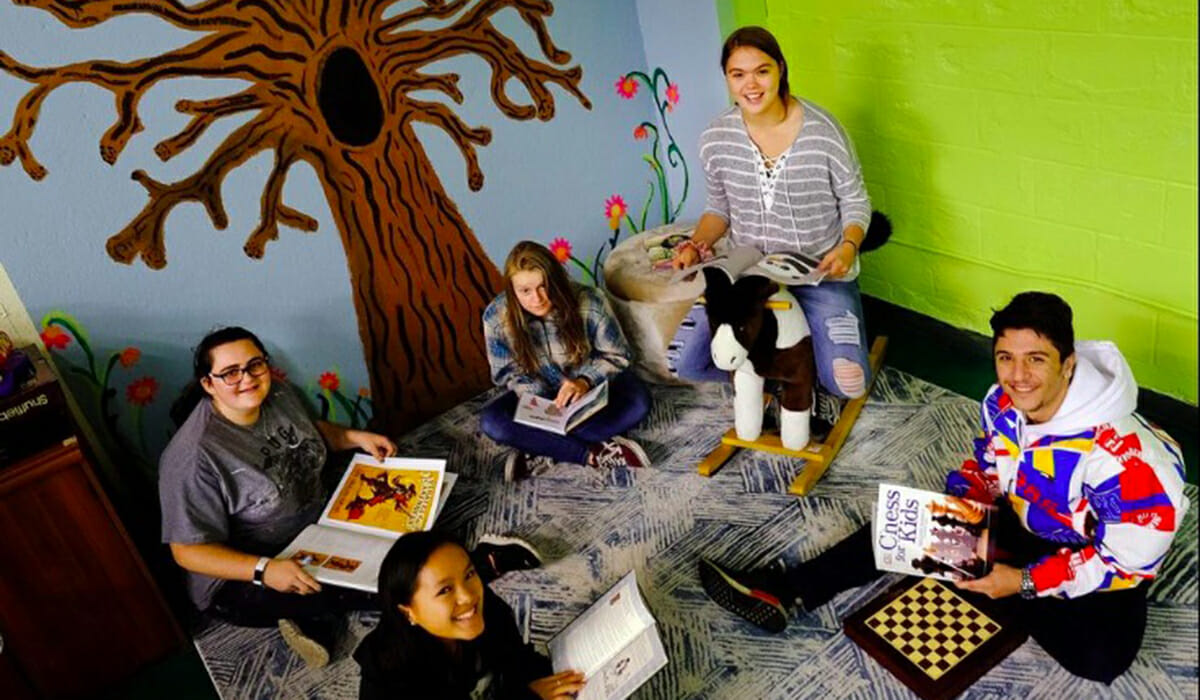
She has helped set up a library at a community recreation center for children from low-income families to develop their literacy skills. She’s helped develop an afterschool program for kids, she’s organized field trips for kids to go blueberry picking, hiking and rock climbing. And currently, her organization is running a summer program for kids living in a housing community.
Lilie and other volunteers at the library they help set up at a community recreation center./ Courtesy Lilie Murray
“Her leadership has really driven all these projects,” her advisor, Kimberly, said. “If she wasn’t there, it wouldn’t happen… The ability to have a vision and see it through is a very strong part of her character.”
In the fall, Lilie will head off to the University of New Hampshire to study business, but no matter how busy school life gets, she said she hopes to keep the Portsmouth Community Closet going because every child deserves the opportunities needed to reach their highest potential.
“I’ve been given a lot of great opportunities to further my education and grow as a person,” Lilie, who was adopted from China, said. “But a lot of these kids aren’t able to have the same opportunities that I did growing up. So I was really fortunate to be able to give back and be a light in their lives.”
Meet Daily Point of Light Award honoree Chase Hartman. Read his story and nominate an outstanding volunteer or family as a Daily Point of Light.
One in four children in America grow up without learning how to read, and students who don’t read proficiently by the 3rd grade are four times more likely to drop out of school. 14-year-old Chase Hartman says that in his Tampa, Florida community, it is not uncommon to come across students who don’t read at age level, an issue the rising high school freshman decided to try to solve.
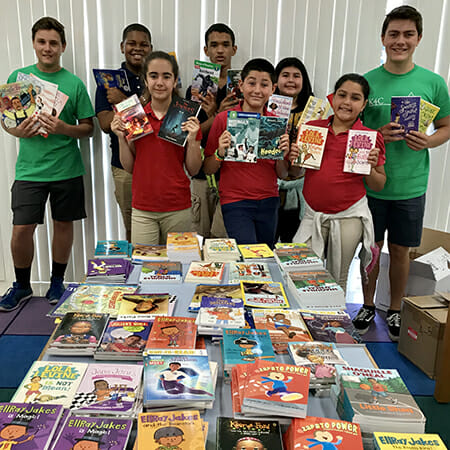
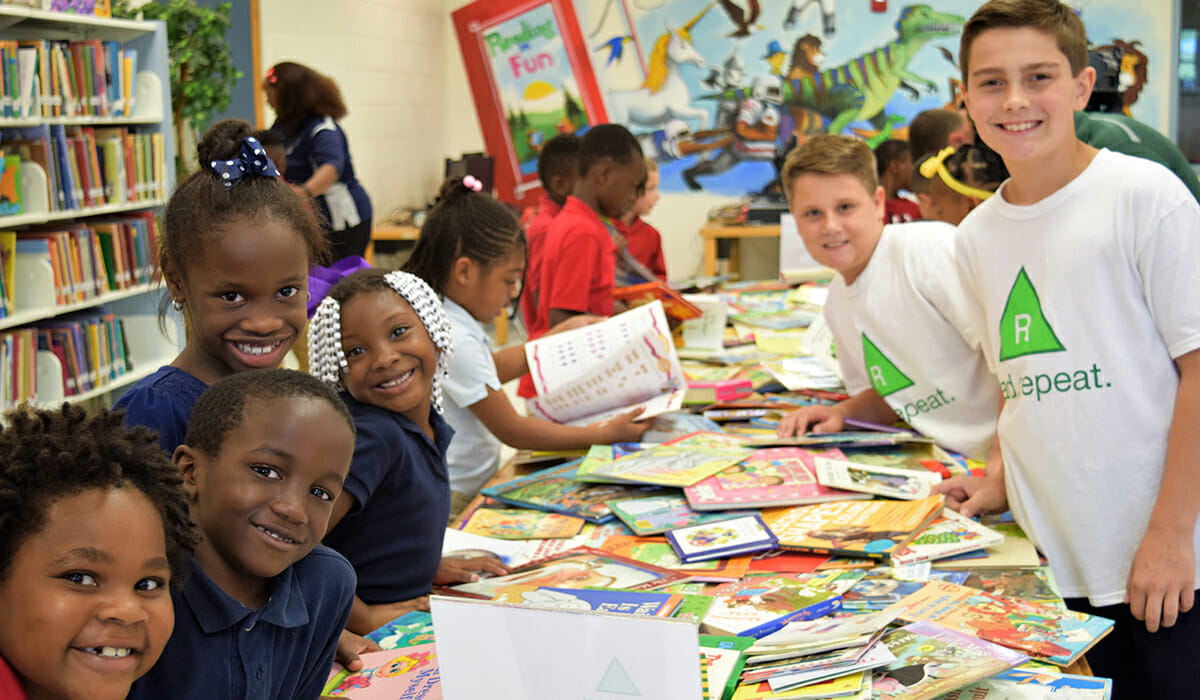
Discovering that some children in his community didn’t own books and at the same time, people and businesses dispose of a huge number of new and used books every day, Chase launched read.repeat. in 2016 along with a fellow student. Getting new and gently used books into the hands of those in need, Chase has distributed over 120,000 books thus far at schools, hospitals and libraries across all 50 states, supporting literacy and helping to improve the future for thousands of impoverished children.
What inspires you to volunteer?
I love volunteering because I get a lot of enjoyment out of being able to help anyone in need. Yes, there is a lot of hard work, but you know in the end, you’re helping people and you’re doing good work.
Describe your role with read.repeat.
As co-founder of read.repeat., I manage our book drives and book drops, sort books and contact organizations to confirm our donated book distributions. We also raise money to support literacy locally.
You started volunteering as a child. Why did you decide to help other children through service?
In 2016, we found a book company at my mom’s work complex willing to give away donated books. There were four giant bins of over 4,000 books they couldn’t sell. We took those books back to a storage unit, and we donated them to any place we could find. Our volunteerism grew from there.
Chase (right) pictured distributing new books with diversity to Cleveland Elementary School students. “We realized a lot of the books we were giving out didn’t feature the demographics of the kids in the schools we visited…Kids need to see themselves in the books they read.”/Courtesy Chase Hartman
Share one personal story with me from your volunteerism.
On our first book drive in Tampa where kids got to come and pick up books, we donated 1,400 books. One girl picked up her books, and then was interviewed by the local news. She told them, “I’m going to hold it, I’m going to love it, and I’m going to read it.” That was very impactful to us because she was one of the first kids we met through our volunteering, and she didn’t have many books at home, but we knew she was going to take our donated books and would read with her family at night and have fun with the books she read.
You also support diversity in literacy and dual-language resources. Explain.
35% of our county is Hispanic and 21% of the families in our county speak Spanish as their first language, so many kids enter school not knowing English. In addition, we realized a lot of the books we were giving out didn’t feature the demographics of the kids in the schools we visited. When we visited Cleveland Elementary School in Tampa, where 92% of the students are minorities, we donated $2,000 worth of new books with diversity to students along with used books. Kids need to see themselves in the books they read. In total, we’ve raised more than $7,000 for books with diversity and $25,000 for dual-language books.
Why do you think it’s important for others to give back?
There are a lot of other people that are less fortunate as compared to upper and middle class people, and those people need our support and help. Through volunteering, we help people with their reading and writing, which can improve graduation rates, and by extension, we’re helping them connect with their families. A lot of the kids say they’ll read books with their mom and dad at night.
What have you learned through your experiences as a volunteer?
Through volunteering and working hard, you can get many things done. Working many hard days in the Florida heat and hot sun, all of it has paid off because we are helping these kids get a better education.
In one word, what does volunteering mean to you?
Happiness. Volunteering brings happiness to others.
read.repeat. co-founder Chase Hartman pictured (right) at his organization’s first book delivery in 2016./Courtesy Chase Hartman
What’s your favorite book?
The Harry Potter series because I like magic and all the mysteries that happen through the series.
When you’re not in school or volunteering, what do you do for fun?
I’m very overscheduled with swimming and Boy Scouts. I don’t have a lot of time to read books but I love reading. We have kind of a big library in our house so I’ll try to pick one book a week and read.
How can readers help?
We haven’t had to pause our volunteer activities as a result of the Covid-19 pandemic, but we’ve slowed a bit. We collected 1,000 books at a drive thru and drop off book drive in mid-May, and friends and families continue to drop books off at our front door. Please visit our GoFundMe page for our back to school drive, and our website for more information about how you can help.
Helping Kids Succeed in School, Volunteer’s “Rainbow” Provides School Supplies to Children in Need
Meet Daily Point of Light Award honoree Rileigh Leighton. Read her story and nominate an outstanding volunteer or family as a Daily Point of Light.
Rileigh Leighton was just 9-years-old when she says she noticed some of her classmates didn’t have appropriate school supplies. “Some kids in classes didn’t have binders, notebooks, the types of pens they needed,” says Rileigh. “I felt I wanted to help these kids because I knew I had the resources and I wanted to share what I had with them.”
Launching Rileigh’s Rainbows in 2014, the now 16-year-old Williamstown, New Jersey resident has provided free school supplies to hundreds of students across the Monroe Township school district in New Jersey. Working with local elementary and middle schools to provide children in need with tools to succeed in class, Rileigh is making a positive impact on school children in her community.
What inspires you to volunteer?
Since I was offered many opportunities when I was younger, I felt that everyone should have the same opportunities and everyone should have school supplies. Once I knew how I could help, I wanted to try to help as many people as possible.
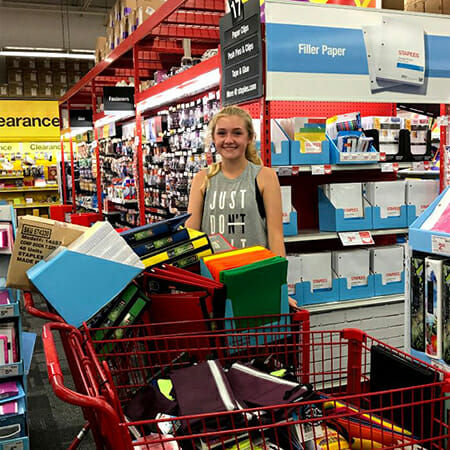
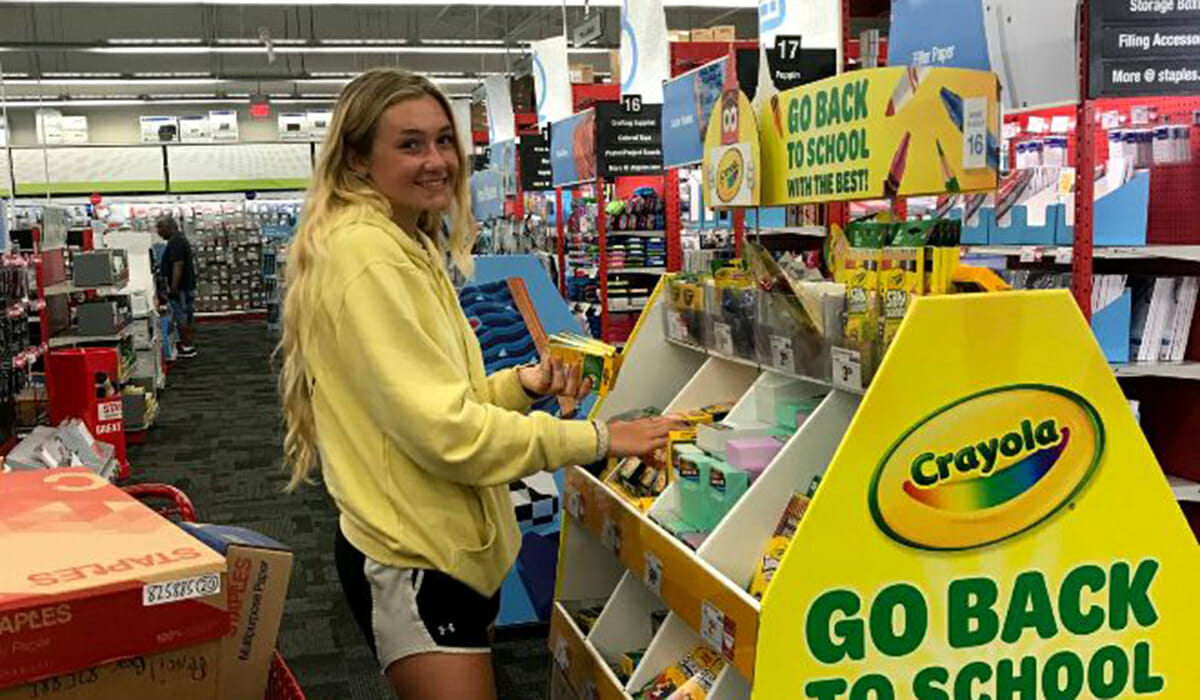
Rileigh’s Rainbows founder and CEO, Rileigh Leighton, pictured shopping for school supplies at Staples. The teen has provided free school supplies to over 700 students since 2014./Courtesy Rileigh Leighton
Why did you decide to help other students in need?
It’s unfair that some kids have supplies, and some kids don’t. Keeping good supplies helps your whole school experience and affects how well you do at school. I first emailed the principal of my elementary school suggesting how I could help, and since then, we’ve provided free school supplies to over 700 students across our school district.
Describe your role with Rileigh’s Rainbows.
As founder and CEO, I gather school supplies, organize our inventory and make sure supplies are distributed to middle or elementary schools. I also handle fundraising. We fundraise and collect donations in order to purchase school supplies. We haven’t branched out to other school districts in New Jersey yet, but plan on doing that in the future. My mom really helps me a lot with Rileigh’s Rainbows, I wouldn’t be able to do any of this stuff without her.
What supplies do you distribute to students?
Binders are one of the big items. Pencils, colored pencils, pencil cases, erasers, pens, glue, gluesticks. We also collect backpacks for some kids.
Share one personal story with me from your volunteerism.
Last summer, we held an ice cream social to help benefit Rileigh’s Rainbows. An elderly woman came up to me and handed me a newspaper clipping reporting on my volunteerism, including a note on it from her congratulating me. That meant a lot to me. I didn’t know this woman and she didn’t know me, but she still took the time to recognize my service. It may sound cliche, but I don’t volunteer for the recognition. It made me feel good that someone appreciated what I was doing and they took time out of their day to make something that was special to me.
Why do you think it’s important for others to give back?
Better than any feeling of getting a new car or a present, giving back makes you feel like such a good person and it helps so many people around you. You can effect a lot of change by giving back to your community.
What’s been the most rewarding part of your service?
I received a bunch of cards from elementary school kids who’d benefited from our school supply donations. I couldn’t believe they sent cards thanking me.
Rileigh Leighton: “Some kids in classes didn’t have binders, notebooks, the types of pens they needed. I felt I wanted to help these kids because I knew I had the resources and I wanted to share what I had with them.”/Courtesy Rileigh Leighton
In one word, what does volunteering mean to you?
Compassion.
When you’re not in school or volunteering, what do you do for fun?
I’m on our school’s varsity volleyball team. I also play golf and I like watching Netflix. I feel like that’s something every teen does (laughs).
How can readers help?
We’ve had to postpone our supplies distribution because of the Covid-19 pandemic, but our donation letters are going out soon, so we’re hoping to resume gathering supplies ahead of the fall. Please visit our Rileigh’s Rainbows Facebook page.
Teen Serves Maryland Community Through Multiple Volunteer Organizations
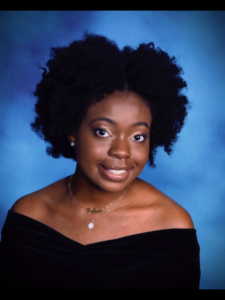
Meet Daily Point of Light Award honoree Esther Obioha. Read her story and nominate an outstanding volunteer or family as a Daily Point of Light.
What Esther Obioha values most in life is making the world a better place in any way she can. Take one quick glance at the long list of ways she serves her community, and it’s clear that she is very much succeeding in upholding her values.
The eighteen-year-old has been an active Girl Scout for the past five years. She frequently volunteers with the organization, including assisting in leading younger troops and helping out at a local Girl Scouts summer camp. For her Gold Award, which is the highest achievement a Girl Scout can earn, she formed the Scholar Dollars Club to help her fellow high school students find and prepare submissions for scholarships. She even attended college courses in order to teach herself how to code a scholarship database. Through the organization, Esther also helped start a menstrual product drive to send sanitary products to girls in Malawi and Nigeria, and co-founded the Women of Color Union in order to connect with and support local girls.
Aside from Girl Scouts, Esther also helps her Silver Spring, Maryland, community by volunteering monthly at Shepherd’s Table, her local soup kitchen, along with her family and the youth group she leads. She also organizes her church to donate meals each month to the nonprofit So Others May Eat, which helps those living in poverty around the Washington, D.C. area. Esther will be heading to the University of Pittsburgh this fall and hopes to enter the healthcare field so she can continue to serve communities in need. Her goal is to open healthcare clinics in healthcare deserts to ensure people living in such areas receive high quality healthcare regardless of their socioeconomic status.
Can you talk to me about your involvement with Girl Scouts and your Gold Award?
I’ve been a Girl Scout for about five years. I do a lot of Sudden Service [Girl Scouts program to notify members of last-minute volunteer opportunities], so any time the Council calls us to do any events or any sort community service where they need extra people, we’re always on the front lines. Every summer — except this one, of course — we go up to a camp up in [Brookeville, Md.] called Camp Brighton Woods. They serve primarily girls in Title 1 schools, so there are reading comprehension-type activities. It’s a really fun place to get girls to come to camp and be able to get a gist of the Girl Scout experience. I even went to one of those camps growing up and that’s what got me hooked onto Girl Scouts in the first place. And then I help my troop leader with her youngest troop.
My Gold Award was the Scholar Dollars Club. I created a scholarship database for my high school. That was pretty difficult because I had never coded before in my life, so I took some classes at [the University of Maryland and Montgomery College] and I even went to my school’s magnet coordinator to get me into the gist of everything. The main reason why I started this project is because there’s a huge gap in getting people to know about scholarships and awareness of certain scholarships out there, especially localized ones, because Montgomery County is only really allowed to advertise the ones they have vetted themselves. That means a lot of the local ones tend to come and go without really any applicants, so whoever would apply would get the full prize or even all the prizes sometimes. I would vet them myself and send them out through newsletters. I realized it would be perfect to have a place where people can translate things and have those things up for them, and any time they wanted to check, they could just go on the database. Currently it’s closed because it’s through Montgomery County, and since schools have been closed the past two months, I’ve really struggled to upload things on to there, so I’ve just been giving out newsletters and keeping everybody posted through my email. During the club, it would [meet] biweekly and we would talk about community service activities. We would write essays together. On certain days of the week, I would call into the career center and explain to them through their translators and everything, the scholarships that are coming up and the ones they can apply for, and do essay-writing workshops and get them ready for the scholarships that are coming up. Through my career center, we worked with other students for internships and community service activities because basically, most of the scholarships deal with what you plan to do in the future [and] what impact have you had in your community, and usually for most people that is their community service.
Esther Obioha is an active volunteer in her Silver Spring, Md. community, where she is in involved in Girl Scouts, her church’s youth group and more service projects./Courtesy Esther Obioha
Through Girl Scouts, I also cofounded the Women of Color Union with my cousin. That was during the Women’s March. We wanted to have a group of girls to go with, so for people who didn’t really have a friend group to go with, we could all take the metro together and march together. After that, it sparked into talking with other girls about having more female authors in our curriculum and having a women’s rights event during our Women’s History Month, which was really nice. In April this year, because April is Black Women’s History Month, we did a really cool thing with black female artists. That was an all online event and really difficult, but it turned out really well. … It was really nice that we all got together, and continued to stay together and talk about the issues that impact us at school and in our communities. I really enjoyed that.
Can you describe the menstrual product drive?
It all started when I was a lot younger. My troop and I were helping another girl [to] get products and supplies for her Gold Award. Around this time, my school wanted to do something with having products being sent over [to girls who needed them], so I was thinking we could make pads. … Because my friend who is also in my Girl Scout troop was also creating pads, I was like, “Why don’t we all link up and do this one big thing?” My troop had a menstrual product drive where they made reusable pads. Then [along with] my school … we put the announcement out there and girls came in and donated things. I know my troop isn’t 100% done with the pads they are doing, but there’s care packages that have already been made with the group that we collected. Those will be sent off in late August I’m hoping. There are some that are going to go to Malawi. When I went to Nigeria two years ago, I realized for a lot of girls in the villages around me — one, there aren’t really many places to go out and buy pads in a timely manner. Two, the pads that are over there are very different from the pads that are over here, and they tend to be more uncomfortable and irritating to that area. I thought it would be a really good idea to send some to those places too, and other villages around, because they aren’t that close to the main city. Each of the boxes we made come with two pads, compostable wipes and a DIY heating pad.
Can you discuss your food distribution-related volunteer work?
I volunteer at Shepherd’s Table. As of recent, I’ve only gone there about two or three times. Every first Saturday and every second Tuesday of the month, I would volunteer at Shepherd’s Table with my church and with my youth group, because I lead my youth group. On Tuesday evenings, I bring my whole youth group and we do dinners there. On those Saturdays, I would just go with myself and my sister, or maybe I would grab a couple friends, or even sometimes I would be like “Hey, I booked this whole day for us, anybody who needs community service hours can just come in.” The space would fill up fast. I would just throw it out there to the club and people would come. It’s really fun. I think the main thing with community service is it’s so much fun when you have people to do it with. … Sometimes my mom, my sister and I would make really big meals for Thanksgiving or holidays and call in beforehand and make sure we can send them in. It’s always just been something that I’ve done. Growing up, that’s something my mom loved to do, so I just kind of followed in her footsteps and it became something I really loved to do. I know it’s something I plan on doing when I go off to college as well.
I [volunteer for So Others May Eat] through my church. It’s the third Sunday of every month. Because not everybody has the time to go and do the soup kitchen, it thought it would be great if everyone can bring meals on that Sunday and then we can send it off to So Others May Eat. It’s an organization where they prepare meal packages, and it’s also kind of like a soup kitchen as well. They [said] what would really help is if you can prepare these meals for us and we could come and pick them up. I thought that could be doable. A lot of people make meals and store them and things like that, so I felt like if we made sure everybody knew about it and kept doing it, we could continue this cycle of community service. Even if it’s not within our community, we can help people in other communities as well.
What inspires you to volunteer in so many different ways?
Honestly, it’s just the people. I remember when I did my first toy drive with my church. My mom used to take me to Shepherd’s Table when she would volunteer, and I would just play with the other kids. I talked about what I hoped to get for Christmas, and then one of the girls I was playing with was like, “Yeah, I don’t know if I’m going to get any toys for Christmas.” I was talking to my mom, “While we’re doing the coat drive this year, can we also ask for people to bring in toys?” We ended up getting a lot of donations, even from friends and family in the community that weren’t even in the parish. We packaged them up and sent them to Shepherd’s Table that winter. It was a wonderful experience to be able to give back in a way that I never thought I could. Even though it may not have been something really big, it was something that had a lasting impact on those kids’ life, being able to have something as simple as a gift that winter. Even taking that burden off their parents that winter, as well, was really nice. I’ve continued to come to Shepherd’s Table and when I was old enough, I started volunteering there.
Then at Girl Scouts, I started doing coastal cleanups and stuff like that. The people I got to meet were so zealous about giving back to their community. It really had an impact on myself, because this was something I already liked to do and these are the people I would like to be around. At camp, just being able to see girls that looked like me doing great things and amazing things, that pushed me to want to be a Girl Scout in the first place. Being a camp counselor myself, being able to be the county-renowned “wonder nugget,” it’s really interesting getting to know the girls and teach them about the Girl Scout values and being able to be a role model to these girls. … It just gives me a warm feeling in my heart that I am able to make an impact through other girls’ lives and through my community, because I was inspiring for them. I was that role model for them. I really do like being able to give back, because you never know how much that can have a hold on people’s lives. That even pushes people to go out and do community service themselves, to help people the way that others helped them.
What have you learned through your experiences as a volunteer?
Honestly, I would say always think about things in the other person’s shoes, but I feel like that’s something I also learned through bible study at school, through all the parables and all the versus we read that are all about giving back to others and respecting others. Community service is one of the ways you can do all of those things in one package. For me, if you see something that you can help with, then there should be no reason why you should stand by. If there’s anything you can do to make the world a better place then do it. For Girl Scouts, it’s “leave a place better than you found it.” All the things I do are all interconnected with community service because that’s the one thing I value most — making the world a better place anyway I can.
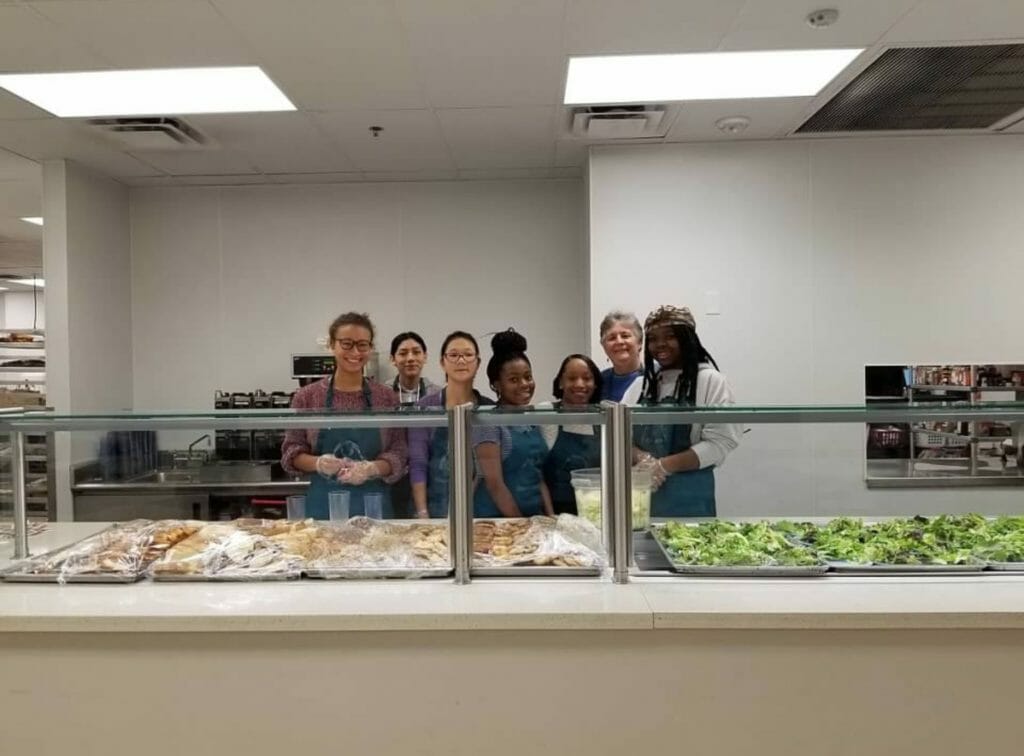
Esther Obioha, center, works to serve food with her Girl Scout troop at her local soup kitchen, Shepherd’s Table./Courtesy Jennifer Manguera
Why do you think it’s important for others to give back?
I feel like in a community where many people are thriving, you thrive as a result. I feel that’s something people tend to forget. If one part of a car isn’t working, then it’s going to be harder to operate that car. If you are able to relieve some of the stress off of another person, they’re able to thrive and they’re able to impact their community. … I feel like sometimes, everybody gets so busy and so caught up in everything that’s going on in their lives, that they tend to forget that not everybody is as fortunate as they. Sometimes they need those couple of meals so they actually have the energy to go out and do their jobs. They need that coat in the winter so they can go and do the jobs they need to do. People need that leg up, and if you have the privilege and if you have the resources to do so, why not help out? Why not help out your community so your community can grow and flourish?
What do you want people to learn from your story?
If anything, I would just tell people to take the risk and find something in community service they love and make that one of their biggest priorities. See how much that effects the world around you. Honestly, I feel like everybody should participate in community service whether it be something as simple as tutoring, or something as big as donating to causes. Especially now in the midst of the Black Lives Matter movement, there are so many things people can do to help others, whether it be signing petitions, donating to the local organizations, even donating meals out to those local organizations so people can be fed throughout these protests. There are so many things that you can do. It doesn’t always have to be the obvious. There are always things that are lurking around in the background that people almost never think about. You just have to find what you really like to do and put all your time and effort into it.
To Science Infinity and Beyond: Teen’s Volunteerism Expands STEM Education
Meet Daily Point of Light Award honoree Arpit Ranasaria. Read his story and nominate an outstanding volunteer or family as a Daily Point of Light.
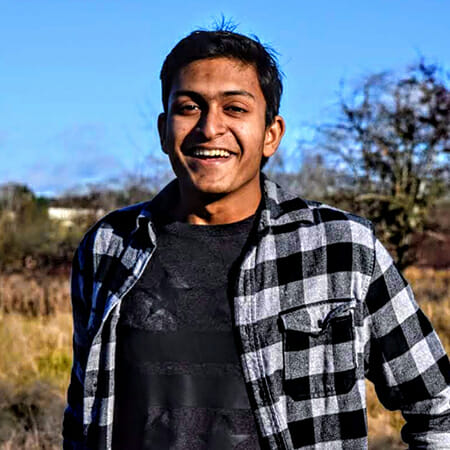
Arpit Ranasaria says his love for STEM-related subjects were ignited when he followed in his older brother’s footsteps, joining a community club called Science Infinity. The 18-year-old Redmond, Washington recent high school graduate has since dedicated his time to increasing access to STEM-related opportunities and education.
As co-president of Science Infinity, now a high school student volunteer run 501(c)(3) non-profit organization, Arpit is committed to spreading knowledge to young students and expanding STEM-related opportunities to underprivileged students. Giving children early exposure to advanced sciences including earth science, biology, physics and chemistry, Arpit has impacted thousands of children since 2016 across the country and internationally.
What inspires you to volunteer?
Whether it’s volunteering and teaching through Science Infinity or serving my time elsewhere in the community, I really love seeing that the work I’m doing has a direct and positive impact on people around me. Volunteering is super fulfilling and makes me feel really happy with myself.
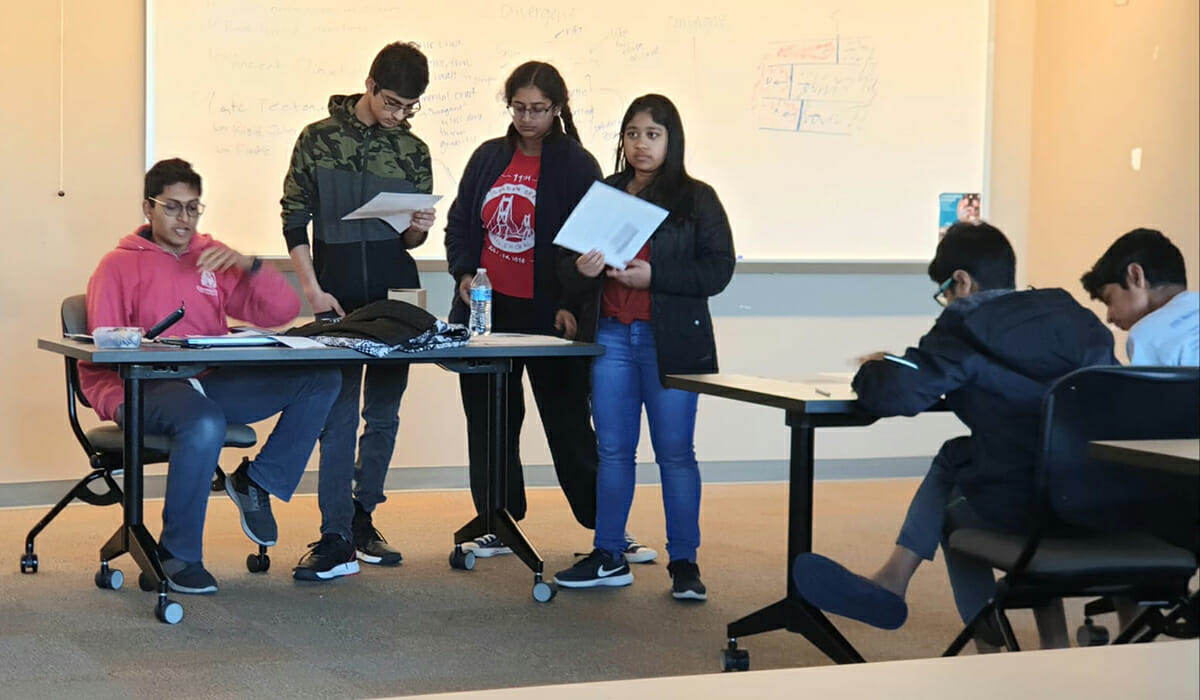
Science Infinity co-president Arpit Ranasaria is offering students early exposure to advanced sciences including earth science, biology, physics and chemistry./Courtesy Arpit Ranasaria
Describe your role with Science Infinity.
As co-president, I manage communications with teachers, parents and students about the classes we offer. We also set up curriculum for our classes and make sure they are running smoothly. In addition to our home chapter in Seattle, we currently have Science Infinity chapters in the Bay Area and Kansas City, Missouri.
How are you helping underserved children?
We have special funds set aside to help underprivileged students and we’ve helped to fund various educational programs closer to home and around the world including to India, Bangladesh, Colombia and Mexico. There are 20-30 high school student volunteers who teach middle school students science and other STEM related topics. Through our programs, we are getting low-income kids involved who didn’t have the resources, money or time to participate.
Share one personal story with me from your volunteerism.
We had a shy 6th grade student join Science Infinity, and while the student was pretty smart, they didn’t participate in class. As the student grew through middle school, I watched over three years as they started finding a passion for all four of the science subjects we were teaching. That student is now a volunteer teacher for Science Infinity and will be taking a leadership position in the organization next year.
Why do you think it’s important for others to give back?
As a human being on this planet, we have the power to do so many things. We have the power to destroy but we also have the ability to create, give back and make the world a better place. It’s important for every person to really be able to use that power and make lives around them better.
In one word, what does volunteering mean to you?
Compassion.
Arpit Ranasaria: “As a human being on this planet, we have the power to do so many things….It’s important for every person to really be able to use that power and make lives around them better.”/Courtesy Arpit Ranasaria
How have you continued your service through the Covid-19 pandemic?
We transferred our curriculum online, and the Bay Area chapter was launched entirely online, post-pandemic. We recently ran an online science competition for students to fundraise, we even have students outside of our chapter areas in the U.S. participating in our online classes.
When you’re not in school or volunteering, what do you do for fun?
I love to play boardgames. I am a huge board game fan. My favorites are Code Names and The Settlers of Catan.
How can readers help?
We’re always looking to expand our reach and help passionate students launch additional Science Infinity clubs around the county. Please visit our website for more information.
With a dream of ending homelessness, 12-year-old starts volunteer organization to provide ‘Blessing Bags’ to those in need
Meet Daily Point of Light Award honoree Jahkil Jackson. Read his story and nominate an outstanding volunteer or family as a Daily Point of Light.
When Jahkil Jackson was just five years old, he experienced a scene so shocking that it stayed with him for years to come.
Jahkil was with his aunt, helping distribute food to the homeless in his city of Chicago during a cold winter. But for the young boy, this was the first time he had even realized that homelessness existed.
“I thought everybody had a home,” Jahkil said. “I didn’t understand at all why they were out there. But that moment made me want to do something about it.”
He approached his parents, saying that he wanted to get every homeless person a house. But with that feat infeasible, he and his parents came up with “Blessing Bags.”
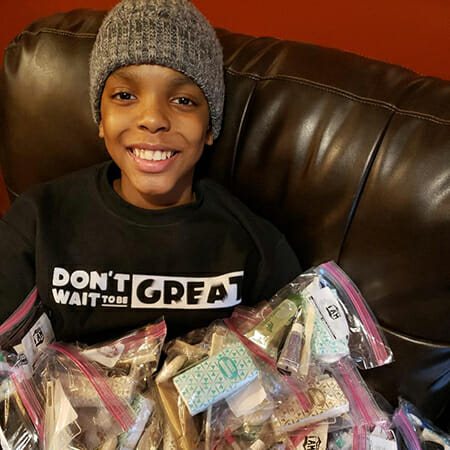
By the time Jahkil was eight, he and his Blessing Bags hit the ground running. He and his friends filled dozens of bags with hand warmers, wipes, socks, deodorant, hand sanitizer, granola bars, toothbrushes, toothpaste and bottled water. Then he took to the streets, handing out the bags to the homeless in Chicago.
Jahkil has provided “Blessing Bags” to nearly 40,000 people around the world./ Courtesy Na-Tae Jackson
One homeless shelter that receives the bags every year is Cornerstone Community Outreach in Chicago, which serves about 300 men, women and children.
“(Jahkil) brought in these Ziploc bags filled with hygiene products, which to the people we serve is like gold because you go through them so quickly,” Sandra Ramsey, executive director of the shelter, said.
“Not only are they homeless, but they usually come with barely anything. They come with the clothes on their backs,” she added. “So (the Blessing Bags) really help them get started in their new world of homelessness.”
In just a few years, Jahkil’s Blessing Bags turned into something greater than he ever imagined. He made the project official by founding a nonprofit called Project I Am, and he organized different drop-off sites and a GoFundMe so people could donate supplies and money.
Jahkil, now 12, has helped provide nearly 40,000 Blessing Bags to people across the nation in Los Angeles, Oklahoma, Atlanta, and more. His efforts have also gone global after he provided Blessing Bags to orphans in Mbabane, Swaziland, volcano victims in Guatemala, and hurricane survivors in Puerto Rico and the Bahamas.
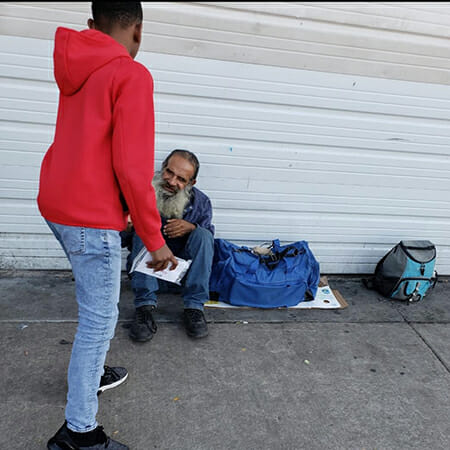
Jahkil handing out one of his “Blessing Bags” to a homeless man in Chicago./ Courtesy Na-Tae Jackson
“It makes me feel really joyful to know that I am affecting other people’s lives and making them happy,” Jahkil said. “So that makes me really grateful to see that.”
The ongoing coronavirus pandemic has put much of the world on hold, but not for Jahkil. He might have had to cancel his large “Blessing Bag packing parties,” but the 12-year-old continued producing Blessing Bags at home with his family.
Knowing that senior citizens were most at risk and unable to go out into the public during the pandemic, Jahkil decided to start giving out Blessing Bags — complete with face masks and gloves — to senior living homes.
On top of his work with Project I Am, Jahkil is a motivational speaker, inspiring other young children around the country to get involved in their communities.
Jahkil’s passion for volunteerism and helping the homeless has received national acclaim. He was recognized as one of CNN Heroes’ Young Wonders and got his own comic book after being named a Marvel Hero in 2019. Most notably, he was acknowledged as one of the three influential people by 2017 by President Barack Obama and the Obama Foundation.
Jahkil said he’s never going to stop helping others because “it’s my passion, it’s what I do.” And if there’s a lesson for others to learn from his story, he said it’s his personal motto he lives by every day:
California Volunteer Takes Time to Smell the Flowers & Inspires Global Love for Environment
Meet Daily Point of Light Award honoree Gary Flanders. Read his story and nominate an outstanding volunteer or family as a Daily Point of Light.
69-year-old Gary Flanders had moved to the West Coast with his wife to be closer to family when the retiree decided to take advantage of his beautiful surroundings in Big Bear City, California. “I’ve always volunteered somewhere in my life. Looking around, I thought, boy, I’m in a National Forest, this is a great place to live. Let me do something here.”
First becoming a Certified California Naturalist, which meant he was trained in California’s unique environment, Gary began volunteering as a volunteer naturalist at Big Bear Discovery Center, a regional visitor and nature center part of the Southern California Mountains Foundation. Helping to support the center since 2015 through community outreach, training, leading tours and more, Gary has connected with hundreds of visitors through his volunteerism, and is spreading a message of conservation and environmental health globally.
What inspires you to volunteer?
It’s cliche. I like being a part of something that’s bigger than me.
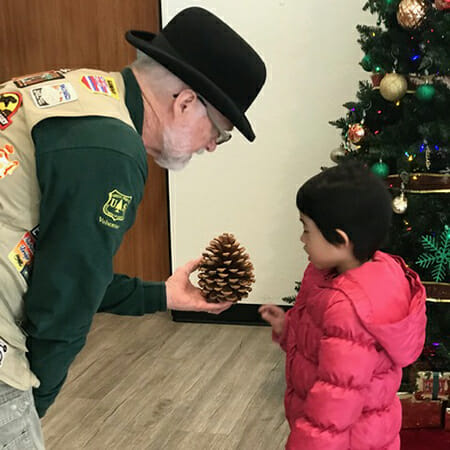
Gary pictured showing a Jeffrey pine cone to a young visitor. Gary Flanders: “This is why we do this. Meeting some little kid who lights up when they see a butterfly or bird or little flower. Volunteering is about connecting with other people, and through my service, I meet people from everywhere.”/Courtesy Gary Flanders
Describe your role at Big Bear Discovery Center.
As a volunteer naturalist at Big Bear Discovery Center, I lead tours, train other volunteers, and develop ways to help people interpret what they see at our center. We do a lot of community outreach. I’ve swept some floors, washed some windows. I also volunteer at the center’s Adventure Outpost store. We have one of the most unique ecological environments in the country, there are certain species of flowers that can only be found here in the entire world, so people from all over the world come to visit.
Explain why volunteerism is rewarding for you.
This little girl was visiting from Malaysia, she had her hijab on, and she asked if it was ok if her brother took a photo of her and I with a big Coulter pine cone. She started following me on Instagram, I followed her back. She’s back home in Malaysia and we still talk to each other. This is why we do this. Meeting some little kid who lights up when they see a butterfly or bird or little flower. Volunteering is about connecting with other people, and through my service, I meet people from everywhere.
Share one personal story with me from your volunteerism.
I was doing animal and other artifacts demonstrations, and this little girl came up to me and she just stood there and stared. I picked up a pine cone and I was being very Fred Roger-y. I told her about the pine cone, which tree it came from. I was sharing all this great info with her, she was very polite and didn’t interrupt. I kind of paused, and she asked, ‘Do you bake?’ (laughs). Her question threw me off, and I responded that I’d made bread once. She asked if it was good and I told her it turned out pretty good (laughs). This is why I do this. It’s about making a connection.
Why do you think it’s important for others to give back?
Volunteering is a way to connect with others and to be of good to the community. Because you’re not paid to do this work, you do it better. It’s something you want to do (laughs).
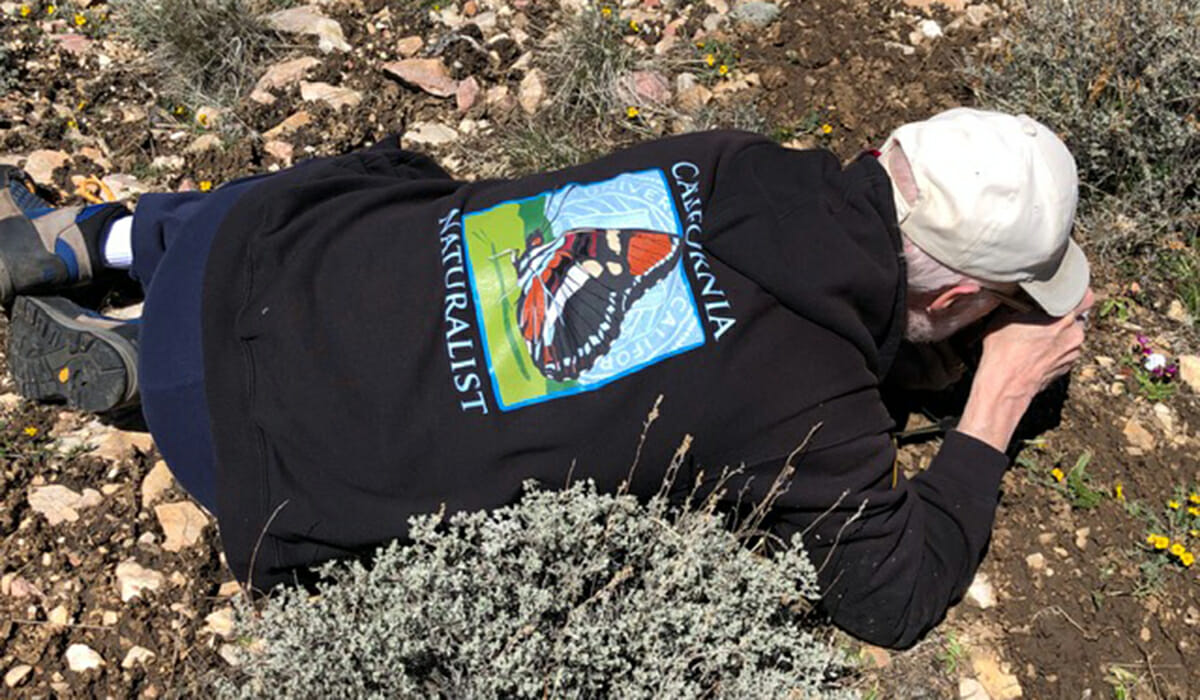
Gary pictured taking a photo of a “Belly Flower”. Gary Flanders: “I can post a picture on Instagram, but It’s so great to smell the pine tree.” /Courtesy Gary Flanders
You spend a lot of time outdoors. What’s your favorite plant?
The Dudleya – it’s called a “live forever”. It’s just this unique little plant, a tiny succulent that needs the environment we have here in California. Our super blooms are just 1.5 – 2 inches tall, we call them “Belly Flowers” because you have to get down on your belly to take a picture of them.
How can readers help?
We’ve had to pause our volunteerism during the pandemic. It’s just really, really tough. We’re hopeful to get back to volunteering when it’s safe, and we’re trying to think of safe ways to keep interest in the forest and continue educating people. Please visit the Big Bear Discovery Center website for more information about how you can help.