Volunteer Helps Provide Essential Health Services to Women in Rural Nicaragua
Meet Daily Point of Light Award honoree Susan Cotton. Read her story and nominate an outstanding volunteer or family as a Daily Point of Light.
In Nicaragua, 90% of women and girls lack access to preventative care. As a result, cervical cancer is the leading cause of death among young women and the number one cancer killer in the country, which also faces the highest rate of adolescent pregnancy in the Americas. The Lily Project, however, is looking to change that by educating, treating and empowering the country’s women and girls.
Susan Cotton is the cofounder and Chair of the Board for the community-based women’s health NGO, which operates mobile women’s health clinics in two communities in rural Nicaragua. The clinics seek to not only provide health services such as cervical cancer screenings, but also educate women and girls on their health. Since Susan helped launch The Lily Project in 2016 along with Anielka Medina and Jonathan Butcher, the organization has delivered health services to more than 20,000 women and educated more than 24,000 girls.
Describe your volunteer role with The Lily Project.
I am cofounder of The Lily Project. We are a women’s health NGO in rural Nicaragua. We operate mobile women’s healths clinics, traveling out to rural communities to provide essential health [services] and cervical cancer screening treatments and education.
How did The Lily Project start?
The Lily Project came about because of the vision of our young founder, Anielka Medina. She lost her mother to cervical cancer. She grew up in a very impoverished community in Nicaragua. Her mom suffered terribly and died when she was just 48 years old. At that moment, Anielka became determined to do something about the disease in her community. She put herself through university and while there, she met Jonathan Butcher, who was working in community development in Nicaragua. He is a U.S. citizen. She started to tell him about the project, her dreams, and what she was trying to accomplish. At the same time, I was completing a Master’s in social entrepreneurship from Pepperdine, and got connected to Jonathan who also was a graduate. He told me about what he was trying to do. My first thought was ‘cervical cancer, we just don’t hear about that being an issue in the U.S. at all.’ What she explained to me is it is still the number one cancer in Nicaragua and other low-resourced countries where there’s just a lack of preventive health. You’re also operating in a culture that is very machismo and [for] women in those communities, particularly in impoverished communities, there is very little education and understanding about how to prevent these kinds of disease or their health in general.
With that impetus and my desire to create some social value that really transcended, that really drove some significant change and betterment for women’s health in the world, I joined forces with Ani and Jonathan. Together we developed a process that would operate culturally appropriately in these rural communities and go out and be able to provide services to women. Essentially our goal was to get out to the women who absolutely had no access to healthcare, so reaching women in very rural communities. Then when we saw not only the underlying health needs, but also the educational needs and the lack of real ownership of their bodies and real awareness of fertility and their own reproductive essential health, we moved to provide these direct services that would also include an educational component, so women would start to have more understanding of their bodies and hopefully overtime begin to feel like they can really take care, and own, their own futures.
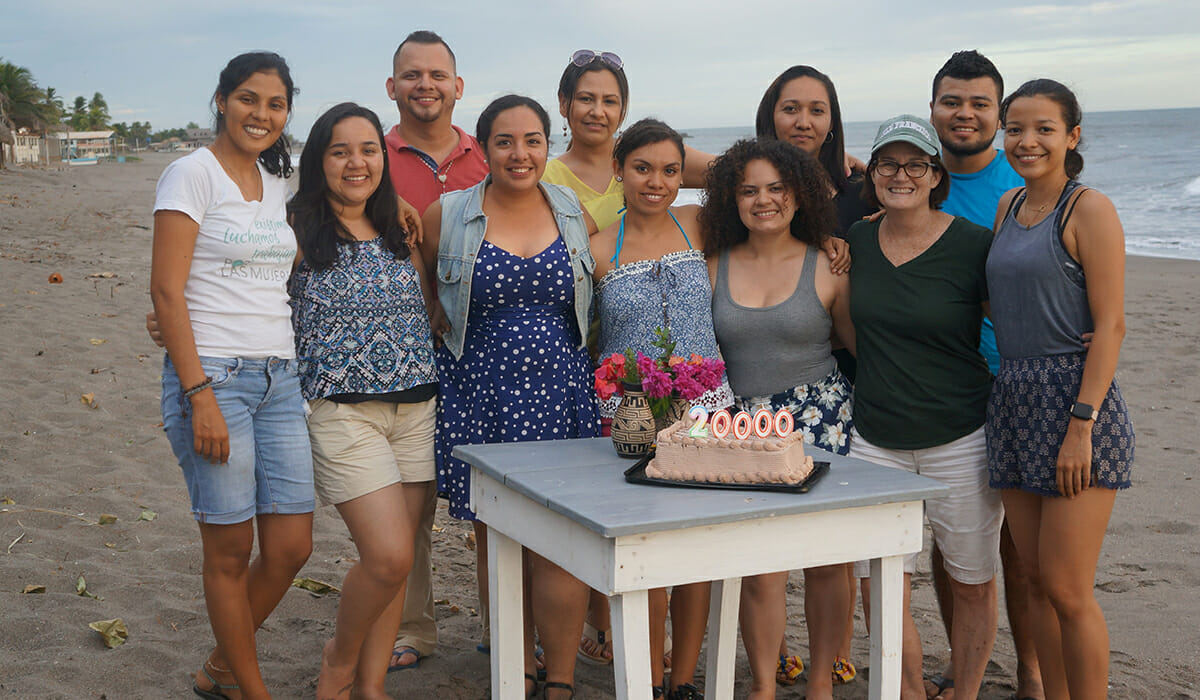
Susan Cotton, bottom row, second from right, celebrates having examined 20,000 women with The Lily Project team./Courtesy Susan Cotton
How does the mobile clinic operate?
We [operate] 365 days. We’re everyday. The model is a grassroots model. We have two teams of young women nurses that go out to these communities along with a driver and security person, a young man who does the operations and drives the truck. They are all young Nicaraguans. They go into the communities every week of the year for the most part, other than holidays, and they do what we call a Lily Health event. We take our mobile clinics and we set up in a church or a school right in the middle of the community. We will serve anywhere from 80 to 100 women in a day. We work very closely with our community partners to help market and make sure we get the attendance so the community is supportive of our work. We go in and set up the clinics and provide the services. The capacity of each mobile clinic is the ability to serve over 3,000 — closer to 3,500 — women a year.
How do you operate the educational component?
The girls will typically come with their mothers to the event, so we’re reaching mothers and their daughters at the events themselves. Our process is basically a three-part process. The first is the group education setting, so we will talk about the reproductive cycle and explain their fertility. We’ll answer questions about their menstrual cycle. Very often, we find even women with three or four children aren’t familiar with their own menstrual cycle, don’t understand it’s relationship to fertility. We have what we call a power bracelet which we introduce women to. It’s a cycle-tracking bracelet so they can understand and start to wear it and start to know the differences that are happening in their body based on the day of their cycle. We also provide education around HPV, cervical cancer, sexually-transmitted diseases, changes in the cervix. We also explain the procedure we’ll be doing that day, which is the screening process which will involve visual inspection with acetic acid. It’s a technique you use by taking a Q-tip, dipping it in vinegar, wiping the cervix, and the pre-cancer regions will react to the acetic acid and show up as white. Based on regulations with the Ministry of Health, we also provide Pap screenings during that process. If the women are exhibiting lesions that need to be removed, we will provide cryotherapy to remove the lesions themselves.
The second part of the process is a one-on-one interview with each woman who we serve. Prior to them having the exam, we will collect their personal health history. We collect all our data on a tablet, so it’s an electronic data collection process. We collect their data and we answer any of their very specific and personal questions they have at that time. It’s a really meaningful opportunity for the women to actually ask questions probably for the first time about their bodies, and for us to be there, listen to her, hear her needs and be able to show empathy and respond to her needs as a young woman who is experiencing all of these things, may have had some issues with sexual abuse. We’re able to help her understand more about it. We have the education, we have the personal interview and then we have the actual exam itself.
Why is it important for girls and women in Nicaragua to have access to this type of healthcare?
Right now, still today, cervical cancer is the number one cancer killer in Nicaragua. It is a leading cause of death in these communities. Women are dying from the disease. It was the same in the U.S. prior to the development of the Pap exam. Basically what is still happening in these low-resource countries is the ability to provide preventative health hasn’t been developed in these countries where the medical systems are overwhelmed and under-resourced. Women’s preventative health is not a primary focus at all in Nicaragua or many countries like Nicaragua. As a result, they’re exposed to HPV and it’s the kind of HPV that will become cervical cancer, but there’s no way for the woman to have any kind of treatment. Cervical cancer is easily prevented or treated if you catch it early. If we were not there, we know in these communities cervical cancer would be higher. We also know we are a resource for the medical system currently. In one community we served last year, the majority of the cervical cancer cases were identified by The Lily Project, not the medical system itself. We’re providing a service that the existing health system doesn’t have the resource and capacity and, frankly, all the interest we have in taking care of the women we’re serving.
What is it like for you to visit these communities and interact with these women?
I love it. I hate the fact that I would be there next month if it wasn’t for Covid. What we always have to realize is number one, we’re a grassroots organization. My role is to be there to understand and observe and learn. The process we use has really been developed by the team. They then teach me things like how we develop relationships and partnerships with the community, the techniques we use, our ability to provide privacy, which is a huge issue for women. They don’t want people to know their test results but typically privacy isn’t valued or isn’t provided in these kinds of health settings. So fundamentally understanding and learning about the needs of the community and things that we take for granted. Every time I go, I go in with tons of assumptions and I need to change my thinking. We did a giveaway raffle and what was most valuable for people was little hand towels. People wanted soft hand towels and washcloths, and things like that. Really having an appreciation for things that we don’t think about being important and valuable. The other thing I always see and get great joy from is the joy of the community. I would say the national song of Nicaragua is a bunch of girls giggling. There’s so much love and so much lightness and laughter. I get to be exposed to that and around people talking and laughing and children getting silly. They have way less from a socioeconomic perspective, but they have so much love and attention and care for each other, and I think that’s enormously inspiring.
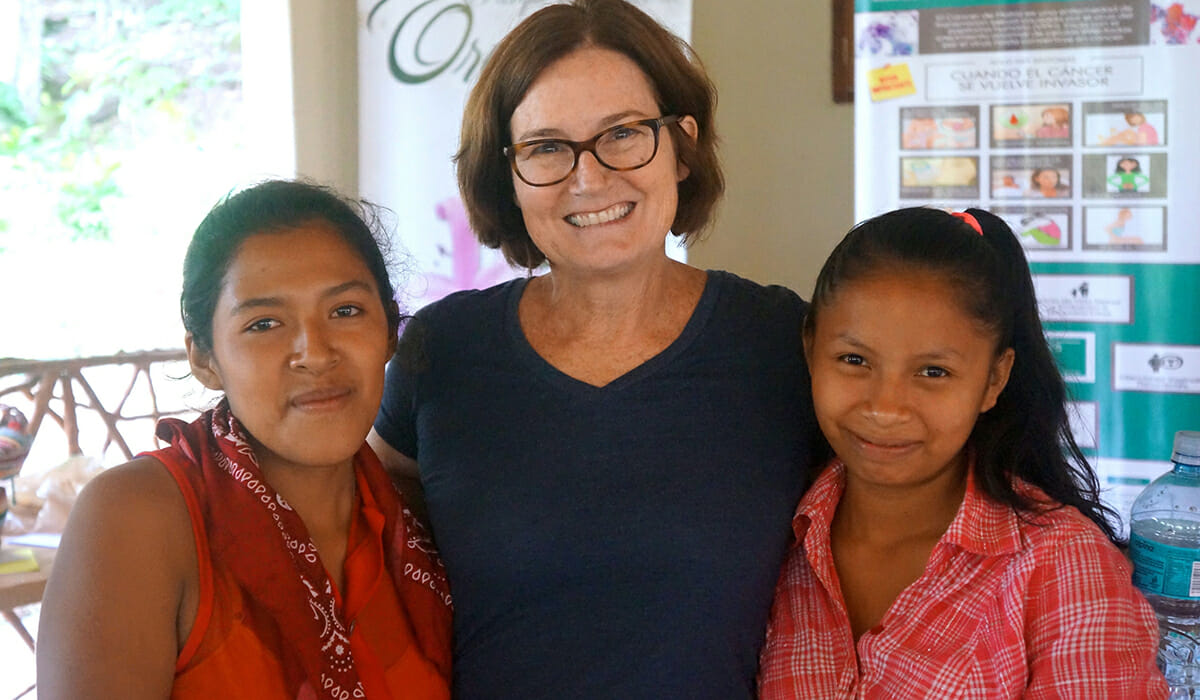
Susan Cotton, center, poses with two clients of The Lily Project, which provides health services and education for women and girls in rural Nicaragua. /Courtesy Susan Cotton
Are there any future partnerships, programs, or events that you are excited about?
We’re just excited to continue to grow. We’re serving two communities now. Our agreement with the Ministry of Health allows us to grow by adding additional teams each year and be able toscreen more women in more communities. Our goal is to add additional mobile health clinics. In addition to that, our goal is also to be able to continue to develop the young leaders we have on our team. We have young nurses and part of the process is we do leadership development with each of them. Our goal would be they experience Lily and then maybe move into other kinds of roles that require changing the culture and changing Nicaragua. These are young women with the leadership potential to go out and create some significant changes in the environment. Lily will be continuing to grow. We believe the women and the partners we help develop will continue to take more and more leadership and help change the world and make the world better for women in Nicaragua particularly. Also, as the Ministry of Health allows for additional kinds of capabilities like the HPV vaccine, which is obviously a huge piece of prevention, and the HPV test — the two processes that don’t exist yet in Nicaragua — we’re advocating for that. [We are] hopeful to be a deliverer of those when they can be available in the community.
What’s been the most rewarding part of your work?
Building relationships with the team in Nicaragua. Ani is fantastic. She’s a very strong and compassionate young leader. Just being able to be there to help her start to achieve her goal and achieve her vision has been the most wonderful part of this experience for me.
What do you want people to learn from your story?
There’s so many ways to contribute. I took the skills that I built over all the years that I worked, and I decided to apply them in a way I knew I could create value. I knew basically it was understanding what I could do and then using those skills to do something. Nobody has to do it the way I’ve done it, but every one of us has the ability to see a whole host of things we’ve built with our experiences, that then can be used to create value and good for other people. I encourage everybody to not shirk away from the opportunities that are out there to be of service, and have fun with it. Do something that gets you incredibly excited, that gets you stimulated, gets you thrilled by being a part of. Certainly I’ve gotten more out of Lily than just about anything in my life. It’s been an incredibly worthwhile experience for me.
Enjoying the Dog Days of Retirement – and Sheltering During the Pandemic
Meet Daily Point of Light Award honoree Fred Rainey. Read his story and nominate an outstanding volunteer or family as a Daily Point of Light.
Fred Rainey wasn’t going to let a little biting problem scare him away.
While volunteering to take care of dogs at Best Friends, a no-kill animal sanctuary in southern Utah, Fred got to know Nicholas, a scruffy little Yorkie with a penchant for chomping down on humans. “I saw this little soul there and he needed some help,” Fred recalled. “I wanted to see how he’d do in a home setting.” So Nicholas was invited for a sleepover and meet Byron, Fred’s 10-year-old three-legged terrier mix. “The boys got along just fine, and Nicholas slowly started to trust. He’s still a biter but he’s slowly coming around.”
A native of Ireland, Fred, 58, admits that volunteering wasn’t a priority during his academic career. After earning his Ph.D. in microbiology, Fred worked at Louisiana State University and the University of Alaska Anchorage. When he decided to retire, he took a leap of faith and moved to St. George in southwest Utah, a favorite region with lots of outdoor activity options. Best Friends still wasn’t on his radar. He spent time traveling and pursuing his passion for photography, settling just fine into his new life.
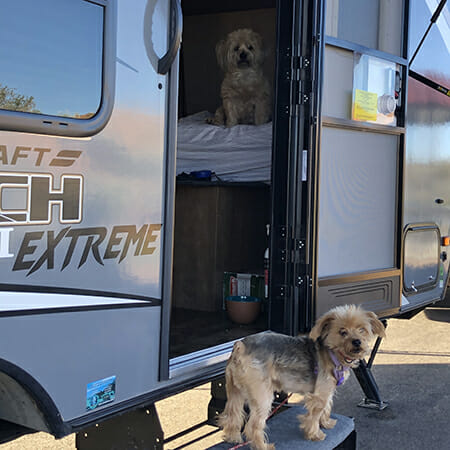
Byron (l) and Nicholas on a camping trip with Fred Rainey./Courtesy Fred Rainey
It was a Facebook event post about Strut Your Mutt at Best Friends that piqued his interest. “It sounded like fun, so Byron and I took a ride.” It’s a three-hour round trip between St. George and the tiny western town of Kanab and Best Friends Animal Sanctuary which sprawls over more than 4,000 glorious red rocky acres in Angel Canyon in big sky Utah. A lifesaving haven for adoptable animals, Best Friends is home to around 1600 dogs, cats, birds, goats, sheep, horses, potbellied pigs and bunnies.
What started out as a five-legged walk of curiosity for Fred and Byron became much more. He met the sanctuary’s volunteer coordinator and found out there was plenty he could do to help. “I’m so thankful for that meeting. Looking back, I realize I was at loose ends with my life’s direction.”
Fred started making the trek every few weeks, then once a week and before too long, was traveling to Best Friends five days a week. He managed the Dogtown Trailer, a temporary holding area for dogs arriving from other shelters. “So many of those dogs were days away from euthanasia and now they are in forever homes. I am so proud of that.”
Fred Rainey moved from St. George to Kanab to make it easier to volunteer at Best Friends./Courtesy Fred Rainey
But spending $500 a month on gas was not sustainable. So… a year ago Fred physically moved to be closer to Best Friends. He and Byron relocated to Kanab, a Western town of some 4,000 people – a big difference from St. George’s 100,000+ metro population.
“I meet so many people from all over the world – more than 30,000 people come to Best Friends every year to tour and volunteer. ” Until the pandemic. With the sanctuary now closed to the public to protect caregivers, volunteers and critters, Fred’s role expanded. “Since the pandemic I became part of the contingency plan and so have been volunteering for four 10-hour shifts per week. This has allowed for social distancing of caregivers and each caregiver having limited contact with others.”
Besides offering some expert advice on cleaning and sanitizing to prevent infection, he works with the same group of dogs and two caregivers daily, minimizing the chance of catching and spreading the virus. Walking, cleaning, feeding, medicating, taking the dogs to the agility course and dog park, on car outings and lots of cleaning rounds out every busy day. Before the pandemic he was also volunteering at the clinic in surgery once a week.
“The only upside to the virus is all the adoptions we’ve had,” said Fred. Resident dogs have gone from more than 400 to under 300 and cats from more than 600 to less than 400.
“We asked a few local volunteers if they could assist – thinking maybe a few shifts here and there,” explained Deb Parker, the animal area team lead and volunteer coordinator. “Fred volunteered to pitch in and now spends 40 hours a week with us since this all began in mid-March. We are so lucky to have him. Fred is an outstanding volunteer — if he sees something that needs to be done, he steps in and gets it done.”
Fred Rainey and Whistler out for a walk at Best Friends./Courtesy Best Friends
Being a lynch pin volunteer at Best Friends was never in Fred’s plan. But he’s grateful for it. “This is such a caring group of people focused on a measurable goal –Best Friends’ campaign is to Save Them All by 2025 – to ensure that we are a no-kill nation by then. I believe it’s going to happen.
“This is my way of giving back,” he said. “I’ve had a pretty good life, traveled to great places for science and for adventure. It’s important to serve because everything in the world isn’t going to get fixed by government. People need to get out and do something to fix the problems. Whatever your interest – people, animals, the environment – there’s a way to get involved and make a difference.”
100-lb+ Dog Duo Deliver Big Comfort to Children and Adults in Need
Meet Daily Point of Light Award honoree Jennifer O’Keefe and her two Leonbergers, Aslan and Digory. Read their story and nominate an outstanding volunteer or family as a Daily Point of Light.
As characters in C.S. Lewis’s The Chronicles of Narnia, Aslan is depicted as a talking lion, a central character in the fantasy series, Digory, a professor who builds a wardrobe that serves as the portal to the fantasy world, Narnia. In real life, Leonbergers Aslan and Digory play equally regal and impactful roles as animal assisted therapy volunteers alongside their owner, Jennifer O’Keefe.
“I met these guys and fell in love at first sight. Everytime we walk into a room they make people smile,” says Jennifer, a Falls Church, Virginia resident.
“You walk through a hospital and people aren’t expecting to see these giant, majestic beasts walk through the hallway. It’s been shown that when people are sick and stressed, animals help to decrease blood pressure, heart rate. There are physiological benefits that people receive from engaging with animals that can last up to 24 hours.”
Reducing stress and raising spirits, 8-year-old, 165-pound Aslan and 5-year-old, 120-pound Digory have helped thousands of individuals they’ve interacted with since 2013. Through a variety of volunteer organizations, the pair have made over 800 visits around the country, says Jennifer, an emergency veteran by day who is also on the board of the Leonberger Health Foundation International.
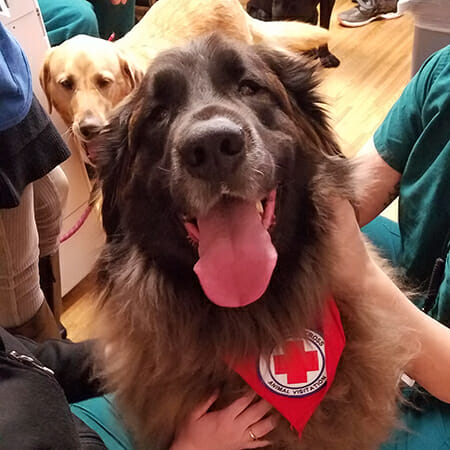
Digory pictured volunteering at Walter Reed National Medical Center, where he, brother Aslan and Jennifer O’Keefe volunteer to provide love and comfort to patients and staff./Courtesy Jennifer O’Keefe
Bred to be people-oriented, the two dogs’ distinctive personalities serve people in need in different ways. Digory is the flirt, says Jennifer. “He can do nothing but bat his eyelashes and give his big goofy grin. He sucks people in. You can just tell he’s eating up every minute of attention he’s getting.” The perfect complement to his enthusiastic younger brother, Aslan is laid-back and fantastic with children, according to their dog mom.
“Aslan is so good with kids, despite his size, he has this presence that kids become comfortable with, even kids that are afraid of dogs. We met this little boy at a Wounded Warrior Project event – all the kids were playing with Aslan and this little boy was obviously afraid of him. After I told the child that Aslan was a gentle dog and wouldn’t bite, five minutes later this kid is laying on him, petting him. It made my heart so happy to see him bonding with a dog that I never thought he’d come anywhere near.”
Visiting hospitals, nursing homes, rehabilitation facilities, schools and libraries through People Animal’s Love (PAL), that human-canine connection is one that also extends beyond ordinary situations like visiting with college students before exams or reading to children at the library. The three make wellness visits geared toward maintaining physiologic health for staff at the National Center for Missing and Exploited Children and the New York City Office of the Chief Medical Examiner.
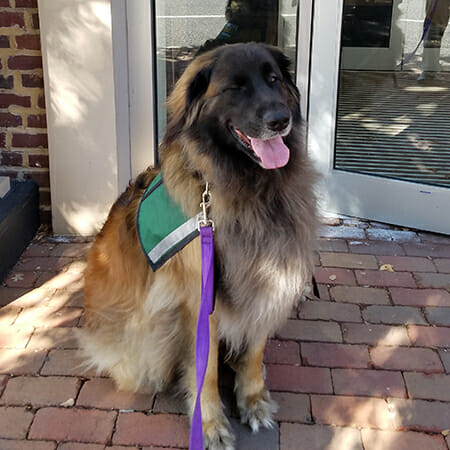
Digory pictured visiting the National Center for Missing & Exploited Children, where Digory and Aslan accompany Jennifer O’Keefe to make wellness visits to staff./Courtesy Jennifer O’Keefe
Additionally, through the American Red Cross Animal Visitation volunteer program, Jennifer, Aslan and Digory provide love and comfort to patients in military hospitals. The trio have the power to brighten the days of seriously ill children who are able to momentarily forget about their sickness, says Kim Skay, clinical research nurse for pediatric oncology patients at Walter Reed National Military Medical Center.
“Unfortunately we have to poke children with needles, we give them medicines that make them sick,” Kim says. “The dogs come in and give these children a whole new positive focus. The dogs will go up to them, put their heads on their laps, get the kids on the ground. The children hug (Aslan and Digory) and forget they’re a patient for awhile, they just remember they’re a kid and they play with them. It’s almost like (the dogs) can sense who needs it the most, and it’s a trickle down effect. They come in, the parent sees the child get happy, the nurse sees the happy child, the nurse gets happy, the parent gets happy. It’s just such a bonus, happy time.”
When disaster strikes, Digory and Aslan can also be called upon, and are sometimes invited to deploy to crisis situations across the country through HOPE Animal-Assisted Crisis Response, responding to national emergencies including flooding, hurricanes, shootings.
“We were in West Virginia for a number of days after historic flooding. There were towns completely wiped off the map, people were killed, people lost everything. We visited FEMA and Red Cross distribution sites, providing stress and physiological healing to flood victims, disaster workers and first responders.”
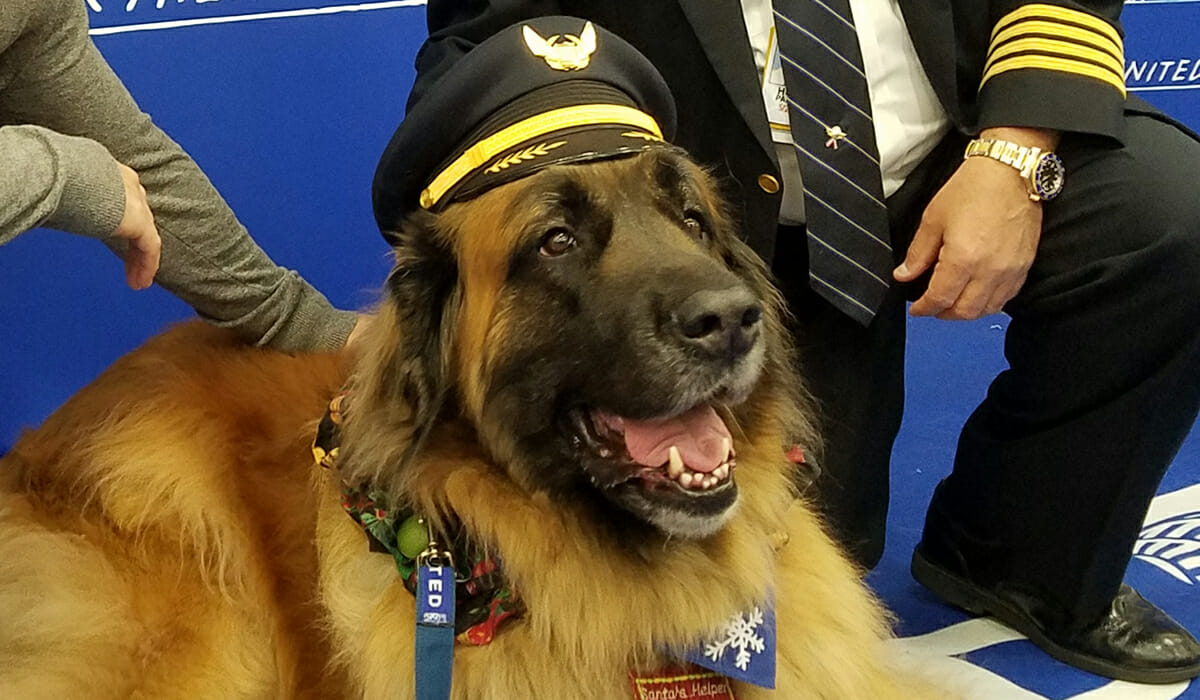
Aslan pictured at a de-stress event at Dulles International Airport, providing some cheer for holiday travelers./Courtesy Jennifer O’Keefe
Jennifer jokes that sometimes, people are so focused on welcoming bigger than life Aslan and Digory with open arms, they don’t remember her name or realize she is with them. “I’m ok with people not knowing my name. I’m an introvert. It’s all about the dogs.” The three are currently grounded at home due to the coronavirus pandemic, but are champing at the bit to get back to their volunteer work.
“We’re all in this world together. I’m very blessed to be in a good place and to have these two dogs in my life. If I can go make someone’s day better, then I’m improving the world that I live in. If we can all help each other out, the world is a better place, it just makes everything better.”
Do you want to make a difference in your community like Jennifer O’Keefe and her two Leonbergers, Aslan and Digory? Find local volunteer opportunities.
Veterinarian Roams Streets of California to Treat Homeless Pets
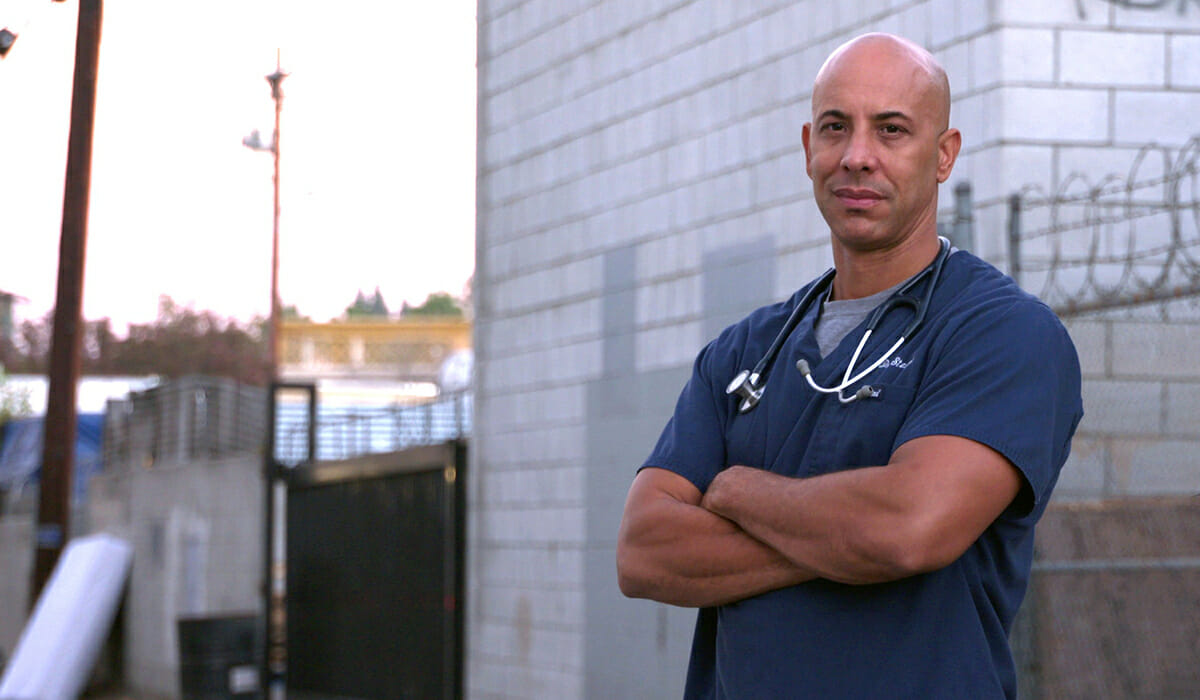
Meet Daily Point of Light Award honoree Dr. Kwane Stewart. Read his story and nominate an outstanding volunteer or family as a Daily Point of Light.
During the 2007 Great Recession, Dr. Kwane Stewart witnessed many people relinquishing their pets for economic reasons at the municipal shelter where he worked as a vet. He himself was hit by the recession, and when he financially got back on his feet around 2012, his memory of the numerous pet owners who were unable to care for their animals inspired him to reach out to the underserved still within his community. Dr. Kwane began hitting the streets of California with a bag of medical supplies, approaching any homeless people he saw with pets and asking if he could help.
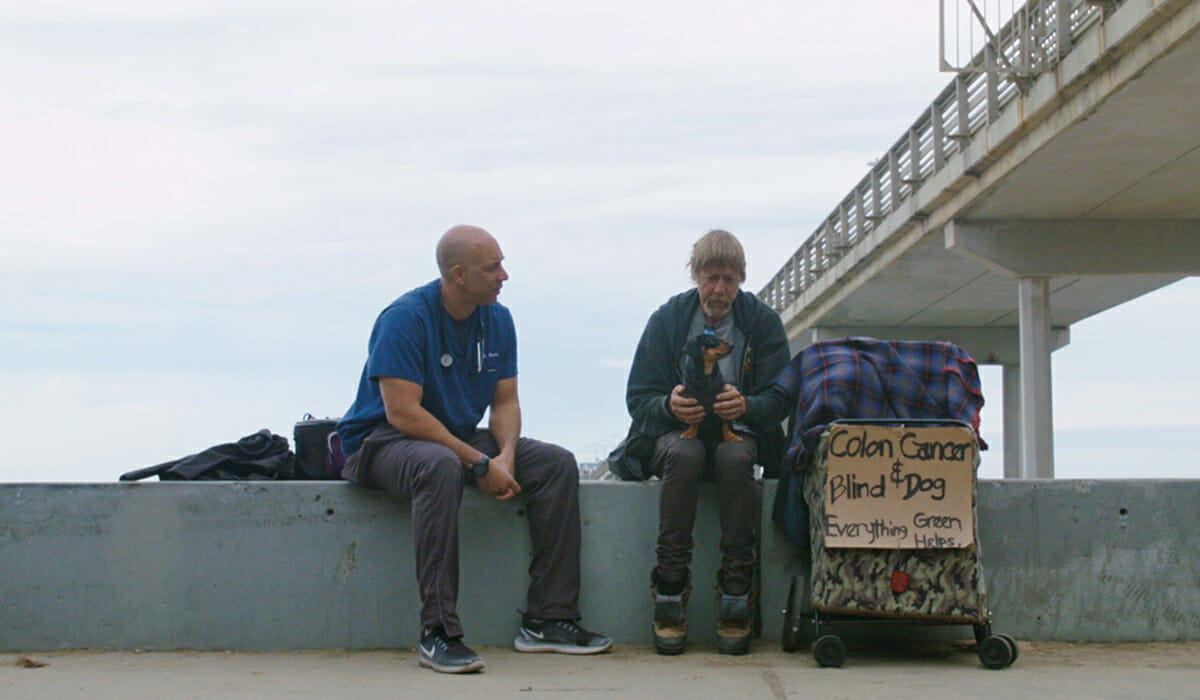
Today, Dr. Kwane is known as “The Street Vet.” During his free time — on weekends, after work, while on the way to the grocery store — he brings medical help and hope to any homeless pet owners he sees, normally within the San Diego and Los Angeles areas. Dr. Kwane can treat about 80 percent of cases he comes across with the basic care materials he keeps in his bag, such as antibiotics, analgesics, vaccines, flea treatments and a toenail trimmer.
“For a lot of these people, their pets are their only source of companionship,” Dr. Kwane, who has been a veterinarian for over 20 years, said. “It gives them purpose and I feel like, and I have been told, it gives them hope.”
Dr. Kwane Stewart, who has worked as a veterinarian for over 20 years, travels California looking to help homeless pets./Courtesy Two Sons Productions/The Street Vet
While the vast majority of the animals Dr. Kwane sees are dogs, he has also come across a handful of cats, a few birds and a 12-foot Burmese python. Some of these cases can be viewed on his reality series “The Street Vet,” which follows his journey helping homeless pets.
If an animal needs more help than what he can provide on the street, Dr. Kwane still does everything in his power to get them treated. He doesn’t have his own practice, as he currently works to oversee the protection and care of animals on movie sets, so he leans on colleagues and friends when he finds an animal who needs additional care. If he is in an area of California where he doesn’t know anyone, he will cold call veterinarians nearby and ask them to take on the case pro bono or at a reduced cost.
One of the veterinarians who often helps him with cases that require extra care is Dr. Laurie Leach. The two met about four years ago at the Beverly Oaks Animal Hospital in Los Angeles, where Dr. Kwane takes on emergency room shifts in order to keep his skills sharp. She said for a lot of the homeless population, their pets are a lifeline for them.
“It truly does warm your heart to see that someone has the time and the willingness and the ability to go out there, and is not afraid to make a connection with them through their pets,” Dr. Leach said. “Their pets are very, very important to them, maybe the only stable thing they have. So as a vet, it is really gratifying to know he is out there doing that.”
During his time helping the homeless population, Dr. Kwane has witnessed them be hassled and mistreated — including having food thrown at them and being spit at while he was helping their pets. He said even he had a lot of his own prejudgments on homeless people prior to his volunteer work, which he quickly learned were wrong after he started interacting with them.
“It’s been enlightening for me to understand them more and realize they’re just people who oftentimes fall on hard times and need to be picked up, or need some help, or some compassion,” Dr. Kwane said.
He has always treated the homeless animals pro bono, so Dr. Kwane started a GoFundMe in September to help with the cost. He set the goal at $10,000, which he thought he wouldn’t reach. After GoFundMe made him their Hero of the Month in February, the support he received skyrocketed. He quickly went from having raised $4,000 to over $110,000.
Dr. Kwane Stewart, left, said for the homeless people he interacts with, their pets are their only source of companionship. /Courtesy Two Sons Productions/The Street Vet
His plan now is to launch a nonprofit called Project Street Vet where people can continue to donate money that will go directly toward treating the pets of the homeless. He dreams of also recruiting veterinarians in other cities around the country to do the same work.
Dr. Kwane has wanted to help save animals since he was in high school. He said the smiles he sees from the homeless pet owners, as well as the knowledge that he can alleviate pain from pets who have possibly been suffering for a long time, is more than enough for him to generate motivation to keep up his work.
“There’s nothing like just treating a pet that would never have otherwise received it,” Dr. Kwane said. “That feeling is indescribable.”
8 Paws + 4 Hands Volunteering to Save the Planet, Indiana Family Picks Up 200K Pounds of Trash
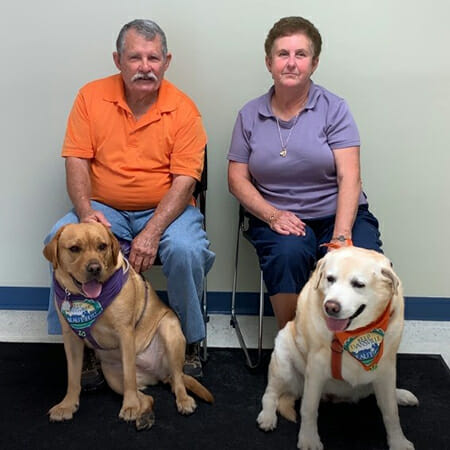
Meet Daily Point of Light Award honorees Susan and Steve Harp and their two yellow Labrador Retrievers, EVIE and VANDY. Read their story and nominate an outstanding volunteer or family as a Daily Point of Light.
For Steve and Susan Harp, residents of Evansville, Indiana, their journey as an environmentally-conscious family started in their youth, Susan a self-described lifelong Girl Scout and Steve, a hunter. Deeply connected to nature, they realized their hometown had a problem in the late 1990s, when plots of land they cared for as part of Keep Evansville Beautiful (KEB), an organization dedicated to creating beautiful and healthy outdoor environments through citizen action, became littered with trash, says Susan.
“We had these gorgeous “Adopt a Spots” with flowers at strategic intersections. You’d go tend to the flowers at your spot and you’d find litter, and it was just disgusting. It was sad.”
Wanting to get their entire community involved in protecting their city’s natural assets and enhancing economic growth for the greater Evansville area, Susan and Steve decided they would impart their appreciation for nature with the youngest generation in their community. The best way to connect with youth, says Steve? Two adorable yellow Labrador Retrievers.
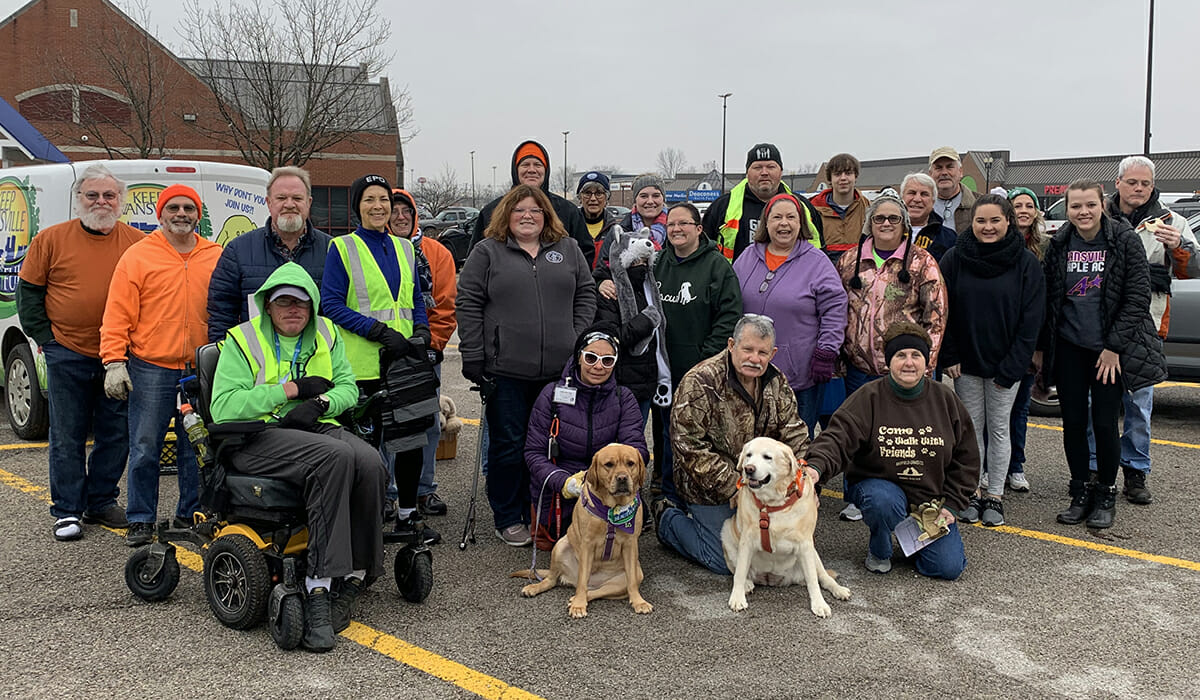
Since 2007, EVIE and VANDY have picked up about 200,000-pounds of trash alongside their owners, Susan and Steve, doing monthly litter pick-ups through Keep Evansville Beautiful./Courtesy Susan and Steve Harp
“If I was to go up to a stranger and ask them to pick up the litter they just threw down on the ground, they’d probably say no,” Steve says. “Some adults don’t care. But when (EVIE and VANDY) are telling you to pick up litter, through the eyes of a child, it’s a lot different. This one grandmother told us that her young grandson refuses to let her leave the local mall until he’s picked up trash across the entire parking lot. And it’s because EVIE told him to do this.”
Naming their fur babies with intention, Susan and Steve have involved their four-legged friends in their volunteerism since they were puppies, training them to retrieve litter and spreading their message of helping the environment to thousands of children and adults across Indiana and nationwide. The two Labs even serve as mascots for Keep Evansville Beautiful.
“We got EVIE SUE in 2007, her name is an acronym for “Every Volunteer Is Essential, Shape Up Evansville,” says Susan. “VANDY LEE arrived in 2016, her name stands for “Volunteers Are Needed Donate Yourself, Love Earth Everyday.”
Susan, Steve, EVIE and VANDY Harp volunteer to save the planet by teaching children and adults about recycling and the importance of not littering. /Courtesy Susan and Steve Harp
Picking up litter monthly, attending community events, going to speak with young students at local schools and traveling for Keep America Beautiful events (KEB is an affiliate of this national organization), the two Labs have become anti-litter mini-celebrities, educating people in-person, online and through books about litter and recycling. Since 2007, the two dogs have picked up about 200,000-pounds of trash alongside their owners, service that will have a lasting impact for generations to come, says KEB executive director, Julie Welch.
“They’ve impacted so many young children talking about littering and recycling, we’ve had children in high school and even beyond that still recognize and remember the dogs. They have reached well over 100,000 young children with their positive message, and the dogs are wonderful. We’ll experience their lasting effect for generations to come.”
Such an established part of their community, Susan says the Labs recently made a college campus visit to a student who first met EVIE when the girl was in third-grade.
“The kids in our community have grown up with EVIE. Picking up litter and protecting the environment – that’s instilled in them that that’s what EVIE means. EVIE the dog brings that story to life. You know there’s a saying – you never follow children or dogs when you’re doing a performance, because dogs just win people over. They leave paw prints. That’s EVIE and VANDY.”
Picking up plastic shopping bags that blow around, plastic bottles, cups from fast food restaurants and paper goods, EVIE once found an unpleasant bundle of trash as the family was volunteering at a clean-up with police. “EVIE picked up a diaper that was wadded up (laughs),” says Susan. “And it was used,” says Steve. “EVIE came back back gently carrying this diaper. Nobody wanted it. We don’t allow them to pick up bad stuff, we watch them. There are a lot of cigarette butts on the ground but we don’t allow them to pick those up,” Susan says.
When EVIE and VANDY aren’t busy with their environmental volunteering, they contribute to other animal causes, including raising money as Team 02 Indiana for the Emma Zen Foundation, which provides animal oxygen masks to fire departments for pets rescued from fires. They also help the local animal control shelter in Evansville. Amidst the coronavirus pandemic, Steve and Susan are leveraging their pets’ social media presence to continue sharing their mission virtually, including doing read-alongs of EVIE’s books on YouTube.
Susan, Steve, EVIE and VANDY visit with the youngest in their community to share their anti-littering message. Pictured speaking to preschool students. /Courtesy Susan and Steve Harp
While stuck at home, EVIE and VANDY continue to help out with trash pickup, occasionally finding scattered litter in the front yard or in the woods around their house, and are eager to get back to work, as are their human owners, says Susan.
“We got EVIE and VANDY to share this message. It’s a worldwide problem and people need to respect the environment. People can be ticketed for littering but the only way we’re going to make a difference is to change the mindset and the only way to do that is teaching our youth that it’s wrong to trash the environment and make sure the earth stays healthy.”
Do you want to make a difference in your community like Susan and Steve Harp and their two yellow Labrador Retrievers, EVIE and VANDY? Find local volunteer opportunities.
Comfort Dog Spurs “Miraculous Moments” Through Volunteer Visits
Meet Daily Point of Light Award honorees Jean Dombi, Kyra Carbone and Seth the comfort dog. Read their story and nominate an outstanding volunteer or family as a Daily Point of Light.
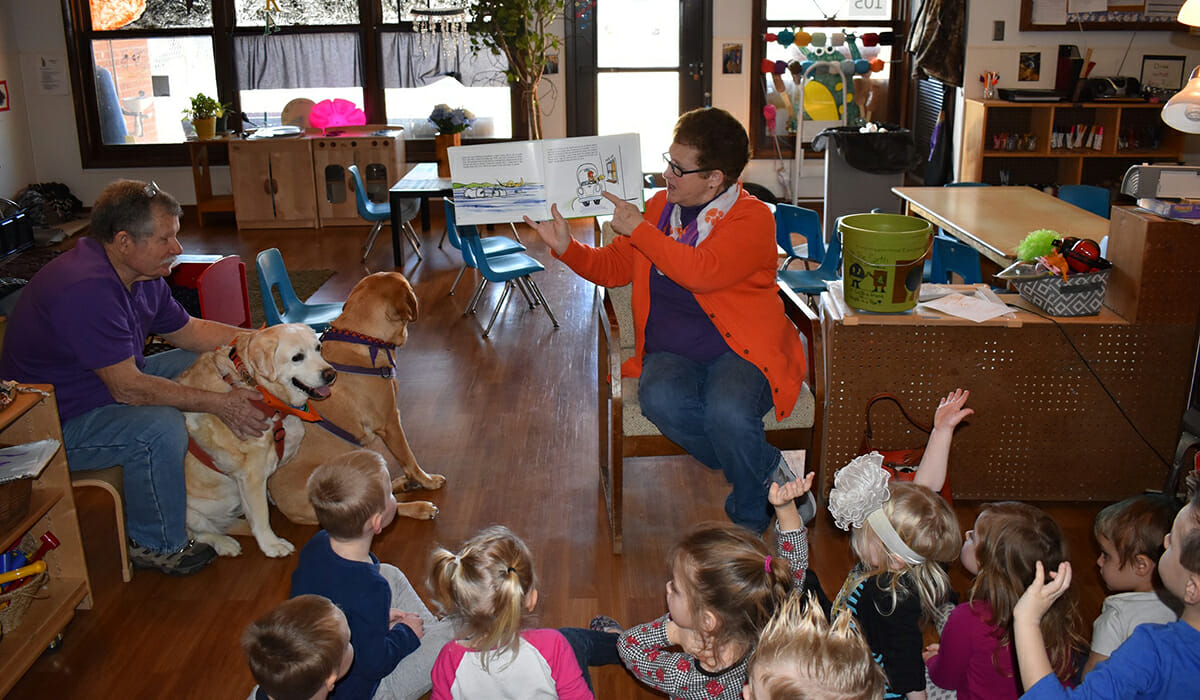
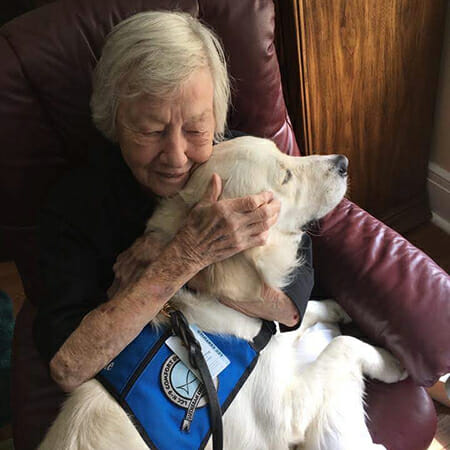
With permission, Seth delicately placed his two front paws on the bed. Visiting a bedridden South Carolina woman suffering from Alzheimer’s disease, Seth followed his handler’s instruction to “rise” and greet the woman, who according to her husband of 67-years, would stare out the window for hours at a time, unresponsive and not engaging. Upon seeing the young Golden Retriever, the woman came alive, says Lutheran Church Charities (LCC) K-9 Comfort Dog Ministry volunteer Kyra Carbone.
“Her face lit up. She started talking, she was cracking jokes at her husband. He started crying, saying he hadn’t seen her like this in years. He was crying, we were crying, everybody in the room was crying. Seth’s face looking at this woman was precious. It was just a miraculous moment.”
That miraculous moment is one of hundreds created by two-year-old Seth, a trained comfort dog who volunteers for the LCC K-9 Comfort Dog Ministry. A resident of Seneca, South Carolina, Seth lives with Kyra but by day is man’s best friend to countless residents of South Carolina and beyond as he serves as a bridge for compassionate ministry. Making 227 visits in the past year to nursing homes, hospitals, schools, assisted living, hospice and special needs facilities – even being deployed out to emergency situations, Seth and his volunteer handlers use their specialized training to connect with people, says LLC K-9 Comfort Dog Ministry volunteer and Seneca, South Carolina resident, Jean Dombi.
Seth pictured doing the “lap” command to get closer to an assisted living resident./Courtesy Jean Dombi, Kyra Carbon
“Lap is one of the favorite commands. It’s done when people are sitting down. That is the favorite because they get to hug Seth. Rise is another favorite for those stuck in a bed. He doesn’t do shake (laughs) because the people Seth is interacting with might have an IV or their skin could be thin. He also doesn’t lick. Some people want him to give kisses, but he is trained not to lick because that could be a health hazard.”
According to Amy Howard, volunteer outreach coordinator at Providence Care Hospice in Piedmont, South Carolina, Seth, Kyra and Jane are offering quality time to hospice patients who may not have much time left.
“Seth brings a lot of comfort and joy to our hospice patients. Oftentimes hospice patients are more isolated because of their declining health. Those who once had dogs or enjoyed them still get to visit. It’s magical to see. Seth is very in tuned to humans, he seems to know when to give that one-on-one attention, when to be still and quiet, when to put a paw up and when to play.”
Zoning in on people who need it most, Jean says Seth’s whole body relaxes when he’s meeting a new person. Sometimes a smile appears on his face, other times she says, you can see the purebred communicating through cues to his handler to get closer to a person. That special connection, formed in moments of sadness, joy and everything in between, is so palpable, Jean says, that the volunteer at times feels like they are led directly to the individual in need of attention.
“Seth has been trained to obey and walk with us,” says Jean. “I was once trying to get down a hallway with him, and he kept turning his head and tried to bring me down another hallway. I finally let him lead the way to this aide who had just sat down on the couch. (Seth) went over to her, he put his paws up on her lap, she put her arms around him and started crying. She had just received bad news from home and didn’t know what to do, but he knew what to do. This dog had such a sense, and helped her release these emotions so she could get back to work. It was an amazing sight.”
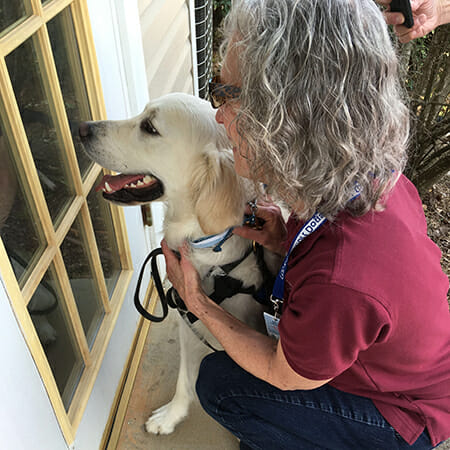
Kyra Carbone pictured with Seth conducting a window visit during stay-at-home orders. As a result of the coronavirus pandemic, LCC is offering virtual visits. Seth has participated in 3 virtual visits with people in Wisconsin, North Carolina and South Carolina./Courtesy Jean Dombi, Kyra Carbon
In addition to his routine visits, Seth and other LCC dogs are trained to respond to tragedies and natural disasters, says Kyra. “We had twin boys killed in a car accident, and we were asked to go visit their kindergarten classmates at school. The kids would pet Seth, talk about their friends and how much they missed them.”
Seth, named for Adam and Eve’s third child in the Bible, serves as a comfort to those sometimes removed from their friends, families or pets. According to Jean and Kyra, their volunteerism truly feels led by God, and their reward is the joy and comfort they are able to bring to others.
“Dogs are bridges to opening conversations,” says Kyra. “Relieving stress, comforting people and opening their hearts to talk when they may not have talked before. The beauty in using (these) beautiful animals is that you’re providing these happy moments for people and it brightens their day.”
His volunteering is technically “work”, but Kyra and Jean say Seth loves every minute of his service. Launching virtual visits in April as a result of the coronavirus pandemic, LCC K-9 Comfort Dog Ministry is still connecting through person-to-person virtual visits, but Seth is eagerly awaiting the day he is able to go back out in the field.
“He is meant to be petted. That is a reward for him as well,” Kyra says. “That’s what’s hard now with social distancing, I can see he misses the visits terribly. I’ve had to give him that love at home that he would be getting out in the field. He does get rewarded by everybody and he really loves the people he sees regularly.”
Virginia Teens Volunteer to Challenge Status Quo with Personalized Education
Meet Daily Point of Light Award honorees Rayan Yu & Andrew Tran. Read their story and nominate an outstanding volunteer or family as a Daily Point of Light.
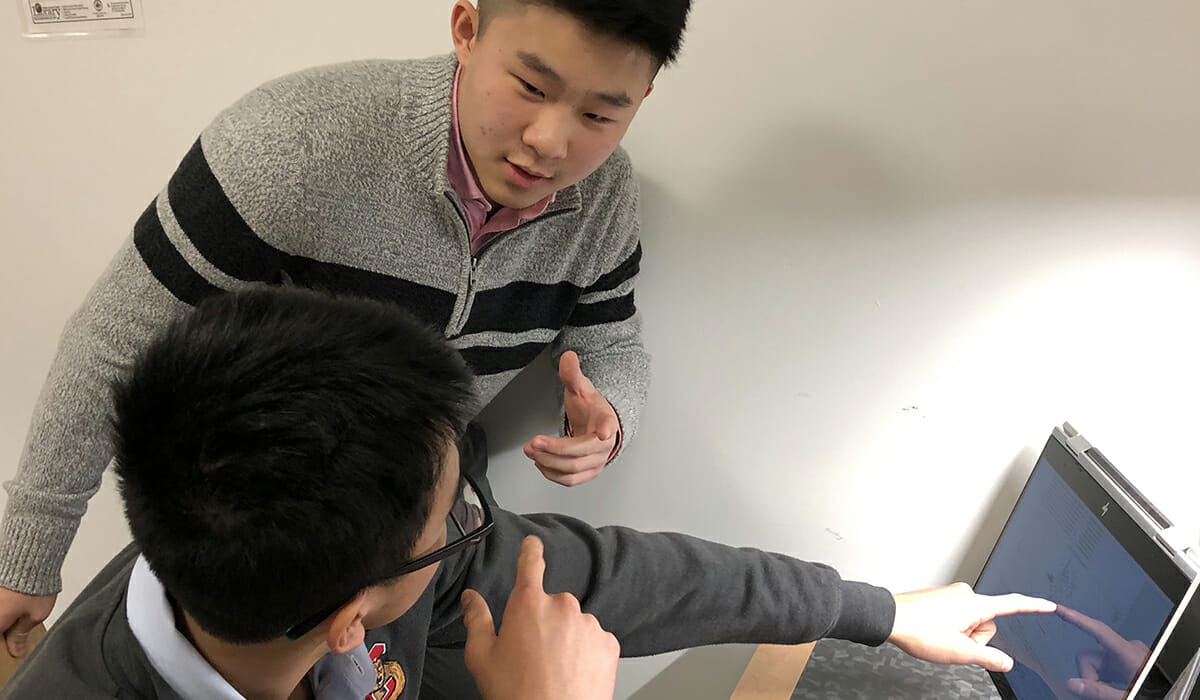
As rising high school seniors, Rayan Yu and Andrew Tran connected over a shared passion to educate students leveraging digital technology. After discovering inequities faced by their classmates here in the U.S. and as far away as students in China, the two Virginia 17-year-olds decided to use their tech skills to provide access to better and more personalized education to students worldwide.
Launching inGenius X in 2018, Andrew and Rayan are working to provide easy access to education anywhere and everywhere through free STEM-education mobile apps to help level the playing field for students around the world who otherwise might not have the resources to reach their full potential. Helping over 60,000 students globally thus far, Rayan and Andrew are challenging the status quo with hyper-personalized education.
What inspires you to volunteer?
Rayan:One summer, I did a volunteer mission in my father’s hometown in rural China, in PingJiang, Hunan and tutored students every day. My parents had mentioned the educational struggles they faced living in rural China, and I witnessed that firsthand during my mission. These students didn’t have curriculum, textbooks, and were in very large classes. That’s when I realized that in our modern, digital age I could educate students across the globe through mobile apps and online resources.
Andrew: I’ve always known that my school in Alexandria, Virginia was historically economically underprivileged, but in my sophomore year, I started to notice that students couldn’t afford backpacks, pencils, the basic necessities. Rayan and I then began to collaborate on how we could combine our skills in digital technology to help these students.
Describe your role with inGenius X.
Rayan: As co-founders, we organize and develop all initiatives. We also recruit volunteers and manage legal and finances, including crowdfunding and grants.
Andrew: As co-founders, we work on business operations and logistics together. I’m mobile app-oriented so I work on the front-end web development for our educational offerings while Rayan is more AI-oriented.
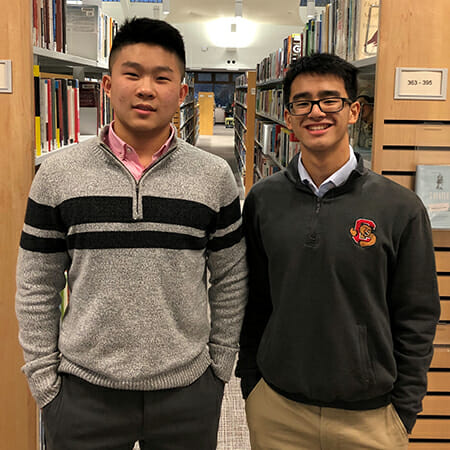
inGenius X’s co-founders Rayan Yu (left), Andrew Tran (right), have connected with over 60,000 students globally through their personalized education digital resources.
Share one personal story with me from your volunteerism.
Andrew: We tutored a girl named Amelia using our app “Mathtivity”. She’d learned to hate math but we’d created a series on mathematics and we saw that her eyes immediately lit up when she was learning. This was a 3rd-grade student who was just getting into these topics and she was already interested in geometry. That experience pushed us forward on our mission.
Rayan:One of the students I tutored in my father’s hometown sent me a photo using our app Mathivity. That made me realize how global our organization is and how we are able to connect with kids across the world using digital resources. It was an extraordinary moment. If I can have a more personal connection with these kids to help them learn more and pull them out from the underprivileged situations they’re in, that sparks the change I want to make in the world.
Tell me about your educational resources.
We have reached over a million people with some of our social media posts, and have directly connected with over 60,000 students thus far. Some of our initiatives include:
Project Edutivity: Educational mobile apps (Mathtivity, Chemtivity, Phystivity, etc.) provide personal learning experiences for students around the world.
Educational Research: Research at the intersection of technology and education with studies such as “inGeniusLearn: Simulating Psychological Tutor-Student Interaction With a Deep Learning-Based Computational Model”.
HackGenius: We host hackathons and other events to provide local underprivileged students with computer science and STEM opportunities.
You’re also offering a program amidst the coronavirus pandemic. Tell me more.
A lot of students have been put out of school because of this modern crisis. We’ve noticed that distance learning can’t compete with face-to-face learning, so we created COVID-19 Online Learning Assistance, made up of virtual learning software like AmeliaX to help students with studying and homework.
What’s one way you hope to inspire others in your service?
Andrew:At its core, inGenius X is caring about something a lot bigger than yourself. For me, the purpose of life is improving the lives of others and enriching those around you. I have seen the effects of poverty and lack of access to education, so with inGenius X, I’m trying to make other people’s lives better with education.
inGenius X co-founders Rayan Yu and Andrew Tran pictured developing AmeliaX, an AI-powered learning assistant to help students in need during the COVID-19 crisis, where digital tools are key to distance education./Courtesy inGenius X
What’s been the most rewarding part of your service?
Rayan:Seeing the number of students that have been able to improve using our resources has been the most rewarding. We receive analytics on the number of our students, how they are improving, and what lessons they are completing. Thousands of students are making progress every day using inGenius X.
In one word, what does volunteering mean to you?
Andrew: Empowerment. We are empowering others, in our case, through technology.
Rayan: Sympathy. Understanding what others are experiencing and being able to act on it.
What have you learned through your experiences as a volunteer?
Andrew: I’ve learned so much more about compassion with regards to my community. As a freshman, I remember very vividly walking through the hallways and not being mindful about the problems other students face. Mindfulness and compassion are both emotions that I’ve experienced throughout this entire process.
How can readers help?
We fundraise for our various purposes, such as funding the creation of a school in Vietnam. For more information about our programs and how you can help, please visit our website.
Teen Tackles Global Issues through Student Exchange Program Service
Meet Daily Point of Light Award honoree Ashley Lin. Read her story and nominate an outstanding volunteer or family as a Daily Point of Light.
Growing up in a bilingual household immersed in a culture vastly different from her native Taiwan, Ashley Lin says it became her mission to figure out who she was as a person, and also learn more about other cultures. Following a once-in-a-lifetime exchange program in Uruguay, the 16-year-old Vancouver, Washington student decided that she wanted to give other students the opportunity to have a meaningful and interdisciplinary cross-cultural learning experience as part of their educational journey.
Launching Project Exchange in 2018, Ashley connects high school and college students from around the world for a 12-week digital exchange program called “cohorts”, facilitating conversations about culture, promoting mutual understanding and preparing young people to tackle today’s critical global issues through cross-cultural collaboration.
Connecting hundreds from the U.S. to the U.K., India and more, Ashley is bridging global gaps and erasing cultural differences between students through Project Exchange across the world.
What inspires you to volunteer?
Learning about different cultures in school brought clarity to my own identity, something I first discovered learning Spanish in middle school. The next step for me was to study abroad, however this was financially inaccessible for my family, and I never thought I’d have that opportunity. In high school, I received a scholarship from the U.S. State Department to serve as a Youth Ambassador to Uruguay. Fully immersing myself in a different culture, I learned from people who maybe didn’t agree with me, but we still had a dialogue about those differences. I realized I could apply what I learned in my own community, and I believed that every student should be able to have access to the same experience I had.
Describe your role with Project Exchange.
As Founder and CEO, I lead a team of about 20 high school and college volunteer students from around the world that facilitate our various programs, social media and outreach. I keep our mission to increase access to cross-cultural learning opportunities alive.
Tell me about some of your programs.
The majority of our students are from the U.S., but we also have students from around the world, including Saudi Arabia, UAE and India. Our exchange facilitators include volunteer college students from Pakistan, India, and the U.K. Some of our programs include:
Digital Exchange Program: An online cultural exchange program designed for and led by students that uses design thinking, community journalism, and the UN Sustainable Development Goals to strengthen language learning and cross-cultural collaboration.
Impact Incubator: A social impact fellowship for exchange alumni to turn intercultural understanding into community action.
Virtual Field Trips: This monthly program explores today’s critical issues from a cross-cultural perspective by helping students connect their local community experiences to the greater global narrative. Limited spots for the upcoming June virtual field trip are available, more information here.
Share one personal story with me from your volunteerism.
A student that participated in our program immigrated from India a few years ago, she lives in Illinois now. By assimilating into U.S. culture, a lot of your own culture and roots are lost in the process. This girl was connected with a student from Pakistan. Traditionally, an Indian wouldn’t usually speak with people from Pakistan, and they have some cultural differences. During this exchange, she was really pushed to learn about Pakistani culture and she was also able to reconnect with some of her own culture because the questions her Pakinstani partner was asking prompted more conversations about Indian culture with her own family. Her exchange experience was a really powerful way for her to not only reconnect with her culture, but also share it and build a cross-cultural relationship that provided an alternative narrative for the traditional India and Pakistan relationship.
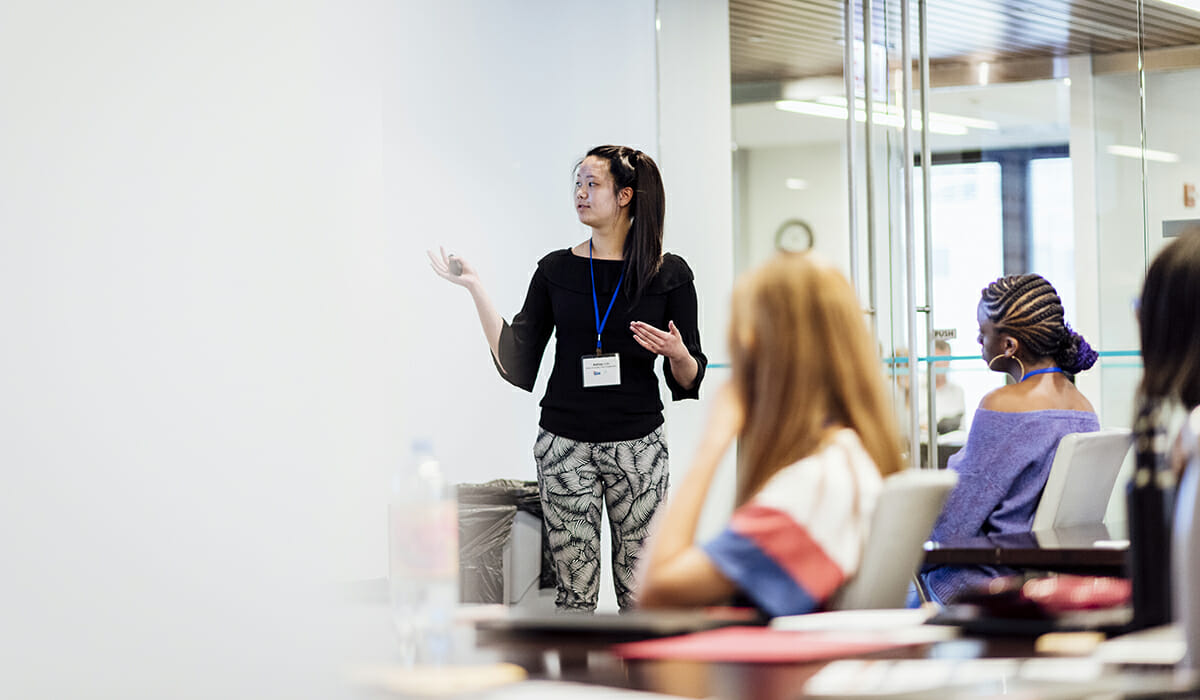
Ashley Lin pictured pitching Project Exchange to Citizen University’s Youth Collaboratory to ask for support. Since 2018, Project Exchange has connected hundreds of students from the U.S. to the U.K., India and more./Courtesy Ashley Lin
In one word, what does volunteering mean to you?
Family. It sounds really cheesy but every one of our cohorts come out as a family. We get so close to each other and the exchange experience is so personal. You are opening up to each other and trusting each other with your experiences in order to grow as a person.
What’s been the most rewarding part of your service?
It’s been rewarding being a part of the intercultural exchange because the learning goes both ways. I help organize our digital exchange program, and when we launch, and all of the student introductions start rolling, it’s absolutely crazy to see all the names, locations and all of the unique student stories. Being part of that interaction myself is amazing, and I’ve learned so much from our participants.
When you’re not busy volunteering or in school, what do you do for fun?
(Laughs). Learning languages and culture is always something I’m interested in. I’m currently learning my 4th language, Arabic. I love ethnic food carts. I recently got into kickboxing and since the coronavirus pandemic started, I have been baking a lot at home. I am still a pretty bad banana bread baker though (laughs).
How can readers help?
We’ve received increased interest in our programs during the pandemic because a lot of students are at home and have free time. Now more than ever before, it is important for students to feel a sense of connection, solidarity and continued community bonding because a lot of our in-person connections have been removed. Please visit our website for more information about how you can help.
Indiana Girl Volunteers to Encourage Friendship and Kindness with “Buddy Benches”
Meet Daily Point of Light Award honoree Sammie Vance. Read her story and nominate an outstanding volunteer or family as a Daily Point of Light.
11-year-old Sammie Vance says the feeling of being left out is hard to explain. “It’s sad. I don’t feel good. I have butterflies in my stomach because I feel nervous.” In a world where children face a myriad of issues including bullying and loneliness, Sammie, a fifth-grader from Fort Wayne, Indiana, is volunteering to promote kindness and inclusion and is serving as an example of how to be a good friend.
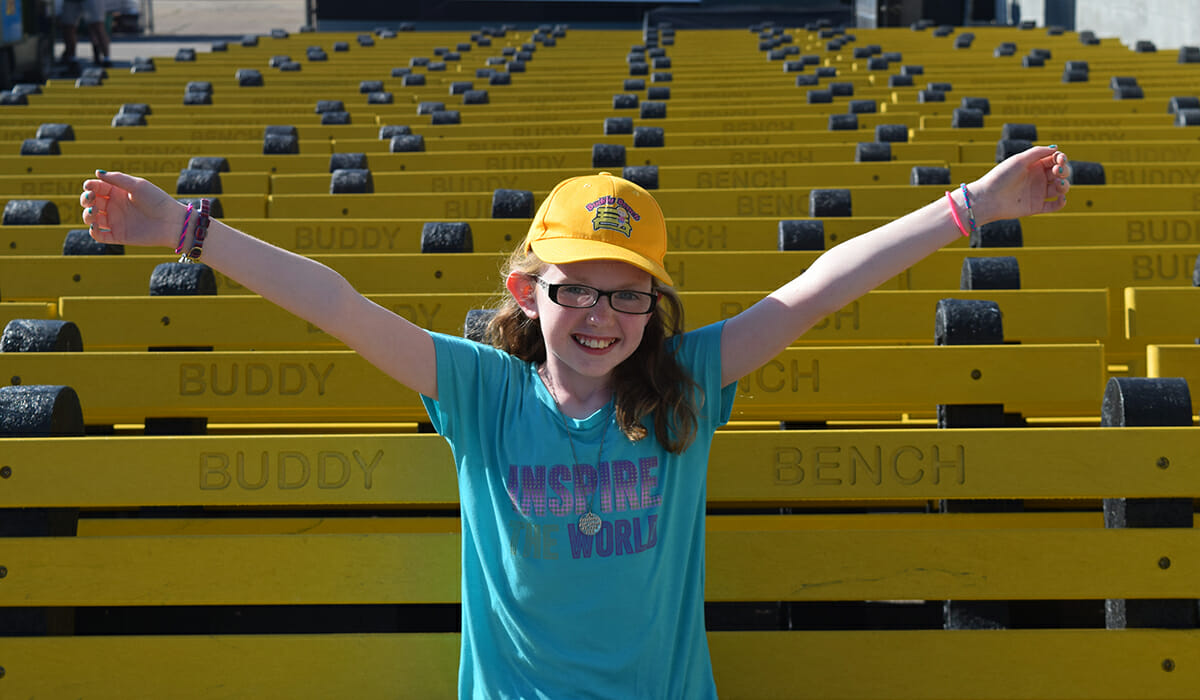
Launching Sammie’s Buddy Bench Project in 2017, Sammie discovered the Buddy Bench after watching a video about the initiative. Designed to eliminate loneliness and foster friendship at school, Buddy Benches are a special place at school where a child can go if they want someone to talk to, promoting the message of kindness on the playground and elsewhere at school.
“It’s nerve wracking to go up to someone and ask them to play,” Sammie says, “because you don’t know what they’re going to say. When you sit on the Buddy Bench it’s easy to notice that someone is sitting on there. When other people know what it’s used for it’s easier because you know that someone is going to come and play with you.”
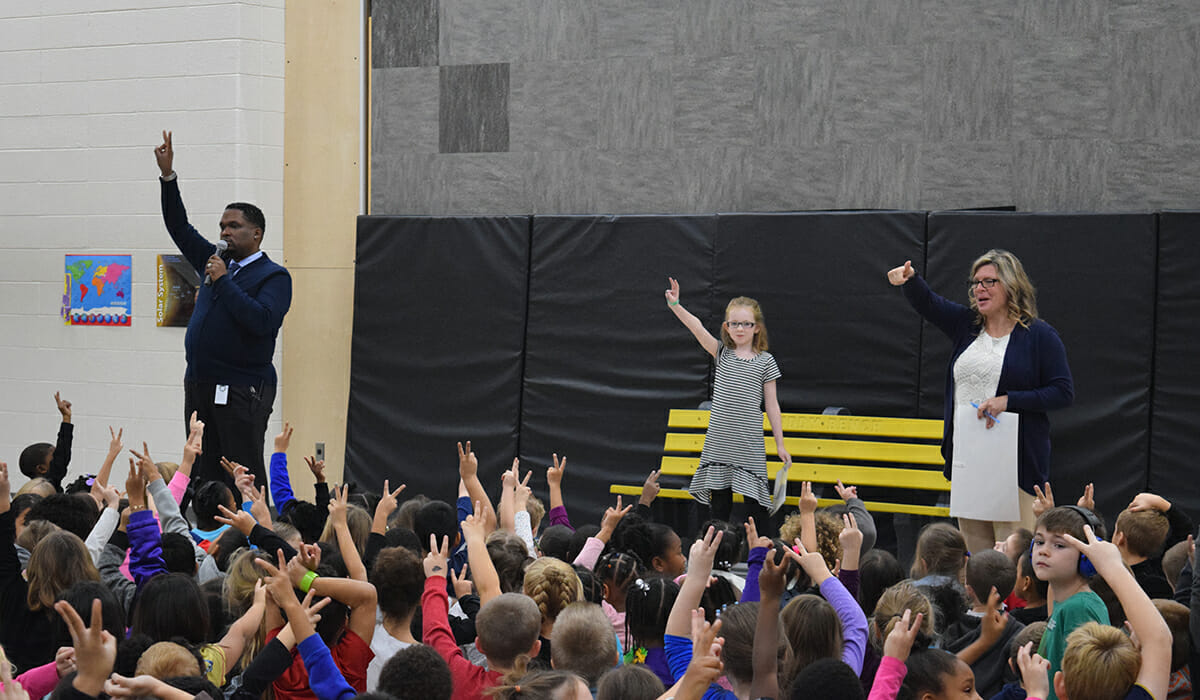
When Sammie set out to establish a Buddy Bench at her elementary school, Haley Elementary, she asked her classmates and community to collect recycled bottle caps and plastic lids, materials that are used to make the benches. Her community responded overwhelmingly, collecting 1,600-pounds of materials, enough to build three benches. Sammie has since been involved in placing over 100 Buddy Benches at schools in the U.S. and internationally. Sammie’s third-grade teacher at Haley Elementary, Kirsten Grotemat, says her former student was so passionate about her service, she inspired many of her classmates to contribute to the effort.
sammie vance, daily point of light award honoree, points of light, volunteer, volunteer stories, volunteer recognition, youth, youth service, Fort wayne, indiana, international service, environment
“Her volunteerism got a lot of kids to get on board because they could bring in five bottle caps and feel like they were a part of something big. Sammie just uplifted kids, she’d tell them how cool it was that they brought caps in. She made them feel so inspired, (her volunteerism) is a piece of what will become history at Haley Elementary, and a piece of what she will probably forever continue to do in her adult life.”
Sammie’s impact has skyrocketed beyond her elementary school, Buddy Benches finding homes on playgrounds at other schools in the U.S. and even internationally, where Sammie has received bottle caps from all over the world and contributed to Buddy Benches at schools in Mexico, India and Germany. According to Sammie, the idea of friendship and kindness has no bounds, extending beyond age, language and cultural differences.
“Bullying and loneliness is a really big deal and it needs to be changed. Even adults need Buddy Benches. Now that a lot of people are aware of it, they’ll want to make a difference. Even as far away as India, people still need friends, and there are still people that feel lonely.”
sammie vance, daily point of light award honoree, points of light, volunteer, volunteer stories, volunteer recognition, youth, youth service, Fort wayne, indiana, international service, environment
Empowering other children to serve their communities, Sammie’s Buddy Bench Project allows kids to make just as much of a difference as adults, says Sammie, since collecting bottle caps and plastic lids doesn’t cost money. An added bonus, her eco-friendly project encourages both children and adults to be kind to the environment by recycling. Amidst the coronavirus pandemic, Sammie’s mission to spread kindness has not faltered, advising others via video calls about how they can build their own Buddy Benches and sending encouraging letters to teachers and others to let them know that they are appreciated. Sammie says her work won’t be done until there are Buddy Benches in every school in the world, and everyone has a friend.
“I like seeing joy on kids’ faces and I love spreading kindness. Kindness is contagious. I used to be very, very shy, and the Buddy Bench has shown me how easy it is to make a friend. I’ve received letters from students thanking me, telling me they’ve made a friend (because of the Buddy Bench). There’s a boy younger than me at school and in the hallway he’ll come up to me and give me a thumbs up and thank me for the work being done. That really warms my heart.”
Meet Daily Point of Light Award honoree Rinna Talwar. Read her story and nominate an outstanding volunteer or family as a Daily Point of Light.
As a 2nd generation American, 15-year-old Rinna Talwar says her family, who arrived in the U.S. from India in the 1950s, has always put an emphasis on uniting their community. Now, the high school sophomore is bringing together seniors and veterans in her own way, by celebrating their birthdays.
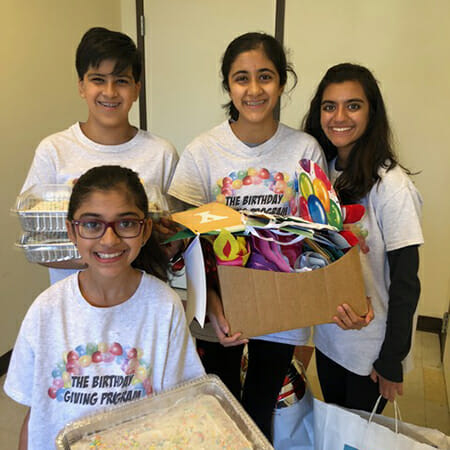
As the founder of the Senior Citizen Division of The Birthday Giving Program, Rinna says about 80% of individuals living in nursing homes don’t receive regular visitors, often struggling with loneliness. Changing lives one birthday at a time, the Roselle, Illinois teen provides birthday bags and cakes to in need senior citizens and veterans. Since 2017, Rinna has celebrated hundreds of birthdays with seniors and veterans, her volunteerism serving as a reminder that they are not alone.
What inspires you to volunteer?
My cousin Sonika Menon founded The Birthday Giving Program, and her volunteerism has inspired mine. We are serving seniors and veterans who sometimes don’t have anyone in their lives to celebrate a birthday with. When my family first immigrated to the U.S., my grandfather founded a temple in Illinois and he was able to bring many people together. Our birthday parties facilitate that same togetherness, so that everyone feels included.
Describe your role with The Birthday Giving Program.
As the founder of the Senior Citizen Division of The Birthday Giving Program, I am in charge of collecting supplies and then assembling the birthday bags. My younger sister, Anya, and I pack bags for each birthday party. I am also in charge of hosting the birthday parties and celebrating with attendees.
The Senior Citizen Division of The Birthday Giving Program team hosting a birthday party at Wayside Cross Ministries in Aurora, Illinois. Pictured: Back row: Rohin Menon, supply chain manager, Sonika Menon, founder of The Birthday Giving Program, Rinna Talwar. Front Row: Anya Talwar, volunteer. /Courtesy Rinna Talwar
Tell me more about these birthday bags.
We try to customize the bags as much as possible. In addition to our bags for seniors and veterans, we also distribute birthday bags to hospitalized children. We’ll make or buy cakes and also include candles, plates and party hats to celebrate a true birthday party. We include crossword puzzles, socks, hats, toiletries, snacks and other items in the bags, and as a finishing touch, a balloon is attached to a teddy bear to go along with the bag. We’ll even customize the items by month – in February we have heart-shaped items, and we celebrate Veterans Day for our vets because of how much they’ve given to us. If we can’t celebrate in-person, we’ll include cake mix and frosting in the bag.
Your birthday parties also feature entertainment, right?
Yes, we play the song “Happy Birthday” for our party attendees and my sister and I both play piano. The music is a really important aspect because it brings seniors and veterans together.
Share one personal story with me from your volunteerism.
Some of the seniors I work with have Alzheimer’s or Parkinson’s disease, and it’s not always easy to communicate with these individuals. We hosted a birthday party at Lakeview Memory Care Community in Illinois, and my sister and I started playing “Don’t Stop Believin’” on the piano by Journey. This man was listening to us play the song and he began crying. The director of the facility told us that the man used to sing that exact song together with his wife, and his wife had just passed away. It was an inspiring moment for me because I was bringing back a memory to this man that was so important.
What’s been the most rewarding part of your service?
It’s been rewarding to spend time with seniors and veterans through my volunteering. People don’t realize the importance of giving back. It’s not about money but instead, sitting down and getting to know these people personally.
In one word, what does volunteering mean to you?
Togetherness.
What’s your favorite birthday cake flavor?
(Laughs). Mine is vanilla cake with chocolate frosting.
How can readers help?
We are not able to distribute birthday bags due to the coronavirus pandemic, but we’re setting up a GoFundMe page for donations so that when we are able to host birthday parties again, we have enough supplies. Please visit our website for more information.