Mom Starts Foundation to Help Children with Learning Disabilities
Meet Daily Point of Light Award honoree Raja Marhaba, who was a 2019 L’Oréal Paris Women of Worth Award winner. Each year L’Oréal Paris and Points of Light recognize and celebrate Women of Worth who make a beautiful difference in their communities. Ten honorees each receive a $10,000 grant to support their most cherished cause, and an online vote determines one honoree who will receive an additional $25,000 grant. Nominations for 2020 are open! If you know a woman who works to create lasting and significant change in her community, nominate her to be one of the 2020 Women of Worth.
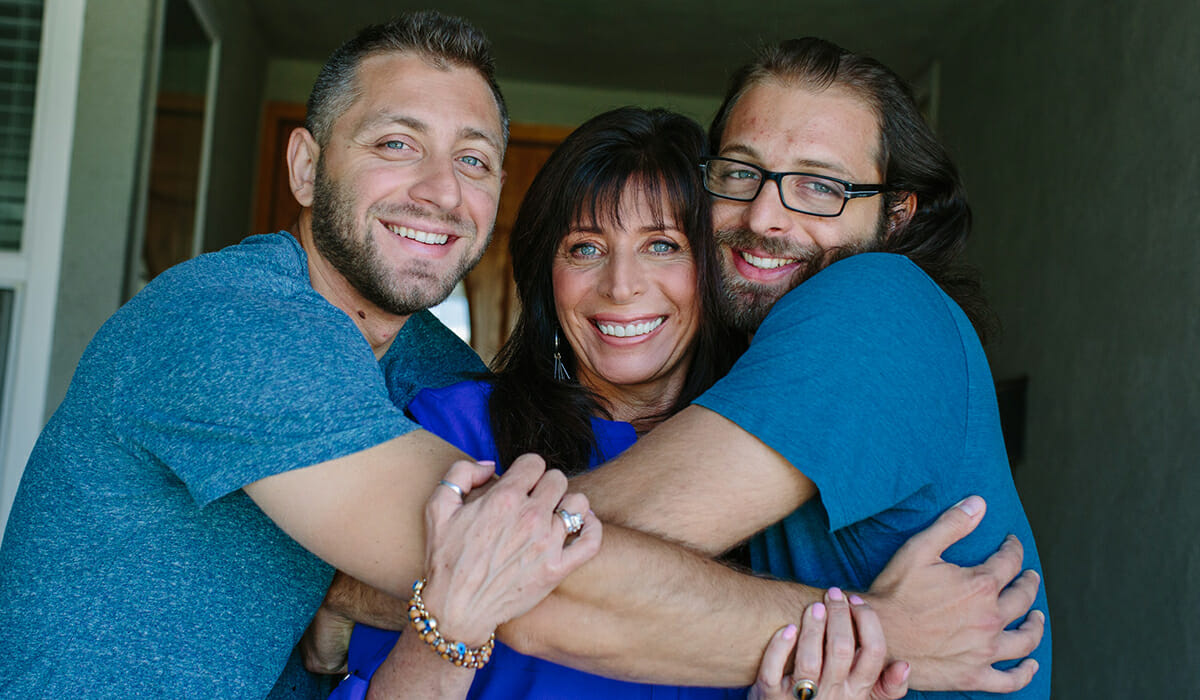
In 2001, Raja Marhaba began a long and tiresome fight against the Los Angeles Unified School District in order to obtain the services needed for her two sons who have learning disabilities. Almost two decades later, her fight for her own kids may be finished, but her fight for the betterment of children with learning disabilities and special needs everywhere is nowhere near over.
When her public school district wouldn’t provide the education plan that her children Jonathan and Omar Jr. needed for their disabilities, Raja was forced to sue the LAUSD. She ultimately won her case, but only after her children’s education was put on hold, her finances had been deeply hurt and her marriage broken. She vowed to never let another family go through what she went through in order to obtain an appropriate public education. As a result, she started The Jonathan Foundation — a nonprofit that provides assistance, private assessments and advocacy for families navigating the special education system. Since 2014, over 300 children have been helped by The Jonathan Foundation’s assessments and Raja’s pro bono advocacy work.
“I’m just a mom who got hurt,” Raja said, “and I want to give back because I don’t want families to suffer like my family suffered, as really as black and white as that is. No gray area.”
What lead you to starting The Jonathan Foundation?
Jonathan Foundation was formed in 2001 because of my trials and tribulations with the public school system trying to get special education services for both of my children. Both of my children are diagnosed with ADHD and learning disabilities. They are described as twice exceptional, highly gifted and learning disabled. Imagine having an IQ over 145, and you’re severely dyslexic and can’t read, and this starts from one, two, three, four [or] five-years-old. You’re this little body. You know you’re very smart but you can’t express yourself, and you see your peers advancing. You start to have behavioral problems because you want to have the teacher tell you it’s ok, and it’s not happening. I tried to get services for both my children and it was very difficult. The school system would not be collaborative for both children and I ended up suing LAUSD [Los Angeles Unified School District]. It took eight years. Each kid started with one lawsuit which was amended three times, and that’s how you ended up having four due processes for each child. They took us to Ninth Circuit Federal Court in an effort not to provide services. It put my family through a financial burden, emotional burden. My kids were placed on hold until the lawsuits were over with and finalized with some sort of resolve.
After that experience, I did not want any family to go through the excruciating pain financially, emotionally. My marriage was broken. When a family tries to raise special needs children, it’s very challenging. Then when you have a typical child, you tend to neglect the typical child, not because you want to, but because the special needs child is taking so much of you to raise. Then how much money do families make, if it’s a single parent or two parents together trying to make money. You’re going to work, you’re coming home, you’re dealing with the school, you’re dealing with services, you’re dealing with the lack of services. You have a child who has various disabilities, anywhere from verbal, non-verbal, cognitive disabilities, physical disabilities. It could be draining on the marriage and on the family. These children need assessments. They need diagnosis. They need services. They need therapies. If you could just imagine the situation in a family with this type of a scenario. That’s what my family went through and I don’t believe that any family should have to pay the high price that my family did to have to get services. No children should be sacrificed for free and appropriate public education, which is what the schools are supposed to provide when you put them in public schools.
Describe what The Jonathan Foundation does.
In 2014, I started an assessment scholarship program. I realized going through the trials and tribulations with the school districts, as I did with my own two children, that the lawyers kept on telling me we need speech and language assessment, we need a psycho-educational assessment. A psycho-educational assessment covers social, emotional, behavioral, cognitive and academic domains. In addition to that, there could be coexisting issues going on or challenging the child. It might be speech and language. It might be occupational therapy. It might be assistive technology where they need software and hardware technology to access their grade level curriculum. It’s very costly. If you’re going to add maybe $3,000 or $3,500 for a speech evaluation, $2,000 for an assistive technology evaluation, $5,000 for a psycho-educational evaluation — that’s almost $10,000 dollars, just for evaluations, and we haven’t started therapy. You have parents working to pay bills and trying to make ends meet. That’s where it stresses the marriage out, which is exactly what happened to me, to my family.
We developed a psycho-educational assessment program to asses the domains I just said — social, emotional, behavioral, cognitive and academic. We hire highly credentialed assessors and they do the assessment with the children. They write a report that could be anywhere from 20 to 40 pages. … With that report, the psychologist comes up with a diagnosis which school districts cannot diagnose, and they give recommendations. That’s valuable information that the parent can take back to the school districts and request services based on the recommendations of the assessor. In addition to that, we ask the assessors to attend the two hour IEP meeting with the school district. An IEP meeting is an Independent Educational Planning meeting. It’s like a negotiation where you say, “Here’s the child, here’s the assessment, here’s what we feel is going on on the parents side,” and the school is saying, “Well, here’s our assessments and here’s what we feel is going on with it.” When you bring in a high-level, credentialed psychologist that can back up the report that they wrote on the child, and now you have a psychologist [along with] the school psychologist, it’s a game changer. You’re able to negotiate and facilitate a meeting trying to get services for the child, in the best interests of the child, in a collaborative manner.
Can you explain why having this type of educational support is important for kids with learning disabilities?
There are so many children in middle and high school who either get in trouble or they end up going to continuation school in high school. Those children may have never had special education, may have never been assessed, may have fallen through the cracks. We give them the label of bad kids when maybe they’re not bad kids. Because we label them as bad kids, they end up on the streets, with the gangs, with drugs, and they end up in a very bad environment. My belief is that if you can assess these children as young as possible, you can find out their strengths and deficits, and you can zone in to them and you can address their weaknesses and challenges. If you can do that, then you can literally save a child’s life.
For example, Jonathan, my dyslexic one, he always got into trouble. He was very hyper. He was very out there with the children, very extroverted, different than his brother. Nobody understood he was dyslexic. He didn’t understand he was dyslexic, until he was tested and then we figured out where the behaviors were coming from. That happens with every child. If a child is showing behavior, there’s a reason for that behavior and you will not know what that reason is unless you’ve assessed. Granted, you have to take family components and situations and environment into the factor as well, but without looking at the big picture, you will never understand what the child is going through. Whether you’re a parent who doesn’t have a child with special needs, or you’re a parent who does have a child with special needs, those parents need to look for the red flags. One teacher told me when my kids used to be in private school when they were very, very young, that Jonathan needed to go into public school at the age of five. She realized he was in trouble and she could not help him in the private school. She said, “Mrs. Marhaba, I’m going to give you one piece of advice. When you leave the private school to go to the public school, you are your children’s best advocate. Nobody knows your children better than you.” Those words have never left me up until today. I give that advice to every parent who I see. When I tell them that, they can connect with me. They go, “You know, you’re right. I knew there was a feeling and I couldn’t pinpoint it, and no one believed me, and look what happened to my child.”
What’s been the most rewarding part of your work?
The children. When I see the success in the children, and I see the parents happy, and when I meet with the children. I’m pretty well versed with the assessments. I understand what the data means and the assessments that psychologists administer on these children. I could look at the data and I can see a child and I can tell the child exactly what the deficits are, what the struggles are in school, without the child saying anything to me. I connect immediately. Then I can teach the parents how to understand what the scores mean, because they do and they don’t. They’ll go to the psychologist, they’ll tell them the data, and then they walk out and they’re so overwhelmed that they forget what the data meant and what the psychologist said. Then once the parent understands how the brain is wired for the child — our trademark is ‘How are you wired?’ for a reason — then the parent understands the weaknesses and the strengths of the child and can communicate better with the child. If the child understands his or her own strength and weaknesses, then the child is not kicking themselves in the butt that they can’t do it. They can have a better understanding of why they can’t do it. … When I finally see the child connecting and progressing in school, and the parent connecting and understanding the child, now we just created a mother-father-child relationship that is more understanding prior to them meeting with me and learning what I’m teaching with them. I like to empower the parents. I don’t want them to be codependent on me because I’m not going to be around forever, and these parents need to move on with their children.
Then over and above that, I have both my kids, both my young men, mentor children. If I see a child struggling with dyslexia, I ask Jonathan to speak with the child. If I tell a child [with dyslexia] I know what you’re going through, I really don’t know what that child is going through, but Jonathan can connect because he walked in that child’s footsteps and he knows what’s going on. The same thing with my son Omar Jr. He has reading comprehension, vocabulary and writing deficits. If I have a child where that’s a deficit area for them, a weakness, I ask my son, “Can you talk to this child and help him understand that it’s not him, that’s just the way his brain is wired, tell them your story?” … That’s what really drives me, the success I’ve seen in these children. I go through them middle, elementary, high school, even college. They’re on my Facebook. They communicate with me. These children, I love them as if they were my own flesh and blood, because I get attached to them. I know personally what that entire family component is going through.
/COURTESY NILAYA SABNIS FOR L’OREAL PARIS USA
Are there any future partnerships, programs, or events that you are excited about?
I’m trying to establish relationships with the police out here. [The Los Angeles Police Department] had offered me 355 juveniles to assess, because they need to be identified to see exactly what their strengths and weaknesses are, acclimate them back into the school systems, get them out of the prisons, and do something positive with their lives. My hope is to establish a partnership. If I could start it in California and Los Angeles, I could replicate it nationally. I want to do a pilot program out here in California where there is a collaboration between the school police, LAPD, and between The Jonathan Foundation, and see if we can come up with a plan to assess these juveniles and get them the help they need and acclimate them back into the school system. Maybe give them the confidence they were lacking, so they can feel good about themselves. A lot of them end up in jails because if they have a learning disability that has never been identified, they’re going to think they’re stupid. No one told them, no one assessed them, no one showed them. That’s part of my mission of what I would like to see moving forward.
What do you want people to learn from your story?
To never give up. I went through hell, literally hell, raising my kids and trying to navigate the school system. It wears and tears your marriage. It wears and tears your family. No matter what, you got to keep pushing through. If you give up on your kids because you’re tired or your marriage is broken, then you just lost souls. I’m trying to save souls. I saved my two children. I saved two souls by sacrificing me, because my marriage did break. Our finances did hurt. But I saved two children. So if my sacrifice was to save my sons by fighting the school systems to the level that I did, then had I given up, they would have been the kids in [Juvenile Detention] I’m talking about now that I would love to help. You can’t give up. It’s very, very emotional and very stressful for these families.
Why do you think it’s important for others to give back?
We’re born for a purpose. I’m not sure that everyone knows what their purpose in life is. Had I not gone through the trials and tribulations within my own family component and the school district, I would maybe never know what my purpose in life is. For every suffering, even with Covid, there’s got to be goodness coming out of it. Covid, even as bad as it is, there’s a lot of positive things coming out. People are helping people. People are reaching out. People are caring. People are suffering in the same manner. People are making homemade masks to help others. … If we don’t help each other and we don’t love each other, whether it’s nationally or globally, we don’t have a fighting chance. Covid has affected everybody globally. If we can unite and do something as a whole, and not compete with each other, and partner up with other organizations to make a difference for the better of human kind — then that’s our purpose in life. Then we would live in a better world.
Volunteer Grows Fresh Vegetables to Feed Children and Families in Food Deserts
Meet Daily Point of Light Award honoree Chander Payne. Read his story and nominate an outstanding volunteer or family as a Daily Point of Light.
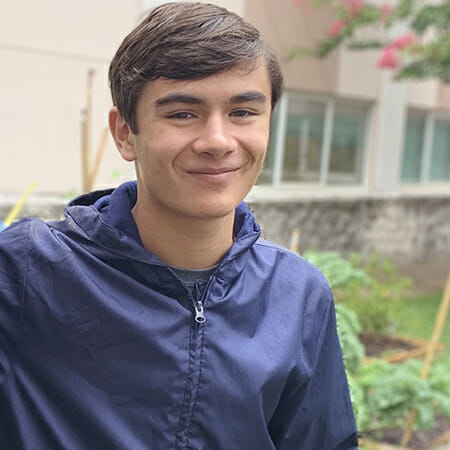
Chander Payne’s story is one of regeneration, both personally and in how he is serving his community through volunteerism. Facing challenges at home and poor health, the high school student turned to urban gardening to heal his body and mind. Realizing the holistic power of fresh food, Chander decided others could similarly benefit, and dedicated his efforts to helping food insecure youth in his community.
Launching Urban Beet in 2018, the now 17-year-old Bethesda, Maryland student is using a multi-pronged approach to feed hungry youth in the Washington D.C. area and advocate for fresh food in his community. Creating urban farms in schools, providing healthy meals and food for local homeless youth and empowering underserved families to grow their own gardens, Chander is changing the way his community is eating and is helping to curb the effects of food deserts on urban families.
What inspires you to volunteer?
I had volunteered before, but this was different because it was personal. I started noticing empty vegetable refrigerators in the lunchroom at school. The “veggie of the day” was french fries. At the same time, I was facing personal challenges at home, and I spent a summer urban gardening, learning about regenerative agriculture from a farmer named Manuel. Being in that garden was a healthy mental escape, and I wanted to share this kind of farming and the resulting benefits I experienced with everyone I knew.
As founder and executive director of Urban Beet, Chander Payne is changing the way his community is eating and is helping to curb the effects of food deserts on urban families./Courtesy Chander Payne
Describe your role with Urban Beet.
As founder and executive director of Urban Beet, I manage communications, create and facilitate our programs, make food deliveries and help to build our urban farms in public schools. Our mission is to create a movement of young people who can join our efforts. We have partnerships with community organizations including: the Homeless Children’s Playtime Project, True Food Kitchen Bethesda, Up Top Acres, Little Lights (starting this summer).
Explain the name “Urban Beet’ to me. Why beet?
When we first started I was really into puns. The idea was, let’s beat food deserts, let’s beat climate change in urban areas through growing food. My favorite vegetable to grow is beets, that’s our namesake. I also really like growing crazy fruits like cantaloupes. The secret to growing cantaloupe: give it a ton of space because it just takes over.
Tell me about some of the programs you offer.
Real Food Program: we grow and deliver fresh, nourishing, local produce to underserved communities, we also serve food pantries and homeless shelters.
Securing our Future: Through these community workdays, we give children experiencing homelessness the opportunity to play outside at our urban farms and learn about urban farming, offering programs ranging from gardening education to art therapy.
Share one personal story with me from your volunteerism.
One of the kids I’ve worked with through our community workdays “Securing our Future” program is an 8-year-old boy from Senegal. His healing and his curiosity inspires me to continue my service because his growth parallels the regeneration of soil that we do through regenerative gardening. The boy will ask me about plants and our gardening education, but our conversations are also personal – he’s asked me how to stop bullies. Our holistic programs enable us to help these youth heal, build creativity and also give them a healthy mental escape.
What kind of fresh produce are you delivering?
Every kind of vegetable you could imagine. Anything from fresh cucumber salad, fresh fruit salad with watermelon, carrots, beets, lettuce and spinach. These meals are meant to provide as much nourishment as possible to people who don’t generally have access to that kind of produce.
What’s been the most rewarding part of your service?
Working with the children in our youth programs over the summer and hearing directly from people we serve when we do deliver fresh food. It warms my heart and it feels good to know that someone, somewhere is enjoying the product.
What’s a saying that you live your life by?
Giving without expectations. Do a good turn daily. The joy of giving. I feel that my purpose is just to give and that’s how I live my life.
How can readers help?
During the COVID-19 pandemic, we are delivering Free Little Farms to underserved families to give them the power to grow food. The little farms are container gardens complete with soil, seeds, and growing instructions. Please visit our website for more information.
7th-Grader Volunteers to Strengthen Bond Between Youth Caregivers and Adults with Alzheimer’s
Meet Daily Point of Light Award honoree Hailey Richman. Read her story and nominate an outstanding volunteer or family as a Daily Point of Light.
Hailey Richman loves to solve puzzles with her beloved 96-year-old grandmother. The two don’t play favorites, according to Hailey, but if she had to pick one, it’d be her grandmother’s Paris cityscape puzzle, featuring the famed Eiffel Tower, once the world’s tallest manmade structure. It only makes sense then, that in helping to support her grandmother’s health, the adolescent’s efforts have soared to new heights to change the way child caretakers are able to connect with adults suffering from dementia.
When her grandmother was first diagnosed with Alzheimer’s disease, the Long Island City, New York child was just four-years-old. Committed to maintaining their close bond, Hailey, now aged 12, set out to learn more about memory loss, and how to support other child caretakers who may feel isolated.
Founding Kid Caregivers in 2016, the 7th grader is helping 1.8 million kids in the U.S. who act as caregivers, and is empowering them to enrich the lives of adults living with Alzheimer’s disease. Hailey uses her personal experience with her grandmother to help others, she says. “If you’re ever struggling with someone with Alzheimer’s disease, the best thing to do is go into their world and connect with them using something they enjoy.”
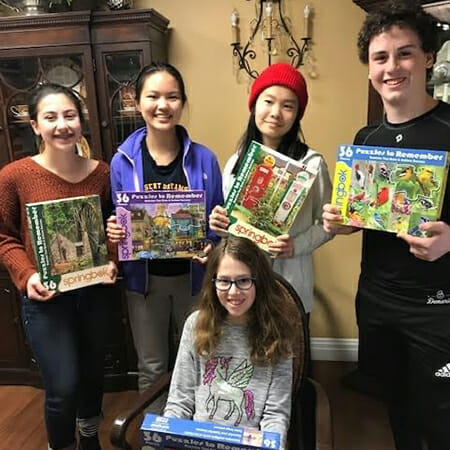
Providing kids as far away as Russia, Germany, Japan and Africa with the tools and resources to interact and enhance eldercare globally, Kid Caregivers provides activity suggestions and online support to kids to better their caregiving experiences. Matching youth volunteers with seniors in memory care facilities, Hailey offers specialized Alzheimer’s jigsaw puzzles through the intergenerational Puzzle Time program to help to calm people suffering from Alzheimer’s disease and benefit cognitive stimulation. Additionally, Hailey says these activities lessen the unease that kids sometimes experience visiting nursing homes, making the visit more fun for both child and senior.
“Seeing smiles on the faces of kids that were afraid to go into nursing homes at first is rewarding,” Hailey says. “Now they don’t want to end their visit with the seniors, because they are so happy.”
Helping both the old and young to feel purposeful and by focusing on youth caretakers, Hailey has filled a critical gap that persists in senior care, where depression and loneliness can negatively affect the life of an individual living in a nursing home. According to Max Wallack, founder and executive director of Puzzles to Remember, an organization that has distributed over 100,000 puzzles to thousands of Alzheimer’s caregiving facilitates globally through Kid Caregivers, Hailey’s service is improving the lives of thousands of seniors and caretakers.
“Hailey is constantly thinking about possible ways to improve the lives of others,” says Max. “She has lifted the spirits and reduced the agitation of those with dementia…Hailey has also interacted with other young caregivers, across the globe, letting them know they are not alone and providing them with some very useful caregiving strategies.”
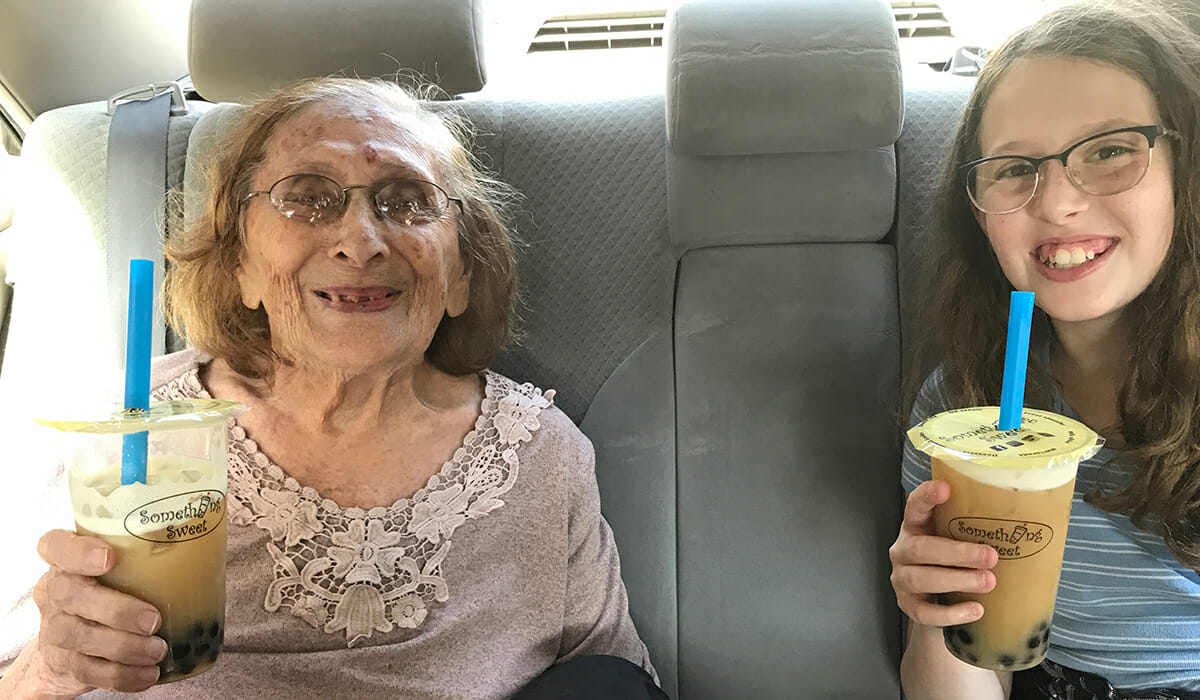
Hailey Richman pictured with her grandmother./Courtesy Hailey Richman
Recently expanding her services, Hailey now offers a program called KidChat so that child volunteers can virtually visit with seniors in an effort to curb social isolation. As a result of the coronavirus pandemic, care facilities have closed to visitors, underscoring the value of this new virtual initiative, says Hailey.
“COVID-19 has been a life-altering pandemic and my visits to grandma have abruptly ended. The amount of social isolation for our nation’s most fragile population is very heartbreaking. I have been communicating with my grandma through FaceTime, and although not perfect, it has been a life-saver for both of us. I realized that there are other seniors who are lonely and do not have anyone in which to video chat, so I decided I would start KidChat!”
Currently the associate director of Puzzles to Remember, Hailey will take over as executive director of the organization in summer 2020. Her programs to unite old and young generations have the power to heal, says Max, and the potential to change the world for the better.
“It is widely accepted that social groups where members share a common problem can be very therapeutic. Hailey provides these groups and opportunities to seniors in nursing facilities, to young caregivers internationally, to students first learning about dementia, and to a vulnerable population of young homeless people who gain an increased sense of self-worth. She clearly makes her community, and indeed the world, better for the wide range of people touched by her efforts.”
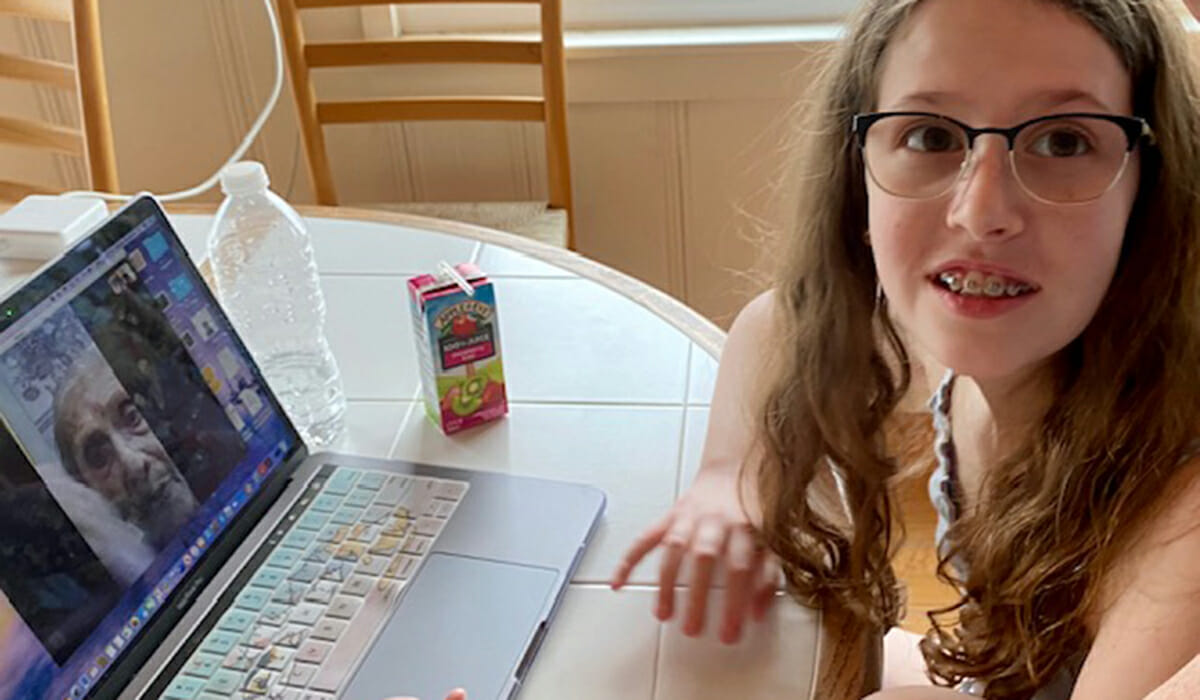
Hailey Richman pictured conducting a FaceTime conversation with her 96-year-old grandmother. Hailey Richman launched KidChat, a program for youth volunteers to virtually visit with seniors in an effort to curb social isolation during the COVID-19 pandemic. /Courtesy Hailey Richman
Educating children like herself about the dementia community and how to better connect with these loved ones in their lives, Hailey says her volunteerism is inspired by her own grandmother’s service.
“My grandma inspires me to volunteer. When she was younger she volunteered at nursing homes, so I’m leading in her path. Just because you’re a kid doesn’t mean you can’t make a difference. You are strong and everyone can make a difference.”
1st Generation American Teens Distribute Healthy Foods to Houston Food Deserts
Meet Daily Point of Light Award honorees Shirley and Annie Zhu. Read their story and nominate an outstanding volunteer or family as a Daily Point of Light.
As twins, Shirley and Annie Zhu have shared many moments and achievements in their lifetime, and now, the 16-year-old sisters are doubling their efforts to curb food insecurity, supplying food deserts in their community with healthy and fresh food.
Launching Fresh Hub in 2018, the Houston, Texas high school juniors are helping to change the lives of food insecure individuals in their community by rescuing food waste and supplying fresh food at distribution centers across the city. Rescuing more than 9,000 pounds of food to benefit nearly 1,200 people across the Houston area thus far, Annie and Shirley are advocating a healthy lifestyle and doing their part to eliminate food deserts in their community.
What inspires you to volunteer?
Annie: After Hurricane Harvey, we volunteered at a local grocery store, and we saw boxes of food that were going to be sent to waste landfills because the food had stayed in the store for too long. On the news, we were seeing that people had lost their homes in the hurricane, and these people were now low on resources. That experience of watching food being thrown away while people were in need catalyzed our action on Project Fresh Hub.
Describe your role with Fresh Hub.
As co-founders, we spread awareness of food deserts, advocate a healthy lifestyle and distribute fresh foods through our partners, including Trader Joes. We organize monthly “Fresh Hub Markets” to distribute the food donations to people in need across the city. Our organization is student-run and student-done. We are in contact with the Houston health department and other organizations to make sure we are serving our clients with produce they need. We have about 100 student volunteers from three different Houston-area schools that help us pack and distribute this food.
You’ve created a Fresh Hub app to expand your reach. Explain.
Shirley: We created the app along with two of our fellow classmates as a way to connect to our clients and share our resources. Our app lists a calendar of events, a recipe hub, and more. We want to promote a sustainable and healthy lifestyle for the people we are serving by giving them free food and helping them find easy recipes to use.
Share one personal story with me from your volunteerism.
Annie: Our parents both immigrated to the United States. When we were younger, our family relied on free food that was provided for us from grocery stores. (My sister and I) were too young to remember this, but from the stories our parents have told us, we realized that food insecurity is very real for a lot of people. Now that we’re older, seeing others in need has changed the way I think about how I want to utilize my resources, and I’m very grateful for what we do have now.
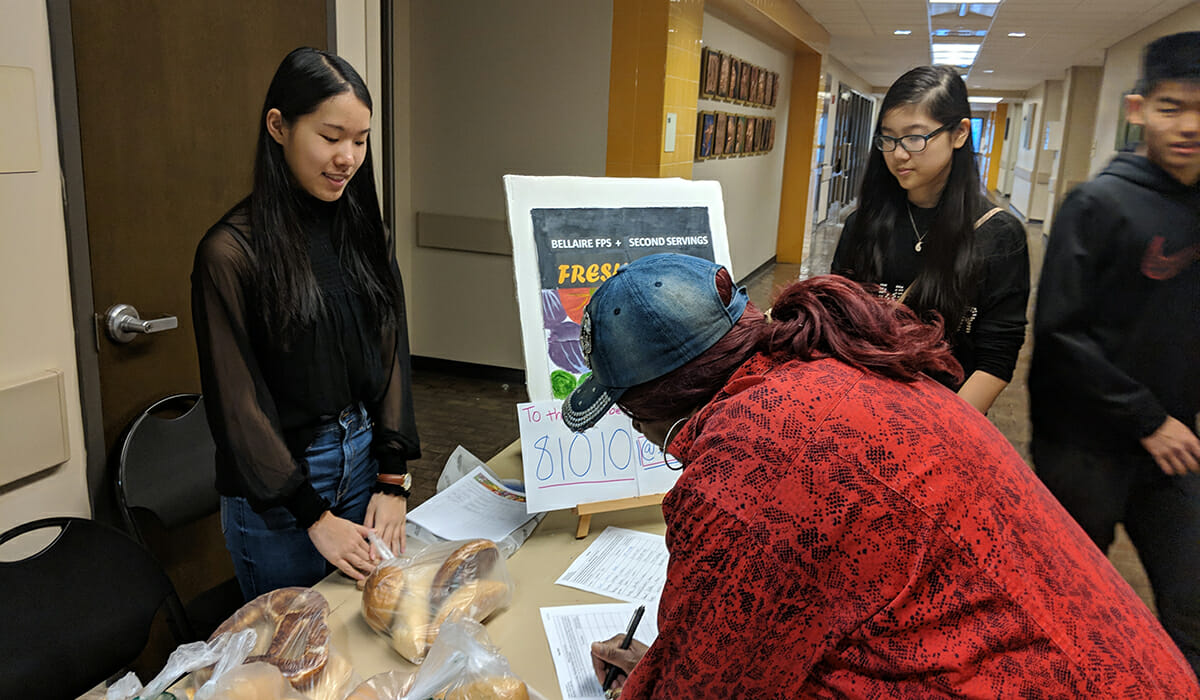
Annie Zhu (left) pictured helping a client sign in before receiving free food from Fresh Hub. Fresh Hub’s mission is to rescue excess produce and distribute healthy food to residents of food deserts in Houston./Courtesy Fresh Hub
What’s one way you hope to inspire others in your service?
Shirley: There’s no prerequisite to be a volunteer, we were just high school students that had a passion and wanted to do something good. Anyone who feels that way can also make an impact in their own community.
What’s been the most rewarding part of your service?
Annie: It’s been rewarding interacting with our clients at our Fresh Hub events, volunteers and community members. We are broadening our horizons when we hear their stories.
In one word, what does volunteering mean to you?
Annie: Compassion. Shirley: Community.
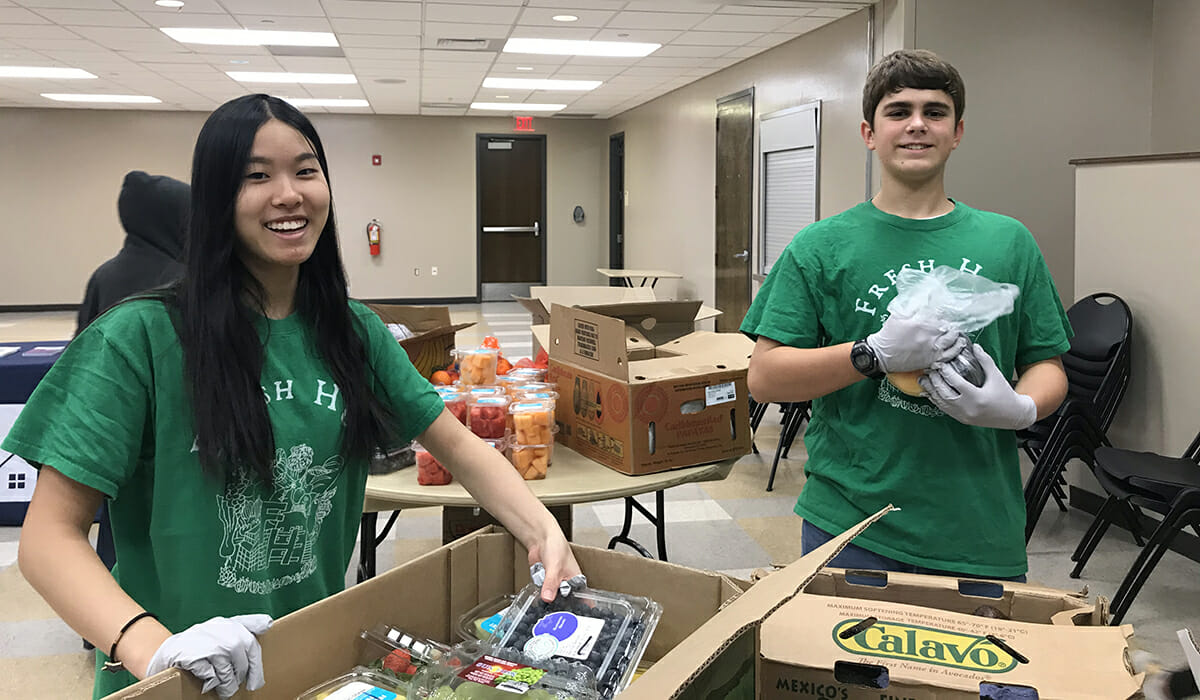
Shirley Zhu (left) and a Project Fresh Hub student volunteer pictured packaging fruits and vegetables for a Fresh Hub event. /Courtesy Fresh Hub
What have you learned through your experiences as a volunteer?
Annie: In the community, everything is interconnected. Every single person’s actions have consequences that can affect everything else. One person’s trash could have been another person’s meal. By understanding how these issues and root causes are interconnected, we are helping individuals comprehensively to curb food waste, food inequity and poverty.
When you’re not busy volunteering or at school, what do you do for fun?
Shirley: I like to do a lot of reading and also art. Recently I was working on painting my own laptop case. Annie:I really enjoy dancing in my free time. Listening to good music and just moving to the beat.
How can readers help?
We have adapted to the COVID-19 pandemic by offering deliveries to food insecure residents at their apartment buildings, and in particular, we are focusing on seniors, because we realize this is a particularly difficult time for them. We are continuing to help our clients because this pandemic has only exacerbated the issue these low-income families face. Please visit our website for more information about how you can help.
California Teen Connects Medical Professionals and Homeless Community
Ishaan Brar first toured a homeless shelter as a Boy Scout. His Scout troop in Bakersfield, Calif., was doing a community service project.
But Ishaan, whose parents are both doctors, noticed something that other teenagers might have overlooked.
“I was noticing injuries, bandages everywhere – some people were really in pain,” says Ishaan. “It really opened my eyes to realizing that the homeless have barriers to accessing health care. I wanted to do something about that.”
“Bakersfield, and literally the rest of California, even before the COVID pandemic, has had an unprecedented homelessness crisis,” says Ishaan. “But Bakersfield especially, because it’s one of the cheapest areas to live in California, has had homeless people flocking to the area. Homeless shelters are over capacity and they actually are building new ones. Because of this occurring, it was a really great time for me to start helping the community. I could see people definitely needed help and I thought I could definitely do something about it.”
The Kern County Homeless Collaborative in January 2019 reported a 50 percent increase in homeless individuals compared with the year before, with 80 percent of the county’s homeless population located in metro Bakersfield.
Ishaan, now 17, created Healthy Community, an organization that brings volunteer medical professionals to shelters and rehabilitation programs to offer health screenings and information on follow-up health care, regardless of people’s ability to pay, immigration status, age or race. Since the group started in 2018, it has held 14 such mobile health clinics, helping at least 850 people to receive health care and information.
Although the in-person clinics have been temporarily suspended due to COVID-19, Ishaan is continuing to collect donations of money and supplies. In addition, he’s stepping up his efforts to post health information online.
Ishaan Brar serves food at New Life Residential Recovery Center in Bakersfield, Calif., during a Healthy Community medical camp in April 2019./Courtesy Ishaan Brar
He’s also launching two sets of podcasts. One series, called “Brarcasts,” is aimed at youth, to talk about current issues, their passion for helping others and how quarantine measures are affecting them. The second series, which Ishaan calls “Doctor Speak,” interviews doctors and nurses about their inspiration for getting into medicine and describing the personal sacrifices that accompany medical careers.
At first, turning his idea into reality wasn’t easy.
Ishaan was only a high school freshman when he first wanted to help people, but he wasn’t sure how to do it. In his sophomore year, he felt bolder, so he started out by approaching local houses of worship for assistance. “I kept getting turned down,” he recalls, “I realized that in their view, I was only 16 and didn’t have a portfolio.” Ishaan then reached out to a social worker who was able to direct him to homeless shelters that might want to be involved. Ishaan began contacting doctor’s clinics to ask for donations of supplies, as well as for staff to volunteer their time.
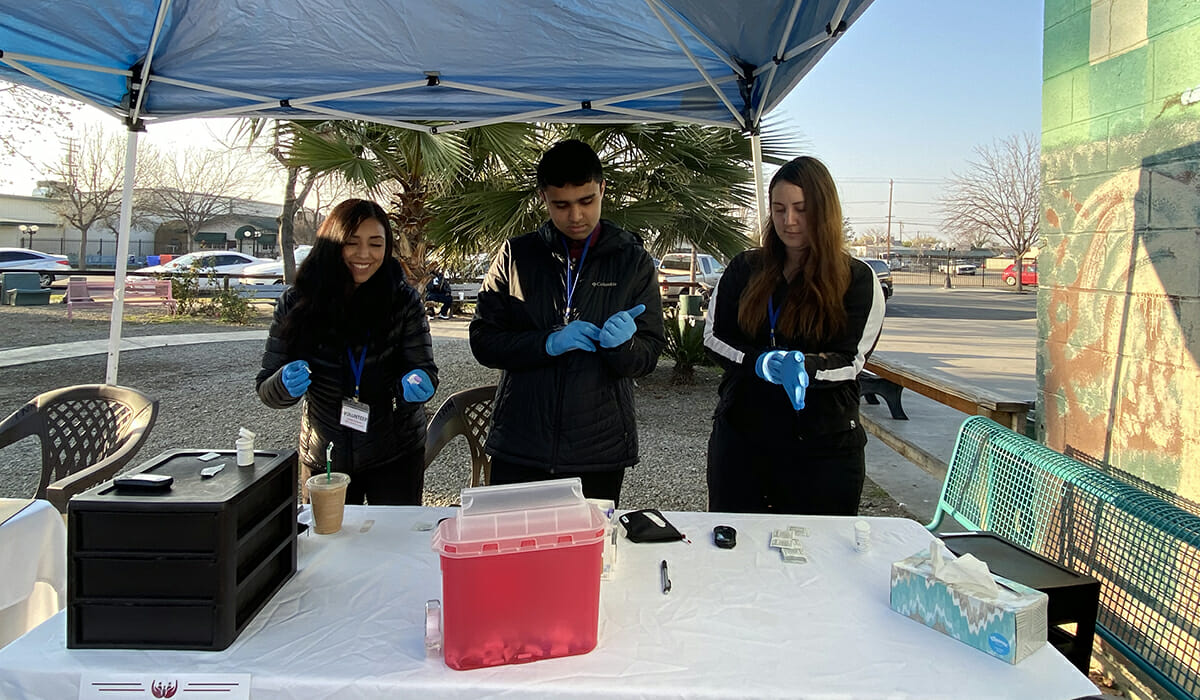
The mobile clinics grew to monthly events, where participants are given height, weight, blood pressure and glucose measurements and other screenings. Doctors are on hand to discuss results and go over medications. Contact information is provided for participants who need further treatment or exams.
Ishaan and other teen volunteers arrive ahead of time, to set up the equipment and tables. They welcome the participants and assist with taking down information and measuring height and weight.
Rhonda Palmbach, whose daughter, now 19, and two sons, ages 24 and 15, have all volunteered with Healthy Community, says it’s taught them leadership, as well as made them aware of those less fortunate. “A lot of kids, especially if they’re in high school, don’t really realize the need that’s out there,” says Palmbach.
Ishaan Brar, center, conducts health screenings Feb. 15, 2020, with other volunteers at the Mission at Kern County, a homeless shelter and rescue mission in Bakersfield, Calif. Free health screenings were given to 119 people that day./Courtesy Ishaan Brar
Although the commitment of just one Saturday per month is easy for high school and college students to manage, Palmbach says her family is impressed with the impact it’s having. “At first, I thought we’re not doing that much,” she said, “but we’re at least telling these people that they matter, and they do appreciate it. When they see younger people in high school coming out, they do think it’s cool, from some of the comments I’ve heard. Those older gentlemen say things like, ‘This is really nice, this is really kind.’”
Palmbach’s oldest son is now studying medicine. Ishaan also says he wants to study medicine or a related field after high school.
As the mobile clinics have made repeat visits to some locations, Palmbach has seen the residents becoming more comfortable – and so have the teen volunteers, who no longer hang back, but go forward and greet them, she said.
“Ishaan has really grown from being a leader, but really quiet, to being able to say, “OK, now we have to do this.’” she said. “I’ve seen him grow in the past year. I’ve seen all the kids grow in the past year.”
101-Year-Old Volunteers at Medical Facility for Over Two Decades, Helping Community and Spreading Joy
Meet Daily Point of Light Award honoree Eulala Roettger. Read her story and nominate an outstanding volunteer or family as a Daily Point of Light.
Eulala Roettger has lived on this earth for more than 100 years, and in that time, the Anderson, Indiana resident says, she’s lived to serve others, saying volunteering is just “what you do.”
Volunteering at the St. Vincent Anderson Erskine Medical Office Building for more than 20 years, Eulala says she started out at the information desk, and her volunteer responsibilities have grown over the years. The centenarian has logged more than 8,500 hours at St. Vincent Anderson, helping patients decades younger than her, serving as an inspiration to others and proving that age is just a number.
What inspires you to volunteer?
I started working as a teacher at a very young age, aged 19, at a time when if there was anything that needed to be done to help outside the academic realm, they gave that job to the teacher. I thought volunteering was what you do. Serving others has been a part of my life.
Describe your role with St. Vincent Anderson Erskine Medical Office Building.
I started as a volunteer in 1998 at the information desk. I volunteer 1-2 days each week, and I do whatever they ask of me in the office. I also help people who need wheelchairs for their visit, and provide information and directions for our visitors.
Eulala Roettger: “When I have a person approach me with a real troubled look on their face, and ask if I can help them, I say ‘yes I can’. When I see that troubled face begin to relax, it makes my volunteerism all worthwhile.”/Courtesy Elizabeth Hart / St. Vincent Anderson Regional
What does it feel like to help others through your volunteering?
When I have a person approach me with a real troubled look on their face, and ask if I can help them, I say ‘yes I can’. When I see that troubled face begin to relax, it makes my volunteerism all worthwhile.
Share one personal story with me from your volunteerism.
The day before Christmas last year, there wasn’t much activity in the building, but I saw this nicely dressed lady come in, pushing her father in a wheelchair. After a few hours, I watched them leave the building and go out to their car. After about 10 minutes, she came back in. This lady was visiting from out of state to visit her father and escort him to his infusion, but she explained to me that her rental car wouldn’t work. She said she didn’t know a person in the town, and asked for my help. We arranged for transportation for them so they were able to get home. This lady stood there and kept saying, ‘oh I feel so bad, because my father is 92-years-old’, and I was probably pushing 100 at that time. I never let them know (laughs).
You’re 101-years-old and still volunteering twice a week. What’s your secret?
I don’t know. I just get up every morning with a purpose. I say, ‘today I’m going to do this’. And I guess that’s what it is. Some days I feel a little under the weather. We all do. I think that I could stay at home, but then I get myself busy and I forget all about it.
What’s one way you hope to inspire others in your service?
When you stay at home you have only yourself for stimulation and watching television. I find when I get out with people, I’m stimulated and I’m buoyed up and it keeps me going. If you want to stay alive and active and mentally alert, find a good volunteer job, one that suits you.
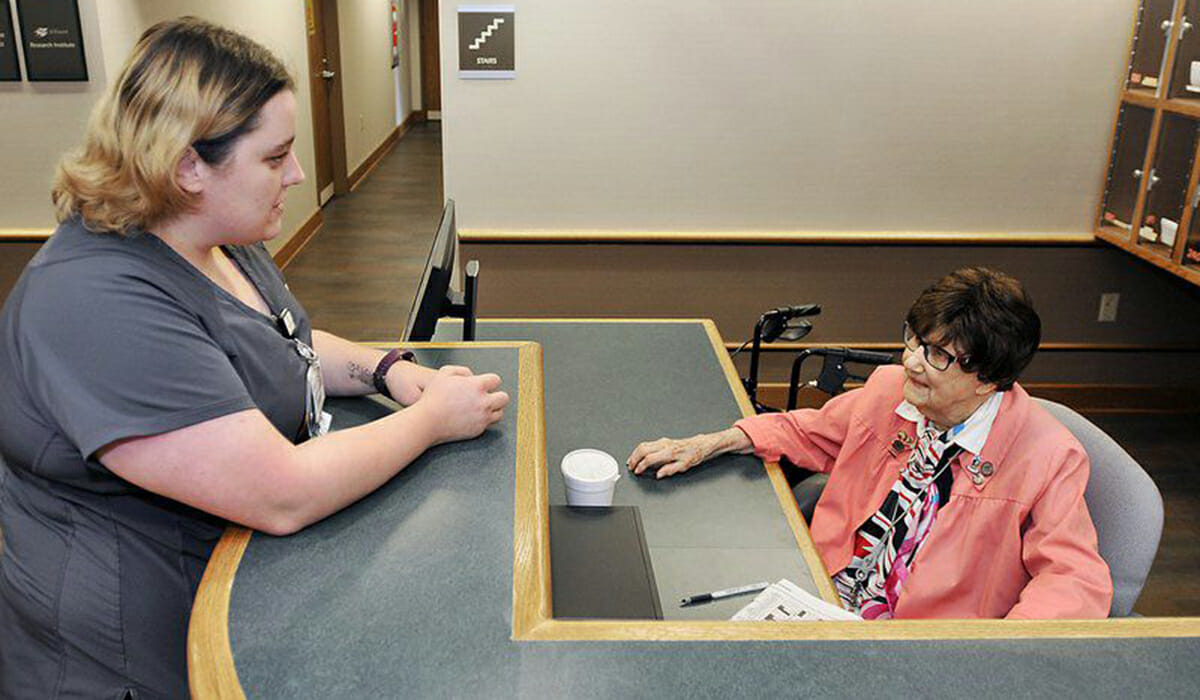
Eulala Roettger first started volunteering at the information desk. Pictured speaking with a staff member, Eulala helps patients decades younger than her, serving as an inspiration to others and proving that age is just a number./Courtesy Elizabeth Hart / St. Vincent Anderson Regional
What’s been the most rewarding part of your service?
It’s been rewarding to make so many friends.
In one word, what does volunteerism mean to you?
Self-satisfaction. I grow and learn by volunteering. Volunteering gives me more than I give.
How can readers help?
If you are interested in volunteering for St. Vincent, please email Elizabeth Hart for more information.
In light of COVID-19, Eulala has had to pause her volunteer activities but looks forward to helping others in more ways in the future.
Military Wives Start Movement to Spread Acts of Kindness
Meet Daily Point of Light Award honorees Maria Reed, Samantha Gomolka and Jessica Manfre. Read their story and nominate an outstanding volunteer or family as a Daily Point of Light.
Maria Reed, Samantha Gomolka and Jessica Manfre had never met prior to last May, when all three were awarded the Armed Forces Insurance Military Spouse of the Year — Maria as Army Spouse, Samantha as National Guard Spouse, and Jessica as Coast Guard Spouse. The three ended up becoming fast friends, so much so that not even a year later, the women have started not only a movement amongst military families, but also their own foundation.
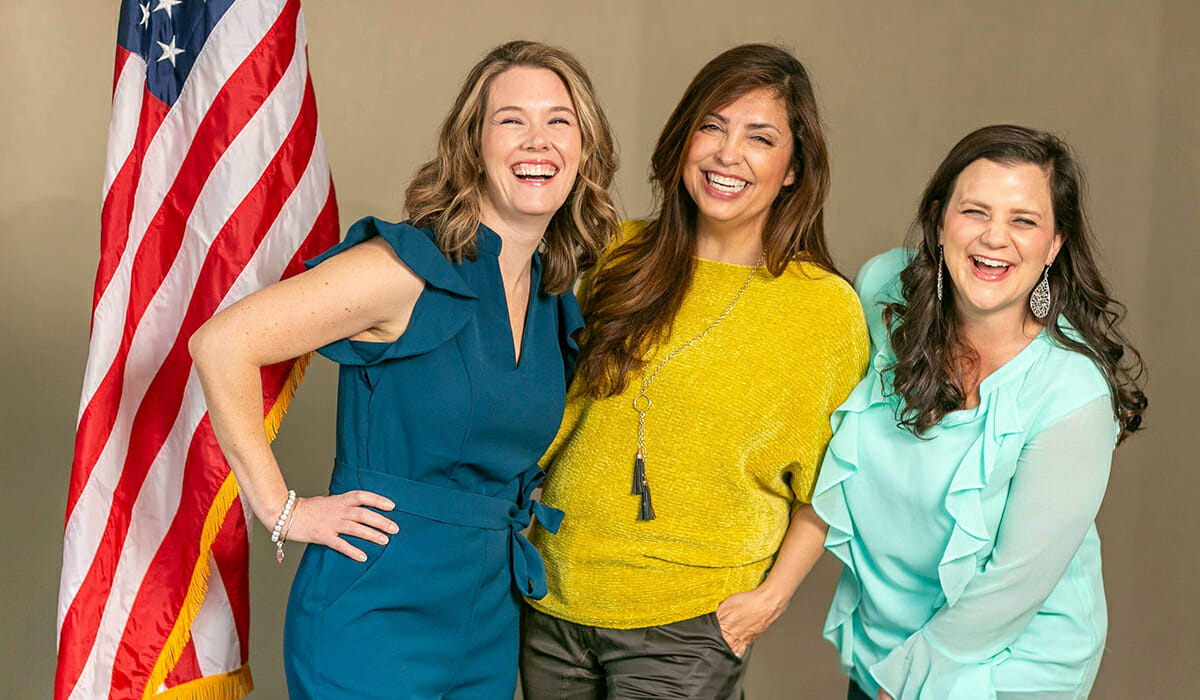
Maria, Samantha and Jessica partnered with Giving Tuesday — a global generosity movement that encourages charitable acts the Tuesday following Thanksgiving — to start Giving Tuesday Military, which specifically encourages members of the military and their families to perform acts of kindness. This past year, the Giving Tuesday Military movement performed over 2.5 million acts of kindness around the country. Further, the trio alongside close friend and Coast Guard spouse Stacy Bilodeau started Inspire Up Foundation, which aims to continue the wave of generosity that Giving Tuesday Military sparked.
Can you describe what Giving Tuesday Military is?
Samantha:Giving Tuesday Military is a movement that was born last September to really find a way to bridge the military-civilian divide, but in a way that wasn’t expected. A lot of what is done is for military families — the civilians doing it as a sign of appreciation. We wanted to flip that script and use military families who already have service hearts to go into the community, make our presence known, and build those relationships and ties with our civilian counterparts through intentional acts of kindness.
How did you three meet and come to start this organization?
Jessica:The three of us were honored with titles of Military Spouse of the Year in May of 2019, so Sam was National Guard Spouse of the Year, Maria was Army Spouse of the Year and I was Coast Guard Spouse of the Year. When we all met, we were friends immediately. Maria has a show called ‘Moving With the Military‘ and she does home makeovers for military families all over the country. When we met, she was like you know, we never featured a Coast Guard family, I would love to work with you. That’s really how it all started. We worked all summer long and we did this makeover. It was an absolutely life-changing experience. I had followed Giving Tuesday for some time, and on a whim I Facebook messaged Giving Tuesday and shared the episode and said “This was so unbelievable and impactful on my life to watch this community come together, I just wanted to share it with you.” Didn’t think I would get a response because they’re so large, but their communications director wrote me back. She was like, “I’m in tears, this is amazing, have you guys ever thought of running a campaign for Giving Tuesday?” That’s really where we all began. We had a conference with them in September. We knew we didn’t want to focus on money. We wanted impactful change, we wanted acts of kindness, we wanted people to be intentional in their life. Our whole entire movement was based on that and based on our goal of one million acts of kindness.
What kind of volunteer projects has Giving Tuesday Military done?
Maria: Giving Tuesday is usually a specific day. It’s the day after Cyber Monday which is the three days after Black Friday. When we think about all of those days, like Jessica said, they’re usually all about money. When you think about Giving Tuesday, it is usually the number one day for nonprofits to receive donations. Bringing in the military community, we knew we wanted everyone to be able to do something regardless of their financial situation. It wasn’t about money, it was about acts of kindness. Acts of kindness range from the Junior ROTCs at the different high schools went onto the military installations and they served the service members. They also served in the community with garbage cleanup, helping the elderly paint their homes, help clean their yards, clean their homes, delivering of baked goods to random people in the community. Simple acts of maybe buying someone a cup of coffee in the line behind you at Starbucks, or as easy as opening a door and saying “I hope you have a wonderful day today.” They do it on purpose, that “OK, I’m going to help this person, how can I help you?” Take your groceries to your car. Leaving things like money at the laundromat with a little box of detergent. Calling people you hadn’t called in a while, leaving a message for someone. Baking things, we baked lots of goods. A high school group left Post-It Notes all over the lockers in their high school with messages of affirmation, “you’re enough,” “you are doing incredible things.”
When we started this movement, we thought it would be one million acts of kindness, and we ended up finding out it was over 2.5 million. I don’t think we’ll ever really know the exact number, but it was at least 2.5 million. It just spiraled. We wanted people not to boast about it, not be like “Hey look at me, look what I did,” but “Today I did this,” and how they felt by doing it, how it impacted them. They hoped what they did helped another person, but how it impacted them as well.
How has Giving Tuesday Military continued throughout the year?
Jessica: Military spouses as a whole I think have such a volunteer heart. Us being in different states, we have different things we’re involved in, whether that’s the VFW [Veterans of the Foreign Wars of the US] or homeless shelters, constantly utilizing our group we have. On Facebook, we have a group that has about 4,000 people in it, so trying every week to engage with them, sharing acts of kindness. From that big movement, other groups developed all over the world, and they are still doing things, so they’re sharing with us what they’re still doing. Obviously with coronavirus impacting our ability to go out and do things, that’s changed. We’ve really been focusing on digital kindness and trying to touch on cyber bullying and do things with the kids. I don’t think there’s a day that we aren’t doing some kind of service project, to be honest.
Although Giving Tuesday isn’t really until December, they are doing an emergency Giving Tuesday [on May 5] in light of everything that’s going on. We’ve come up with a couple different initiatives to help promote under Giving Tuesday Military so we’ll be working quite a bit.
Jessica Manfre, left, delivered 2,000 items that had been raised for homeless shelters in East St. Louis, Mo., this past December./Courtesy Maria Reed, Samantha Gomolka, Jessica Manfre
What are you doing aside from Giving Tuesday Military?
Samantha: April 1 is when we [launched] our new foundation. It’s called Inspire Up Foundation. Once we did the action report of Giving Tuesday Military, we knew the impact was so great on both the givers and receivers that it couldn’t be contained to one day. We really had to find a way to perpetuate kindness every day throughout the year. We had someone say “#givingalways.” That was a driving force between our strategy sessions. We have initiatives that fall underneath Inspire Up, and one of them is #LoveMilKids. We’ve received uniform donations all over the world for all branches of the military and we have been making stuffed hearts to send to military children. The first 500 have been [free through sponsorship of First Command Financial and Scott Credit Union]. Then we’re going to be receiving monetary donations where someone can sponsor a heart. They can donate a heart to send to other children. We’ve also spoken about expanding that, especially in light of coronavirus, to Hearts for Heroes. So all first responders, people on the front lines right now using their own bravery and courage and sacrifice, all ideals we really cherish, to honor them. We’ve been hard at work doing this behind the scenes.
Maria: One of the reasons [we launched on] April 1 is because April is the Month of the Military Child, so we can make sure we can get the hearts into the hands of as many military kids as possible. Those hearts would be free to military families. They’re being made from repurposed old military uniforms, so they can be from a different generation. That, I think, is what’s the beauty. The veterans who have donated those uniforms, they’ve said you’re giving us a purpose. They’re like, “I can do this,” and “Yes, take my old uniform, it was just sitting there in the trunk.” Getting them to us feels like it’s going to help these military kids, especially during this time because there’s so much of the unknown and insecurity. It’s a way to give children something to hold onto and be proud.
Why is it important for military spouses and families to have organizations like this?
Maria: Military families, because we are all over the world in different places and not necessarily even near military installations for many of [those with a permanent change-of-station order]. Many military families have reached out that they feel isolated. They don’t feel connected with the military community, or any community, for that matter. They oftentimes feel like the civilian community doesn’t want to be their friend, if you will, because they’re like, “you’re going to leave, you’re not going to be here.” That happened to me where civilians did not want to have their kids be friends with my kids because they knew we were going to be leaving some day, and that to me has to stop. We are a people, we are a human race, we all need to connect. I think this is so important for military families because it gives them a purpose. It gives them a way to feel connected to their community, and even if they can’t physically go out and do something, if they can be perhaps organizers for different events, being able to put all those things together — it really gives them a mission. I think military families, we’re very much mission orientated. Give us a task, give us a purpose, and we’re on it, we’re going to get it done. I think it’s very, very important for the wellness and mental health of military families.
Samantha Gomolka, Maria Reed and Jessica Manfre met last year when they were awarded the Armed Forces Insurance Military Spouse of the Year awards./Courtesy Maria Reed, Samantha Gomolka, Jessica Manfre
What’s been the most rewarding part of your work?
Samantha: I think it comes back to it was never about the number. One million acts was our pie-in-the-sky goal. Maria had discussed it during one of the interviews that the military represents one percent of the population and that would have been a big number to reach. But also during our strategy sessions, we knew if we could impact one life, that all of this would be worth it. The stories that really stayed with us were how people were impacted, how people felt a sense of belonging. We had deployed soldiers who participated in Giving Tuesday Military. They had just come out of the field. They hadn’t had normal food or coffee in six weeks. The one act of kindness was that he went to a Starbucks to buy the cup of coffee that he had been thinking about for weeks. He saw a homeless gentleman, and even before he took a sip fo coffee himself, he handed it to him and kept walking because he had to report for duty. I think that speaks from the heart as such a true act of kindness, that people are giving whatever they have to give. It changed me. Going into it, I always thought I was nice, but not necessarily kind all the time, really looking for opportunities. It changed the way I lived my life, looking for those nooks and crannies where I can infuse that for somebody else.
Jessica: We all three have always been involved in service of some kind. I think it just solidified for me that this is what we’re meant to do. There’s no one story that stands out above the others. I want to live that everyday. I think that’s the end for me — I want that to be my everyday. I want that to be everyone’s everyday.
Maria: For me, I think the biggest thing was working with youth. They’re so touched and moved by everything they see on social media, and sadly most of the time, it’s not good. There’s a lot of negativity wrapped up in this whole ‘my Instagram life,’ and I’m like, but that’s not real life. Let’s show them a better example. Seeing all of these different high school groups, these kids, step up and become leaders, and then their groups stepping out in their community and doing things — that’s our future. That’s what it’s going to look like. It’s not going to look like all this negativity and hate we’ve been seeing. It’s going to be kind and it’s going to be good. What I saw in young people, that left such an impact on me.
What do you want people to learn from your story?
Maria: I want people to know that ordinary people can do the extraordinary.
Samantha: Absolutely. We’re not business gurus. We’re coming together to learn nonprofits together. This was totally a passion project. It was an idea hatched in September. We didn’t know if it was going to work, but we certainly weren’t going to take no for an answer. We kept talking and promoting and asking, and people shared with our vision and chose to stand shoulder to shoulder with us, and we changed the world. We may not know how to do it, but we’re determined to figure it out. I think if anybody has that source of passion, they just need to go with it, because it could change the world quite literally.
Daughter of Holocaust Survivors Volunteers to Save Lives in Syria
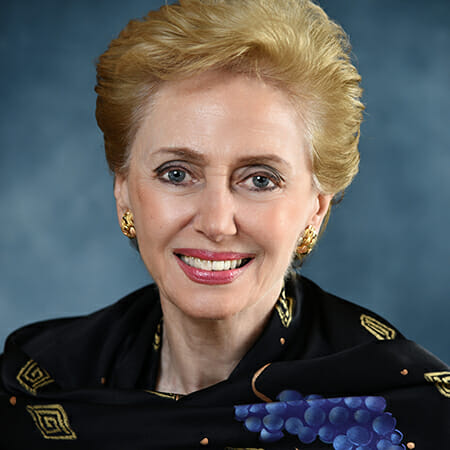
Meet Daily Point of Light Award honoree Georgette Bennett. Read her story and nominate an outstanding volunteer or family as a Daily Point of Light.
Born in Budapest, Hungary the year after World War II ended, Georgette Bennett was a child when she arrived in the U.S., her parents fleeing from the horrors of the Holocaust and violence they faced as Hungarian Jews. Just 6-years-old, a ship manifest classified the family as refugees with no home.
“Next to our names on the passenger manifest for the ship on which we arrived in Manhattan, there was a column to enter nationality. For my parents and me, it said ‘stateless’. We arrived in the U.S. in the middle of the McCarthy era….whenever I went to a post office there would be big signs about alien registration. That was me. I was an alien. I lost my roots.”
Growing up in near poverty after her father’s death shortly after the family fled to the U.S., the now 73-year-old New York City resident says she lived in terror of also losing her mother, and living in a strange country with no support system. Against all odds, Georgette says her mother still managed to seek out a living to support the two, and each year, she would go door to door collecting money for the National Council of Jewish Women. That sense of service even in the face of adversity left a lasting impression on Georgette, and several years ago, when she discovered a burgeoning crisis that wasn’t being addressed, Georgette took matters into her own hands.
Through Multifaith Alliance for Syrian Refugees, founder Georgette Bennett has helped tens of thousands of Syrian war victims by delivering desperately needed relief to difficult-to-access villages./Courtesy Multifaith Alliance for Syrian Refugees
Georgette’s late husband, Rabbi Marc Tanenbaum, a pioneer in interreligious relations and a prominent human rights activist, had served as a board member of the International Rescue Committee (IRC), and following his death, Georgette joined the board, deeply committed to supporting refugees. “In January 2013 the IRC issued a report on the Syrian crisis, and being a typical overextended New Yorker, that report sat on my desk for a few months before I had the time to read it. I was absolutely stunned by the magnitude of the crisis and the silence of the world in the face of the crisis. Leviticus 19:16 kept reverberating in my head: ‘Thou shalt not stand by idly while the blood of your neighbor cries out from the earth.’”
Feeling commanded to take action, Georgette founded Multifaith Alliance for Syrian Refugees (MFA) in 2013, the largest U.S. multifaith response to the Syrian crisis, comprising more than 100 faith-based and secular organizations committed to aiding Syrian war victims. Working with partners in the region, MFA brings desperately needed relief through essential supplies delivered to difficult-to-access villages in Syria. To date, MFA has facilitated the delivery of more than $150 million in relief, including clothing, blankets, food, sanitary items, medications, medical equipment and supplies. Describing recent attacks in Idlib, in northwestern Syria, Georgette says conditions were nearing unliveable for those in the region.
“It was in the middle of a bitter, bitter, cold winter. These people had absolutely no shelter. Mothers were waking up finding their babies frozen to death. That’s how bad it was. We immediately partnered with one of our local partners in Syria to get hundreds of tents so that they at least had some kind of shelter, and our partner provided infrastructure including water lines and electricity.”
For Georgette, a sociologist by training, providing humanitarian aid for Syrians, historically regarded by Israel as an enemy state, was never a question. According to Shadi Martini, executive director at MFA and a native Syrian, by uniting many faiths, Georgette’s service has fundamentally changed the future for Syrians.
“There was a lot of friction between Muslims and Jews, Israelis and Syria,” says Shadi. “She succeeded on the first level by joining Muslims, Jews, Christians, everyone in this adventure to help Syrian war victims. (Also), she kept pushing for the Israel authority to open borders for outbound humanitarian aid into Syria. This shifted the landscape tremendously…people who have no connection to Syria now have Syria on their radar.”
Georgette says that as a refugee herself, she was gripped by the extent of the gender violence occurring in Syria, women and children making up 80% of Syrian refugees, and says her ability to unify opposing groups to alleviate terrible suffering that all Syrian refugees face has been rewarding.
“As a volunteer, it’s also important to know that I’ve been able to inspire others to join me in this work, because I don’t think I could have done any of this myself. I was able to carry a message to my community which is seemingly counterintuitive: Why should Jews be supportive of sworn enemies? I get enormous joy from people being able to rise above politics, Syrians and Israelis coming together, and beginning to trust each other.”
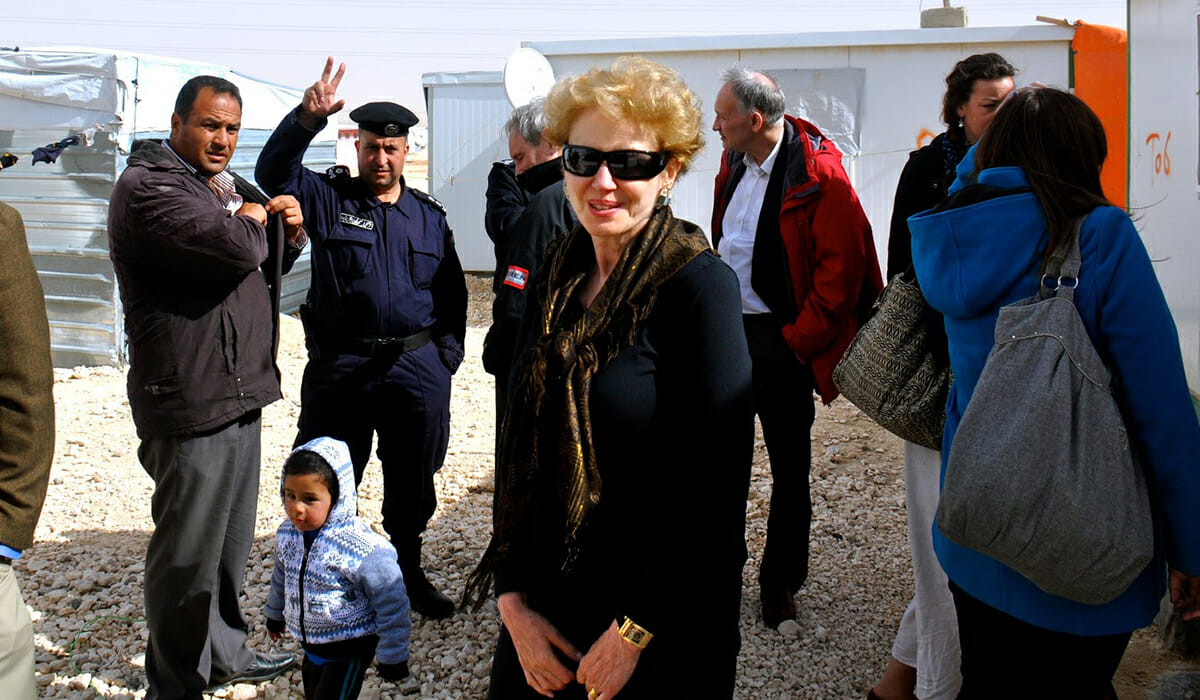
MFA founder Georgette Bennett pictured at a base camp in Jordan./Courtesy Multifaith Alliance for Syrian Refugees
Described as both “passionate and compassionate,” Shadi praises Georgette’s drive to create change for a place that she has no personal ties to. “I’ve heard a lot of children of Holocaust survivors have this stamina, and they have an ability to work much more than other people. She’s always trying to do the maximum good that is possible in one lifetime.”
For Georgette, who launched MFA assuming the civil war would be over in a few years, the work continues. Scaling up humanitarian aid deliveries and supporting education in the country are her top priorities, saying there is a “lost generation” due to the years of schooling that Syrian children have missed. Her mission, to help plant seeds for future stability in the region with partnerships between Syria and Israel being key, Georgette says that her volunteerism has demonstrated that sworn enemies are capable of working together and partnering for a positive outcome.
“Everybody wants to help, everybody wants to be able to do something, but when you’re confronting a crisis of this magnitude, you have to be able to find the niche, the entry point where you can do something that is relevant. What gives me gratification is having found that entry point and knowing that along with the people who did this with me, that we were relevant and we are having an impact.”
Vermont Teen Connects Rural and Migrant Youth through Storytelling
Meet Daily Point of Light Award honoree Lena Ashooh. Read her story and nominate an outstanding volunteer or family as a Daily Point of Light.
Growing up down the street from Shelburne Farms in Shelburne, Vermont, Lena Ashooh loved visiting the farm’s Brown Swiss calves, and when she finally got the chance as a teenager to show the calves at agricultural fairs, the 16-year-old relished the chance to meet like-minded teens.
Discovering the benefit of connecting with other rural youth with different perspectives, Lena founded Mi Vida, Mi Voz, a program dedicated to using art and culture as drivers of a more just community, inclusive of all young people. Lena believes it is particularly important to spotlight the need for support of minority groups, including migrant youth who are sometimes forced to relocate to obtain seasonal or temporary employment in agriculture.
By working to unite young people as an essential force in creating positive social change, Lena is providing opportunities for youth to make meaningful connections and truly have their voices heard.
What inspires you to volunteer?
It’s really easy to look at national headlines and hear about issues that people are facing across the globe. We as young people face some of the globe’s most pressing issues. I’m inspired by the power in really small, community-based efforts. By providing tremendous support to rural youth across the state of Vermont, I’ve learned that these connections do have the power to transform lives.
Why did you name your organization ‘Mi Vida, Mi Voz’?
Translated to English, the organization’s name means, ‘my life, my voice’. As a 4-H volunteer, I love the community I find myself a part of, and I realized that the big youth migrant population within the Vermont agricultural community, many of them LatinX, could benefit by connecting with other youth through educational programs. By empowering these different groups to share the challenges they face as being part of the agricultural industry, I decided our organization’s name should describe how these individuals are reclaiming their own voice through storytelling to share their different perspectives and put their truth out there to connect with other people.
Describe your role with Mi Vida, Mi Voz.
As founder and director, I hosted our first conference in summer 2019, and I am now gathering presenters for our second annual conference this summer. We’ve been thrown off a little bit by coronavirus, but we’re hoping our conference will take place this summer as planned. The conference holds workshops, open-mics and powerful storytelling across youth, artists, activists, musicians, writers and educators. We are currently working on creating an online space for our youth advisory board so that we can virtually meet and share our experiences year-round.
Share one personal story with me from your volunteerism.
At our conference last summer, an attendee shared a story about poverty within his community back at home, and his recollections of a red toy truck that his parents couldn’t afford to buy him as a child. After working in Vermont, this teen was able to save up enough money to send back to his mother and buy that toy truck, and he’s hoping to save it for his children so that they can play with it together. Watching this person speak about his life, family, and aspirations was transformative, and I felt very lucky to be a part of this community where we could speak openly about our pasts and aspirations.
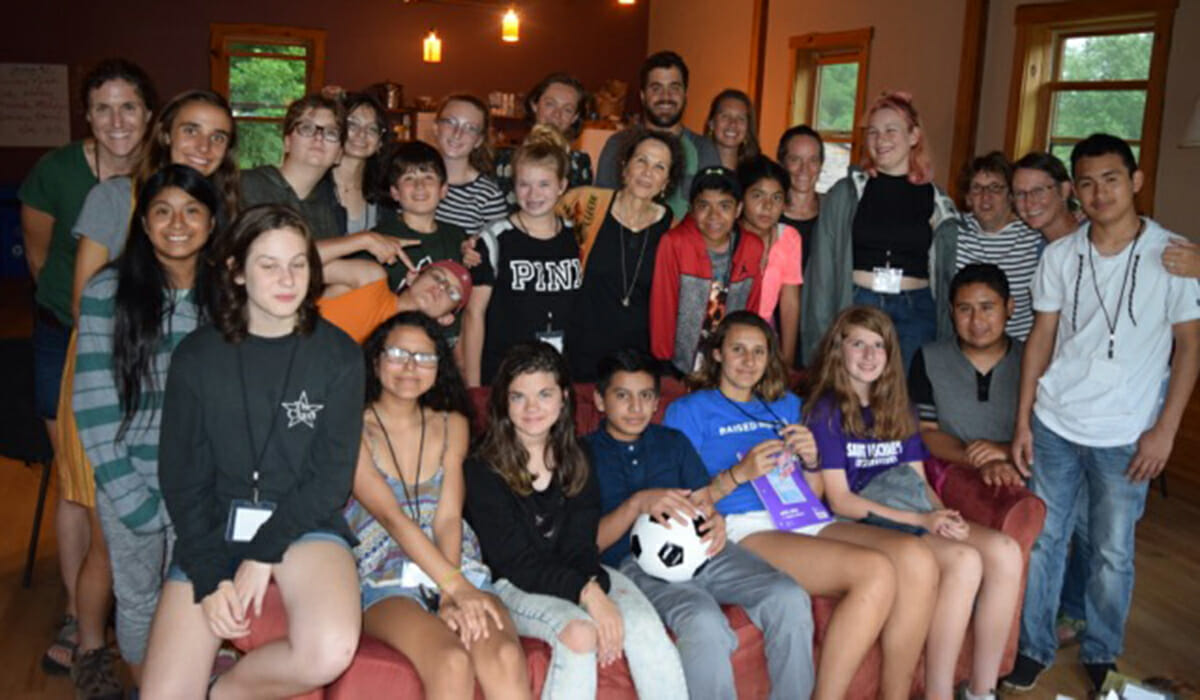
Photo taken at the inaugural “Mi Vida, Mi Voz” storytelling conference in July 2020. /Courtesy Lena Ashooh
What’s one way you hope to inspire others in your service?
Our program serves as a liaison between two influential organizations, the Vermont Migrant Education Program (VMEP) and the Middlebury Bread Loaf NextGeneration Leadership Network (BLTN NextGen). Because of the success we’ve had using storytelling to share experiences and connect with others, BLTN NextGen has begun using storytelling at all their sites nationwide to bring voice to members of the community who otherwise wouldn’t have a chance to do so. Whether it be storytelling or community-based events, it would be awesome to see even more youth and populations across the country engage and connect with other members of the community.
You are a junior in high school. When you are not busy with school and volunteering, what do you do for fun?
I really like showing cows. I also play field hockey and lacrosse, and do art projects.
In one word, what does volunteering mean to you?
Engagement.
How can readers help?
We’re always looking for more partners and organizations who are interested in sharing their story or participating in joint events to collaborate and fundraise. Please visit our website for more information.
For hotel owners and managers, towels, blankets and sheets that have slight stains or rips can mean dissatisfied guests. But for people who are homeless or staying at shelters for protection or because of an emergency, fresh clean linens mean comfort and warmth. Thick, soft towels and maybe even bathrobes are an added blessing when the opportunity to take a shower is offered.
For dogs and cats in rescue shelters, gently used linens mean a soft bed and a way to be dried after a much-needed bath.
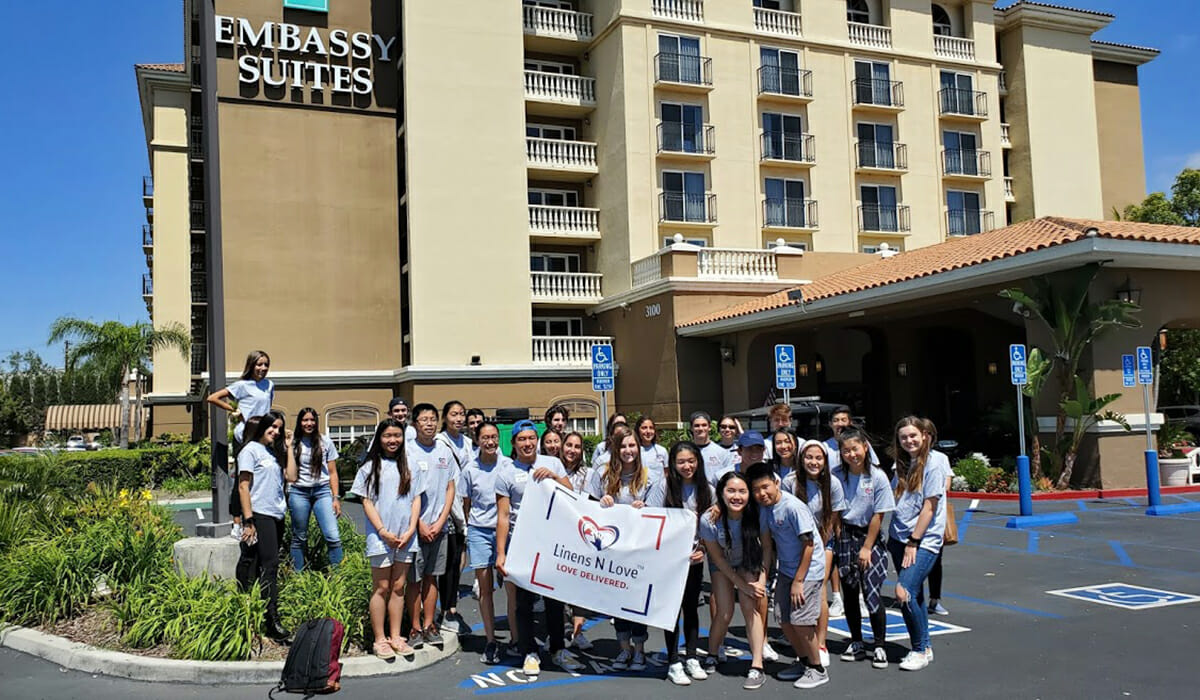
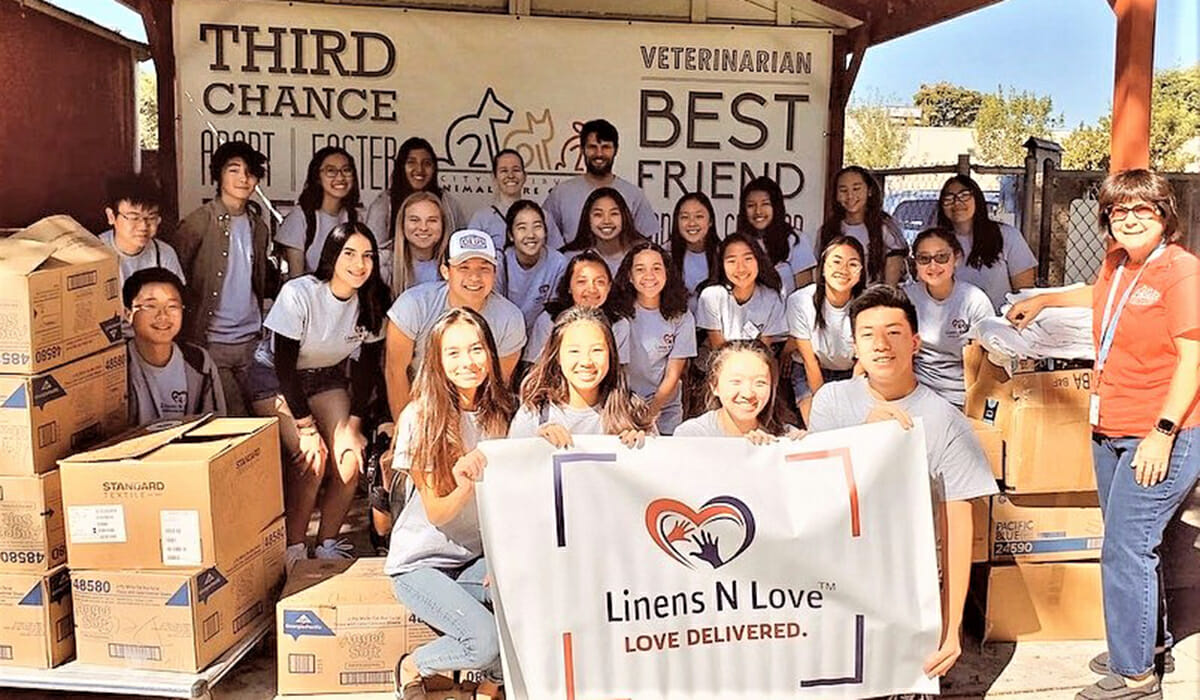
Vivian Wang, 17, along with her volunteer organization, Linens N Love, has been collecting linens from hotels and distributing them to various shelters since 2014. To date, Linens N Love, with mostly teenaged volunteers, has donated more than 16,000 linens internationally and received more than $15,000 in grant funding.
The positive environmental impact isn’t lost on Vivian, either. “Hotels can’t keep too many linens in their inventory, especially if they don’t meet the hotel standards anymore, so they would otherwise end up in landfills,” says Vivian. According to her research, some 17 million tons of textiles are dumped in landfills each year.
But perhaps best of all, Vivian says she and her fellow volunteers have grown in compassion and awareness of the less fortunate by donating linens. She makes it a point to request a tour of each facility upon bringing donations.
For example, Vivian, who attends Valencia High School, an international baccalaureate school in Placentia, Calif., says she and other student volunteers were surprised to discover a teen orphanage near their school. “You could cross the street and walk to it in just one minute,” she said. “But most of people at my high school didn’t know about it. After we organized a delivery there to donate linens, we listened to a Q & A session and got a tour. It was super eye-opening.”
Co-founded by teens Vivian and May Wang, Linens N Love is a volunteer non-profit organization that collects gently used linens from hotels and delivers them to homeless shelters and animal shelters./Courtesy Vivian Wang
Vivian was only in 6th grade when she and her older sister, May, then a high school freshman, founded Linens N Love. The girls’ father works in the hotel industry, so they knew that towels and bedding are continuously discarded.
Vivian admits they at first planned to make a one-time delivery of linens to satisfy a school assignment.
“No way we thought this would be an ongoing thing,” said Vivian.
They chose to donate the bedding to a local animal shelter. “It was crazy to see what it was like,” recalls Vivian. “It was an outdoor shelter and this was winter. The dogs were shaking with cold. It was hard to see that.”
Vivian and May began to wonder how a lack of linens might affect humans. “We thought about teens, orphanages, veterans,” says Vivian. “My sister realized that high schools are the perfect platform to recruit volunteers to join clubs, so she started the first chapter of Linens N Love.”
Today, now that May is in college, Vivian coordinates Linens N Love chapters at several high schools.
Samantha How, 17, a family friend, started a chapter at Canyon High School in Anaheim, Calif. “I really like this cause,” says Samantha, who feels the leadership skills that she and her classmates are developing are as important as the donations. “Vivian really advocates for teens to be leaders of the next generation – we are going to be the adults. It’s important for young people who have benefited from their community to give back and also prepare the community for the next generation.’ Reusing linens represents a “green mentality” of protecting resources, she added.
Shweta Shah, 16, who is Valencia High School’s current Linens N Love chapter president, says her fellow students often ask when the next delivery will be, despite their busy schedules. “They consistently want to be involved,” says Shah, noting that students like the “double-edged” benefits of helping people in need and also saving the planet. Shweta has gotten her younger brother, Vivek, 15, involved with Linens N Love, saying it’s strengthened the bond between the two while helping him prepare to take over after she graduates.
Haley Cooper, development manager at HIS House in Placentia, Calif., praised Linens N Love for regularly donating fresh bedding that the transitional housing shelter would otherwise have to buy. “We have 54 beds, and whenever a family moves in, we provide all new linens, which they get to take with them when they transition into their own home,” says Cooper, adding it’s one less expense for families struggling to buy food and pay rent.
Vivian Wang (holding sign, third from left) and her Linens N Love team deliver 300 gently used linens to an animal shelter in California. /Courtesy Vivian Wang
“We had a family recently that had moved out of our program and because of COVID-19, lost their jobs and were unable to pay rent, so they had to return,” said Cooper. “For someone who is homeless, just having a bed with clean linens is a huge relief if they haven’t had that for days. They are just so thankful.”
Cooper says she’s impressed that someone as young as Vivian was so “innovative to see what could have been waste and use it for the greater good.”
Speaking of COVID-19, Vivian reports that she’s holding her student leadership sessions online while schools are closed. In addition, although Linens N Love is temporarily suspending deliveries of linens, they’ve jumped in with a new pandemic-related initiative.
“We are instead partnering with Peace First,” says Vivian. “We are planning a rapid response initiative to donate new face masks to our local community. Our hotel partners graciously provided us with these donations of face masks.”