California Family Volunteers to Build Community Support for Foster and Adopted Children
Meet Daily Point of Light Award honorees the Orlando family. Read their story and nominate an outstanding volunteer or family as a Daily Point of Light.
As a family of 12 and parents to 10 adopted children, including 7 former foster children from the same family, Donald and Rendy Orlando say their foster children showed up to the house with the clothes on their backs and not much else. Wanting to help other children in similar circumstances, the Hayward, California family has dedicated their volunteerism to supporting adopted and foster children in need.
Through the Alameda County Foster Parent Association, which helps to ensure consistent, safe, quality care for children, foster and adopted, in need of out-of-home placement, the Orlando family acts as a first responder team when a child or teenager is in need by organizing and providing donated clothes and other items. Since 2016, the family has helped hundreds of other foster and adopted children in the community so that they feel comfortable and cared for in their new surroundings. In recognition of their service work, the Orlando’s were finalists for Disney and Points of Light Volunteer Family of the Year, and received a trip to Disney World.
Points of Light spoke with Donald, Rendy and two of their older children who are both adopted, Gabriel and Gia, about their volunteerism.
What inspires you to volunteer?
Donald: The children that come into foster care don’t have anything with them. They come with the shirts on their backs and not much else. We help to give them something new to start their lives off so they have a fresh start and know that they’re loved and cared for. Gabriel: Volunteering makes me feel like we are helping kids feel like they are somebody, when before they used to be a nobody.
How has volunteering as a family changed the impact of your service?
Donald: Volunteering as a family gives us more of a purpose. We are trying to instill in others a sense of working together as a team in order to bring back that community sense that we’ve lost over the years in our society. We’re teaching our kids certain moral values to help others.
Describe your role with Alameda County Foster Parent Association.
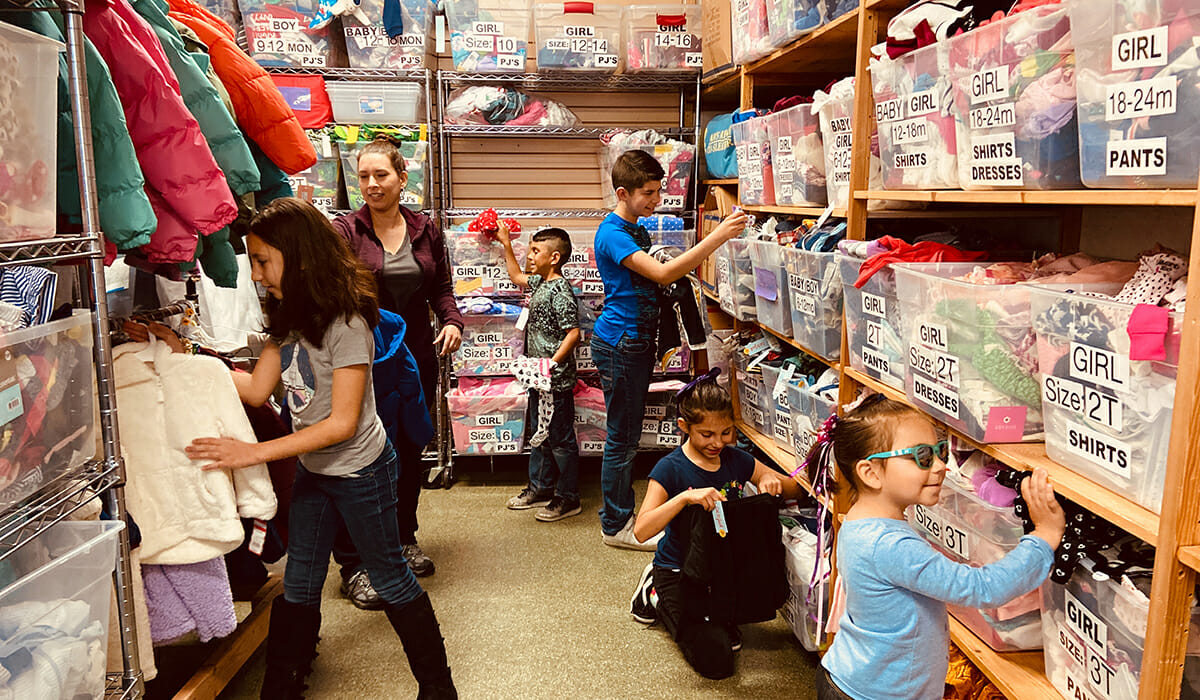
Rendy: Our family volunteers with the association and in addition, I am co-fundraiser on the board. As volunteers, our family sorts and itemizes clothing donated for children. Organizing the clothes by gender and size helps our youngest children to improve their reading and organizational skills. Gia: I always ask mom if I can help her, I like to help organize the clothes. I organize and put stuff away so it’s not on the ground. I think volunteering is pretty fun because I get to help other people out.
Share one personal story with me from your volunteerism.
Rendy: About three months ago, a home shooting occurred in our area, it was a horrible travesty. Two young boys from the home came into out-of-home care. Their pregnant mother had been shot in front of them, she lost the baby. Their father was shot and hospitalized in the intensive care unit. At that point the children had absolutely nothing as they left the house. We were called in to give them new wardrobes and new backpacks. After the fact, the children told a social worker that they loved the new blankets we’d given them because they were so soft and comforting. It is important to us that we have the ability to be on call for these kids and know that we’ve made a difference.
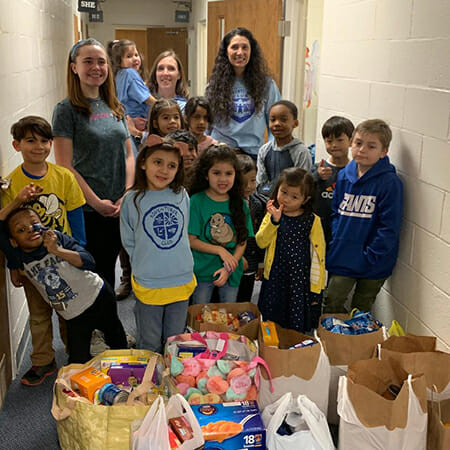
Rendy Orlando and five younger children sorting new clothes into bins for the Clothing Closet at Alameda County Foster Parent Association./Courtesy Orlando Family
What’s one way you hope to inspire others in your service?
Donald: We want people to learn to be able to give back. Society is always a take, or getting something. We want to be able to give back and instill in others the sense to give back, especially to children that are less fortunate.
In one word, what does volunteering mean to you?
Gabriel: Sharing. Gia: Helping. Helping out people.
What’s the most rewarding part of your service?
Rendy: We hold a backpack event for children because many of them have never received a backpack full of supplies. When they receive the backpack and start digging through it and laying everything out, there’s a look in their eyes, first surprise, and then joy. Many of them say thank you. That makes us happy.
What have you learned through your experiences as a volunteer?
Gabriel: I’ve learned that deep down in me, I feel excitement when I volunteer, like a firework going up and exploding like joy. Rendy: Just as our family continued to grow, we knew we had enough love to volunteer. If we have the time and energy to serve, we just keep pushing forward. We even volunteer just a little bit at a time, it doesn’t have to be the whole kit and caboodle.
What saying do you live your life by?
Rendy: We always say we’re blessed.
How can readers help?
Rendy: We are volunteering a little bit more now because of the coronavirus pandemic. The diapers and baby wipes flew off the shelves at stores, so we’ve been able to give those items to families in need. Please visit the Alameda County Foster Parent Association website for more information about how you can give back.
Volunteer Spends Almost a Decade Teaching English to Dallas-Area Immigrants and Refugees
Meet Daily Point of Light Award honoree Kristl Evans Linenschmidt. Read her story and nominate an outstanding volunteer or family as a Daily Point of Light.
Nine years ago, Kristl Evans Linenschmidt’s mother invited her to come help co-teach her English classes at Literacy Achieves, a nonprofit she had been volunteering at for years. Despite no history of being an educator, Kristl decided to join her mom in teaching literacy and life skills to non-English speaking adults in Dallas’s Vickory Meadow neighborhood, which houses thousands of immigrants and refugees. Almost a decade later, while her mother has since retired, Kristl is still going strong.
She currently teaches two morning classes, where she works tirelessly to help her students achieve their goals. The students come from over 50 countries and speak a myriad of languages, although Kristl says love is the universal language that brings them together. She has become so dedicated to her volunteer work, that Kristl completed a Second Language Teaching Academy certification at Brookhaven College in order to better help her students.
“Now I kind of laugh and say I’m a certified ESL instructor working as a freelance bookkeeper to support my volunteer teaching habit,” Kristl said.
Describe what Literacy Achieves does.
Literacy Achieves is a 501(c)(3) nonprofit that was established in 1997 by members of the Preston Hollow Presbyterian Church, which is actually my church. The initial mission was to help adults learn English in the Vickory Meadow area, which is a low-income neighborhood with thousands of immigrants and refugees. The past 23 years, it’s experienced steady growth and really been able to increase the impact with their program. Today, Literacy Achieves serves about 1,100 adult students and 320 young children annually at three different campuses in the Dallas area. They are located in neighborhoods of highest need, so that helps with time and transportation and child care and money. Having neighborhood access to these quality programs is a big deal. The classes are free of charge. They contribute 30 dollars for their books. Basically it’s teaching language and life skills. That is done through between 300 and 350 dedicated volunteers that do it. It’s really pretty impressive. It’s done through this two-generational approach, which is while the adults are learning English, the children are also being taken care of. There’s an early-childhood education program in conjunction with the adult literacy program. That makes it a really holistic, integrative approach.
What’s really awesome about it is that we hosted on-site visits in collaboration with the World Affairs Council, which is a high-level State Department delegation that come through the U.S. International Visitor Leadership Program. The delegation wants to study best practices for refugee resettlement and they were specifically requesting to met with Literacy Achieves, with our group, to discuss the various sorts of literacy programs and the approach to ESL instruction that accommodates the entire family. Just last week, we had a whole delegation from Estonia. I hadn’t met anybody from Estonia before so that was kind of fun. The way the volunteering works is there are morning, afternoon and evening classes, so it accommodates people in the work force that have to come at night, and then the early-childhood program is during the day. It’s a team-teaching model so every classroom has two teachers. Classes are two hours, four days a week. So it’s two hours Monday, Tuesday, Wednesday and Thursday in the morning, in the afternoon and in the evening. You would have a team of different teachers every day, so that’s where the army of teachers comes in with the almost 350 volunteer teachers.
What is your role with Literacy Achieves?
I teach two classes. I teach what is called a morning 1A class and a morning 1C class. I follow an established curriculum that is published every year by the school. We are given a set of books. We have the student text, student workbooks, and then we have a teacher guide. Everything is so well organized and so well laid out, so we know that I teach Tuesday mornings and Wednesday, and looking at the curriculum I’m supposed to cover these four pages in the student text and these two pages in the student workbook. Of course we are free to make adaptations to that and to expand, kind of explode the lesson if you will — get it off the page and make it relevant to these students’ lives and needs and that kind of thing. If we’re doing something like leaving messages on a telephone, we can practice leaving our own messages. I like to get them to write their messages and then record them on the cell phone, and then I can play it back on the speaker in the computer so they can hear it. Depending on what level people are, we can practice writing down the phone number that people are leaving, or what the message is, or the name of the person, that kind of thing.
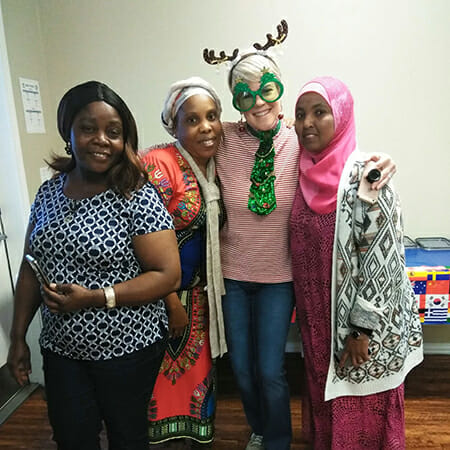
Kristl Evans Linenschmidt, second from right, poses with some of the many students she has had in the nine years she has volunteered at Literacy Achieves./Courtesy Kristl Evans Linenschmidt
What about this organization has made you want to keep coming back year after year?
It’s the students. The organization itself has got this great model that mobilizes all these volunteers. It’s got this great mission. It’s very innovative and it’s so well organized and so well run. It’s got great leadership. The students are so amazing because they come from over 50 countries. It kind of blows my mind that we’ve had people from Peru, Honduras, Togo, [Democratic Republic of] Congo, Guinea, Uganda, Rwanda, Syria, Iraq, Iran, Israel, Mexico, Burma, Eritrea. Well, I don’t speak French of Farsi or Burmese or Arabic or Somali or Spanish or Liberian, so we need a common language. I say that part of what we’re doing at Literacy Achieves is cross-cultural communication and community. Because gosh, we’ve got 50 different countries and just as many languages so we need to be able to communicate with each other, so we’ve got this cross-cultural communication thing. Then the community building is just so amazing. We’re doing it [by] offering these English lessons, but there’s so much more to it. My students teach me about resilience and determination and ingenuity and generosity, and it’s a beautiful thing. We all learn we’re in this thing called life together. Love is the universal language and we speak a lot of it in class. Living for the ‘aha’ moments where somebody understands the concepts, but even more than that, the hugs and the high fives when there’s the feeling of ‘Oh, I can do this, I’m capable, I’m understood, I’m accepted.’ It’s about building relationships.
Why is it important for refugees and immigrants to have access to this type of tutoring?
I think the lack of English literacy limits things like access to employment, effective parenting, preventive healthcare. It increases the vulnerability of living in poverty, and there’s a clear correlation between more education and higher earning. We want to get people engaged in the community and able to take care of themselves and their families, and to be effective parents and good employees and good citizens in the community.
What have been some of your student success stories?
I can’t even tell you how great the students are. Kurdo Banko is a Syrian refugee and he got this great job at this restaurant in Dallas named Hibiscus. Chef Graham [Dodds] took him to New York to make these crazy rabbit tortellini things, this rabbit dish, and it was like, ‘Wow, Kurdo really made it.’ And yet, what he really wanted to do was be a tailor, because that’s what he was in Syria. He is now a tailor in the suburb of Dallas and he is making women’s suits and prom dresses and evening gowns. It is amazing. All these people come here for a better life, and they really want to engage and they want to participate and they want to contribute and they want to give back. Blanca is a student from Mexico and she completed four years at the school. She now runs a parent support group and she acts as a liaison to other parents who need help. Mojgan, one of my level four students, she was a proud momma of a 15-year-old [Rooha] who got involved with the international street art awareness campaign called ‘Education is Not a Crime.’ We’re all richer when we can share our gifts and our experiences, and our community is better for it.
What’s been the most rewarding part of your work?
When I talk about Literacy Achieves, I say that the spirit of cooperation and compassion that I see in my class gives me hope for the world. These are beautiful, amazing students. When I leave for class, my husband says, ‘Go be a blessing,’ and I always say, ‘I’m going to get a blessing.’ The most rewarding thing is really seeing the growth in the students, and the growth in confidence and the growth in capability, and the impact on their lives with having more confidence, with being able to [achieve] whatever their goals are. You’ve got a spectrum of language learners. You’ve got the beginners, and the goals are simple things like ‘I need to understand my environment, I need to be able to read community signs and street signs, and to know that an H actually stands for hospital, and I need to read simple notices.’ Then it becomes ‘I need to talk to my doctor and help my child in school or talk to their teacher.’ Then as we gain more language, ‘I want to apply for a job or keep a job or get a better job.’ What’s great is every class gets to determine their own set of goals, which is where the flexibility and the customization part of the classroom comes in. When I was teaching with my mom in a level four class, they had outlined all these goals — to go to college, to understand my paycheck, those kinds of things, and then the goal was help each other in life. For me it was kind of like ‘Boom, wow, that’s it, you’ve got it.’ In the business world, we might phrase it by saying networking or team working or community building, but I really like the way they phrased it. Their goal is to help each other in life. It is that spirit of camaraderie and compassion that you feel walking into Literacy Achieves that drives me to want to come back and do more.
Why do you think it’s important for others to give back?
I think everybody has got something to give. Part of what’s so great at Literacy Achieves is you don’t have to have any teaching experience because the curriculum is so well organized. You just have to have a little bit of compassion, and an interest in getting to know students. That whole idea of how people might not remember what you said but they’ll remember how you made them feel — I think we can all reach out and make people feel welcome and accepted. Everybody can do that. We just have a well of experiences that we can share with one another.
What do you want people to learn from your story?
To engage with people that aren’t like us. To engage with people from all over the world. I say that it’s kind of a mini United Nations with students from all these different places. When we get to know each other, we become a community. Engage, engage.
Kenyan Refugee Volunteers to Democratize Educational Opportunities
Meet Daily Point of Light Award honoree Hayat Muse. Read her story and nominate an outstanding volunteer or family as a Daily Point of Light.
It was the random words and equations in her freshman geometry class that first turned Hayat Muse’s stomach. As each day went by, the Minneapolis, Minnesota teen says she realized the public school education she’d been receiving in the low-income, minority community in North Minneapolis she was raised in didn’t match up to the education and opportunities other students were receiving.
“It felt very frustrating,” Hayat says. “There were so many educational opportunities taken from me and teachers were seeing me being unable to catch up, and they were using that to measure my intelligence rather than (considering) my background and where I was coming from.”
Having attended what she says was one of worst public elementary schools in the state, Hayat observed how educational inequities were sometimes divided by racial and socioeconomic lines, resulting in decreased resources and opportunities for herself and her peers. The now 17-year-old says she questioned why she didn’t deserve the same education as other children, and then she got to work. Co-founding Kow iyo Labo with her older sister and two friends in 2018, Hayat made it her mission to achieve education equity and involve youth in education reform.
“It was my duty to step up and offer resources for people. Kow iyo Labo means “one and two” in Somali. Education and equity start from the very beginning, before kids even know their numbers. The kids I work with, we all come from low-income communities, and we’re just getting started. We’re going to fight more and harder for better education.”
In its first two years, Kow iyo Labo has impacted over 600 students, parents and teachers, and grown to over 60 mentors and tutors. Hayat’s drive is being recognized by her peers and by education leaders, says Emily Byers-Ferrian, student and family advocate for Spring Lake Park Schools in Minnesota.
“When the associate principal and I met with her, as soon as she left the room, I turned to him and said, ‘You do realize she’s smarter than both of us? This girl is going to change the world’ (laughs). It was so clear to me that she had already done a lot of learning and reflection, and thinking about these topics around equity, inclusion and cultural proficiency.”
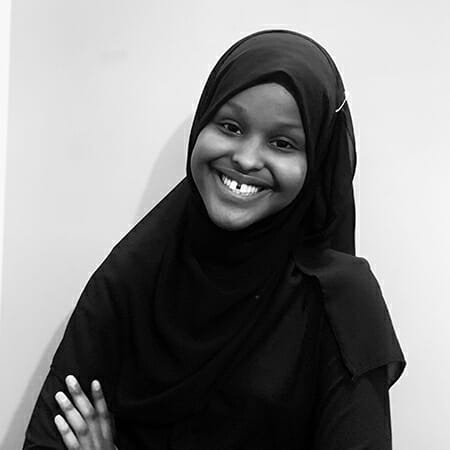
Kow iyo Labo co-founder Hayat Muse (pictured) has served over 600 students, parents and teachers as she works to achieve education equity in her community and involve youth in education reform./Courtesy Hayat Muse
Hayat’s passion for better education is rooted in her own background as an immigrant, and her story as the daughter of a Kenyan refugee. Born in Kenya, the African-American teenager arrived in the U.S. at the age of 4. Her single mother sought a better future for her children in America, a new home where they could get a better education and feel safe.
“My mother was a child bride, staying in Kenya would have meant an endless cycle of economic dependence for her and us. We couldn’t go back to Somalia because there was a war going on. Coming to the U.S. at 22 as a single mother of five children was hard, but keeping herself composed and strong for us has inspired me, and watching my mom give up so much for our opportunities has led me to believe I can’t sit around idly and waste what she poured into me.”
Kow iyo Labo offers individual tutoring to students, mentorships which provide emotional and academic support, and workshops for parents and teachers. Embracing youth inclusion in what has traditionally been adult-led education reform is a novel approach, says Emily, who is collaborating with Hayat to create a school environment between staff and students where all feel a sense of belonging, and every student has a set of tools to succeed.
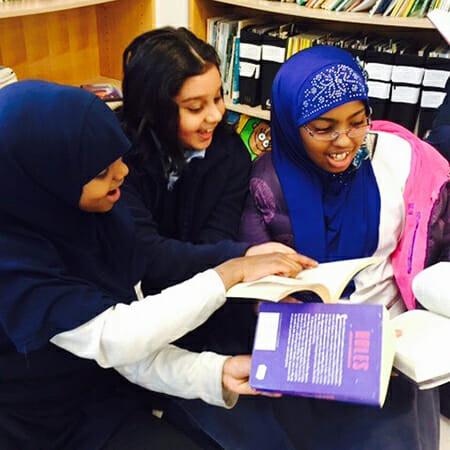
Hayat Muse is democratizing education and opportunities for students in her community through Kow iyo Labo’s tutoring program. Students here are pictured participating in one of Kow iyo Labo’s reading and writing programs./Courtesy Hayat Muse
“Historically…there’s a power dynamic where the teacher imparts and the student learns. (Hayat’s) setting up a structure and modeling it herself in her interactions with staff…where it’s a more mutual power dynamic. That’s important work because in order to create an educational experience that is more equitable for all students, we need more voices that are a part of the conversation in creating those experiences.”
By infusing the education reform movement with youth voices at the heart of the conversation, Hayat’s youth-run organization is disrupting education reform as well as providing opportunities, empowerment, and representation to children in her community who haven’t historically had access to these tools. According to Hayat, while she and her peers used to dread attending their district’s public school, where the environment challenged and discouraged them from success, she now envisions a changed future for students globally, where they are being handed the keys to their education.
“Education and advocacy gives these lower-income students educational attainment, but it also helps them to aspire and think beyond what has been shown to them their entire lives. Growing up in North Minneapolis, you don’t think you can be a doctor or lawyer. When we give kids these opportunities, it opens their eyes to what they used to think were crazy dreams, and instead makes them realize they can aspire to these goals.”
New York Woman Empowers Over 100 High School Girls Through Mentorship
Meet Daily Point of Light Award honoree Hetal Jani, who was a 2019 L’Oréal Paris Women of Worth Award. Each year L’Oréal Paris and Points of Light recognize and celebrate Women of Worth who make a beautiful difference in their communities. Ten honorees each receive a $10,000 grant to support their most cherished cause, and an online vote determines one honoree who will receive an additional $25,000 grant. Nominations for 2020 will open on April 20! If you know a woman who works to create lasting and significant change in her community, nominate her to be one of the 2020 Women of Worth.
For almost five years, Hetal Jani has been working tirelessly to support high school students most in need of support. Her nonprofit SPEAKHIRE works to provide a network of mentors to disconnected students, typically girls who are from immigrant families and marginalized communities. SPEAKHIRE, which stands for Support Prepare Empower Aspiring Kids, connects participating students to professionals around the world who provide them virtual mentorship and career advice.
As the Founder and Executive Director, Hetal has helped over 100 girls so far, all of whom are in high school. Because it is a virtual program, SPEAKHIRE has been able to reach students from New York, New Jersey and Pennsylvania, and is looking to start supporting students in Washington and Texas. The mentors themselves work in fields including law, education, STEM, health sciences, arts, entertainment and lifestyle. The goal is to provide the students with the skills and confidence they need to succeed not just in high school, but when they enter the workforce as well.
Describe what SPEAKHIRE does.
We connect the most disconnected students — so typically students from immigrant families and marginalized communities — to visible role models using technology. This allows them to have the access to not just the network, but also the information that they need, and then develop the skills they need to get ahead not just in high school but beyond high school. We think that is critical because we know this particular population of youth are expected to be the majority of the work force in just a few years, so we’re preparing them for the work force.
What inspired you to start this organization?
A number of different things that happened personally, but then also secondary through friends and others that I know. This one moment that had me reflect on all that was when I was working with a student in terms of academic support. I had been working with her for four years and she was an academically stellar student, brilliant by all means. Part of the work that I always try to do with students is make sure they’re independent, so she had accepted a long essay assignment on her own soon after entering middle school. She was only 12 at the time. She got a not terrible score. It was around an 80 something. After four years, I had never met her father, but he came and he relayed his disappointment. He was disappointed to a level where he ended up threatening her at the age of 12 with being sent to their home country to get married, which I thought was incredibly drastic. It was just a harsh response to something that was a good score. It was one of the top scores in the class, but she was devastated. She relayed to me that no matter what she did, because she was a girl, it felt like she was never good enough, and she had to be perfect in order for her to be good enough. Her mother came the next day. I am of East Indian descent, so she told me because of our cultural similarities, I should be able to understand where she’s coming from and that in her household, she can’t speak up for her daughter. That’s where I started thinking about it — are women in America from marginalized communities and marginalized cultures still facing a lot of the same barriers that they’re facing in their countries of origin, simply as a result of them being women?
Can you describe what the different programs SPEAK offers?
One of our main programs is called our Foundational Year. Through that, we take the girls — and then we also now incorporate boys — to mentor under three different professionals. It is virtual mentoring. The intention there is that three different professionals are matched in careers of interest for the students so they can get the exposure. It’s called Foundational Year because they also start learning some of the foundational skills so they can really set themselves up for success in that future career. Also, with at least one of the mentors, we try to match them on culture, so they can have the conversation around culture and how to address any barriers that are culturally-imposed, specific also to gender. We also have a peer-leadership component, where some of the students in a particular high school will go through our leadership curriculum. They will then guide the other students in our program at that school to utilize the skills that their mentors have taught them over the year to carry out a community project. One of the programs at one of our schools led by the peer leaders was to do a food and clothing drive for a local nonprofit that serves the homeless. [Due to COVID-19] we pivoted that to doing more of a virtual response to the importance of donating, especially at this time, to the hungry.
We have a Speaker Series. The intention of the Speaker Series is to highlight a lot of the hard work that often goes unnoticed by a lot of the people that have been in our Speaker Series … It’s a numbers of authentic stories shared by individuals who have struggled so much. Their work in the workplace often goes unnoticed. The reason we highlight that is because where would they be if we acknowledged them a little bit more? We oftentimes spotlight individuals after they’ve done a lot of the hard work, and we forget the amount of work it took to get to that point. We end up spotlighting people who have been able to more easily get their name out there because they have the right connections and the right network. Then there are a lot of people who we forget that without them, a lot of this work wouldn’t get done. That’s the intention of our Speaker Series, to highlight some of these people who do this critical work without really getting that peer recognition.
Are there any future partnerships, programs, or events that you are excited about?
With COVD-19, we’re hoping things pan out, but we are supposed to be working with IDEA schools in Texas. [We would be] really helping a critical population of girls who, at the border, are not getting the support necessary from their families and their communities. Because the communities themselves are so marginalized and unfortunately under attack in different ways, it’s harder to get them the resources they need to make sure high school is a meaningful place for them. We’re looking forward to really formalizing that partnership and serving that community. Additionally — again, hopefully things can move forward despite what’s going on nationally — we’re supposed to also serve a school in Tacoma, Washington. They’re a gateway to a lot of new immigrants as well because of the proximity to Seattle, so we are looking forward to that partnership moving forward.
On a broader scale, where do you want to see SPEAKHIRE go in the future?
Especially with the response to COVID-19, we see how technology needs to be integrated, especially in schools. Physical schools are a must. I’m an educator through and through. We need to have spaces where our children can learn, but I think what we see now is that learning has to be ongoing. We have to make sure our teachers are equipped and our schools are equipped with additional support, so that our students are supported even outside physical places like schools. Our program can do that. We are supporting some of the most disconnected students. We’re connecting them to physical role models right now because they don’t have the social support at home. We know they don’t necessarily have English-speaking homes, or they don’t have anyone in their home who can really help them connect to technology otherwise. Because of our program, they already have the technical skills to continue working with their mentors. We’ve been completely resilient to COVID-19. All of our current students have connected to our mentors and our mentors have been thinking of a way to give back. This is something meaningful for them to do as well in response to COVID-19. We know this is a proven concept that can and should be in a lot of schools around the nation where students need the additional visible role models to really help them navigate the schools and their career path.
What’s been the most rewarding part of your work?
Every time I get a mentor application that tells me ‘I needed this when I was younger.’ I think the reason I didn’t start SPEAKHIRE earlier, and I didn’t even reflect until that situation happened with that student, is because sometimes you feel alone in that confusion, especially when you’re navigating multiple cultures. I am someone who was born and raised here in America, but I’m born and raised to Indian immigrants, so I was raised in a home that was culturally Indian. But then you step outside your home and you’re navigating a space where you’re supposed to be American, so your identity is clashing at all times. When we do get a mentor application where a mentor really understands the limitations not only faced by a woman, but also faced by a woman of color, a woman of a marginalized culture, or a culture that’s underrepresented — it’s good to know you’re not alone and you’re doing work that’s really meaningful for more than youth. It’s also meaningful for multiple generations. Our goal has always been to make sure we’re empowering girls and women both, and that we are preparing the next generation but at the same time we’re supporting the current generation. When I see the mentors and mentees connecting, I can sense the development of both and it’s a beautiful relationship to watch.
As the Founder and Executive Director, Hetal has helped over 100 girls so far, all of whom are in high school./Courtesy Nilaya Sabnis for L’Oreal Paris USA
What do you want people to learn from your story?
In doing this work, there’s oftentimes still a lot of assumptions made about what someone should be able to do when given an opportunity, because we think those opportunities are received in the same way. We forget to ask the backstories or the level of understanding or really how they can manage the opportunity. What I mean by that is, we do have a lot of girls who academically can perform. As I mentioned, the student I started SPEAKHIRE for, she was academically a stellar student. She got straight A’s except for this one grade. We just consider that one aspect and think well, she had the education, so she should be able to achieve anything. We miss big parts of their lives where we really could be stepping in and supporting them so they can meet their full potential. We hear often that we’re serving a population of students who are not necessarily vulnerable, but we know from our mentors that these women might be further along in their careers if they got the critical support at an earlier point in time. Just because someone is hardworking, and just because someone is maybe quiet or doing what they’re told to do or obedient, doesn’t mean they don’t need support. If you do support them in the smallest ways, that could have a huge return investment. I would really love for people to know that the work we’re putting in often gets dismissed because the population outwardly doesn’t seem as vulnerable. That’s unfortunate because I think [those people] could make a little bit of time and the investment could go so far.
Why do you think it’s important for others to give back?
If I’m not satisfied in life that I’m actually doing something meaningful with my time — I don’t know how to live any other way. Whatever you have, if you can use that to help somebody else, then it brings a sense of fulfillment. I haven’t felt that kind of fulfillment through anything else. I feel that other people should give for the same reasons, that it brings yourself so much joy and fulfillment. A lot of this work is hard work. There are times where I’m reminded it’s work, but there are oftentimes where it just feels like I’m living life because you know the impact it’s having. I would rather be doing this because it brings me so much joy that it actually oftentimes doesn’t feel like work, even though it’s challenging.
Meet Daily Point of Light Award honoree Natalia Zamora. Read her story and nominate an outstanding volunteer or family as a Daily Point of Light.
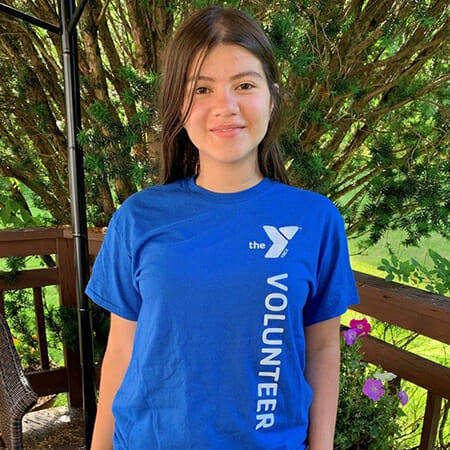
While many teens across the country spend their Saturday mornings sleeping in or hanging out with friends, 17-year-old Natalia Zamora has spent hers volunteering at her local YMCA in Hunterdon County, NJ. Since she was in the seventh grade, Natalia has participated in her YMCA’s weekly Produce Distribution Program, bringing fresh food to families in need within her community. As she has gotten older, Natalia has also taken on the added responsibility of collecting the food from local businesses and helping to supervise the distribution as needed.
Natalia says on average, she collects 10-15 industrial boxes of produce from the local ShopRite and food pantries, and about four bags of bread from Panera Bread, with about 20 families stopping by the Saturday distribution. Many of the families speak Spanish, so being bilingual allows Natalia to interact with many of them, which she said is very rewarding. Also rewarding to her is that she was able to share this experience with her sister, who volunteered with her every Saturday prior to moving away for college.
Describe your volunteer role with the Hunterdon County YMCA.
Every Saturday I go to … [the Hunterdon County YMCA’s] program where stores in the area of Flemington [New Jersey] donate food. Panera donates bread and ShopRite donates different produce and things like that to the Y. Then we collect it from the community and we bring it to this church, and then we organize it and distribute it.
I first got involved I believe in 2016. I was in seventh grade. As I got older, I got more responsibility. Now I drive around and I collect the food, not just distribute it. Sometimes when our supervisor Gabriela can’t be there, I take over with my sister.
Natalia Zamora has spent the past four years volunteering every Saturday at her local YMCA’s Produce Distribution Program./Courtesy Natalia Zamora
Why did you want to volunteer in this way?
I really love doing it. A lot of people in the community who are in need are actually Spanish speakers and I also can speak Spanish, so there was definitely a need for more volunteers to be able to speak Spanish and English. I felt proud that I was able to do that for my community. On top of that, I just love volunteering. I’ve volunteered in the past with my church and I’m a Girl Scout, so I just kind of fell into it. It was really fun.
Why is it important for your community to have this food distribution?
It’s really important because I think that a lot of the time produce and things like that can be very expensive around the area — so having that extra safety net to know if you can’t really afford to buy completely fresh produce every week, our community is going to be able to support us in our time of need.
What is it like to be able to have face-to-face interaction with the people you are helping?
It’s really nice. A lot of the people who go there speak Spanish so it’s nice to not only have an opportunity to work on my Spanish, but also there are a lot of kids there. The way our program is separated is at the beginning you give out the bread, and then towards the end you give out the produce. When I’m in charge of giving out the bread, a lot of kids come up to me and know me, and they ask for cookies and things like that and I give it to them. That’s really rewarding.
What has been like to be able to share this experience with your sister?
It’s been really valuable. Before she went to college, every single time she went, we went together. When our supervisor couldn’t be there for whatever reason, it was really nice to have that second person to rely on when we were running things because a lot of the time you’re dealing with 20 families, plus kids, plus all volunteers. Being the only Spanish speakers there, that’s why we’re in charge. It can be really overwhelming, so having that second person was really valuable and the fact that it was my sister was also really nice. We always drove there together and we could share that experience as a family.
What’s been the most rewarding part of your work?
The most rewarding part I would have to say is being able to make a difference in my community. Having it be such a small community-based thing in my town, it really feels nice to know I’m working at a local level to make sure the people in my community are being taken care of. It’s nice since I’ve been part of this organization for so long, I have grown up with that idea of service every Saturday. It’s been really rewarding to be able to integrate giving back into my routine. I feel like I’m going to be able to bring it with me as I grow up.
What have you learned through your experiences as a volunteer?
I learned a lot of patience. A lot of the time when you’re going there, there are different types of people that are going to want to get bread before another person or get the produce before everyone else. It’s a really learned kind of skill to figure out how to diffuse a situation and also have patience. That’s also a really rewarding thing I learned from the program — being able to deal with difficult situations and different confrontations and be able to diffuse the situation.
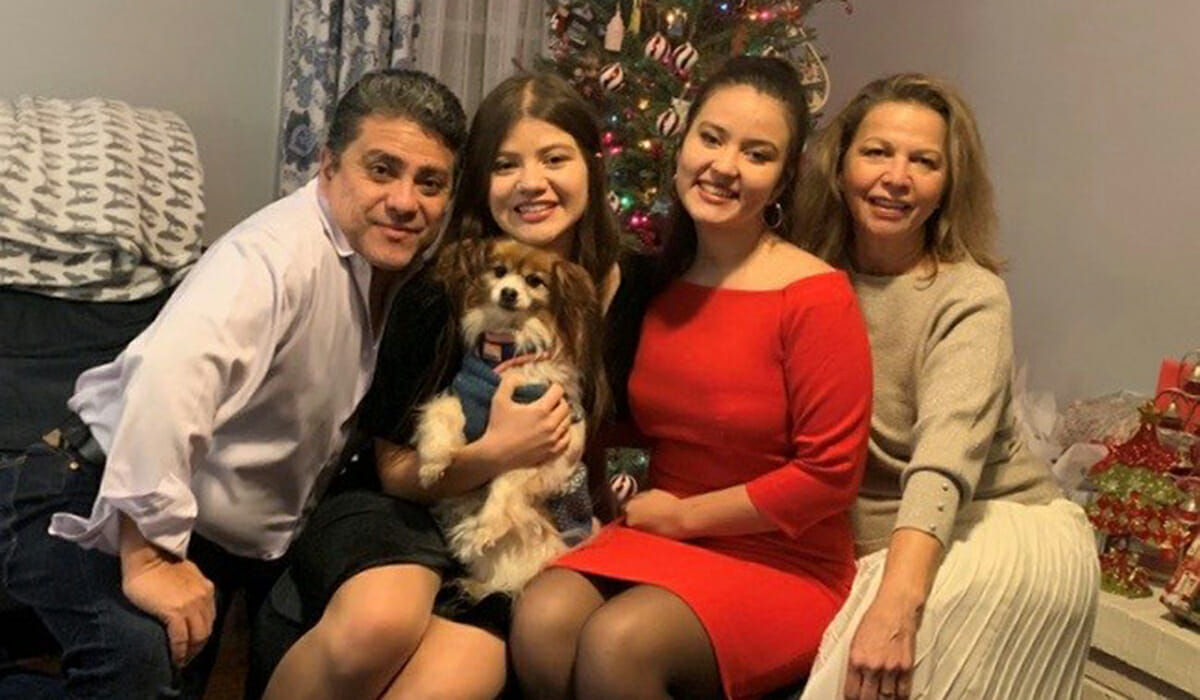
Natalia Zamora, second from left, poses with her parents as well as her sister, who volunteered with her at their local YMCA every Saturday before moving away for college./Courtesy Natalia Zamora
Why do you think it’s important for others to give back?
I think it’s really important to give back to the community because you never really know where your life is going to take you. I personally know if I was in a situation where I did need a little extra help, or even if anyone was in that situation, that they would hope there would be people to step up and give them a hand. You never really know what’s going to happen, so knowing that there are groups out there like the Y, like the United Way, that are ready to give you a hand when you need it, I feel like it’s a really important part of our community that should be valued.
What do you want people to learn from your story?
Honestly I just think that if anyone were to take away anything, it would be that it really doesn’t take much to be active in your community and really give back. All you’re doing is taking a few hours out of your day. It’s really rewarding. You make friends. It’s always great when you see people out in public and they say ‘hi’ to you from your volunteering. It’s a different kind of fulfillment to volunteer other than working a job and doing things like that. Volunteering doesn’t have to be anything super big and you can still make a big difference.
Packing 10k+ “Weekend Bags” for Hungry Students, Teen Volunteer Feeds her Community
Meet Daily Point of Light Award honoree Isobel Castello. Read her story and nominate an outstanding volunteer or family as a Daily Point of Light.
If the average person packed a bagged lunch each weekday for a year, they’d pack 260 bags in total. In contrast, 18-year-old Isobel Costello has packed almost 40 times that amount, totaling more than 10,000 bags of meals, as she works to end juvenile food insufficiency in her community.
As the founder of The Weekend Bag Program Inc., Isobel, a high school senior from Green Township, New Jersey, packs bags filled with lunches, snacks and hygiene essentials to last students through the weekend. Realizing that her peers didn’t have enough food or basics at home, the bags help to fill the gap while students aren’t receiving free or reduced lunches at school. Providing bags to elementary, middle and high school students across six schools in Sussex County, New Jersey, Isobel is helping to feed students in her community and is relieving stress for struggling families.
What inspires you to volunteer?
During freshman year of high school I’d hear chatter amongst kids that a lot of students were going home for the weekend with little to no food to eat, and not enough essential hygiene items. Some didn’t want to come to school because they didn’t feel comfortable, or didn’t feel clean. Others were excited to come to school because they knew they were guaranteed a meal. When I realized that even a couple of my friends were affected, I knew I had to do something to help. I am inspired to volunteer because this is an opportunity to both help these students and their families, and bring the community together as I raise awareness about food insufficiency.
Describe your role with The Weekend Bag Program Inc.
As founder and president of The Weekend Bag Program Inc., I spend about 20 hours each week monitoring communications, scheduling and hosting meetings, and packing and delivering the weekend bags. I pack 65 bags each week, and occasionally have community members and other students shop with me for supplies. I am also constantly fundraising and soliciting donations, as we rely on donations for our supplies.
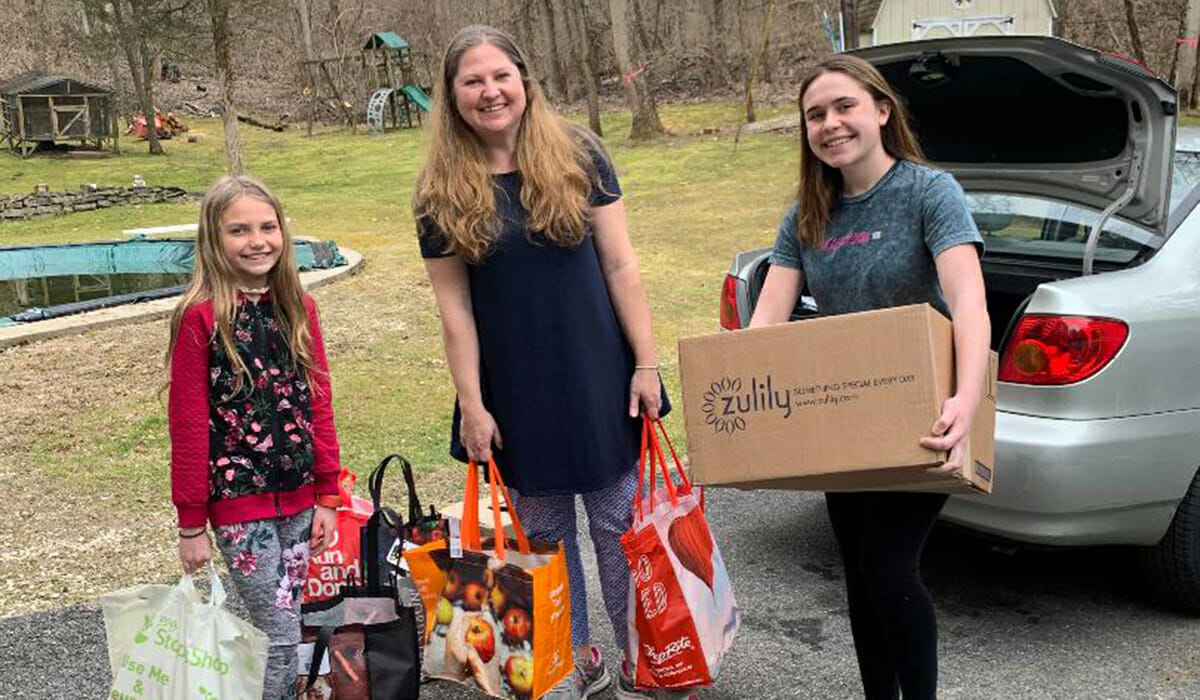
Isobel Costello works with community members and other organizations to fundraise and collect donations for the weekend bags she fills with lunches, snacks and hygiene essentials for students in need./Courtesy Isobel Costello
What gets packed in a weekend bag?
Each weekend bag includes six meals, which equals out to two breakfast meals, two lunches and two dinners to cover a student’s meals on Saturday and Sunday. The bags include snacks like granola bars, and popcorn, drinks like water and juice boxes, and meal items including ramen noodles, canned soup, pasta and pasta sauce, mac and cheese. We also pack hygiene products like toilet paper, tissues, shampoo, conditioner, toothpaste, deodorant and body wash. I’ll pack the bags and then deliver them to liaisons we work with at each school who then in turn distribute the bags to our anonymous recipients.
Share one personal story with me from your volunteerism.
Once, I was in a local grocery store shopping for my program when a female shopper came up to me, and without saying a word, hugged me. I had no clue who she was. She had a very close friend who was receiving our weekend bags. She explained how the assistance had impacted the entire family, because the extra food and items meant that the student’s mother could focus on bettering her situation instead of worrying about how to provide as much for her children. She started crying, which made me cry! (laughs).
In one word, what does volunteering mean to you?
Community.
What’s one way you hope to inspire others in your service?
I want to show people that no matter what they want to do, as long as they push for their idea and they’re patient, they can get it done.
What’s been the most rewarding part of your service?
When Friday comes along, I get a few minutes to sit and re-evaluate and I think about those bags that went out and those families that now have items that they wouldn’t necessarily have without us. That is a good feeling, knowing that we are helping people.
Isobel Costello (right) pictured alongside a young community member who collected donations for The Weekend Bag Program Inc. in lieu of receiving presents for her 10th birthday./Courtesy Isobel Costello
What’s your perspective on food now that you’ve witnessed food insufficiency in your community?
I’m always grateful for whatever is put in front of me from my family. I’ve learned that nothing comes without having to work for it. When i sit down and use toilet paper, it is a constant reminder for me that because of this program, others have toilet paper as well. It’s a constant reminder that you should always be grateful for what you have.
What have you learned through your experiences as a volunteer?
I’ve learned that you face a lot of “no’s” before you get a yes when it comes to volunteerism. That’s where my patience comes in. That “no” just means they’re not necessarily ready just yet.
How can readers help?
We are continuing to pack bags for students through the coronavirus pandemic, but we are in need of specific supplies. Please visit our Facebook page for more information about how you can help and visit our PayPal to donate to the cause.
Teen Serves Community’s Youth Through Multiple Volunteer Organizations
Meet Daily Point of Light Award honoree Kyle Sugita. Read his story and nominate an outstanding volunteer or family as a Daily Point of Light.
At just eighteen-years-old, Kyle Sugita is doing more than his part to positively impact the young people in his community by volunteering for not one, but two different youth-based organizations in his Irvine, Calif. hometown.
Kyle serves as a Junior Counselor for a summer camp provided by Kizuna, a cultural youth group that offers education and empowerment programs for Japanese Americans. Each summer for the past four years, he has led elementary- and middle school-aged kids through lessons and activities designed to teach them about their heritage.
In addition, he has spent the past year volunteering for the International Youth Neuroscience Association [IYNA], a youth-led nonprofit that offers education and networking to students interested in neuroscience. Kyle, who wants to work in clinical neurology himself, is the President for his high school’s local chapter, and also works as a Junior Editor for the IYNA Journal. He has helped plan a walkathon benefiting the Michael J. Fox Foundation with IYNA’s Fundraising Department, and jumped in to become the stand-in Co-director of the department as the previous Co-director is currently unable to do so. While the walkathon has been cancelled due to the coronavirus pandemic, IYNA has postponed the fundraiser and Kyle will continue planning it, along with continuing his many other volunteer roles in the community.
Describe your volunteer role with Kizuna.
It’s a cultural youth group. It’s mainly for Japanese-American youth. I work with kids aged eight to 13 over the summer. I proctor lessons and classes and activities and teach them about the Japanese-American heritage, which is about internment under Executive Order 9066 back in World War II, it’s about Pearl Harbor, and things that we, as a declining population, are losing sight of. Because we have groups like Kuzina, the next generation gets to remember our traditions and our values.
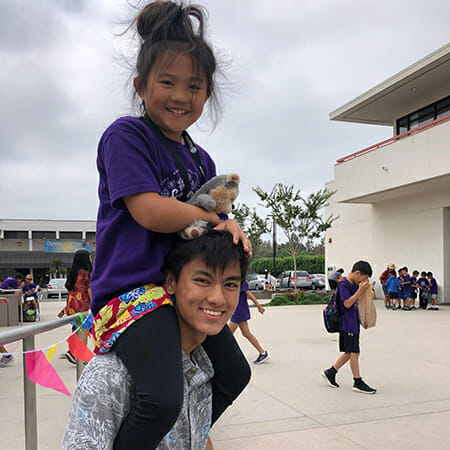
Kyle Sugita poses with one of the campers at Kizuna’s summer program dedicated to honoring Japanese-American traditions and values./Courtesy Kyle Sugita
Why did you want to volunteer in this way?
Mainly because in Irvine where I was raised, there’s not a lot of Japanese Americans. There’s not a lot of Japanese period. I was kind of disconnected from my cultural roots. I attended Japanese language school and through that I was introduced to some people who are directors at Kuzina. I reached out to them and asked if I could be a Junior Counselor and they invited me to participate as an actual counselor over the summer, and I just stuck with it over four years.
What is an average day at Kizuna like?
Every program is a week long at different locations throughout southern California. It’s nine hours for the students and it’s a good ten hours for counselors because they have to clean up and set up. The kids arrive around 8:30 [a.m.] and we introduce them to what the lesson is going to be for that day. We try to make it more fun and interactive for them as we go, so Thursday for example might be Undokai Day, which is Japanese sports festival. Every single activity that we go over in the nine hours is some deviation of sports in Japan, and they’re all connected back to that. It’s a theme that is connected to a bunch of different activities that we stretch over the day so the kids really remember that Monday was this, Tuesday was this. We have one day, usually a Wednesday, where we take the kids on a field trip to Little Tokyo for the day. It’s in Los Angeles. It’s kind of like Chinatown but it’s Japan-based obviously. We take them around to different cultural locations, museums, memorials. One of the famous ones we like to take them to is Go For Broke, which is about the [Japanese-American soldiers] in World War II.
Why is it important for Japanese American youth to be involved in something like this and have knowledge of their cultural roots?
If you look at the statistics, the number of “Japantowns” are declining in number. They’re physically disappearing because of gentrification. Throughout California and throughout the United States, the population of Japanese Americans is physically declining. Access for the few of us left to cultural landmarks, cultural points to actually reconnect and understand where we came from — they’re gone. … For all of the kids that still identify with that Japanese last name or that Japanese heritage, we don’t want them to not know where they came from and not have that community. For me personally, I didn’t know where that community was because of the city I was raised in. It was really nice for me to find a group of people that still care about our heritage. For a lot of younger kids, below the age of 13 even, it matters to them because they’re alone. They don’t have a large friend group that identifies in this way. Through Kizuna, they can be confident that there’s still people out there like them.
Describe your volunteer role with the International Youth Neuroscience Association.
I am a Junior Editor and right now I’m a stand-in Co-director of the Fundraising Department. As a Junior Editor, it’s on the editing committee for the IYNA Journal, which is a neuroscience-specific edited journal where any student in high school or undergraduate level can submit research. It doesn’t have to be conducted in a lab, but if they conduct it via external resources, like NCBI [National Center for Biotechnology Information], they’re allowed to write their own research papers and submit it. Then we, as Junior Editors, revise over a couple rounds and then it gets published after maybe three rounds. In the Fundraising Department, right now we were just planning a fundraiser, a walkathon in Manhattan Beach, but it got cancelled because of the coronavirus [pandemic]. It was supposed to take place on April 18. That was for the Michael J. Fox Foundation. That’s for Parkinson’s disease research. That was our biggest project and it was going really well, but unfortunately because of the restriction on people, we had to cancel that. Then I’m a Chapter President on a local level at the IYNA club at my high school. They were also really involved in planning the walkathon.
Can you describe what IYNA does?
There’s a couple branches. There’s a department called the MYELIN …The department is developing neuroscience as a high school class because right now there is no neuroscience elective in the high school curriculum. The MYELIN department is trying to develop a neuroscience class so that public schools and private schools across the nation and internationally can teach neuroscience to high school students, because it’s not really offered like other ROP [Regional Occupational Program] classes. It’s trying to introduce neuroscience at the high school level.
There’s fundraising, there’s the journal department, there’s the chapter networks — the local chapter networks systems, LCN, and the national chapter network systems, which is NCN, which basically is the most accessible to anybody who wants to join the IYNA. If you are in high school or college you can join your university’s branch of the local chapter network which is a part of the national chapter network. At my club, when I have new members who want to join, that’s what always talk to them about because they can sign up to become a member and they will immediately be a part of the LCN and then they have access to resources on the national level. They can talk to people at other branches and other locations. The main benefit is you can meet other people who have similar interests in the brain. … Neuroscience has a lot of branches. There’s computational neuroscience, there’s neuroengineering, there’s neurosurgery. You can meet all those people once you have access to people at other locations. It’s not just your high school or just your college. That’s one of the biggest networking things that I think the IYNA provides, especially for younger students. Neuroscience is a new field so there’s not a lot of youth groups for it, and IYNA provides the foundation for people to meet other people with similar interests.
Why is it important for neuroscience networks and classes to be available to students as young as high school?
It’s mainly because if you want to go into business for example, you do have an opportunity to take business classes at the local community college. If you want to major in statistics, you have an AP Statistics class at school. If you want to be a biology major, the same thing goes — you have many avenues to explore that in high school. When you’re choosing a major when you’re applying to college, there’s a lot of majors that people just don’t choose because they don’t know what it is. … I want to go into clinical neurology, which is a lot of prescription drugs for neurological conditions, but I have a friend who is in the chapter at my school and she wants to go into computational neuroscience which is completely different. You would go into computer science and some other degree of cognitive science with that. So the opportunity to explore it at an early age helps people tailor and know better, when they apply to college or graduate school, what they’re trying to do with that education or with that pursuit.
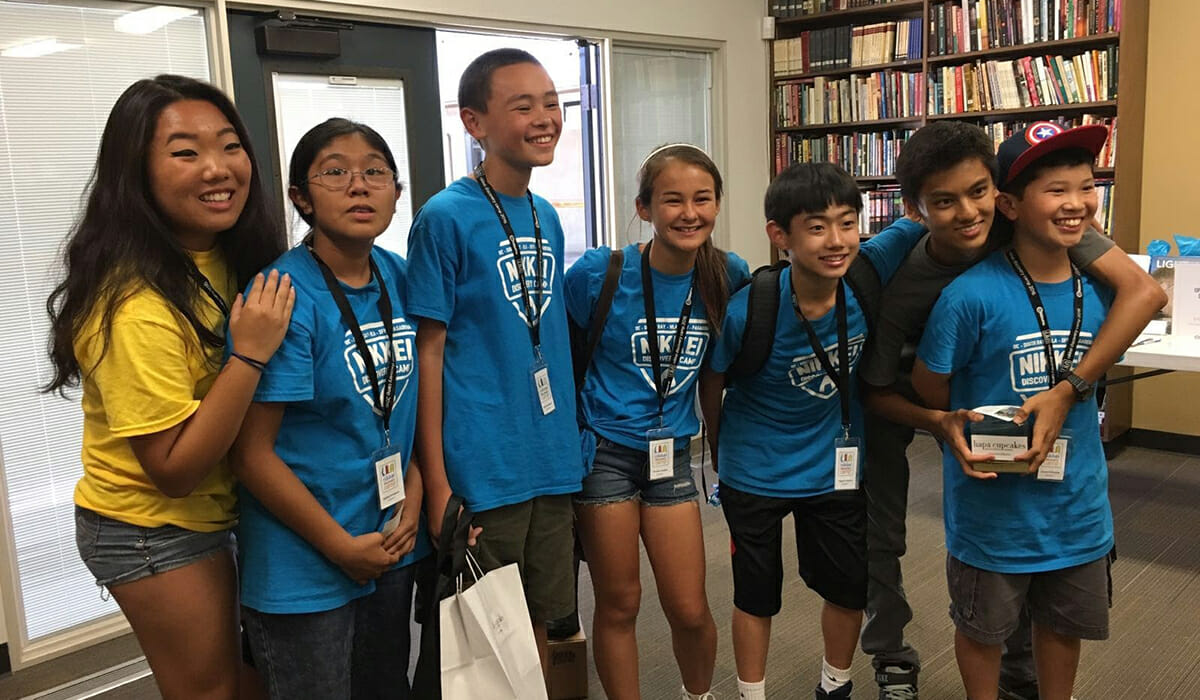
Kyle Sugita, second from right, has volunteered as a counselor at Kizuna’s summer camp for the past four years./Courtesy Kyle Sugita
What’s been the most rewarding part of your work?
I’m going to say Kizuna. It’s not rewarding in the sense that I see a whole lot of change in the kids, it’s rewarding that I see these kids come back every year. Their parents have to drive them out to the location, but the thing is, the kids want to come back and see the counselors and see their friends and other campers. Even though they’re too young to express that it meant something to them, I know they probably have trouble finding these people who identify in the same way in their elementary schools, for example. You just know as a counselor you had that impact because they keep coming back year after year and their parents aren’t forcing them. They run to you when they arrive at 8:30 in the morning. They want to be there. Even though they’ve seen this lesson for the past two years, they’ve seen these exact same schedules, they’ve been to Little Tokyo three times already, they still come back and that means a lot to me.
Why do you think it’s important for others to give back?
As an intern at UCI [University of California]’s Department of Neurology, I was also an intern at the Department of Neurosurgery. One of the neurosurgeons I talked to, who actually inspired me to join IYNA, he said ‘I’m not practicing neurosurgery because I love neurosurgery, I don’t even love the brain.’ He said, ‘I need to give back to the world that has given me so much.’ At the time he told me that, I didn’t really understand. I couldn’t process, I wasn’t old enough. But what that meant was, the world has given us our memories, our positive experiences, even our negative experiences with other people, and all of these things that we have gone through that have made us our individual selves. The world gave that to us, and it would be so selfish if we didn’t give back, regardless of who benefited from us giving back. The world didn’t care that you specifically, now you have this memory, now you know this about yourself. The world just gave it to you. You should give back to the world knowing that regardless of the name of that kid, or the name of that person you were just kind to or you just gave something to, it’s going to change them in some way, just like the world gave you something regardless of how it changed you.
Over Decades of Hospital Service, Senior Logs 10k+ Volunteer Hours
Meet Daily Point of Light Award honoree Judie Byers. Read her story and nominate an outstanding volunteer or family as a Daily Point of Light.
Watching her father undergo physical therapy following a debilitating stroke, Judie Byers says she discovered the power of medical interventions like physical therapy, and decided she wanted to be a part of healing others in her own community.
Serving as a volunteer for St. Vincent Anderson Regional Hospital as a member of the Victoria Guild Board for more than four decades, the 82-year-old Anderson, Indiana resident has logged more than 10,300 hours of service helping out in the hospital gift shop, transporting patients and more. Connecting with thousands of people at St. Vincent, Judie is brightening the days of inpatients, their family and friends.
Describe your role with St. Vincent Anderson Regional Hospital.
As a member of the Victoria Guild Board, I am a volunteer at St. Vincent Anderson Regional Hospital. I’ve done everything from transporting patients, working at the hospital gift shop to helping to organize projects at the hospital. I have also served several times as president of the Victoria Guild Board, whose mission is to support the hospital and the welfare of its patients through fundraising.
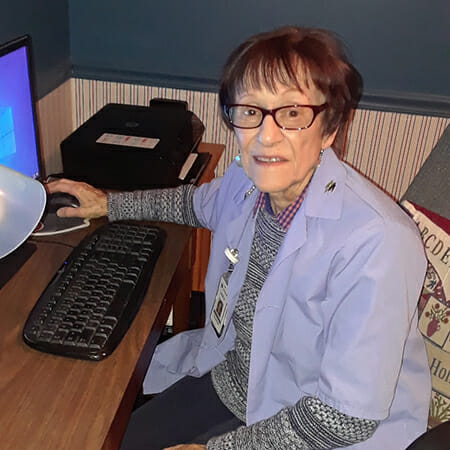
As a member of the Victoria Guild Board at St. Vincent Anderson Regional Hospital, Judie Byers has logged more than 10,300 hours of service as a volunteer./Courtesy Judie Byers
What inspires you to volunteer?
As a child, my teachers taught me that you step up and help people when they are in need of help. Our fundraising efforts help to support the hospital in the form of gifts, and when we put our support into resources and items like equipment needed at the hospital, I can see that we are helping others. I am continually inspired by the Victoria Guild Board’s mission to support the welfare of the hospital.
Share one personal story with me from your volunteerism.
If someone comes to the hospital gift shop and asks how to reach a patient on a certain floor, I will personally guide them to the patient, because that’s what the person needs. We have people coming in who have family members in the intensive care unit, for example, and we’ll take the time to listen and console them. We act as ambassadors for the hospital and help people in their time of need.
You are a role model for younger volunteers. Why is that important?
When other volunteers tell me I’m amazing, I always say, ‘You and all the others here in the organization are just as amazing!’ It’s important to get younger people volunteering because we need to encourage our next generation to give back to our community. Service at the hospital can also open the door for these individuals to seek a career in some other field like medicine. We’ll get them at the hospital either way (laughs).
What’s one way you hope to inspire others in your service?
Your volunteerism doesn’t have to be a huge act to help people. You can serve in your own little way, by being kind and stepping up when you see something that needs to be addressed.
In one word, what does volunteering mean to you?
Helping people. That’s two words (laughs).
What’s been the most rewarding part of your service?
Getting to know the Victoria Guild Board members. We have 40 board members, myself included. It’s rewarding to know that we are all looking in the same direction, dedicated and united in the purpose of serving others.
What have you learned through your experiences as a volunteer?
Sometimes people get bogged down with being tired, or losing sight of our volunteer mission while working in a particular job. I have learned that I can step up and remind people of our purpose and why we are there serving.
Volunteer Inspires Confidence in Students Struggling With Math Through Tutoring Program
Meet Daily Point of Light Award honoree Prarthana Prashanth. Read her story and nominate an outstanding volunteer or family as a Daily Point of Light.
Eight years ago, Urvi Gupta developed the California OneInMath program. When she was in eighth grade, Prarthana Prashanth implemented the program in the Chicagoland area. While Prarthana’s Chicago chapter began with only five students, OneInMath has expanded to six libraries and will be impacting around 200 kids this next session with around 40 high school volunteers.
At OneInMath, K-3rd grade students are taught in groups of five among students of different grades and abilities reducing peer pressure. Also, students are taught by the same tutor weekly for 10-12 weeks in fall and in spring, ensuring continuity. As the Chicago lead for OneInMath, Prarthana helps struggling students, trains tutors, and communicates with parents. She loves watching as students’ fears towards math transform into love. She hopes to continue growing the program and encourages students to get involved in serving the community. Her story inspires others that, regardless of age, with dedication, hard work, and passion, anything can be accomplished.
Seeing both the students and high school volunteers grow throughout the session inspires Prarthana to continue volunteering. She loves seeing students that come into the first class uninterested, scared, or struggling with math slowly gain confidence and start to enjoy math. She also enjoys seeing volunteers grow in their communication and leadership skills through being a role model for students and through discussing with parents.
As the Chicago lead for OneInMath, Prarthana prepares flyers to advertise the program, trains all the new high school volunteers and appoints two session leads and one adult session manager per library before the session begins says Prarthana. Weekly, she rotates between libraries to check in on the volunteers. The volunteers work specifically with struggling students and occasionally substitute when volunteers are not available. Throughout the session, Prarthana handles communications with the parents, volunteers, and librarians. She meets with community stakeholders to expand her program.
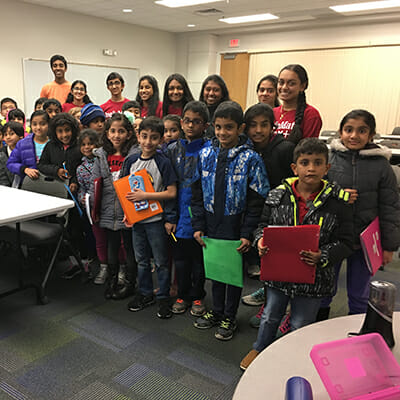
Photo of the Eola library students and volunteers, taken at the end of the Spring 2018 session. Photo Credit: OneInMath
“The most rewarding part of my work has been seeing the numerous people in the community that has been impacted by the OneInMath program,” says Prarthana. “After each session, we send out a survey to all the parents asking for their opinions and feedback on the program. It is so gratifying to see that more than 99% of the parents recommend the program, and it is amazing to read parents’ testimonials regarding their child’s growth inside and outside of school due to the program.”
Beyond the impact OneInMath has on students and parents, Prarthana says it is rewarding to view OneInMath’s impact on the development of local high school students and the growth of libraries’ footprints as well.
Through her volunteering experiences, Prarthana has learned how to work with people of various ages and backgrounds, including young children, high school peers, parents, and librarians. Through teaching different types of children, she has learned how to communicate the same concept in a variety of methods.
“I have learned to be flexible and to utilize negotiation techniques in dealing with parents,” says Prarthana. “Additionally, through volunteering, I have realized the importance of planning and organization, whether it be in monitoring each student’s progress or in overseeing the program in each library.”
Prarthana is currently attempting to create a sustainable OneInMath expansion plan for libraries outside of the Chicago Western Suburbs to implement the program. After trying out this plan in a few libraries, she hopes to scale the idea, implementing OneInMath across the nation.
“Giving back increases a person’s sense of awareness regarding the community surrounding them. It exposes the person to a variety of backgrounds and perspectives that are usually hidden or overlooked,” explains Prarthana. “Furthermore, seeing what others lack increases the person’s gratitude for all they have. Most importantly, giving back allows society to balance and spread out opportunity. “
Through her story, Prarthana wants people to learn that with hard work and persistence, achieving any noble cause is possible. OneInMath helped her grow as an individual and a leader, in a way that no other activity has shaped her. Prarthana believes giving back is one of the best ways to discover yourself as a person, while also making a lasting impact on society.
Prarthana encourages everyone to be active participates in their community. “If there is a problem in your community that you hope to solve, do not hesitate and go for it!”
Community-Oriented Teen Empowers the Underserved through STEM and Education
Meet Daily Point of Light Award honoree Dipen Mehta. Read his story and nominate an outstanding volunteer or family as a Daily Point of Light.
People around the world have limited exposure to science, technology, engineering and mathematics, but Dipen Mehta is determined to connect as many individuals and schools to STEM-related opportunities. The 17-year-old gives people of all ages, backgrounds and geographic locations the chance to a brighter future through innovative educational programs aimed at targeting underserved communities reach their full potential with technology.
After living in India as a child, Dipen realized that there are opportunity gaps between communities and certain demographics. As a sophomore in high school, he decided to create Coding for Community, an organization that uses the power of technology and education to empower underprivileged and disadvantaged communities across the globe. From helping students find career paths in STEM to assisting grandparents with sending emojis, Dipen is relentless in helping others solve issues through science and technology.
What first inspired you to begin volunteering?
I was inspired by many different things, which all eventually culminated. My experiences moving to India and living in relatively rural areas exposed me to the importance of community service and education in empowering populations. Throughout my life, I made many friends who were refugees. Through learning of their apprehensions about succeeding in a foreign land, I developed a sense of the incomparable emotional, physical and social tolls that immigrants and refugees endure. This was one of the first experiences that strongly influenced me to begin volunteering and helping those around me who do not have a level ground to succeed.
How did you become passionate about using coding and technology to improve communities?
When I moved back to the United States and went to Sope Creek Elementary, a school with an emphasis on STEM, I increasingly realized the importance of STEM in a world where technology is involving itself in every career and every aspect of life. As I pursued my interest in science and technology in high school through courses and clubs, I realized that not all schools in my county were like Sope Creek, and not all populations got such an exposure to STEM. That’s how, as a sophomore, I was inspired to create Coding for Community, and volunteer to provide equal exposure and opportunities in STEM to disadvantaged communities across the world.
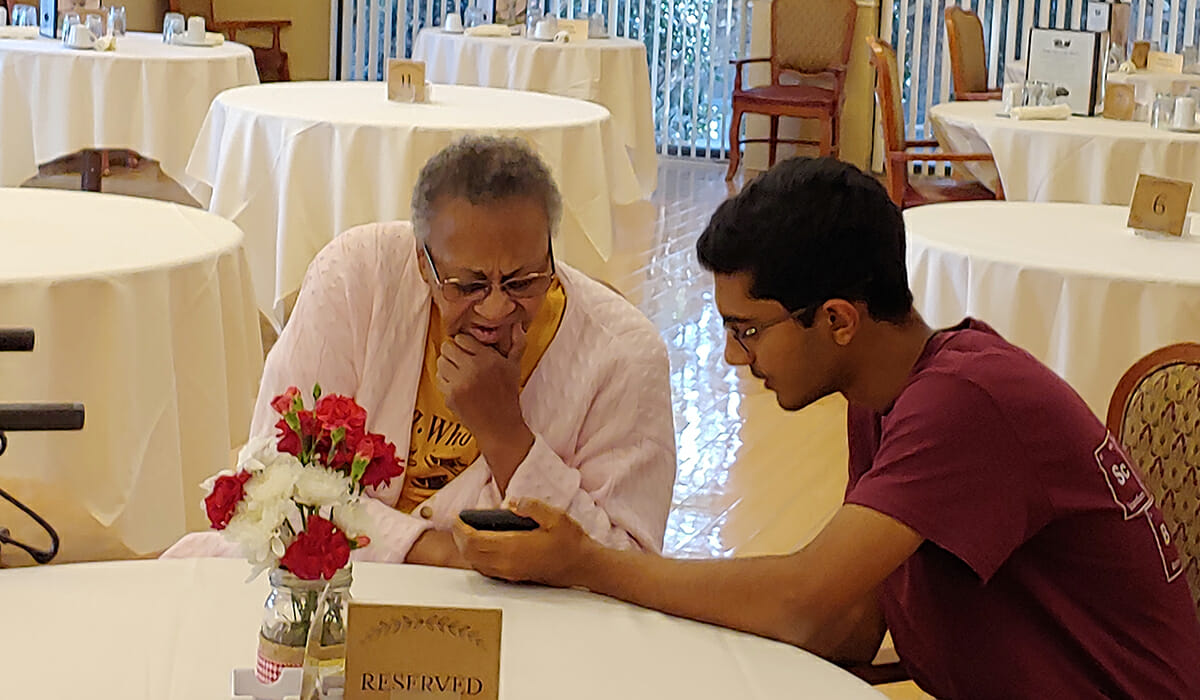
Dipen Mehta shows a resident of Manor Care Senior Living Home and Rehab Center the steps to send balloon and cake emojis for her niece’s birthday text. /Courtesy Dipen Mehta
How has your volunteering gone global in helping Rohingya refugees in Bangladesh?
We have been fortunate enough to collaborate with Community Partners International in helping build a health survey app for UNHCR workers at Cox’s Bazar, the largest refugee camp in the world. Specifically, we help with translating audio files into different languages so that the Rohingya refugees who reside in the camp will be able to understand and provide accurate responses to health-related questions. This app would make it easier for UNHCR workers to monitor the health of such large populations of refugees living in precarious conditions.
Describe your volunteer role with Coding for Community, and other activities you are a part of.
As President of Coding for Community, I plan and lead all of our initiatives. These initiatives are based of the four pillars of Coding for Community. The first is local outreach; as a part of local outreach, our volunteers and I go to disadvantaged communities including elementary schools in low-income areas, rehab centers, low-income residential areas, and senior living homes to teach relevant computer and technology skills. At elementary schools, we encourage students to explore STEM and possibly consider careers involving STEM. At rehab centers and low-income residences, we teach basic computer skills and digital literacy applicable to many kinds of careers. Finally, at senior living homes, we help seniors with their technology – such as smartphones, computers, etc. – and help them communicate with loved ones through text and email. Our second pillar is refugee outreach. Refugee outreach is similar to local outreach, but is expanded to involve activities that allow for a smoother transition for refugees into life in the United States. This includes basic computer skills, English language help, and citizenship test assistance. Our third pillar is social technology. Here, volunteers and I have mini-hackathons and work on projects that involve the creation of socially impactful technology. For example, one mobile app that volunteers and I created was “Stop Food Wastage,” which is available on Android and iOS. This app is a very simple platform that allows restaurants to post and leftover food they have at the end of the day which charities and claim and pick up. We have contacted several local restaurants and charities and are in the stage of expanding the usage of the app. As a part of this pillar, volunteers and I also hold technology drives, in which our team collects functional technology donations from people who no longer want their old laptops, webcams and keyboards. Currently, we have collected $7500 worth of technology and are in the process of distributing it to low-income residential and refugee communities. Finally, our fourth pillar is international outreach. As I mentioned previously, through this pillar, I have led my team in our collaboration with Community Partners International for the Cox’s Bazar health survey app.
How have you gotten members of your high school community to engage in volunteerism and “Coding for Community?”
The main ways I have involved members of my high school community are through the first and third pillars. Members of my high school’s Coding Club – which is my high school’s chapter of Coding for Community – have accompanied me to volunteer at local elementary schools and rehab centers. Also, when I work on social technology projects, I work primarily with high school Coding Club members.
What’s been the most rewarding part of your work?
My most satisfying moment was this summer when Dana, now a seventh-grader, emailed me about her success in learning Python, a computer language that I haven’t even grasped myself.
What have you learned through your experiences as volunteers?
Through my experiences as a volunteer, I have been able to witness firsthand the power of education, science and technology transform lives and empower communities.
Why is it so important for young people to be engaged in volunteering and service?
Cultivating a sense of community and a culture of service starts young. As the youth help to improve their communities, not only will they develop a habit of community service, but they will also benefit themselves by increasing their own well being and strengthening their sense of identity and self-esteem.
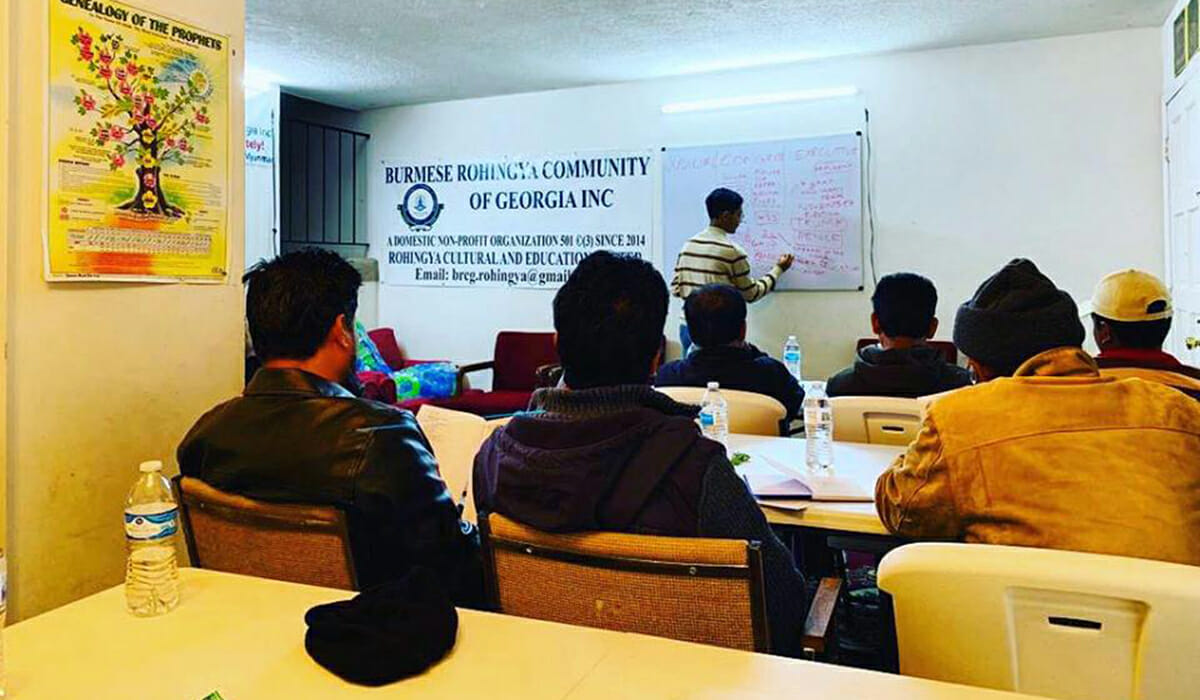
] Dipen Mehta teaches the Rohingya community in Atlanta how to ace their citizenship test. /Courtesy Dapen Mehta
Are there any future partnerships, programs, or events that you are excited about?
Our team at the Coding for Community chapter at my high school is currently in the process of working on building an app for our school community using React. After implementing this at Walton, we plan to expand this idea to other schools. We currently have a sketch of the UI, but we’re really excited for this project and we hope to finish before June.
Why do you think it’s important for others to give back?
Giving back is something that allows individuals to uplift themselves and their entire community. Not only does giving back improve the well being of those who give back, it creates a tremendous positive change in the lives of others that can make people realize that everyone can use their own abilities to make more positive changes a reality. This strengthens their self-esteem and willingness to help.
What do you want people to learn from your story?
I want more people to mobilize STEM-based community service initiatives after looking at the progress that Coding for Community has made. From my story, I hope people realize the power of science and technology to empower communities both through education and through dynamic real-world applications.