Cancer Survivor’s Faith is Foundation for Service to Those in Need
Meet Daily Point of Light Award honoree Shirley Sanders. Read her story and nominate an outstanding volunteer or family as a Daily Point of Light.
A dedicated volunteer, Shirley Sanders says she is a “jack of all trades” when it comes to her service, helping out wherever the need exists.
Through American Cancer Society (ACS), the 64-year-old Gettysburg, Pennsylvania resident, who is a cancer survivor, helps to run the Adams County Relay for Life, where she leads the luminaria ceremony which honors survivors and those who have lost the battle to cancer. Shirley also serves Habitat for Humanity, which helps families build and improve places to call home.
Active in her church and community, Shirley has connected with thousands of people in need through her volunteerism.
Active in her church and community, Shirley Sanders has connected with thousands of people in need through her volunteerism./Courtesy Shirley Sanders
What inspires you to volunteer?
It’s our calling to help others in need. Doing for others is a good feeling.
Describe your role with ACS and Habitat for Humanity.
As a volunteer for ACS, I lead the luminaria ceremony and I am a captain of a Relay for Life team and also plan for the event. Not only am I a 31-year survivor of cancer, I lost both my brother and sister to cancer, in addition to a number of other family members and friends. My volunteerism for ACS raises awareness about the resources they provide to people battling cancer.
Serving for Habitat for Humanity, I volunteer and recruit others to join our workdays. I’m mostly a gopher or I’ll participate in clean up. I’m a jack of all trades. I’ll pick all the nails up, paint and sand as we build affordable housing for families in need.
Share one personal story with me from your volunteerism.
Cancer survivors will speak at the luminaria ceremony, where we light candles honoring loved ones. Speaking is healing, they say, because they get a chance to share their story about what they’ve gone through battling cancer. The ceremony helps these individuals grieve and heal.
What’s one way you hope to inspire others in your service?
Look beyond yourself to serve. I feel like I get more out of volunteering than I put into it. Volunteering is a good feeling, it brings joy to know you can help someone else.
What’s been the most rewarding part of your service?
We are called to serve. I’ve been blessed in many ways. I am alive, have a home, husband, children and grandchildren. I was blessed to have all of this in my life and I want to bless others by doing for them. It’s my faith that is the foundation for my service.
In one word describe what volunteering means to you.
Do you want to make a difference in your community like Shirley Sanders? Find local volunteer opportunities.
Retired Volunteer Delivers Safety and Comfort to Families and Individuals
Meet Daily Point of Light Award honoree Mike Brockman. Read his story and nominate an outstanding volunteer or family as a Daily Point of Light.
Mike Brockman says as a UPS driver, he valued the connections he made with the people he met along his various routes. After retiring, Mike decided to continue connecting with his neighbors, serving help and hope to those in need.
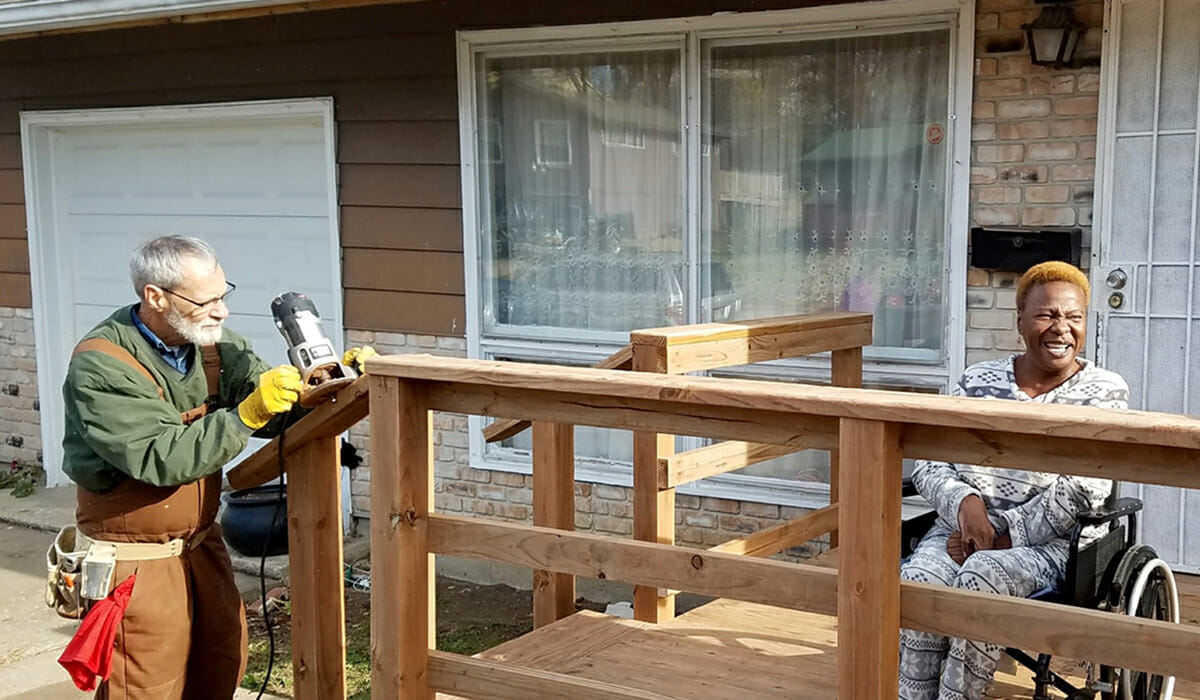
In 2017, Mike began volunteering for HappyBottoms, a diaper bank based in Kansas City, Kansas. According to HappyBottoms, there are more than 20,000 underserved children in the Kansas City area that aren’t receiving the diapers they need. Mike says as a delivery driver for the organization, he drops off thousands of donated diapers at a time to partner agencies who distribute diapers to families in need. Extending his service beyond children in the community, Mike also serves as a volunteer for HopeBUILDERS, an organization that assists homeowners with critical repairs or wheelchair ramps. Serving neighbors of all ages to ensure they are able to live safe and comfortable lives with dignity, Mike is connecting with many in his community through his volunteerism.
What inspires you to volunteer?
I am always wanting to give back. I’ve been blessed in my life and I just wanted to give back and help those in need.
Describe your role with HappyBottoms and HopeBUILDERS.
At HappyBottoms, I first started by wrapping diapers for families in need, but when the organization decided to begin diaper deliveries, they asked if I’d be their delivery driver. I drive the deliveries, help to unload the truck at HappyBottom partner agencies, and will pick up empty bags to bring back to HappyBottoms to be refilled with more donations.
At HopeBUILDERS, we are helping people who need critical repairs done to their home such as bathroom remodels for disabled people and wheelchair ramps. I have learned invaluable building skills while helping others in need.
Mike Brockman serves as a volunteer for HopeBUILDERS, an organization that assists homeowners with critical repairs or wheelchair ramps. /Courtesy Mike Brockman
Share one personal story with me from your volunteerism.
I take the time to visit with all the people I see on a regular basis through my deliveries with HappyBottoms. I meet families who are so thankful and grateful for the service. Some of them wait for me to get there because they’ve run out of diapers and they’re so glad to see me show up.
What’s one way you hope to inspire others in your service?
If you want to give back in some way, volunteer. Anything you can do to help is a good thing, and there’s such a need. I see a need for volunteers more now than ever before. Offer your time and someone will use you for whatever they can use you for.
What’s been the most rewarding part of your service?
Seeing how grateful people are. I’ve seen some people actually cry when we build them wheelchair ramps. People are overwhelmed by our generosity when we help. It’s a great feeling.
Describe what volunteerism means to you in one word.
Love. Volunteering is not a job, it’s a pleasure.
What have you learned through your experiences as a volunteer?
I’ve learned to be more open with folks and exhibit more care. We can all get a hard edge to us sometimes, and this kind of work brings out the gentleness in you. Also, it’s a way to develop more skills. When you volunteer you’re learning from experts and so you are learning those skills as well.
Medical Student Mentors Underrepresented Youth Pursuing Careers in Medicine
Meet Daily Point of Light Award honoree Julia Xia. Read her story and nominate an outstanding volunteer or family as a Daily Point of Light.
Emory University School of Medicine student Julia Xia has found a way to combine her passion, for both the medical field as well as mentoring youth, through the Young Physician’s Initiative, an Atlanta-based nonprofit that provides guidance to high school and college students pursuing a career in medicine.
Julia is one of the directors for the Young Physician’s Initiative [YPI], which specifically targets youth in underrepresented communities who may not have access to information about the medical field or what it takes to enter it. Medical students visit local high schools and universities on a monthly basis to provide interested students with a curriculum that introduces them to real-life medical cases, as well as resources and mentoring on how to apply to and prepare for medical schools. Julia was drawn to the program by her love of teaching — prior to medical school, she taught English to high school students in Indonesia — as well as her desire to see more diversity in the medical field.
Describe your volunteer role with Young Physician’s Initiative.
I’ve had a couple of different roles with the Young Physician’s Initiative. When I started out, I was working with [YPI Executive Director and Founder Dr. Heval Mohamed Kelli] to start a new branch for YPI at a local high school in Atlanta. It was the North Druid Hills High School. I would go there after school once a month with one other medical student and we would bring a medical case, or we would bring another presentation on what it’s like to apply to medical school. We designed this curriculum throughout the whole year where every month we would bring them something that would give them exposure to what the field of medicine is like, what it takes to get there, to become a doctor. We would also organize some other speaker events with physicians to come and talk about their job. We also tailored it to what students were interested in, whether or not they needed help with anything that they were working on as a college application, or if they had anything they were interested in like a workshop.
I spent the next year expanding YPI to the college level. Previously we had only been doing it in high school, and then we started expanding to colleges in Atlanta. The first college we did was Georgia State. I essentially did the same thing, but I scaled it up to the undergraduate level where I brought more complex medical cases to a group of college students. We would meet in the evenings and go through what it’s like to diagnose a disease and think like a doctor, basically. We also had more advanced workshops for applying to medical schools, like medical student panels where we got a bunch of incoming students to ask questions they had. I designed a medical ethics session for them and I held mock interviews for them to practice their interview skills. Later on in the year, once we got our undergraduate curriculum solidified, we expanded it to other schools like Georgia Tech, Clark Atlanta. That was an exciting expansion for YPI.
This year I am taking a director role, where I’m now training medical students to lead these sessions at their different schools. We have YPI at over ten different high schools and undergraduate campuses in Atlanta. We have a whole team of medical students who are interested in teaching and working with students who are interested in medicine. I hold the training sessions for them. I give them a tour of the curriculum we designed, I give them all the resources we have, I share with them all the things students have really liked in the past. Also in the director role, I will gather data from all of our surveys we have the students take about the curriculum. I submit them to conferences so we can present the work we do at YPI on a national level. We really try to design our curriculum so it’s simple and replicable and easy for other schools to adopt if they want to.
Why did you want to get involved in the Youth Physician’s Initiative?
It’s something I wanted to become involved in because I loved being in the classroom. I was a teacher before I came to medical school so I loved mentorship and teaching in the classroom. I also really admired the vision that YPI had. Our main goal is to bring exposure and mentorship from the medical field to different underrepresented students in local high schools and colleges who might not necessarily know someone in medicine. If you don’t know someone personally who has been through the process, it’s actually really, really hard and difficult to know what you have to do, and what the whole process of applying is, or what the field is about. We wanted to make this more accessible to students who may not have this opportunity otherwise and provide a whole network of mentorship for them to access later on, and also to show them that we are interested in helping them. They really appreciate that medical students, residents and physicians have taken the time to come to their schools and be present in the community and demonstrate interest and an investment in their futures. That’s really mostly why I believe in YPI and why I started with Dr. Kelli.
Why is it important to reach students in these underrepresented communities?
It’s important because historically we do not have enough diversity in medicine. All of these studies in recent years have shown that statistically, the percentage of minority physicians is really, really small. It’s very unfortunate because the patients we see every day are diverse. In order to have physicians who can properly advocate for them, believe in them, invest in them and communicate with them, I think it’s important to have that diversity mirrored in the physician workforce as well. They definitely have done studies where physicians who come from underrepresented communities are more likely to, when they finish their training, practice in these communities and they’re more likely to believe in these communities and advocate for them.
What kind of feedback have you received from the students?
The students really love it. The high school students, they are really just getting the beginnings of an idea of what the field of medicine is like, so for them, it is like we’re busting a lot of myths about the field of medicine — that it’s so hard and difficult of a process to get into and also complete. People think it’s really expensive and inaccessible, people think ‘I’ll never get into medical school,’ that it’s just a distant dream. I think for the high school level, we’re really being there and being present in their classrooms and sharing with them what it really is like day to day to think like a doctor and solve medical cases. It makes it seem a little bit more real and accessible for them. It’s sparking interest for them, so they’ve really enjoyed solving the cases and just getting a taste of that problem-solving investigative thinking that it takes. They really enjoy it when we bring physical exam tools like stethoscopes or reflex hammers and let them try out what it feels like to do a physical exam. We answer a lot of their questions about what do I have to do in college to get ready for medical school, and what are the realities of applying to a field that seems to be competitive but really, with the right guidance, is very doable. It’s piquing their interest and they’re getting excited about it.
Then at the college level, the students really already have an idea that they’re interested in medicine. A lot of them are already pursuing the pre-med track, so they just have a lot of practical questions about what it takes to complete the application cycle. Having this direct mentorship for them, it’s really valuable because they’re actually in the process of preparing themselves for the next step in their careers. They really know a lot more at the college level, to where they can dive into these cases. I think it’s exciting for them to be able to apply what they’re learning in college to real-life patients, and those are the kinds of cases we bring. I’ve been getting a lot of students who will stay after the workshops with additional questions. A lot of them will reach out. We’ll always give them our emails and they’ll ask us questions about personal things they’re wondering about. I think they appreciate having individual medical students or physicians that they can reach out to and connect with.
Are there any future partnerships, programs, or events that you are excited about?
We’re constantly excited about expanding to new schools. Each year, we’ve expanded to new campuses and new schools in the community. That’s always a thing we’re really, really happy about. We’ve also been organizing an annual conference called ‘Doctor for a Day,’ which we’re all really excited about. It’s basically a very expanded, large-scale, full-day conference where we’re doing a lot of the same things, but we make it available to anyone in the community who wants to come. We were getting a lot of interest from students who did not necessarily have YPI established at their school but still wanted something like it, so we designed this one-day conference on a Saturday called Doctor for a Day, where we brought in a whole network of physicians. We have a networking lunch and we also have medical cases for them to go through. We have similar-to-normal-YPI curriculum, we have a medical student panel, we have physician speakers. We’ve been able to expand and make this accessible to people who don’t necessarily have YPI at their schools. Last year was the first time we tried it and it was a really great success. A lot of participants really loved it so we’re doing it again this year in February.
What have you learned through your experiences as a volunteer?
I’ve learned that these students are by far the most motivated and energetic students I’ve ever worked with. I think that students from underrepresented schools do not lack anything like inspiration and motivation. What they really just need is to be put in touch with the right resources. I think that’s something YPI is able to provide — putting them in touch with mentors and resources, pointing them in the right direction. It’s not telling them what to do with their lives, and it’s not telling them what they should or shouldn’t choose for their career. It’s just showing them what the options are and that they are more than capable of pursuing it themselves. I’ve definitely seen how driven they are and it’s very rewarding.
What do you want people to learn from your story?
It truly matters when you invest in A, the youth and the young student population of our generation, and then B, underrepresented schools that don’t necessarily have the same resources and connections that other places do. That’s one thing that I think is so enriching about this program. The success of these students — and we are tracking where they go after they graduate, and hearing their success stories and seeing how they progress — has just showed me how it is so, so important and so worthwhile to invest time and energy in young students, especially from those in minority backgrounds who do have the interest and are driven to pursue careers, in medicine for example, and just may not know the path to take.
Is there anything else you think is important for people to know about Youth Physician Initiative?
I think it’s important to acknowledge all the mentors and teammates that I have in YPI. I want to acknowledge Dr. Kelli, who is the founder of YPI. He’s been my mentor in this entire over-three-year process of working on and building YPI. I want to acknowledge the 15 to 20 other medical students who are doing this YPI initiative with me. Everyone is committed to their sites and their schools and YPI wouldn’t be able to have it without them putting their time into it.
Teenager Creates Literacy Packets for Underserved Communities
Meet Daily Point of Light Award honoree, Jordan Grabelle. Read her story and nominate an outstanding volunteer or family member as a Daily Point of Light.
When she was seven years old, Jordan Grabelle helped her older sister run book distributions in lower-income neighborhoods. While volunteering at these events, she noticed that many students in nearby at-risk communities, such as Philadelphia and Camden, read significantly below her grade level. At age 10, she founded Love Letters for Literacy, an innovative nonprofit which promotes literacy among at-risk pre-readers and fosters a love of reading.
“Through my volunteer work, I have been able to experience the satisfaction of playing a role in helping to equalize the educational playing field for children in need,” says Jordan. “Serving others has also taught me to become more responsive to the needs of others and to push myself to overcome challenges.”
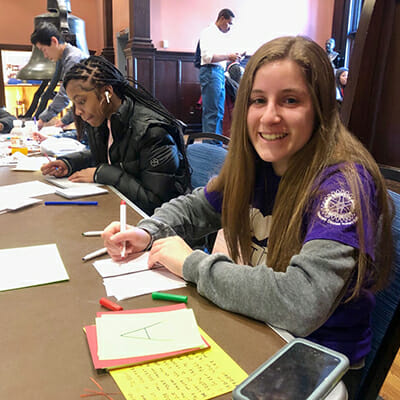
Love Letters for Literacy helps lower-income children obtain resources they need to become capable readers. Volunteers use paper and markers to create 26 flashcards from A-Z, and then present literacy packets to children along with notes from the creator and instructions explaining how to play games with the flashcards.
“These packets make learning the alphabet fun through simple educational games that the whole family can play,” says Jordan. “Volunteers and I visit classrooms teaching children how to use the packets following a curriculum.”
Over 50 volunteers join in creating Love Letters packets at a Martin Luther King, Jr. Day of Service Event.
As the Love Letters for Literacy Executive Director, Jordan has dedicated over five years scaling her project from creating all the packets herself for local donations to a global nonprofit that has recruited over 3,350 volunteers to promote literacy in 49 States and 18 countries.
And that’s only the start. The Fischler School of Education at Florida’s Nova Southeastern University incorporated Love Letters for Literacy into its curriculum, recruiting graduate students to bring the program into classrooms where they student-teach. Jordan looks forward to expanding her work with other graduate and undergraduate education programs.
Love Letters for Literacy currently donates packets to many Head Start programs and is looking to partner with even more this coming year. Finally, they also partner with over 100 various service clubs of all ages such as Circle K Clubs, Kiwanis Clubs, Rotary Clubs and Key Clubs. The nonprofit is constantly in talks with new chapters of the clubs in different countries.
“The feedback I receive from the schools and families who give the literacy packets motivates me to continue volunteering,” Jordan says. “Also, the many volunteers who participate in making literacy packets for Love Letters for Literacy each year inspire me to continue.”
Jordan believes it is important for others to give back because people have a responsibility to work together to better their communities. She believes paying it forward is the right thing to do and enables people to become more empathetic to the difficulties others face.
Classically-Trained Musician Serves as Man’s Best Friend to Victimized Dogs
Meet Daily Point of Light Award honoree Martin Agee. Read his story and nominate an outstanding volunteer or family as a Daily Point of Light.
A lifetime animal lover, the death of Martin Agee’s ex-racing greyhound, Melody, whom he had adopted as a family pet, was devastating for the 62-year-old New Yorker. Hoping to heal from the loss, Martin sought out other dogs in need and began volunteering at the American Society for the Prevention of Cruelty to Animals (ASPCA) in New York City.
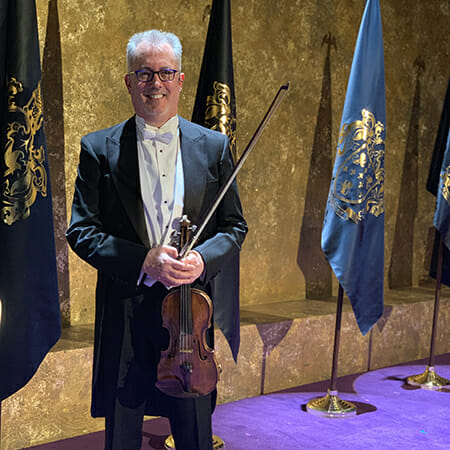
Initially volunteering as an adoption counselor for the ASPCA in 2017, Martin realized that his skillset as a professional musician could also benefit abused or traumatized dogs. Having performed as a broadway violinist for decades, Martin says he is using his professional skillset to serve as man’s best friend and connect with hundreds of dogs through the power of music.
What inspires you to volunteer?
After losing Melody, I am inspired to volunteer because rehabilitating recovering animals has brought me so much personal gratification and satisfaction.
Describe your role with American Society for the Prevention of Cruelty to Animals (ASPCA).
The ASPCA has a program called the Animal Recovery Center (ARC), which uses storytellers to calm dogs and ready recovering animals for eventual adoption. Instead of reading to dogs, I proposed another kind of therapy: playing music. Weekly, I visit the ASPCA and play Bach, Beethoven, and Handel’s sonata to a handful of dogs.
A classically-trained violinist, Martin Agee is pictured at the Broadway production of King Lear./Courtesy Martin Agee
How do the dogs react to your music?
I have found that playing classical music like Bach and Handel is certainly what I enjoy and I think they enjoy it too. Once in awhile I’ll do my own improvisation but dogs ears can be very sensitive, so I have to be careful about volume and high pitches. The dogs welcome my music with loud barks, many dogs cock their heads to listen and fiercely wag their tails. All intently watch, and many curl up on their beds.
Share one personal story with me from your volunteerism.
I met a dog named Gina who is a pit bull-terrier mix. She had experienced some trauma – one of her legs was wrapped with a bandage and she had a cone over her head. The first time I started playing for her, she would start singing along. She’d come up to the glass separating us and she’d lean her whole body up to the window and would literally sing along to my music. It was one of the most unbelievable experiences to see her reaction.
What’s one way you hope to inspire others in your service?
I certainly hope that no one would suffer the loss of a pet, but if they are struggling, volunteering at an animal shelter or helping a person in any way will be helpful in their own journey to reconnect. It’s satisfying to know you are helping vulnerable people or animals move on to a new step in their life.
What’s been the most rewarding part of your service?
The dogs I play to experience something similar to the connection I have with an audience sitting in a concert hall. It’s rewarding to know that I am giving these very vulnerable and sensitive dogs a respite in their recovery and their daily lives.
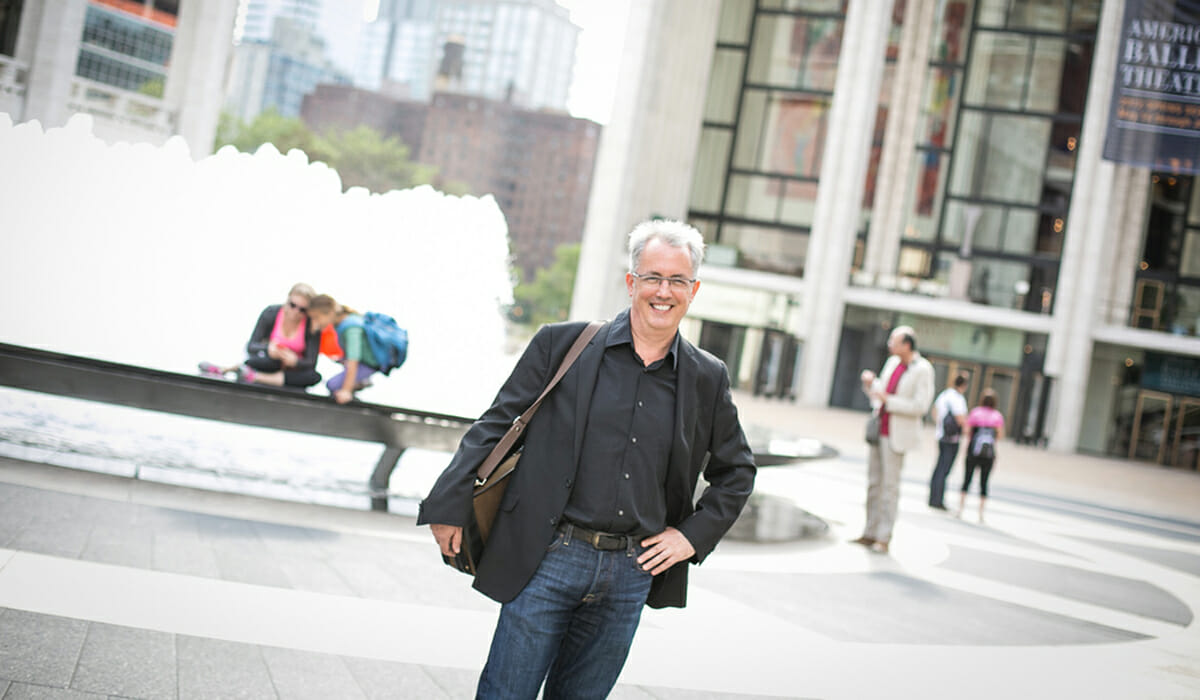
Martin Agee pictured at the Lincoln Center for the Performing Arts. “The dogs I play to experience something similar to the connection I have with an audience sitting in a concert hall.”/Courtesy Martin Agee
What does volunteering mean to you in one word?
Giving. Volunteering has been life changing for me and playing music to animals has taken me behind the scenes of their rehabilitation and has given me a whole new perspective on the work ASPCA does.
What have you learned through your experiences as a volunteer?
I’ve learned about the importance of the human and canine connection. Through volunteering, I have gained a tremendous amount of confidence in my ability to make a connection with both animals and people.
How can readers help?
Please visit the ASPCA website for more information about how you can help.
First-Generation American Teen Provides Refugees with Tools to Assimilate
Meet Daily Point of Light Award honoree Sarina Krishnan. Read her story and nominate an outstanding volunteer or family as a Daily Point of Light.
Sarina Krishnan’s parents faced adversity as new immigrants in the U.S., experiencing differences in culture and lifestyle and challenges speaking English as a second language. The 17-year-old Poway, California resident says when she first witnessed similar difficulties as a volunteer, she decided she could make an impact on individuals like her parents by connecting refugees and migrants to critical tools necessary for assimilation.
Founding Pathways to Assimilation in 2016, Sarina is providing resources to refugees and migrants to make them feel welcome and supported in the United States. Realizing just how difficult even mundane activities like paying for groceries and asking for directions can be for newcomers who aren’t native English speakers, Sarina has helped over 1,000 local migrant families to better assimilate in their new home.
What inspires you to volunteer?
I’m fortunate enough to have many opportunities and my parents encourage my service. My volunteerism is helping hundreds of refugees and immigrants forge friendships in their communities and become more comfortable with living in the U.S.
Describe your role with Pathways to Assimilation.
As the founder and president of Pathways to Assimilation, I tutor students and families in English, speak at youth empowerment conferences and facilitate other events and activities for refugees and migrants. Our organization has a board of advisors in addition to a number of volunteers that help us at events.
Share one personal story with me from your volunteerism.
I volunteered closely with a Syrian refugee family in San Diego and through that close relationship, I realized just how prevalent problems acclimating to America can be for migrants. We decided to address basic issues that often aren’t handled by other agencies or organizations.
Describe how else you are helping migrants through your volunteerism.
We partnered with University of San Diego to host collaborative sessions with Somalian refugees and police officers in an effort to mitigate perceived police hostility and improve community relations. Additionally, I created a social networking app called ‘CommunitiesConnect’ which helps refugees with their transition to the U.S. by connecting them to people with similar backgrounds and shared experiences in culture.
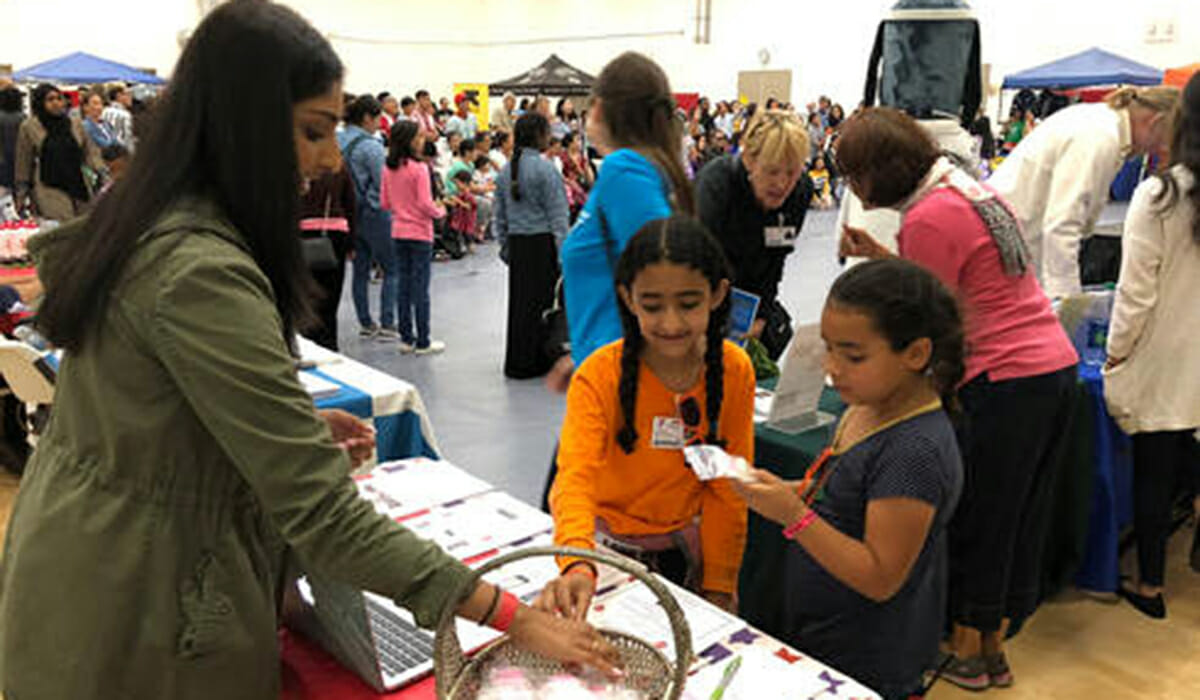
Sarina Krishnan connects refugees and migrants to critical tools necessary for assimilation./Courtesy Sarina Krishnan
What’s been the most rewarding part of your service?
It’s rewarding for me to know that I have a small role in helping migrants. Seeing the progression of a student or family, they are more confident in their English-speaking skills and overall have more excitement to live their life in the U.S.
Describe what volunteerism means to you.
It’s mutually rewarding. Just as I’m helping others, there’s a lot to be gained by serving others.
What have you learned through your experiences as a volunteer?
I’ve learned about perseverance and resilience because I knew how important the work I was doing was, and how beneficial it would be to the people I was serving. That is what pushed me to keep going.
You’re a high school senior. What do you do when you are not studying or volunteering?
I like to hang out with my friends, we’re fortunate to have nice nature around us. We go on hikes, go to the beach, get brunch.
Teenager Uses Volunteer Work to Promote Emergency Preparedness in Community
Meet Daily Point of Light Award honoree Vishnu Iyer. Read his story and nominate an outstanding volunteer or family as a Daily Point of Light.
Not a lot of teenagers, or even adults, are incredibly concerned with emergency preparedness, much less knowledgable about it at all. Vishnu Iyer, however, is trying to change that for his Indiana community in order to help make his classmates and neighbors as ready as possible for potential disasters and emergencies.
The fifteen-year-old is the first student from Indiana to join the FEMA Region V Youth Preparedness Council. Last year, for his project with the council, Vishnu created an Emergency Preparedness Club at his high school. Through his club, he teaches hands-only CPR and other important safety and emergency members to his classmates. He also teaches hands-only CPR to members of the community through the American Red Cross and is preparing to start teaching disaster mapping courses for them as well.
Describe your volunteer role with the Emergency Preparedness Club at your school.
I started the club last year at my school. I started it because it was my project for my FEMA Youth Preparedness Council. I joined the FEMA Youth Preparedness Council because I figured out there was no real emergency preparedness program in Indiana for youth, so I decided to create one at my school.
We usually have a meeting once or twice a year. This year I’m going to bring in Red Cross officials who teach hands-only CPR to all my club members. Last year, we had full one-day training that included fire safety, tornado safety, team organization, and 911 calls.
Can you describe what you do with the FEMA Youth Preparedness Council?
I joined the FEMA Youth Preparedness Council last year. It’s for high school students and we try to promote emergency preparedness for youth in our community. I’m the only student from Indiana on the council. Last year I decided to make my club and my club was part of my project. This year I’m working on mapping and my club again, and also teaching hands-only CPR.
Describe your volunteer role with the Red Cross.
I go to different meetings to teach hands-only CPR to the community. One of the meetings I did was at a local church event so I taught about 100 people how to do hands-only CPR, and then also recently I did a mall event that was very successful.
I’m also a part of the Red Cross Mapping Team where we do disaster mapping. That’s very recently that I just learned how to do mapping, and I’m also going to help a couple of Red Cross officials to teach classes to adults on Red Cross disaster mapping.
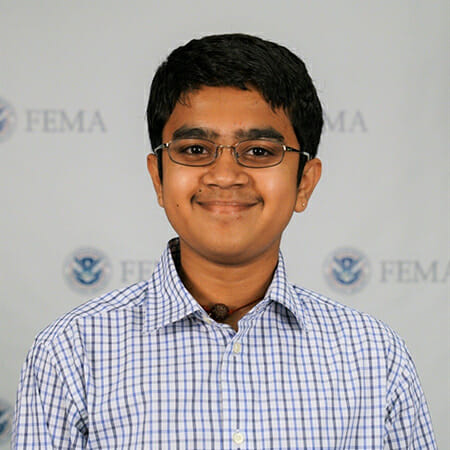
Vishnu Iyer helps promote emergency preparedness through his involvement with FEMA, the Red Cross and the Emergency Preparedness Club he founded at his high school./Courtesy Vishnu Iyer
What is disaster mapping?
Why is emergency preparedness so important?
I feel like emergencies are one of the things most people think you can’t really be prepared for and it’s really random, but I wanted to [get involved] because they can happen at any time. I also read an article on monster hurricanes like Hurricanes Harvey, Maria, and Irma, and this affected a lot of people, so I decided to try to make an effort to help my community because there was no current program for youth.
What kind of feedback have you received from people involved in your club?
The people that came to my club last year said it was really cool and helpful. One of the things they really liked was the fire simulation we did and how to use a fire extinguisher. We used an electronic screen with fire on it and people really liked that. Also, I’m getting a lot of interest in my club this year because people are more inclined to do a shorter hands-only CPR session rather than the longer one that I did last year.
Are there any future partnerships, programs, or events that you are excited about?
My first hands-on CPR session is going to be in December or January. I haven’t figured out the date yet with my principal, but I’m really excited about that.
This year I’m going to apply for the FEMA National Team, which will be a much bigger project at a national scale. I really hope that doing all my projects will give me the experience to work on the National Team. It would be the same type of emergency preparedness project, but on a much bigger scale and I would also collaborate with people from across the nation.
Why do you think it’s important for others to give back?
I think it’s really important because if you don’t give back to your community, you’re not helping other people and you’re not showing them the kindness that they gave to you. If you don’t help your community, the community will go in a negative place.
‘Vision’ of Kindness Leads Woman to Celebrate Cancer Survivors and Foster Children
Meet Daily Point of Light Award honoree Sonya Adams. Read her story and nominate an outstanding volunteer or family as a Daily Point of Light.
What started as a simple idea to provide random acts of kindness grew into several years of nonprofit work and volunteerism for Sonya Adams, the founder and president of Celebrating a Vision. The Pomona, Calif. resident’s 2013 vision led her to create the organization, which plans unique experiences and exciting excursions that celebrate and honor cancer survivors and foster children.
“I believe if you are a survivor of anything you should be celebrated,” Sonya said, “for just even overcoming the battle.”
Sonya’s first act of kindness was a $5 Starbucks gift card. Today, the acts of kindness include Malibu wine safaris, VIP private events at Magic Mountain, sunset sails, helicopter rides, concert tickets and more — at no expense to the recipients or the families and friends they bring along. With a team of five volunteers, Sonya provides about ten acts of kindness each month. Celebrating a Vision has impacted close to 300 people by bringing them joy as well as encouraging them to step outside their comfort zone and reach their goals.
Describe your volunteer role with Celebrating a Vision.
We provide amazing experiences for cancer survivors and foster children. I am the president and founder.
In 2013, I had a vision to provide random acts of kindness for cancer survivors. As you can hear, the word ‘vision’ is incorporated with the name of the organization. I had a vision to provide these experiences so I came up with this concept of providing concert tickets, limousine rides, helicopter excursions. I started to provide all of these things. My very first random act of kindness was a $5 Starbucks gift card, so you can see where the organization has grown from a $5 Starbucks gift card to now offering limousine rides and concert tickets and cruises and things of that nature.
Can you describe the process of choosing a recipient and their act of kindness?
You have to submit a letter to the organization or an email, and myself and my team go through the letters. We have to pick and choose from the letters whether you are chosen to be a recipient of Celebrating a Vision. We are inundated with letters all the time asking for various requests. We’re one organization with two major causes because we work with foster children and cancer survivors.
I try to curtail [the experiences] to the person who we are honoring. We had a gentleman who was a prostate [cancer] survivor and his wife said he likes fast cars. I collaborated behind the scenes with his wife and I was able to get him a ride in a Lamborghini on a speedway track. We blindfolded him and we whisked him off to the speedway, and when he got there he was able to ride around in the Lamborghini with speed past 200 miles per hour. He was just so ecstatic. I try to work behind the scenes with family and friends to find out exactly what the person’s personality is like if I don’t have a chance to meet them beforehand.
Are there any acts of kindness that were particularly memorable to you?
I’m going to say when I took 10 kids on a sunset sail. Ten childhood cancer survivors were afforded the opportunity by the organization to go a tall ship for a two-hour sunset sail. Some of the children had never even been on a boat before, never been out to the ocean before. It was a real treat to see their faces and be on an actual ship and be involved in the sail. They had the children reeling out the ropes and really be involved in it. They all received gift bags. Lunch was included. I had about 25 people — the survivors and then also I was able to have their parents or their siblings accompany them, all at no cost.
What kind of feedback have you received from those who have gone on these experiences?
For what I hear from the feedback, it gives them the strength and the courage to move on and to do certain things that they were maybe a little apprehensive about doing. The experiences are oftentimes afforded to these people who don’t get the chance to do things I offer — as a I said before, hot air balloon rides, Lamborghini rides and things of that nature. It pulls them out of their comfort zone, and it allows them to reach for higher goals or to do things they normally wouldn’t do. From what I’ve been told, when I took three women on a helicopter excursion, it gave them the strength and courage to move on and to take on things that they never probably would have taken on.
What’s been the most rewarding part of your work?
The smiles and the joy that I see from the children’s faces and also the survivors’. When the survivors come back and drop by a random act of kindness, maybe four or five years later, and they say ‘Sonya, I’m still cancer free’ or ‘This is what I’m doing today,’ their accomplishments. My very first random act of kindness, I’m trying to locate him now. I’m going to be doing very soon ‘Where Are They Today’ to see what they’ve done and how they’re doing and different things like that.
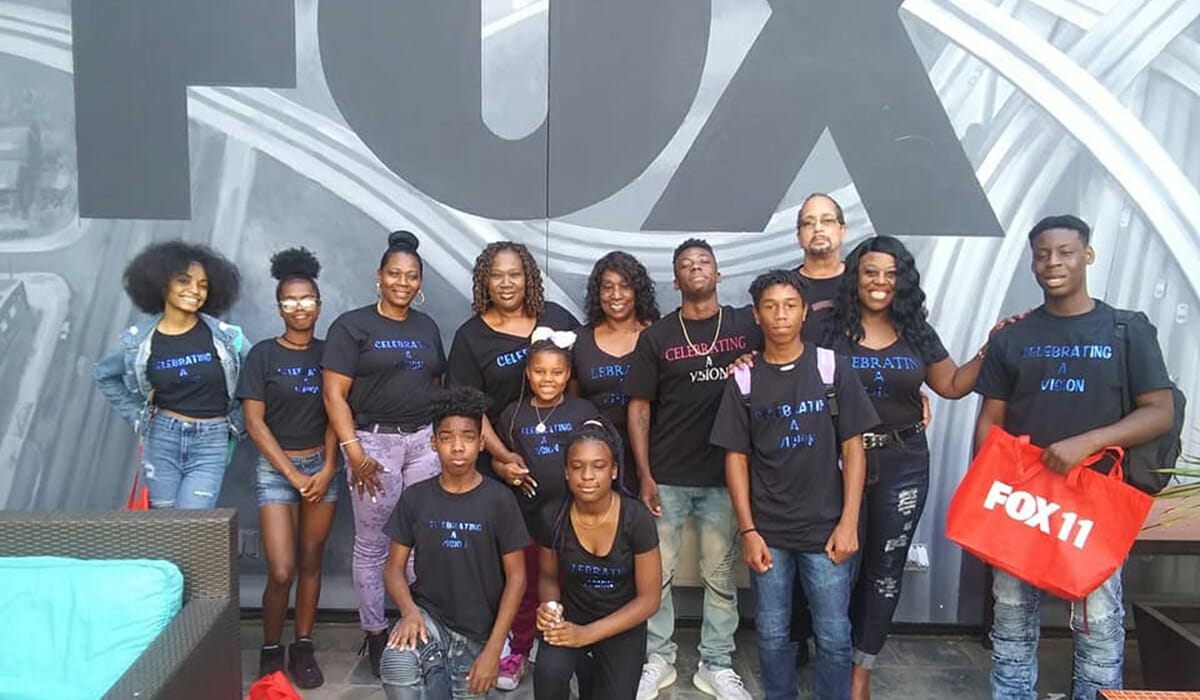
Sonya Adams, second from right, stands with foster children who Celebrating a Vision took on a tour of the FOX 11 television studio./Courtesy Sonya Adams
What have you learned through your experiences as a volunteer?
Gratitude and the importance of paying it forward. It’s very powerful. I believe when you understand the importance of paying it forward, you understand what makes the world go round, that cause and effect. I want to say that we measure success by the lives we change. I think if more people understood that, I think the world would be a better place. It’s not always about money. For my organization and for me, you measure the success by the lives you change. You can change someone’s life by providing an act of kindness. I may not know or they may not voice it, but later on down the road it may have affected them in a way where they’ve decided not to give up. I usually tell my survivors and the children to always go after your dream and never give up and don’t listen to the chatter. Because as I stated earlier, I had no idea where the resources were going to come from, I had no idea where the funding was going to come from. I stepped out on faith and here I am today offering these awesome excursions.
Why do you think it’s important for others to give back?
I think it’s important for others to give back, that way you can understand that you too could at some point be in a situation where you may need some assistance, and you’ll want someone to give back to you. For me, it’s important for me to give back because I may be at some point in a situation where I may be going through chemo and I may be a survivor, and I would love for someone to recognize and honor me and celebrate me for being a survivor.
It’s important to give back for foster children because I believe they need to experience things in life they could probably use as they age out the system. The tools and the resources that I offer foster children, they don’t normally receive those types of things in foster care. We introduce them to cultural arts, recording studios, live TV studio tours at FOX11, helicopter excursions, horticulture. These are things they’re not normally accustomed to in the foster system. It’s very important for people to understand and give back, because again, you may find yourself in that situation.
Is there anything else you would want people to know about this organization?
Please support your local charities because we really are out here in the trenches doing the work. Oftentimes, organizations like Celebrating a Vision don’t get the resources and the recognition needed to continue the vision. Please support your local charities because we also are just like the bigger corporations, we need volunteers and resources as well.
Ten years ago, Annette March-Grier, the co-founder of Roberta’s House, asked Milton to join as a board member. Milton was impressed by what Roberta’s House had to offer grieving families. He understands that Baltimore carries “extra grief”. Volunteering at Roberta’s House has taught Milton grief comes in many forms.
“Grief turns to anger which can turn to violence,” says Milton.
Roberta’s House is a safe place where children, teens and adults discover that they are not alone in their grief. Children with their families share their feelings, memories and experiences in an atmosphere of acceptance with the love and support of trained volunteers.
The volunteers of Roberta’s House, along with a staff of professionals, assist children, teens and adults on how to experience and express their feelings safely and in a healthy manner. Children work in small age-appropriate groups utilizing creative activities to identify feelings and needs. Adults share in groups and are given resources to support them in their journey. By working through the necessary grief task and understanding the essential needs of a child’s grief, it allows families to support each other and communicate more effectively. Roberta’s House is the first African American grief counseling center in the country.
“It is amazing the amount of time and effort that every day people will put into a mission that they’ve taken upon themselves,” says Milton. “They have a sense of mission. I’ve had an unbelievable experience with the volunteers. It is phenomenal the good that human beings have inside them in a world that is so disconnected.”
Professionally, Milton is an agent at New York Life and is involved in the company’s Grief-Sensitive Schools Initiative (GSSI), a volunteer effort that utilizes New York Life’s agents and employees to go into local schools and present bereavement resources to educators. Together with Annette, Milton was instrumental in getting the entire Baltimore City Public School District involved in the Grief-Sensitive Schools Initiative. Milton plans to bring GSSI to various Baltimore schools in the upcoming months.
Milton says the most rewarding part of his work is when young people and adults tell the story of what Roberta’s House has done for them. At the ground-breaking ceremony, Milton says four young people spoke about the death of their grandmother. He was moved by how Roberta’s House had given them a place to express their grief, and to find other people in similar situations and find relief.
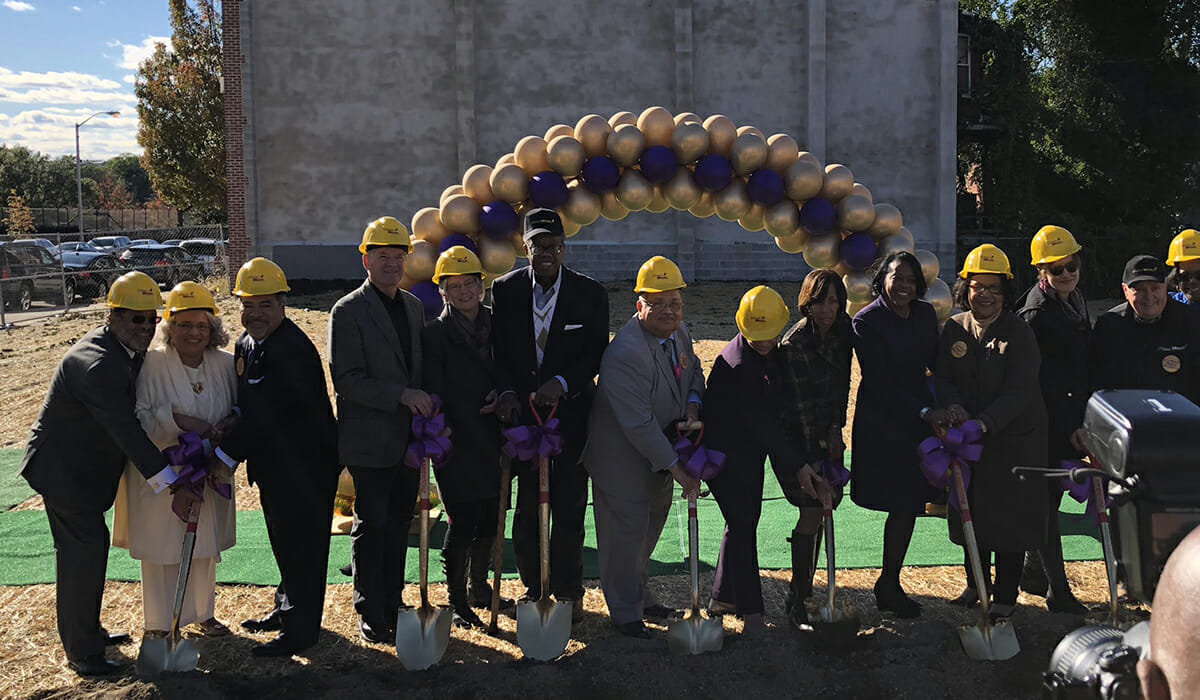
Milton Dugger and other board members breaking ground on the new Roberta House location.
“The volunteers are trying to turn the tides for young people,” says Milton. “Roberta’s House is a shining light. The light shines on the volunteers who have made things better for the citizens of Baltimore.”
Milton says he had family teach him the importance of giving, and not sitting on the sidelines. “What are you here for?” Milton asks. “Are you here to do just for you? Or do you believe in engagement, and involvement, action, sharing, a sense of mission to make life better for those you know and those you don’t know?”
These values are what brought Milton to invest his time in Roberta’s House.
Roberta’s House is breaking ground on a new facility this year. This 22,000 square foot state of the art grief center will be the first of its kind in the nation. The new expansion will include art activity rooms, a library resource center, a multi-purpose room, a theater, a fitness room, a game room, an expression room, conference rooms, family counseling rooms, and administrative offices.
Milton is thrilled to break ground on this project and provide a space for the young people of Baltimore to express their grief and share their stories.
College Student volunteers and brings smiles to elders in hospice care
Meet Daily Point of Light Award honoree Zach LeMense. Read his story and nominate an outstanding volunteer or family as a Daily Point of Light.
A typical college student’s life revolves around juggling studies and social life. However, for college student Zach LeMense, much of his free time is spent providing support to people more than twice his age. The University of Notre Dame student volunteers with AseraCare Hospice providing companionship and support to people in hospice care. Zach’s role can range from reading to the patients to playing board games and strolling outside with them.
As someone who is aiming to go to medical school after college, Zach understands the value of socialization and emotional support for the most vulnerable members of our society. Patients in hospice care often report how lonely they get. Oftentimes, patients do not have a lot of family visitors and they are overcome with joy whenever a volunteer like Zach pays a visit.
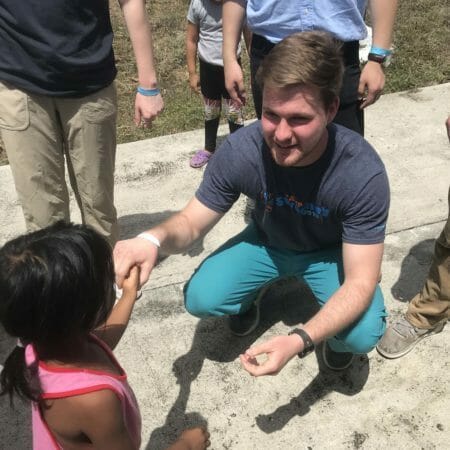
Zach has also gone with the University of Notre Dame’s Global Medical Brigades to Panama, where he was involved with providing medical resources and education to those in need. The Kansas native shadowed physicians, dentists, and pharmacists to educate the local community on the importance of hygiene and health.
Outside of volunteer work, Zach is involved in many physical activities, such as cycling, running, and weightlifting. As an aspiring physician, the 22-year old old hopes to incorporate nutrition and exercise into his future practice for the overall health benefits that they can provide for patients.
What inspires you to volunteer?
I am inspired to volunteer because I desire to bring hope and fulfillment to the lives of those I interact with. With the help of AseraCare Hospice, I volunteer so that I can provide emotional support and companionship to some of the most vulnerable members of our society. Many patients under hospice care become lonely, and my goal is to be their friend so that they may find as much fulfillment out of life as possible. After working with several patients, I have come to find that their smiles and genuine enjoyment of my company really motivate me to serve them to the best of my ability. Additionally, as an aspiring physician, I have always had a calling to help others in any capacity. After attending a Jesuit high school in Kansas City, Missouri, I learned what it means to be a “Man for Others,” and I have striven to incorporate service work into my goals of helping other people.
Describe your volunteer role.
My role as a volunteer includes providing emotional support and companionship to patients in hospice care. These roles can take many forms and include activities such as reading, playing board games, and strolling around outside. However, perhaps the most fulfilling aspect of my volunteering role is speaking and reflecting with the patients about life. Allowing them to open up about their life experiences enables them to be fulfilled in what they have accomplished, and I always learn something from what they say.
What has been the most rewarding part of your work?
The most rewarding part of my work is what I have been able to learn from the patients that I interact with. I have discovered that not only am I giving my time and talents to these patients, but they are also giving so much of themselves to me. They have shown me what true courage, bravery, and strength look like. They have helped me realize how to have hope when faced with disease. I strive to incorporate these traits into my future profession as a physician so that I can be of true service to all my patients.
Zach LeMense (Right) teaching a little girl how to dance on a Global Medical Brigade in Panama./ Courtesy of Zach LeMense
Are there any future partnerships, programs, or events that you are excited about?
I am excited to continue my volunteer work as I begin medical school this upcoming school year. The volunteering opportunities offered by schools take many forms, so I am excited to learn about the various programs. I hope to continue growing as a “Man for Others” as I pursue a medical education, and volunteer work will be foundational in that goal.
Why do you think it’s important for others to give back?
I think it’s incredibly important for people to give back to their communities because it is a source of continual growth and learning as well as showing a commitment to the greater good. I believe that we can learn something from everyone we meet, and serving others enables us to strive for the improvement of the community while learning from those we serve. My volunteering experiences have shown me that those I have served have taught me more about myself and my beliefs than I would have originally thought. By giving back, other people may find how much they can learn about themselves while providing for the betterment of the community.
What do you want people to learn from your story?
From my story, I want people to learn how to become inspired in their everyday lives and how volunteer work can serve as the catalyst for inspiration. I want people to learn about being a “Man or Woman for Others,” and how that ideal can play into their personal and professional lives. As has been the case for me, I hope that people find that service work not only shows a commitment to the community, but it also can be a great source of fulfillment.