After Recovering from Eating Disorder, Minnesota Woman Serves to Connect Others to Treatment
Meet Daily Point of Light Award honoree Shira Charpentier. Read her story and nominate an outstanding volunteer or family as a Daily Point of Light.
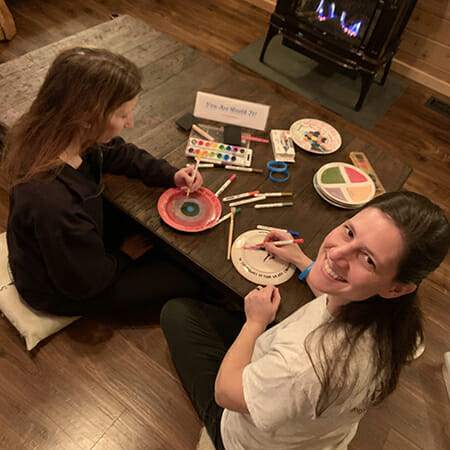
Shira Charpentier battled an eating disorder for years, and says she struggled to find a community to connect with outside of traditional treatment. After achieving recovery, Shira decided to draw upon her own experiences to help others suffering from eating disorders.
Launching Living Proof MN in 2019, the 36-year-old Minneapolis, Minnesota resident provides a community to individuals impacted by eating disorders and hope for recovery in the future. Through support groups, activities and mentorship, Shira has connected with over 100 individuals thus far, offering resources and inspiration for healthy living.
What inspires you to volunteer?
I understand the pain and the suffering that people with disorders go through. For the most part, the general public doesn’t know how to support people to move beyond eating disorders. I can affect others struggling because I’ve been there. I am someone they can talk to because I am experienced in what they are going through and can hopefully guide them to the other side.
Describe your role with Living Proof MN.
Through Living Proof MN, I am offering a community and resources that I wish was available when I was struggling. In addition to our short-term support home for individuals with eating disorders, I provide global peer-on-peer mentorship, support groups, events and educational workshops with meal support.
Share one personal story with me from your volunteerism.
I received a note from a woman who we worked with. She mentioned how I’ve created an opportunity for her to see forward, and that recovery is now possible and worth it. She talks about how our compassion gives her hope. Recovery can be terrifying, but we are working with people to get at the heart of the eating disorder, let it go, and embrace the true person they are, not what the eating disorder wants them to be.
As the founder of Living Proof MN, Shira Charpentier has connected with over 100 individuals offering resources and inspiration for healthy living./Courtesy Shira Charpentier
What’s been the most rewarding part of your service?
Our work is rewarding because we help people to find their passion and create a future for themselves.
You’re not just helping people in your own community. Explain.
I am a registered nurse, and through Living Proof MN, I offer mentorship to people all over the world, either face-to-face or through online platforms. I also mentor parents and loved ones of those struggling and particularly those battling eating disorders on their own whose time in treatment did not work.
Your service is helping people in sometimes life or death situations. How meaningful is that to you?
I feel grateful that I’m allowed into these people’s lives and they trust me. I am honored that they open up to me. This is such a severe and shameful illness, it’s hard for people to get help. We are creating awareness and education through Living Proof MN.
What have you learned through your experiences as a volunteer?
The biggest thing: I’m modeling the behavior that I want other people to start living by. I’m living my life and others are seeing that I am ‘living proof’ – that I overcame my illness, and they are finding a new sense of hope and inspiration for their own selves.
In one word, describe what volunteerism means to you.
Comfort. Through my service, I am giving people comfort and safety.
How can readers help?
We rely on donations to offer activities. Please visit our website for more information about how you can help.
High Schooler Founds Nonprofit to Share Music with Community
Meet Daily Point of Light Award honoree Anna Johnson. Read her story and nominate an outstanding volunteer or family as a Daily Point of Light.
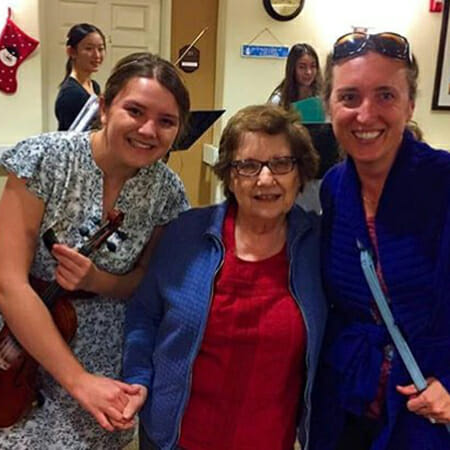
Anna Johnson says she has been a musician for her entire life. The seventeen-year-old violinist and saxophonist performed in competitions, participated in several music groups, and even in her free time, would play for local retirement homes. But when the highly competitive nature of the music world started to make her feel bitter, Anna decided to reconcile those feelings by using her musical talents, as well as her experiences playing for senior citizens, to bring the joy of music to her community.
During her sophomore year of high school, the Augura Hills, Calif. native created the nonprofit Harmonic Youth Orchestra, Inc., as a way to continue to serve both audiences and fellow musicians. The orchestra, which now consists of over 100 middle and high school students, is free and all-inclusive, regardless of playing level, and is focused on creating a fun, pressure-free environment for the performers. The group performs for at least one retirement home each weekend, as well as other events such as a Ronald McDonald House Los Angeles fundraiser for childhood cancer awareness and the 100th anniversary of the city library. Outside of practicing together, the orchestra also provides a peer mentoring program to any interested students, helping to foster the community feel toward music that Anna aspired for when she set out to create her organization.
Describe your volunteer role with Harmonic Youth Orchestra, Inc.
I completely started it toward my sophomore year. Now I’m a senior, so this is it’s third year. My whole life, I’ve been a musician — different instruments, different groups. The inspiration for this group came out of a number of things. First of all it came from my grandpa. He recently passed away, but when I was younger, he would volunteer at the retirement home and take me every weekend when we lived in Maryland. We would go and he would sit there with the patients. I was really little, but I would watch him, talk to them, room by room. People couldn’t even leave their room. It was more hospice. It was really inspiring and beautiful, so I had those memories from my youth. At the same time, on my own I had gone and played for different retirement homes as a musician. Every time you go, there’s this huge sense of gratefulness and everyone is so happy to hear your play. It’s a really peaceful, happy environment. There’s seniors who hum along. Definitely a really inspiring way to give back everything musicians have.
Another thing was at the time, I had been a really competitive musician, so I did competitions and I did more solo work. I was growing a little bit bitter toward that competitive nature of music, and trying to edge each other out as musicians and competing against each other. I was in all these groups and you had to pay thousands of dollars just to play with them. This had been turning myself against everything I had done since I was little. I was growing bitter. So I wanted to do something that was completely inclusive of all musicians, completely free. No matter your playing level, everyone appreciates you. I wanted to do something inclusive and focused on service and giving back, and not the more competitiveness and bettering yourself, but bettering the community through music. As a leader in my orchestra at school, I wanted to give the musicians at my school and schools all around these opportunities to feel the same way I did in playing for the retirement homes.
At the beginning of my sophomore year — I’m from a family of attorneys, so we all got together and sat down, got all the paperwork done. We filed a nonprofit and I developed a board. Most are my friends from orchestra, but the board consists of people from different high schools all around the county. We all started recruiting musicians. Right now, we have over 100 student musicians. We used social media and we used all the Google calendar stuff to connect and collaborate and play in concerts across the county, different retirement homes, community events. [We’re] a network of chamber musicians and performers, open to everyone, just to enrich the community through music and focus on that aspect.
Anna Johnson, left, organizes at least one performance for a local retirement home each week with her nonprofit Harmonic Youth Orchestra, Inc./Courtesy Anna Johnson
Can you describe the Music Peer Mentoring Program?
Basically, at our school we use the top ambassadors from each subcategory of music. As part of my board for Harmonic, I have it divided into subcategories. We have one for jazz, one for orchestra, one for concert band and one for choir. The leaders of each of those groups offer up their time at whichever high school they’re located at, and we’ll come in early mornings and we’ll sit with students. We offer peer tutoring for any music help they need. We don’t have a lot of tests for our music classes, so just nailing down their parts, preparing for performances, helping with recordings for different competitions or for school, stuff like that. Those are for more experienced musicians, but there are also kids at our school who are just starting an instrument for their first time in high school, or want to pick up a new instrument, or just want to learn something new. It varies anywhere from really first-time, inexperienced musicians to experienced musicians — tutoring, helping teach music in a peer-mentoring, friendly, free-of-expense way.
Why is music important to you?
I actually am the first musician in my family, so it didn’t come through the family. I experimented with so many different things when I was younger and for some reason music just always stuck with me. I think I have a lot of passion and emotion, and I feel like I can express all of that through music. Stress, anxiety, fear, it all comes out through music. The way you feel when you’re playing is beautiful. More so than that, my interest in music doesn’t really lie with the technicalities of the instrument or the logistics in playing. It really lies with the community. That’s why I decided to start this nonprofit and that’s why everything I’ve done with music in my later-high school years has revolved around community music. I do love the instrument itself, but what I really love about it is how it feels to play together and make music together with a group and with your friends.
Why do you want to spread music to your community and to youth who may not have other access to learning music?
I think like most things, it kind of can be compared to any global debate. Music is something that’s incredibly beautiful. It’s psychologically proven to have incredible connective powers and it just makes you feel good. It makes your feel great. It brings the community together in a way that nothing else really does. It connects people across generations, which I think is really cool. We’ll play music for the seniors at the retirement home and they’ll remember it and sing with us, everyone together at once, and it’s a really unique and powerful feeling.
That being said, I really don’t think that anybody should be discriminated in obtaining or having the opportunity to learn music or experience that feeling. That’s why we try to teach music to anybody who wants to learn music, and that’s why it’s incredibly important to spread it throughout your community.
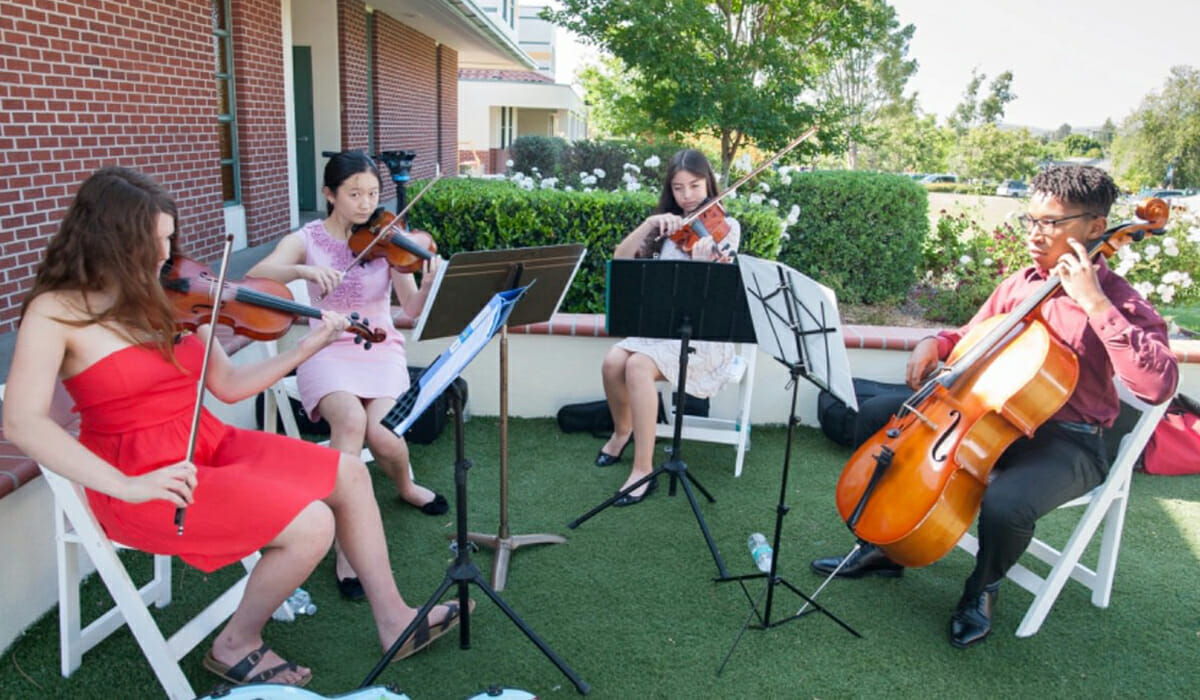
Anna Johnson, left, performs with her nonprofit Harmonic Youth Orchestra, Inc., a free and all-inclusive performance group for local youth musicians./Courtesy Anna Johnson
What kind of feedback have you gotten from those who listen to your performances as well as those who are involved in the orchestra?
We perform at the retirement homes and almost always, all the seniors will come up and they’ll give us hugs and kisses. It’s something you’ve never experienced before. I think they’re more grateful than any other audience member I’ve ever performed for. They find so much beauty in it. It’s really special. It’s kind of like a light in their day and it reminds them of their past. For the seniors, we try to play music more from their generation that reminds them of that. They’ll come up after and tell us stories. We’ve had people who were music teachers in their youth or musicians, and they’ll tell us all their memories and stories. It’s a way of connecting.
The students themselves I think are really grateful for the organization. We’ve gotten so many involved and I think that speaks for itself. On top of that, I think for almost anyone I’ve ever talked to and for myself included, I think it’s one of the most enriching music experiences we have in the community because it’s not stressful. There’s no pressure. It’s just kind and grateful and everyone appreciates you and it’s fun and it’s just with your friends. I think everyone really thoroughly enjoys it.
What’s been the most rewarding part of your work?
Probably the most rewarding part is being able to get to this point in the organization where it’s become extremely self sufficient and self run. Starting at the beginning, it was a lot of work to get everything going. You had to hammer musicians to show up to play and recruit musicians. It was hard to organize performances. Now I feel like I’ve gotten to a position where the board is very organized and very efficient and can kind of run on our own and I can depend on everyone. We have all these partnerships with different retirement homes across the county and people know us when we show up and play. All the weight has been lifted off recently for me and now it’s completely about enjoying the music, and feeling that sense of satisfaction and pride that this is something I created. Watching all these musicians start scheduling things on their own and performing for retirement homes even if I’m not there — I feel like it’s extended way beyond myself and will continue after I’m gone, which is one of the most rewarding feelings.
Why do you think it’s important for others to give back to their communities?
For every reason, but most importantly I think that community is really all we have at the end of the day. I think it’s the most important thing. I think when all else goes crazy, all else fails, community is something that always stands. Recently in my area, we’ve had a lot going on. Last year, we had those crazy wildfires. We all had to get evacuated, and we had those wildfires again this year. Last year, we had a few shootings in our local area. Especially during those times, you notice when all else goes crazy, community stands together and at the end of the day they’re always there for each other. That’s really all we have at the end of the day. It’s the most important foundation of anything, community supporting each other. I think it’s not only a privilege, but it also should be every individual’s duty to serve their communities.
What do you want people to learn from your story?
I would want people to take from my story what I kind of learned from my own personal journey, which was I would encourage people to use their talents and their skills in a more service-oriented way and think of how they can use their talents to give back to the community, and not only serve themselves but serve others.
16-year-old Megan Chen says if she were a plant she’d be a tomato. Reliable, fast and easy to grow, tomatoes are often people’s first foray into gardening. So it makes sense that Megan – as a tomato – would introduce container gardening to her community with The Urban Garden Initiative.
Knowing that she lived in a food desert where many students didn’t have access to fresh fruits or vegetables, Megan decided to find a solution to help students have better access to nutritious food. After researching food deserts, Megan started with small workshops to help students grow their own container gardens. An easy, transportable urban gardening method, container gardening is a great space saver and has almost an equal yield compared to a traditional garden.
Each TUGI workshop typically lasts 45 minutes to one hour, and contains an educational component as well as a hands-on gardening component. Fast, reliable, and easy, the seeds of her workshop eventually grew into the organization’s mission is to inspire and empower youth to achieve urban sustainability though a gardening-based educational program. In order to achieve these goals, they have designed a year-long program that engages youth in environmental education as well as urban gardening in both the fall and the spring time. Taking her urban gardening workshop on the road to schools throughout New Castle County in Delaware, Megan is teaching students from preschool through middle school that it’s fun to get your hands dirty, and easy to plant and maintain an indoor or outdoor garden. In the spring, TUGI will offer 6-week workshops at 15 area schools – and new chapters will soon be opening in other states.
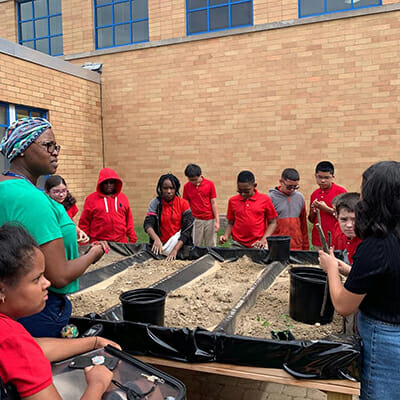
Megan Chen demonstrates a gardening technique with students.
As founder and director of The Urban Garden Initiative, Megan has developed her leadership skills and learned to wear a lot of hats. She leads a growing team of volunteers and spends much of her time planning curriculum and running the organization’s social media.
“Community service gives you a whole new and deeper understanding and helps you expand your horizons,” Megan Chen says. “Doing activities with middle schoolers and teaching them about the environment and hands on gardening is rewarding.”
Megan’s passion for the environment and her community is the foundation for her work with TUGI. And her love for environmental science drives her desire to teach other young people about food deserts and the benefits of urban gardening.
“If there is a problem you see or something you want to solve, don’t be afraid to start small and do something about it. Don’t be afraid to get started,” said Megan. “Age is not a limiting factor. You don’t have to graduate college, or be a certain age to get things started. Have a network of people to help.”
Megan Chen is planting seeds of change in her community and helping students grow into mindful gardeners.
Do you want to make a difference in your community like Megan Chen? Find local volunteer opportunities.
Shelter Volunteer Gives Dogs Second Chance at Life
Meet Daily Point of Light Award honoree Savannah Loehr. Read her story and nominate an outstanding volunteer or family as a Daily Point of Light.
As a child, Savannah Loehr started volunteering at Posey County Pound Puppies in Posey County, Indiana with her grandmother. The now 19-year-old student has continued to support the animal shelter in an effort to give all stray dogs a new home and a second chance at life.
A self-proclaimed nurturer, the New Harmony, Indiana resident says she’s interacted with hundreds of dogs throughout her service, initially walking and feeding the dogs, then as she got older, graduating to organizing and hosting events to fundraise for PC Pound Puppies.
Savannah’s service at the shelter is one part of a variety of volunteer work that the teen has committed to as she works to better her community.
What inspires you to volunteer?
I’m a nurturer and I’m very empathetic. I’m able to relate to people and animals. I know a lot of people in my community, and I know I am helping others through my volunteerism.
Describe your role with Posey County Pound Puppies.
Initially, I would walk the shelter dogs a few days a week, feed and play with them. Now, I help at PC Pound Puppies fundraisers and benefits. I support their events by helping to organize the craft show, selling raffle tickets and soliciting donations from local businesses.
Share one personal story with me from your volunteerism.
We had this one little dog, a pug, at the shelter because he’d been rescued from an abandoned home. Many animals had been left behind in a home, locked up in the basement, and shelter staff including my biological father, Waylon, went to rescue the dogs. We named the dog “Waylon” because of that, and we still get updates about the dog from his new family. He’s doing fantastic now, he’s completely playful and you wouldn’t know what he’d been through in the past.
Your volunteerism isn’t limited to service at the shelter. Explain.
I once adopted a family for Christmas so they had presents under the tree, and have also gathered food items for families at Thanksgiving. I have volunteered to raise awareness about child abuse prevention, help connect underprivileged children with law enforcement through Shop with a Cop and more. I’ve fundraised for the Special Olympics, and helped to organize a hygiene drive for the community.
Savannah Loehr helped organize a walk to end Alzheimer’s in August 2018./Courtesy Savanna Loehr
What’s been the most rewarding part of your service?
Seeing the expression on these animals faces once we’ve rescued them is rewarding to me. These dogs will come in to the shelter torn to pieces from dog fighting, or their owners have abused them, or they’ve been thrown out in the streets and there’s nowhere for them to go. Interacting with these dogs, seeing them receive treatment and progress back to their normal selves is a reward in itself to me.
What have you learned through your experiences as a volunteer?
I’ve learned that some individuals haven’t experienced the privilege that I have, and by working and volunteering, you understand what is going on in your community and how you can help. Service has made me more aware of changes that need to happen in my community, and the need to be more involved.
When you’re not in school or volunteering, how do you spend your free time?
I’m involved with numerous clubs at my school, including Key Club, which encourages students to be involved in their community through service, and SADD, which stands for “students against destructive decisions.”
Teen Serves as Next-Gen Voice of Wildlife Conservation
Meet Daily Point of Light Award honoree Taegen Yardley. Read her story and nominate an outstanding volunteer or family as a Daily Point of Light.
Taegen Yardley says as a 6th grader she learned about the horrifics of wildlife trafficking, and discovered that trafficking was even taking place in her home state of Vermont. Committing to promoting wildlife conservation, Taegan decided to use her voice to protect animals and raise awareness about trafficking.
Initially focusing on elephant conservation with her initiative, A World with Elephants, the now 16-year-old Stowe, Vermont resident quickly expanded her efforts, discovering that the issue was widespread, with thousands of wildlife species threatened by illegal and unsustainable wildlife trade. Estimated to be a multibillion-dollar business, trafficking involves the unlawful harvest of and trade in live animals and plants or parts and products derived from them.
Connecting with thousands of people through her educational conservation movies, Taegen is one of the next-generation of leaders raising awareness about the planet’s most critically endangered species and the impact of decreasing biodiversity.
What inspires you to volunteer?
This was my first real introduction into advocacy. Seeing that my voice had power was an “aha moment” for me, because I realized that young voices can make a difference. A lot of youth today think their voices are too small, but I’ve discovered through my volunteerism that I can get other kids to raise their voices about unique issues they are passionate about.
Describe your role with A World with Elephants.
As the founder of A World with Elephants, I am educating the world about our rapidly decreasing biodiversity and the plight of our planet’s most critically endangered species. As the leader of this initiative, I post on our Facebook page to raise awareness, and I speak to students to educate them about these issues. Additionally, I produce and promote movies about wildlife and conservation issues. My former social students teacher, Mark Cline Lucey, who is also a filmmaker, handles all of the filming and editing for my movies.
Why have you decided to help endangered animals?
I’ve always loved animals, and the altruism and compassion elephants have for others is astounding to me, and are qualities that drew me to them. By volunteering to help endangered species, I am giving future generations the chance to witness these amazing animals on this amazing planet.
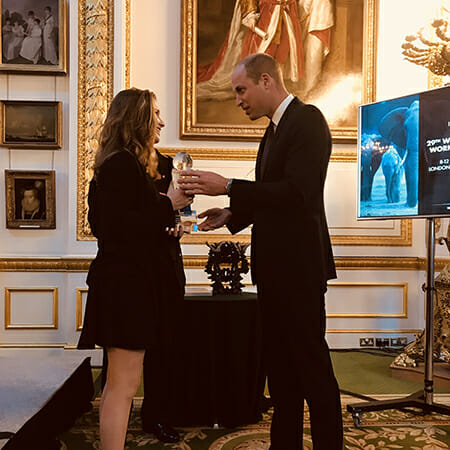
Taegen Yardley was recently awarded Interpol’s “Fostering Partnerships in Conservation Award” by Prince William, Duke of Cambridge./Courtesy Taegen Yardley
As part of your volunteerism, you produce conservation movies. Explain.
I’ve produced five movies thus far, and these mini-documentaries have been shown around the world. I’ve been invited to speak at the National Geographic Society, the Department of the Interior, and the United Nations. The U.S. Fish and Wildlife Service uses some of my movies in courses being taught in San Salvador, Budapest and Vietnam.
Share one personal story with me from your volunteerism.
I was speaking to 3rd graders at a local school and showed them one of my movies. Trafficking is a difficult topic to teach young kids because it’s heartbreaking to watch the animals being slaughtered. One of the kids started crying. All the students came up to me after the movie asking what they could do to stop the killing of animals. It was validation for me that I am making a difference across my generation.
When you’re not at school or volunteering, what do you do for fun?
I am a ski racer and ski coach. I enjoy teaching younger kids how to race. I also started a girls boxing group, and I’m really into theater and singing. I also spend my spare time hiking and hanging out with my family.
What’s been the most rewarding part of your service?
Seeing the impact I am making on others and the ripple effect my voice has. When I inspire someone to want to learn more and dive deeper into an issue they are passionate about, that’s extremely rewarding.
Teen Violinist Brings ‘Joy of Music’ to Community Members of All Ages
Meet Daily Point of Light Award honoree Joseph Zhong. Read his story and nominate an outstanding volunteer or family as a Daily Point of Light.
Music has been an integral part of sixteen-year-old Joseph Zhong’s life since he began performing violin in third grade at the urging of his grandmother. As a token of gratitude to her, as well as a way to help spread the therapeutic effects Joseph himself felt from playing music, he decided to start performing for residents at senior living centers. When the elderly at the centers responded positively and more of his friends and fellow musicians began to join him, his organization Joy of Music was born.
Joy of Music brings monthly live concerts to the elderly community around Joseph’s hometown of Omaha, Neb. The concerts are performed by students ranging from second grade to college. The organization also serves as a mentoring program to the younger students, teaching them both musical skills as well as building their confidence through performing. Right now, the group consists of mainly violinists and pianists, but is also expanding into other instruments such as cello and saxophone. Joseph hopes Joy of Music will grow in the coming years to not only have more instruments, but also have performances in more senior living communities — so even more people, young and old, can experience the happiness brought by music.
Describe your volunteer role with Joy of Music.
Joy of Music is a volunteer program that helps bring live music and live concerts to the elderly in the community, as well as provide music education for the young musicians in our community. When we visit these senior living communities, we also typically bring gifts and we do cookie deliveries … We try to visit them once a month for concerts, but then we also try to visit them every other week, [doing] cookie deliveries and just dropping off notes telling them that we’re thankful for them. On the other side, our mentoring program, we try to provide lessons for the youth in the Omaha community for right now violin and piano, and we’re trying to expand that a little bit.
What made you want to start Joy of Music?
Initially, what led me to create this was my grandmother raised me until I was in about sixth grade, so I always felt indebted to the elderly because of what my grandmother has done. So the summer heading into my eighth-grade year, I started playing at retirement homes by myself. Then a few of my friends wanted to join me, so we formed a quartet. Then I had more friends who wanted to join me so I formed another group, the Joy Group, which consisted of people of all ages, from second grade to college, and we started performing. What I found out when we started performing is that the younger people in our group sometimes didn’t know the music well enough, so we stared the mentoring program because of that. It just kind of grew from that.
When did you first get involved with music, and why is it important to you?
I started getting involved in music in third grade. I stared playing music because my grandmother had a violin around in her house and she gave it to me and asked me to start playing it. Ever since, violin and music have been an integral part of my life. For me, violin has a lot of therapeutic effects, whether it’s as a performer or seeing the therapeutic effects on the audience members. Especially during middle school, it was a way for me to destress and for me to let go of my feelings, that type of thing. That’s why it’s always been important to me, and being able to see how the same affect is had on the audience when I go out to perform is also really meaningful for me.
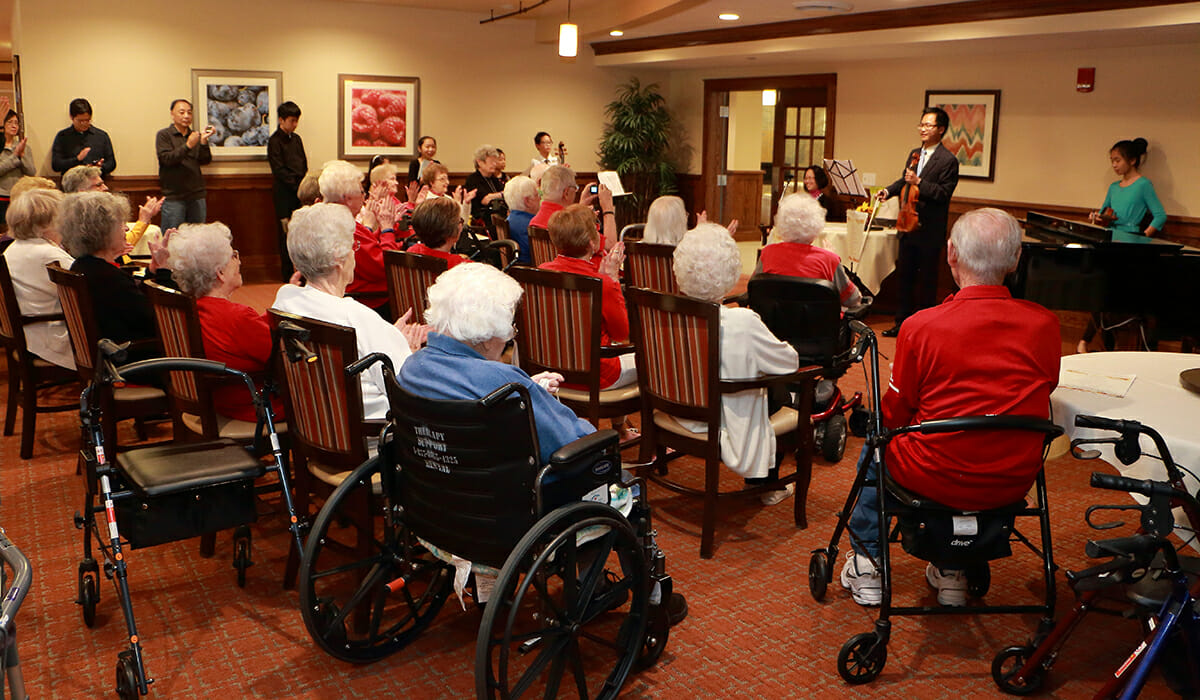
Joseph Zhong, standing at the front of the room, leads Joy of Music to perform a concert for a local senior living community once a month./Courtesy Joseph Zhong
How does Joy of Music benefit the students as well as the elderly communities?
The elderly in our community typically don’t have people who either visit them or bring them entertainment. Usually sometimes they don’t have both. By having a group of students that go and visit the elderly to show them they are still appreciated in the community, and that we want to bring them entertainment, is very important because oftentimes I feel like they also feel left out. Based off the feedback forms I usually give that I get back form these elderly people, they’re really happy that we come and they’re a lot more joyful when we come. I actually had a personal experience with this. When we first started performing at the senior living community, you could really tell that the elderly in that community were very down. The atmosphere is really, really heavy. In fact, when I first started playing, it was really hard for me to create a positive vibe with music, but by the time that we got to the end of the show, a lot of the elderly were actually standing up and singing along and were really happy. The therapeutic effects of the music really brought them joy and also made them a part of the community. The therapeutics of music can also help people live a longer life. That’s how we try to help the elderly.
The youth music community in Omaha, Neb. is slowly dying. It’s shown in our area’s local youth orchestra. They’re slowly getting less and less students as well as getting less and less funding because they don’t have many students. By us promoting music to the community and helping mentor these young musicians, we’re hoping it can continue to sustain the Omaha musical community going forward.
What kind of feedback have you gotten from students being mentored?
They really enjoy the experience. They’re hoping that the program continues even after I graduate for college, so a lot of them are gearing up for that. I had a student who struggled with performing on stage. He had very little confidence in his playing abilities but he was a really good player. I was slowly able to build up his confidence by first having him perform in bigger groups. Then slowly the group size got smaller until we were doing duets, and now he’s performing solo. He is really thankful for me helping him overcome that natural shyness he had, and that helped him gain confidence.
What’s been the most rewarding part of your work?
I think the most rewarding part is really twofold. The first fold is seeing the mentees grow in their abilities to both play instruments, as well as their confidence. Seeing them enjoy music so much really drives what I do. I also love spending time with the elderly after the performance because talking with them during that time is super nice. They’re really happy that you came, and we can also get honest feedback from them during those times as well. It’s really great to spend the time to get to know them and know their story and how they contribute to making our community a better place.
Why do you think it’s important for others to give back?
I think it’s important because oftentimes we as young people, and also as students, are being taken care of, whether by our parents or by people in our community. We are the ones being taught and we are the ones receiving all the benefits of living in a community without really contributing very much back to it. I feel like giving back even when you’re young helps to create a spirit of making sure the community is always at the forefront of what you think, and always giving back to the community regardless of what stage you’re in in your life. The habits that we develop when we are younger stay with us even when we’re older. Ensuring students volunteer and help out when they’re younger will create a habit that they will also maintain when they are older.
What do you want people to learn from your story?
What I really want them to learn is that the changes that we make can start off really small. The organization that I built really started off as a small thing of me wanting to perform for the elderly and wanting to bring music to them. It slowly grew bigger and bigger and bigger. I feel like the changes we need to make this world a better place can start really small. Surround yourself with like-minded people, because it helps you make those changes bigger and bigger and bigger, creating a giant ripple effect.
Young Girl with Alopecia Volunteers to Help Other Bald Children Feel Confident
Meet Daily Point of Light Award honoree Rosie Quinn. Read her story and nominate an outstanding volunteer or family as a Daily Point of Light.
She’s a bubbly third-grader who talks a mile a minute. A self-described “confident” young girl who really likes to read, play softball and piano. She says one day that she’ll be a Supreme Court justice, and her younger sister will be president. 8-year-old Rosie Quinn also has Alopecia universalis, an autoimmune disease she was diagnosed with as a toddler that causes sudden and complete hair loss.
When Rosie’s parents realized the power an artistic outlet such as painting carried for their young child, her mother, Paula, decided to transfer her most-prized paintings to a head scarf for Rosie, so that the attention on Rosie’s head would focus on her beautiful art and natural ability, instead of her hair loss.
Striving to help other bald children who may receive unwanted attention as a result of their hair loss, the Chicago, Illinois child founded Coming Up Rosies along with her parents. Creating head and neck scarves and superhero capes out of original artwork, the organization is dedicated to providing art therapy and the chance for children to wear their masterpieces with pride. Donating more than 1,300 Smile Kits full of art supplies and a customizable scarf to over 20 children’s hospitals and treatment centers around the country thus far, Rosie is helping to empower other children to love themselves unconditionally, hair or no hair.
What inspires you to volunteer?
Rosie:When I was little, I used to get bullied a lot. My mom suggested we use one of my paintings on a headscarf, and after five minutes of looking in the mirror, I decided I wanted to give a scarf to all the bald kids in the world. We want to help other kids, and it makes me smile and feel really accomplished when we get a picture, video or letter from someone telling us how they have used our Smile Kits.
Explain the name behind “Coming Up Rosies”.
Paula: Rosie has shown me how to make lemonade out of lemons, and now I know, after all, that everything is Coming Up Rosies. Our mission is to restore confidence, happiness and pride to anyone struggling with low self-esteem during their medical journey, especially bald children.
Describe your role with Coming Up Rosies.
Rosie: We raise awareness about Coming Up Rosies and attend events at the Ronald McDonald House. We tell people everywhere about our organization – even people at Starbucks that we run into. I sign my name using a Sharpie on our business cards so that people have information about us. We rely on donations to help us buy Smile Kit materials for children. We also host an annual race called 3 Miles for Smiles to fundraise and support our mission.
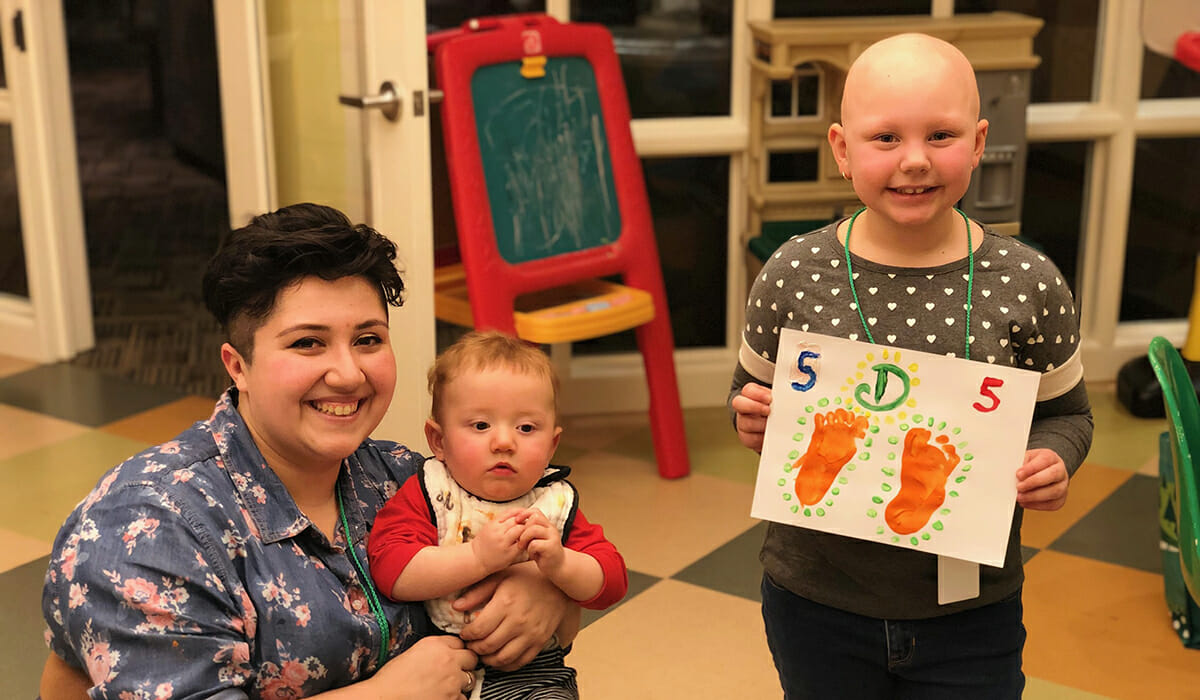
Coming Up Rosies is focused on restoring confidence, happiness and pride to anyone struggling with low self-esteem during their medical journey, especially bald children./Courtesy Rosie Quinn / Coming Up Rosies
Share one personal story with me from your volunteerism.
Rosie: A girl named Riley has cancer and she sent us a video of her opening her scarf. She really liked it. We like to make other kids smile and by sending them kits and telling us how much they like the scarves, they make us smile back. I’m used to not having hair now, and I’m already confident when I step outside, so I don’t want to hide my head, but other kids might want to. That’s what our scarves are for.
What’s one way you hope to inspire others in your service?
Rosie: If everyone just tried to make each other happy and smile, no one would be sad. I want people to find someone left out at school, or having a hard time, and try to make them smile and happy. Even helping your community by picking up trash, you might help connect with someone else.
What’s in the future for Coming Up Rosies?
Rosie:We’ve sent scarves to people with alopecia as far away as Ireland and Australia. We want to help many people so that our organization grows and grows.
Paula: Her long-term goal is to provide Smile Kits to each of the 300 children’s hospitals across the U.S. We’ve sent kits to children’s hospitals and treatment centers all over the country, including to the Ronald McDonald House, and hospitals in Massachusetts, Florida, Indiana, Texas and Missouri.
What have you learned through your experiences as a volunteer?
Everyone is different and everyone has lots of love and we love going and being there for them.
How can readers help?
Please check out our website for more information about how you can help.
Turning a Disability into His Purpose, Texas Teen Provides Hearing Aids to Those in Need
Meet Daily Point of Light Award honoree Braden Baker. Read his story and nominate an outstanding volunteer or family as a Daily Point of Light.
13-year-old Braden Baker’s dog Chewy might have taken his name a bit too literally when he not once, but twice chewed up Braden’s hearing aids. The Texas teen was born with bilateral sensorineural hearing loss, so his hearing aids are essential to his everyday life.
Braden’s parents sat him down and told him the importance of taking good care of his hearing aids because they were expensive, and some families couldn’t afford them. But in this moment, something clicked inside Braden, and instead of just putting away his hearing aids in a safer place, he took the lesson a step further and started a GoFundMe to provide hearing aids for those in need.
“I think one of the biggest things in life is communication and being able to hear the sounds outside, being able to talk to your family. It’s just so important to me. I just want everyone in the world to be able to experience it,” Braden said.
Donations started rolling in from family and friends. $100, $500, thousands… But after Braden was featured on The Ellen Show in 2017, awareness of his cause spread like wildfire and donations poured in. Braden’s initial goal was to raise $1,000, but his GoFundMe has now raised more than $112,000.
“People kept donating and it just kept blowing up,” Braden said. “I never expected anything like that, and it was just mind-blowing how all these people could actually help me. It inspired me to keep going and it made me realize that I have a voice.”
Braden (right) says seeing the smile spread across a person’s face when they hear for the first time is the most rewarding part of his work./ Courtesy Ashley Baker
When trying to decide where to donate the money he had raised, Braden simply looked at his own hearing aids, which were made by the company Oticon. The hearing aid manufacturer has their own humanitarian organization that provides refurbished hearing aids to underserved populations around the world.
Through Oticon, Braden was able to meet audiologist Dr. Kamal Elliot who told Braden that he needed to see his funds in action. So she and Braden, along with Entheos Audiology Cooperative, set out to the Panajachel area of Guatemala for five days in 2017. There, Braden was able to see his first “hearing smile.”
“A hearing smile is when someone is just so joyed that they’re finally able to hear for the very first time in their lives,” Braden explained. “They laugh or they cry, or they just have this big smile on their face… Just being able to be there to witness all this was probably the biggest moment of my life.”
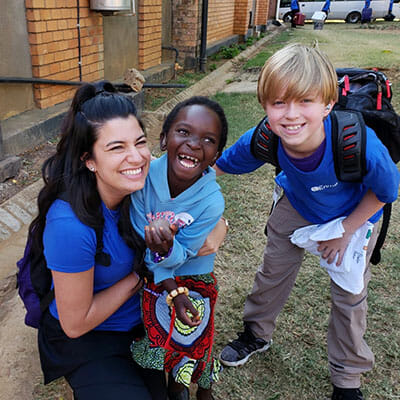
Since then, Braden has become an official ambassador for Oticon and Entheos’ Hearing the Call and has visited multiple countries including Ecuador and Zambia to help provide hundreds of hearing aids. But some of his favorite “hearing smiles” were from people in his own hometown of Fort Worth.
“Our local public school has three audiologists and they give hearing aids to hearing impaired kids who can’t afford them,” Braden said. “But they give them the hearing aids in the morning and then they have to turn them in at the end of the day so they won’t be able to hear very well on the weekends and on breaks. So I was able to raise enough money to give all of these kids their own hearing aids and it was such a good time.”
Braden travels often around the U.S. to speak at conferences and other events about his cause. He even presented his own TED Talk titled “You’re Never Too Young to Make an Impact” last year. His mother, Ashley, says it amazes her each time this young teenager is able to speak in front of a crowd of hundreds.
“His disability has become his greatest ability,” Ashley said. “He’s taken that disability and said, ‘Look what I was able to do with it. Look at how I was able to play it forward.’”
Braden’s passion for helping others has caught a lot of media attention. He’s even featured on “The Marvel Hero Project” on Disney+, which celebrates a number of young heroes making a difference in their communities. But Ashley says even if all this media and attention disappears tomorrow, she and Braden will forever be changed by this experience and the audiologists who showed them the power of giving hearing to somebody.
“I just want to let people know that if they truly believe in something, they can make it happen,” Braden said.