Volunteer Duo Double the Service and Maximize Smiles with “Project Smile AZ” Service
Meet Daily Point of Light Award honorees Hurshneet and Pravneet Chadha. Read their story and nominate an outstanding volunteer or family as a Daily Point of Light.
As the COVID-19 outbreak worsened in March, Hurshneet and Pravneet Chadha say their parents, both healthcare workers, were coming home each night and sharing stories of how lonely their patients were due to restricted visitor policies. Wanting to boost morale for these isolated patients who were unable to have family or friends by their side, the Phoenix, Arizona brothers decided to deliver cheer and hope in the form of “smile cards”.
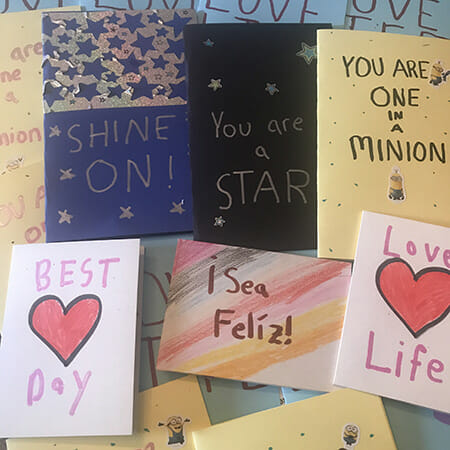
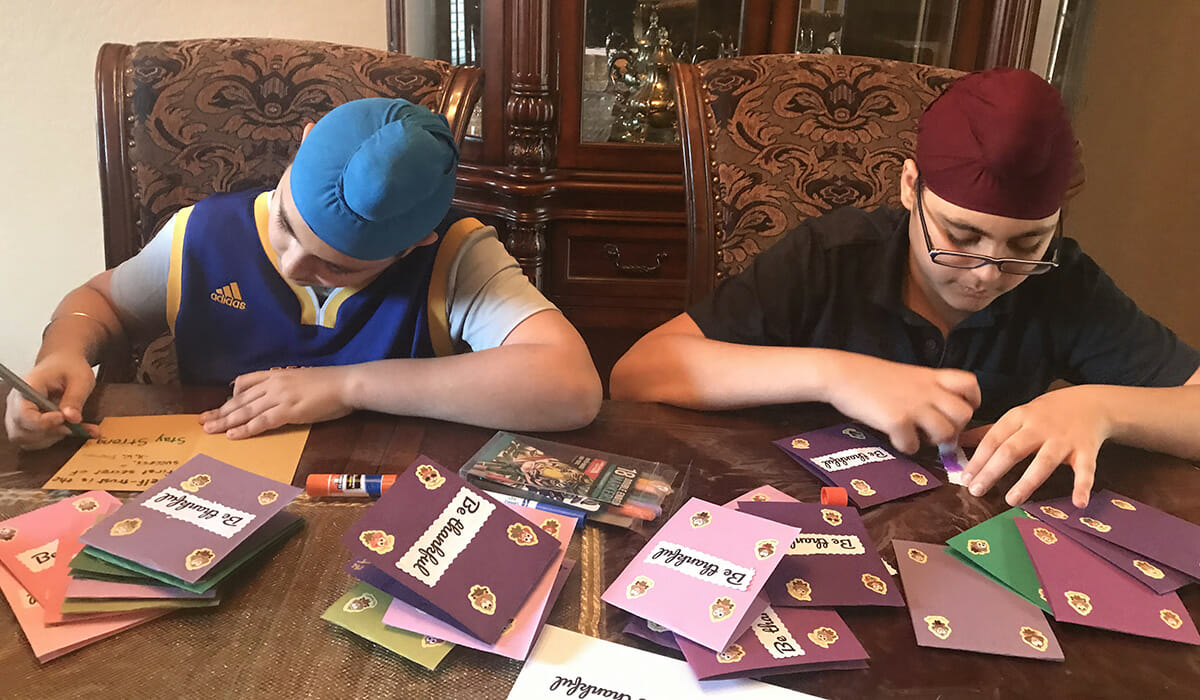
Through their Project Smile AZ initiative, Hurshneet, aged 15, and Pravneet, aged 12, have made more than 2,400 cards filled with inspiring messages for hospitalized patients and children and adults in need. Additionally, the boys are helping other children to volunteer, by sharing Project Smile AZ Kits for kids who want to make cards but lack the resources. Bringing a smile to everyone from ‘A to Z’, Hurshneet and Pravneet are using handmade cards to help get patients through tough times.
What inspires you to volunteer?
Pravneet: We’re inspired to give back to the community where we grew up. Because of COVID-19, patients aren’t able to receive visitors. These cards cheer patients up, remind them they aren’t alone and motivate them to help get them through their illness.
Through their Project Smile AZ initiative, Hurshneet and Pravneet Chadna have made more than 2,400 cards filled with inspiring messages for hospitalized patients and children and adults in need. /Courtesy Hurshneet and Pravneet Chadha
Describe your volunteerism with Project Smile AZ.
Pravneet: As founders and Chief Smile Officers, we make most of the cards on our own, but we’ve also received a ton of card deliveries through our Project Smile AZ Kits from other people across the country, including as far away Boston and India. Close to 100 kits have been donated to children and adults in need. We also manage fundraising for our initiative.
How are you inspiring people with these smile cards?
Hurshneet: I include a list of quotes in the card. (My brother and I) will find inspirational messages online, and we also draw anything that we think would be related to the quote that helps give the person positive vibes and helps them recover.
Share one personal story with me from your volunteerism.
Hurshneet: Me and my mom visited a children’s hospital recently to deliver kits, and the hospital’s CEO greeted us when we arrived. The CEO told us what an impact the cards would have on the patients, and that motivated me to continue this service. It felt great to hear that I am making a change to society and making a change for the better. Through volunteering, I am doing my part in this wonderful community.
Why do you think it’s important for others to give back?
Pravneet: I am where I am now because of the community I grew up in. It feels right to give back to the community that raises you up along with your family.
What’s been the most rewarding part of your service?
Hurshneet: Seeing the smiles on the faces of the hospital staff and patients we talk to has truly made an impact on my life. We are changing the world through our service.
What’s in the future for your volunteerism?
Pravneet: We hope to continue our service after the pandemic. This is just another way to give back to the community.
In one word, what does volunteering mean to you?
Pravneet: Life. Hurshneet: Change.
Hurshneet Chadha – “I include a list of quotes in the card. (My brother and I) will find inspirational messages online, and we also draw anything that we think would be related to the quote that helps give the person positive vibes and helps them recover.”/Courtesy Hurshneet and Pravneet Chadha
When you’re not busy in school or volunteering, what do you do for fun?
Pravneet: I play basketball and also make cards. Hurshneet: I play video games or edit videos.
How can readers help?
We are holding a holiday card drive as holidays can be particularly emotionally hard for patients in hospitals. Please visit our website for more information about how to give back and how to request cards.
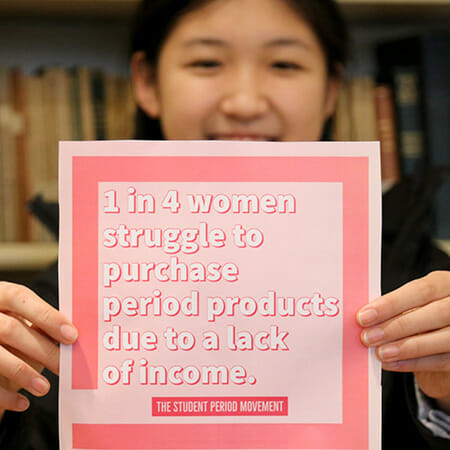
Roughly half the human population has or will experience menstruation at some point in their lives, but 1 in 4 women struggle to afford period products, and amongst low-income women in the U.S., nearly two-thirds said they couldn’t afford menstrual hygiene products. After watching a documentary on the topic, 16-year-old Joanna Lin says she discovered the alarming stigma and inequity surrounding menstruation, and dedicated her volunteerism to raise awareness and reform period education.
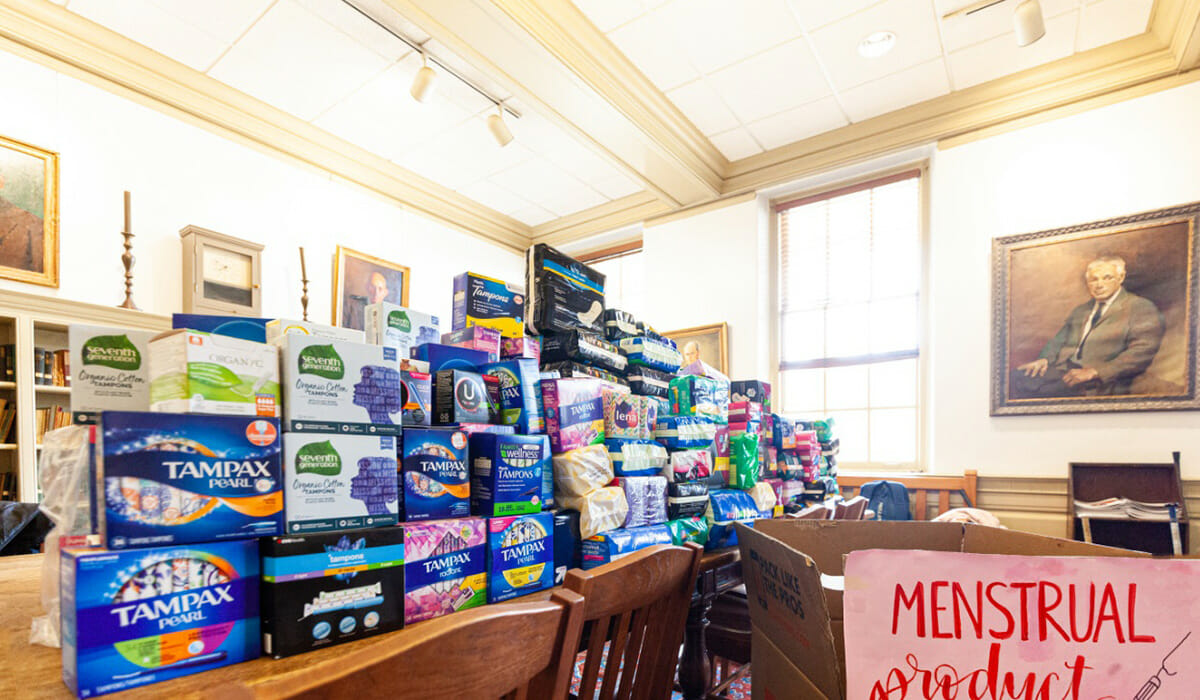
Launching The Student Period Movement in 2019, the Ambler, Pennsylvania high school junior has been joined by other student volunteers across the country to support menstrual equity and dismantle the stigma about periods. Raising more than $1,000 and donating over 5,000 individual menstrual products thus far, Joanna is helping to support homeless, low-income and student populations by changing the period education system and origins of the menstrual taboo.
What inspires you to volunteer?
I didn’t know much about the menstrual stigma. It’s important to understand the issue and to recognize the impact of what the stigma can cause, especially for low-income or otherwise underserved populations. There are young people in the world who miss school because of the shame of having periods. Even in the U.S., the so-called “Pink Tax” menstrual product tax exists in 31 states. Awareness and action is a really big step towards fostering positive change that can spread rapidly.
Joanna has dedicated her volunteerism to raise awareness of menstruation inequities and reform period education./Courtesy Joanna Lin
Describe your volunteerism with The Student Period Movement.
As founder and president, I work with about 20 or so student volunteers across the country on varied monthly projects including fundraising for homeless menstruators and hosting online webinars and docuseries. I also meet with my fellow volunteers and manage community collaborations with organizations dedicated to helping populations across the U.S. and internationally.
Share one personal story with me from your volunteerism.
I am a student at Germantown Friends School, and we ran a menstrual product drive there. After the drive, we noticed a large change, particularly in the middle school students. Teachers said their students were being more vocal about asking for menstrual products, and some students even put menstrual products for others to use in the school bathrooms. It was exciting to discover that we increased awareness amongst these students, and inspired them to take further action to help their peers.
Why do you think it’s important for others to give back?
Giving back is essential for awareness and action. Volunteering is the first step towards creating awareness and action. Through service, we can reform the process and effect systemic change.
What’s been the most rewarding part of your service?
It’s been rewarding working with the volunteer team. Connecting with people who have similar interest in our cause has been extremely heartwarming.
How have you continued to volunteer throughout the COVID-19 pandemic?
The pandemic has depleted menstrual products for a lot of homeless shelters, so we’ve continued to fundraise online to help support homeless menstruators. Our plans to hold in-person seminars and possibly meet with lawmakers have been put on hold. We’ve switched to hosting more webinars, but since many of our volunteers live in different places, we are continuing to communicate virtually as we did before.
The Student Period Movement is led by youth volunteers across the U.S. who are supporting homeless, low-income and student populations by changing the period education system and origins of the menstrual taboo. /Courtesy Joanna Lin
In one word, what does volunteering mean to you?
Change. Specifically with The Student Period Movement, we are volunteering to initiate change and spread awareness for an issue that has not been brought to many people’s attention for a long time.
When you’re not busy volunteering or in school, what do you do for fun?
I play tennis and I also play for my high school tennis team. I also enjoy oil painting.
Volunteer Helps Provide Food ‘For the Kids’ of Salt Lake City
Meet Daily Point of Light Award honoree Suzanne Meyer. Read her story and nominate an outstanding volunteer or family as a Point of Light.
A chance encounter in a Salt Lake City Hyatt hotel led Suzanne Meyer to For the Kids, a nonprofit that provides food for children at local Title I schools to take home over the weekend. Inspired by their message, Suzanne became their first volunteer, working out of a supply closet to sort and fill bags of food for 75 kids. Seven years later, For the Kids now provides 600 meals a week to two schools, and has numerous volunteers that Suzanne helps organize not from a supply closet, but from the nonprofit’s own office.
For the Kids also helps provide meals for the whole family during Thanksgiving and Christmas, and was able to provide some extra food over the summer during the COVID-19 pandemic. This year, For the Kids served Thanksgiving dinner to 925 families from three different schools. In the seven years that For the Kids has been providing food, studies have shown that the kids’ test scores have increased due to being able to focus on their studies rather than where they will get their next meal.
Describe your volunteer role with For the Kids.
I’ve been with them for almost seven years now. I started out before it was For the Kids, when the director did it out of her own office. We fill bags of food. We started sponsoring with one, and we’re now up to two Title I schools in Salt Lake City. We give bags of food to kids in need to last them through the weekend. They’ll have two breakfasts, two lunches, two dinners and two snacks. We started with 75 kids when I started, and we’re up to 600 kids now. I started being the only one filling the bags, sorting them by grade level, and bringing them to the school. We now have an army of volunteers who help us out, so I don’t do as much of the sorting. I’m now organizing the volunteers to do the sorting. I also am involved with fundraising, calling to try to get people to donate, and then picking up the donations.
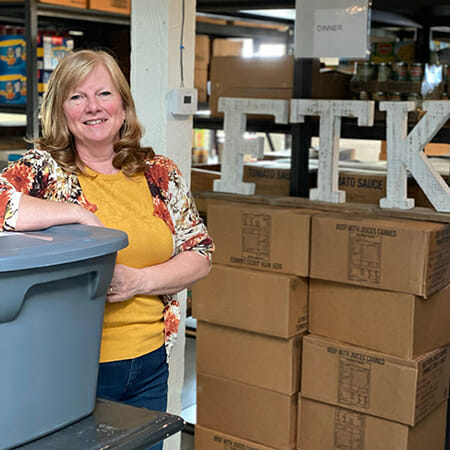
A chance encounter led to Suzanne Meyer becoming the first volunteer for For the Kids, a nonprofit she has volunteered with for the past seven years./Courtesy Suzanne Meyer
What first inspired you to start volunteering with For the Kids?
It was funny, I fell into this charity. We had moved here to Salt Lake seven years ago and while we were house hunting, our kids came to visit and stayed in a hotel. The director of my charity worked at that hotel and was having a small fundraiser. I stumbled upon it and spent some money, and I thought, ‘Well, I could do more than just spend some money at a fundraiser.’ She told me what she did, I asked her if I could help in anyway, and she said sure. I was her first volunteer and at that time, there were just three of us working. I was born to a solidly middle-class family and I wanted for nothing. I’m in a nice house now. We have secure jobs. I have what I need, and there’s so many people out there that don’t. It makes me feel good to know in a small way, I can change a few peoples’ lives.
Can you talk about the importance of these kids having that access to food over the weekend?
It’s hugely important and it’s not just truly the weekend. The teachers were saying some of these kids were coming back on Monday and you could hear their stomachs rumbling. They can’t concentrate on learning when they’re thinking about how hungry they are. We have seen in studies that since we’ve been doing this in the past seven years, their test grades have gone up, up, up, because that’s one less worry for these kids. They can eat, they don’t have to worry about being hungry, and they can concentrate on being able to read a book at home or being able to do their homework. Kids have so much to worry about in the modern world. The last thing they need to worry about it whether or not they’re hungry.
What has it been like to see For the Kids grow so exponentially over the years?
It’s pretty unbelievable. When I started, I was working out of a storage closet in a Hyatt downtown, barely room for two people in this little closet, and putting bags together. We now have a small office space that’s been given to us at a good price where we’ve just got buckets and buckets of food. Every time we add more kids I’m amazed, and we do it. I can’t believe that it’s as big now as it is from when I started with it. It really is amazing.
What’s been the most rewarding part of your work?
I don’t interact with the kids very much. We just deliver the food outside their classrooms and walk away and don’t see them. But every once in awhile when you’re in the school and you’re carrying the blue bags through the hallways, they look at you and go, “You’re the food lady!” and they get very excited. Knowing that these kids look at us and go, “Oh, you’re helping me,” that’s been very fun — to see the kids smile, see the kids excited about it.
Why do you think it’s important for others to give back?
I think community is the building block of our society. You help those around you, particularly nowadays when people are not living near their families anymore. When my parents grew up, you didn’t move more than 20 miles away from your family. Nowadays, a lot of people, their community is everybody they live with but not necessarily their family. You need to rely on your community sometimes because your family is not there. If you have a strong community, then that radiates out. Then you have strong communities get together, and before you know, you have a very strong society. But you have to start at the base.
What do you want people to learn from your story?
To be hopeful. There is always somebody out there who is going to help you. You maybe need to look for it, but you’re not alone. There are people out there who will catch you when you fall. They are there for you. You’re not alone.
Volunteer Brings Together Massachusetts Community to Make Masks for Healthcare Professionals
Meet Daily Point of Light Award honoree Heather Staples-Heitke. Read her story and nominate an outstanding volunteer or family as a Point of Light.
At the start of the COVID-19 pandemic in March, Heather Staples-Heitke was upset to hear about the lack of personal protective equipment for healthcare workers in her Beverly, Mass. community — including her wife, brother and sister-in-law, who all work at their local hospital. She said her brother, who was transferred to work on a COVID floor, was told to bring in whatever he could to cover his face because there were not enough masks to go around.
Wanting to help out and having sewn for over a decade, Heather made masks for her family members. She was inspired to take it a step further by creating a Facebook group, North Shore Fabric Masks for Health Professionals, in case there were people in her community who wanted to help make masks for other frontline workers as well.
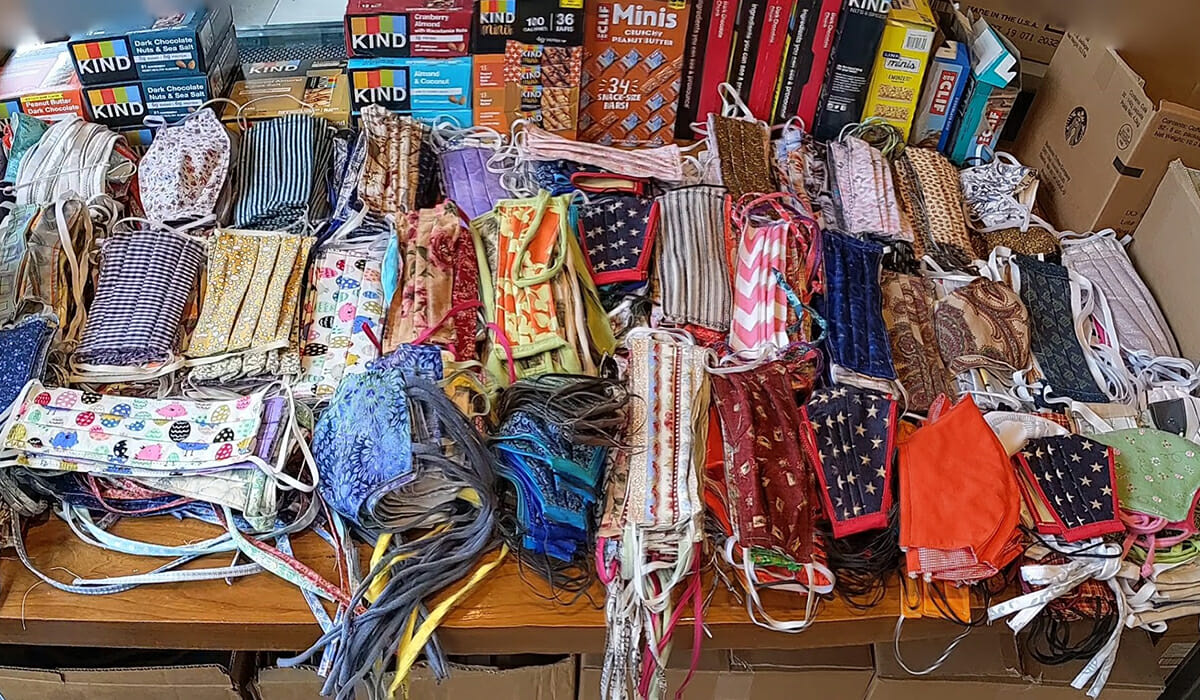
Her instinct proved to be right. There are currently at least 1,200 volunteers in the group who have helped provide over 20,000 masks to close to 100 different organizations. They’ve also donated scrubs caps, ear savers, isolation gowns, and care packages filled with snacks, cards, and hand-drawn pictures from local kids.
“I think people just felt really helpless, and they wanted to find a way to help and feel like they’re doing something when everything felt so out of control,” Heather said.
Heather Staples-Heitke was inspired to start her organization North Shore Fabric Masks for Health Professionals due to the shortage of masks for healthcare workers at the start of the COVID-19 pandemic./Courtesy Heather Staples-Heitke
After the group made enough masks and other personal protective equipment for local hospital and nursing home workers in need, they started sending masks to other at-risk people, including nursing home residents, migrant workers, members of the homeless population, and families of students in school lunch and YMCA programs. The group currently gets requests to make about 300 masks per week, but at their busiest point were making close to 1,000 masks a day.
“It’s been humbling to see how big it’s gotten and how much we were able to do in a few short months,” Heather said. “I think it really speaks to the fact that people ultimately want to do good and want to help if they can. A lot of them just don’t know how to start.”
The Facebook group consists of sewers as well as volunteers who wash and cut the fabric, transport materials, and deliver the packages. Aside from a main donation drop location in Beverly, there are five others in the surrounding cities. North Shore Fabric Masks for Health Professionals has turned into a community-wide affair, with multiple generations of families sewing together and local high school students volunteering each weekend to organize the upcoming week’s orders.
One of the drop box locations is at the home of Randy and Lori Reinbold, who were looking for a way to help healthcare workers themselves when a Facebook friend of Lori’s shared the link to North Shore Fabric Masks for Health Professionals. The couple now help organize the donations, and Randy runs the group’s website. Their teenaged son also helps out by bundling the bags of masks and keeping track of all of the material going in and out.
“I think for my husband and I, it’s just been one small beacon of hope,” Lori said.
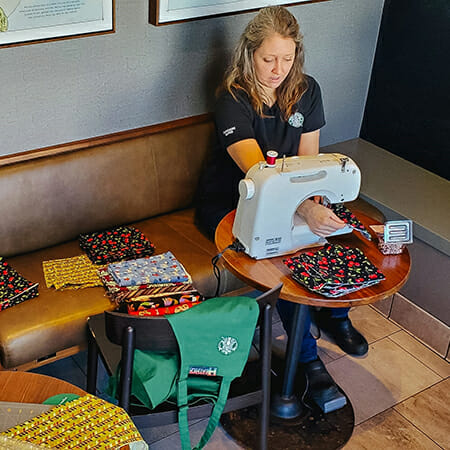
Heather Staples-Heitke sews masks that will be delivered to frontline workers and vulnerable populations through her organization North Shore Fabric Masks for Health Professionals. /Courtesy Heather Staples-Heitke
Heather said while ideally there won’t be a need for North Shore Fabric Masks for Health Professionals, the group doesn’t expect that to happen anytime soon. They plan on collecting masks even when the pandemic slows down in case there are additional waves of COVID cases. And because the group have become like a virtual family to one another, Heather and the moderators have discussed finding ways to continue bringing the group together once the pandemic is officially over. They’ve thrown around ideas such as starting quilting groups or visiting nursing homes together.
“I think the coolest part of it is how the community came together, and such a diverse population and so many different age groups and everything,” Heather said. “We all came together and did what we could. If everyone does their little piece, big things can happen.”
Meet Daily Point Award honoree Anastasia Hartman. Read her story and nominate an outstanding volunteer or family as a Daily Point of Light.
Anastasia Hartman, 14, is proud to call herself an Army brat. As the daughter and granddaughter of military veterans, she has seen loved ones struggle with the aftereffects of PTSD, a struggle that affects the entire family. She knows what it’s like to see a parent go off to serve, missing their kids’ birthdays and holidays. Since she was eight, Anastasia dreamed up creative ways to make things easier for military families, raising funds to deliver more than 3500 pounds of food and 2500 new blankets, toys and pajamas to military kids. When disasters have struck, like the 2017 shooting at Rancho Tehama Elementary School and the 2018 Paradise fire, she’s raised money to provide those affected families and kids with bikes, toys and foods. Her next step is to raise the money needed to turn Project Heroes into an official 501c, setting up the non-profit to help veterans and their families for years to come.
What inspires you to volunteer?
I’m inspired to help because I’ve grown up in a military family and I know the challenges firsthand. My dad and my grandpa both have PTSD, different wars but the same issues. My dad often says if he didn’t have our family and the support of my mom that he would be one of those homeless veterans on the street – something that’s impossible to imagine. But if my dad could be one of those veterans, how many amazing people are out there that need help like my dad? I wanted to serve those who served us.
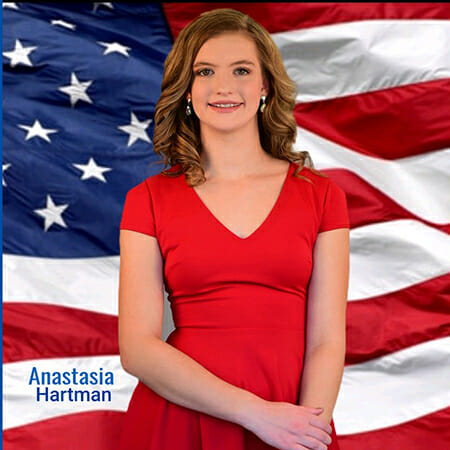
Anastasia Hartman founded Project Heroes to help enlisted men and women and their families./Courtesy Anastasia Hartman
Describe your volunteer role with Project Heroes?
I founded Project Heroes when I was eight, almost six years ago. It’s grown, with the help of my parents and the law firm McCammon and Murray and is now a corporation – so I guess I’m CEO. I try and get other kids involved and help to fundraise and serve. I collect donations and talk to businesses about my project. I organize and deliver.
What’s been the most rewarding part of your work?
Knowing that I am making a difference in the life of a veteran. At one of my dad’s therapy sessions I learned that 22 veterans die every day from suicide. I started this project as a way to help – even if it just brings a smile and gives that person hope for another day. It makes me so happy to know that I can do that for someone else.
What have you learned through your experiences as a volunteer?
I have learned that I cannot do everything by myself! I need to get friends and people in the community involved. I have an amazing community that supports my project and I know it wouldn’t be possible without them. I’ve also learned that my project helps me as much as I try to help others. It’s taught me that I want to have a heart for service. In the beginning I wanted to help the 649th which had more than 100 kids with parents deploying for Christmas. I wanted to make their Christmas better. The need just continues. I’ve learned that service to others isn’t about just doing one good deed, it’s about making service a part of your daily life and always making other a priority.
Are there any future partnerships, programs, or events that you are excited about?
In partnership with the Chamber of Commerce this July I’m excited about the first Ag America/Project Heroes Miss 4th of July benefit pageant. The pageant will get girls involved in the community to help and volunteer with Project heroes. The proceeds will go to help Project Heroes at Christmas and fund the Los Molinos High School Project Heroes Scholarship to benefit a veteran’s child or grandchild or someone who has completed 250 hours of veteran related community service.
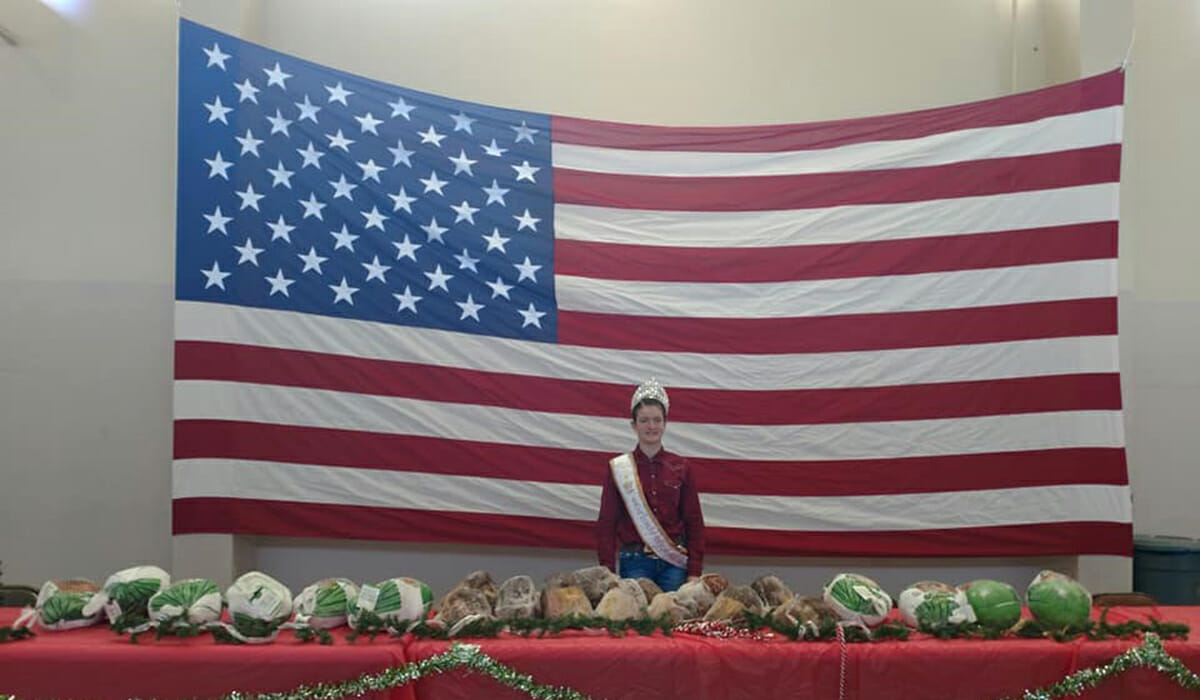
Anastasia Hartman works with local partners to bring hams and turkeys to military families for the holidays./Courtesy Anastasia Hartman
Why do you think it’s important for others to give back?
Change doesn’t happen unless you make it happen. If you don’t get out there and try to give back to your community or to those who spent their lives giving to you, then nothing ever gets better. You have to be a leader and go out and inspire others to do good deeds to make a difference in this world — even if it’s only one person at a time. It’s important to give back because it creates a chain effect of kindness and LOVE.
What do you want people to learn from your story?
I want people to know that no matter how old they are, you can make a difference. I am only 14 and I know I am making a difference. You can too!
Period Awareness for All Populations: Teen Volunteer Advocates for “Modern Women”
Meet Daily Point of Light Award honoree Emilie Ma. Read her story and nominate an outstanding volunteer or family as a Daily Point of Light.
As a freshman at Hamilton High, the largest public high school in the state of Arizona, Emilie Ma says when she realized her school had no menstrual product dispensers, she was “amazed.” The Chandler, Arizona teen then took action to ensure that essential feminine products would be available to her classmates.
Her efforts growing since that day, Emilie Ma founded Modern Women in 2017, a student-led organization dedicated to improving the holistic health of women. Advocating for women’s rights to reproductive health across populations including low-income, Native American and international, Emilie is serving as the ultimate modern woman as she volunteers to erase the stigma associated with feminine hygiene and help underserved women.
What inspires you to volunteer?
I’m inspired to volunteer because of the stories of the members I meet. We volunteer with people from Wisconsin and Illinois to Nepal and from the Native American reservations near my city. That diversity and the stories of adversity they face is what really inspires me to bring menstrual equity to all.
Through Modern Women, Emilie has donated 3,200 menstrual products to impoverished women and students across the state of Arizona. / Courtesy Emilie Ma
Describe your volunteerism with Modern Women.
As founder and president, I fundraise money which is used to purchase products we donate. We’ve donated 3,200 menstrual products within our Period Care Packages, which include tampons and pads, to impoverished women and students across the state of Arizona. I am also working with local Arizona schools to implement our Project Period, which offers menstrual pad boxes to schools. We have already established this program at a local charter school.
Share one personal story with me from your volunteerism.
Through our online advocacy, I met a girl who lives in Nepal. In one of her local villages, there was stigma around periods, and whenever a girl is menstruating, she has to be sent to a menstruation hut. There are laws forbidding that ostracization, but it still happens illegally. I was shocked this kind of thing still happens. Before my volunteerism, I had a really gilded view of menstruation and what it looked like around the world. I didn’t realize that stigma went as far as to isolate women from their families for a couple of days like this. Through education, advocacy and change, we’re working to raise awareness across many cultures.
Why do you think it’s important for others to give back?
I’ve been able to find personal growth through service. I’ve become more open minded. Initially, I was hesitant to even use the word ‘period’ with my peers. Over time, I became accustomed to those words and uncovered the prejudice in these social issues. The need to bring attention to this issue is more crucial than ever.
How have you continued to volunteer throughout the COVID-19 pandemic?
The pandemic has made my service a little bit more difficult. We’re keeping on top of pandemic regulations while promoting our causes. We’ve also added handmade face masks to the Period Care Packages that we distribute. All other work is being done virtually.
What have you learned from your volunteerism?
We are committed to diversity and inclusion. We’re dedicated to bringing in BIPOC voices to the menstrual moment, especially people who aren’t represented. What makes Modern Women work is how unique perspectives are being contributed to the conversation.
In one word, what does volunteering mean to you?
Meaning. Volunteerism is full of meaning.
When you’re not busy volunteering or going to school, what do you do for fun?
I really enjoy skateboarding. I also create comics with my brother about emus and their place in history.
How can readers help?
We rely on donations to fund our product distribution.
Volunteerism as the Great Equalizer: Florida Family Inspires Service at all Ages
Meet Daily Point of Light Award honorees the Nappi family. Read their story and nominate an outstanding volunteer or family as a Daily Point of Light.
Nicole and Steve Nappi met in elementary school, and have “been together forever,” Nicole says. Volunteering with each other in high school and then college, the childhood sweethearts have since grown their family, both in size and love for one another. Now totaling six strong, what makes the North Port, Florida family so special is the impact their volunteerism is having on their community and how they are inspiring other families to give back.
Finding limited volunteer opportunities for their young children to participate in, Nicole and Steve launched Move Mountains, an organization focused on giving children leadership skills to change the world and their families a chance to serve their neighbors in southwest Florida and beyond.
“Volunteering is contagious,” says Nicole. “If we can reach these kids when they’re young, and instill the importance of giving back, it becomes automatic. If you can create a community and then a world where children are raised like that, the difference it’s going to make across the country and across the world is truly incredible.”
By offering families a chance to get children involved, the Nappi family is showing how people of all ages can give back. Offering assistance to the Florida Department of Children and Families, local police and firefighters, assisted living facilities, children’s hospitals, children’s shelters, animal shelters, food banks, even uniting the community to raise money for a friend stricken with cancer, the Nappi’s have connected with close to 1,000 individuals through their volunteerism, and have inspired hundreds of youth volunteers and their families to join in their service. According to Steve, spreading that giving spirit has become second nature to the Nappi children, as they follow in their parents’ altruistic footsteps, 11-year-old Owen recently donating his birthday money to an animal shelter, and his younger siblings following suit.
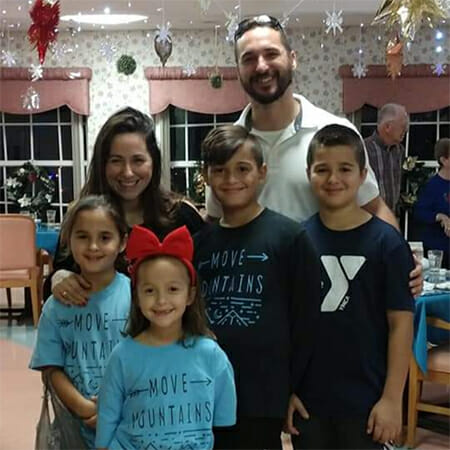
The Nappi’s have connected with close to 1,000 individuals through their volunteerism, and have inspired hundreds of youth volunteers and their families to join in their service./Courtesy Nappi Family
“Our goal as parents is to make sure we’re producing kids that are going to give back and contribute to society,” says Steve. “Status means nothing if you don’t have a good heart. The fact that these kids donate their birthday money means they understand the meaning of giving selflessly. They just do it, they’re not expecting accolades. The lives we’ve touched and the happiness (volunteering) has brought us as a family is just really tremendous.”
That happiness is a constant energy surrounding the Nappi family, so infectious it is felt by all those in its presence. Connecting with seniors at assisted living facility North Port Pines over activities, games and celebrations, the Nappi’s have become like family to many residents, says North Port Pines activities director Kelli Catropa.
“Residents will come over to me and ask how the family is doing,” says Kelli. “They go out of their way to ask about these kids. They’re constantly asking me to pull up pictures of them, they just miss them so much. When (the Nappi’s) come to visit, they’d come as a family and they’d do what they were here to do, and then just stick around and socialize. It’s like family. It means everything to our residents. Nicole and Steve are two of the most amazing angels on this earth.”
From the kids designing Thanksgiving paper placemats to an informal adopt-a-grandparent program, the Nappi family goes out of their way to brighten the day of the residents. Says 9-year-old Ella, who joined her siblings to throw a birthday party for one resident who turned 107, complete with a Mickey and Minnie Mouse cake, “people thanking us makes me feel good.”
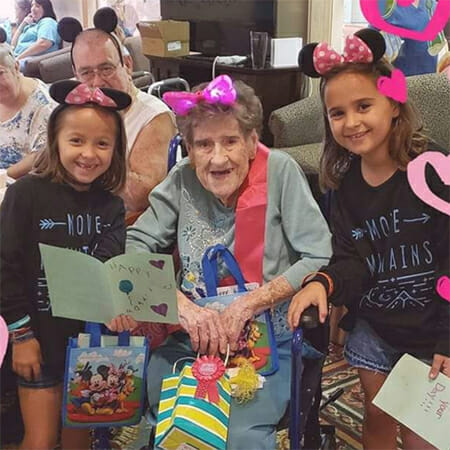
Ava and Ella Nappi pictured with “Miss Maggie”, a resident at North Port Pines assisted living facility, where the family celebrated her 107th birthday./Courtesy Nappi Family
It’s the innate understanding children have in how to help those in need that makes Move Mountains even more unique, says Nicole. “Ella and a friend were literally feeding a senior resident (at this birthday party). She couldn’t hold the fork herself, so Ella’s friend was spooning the cake into her mouth. No one asked them to do it, they saw a need and immediately filled it.”
Along with Ella, the Nappi siblings, Austin, age 13, Owen and Ava, also 9, are living service-centered lives, from helping seniors to lending a hand during natural disasters, even asking their parents to volunteer while on family vacations.
“We helped (in the wake of) Hurricane Irma,” says Steve. “We drove up to Atlanta as a family to help our own family, and once they were all cleaned up, we visited a food bank and boxed up meals that ironically, got sent all the way back down to Miami. For me, that was one of the most impactful days of service we’ve had. To have our family there together, helping others. The kids were so excited to be doing such a good deed.”
“Every project brings something different,” adds Steve. “What’s the saying? All the feels. I really believe that. Some of these (service projects) are comical, some will make you happy. Some are sad and really emotional, they will touch you in a different way. Some people think of volunteering as a chore or daunting task, but as you do it, it’s something really enjoyable.”
Move Mountains is currently fundraising for a student bicycle drive ahead of Christmas to help kids get to and from school, sports and jobs. The most powerful aspect of their service, Nicole says, is how it’s leveling the playing field for everyone to give back using their own talents, and using volunteerism as the great equalizer to bring a community together for the common good.
“I’m actually getting kind of emotional. Being a teacher, I’ve seen such a struggle with local kids. I’ve had students live in their cars, or were homeless, living in hotels. (Move Mountains) involves children of every background. You can have that kid living in his car volunteering, and he’ll help with a project alongside a kid who plays five sports and has an iPhone. (Kids) don’t know any different. When they’re working hand in hand to make somebody’s life easier, all that status stuff drops to the side.”
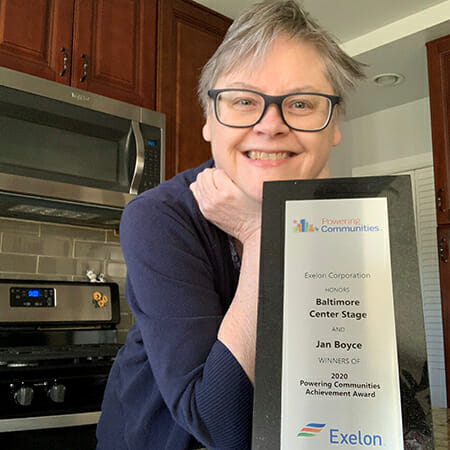
For over two decades, Jan Boyce has helped spread Baltimore Center Stage’s message of diversity and inclusion throughout her community. Since 1997, she has served as a dedicated performance volunteer for Maryland’s state theater, with duties ranging from taking tickets, working as an usher, describing audio for the theater’s closed captioning, leading theater tours, training new volunteers, and helping cook for annual technical dinners. Jan has received multiple awards from Center Stage for the amount of volunteer hours she puts in, typically volunteering for three to four shows each season.
While the COVID-19 pandemic has put a pause on Baltimore Center Stage’s season, Jan has continued to find ways to volunteer by helping to distribute food from the Maryland Food Bank at the theater over the summer. In addition to her tireless effort to Baltimore Center Stage, Jan raises money for the American Heart Association and has participated in their annual Heart Walk for the past decade. She is also a member of the United Way of Central Maryland’s Tocqueville Society, donating $10,000 to the nonprofit each year as well as participating in their events.
Describe your volunteer role with Baltimore Center Stage.
I am a performance volunteer which means I help patrons. I might take your ticket, I might lead you to your seat, I might be at the audio describe. We do closed captioning at Center Stage now, so I actually run the scripts from the back of the theater for people who may have hearing issues or just need the addition of being able to see the words that the actors are saying. That’s done live. I’m also a docent. A docent basically is responsible to be an ambassador to Center Stage. We give tours. They’re free. I’ll take you into the scene shop, I’ll take you to the costume shop, I’ll explain the history of Center Stage to the patrons who are interested and walk them around. Also, Center Stage does what’s called a technical dinner for the actors and the crew. A technical dinner is done usually the Saturday or Sunday before the performance is going to start, which typically is on a Wednesday or a Thursday. Volunteers bring food. I’m typically the vegetable person, and that could be 50 people you’re cooking food for. The other thing I do is when new performance volunteers join Center Stage, I’ll help them get acclimated and learn the dos and don’ts.
What inspired you to first get involved with Baltimore Center Stage?
Back in 1997, I worked for BGE, which is a part of the Exelon companies now. They had a volunteer coordinator who sent out a message that Center Stage was looking for performance volunteers. I’ve always loved the theater. I have no talent when it comes to performing, but I really do love going to the theater, so I thought it was the perfect fit for me because I like people as well. I joined in the ’97-98 season. It became, I always say, a match made in heaven. I was the Rookie of the Year in that season. I worked I want to say close to 95 hours, and I joined halfway in season. I’ve been doing it for the last 22 years. … I get a lot of enjoyment from it.
Jan Boyce poses with one of the many awards she has received in recognition of her volunteer service for Baltimore Center Stage./Courtesy Jan Boyce
What kind of role do you think Baltimore Center Stage has in your community?
Their mission is to bring diversity and inclusion to all. They are very much engaged in the community where the building resides, as well as bringing in new plays that are thought-provoking, plays or musicals or something that’s going to be different. When I first started, we had a director who made it her mission to always do at least two African-American plays within the season. It was required. She wanted to make sure everybody felt included. I love August Wilson. He is one of my favorite playwrights. He’s from Pittsburgh from a very predominantly African-American neighborhood, so he had a lot of relationships with Baltimore with it being a very African-centric city also. I got to meet August Wilson, and having opportunities to meet these actors and playwrights is just amazing.
Another thing they do is they have a fantastic education program. One thing I really missed doing this summer is a workshop where they have kids come in. There’s usually one workshop that will have an older set of kids, kids who are really interested in getting into theater eventually. There’s other workshops where they will have seven, eight, and nine-year-olds, and they actually put on a show at the end of their run with this workshop. It’s amazing what the people there do. I never realized, until I started working in a theater, that there are so many other opportunities in the theater. You don’t have to be a writer and you don’t have to be an actor. You can be a seamstress or you can build things. You can be an electrician. You can be all these different marvelous things within that group. They teach the kids different aspects of the theater. I’ve always found that their educational programs were just very inclusive and brought in people. These kids are marvelous. Kids who are shy and who may be afraid to step out of bounds, it opens up worlds for them. It’s amazing to watch these kids blossom and it’s a beautiful thing. I’m so glad that Center Stage does it. It’s part of their core mission to bring that diversity and inclusion into the community they serve.
What’s been the most rewarding part of your work?
I think knowing that I’m helping, whether it’s knowing I’m helping the Center Stage folks or I’m helping the patrons. On Wednesdays, we have a matinee, and that typically has a lot of clients who need more assistance than other clients. There’s three steps [in the theater], but three steps might not be the easiest thing for that person to get down. Just offering your arm so they feel a little secure when they’re walking down to get to wherever their seat is, is always a good feeling. I remember we had an emergency once when the plumbing decided to back up. The show went on, but at the end of the show, we had to get all the patrons out of the building without any instance. I was told I was the calm that kept everybody OK — ‘We’re just going to take this calmly, make sure you take this door, we want to make sure you don’t slip, don’t fall’ — make sure people were safe. I think I’m chosen a lot of times to do things when they know they need somebody who can be level set, who’s not going to be hyper or concerned. Because sometimes things do happen, and you just have to be able to be calm in your reaction to whatever is happening around you.
Why do you think it’s important for others to give back?
I think it’s important because it makes you feel good. That’s what I get out of doing it. I get the extra bonus because I love theater and I get to see the shows, but I think partly for me, it enriches my life being able to give back. Helping people experience the magic of theater is a wonderful thing.
Why do you think theater is magical and important for a community to have as an outlet?
I always say theater can make you laugh, it can make you cry. It can show you something from a historical perspective you never even imagined. I remember we did one play and I could only see that play one time, it was just that emotional. It brings things to people that you may not have thought. I can’t know what the experienced of being an African American is, but I can live that experience through the theater. I’ve never lived in a man’s shoes, but I can experience something through someone else’s eyes through the theater. I think theater brings you aspects of life that you may not have experienced directly, but it gives you that sense of who other people can be and are.
Can you describe the other ways you volunteer?
I volunteer with the American Heart Association. Every year I’m one of their leading individual donors as well as a money raiser. I walk [in their annual Heart Walk]. This year it had to be a virtual walk, of course. I’ve been doing that for about 10 years.
I’m also a Tocqueville member of the Untied Way, which means that I donate about $10,000 dollars every year to go to help people who need assistance. United Way of Central Maryland does such marvelous and wonderful things. When people really need that extra help and sometimes people just don’t know how and where to get it, their 211 service they have here in Maryland is great because people can call up and find out, ‘Who can I go to for this help?’ They really do help their people. I think it’s good for brotherhood or sisterhood. We have to take care of each other. That’s important to me, that we all take care of each other.
What do you want people to learn from your story?
I think giving back is important. I don’t talk about it a lot. I don’t say “You have to volunteer and you have to do this and you have to do that,” but to me, giving back is important. It actually makes me feel more whole. Partly with this coronavirus, I feel like I’m missing out because I don’t have that contact with people that I would normally be having. It’s sad I’m not experiencing that right now. I think to me that’s what you really want to be able to do. It makes me feel like I’ve done something good in this world, and it enhances me as a person, I think.
Future Healthcare Worker Volunteers to Pursue Passions and Help Community
Meet Daily Point of Light Award honoree Angeline Ajit. Read her story and nominate an outstanding volunteer or family as a Daily Point of Light.
17-year-old Angeline Ajit is using her skills for the greater good, as the high school senior helps people near and far by supporting healthcare workers and promoting education.
By supporting hospitalized children through Project Sunshine and serving as a volunteer that visits with patients at a local Texas Health hospital, the Dallas, Texas teen is laying the groundwork for her future career in medicine as she forms caring connections with people in need. Her service also focuses on promoting education, both as a tutor for American Space Kulob, where Angeline teaches students in Tajikistan how to speak English, and teaching impoverished children in Kenya, Thailand, and Indonesia through the International Humanity Foundation. Connecting with people in need of all ages both near and far, Angeline is pursuing her passions to better the world.
What inspires you to volunteer?
I really enjoy the satisfaction you get when you can use things you personally enjoy doing to help other people. I have other interests and do eventually want a career in the medical field so volunteering is a way for me to pursue my passion and also help other people.
Describe your volunteerism with Project Sunshine.
As the committee head for Project Sunshine at my high school, Texas Academy of Mathematics and Science in Denton, Texas, we’ve donated over 100 “Sending Sunshine” activity kits and “Surgi Dolls” to children living with medical challenges at local hospitals. The Surgi Dolls can be personalized and decorated, and are used to comfort young patients. Through fundraisers and events, I raise money along with 20-30 of my classmates and peer volunteers for these dolls and activity kits, which we then assemble and donate to local hospitals.
Share one personal story with me from your volunteerism.
It has been a lot of small moments like braiding a kid’s hair or teaching a little boy how to blend different colors together with a white crayon. It makes me happy to know that I’ve brightened up their hospital visits. Project Sunshine really spreads “sunshine” and raises awareness for the emotional needs of children facing medical challenges by helping to foster their creativity and self-expression. It reminds me of how beneficial the arts can be for therapeutic purposes in healthcare settings.
Why do you think it’s important for others to give back?
Volunteering is essential because a lot of organizations and charities rely on the generosity of volunteers to help people in need and specific causes. Committing to service is also a really good way to inspire activism and encourage others to volunteer.
What’s been the most rewarding part of your service?
It’s been rewarding for me to make close connections with patients. These relationships help you develop greater insight into the humanistic and social aspects of medicine.
How have you continued to volunteer throughout the pandemic?
We are working on creating activities packets to inspire play and engagement to send to hospitalized patients for Project Sunshine, including puzzles and coloring pages. My volunteerism for American Space Kulob was already virtual before the pandemic, so this service has continued as I help to teach Tajikistan children English by tutoring, hosting a virtual conversation club and helping to grade assignments.
In one word, what does volunteering mean to you?
Change. Volunteering is creating the positive change you want to see in the community.
When you’re not busy volunteering or in school, what do you do for fun?
I really enjoy reading. I read a lot of sci-fi and dystopian novels because they make me think critically about the world we live in. And I love anything artsy, like drawing and sketching.
Illinois Teen Brings Educational Materials to Kids Struggling During Pandemic
Meet Daily Point of Light Award honoree Samantha. Read Samantha’s story and nominate an outstanding volunteer or family as a Point of Light.
When the COVID-19 pandemic led to school going online and many previous commitments being cancelled, Samantha Feinberg found herself with a lot more free time to spend. Not content with using that time to simply relax and hang out, as many other teenagers may have done, the 16-year-old Deerfield, Ill.-native wanted instead to do something positive for youth related to her passion for education. After brainstorming ways to help with her friend, Samantha helped cofound their own nonprofit, Balance Boxes, in March.
Balance Boxes provide students in low-income communities with a ‘balance’ of both educational and enjoyable materials. Students are given boxes filled with snacks, books, games, toys, and information on how to register for free one-to-one virtual tutoring. Through the power of social media, Samantha was able to help encourage other teens to start chapters of Balance Boxes for their own communities. So far, there are over 40 chapters representing over 25 countries. In the short time since its inception, the nonprofit has delivered over 3,000 boxes, amassed over 150 youth volunteers, raised over $104,000, and partnered with over 100 companies.
Describe your volunteer role with Balance Boxes.
Balances Boxes is a youth-led nonprofit. It was started during the start of the coronavirus in March by me and my friend in Illinois. We provide underserved youth in kindergarten through fifth grade with books, games, toys, snacks, and free virtual tutoring services. During the start of the summer, we started to expand. We are currently up to over 40 chapters representing over 25 countries across the globe, and we are on six continents. We have provided over 3,000 kids with boxes over the past six months. We have partnered with over 100 companies and they have donated items for the kids’ boxes.
Samantha Feinberg serves as the co-founder of the youth-led nonprofit Balance Box./Courtesy Samantha Feinberg
How exactly do Balance Boxes help the kids they’re being given to?
All the kids who we work with are on free and/or reduced lunch programs in a low-income area or are in need of some extra support, [such as] if they’re in foster care or use the food pantry. All our boxes give the families a meal and a snack for the kids, as many of the families don’t have access to food regularly. Most kids on this program rely on school meals, and with school being online, that’s problematic. We also put books in all of our boxes, because a lot of kids desire books to read and with libraries being shut down, this was a great way to get them educational material. Then we put in free virtual tutoring services as many of the families that we work with can’t afford one-to-one tutors and the parents are working, so they can’t dedicate a lot of time to work on math or English with their children. We work with a third-party service that provides the kids one-to-one tutoring every week. Then we throw in some games and toys for the kids to have a more fun aspect to the box, so we focus on both educational and enjoyable activities.
Why do you think you’ve been able to mobilize so many other young volunteers? Why is this important to them?
I think the kids we’re working with realize that they’re fortunate, so they want to help. Seeing all the success our organization has had and the impacts it’s had on the families, that motivated many people to want to get involved. We’ve had an influx of people coming in once they hear about all the new chapters. Once you hear about all the different places we represent, all these people want to get involved and be a part of the organization. We have social times, we talk, we do work. It’s just a great community of a diverse group of youth.
When you first started this nonprofit, did you ever imagine it would grow to be so big?
No. Our original goal was to make 50 boxes by the end of the summer, but by the end of the summer we had already delivered 600 boxes and had expanded to 20 states, so it was much different from what we were expecting. We changed our goal to keep this ongoing past COVID. We have no plans to stop.
What are your other goals for Balance Box?
My goal is to get in a couple more countries by the start of 2021, and I hope to get all 50 states covered by 2022. Our goal is to get about 6,000 boxes out during these next couple months. Our hopes are also to start in the Illinois area a field trip program to take the kids to museums, once the virus is over and it’s safe for outings.
What’s been the most rewarding part of your work?
My most rewarding part is definitely going to the schools. We haven’t been able to see a lot of the children due to online learning, but at one of the schools we were able to see the kids. It was outside. They were at their local recreation center. The kids were walking with their parents to pick up their school supplies and they were walking home with giant boxes of items, probably about the size of the kindergarteners, so that was really fun to see.
Why do you think it’s important for others to give back?
I think it’s important to always give back to those who are in need if you have the ability to. Especially with such a terrible time going on with the virus, it’s always great to just help those around you if you are able.
What do you want people to learn from your story?
I would want people to know that they can take anything they’re passionate about and bring it into a way to help others. I care deeply about education and I was able to make that into a mission. Other people may care about sports, dance, an array of many other topics, and you can make that into a mission to help other people.