Teens Start Nonprofit to Promote Accessibility in Medical Field for Fellow High School Students
Meet Daily Point of Light Award honorees Gael Gonzalez-DeLaLuz and Aliza Lopez. Read their story and nominate an outstanding volunteer or family as a Point of Light.
Gael Gonzalez-DeLaLuz and Aliza Lopez have both been passionate about the medical field from very young ages. Wanting to increase accessibility to the field for young people such as themselves, last year they started the nonprofit Medicine Encompassed, which promotes awareness of the medical field to high school students. The duo, based in North Brunswick, N.J., serve as Medicine Encompassed’s co-CEOs, leading a board of directors of over 30 other young people to educate and foster a sense of community for their fellow students interested in studying medicine.
Since its creation, Medicine Encompassed has reached over 1,300 students in over 40 states and 40 countries. They offer a mentorship program to connect high schoolers to pre-med and medical students, over 500 lessons on medical concepts, a newsletter, a podcast, research initiatives and more. Gael and Aliza, who are rising high school juniors, will soon be running Medicine Encompassed’s first ever community conference, a four-day virtual event of panels and workshops for young people around the world.
Describe your volunteer role with Medicine Encompassed.
Aliza: We’re a student-run 501(c)(3) and we basically aim to promote awareness and increase accessibility for those who are interested in future medical careers. We achieve this mission statement through a lot of different mediums and platforms. These initiatives range from the resources we have posted on our website, our STEAM-based medical curricula. We hold a lot of community events with various medical professionals to have our students gain exposure to different fields that medicine is composed of. We also have our podcast initiative, our research initiative, our mentorship initiative. We have been pairing high school students with advisees who are at the undergraduate and graduate level.
Gael:The two of us are the co-CEOs, so we run a lot of the general operations of the organization. For example, we lead the board of directors of over 30 other high school students and a couple of undergrads. Aliza creates most of our framework for educational materials and curriculum. We manage finances and we do outreach. We also create a lot of the base of what Medicine Encompassed is. As the co-founders, we in a sense built the whole organization from the ground up.
What inspired you to start this?
Aliza:Since medicine is generally such a multifaceted field, and with the number of students who are interested in such a complex field as medicine and generally STEAM, I think it was really just finding that concrete platform for students within our community to network and get to know the aims and prospects of medical professionals, and really just extending this mission to other age groups and building that sense of community, and bridging that gap between different age groups and different levels in medicine.
Why is it important for young people to have a resource like Medicine Encompassed?
Gael: I think Medicine Encompassed, at least at this point, has been something that has allowed students to explore their interests and their passions. Sometimes young people can tend to be pretty indecisive with what they want to do, so I think it’s good to help support student journeys of self discovery and in general helping people in whatever they can in order to explore something that was hidden within them.
Do you have any goals you would like to achieve with this organization?
Gael:Definitely to foster a community of likeminded people and students who are really interested in pursuing medical professions, and also generally expanding along with our professional networks. That’s something we’ve been working on recently.
Aliza: As for specific goals and numbers, we’ve been working on our STEAM-based medical curriculum for awhile now, and I think it’s definitely a primary aim of ours to implement these curricula into schools and start doing in-person seminars and more interactive workshops with younger students. The main point is more global expansion.
Are there any future partnerships, programs, or events that you are excited about?
Gael: We are hosting our first-ever virtual conference, Medicine enCONpassed. It’s going to be four days long from August 4 to August 7, and it’s completely free and we have a ton of events signed up for those four days. We have a couple of panels such as getting scientific internships, pre-medical student panels, how to conduct independent research, diversity and equity in STEM fields, virtual shadowing and CAT prep. Also just general workshops with medical professionals and other student organizations we’ll be partnering with in order to promote the event.
Gael Gonzalez-DeLaLuz and Aliza Lopez, top left, run a board meeting with some of their Medicine Encompassed team./Courtesy Gael Gonzalez-DeLaLuz and Aliza Lopez
What drives you to spend so much time working on Medicine Encompassed when you’re also students yourselves?
Aliza: It’s really that prospect of making that impact and seeing the positive effects of it. In my eyes, we’re driving that force for medical revolutions, especially for students. That’s really the one thing that motivates me to keep going for Medicine Encompassed — all the positive results and how students can take away and benefit from our services.
What’s been the most rewarding part of your work?
Aliza: It’s really just the notion that we’re defying that whole ‘age equates to impact’ thing. Gael and I started ideating this organization at a pretty young age, when we were 13 or 14. All of the impact points, statistics and initiatives that we’ve launched to date attests to the fact that as long as we have that vision, we can really spark that change in our community and make as much impact as we aim for.
Why do you think it’s important for others to give back?
Aliza: We’re both proof of what happens as a result. … If one group or population really drives that first step toward making an impact, it brings up other people and proves that if they can do it, then obviously there is that capability for others to do the same. The way I think about it, the more steps you make toward impact, the more influential your initiatives will be.
Volunteer Translates Beach Cleanups Into Art to Showcase Overuse of Plastic
Meet Daily Point of Light Award honoree Sarah Thornington. Read her story and nominate an outstanding volunteer or family as a Point of Light.
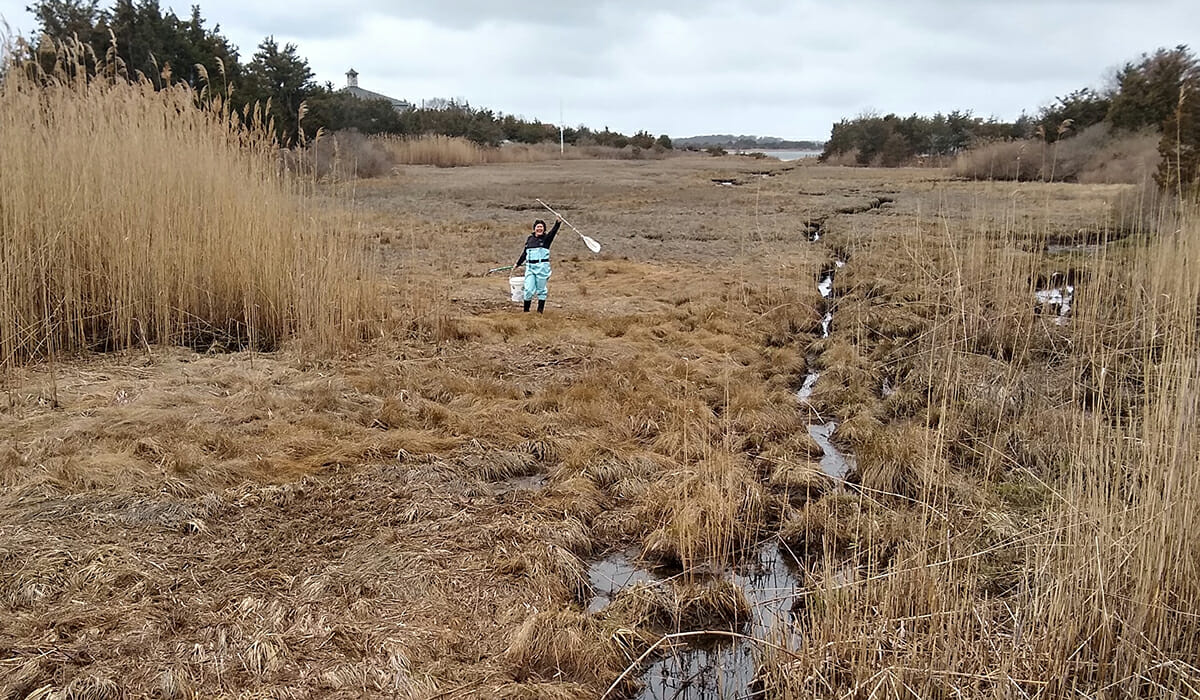
For the past 15 years or so, Sarah Thornington has walked her black Lab down the same mile-long section of coast in her town of West Yarmouth, Mass. She picks up any trash she sees on her walk and was consistently arriving home with her pockets and trash bags full of debris. A professional photographer, Sarah decided to turn her cleanups into a daily, year-long project documented on her Instagram, A Year of Plastic, as a way to raise awareness for the amount of trash and single-use plastics that wash up on beaches.
Sarah started the project in February 2019 with the goal of picking up three pieces of plastic each day, which would translate to a little over 1,000 pieces by the end of the year. She hit that goal after only nine days. By February 2020, she had picked up, washed and sorted over 21,000 pieces of plastic, along with numerous other types of garbage. While the project has since ended, Sarah is continuing to do beach cleanups weekly and is regularly updating her Instagram, now with art projects she makes with the collected debris. She has shown her art at four different exhibits so far, with the goal of starting a conversation in her community on cutting down plastic and keeping the earth clean.
Describe your Instagram project, A Year of Plastic.
I started it in February 2019. I had been doing a lot of beach cleanups. I was amazed by the sheer quantity of marine debris I was picking up, so I decided to do a beach cleanup every day for a year. I am one of those people who like things to be organized and neat, so I kept putting off when I was going to start. Then I was at the beach and found two little Army figures, and there was this fantastic sunset. Even though it was February 8th, I thought, today’s the day I’m starting because it’s perfect. I started the Instagram account on the first day of a year-long project doing a beach cleanup everyday.
Sarah Thornington participates in a town cleanup in June 2021./Courtesy Sarah Thornington
Why was this something you wanted to document on Instagram?
I wanted to make people aware of the sheer quantity of debris that was washing up on a tiny little mile-long section of coast that is actually quite clean. I wanted to do it on Instagram because I am a photographer, so I wanted to use my talent to show plastic in other ways — do flats lays, make pictures out of it, not just show ‘here’s a pile of garbage.’ I wanted to use my photographic skills and make it interesting and tell little stories about it.
What reaction did you want people to have when they saw your photos?
I wanted people to go, “Oh my gosh, there’s that much plastic on the beaches? How can I help? How can I make that better?” I wanted people to think about their single-use plastics especially. I wanted them to think about how much trash they’re creating and how everybody is involved in this. We’re all interconnected. Every single person needs to take ownership of the planet.
What kind of reaction have you gotten from your art exhibits featuring the debris you find?
It’s been great. I get a lot of, “Oh my gosh, I can’t even believe you found all of this stuff.” I get a lot of people who say you’ve convinced me to skip the straw, or you convinced me to not use plastic bags. With the latest one at the Atlantic White Shark Conservancy, they commented on how many conversations people had within their families about taking care of your stuff and limiting what you buy. People talk about how everyone is so surprised I find so many shotgun shells and shotshell wads on the beach. Of course, it kind of freaks people out, but we can also talk about the science of it all and how the tides are bringing all this stuff in. We can talk about how even if you’re inland, your trash can still make it to the ocean. Probably shock is the biggest response.
What are your plans now that the project has finished?
I still continue to do beach cleanups. I probably do a good beach cleanup every week, and I still pick up trash every time I see it. At the moment, I’m doing 100 days of picking up a piece of litter everyday. … I’m always going to do beach cleanups. That’s never not going to be a part of my life. I still post regularly to my Instagram. I’ve been making more art with the pieces because I find that’s been a really good way to get conversations moving. … If I know I’m going to do an hour-long beach cleanup, I will track it all. Keeping track of my data through Ocean Conservancy’s Clean Swell app, Center for Coastal Studies and Surfrider Massachusetts worksheets is important so changes are able to be made at the municipal and governmental levels to require sustainability of industries and businesses with their handling of their plastic creation and waste.
Surfrider Massachusetts is doing an initiative this summer where they are trying to get every part of the coast around Massachusetts to have a beach cleanup. I’ve already done one specifically for them and there’s a bunch of towns that still need to be connected, so I’m going to go and get as many around me as I possibly can. I’m out there cleaning the beaches anyway, so I would like it to be helpful. I don’t want to be cleaning the beaches. What I want is for people to be aware of their single-use plastic use. I want them to stop using all of our resources. Reduce, reuse, recycle — which is now reduce, reuse, repurpose, refuse — whatever R’s you use, they always start with ‘reduce.’ That’s the message I hope we get across in all of this. We don’t want to be cleaning the beaches. We don’t want to be picking up litter off the side of the street. We want the beaches to be clean.
Are there any future partnerships, programs, or events that you are excited about?
Center for Coastal Studies’ Ghost Gear Initiative. The woman who is in charge of the Ghost Gear Initiative has a beach brigade down here. Every now and again, she will call people down to Provincetown if there’s something big [to clean up]. I am part of that beach brigade. Every time she does it, they bring in ghost gear during the winter months when the boats aren’t out getting fish. They go out and they retrieve lost and abandoned fishing gear including lobster traps and lobster nets. They bring them back in and I go down and help sort and dispose of all the gear. I think it’s a wonderful initiative because ghost gear is a huge problem.
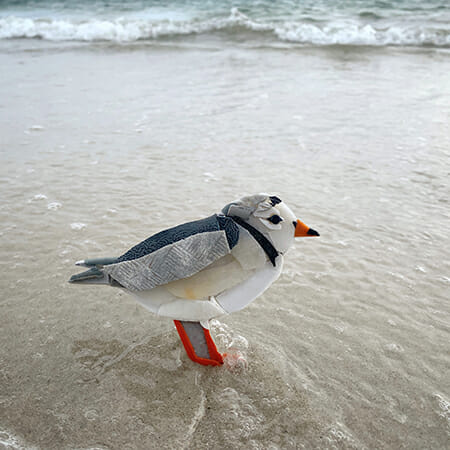
One of Sarah Thornington’s creations, made of materials she collected while cleaning up beaches, enjoys the waves on Cape Cod./Courtesy Sarah Thornington
What’s been the most rewarding part of your work?
I think the most rewarding part is when people tell me that I’ve made them think, or I’ve made them make a change in their lifestyle.
Why do you think it’s important for others to give back?
I think it’s our responsibility as humans. We’re all in this together and I think whatever your passion is, there’s people who need you to help. My passion is the environment, so I do what I can do. Other people have other talents in other areas and so by giving back, it’s making the world happier and friendlier and nicer and kinder. It’s so much easier to be helpful and nice than to be all about yourself. There’s nothing good about that. I can’t even imagine not giving back. It’s not giving back, it’s just being.
What do you want people to learn from your story?
I think this is where I would like to throw out again that whole ‘reduce’ [idea]. We only have one planet. We all need to walk lightly on it. We need to be aware of all of our choices and we need to vote for the planet.
Vietnam Vet Serves Veterans in Hospice with Compassion and Dignity
Meet Daily Point of Light Award honoree Lennie Poling. Read his story and nominate an outstanding volunteer or family as a Daily Point of Light.
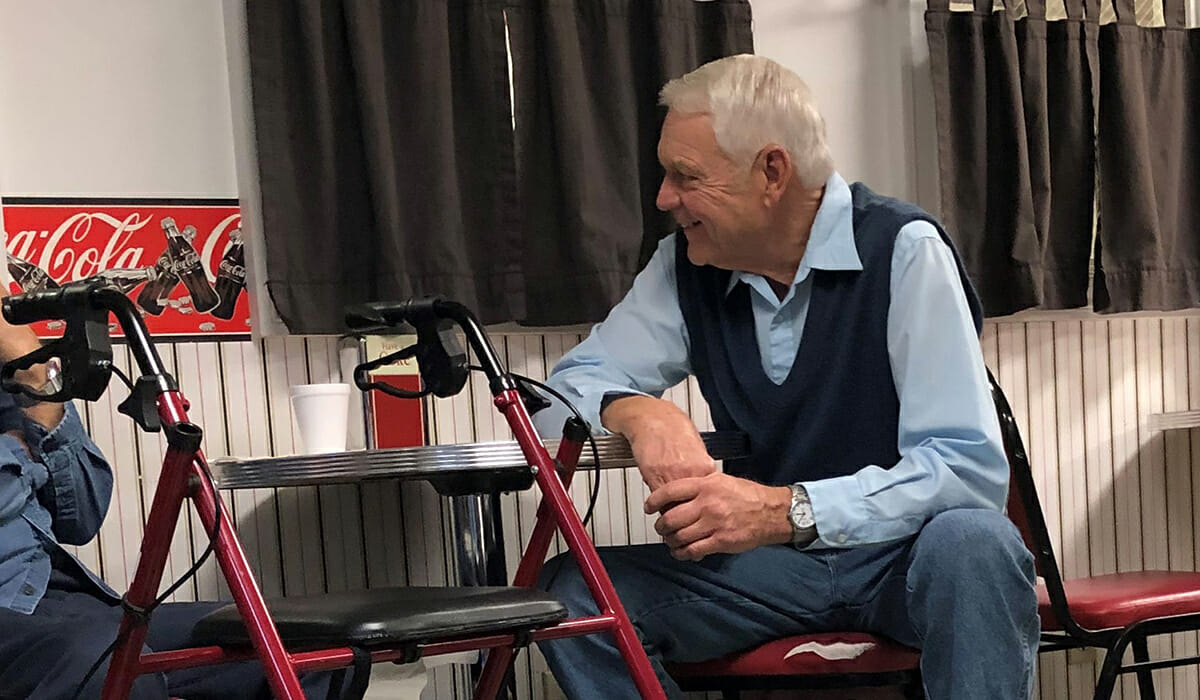
Lennie Poling says as a volunteer with Mountain Hospice’s “We Honor Veterans” program, he and his fellow volunteers are providing comfort and support for veterans receiving care.
A Vietnam veteran who served in the United States Army, Lennie is in a unique position to bond with veterans through the program, which is a part of the National Hospice Palliative Care Organization. The Belington, West Virginia senior has dedicated his volunteer time to providing companionship to terminally ill veterans who at times find themselves alone at the end of distinguished lives.
What inspires you to volunteer?
I’m inspired to volunteer because there’s just so much need within the community and across the world, actually. Especially when it comes to veterans. The WWII veterans are passing quickly, so we mostly serve Vietnam veterans. These folks have stories to tell that a lot of people wouldn’t understand unless you were a veteran yourself.
Lennie Poling has dedicated his volunteer time to serving terminally ill veterans. /Courtesy Patty Delauder / Mountain Hospice
Describe your volunteerism with “We Honor Veterans”.
We Honor Veterans is a national program that partners with local hospices and community organizations to support veterans. There are three of us volunteers from my church that do this, and we travel as a group. We’ll host veterans at our Veteran to Veteran Cafes, where we meet and talk. Sometimes we’ll have government folks come in to answer questions and provide resources for the vets. We’re there to help veterans in any way we can. They like to sit with someone who understands what they’re saying.
Share one personal story with me from your volunteerism.
It’s personal everytime we go to visit! Everyone we talk to wants to thank us. Many times we’ll get some tears. Some of the veterans are very sick and they’re lonely, they don’t get many visits from people. They always invite you back. The service is very humbling for me, it warms my heart to know that God has given me the ability to help to brighten their day a little bit.
Why do you think it’s important for others to give back?
As Americans, we’ve received so many things. We’re so blessed throughout our lifetimes because people like ministers, teachers and others are there to help us. If we’re able, there’s no reason we shouldn’t be able to help someone when they’re in need.
What’s been the most rewarding part of your service?
It’s rewarding to enjoy time with these vets. Ideally, we get their minds off their illnesses and their troubles. It’s very humbling to be with these folks.
How have you continued to volunteer throughout the COVID-19 pandemic?
The volunteers paused making in-person visits during the peak of the pandemic, but we’d call the vets on the phone and speak with them. Just recently we were able to resume our in-person visits.
As a “We Honor Veterans” volunteer, Lennie provides companionship to veterans./Courtesy Patty Delauder / Mountain Hospice
What do you want people to learn from your story?
Often, you think you’re serving to be a blessing to these people, but what ends up happening is, they’re a blessing to you.
What does volunteering mean to you?
It’s humbling. Also, very joyful, satisfying and fulfilling.
How can readers help?
Please visit the Mountain Hospice’s “We Honor Veterans” page for more information about how you can help.
Clothing Designer Volunteers to Sew Thousands of Masks for Professionals in Need During Pandemic
Meet Daily Point of Light Award honoree Vicki Vogel. Read her story and nominate an outstanding volunteer or family as a Daily Point of Light.
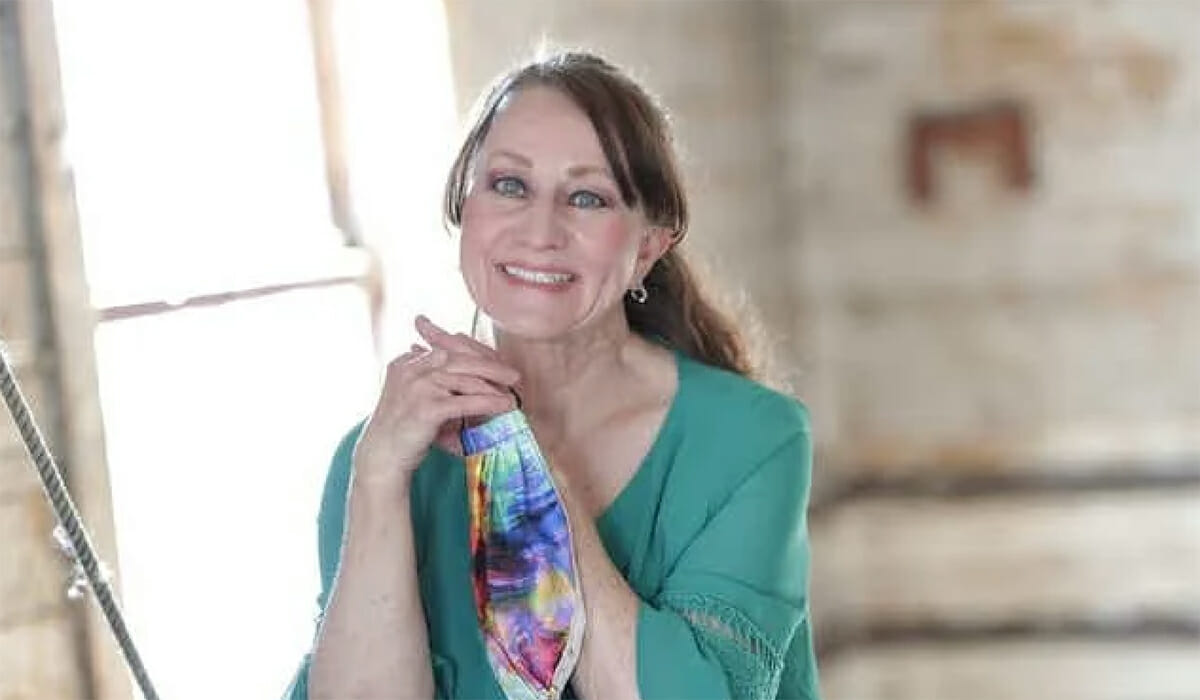
As a clothing designer, Vicki Vogel professionally sewed, designed and taught for 40 years. Throughout the years, the Appleton, Wisconsin resident has served her community in many ways, but in 2020, she stepped out of retirement and stepped up to combat the shortages of PPE using her sewing skills.
Joining the volunteer efforts of ThedaCare, a hospital system in Wisconsin, Vicki brought together hundreds of local sewers as they worked to support community members, hospital staff, first responders and more. Known as the “ThedaCare Mask Makers,” the group produced various masks Vicki designed for many groups in need, making thousands of masks each week at their peak of service. Vicki’s sewing united the fabric of her community, inspiring even more volunteerism and helping thousands around the country to mask up amid the COVID-19 pandemic.
What inspires you to volunteer?
I was raised to be involved. Rather than say, “there’s a problem,” my mindset is to step in and say, “let’s fix this.” I looked at the pandemic and I knew that without a doubt, I had a combination of talents across sewing, design, teaching and leadership that were very unique, and I had to use them.
Describe your volunteerism with ThedaCare.
I served as lead designer and mask making coordinator for the ThedaCare Mask Makers. We received grants for our supplies and then distributed supplies and taught our sewers four major mask designs. We also helped in other ways, like performing mask testing, coordinating sewing machine maintenance and scissors sharpening to help with costs. I even taught sewing lessons online, and in my driveway, socially-distanced and masked.
Vicki’s sewing united the fabric of her community, inspiring even more volunteerism and helping thousands around the country to mask up./Courtesy Dan Powers, photographer, USA Today Network, WI
Share one personal story with me from your volunteerism.
In addition to my recent volunteerism with ThedaCare, I’ve volunteered with Fox-Wolf Watershed Alliance for several years. One individual at the alliance told me I make a difference with everyone I come into contact with. It was really wonderful (to receive that compliment) because I‘d felt I’d done something small, but it had made a big difference to this person. It goes to show that regardless of what level volunteerism you offer, it has a huge impact.
Why do you think it’s important for others to give back?
My family’s philosophy is to be involved in our community. It’s important to volunteer and make a difference where you live. I tell my kids, anytime I have exposure to anyone or get involved in the littlest thing, I hope that group, organization or person is better from having that exposure to me.
What’s been the most rewarding part of your service?
This service wasn’t just about helping the community. A lot of the mask makers are retired like me, and they needed this sewing for their own mental health. We developed our own community, and so the volunteerism helped the volunteers themselves as much as we helped our community members.
What do you want people to learn from your story?
Volunteering makes you feel good. I would even say particularly for young people, get involved in your community. My children and grandchildren are involved in service. Being involved in your community gives you that sense of belonging and connection to others.
In one word, what does volunteering mean to you?
Pride.
How can readers help?
Please visit the ThedaCare website for more information about how you can help.
Teen Volunteer Helps Other Adolescents by “Setting Scoliosis Straight”
Meet Daily Point of Light Award honoree Leah Themistokleous. Read her story and nominate an outstanding volunteer or family as a Daily Point of Light.
Among the traditional milestones high school students experience, Leah Themistokleous’s full spinal fusion surgery was certainly unusual, but literally, formative. After an 8-hour surgery, two titanium rods and 22 screws, the Brookeville, Maryland student woke up from surgery 2 1/2 inches taller, and knew she could help many more children and adolescents affected by scoliosis.
Serving as a volunteer ambassador for Setting Scoliosis Straight, Leah’s volunteerism helps to empower millions of people impacted by scoliosis and their families. The now 17-year-old rising high school senior is using experiences from her life-changing health journey to fundraise, raise awareness and support innovation and treatment of spinal deformities in children and adolescents in her community and around the world.
What inspires you to volunteer?
Connecting with others who are undergoing surgery and helping them get through it inspires me. It is very meaningful that I can help people who have the same problem as me through a very anxious, frustrating journey.
Describe your volunteerism with Setting Scoliosis Straight.
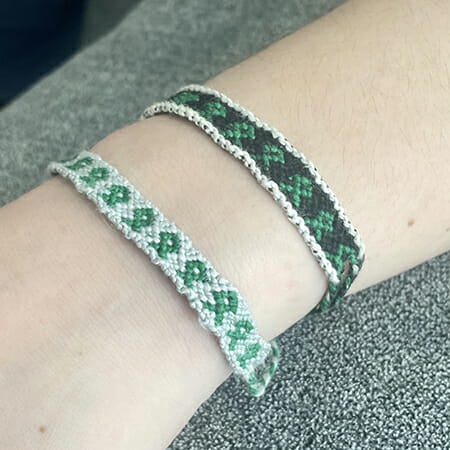
As a volunteer ambassador, I fundraise to support research, host patient webinars, raise awareness and share education online about scoliosis, and serve as an advocate at various events including recently with the FDA’s Patient and Caregiver Connection. When people donate through my personal page to support research, I send them a homemade scoliosis themed jewelry piece.
Leah created homemade string bracelets to raise awareness for scoliosis research. /Courtesy Leah Themistokleous
Share one personal story with me from your volunteerism.
I met a girl on a scoliosis Facebook group who was one year older than me, but she hadn’t received surgery yet. We ended up meeting in person, and became really good friends. She was really nervous ahead of her surgery, and helping to ease her anxiety was really good for me because I remember being really nervous before my surgery. At times, I’ve struggled because I don’t always ask for help. Volunteering is a big thing in my life, and I get to make other people feel good about themselves too.
Why do you think it’s important for others to give back?
It’s important to inspire other people to volunteer. Volunteer work helps people get through hard times, and on a greater scale, helps communities and keeps generations moving forward.
What do you want people to learn from your story?
You gain so much strength and become an even better person through challenging journeys, because you can learn from what you endure, and overall, become a better person.
In one word, what does volunteering mean to you?
Inspirational.
When you’re not busy with school or volunteering, what do you do for fun?
I love to vacation with my friends. I’ve been a competitive cheerleader for seven years and I was the cheer team high school captain. I unfortunately can’t tumble anymore but I’m really good at dancing.
How can readers help?
Please visit the Setting Scoliosis Straight website for more information about how you can help and visit my personal website to learn more about how I’m supporting scoliosis research.
Inspired by Great-Grandfather’s Memory Loss, Teen’s “Rememoirs” Volunteerism Helps Seniors
Meet Daily Point of Light Award honoree Siddharth Satish. Read his story and nominate an outstanding volunteer or family as a Daily Point of Light.
In his nineties and suffering from Alzheimer’s disease, Siddharth Satish’s adopted great-grandfather, “Thatha”, struggles to remember specifics of the day, but the two have bonded over stories of his childhood. Revisiting scenes from Thatha’s past to build more short-term memory, Siddharth realized he held the key to a better life for many seniors.
Launching Rememoirs in 2019, Siddharth is dedicated to improving the lives of elderly who are suffering from diseases like Alzheimer’s and dementia. The 16-year-old West Windsor, New Jersey student has connected with more than 50,000 individuals across more than 100 countries as he spreads his message of memory building and creates positive bonds between youth and seniors.
What inspires you to volunteer?
I’m inspired to fix the problems I see around me. I strongly believe necessity is the mother of invention, and that is what drives my volunteerism.
Describe your volunteerism with Rememoirs.
As founder and CEO, I form partnerships with organizations like African Union Watch, expand our service through chapters across the globe and recruit volunteers. Our nearly 2,000 student volunteers help seniors through initiatives including building memory boxes, letter writing and video calling. Using memories like pictures, lockets, books and more, we hope to elicit emotions and bring back memories for seniors about events that happened long ago. Lastly, I work on fundraising through grants and raise awareness about our service publicly, including recently at several UN events.
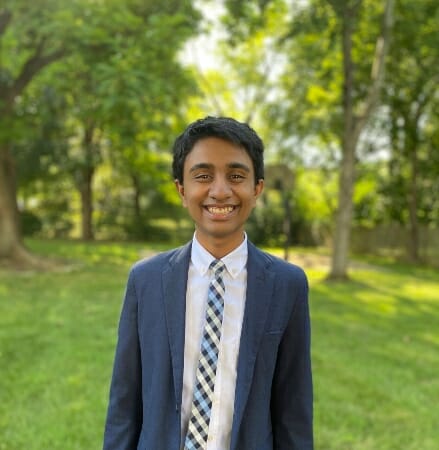
Rememoirs founder Siddharth Satish is improving the lives of elderly who are suffering from diseases like Alzheimer’s and dementia through volunteerism./ Courtesy Siddharth Satish
Share one personal story with me from your volunteerism.
In order to help build diversity in medicine, we created our Young Women in Medicine initiative. We recently had an opportunity to provide content to an African community, and it was the first time this content would be condoned by the community due to historic suppression. Essentially, we’ve crossed the rubicon by pioneering this medicine program. That experience gave me clarity on how you can change boundaries through volunteerism.
Why do you think it’s important for others to give back?
We all live off of what people have given before. Building upon that foundation of service through continued volunteerism is an important force to have in our lives.
What’s been the most rewarding part of your service?
It’s rewarding to reach more youth and expand their perspectives of the world. We are creating an intergenerational partnership between youth and the elderly for a common goal.
What does Thatha say about your volunteerism?
Growing up, he didn’t have much family around him and he thought he’d live his life unknown, but now through my volunteerism, he’s received international recognition. He doesn’t say too much, but I know he feels very proud of the accomplishment.
In one word, what does volunteering mean to you?
Empathy.
When you’re not busy with school or volunteering, what do you do for fun?
I love debate. That’s my favorite extracurricular activity.
College Grad’s Red Cross Service Keeps Volunteers Engaged During COVID-19 Pandemic
Meet Daily Point of Light Award honoree Allison Carey. Read her story and nominate an outstanding volunteer or family as a Daily Point of Light.
A recent college graduate, Allison Carey has the world at her fingertips. It’s those steady hands and her consistent service that helped to power volunteerism for the American Red Cross of Northern New England during the COVID-19 pandemic.
Starting as a volunteer for the Red Cross in summer 2019 while still a college student, 22-year-old Allison became an integral part of the organization’s mission during the pandemic by supporting blood drives and engaging volunteers. Recognized for her reliable and compassionate volunteerism, the Burlington, Vermont resident is working behind the scenes to positively contribute to her community.
What inspires you to volunteer?
I’m inspired to volunteer because I’ve seen firsthand the impact the Red Cross makes. From donating blood to working behind the scenes, there are always opportunities to help out with the organization.
Describe your volunteerism with the Red Cross.
As a volunteer, I support programs including:
Blood Services: I help to ensure volunteers are scheduled for upcoming blood drives, where life-saving units of blood are collected.
Volunteer Services: During the pandemic, I helped to virtually engage volunteers by recruiting and serving as a point of contact.
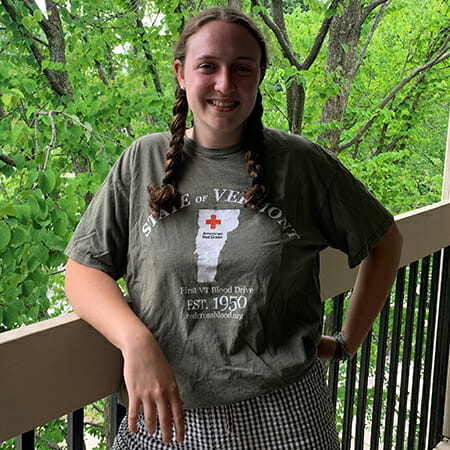
Recognized for her reliable and compassionate volunteerism, the recent college graduate is working behind the scenes to positively contribute to her community./ Courtesy Allison Carey
Share one personal story with me from your volunteerism.
By recruiting new volunteers, I could see on paper the impact I was making through service. Behind the scenes I was helping other volunteers, and it was very fulfilling to see the sheer volume of their contributions.
Why do you think it’s important for others to give back?
Life is a “you give some, you get some” situation. It’s important to volunteer because throughout your life, you may be helped by volunteers without even realizing. For me personally, when I’ve participated in blood drives, I know the Red Cross has helped me.
You’re recognized for being a reliable and compassionate volunteer. What does that mean to you?
It makes me very appreciative. Sometimes, you only receive appreciation for the work you submit. It’s nice to know that someone appreciates your personality and how you contribute.
What do you want people to learn from your story?
You can be as involved or uninvolved as you want when volunteering. Organizations like the Red Cross are really appreciative of the time you are able to dedicate to service, whether it’s a little or almost full-time. Even volunteer the smallest amount, and you’ll make a difference.
In one word, what does volunteering mean to you?
Fulfillment.
How can readers help?
Please visit the Red Cross website for more information about how you can help.
Through Youth Leadership Group, Teen Helps Provide Eye Care to Kids in Rural India
Meet Daily Point of Light Award honoree Abhiram Talluri. Read his story and nominate an outstanding volunteer or family as a Point of Light.
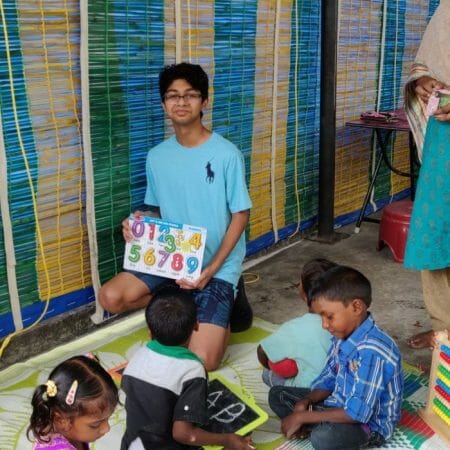
Abhiram Talluri said he never really understood the point of volunteering until his sister pushed him to give PURE Youth a try. Part of the organization People for Urban and Rural Education, the international leadership program aims to bring awareness on the impact of education through volunteer projects and fundraising. When he joined the Jacksonville, Fla., chapter, Abhiram’s entire outlook on volunteering changed, and he says he has since become a better person.
Abhiram is a part of both PURE Youth and PURE Femme, which focuses on menstrual hygiene education. Through PURE Youth, the 16-year-old designed and planned the implementation of the ‘FoFo’ project, which helps test the eyesight of children in rural India and get them the help they need if vision problems are discovered. So far, the project has been implemented in ten schools. This summer, Abhiram will also travel to Barbados with PURE Femme to distribute menstrual projects and give presentations on menstrual hygiene to schools and shelters.
Describe your volunteer role with PURE Youth.
We’re a part of PURE, and usually we’re fundraising for the other parts of PURE for activities such as donating to shelters or schools in India and supporting them and making sure every child gets an education. I’m part of the Jacksonville chapter. The most recent fundraiser we did was a game night in my chapter. We did a game night for one of our focus groups which is PURE Femme Youth, which I’m also a part of. We were funding for patent manufacturing units. Usually I’m reaching out to people and trying to get funds, and when I’m doing my PURE Femme work, usually we make webinars or reach out to other organizations to see if they would like to partner with us and spread the word of menstrual hygiene awareness.
When did you first get involved with PURE Youth, and what inspired you to do so?
I think around two or three years ago. I’ve been an active member for the past few years. I really like their message. Most of our work is primarily based in India and I’m from India, so it really resonated with me, their message that we empower through education. I really liked that message so I wanted to join.
Abhiram Talluri serves as a volunteer with PURE Youth, a leadership program within People for Urban and Rural Education./ Courtesy Abhiram Talluri
Describe your ‘FoFo’ project.
I called it PURE Sight, since it’s being executed through PURE’s on-ground team. I found an invention online for a tool which is like an on-the-go vision screening process. You use the tool and you can adjust it to see if you’re nearsighted or farsighted. If they have any trouble with their vision, then we get them further help. We send them to more professional help and an actual vision doctor and make sure they get the glasses or any surgery if needed.
What inspired you to do the ‘FoFo’ project?
I started it back in January and I finished it in May. Since I was in third grade, I’ve had glasses, and it was really hard for me before I got them. I sat in the back [of the classroom] and seeing the board was really hard. I realized that kids in India in rural areas won’t really have a doctor nearby. If there is one, it’s going to be one a few miles away which is really hard for them to get to and really inconvenient. I wanted a really fast and simple way for them to get help and see if they need help, and for us to support them.
Are there any future partnerships, programs, or events that you are excited about?
My focus group in Pure Femme is planning on going to Barbados and talk to a few shelters and schools there about menstrual hygiene and how it shouldn’t be a taboo topic. We’re probably going to distribute pads to the shelters and schools as well. That’s happening in August. That’s our big project for this summer.
What’s been the most rewarding part of your work?
Before I started PURE, I was kind of a selfish person you could say. I didn’t really understand the point of doing charity work. My sister started before me and she was really enjoying it, so I wanted to give it a try. I’ve really enjoyed myself these past few years. I think I’ve become a better person because of PURE, so I think that’s the most rewarding part.
How has your view of volunteering changed?
When I first went to India to do some work myself before the pandemic happened, I got to interact with the kids there. When I saw their smiles and how happy they were, genuine happiness just from getting the basic necessities, it really changed something in me and I really wanted to do more work for them.
What have you learned through your experiences as a volunteer?
Knowing how grateful I should be for having all these luxuries, and having warm water and water to drink in general, having food on the plate, knowing I’ll have a meal tonight. I’ve learned to see that.
“The Debate Group” Volunteer Opens Path to Success for Underserved Students
Meet Daily Point of Light Award honoree Sai Bommineni. Read his story and nominate an outstanding volunteer or family as a Daily Point of Light.
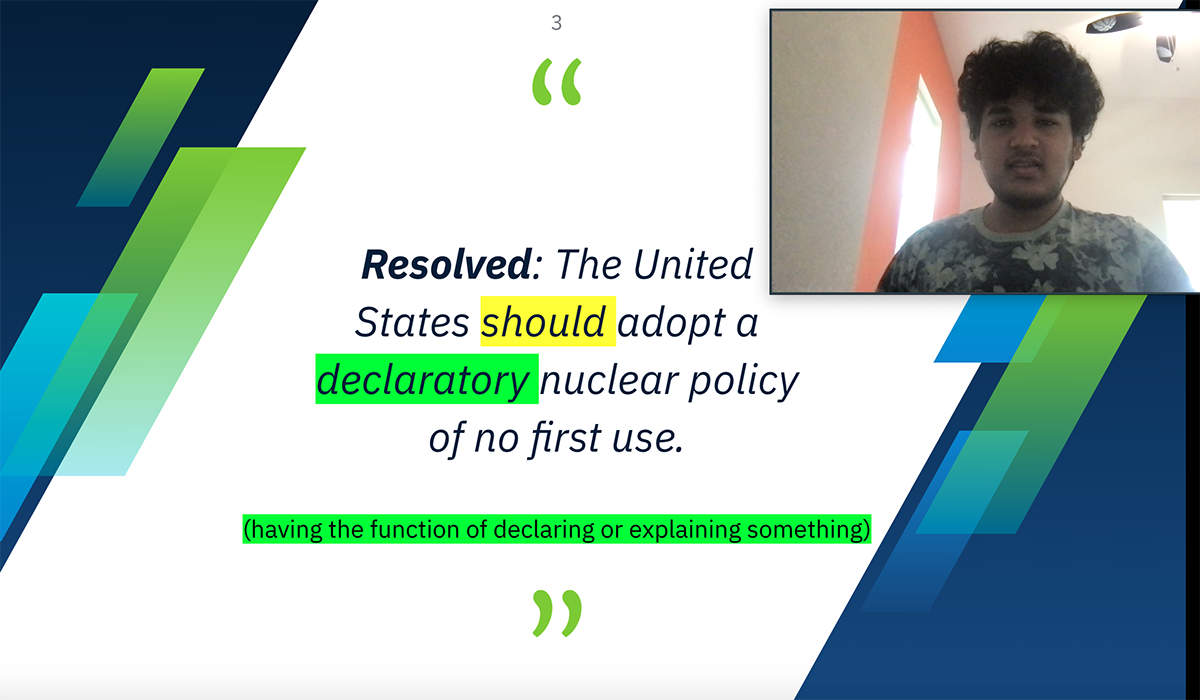
Establishing friendships with other debaters, Sai Bommineni was able to improve his debate skills, but the Frisco, Texas 17-year-old’s humble start to debating meant his path to becoming a debate champion wasn’t always easy. Pairing low-income youth with nationally ranked debaters, Sai has dedicated his service to giving a voice to kids in need.
Co-founding The Debate Group with his classmates, the rising high school senior is helping to provide free debate instruction by connecting experienced coaches with younger students. Helping more than 400 students thus far from California to New York, Sai’s volunteerism is opening doors for underrepresented kids who lack the resources and opportunities to access debate, and inspiring others to give back to those in need.
What inspires you to volunteer?
Debate is very expensive, and I understood how it felt to be underserved as our debate team did not have access to broad resources or opportunities. We are inspired to help others succeed in the world of debate, and I wanted to make sure others had the opportunity to grow their skills.
Describe your volunteerism with The Debate Group.
As co-founder and executive director, I work to expand our mentorship program, I also manage recruiting, social media and marketing for the organization. Lastly, I create curriculum we use for our mentees. We offer virtual programs including seminars, events and debate spaces. We’ve also partnered with organizations to provide scholarships for program participants to attend debate camps.
Connecting with more than 400 students across the country, Sai’s volunteerism is opening doors for underrepresented kids who lack opportunities. /Courtesy Sai Bommineni
Share one personal story with me from your volunteerism.
We’ve taught multiple mentees from one particular school whose program was heavily underfunded and the team wasn’t seeing much success. After our help, the team qualified for two separate high-profile tournaments, and that was really rewarding for our organization. As someone who had to jump through hoops myself, we saw we were making solid progress in helping underprivileged children join the debate space, and we’re changing the future in small part by helping to make debate more accessible to everyone.
Why do you think it’s important for others to give back?
We are all meant to provide everything we can to our community. Volunteering maximizes the overall happiness of everyone involved, and we owe it to each other to help one another inherently. Volunteerism isn’t an obligation, but more of a necessity.
What do you want people to learn from your story?
Anyone can volunteer, even if your service isn’t something major. Everyone has different skills and specialties and you can use those skills to help others.
In one word, what does volunteering mean to you?
Giving.
When you’re not busy with school or volunteering, what do you do for fun?
I like to ride my bike, play tennis and play video games. My favorite video game is “Call of Duty Modern Warfare.”
How can readers help?
Please visit our website for more information about how you can help.
Teen’s “STEM Mindset” Service Increases Global Access to Education for Underrepresented Youth
Meet Daily Point of Light Award honoree Allison Eisenberg. Read her story and nominate an outstanding volunteer or family as a Daily Point of Light.
As a young female student interested in STEM, Allison Eisenberg says opportunities and resources to learn more were few and far between. When kids were sent home for remote learning because of the COVID-19 pandemic, the 16-year-old Glen Rock, New Jersey student started teaching STEM workshops to children of healthcare and frontline workers. That effort has blossomed into a global organization, as Allison serves up a STEM community to kids in need.
Launching STEM Mindset in June 2020, the rising high school senior and STEM Mindset student volunteers have virtually connected with a couple hundred students through workshops, events, mentoring and more. Reaching students in her community and beyond, Allison is making STEM education more accessible and helping to secure a brighter future for underrepresented youth.
What inspires you to volunteer?
As a girl in STEM, I’ve had limited opportunities. I love giving back and giving other underrepresented youth opportunities I may not have had when I was a younger student. All the smiling faces in our virtual workshops make me happy and inspire me to volunteer.
Describe your volunteerism with STEM Mindset.
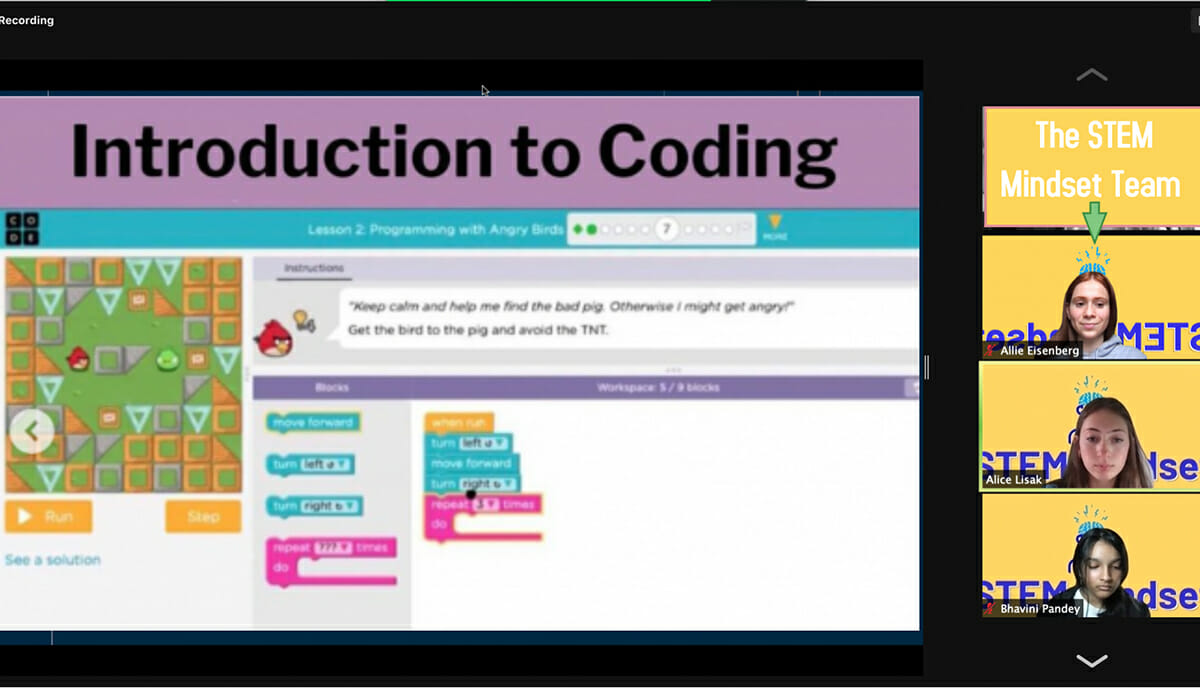
As founder, I hold weekly meetings with our board, meet and schedule our student volunteers for workshops and mentorship program, plan curriculum and organize events, facilitate our partnerships and manage a variety of initiatives including our app design competition and more. Through service, we are connecting with students in the United States and internationally in places like Saudi Arabia and India to spark interest in science, coding and technology.
Share one personal story with me from your volunteerism.
During one of our first workshops, I taught intro to coding. After the hour-long virtual workshop, I told students they could stay on if they had more questions. It was so nice to see how many stayed, and how self-motivated they were. I look forward to putting in the time to volunteer because hopefully, these students really enjoy what they learn about such a unique field, and we introduce them at such a young age that they’re able to enjoy the subject and pursue it in the future.
Through virtual workshops, mentoring and events, STEM Mindset sparks interest in science, coding, technology, even topics like debate and cybersecurity to help students develop critical thinking and communication-related skills. /Courtesy Allison Eisenberg
Why do you think it’s important for others to give back?
In my case, with STEM, it’s important to volunteer because there are limited opportunities for some of these students, and subsequently, limited career opportunities. Hopefully our introduction means these children will be more successful in the future, and this education opens doors for them in college and their career.
What’s in the future for your volunteerism?
We have grown virtually so we’re able to offer opportunities all across the world. One day, I hope to provide in-person support locally to my community, like laptops for students to participate in our workshops, in addition to continuing our virtual efforts.
What do you want people to learn from your story?
It’s important to pursue whatever you’re interested in. For me, it’s computer science. At first, it was overwhelming to start this service because of the logistics, but now I look forward to it every single day. If you’re passionate about a topic and want to give back, work hard, take on challenges and it’ll come more naturally.
In one word, what does volunteering mean to you?
Happiness. Seeing happy faces on our students.
When you’re not busy with school or volunteering, what do you do for fun?
I love playing tennis. I play competitively on my school’s team. Naomi Osaka is my favorite professional tennis player. I also love traveling with my family.
How can readers help?
We’re always looking for more volunteers to teach and for more participants to join our workshops. Please visit our website for more information.