Teen’s Entrepreneurial Spirit Creates Global “EntrepreYOUership” for Other Kids
Meet Daily Point of Light Award honoree Naomi Porter. Read her story and nominate an outstanding volunteer or family as a Daily Point of Light.
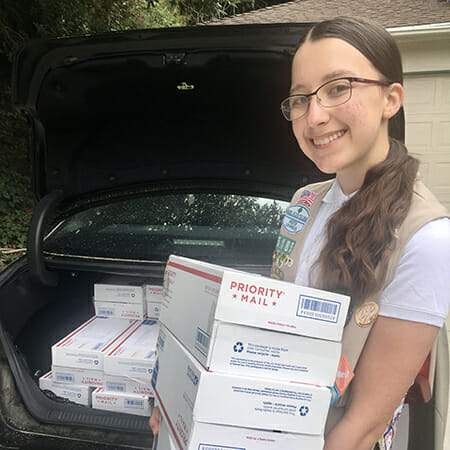
Growing up, Naomi Porter says she felt like she was surrounded by children connecting with their passions, and she was left in the dust.
“Did I miss the memo?” says Naomi. “I didn’t find anything that fit me well. Everyone was figuring out sports, art, dance, and I wasn’t good at any of those things. Then, I saw an ad in the newspaper which read, ‘Calling all young entrepreneurs.’ All 4-foot, 9-inches of me got up to the microphone at this event, and I started talking. In that moment, I realized, this is what I want to do.”
The now Los Angeles, California high school sophomore, who launched her first company at the tender age of 11, says she was seeking educational resources, support, and a community of entrepreneurs just like her – but was coming up empty. That’s when she started EntrepreYOUership, an organization dedicated to increasing access to entrepreneurial education.
“As a young entrepreneur, I’ve relied on self-education, mentorship, and figuring things out myself. If I had questions about topics I couldn’t go to my school to (learn more about) tax codes, employment law, advertising and marketing, all things you need to know about when starting a business. That’s when I realized there was a need for more programming around being an entrepreneur.”
Increasing access to free entrepreneurial education for kids aged 12 to 18, EntrepreYOUership has served more than 1,000 middle and high school students in the United States and internationally. In particular, Naomi is teaching the youngest generation through service that there are multiple pathways to success, as she gets more girls and youth involved in learning fundamental skills and building interest in entrepreneurship.
Naomi Porter: “So often, people say that one person can’t make a difference, or one vote can’t make or break an election, that individual contribution doesn’t matter, but it does. Your one individual contribution can build a network of people…We’re looking to redefine the way we view success and (through volunteerism) we keep empowering and inspiring young people.” /Courtesy Naomi Porter
“I partnered with an organization called Superposition to get girls interested in STEM. After working with us, one girl said to me, ‘Oh my gosh, I didn’t even realize I was an entrepreneur!’ That’s when it clicked for me. Entrepreneurship is the intersection of (many real life subjects) and that’s our mission to make sure all youth can have an entrepreneurial mindset. It was a very ‘yes!’ moment. Like when you hear someone giving a speech and you’re like, ‘Yes, yes yes!’ Finally, (this girl) was articulating the vision I’d set to empower all youth to become entrepreneurs.”
Offering business and development workshops that equip youth with an entrepreneurial mindset, program participants receive support to write business plans and have access to start-up funding. Partnering with existing community organizations, the youth-led organization is showing kids that entrepreneurship isn’t just reserved for adults with degrees and access to venture capital. Turning dreams into reality, Naomi is teaching other kids lifelong skills, says Crystal Cabello, career bound coordinator for Boys & Girls Clubs of the Los Angeles Harbor.
“Naomi put an entire course on entrepreneurship and building business as a teen together right before the pandemic hit,” says Crystal. “Within a week, she shifted to make everything available virtually, and she took that opportunity to invite people from other states. From teen to teen, it’s helpful for youth to see they can open up their own small business. (It’s at) a very small scale, but these skills will be transferable when they start pursuing other things. Naomi is providing youth with a completely different perspective, one that they can achieve.”
Adjusting to the impact of the COVID-19 pandemic, Naomi’s shift to virtual events and programs allowed more youth to participate globally. Innovating to keep students engaged online, Naomi even offered conversational “Think Tank” sessions. Reaching that larger audience, Naomi, who says she hopes to become a school superintendent and then the U.S. Secretary of Education one day, is effecting greater change, student by student, proving that volunteerism knows no limit at any age.
“So often, people say that one person can’t make a difference, or one vote can’t make or break an election, that individual contribution doesn’t matter, but it does. Your one individual contribution can build a network of people. Entrepreneurship is a lifetime thing as I continue to look for more ways to engage. We’re looking to redefine the way we view success and (through volunteerism) we keep empowering and inspiring young people.”
Through Decades of Service, Virginia Volunteer Shares Love by Helping Animals in Need
Meet Daily Point of Light Award honoree Juanita Easton. Read her story and nominate an outstanding volunteer or family as a Daily Point of Light.
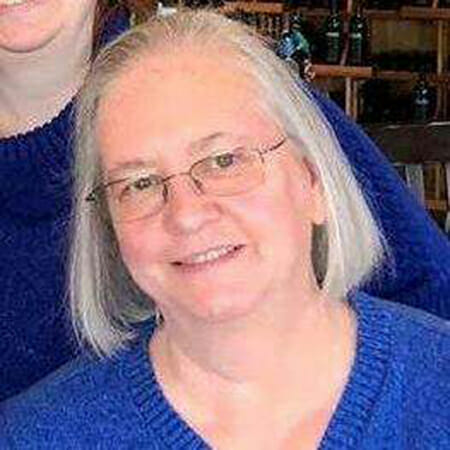
Juanita Easton is the longest-serving volunteer at The Humane Society of Loudoun County (HSLC) animal rescue, dedicating more than 20 years of service to helping animals and by extension, her greater community. It’s the love and care she extends to help others through ups and downs that is building a better world, one animal at a time.
Starting as a volunteer at HSLC in 2001, Juanita now serves as the organization’s president, pet pantry lead, education lead, and financial assistance lead. The Sterling, Virginia resident helps to facilitate HSCL’s programs including rescue, foster and adoption, a community cats/TNR and barn cats program, pet pantry, human education and low cost spay/neuter, even getting youth in the community involved with food pantry drives. Juanita has helped thousands of individuals and animals in her decades of volunteerism, offering a critical resource that is changing lives across Loudoun County and giving animals a second chance at life.
What inspires you to volunteer?
My love of animals inspires me. I looked for service opportunities in my community and found HSLC. Volunteering with them seemed like a good way to get my feet wet, and it went from there. Once you start something like this, it’s hard to walk away.
Describe your volunteerism with HSLC.
I’m chief cook and bottle washer (laughs). There are peaks and valleys in non-profit organizations, and where there’s a need, you step in and do it. We work to keep pets in their home and help whenever and whenever we can. In addition to my main responsibilities, I run HSLC’s Loudoun Pet Pantry, which was launched in 2013 and operates out of my garage since we don’t have a physical facility. We collect dog and cat food for Loudoun Hunger Relief, which distributes the food to needy families in Loudoun County.
Dedicating more than 20 years of service to helping animals and by extension, her greater community, Juanita Easton serves with love and care./Courtesy Juanita Easton
Share one personal story with me from your volunteerism.
We give some of our foster animals better exposure at local pet stores to increase their chances of being adopted. I was fostering one cat who started to have trouble at adoption events. She was acting out and hiding. She got an infection, and so I brought her home for extra care. This poor kitty came to us from a county shelter, and she’d forgotten how to be a cat. I had to show her it was ok to get in my lap, it was ok to play again. After a few weeks, I took her back to adoption events, and she became a totally different cat. This woman interested in adopting an animal visited, the cat walked right over to her and climbed right into her lap. What’s so great about this was that the family who adopted the cat (Penelope), had a perfect home for the cat and she just has the greatest life. It makes me so happy to have been able to give Penelope and other animals a second chance at life. It makes my heart feel happy.
Why do you think it’s important for others to give back?
There is such a need in our community and in our world. If everybody took care of their corner of the world, the whole world would be a better place.
What’s been the most rewarding part of your service?
It’s rewarding when we take in an animal that has been abused, abandoned or just needs love, and we turn them around and give them a happy home.
How have you continued to volunteer throughout the COVID-19 pandemic?
We had to stop hosting events because they couldn’t be done in person, however we were very, very active right before the pandemic and animal adoptions and HSLC volunteerism continued. The pet pantry kept running because it was an essential service. Throughout 2020, we distributed more than 27,000 pounds of food to families in need, ensuring that more than 4,400 animals in Loudoun County could be fed. We found that doing virtual home inspections was effective during this time, so we may continue doing that.
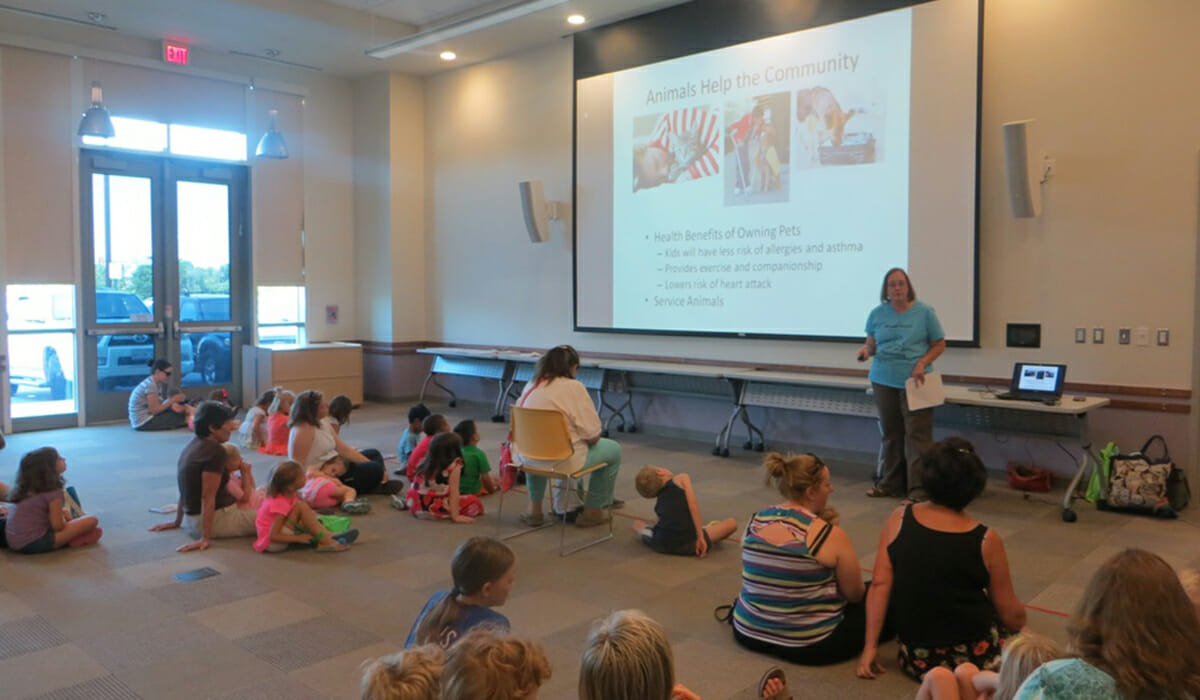
Juanita sharing an HSLC presentation at a local library./Courtesy Juanita Easton
What do you want people to learn from your story?
Volunteering and giving back to the community not only gives to the community, but also gives to your own self. You grow in ways you never would have thought you could.
In one word, what does volunteering mean to you?
Caring.
How can readers help?
We rely on donations to support our animals and programming. The pet pantry always needs more food. Please visit HSLC’s website for more information about how you can help.
Future Caregiver Addresses Medical Expenses to Support Sick Kids and Families
Meet Daily Point of Light Award honoree Angelina Xu. Read her story and nominate an outstanding volunteer or family as a Daily Point of Light.
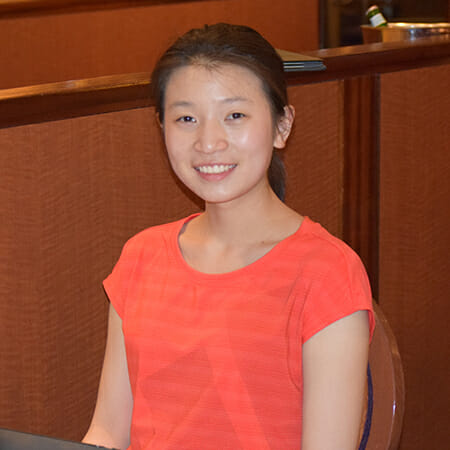
Angelina Xu has volunteered more than 500 hours at Children’s Specialized Hospital in Mountainside, New Jersey, connecting with children battling long-term illness. When Angelina says she discovered how parents sometimes face exorbitant medical bills for their children’s care, she knew she wanted to do more to offer support to the sick children and their families.
Founding a chapter of Miracle Network at her high school, the 18-year-old Basking Ridge, New Jersey senior is raising awareness for pediatric illness and fundraising to support patients and families. Raising $10,000 thus far and reaching more than 1,000 patient families across New Jersey in the past year alone, Angelina’s volunteerism amid the COVID-19 pandemic has been critical as she connects patients and their families with resources.
What inspires you to volunteer?
I’ve always wanted to enter the medical field, and understand how important it is to take care of people of all ages. Volunteering In long-term care, I realized how profound the bond between doctors and patients are, and that motivated me to volunteer across different areas in the medical field.
As a Miracle Network volunteer, Angelina Xu is supporting families across the state of New Jersey who sometimes face exorbitant medical bills caring for their sick children. /Courtesy Angelina Xu
Describe your volunteerism with Miracle Network.
As founder and president of my local Miracle Network chapter, I’ve raised more than $10,000 by mobilizing my school through fundraising teams, raising community awareness through business sponsorships, and selling 300 pounds of cookie dough. We also offer support sessions for patients and their families so they can share their health journeys and rehabilitation stories.
Share one personal story with me from your volunteerism.
After founding the organization, word got around in school about our service. One of my teachers heard about our fundraising, and she expressed her gratitude for my efforts, telling me her son went to Children’s Specialized Hospital for rehabilitation after an accident. It doesn’t matter that we don’t always know who exactly we’re helping, but we know we are impacting people.
Why do you think it’s important for others to give back?
That’s one of the major driving factors behind every single community service project. You know you’re impacting someone in some way. Knowing everything you’re doing has a greater impact on others helps you to overcome obstacles.
How have you continued to volunteer throughout the pandemic?
COVID-19 closed the hospital to volunteers and halted in-person fundraisers. We were planning an in-person Miracle Network Dance Marathon, but that had to be cancelled because of the pandemic. Instead, I led virtual support sessions, reaching more than 1,000 patient families in New Jersey. Now that things are opening up more, we do want to facilitate in-person contact, but we also realize our virtual support sessions expanded our scope to be able to reach more families across the state. That was a major benefit.
What’s been the most rewarding part of your service?
Interacting with the families and seeing the smiles from children. I can help them play games, and see the satisfaction they receive when we finish a picture or drawing together. The patients and families told us their stories during our virtual support sessions, and after hearing their stories, it was rewarding knowing that they could benefit directly from our efforts and the money we were raising.
What do you want people to learn from your story?
Keep an eye out for ways you can help your community. It’s important to have that mindset and look for ways to actively support and improve society.
In one word, what does volunteering mean to you?
Compassion. And giving back.
When you’re not busy volunteering or in school, what do you do for fun?
I play the violin. I’ve been playing it since kindergarten. I’ve been playing “Thais” Meditation, and I’m trying to get into popular songs as well. I also used to play the piano. I’m very interested in music. I also do science research.
How can readers help?
Miracle Network raises funds and awareness for more than 170 pediatric hospitals across North America. Please visit their website to find your local Miracle Network and support children’s hospitals.
Maryland Teen Opens Home to Hundreds of Foster Animals
Meet Daily Point of Light Award honoree Miriam Talalay. Read her story and nominate an outstanding volunteer or family as a Daily Point of Light.
Ever since she was ten years old, Miriam Talalay’s home was filled with foster animals. The now 16-year-old Lutherville-Timonium, Maryland, native has fostered more than 150 animals with the Maryland SPCA and volunteered nearly 3,000 hours socializing, administering medication and intentionally caring for the basic needs of foster animals.
Talalay even remembers fostering a three-legged cat, a cat with leprosy, and many mothers and baby kittens over the past seven years. In addition to her foster animals, she has two dogs of her own, Rosie and Ruby, and one cat named Thumbelina.
Now a junior at Dulaney High School, Talalay has dreams of attending Cornell for biology and learning about birds in the school’s ornithology lab. She invisions herself working with animals in some way, either working with an organization like SPCA or being a wildlife rehabilitator.
Talalay has always had an interest in art since attending art camp, and has been drawing for her entire life. Her favorite subject to draw is animals, of course, especially birds.
Describe your role with the Maryland SPCA.
My family adopted one of our dogs from the Maryland SPCA. We were looking for ways that I could volunteer with animals, but you have to be 18 to physically go to the SPCA to volunteer. Then we found fostering, which has no age limit, and I started when I was in fifth grade.
I’ve been fostering for almost seven years with nearly 3,000 hours of service time caring for over 150 animals. We mostly foster cats and kittens, but sometimes dogs, too. We have a large bathroom with a window in our basement where we keep them, or we let them roam the basement with supervision. Animals usually stay for two to three weeks, maybe a month, and we always post pictures of animals for people interested in adoption.
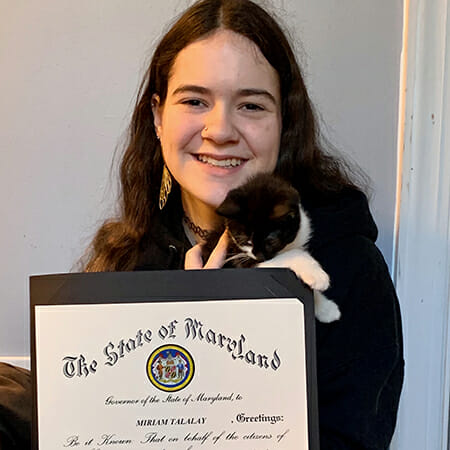
Miriam Talalay receives a Governor’s Certificate from Gov. Hogan of Maryland for her commitment to volunteer service and nearly 3,000 completed volunteer hours. /Courtesy Miriam Talalay
Did your volunteerism shift at all during the COVID-19 pandemic?
It shifted quite a bit because a lot of animals needed foster care because people weren’t really allowed to go to the shelter anymore. Luckily, all of the cats and dogs went into foster care so we fostered a lot of animals and we had more time to do so. We were also able to foster more animals like puppies and those with medical conditions, like a cat who had to get both of her eyes removed.
We also had the first pair of kittens who were adopted during the COVID-19 shutdown, so we had this driveway adoption because no one could go inside buildings.
I also volunteered with the Blue Hill Heritage Trust in Maine during the pandemic and created a series of “Virtual Arts in Nature” videos on local trails for children and adults.
Describe the recognition you received from the Gov. of Maryland for your volunteerism.
I was recognized by Gov. Hogan for my hours of community service at SPCA in December of 2020 with a certificate. I was incredibly thankful to the people at SPCA who made the nomination. It was so nice to get their recognition.
Are you involved in volunteer service activities outside of SPCA?
Yes, I’m a part of our Key Club — a service club at my high school — and I chair animal-related events. One event is an animal food drive for the SPCA where we do collections every month to gather dry and wet animal food. Then I drive them over to SPCA and the food goes to SPCA’s Kibble Connection, which provides pet food to low-income residents in Baltimore City. The other event is a dog toy making event where people make their own dog toys out of old T-shirts, socks and water bottles and receive service hours in return.
I actually just joined the Key Club this school year. I wasn’t really sure how to join clubs during my first two years in high school, but then there was a virtual club rush during the pandemic, so I decided to try it on a whim and I’ve really liked it. There weren’t really many animal-related things at school before I joined. I’m also a part of the environmental issues club at my school.
What inspires you to volunteer?
It’s really just a love for animals. I’ve loved animals since I was very young, and animals have always been my passion. Getting to foster and getting to see all of these animals go to good homes instead of being at the shelter makes me so incredibly happy. I just enjoy being able to care for them because animals are just my favorite thing in the world.
What have you learned through your experience as a volunteer?
I learned how to take care of these animals, of course, and I learned how to give them medicine and do all sorts of duties. I also learned a lot about behaviors and socialization.
Why is it important for others to give back? Especially youth?
I would say that there’s always going to be animals in the shelter, so the best thing you can do is take them out of that cage and get them to your house and care for them because all animals want is to have someone love them. It’s a great way to familiarize yourself with service, especially for youth. Even though you can’t physically go to the SPCA and volunteer right now, fostering a great way to make good connections. It’s just very fulfilling, and it’s just great for anybody who has a love for animals.
What would you want others to learn from your service story?
I really want people to learn that an animal’s entire life is what we give them. Fostering is so important in the sense that we’re their entire lives. Fostering allows them to feel loved outside of the shelter. Then they get put in loving homes, which is just so important because there’s so many stray animals out there. There’s always going to be puppies, kittens and dogs that aren’t safe that need homes and fostering really helps with the process.
Are there any partnerships, programs, or events that you are excited about?
I just started fostering for another place called TRU Rescue, and we have a puppy from there right now. There’s going to be a few adoption events at pet stores so people can meet the puppies.
Recently we also went to the Greater Baltimore Medical Center with TRU Rescue puppies to visit the nurses and had a little cheer up puppy party. The event was for nurses of the intensive care unit and other healthcare workers who have been hit hardest during COVID-19. We had puppies, snacks and other adult dogs and they all just snuggled. It was so nice to meet all of the nurses — they’re working so hard. We just wanted to give back and that’s my favorite thing. We will hopefully do this again soon.
Teen Advocate Makes Positive Impact on Community Through “Good Intentions”
Meet Daily Point of Light Award honoree Pranav Giridhar. Read his story and nominate an outstanding volunteer or family as a Daily Point of Light.
14-year-old Pranav Giridhar says he feels fortunate to have received a good education growing up. When the 8th grade Ashburn, Virginia student realized that not all children were able to enjoy the same kind of education, he decided to dedicate his service to advocating for quality education for underprivileged kids.
Launching Good Intentions Foundation in September 2020, Pranav advocates for education, climate action and sustainability across the globe. Millions and millions of primary school children are out of school around the world, a statistic which worsened amid the COVID-19 pandemic. Dedicated to offering critical social services, Pranav says his “good intentioned” volunteerism became even more important during the pandemic as individuals around the world faced adversity.
What inspires you to volunteer?
I never had to worry about whether I had to hop on a bus or walk two miles to school, and the more I read about the issues some children face and how that adversity results in lack of education, that hit me and made me want to help in any way I can. It’s a blessing to have an education, and I wanted to help provide that blessing to other children, particularly underprivileged children.
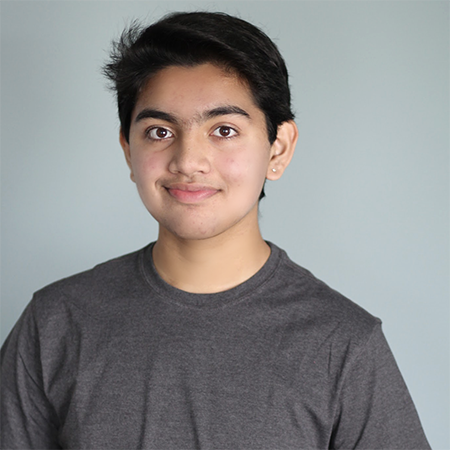
Pranav Giridhar launched Good Intentions Foundation in 2020 to offer critical social services around the world, support that became even more important amid the COVID-19 pandemic. /Courtesy Pranav Giridhar
Describe your volunteerism with Good Intentions Foundation.
As founder, CEO and chairman of the board, I lead education and some environmental initiatives. I’m the president of my middle school student council and we wanted to do something for the community, so launching Good Intentions was one of my projects to help. We have about 15 volunteers, mostly other students. We hold many events online because of the pandemic.
Share one personal story with me from your volunteerism.
We collected clothes from communities in Virginia and donated these clothes to local charities. It was winter time so the majority of clothes we received were puffer jackets, gloves and scarves. I felt joy being able to provide a resource for a family that didn’t have it, and I was proud of myself for taking initiative to help others.
Why do you think it’s important for others to give back?
Volunteering gives you a sense of humility and lets you be more aware of issues people around the world are facing. You may just feel like your contribution is just a drop in the ocean, but that assistance could make someone else’s life a lot easier. As a volunteer, you can provide resources for people who may not be able to provide for themselves.
What’s in the future for your volunteerism?
We launched in 2020 to respond to issues that existed before the pandemic, but COVID-19 made those issues ten times worse, and that made me want to help out even more. We believe everyone deserves education, and Good Intentions is a long-term project to impact underprivileged children and make sure we’re able to solve issues across environment and education.
What do you want people to learn from your story?
Contribute to whatever non-profit you want to help with the intention of actually helping others. Make sure you are serving because you want to help others, and you genuinely want to make an impact on people’s lives.
In one word, what does volunteering mean to you?
Humility.
When you’re not busy volunteering or in school, what do you do for fun?
I’m an entrepreneur. I run several technology companies, and most recently had a tech company acquired.
How can readers help?
Please visit our website for more information about how you can help.
As a volunteer with the National Suicide Prevention Lifeline, Kevin Tu says he was struck by the calls he received from people who said they had substance use disorders, and no matter how hard they’d tried, they just couldn’t break the cycle.
“When people on the suicide hotline called in and talked about substance use disorders, a lot of times they would start crying,” says Kevin. “A lot of these people were the same age as my parents. It was heartbreaking to imagine what life would be like without my parents, how much struggle these families were going through. Those were the thoughts that were going through my head. It was really, really easy to relate to them.”
As a result of increasing concern over substance use disorder in rural areas, Kevin founded CORA (Combatting Overdoses in Rural Areas) in the summer of 2020. Volunteering to address the opioid epidemic, the 20-year-old University of Maryland sophomore has since partnered with more than 180 communities in eight states across the country to provide tailored opioid education, resources and harm reduction. Fostering what he calls a “culture of care” to reduce health disparities through compassionate service, Kevin says he expects to help thousands of Americans in the coming year as he works to prevent addiction.
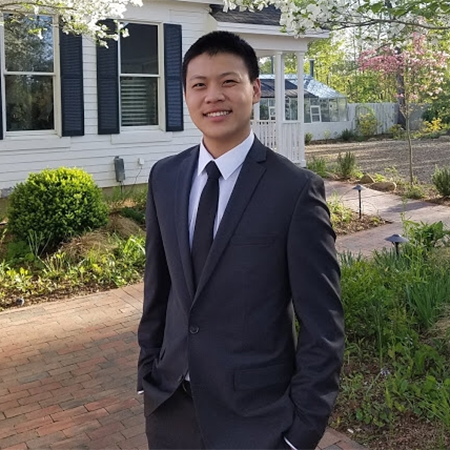
Volunteering to address the opioid epidemic in rural communities through CORA, Kevin Tu expects to serve thousands of Americans in the coming year./Courtesy Kevin Tu
“Through volunteering, I’ve noticed that I’ve been able to understand people a lot more and deepen my sense of empathy. (Once), I was watching videos with friends and we came across a documentary about people struggling with opioid use disorders. As I watched this documentary I started to get emotional, but a lot of my friends were saying, ‘hey, this was their decision to get into this position’. That’s why I work to raise awareness and empower other people to develop a culture of care for these people who are struggling.”
“To make any meaningful positive social change, you need someone who is not afraid to think about what’s not already possible,” says Marianne. “Kevin is willing to think about new ideas people have never done before or is the first person to say, ‘I want to do this.’ By continuously working and following his vision, we’ve been able to progress and improve CORA.”
By humanizing the opioid epidemic, Kevin is sharing a part of himself through service as well.
“I have personal connections to my volunteerism with The National Suicide Prevention Lifeline and also, TREVOR Lifeline, which operates through The TREVOR Project. Back in high school, I was struggling quite a bit mentally and had suicidal thoughts. I was also struggling with my sexuality at the time, which added to the confusion I was feeling. I was one of the lucky people who was able to get help and have a supportive network to turn to. So when I became more mentally stable, I knew I wanted to help other people that had experienced the same hardship and turmoil I had.”
Kevin has volunteered thousands of hours in ways big and small to help others. He says volunteerism isn’t limited to one giving to another, rather, the benefits from service extend to the volunteer and beyond.
“This person (called the National Suicide Prevention Lifeline), introduced themselves and then said they had no reason to live. They told me they had a gun in their hand and they were ready to shoot unless I gave them a reason to live. I was able to keep this person safe and when they said I helped them, it made me feel like I was making a difference, at least for that one person. Volunteerism is a two-way street. There’s giving from both sides. I wouldn’t have been able to help the caller as much if they hadn’t opened up about what was going on in their life. I was really happy that a stranger was able to put that trust in me, and I was really happy to help the person. Hopefully they are in a better place right now.”
Having dealt with multiple heart conditions her entire life, 17-year-old Rylie Dewley knows that the common assumption that kids don’t develop heart conditions is incorrect. With Start Heart Smart, Rylie is working to dispel that myth as well as provide support to other children who are dealing with heart issues. Through the organization, which she started two years ago, Rylie gives presentations on heart health to elementary and middle schoolers around her native Michigan. She has also delivered over 50 care packages to kids at two different local hospitals.
In addition to her service work with Start Heart Smart, Rylie also started an Adopt-a-Senior program last year for local high school seniors who were in need of cheer after the COVID-19 pandemic cancelled their prom and graduation. Because of the positive turnout, she continued the project this year and hopes to do so next year as well. A longtime volunteer, Rylie has also helped out at local homeless shelter Carriage Town at least twice a month since she was 10.
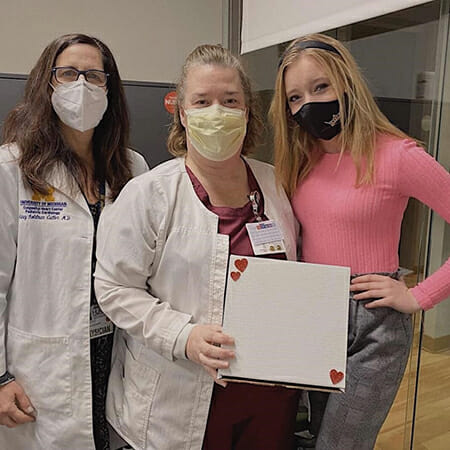
Rylie Dewley, right, delivers care packages to a local hospital through her organization Start Heart Smart.
Describe your volunteer role with Start Heart Smart.
I started Start Heart Smart a couple years ago. Ever since I was young, I struggled with different heart conditions. I was born with holes in my heart and a heart murmur. When I was five, I was told those went away, but when I was 13, I was told that I had been re-diagnosed with a heart murmur and told that I also had a new condition called leaky valves and mitral insufficiency. I knew I wanted to promote the idea that kids can have heart conditions. A lot of people don’t realize that teens and kids can have heart conditions, but I’m living proof of that. Through Start Heart Smart, I am able to share my story and help people keep their hearts healthy.
I am able to go into classrooms and speak to students. That’s one of my favorite events to do because I’m able to talk right with the students. I am able to give them all the information they need and then they can pass it on to their parents. I go to local events and I promote Start Heart Smart. I also have care packages I give to children who are suffering from heart conditions at different hospitals.
What is in the care packages, and why was that something you wanted to do on top of the education aspect?
Some of the things we put in are teddy bears, socks, notebooks that look like hearts and little heart erasers and suckers, and I always finish off the boxes with a note from me saying ‘Hey, I’m thinking about you and you’re going to do so many great things so don’t give up yet, you are so strong.’ … I think the care packages were a great idea because I have been in the patients’ shoes. I grew up pretty much in the hospital. I was always going there for my heart conditions. I was also born premature, so I was going to the hospital to get my check ups. It was so scary be-ing in those situations, so I knew I wanted to do something to bring a smile to the patients’ faces which is why we went with care packages.
Why was it important for you to create Start Heart Smart?
Ever since I was young I had heart conditions, and it was always really scary not only for me but for my family as well. It was hard because there weren’t many sources I could go to that talked about children’s heart disease or the fact that children could have heart disease. I didn’t know what it meant. I wish that I would have had someone there to tell me and explain it to me, so I want to be that person for other children who have heart conditions, and I also want to be able to prevent that feeling in other kids. I want them to be able to prevent themselves from having heart disease right now or even when they get older.
Can you talk about your Adopt-a-Senior program?
I created the Adopt-a-Senior program last year for the seniors of the class of 2020. I was really close to the senior class last year and this year, and I knew a lot of them were really upset because they weren’t able to have their prom or graduation due to COVID. I created this group where people in Grand Blanc were able to join the Facebook page, and people would post their seniors on it saying “This is my senior, this is what my senior likes, who would like to adopt them?”, and then someone from the community can adopt a senior. They get them gifts before graduation and give them little surprises.
What was the reaction to that program?
It was awesome. I didn’t exactly know how it was going to go at first because it was my first year doing it, and I was really worried it wasn’t going to get the reaction I hoped, but so many people in the community came together. Over 1,600 people are involved in the group now and over 400 seniors were adopted last year, so the response has been amazing.
What have you learned through your experiences as a volunteer?
I’ve learned so many things through volunteering. One lesson I learned quite a lot is be gracious for everything that you have. I volunteer through a lot of different homeless shelters and people who are in those situations don’t have a lot. They have very little and yet they’re so gracious for everything. It was really great to see that even though they’re faced with this challenging situation, they could be grateful through it. That’s a lesson I take through my everyday life.
What do you do when you volunteer at the homeless shelters?
The main homeless shelter I volunteer at is Carriage Town in Flint. I serve food and also work with helping them with their programming on their computers. I do it at least twice a month. I started probably when I was 10. I’ve grown up volunteering. It was something my mom really pushed my brother Hunter and I to do. I fell in love with it. When I heard about Carriage Town and heard it was so close to me, I really wanted to be able to go there and help.
What’s been the most rewarding part of your work?
Seeing people’s reactions is always amazing. I was able to receive some pictures of the patients opening the care packages and they looked so happy and so excited and that was an amazing feeling.
Why do you think it’s important for others to give back?
Volunteering and giving back to the community is important in so many different ways. Your community most of the time has helped you grow and helped shape you into who you are, so volunteering is not just a way to give back, it’s a way to say thank you by helping others.
Wildlife Expert Volunteers to Give Animals Second Chance at Life
Meet Daily Point of Light Award honoree Bob Nightwalker. Read his story and nominate an outstanding volunteer or family as a Daily Point of Light.
Bob Nightwalker’s career as a wildlife rehabilitator has strengthened his service commitment to wildlife that need help, as the Fort Collins, Colorado resident volunteers more than 500 hours each year to help give animals a second chance at life.
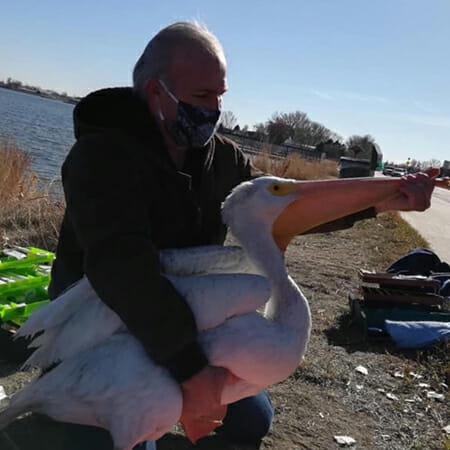
As a volunteer with the Northern Colorado Wildlife Center (NOCO), Bob has rescued hundreds of wildlife experiencing emergencies, from birds attacked by cats, pelicans caught in fishing line and raccoons struck by disease. Helping the animals to rehabilitate, Bob is dedicated to protecting wildlife and also raising awareness about how humans and wildlife can peacefully coexist. In addition to his critical service, Bob is advocating for a new center to expand NOCO’s efforts to care for wildlife in northern Colorado.
What inspires you to volunteer?
The facility in northern Colorado which provided care to non-raptor wildlife discontinued their services several years ago, which has resulted in thousands of animals being left untreated. There are no other wildlife rehabilitation centers to accept mammals and birds other than raptors within a reasonable distance. We’re seeing people try to help wildlife on their own, which is not just illegal, but can be dangerous. The animals are not getting the help they need but also, we want to bring this resource back to the community.
As a volunteer with the Northern Colorado Wildlife Center (NOCO), Bob Nightwalker has rescued hundreds of wildlife experiencing emergencies, from birds attacked by cats, pelicans caught in fishing line and raccoons struck by disease./Courtesy Bob Nightwalker
Describe your volunteerism with Northern Colorado Wildlife Center.
We visit schools to educate children about what to do if you find an animal and how to coexist. We do some animal rescues. We’re licensed to rescue reptiles and amphibians and also help with other animals that other people probably can’t get help with, including pelicans and raccoons.
Share one personal story with me from your volunteerism.
We all got together for a pelican that was tangled in fishing line. The community couldn’t get anyone else to come and help. It was a water rescue so several volunteers assisted to get the fishing line off the pelican and get it into a rehabilitation center. We weren’t the only ones involved in the rescue, people who lived around the lake were offering kayaks and paddle boards to help us get to the pelican. That’s what made me feel good, to see how many people cared about the pelican and how we could help more wildlife like this if we had a wildlife center in our area. This experience drives me to get the funds necessary to build an expanded center.
Why do you think it’s important for others to give back?
In my profession, all these animals have are the people that care about them and those who want to help and give these animals a second chance. That desire to give back is across the spectrum, from vulnerable people to animals. Everybody needs somebody at some point and time.
What’s been the most rewarding part of your service?
It’s rewarding seeing the animals go back to the wild, and the people we touch and educate that decide to go into this field.
How have you continued to volunteer throughout the COVID-19 pandemic?
We put a lot of education programs on hold because of the pandemic, and couldn’t do a lot of fundraising. We are already restarting some outside teaching with school groups and have some fundraising for expanded wildlife service in the works.
What do you want people to learn from your story?
It’s not just people that can be helped through service, wildlife needs help too. If you want to help wildlife, look online and check to see what’s in your area. Even young children, if they can’t volunteer at a center, they can help with environmental clean-ups. We see a lot of waterfowl come in to the center that have gotten tangled up in fishing line.
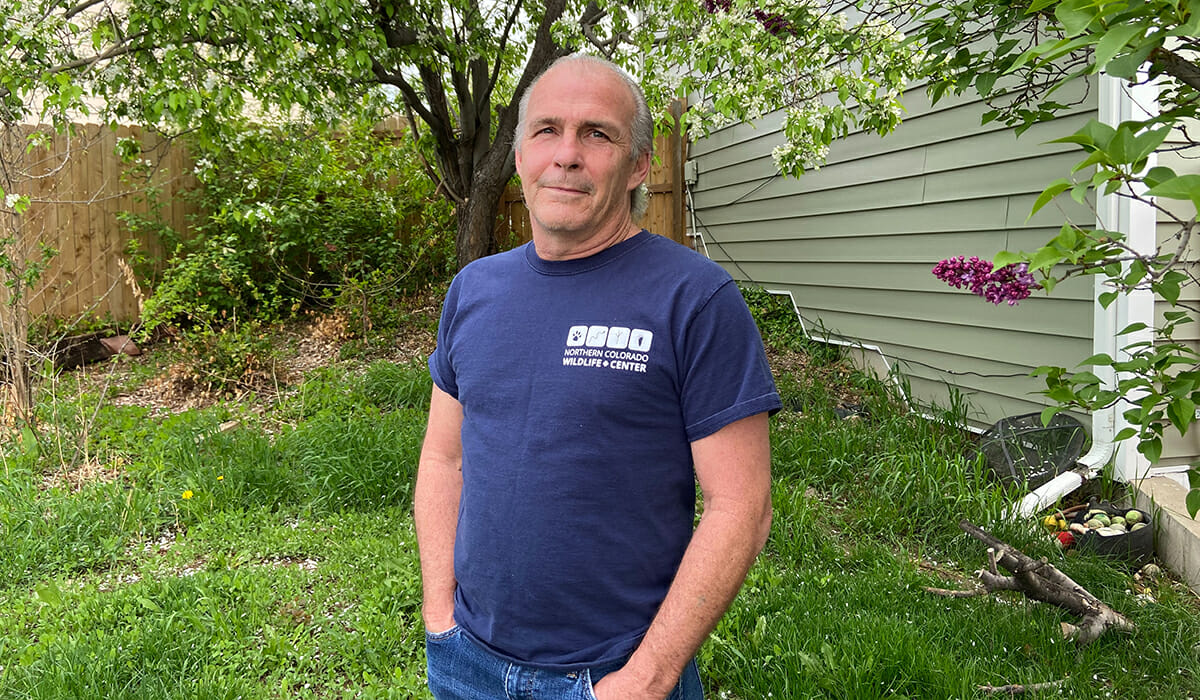
Bob Nightwalker: “That desire to give back is across the spectrum, from vulnerable people to animals. Everybody needs somebody at some point and time.”/Courtesy Bob Nightwalker
Tell me about the coolest rescue you’ve done.
With NOCO, during the big wildfires we had in Colorado in 2020, we rescued a rattlesnake. A homeowner was trying to do fire mitigation around his house, and the rattlesnake came in to us with a pretty deep wound. The vet did surgery to remove some ribs that were severed and we had to do daily antibiotics. It was a pretty cool patient given that the circumstances were pretty unique. After a few months of rehabilitation, the snake was released back into the wild, healthy.
In one word, what does volunteering mean to you?
Community.
How can readers help?
We rely on fundraising to support our programs, and hope to be able to expand to offer more wildlife services. Please visit NOCO’s website for more information about how you can help.
Lifelong Volunteer and Primary Care Doctor Boosts Volunteerism Amid COVID-19 Pandemic
Meet Daily Point of Light Award honoree Dr. Amit Sapra. Read his story and nominate an outstanding volunteer or family as a Daily Point of Light.
Amit Sapra M.D., FAAFP, Dipl. of ABOM., says his connection to service and helping others runs so deep, it’s a desire he’s felt since childhood. When the Springfield, Illinois primary care physician and assistant professor of Clinical Family & Community Medicine at the Southern Illinois University School of Medicine (SIU), who also serves as medical director of outreach for health centers at the SIU Center For Family Medicine, began to see the great need in his community amid the COVID-19 pandemic, he boosted his volunteerism.
Serving at the COVID-19 testing site at SIU, and then later designated as an Illinois COVID-19 Prevention Ambassador, Amit’s volunteerism and advocacy during the pandemic helped to raise awareness and support struggling individuals. In addition to his volunteerism on the front lines, Amit also confronted issues resulting from the pandemic including food insecurity, collecting more than 1,200 food items at his clinic, the Center for Family Medicine at Southern Illinois University. Stepping up to provide care amid the pandemic, Amit continues to promote education and resources to help his community.
What inspires you to volunteer?
I’ve been helping individuals since my childhood. I feel strongly for other people’s suffering and treat another human being like extended family. I’m inspired because I just have a desire to help. I felt like if I had a choice, I’d pick the role of healer.
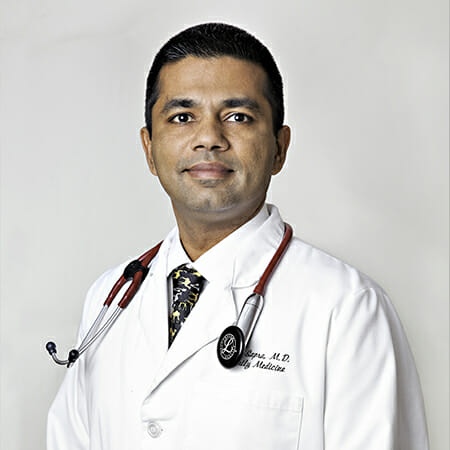
Amit Sapra M.D., FAAFP, Dipl. of ABOM., has a lifelong connection to service, and as a healthcare worker, is dedicated to helping and healing others. /Courtesy Amit Sapra
Describe your volunteerism.
Volunteerism has spanned my entire life. As a health care worker, it’s my obligation to provide urgent medical care during a disaster. During the pandemic, I advocated and educated individuals including children about face masks, combatted food insecurity around our community through our clinic, and tested patients for COVID-19. In addition to my direct care work, I’ve continued my service throughout this year as an Illinois COVID-19 Prevention Ambassador by informing the general public about the vaccine and other prevention measures. My volunteerism increased this year to help stop the spread of COVID-19.
Share one personal story with me from your volunteerism.
I was living in India in 2001 and working as an orthopedic surgery resident when a devastating earthquake hit western India. There were thousands of deaths and many more injured. I organized a rescue team and flew to the area in the immediate wake of the earthquake. We set up a mobile clinic and operating room and I stayed weeks with some of my co-workers to treat individuals who suffered musculoskeletal injuries. There was a lot of grief and anger. Also, a mixed feeling of helplessness and frustration because I realized people could use a lot more help than what we could give them, but also a feeling of contentment that I was doing all I could do to help them.
Why do you think it’s important for others to give back?
Volunteering is the only way we can create equality for all life forms. There are people who work harder and suffer from more severe conditions and still don’t get the basic rewards they would need to have a reasonably good quality of life. If we don’t volunteer or help people, we are never going to be able to equalize the scale. That’s the only way to carry on and to make sure that life is fruitful and to have fulfillment.
What’s been the most rewarding part of your service?
It’s rewarding to give some meaning to my life through service. I know that the day I go out of the way for somebody, I sleep better.
How have you continued to volunteer throughout the pandemic?
I’ve increased my volunteerism. I see so many new problems than just medical problems resulting from the pandemic. There are so many social problems the pandemic caused, it’s unbelievable.
What do you want people to learn from your story?
We don’t take any wealth or degrees with us when we go away from this world. We go away content and happy if we’ve made a difference in somebody’s life.
Teen Volunteer Helps Pollinators, Improves Community and Preserves Ecosystem
Meet Daily Point of Light Award honoree Spencer Burke. Read his story and nominate an outstanding volunteer or family as a Daily Point of Light.
17-year-old Spencer Burke’s environmental and conservation volunteerism is helping to change the world and inspiring others to give back in their own ways.
In 2019, the Dallas, Texas high school junior launched the Solitary Beehive project as part of his Boy Scouts service, and since then, he’s designed and built 100 solitary bee habitats which have been placed across Dallas Fort Worth. In addition to his work to make a difference to save the solitary bees and preserve the ecosystem, Spencer is making a positive impact on his community through volunteerism.
What inspires you to volunteer?
You’re only going to live once. It may not be directly, but you’re going to see the impact you have on a global scale. If you interact with a thousand people in your lifetime, you can make a positive impact on those people, which will then reverberate with another thousand, eventually reaching its climax.
Why did you decide to help bees through service?
Over 90% of all the bee species are solitary bees, as not all bees live in large family groups like honey bees. One in four face extinction because of global warming, habitat loss and the use of neonicotinoids, which are insecticides. I saw a TV show about how bees were leaving, and that got me thinking about the topic. After researching online, I realized it was important that I get involved.
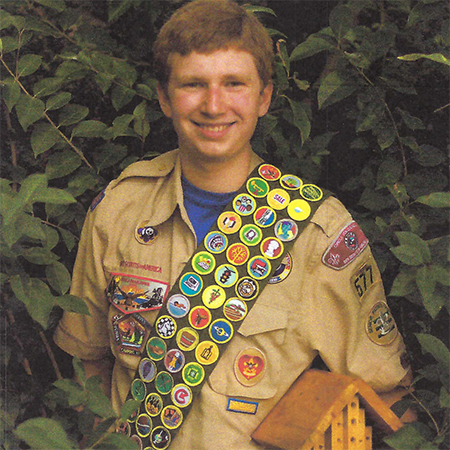
Spencer’s Solitary Beehive project started as part of his Boy Scouts service project, and his other volunteerism focuses on conservation and environmental sustainability. /Courtesy Spencer Burke
Describe your volunteerism.
My volunteerism is largely centered around environmental causes and conservation.
Solitary Beehive project: We made 100 solitary beehives and worked with the city of Dallas under urban biologist Brett Johnson to get the beehives placed around the Dallas Fort Worth area, including Twelve Hills Nature Center, Harry S Moss Park and the Connemara Conservancy.
Northaven Trail: As a trail captain, I oversee projects including trail cleaning and seed-ball building. The Seed Ball building project is also geared towards helping the Solitary Bees as we used native seeds and flowers to provide some additional possible food sources.
Twelve Hills Nature Center: I have led multiple projects to control many invasive species and replace them with native species. This is helpful to solitary bees as invasive species do not provide much nutrients to solitary bees, whereas natives provide much more nutrients to native solitary bees.
When I’m not working on these projects, I am raising and releasing quail, including at the Connemara Conservancy. In addition to environmental volunteerism I volunteer with Chess for Humanity.
Share one personal story with me from your volunteerism.
I was putting up a solitary beehive at a park and I saw a little kid watching me. He had no idea what the beehive was, so I explained it to him, and he said, “Oh, that’s really cool.” One reason we place beehives in parks is to help raise awareness. An interaction like that reminds me that my service is worth it, because hopefully we inspire other people to find an issue they care about and do something about it.
Why do you think it’s important for others to give back?
We’re all given so much. Being born in a country that has running water, that’s not a privilege every child has. Having access to electricity is not something every kid has. Going to school is not something every kid has. Service helps to equalize when you help those who don’t have what you have, and volunteering makes you more thankful for what you have.
What’s been the most rewarding part of your service?
It’s rewarding knowing the solitary bee hives we place will last for quite awhile and will have a lasting impact.
How have you continued to volunteer throughout the pandemic?
During our build days we socially distanced, held the builds in an outdoor environment and wore masks.
What do you want people to learn from your story?
I’m 17. I’m not a genius, I’m just like any other kid. If I can do it, anyone can do it. Pursue your dreams and passion.
In one word, what does volunteering mean to you?
Change. If you can make a positive impact on somebody you should, because it’s just the right thing to do.
When you’re not busy with school or volunteering what do you do for fun?