First Responder’s Volunteer Commitment to Neighbors Strengthens Community
Meet Daily Point of Light Award honoree Steven Hudson. Read his story and nominate an outstanding volunteer or family as a Daily Point of Light.
Steven Hudson says his calling in life means oftentimes helping people on their worst day, a commitment to service developed first as a Methodist minister’s son, and then later, marrying into a family committed to the community fire department.
“God gives you a calling in life,” says Steven. “My dad’s a Methodist minister, his ministry is from the pulpit. My ministry is helping people when they need it the most. I don’t usually meet them on the best day of their life, it’s usually the worst.”
Steven’s service as a volunteer firefighter and paramedic in Hickory Tavern, South Carolina has spanned more than three decades, responding to calls for assistance, emergency scenes and natural disasters. As the 50-year-old serves on the front lines in his hometown, he is also inspiring younger generations to give back in a similar fashion, as the lead paramedic program instructor and coordinator for Piedmont Technical College. Through his mentorship with the Hickory Tavern Explorer’s Post, Steven is equipping teenagers with life skills that translate into lifelong careers.
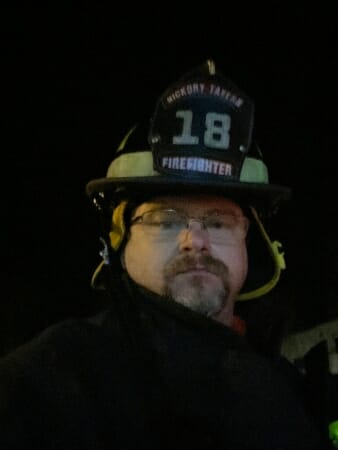
Steven Hudson has served more than 30 years as a volunteer firefighter and paramedic in Hickory Tavern, South Carolina. /Courtesy Steven Hudson
“Growing up, whether it was teaching Sunday School or volunteering in the community, we did it. Having those examples as a young person, for as long as I can remember, helped build me into the person that I have become. Watching lives wasted because of drugs and alcohol, the excessively high rate of suicide (we’re seeing) amongst high school kids. If I can take some of these kids that have not had a lot of parental guidance, or come from broken homes, and help them develop a life skill, we give them that little extra boost when they need it the most.”
As a first responder, Steven’s service to the community where he’s raised his family means he is sometimes shoulder to shoulder with neighbors as they fight for their lives or mourn loss.
“Some are harder than others. Having to explain to one of my best friend’s that her son was not coming home after a car accident. Knowing we did everything we could but it wasn’t enough. That stands out, that was huge. But she still thanks me. One of my friends took an overdose. (Whether it was) accidental or on purpose, I don’t know, but when you’re in a community the size of ours, you know a lot of people.”
When Hurricane Florence hit Bennettsville, South Carolina in 2018, Steven was deployed as a member of the regional dive and rescue team.
“One particular neighborhood, the houses had water up halfway to the ceiling in the living room. We were literally in boats, and walking in water that was up to our chests, and you don’t know what’s in that water. You’d come across mountains of fire ants floating in the water, and when they hit something solid, they scatter. There were roads and bridges that were completely gone. We had the road closed because water was rushing over it from a lake above us, and a lady in her eighties was trying to walk across the water. We made a ‘V’ to break the water to bring the boat to her and then wedge walked over to her. She was very thankful for our presence, knowing we were there to help her. There were farms inundated, farmers literally lost everything they had planted for that year. The human toll, the look on the face of someone as you remove them from their house, because it’s flooded and they can’t get away (sighs).”
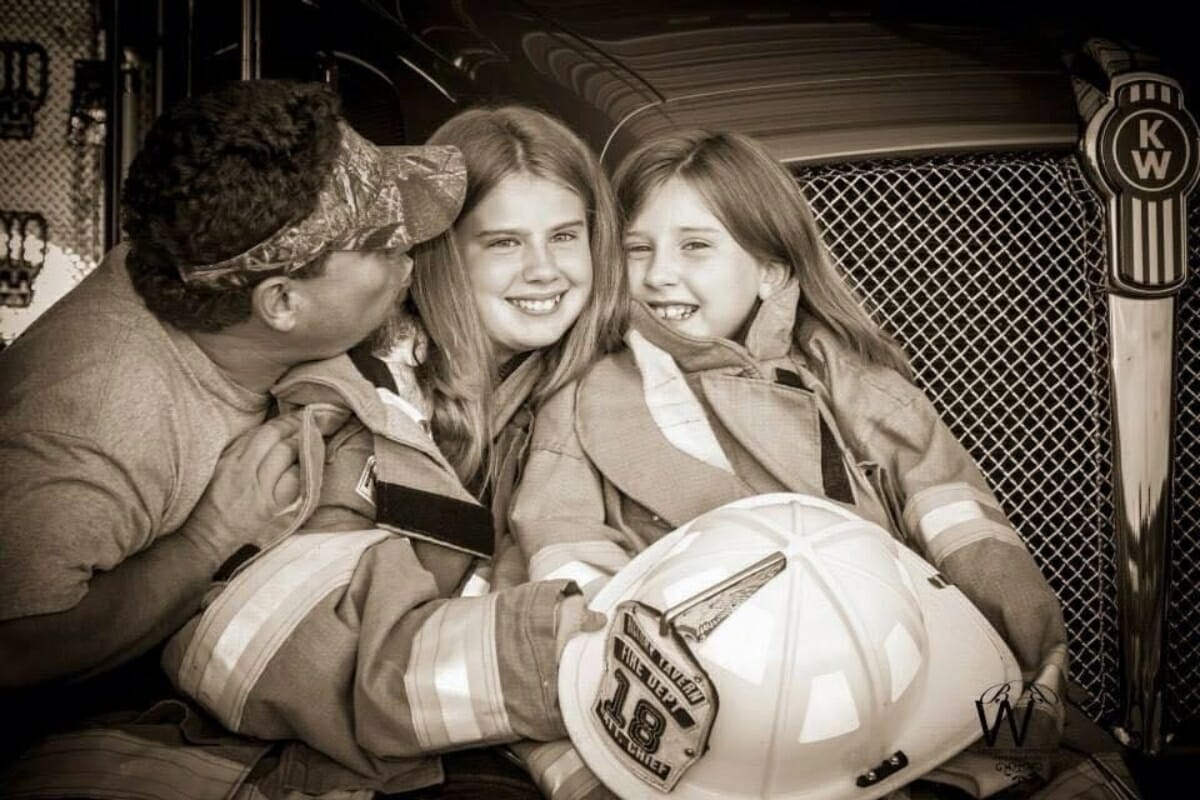
Steven pictured with his two daughters when they were younger, Abbie (center) Carlie (right). Steven just celebrated 25 years of marriage with his wife, Tracie, whose family legacy he is carrying on through his fire department volunteerism. / Courtesy Steven Hudson
Witnessing that human toll has led Steven to dig deep, allowing his service to be guided by his devotion to faith, family and his first responder responsibilities. By giving back to his neighbors and serving as an inspiration to others, Steven is setting an example for generations to come of how service can strengthen a community.
“I had a patient probably 15 years ago, he was in cardiac arrest. We got his heart started again, and he lived another year or so. He had that extra year he would not have had, had we not been there. Knowing that I gave someone a second chance at life. I don’t know how to describe it. That he had that extra time with his family was something that I could be proud of, and something I knew my children could look at later on and say, ‘You know, that person was here for Christmas because of my dad.’”
Volunteer Creates Safer Community for Children through Advocacy and Mentorship
Meet Daily Point of Light Award honoree Stacey Chavis. Read her story and nominate an outstanding volunteer or family as a Daily Point of Light.
As a public policy consultant, Stacey Chavis works to change lives and better communities, a passion she is applying to her volunteerism helping children.
Spotlighting what is currently the fastest growing criminal enterprise in the world, Stacey’s service with United Way of Greater Atlanta in the fight against human trafficking hits close to home, as Atlanta ranks among the top states with the highest incidence of sexually trafficked children. In addition to her volunteerism protecting children, the 40-year-old Atlanta, Georgia resident supports a number of initiatives and organizations that help children to thrive, including Junior League of Atlanta, Girl Scouts of Greater Atlanta and Wellspring Living. Serving on the front lines to better the lives of children in her community and beyond, Stacey is creating a safer community through acts of service big and small.
What inspires you to volunteer?
I watched my parents and my late grandmother serve our community. My younger brother and I were raised knowing volunteerism and community service was just something you did. I am inspired to use my time, talent and treasure to help other people and contribute to my community.
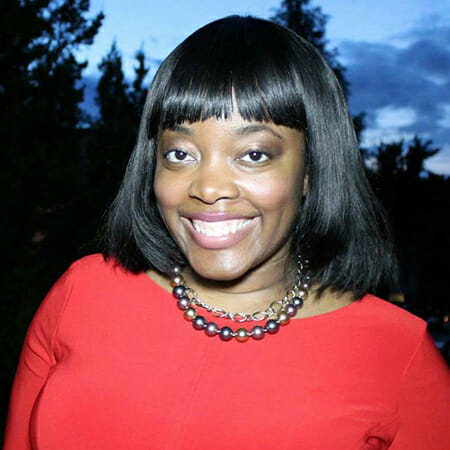
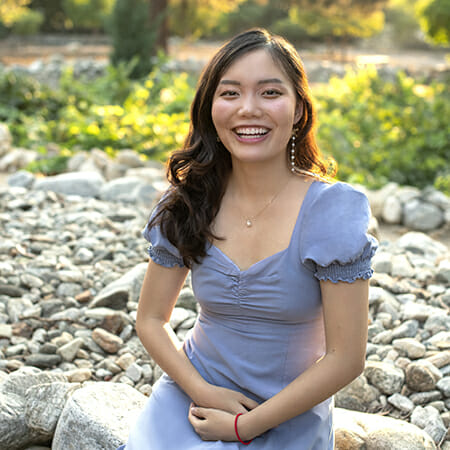
Stacey Chavis is volunteering to support children and create a safer community through acts of service big and small. /Courtesy Stacey Chavis
Describe your volunteerism.
My volunteerism started over 10 years ago through Ray of Hope Chrisitian Church. As I learned more about human trafficking, specifically in the Atlanta metro area, I increased my advocacy and service through several organizations, including:
United Way of Greater Atlanta (UWGA): I serve on the board of directors and also as the Public Policy Chair.
Junior League of Atlanta (JLA): I serve on the board of directors and also as vice president of advocacy and initiatives.
Through my volunteerism, I helped to get legislation passed for child victims of human trafficking including leading the team that worked on Senate Bill 8, also known as the Safe Harbor/Rachel’s Law legislation, which extends the statute of limitations for child sex trafficking victims. My service also led to the creation of the GRACE Commission (Georgians for Refuge, Action, Compassion, and Education Commission).
I have mentored young girls through Girl Scouts of Greater Atlanta, and also serve on the board for Wellspring Living, an organization that provides specialized recovery services for young domestic sex trafficking victims. I led the team that started the Clothing Closet at Wellspring Living for the young women we serve. I also developed a partnership with UWGA and JLA to pack purses with personal hygiene products for women survivors.
Share one personal story with me from your volunteerism.
We attended former Georgia Gov. Nathan Deal’s bill signing for Rachel’s Law. From an advocate’s perspective, it was wonderful to see the culmination of many years of work, and think about next steps. It means the world to know I can get children the support they need through volunteerism. This service is long-lasting and will outlast my lifetime. I have many more years of service work to do, but for me, it’s the single most important service I’ve done thus far.
Why do you think it’s important for others to give back?
It’s important to volunteer because we are fortunate. I’m very fortunate in the way I live and work. I’m deeply religious, and it’s part of my Christian belief and duty to give back to others who are less fortunate.
What’s your volunteering motto?
Muhammad Ali is quoted as saying, ‘Service to others is the rent you pay for your room here on earth.’ You are the example to inspire others to serve as well.
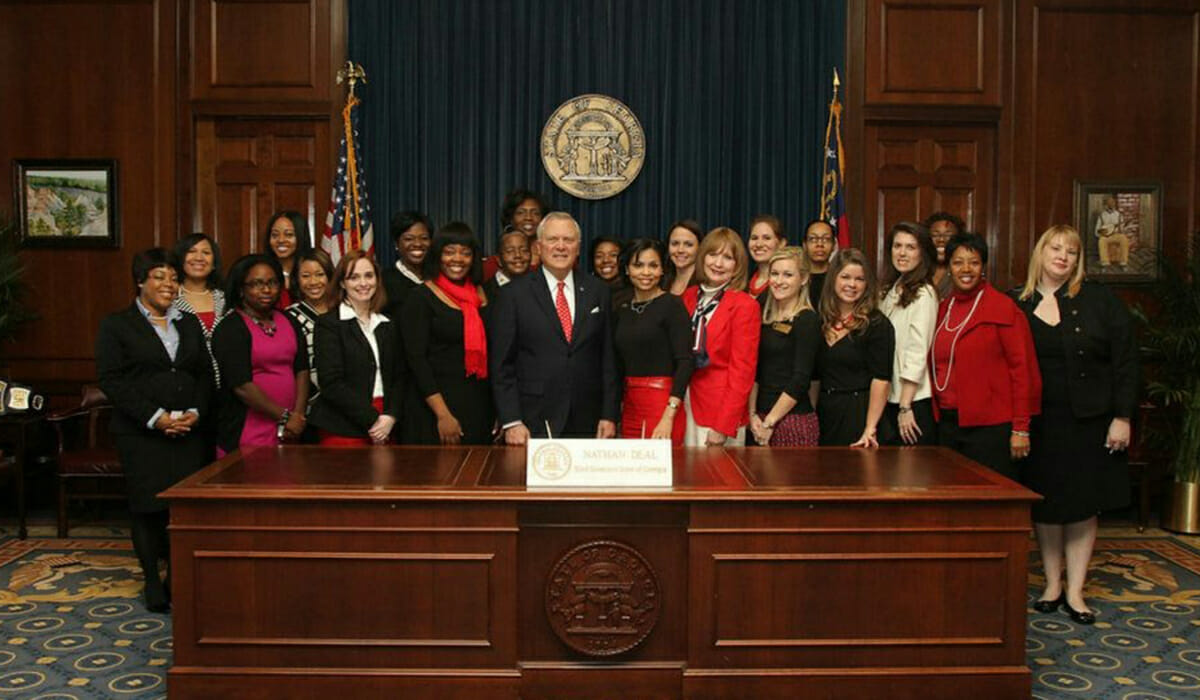
Through her volunteerism with Junior League of Atlanta (JLA) and United Way of Greater Atlanta, Stacey helped to get legislation passed for child victims of human trafficking. Stacey and other JLA members pictured with former Georgia Gov. Nathan Deal./Courtesy Stacey Chavis
What do you want people to learn from your story?
When you find a cause and work you’re deeply passionate about, you too can make a difference. Also, you can use your voice to advocate. You may think your one voice doesn’t matter, but coupled with others, you can make a difference.
How have you continued to volunteer throughout the COVID-19 pandemic?
We’ve had to postpone a lot of service, as much of our work is direct and in-person. We’ve still been able to conduct some service work online, and we’re still able to fundraise.
In one word, what does volunteering mean to you?
Everything.
How can readers help?
Please visit Wellspring Living’s website for more information about how you can help.
Teen Brings Computer Science Education to Disadvantaged Students Around the World
Meet Daily Point of Light Award honoree Vardhan Agrawal. Read his story and nominate an outstanding volunteer or family as a Point of Light.
Growing up in Cupertino, Calif., Vardhan Agrawal figured other kids within Silicon Valley had the same access to coding and Computer Science education as he did. After learning there were people living only a few miles from him who had no access to this type of learning, Vardhan started teaching kids locally. This ultimately inspired him to start TheOpenCode Foundation, a nonprofit that provides computer science education to disadvantaged students, in 2019.
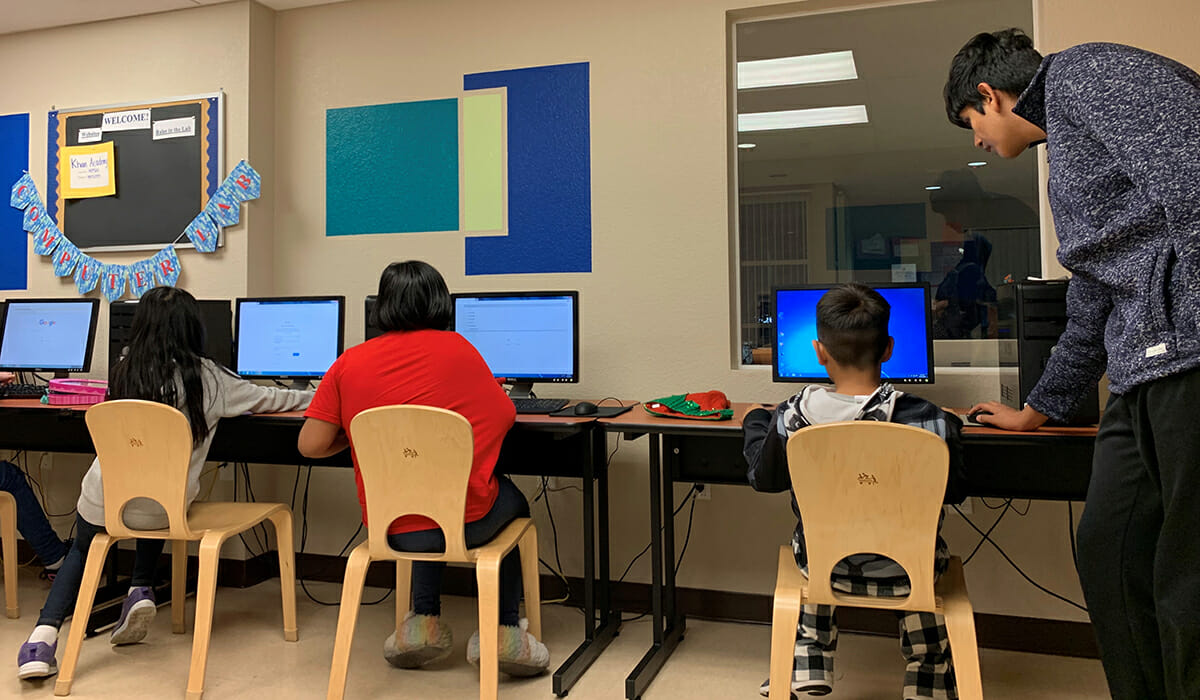
At just 18 years old, Vardhan has led TheOpenCode Foundation in reaching 10,000 people in 56 countries with the help of 251 team members. The nonprofit teaches beginner and accelerator programming courses mainly to teenagers in homeless shelters, and is working on expanding to Title I schools as well. TheOpenCode Foundation has partnerships with local tech companies, including Twitter, and school districts who regularly donate computers to help expand the nonprofit’s laptop rotation program for its students. After graduating high school this spring, Vardhan will be attending Stanford University where he plans to keep expanding TheOpenCode Foundation’s global operations.
Describe your volunteer role with TheOpenCode Foundation.
TheOpenCode Foundation is a 501(c)(3) nonprofit organization which provides disadvantaged students the education and resources needed to pursue a career in computer science. I am the founder and executive director. I basically oversee operations. I hire team members and help to also hire board members and make sure the organization is staying true to its mission. I also basically think up the main direction of the organization, including our new programs and how to improve our existing programs.
What inspired you to start this?
I was inspired to start it because living in Silicon Valley, I thought access to coding was ubiquitous, but a few summers ago I learned there were people just a few miles from me who didn’t actually have access to it or have any experience with CS or coding. I started to teach some students locally, and I figured there’s a lot of untapped potential. I eventually turned that into a foundation.
What kind of programs does TheOpenCode Foundation offer?
We have our main program which is our boot camp where we take students from no programming experience to having some experience. It’s more of an introductory thing and it lasts about ten weeks. We teach this at homeless shelters and are working on expanding to Title I schools soon. We also have an accelerator program which is where we look for high-potential, low-resource students who would benefit from one-on-one training and connections in the industry. We also run a podcast called The Open Show which provides bite-size content on tech topics. We have a hackathon. We had our first annual one in May, which brought in 1,200 hackers, 555 of which were first timers. We’re hoping to further expand it this year and in future years.
Why is it important for people have access to this type of education?
I think as technology gets more interwoven into our lives, coding is almost like an essential skill nowadays. The inequality of the field has been increasing actually, even though the importance of coding itself is increasing also. The problem is basically three-pronged, in that CS is usually offered at higher-income schools, and second, at the places it is offered, people from lower socioeconomic statuses statistically don’t choose it because of lack of resources. Then there’s a false perception that learning to code means pursuing CS as a major in college.
Do you have any goals for your organization?
Eventually, the goal is to reach as many people as possible. Maybe in the next five years, reach one million students instead of how many we currently have. The goal is to keep expanding and keep improving our programs to reach as many as possible.
What’s been the most rewarding part of your work?
I think the most rewarding part is seeing people actually get interested and start being able to solve problems in their community. That’s part of the reason I started this, because CS has given me an opportunity to solve problems in my community, so seeing other people be able to take CS and use it as a tool is the most rewarding thing.
Why do you think it’s important for others to give back?
If someone gains something from a particular field, I think it’s almost a moral obligation for them to give back and expand that for others to be able to benefit from it.
What do you want people to learn from your story?
I would want to recommend that if people see a problem, they should act on it, because no matter what their age is or where they’re from, they can make a difference.
Community Gardener Transforms Neighborhood Through Volunteer-Run Garden
Meet Daily Point of Light Award honoree Rosa Johnson. Read her story and nominate an outstanding volunteer or family as a Point of Light.
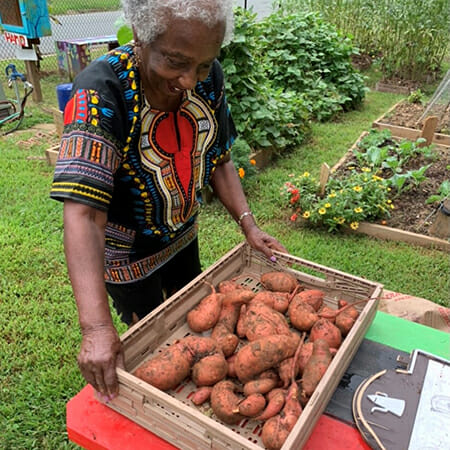
Almost every morning, residents of Winston-Salem, N.C. can find their neighbor Rosa Johnson tending to the Kimberley Park Community Garden. She calls the garden her “happy place,” and describes it as akin to a World War II-era Victory Garden — “victory over fear, victory over violence.” And through her happy place, she is providing both joy and free, healthy food to her community.
Rosa first became involved in the garden four years ago, when it was named the Maya Angelou Mothers and Daughters’ Garden, having been inspired to get involved because she is Angelou’s only living niece. In the past few years, she has helped completely renovate the garden, which was renamed for the elementary school across the street whose children assisted her in restoring it, including decorating the garden’s sheds, benches, and bird houses. Today, Rosa leads fellow volunteers in maintaining the garden’s 30 beds, consisting of numerous vegetables, fruits, and herbs. Anyone who helps out at the garden is welcome to take home its food, which is also donated to local food bank H.O.P.E. and to the community’s elderly population.
Describe your volunteer role with the Kimberley Park Community Garden.
I am an urban gardener and my motto is transformation through collaboration. I came into this community with full intention of transforming it into it’s highest potential. I’ve been fortunate enough to collaborate with other stakeholders this community. Habitat for Humanity helped me quite a lot. They donated lots of wood for our raised beds in the garden.
How did you get involved in this garden?
This garden was started many years ago and it was called the Maya Angelou Mothers’ and Daughters’ Garden. I’m Maya Angelou’s only living niece, so I was inspired to take part in renovating this garden when I moved on this block. The reason being, I’m a vegan, I raised four children in California out of a garden, so I was very much familiar with gardening. I was fortunate enough to attend the North Carolina State Extension to learn more about gardening here in this city and in this state. Since it was so close to me, within walking distance of where I live, I was stimulated to start this and to reenvision this garden. It’s across the street from an elementary school, and I’m very much involved with the children here in this community. In fact, the children help with this garden. They put in a lot of sweat hours at the beginning of the garden.
Rosa Johnson serves as a dedicated volunteer to the Kimberley School Community Garden, growing vegetables, fruits, and herbs for her Winston-Salem, N.C. community./Courtesy Helena LeRoy
Why was it important for the children to be involved in the garden?
Unfortunately, we live in a food desert here. I found out in talking to the children that they really had no idea where food came from. They saw me eating a snow pea off of a plant, and they were amazed I could even eat something that grew out of that dirt.
Where is the food donated?
I donate it to the community and anybody who works in the garden is free to have the food. Last year, we took a lot of the extra food to H.O.P.E. They deliver food in this community. It’s strange, a lot of people think I would charge them to work this garden. No, no, no, please, if you want a bed, please come and work it. It’s yours. Food is free. Health is wealth. I promote that. There’s a fence around the garden, so when I open it, then people know they can come and help me or just look around.
Why is it important for your community to have this resource?
I witness so much healing through this garden. Unfortunately there are a lot of people, primarily women, that are emotionally depleted. Some have mental health problems. I found that coming to work in this soil, in this dirt, has helped at least two or three ladies get off heavy medication and release a lot of stress by working in the soil. Then to reap the harvest, the food that nourishes your body — it’s priceless.
What’s been the most rewarding part of your work?
For me, as an elder, first of all to have the food to feed my body and keep me healthy. The other important thing for me is that my community is able to see that someone cares enough to try to make a difference. It’s almost had a domino effect. Once there’s some other homeowners on this block, they see what I’m doing over there, so now they’re upgrading their property. One family two doors down from the garden, they’re putting a garden in their backyard. It is having a domino effect in this community. They see someone cares. I’m not from here, I’m from California, so for them to see me care enough to pick up the trash, then someone else maybe will come behind me and do the same thing and upgrade this community.
What have you learned through your experiences as a volunteer?
You have to be persistent, have the courage to keep going on, and be energized. It is work. When people call me and want to volunteer, I appreciate all the many volunteers. Now I’m getting a cross section. I have volunteers from Brazil, from Paris, from China — one or two, but it’s fascinating to see how this is spreading out. It’s my healing place, really. It’s what keeps me sane during these times.
What do you want people to learn from your story?
To never give up. You can transform where you live. When I first moved to this community, there was always a lot of trash. I would call the city and say, “Why don’t you send somebody out here to get this up?” And they told me, “Well, nobody complains.” Well, I am complaining, because I want to transform this community into something of value. It’s important that other people learn that by volunteering in your community, you can upgrade your lifestyle, the way you live. You can encourage children to live a better life. It’s important to me.
Suicide Survivor Offers Lifeline to Youth through “Letters to Strangers” Volunteerism
Content Warning: Points of Light highlights uplifting stories, however, we acknowledge that the following content may be difficult for some readers. We encourage you to please care for your safety and wellbeing above all.
Meet Daily Point of Light Award honoree Diana Chao, who was a 2020 L’Oréal Paris Women of Worth Award. Each year L’Oréal Paris and Points of Light recognize and celebrate Women of Worth who make a beautiful difference in their communities. Ten honorees each receive a $20,000 grant to support their most cherished cause, and an online vote determines one honoree who will receive an additional $25,000 grant. Nominations for 2021 are now open! If you know a woman who works to create lasting and significant change in her community, nominate her to be one of the 2021 Women of Worth.
Diagnosed with bipolar disorder at age 13, Diana Chao survived a series of suicide attempts through her teens. When Diana’s brother discovered her on the final attempt, Diana says she knew she had to get help.
“I made a vow to myself that no matter how dark my world got, I could never drag (my brother) down with me,” says Diana. “That became a turning point. I am first generation, my parents didn’t speak English, and we were living below the poverty line. The health care system was very inaccessible to me at the time. So I turned to writing. I wrote to no one, but also to everyone at once.”
Journaling evolved into what Diana envisioned as writing letters to strangers. Mechanical pencil in hand, the now 22-year-old student from Claremont, California says she got her thoughts down on paper. In expressing herself through writing, Diana found her voice, and decided to help others do the same, through Letters to Strangers.
“I developed this model that writing is humanity distilled into ink. (Writing about) things that were going on in my life. Questions I had that I didn’t know how to ask people who knew me. Feelings I had about my own worth and value. Thinking about how I’d talk to a stranger about these thoughts, in those moments I realized I was trying to be kind and empathetic to these people I’d never met, but I couldn’t do the same for myself. I realized if this could help me discover my voice, then maybe it could help others as well.”
Founding Letters to Strangers as a student club when she was just 14, Diana, who also serves as executive director of the global youth-run organization, has since connected with more than 35,000 people in the United States and internationally, which counts thousands of volunteers and chapters in 20 countries. Open to individuals with or without mental illness, Letters to Strangers seeks to normalize conversations around mental health. By creating an inclusive space that is destigmatizing mental illness and increasing access to affordable, quality treatment for youth aged 13 to 24, Diana says she’s paying forward the second chance she got in life.
Through Letters to Strangers, Diana is reminding vulnerable youth they are not alone, destigmatizing mental illness and advocating for increased access to affordable, quality treatment for youth aged 13 to 24./courtesy Cara Robbins
“After I survived my suicide attempts, I was struck by how I felt like being alive was this miraculous chance that so few people were lucky enough to have. I felt like I needed to give my version of gratitude back to the world.”
That grateful service includes an anonymous letter exchange within chapters, peer education, workshops, events and online resources including videos and the world’s first “Youth for Youth Mental Health Guidebook.” Hoping to bring the guidebook into classrooms one day, Diana has partnered with many organizations to extend her reach, including NAMI (National Alliance on Mental Illness), Active Minds, Mental Health America (MHA), Unilever, DoSomething.org, Adobe, Viacom’s Generation Change, Made of Millions and Screen Actors Guild of New York. Diana’s lived experience and perspective as a first generation Asian-American helps to empower other minority youth who struggle to find their own voices, says Maggie Luo, associate director of development and communications for NAMI New Jersey, a partner to Letters to Strangers.
“Because of cultural and systemic hurdles in seeking help, (Diana’s) brave representation of the community has really helped young Asian-American women and men who may not feel like they have a voice to come out and get help,” says Maggie. “‘Strangers’ is a term so many of us can identify with in society, but (Letters to Strangers) lights up the day for many people whom are not cared for by anyone else. Diana is truly a courageous person who put a face to the Asian-American experience in America, and for those still on the earliest stretch of their health-seeking journey, her work heals in a powerful way.”
Diana’s service is particularly unique, she says, as she trail blazes the path to healing for many underrepresented youth as one of the few public young Asian-American mental health advocates, reminding youth they are not alone.
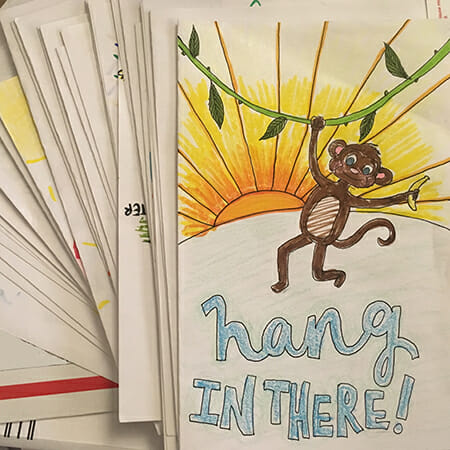
A bundle of 100 letters submitted by a stranger for distribution by Letters to Strangers. Diana Chao: “I developed this model that writing is humanity distilled into ink…I realized if this could help me discover my voice, then maybe it could help others as well.”/Courtesy Diana Chao
“After all of these years, I’m one of very few, if not the only, young Asian-American mental health advocates that has been in the field for as long as I have. Asian-American youth see themselves in me and feel validated. One 14-year-old adoptee from China reached out to me, she was raised by white parents and had been hospitalized for a suicide attempt. She felt constant tension between her heritage and the environment around her. After she discovered Letters to Strangers, she saw in me someone who looked like her and faced similar struggles as her, but who also fought through it. She’s now one of our volunteers. It’s honestly a blessing to witness.”
Amid the COVID-19 pandemic, Letters to Strangers has launched an online version of their letter exchange, and Diana says the work to creatively serve youth in need has not stopped.
“Menstrual product prices saw a huge increase in cost in Zimbabwe due to the pandemic. We started to see conversations about a lack of dignity leading to trauma for a lot of students there, and we ended up supplementing sexual hygiene with our mental health curriculum, even partnering with a local sewing school so students could learn how to sew their own pads.”
Empowering youth to advocate for their own mental health and encouraging increased mental health resources and support at the local, state and national level, Diana envisions a stronger, healthier future in communities across the globe.
“Serving is a lifelong journey. I know personally that when all you understand is emptiness, one letter, one human connection, can save a life. Mental health matters, mental health is personal. I fight because I can’t bear it otherwise.”
If you or someone you know may be considering suicide, contact the National Suicide Prevention Lifeline at 1-800-273-8255 or text HOME to 741741 to talk to a trained crisis counselor through Crisis Text Line – it’s anonymous, free and available 24/7.
Volunteer Springs Into Action to Help Tornado Victims Amid Pandemic
Meet Daily Point of Light Award honoree Melissa Alexander. Read her story and nominate an outstanding volunteer or family as a Daily Point of Light.
A Texas native, Melissa Alexander has seen her fair share of tornadoes, so when a deadly tornado hit just one block away from her home in Hermitage, Tennessee, the 51-year-old sprung into action to help her neighbors.
Striking Nashville and surrounding areas, the March 2, 2020 overnight tornado killed 25 people and wreaked havoc across the region, becoming one of the costliest tornadoes in United States history. As a volunteer with Hands On Nashville (HON), Melissa kicked her service into high gear to help her neighbors rebuild. Offering disaster and emergency services and resources through HON’s partner organization, Project Connect, to hundreds of individuals, Melissa’s volunteerism is aiding recovery efforts further complicated by the COVID-19 pandemic. Volunteering hundreds of hours since 2019, Melissa has become known as the “resource guru,” helping neighbors in need.
What inspires you to volunteer?
Volunteering is a part of my life. I serve because there are people that need help and they appreciate it.
After the tornado hit, I knew I couldn’t just stay home. I’m from Texas, and after a disaster, if someone needs your help, you just go. I was without power for four days after the tornado, and was grateful to have the opportunity to get out of the house and be of service to others.
Volunteering hundreds of hours to provide resources to others, Melissa has become known as the “resource guru”./Courtesy Melissa Alexander
Describe your volunteerism.
In addition to my volunteerism with Hands On Nashville, I am a volunteer with Project Connect. I help out with projects in the resource center, but after the tornado, I was doing everything from canvassing the neighborhoods to provide information on our resources, to delivering meals to community members devastated by the tornado and impacted by COVID, connecting residents to FEMA to get back online, to food stamps and accessing their stimulus checks. In addition to my volunteerism with HON, I volunteer with Book’em, an organization that supports literacy for children, and Mid-Tennessee Council of the Blind.
Share one personal story with me from your volunteerism.
Part of my service includes connecting people to FEMA. One person called and told me they’d received their FEMA check to rebuild. They were so excited, and their reaction gave me a real sense of accomplishment. This person had tarps on their roof and wood over the windows, and they had nowhere to go. I made it easier for them to be able to repair and they didn’t give up because of my help.
Why do you think it’s important for others to give back?
Volunteering makes you feel good. It sounds so corny, but you get more out of service than you give.
How have you continued to volunteer throughout the pandemic?
When the tornado hit, I didn’t have anything to do because I didn’t have any power (laughs). The next day, I went and volunteered. Like my neighbors, I was impacted by the tornado and COVID, but these people were impacted more than me. Because of that I felt like I had to give back. I knew how to tap into the resources in the community and use my skills.
What do you want people to learn from your story?
Taking your own time to give back only makes you a better person. Volunteering helps you learn about your own self.
In one word, what does volunteering mean to you?
The world. Volunteering gets me out of my house and it gives me purpose.
How can readers help?
Please visit Hands On Nashville’s website for more information about how you can help.
When Ara Eagan began speaking with a therapist about her experience of abuse and trauma at the hands of an adult stranger, she found it difficult to open up to an adult. Thinking other teens may have experienced something similar, she started asking around her high school for others who were looking for support from people their own age. She and a group of friends started meeting up at a local library in Ara’s hometown of Gastonia, N.C., to talk through what they were going through.
Over the past six years, that initial meeting between a few friends has transformed into the national nonprofit Teen Talks, which has brought together approximately 10,500 young people in all 50 states to safely discuss how to cope with the after effects of abuse and trauma.
“I think one of the most crippling things when it comes to mental health sometimes is loneliness, and the feeling you can’t talk to anyone about what’s going on,” Ara said. “I think creating that type of safe space and me being like, this isn’t OK, we need to have someplace where teens can talk about this and feel safe, is probably the most rewarding thing and the thing I’m most proud about.”
After the initial library meeting, word of the support group spread and more teens started showing up. Realizing she couldn’t facilitate the meetings on her own, Ara began reaching out to mental health professionals to help out. As the meetings’ attendance continued to grow, Teen Talks was established at other local high schools, and then started expanding into other states where Ara had family. Finally, in 2017, she took the plunge and officially established Teen Talks as a national nonprofit.
Ara Eagan is the founder and CEO of Teen Talks, a national nonprofit that brings together young people who have experienced abuse and trauma to meet with mental health professionals as a peer group./ Courtesy Ara Eagan
“Nowadays, when I think back to sitting in a room in the local library with some friends to the extent it is today, it’s completely surreal,” Ara said. “I never could have imagined it and I never would have been able to do it without all the help I got.”
Teen Talks typically draws people aged 13 to 20, but the nonprofit has been working to establish offshoots both specifically for preteens and for college-aged kids. While the nonprofit targets those who have experienced abuse or other trauma, anyone is welcome to attend regardless of what mental health issues they are going through.
A typical Teen Talks session lasts for about an hour, with volunteer mental health professionals overseeing discussions both with the group as a whole and with attendees broken up into smaller groups. Teen Talks currently has over 1,200 mental health coordinators and over 500 volunteers around the country working to facilitate the support groups.
Ara thinks the success of Teen Talks comes from many young people finding it intimidating to open up to adult mental health professionals when they meet with them one-on-one.
“These people are usually a lot older than you, and a lot of times, a lot of abuse is carried out by adults,” Ara said. “I think for that reason it’s really nerve wracking in multiple ways. I feel like when you’re talking to someone your own age, it’s much easier to one, relate to them, and two, it feels almost a little bit more informal and not as scary.”
Prior to the COVID-19 pandemic, Ara would travel to different chapters to check in and offer support. She also asks all chapters to print her personal cell phone number on any flyers or handouts they distribute so attendees can call her when they need someone to talk to. She’s received calls from Alaska to New York, always offering the teens on the other end of the line a listening ear.
“The idea that there’s always someone that’s going to pick up your call, which I try to do as often as I can, is really reassuring to me,” Ara said. “It’s kind of the same idea of when you call your best friend. They’re typically always going to answer, and that’s the kind of thing I wanted to do.”
Halle Nobles, who serves as Teen Talks’ marketing coordinator volunteer, described Ara as a compassionate leader who makes it clear how passionate she is about her nonprofit and helping as many people as possible.
“It takes a unique person to make something like this,” Halle said. “It really just reflects on how much she cares about different people. She is the most lovely human being on this planet.”
Ara is currently in her senior year at Princeton University, where she studies sociology. Upon graduation, she plans on studying international business and relations in graduate school in order to help her ultimately establish Teen Talks as a nonprofit corporation. She also hopes to expand into other countries in North and South America in the future.
Volunteer Athlete Encourages Inclusion and Sportsmanship On and Off The Field
Meet Daily Point of Light Award honoree Madison Bauerle. Read her story and nominate an outstanding volunteer or family as a Daily Point of Light.
As a student athlete at Appoquinimink High School, Madison Bauerle is always on the go, and the Middletown, Delaware high school senior will be even busier next year, as she heads to the University of Pennsylvania to play Division 1 softball and study biophysics. A dedicated teammate on and off the field, 18-year-old Madison is changing lives in her community through volunteerism.
Because of my family and friends, I’ve had opportunities to do the things I’ve dreamed of. Volunteerism is a reminder of the responsibility to give back to others that are in need. Sports have always been a passion of mine and sharing that passion with other students has been really rewarding.
Describe your volunteerism.
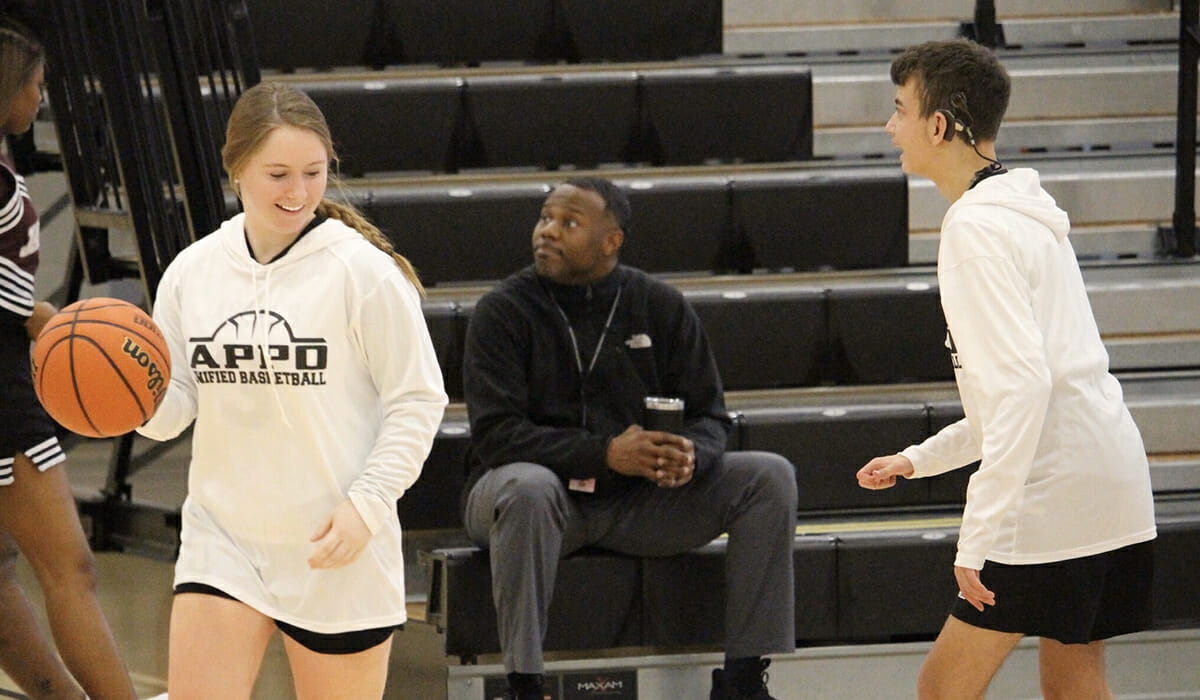
I’m a volunteer with Special Olympics and also a volunteer athlete at Unified Sports, which has multiple teams at our high school. I play with Unified Sports during Fall and Winter sports seasons, and then help out with Special Olympics other times of the year. I’m currently helping to start up the softball program for Special Olympics in Delaware. I’ve connected with dozens of athletes and serve as a teacher, player and coach for Unified Sports, helping kids with intellectual disabilities on the field and off, as a partner with them in the classroom.
As a volunteer for Special Olympics, Madison Bauerle plays alongside student athletes with intellectual disabilities through the Delaware Interscholastic Athletic Association (DIAA)/Special Olympics of Delaware (SODE) program Unified Sports. / Courtesy Madison Bauerle
Share one personal story with me from your volunteerism.
I first became buddies with a boy named Logan in middle school, he’s now a lifelong buddy of mine. We play flag football and basketball together through United. He’s had lots of health issues and is now fully deaf and bound to a wheelchair. He loves all kinds of sports and we’ve bonded over our love for sports and competition. Logan inspired me to join Unified and to help more kids. Over the last two years he’s made a full recovery, progressing and learning how to live with his disabilities. He recently told me he is going to come watch me play sports in college. It is nice to see my effort with Logan in the classroom turn into a meaningful friendship that won’t end once I graduate.
Why do you think it’s important for others to give back?
People really need to come together and find more similarities with each other than differences, especially during times like this. We are all extremely fortunate, and it’s important for people to take time to build each other up to our full potential.
What’s been the most rewarding part of your service?
It’s rewarding to see kids, especially in the Special Olympics, find enjoyment in sports and building friendships that they never would have before. Our volunteerism promotes social inclusion on and off the field.
How have you continued to volunteer throughout the COVID-19 pandemic?
We’ve adjusted our service in response to the pandemic, and how we think about sports. A lot of in-person activities have been difficult. We’ll practice with the team over Zoom, we don’t solely focus on the physical part of sports, but we talk about sportsmanship as well. We are still giving students that feeling of teamwork through distanced in-person events, virtual activities and practices.
In one word, what does volunteering mean to you?
Humility.
When you’re not busy volunteering or in school, what do you do for fun?
I love softball. I love being outside. I’ll spend time with my parents whether it’s walking, hiking or canoeing.
Local Business Owner “Showering Love” for Homeless through “HandsOn” Volunteerism
Meet Daily Point of Light Award honoree Stacy Kanas. Read her story and nominate an outstanding volunteer or family as a Daily Point of Light.
For the last decade, Stacy Kanas has connected with thousands in her community by volunteering with HandsOn Broward, an organization that transforms local communities through meaningful hands-on service projects.
Most recently, the local business owner has focused her service to help the homeless by leading a monthly project for HandsOn through Showering Love, a mobile bus which offers weekly showers. Creating the “Helping the Homeless” project in 2019, Stacy’s service has been invaluable as her community grapples with the COVID-19 pandemic. So often considered “invisible people,” says the Plantation, Florida resident, Stacy is fighting to spotlight the great need that exists amongst the homeless population and has become known as an all-star volunteer as she encourages her community to extend kindness to those in need.
What inspires you to volunteer?
I’ve been volunteering for many years. I first connected with HandsOn when I was trying to find volunteer opportunities for my two girls, and they now volunteer with me. I’ve always had an interest in the disenfranchised and people who are on the fringe because of circumstances beyond their control. Volunteerism has allowed me to use my resources and my time to hopefully make a difference with others.
Stacy Kanas (left) pictured handing out necessities in downtown Fort Lauderdale. Through her HandsOn Broward project, “Helping the Homeless”, Stacy is offering assistance to homeless in her community via Showering Love./ Courtesy Stacy Kanas
Describe your volunteerism with HandsOn Broward.
I’ve been a HandsOn Broward volunteer for a decade, and have participated in projects with a variety of local non-profits over the years, including the Ronald McDonald House Charities, the Children’s Services Council of Broward County, Heal the Planet and more. More recently, as a volunteer Project Leader, I created “Helping the Homeless,” which helps the unhoused population through Showering Love. I organize volunteers and once a month, do whatever the organization needs from us, from sorting donations to special events, to collecting and distributing basic necessities like clothing and personal health items for the homeless.
Explain why you’ve dedicated your service to the homeless.
The homeless are considered invisible people. People pass them all the time but don’t pay attention, don’t even smile and don’t give them a wave. Through service, I’ve learned to stop and appreciate another human being who is going through something.
Share one personal story with me from your volunteerism.
We have a large homeless issue in South Florida, particularly in Broward County. People are literally living on the streets in downtown Fort Lauderdale in tents. Through volunteerism, I collect donated items and money to distribute to those in need, and kind of like make a wish, I’ve been able to give items that change lives. For example, I was able to immediately get a walker for a man who needed one. That was a major turning point and the man was so appreciative that he was able to walk again. It is gratifying to know that you can make a difference immediately through resources.
Why do you think it’s important for others to give back?
We are all interconnected despite our socio economic or religious status. Volunteering also gives me the opportunity to teach my children the value of interconnectedness and the importance of being there for each other. You never know when you’re going to be in that situation where you need help as well.
Stacy (left) pictured with friend, Laura. Stacy is serving those experiencing homelessness in many ways, including an art therapy project, Change Through Art./ Courtesy Stacy Kanas
What’s been the most rewarding part of your service?
It’s rewarding just to see someone receive an essential item we take for granted. A fresh pair of pants, socks, a bottle of shampoo or water, a blanket. These are daily things that unhoused people are so grateful for.
What do you want people to learn from your story?
Everyone is able to make a change in this world for someone else through the smallest act of kindness. It does not necessarily take money, it just takes a little bit of time and a little bit of interest in your fellow human being. This is the essence of being a volunteer.
How have you continued to volunteer throughout the pandemic?
After a pause, we have resumed our monthly volunteer service with Showering Love but our activities are outside, distanced and masked. I started an art therapy project for the homeless last year called Change Through Art, but that program has been put on pause because of the pandemic.
In one word, what does volunteering mean to you?
It’s world-changing. Volunteering is what I am trying to push out into the atmosphere.
How can readers help?
Please visit HandsOn Broward’s website for more information about how you can help.
Twelve-Year-Old Encourages Proper Recycling of Batteries Around the Country
Meet Daily Point of Light Award honoree Sri Nihal Tammana. Read his story and nominate an outstanding volunteer or family as a Point of Light.
On Sri Nihal Tammana’s tenth birthday, his parents encouraged him to start watching the news with them as he was growing into a young adult. When he sat down to watch with his dad that day, they witnessed a story on how 15 billion used batteries are thrown away improperly every year, causing fires and harming animals across the world.
“Earth is doing something nice for us,” Sri Nihal said. “It’s given us food, water, and shelter, so we need to do something nice back to Mother Earth. Instead, we’re doing the complete opposite.”
Deeply upset from hearing that so many people were unaware of how their trash was harming the earth, Sri Nihal decided that day to make a change.
That year, he started Recycle My Battery, a nonprofit organization that campaigns to raise awareness on properly recycling batteries. Because batteries may contain toxins such as mercury and zinc, if they are not recycled properly, they can overheat and cause fires, or their chemicals can leak into the ground, poisoning both animals and people. In addition to its education component, Recycle My Battery also provides free battery bins to offices, schools, libraries, and other locations around the country in order to help people properly recycle theirs.
Now 12-years-old, Sri Nihal has led Recycle My Battery and its over 75 youth volunteers in recycling over 75,000 used batteries and educating over one million kids and adults across the nation.
Sri Nihal Tammana serves as the founder of Recycle My Battery, a nonprofit that promotes the proper recycling of batteries around the country through education and implementation of battery bins./ Courtesy Sri Nihal Tammana
Recycle My Battery’s slogan, created by Sri Nihal, is “If I can make earth a better place to live, you can. If you can make earth a better place to live, we all can!”
Recycle My Battery aims to target kids in particular so the next generation is engrained with the knowledge on how to properly recycle batteries, and also in the hopes that kids will then share this information with their parents.
“If kids tell their parents, then their parents will tell more and more people,” Sri Nihal said. “That way, this will give us a big chance to educate a lot of people. We can build many steps toward our dream by educating only kids.”
Prior to the COVID-19 pandemic, Sri Nihal educated kids by presenting to schools. The pandemic has caused Recycle My Battery to switch gears and focus on education through videos, blogs, and social media. He even recently presented a TEDx Talk that will be posted online next month.
Recycle My Battery encourages anyone seeking to properly dispose of a used battery to drop them off at their local Staples, Office Depot or Best Buy. Sri Nihal also accepts battery deliveries that he disposes of himself. The nonprofit is partnered with Call2Recycle, which sends Recycle My Battery battery bins for free so the organization can ship them to different locations around the United States, which are then shipped back to Call2Recycle for proper disposal.
Some of the battery bins Sri Nihal implemented are at his former elementary school, Woodbrook Elementary in Edison, New Jersey. Woodbrook’s principal, Nicole Cirillo, recalled when Sri Nihal first contacted her while he was in fifth grade, asking to not only set out the bins but to also deliver a presentation on recycling batteries to his peers.
“I think he really cares about doing the right thing for our school and for the environment,” Nicole said. “I don’t think, for him, it’s ever been a self-centered venture. It’s always been about what can I do for the earth? What can I do for my community?”
Sri Nihal is incredibly dedicated to his organization, logging 1,200 hours on his initiative in 2020, and over 300 so far in 2021. He said he is driven to work so hard in the pursuit of bringing the 15 million used batteries thrown away each year to zero. While he knows this will take at least a decade to achieve, he is committed to furthering along the process.
“We can bring something to Mother Earth,” Sri Nihal said. “I’m actually excited and happy I’m helping Mother Earth in one way. This is very rewarding to me.”