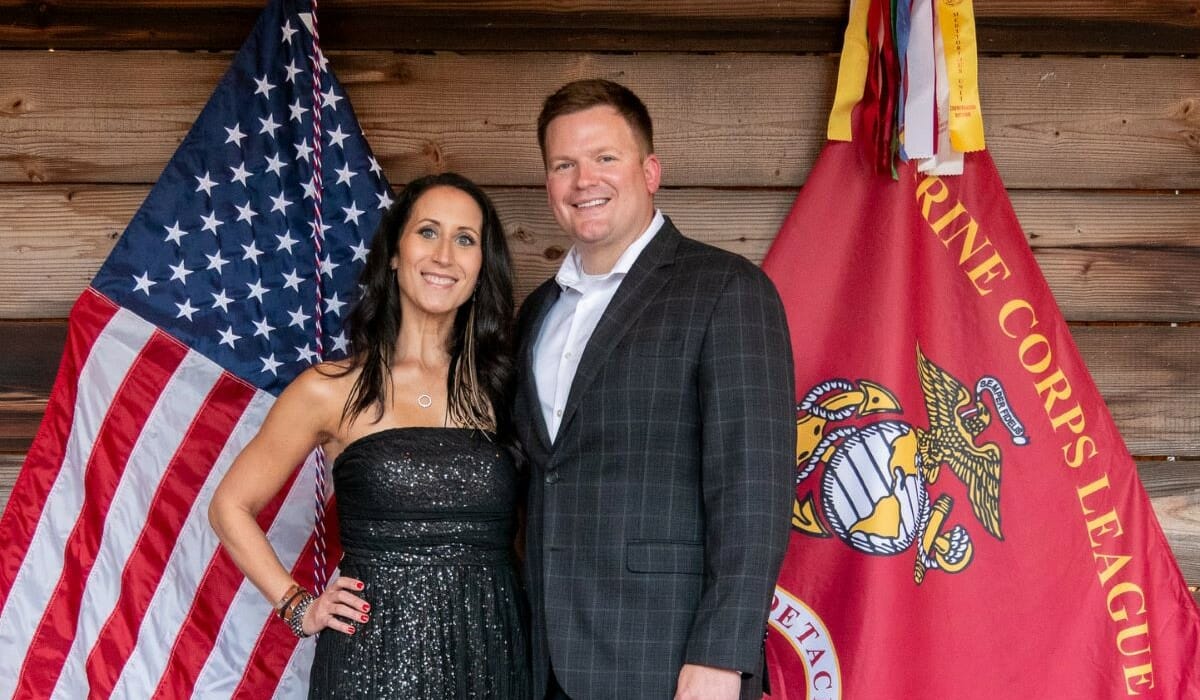
Marine Veteran Provides Aid and Relief to Sisters in Arms With Invisible Injuries
Meet Daily Point of Light Award honoree Juanita Sepulveda. Read her story and nominate an outstanding volunteer or family as a Point of Light.
When Juanita Sepulveda was honorably discharged from the Marines in 2002, she found several gaps in services and support available for her transition into civilian life. Now, she dedicates her life to serving other veterans, and in particular women, in order to ensure that her sisters in arms have as smooth of a transition as possible.
For the past three years, Juanita has served as Chief Operating Officer for The Pink Berets, a nonprofit that provides aid and relief for women veterans with invisible injuries such as post traumatic stress disorder, military sexual trauma, and combat trauma stress.While the organization is based in the San Antonio, Texas area, women all around the country participate virtually or travel to attend the nonprofit’s events. In her role, Juanita handles a wide range of responsibilities including logistics, outreach, fundraising, and budgeting.
Juanita was introduced to The Pink Berets while she was serving as the director of the PTSD Foundation of America. The organization invited her to attend their annual Foxhole to Fashion fundraiser where she was able to meet the team. She was so inspired by what she saw that in 2018, Juanita transitioned from the PTSD Foundation to The Pink Berets.
“I realized we had parallels, a lot of the same desires and passion for our community,” Juanita said. “Most importantly, the population [The Pink Berets were] serving was the population I looked like.”
The Pink Berets provides a host of different programs that offer a holistic therapeutic approach to combatting trauma. Juanita’s favorite programs are the culinary program, which emphasizes communication skills in order for participants to create tasty dishes to take home, and the art program. Through painting, sketching, sculpting, woodworking, restoring furniture, and more, the art program allows women to express themselves creatively.
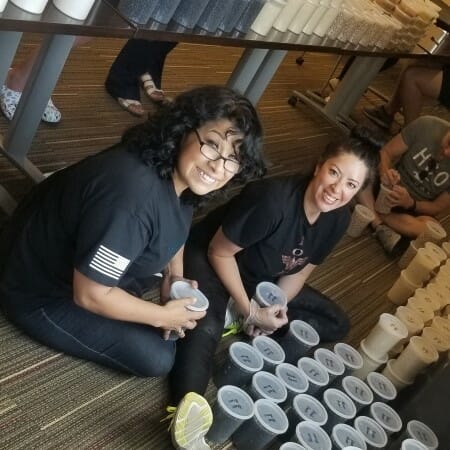
Juanita Sepulveda, left, sorts items for a food distribution for veterans organized by The Pink Berets in collaboration with Minority Veterans of America, Texas A&M, and City of San Antonio volunteers./Courtesy Juanita Sepulveda
The nonprofit also offers retreats and special events. A highlight for Juanita is Women Warriors on Water, a yearly fishing expedition sponsored each year by Baffin Bay Rod in Riviera, Texas. Each year, 21 women veterans come together to bond with one another on the water and experience some peace and escapism.
Juanita’s work with The Pink Berets is always ongoing, with her helping women in some way every single day — whether that looks like vetting potential future programs, or delivering dinner to a veteran and her children who are living in a shelter. Juanita said her service doesn’t feel like work to her, because she herself knows exactly what the women she is helping are going through.
“What drives me is the fact that every person has value, and sometimes they don’t feel like they do,” she said. “What’s nice about our program is we remind them.”
Though The Pink Berets focus on women, they also will help any men in need by making connections for them to receive the most applicable resources. Further, the nonprofit realizes that they may not be the answer for everyone, and are always willing to point women in another direction to the multiple different organizations and people that The Pink Berets collaborate with. They also collaborate with other organizations to ensure free transport for women veterans outside of San Antonio to attend The Pink Berets’ programs, particularly their retreats.
San Antonio District 4 Councilwoman Adriana Rocha Garcia said she always wants to support anything Juanita is involved with, because she does so much for their shared community. The two have worked together for over five years, as Juanita chairs the city’s Small Business Advocacy Committee and is on the City Commission on Veterans Affairs.
“She gets everything together and helps everyone achieve a common goal,” Rocha Garcia said. “I have no doubt that anything she’s a part of is going to be successful.”
Recently, the councilwoman attended a yard clean up for a veteran in District 4 that was organized by The Pink Berets. Upon arrival, it was discovered there were no more gloves left for her to wear while she volunteered. She said Juanita was very apologetic and fretted over her, until she finally took off her own gloves and insisted Rocha Garcia wear them.
“She literally will take the gloves off her hand for you,” the councilwoman laughed.
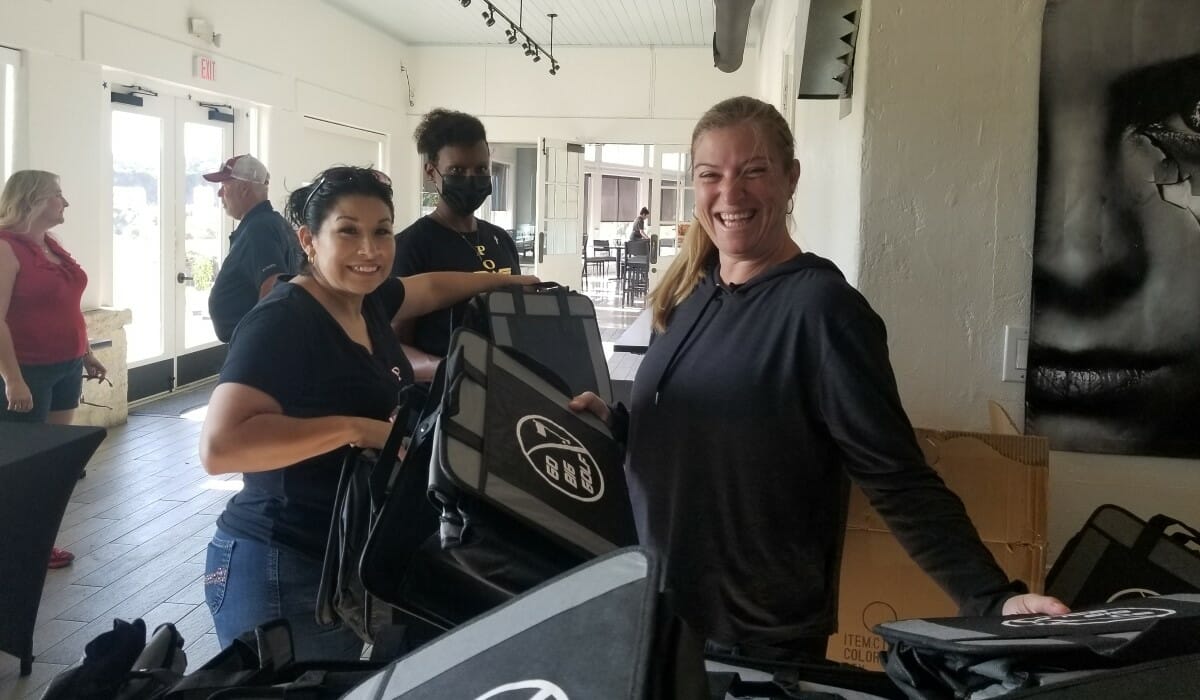
Juanita Sepulveda, left, sets up for a Veterans Day golf classic fundraiser organized by The Pink Berets, a nonprofit that serves women veterans./Courtesy Juanita Sepulveda
This coming year, The Pink Berets are looking to obtain property where they would be able to house veterans. A growing number of women veterans, many of them with children, are experiencing homelessness. The campus would be based in San Antonio and would provide transition, short term, or long term housing for single women veterans and their children.
Juanita, who was once homeless herself, said she wants “the campus created so we can start regaining our resiliency, and resiliency in multiple forms, whether it’s through career development, education, reducing food scarcity, or maybe just a teaching facility to emphasize the skills we once had in the military, and remind ourselves that we still possess those skills.”
Juanita said the most rewarding part of the work she does is seeing women realize that they haven’t been forgotten, as well as remembering the value she brings by working on a program she wishes existed when she first transitioned out of the military.
When schools around the United States sent students home for remote learning, 16-year-old Saiya Shah says she noticed how difficult it was for teachers to conduct hands-on activities.
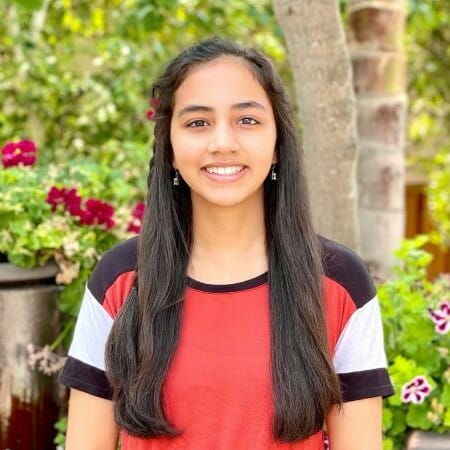
Launching Science For Kidz in November 2020 as part of her Girl Scouts Gold Award, Saiya, a Fullerton, California student, is offering hands-on science activities and experiments to promote, support and enhance high quality science and STEM education for children. Science for Kidz has reached more than 1,000 elementary school students around the U.S. as Saiya works to democratize STEM, a field she says historically lacks racial and gender equity. Engaging children and opening doors to a future in STEM, Saiya is sparking a lifelong passion for science through volunteerism.
What inspires you to volunteer?
I’m really excited to volunteer because I want to make a difference in my community. There’s a lot of people who are struggling in a lot of different ways, and volunteerism is the best way to provide aid in whatever way we can. Our ultimate goal is to create a more positive community.
Describe your volunteerism with Science For Kidz.
As founder, I’m in charge of managing all activities as well as our chapters and volunteers. I initiate and lead projects, including our videos, and as [pandemic restrictions have eased], we’ve done more in-person activities in our area. Typically, in exchange for our science kits, which include materials and a QR code to access science videos, schools provide us with materials for our activities so students can use them at home.
Share one personal story with me from your volunteerism.
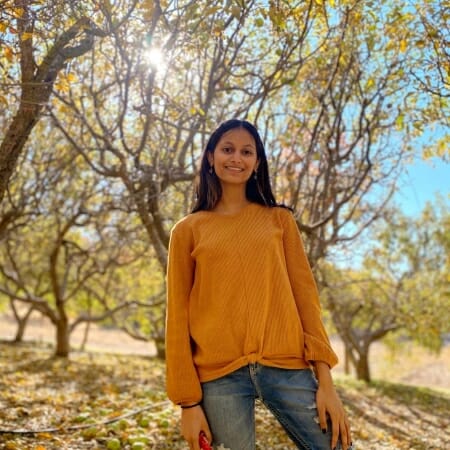
Saiya Shah promotes her passion for STEM through volunteerism with Science for Kidz./Courtesy Saiya Shah
We hosted a virtual session and noticed one kid was struggling making the experiments. We were able to guide this student through the experiment, and when they finally got it, you could see their excited face on Zoom. It made me really excited because you could see the kid was really engaged, and you could see the spark for STEM.
Why do you think it’s important for others to give back?
We’re trying to make society more equitable for people. We give students a chance to try something they haven’t tried before. Not everyone is born into the same circumstances, but by lending a helping hand and creating more equitable experiences, we make a difference and make it more fair for everyone as well.
What’s been the most rewarding part of your service?
It’s rewarding to see the excitement from kids when performing different experiments virtually or in-person. Some teachers have sent us photos of kids performing our experiments, you can see how excited (they are.) If you really engage students with activities and they enjoy them, it’s super cool how proud they are of the final product.
What’s your favorite experiment?
Bouncing Bubbles. The science behind the experiment isn’t super complicated, but it’s a really fun experiment for students and for me. You blow bubbles and bounce them on your hand. The materials include our Bouncing Bubble mix and a bubble wand, which is a pipe cleaner folded into a circle.
What’s in the future for your volunteerism?
We were able to reach out to different schools and teachers during the pandemic because students needed more things to do. Our volunteerism will continue because we’re still focused on trying to bring hands-on activities to students. Especially with racial and gender discrepancies in the STEM field, it’s so important to offer at-home opportunities to students who don’t otherwise have access.
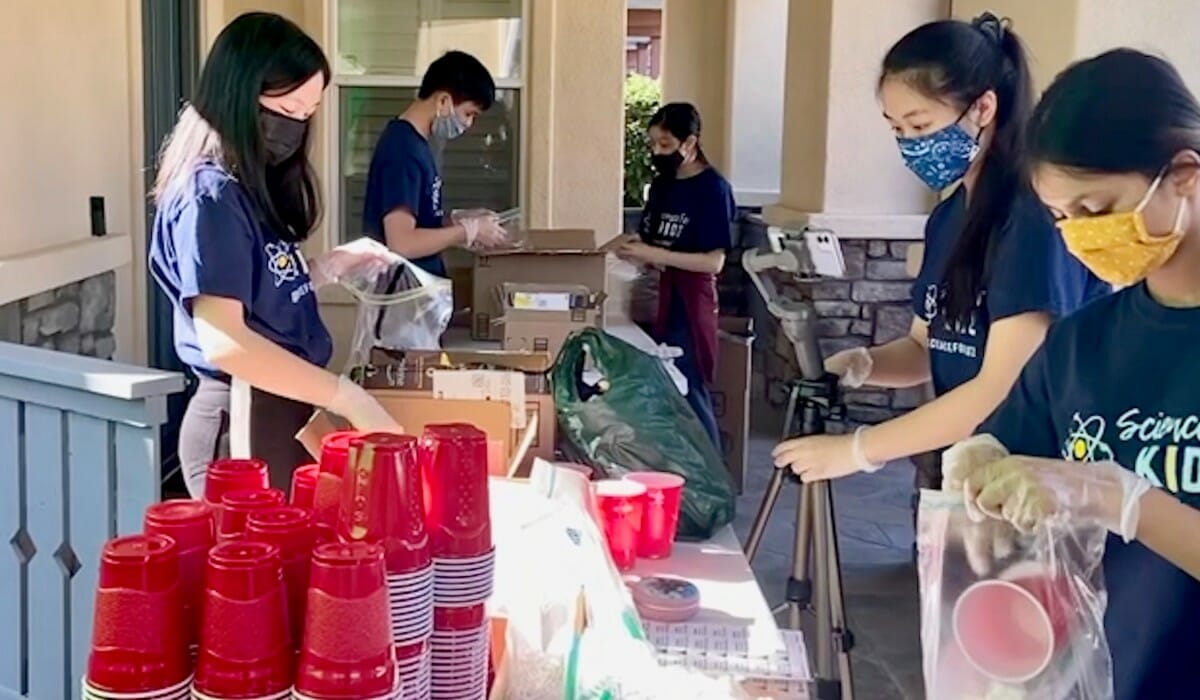
Science for Kidz volunteers pictured making science kits for students. The organization has reached more than 1,000 kids through 900 Science Kits thus far./Courtesy Saiya Shah
In one word, what does volunteering mean to you?
Teamwork. The most important part of volunteering is creating a team of dedicated people who are also passionate about the same idea. It only takes one person to motivate a group of people to take action, but in order to make change, you need the entire community to make a difference. There is more power in numbers.
When you’re not busy volunteering or in school, what do you do for fun?
I compete in cyber security competitions through our high school cyber security program, CyberPatriot. That’s been really fun.
How can readers help?
Please visit our website for more information on how you can help.
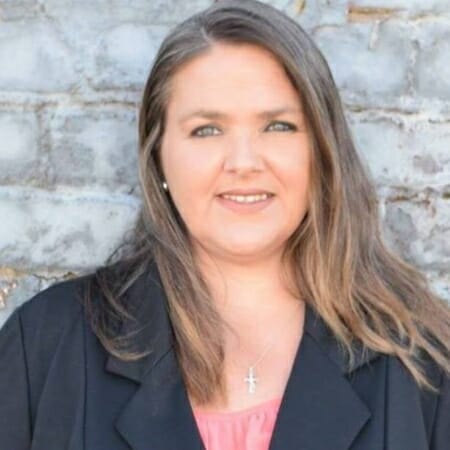
After losing her home in Hurricane Katrina, Patt Ellis was inspired to help people in their greatest time of need by teaching them how to overcome such adversity. Since 2010, she has been a dedicated American Red Cross volunteer, helping with disaster assistance and client case work. Whenever there’s a storm or house fire in or near her Seminary, Mississippi, community, neighbors can rely on Patt to show them empathy and guide them through the recovery process.
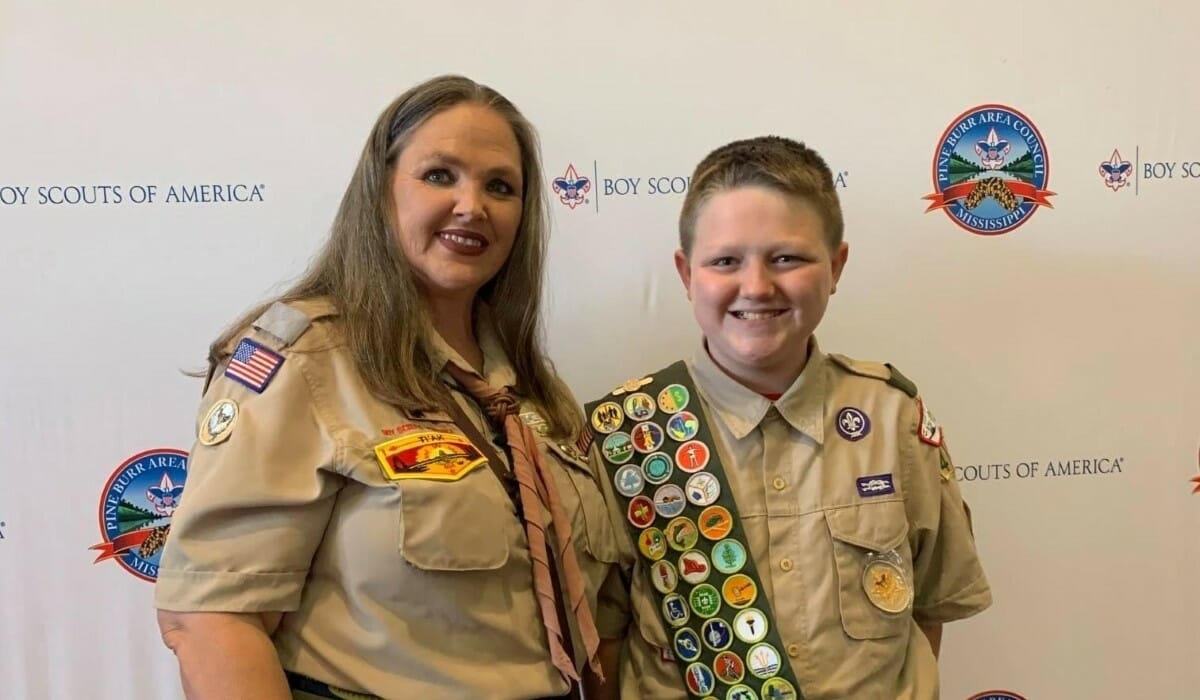
A lifelong volunteer, Patt has also served Girl Scouts for 26 years and Boy Scouts for 14. She describes herself as a volunteer at heart, and says if there’s a hand to be given, she will be there.
Describe your volunteer role with American Red Cross.
I help with disaster assistance and client case work. I come in after the storms and I drive around to the different communities and do disaster assistance. Once all our assessments are done, we start trying to work with different clients and help them, whether it be referring them to other aid to get started over again. I also help fire victims. If they have a house fire, I’m one of the community responders who comes in and puts in a case with some assistance. We’re able to give them assistance to help them for the first three days after the fire normally.
What inspired you to start volunteering in this way?
After Hurricane Katrina in 2005, I felt helpless because my home was destroyed. I didn’t know where to turn to or where to go. Once I found out how to overcome that, I wanted to be able to give back and help others find that success as I did.
How does it feel to help people who are in a position you were once in?
Patt Ellis serves as a dedicated volunteer for American Red Cross, which she began helping in 2010./Courtesy Patt Ellis
I love it because I can see the difference it makes in peoples’ lives. It’s very satisfying.
Has there been any event from your time as a Red Cross volunteer that has been particularly memorable for you?
Last year, my community was hit by the Easter tornado. For six weeks I drove around doing damage assessment and I saw people helping people. Neighbors helping neighbors. Those were just precious memories for me.
What kind of effect do you think the Red Cross has on your community?
I think they offer a good support system. I know for me to be able to give those resources the Red Cross has set aside to people, it helps them to move on. Some of them don’t have any other resources, and to even give that little bit that the Red Cross gives, I think it’s absolutely wonderful for them. They’re relieved because they’re like, “I don’t know where I’m going to be tomorrow or where I’m going to lay my head down tonight.” That’s why a lot of those people are so appreciative.
What drives you to volunteer for the Red Cross on top of all your Scout service?
I enjoy doing Red Cross because that’s not something I do everyday. That’s only when the need is there. When the need is there, you know you have to be there because there’s people depending on you. With Red Cross, we know they’re depending on us because if we’re not there, who is going to be there?
Patt Ellis volunteers with Boy Scouts, one of the many ways she serves her community./Courtesy Patt Ellis
What’s been the most rewarding part of your work?
Seeing the difference we make for others.
What have you learned through your experiences as a volunteer?
I’ve learned things I never thought I could learn, actually. There’s so much you can learn when you’re out volunteering like that. You learn people skills. You learn to be empathetic. You have to really show that compassion and teamwork. We all have to remember that we’re in this together. It’s not one person doing it all.
What do you want people to learn from your story?
Volunteers do it from the heart. They don’t do it for any of the awards or glory. They do it because they love people. They love what they do.
California Teen Volunteer Promotes STEM Tutoring for Students
Meet Daily Point of Light Award honoree Anchal Bhardwaj. Read her story and nominate an outstanding volunteer or family as a Daily Point of Light.
15-year-old Anchal Bhardwaj says when she realized kids didn’t have much to do during the COVID-19 pandemic, she decided offering access to STEM-related tutoring would help to fill in education gaps.
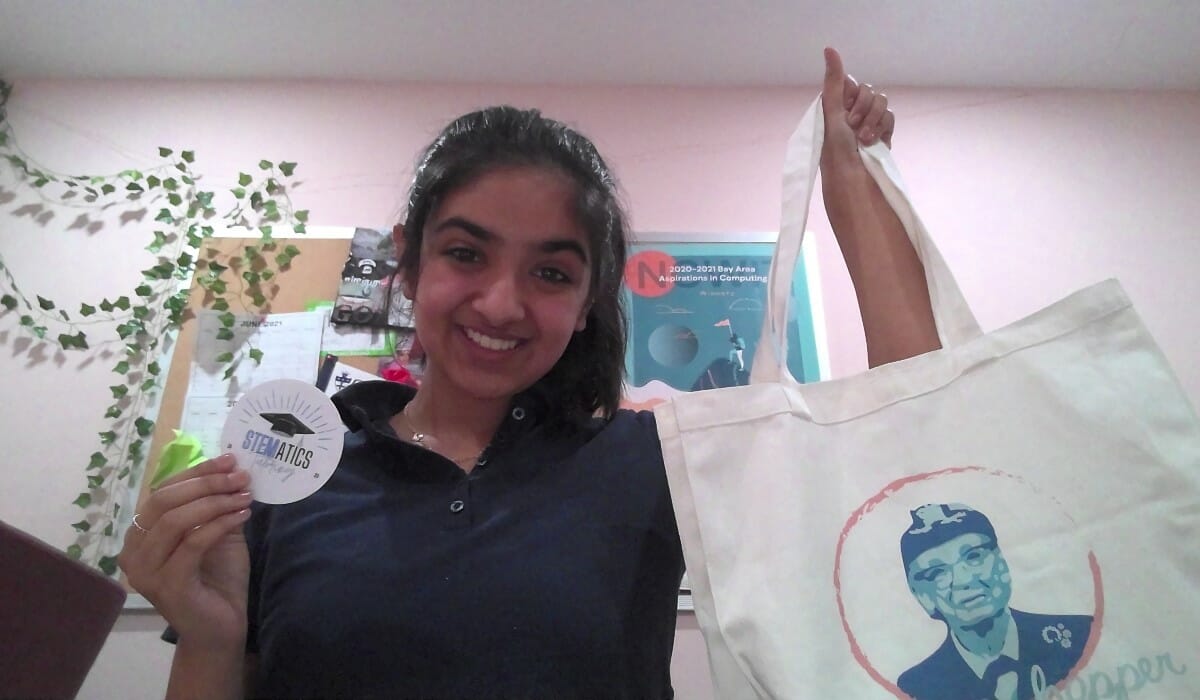
After more than a year of volunteerism with STEMATICS, Anchal, a San Jose, California high school sophomore, has connected with more than 500 students in seven countries around the world. Providing students with the opportunity to learn more about computer science and math concepts, Anchal is also empowering high school students to give back, as they serve as tutors and instructors.
What inspires you to volunteer?
I didn’t really have a lot of STEM resources in elementary or middle school, a lot of resources are guided towards older students. By volunteering, I wanted to see how kids could re-imagine their own education through the field. I’m inspired to volunteer to help people find that feeling of learning.
Describe your volunteerism with STEMATICS.
As founder and director, I tutor students and teach free classes. I create all curriculum for classes, and manage our 15-20 student volunteers. In addition, we host monthly panels, post resources on social media and I manage class communications. Outside of the classes and tutoring we offer, we host AstraHacks, the world’s first hackathon available for elementary and middle school students. We rely on grants to support our classes, and also accept donations from participants, of which we’ve donated around $7,000 to local charities thus far, including to FISH Food Bank and UNICEF. In addition to my volunteerism with STEMATICS, I volunteer at Destination Science and participate in hackathons with projects to help the community.
Share one personal story with me from your volunteerism.
The first class I taught was a Python programming class. Two kids in our neighborhood participated, and after the session, they dropped a card and chocolate bar at my house as a thank you. I still have the card, it’s up on my wall. Everybody wants to know they’ve made a beneficial impact in some way or another. It makes me feel really proud having someone acknowledge that impact, and it really drives me.
Why do you think it’s important for others to give back?
Everyone’s had that person in their life who has sacrificed for them. It’s up to you to make sure other people have that person who gives back. As soon as everyone has that person, that lighthouse, it’s going to be a lot easier to create change in our world.
STEMATICS has connected more than 500 students in seven countries with free classes and STEM-related tutoring./Courtesy Anchal Bhardwaj
How have you continued to volunteer throughout the pandemic?
We started STEMATICS in the middle of the pandemic because kids didn’t have much to do at home. Our virtual format helped because we haven’t had facility costs, and also, we could reach students in different countries. Teaching doesn’t have to be in-person to be impactful, you can also have experiences online.
What do you want people to learn from your story?
Don’t underestimate the impact of very small decisions. Even if it’s just holding the door for someone or teaching a person a skill you have, service can be very beneficial in a person’s life.
In one word, what does volunteering mean to you?
Community. You build community and you help your community. Volunteering is all about your community, whether it’s small or big.
When you’re not busy with volunteering or school, what do you do for fun?
I’m in debate. That’s what I love doing. I participate in the national circuit as a public forum debater. I’m also a Boba tea connoisseur.
How can readers help?
Please visit our website for more information about how you can help.
Romal Mitr has been passionate about the environment for as long as she can remember, due to being raised in a household that pushed for environmental sustainability. So it was no surprise when in 2019 she started Reimagining Earth, an initiative that aims to inspire people to think of creative ways to combat the world’s environmental problems. The 16-year-old has combined four of her own creative interests — filmmaking, geography, education, and origami — into Reimagining Earth’s programs.
An avid filmmaker, Romal started a filmmaking program and launched Earth Unfiltered: Bay Area’s Environmental Youth Film Festival. Her interest in geography led her to start a mapmaking program that works to chart infrastructure to help create more accurate carbon footprint estimates. So far, she’s organized multiple mapmaking workshops and collected nearly 75 unique maps. For the education component, she’s working with California assembly members to propose bill that would increase environmental education in youth, and also serves as president of her school’s environmental club. Finally, she incorporates her origami hobby by hosting workshops and seminars on how to create sustainable origami out of recycled materials.
Describe your volunteer role with Reimagining Earth.
I’m the founder of Reimagining Earth. It’s an initiative I started that works to normalize the use of creativity when we look to combat our environmental problems. As my role in founder, I have started four programs under Reimagining Earth. They all channel my unique interests toward furthering the environmental movement.
What inspired you to start Reimagining Earth?
The whole premise of Reimagining Earth is to encourage people to creatively approach the environmental movement. I realized in my experience, many youth are often discouraged from approaching the environmental movement because they feel like it’s daunting or they feel like they don’t really have anything to contribute. I really wanted to encourage my peers to start taking small steps toward the environmental movement. I realized anyone can channel their passion toward furthering any environmental action, so I wanted to encourage people to look at their own lifestyles and reimagine them in new, more sustainable ways.
Of all the programs, is there one that you are especially passionate about?
Romal Mitr serves as the founder of Reimagining Earth, an initiative that promotes using creative thinking to combat environmental problems./Courtesy Romal Mitr
I think all of them come from my deep passions, so all of them are very dear to me because they’re from what I’ve been doing from childhood, and just reimagined to channel them toward environmentalism. But I definitely think filmmaking is something I love to do all the time. I think it’s a really unique way to disseminate powerful messages. I feel like filmmaking is something many people overlook or don’t necessarily think has as much potential, but I have seen the effects of my films and my mini videos and how it has been able to inspire change in my community.
Do you have any goals you would like to achieve with Reimagining Earth?
I launched the environmental film festival, so one of the major next steps we have is sorting through all the entries we’ve gotten and trying to designate who would be the winners. I’m working on driving my legislative change to get my proposed bill passed, because I think increasing environmental education in youth is definitely the first step toward combatting our various environmental issues. Getting my proposed bills passed is something I’m currently working on with assembly members.
Also, as part of my mapmaking project, based on the maps I’ve created, I’ve been trying to create more accurate carbon footprint estimates that take into account the urbanization in areas around the world. I’ve been charting this infrastructure like roads and buildings in secluded places, and the urbanization and the effects of the infrastructure in those places. I would like to look at how that has an impact on the global footprint estimates, because I know most estimates aren’t that comprehensive and they don’t really take into account the rates of urbanization in those areas.
Are there any future partnerships, programs, or events that you are excited about?
My origami initiative is partnered with an organization called Paper for Water. Paper for Water is another youth-led organization I work with. Their goal is to create origami and fundraise using that origami to help provide clean water to impoverished communities. I’ve been working with them and we hope to develop a line of sustainable origami, because they work with regular origami. I’ve been pushing for creating that origami out of more sustainable materials like recycled paper, for example. We will still fundraise for these impoverished communities and provide them with clean water, but instead of selling regular origami, we will sell more sustainable ones.
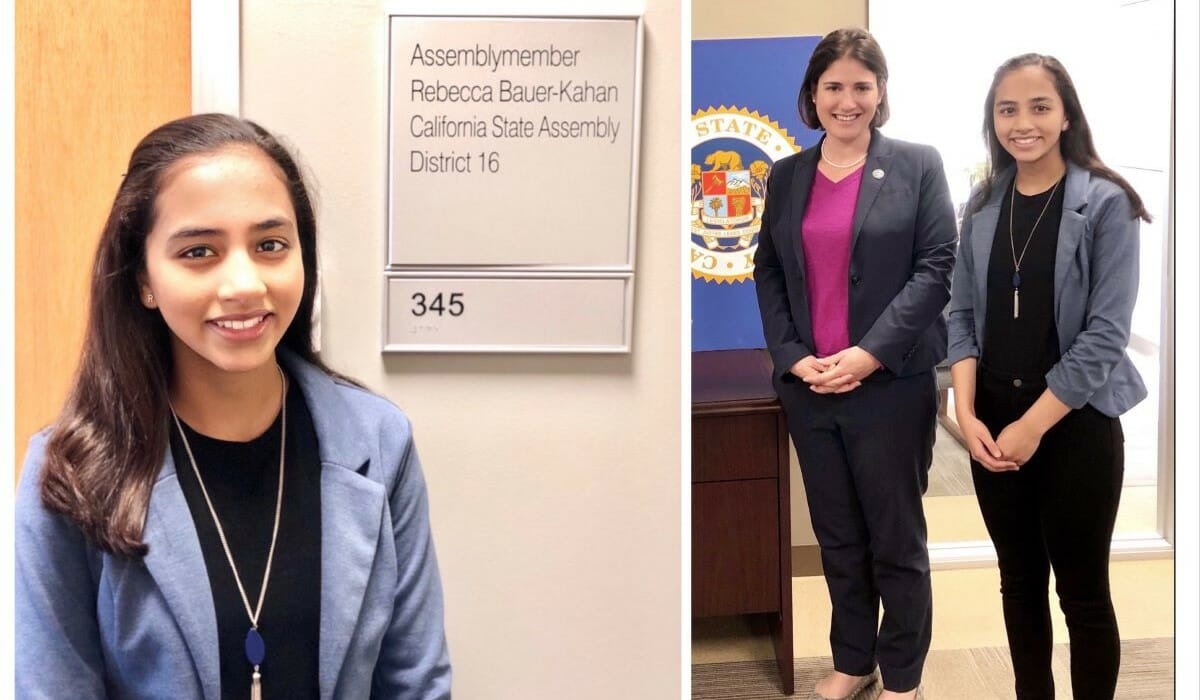
Romal Mitr meets with California assembly member Rebecca Bauer-Kahan to discuss legislation that would increase environmental education for youth./Courtesy Romal Mitr
What’s been the most rewarding part of your work?
The most rewarding part has been looking at the effects of increasing environmental education. I can really see that people are inspired by this initiative and they feel if I’m able to apply my diverse passions towards furthering the environmental movement, they can do the same in their own unique way. I think that has definitely been the most rewarding part — seeing youth realize they have the ability to contribute to the environmental movement even if it’s not in conventional ways.
Why do you think it’s important for others to give back?
Service is something that is really dear to me. I truly believe that it’s important for everyone, especially in the environmental movement, to come together in unity to help further various environmental initiatives. If everyone is working on their own separate environmental initiatives, or people aren’t supporting each other in this journey, it will be very hard to catalyze change. If we all work together and come together in solidarity, I think working toward a common goal such as improving the environment is definitely something that’s attainable.
What do you want people to learn from your story?
I want people to feel as if they are able to make an environmental difference in any way, whether that’s looking at their passions and reimagining them in more sustainable ways, or whether it’s creating an innovation that would help solve an environmental issue. Everyone has a unique role in contributing to the environmental movement, and if people truly embrace that role, we’ll be able to solve our environmental issues like climate change much faster.
Elementary Student’s Good Deeds Promote Worldwide Change and Peace
Meet Daily Point of Light Award honoree Paisley Elliott. Read her story and nominate an outstanding volunteer or family as a Daily Point of Light.
During an outreach trip to Uganda, 8-year-old Paisley Elliott describes the electric joy she felt interacting with children her age.
“When we drove past (the children), it made my heart smile and cry with happiness,” says Paisley. “Whenever I passed them, they kept yelling my name and waving. They knew more about me than I thought. I’m helping these kids and they consider me as a friend because of how much I’ve done.”
It’s what Paisley, a Texas 3rd grader, has accomplished for others through volunteerism in the past four years that is remarkable for such a young child, and even greater, her plans for the future. As the founder of Paisley’s Pals, she is uniting with kids all around the world to increase access to STEM education and she says, build the next generation of changemakers.
“(Kids in need,) they’re just like you and me mostly. What if their story was my story? We’re mostly the exact same. (Through my volunteerism,) I am showing them that they can be free too, in their own way.”
Committing to humanitarian projects in countries including the United States, Mexico, Nicaragua, Switzerland, Greece and Uganda, raising more than $56,000 and changing the lives of children around the world, Paisley’s compassion and desire to build a more inclusive world guides her superstar service.
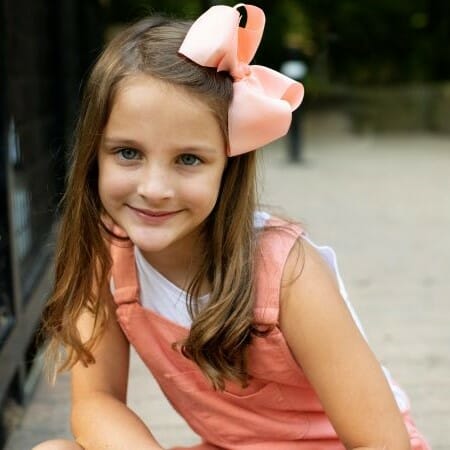
Paisley’s Pals founder, Paisley Elliott, is volunteering to increase global access for kids to STEM education and build the next generation of changemakers./Courtesy Paisley Elliot
“We have a program for kids called the SHINE box. It’s a portable, mixed-aged STEAM toolbox that includes materials for lessons that focus on sustainable development goals. It also includes a bike share program to help kids get to school faster. We have solar radios and also have solar lights that take up energy from the sun, so at night kids can use the lights for studying to catch up on homework, or to cook. Our SHINE box is a popup classroom, (we’re teaching underserved kids that) you don’t have to not play, because playing is a big part of learning and using your imagination too.”
Creating her SHINE box to help children in refugee camps, often plagued by a lack of resources including no internet, Paisley is empowering the next generation of global citizens. Built to facilitate learning for 50 students, the SHINE box serves as a mobile learning platform, and is filled with reusable materials like LEGO blocks, solar lamps, reusable sanitary pads and more. Amid the COVID-19 pandemic, Paisley says she realized learning wasn’t just limited to classrooms, further underscoring the importance of learning resources like hers for displaced children.
There are now 10 SHINE boxes in Rwamwanja, a refugee camp in southwestern Uganda home to nearly 70,000 refugees, where Paisley is also working in partnership with the Refugee Innovation Centre to launch the PeaceMaker Preschool. Olivier Nkunzurwanda, the CEO and founder of the Refugee Innovation Centre, says Paisley’s help is promoting change in the lives of hundreds of children, who face daily hurdles accessing education and other essential resources.
“Paisley’s Pals SHINE boxes are very useful to areas like Rwamwanja whereby there is a lack of enough structures,” says Olivier. “Paisley’s Pals also provided learning materials to children that can satisfy 100 children but more than 200 children use them by sharing. Since September 2021, we supported 550 young adolescent girls with the skills in Menstrual Hygiene Management and provided them with one year of reusable sanitary pads. (Lastly,) more than 400 books were distributed to primary and secondary schools even if there are still thousands of children in schools that need books.”
Volunteering to better lives around the world and get STEM education into the hands of displaced children, it’s Paisley’s creativity that continues to feed the fire of her service, says Erin Patterson, a neighbor who recently accompanied Paisley and her mother on a trip to Uganda.
“It’s like she never runs out of ideas,” says Erin. “(Paisley) is this ever flowing foundation of ideas…she’s changing the lives of children around the world and it’s easy to see the impact every single day. What’s hard to measure is the inspiration she brings to these kids so they can change their lives after Paisley has returned to Texas. That’s one of the special things about Paisley, she’s showing kids all around the world they can change their lives and change the lives of other children all around the world too.”
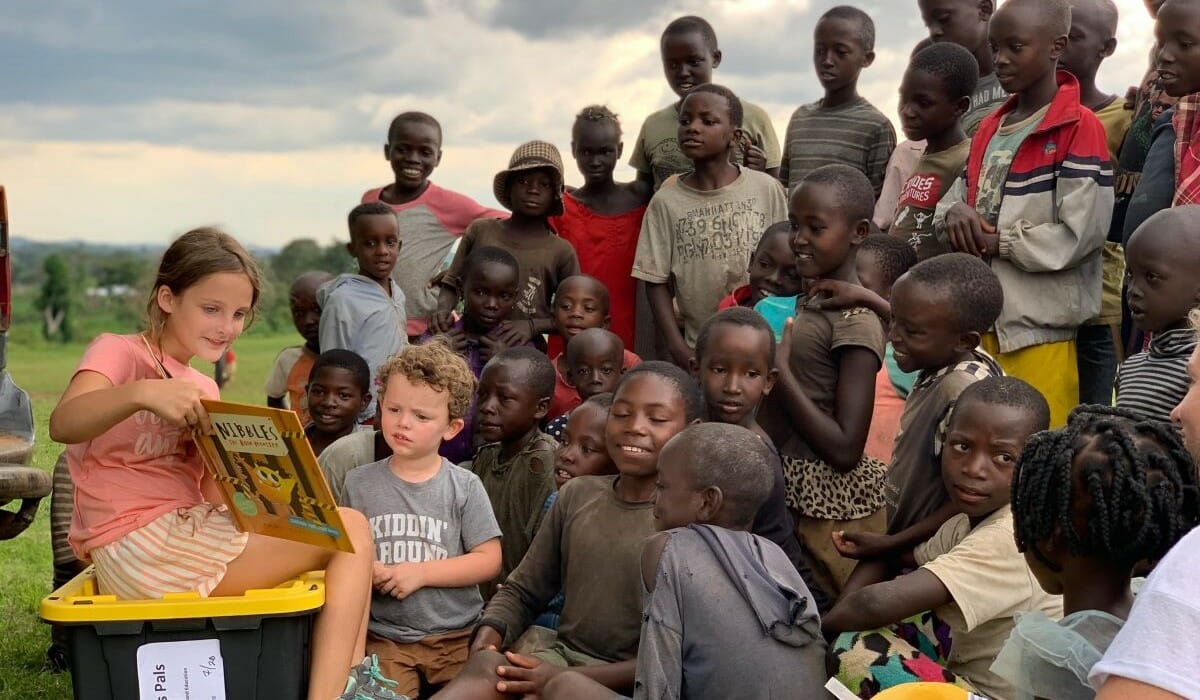
Paisley Elliott pictured reading to children in a refugee settlement./Courtesy Paisley Elliot
Inspired by the plight of refugee children forced to flee from their home countries, Paisley has partnered with organizations to maximize her impact, including the Refugee Innovation Centre, Totem Italia, NuMinds Enrichment, AfriPads, UNHCR, and Lifeline Energy Radio. Her work internationally and even closer to home, quite literally, her front yard, demonstrates her empathetic service and advocacy on behalf of others. Protesting the separation of children from their families at the southern border during the Trump administration, Paisley camped outside in front of her mother’s home for 34 weeks. Describing a circle of kindness as she offers hope for the future to other children, Paisley invites other volunteers, young and old, to join her in changing the world.
“If we help (someone), then maybe later on, if we have to go someplace because of a hurricane or something, then they’ll be able to help us because they’ll remember us for our good deeds. It doesn’t matter how old or how young you are. No one can stop you from changing the world and doing what’s right. We can be change makers and peacemakers. We will lead the way, no matter if you’re young or old, you can still make things right.”
New Jersey Volunteer’s “Neighborhood Langar” Serves Thousands of Meals
Meet Daily Point of Light Award honoree Sachdeep Arora. Read his story and nominate an outstanding volunteer or family as a Daily Point of Light.
In the Sikh community, a “langar” is a community kitchen, where according to Pennington, New Jersey resident Sachdeep Arora, people join together as equals to eat.
Since 2015, Sachdeep has volunteered alongside many dedicated volunteers to serve more than 50,000 meals and distribute thousands of essentials through Neighborhood Langar. Connecting with the hungry and homeless in areas of need across the state, Sachdeep’s community service even takes to the streets of Trenton to serve free hot meals. His volunteerism is a “movement,” in Sachdeep’s words, that is empowering individuals through service and kindness.
What inspires you to volunteer?
My family has been serving for generations. Prior to that, our bloodlines have been doing this for generations. It was instilled in us to help those around us. With all the negativity that happens on a daily basis, it’s nice to be able to go and spread some positivity without an agenda every so often, and inspire others to join us.
Describe your volunteerism with Neighborhood Langar.
I’m the fortunate facilitator that gets to help other volunteers. We collect donations of essentials like toiletries, clothes, blankets, outerwear. A family will take on one month of preparing hot meals, which are then packed up with other items. We’ll distribute the packages to locations on the street and then to other community partners. We feed more than 300 homeless people each month, and thus far, we’ve served more than 50,000 meals and distributed thousands of bags with basic essentials.
Share one personal story with me from your volunteerism.
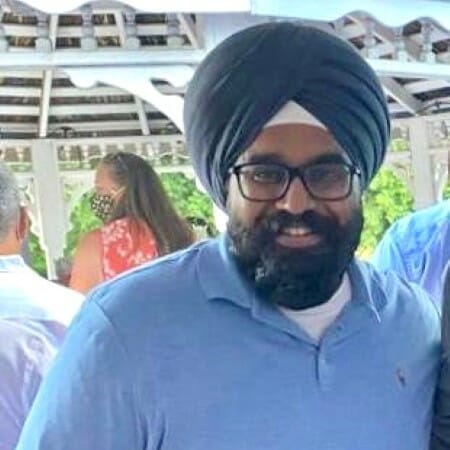
Through New Jersey’s Neighborhood Langar, Sachdeep is volunteering alongside many other dedicated volunteers to help the hungry and homeless./Courtesy Sachdeep Arora
I grew up in the area I serve, and while volunteering, I once noticed someone I grew up with playing football at the other end of the table asking for donations. That’s happened to me a few times. I’ll see people I grew up with, or their relatives. That always hits home the most. We both grew up in the same situations, but we took two different paths. You’ve heard the term “selfless service.” We try to do this as a means to help others without impacting ourselves, but obviously, when you do this, you can’t help but feel full inside from giving back and helping those around you.
Why do you think it’s important for others to give back?
We all have to remember where we came from, who we are and what’s around us all the time. I had my family to push me through, get an education and be in the position I’m in, but not everybody has that support. I don’t want folks to think we’re giving them a hand out, we’re helping them to better themselves. If I can provide a little bit of relief to somebody, whether through food or other things, I feel we’ve done our part to help society and empower others.
What’s been the most rewarding part of your service?
(Laughs.) It’s the amount of enthusiasm and involvement I get from my fellow volunteers and the positive reactions from the folks that are receiving the things we are providing. We serve with the community at large, organizations including Sikh Sabha of New Jersey, Inc, Trenton Police PBA Local 11 Community Outreach, HelpSelf, ONE Project and Clara’s Heart, they all come together and as one, work together. We laugh, we serve, we enjoy ourselves. It’s just a very positive atmosphere.
How have you continued to volunteer throughout the COVID-19 pandemic?
We had to stop service for one month, but even during that time, I still went out by myself to serve. The need was even greater during the pandemic. We’re back up and running, and we’re serving more locations now than ever before.
In one word, what does volunteering mean to you?
Community.
How can readers help?
Neighborhood Langar always needs more volunteers. Please visit the Sikh Saba of New Jersey Facebook page for more information about how you can help.
Teen Helps With COVID-19 Prevention in California Community
Meet Daily Point of Light Award honoree Edward Fabi. Read his story and nominate an outstanding volunteer or family as a Point of Light.
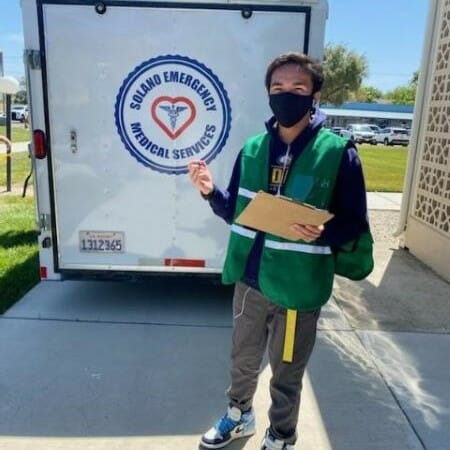
When the COVID-19 pandemic hit, Edward Fabi quickly stepped up as Asian Pacific Islander American Public Affairs (APAPA) began helping those in need throughout his Solano County, California community. Edward, who has served as an intern for APAPA since he was a freshman in high school, dutifully helped the nonprofit with distributing masks and running mass vaccination clinics, as well as with distributing food to those in need. As a current University of California, Davis student studying bioscience, Edward knew how important it was for his community to have this healthcare access.
Aside from his pandemic-related work, Edward also assists with APAPA’s annual National Night Out event to help build relationships between community members and local law enforcement. In addition to his work with APAPA, Edward leads youth volunteers in laying wreaths at the Sacramento Valley National Cemetery each holiday season for Wreaths Across America.
Describe your volunteer role with Asian Pacific Islander American Public Affairs.
I would help them with different mask distributions. I distributed 100,000 masks for COVID-19 prevention. We would give these masks to local businesses, fire departments, and police stations. This was at the height of COVID-19 when it was nearly impossible to get any PPE. We also worked with APAPA to do National Night Out, which worked to build relationships between the community and law enforcement to promote safe neighborhoods.
What inspired you to get involved in APAPA?
Community outreach is really important. They reached out to my eighth-grade class, and seeing them do all the help they did and also all the cultural events I saw them do [inspired me]. For example, when they did the dragon dance during the 4th of July parade for Solano County [and] all the Chinese New Years events they would have every year. Sharing Chinese culture, and being Asian and not having too many Asians in my community, I think really influenced me.
What did you do to help with the mass vaccination clinics?
Edward Fabi volunteers at one of the mass vaccination clinics that were hosted by Asian Pacific Islander American Public Affairs along with Solano County Public Health./Courtesy Edward Fabi
When they were starting the clinics with Solano Public Health, they didn’t have nearly enough volunteers to cover all the people who had intended to get their vaccinations. This included people who were just walking in who didn’t make an appointment. We were able to serve them. My youth volunteers and I were filling out COVID vaccination cards. We would check up on those who were vaccinated to see if they developed any symptoms. We checked the health information on their COVID information sheets to see if it was all accurate and if they were eligible to get the vaccinations. We were all supervised and trained by the doctors on site.
What do you do for APAPA’s National Night Out campaigns?
I helped recruit different youth volunteers and also worked with the police officers to make sure they would be able to show up to the different communities. During 2019, when it was safe to go out, me and a couple other youth volunteers went door to door informing the communities involved about the upcoming National Night Out. It had a lot of fun little events for kids to go to and meet with local law enforcement. … It’s a one-time event during the year near the end of summer. We were planning to do it in 2020, but because of COVID, we cancelled it. Then we brought it back in 2021 following COVID practices.
Can you explain what you do to honor veterans during the holidays?
Growing up in a military family, I recognized how important freedom is, and I believe it’s very important to show our appreciation to those who made the ultimate sacrifice in protecting it. A couple of youth volunteers I gathered and I go out to the Sacramento Valley National Cemetery. We take out wreaths from the trucks and lay them on the 26,000 gravestones they have. I’ve been doing this since 2016. [This week] I’ll be doing it again and that will make five years.
Are there any future partnerships, programs, or events that you are excited about?
We’re helping unload the truckloads of wreaths again at the Sacramento Valley National Cemetery on December 11. [If anyone wanted to help] I would say show up to the cemetery. After we set up all the wreaths, we still have to go back and clean them up. I would recommend going to the Sacramento Valley National Cemetery’s website to see when the date for cleanup will be.
Is there anything you’ve done while volunteering that you’re particularly proud of?
I’m going to UC Davis. I’m a bioscience major working into pre health because I believe in healthcare access for all. Working for all these different communities, I’ve been able to realize it’s very important for everyone to have healthcare access. For the 100,000 masks for COVID-19 prevention and the 15 medical clinics helping to vaccinate over 5,000 people, these were working with populations that don’t usually receive healthcare attention.
Why do you think it’s important for others to give back?
I think it’s important to be engaged with your community, to be able to know what your community needs, and to give back to all those who need it.
What do you want people to learn from your story?
I want everybody to start volunteering early. I was even able to start as early as eighth grade working with APAPA, so it doesn’t matter what age you are. I think you can do a lot with the time you have.
American Girl Doll Aficionado Donates “Adopt-a-Doll” to Girls in Need
Meet Daily Point of Light Award honoree Lauren Rivera. Read her story and nominate an outstanding volunteer or family as a Daily Point of Light.
Adoption Day is Lauren Rivera’s favorite, as the Danville, California 18-year-old lovingly hands a customized American Girl doll off to a girl in need.
As the founder of Adopt-a-Doll, Lauren, a college freshman, has given more than 70 refurbished dolls a new home as she delights girls around the Bay Area with dolls that match their owners. Placing gently-used dolls from generous donors with girls aged 5-12 who are having a difficult time in their lives, whether it’s a disability, serious illness, homelessness or domestic abuse, Lauren is giving new life to a beloved doll and gifting joy to girls experiencing hardship.
What inspires you to volunteer?
My faith plays a big part in my service, and I’ve been blessed with so much. I want to be able to share what I’ve been blessed with and joy with people who may not have had the opportunity to experience that yet.
Describe your volunteerism with Adopt-a-Doll.
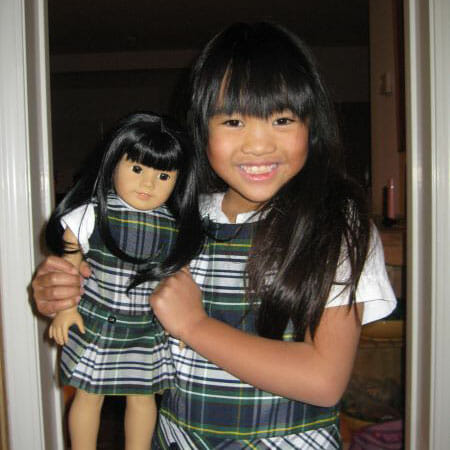
Lauren pictured as a young girl with her favorite American Girl doll, “Alissa”./Courtesy Lauren Rivera
When I realized that there were lots of beautiful dolls collecting dust in people’s homes, and lots of little girls who would just love the chance to own a special doll, I decided to launch Adopt-a-Doll to bring them all together. As founder and CEO, I reach out to organizations including Down Syndrome Connection of the Bay Area, Shelter Inc. and Shepherd’s Gate to see who has little girls who are willing to adopt the dolls. I also coordinate with potential donors, pick up the dolls and refurbish them before matching them with new owners. I personally present the dolls to their new families, that is my favorite part. I call that “adoption day.” We have a handful of student volunteers that assist with Adopt-a-Doll activities, and we facilitate thank-you notes and photos so the doll’s original owner can be assured that their special doll has safely ended up in a loving new home.
Share one personal story with me from your volunteerism.
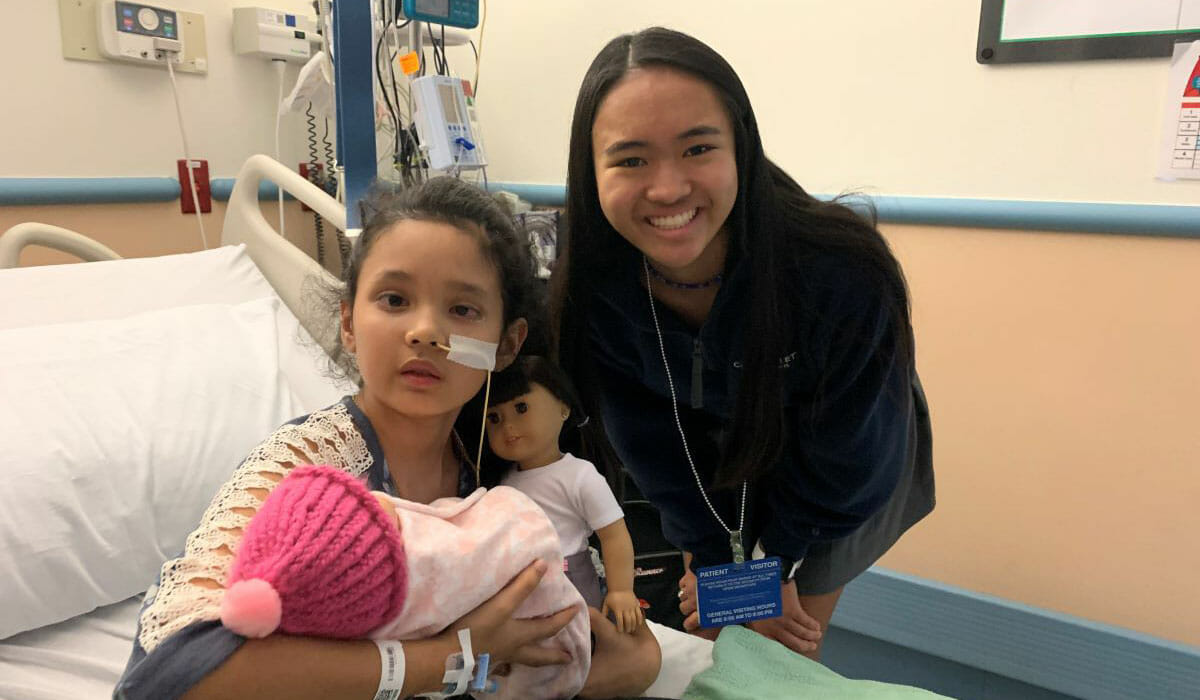
During one adoption day, I met a little girl through Down Syndrome Connection. Her mom told me that her daughter spends a lot of time in the hospital because of her Down syndrome. A few years ago, the girl was in the hospital near an American Girl doll store, so the two visited the store to cheer the girl up, but weren’t able to buy her a doll. The mom said how thankful she was to have a doll to play with and give her comfort while she was at the hospital. I was really touched and thankful to see the impact we’re making on these little girls.
Why do you think it’s important for others to give back?
In my experience, doing service not only impacts the person receiving the service, but to know you’re making a difference also brings so much fulfillment and happiness to your own life.
How have you continued to volunteer throughout the COVID-19 pandemic?
My favorite part about Adopt-a-Doll are adoption days. The pandemic took away that in-person connection, that was the saddest part, but we were still able to safely drop the dolls off, and then take pictures of the girls from afar. We are now back to delivering dolls in-person.
Since launching Adopt-a-Doll in 2019, Lauren has delivered joy to dozens of little girls./Courtesy Lauren Rivera
What do you want people to learn from your story?
Giving a doll to a little girl really isn’t saving the world, but it’s still bringing joy to her life. Taking the small steps to intentionally bring joy to someone’s life does make a difference, as small as it may seem.
What’s your favorite American Girl doll adoption story?
I got one doll who came with a missing eyeball and a cracked skull. She’d been through a lot (laughs.) I sent her to the doll hospital and she came back brand new and beautiful. That was cool to witness.
When you’re not busy with school or volunteering, what do you do for fun?
I love music. I sing in choir, play piano and I love running and backpacking.
How can readers help?
We donate refurbished dolls to organizations, but we also accept monetary donations if individuals would like to purchase a new doll for a child, as some organizations allow only new dolls. Please visit our website to learn more about how you can help, even if you don’t have a doll to donate.
After Losing Childhood Friend and Fellow Marine to Suicide, Veteran Devotes Service to Vets
Meet Daily Point of Light Award honoree Roy Brown. Read his story and nominate an outstanding volunteer or family as a Daily Point of Light.
39-year-old Roy Brown grew up two doors down from his childhood friend, Francis McNally. The two bonded playing video games and sports, and so when Roy decided to head off to bootcamp, he convinced Francis to join him. After serving in Iraq, Francis returned home and committed suicide.
In response to alarming veteran suicide rates, for those under 34, three times that of non-veterans, Roy is now volunteering in honor of Francis, and more than 20 other men he served with during his time in the Marines who have taken their own lives. Founding Operation Patriots FOB (OPFOB) alongside his wife, Stephanie, Royis offering free recreational peer-to-peer experiences for combat veterans and first responders to provide them with a brighter outlook on their future. From fishing to golf to hunting and more, Roy, a resident of Bluffton, South Carolina, is helping veterans find life purpose beyond the call of duty.
What inspires you to volunteer?
The mission hits close to home. I spent three years in Iraq, and have lost more friends and coworkers to suicide than I did to combat. I’ve lost over 20 guys that I served with to suicide. I was sick of sitting on the sidelines. My wife and I put our heads together to try to reduce veteran suicides. In the area we live in, there are approximately 120,000 veterans, so we didn’t have to go far to start helping people.
Describe your volunteerism with Operation Patriots FOB.
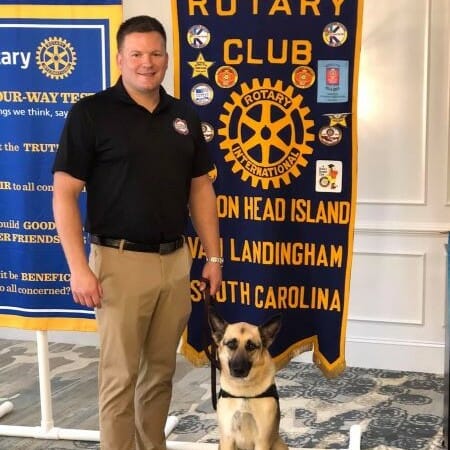
Rob pictured with his service dog Mya. Through volunteerism, Roy offers free recreational peer-to-peer experiences for combat veterans and first responders./Courtesy Roy Brown
Our organization is a place for vets, first responders and their families to be themselves, feel comfortable around other like-minded veterans and hopefully build a network that they can lean on when times get tough. I serve as founder and chairman of the board, and my wife and I wear many hats throughout the organization. We fundraise, host events, plan activities for veterans including guided hunts, fishing, golfing trips, concerts, shooting or just hanging around by the bonfire. Any activity that gets vets back outdoors and fosters positive experiences through outdoor recreational activity. What we’re doing is a big team effort. Without our volunteers, none of this would have come to light. Our volunteers are amazing people, most of them are veterans or spouses of vets, and they [work hard for us] everyday.
Share one personal story with me from your volunteerism.
An older couple called me, their son is a Navy vet and lives locally to me. They explained he was going through a really rough time and they had been unable to reach him. Myself and another guy hopped in a truck, drove over to his house and knocked on his door. We just sat and talked with him for an hour. Once we felt he was in an ok place, we left. A few months after that, the man left me a voicemail, and said that just before we rang the doorbell, he had a rifle out and he was about to commit suicide. It gives you goosebumps when you hear it. If we just save one, then it’s mission accomplished. Our goal is to save many. We believe in our hearts that day that we did save one. At the same time, we know we have a lot more work to do. Since that time, I’ve lost two more guys to suicide. It’s a double-edged sword. You want to feel good about the ones you are making an impact on, but at the same time, it’s hard to feel good about it when you’re still losing guys. That’s what keeps the fire burning for us to keep pushing forward.
Why do you think it’s important for others to give back?
The good Lord blesses some of us more than others. It’s our responsibility to give back. That’s what makes this country as special as it is.
What’s been the most rewarding part of your service?
That I get to meet a lot of cool vets. I get to hang out with a lot of interesting vets, that’s rewarding. I’m personally going through this as well. I’ve had my struggles. We built this organization based off of what helped me the most with my PTSD. Every day I get to get up, work with veterans, help veterans and play with veterans.
How have you continued to volunteer throughout the COVID-19 pandemic?
At our main facility, we have 268 acres. When everybody was stuck at home, veterans could reach out to us, come out to our property and be outside, safe and around other vets. Unfortunately, during the pandemic, the number of veteran and active duty suicides went up. Even now with the end of the Afghanistan war, we’re still seeing a surge of suicides amongst vets and active duty. Our services are needed now more than ever.
Roy Brown pictured with his wife, Stephanie. The two founded Operation Patriots FOB in response to alarming veteran and active duty suicide rates./Courtesy Rebecca W. Bass
What do you want people to learn from your story?
At the very least, if you’re a veteran, pick up the phone and call your battle buddies. Vets and family members, pick up the phone and call them and see how they’re doing. Unfortunately around the holidays, it’s the worst time of year for veterans with depression and suicide. If you want to do more, research and locate your local veteran organization and volunteer, or participate as a veteran.
In one word, what does volunteering mean to you?
Blessed. I feel very blessed to be in the position I am to give back. I have the capacity to take care of my bills every month, and there are a lot of veterans that are struggling a lot more than myself. I am also blessed for the struggles I’ve gone through personally, for the past almost 17 years, because that made me stronger to be able to to deal with these situations and give back.
How can readers help?
We are a 100% volunteer run organization. Every dollar we raise goes a long way, and we welcome new volunteers. Please visit our website for more information about how you can help.