Volunteer Teaches “Better Money Habits” to His Community
Meet Daily Point of Light Award honoree André Turman. Read his story and nominate an outstanding volunteer or family as a Point of Light.
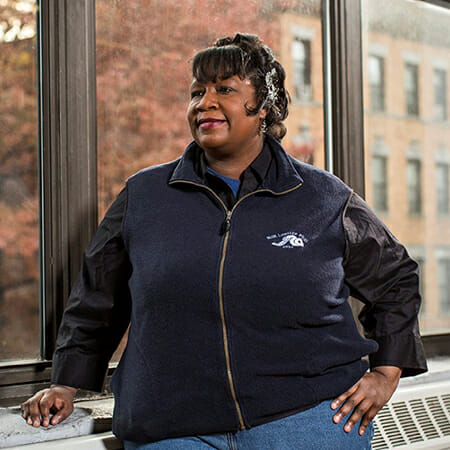
André Turman grew up in a home where money was a taboo subject. He had no idea of his parents’ income or assets until he filled out college financial aid forms. Now, André makes a living by talking about money every day as a financial advisor for Bank of America Merrill Lynch. In addition, he devotes countless hours as a volunteer, talking about money issues and how to make smart financial decisions, as part of Bank of America’s Better Money Habits program.
In partnership with Khan Academy, the Bank of America Better Money Habits program offers a very comprehensive, interactive website where people at all stages of life can find information about everything from saving and budgeting, mortgages, taxes and paying for college to preparing for retirement. Volunteers like André give of their own time to teach money basics to school and church groups, and other organizations, offering a personal connection and encouragement.
Describe your role with Better Money Habits.
As a Better Money Habits champion, I go out into the community, partnering with nonprofits and agencies. I focus on all ages. Our community includes the greater Albany, New York area, and there are wealth disparities. I’m a facilitator and mentor for students in high school STEM programs, conduct workshops at local churches, and present to members of historically Black sororities and fraternities, where the average age is around 45.
How has your volunteering continued through the coronavirus pandemic?
Last year, we were able to pivot and offer these programs virtually. During the sessions, I can take participants right to the (Better Money Habits) website and play the videos and do workshops. The virtual option actually turned out to be a great resource, as we were able to expand our reach outside of the immediate community. Many of the agencies we work with have a global presence and were able to invite people from all over to attend virtual sessions. In-person events typically see 30 or 40 people register, of which maybe 10 or 15 would attend. For one workshop we offered virtually, we had 84 people attend our first session and upwards of 50 continued to attend, with 30 people attending all six sessions. People really adopted the virtual platform and it offers more flexibility.
What inspires you to volunteer?
One of the reasons I became a financial advisor is that I realized, as a young adult and young parent, that I didn’t have very good financial habits. Growing up, we didn’t talk about finances in my household. If I had known then what I know now, I would have avoided a lot of financial pitfalls along the way. I felt compelled and it is a passion of mine to be able to take what I have learned and share it with others. Finances are intertwined in every aspect of our lives – you can’t avoid it.
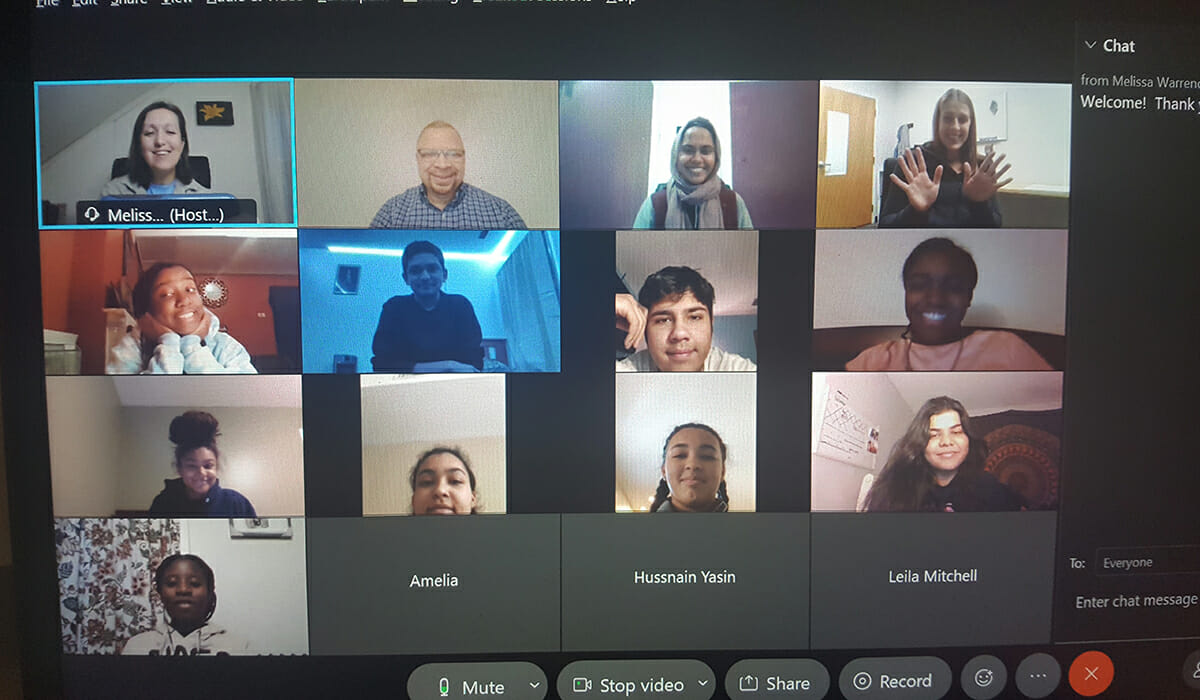
Melissa Warrender, AMC STEP Coordinator (top left) and André Turman, Bank of America Better Money Champion Volunteer (top, second from left) conduct a virtual session in November 2020 for students in the AMC STEP program on “Personal Banking and Privacy/Security,” using resources available on the Better Money Habits website./ Courtesy André Turman
What are some of the hard parts of your volunteer work?
Talking about finances is not sexy. A lot of people don’t want to talk about it. A lot of people feel it’s taboo to talk about how much someone earns or has in savings. In low- and moderate-income communities, they not only don’t talk about it, but they don’t have the resources. There’s an embarrassment to share their situation, because it might put them in a negative light. The reality, however, is that many people are in the same situation, and that having the conversation is what propels individuals to change that narrative and begin making choices and implementing best practices to propel them out of that current situation. The challenge is to change that mind-set.
What have been the most rewarding aspects of being a volunteer?
Taking it from that first point of discovery to “This is where I am and these are my short-term and long-terms goals,” and hearing back from individuals or getting feedback from the organizations that I work with that someone was able to buy their first home or a student that we worked with was able to go to college and find ways to meet the financial obligations to achieve that degree. That families now have more confidence about their financial situation because they have a plan in place if life happens – and we all know that life happens. I’ve had students see me in the neighborhood and run up to me and tell me about their college experience.
Why do you think it’s important for others to give back?
At the end of the day, it gives purpose. Being a volunteer offers holistic life fulfillment and a well-roundedness that work alone can’t do. When you look back on it all, you go, “Hey, I made a mark in life.” It’s not hard to find volunteer opportunities to offer your time, talent and treasure.
How can others help volunteer in a similar way?
I’m honored to work for Bank of America, which is devoted to offering volunteer opportunities, but I believe other companies may offer similar programs, or individuals at other companies may spearhead volunteer work at various organizations. Start your volunteer efforts with what you’re passionate about, because people will see your genuineness and know it’s coming from a sincere place.
Activist Fights Revenge Porn Through Leading National Protests
Meet Daily Point of Light Award honoree Leah Juliett, who was a 2020 L’Oréal Paris Women of Worth Awardee. Each year L’Oréal Paris and Points of Light recognize and celebrate Women of Worth who make a beautiful difference in their communities. Ten honorees each receive a $20,000 grant to support their most cherished cause, and an online vote determines one honoree who will receive an additional $25,000 grant. Nominations for 2021 are now open! If you know a woman who works to create lasting and significant change in her community, nominate her to be one of the 2021 Women of Worth.
When Leah Juliett searched about revenge porn online after becoming a victim of the crime at age 14, all they found was information on victims committing suicide, losing their jobs, or facing further forms of injustice.
Now a decade later, when you enter revenge porn into a search engine, you instead receive resources — including those provided by March Against Revenge Porn, the nonprofit Leah started as a way to take back their story.
As the founder and executive director of March Against Revenge Porn, Leah is organizing revenge porn victims and allies to help eradicate and combat tech-based sexual abuse and image abuse. The nonprofit leads protest marches across the country, advocates for legislation that criminalizes revenge porn, and maintains a legal defense fund to provide mini-grants to help victims pay their legal fees.
March Against Revenge Porn first started in 2016 when Leah was just 19-years-old as a way to tell their own story of being victimized by revenge porn. When they were in high school, Leah’s nude photos were posted on a global anonymous image board. They struggled to get the photos taken down and said they felt shame for years. When Leah later found out the man who shared their nude photos went on to sexually assault a minor, it spurred them to take action.
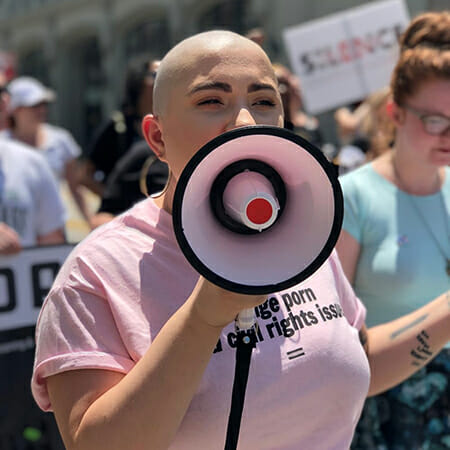
Leah Juliett attends one of the many protest marches organized by her nonprofit March Against Revenge Porn, which seeks to eradicate the crime of tech-based sexual abuse and image abuse./Courtesy Leah Juliett
“It helped me to realize that when someone isn’t held accountable for violence that they commit against you, they will continue to commit violence against other people,” Leah said. “So I started March Against Revenge Porn to tell my story but also in the process tell the story of others, and to change laws and change mindsets around the crime that first victimized me.”
March Against Revenge Porn’s slogan is to “reclaim shame.” Leah said that when they first started to share their story, they wanted to be shameless. They’ve since realized that everyone has shame, and wants to emphasize to victims that it’s ok to feel that way.
“It’s about taking our shame, reclaiming it, recycling it, and using that power and that energy to be a force for social good and be a force to change the world,” Leah said.
According to data shared by March Against Revenge Porn, an estimated 10 million Internet users are victimized by revenge porn in the United States, and international data indicates that one in three are victims worldwide. The nonprofit emphasizes that 17% of lesbian, gay, and bisexual people are victimized by revenge porn in comparison to only 2% of heterosexual people. Revenge porn also disproportionately effects Black and Brown people, as well as women and those who are low-income and financially insecure. March Against Revenge Porn is currently engaging in both external research and their own research into how revenge porn effects the transgender community as well.
March Against Revenge Porn Associate Director BeLinda Berry, who joined the nonprofit in 2018 after partnering with Leah to plan a march in Pittsburgh, said it has been particularly heartening to work with someone who wants to lift the voices of the LGBTQ community.
“They’re a passionate and dedicated and hardworking person who is really out to make changes and to amplify voices,” BeLinda said, “and really just willing to talk about the hard-to-talk-about issues.”
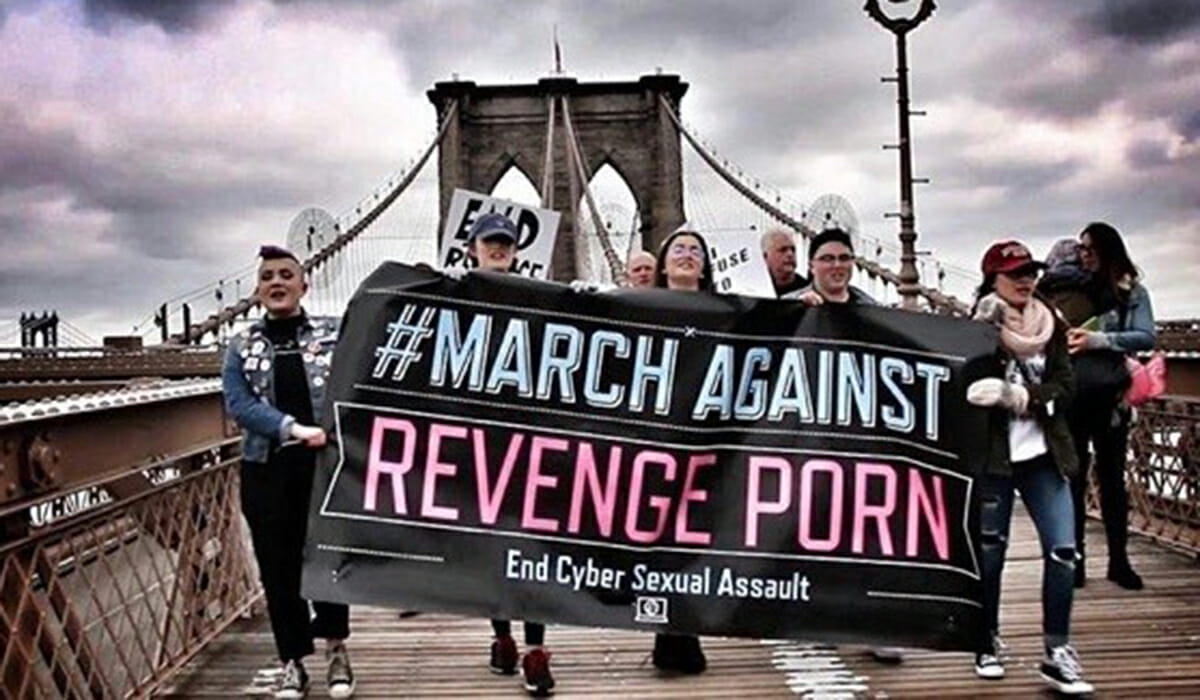
One of the biggest aspects of March Against Revenge Porn is its protest marches, which have taken place in Orlando, Boston, Pittsburgh, and across the Brooklyn Bridge. Depending on the location, the marches usually see between 50 and 100 people attending, while their viral video campaigns around the marches have generated an audience of millions.
Leah Juliett, left, marches across the Brooklyn Bridge in protest of revenge porn with her nonprofit March Against Revenge Porn./Courtesy Leah Juliett
“It’s really a big physical act of taking back the image that was taken from us,” Leah said of the marches, “so instead of only being recognizable as a naked body, we’re now recognizable as an active, boots-on-the-ground protestor.”
When physical marches had to be put on hold in 2020 due to the COVID-19 pandemic, the nonprofit held a digital march instead by starting the podcast “March Across America,” an interview series that aims to share the story of a revenge porn victim from all 50 states. Physical marches will resume this year in Los Angeles, Minneapolis, and Washington, DC.
Leah said the nonprofit has marched with strangers across cities who have described having their voices amplified in such a way as an affirming and life-saving experience for them. Leah added that they receive letters, emails, and messages from people who said March Against Revenge Porn made them realize they aren’t alone and that they have resources to continue fighting. They emphasized that the nonprofit is open 24/7 to victims, who can direct message or email them at any time for advice or for a listening ear.
For Leah, the most rewarding part of the work they’re doing is that young people today don’t have to experience a world without access to resources or justice for this crime.
“I’m always honoring my younger self who didn’t have a voice, and who was victimized and exploited but didn’t have anywhere to turn,” Leah said. “I’m doing my work on behalf of that version of myself who was trapped online.”
Lifelong Volunteer Dedicates Years of Service to Greater Boston Community
Meet Daily Point of Light Award honoree Emma Lathan. Read her story and nominate an outstanding volunteer or family as a Point of Light.
Emma Lathan is the epitome of a volunteer, having dedicated her entire life to giving back to others in a myriad of ways throughout the greater Boston area. Emma, who resides in Quincy, Massachusetts, currently volunteers 20 to 40 hours a month — although she was doubling that time prior to the COVID-19 pandemic — for a variety of volunteer organizations, some of which she has been with for over two decades. Emma signed up to volunteer with Boston Cares, the largest volunteer agency in New England, on New Year’s Eve 1998, after seeing their newsletter circulating in the building she worked in. She had always been active with community service, but was intrigued by their diverse assortment of volunteer opportunities.
That organization introduced her to multiple others that she continues to actively volunteer with today. Since 1999, she has served the The Greater Boston Food Bank. When Boston Cares wanted some of their volunteers trained in assisting disaster service agencies, Emma joined the Red Cross in 2013. Boston Cares also led her to the Prison Book Program, a grassroots organization that sends free books to prisoners nationwide. Not content to stop there, Emma also volunteers in numerous other capacities, including for additional volunteer agencies, a land conservation nonprofit, a bookstore that empowers youth, local academic competitions, and more.
Describe your volunteer role with Boston Cares.
I’m primarily a volunteer leader through them. They provide different volunteer opportunities under a variety of different categories, anything from sitting with animals, to sorting food at food banks, and cleanups in open spaces. Right now, the project that I’m currently able to do is sorting food at the Greater Boston Food Bank. [As volunteer leader], primarily I’m responsible for signing up people who are interested in volunteering through Boston Cares on any one of the volunteer opportunities. For example, if you were interested in sorting food at the Boston Food Bank, you would sign up. I would have a list of the people who signed up. As a group, we would go into the site and we would provide our volunteer services to the food bank. In addition to helping perform whatever task they would have for us during the day, I would also make sure the volunteers are taken care of and that they’re engaged properly. If they have any questions or any issues, I could assist them with that. Also for the nonprofit that we’re serving, I’m making sure we’re meeting whatever goals or expectations they have for the work we do that day.
Can you expand on your work with the Boston Food Bank?
Primarily it would be through Boston Cares sorting the food. The food bank is the big repository. Organizations actually would come into the food bank, and they would order whatever types or kinds of food they would need and take it back to their places and distribute it to people. One partnership they had this summer was through the Boston Public Schools. I was able to assist them. Usually during the summertime, because children aren’t in school and sometimes the meals they get at school are the only meals that they get during a day, places like the food bank have had small programs where they would provide meals to the children in the Boston Public Schools who are missing that for the normal summer vacation. With the pandemic, with many people staying at home and not being able to go to school, they started doing home deliveries of different foods and things like that. I was able to participate in that which was great, particularly at time where a lot of volunteer opportunities, due to the pandemic … didn’t take place or had to figure out another way to do something.
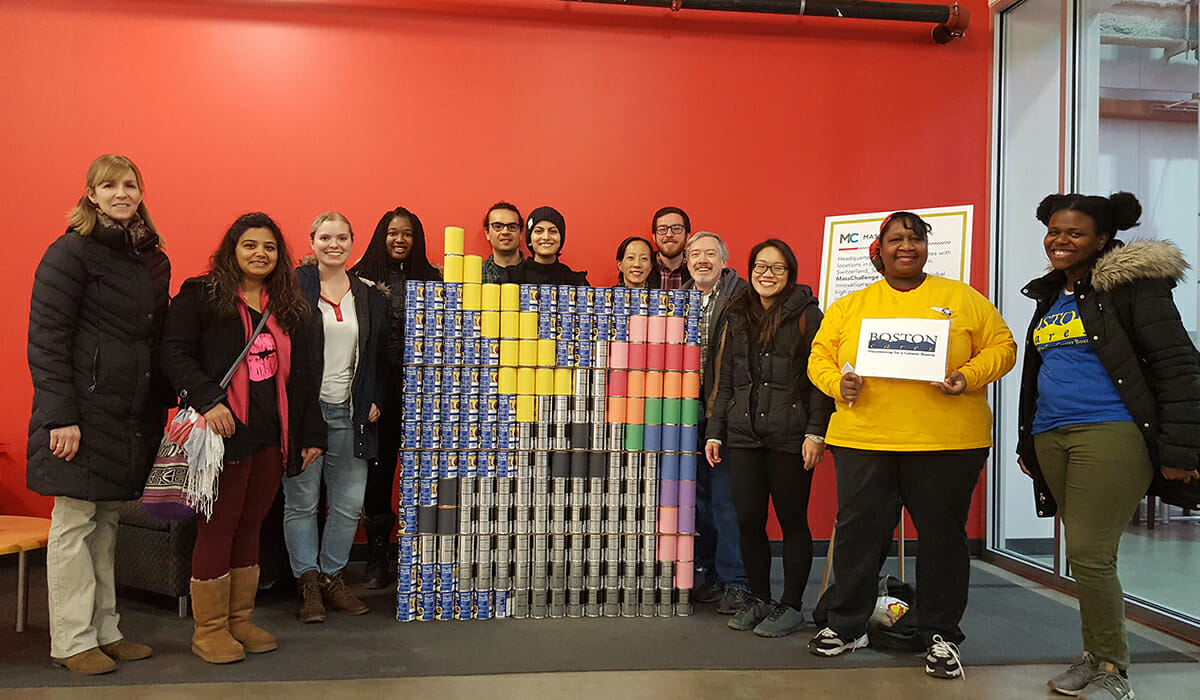
Emma Lathan, second from right, poses with volunteers at the Greater Boston Food Bank, which she has served in conjunction with Boston Cares since 1999. /Courtesy Emma Lathan
Describe your volunteer role with the Red Cross.
It’s primarily working disaster services, so that can take many forms. One would be assisting with shelter management when we need to open shelters to take people in after a disaster has happened, and that can be anything from a hurricane to a home fire, [although] usually you’re talking about an apartment complex [fire]. We also would provide comfort services and connect them with other agencies that might be able to assist people with starting their lives over — a place like Boston ReStore which would have furniture, the Salvation Army which might help with job and housing services, rental assistance, things like that. We also would, if necessary, assist with doing damage assessment for housing, and feeding people if there’s a need. There are lots of times during individual disasters where we need to give them a hot meal for the night, if not usually a bit longer, and that’s usually in conjuncture with sheltering. We’ve also gone virtual where we’re able to provide those referral services or assess those needs, but are able to do it in a virtual environment without physically having to be there, which is great on a number of levels because it allows us to provide assistance across state lines which has been very necessary in the past few years.
Can you discuss your work with the Prison Book Program?
It’s been around since 1972. It sends books to prisoners nationwide, about 44 states, at least 800 institutions, and that’s federal as well as state prisons. Sometimes we will get involved in some advocacy work. Recently we testified at a public hearing concerning the Xeroxing of mail to people in prison, and concerns about tablets being introduced to prisons because of the precipitous cost and also the idea around a certain level of privacy. It’s based in Quincy. Boston Cares again introduced me to that. They’ve been a longtime partner. Prison Book also organized a conference which brought together different books-to-prisoner programs across the state, and we were able to share best practices and find even more connections to the issue of literacy or reading in prisons and prison education. … [Due to the pandemic], we couldn’t take groups of volunteers in anymore, so the people who managed Prison Book and I became that type of volunteer. We took on the delivering ourselves and distributing books to prisons, wrapping them, and doing it from our homes and so forth.
What other volunteer activities do you do?
There are quite a few. I’ve done it through different organizations. There’s People Making a Difference, which is similar to Boston Cares but only on a very small scale. Through them, I’ve assisted at the Braille Press where we would assist them in putting together books for their clientele, which is people who are blind. Also assisting at the National Ocean Sciences Bowl — the Blue Lobster Bowl — which is basically an academic decathlon but with an oceanographic, geology focus. I’m assisting in judging and time keeping for that opportunity, and that’s an annual thing. Helping with The Trustees with their seat gathering. They have a seat gathering conference every year, so we actually put together seats for those. There were a few times where we’ve done cleanup and assisted with maintaining the land for The Trustees. I’ve also volunteered through One Brick, which is national but there is a chapter in Boston. They have done similar things [as Boston Cares]. I’ve volunteered at the food bank but they’ve also done things such as the Boston Debate League, which is a debate league specific to Boston. The neighborhoods of Boston are represented in debating, so they need judges to help with that. I’ve done matches in high school, so it’s always been an interesting experience to see people from the other side.
Emma Lathan, center, attends the 2019 National Conference for Books to Prisoners, which she co-chaired as a volunteer with Prison Book Program./ Courtesy Emma Lathan
What’s been the most rewarding part of your work?
Knowing that I was able to make a difference, no matter how small. That can mean anything. It doesn’t have to be a big impact, because there’s certain things that you’re not going to see the impact immediately. You’ll see it down the line. When I volunteer through Boston Cares, we had a group that assisted More Than Words, which is a bookstore that also offers job training to court-involved youth. When we started partnering with them, they were a few years into themselves, so to speak, so it wasn’t at the very beginning where they had a box of books and a dream, but it was definitely a smaller program. They had one site in Waltham, and they were still working out a lot in terms of the student side. To see them go from that one small store in Waltham to the larger store they have in the south end of Boston, and to see that their online services are big and that they’re able to host events, that they were able to graduate so many people, some of whom have come back and now they work in the program and they’re business managers and they assist others with training; to know that you were some small part of making that happen, and we’re talking seven, maybe ten years — that’s rewarding just to see that, and see that progress that’s been made in a place like that. Even if we want to talk about the food bank, seeing them go from what they used to do in a very small place to the big beautiful building they have now. There’s also maybe a small sense of pride that when they started hosting volunteers again, they reached out to individual volunteers, and I was one of them. I was very surprised to get an email and they were like, we want to bring in people who know the program and we trust to be able to help us. Hearing that was a good feeling.
What inspires you to volunteer in so many different ways?
It has to do a lot with wanting to give back in ways that I think I’m able to give back, and being a person who wants to contribute even if it’s in some small way to my community and to society. If I have the time and it’s something I can do, why not? I know not everybody can, and not everybody is able to for a variety of reasons, and there’s nothing wrong with that. I think of all the hours of engagement I’ve had, and I think “wow.” Right now, even pre-pandemic, you get to a certain point in your life and you’re slowing down. I don’t do nearly as much as I used to, but I’m grateful I was able to [volunteer more] when I was able to do it.
What have you learned through your experiences as a volunteer?
I’ve learned a lot of different skills. I always describe myself as being an extroverted introvert. Even though there’s times I’m very quiet, I learned how to be an extrovert when I need to and how to make connections to people and connect people with people, which are skills that a leader should have. I’ve learned a lot about the different issues that a lot of the organizations deal with. I definitely learned a lot about the nonprofit landscape in the state of Massachusetts, the different types of organizations, what they’ve had to contend with in terms of the state laws, and the difference between something like a Red Cross versus something like Prison Book. One is all volunteer run and managed, and trying to get as much in grant money and individual money as possible for it to work with very little overhead, and the Red Cross is of course more established and it’s a chapter of a larger national organization, so it’s a little bit different there. Also seeing some of the similarities between both organizations as well. I would probably say meeting different people has been an interesting learning experience.
What do you want people to learn from your story?
People throw around the term lately that superheroes don’t wear capes, that anybody can be a hero. I would definitely amend that to say it’s not about being a hero. It’s about seeing a need, seeing a place where you know you have a talent, no matter what it is. You may not even think you have a talent, but you can contribute whatever to the greater good. I did a lot of hours and I’ve done a lot of different things, but there were also times I wasn’t able to do different things. There were people I volunteered with who were only able to maybe volunteer once or give lesser hours, and I never shamed them for that because we’re all trying to do the best we can in this thing called life. I think whatever you do is enough. No matter more or less, top or bottom, no matter what your background is, who you are, what you’ve done, as [basketball player Jim] Valvano said, everyday ordinary people do extraordinary things. It doesn’t take a superhero to provide service or to support community or to make the world a better place. It just takes ordinary people providing whatever gifts they have and whatever time they have. It all works out.
California volunteer breaks the barrier between the Deaf and hearing by teaching sign language to his community
Meet Daily Point of Light Award honoree Michael Agyin. Read his story and nominate an outstanding volunteer or family as a Daily Point of Light.
Michael Agyin was dealt with what he described as a “double whammy” in life. He’s Black, and he’s also Deaf – a one-two punch that made the Compton native feel invisible while growing up.
Michael’s parents, immigrants from Ghana, treated him equally to how they treated his hearing siblings. But still, Michael always knew that he was different.
“I had no one to guide me or lead me,” Michael said in a TEDx talk he gave last year. “I lacked sound and I lacked identity. I was searching for who I am, and I wanted to be a part of my community.”
Unable to learn American Sign Language until he was 18, Michael wore hearing aids when he was young, for which he was bullied. He had to take speech therapy to learn how to read lips and speak. In all of these circumstances, it was ultimately Michael who had to change himself to fit into a society that wasn’t accommodating to his disability.
“But being angry doesn’t solve anything,” the now 42-year-old told Points of Light. “So my goal has always been to be patient and be creative in problem solving on how to communicate with people.”
During the global pandemic, Michael, who works as a behavioral therapist, saw that it was even more difficult for those who are hearing impaired to go about their daily lives.
“We lost access to people’s facial expressions. We normally can’t go through drive thrus because we’re Deaf but now even when we want to order inside a restaurant, it’s harder because everybody is wearing a mask due to covid,” Michael said.
Believing that it was time for the city of Compton to start being more inclusive and accessible for people like him, Michael took matters into his own hands and started the Compton ASL Club in April to teach American Sign Language online to his city and beyond for free.
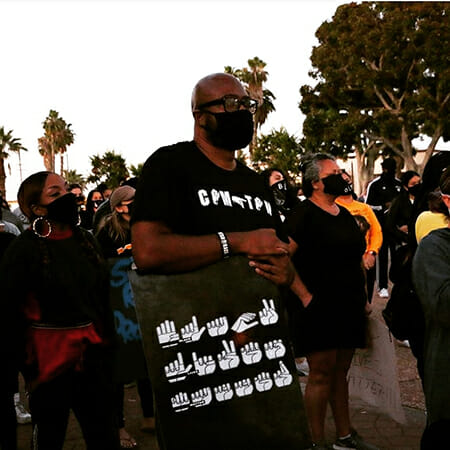
Michael worked to ensure members of the Deaf community felt included at the Black Lives Matter protests last summer by pushing for ASL interpreters to be present. / Courtesy Michael Agyin
Each week, about 20-40 people join his classes held on Instagram Live. Michael teaches them how to sign basic words such as numbers, letters and colors. But he has also taught them how to sign phrases relevant to current events such as “vote” or “Black Lives Matter.”
Michael also uses the platform to teach others about Deaf culture, the achievements of the community, and the need for social advocacy and accessibility. He has interviewed other people from the hearing impaired community, such as Deaf activists, who share their own stories and experiences of being Deaf.
Michael understands that a couple lessons on basic ASL signs won’t make his students fluent, but he said it’s not about their skill level; it’s the fact that they’re making an effort that makes all the difference.
“I’m so proud of them because many of them have never done it before. I give them homework to make a video of themselves signing and post it on Instagram and I love it. It makes it feel like a community experience.” Michael said.
On top of his work with the Compton ASL Club, Michael has volunteered in various capacities within his community. He’s organized toy drives specifically for children with disabilities and he was also active at last year’s Black Lives Matter rallies, where he pushed leaders of the movement to have ASL interpreters present and Deaf activists felt heard.
While being Black and Deaf has put Michael at a major societal disadvantage, he said those traits are also what give him the unique perspective to be a force for change in both the realms of racial equality and disability rights.
“During his TED talk, Michael told us about how he was pulled over by police and he had to pull up a sign that said ‘I cannot hear,’” said Veronica Clanton-Higgins, organizer and founder of TEDxComptonBlvd. “Michael has really shone a light on what life is like as a person who is Black and deaf. And his story shows people that you can do anything, that nothing is impossible.”
As the Compton ASL Club grows, Michael hopes to take his classes from Instagram Live to Zoom and eventually hold in-person classes. But even if you’re not in Compton to take one of Michael’s ASL classes, he said everybody should strive to help people who are hearing impaired feel included.
“Deaf people can’t learn to hear, but hearing people can learn to sign,” Michael said. “For Deaf people, life is already a challenge, so make them feel welcome.”
University Global Studies Director Leads Students in International Service Work
Meet Daily Point of Light Award honoree Stacie Freeman. Read her story and nominate an outstanding volunteer or family as a Point of Light.
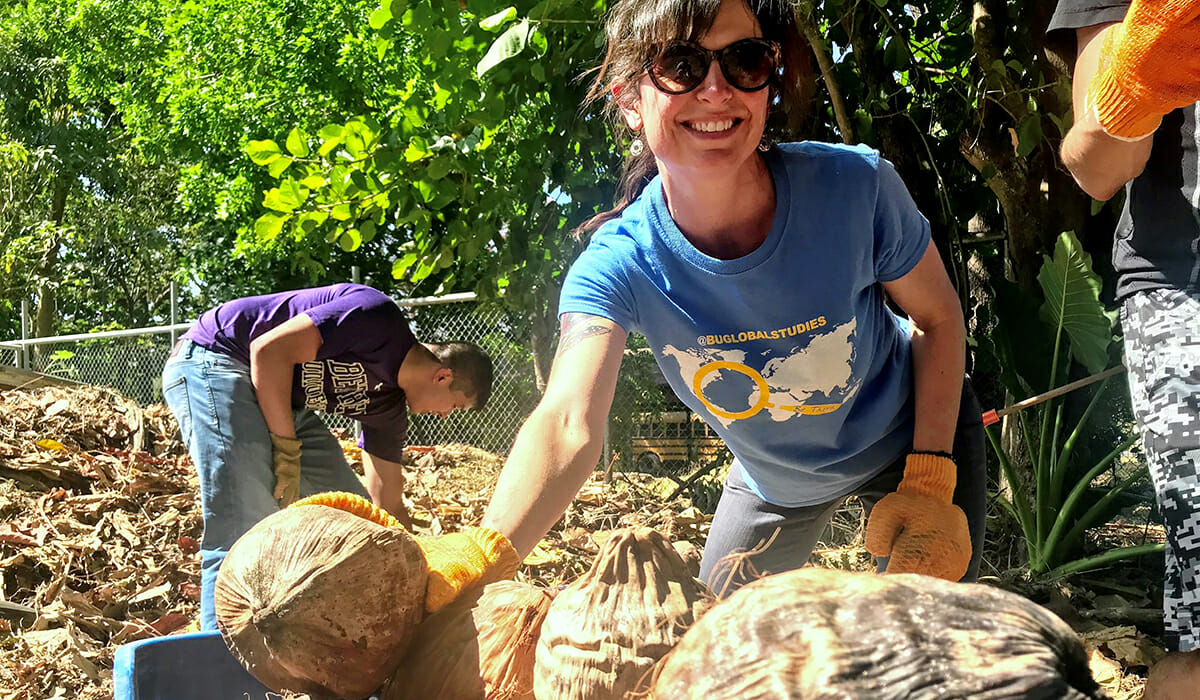
Bethel University Global Studies Director Stacie Freeman said she is trying to instill a love of other people in her students in order to contribute to a more peaceful and sustainable society. To do that, she has partnered her university with Bright Light Volunteers, a nonprofit organization that connects college and high school students with service trips around the world. Ten years ago, Stacie helped start international service trips at Bethel University, a private university in McKenzie, Tennessee. From there, she connected with Bright Light Volunteers’ founder Catherine Greenberg, and formed a partnership with her in 2016 that ultimately led to Stacie becoming co-executive director of the nonprofit.
Since its inception, Bright Light Volunteers has recruited over 7,800 students to complete over 624,000 service hours. While many of Bright Light Volunteers’ student participants are from Tennessee, the nonprofit is nationwide and has worked with students from California to New Jersey. Stacie travels with Bethel University students on all of their trips, which range from volunteering on an organic farm in Cuba to a sea turtle rescue center in Costa Rica. While the COVID-19 pandemic has put a halt to international travel, Bright Light Volunteers has created a virtual internship program for students to volunteer with their community partners from home.
Describe your volunteer role with Bright Light Volunteers.
I wear a couple of different hats at Bright Light. As the co-executive director of the organization, I work on things like grant writing. I recently earned a grant from National Geographic as an educator to improve the online academic component of the program. Students who travel with us take a college class and they get college credit for it. As a National Geographic-certified educator, I had the opportunity to apply for this grant to improve that course, and I earned it and received it. Applying for grants is obviously a big part of that role there. One of the really important things about we do and what I think is one of the unique things about what we do, is that we offer global service learning and citizenship programs to Title I students. Most of the kids that attend our schools are on free or reduced lunch. What that means for me is I have to do a lot of fundraising to get these kids on these programs, because they’re not coming from places of means, and they’re in rural schools which makes them an even more unique population. Study abroad, especially at the high school level, is limited to the coasts and a few major cities in between. What we’re offering to Title I high school students and college students, many of whom are first generation, is an opportunity to study abroad short term and serve internationally. Doing that with that particular population requires a lot of grant writing, a lot of fundraising, and all of the sort of administrative stuff you might expect an executive director would do. I wrote the strategic plan and came up with all the goals and objectives. We organize and oversee board meetings. Catherine and I run the ad campaigns that you see on Facebook and Instagram and other social media platforms. When you’re a small nonprofit like we are with big dreams, there’s a lot of work, and the two of us do the bulk of it.
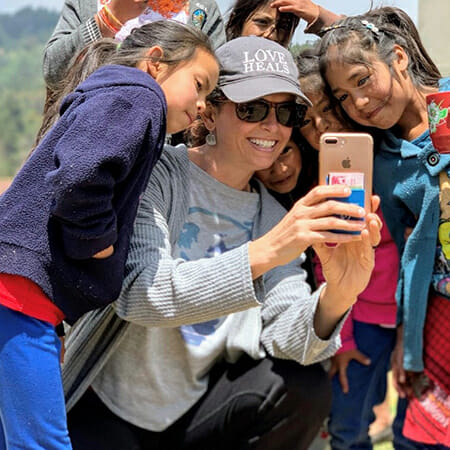
Stacie Freeman takes a selfie with children while program building in Guatemala with Bright Light Volunteers and Bethel University./ Courtesy Stacie Freeman
How did you get involved with Bright Light Volunteers?
Essentially the founder of Bright Light, Catherine Greenberg, and I have been working together off and on for several years to provide international global service opportunities to college students and now high school students. Our relationship really began with her being a program coordinator and me as an educator. I’m the director of Global Studies at Bethel University here in northwest Tennessee. Prior to holding that position, I was an associate professor of sociology and we didn’t really have a global studies program at our university, so I sort of imagined and started a program there at Bethel where students would earn college credit for traveling internationally on what really amounts to a mission trip. The idea was that they would learn about the place they were visiting. They would learn the culture and the history of the people, and develop an appreciation for that side of the experience, but in addition to doing a traditional study abroad, we would also serve in some capacity. When I imagined this program in my mind at Bethel, I began looking for nonprofit partners to help me bring it all to fruition. Long story short, Catherine Greenberg was on the other side of that phone call as were working at Bethel to create this program. She and I began working together to offer these opportunities. She founded Bright Light about halfway through us meeting and me coming on board as the executive director at Bright Light Volunteers.
Really, we’ve not fared far from that mission we started with two years ago this year. Bright Light even to this day is an organization dedicated to providing educational opportunities and service opportunities for high school students and college students who are looking to make the world a better and brighter place. I think we’re both interested in creating a world that is more full of love and more full of peace than when we found it. I think we both believe that education and service and cultural immersion are key places of that puzzle.
What types of service projects have you done?
We built a new cafeteria in Peru. That was a really interesting project. We were in the Maras community of the Peruvian highlands. The situation there was kids were attending school, but some of them were having to walk an hour to two hours to school every morning, and then they were having to walk an hour to two hours home every afternoon. They might eat a little before they left home, but there was no cafeteria, no space to prepare food at this little rural school up in the Peruvian highlands. These kids were basically going most of the day without something to eat. They may have packed a little something in their backpacks, but they weren’t getting a meal. … That’s a long time for a child to sustain themselves without a full meal. We went into the Maras community and we partnered with the local government and school, and we built a brand new cafeteria for the kids from the ground up. Now when they get to school, they have a place not only to prepare meals, but to eat them.
One of the things we always try to do is go into communities first and ask what do they need, so we never ride in our white horses and say “Oh, we’re here, never fear, let us help you with this thing.” We always work with the leaders — the religious leaders, the education leaders, the government leaders, and the community to say “Hey, we have several groups of students we could bring here to volunteer to help you with whatever community-identified need you share with us, what might that look like?” The community decided they needed a cafeteria, so we just went in with the manpower, the materials, the money, the funding, etc., and made it happen. That’s one example of a community-led project we’ve completed. In Costa Rica, we volunteer with a nonprofit that’s dedicated to rescuing sea turtles. When we go to Cuba, we work on an organic farm with the Cuban people which in that capacity, students learn more about sustainability and sustainable farming methods. … We teach in schools around the globe. We teach English primarily, given that English is basically the language of business and education and tourism. That’s just a smattering. We do so many different things.
Stacie Freeman works with Finca Agroecologica El Paraiso in Vinales, Cuba, while on a Bright Light Volunteers and Bethel University trip./ Courtesy Stacie Freeman
How have you adapted the program during the COVID-19 pandemic?
It was this time last year I was in Colombia with a group when the world shut down, and we had maybe five more programs after that on the books and nearly 100 more students planning to travel. To have to call all of that off was a really difficult decision. I could see and I was hearing what was happening in China and other places, and it became very apparent to me quickly that 2020 would not involve travel. I’m hopeful we’ll be back in full swing by 2022. What we’ve tried to do in the interim is provide a lot of virtual learning opportunities and we’ve been primarily hosting those through social media. We have a virtual internship program established, so that students who are still interested in getting that international service experience can still volunteer with our partners. What that might look like, for instance — let’s go back to the turtle rescue center. Well, the turtle rescue center has a website. They have accounting needs. They have social media needs. There’s all kinds of things students can do right here at home and still serve the conservation program project we worked on two years ago in Costa Rica. We’ve been trying to connect people virtually to our partners. One of the virtual projects we’ve done at Bethel, and this was just limited to Bethel students, is we’ve been teaching English classes virtually in one of our partner’s schools in Colombia. We try to do things like that to stay connected to our partners, to stay connected to our communities, to keep our students engaged and keep international service and learning on the forefront of their minds, so that when it is time to travel again, they’ll be ready.
What’s been the most rewarding part of your work?
I go to the same places over and over and over. I’ve been to Costa Rica 15 or 20 times. I ran into our registrar a couple years ago in the hall, and she said, “Stacie, where are you going?” I said Costa Rica and I told her what project we’re doing. She said, “Do you ever get tired of going back to Costa Rica?” and I said no. Because the most rewarding part of my work is not the places I get to visit. It’s not the beautiful places and things I’ve gotten to see over the years. It’s the people I get to work with. Every single time we get to travel, it’s a new group of students. The most rewarding part of it for me is seeing every new group seeing Costa Rica for the first time, volunteering internationally for the first time. That light bulb that goes off when they realize we’re all in this together. For one of our projects, we were picking up plastic off a beach in Costa Rica and we were taking it to a toymaker there in Santa Teresa who was upcycling all this refuse from the beach into toys for children, and then Ecobricks for houses and schools. To watch these kids pick up a bottle that clearly came from the United States that’s on a beach in Costa Rica, or a plastic water bottle that has writing in Chinese from literally the other side of the planet, watching that light bulb go off like we’re all in this together, we are one race of people with real problems to solve; then watching them develop an understanding that they can play a part even if it’s small, is hands down the best part of it all.
What do you want people to learn from your story?
I think one person can make a difference. You don’t have to save the world. I think that’s the other thing. I know sometimes we get overwhelmed. I know I do. I look out at the world we live in and I think oh my gosh, how will we ever fix all of this? Well, the reality is that I can’t. And now I can’t take a group of ten students to anywhere in the world. I can’t take them down the street. I can’t take them to Kentucky. I can’t take them to Pennsylvania. I can’t take them to Costa Rica and help solve all the world’s problems. But we can help solve this one thing. Mother Teresa basically said when you do small things with big love, you’re making useful change in the world. At the end of the day, if we all love each other a little more, and if that creates a little more peace on earth, then my job here is mission accomplished.
Teen Rediscovers Kindness & Hope through “Meals on Wheels” Volunteerism for Seniors
Meet Daily Point of Light Award honoree Rachael Gavlik. Read her story and nominate an outstanding volunteer or family as a Daily Point of Light.
Bullied in school, Rachael Gavlik says she had a hard time seeing the good in people, and at times, lost hope in the goodness of the world. The 18-year-old McMurray, Pennsylvania high school senior decided to turn a negative into a positive through service, creating kindness and serving as a symbol of hope to others.
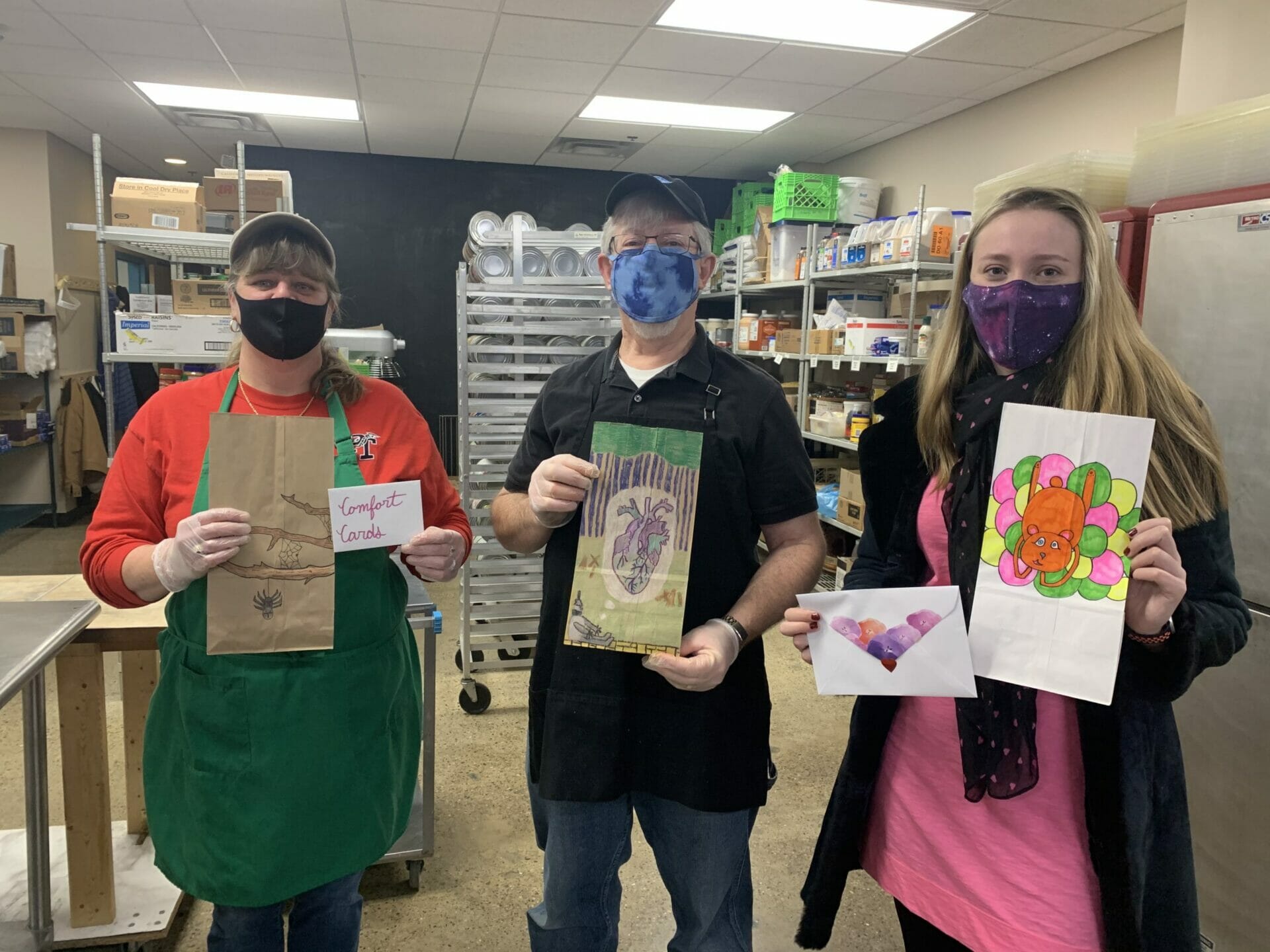
As a volunteer for Meals on Wheels, Rachael is helping to support the thousands of hot meals delivered to seniors every year, the organization providing daily personal contact for seniors increasingly isolated during the COVID-19 pandemic. First volunteering in-person helping to pack lunches and creating unique lunch bag designs to brighten the day of a senior receiving the meal, Rachael has supercharged her efforts in response to the pandemic, making bags, placemats, cards and blankets. Delivering handmade love to seniors and volunteering well over 1,000 hours thus far, Rachael is reminding seniors that they are not alone.
What inspires you to volunteer?
I felt like I didn’t matter, and I lost hope that there was good amongst people because of my experience at school. I decided that if I couldn’t see the good, I would create it myself. Some of these seniors have no family or no visitors, so receiving a card or drawing, even from a total stranger, lets them know they do matter and they are special.
You’re delivering handmade hope through your volunteerism. Explain.
Volunteering gives me purpose, and I thought that I should be the person I want to see in the world. By turning a negative into a positive, I hope that I can inspire others to do the same. I want everything that I make to be a symbol of hope in someone’s life.
Describe your volunteerism with Meals on Wheels.
When I first got introduced to Meals on Wheels, I started out creating designs on paper bags, and then over time I loved it so much that I kept going. The designs give the seniors something exciting to look at while they’re eating lunch. I’ve designed hundreds of lunch bags, placemats, cards and fleece blankets since the pandemic began. I sometimes try to coordinate designs for upcoming holidays.
Share one personal story with me from your volunteerism.
A Meals on Wheels coordinator recently sent a picture of a lady who thanked me for her lunch bag. She had this huge smile on her face. I’d created this design for her bag of a little boy holding a hose and spraying paint to make a rainbow. To see how purely happy and comforted seniors are with something so simple as a drawing gives me a feeling of pure joy. Some even display all the items they receive from us on their windowsill. It’s so cool to know they look at something I’ve created on a daily basis, and it reminds them that they matter.
Rachael (right) draws designs on lunch bags seniors receive from Meals on Wheels, brightening the day for sometimes lonely seniors. / Courtesy Rachael Gavlik
Why do you think it’s important for others to give back?
We all have times in life where we’re feeling not at our best and we could use extra support. It’s important to contribute because you don’t always know what other people are going through, but putting out some good in the world gives it to people who really need it.
What’s been the most rewarding part of your service?
It’s rewarding knowing I can bring seniors some joy, especially during times when I, too, longed to feel that joy and excitement from things around me.
How have you continued to volunteer throughout the pandemic?
I shifted more of my volunteerism to what I could do at home. I started designing bags, and when I ran out of bags, I moved on to cards, placemats and then eventually, fleece blankets. From August to December I ran a blanket project and created over 600 fleece blankets which were donated to Meals on Wheels clients and local shelters.
In one word, what does volunteering mean to you?
Happiness. Volunteering is best when you find something you enjoy and you can share it with others. I enjoy art and visual projects, but service doesn’t have to be a humongous project. It can be as small as one card.
When you’re not busy with school or volunteering, what do you do for fun?
My dog, Yogi, is my best friend. He’s a Havanese. I play with him and he loves to do tricks. We’ll say, ‘take a nap,’ and he’ll lay on the ground. When we say ‘wake up’ he jumps up.
Teenage duo bridges gap between Gen Z and volunteerism by providing student-led service projects the support to grow
Meet Daily Point of Light Award honorees Kruthik Ravikanti and Deesha Panchal. Read their story and nominate an outstanding volunteer or family as a Daily Point of Light.
Running a nonprofit organization is no joke. Raising money, recruiting volunteers and dealing with any legal issues involved in fighting for an important cause would be difficult for any adult. But when you’re a high schooler with no financial means of your own, no network and already a ton of homework on your plate, trying to make a greater impact with your service project can seem near impossible.
Kruthik Ravikanti and Deesha Panchal, two high schoolers from Georgia, were in that exact position with their own service projects just a year ago. Kruthik found that without a 501(c)(3) status, it was difficult for his organization called the Seeds of Literature Project to get the money it needed to provide underprivileged children with books. The same went for Deesha with her organization, Little Hands, which helps students from low-income backgrounds with educational support.
After seeing some of his volunteer work online, Deesha reached out to Kruthik last March to voice her struggles, which he echoed.
“So we sat down and brainstormed, ‘How do we create an umbrella organization that helps students get involved in service and create a socially conscious generation?’”
They came up with Georgia Youth Leaders, a nonprofit organization with official 501(c)(3) status that takes smaller student-led projects to the next level by helping them obtain funding, apply for grants, recruit volunteers and more.
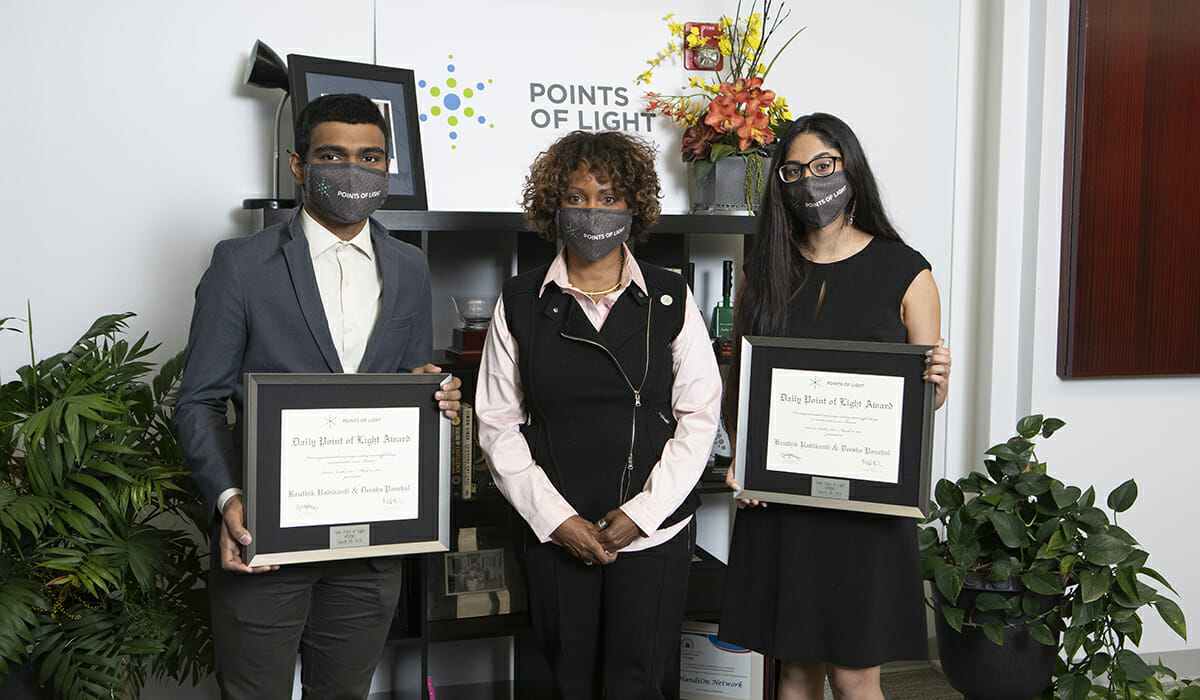
Kruthik (left) and Deesha (right) are co-founders of Georgia Youth Leaders, a nonprofit that helps student-led service projects procure funding, recruit volunteers and network with mentors to make a greater impact in their community. /Courtesy Kruthik Ravikanti
Since starting back in May, Georgia Youth Leaders already has eight daughter organizations under its umbrella, with causes ranging from cleaning up the community to helping victims of sexual violence. Kruthik and Deesha first started supporting the organizations by hosting webinars, connecting them with mentors and meeting with them each week to see how they could make a greater impact. But after officially obtaining its 501(c)(3) status in October, Georgia Youth Leaders has been able to procure thousands of dollars in grant money for its daughter organizations.
“Georgia Youth Leaders has given us multiple opportunities to apply for grants such as the Hershey Heartwarming grant, which we actually won,” said Rhea Saravanan, founder of RisingSTEMs, a student-led organization allowing underprivileged children explore their interest in STEM (science, tech, engineering and math).
“It was a $250 grant, which made a huge difference in our organization. We’re going to put that funding towards our project this summer where we’re sending 1,500 project STEM bags to a new school in Uganda,” Rhea continued.
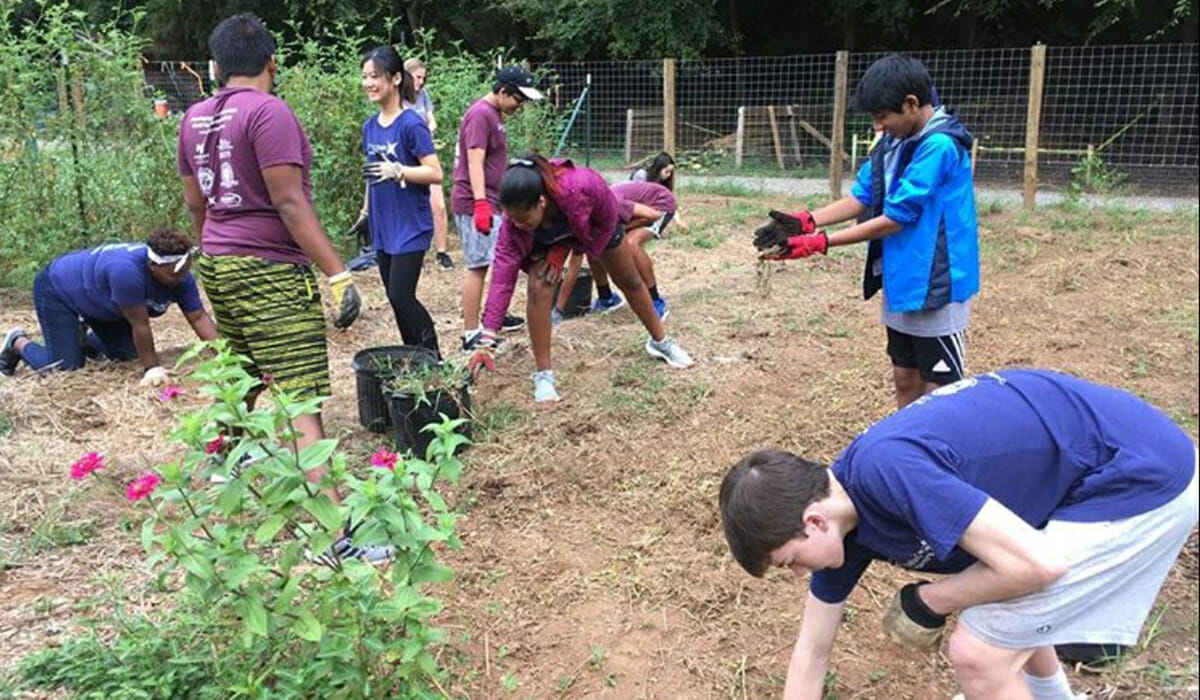
Kruthik (far left) with other volunteers from Seeds of Literature, one of GYL’s daughter organizations that provides books for underprivileged children. / Courtesy Kruthik Ravikanti
Even with eight daughter organizations under their umbrella, Kruthik and Deesha are working to sponsor more student-led organizations and are planning to host a summit in April where they will teach students how to identify injustices in their community and create the actionable steps to create change.
While many young students and high schoolers are jaded by volunteering as it is often a mandatory act that schools require, Kruthik said the key to making it fun is to pair it with something that you already love.
“If you really love basketball, why not start a basketball camp for underprivileged kids?” the high school senior said. “If you find your passion and combine it with a service project and make something out of it, it will mean so much to you, but so much more to them as well.”
Music Teacher Hits High Notes of Service to Inspire Younger Generation of Volunteers
Meet Daily Point of Light Award honoree Wendy Wu. Read her story and nominate an outstanding volunteer or family as a Daily Point of Light.
By day, Wendy Wu is a piano teacher who shares her love for music with students of all ages, but through volunteering, Wendy is expanding her impact on younger generations and inspiring future acts of service.
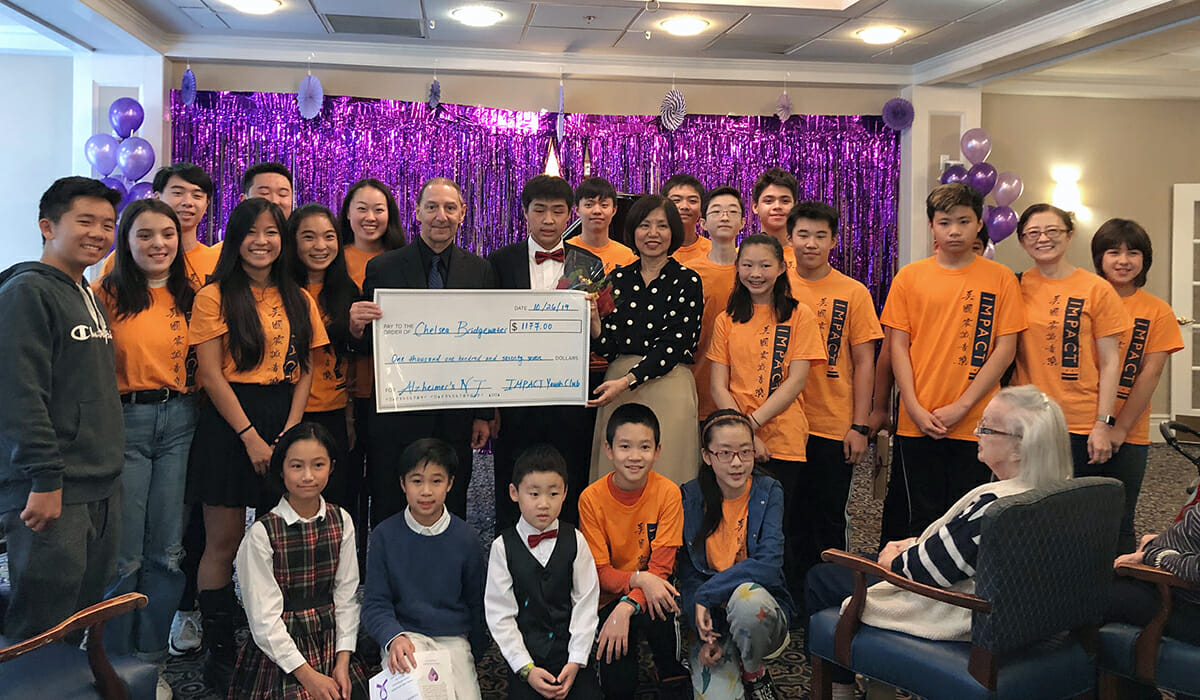
Launching IYC (IMPACT Youth Club) in 2013, Wendy is empowering future service leaders through student-run community-based acts of kindness and charity activities. Building confidence for youth through mentorship, IYC gives students of all backgrounds including in New Jersey, New York, Connecticut and internationally in Taiwan and China the opportunity to develop their own service projects and do good deeds through the promotion of music performance, art and education. Connecting with several hundred youth thus far, Wendy is hitting the high notes of service by inspiring younger generations to volunteer.
What inspires you to volunteer?
My passion for music is what inspired this journey into volunteering. Initially, we started as a youth group focused solely on spreading music into the community. Then, our efforts evolved into a group passionate about helping the community in more ways than one. As a teacher, I don’t just teach music, I also foster growth, personality and empathy. Through volunteerism, I’m helping to build these characteristics, which are really critical to developing adults who want to give back to the community.
How are you inspiring youth to serve?
We really focus on autonomy to help build confidence in students. We explain to students that volunteering is their responsibility to help others.
Describe your volunteerism with IYC.
As founder and executive director, I wear multiple hats. I coordinate and oversee activities for our mostly student volunteers including music events. We have hundreds of volunteers in the U.S. IYC fundraises to support activities through donations and events.
IYC raised money to purchase 4,500 masks and 700 medical gowns for local hospitals and police stations during the COVID-19 pandemic./Courtesy Wendy Wu
Why do you think it’s important for others to give back?
In Chinese, we believe and live by what Confucius says. Pretend society is a hot pot of boiling water, some people will be like eggs, they start off soft but once they get into society they become hardened. Others are like carrots, initially hard but soften through time. Others are like tea leaves, once they enter society they change water to tea, forever influencing society. I tell my volunteers to be the tea leaves in their own communities. We all want to be tea leaves (laughs!)
What’s been the most rewarding part of your service?
It’s rewarding to foster the next generation of leaders and givers and to inspire others to become empathetic and loving.
How have you continued to volunteer throughout the COVID-19 pandemic?
We supported youth volunteers to coordinate activities including music events during the pandemic. We ran even more activities this year than last because of the virtual opportunities. Some kids felt isolated and frustrated during the pandemic, so one of our student volunteers created a virtual exercise class, and we also hosted online conversations for younger students. We conducted virtual music concerts and distributed them to local senior centers. We also made cards for senior centers and staff. Lastly, we supported frontline workers by raising money to purchase 4,500 masks and 700 medical gowns for local hospitals and police stations.
In one word, what does volunteering mean to you?
Love. There’s a ‘love’ hidden inside the word, volunteering. You have to find it (laughs.)
How can readers help?
Please visit IYC’s website for more information about how you can give back.
Florida Teen Washes Windows for Veterans, Plans to Continue Service in College
Meet Daily Point of Light Award honoree Derek Fletcher. Read his story and nominate an outstanding volunteer or family as a Daily Point of Light.
Before leaving for college in August 2021,17-year-old Derek Fletcher plans to spend the summer raising money for veterans by washing windows. What once started out as a means to raise money for his first car, Fletcher realized that the small act of washing windows can make a huge impact in the lives of others.
Fletcher’s Washing Window For Warriors program in Boca Raton, Florida, partners with Hope for the Warriors, a nonprofit that meets the changing needs of service members and their families, with a goal of reaching $10,000 to donate.
He hopes to expand his window washing efforts after he starts college in Gainesville, Florida, to continue helping people learn that you can find yourself by serving others.
How did you start Washing Windows for Warriors and connect with Hope for the Warriors?
About three years ago it was my freshman year and I was washing windows to raise money for my first car. Once I bought my car, I kind of stopped for a year and I was talking with my best friend Jonathan Chidiac because we wanted to impact our community in a good way and realized that we could wash windows and donate all the money to disabled veterans and their families.
So we spent about a week looking through every charity and we reached out to Mrs. Robin Keller, the CEO of Hope for the Warriors, and she said that she’d love to partner with us. That’s where it all started. After we raised around $2,000 we were able to get on local news channels, which was amazing. We soon had three months booked in the summer and worked like eight hours a day. That was all we did and then it was all history from there. We kind of have recurring clients now so when they need their windows washed again, we just go back. We’ve raised a little bit above $8,000.
What sparked the idea of giving the raised funds to the veteran community?
I had a great grandfather and grandfather that were in the Royal British Air Force. It’s always been something prevalent in my life that we should give back to our veterans and respect them and thank them for their service. My best friend Jonathan’s uncle is a marine in Brazil. So we have family from around the world. They didn’t serve the United States of America, but because we’re from the U.S., we really wanted to pay back our veterans and thank them by spending our time washing windows — doing what we love together.
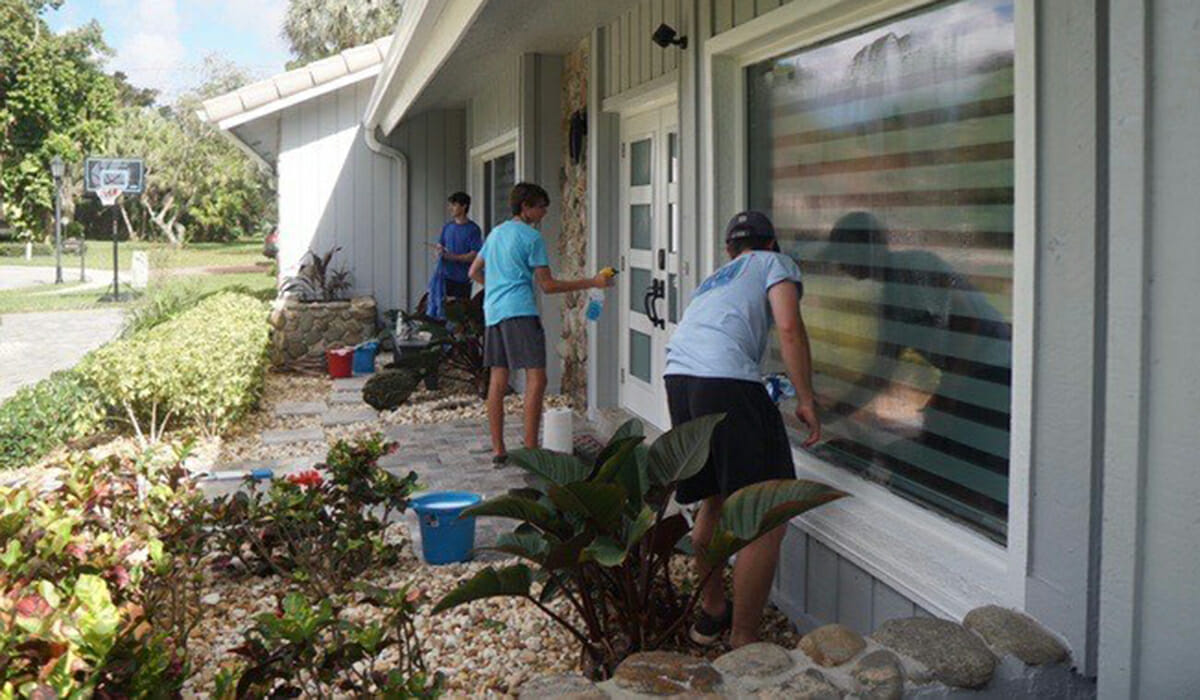
Derek Fletcher (left) and his childhood best friend, Jonathan Chidiac, wash windows in Boca Raton, Florida, to raise money for U.S. veterans through their Washing Windows for Warriors program./ Courtesy Derek Fletcher
Have you met any of the veterans that Washing Windows for Warriors is helping?
We haven’t yet but we’d love to. We’ve received many letters and unfortunately, the veteran that reached out to us passed away from COVID-19 recently, but I’ll always remember what he sent us — thanking us for our service and how and how he really appreciates what we’re doing. That’s just what kept driving me to keep washing windows.
Why do you think it’s important to give back to the community?
I think it’s very important because it teaches you a lot about yourself and how far you can dig deep to help other people. it’s the most selfless thing you can do. You really can’t be greedy, because it just doesn’t work at a certain point. Money is not going to be everything and you really have to take care of others in society — especially with veterans who put their life on the line for us. Any way that the youth can get involved in helping the community, I think it’s great, and whether that be volunteering in a medical center, washing windows or anything — it teaches you a lot about yourself.
What’s been the most rewarding part of doing this work?
I think hearing from veterans is definitely rewarding and my parents have been really proud of me. So that was great. I learn a lot about myself through the service of others. The veterans sending us letters just really taught me how appreciative they are. Even when they shouldn’t even be thanking us because I really am thanking them for all their service. I just think their appreciation really was amazing. That really touched my heart.
What would you want others to learn from your story?
I think I want people to learn that you can find yourself by serving others. Even I feel somewhat selfish sometimes. So I think just letting go of your ego and just washing windows and going the lowest you can to help others, no matter who it is, I think that’s just incredible.
Are there any partnerships, programs, or events that you are excited about?
We partnered with Mission 22 on Instagram when they had a golf tournament, and one of the holes was named after us, which was awesome. We want to continue collaborating with people on social media because that really kind of helps spread our message. But I’m looking forward to college, I really want to just keep doing this, keep building on it, because I think we had a good thing going.
New York Mom Builds Support Network for Autistic Individuals and Their Families
Meet Daily Point of Light Award honoree Michele Sanchez-Stierheim. Read her story and nominate an outstanding volunteer or family as a Point of Light.
After feeling dissatisfied with the level of support available for her and her two autistic children, Michele Sanchez-Stierheim decided to take it upon herself to bring forth the change she wanted to see for families going through the same experience. In 2017, the New York-based mother of five started meeting at a local Dunkin’ Donuts with other parents to go over IEPs, or Individualized Education Plans, and other materials that families with autistic children have to navigate. Almost five years later, Michele is now providing a support system to over 100 families with her nonprofit Spectrum Warriors.
Along with about five volunteers, she hosts monthly workshops and family check-in meetings where she organizes guests and topics based on the families’ needs, ranging from speaking with a special education lawyer to going over financial planning for their children. Additionally, Spectrum Warriors hosts events such as Family Day, where families with autistic children meet with local law enforcement. Some of Spectrum Warriors’ partnerships include the New York Police Department, the New York City Department of Correction, and the New York State Association of Safety Officers, Inc., the latter through which the nonprofit will be providing training opportunities for officers and fire safety officials.
Michele Sanchez-Stierheim spends time with her daughter and children of families supported by Spectrum Warriors./ Courtesy Michele Sanchez-Stierheim
Describe your volunteer role with Spectrum Warriors.
It was started as a grassroots movement. I have two children who are autistic and really it started with my being dissatisfied with the level of support that was made available. There were no real parent groups that were warm and friendly and welcoming. It started that way, meeting at a local Dunkin’ Donuts and going over IEPs and so forth. We have become way more than just parent support. My children have had experiences with having 911 called on them, and for awhile I was angry. Then things kind of shifted like a kaleidoscope and it was like, well the officers don’t know, the first responders don’t know, how can I help them know? From that, Family Day was formed. Family Day became an annual event. Unfortunately, because of COVID, in 2020 it didn’t happen. Family Day was meant to connect law enforcement to our population, and to find a mutual space to do it in a way that would be fun. We started with approximately 80 families the first time, give or take, and started to form connections with law enforcement. Then moving forward, I got the Department of Correction involved as well.
I founded Spectrum Warriors. I don’t get paid for anything I do. None of my volunteers get paid. A lot of my volunteers are parents who have walked through the process of say, completing an evaluation, because that can be tricky depending on where you go. IEP support, being able to advocate for what our kids need — a lot of that is intimidating, so I kind of stepped up and stepped in. All you have to do is give me 24-hour notice and I’m there. I am a DIR [Developmental, Individual-differences, and Relationships]/Floortime [a child-focused model for conducting an assessment and developing a program tailored to the child] practitioner, so I work one-on-one with families and I do home visits or, lately with COVID, I’ve been doing teletherapy. There’s so many aspects of Spectrum Warriors right now.
Why is it important for families to have this network of support?
It’s isolating, honestly. I can speak from my own personal experience and what I see families go through. You get a diagnosis and you feel your world is crumbling under you. You have all these professionals, and yes there are these groups they call parent support, but it’s really not. … The level of support that’s available is not very good, and from my perspective both as a parent and as someone who is helping other parents, you feel like you’re in a hole. I don’t need somebody who is going to tell me they’ll fill out paperwork. I don’t need someone who is going to offer me a ladder. Come down in here and help me get out. Sit with me and help me figure out how to get out. Show me I can get out.
What kind of feedback are you getting from the families you’re working with?
It’s all positive. They are grateful. It’s really hard for families to find somebody who understands exactly where they are. Because I have walked through it and I’m still walking through it, I have a different perspective from somebody who comes from a different arena, so to speak. We have a heavy focus on safety with law enforcement, but we also have a focus on advocacy in the schools and community. Everybody has April set as Autism Awareness Month and we have a different perspective on that. If there’s a day or month that’s already set, the world is already aware. What we need is acceptance and inclusion. Coming from the perspective of myself being a mom, living in it and reaching out and doing work with families who are going through it, it’s completely different from an outside agency who may have a Bachelor’s in child development, but they’ve never been through it.
Can you explain the importance of law enforcement and first responders having proper training for interacting with autistic individuals?
I have had incidences where 911 has been called on my own children due to meltdowns and behaviors that are not understood. I have worked with families who have had 911 called on their children, small children and adult children. If you look at the media, and it’s not always covered so you really have to go digging, there are more and more incidents of law enforcement being called due to behaviors, due to a meltdown, due to people not understanding what’s going on. The initial call is reported as an EDP, which is an Emotionally Disturbed Person, even though they’re trying to change the language to Emotionally Distressed. The way they respond to that is not very kindly at all. We have more incidents of children and young adults being harmed, being restrained, when that is absolutely unnecessary. There are other ways to approach it.
What’s been the most rewarding part of your work?
Families feeling understood. Families feeling accepted. When it comes to me doing in-home [therapy] or now via video teletherapy — the connections. When I work with a family, if they need to be able to find something different than ABA [Applied Behavior Analysis; a type of therapy for understanding and changing behavior], because ABA doesn’t always work and it’s not exactly the kindest method in my opinion from what I’ve seen; if I’m doing Floortime and a family is able to make connection with their child, that’s amazing. That is the most rewarding — seeing that spark, that ‘aha,’ that gleam in their kids eye and the parents being able to make a connection with their kid. It’s amazing.
What do you want people to learn from your story?
That autism is not one size fits all. That we already have awareness; we want acceptance and inclusion. We want to be included and welcomed into our communities. We want to feel welcomed. It’s OK to ask questions. It’s not OK to automatically judge. If you see someone having a hard time and you see someone who is being excluded, be that light to them. Connect to them. Reach out to them.
Why do you think it’s important for others to give back?
We all have something to give. Even with myself, I was fortunate and I came across people who were willing to help me and propel me forward, and it’s kind of a ‘pay it forward’ thing. If somebody helps you, why not go and extend your hand to help somebody else? It starts a cycle that is beautiful.