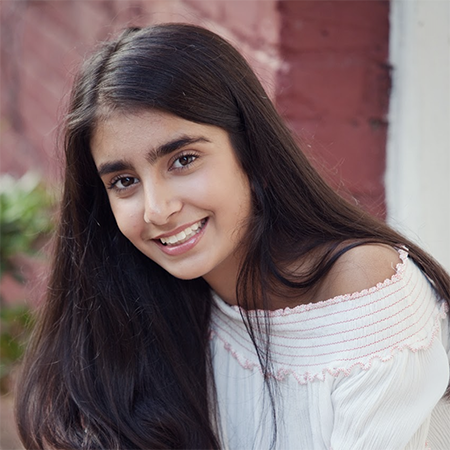
Family Bonds Together By Serving Chicago Community
Meet Daily Point of Light Award honorees the Riley-Scruggs family. Read their story and nominate an outstanding volunteer or family as a Point of Light.
Volunteering has always been important for Lisa Scruggs, who became especially dedicated to community service while attending Georgetown University. The importance of giving back was something she wanted to impart on her children — and based on the family’s tireless track record of steadily volunteering throughout their Chicago community, she has succeeded.
Lisa, along with 16-year-old twins Jacob and Maya and 10-year-old Zachary, have been ardent supporters of The Honeycomb Project, an organization that mobilizes families to volunteer for various nonprofits in Chicago. Since first joining in 2013, they have particularly focused on The Honeycomb Project’s volunteer opportunities related to food insecurity.
“Certainly as parents, my husband and I think it’s incredibly gratifying to know our kids are able to have this experience to see up close the different needs in the community and think of different ways to address it and push it into thinking,” Lisa said.
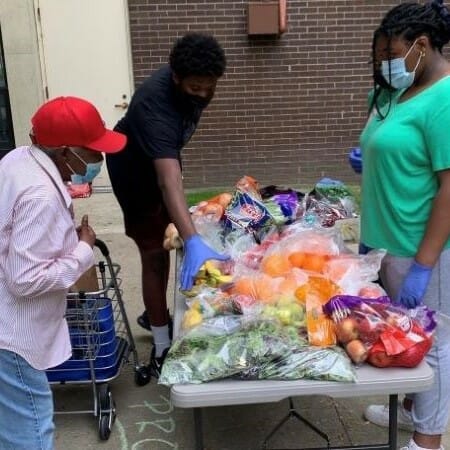
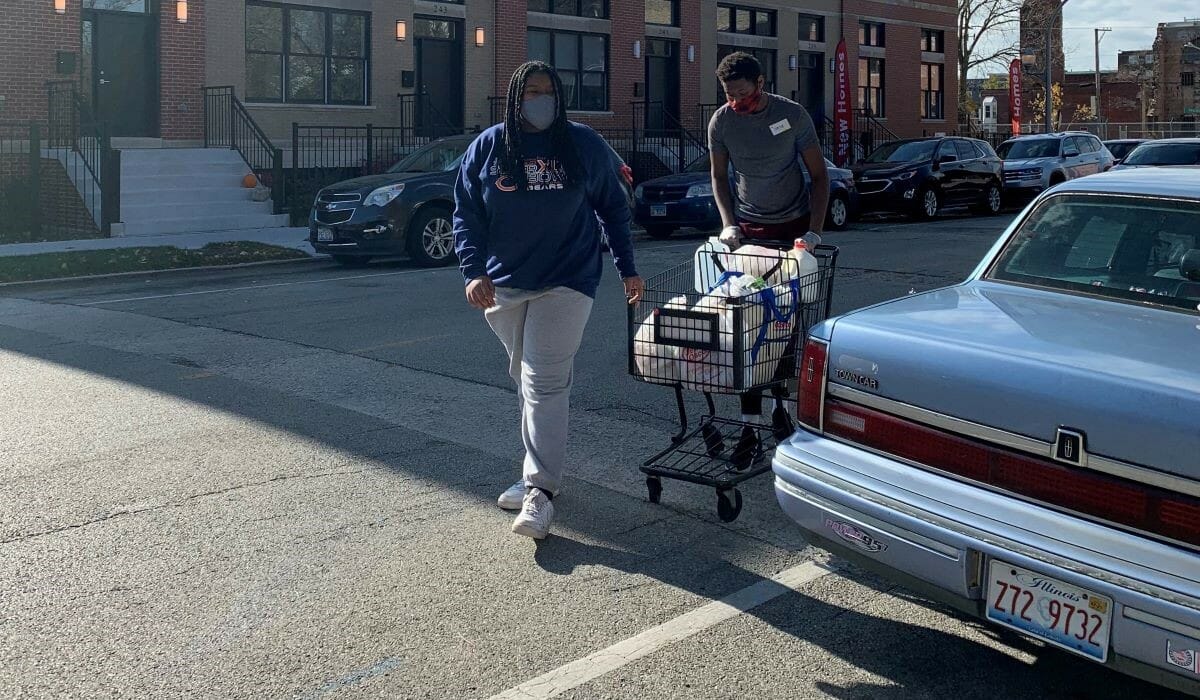
Each month since the COVID-19 pandemic began, the Riley-Scruggs family go grocery shopping for seniors living in Lincoln Perry Apartments, a Chicago Housing Authority affordable housing community. The family shops for groceries as well as other needed items like cleaning supplies, then set up a mobile grocery store at the apartment complex for the seniors to shop safely. Jacob and Zachary also often help the seniors with their carts and bring the groceries back to their apartments for them.
“It’s really cool hanging out with my family and having another bond, another thing we can do together,” Zachary said. “And we connect with other people as well.”
Aside from their work with seniors, the Riley-Scruggs family has made blankets out of recycled bags for the homeless, written notes for veterans, and created care packages for families with kids in shelters as well as for children being treated at La Rabida Children’s Hospital.
The Riley-Scruggs family help seniors pick out groceries during an ongoing Honeycomb Project to assist them during the COVID-19 pandemic./Courtesy Riley-Scruggs Family
The family has also helped step up into leadership roles to help plan events for The Honeycomb Project. This past summer, they served on a planning committee for a party that also served as a school supply collection drive for college-bound students who were struggling to afford items such as backpacks, toiletries, and sheets and pillow cases for their dorm rooms.
“The situations people are born into, they’re not always as fortunate as us, so it’s always important to give back and make sure people are able to not feel helpless,” Jacob said.
Bri Lilly, The Honeycomb Project’s program manager, described the Riley-Scruggs as one of the “cornerstone, foundational families,” especially during the pandemic, who can always be relied on to help out in some way. Even if they are unable to attend an event, she said, they may stop by with a donation of groceries instead.
“They are, first and foremost, kind and selfless,” Bri said. “They think of others before themselves and put needs of others above their convenience or above their plans or schedule.”
Lisa said she was drawn to The Honeycomb Project due to their variety of different projects making it easy to incorporate volunteering into a regular part of the family’s routine, the importance of which she really wanted her kids to understand. She hopes that when they are adults, they will continue to search for volunteering opportunities and involve their own families one day as well.
The family is also spreading the spirit of volunteerism to others in their community. The kids sometimes bring friends along with them on service projects.
“Teenagers should volunteer,” Maya said. “It’s a great way to bond with your friends but also give back to the community.”
Maya and Jacob Riley-Scruggs deliver groceries to seniors for The Honeycomb Project./Courtesy Riley-Scruggs Family
The Riley-Scruggs make sure they are participating in a service project at least once a month, even despite their busy schedules — Lisa serving as a lawyer, her husband a Chicago firefighter, and her kids attending school and being involved in a variety of different activities.
“For us as a family, it’s a way we make sure we’re not sitting in front of screens individually doing what we often do, carrying out our individual lives, but it’s a time we come together as a family, too,” Lisa said.
Looking to the future, the family plans on continuing to support Lincoln Perry Apartments throughout the pandemic. Later this month, they will help throw a Halloween party for the seniors, in order to get them socializing and continue to check in on them.
Teen Volunteer’s COVID-19 Care Packages Improves Safety for Community
Meet Daily Point of Light Award honoree Prayrak Bajaj. Read his story and nominate an outstanding volunteer or family as a Daily Point of Light.
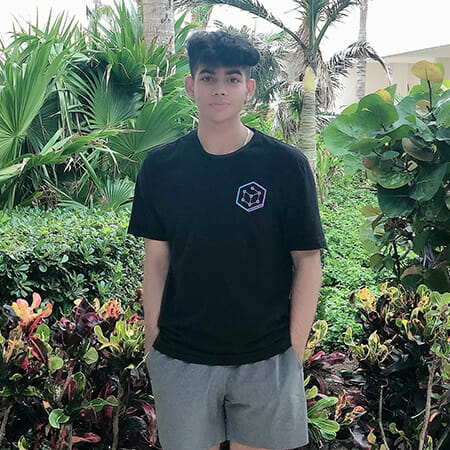
As restaurants and other local businesses struggled at the start of the COVID-19 pandemic, closing their doors or searching for critical PPE in low supply, 16-year-old Prayrak Bajaj worried that he was losing a part of his community.
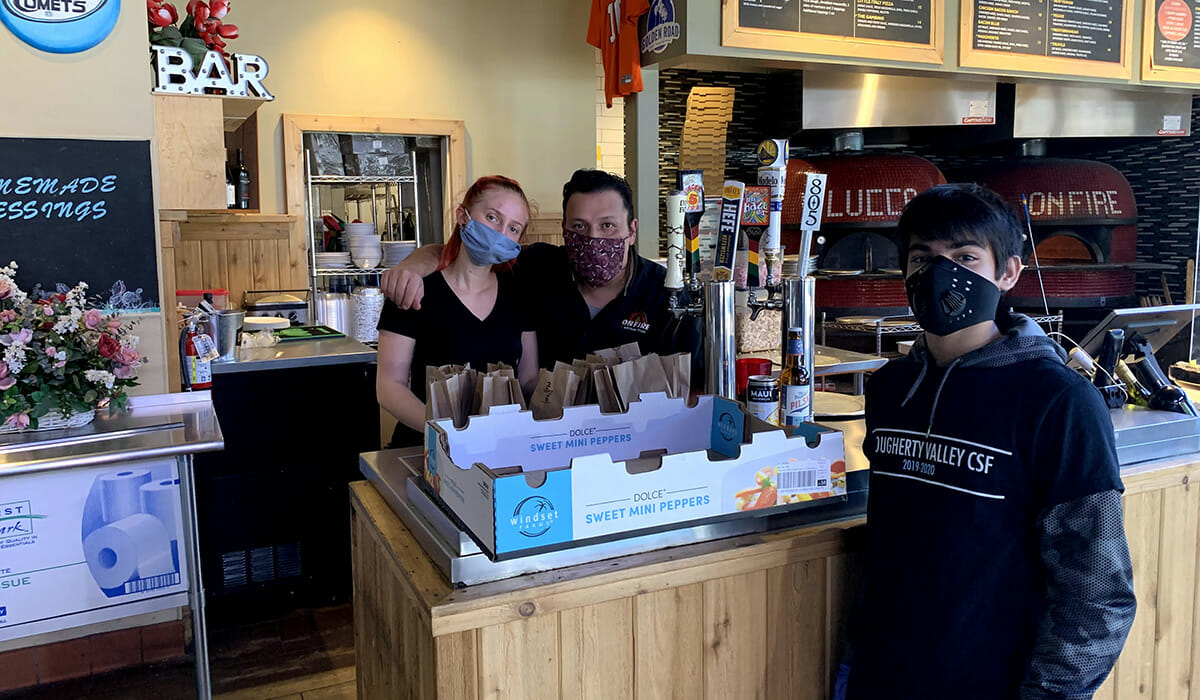
Launching Project Community Against COVID in April 2020, the initiative has since provided more than 350 care packages across the San Ramon, California teen’s community. Providing masks, gloves and education about the pandemic, Prayrak is ensuring the safety of hundreds of workers in local businesses and making a positive impact through volunteerism.
What inspires you to volunteer?
I’m inspired to volunteer to give back to the community that bred us, has fed us and made us who we are today. It’s only right to give back to the community that helped us get onto our feet.
Describe your volunteerism with Project Community Against COVID.
We work to improve our community’s awareness and knowledge of resisting the pandemic. As founder, I gather resources and donations for our care packages, which I assemble and deliver myself. We accept donations including masks and gloves for the care packages, which we distribute to local grocery stores, businesses and restaurants. A handful of friends volunteer with me.
Share one personal story with me from your volunteerism.
Prayrak has distributed more than 350 care packages across his community./Courtesy Prayrak Bajaj
Earlier in the pandemic, we donated 50 care packages to a local Indian restaurant. The restaurant was about to go out of business, and that spoke to me because it was one of my favorite restaurants as a child. Witnessing the customers and restaurant’s delight about the care packages made me want to continue the initiative, because I know I am making a difference in people’s lives.
Why do you think it’s important for others to give back?
Helping and working together is the only way to get through the pandemic. Volunteering is a major solution to getting through the pandemic effectively.
What’s been the most rewarding part of your service?
It’s rewarding to receive thanks from people who tell us how we are really helping them out in a time of need.
What does the future of your volunteerism look like?
I hope to continue this service even beyond the pandemic. Even when we are out of the woods, we plan to continue donating care packages because COVID-19 and its health risks will still be an issue, and people will be in constant need.
In one word, what does volunteering mean to you?
Rewarding.
Prayrak is ensuring the safety of hundreds of workers in local businesses and making a positive impact through volunteerism./Courtesy Prayrak Bajaj
When you’re not busy volunteering or in school, what do you do for fun?
I’m a Boy Scout. I love camping, hiking, anything of that sort. I’m a 3rd Degree Black Belt in Taekwondo.
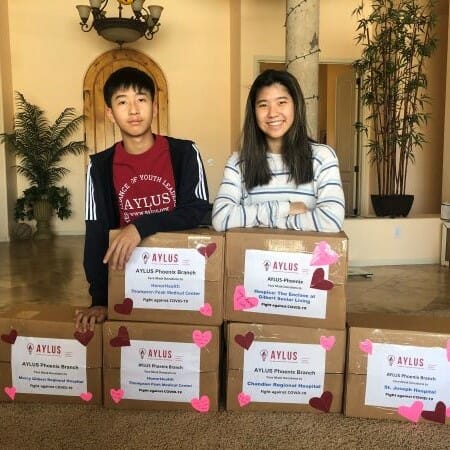
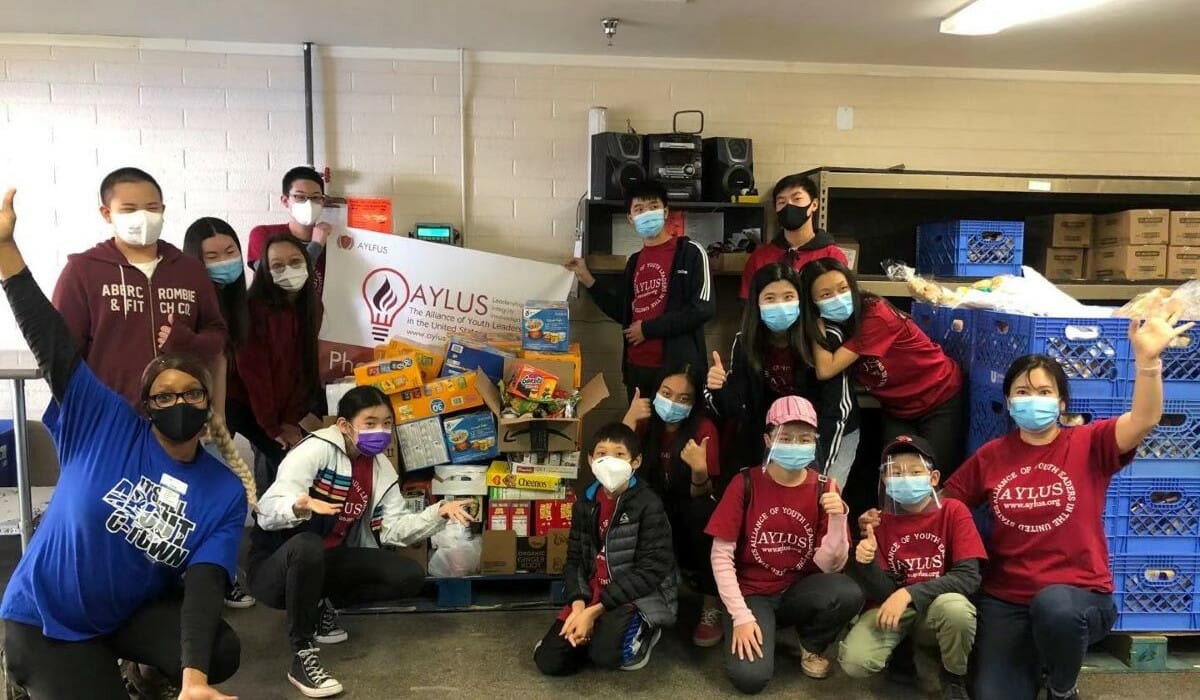
Dedicated to the advancement of communities, AYLUS helps people thrive by developing leadership, integrity and innovation through service projects. An AYLUS volunteer since 2019 who serves in a variety of leadership roles, 16-year-old Katherine, a Chandler, Arizona resident, has touched tens of thousands of people across the nation through volunteerism as she builds towards a better future and helps others become their best selves.
What inspires you to volunteer?
I’ve always loved giving back to the community. Volunteering is the best way to get involved and also receive a sense of fulfilment to do service projects that directly benefit others.
Describe your volunteerism with AYLUS.
I do a little bit of everything (laughs). Some of my responsibilities include:
Co-Vice President of the National Board: I volunteer around national events, conferences, and fundraising, including raising money for PPE during COVID-19.
President and Co-Founder of the Phoenix branch: Volunteering at senior centers, marathons and food banks. We also donated PPE to various high-risk areas around Phoenix during the pandemic.
Deputy Editor-in-Chief of the AYLUS Times: I edit and write a monthly newspaper that covers AYLUS branch activities across the nation.
How does your volunteerism impact communities around the country?
As a volunteer with AYLUS, Katherine Wei is helping individuals and communities thrive. Katherine donated PPE to high-risk areas around the Phoenix, Arizona area during COVID-19./Courtesy Katherine Wei
We focus on three main qualities to help develop youth and make sure they have qualities to be confident and satisfied about their future. It’s really meaningful to be able to help my peers and see them grow, along with growing myself, as we build the next generation of youth leaders.
Share one personal story with me from your volunteerism.
Before the pandemic, we’d done a lot of concerts at senior centers where we’d sing and dance. Seniors are usually isolated and probably a little bit lonely, but when we perform, we see happy expressions on their faces and genuine smiles. It’s really heartwarming to see the positive impact we make on seniors by bringing music into their lives and giving them company.
Why do you think it’s important for others to give back?
Giving back is vital to building a healthy community. Especially for the younger generation and people like me, we have so much potential to bring in skills and perspectives that can really advance society. Giving back almost feels like a duty to create a community in which people thrive and learn from each other.
How have you continued to volunteer throughout the pandemic?
We had to come up with more creative ideas on how to stay engaged and involved while still staying safe during the pandemic. We performed virtual concerts for senior centers, and many of the other activities we did were socially distanced and in smaller groups. My volunteerism increased during COVID because there was a lot more time to dedicate to service.
What do you want people to learn from your story?
Believe in yourself and be confident in your abilities. Students are often taught we shouldn’t speak up because we’re young and inexperienced, but in reality, the only person who can make you feel less than you are is yourself. Be confident to succeed and prove yourself wrong by helping to make a huge impact.
In one word, what does volunteering mean to you?
Enjoyment.
Katherine Wei: “Giving back is vital to building a healthy community. Especially for the younger generation and people like me, we have so much potential to bring in skills and perspectives that can really advance society.”/Courtesy Katherine Wei
When you’re not busy with school or volunteering, what do you do for fun?
I like to play volleyball. I write poetry and paint. I also watch a lot of Netflix and Disney+.
How can readers help?
Please visit the AYLUS website for more information about how you can help.
After Personal Alzheimer’s Experience, Volunteer Extends Service and Support to Patient Caregivers
Meet Daily Point of Light Award honoree Candy Feinstein. Read her story and nominate an outstanding volunteer or family as a Daily Point of Light.
Candy Feinstein lost both her mother and father to Alzheimer’s Disease, and her husband has been living with the progressive disease since 2008. In the face of her very personal struggles with the devastating disease, the 68-year-old has extended her hands and heart to others, filling a gap in support for her greater community.
As a volunteer support group facilitator for the Alzheimer’s Association, Candy, a resident of Davis, Illinois, is offering vital support to Alzheimer’s and dementia patient caregivers who are desperate for help. Describing a dearth of resources across rural America, worsened by a lack of funding for medical care, Candy is a dedicated advocate who connects caregivers within her rural community.
What inspires you to volunteer?
After losing my mother and father, and then my husband’s diagnosis, I just needed support. I needed somebody else to talk to that was going through what I was going through, and I knew there was nothing in this area. I got busy and found the Alzheimer’s Association, and my volunteerism took off from there.
Describe your volunteerism with the Alzheimer’s Association.
As avolunteer support group facilitator, I organize our monthly group meetings and promote them on social media. Family, friends and Alzheimer’s and dementia patients are welcome at the meetings, most of us are caregivers for parents or spouses. I also serve as an ambassador for the organization and share information and resources about the disease.
Part of your service is as a volunteer ambassador. Tell me more.
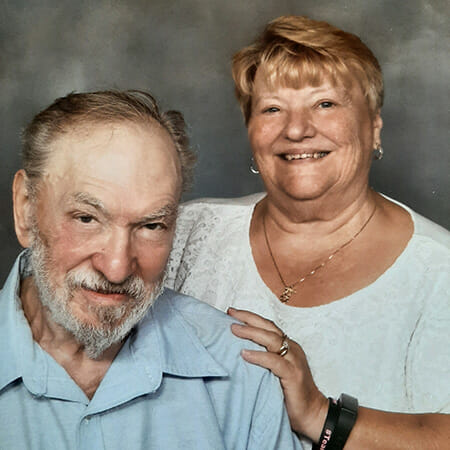
Candy pictured with her husband, Gilbert (Gibby.) After her husband’s Alzheimer’s Disease diagnosis and losing both parents to the disease, Candy decided to volunteer with the Alzheimer’s Association to support others./Courtesy Candy Feinstein
The Alzheimer’s Association is a wonderful, wonderful network of people. It’s such a force. I’ll listen to people talking about their family members, and I’ll hand them an Alzheimer’s Association card, even in Walmart or the grocery store. I’ll tell them, when it’s 4 a.m. in the morning, and you’re crying with (your loved one), call (Alzheimer’s Association).
Share one personal story with me from your volunteerism.
We had a new fellow join our group, he came from about 40 miles away, and his mother is in a declining state with Sundowner’s syndrome. He and his brother are her caregivers, and he is trying to feel his way along, find support and find out what’s next. He seems truly helped and inspired (by our group). It makes me feel so fulfilled, so rewarded, so full of love and happiness that I’m able to give someone else comfort. And it’s certainly not just me. We share support as a group.
Why do you think it’s important for others to give back?
We need to help one another. We are all in this together. Alzheimer’s disease and dementia are truly an epidemic, and it’s getting worse every day. Most of us can’t afford to put our loved ones in an institution, or wouldn’t even if we could afford it. We need to know we’re not in this alone, to know there’s someone close, that I can pick up the phone and tell them, I’m having a really hard day, can you just come and sit with me?
What’s been the most rewarding part of your service?
It’s rewarding being there. Being able to hug somebody when they’re having a bad day. I’ve found this group of people are real huggers, and I am, so it works out real well (laughs.)
How have you continued to volunteer throughout the COVID-19 pandemic?
Before the pandemic, we were meeting in-person, but we established a virtual monthly meeting once the pandemic started. We became a Zoom generation (laughs.) For people my age it’s a little bit more difficult to get to the point where we feel comfortable with that, but we managed! We are meeting in-person once again.
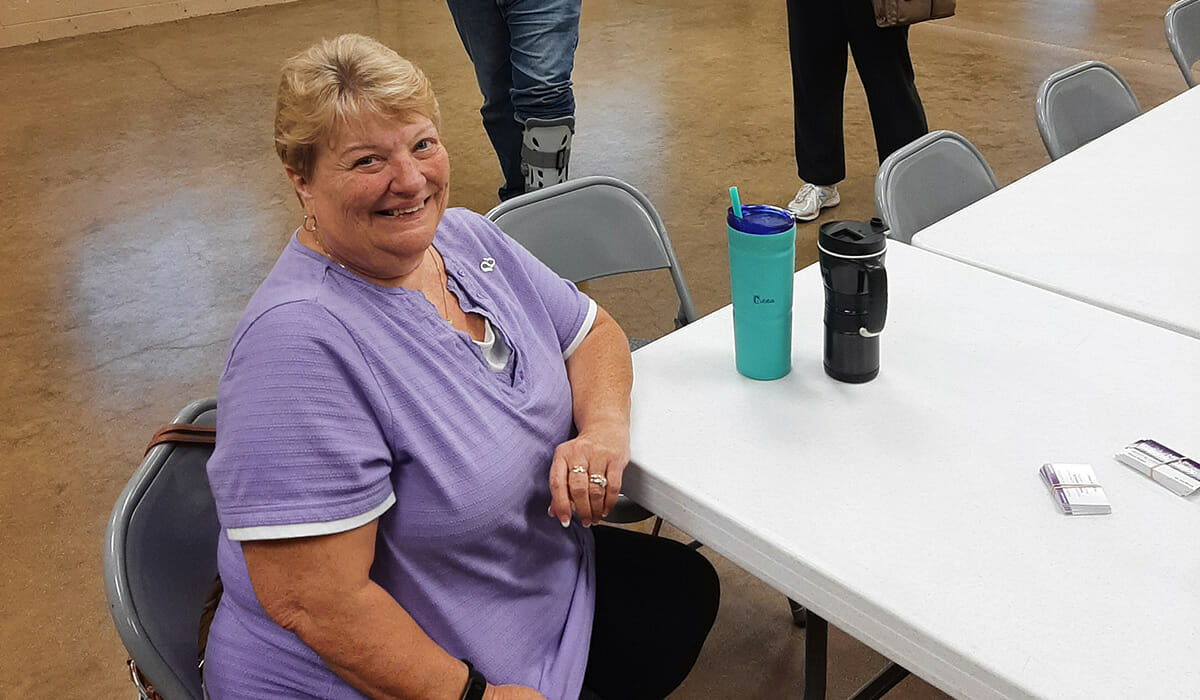
Candy pictured at her Alzheimer’s support group meeting with participants. Candy Feinstein: “We need to help one another. We are all in this together. Alzheimer’s disease and dementia are truly an epidemic, and it’s getting worse every day.”/Courtesy Candy Feinstein
What do you want people to learn from your story?
Pay it forward. I certainly think that helping other people has helped me cope in my life. Volunteering makes me feel worthwhile, like there’s a purpose and a reason. I love helping other people. I love making other people smile.
In one word, what does volunteering mean to you?
Everything. I volunteer for other causes in my community, including the Alzheimer’s Association.
Meet Daily Point of Light Award honoree Dylan Mondrus. Read his story and nominate an outstanding volunteer or family as a Daily Point of Light.
Dylan Mondrus’ volunteer service didn’t stop after he completed his Boy Scout Eagle Project. The 16-year-old radiates service wherever he goes. From working with the Fidelco Foundation to holding leadership roles in high school, Dylan wants to create a cycle of service throughout his community.
As a Boy Scout, Dylan has to complete a capstone service project called the Eagle Scout Project. For his project, he built agility equipment and volunteered with the puppies of the Fidelco Foundation, an organization that breeds and trains German Shepherd puppies to become companions for the guide dog community and search and rescue dogs. The Weston, Connecticut, native completed his project in May of 2021, but still helps adolescent dogs become ready to help those in need and even signed up to be a foster puppy sitter.
Describe how you first discovered the Fidelco Foundation:
I started searching on the internet for ideas for my Eagle Scout project, but my inspiration came from my sister because I was like nine years old when she used to take Sundays off and go to this charity organization for dogs. They trained puppies to grow up to be service Dogs for the Blind. So when I was looking for an Eagle Scout project, I looked at that as an example. I looked on the internet for similar organizations and I found the Fidelco Foundation which is pretty much the same thing where they take puppies and train them for about a year or so — with basic developmental stuff — and then they send them off to adoption. They send them off for adoption for about a year where they continue developing skills and then they come back after a year when they’re ready to start actually training to be service dogs.
Can you explain your volunteer activities and how they’ve grown?
After I worked with Fidelco for my Eagle Scout project, they offered me the chance to be one of the adopters that take in German Shepherds before they match with someone in need.
Before that, my Eagle Scout project was mainly about building equipment and little playgrounds for the puppies so the learning process could be more efficient. I built a structure to help them go up and down a system of stairs that basically taught them how to go upstairs. That was very valuable. I also built hurdles with sports cones and PVC pipe for the Fidelco pups to learn how to jump over small obstacles. Another one was just the play gym where they could go in and grab toys hanging from the wall.
What do your volunteer activities look like at school?
Dylan Monrus builds equipment and obstacles to make the learning process more efficient for Fidelco Foundation’s puppies./Courtesy Dylan Mondrus
I’m the president of CLPS — the Cultural Linguistics Preservation Society — which works to preserve Indigenous culture. I’m also the vice president of the American Heroes Club, which honors veterans and American heroes.
What inspires you to volunteer?
I just like to help people. It’s just human nature. Humans are naturally altruistic, and you want to help people and you want to give to others, and you want to see people happy and not have to suffer the way that you could, you know, you just want to have an impact.
What have you learned through your experience as a volunteer?
I’ve learned that, you know, volunteering isn’t as easy as people think. People always make commitments to volunteer work saying I’m gonna do this and I’m gonna do that. But it’s actually an activity that’s both work and fun. But at the end of the day, it’s rewarding and it’s very inspiring. It gives me hope for humanity that we can provide people fulfillment and see success.
Why is it important for others to give back, especially students?
Because so much is given to you through your community more than you know, and it’s just your responsibility to give back and keep that cycle going, you know. Not that I’m a saint, but it’s important to keep the cycle going and keep the community thriving so they can also give to those that come next.
Are there any partnerships, programs, or events that you are excited about?
I’m just excited to keep working and hopefully being certified in the adoption process. I relish at being at the whim for anything Fidelco needs me to be, you know. They trust me, and I trust them, and I’m happy to do anything needed.
Volunteer Helps Bring Coping Mechanisms to Cancer Patients and Families
Meet Daily Point of Light Award honoree Dr. Maryam Davodi-Far. Read her story and nominate an outstanding volunteer or family as a Point of Light.
At a very early age, Dr. Maryam Davodi-Far learned from her parents the importance of channeling her energy into making someone’s life better, a lesson she said always stayed with her.
Now, she channels that energy every day as the co-founder and executive director of the Cancer Coping Center, a nonprofit that provides free coping mechanisms to patients being treated for cancer, as well as their family members and caregivers.
The center is a mobile service that brings its creative coping sessions directly to patients in cancer centers, hospitals, physician offices, or other healthcare centers in the San Diego and Santa Barbara, California areas. The sessions frequently involve therapeutic arts, including making memory boards, painting, scrapbooking, drawing, jewelry making, or knitting.
Maryam, a psychotherapist, has spent her entire career in the nonprofit center, but she was particularly drawn to opening the Cancer Coping Center after realizing she doesn’t know a person who hasn’t been touched by cancer in some way. She was also drawn to starting a cancer nonprofit after working at a children’s hospital with kids who had been diagnosed with the disease. She particularly wanted to create a program that would provide balance to the medical treatment patients receive.
Dr. Maryam Davodi-Far serves as the co-founder and executive director of the Cancer Coping Center, a nonprofit that provides free coping mechanisms to cancer patients./Courtesy Dr. Maryam Davodi-Far
“I wanted to do something that would support that, but not be in that same vein,” Maryam said. “It would be lighter, bring some levity, some joy, some fun, and some light to that process.”
The center is entirely run by volunteers, with a staff that ranges from 50 to 75 people. Some of the volunteers have survived cancer themselves or lost family members to it, while others are in the medical field or are looking to join. There are also always staff clinicians on hand during the mobile sessions to make sure patients are able to process any pain that comes up during the therapeutic sessions.
“Sometimes the process is rough. Sometimes it’s raw. Sometimes it’s very organic,” Maryam said. “But we want to make sure everyone feels safe and comfortable before we finish the session, whatever it is.”
By the end of the sessions, patients often leave feeling more confident and secure, as the process of creating is a calming distraction for them, even if only for an hour or two. Maryam said they frequently give their finished art pieces to a loved one. Clients are allowed to keep supplies like pencil kits and notepads so they can continue creating in their own time.
Prior to the Covid-19 pandemic, the Cancer Coping Center was averaging about four to six sessions a month. While the amount of sessions have decreased since switching to virtual work, the center hopes to begin reincorporating smaller, in-person sessions again next year.
In addition to its direct work with cancer patients, the Center also has an Executive Coaching Program that provides nonprofit executives with one-on-one sessions on enhancing leadership and effectiveness. There’s also the Cancer Coping Center in Color program, which solicits artwork from individuals who have been touched by cancer in some way.
The Cancer Coping Center’s therapeutic sessions often involve visual arts, such as 12-year-old volunteer Jet Wu’s drawing which was sold at an auction for $550 to raise funds for the center./Courtesy Dr. Maryam Davodi-Far
Jonathan Landau, a member of the Cancer Coping Center Board of Directors and friend of Maryam’s for almost 20 years, described her as super positive and a great leader who empowers others. His stories of her recall a very authentic and caring person — the type to greet every single individual personally at an event, no matter how large, and who sent him a card upon hearing he was ill last year and then had multiple family members help check up on him.
“I think her overall premise is that being a volunteer enriches your life and other people’s lives, and that there’s this positive symmetry between all of those who are involved,” he said. “She’s a symbol for that, I would say.”
In the future, Maryam hopes to expand the Cancer Coping Center with chapters in other parts of California, and perhaps even other parts of the United States. She is always open to new partnerships, and encourages anyone interested in helping in some way to reach out to her through the center’s website.
“Volunteering reminds us that we’re part of a larger whole and we’re connected,” Maryam said. “I feel like it’s a gift that rewards both the giver and the receiver. I urge everyone to volunteer if they can.”
High School Volunteer Expands Affordable STEM Education for Students
Meet Daily Point of Light Award honoree Winnie Wang. Read her story and nominate an outstanding volunteer or family as a Daily Point of Light.
Through her involvement in student government, 17-year-old Winnie Wang became interested in education equity. The high school senior, who attends a STEM school, decided she would commit her volunteerism to increasing access to STEM for kids in need.
As the volunteer vice president with SMath Tutors, Winnie is providing affordable, quality education to underprivileged students from elementary to high school who lack access to STEM education or have struggled educationally through the COVID-19 pandemic. Offering courses and tutoring, 90 student tutors have completed more than 60 volunteer hours each, the organization connecting with more than 250 students up and down the East Coast and inspiring youth service.
What inspires you to volunteer?
I’m inspired to share my love of learning and provide opportunities to others, especially given the opportunities I’ve had.
Describe your volunteerism with SMath Tutors.
As vice president, I do it all. I recruit and manage volunteers, help to develop courses and set up classes. We have over 25 courses and are currently working to establish a STEM education after-school initiative in Durham, North Carolina schools.
Share one personal story with me from your volunteerism.
For one of our programs, we taught a biology class, and the students stayed after and created presentations we didn’t ask them to do. I thought it was really interesting that they took their own time to look deeper into a topic we taught them, and create something. It makes me feel really proud that this one idea could turn into something so big.
Why do you think it’s important for others to give back?
It’s really important for youth to contribute to causes like this. Oftentimes they feel like they can’t have an impact, but youth should try to achieve changes, whether at school or legislative changes at the state level. I feel like that’s really possible.
What’s been the most rewarding part of your service?
It’s rewarding to work with the students themselves. We like to promote the importance of doing activities within STEM education because it’s not implemented that much in classrooms.
Winnie says she uses her own school experiences to think of new ideas for STEM experiments and ways to reach out to new students. SMath Tutors has connected with more than 250 students up and down the East Coast and inspires youth service./Courtesy Winnie Wang
How have you continued to volunteer throughout the pandemic?
We’re preparing to start our elementary after-school program in-person, it will be conducted outdoors. We’ll continue offering online classes for student participants. Especially during the pandemic, every student was at a different part of their education. Some were struggling, some were super unchallenged by the level of learning, and they wanted to seek out new interests or needed more support. That’s where we stepped in.
In two words, what does volunteering mean to you?
Individual impact.
When you’re not busy with school or volunteering, what do you do for fun?
I’m the captain of my diving team. I also really enjoy keeping up to date with politics.
How can readers help?
We’ve supported our communities while also tutoring communities, as donations from student participants go directly to the Food Bank of Central and Eastern North Carolina. We’ve donated more than $25,000 to the food bank thus far, providing continued COVID-19 relief for struggling communities. Please visit our website for more information about how you can help and also, get ideas for how you can offer tutoring in your own community.
Volunteer Ensures No Child is Left Behind Through Community Outreach Program
Meet Daily Point of Light Award honoree Eugene Campbell. Read his story and nominate an outstanding volunteer or family as a Point of Light.
Growing up, Eugene Campbell used to watch his grandmother shower the kids in his community with love and support, making sure no child went without. Now, Eugene is stepping up to be that support system in his St. Bernard Parish, La. community through the Irene Campbell Foundation, a community outreach program he started in his grandmother’s name.
Since Eugene founded it five years ago, the Irene Campbell Foundation’s variety of programs have focused on supporting youth, such as its Backpack Program which provides 250 kids with lunches to eat over the weekend for when they’re not in school. Each holiday season, the foundation provides approximately 600 kids with Christmas gifts. And last August, Eugene partnered with Nunez Community College to further expand the foundation’s Reach One Teach One Program, which introduces kids to trade school opportunities.
“They always used to tell me, it takes a village to raise a child,” Eugene said. “So you know what, I’m going to be that village.”
Describe your volunteer role with Irene Campbell Foundation.
I live by ‘reach one, teach one,’ so no child is left behind. I give out school supplies and I do a Christmas [gift program]. I coach rec ball too, so I’m able to see who is really in need. My sister is a substitute teacher. They had a child who every Monday was cutting up. Come to find out, the child wasn’t eating during the weekend. We started packing little lunches for him. Now we have a Backpack Program. We service about 250 kids in the Violet, St. Bernard Perish area. For recreation, if someone couldn’t afford to play sports, I would pay for them to keep them out of trouble. I have a ‘Reach One, Teach One’ trade class I do. When you’re 18, you graduate. I even do summer programs. I take them to see what they want to be and what they want to do, from body shop work, so painting, body and fender, and I take them to see some of my friends who weld, who fish. It’s youth development. Basically, I reach the community and let the kids in the community know they’re not left behind.
What inspired you to start this?
Eugene Campbell serves as the founder of the Irene Campbell Foundation, a community outreach program focused on supporting his St. Bernard Parish, La. community’s children./Courtesy Eugene Campbell
What inspired me to do it was I had been giving back and helping since I was in school. … Growing up, my family basically helped each other. My aunties didn’t have kids at the time, so they made sure my mother and us kids were able to help each other. My auntie would buy all our shoes. My uncle would buy all our backpacks. It was a village within the community, not us by ourselves. That’s what I tend to try to do now.
Why did you want to name your foundation after your grandmother?
She was that person in our community. She never let anyone feel they were left behind, no matter where she was at. She would go service all over the world with the pastor, but also in our community. She was the one who would feed you, bathe you. You needed somewhere to live, she would give you somewhere to live. Give you something to drink. She was that focal point. She made sure no one was left behind. It takes a village. When I was growing up, she was that village within our community.
Can you talk about your recent partnership with Nunez Community College?
The partnership is to help the kids with trades like welding. I’m informing them of all the trades and other opportunities you can have while still going to college. Not everybody is going to be a doctor or lawyer, but most don’t understand there’s other options within trade school or even community college. I’m going to let them know. … Most of us are hands on, so I’m able to put a child in a position to see what they really love to do. They might want to be a welder. They might want to drive a fork lift. They might want to be a truck driver. With the partnership with Nunez, they’re going to help me do what I’m already doing, but help with a bigger facility.
Is there any program that is particularly special for you?
I like to do my Christmas giveaway. My sister being a sub and me coaching rec, I normally hear the kids talking. The night before Christmas Eve, my sister and I wrap all the presents, and I drop it off at their building with a note. I do that for kids who I know really need it and would cherish it. I guess you could say it’s like a secret Santa.
What kind of change do you see in the kids who you work with?
You see a change because they feel more comfortable speaking to me, or they open up, or they give me a high five. I ask how they’re doing and they tell me they had a good day at school. They tell me before I even ask them. You see the excitement and them breaking out of their shell. They want more. They understand that you care about them.
Eugene Campbell and volunteers host a hot meal drive through Eugene’s community outreach program, the Irene Campbell Foundation./Courtesy Eugene Campbell
What’s been the most rewarding part of your work?
Actually feeling and seeing the progress of change. Even changing things you thought you couldn’t change. You can’t save everybody. Some come and some won’t, but seeing a change in the ones you probably felt you couldn’t break, that’s the most important. Even seeing the ones who are older than me and encouraging them, like, ‘Man, I see you doing your thing, keep it up, you motivated me the whole time I was growing up.’ It’s crazy, but seeing people’s progress. If I can see them making change and trying, I’m going to help.
What do you want people to learn from your story?
Everyone has a purpose. It’s up to you to find it. Reach one, teach one. No matter what, we’re all one. You see someone down who you can help — you never know what they may be going through. Even with me, I might be going through something, but a smile a day takes the pain away. Me smiling at someone else and making them smile makes me feel better.
First Generation American Teen Builds Bridges to Brighter Future through Literacy
Meet Daily Point of Light Award honoree Elizabeth Shvarts. Read her story and nominate an outstanding volunteer or family as a Daily Point of Light.
17-year-old Elizabeth Shvarts has always had a love for reading and a passion for spelling, even competing in the Scripps National Spelling Bee. The Staten Island, New York high school senior is now empowering other students to improve their literacy.
Co-founding Bridge to Literacy (BTL) with a fellow classmate and friend, Elizabeth is building bridges to a brighter future through literacy by offering personalized learning and valuable resources. Helping to tackle societal inequities and fostering cross-cultural bonds, Elizabeth’s service has stretched across six continents, donating $20,000 of devices and collecting nearly 4,500 pounds of books. Spelling out success for students around the world, Elizabeth is making positive global change through volunteerism.
What inspires you to volunteer?
I’m inspired by the promise of possibility. Whether I make someone smile, or facilitate collaboration across continents, we are helping individuals with different backgrounds that want to inspire literacy through creative ways and their impact is amplified through their work together.
Why is this cause so important to you?
As a first generation Russian-Jewish American, I know my parents were not able to have access to mentorship and literacy. I felt a person’s financial or geographical situation shouldn’t matter, everyone should have access to literacy to get that spark and curiosity for learning.
Describe your volunteerism with BTL.
Bridge to Literacy (BTL) co-founder Elizabeth Shvarts is improving literacy for students around the world by offering personalized learning and valuable resources./Courtesy Elizabeth Shvarts
As co-founder, I work across all departments. I help to onboard volunteers, coordinate sponsorships and partnerships with international organizations. I manage communications, mobilize fundraising events like our book and electronics drives and lastly, serve as an ambassador. We have connected with more than 100 students thus far, and have 150 youth volunteers, spread across the United States and elsewhere internationally.
Share one personal story with me from your volunteerism.
One of our volunteers has found really good friends over the course of the program. He thanked me for creating a platform where people could meet. It fills me with a lot of gratitude to know we created a platform that encourages friendship and social impact. It’s really special to know this space allows people to share their journeys, whether it’s literacy or their personal journeys.
Why do you think it’s important for others to give back?
Communities are founded on people caring for each other and going out of their way to do nice things for others. Eventually, those small acts will create a ripple effect and create a wave of making everyone’s day better and holistically, make everything better.
What’s been the most rewarding part of your service?
Watching people transform not just in their understanding of literacy, but also, increasing their confidence levels as students and risk taking when it comes to English. Our lessons are conducted in English and also, the language students are most comfortable speaking in, whether Spanish or Russian.
How have you continued to volunteer throughout the COVID-19 pandemic?
Once the pandemic hit, we shifted all our activities to virtual, including our one-on-one lessons. We realized during the pandemic that offering individualized curriculum was important, as schools had shut down and students lost access to critical learning opportunities.
In one word, what does volunteering mean to you?
Amplifying.
Volunteers at the BTL LIteracy Kit event: (from left to right) Elizabeth Shvarts, Mirka Garcia, Olivia Zadvinskiy, George Jejelava, co-founder and co-director Gary Shteyman.)/Courtesy Elizabeth Shvarts
When you’re not busy with school or volunteering, what do you do for fun?
I’m trying very diligently to cook. I’ve gotten pretty good at making fried rice. I love learning how to play the piano. I play oboe. I love doing martial arts, sports, reading and creative writing.
What’s your favorite word from the National Spelling Bee?
This is not one of the words I had, but it is a cult favorite among spellers, “pneumonoultramicroscopicsilicovolcanoconiosis”. Initially, I was really stumped by the word, but it’s a lot more simple if you break it down. It is a term for a lung disease caused by inhaling silica dust, like from volcanoes.
How can readers help?
We’re reliant on donations to support our programs and are always looking for more volunteers. Our volunteers aren’t just teachers, they have a range of responsibilities and skills. For more information please visit our website.
Teen Volunteer Invests in Thousands of Homeless Single Moms & Kids to Promote Economic Mobility
Meet Daily Point of Light Award honoree Sahana Mantha. Read her story and nominate an outstanding volunteer or family as a Daily Point of Light.
Under ten years old when she co-founded an organization to help her community, now 15-year-old Sahana Mantha has moved mountains to empower homeless single mothers to become financially resilient.
When Sahana, a Charlotte, North Carolina student, co-launched Foundation For Girls (FFG) in 2014 with her older sister Shreya, she says the two wanted to provide similar support and stability they’d been raised with. “Growing up, we had everything we needed,” says Sahana. “We didn’t know what was happening basically in our backyard. We visited a homeless shelter and saw these children (that were) basically my sister and my age.” Since then, Sahana has invested in more than 2,500 homeless single mothers and their children across the country, helping to economically empower women and offer the opportunity of multi-generational change.
What inspires you to volunteer?
I’m inspired to help vulnerable individuals. We make people happy, and help them to grow, whether financially or in their careers, helping them to lead a fulfilled life after FFG.
Describe your volunteerism with FFG.
As co-founder, I work on strategic needs, expansion and co-lead our Digitally Forward program. In addition, we offer programs including Circle of Care, which encourages financial resilience through investment in women with resources, relationships and recommendations. Our support promotes building social networks and healthy relationships. We have about 100 volunteers across the country, mostly young professionals.
How have you continued to volunteer throughout the COVID-19 pandemic?
As the co-founder of Foundation for Girls (FFG), Sahana Mantha is economically empowering women and offering the opportunity of multi-generational change. /Courtesy Sahana Mantha
All of our activities went virtual. We noticed a lot of our participants had lost their jobs, so we started distributing Care Packs through our Circle of Care program, filled with essentials donated by community members. By leveraging technology, we were able to expand our programming to nine states around the country.
Share one personal story with me from your volunteerism.
We met one of our long-term participants when she was 14 and in state custody at a foster care facility. She’s been working with the program for about four years now, and each time she gets on a call with new FFG participants, she explains how our organization transformed her life, from where she was to now, she has a job and is going to college. It really just brightens my day to hear how her life trajectory has changed.
What’s been the most rewarding part of your service?
When we get to meet the daughter of this participant. Every time we deliver Care Packs with all her favorite snacks, I love seeing her bright and happy.
Why do you think it’s important for others to give back?
When it comes to volunteering, especially if you’re privileged, you should always want to give back to others to help them grow all around, whether financially, digitally or career wise.
FFG began delivering Care Packs through their Circle of Care program to help moms sustain themselves through tough times. /Courtesy Sahana Mantha
What do you want people to learn from your story?
Understand what problems exist, know what you’re passionate about, what resources you need and how you can go about helping your community.
In one word, what does volunteering mean to you?
Care.
When you’re not busy volunteering or in school, what do you do for fun?
I’m a junior golfer. My favorite golf professional is Lydia Ko.
How can readers help?
Please visit theFoundation For Girls website for more information about how you can help.