New York 6th Grader’s Volunteerism Puts Focus on Children with Visual Impairments
Meet Daily Point of Light Award honoree Caitlyn Michiels. Read her story and nominate an outstanding volunteer or family as a Daily Point of Light.
Diagnosed with Uveitis in elementary school, Caitlyn Michiels experiences eye inflammation produced by her body that can cause further complications for pediatric patients, and in some cases, blindness. When she discovered that not all children could afford the costs associated with visual impairment, Caitlyn decided to volunteer to help those in need.
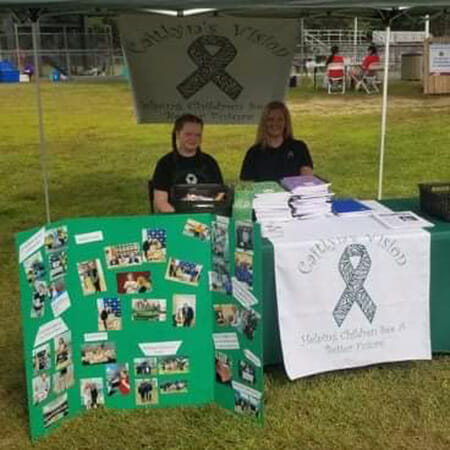
As the founder of Caitlyn’s Vision, the now 11-year-old Mastic, New York student is ensuring that each child that needs treatment and glasses can receive it, regardless of their insurance coverage. Raising tens of thousands of dollars to help children with visual impairments, Caitlin has collected and donated more than 2,000 pairs of used eyeglasses around the world. By focusing on improving health, Caitlyn is volunteering to raise awareness of eye health and supporting others who experience visual impairment.
What inspires you to volunteer?
It makes me feel really good that people are able to have medicine, or are able to see the details of loved one’s faces, or read a textbook. That’s what inspires me to volunteer.
Describe your volunteerism with Caitlyn’s Vision.
Caitlyn Michiels: “It makes me feel really good that people are able to have medicine, or are able to see the details of loved one’s faces, or read a textbook. That’s what inspires me to volunteer.”/Courtesy Caitlyn’s Vision
Our mission is to make sure every child who needs treatment for vision impairment or glasses receives that help. We will pay the difference if their insurance doesn’t cover what a child needs, like a pair of glasses that they want. As founder, I collect used eyeglasses and we also donate other vision assisted devices, like a VR headset, a pair of color blind eyeglasses and 600 light covers that can be used over harsh classroom lights in schools. In 2019, “Caitlyn’s Law” was passed, which designates August as Children’s Eye Health and Safety Month in Suffolk County, and directs the department of health to distribute information on eye health.
Share one personal story with me from your volunteerism.
We donated a VR headset to a legally blind girl my age from Phoenix, Arizona, and she used the headset to read a textbook that she couldn’t read before. That made me realize how much I can help other kids, and it makes me feel really happy that other people can look up to me because of volunteerism.
Why do you think it’s important for others to give back?
Not everyone is as fortunate as me. Others need more help. That is why it’s important to volunteer.
How have you continued to volunteer throughout the COVID-19 pandemic?
We had fundraising planned during the pandemic that we had to cancel. We’re still adjusting our service and have re-scheduled a lot of events we’d planned for last year.
Raising tens of thousands of dollars to help children with visual impairments, Caitlin has collected and donated more than 2,000 pairs of used eyeglasses around the world. /Courtesy Caitlyn’s Vision
What do you want people to learn from your story?
Don’t take your sight for granted, not everybody can see. Please get your eyes checked, because vision health is very important.
In one word, what does volunteering mean to you?
Giving. We are helping people and helping to raise awareness about vision impairment. Volunteering makes me feel really proud of myself and happy.
How is your health, and what do you do for fun?
I wear glasses occasionally, but my health is a lot better than what it used to be. I’ve been taking dance lessons for tap and jazz, and I play lacrosse.
How can readers help?
We rely on donations to help cover vision impairment costs for kids, and to fulfill our Child’s Vision Bucket List requests, which offers experiences a child would want to see or do before they lose their vision. It can be as big as seeing a natural wonder, or as simple as seeing a movie. Please visit our website for more information about how you can give back.
Marine Honors Commitment to Community through National Urban League Volunteerism
Meet Daily Point of Light Award honoree Stanley Gray. Read his story and nominate an outstanding volunteer or family as a Daily Point of Light.
The first African American assigned to command a reconnaissance company in the U.S. Marine Corps, Stanley Gray of Tampa, Fla., is dedicated to his nation and community, and is sharing hope through his volunteerism, giving a hand up to individuals looking for a brighter future.
Committed in his desire to help others and strengthen community, Stanley has given back in many ways, most recently, establishing a new approved National Urban League affiliate chapter in Hillsborough County (ULHC). Stanley’s support has reinvigorated direct services that impact and improve lives, promoting economic equity for African Americans and minorities after the community lost its chapter nearly two decades ago. Persisting through delays amid the COVID-19 pandemic, Stanley rallied others to the cause with a forward-looking vision, making a positive impact on his community through volunteerism.
What inspires you to volunteer?
Volunteerism is personal to me. I was adopted by a black family when I was five years old, and my whole world changed. I am very, very appreciative of my father for what he did for me. He’s a better man in many ways than I’ll ever be. Throughout my life people have helped me, and without that help, I wouldn’t be where I’m at today.
You’re recognized for your collaborative volunteerism. What does that mean to you?
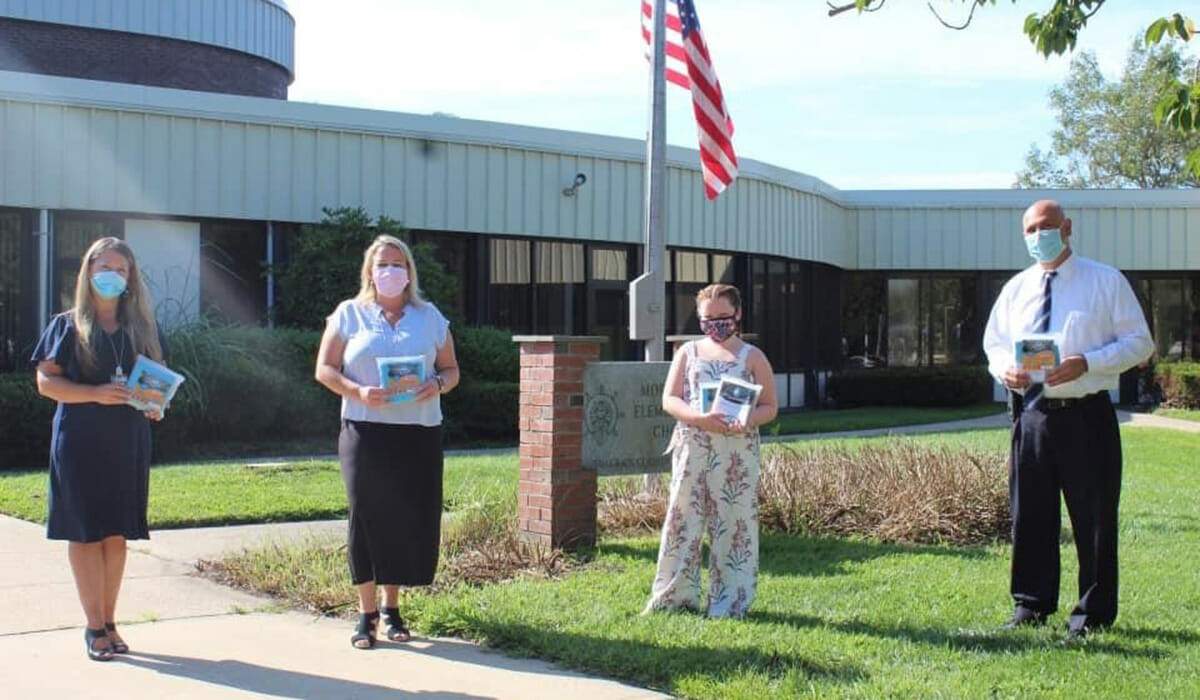
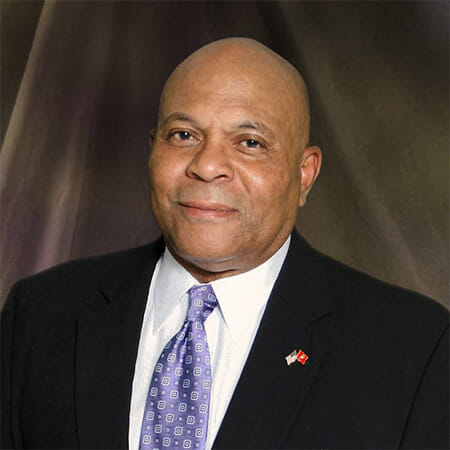
A Marine dedicated to his nation and community, Stanley Gray has given back in many ways, most recently, establishing a new approved National Urban League affiliate chapter in Hillsborough County, Florida./Courtesy Stanley Gray
I appreciate the recognition but it’s not something I look for. When I was in the Marine Corps, people would ask what they were most proud of. I’m most proud of every Marine I ever had that received his diploma. Every one that wanted to go to college, we found them money. Those are the things I’m proud of.
Describe your volunteerism with ULHC.
I am getting things off the ground and then will pass on leadership of the affiliate chapter. By leveraging my personal relationships to fundraise, we established programs in addition to developing collaborative relationships with other organizations. We now have a board of directors and more than 220 members.
Share one personal story with me from your volunteerism.
A young man came to our office, he is a graduate of Morehouse College and has a masters degree from Florida Institute of Technology. He’d not been able to find employment, and then adding in COVID, it put him in a real place of flux. We sat down, went over his resume, did interview prep, worked on his presence, and he was able to get job making a $75,000 salary just one year out of school. That, to me, is what we’re supposed to be about. Volunteering is emotionally paying out rent. We’re supposed to help people live to their potential, not to sustain them where they’re at.
Why do you think it’s important for others to give back?
I do believe in the golden rule and I also believe that you will be rewarded at least two-fold when you give with no expectation to get. The only way we’re going to get better as a nation is when people start giving back to move us collectively forward.
What’s been the most rewarding part of your service?
Being a part of people meeting their objective is most rewarding. We’ve a part of turning their lives around. I’ve been doing this for probably 30 years, but you’re not just making a difference in one person’s life, that change affects other lives and families.
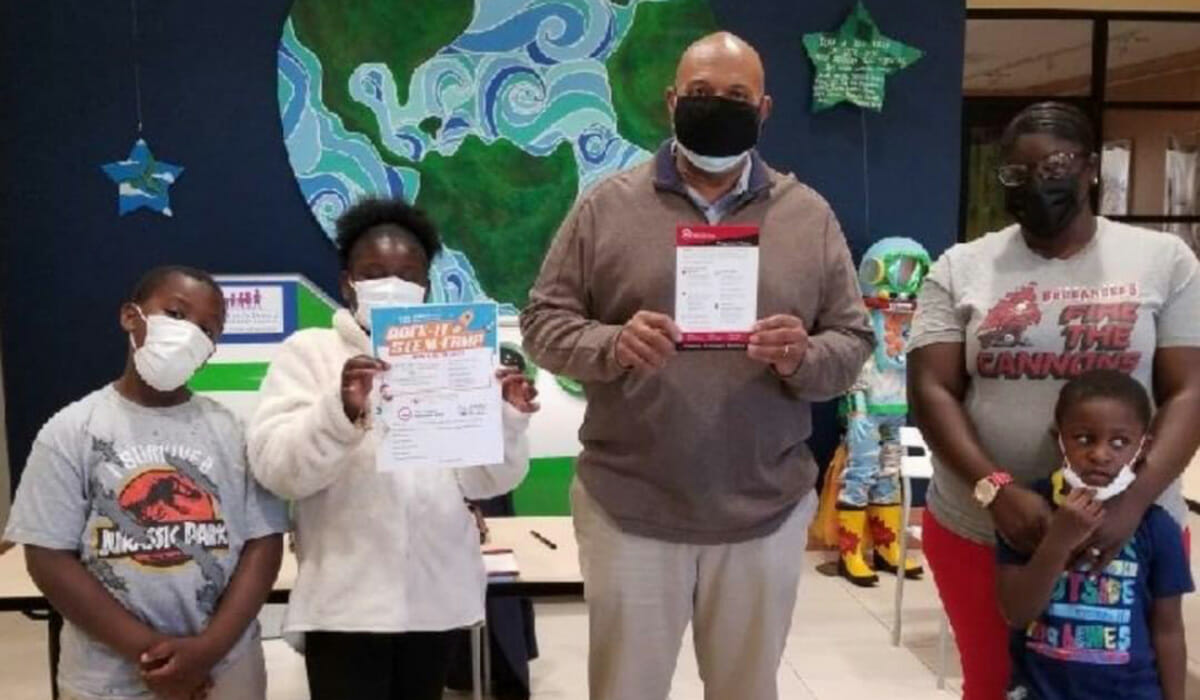
Stanley is sharing hope through his volunteerism, giving a hand up to individuals looking for a brighter future./Courtesy Stanley Gray
How have you continued to volunteer throughout the pandemic?
We had to find different ways to get people involved while taking precautions. We just launched our Young Professionals program for Urban League. Everyone talks about why we have so much unemployment, and why we can’t find people to work. We have a level of apathy (in the country) and people have given up hope. We’re focusing on young professionals to get involved and help provide avenues of hope to others.
What do you want people to learn from your story?
Know what your talents are and then share them with somebody. There’s no expectation you’ll be paid back, but do so in a very honest and forthright manner so people understand you have their betterment at heart.
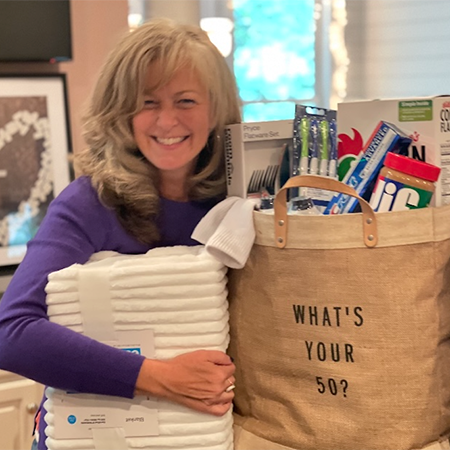
Kristen Weinberg wanted to mark her 50th birthday with something especially meaningful — donations of 50 items to 12 different charities throughout the year. After encouragement from her husband to invite others to participate, Kristen asked family and friends if they wanted to join in as well. Within two weeks, 30 different donation projects were in the works across multiple states. From that initial idea, What’s Your 50? was born.
In the over two years since it began, Kristen’s What’s Your 50? movement has completed 300 donation projects in nine different states. The donations have ranged from toys for hospitalized children to more recently, furniture for Afghan refugees newly placed in apartments. Through What’s Your 50?, Kristen is hoping to spread the message that anyone can get involved in philanthropy.
Describe how you started What’s Your 50?.
I was coming up on my 50th birthday and I decided I was going to help 12 charities that year to represent the 12 months. I was going to donate 50 items to each charity. My husband was like, woah, that’s a lot of items. Let’s spread it out to family and friends and ask people, if you could help a charity or an organization or a hospital or anyone, what would you do to help them with an increment of 50? Within less than two weeks, we had 30 different projects being rolled out across multiple states. It took off from there as a movement. I continue to ask the question, if you could help the world, what would you do in an increment of 50 to make a difference?
It’s been heartwarming to see all the incredible ways people can help that are so easy, so simplistic, so strong, and make such an impact when they seem like such a minor thing — like for example, socks. My husband found out that the men’s shelters never receive socks. It’s the most needed, least donated item. So he said, “I’m going to try to collect 50 pairs of socks.” People flooded him with socks. He got over 340 pairs. When he delivered them to the men’s shelter, they were completely overwhelmed with excitement, because it meant that many men were going to get a fresh new pair of socks.
Have any What’s Your 50 projects particularly stuck with you?
There’s been tons. One I always like to comment with women — how many of us have a bra? A perfectly good bra that sits in the back of your drawer for whatever reason. So I said, “Ladies, we’re all going to yank that one bra out of the drawer and I’m going to collect 50 of them.” I gave them to a charity whose primarily purpose is to collect bras and give them to less fortunate women. They’re extremely expensive and what’s the point of keeping them in the back of our drawer if we’re never going to wear them?
How can people get involved in this movement?
There’s the Facebook page, which is a group page that allows people to make their own comments. They would say, “I’ve joined the What’s Your 50? movement, I would like to collect 50” of whatever the case may be. My girlfriend said she wanted to collect makeup, because she went through a rough patch and it took every inch of her being to get up every morning and start her day. She said, “Kristen, this sounds menial and silly, but mascara and lipstick got my day started and empowered me to keep going. I would like to collect 50 pieces of makeup for women of a battered and abused shelter.” She posted on social media, ‘Please help me, I’m trying to collect 50 pieces of brand new makeup. I have a basket on my front door or you can order directly from websites and mail it to me.’ She was able to give 150 lipsticks, mascaras, and eye shadows to a battered and abused center in downtown D.C. and the women were absolutely thrilled.
Why do you think this movement resonates so much with people?
Kristen Weinberg poses with examples of items that can be donated as part of the What’s Your 50? movement she started. /Courtesy Kristen Weinberg
Because you can do it from the comfort of your home, from the comfort of your own community. You can see these simple, affordable, taken-for-granted items can make such a huge impact. One man donated to a food bank and his client started crying on the telephone when he said he donated [50 boxes of] cereal. She said, “I grew up depending on food donated from food banks. No one ever thinks to donate cereal.” For a kid to see a box of cereal in their bag of donations was like liquid gold to them, because most people donate what, the thing in the back of their pantry that they’re never going to want to eat? To get something as simple as a box of cereal is phenomenal. It makes people realize wow, I really can help, and it’s easy and it’s fun and it’s simple. It’s the simple things we all live with everyday that make a big impact.
What are your future goals with this movement?
I want more people to try it out. I want more people to dip their toes in philanthropy. Mr. Rogers was an awesome TV show I watched as a kid, where he was all about community and kindness. There was a famous quote he said — when he would turn on the news and see awful things going on, his mom would say look for the helpers. If you see the helpers, it will make you feel better. I want to add to that, look for the helpers and ask them what can we do to help you, because chances are the things they need are the basics that you’ll be able to get. Give them that extra help they need in order to help the world, be it socks, canned green beans, hot sauce, bras.
What’s been the most rewarding part of your work?
To know that the little things we do make such a big impact and that even something as simple as a soccer ball can change the life of a child who can’t afford a soccer ball. I live in Montgomery County, Maryland, and Montgomery County is one of the top wealthiest counties in the country. A teacher in Montgomery County said if I could get a What’s Your 50?, I would love for you to give me 50 ziplock baggies, each of them containing two sharpened pencils and a box of crayons, because my students can’t complete their homework because they do not own a pencil. … We were able to put together 175 ziplock baggies with sharpened pencils and crayons, and she was able to give them out to multiple kids in multiple grades knowing they’re now going to be able to do their homework. Something as simple as a pencil, a basic tool that’s going to change a child’s life and better their educational learning. It baffles my mind how easy it is to make a difference with something as simple as a sharpened pencil.
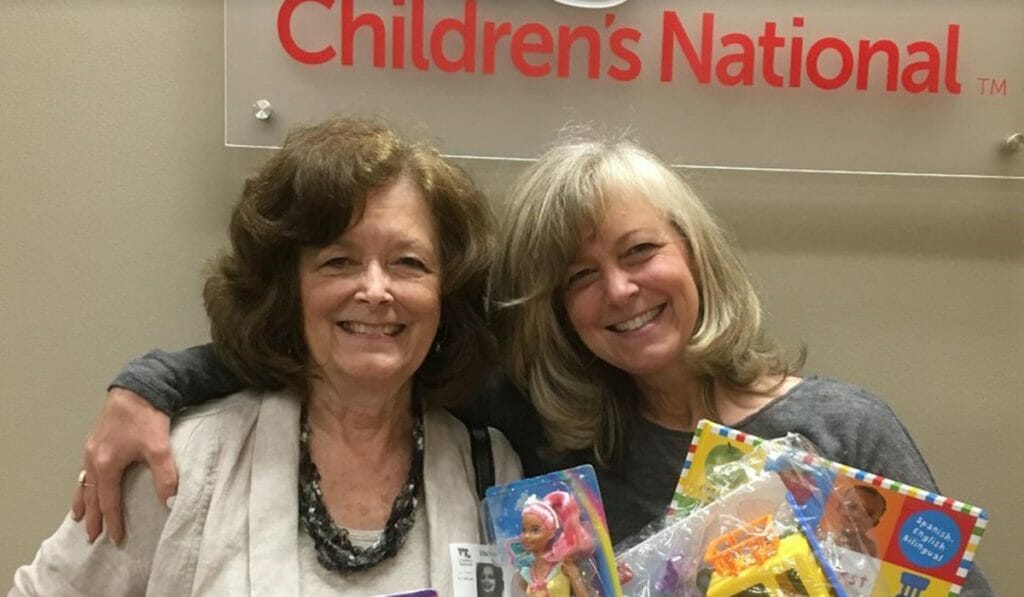
Kristen Weinberg, right, and her mother deliver toy’s to a children’s hospital in Washington, D.C. as part of her What’s Your 50? movement. /Courtesy Kristen Weinberg
Why do you think it’s important for others to give back?
Our world is drowning, and the life preservers that they need are so incredibly easy. For whatever reason, nobody talks about how easy it is to make that impact and to help. It could even be as simple as writing 50 letters to the staff at the hospital saying we see you and we appreciate you.
What do you want people to learn from your story?
That helping is so incredibly easy and fun. You just need to pick a person, place, or thing and ask them, what can I do to be that louder voice that can help you? You’re going to be amazed at how easy it is to help.
7th Grade Volunteer Steps Up to Feed Hungry Community During COVID-19 Pandemic
Meet Daily Point of Light Award honoree Ruby Weiner. Read her story and nominate an outstanding volunteer or family as a Daily Point of Light.
11-year-old Ruby Weiner has volunteered since she was a small child, but it’s her current service that is nourishing bodies and minds in her community, stepping up to meet true need during the COVID-19 pandemic.
As food insecurity amongst families with children tripled nationwide at the start of the pandemic, Ruby established Ruby’s Little Food Pantries. Volunteering to feed her own greater community, the Ridgefield, Connecticut student is filling the gap to helping hungry families and is inspiring community service in the process.
Points of Light spoke with Ruby and her mother, Patty, about her volunteerism.
What inspires you to volunteer?
Ruby: People sometimes need help. I’m inspired because there’s a need and it’s good to help.
Describe your volunteerism with Ruby’s Little Food Pantry.
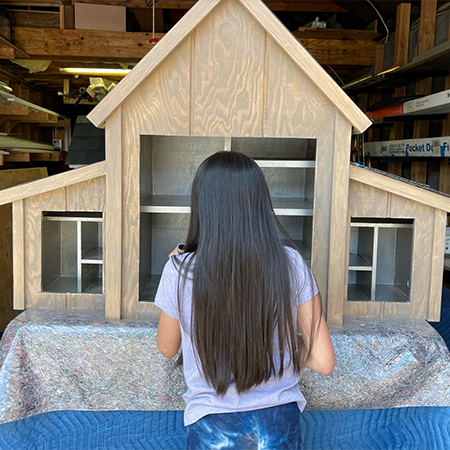
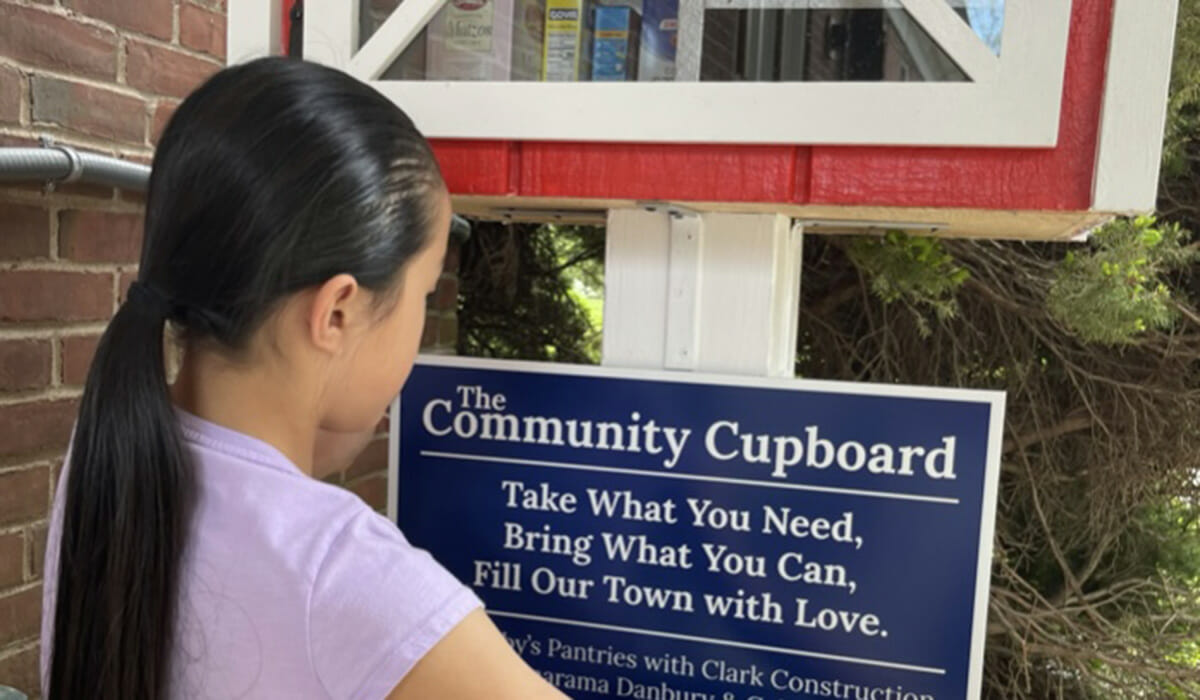
Ruby:The one free standing food pantry we had in our community was being relocated, so we raised enough money from a grant and community donations to build five little food pantries to fill that need. With help from a local construction company, I designed, built and installed the food pantries. I organize food drives to keep the food pantries replenished for anyone, from any town, who is in need. People can also donate directly to the pantry. The most common items donated are pasta, canned foods and rice.
You volunteer with your mom. How does that make you feel?
Ruby:She supports me and we’re supporting each other when we volunteer. It makes me happy because if I didn’t have somebody to volunteer with, I don’t think it would be as fun.
With the support of a grant and her community, Ruby built five little food pantries. /Courtesy Ruby Weiner
How is your service positively impacting your community?
Patty:We’d always seen food fly off the shelf at the previous food pantry, and it bothered Ruby to think it was being relocated. Each little food pantry is designed to hold canned and non-perishable food, baby food jars, diapers, wipes and “Birthday Cake Boxes.” Ruby had asked me, “If people can’t buy their own food, how are they going to have food for their own children and birthdays?” So we offer pantry items to make a birthday cake including a tin, frosting, cake mix, candles and napkins.
Share one personal story with me from your volunteerism.
Ruby: I’m working on a project now to establish another food pantry in a different community, and we surveyed people to ask what they wanted in a pantry. A lot of people said it was such a great idea, and thanked us. That made me feel really good, because now I really know people want this service, and my volunteerism will be cherished.
Your volunteerism isn’t limited to your little food pantries. Explain.
Ruby: I first joined my mom to volunteer in 1st grade, and have been volunteering ever since, at organizations including: Ridgefield Girl Scouts, GSofCT, National Charity League (NCL) Nutmeg Chapter’s ROAR/Ridgefield Operation for Animal Rescue, National Charity League, Family and Children’s Aid, Meals on Wheels of Ridgefield CT, Scott Hamilton Cares Foundation – Sk8 to Elimin8 Cancer, Dress for Success Mid-Fairfield County and Ben’s Bells.
Explain how Ruby’s service inspires others.
Patty: It’s really important to empower children. If more kids understood their community though their parents, I think that there could be more of a call to action to help. We have a call to action that empowers children and helps to feed community members. Ruby’s Girl Scout and school friends have contributed to this project.
Ruby first joined her mom to volunteer as a young child. Ruby Weiner: “She supports me and we’re supporting each other when we volunteer. It makes me happy because if I didn’t have somebody to volunteer with, I don’t think it would be as fun.”/Courtesy Ruby Weiner
What’s been the most rewarding part of your service?
Ruby: It’s rewarding to hear about, or see people donate to help others.
When you’re not busy with school or volunteering, what do you do for fun?
Ruby: I figure skate six days a week.
How can readers help?
Please visit our Facebook page for more information about how you can help.
Volunteer Pays Forward Support to Strengthen Families After Personal Struggles
Meet Daily Point of Light Award honoree Rose Rivera-Hrosik. Read her story and nominate an outstanding volunteer or family as a Daily Point of Light.
Rose Rivera-Hrosik of Ambler, Pennsylvania experienced personal struggles during the housing crisis, saying she lacked support and felt overlooked. Through volunteerism, Rose has committed her service to providing support to others.
As a volunteer for the Inter-Faith Housing Alliance, an organization that offers programs designed to bridge homelessness and independence, Rose is helping to keep families together and contributing to a stronger community. The organization’s first virtual volunteer at the start of the COVID-19 pandemic, Rose’s personal strength and dedication is helping community members achieve self-sufficiency.
What inspires you to volunteer?
I found it very hard to get help when you’re a single person. I was in a not great place myself a few years ago and some people reached out and helped me even though I didn’t have any children. One person who helped me is the current director of the Inter-Faith Housing Alliance. That support is what inspires me to volunteer.
Inter-Faith Housing Alliance’s first virtual volunteer, Rose continued doing important volunteer work at home to support the organization./Courtesy Rose Rivera-Hrosik
Describe your volunteerism.
At Inter-Faith Housing Alliance, I help with administrative tasks, I input food and in-kind donations, and I helped to implement the organization’s database. I’ve volunteered nearly 3,000 hours thus far, and was the first virtual volunteer after the COVID-19 pandemic began. My volunteerism offers support, whether to individuals or to families, where kids can be kids and parents can go to school or work. I feel it is important to try to keep families together that are facing homelessness rather than split them up. In addition to my volunteerism with Inter-Faith, I serve as Auxiliary President at the John Rivers Memorial VFW Post 11322.
You’re described as the volunteer muscle for Inter-Faith. How does that make you feel?
It’s very humbling to hear someone say that I’m the muscle behind the organization. There are many people that do a lot in different ways.
Share one personal story with me from your volunteerism.
I was working on the organization’s main fundraiser, an annual golf outing, and there was a lot of hands-on work to be done, so I offered feedback on how it could be more efficient. You don’t realize just how much you’re doing until you see the end product. Now they’ve got it down to a science, but I’m always trying to improve because the idea behind having a volunteer is to free up the time of people doing the paid work to do those intangible things they may not be able to express.
Why do you think it’s important for others to give back?
If everyone would just lend a hand here or lend a hand there, a lot of amazing things can happen. As humans, it’s our responsibility to care for our fellow people.
What’s been the most rewarding part of your service?
It’s rewarding to know that my volunteerism makes a difference. Not everybody can say they’re making a difference in someone’s life and helps them do what they need to do.
]: A volunteer with Inter-Faith Housing Alliance, Rose Rivera-Hrosik is contributing to a stronger community. /Courtesy Rose Rivera-Hrosik
How did your volunteerism change during the COVID-19 pandemic?
I was the organization’s first virtual volunteer. I’d pick up paperwork and volunteer from home, because there was paperwork that needed to be processed, but no one at the office was trained to do it. I’ve been volunteering and helping the organization with data input longer than some of the salaried employees.
In one word, what does volunteering mean to you?
Smiles. The smiles you see on the kids’ faces at Christmas time when they have a gift to open. Or when they get something they’ve been longing for and needing for a very long time, and they never thought they’d get it, and there it is.
Meet Daily Point of Light Award honoree Sheza Saiyed. Read her story and nominate an outstanding volunteer or family as a Daily Point of Light.
Born in India, Sheza Saiyed moved to the United States with her family as a 5th grader. The now 17-year-old says she grew up with access to quality education, but witnessed great need in her surrounding community.
“Workers used to come to my grandmother’s house, and they’d bring their young children, daughters my age, to help them sweep, mop and wash dishes,” says Sheza. “I used to wonder why they weren’t at school, because it’d be a weekday. My mom explained that not everyone is as fortunate and they needed money, so they had to prioritize working over school. I felt privileged but also sad, because not every child was getting the life I was.”
That experience, coupled with Sheza’s strong desire to help children in her own community who lacked access to educational resources and mentors to guide their education, has served as a catalyst for her service with Youth Promise. The organization, which provides free, virtual tutoring to underserved kids around the world, is educating students at a time of great instability and need during the COVID-19 pandemic, says Sheza, a Fremont, California high school senior.
“I highly value education and think every child should receive access to the right type of facilities to obtain an education. Amidst the pandemic, the technology divide was exposed, and that also affected underprivileged children who couldn’t access online courses as easily as we did.”
Through individual tutoring in subjects like English grammar and engineering, group classes and college and test prep workshops taught by volunteers, many students themselves, Youth Promise is helping children to reach their full potential. According to Sheza, who tutored students in her own community prior to her volunteerism with Youth Promise, by forming partnerships with community organizations and connecting with students and teachers in underserved areas, Youth Promise is changing life for students now, and for others in the future.
As a volunteer with Youth Promise, Sheza Saiyed is democratizing virtual education for underserved students around the world./ Sheza Saiyed
“It’s interesting. (My team) tutors teachers in Bangladesh so they can teach English grammar classes to their younger students. Some of these teachers are recent college graduates, but are still weak in science and English. The extra assistance we provide impacts them and indirectly impacts the children they are teaching. As a student in the Bay Area, I was exposed to engineering, but a lot of kids are intimidated by the field, especially girls. (Through volunteerism,) we’re reaching out to high school children who wouldn’t be learning diverse subjects like engineering until they reach college. We incorporate projects and fun lectures to make it more engaging, and (through our education,) they know it’s another option they can pursue in college.”
In addition to connecting with teachers and students, Sheza builds curriculum and training for Youth Promise. Bianca Jortner, Youth Promise founder and president, calls Sheza a “leader and passionate individual,” her devotion to democratizing virtual education positively changing reality for many.
“(Sheza has) contributed largely to where Youth Promise is today. She’s not only the head of social media, but she also created a partnership with an organization in Bangladesh where she led English grammar sessions. She’s empowered (teachers and students) in that she’s allowed them to gain access to educational opportunities they wouldn’t otherwise have. She’s the one volunteer I can always count on to garner volunteers towards a common cause.”
That drive towards a common cause will continue, says Sheza, as the organization reaches out to more children in more underserved areas to boost access to education. As need increased during the pandemic, Youth Promise thrived, opening the door for volunteers to virtually reach more children internationally than ever before, Sheza says.
“Sometimes people don’t think about volunteering to help internationally. They often think about helping their local communities. But the introduction of how easy it is to access people through Zoom, instead of being present to volunteer, will hopefully encourage people to reach out internationally and help areas where there’s more need. The need for enhancing education and improving the lives of underprivileged children will always persist. By volunteering with organizations like Youth Promise, (our service) won’t eradicate the issue, but it will help improve the issue.”
Sheza’s dedication to volunteerism is complemented by her empathy for others, a feeling she hopes to inspire others with.
“The takeaway from my service is to empathize with the situation of others. As much as you can empathize, it makes volunteering a lot easier and it becomes natural. Instead of a duty, think of volunteering as a way of sharing your own abilities for the betterment of others.”
Teen Makes Community Stronger During Pandemic By Starting Multiple Volunteer Organizations
Meet Daily Point of Light Award honoree Ina Kathy Chun. Read her story and nominate an outstanding volunteer or family as a Point of Light.
While some people spent their newfound time at home during the COVID-19 pandemic picking up new hobbies or catching up on their favorite shows, Ina Kathy Chun spent hers helping those in need. At the start of the pandemic, the Irvine, California resident started Tetra Kids, a youth-led initiative to teach computer science and literacy to foster kids around the world. Ina Kathy and her 15 or so fellow high school-aged volunteers have so far educated over 100 students from foster care organizations as close as Los Angeles and as far as Kenya, Thailand, and India.
Also at the start of the pandemic, Ina Kathy started Bridge Club Global, a student organization that creates, packages, and delivers FDA-approved masks to hospitals and nurses associations. They also recorded a compilation of comforting music to help improve doctors’ and nurses’ morale. Not content with stopping there, Ina Kathy started a community garden initiative in October 2020. Green Gardens utilizes carbon sequestration in order to help combat greenhouse gases and carbon emissions, and also produces vegetables for local food pantries.
Describe your volunteer role with Tetra Kids.
Tetra Kids is a youth-led initiative I first started when I became aware of the foster issue, not only through an article I wrote but also talking with my friends who were foster kids themselves and going through that experience. Especially when the pandemic started, I realized that even my community, my school, and students around me were having a difficult time, even though many of us had stable homes and stable lives outside of school. I was thinking about how much more difficult it would be for those who don’t necessarily have a stable home or background, or are subject to all those difficulties in the foster system. I created a team of high school volunteers to teach computer science and basic computer literacy to foster youth here in the U.S., so in L.A., New York, and other areas. We also reached out to other foster care organizations in India, Thailand, and Kenya, and we worked with those foster youth in those areas to help them get used to computer programming and help them have a friendly relationship with coding, so they’re more empowered in the 21st century and able to express their voice.
Why did you want to teach these kids computer programming?
I think from my experience, computer programming and even computer literacy really opens up a whole new world. I definitely think especially today in the digital age, it’s a first step to making sure your voice is heard. Especially for kids like foster youth, sometimes their voices aren’t necessarily heard and it’s other people speaking for them or advocating for them — which is great, but I think computer programming and computer literacy are really critical to making sure your voice is heard, even in different countries. It’s important to start introducing them to a fun relationship with coding while they’re still young.
Can you explain your work with Bridge Club Global?
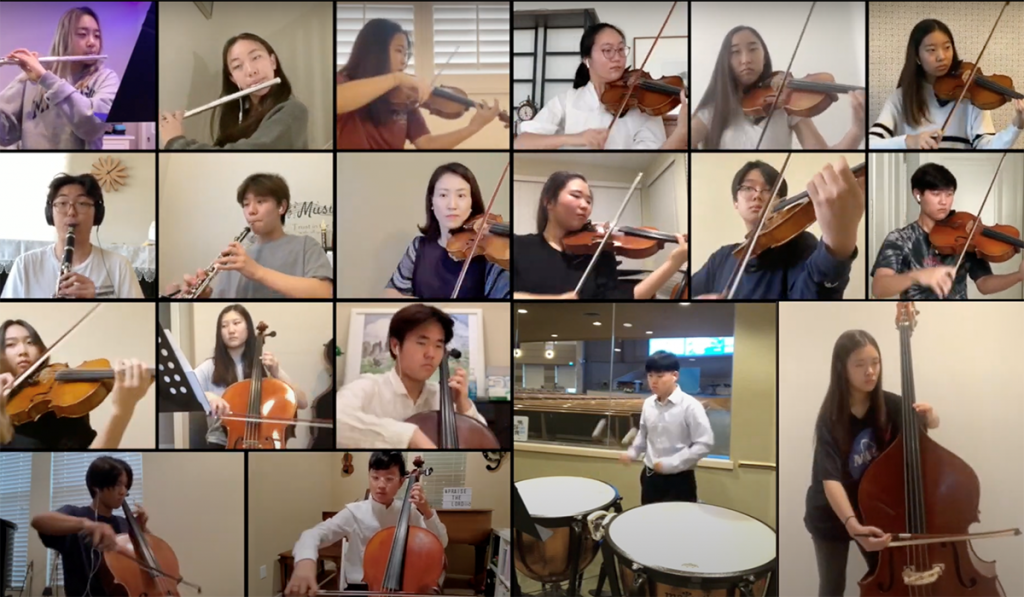
Bridge Club Global is also a student club organization I created when the pandemic first started. I was hearing in the news and hearing from different mentors I have about different shortages and lack of PPE in hospitals and nurses associations. We created, packaged, and delivered FDA-approved masks. There were over 5,000 sent to different nurses associations and hospitals in L.A. and New York. We also had a team of classical musicians, anything from violin to bass to flute, and we recorded a compilation of comforting music. The music was chosen to offer solace during the pandemic. I heard from a lot of doctors and nurses who have been experiencing low morale in their hospitals, which is very understandably true, and I think we were trying to offer some comfort.
What inspired the music component of Bridge Club Global?
I am a musician myself. I play the double bass. I think that’s why I wanted to include this orchestral part of Bridge Club because I personally experienced how great it is to be part of something like an orchestra. Hearing that music is really comforting, especially when I’m having difficult days.
Ina Kathy Chun, bottom right, plays bass in an orchestra that came together to record comforting music for doctors and nurses during the COVID-19 pandemic./ Courtesy Ina Kathy Chun
Can you describe the community garden service you started?
It’s called Green Gardens. We create community carbon sequestration gardens. They absorb carbon from the atmosphere and store it in the soil, which is great for combating greenhouse gases and carbon emissions, especially in southern California where we were having lots of wildfires. There was a wildfire that made me and all my 90,000 neighbors evacuate, so it’s really great to get in touch with the earth. We’ve been in those gardens while we’re doing carbon sequestration in the soil. We grow corn and radishes and we’ve been donating that to local food pantries.
What drives you to volunteer in so many different ways?
I think my relationship with my community is what primarily motivates me to do things like this. I’ve always been involved in my community, but I think making those relationships person-to-person, and seeing those impacts of what you’ve done and the community service you’ve done, make it really rewarding to me.
What have you learned through your experiences as a volunteer?
I actually learned so much from every single experience and every single meeting. I think definitely the kids at the foster youth centers have taught me so much, even just hearing the way they think about the world. I think having that sort of childhood innocence and that creativity they offer is really amazing and something I definitely learn from. They see topics in a different perspective or different light. When they tell me about things I teach them but they process it a little differently, it’s really interesting and pretty cool to hear how they view the world a little bit differently.
What do you want people to learn from your story?
Community service and service projects don’t necessarily have to be grand or intimidating or very established. I think any sort of positive impact you can have on your community is something that is worth trying. No matter how small the impact, if you’re having a positive benefit and a positive outlook on your community, then you’re doing something great with your time.
Neighbor Serves Neighbors with Essentials and Dignity through “Treasure Box Project”
Meet Daily Point of Light Award honoree Jaclyn Crawford. Read her story and nominate an outstanding volunteer or family as a Daily Point of Light.
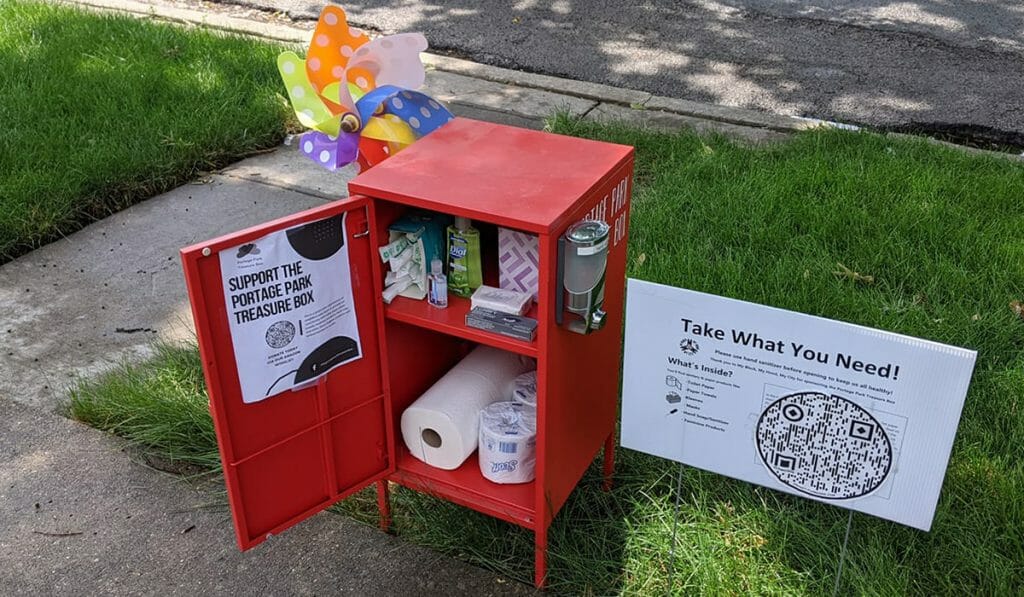
As essentials flew off the shelves at the beginning of the COVID-19 pandemic, Jaclyn Crawford knew she could help her neighbors with the extras she had on hand. First putting a metal storage box filled with basic necessities like toilet paper in her front yard, she continued to offer supplies months later, even after shelves were restocked, saying the need continued.
Officially launching the Treasure Box Project in March 2021, Jaclyn, a 31-year-old Chicago, Illinois resident, is serving her neighbors with essentials and dignity. From busy moms to families working to make ends meet, Jaclyn’s generous volunteerism is empowering her neighbors and helping to fill the gaps for her community.
What inspires you to volunteer?
I really love my neighborhood and Chicago. That’s at the heart of why I do what I do. It’s hard to find toilet paper and other essentials in food pantries. I saw a way I could help to fill that void in my community and I wanted to just do it.
What items can be found in your Treasure Boxes?
Toilet paper, tissues, hand sanitizer, toothpaste, deodorant, body soap, body wash and feminine hygiene products are some of the items we offer.
Describe your volunteerism with Treasure Box Project.
As founder, I do everything (laughs). I’m a one-woman operation. In addition to Treasure Boxes, we also operate a home delivery option for homebound individuals. I coordinate volunteers with deliveries being made, I store donations and fill boxes and I run events, from farmers markets to coffee shop fundraisers. Lastly, I manage our social media and promotion. We’ve distributed thousands of items thus far from Treasure Boxes around greater Chicago, and have delivered more than 300 boxes. Through service, we are offering important household supplies while preserving anonymity, dignity and respect.
As essentials flew off the shelves at the beginning of the COVID-19 pandemic, Jaclyn put a metal storage box on her front yard with supplies like toilet paper and toothpaste. / Courtesy Jaclyn Crawford
Share one personal story with me from your volunteerism.
One of my goals for the project is to keep things anonymous and give people dignity and respect. People will leave little notes at the box on my front yard, or thank you cards. I don’t necessarily want people to know my face, and want to help keep recipients anonymous, but that little card means I’m doing the right thing. That means the world to me.
Why do you think it’s important for others to give back?
As a community, we’re here for each other during a pandemic, or even outside of that. Volunteering makes everyone in your community successful.
What’s been the most rewarding part of your service?
It’s been rewarding to meet people in my community that I might not have met otherwise. I love the city of Chicago, and my neighborhood, Portage Park. I have met so many recipients and donors that I’m not sure I would have met otherwise. By volunteering, I’m a much better community member and I’ve made new friends and met new neighbors.
What’s in the future for your volunteerism?
The project will continue. If there’s one thing I’ve learned from this project, it’s that everyone needs toilet paper every day. I don’t see the need going away anytime soon.
What do you want people to learn from your story?
It doesn’t take a big organization to make a big difference. I’m one person and I’ve seen the impact just one box of home supplies on my front lawn makes. Don’t be scared to put yourself out there, go for it and do what your community needs.
In two words, what does volunteering mean to you?
Loving people.
How can readers help?
We rely on donations of basic necessities to continue the program. Please visit our website and Facebook page, or email us to find out how you can help.
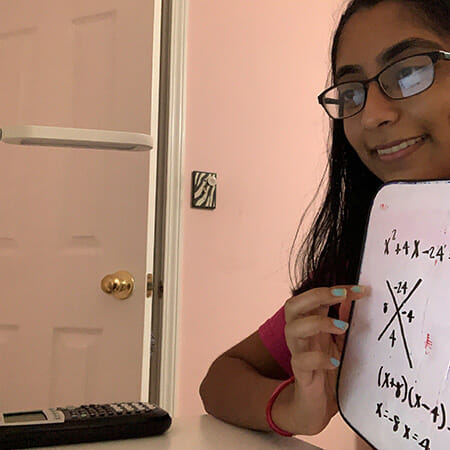
Jheel Druv believes every student deserves the opportunity to learn, regardless of their economic situation. After she herself was unable to afford the same SAT review classes as a friend, the Lilburn, Ga.-based teen was inspired to start a free tutoring program with the goal of making education accessible to all.
Last year, Jheel founded Tutoring4All, an international one-on-one tutoring program that connects students from kindergarten to college with tutors in subjects ranging from AP Biology to resume building. The volunteer tutoring team consists of about 50 students in high school and college, who have so far helped educate 150 students. Aside from running Tutoring4All, Jheel herself also tutors about four sessions a week.
Describe your volunteer role with Tutoring4All.
Tutoring4All a worldwide tutoring organization where we tutor students for free by connecting the tutors to the students. As founder, I manage the communications and online presence, and I also tutor and make the content for all the subject areas we tutor in. I also manage the summer bootcamps we hold for the summer. I also recruit the volunteer tutors, who are all students as well.
Jheel Druv tutors a student through Tutoring4All, the international tutoring organization she started./Courtesy Jheel Druv
What inspired you to start Tutoring4All?
My friend and I were talking once and she told me she was going to SAT review classes. I asked her how much they were because I wanted to participate in that too, for extra review. She said they were $1,000. I wasn’t in a situation where I could pay for this and I know this is a problem for a lot of people. Everyone deserves to learn so I wanted to share this opportunity with others, which inspired me to found this.
Can you describe the summer bootcamps?
We hold summer boot camps every summer. We have a boot camp for art, one for music, and one for math and science. You learn the foundations to the upcoming year’s content. It’s only available [for grades] K-8. A lot of students don’t really have anything to do in the summer, so I thought it would be a good idea to have that program for students to have something to do and learn something they’re passionate about.
Do you have any goals you would like to see the organization achieve?
A goal is to expand the tutoring even more. We are mostly here and in Canada, and a couple countries in Europe and India are participating in this. I want to grow even more to countries in Africa and Australia and South America. I want to grow our online presence and our organization and make it more known.
Why is making tutoring accessible so important to you?
I had a financial situation as well where I wasn’t able to pay for tutoring classes, even in classes I was struggling with at the time. I wanted for other people to have that for them and be able to learn and to have the same opportunities that people with more financial resources have. Everyone deserves the same, and everyone should be able to learn.
What’s been the most rewarding part of your work?
I love interacting with the kids and teaching all these subjects and making a lasting impact on their life. A lot of people are unable to pay for tutoring classes so through this, I hope they’re able to learn just as much. I might just be a part of their life for a little bit of time, but I hope what I teach them in those classes can help build a stronger younger generation.
Why do you think it’s important for others to give back?
I think volunteering is our purpose and we have to leave the world better. When we give back to others who are less fortunate, we learn how to support each other and build our communities.
What do you want people to learn from your story?
Do what you’re passionate about and try to leave the world a better place.
Texas Twins Double their Impact for Underserved Kids with “Mission BE A Resource”
Meet Daily Point of Light Award honoree Maya and Arjun Govindaraj. Read their story and nominate an outstanding volunteer or family as a Daily Point of Light.
Arjun and Maya Govindaraj say they knew millions were being impacted by the COVID-19 pandemic, and wanted to help in some way. “Even the littlest amount of help can go a long way,” says 14-year-old Arjun, who describes seeing long lines of people waiting at food banks in their community when the pandemic caused job losses and the closure of many important resources.
Launching Mission BE A Resource, Arjun and twin sister Maya, both 8th graders in Sugar Land, Texas, are helping children in need. Supporting food security, literacy and educational initiatives, Maya and Arjun have been joined by classmates, all volunteers aged 13 and under, as they unite amid a worldwide crisis to serve others.
What inspires you to volunteer?
Maya: No matter what your age, there are many ways to give back. Not every kid our age likes volunteering. I’m inspired to volunteer and hope other kids will as well.
Arjun and Maya say they knew millions were being impacted by the COVID-19 pandemic, and wanted to help in some way./Courtesy Mara & Arjun Govindaraj
Describe your volunteerism with Mission BE A Resource.
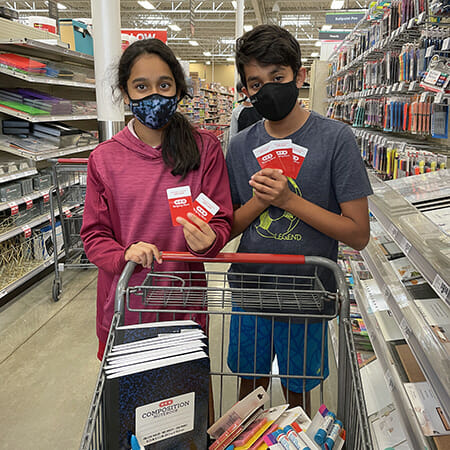
Arjun: My sister and I are both co-founders, I serve as president and Maya is vice president. We first started out as a club, and many friends and families donated money for us to help children in need. We are now a non-profit organization, and offer support through donations, grants and by volunteering our time. We’ve volunteered at everything from charity events to food banks, toy and book drives, to making care packages for cancer patients. We’ll stock up on items like school supplies, clothes and food and will donate those items to Rainbow Rooms, dedicated to serving the critical needs of abused and neglected children and adults. We’ve donated thousands of dollars worth of items thus far and have volunteered at organizations including Second Mile, Roserich Helping Hands, Teachers Aid at Houston Food Bank, Fort Bend Rainbow Room, Kids’ Meals, India House Houston, BEAR and Child Advocates of Fort Bend.
Share one personal story with me from your volunteerism.
Arjun: We were delivering food to a big line of dozens of cars waiting for us at an event. As we were steering shopping carts up to cars, a man approached us and said, “God bless you.” That made us feel really, really good. Volunteering makes me feel a bunch of empathy and compassion towards others. This experience just makes me want to do more, work harder and work longer.
Why do you think it’s important for others to give back?
Maya: Kids who go to good schools realize they’re privileged. When you see other kids that don’t have as much, and need food and clothes, that’s when you realize why it’s so important to give to others.
What’s been the most rewarding part of your service?
Arjun: The happiness is rewarding. Service really gives us a lot of drive to volunteer, and we end up volunteering a lot more because of that happiness. Instead of playing video games and sitting alone, me and my friends will go to the food bank and have fun volunteering.
In one word, what does volunteering mean to you?
Maya: Service. We’re helping children who are abused and giving to others who don’t have as much.
Arjun: Empathy.
When you’re not busy with school or volunteering, what do you do for fun?
Maya: I play tennis tournaments on the weekend. I also play piano and enjoy drawing.
Arjun: I usually play tennis and soccer. I also play piano like my sister and also play the drums.
What does the future of your volunteerism look like?
Arjun: I hope to be able to do more and bigger projects like Operation Christmas Child. I want to buy enough supplies and fill boxes for children all over the world.
How can readers help?
We rely on donations to support children in need. Please visit our fundraising page for more information about how you can give back.
Do you want to make a difference in your community like Maya and Arjun Govindaraj? Find local volunteer opportunities.