Massachusetts Teen Works To Improve Literacy Among Kids in Foster Care
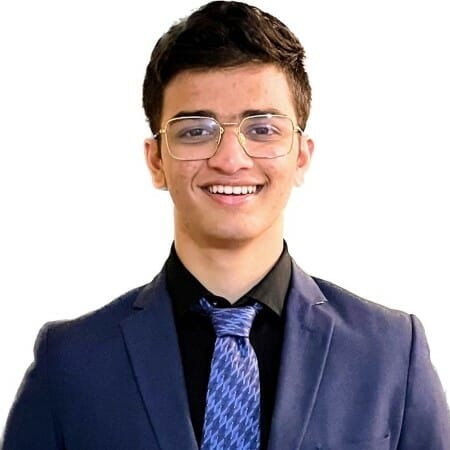
Meet Daily Point of Light Award honoree Shivani Gulati. Read her story and nominate an outstanding volunteer or family as a Daily Point of Light.
Shivani has been volunteering for as long as she can remember. She was about seven years old when she first heard about the foster care system, since her cousin was adopted through foster care. One of the very first things she learned about the foster care system is that some kids may not have backpacks for their schools. Instead, they may have to use trash bags to carry their books and supplies. This shocked Shivani, and shortly afterward, she began volunteering to collect backpacks, toiletries, school supplies and holiday gifts for kids in the foster care system.
What inspires you to volunteer?
Every kid deserves a chance. I discovered that nearly half of kids in the foster care system don’t graduate from high school and can fall into poverty and homelessness. The interactions I’ve had and stories I’ve heard about my impact in helping kids read energize me and inspire me to do more.
Describe your volunteer role with Small Words Impact.
I was volunteering at the Department of Children and Families (DCF) in Boston, helping to renovate an office, when I saw this adorable little four-year-old girl. Our eyes met, and she ran up to me, squeezed my legs and blurted out that she loved me. Then she went around the room and gave every other volunteer a huge hug and told them she loved them. She had just been brought in for emergency placement. It was heartbreaking to see this small child, so filled with love, without a loving family.
I noticed that this little girl loved all the books we had just organized, but she couldn’t read. Later, I learned from a former foster kid that he hadn’t learned to read fluently until he was a sophomore in high school. I started doing research and found that over 80% of third grade kids in the foster system are not reading on grade level. That inspired me to do what I could to boost literacy among foster kids, and I started a nonprofit organization called Small Words Impact. We work with pre-kindergarten and elementary school kids.
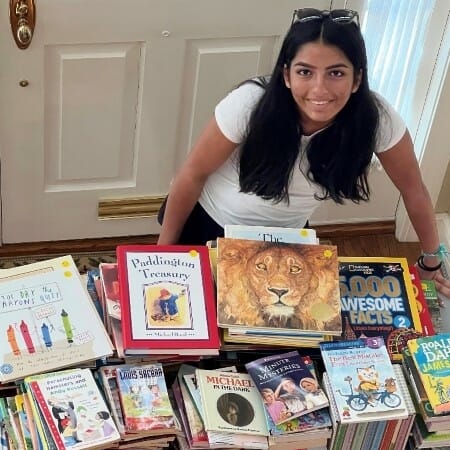
Shivani Gulati sorting books for distribution to kids in the foster care system./Courtesy Shivani Gulati
There are two building blocks to reading. The first is access to books, and the other is being read to. That’s why we take a two-pronged approach. First, we collect and distribute books. So far, my organization has collected over 50,000 books and distributed them among foster care organizations in 15 states.
Second, I wanted to give the kids the experience of being read to. I decided to record stories on MP3 players that the kids could listen to while following along with the book. I distributed the recordings through Hopewell, a foster care organization in Massachusetts.
I heard so many uplifting stories about the kids and the recordings! One little boy was so attached to his recorder that he wouldn’t let go of it. He even recorded himself reading the story and played it back to himself.
Today, we’re putting recorders in every DCF office in Massachusetts. These recorders are purchased with grant money I received.
My hope is that these kids will have the tools and support to read better, gain confidence and love reading and learning. It’s so hard to enjoy learning or catch up when they’re behind, which is why about half of all foster kids don’t graduate high school.
What has been the most rewarding part of your work?
By far the most rewarding part of my work is the interactions I’ve had with kids. I love hearing stories of my impact. I love hearing that I can make a difference and do something to support these kids. It energizes me to keep doing more.
What have you learned through your experiences as a volunteer?
I’ve learned that the most important thing is to take the first step. I didn’t start with many books or any recordings. I started with one book drive and a few books, and it snowballed from there. You don’t necessarily know where your volunteering journey will go, and that’s okay. People will appear to help you. So many people have stepped up to help after seeing the value in what I’m doing. Dream big, take the first step, and go for it.
Tell us about future partnerships, programs or events that you are excited about.
I’m working on an employment program with two large restaurant and fast food franchises in Massachusetts with the idea that foster kids who age out of the system at 18 and may not be prepared for “real life.” We provide them with a job, career path, mentorship, experience, to help them get a head start on adult life. Even if they don’t stay with the restaurant industry, it’s a great foot in the door into the working world.
We are also partnering with other organizations to teach life skills, provide tablets, offer mentorship and more.
Why is it important for people to get involved with causes they care about?
If someone is passionate about something, they’re doing a service to themselves and others by pursuing it. If you feel that one person can’t make much of an impact, it’s important to know that helping just one person can mean the world to that person. You are so much more powerful than you know. You are doing a service to everyone if you volunteer.
What do you want people to learn from your story?
I see myself still volunteering a decade from now. I hope to continue the work I do with foster care. I’m not sure what my career path will be yet, but I want to do something that will make a positive impact on other people’s lives.
Student Creates Consistent and Sustainable Ways to Mentor Youth During the Pandemic and Beyond
Meet Daily Point of Light Award honoree Sruthi Sentil. Read her story and nominate an outstanding volunteer or family as a Daily Point of Light.
The COVID-19 pandemic quickly made classes virtual for students of all ages during the spring of 2020. During the summer of 2021, Sruthi Sentil began mentoring students in foster care. She soon realized just how many kids were in need of connection to normalcy, and she decided to create BuddyKnit in 2021 to bridge the gap for young people across Florida.
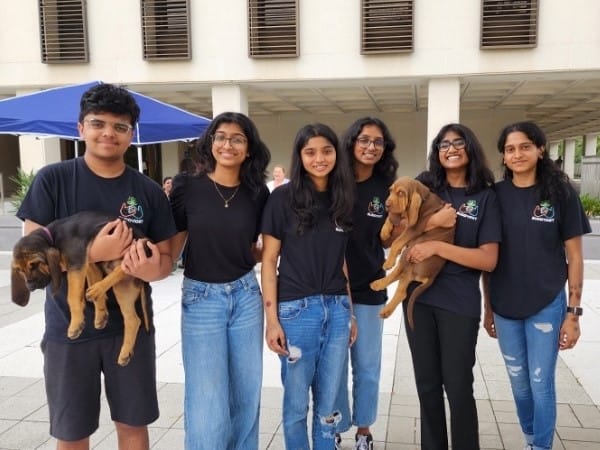
Peer connection uplifts and supports students of all backgrounds, said Sruthi. Equal access to traditional forms of academic support can be one of the most critical things in a student’s life. Sruthi’s leadership has impacted more than 250 volunteers and students with 80 long-term mentorship matches. At BuddyKnit, mentors generally meet with one or two mentees weekly or even twice a week — whatever works for both of their schedules.
“I just needed a volunteer opportunity, which is how I first got into mentoring, but once things picked up for me, I realized that there were so many kids that needed this type of support,” Sruthi said. “Case managers always had kids for me to take in, so I realized that there was no organization facilitating this connection between high schoolers and foster kids. I wanted to create that place,” she added.
From foster care kids and youth to students in homeless shelters and Title 1 schools, Sruthi’s BuddyKnit connects vulnerable kids in the community to relatable peers eager to provide normalcy and fun. As she enters her sophomore year studying computer science at Cornell University, Sruthi is transitioning out of her role as executive director to hand over more leadership to the organization’s executive board, who handle the majority of the day-to-day operations.
Sruthi’s leadership has impacted more than 250 volunteers and students with 80 long-term mentorship matches./Courtesy Sruthi Sentil
But in the early days of BuddyKnit, Sruthi had around four kids matched up with her as mentees. She also personally recruited mentors, matched high school mentors to youth participants, expanded the program to various school districts and wrote the organization’s grant applications. She also developed a web application that can now do the mentor and mentee matching on its own.
One of Sruthi’s grants that she received allowed her to start a robotics exposition initiative at BuddyKnit. Mentors and mentees were invited to spend the day in person at a partner school to create their own finished products. Sruthi hopes this new program will continue in the years to come.
“Our mentoring isn’t limited to just academics. We want to be there for our students in any capacity,” said Sruthi.
BuddyKnit has volunteers who simply play video games with their mentors or do art projects together — anything that makes them feel comfortable and offers them human-to-human connection.
Sruthi said that the most rewarding part of BuddyKnit so far has been being able to interact with people from diverse backgrounds and ages and that it’s prepared her for a future of advocacy. She shared that, while it’s not always easy to appreciate the immediate impact of your work when activities and meetings are virtual, seeing the fourth and fifth graders in a school cafeteria for the robotics exposition was a moment she really felt BuddyKnit come together.
“The BuddyKnit program has been great for my daughter. She’s been connected with a mentor who helps her with multiple subjects in school and is also quickly becoming a trusted friend,” said Lola G., a parent of a youth involved in Buddy Knit. “The flexibility to meet online has been great for our family. I’d definitely recommend this program.”
The now 18-year-old has learned many lessons throughout growing BuddyKnit, one of the biggest ones being what she calls “effective altruism.” It involves being goal oriented, but with character; it’s about spending your time and knowing it doesn’t have to be particularly productive — it just has to be time spent on becoming a better person.
Sruthi wants other youth to know that there are many organizations out there to get involved with. Instead of showing up to places out of obligation, she hopes to encourage people to dive deep into volunteering and making a difference in small ways. As a highschooler, it may feel intimidating, but Sruthi knows it can be done in ways that are mutually beneficial for the volunteer and the recipient.
When Sruthi first started mentoring, she realized that some kids did not want to be there; it was intimidating. But she knew they were going through a lot at home already. Just being a consistent source of support made the world of a difference.
“Any small step really does matter,” Sruthi said. “Even if you don’t see the impact at first, just know it’s there. Know it’s important, and try to push yourself to continue.”
Atlanta Area Youth Works to End Food Insecurity in Her Community With Thousands of Sandwiches
Meet Daily Point of Light Award honoree Katherine Kringelis. Read her story and nominate an outstanding volunteer or family as a Daily Point of Light.
Katherine Kringelis began volunteering with The Sandwich Project at the age of 12 to help fight food insecurity in her metro Atlanta community. TSP has distributed more than 850,000 sandwiches to people in need of food, and each week, Katherine assembles homemade sandwiches to deliver to one of 60 TSP drop off points across Atlanta.
For more than a year and a half, Katherine has made over 1,000 sandwiches. The fact that her sandwiches end up at someone else’s table motivates her to keep assembling food for others and hopes other young people will join her at TSP and give back at an early age when volunteer opportunities are hard to find.
What inspires you to volunteer?
The Sandwich Project benefits the brothers and sisters referenced in Matthew 25:35: “For I was hungry and you gave me something to eat, I was thirsty and you gave me something to drink, I was a stranger and you invited me in.” It’s such a fitting verse because it is not necessary to know the other person to know all that’s essential about how we should interact.
Describe your volunteer role with The Sandwich Project.
Sometimes we seek out opportunities, and other times they find us. My start with TSP was a mix of both. In March 2022, I became aware of TSP through Pebble Tossers, an organization that connects youth to service opportunities in metro Atlanta. At almost the same time, the Beta Club at my school announced a service project with TSP. With many new members like me having just joined Beta Club, making sandwiches was a great ice-breaker. TSP would play a similar social role for me a year later, when on my third day at my new school, the student body joined together to make 1,643 sandwiches for TSP.
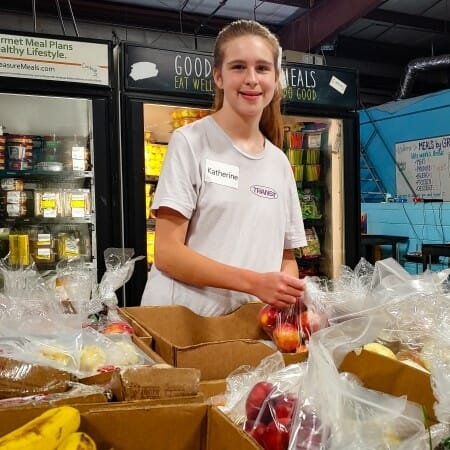
Katherine has made more than 1,000 sandwiches with The Sandwich Project./Courtesy Katherine Kringelis
Every Tuesday or Wednesday, I make sandwiches at home, following the instructions provided by TSP. The sandwiches are then taken to a local host who collects them via contactless dropoff on Wednesdays. On Thursdays, the host takes them to a local charity or TSP sends a driver to get them. The charities then distribute the sandwiches around the metro area. Through its network of 4000 volunteers, TSP has collected over 1 million sandwiches in metro Atlanta since 2020.
What has been the most rewarding part of your work?
On my first day of volunteering at a local food pantry, my first task was a most unexpected one. Instead of stocking shelves for shoppers, I was tasked with removing expired bread and bagging it for a local farmer who regularly collects expired food from the pantry to feed his pigs. I certainly did not have that on my bingo card! With the pantry open to shoppers only on Wednesdays, sometimes perishable donations, like bread, have to be discarded. At the end of another shift, there was lots of bread that would go bad over the next week. Yet, I knew that the TSP network would be in the community the following day distributing its sandwiches. With the blessing of the pantry staff, I took a box full of baguettes and bagels to the TSP host when I dropped off sandwiches that evening. It was such a simple act but was quite fulfilling to match surplus with need and sparked my curiosity about other match-making opportunities that might exist.
What have you learned through your experience with TSP?
My experiences as a volunteer have taught me the importance of balancing long-term solutions with immediate actions. Initially, my focus was on addressing the root causes of various issues. For instance, during a service learning project at school, we tackled the problem of clean water scarcity in South Sudan by raising funds to build and repair water wells. For my Girl Scout high awards, each project has to be designed as a sustainable solution. Teaching a man to fish, as they say, feeds him for a lifetime.
However, many of the world’s challenges are complex and have persisted for centuries despite the efforts of well-intentioned individuals. While addressing the underlying causes is crucial, there are also immediate needs that require our attention and action.
My work with TSP has been a reminder of the starfish story, in which a beachcomber is faced with thousands of stranded starfish. While unable to save them all, the beachcomber starts tossing them, one by one, back into the safety of the ocean. Like that beachcomber, in making sandwiches, I am doing for one what I wish I could do for all.
What are your goals for The Sandwich Project?
I want to do my part to ensure that TSP can continue operating, which for me means focusing on food safety. I make sandwiches in small batches so that supplies can stay refrigerated as much as possible, and always use a cold cooler in the car from the store and to the host.
I hope that TSP can retain its simplicity, as I believe that will help sustain engagement from current volunteers and enable growth. I would love to see TSP expand into other cities so that it can help channel the energy and resources of local volunteers to their neighbors in need.
Why is it important for others to get involved in causes they care about?
Each of us has unique gifts and talents, all of which are needed to fulfill our potential as a community. Who knows what could be accomplished when we gather together to focus on what matters.
In tackling today’s great social challenges, we could borrow the reasoning from JFK‘s famous moon speech. We can choose to do these things, “…not because they are easy, but because they are hard, because that goal will serve to organize and measure the best of our energies and skills, because that challenge is one that we are willing to accept, one we are unwilling to postpone, and one which we intend to win…” Hunger would not still exist if solving its root causes were easy, and yet solving it is a goal we intend to win.
In the meantime, though, we can be a light for neighbors in difficult circumstances. For the food insecure, a win could be as simple as buying some extra groceries, making a sandwich and sharing it with a neighbor in need.
What do you want people to learn from your story?
I hope to inspire others to take action by showing how simple it can be to make a difference. I would love for those who live in Atlanta or Minnesota, where TSP operates, to join in making sandwiches for TSP, either at home or together in groups, or even to become a host. For those who don’t live near TSP, there are dozens of ways to address food insecurity, such as volunteering at or donating to a local food pantry. Or maybe your passion lies elsewhere. Discover what breaks your heart and commit to working towards resolving that issue. Don’t be deterred if the challenge seems overwhelming. As Ronald Reagan wisely stated, “We can’t help everyone, but everyone can help someone.”
Air Force Veteran Gives Selflessly to Support Female Veterans
Meet Daily Point of Light Award honoree Lianna Garcia. Read her story and nominate an outstanding volunteer or family as a Daily Point of Light.
Content Warning: Points of Light is proud to share the following uplifting and inspiring story. However, we acknowledge that a small portion below may be difficult for some readers. We encourage you to please care for your own wellbeing above all.
Lianna Garcia is originally from Robstown, Texas, a small town near Corpus Christi. After graduating from high school, Lianna went to college but by her second semester, she found herself heading down a path she didn’t like. One day, while driving down the freeway, she spotted an Air Force recruitment sign. She made an impulsive decision and felt joining the military would be a great way to turn her life around. She drove up to the recruiter’s office and walked in. A few hours later, she walked out, enlisted in the United States Air Force.
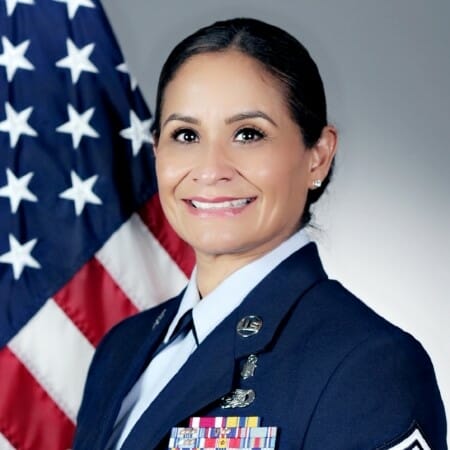
Lianna served as an Air Force Security Forces Officer for four years. After she completed her enlistment, she found herself wishing she had stayed. She happened to run into a friend who was in the Air Force Reserves. Something resonated, and she rejoined the Air Force, this time serving in the Reserves for thirty-three years. She recently retired as a First Sergeant/Senior Master Sergeant.
For nearly the last decade, Lianna has brought her history of service to her volunteerism with The Pink Berets, an organization founded to support female veterans suffering from invisible injuries such as PTSD, Military Sexual Trauma, and Combat Trauma Stress. Read on to learn how Lianna is working to find innovative solutions to challenges facing female veterans.
What inspires you to volunteer?
I wanted to give back to my fellow veterans and use my experiences, both good and bad, as a way to provide support and resources. I’ve always had a sense of wanting to give back. I’ve had plenty of volunteer opportunities throughout my life beyond the Pink Berets. I have volunteered at food banks and Habitat for Humanity for years.
The heartfelt emotions I witness and the genuine gratitude in people’s eyes inspire me deeply. Even the smallest gestures I make can hold immense significance for the individuals they touch.
Lianna Garcia, volunteer and board member of The Pink Berets./Courtesy Lianna Garcia
Describe your volunteer role with the Pink Berets.
The Pink Berets were created for female veterans who are suffering from invisible injuries including military sexual trauma (MST), traumatic brain injury (TBI) and post-traumatic stress disorder (PTSD). Many women have had negative experiences and carry emotional wounds for the rest of our lives whether they were in a combat situation or not. There aren’t many outlets for our women veterans. Some are homeless, some have mental health issues, some are single moms, some are suffering from physical and emotional trauma, and we help them all. Everything the Pink Berets offer is at no cost to the veterans. We offer personal and group therapy, culinary therapy, equine therapy, service dogs, events, retreats and a variety of resources. We help on a local level but also advocate for change.
My role as a board member and 9-year volunteer is to help with operations and to continue to develop our vision and goals on an annual basis. I help coordinate events and support our CEO.
During the time that I have volunteered with TPB, I have had the opportunity to work with our veteran community in many different capacities, most importantly in MST survivor care and support. In my current role, I have been uniquely equipped to understand the lived experiences of those who have served our great nation as I recently retired from a 33 year commitment to my country as an Air Force First Sergeant. The knowledge I provide is invaluable as you challenge everyone to dig deeper for solutions that will work at all levels of healing. I have the heart, passion, lived experience and mind to be able to truly support those efforts to ensure all who engage with TPB feel safe, supported and welcomed.
What has been the most rewarding part of your work?
Believing that we make a positive impact on the people we touch. Food drives, school supply drives and more. The women who come to us have legitimate and pressing needs. They are incredibly grateful for the help and support we provide. It’s a sisterhood belonging. We help to heal and empower our veterans to reintegrate them back into society and move forward.
In 2015 I had just come back from deployment, so I know what many of our clients are going through. I have personally used the Pink Beret resources to help myself heal. I’ve used counseling, retreats, equine therapy and various tools and resources, and now I’m in a position to help facilitate a safe space to acknowledge feelings, emotions and experiences and help women heal and move forward.
I strongly believe in pushing the narrative to develop innovative solutions to a decades-old problem of addressing PTSD and MST in women veterans. We have effected change and that is very important to me.
What have you learned through your experiences as a volunteer?
You never know what the person who is coming to you for help has experienced. If you can help them heal, offer support, empower them and help them, you have done a good thing. It doesn’t matter if what they need is “small” or “big,” for them it’s exactly what they need.
Are there any future partnerships, programs or events that you are excited about?
I’m looking forward to a Texas hill country ranch retreat for female veterans in October and November where we’ll have equine therapy and tons of opportunities to help each other.
We are planning a 2024 Women Veterans Cruise, June 10-14, 2024. Our lady vets can register for $175 per person and pay the remaining balance in early 2024. Registration and pricing information can be found on The Pink Berets website. I’m really excited and looking forward to this event. We do so many things. If anyone is interested they can go to our website and sign up for support, our newsletter, volunteer opportunities and membership.
Why is it important for people to get involved with causes they care about?
Volunteering teaches you the value of compassion. It teaches you to be nonjudgmental because you never know where people have been. I try to get my 14-year-old son involved. To me, community is people helping people.
For me, it’s important to bring awareness of what our women and men veterans go through and get people involved in helping them heal and overcome challenges.
What do you want people to learn from your story?
You don’t have to go through it alone. There are people who honestly want to help and support you. Don’t be afraid to ask for help. Don’t fight your battles alone. Regardless of what you’re going through, there are always people who want to help.
If you or someone you know may be struggling with invisible injuries such as PTSD, Military Sexual Trauma or Combat Trauma Stress, reach out to The Pink Berets. For specialized support with a variety of mental and physical health the VA Department of the U.S. offers Make the Connection, a website with resources for veterans and their loved ones.
Middle School Pageant Queen Fights for Sustainability and the Well-Being of Special Needs Students
Meet Daily Point of Light Award honoree Nicole Hahagutchi. Read her story and nominate an outstanding volunteer or family as a Daily Point of Light.
Nicole Haragutchi is a busy 11-year-old. She loves singing, playing piano, drawing, spending time with family and participating in pageants. As an introvert, Nicole credits her involvement in pageants and volunteer service through her resulting foundation with building social skills and confidence. Her foundation, If You Can Dream, focuses on environmental initiatives and helping students with special needs.
With family heritage in the Philippines, Japan and Brazil, Nicole has spent time in each place visiting kin and volunteering along the way. Earlier this year, she visited the latter two countries. Passionate about her heritage, she can rattle off a welcoming phrase in Tagalog, one of three main languages of her mother’s home country. Her multiple concurrent projects include saving endangered species from extinction, creating sustainable food production methods and donating to help children with special needs.
As a fan of STEM projects, Nicole is also working on learning to code, with the goal of creating a game that teaches people about sustainability. One of the ways she funds her foundation is with award money from STEM projects. In her attempt to create a self-sustaining world, she has nearly done the same with her service. Nicole, with her strong determination and impressive skills, is leaving a lasting legacy of kindness in just over the decade she has been alive.
What inspires you to volunteer?
When I started my foundation, I saw problems like floods, typhoons, wildfires and hunger, and I wanted to help solve them. The main issue is climate change, so I started working on sustainable food production and farming. I also work with many people around the world on the Call to Action, which spreads awareness of endangered species. I started all this because I wanted to help make our planet a better place for everyone.
Describe your volunteer role within your foundation’s different projects.
There are a few projects I’m working on. The first is to save the araucaria angustifolia, a tree native to southern Brazil, from extinction. It’s very important to the local culture, previously for lumber and now, for the piñon (seeds), and it’s one of my favorite foods. After doing some research, my Brazilian ambassador and I organized a series of planting events to raise awareness. Tying in my foundation’s other mission, I contacted a local student with special needs to be the face of the project. And I was the point of contact for the press.
Nicole Haragutchi, founder of the If You Can Dream Foundation and driving force behind multiple environmental initiatives./Courtesy Nicole Haragutchi
Myfoundation has many ambassadors, so when I wasn’t able to go help with the planting events because I was in school, they were able to move forward. I contacted the mayor there to plan. We all worked together.
That led to Project Extinction Call to Action, an initiative to raise awareness of other endangered species by teaming up with organizations and individuals in Brazil, the Philippines and Florida. We ran campaigns for the tarsier, the blue macaw, the pink dolphin, the giant anteater and the manatee. We’re also getting ready to study the effects of climate change and the potential for a sixth mass extinction. I developed the homepage for the project and coordinate with our contacts. And I’m preparing to use to enter a couple of competitions in hopes of securing funds for my other programs. I’ll be presenting my findings at the Global Innovation Field Trip International Conference.
As part of the project, my friend Ashweja and I are working to find a way to remove excess sargassum that hits the coast of Florida each year. It interferes with the manatees’ food supply and sometimes suffocates them. We want to turn it into something useful, so we ran an experiment to convert it into bioplastic that dissolves in water. I talked to the owner of a company that makes bioplastic bags about how we can use this, and he gave me a lot of tips. We’re talking about starting a podcast.
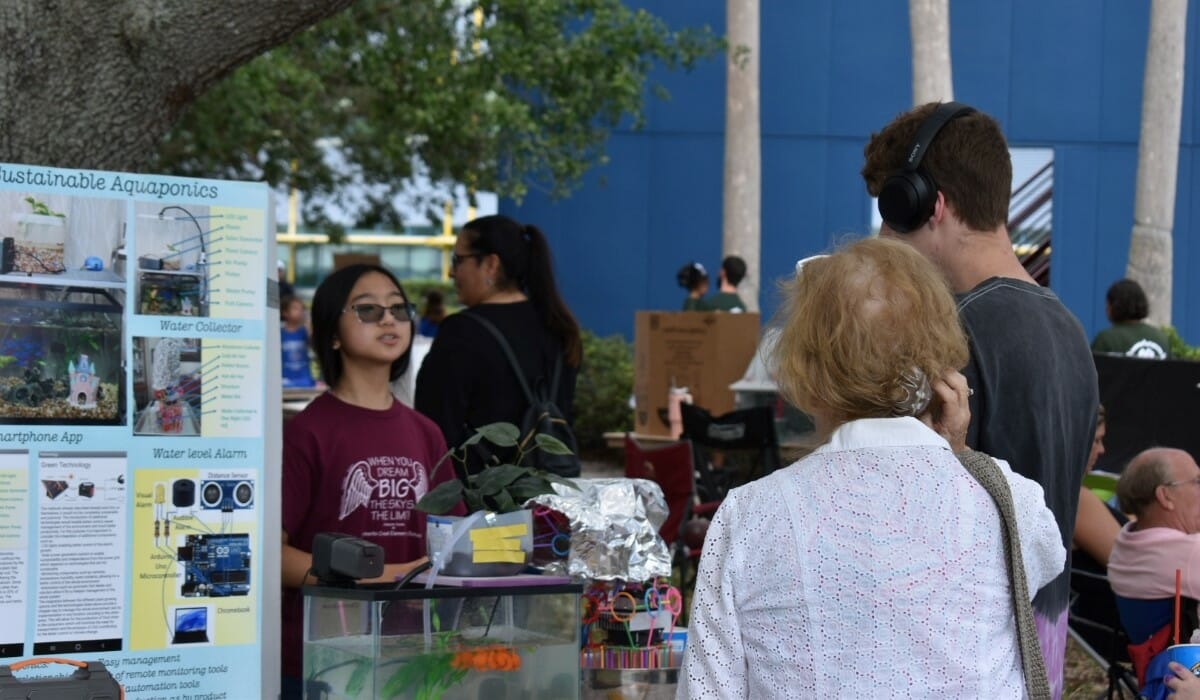
The third project uses modern food production methods integrated with green technologies to make them sustainable. We create different prototypes of aquaponics, hydroponics, sprouting, microgreens and fungi which uses a fraction of the water normally used in traditional food production by using water in a closed circuit. Prototypes utilize devices that capture water from the air, reduce water waste and chemical runoff, allow remote monitoring and automate actions with green energy and elements of AI. I’ve worked with contacts on Lakota and Guarani Indian Reservations in South Dakota and Brazil—and a special needs school in the Philippines—to replicate these growing methods and test feasibility in different locations with success. Everyone is learning. And I created an Android app to facilitate that.
The main project and objective of my foundation is to make dreams come true for students with special needs. We’ve sent someone from Brazil to Disneyworld. We’ve given people books and a bicycle. Recently, we delivered food baskets to children in the Cayayan Valley region of the Philippines. I contact recipients, raise funds and deliver donations or coordinate delivery through foundation ambassadors. I’m also working with the Tagaytay City Special Education center to provide resources.
What’s been the most rewarding part of your work?
It’s how you feel inside. When you help a person and make someone’s day, like giving food to students with special needs, it’s heartwarming. I felt this warmth in my heart, which made me want to do more for the world. It motivates me to help more. It keeps me going.
What have you learned through your experiences as a volunteer?
I’ve learned to be more open-minded and more responsible. It’s also helped me be kinder. Before I started volunteering, I had social anxiety; I wasn’t able to talk to people. But after volunteering, I started to feel more comfortable and could better see what help people needed. My pageants also helped me a lot with talking to people and not being nervous.
At a scholastic fair, Nicole showcases her sustainable food production design project./Courtesy Nicole Haragutchi
Are there any future partnerships, programs or events that you are excited about?
I’m looking forward to mentoring more schools. I’m also working on making a sustainability game on Roblox studio so people can learn more about being sustainable.
Why is it important for others to get involved in causes they care about?
If we don’t do anything, we might go extinct. In my area and probably other areas in the U.S. and Europe, there has been a heatwave this summer. And this is happening because of climate change. I want us to slow down or stop this so we don’t become the sixth mass extinction, and we can all make our world a sustainable place where we can all survive.
What do you want people to learn from your story?
Always be sustainable and think of your day-to-day actions. When you’re leaving a room, turn off the light. While you’re brushing your teeth, turn off the faucet. And take shorter showers or, when it’s hot, use colder water. You might think this won’t do much, but it helps. And take small, kind actions. Help a person at school with their books or their homework. Put a smile on their face, and you’ll feel the warmth in your heart. Be kind and learn to be sustainable so we can all help make the world a better place for everyone.
Volunteer Dedicates Her Time Making Her Hometown Beautiful
Meet Daily Point of Light Award honoree Nancy Hardigree. Read her story and nominate an outstanding volunteer or family as a Daily Point of Light.
Nancy Hardigree is the fifth generation of her family to live in Hartwell, Georgia. She’s proud to be part of a long line in the town, and she describes Hartwell as “an old southern town” that has always been very welcoming and open to change. In 1982, Hartwell elected its first female mayor, Joan Saliba to whom Nancy credits much of Hartwell’s current success. Mayor Saliba created a Historic Preservation Commission and a Downtown Development Authority, both of which Nancy has been a member of since their creation.
Since then, Nancy has been an integral part in helping Hartwell stand out among neighboring towns. Even with its meager population of about 5,000 people, Nancy says that the town really has been able to shine due to the local organizations created to make the downtown special. Her favorite part of her volunteer role is working on the town’s Main Street and finding ways to make storefronts more inviting. But whatever she is involved in, it’s the other people that make the biggest impact on her.
“Nothing I have accomplished has been without the help and guidance of many, many other volunteers and staff people,” Nancy says. “These relationships are as precious to me as our beautiful and vital downtown.”
What inspires you to volunteer?
I guess I was brought up that way, and I’ve saved a lot of things from my family’s past. I still have my grandmother’s PTA minutes from when she was the secretary of the local PTA. My grandfather was the county school superintendent. My father was always involved in Kiwanis, and he was a commander of the Veterans of Foreign Wars during the Korean War where he would have to preside at the funerals when the boys would be sent back home. I just always had this feeling that you give back. If you want your community to thrive, you’ve got to get out there and work. It’s not going to just happen. You can’t sit on the sidelines and complain about things.
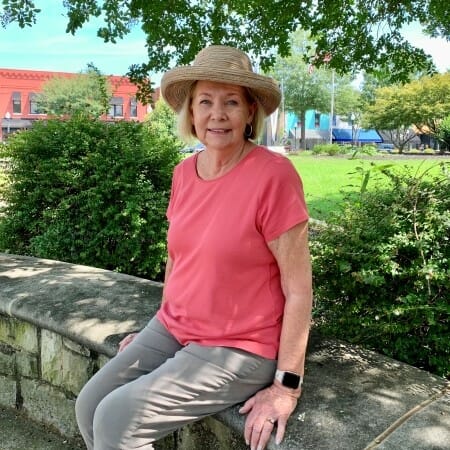
Nancy Hardigree is very active in the revitalization of Hartwell’s historic downtown./Courtesy Nancy Hardigree
Describe your volunteer roles with the city of Hartwell?
I was very much involved in the conception and the very first stages of quite a few things in the city. Since the late 1980s I have enjoyed being involved in many aspects of downtown development and revitalization through the City of Hartwell’s Downtown Development Authority (DDA) and later the Main Street program. It has been a joy to see our sleepy little town transition into a flourishing tourist destination.
In the late 1990s, I assisted the DDA director as a major support person in obtaining federal funding for a massive streetscape and courthouse grounds landscape project. In this capacity I helped coordinate city and county government’s needs and funding responsibilities. This also involved many design consultations with the municipal contractors. I also chaired a campaign to sell twenty park benches to individual families in memory of loved ones.
Then, you know you’re old when you’re on the cemetery board (laughs). I was asked to be on the cemetery board, and it’s a historic cemetery – lots of people were buried there in the 1800s. The cemetery committee was really created to maintain the cemetery, but there was lots of interest and people wanted to be buried in it. However, there wasn’t any more land to sell cemetery lots. So, we created a columbarium garden. We had a civil engineer, a lawyer, a guy who was a retailer and my role was landscaping. It’s lovely, I’m very proud of that.
Also, a friend wanted Hart County enrolled and involved in the Dolly Parton Imagination Library. We created a community action team. We’ve got 800 kids in Hart County and they get a free book in their mailbox every month. That’s been very fulfilling.
Additionally, I helped with the starting of a YMCA here in Hartwell, which is unheard of in a town the size of 5,000 people. I work at the food pantry and I’m in the garden club – I just have always enjoyed being involved. You meet so many interesting people.
What makes Hartwell so special to you?
I guess I could say it’s all I’ve ever known. I’ve always been happy here. I had a nice childhood and coming back into Hartwell [after college] I got involved and I have just enjoyed it. I feel a real sense of home and I’ve always wanted the best for my hometown.
What’s been the most rewarding part of your work?
Well, our city has exploded, and we’re sort of the envy of surrounding towns. During COVID the streets were full of people because they moved out of Atlanta. Their kids weren’t in school and they moved to their lake houses. Then, it seemed like they ended up thinking, “Hmm, you know, the school systems here are pretty good, maybe we’ll just move here.” I think we put so many things in place to enable the growth to happen and the prosperity of the town. So that has to be the most fulfilling part.
What have you learned through your experiences as a volunteer?
Every project you’re involved in, you pick up a set of skills. I was an interior design major, I’ve always liked design, but never knew much about architecture or building. So, I learned those skills through my work with historic preservation. And when I was working with the DDA, we had to match this federal grant that we got and we were working with politicians going back and forth to all these council meetings, city council meetings, county commissioner’s meetings – that experience was eye opening. It made me realize how difficult it is to get anything done.
If you put yourself out there, there’s going to be a skillset that you’re going to have to educate yourself about and, in order to be effective, you’ve got to learn.
Are there any future partnerships, programs, or events that you are excited about?
A great resource for Hartwell and Hart County has been the University of Georgia’s Archway program. It connects you with graduate students. We’ve got a Railroad Street project, which is on a back street, and because I’m involved with the façades and historic preservation, the backs of the buildings are exposed to this new railroad street park. We’ve been trying to figure out how we could help the store owners with money, like the façade grants, and also help give direction, because there are city regulations that you’ve got to adhere to. So, we called Archway in to help us with that and this will be a student’s project, to come up with a design.
Why is it important for others to get involved in causes they care about?
Oh, it’s one of life’s most fulfilling things. If you can just get yourself out there, get into your community, learn about what’s going on, enjoy people and you will make relationships that last forever. Open yourself up to opportunities that you can help people and you will get fulfilling things back. You know that just is kind of what makes the world go around.
What do you want people to learn from your story?
Giving back to your community – your community benefits from it, but you benefit from it as well, if not more.
Do you want to make a difference in your community like Nancy? Find local volunteeropportunities.
Volunteer Photographer Turns His Hobby into Service, Teaching Families How to Capture High-Quality Memories of Their Own
Meet Daily Point of Light Award honoree Lu Li. Read his story and nominate an outstanding volunteer or family as a Daily Point of Light.
Lu Li’s love for photography blossomed during his childhood in China. However, it wasn’t until he reached his 30s and made the decision to immigrate to the United States in 2000 that his hobby truly flourished. Upon settling in his new home, he eagerly purchased his very first camera and began to teach himself the fundamentals of photography through YouTube tutorials and other online resources. With years of practice, he honed his skills, transforming mere snapshots into captivating, high-quality images that capture a moment and preserve it forever.
In 2017, Lu elevated his beloved hobby into a way to serve others. His daughter was enrolled at the Main Line Chinese Culture Center’s weekend school to explore her Chinese culture, so he started shooting pictures and video at different events and activities held by the organization. MLCCC is a nonprofit organization located in Malvern, Pennsylvania, that runs a weekend school and summer camp to teach Mandarin as well as classes in Chinese culture and traditional art forms to help young Chinese Americans connect to their roots.
“The first time I took a lot of photos for the school was during its Chinese New Year Gala,” Lu said. “I took many photos of the performers and the audience, and I shared that with the whole community. So many parents loved the photos and they asked, ‘Can you start a class to teach us how to take photos?’ So that gave me the idea to start a photography club.”
Lu’s Club 166 teaches parents how to use a camera, compose a shot and edit photos, so they can capture high-quality memories of their own./Courtesy MLCCC
Named Club 166 after the classroom they meet in, every Sunday while their children learn Mandarin and other cultural lessons, the parents learn about photography from Lu.
“I teach them how to use the cameras and how to use photo-editing software,” Lu said. “But most importantly, I share my experiences with them of how to catch that beautiful moment. Of course, you can capture a higher-quality picture if you have a better camera. But I show them that it’s not about the quality. It’s the content of the moment that makes a photo beautiful.”
Because of Lu’s Club 166, which he has taught for nearly seven years now, it’s not just Lu who is offering free photography services for the community.
“Just like I have done for many years, there are now more people who are taking high-quality photos freely for the whole community, such as passport photos, family photos and professional headshot photos,” Lu said.
With his team of newly trained photographers, Lu captures photos and videos of all the fun and precious moments that happen at MLCCC such as new students arriving on the first day of school to parents practicing their Tai Chi moves.
Five years ago, Lu started sharing his expertise with MLCCC’s Junior Journalist Class, which allows young students to practice speaking Chinese while also learning the important journalistic skills of interviewing others and talking to a camera. With Lu behind the camera, students interview teachers, parents and other students to create a newscast-type video or vlog recapping an MLCCC event. For those who are camera shy, but still want to show off their interviews or Chinese language skills, Lu created the MLCCC Podcast where they can do exactly that in an audio-only format.
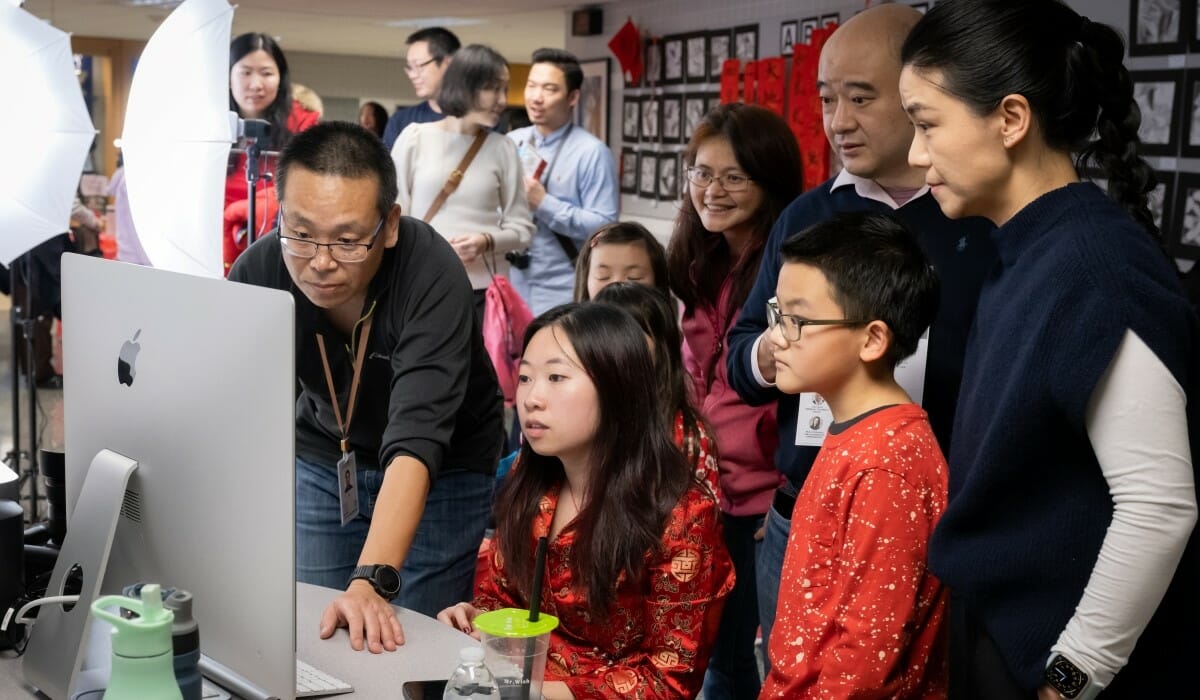
Lu shows a family a preview of the photos he took of them at the 2023 MLCCC Spring Festival Gala./Courtesy MLCCC
On top of all that, Lu also leads a cycling club during summer break and a tennis club during the spring and fall so that parents who are waiting for their child to finish classes don’t just sit around on their phones but use that time to get active.
“Lu is such an inspiring person,” said Qunbin Xiong, former School Principal at MLCCC. “He’s always helping the school design programs and organize our annual community events. His dedication and willingness to help has an influence on other people, young and old, to be a better person and make the community a better place for everybody.”
Lu hopes his story inspires others to find their own way to volunteer.
“You might not be good at taking photos or you may not like playing tennis,” Lu said “But you can do other things to volunteer based on your own interests and hobbies. Just a little bit of volunteering can make a big difference.”
Kentucky Teen Expands AI Technology for Social Good
Meet Daily Point of Light Award honoree Shraman Kar. Read his story and nominate an outstanding volunteer or family as a Daily Point of Light.
Artificial intelligence (AI) is transforming nearly every industry. High school student Shraman Kar has always been passionate about computer science. At a young age, he became interested in competitive math and, as a sixth grader, began working on a project that would automate his irrigation system in his garden. It was through the process of figuring out how to estimate ideal water flow that Shraman became interested in artificial intelligence. He soon discovered the immense potential of AI to solve real-world problems. At the same time, he became frustrated by how inaccessible the technology was to young people. Wanting to democratize AI and make it accessible to anyone, Shraman launched Community AI, a nonprofit that educates young people and helps them create their own AI projects for social good. Since its founding, Community AI has reached over 1,200 young people in 58 countries, tackling issues from disease monitoring to school safety.
Read on to learn how Shraman is leveraging new technology for social good.
What inspires you to volunteer?
I am motivated by helping others and representing others who face challenges. Growing up, I didn’t attend an affluent school. I have several friends who experience food insecurity, so it has always been important for me to help others. I became aware of the problem of food waste, and started donating food I collected in the neighborhood to a local food bank.
This in turn sparked the idea for “Foodle,” which predates but is now a part of my Community AI organization. Foodle helps automate the process of donating food. It matches donated food with recipients who need it. What’s amazing about Foodle is that it makes it easy for people to donate food. I believe that most people don’t want to waste food, but they throw it away because it’s the easiest thing to do. Up until now, it hasn’t always been easy to donate food. Foodle is an app with a smart basket. Someone places a food item into the smart basket, and the app automatically notifies a food bank and other “Foodle” users that need that item. Best of all, the food banks will pick up the donated items.
Shraman Kar, Founder of Community AI./Courtesy Shraman Kar
Describe your volunteer role with Community AI?
I am the founder and CEO of Community AI. I help run the summer camps, workshops and help guide students/members to create their own AI projects for social good. We do several AI events throughout the year, like an annual AI Fair called “Sustainability and Community AI Fair,” where students showcase their community- and environment-focused technology projects to industry leaders and get funding from Community AI. We raised more that $50,000 to provide funding for excellent projects and to provide scholarships to students from low-income households to create projects without any financial burden. We also host AI talks where Articifial Intelligence leaders from industry and academia share their experiences with our members. Community AI is student-led organization for youth and includes advisors and mentors within the community.
I am also involved in developing and beta testing Foodle. So far, Foodle is currently available in the Louisville, Kentucky, area. We’re still in beta testing but the app is simple to use and has amazing potential to scale worldwide. Foodle is one of the driving factors of Community AI and the perfect example of using technology for social good.
I also wrote a book that discusses how to use the new generative AI technology in a responsible fashion.
What’s been the most rewarding part of your work?
Right now, I feel that Artificial Intelligence has a negative sentiment around it. However, it has so much potential to be used for good. It’s so rewarding that our members see the potential of AI for social good. Across the globe, Community AI members have created amazing AI projects to impact their communities. And there are a lot of us! We have over 1,200 members, mostly high school students, in 58 countries and we are planning on expanding into other countries as well.
What have you learned through your experiences as a volunteer?
I have learned the importance of inclusion and diversity. Currently, AI technology can be inaccessible since it’s complex to learn. We believe it can be made simpler to learn. This can be life-changing for high school students, especially those in a lower socioeconomic status who are filled with creativity but maybe lack math and science skills to create their own AI projects. Democratizing AI is the best way forward for this technology so that it doesn’t continue to be dictated by a select few. Democratizing AI can leverage its power for social good.
Are there any future partnerships, programs, or events that you are excited about?
We are looking forward to our next AI Fair, where people in the community and Community AI members will showcase their AI projects. Examples of past socially responsible AI projects include a project that helps separate trash; a project that monitors Parkinson’s Disease through a wearable device; and a project that enhances school safety by identifying weapons. We are proud to be partner of Schneider Electric and University of Louisville. We are also recognized by Google and Microsoft as their nonprofit partner.
There are also some AI workshops coming up this winter and next summer.
Why is it important for others to get involved with causes they care about?
Anyone can make an impact and enforce the changes they want to see in the world – make the world how they envision it.
What do you want people to learn from your story?
No goal is unreachable. If you have a vision and motivation and work hard, you can do anything you want. For me, technology married with humanity and creativity has an incredible potential to help worldwide.
College Student Raises Service Dogs and Advocates for Those Who Need Them
Meet Daily Point of Light Award honoree Lexi Kruger. Read her story and nominate an outstanding volunteer or family as a Daily Point of Light.
Lexi Krueger loves dogs. Growing up with multiple pups at once, freshman year of college was the first time in her life she lived without a four-legged friend. In another first, she has recently moved out of Maryland for the first time to set up in Boston for medical school. While her two German shepherds, Dexter and Poppy, will stay with family, Lexi won’t be living alone.
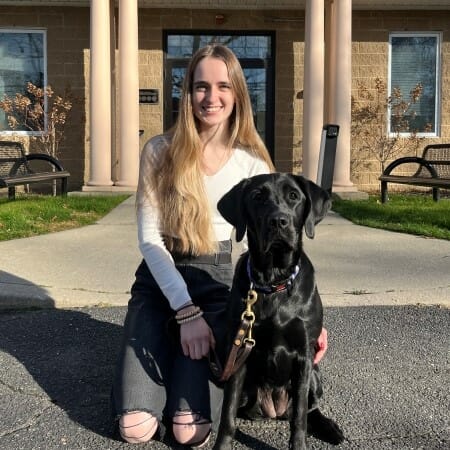
During her dogless period in 2019, Lexi discovered America’s VetDogs and the Guide Dog Foundation through on-campus chapters and has been raising service dogs for both veterans and the blind or visually impaired ever since, getting them used to being out in public and adding to and reinforcing training each week. She is also an area coordinator and PTSD curriculum mentor.
Mary, her nine-month-old service dog in training — her fourth — is on the PTSD track and will accompany Lexi as she goes about her days, including her lectures. As she looks ahead, facing the long hours of residency and beyond, she hopes to finish Mary’s training and stay connected to the organizations she serves in other ways until she can one day get back to what she likes best, raising dogs.
What inspires you to volunteer?
We always say that if you have a dog in a yellow vest, it’s like walking around with a billboard. I got involved initially, because I saw these dogs around my campus and wanted to see what it was all about. I was a psychology major. Trying to find something that combined my interests in mental health and disability advocacy and disability, health and community health led me to the Guide Dog Foundation and America’s VetDogs.
Describe your volunteer role with The Guide Dog Foundation (GDF) and America’s VetDogs (AVD).
I think of myself as first and foremost, a puppy raiser. I get a puppy from the time they’re two- or three-month old until they’re 14- to 18-months old or whenever the foundation needs them back. It’s my job to raise, house, care for, socialize and train some skills during that time. They learn the basics with us and then go in for training with professionals to work through any issues and really polish off their skills.Our biggest responsibility is preparing this puppy to go anywhere and everywhere with their future handler. The dog comes everywhere with me in public – lectures, doctor’s appointments, movies, etc.
In December 2022, Lexi sent Belle, her third service dog in training, in for formal training./Courtesy Lexi Kruger
I tend to raise dogs on the PTSD track for AVD. In addition to that basic home socialization, we teach about 10-15 extra skills like rest, a calming deep pressure therapy skill where the dog puts their head in your lap for about three minutes while you pet them. It’s targeted towards helping someone who might need to ground themselves when they’re stressed. My other role is as a PTSD curriculum mentor. I meet with people to go over how to train these skills, review how it’s going, send videos back and forth and so on.
I’m also an area coordinator. I started in college and led our club through recruiting new raisers, training prospective and current raisers, engaging in outreach, etc. The biggest part is just being a resource when people have questions. I work with individual raiser pairs to help them through issues with their dogs.
What are some of the skills you teach?
I’ve taught my dogs to pick up dropped objects or bring things to me. It’s helpful for someone with limited mobility if they drop their keys or if they need the dog to grab their phone off the table.
One of the classic service dog skills is being able to hit a push plate to open a door or open a handicap door for a wheelchair. Another one I really love is alert, which is a nightmare interruption skill. The dog learns to hit the side of my leg three or four times in order to eventually wake someone up from a nightmare.
What’s been the most rewarding part of your work?
There are little victories when the dog does something that you’ve been working on for the first time, but the most rewarding part is seeing them graduate. My first three dogs all graduated as working service dogs, and each time it was an overwhelmingly positive experience. And when they go off with the person they were always meant to be with, the person whose life they’re going to change.
I was able to see my last dog, Belle, graduate as a working PTSD service dog and meet the person she’s serving. He’d been on a waitlist for four years. This was the answer that was going to help him go out in public again, help him interact with his family again and go to a movie with confidence and comfort.
What have you learned through your experiences as a volunteer?
It’s taught me how to be effective as a part of a team, and I’ve learned a lot about myself. As I said, I have a strong interest in psychology, and this has taught me that there’s an avenue for me to help people in a lot of different ways. I’d love to stay connected with the veteran and disabled communities, especially as I look at the competencies and the sensitivities that I’ve been able to develop and the ways those will help me as a future doctor.
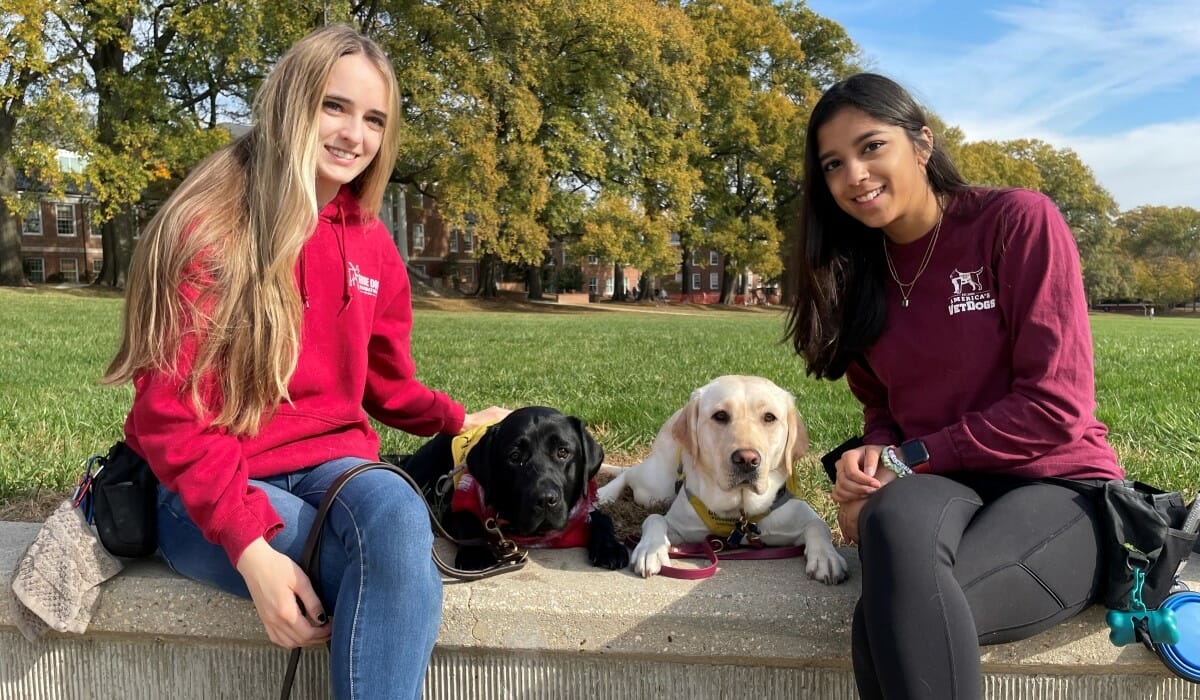
Lexi [left] and fellow volunteer Ashana enjoy the afternoon after a Veterans Day new event on their campus in 2021 with their service dogs in training Piper and Toulouse, half-siblings./Courtesy Lexi Kruger
Are there any future partnerships, programs, or events that you are excited about?
We’ve been at the Capitol in Washington, D.C., trying to push forward this bill called the Working Dog Commemorative Coin Act. It supports AVD and will help bring in funds. One thing these organizations stress is that they don’t want recipients to have to pay for these dogs. Every dog we provide is there because of the work of volunteers like puppy raisers and the donations of groups that sponsor our dogs. My current service dog is named Mary because someone donated $6,000 to name her. Because of that donation, she’s going to be able to one day serve a veteran who needs her. Mary has met a lot of Congress members, too.
Why is it important for others to get involved in causes they care about?
It brings a sense of connection and community, not just with the population you serve but with all sorts of different people. And you’ll learn why these causes are important to them. In undergrad, some volunteers just wanted to hang out with a dog, but many of them had veterans or other family members who received dogs and who want to be able to do for others what that dog did for their family. Volunteering also gives you perspective on what other people are going through. At the end of the day, we do all of it for these communities, especially AVD serving our nation’s heroes.
What do you want people to learn from your story?
Explore the ways you can get involved. Don’t underestimate the role you can play. I look back at when I started doing this, and I didn’t know if I would have time to puppy raise or if I could emotionally handle doing it more than once. But I found so much to grow through and learn as a part of this process.
Volunteer Spreads Financial Literacy to Students to Equip Them for Brighter Futures
Meet Daily Point of Light Award honoree Holly Parnell Thompson. Read her story and nominate an outstanding volunteer or family as a Daily Point of Light.
Not every financial advisor might choose to lend over 60 hours of volunteer time a month to teaching children financial literacy, but that’s exactly what Holly Parnell Thompson of Lakewood Ranch, Florida, does. Holly works with Junior Achievement of the Bluegrass to help equip students from second grade through eighth with the money management and financial planning skills they will need throughout their lives.
When the pandemic forced school closures, she created a virtual program utilizing Google Classroom and resources from Bank of America’s Better Money Habits. In collaboration with middle school teachers and Junior Achievement, her creative, interactive assignments helped students better understand checking accounts, loans and interest rates, mortgages, and budgeting.
The success of Holly’s program lead the school to ask her to record the lecture portion and create teaching notes for other volunteers to utilize so the program could be rolled out to multiple schools at the same time.
Read on to find out what drives Holly to lend her time and talent to this cause.
Describe your volunteer role.
My volunteer role is delivering financial education in schools, around topics such as pay, checking and savings accounts and cards, investing and retirement savings and credit. Over the past eight years, I’ve volunteered with local schools to talk Junior Achievement with grades 2 through 8. I deliver a six-week program to five classes, three days weekly. So on average it is about 60-65 hours of volunteering each month.
I’ve also helped to update an outdated curriculum. An example is updating the companies we talk about in our stock market lesson to help make the lesson more meaningful. Students know the companies we mention – they’ve shopped with them – and that helps them stay excited and involved.
Holly teaches financial literacy to students in local schools through Junior Achievement of the Bluegrass./Courtesy Holly Parnell Thompson
As the COVID-19 pandemic broke out and schools were closed, I took the entire curriculum and the weekly lectures and put them all online, making the entire program virtual. This allowed the Social Studies teachers to incorporate it into their own economic curriculum and make changes as necessary. It also allowed us to adapt the curriculum for special needs students on 504 plans or IEPs.
During the breaks between delivering sessions, I also spend time with the teachers on feedback and course improvements.
What inspired you to get started with this initiative?
I’ve always been involved with volunteer work at some time in my life. As a financial advisor, we work with Junior Achievement, offering financial literacy classes in a pretty big way. When standards changed in teaching financial literacy in grades K-12, and they created a financial literacy exam for high schoolers to pass, I wanted to be a part of that. To help them learn not only what they needed to learn, but also to be good stewards of money as they grow up.
Our family has always been involved in volunteerism, but this particular program came to me because it has an educational component and it had financial literacy involved, which is what my background is.
Any rewarding stories from your volunteer work?
Something in particular happens every time I teach this course. We noticed the course was completely outdated. So we revised it and put it into Google Classroom. We made it interactive. And one of the things we talk about is payroll and we talk about income vs. take-home pay. We talk about where those taxes go and what they’re used for. Then, we go through a budgeting process to create a budget. If there’s a shortfall, we talk about how to fix that: make more money, spend less.
In the very last session, we put up the U.S. debt clock. We look at the debt that the U.S. government is in, and we review all the things that taxes do. Then we ask, what should we do? Increase taxes, or spend less? We started teaching this in seventh grade. And with seventh graders, you never know what you’re going to get. I love that age. They get into an extremely meaningful debate, every class. They debate over increasing taxes vs. cutting spending, and where to cut that spending from. It always comes down to cutting social programs. But then, there’s always one student who says something like, “I live with my grandmother because my parents are deceased. She’s disabled, and if she wasn’t getting food stamps, we couldn’t afford to live.”
They’re saying that in front of all their friends and peers. And the response is always to take care of that student. This drives the students to a more meaningful debate over what is right or just. Where measurements or assessment points for social programs should be. These kids are 12 or 13 years old, and they’re having a cordial debate, an intelligent debate. They’re thinking about each other, and it gives me so much hope for the future. These are the people who will be leading our country someday.
What’s your advice for people who want to start volunteering?
Find your passion. Then, Google it to find an organization that shares that same passion. Call them up and volunteer. It’s so much easier today than it was 20 or 30 years ago. We have search engines, and we can find those organizations whose missions coordinate with our passions. You want to volunteer in areas that are meaningful to you, because then you get as much out of it as you are giving.