Volunteer Contributes Thousands of Hours of Time to Spread the Love of Literacy
Meet Daily Point of Light Award honoree Teresa Gerald. Read her story and nominate an outstanding volunteer or family as a Daily Point of Light.
Teresa Gerald of Ridgeland, Mississippi, has always loved literacy. So she channeled this passion into volunteer work through Friends of the Ridgeland Library, where she has held the elected position of president since 2014, contributing thousands of hours of volunteer time.
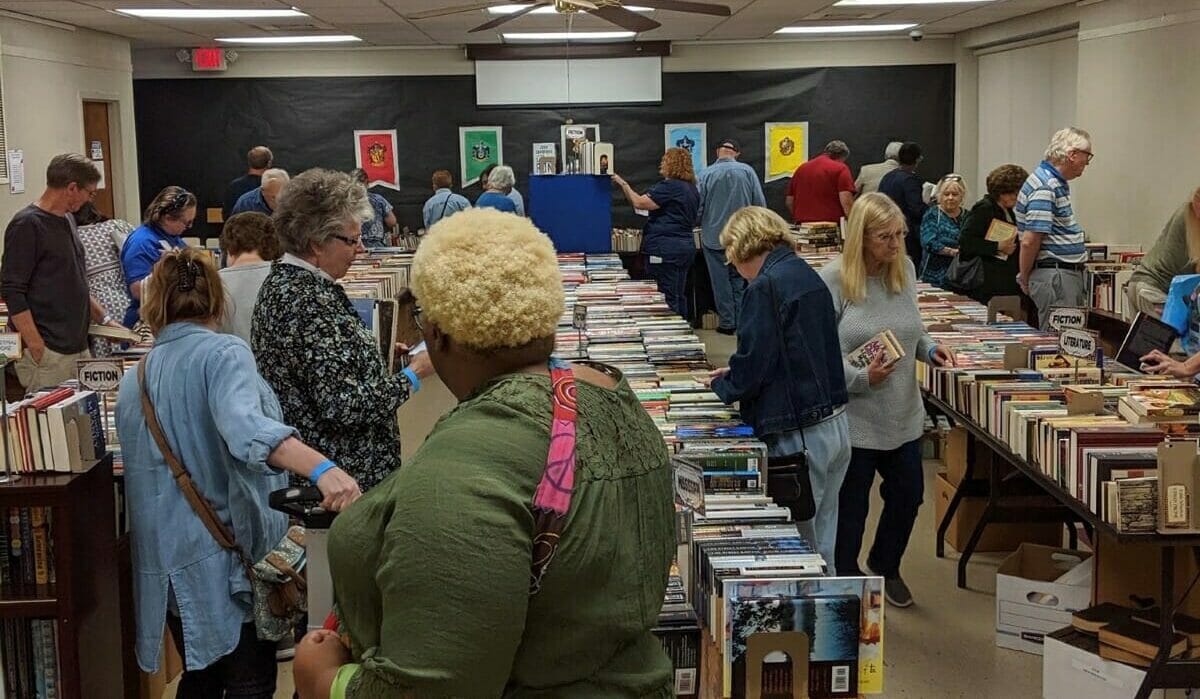
Two times a year, Teresa manages, promotes and works the Friends of the Ridgeland Library Book Sale. When the library’s funding was cut by $110,000 in fiscal year 2021-2022, she led a fundraising campaign with Every Library Institute that raised $112,000 of emergency funds.
Teresa is not afraid of a challenge and faces all obstacles with a fierce attitude that comes from her experience as a leader. Read on to find out what inspires her and keeps her going when those challenges arise.
Describe your volunteer role.
I am a member of the Friends of the Ridgeland Library and have been since the early 2000s. I became very active in the organization when I retired in 2014, because I had more time. The main focus of what the Friends of the Library does is to raise money through used book sales and memberships. We’ve designated that money to buy furniture and fixtures that will be over and above our library’s budget, if and when the City of Ridgeland builds a new library.
In the meantime, we’ve used some of the funds to give the library some of the things that are not in their budget, like study tables and chairs. We replaced the refrigerator. We bought a vacuum cleaner a few years ago. So, different things that are needed, that aren’t in the budget.
We also fund travel and expenses for guest speakers. We contribute money every summer for the summer reading program. All of the board members feel that putting books and resources in people’s hands is critical to keeping a vibrant community.
What inspired you to start volunteering with the Friends of the Ridgeland Library?
I’ve always loved books; for as long as I can remember, books have been a part of my life. So that means I love libraries. A good friend of mine was active in the Friends in the early 2000s and got me to join, even when I didn’t have much time. Then she got involved in putting on the book sales, and I started helping with that.
Then, she moved and I ended up being responsible for the book sales. Then, I was on the Board of Directors. And that’s how I got involved.
The commitment and dedication and hard work and perseverance of our library staff in Ridgeland – this group of young people love what they do, and it shows. They walk into that library and they smile. They offer to help. They enjoy being there. They don’t get enough credit for what they do. I encourage people to walk into the library and say thank you to the people who work there. They help our community and meet a lot of the needs that aren’t met by other systems in the city, county or state.
The fall Book Sale is a popular event that helps provide necessary funds for the library./Courtesy Teresa Gerald
Why do you think access to books is so important today?
I saw a quote: “A child who reads becomes an adult who thinks.” We need citizens in our country – and people in our world – who think. Reading enhances that. It gives us new ideas, different points of view. It takes us out of our mundane worlds and gives us things we’ve never thought about.
I like to see children come into the library with their parents to get their first library card. When I have the opportunity, I tell them, “Do you realize that with that library card and a book, you can go anywhere you want to go in this world, or out of this world?” Their eyes get big and they smile. I just want people to read and to learn.
Are there any future partnerships, programs or events that you are excited about?
We partner with the library every summer for their summer reading program, so we’re doing that this summer. This year’s theme is a response to the attempt of censoring our library last year. This is still going on in our state and many states around the country. We want people to realize that freedom is not free – we’ve got to stand up for it.
Of course, we also have our fall book sale coming up in October.
Why is it important for people to get involved with the causes they care about?
Volunteering lets us contribute to the community. As citizens in this country, we get to “give back” for so many of the things we’re given in this country. We have these freedoms, and volunteering lets us be aware of them for our personal edification, and also to remind others that we need to protect them and enjoy them.
Personally, volunteering gives me a great sense of gratification. My parents taught me growing up that it’s better to give than to receive, and it’s true. I feel so much better when I’m volunteering and giving time and energy. It gives me a sense of well-being, feeling better about myself and our community and our country.
Retired Fireman and Army Veteran Continues Life of Service by Helping Victims of Natural Disasters
Meet Daily Point of Light Award honoree Tom Schneider. Read his story and nominate an outstanding volunteer or family as a Daily Point of Light.
For Tom Schneider of Florence, Kentucky, service is ingrained in his bones. He first answered the call to service in the 1960s, when he served in the United States Army and deployed to South Korea in the aftermath of the Korean War. After the military, he fearlessly battled blazes for nearly three decades as a firefighter, placing himself at risk to save lives and protect communities.
Now, at the age of 76, Tom could have chosen to embrace his well-deserved retirement. But instead of kicking back his feet to finally rest, he has picked up a different coat of service, a bright red one that bears the name American Red Cross.
Since 2017, Tom has responded to countless natural disasters across Kentucky, Indiana and Florida, extending a helping hand to those devastated by floods, fires, tornadoes, hurricanes, and even plane crashes. Alongside his fellow Red Cross volunteers, Tom offers essential aid, including clothing, warm blankets, food and financial assistance to help victims get back on their feet.
Tom’s introduction to the American Red Cross and its disaster action team occurred when he himself was in need. While volunteering as a firefighter during a fire in Villa Hills, Kentucky, Tom found solace in the compassionate care provided by the Red Cross.
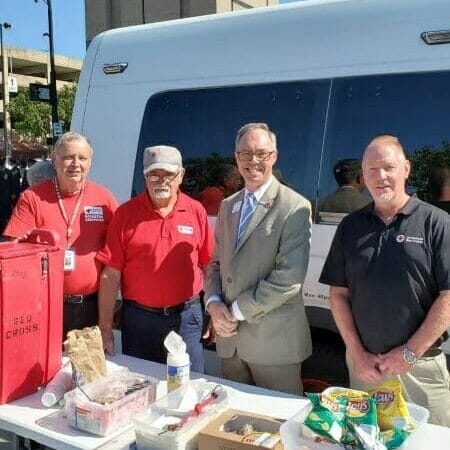
Tom Schneider (second from left) and his volunteer leader, Carl Biery (far left), provide food and other aid-in-kind to victims of a disaster./ Courtesy Carl Biery
“Everything was freezing, and I got wet,” Tom recalled. “I went looking for a cup of coffee and saw that the Red Cross was there. They gave me a pair of dry socks and that was like gold. So, when I retired seven years ago and wanted to do something, I turned to the Red Cross.”
Carl Biery, leader of the Northern Kentucky disaster team, said that whenever disaster strikes, Tom is often one of the first to respond.
“We have a disaster van with supplies on it like clothes, blankets, first aid supplies, you name it. And Tom is our main driver,” Carl said. “Earlier this year, during a blizzard in northern Kentucky, we struggled to find someone to drive a trailer of supplies to a shelter because the roads were so bad. But Tom volunteered and the supplies reached the shelter.”
“He’s just one of a million that does this kind of stuff and gives his whole heart to it,” Carl added.
The number of disasters Tom has responded to is too much to tally. In just the first six months of last year, he answered 176 calls, promptly rushing to aid disaster-stricken individuals. Regardless of the hour or the distance, Tom believes every sacrifice is worthwhile.
“We assisted 12 families during a big fire. One lady came up to me, hugged me and said, ‘Thank you.’ Another time, I wrapped a girl in a blanket and took her into the van and gave her new clothes to change into. When she came out, she gave me a big hug and said, ‘This is beautiful. Thank you,’” Tom recalled. “Those are precious times to me.”
When not volunteering with the Red Cross, Tom lends his time to two choral groups that uplift spirits by performing at nursing homes, churches and various community events. Recently, one of the groups sang a Rodgers and Hammerstein medley at a nursing home.
“Many residents can do little more than move from their rooms to the cafeteria. But when we sing, you see people just singing along with you, people clapping, people swaying. When we finish, they’ll come up and thank us or invite us over to sit down with them for a cup of coffee,” Tom said.
Tom’s dedication extends to his church, where he volunteers whenever possible. He has also volunteered with Habitat for Humanity, helping build homes for families lacking safe and consistent housing.
Even if it’s not for the American Red Cross, Tom hopes his story will inspire others to volunteer.
“Volunteering will open your eyes to other people’s problems and situations. It’ll get you to appreciate what you have and also how you might help them in some way somehow,” Tom said.
After Losing Her Best Friend to Cancer, 12-year-old Volunteer Works Hard to Raise Awareness
Meet Daily Point of Light Award honoree Cameron Bolton. Read her story and nominate an outstanding volunteer or family as a Daily Point of Light.
When 12-year-old Cameron Bolton lost her grandpa, who she calls Pop Pop, to a rare and aggressive bile duct cancer called cholangiocarcinoma (cholangio), she became impelled to get involved in helping others with the disease. For the past three and a half years, she has volunteered with The Quack Out Cholangio 5k Run/Walk to Crush Bile Duct Cancer and is now the co-secretary of Team Cure Cholangio, a 501c3 nonprofit organization that supports raising awareness and funding to help those with cholangiocarcinoma. Cameron says that she loves being involved on the day of the race, and it’s become a big part of her life. Not only does she have fun volunteering, she also uses the cause to develop lifelong leadership skills.
What inspires you to volunteer?
It was my Pop Pop who inspired me to volunteer because I do it to support him. Also, it’s something that my mom and I love doing together.
What’s your favorite memory with your Pop Pop?
My favorite memory with him is when he would sing us songs and lullabies.
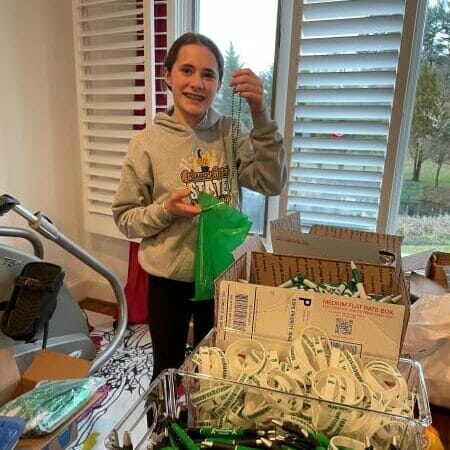
Before the race, Cameron puts together gift bags for the participants in the event’s 5K race./Courtesy Cameron Bolton
Describe your volunteer role with Quack Out Cholangio 5K?
I’m the secretary on the team, so my mom and I do the raffle every year [at the race]. There’s a table set up with free little goodies and you can buy raffle tickets to win stuff that businesses donate for the raffle. We also make the gift bags for the 5k for the runners. Then after the race, my mom and I bring the extra food and drinks to the Ronald McDonald house to give them to the children there.
Also, throughout the year to spread awareness for the race, another volunteer paints rocks whenever we go in a walk in like a state park or we’re visiting somewhere, we’ll bring the rocks we will hide them. Then, there is a QR code on the rock that brings you to a Facebook page of the race. It spreads awareness for others, and you then can re-hide the rock once you find it. And then the same thing will happen, and the awareness is just getting spread all over. I think it’s really cool to help out with everything and each year I become a better leader.
On the day of the Quack Out 5k, what is your favorite moment?
Most of my family did the race this year and it’s enjoyable to be running the race with them. I ran with my cousins and family, so I talk to them on the way. The race is a bit challenging, but I get through it.
What have you learned through your experiences as a volunteer?
I think that I have learned more leadership skills, how to spread awareness and how to help others.
Why is it important for others to get involved in causes they care about?
I think it’s important to volunteer because as a volunteer you can spread much more awareness, and it’s good to learn more skills. Also, my Pop Pop volunteered before he passed away, So I find it my job to continue volunteering for him.
Self-Taught Student from Afghanistan Helps Other Displaced Students Adjust to Moving to the United States
Meet Daily Point of Light Award honoree Nessar Hekmatjo. Read his story and nominate an outstanding volunteer or family as a Daily Point of Light.
In 2017, Nessar Ahmad Hekmatjo and his family moved to the United States from Afghanistan. It was not an easy transition – he understood very little English, and the coursework was a completely different experience from one country to another. He spent his first two years teaching himself English and distinguishing the cultural differences in the school systems in each country.
Four years later, Nessar graduated high school, is attending college full time and is the rising President of Willow Way Tutoring and Enrinchment, an award winning, multilingual nonprofit that specializes in newcomer or displaced students. He speaks Dari, Farsi and Pashto, so he is able to mentor many students who come to the U.S. feeling the same way he did. Now, he is currently on track for a nursing degree, but is hoping to one day become a surgeon. In his spare time, he is tutoring displaced students in numerous subjects and cultural differences.
What inspires you to volunteer?
I came to the United States six years ago, and when I came here, I couldn’t speak English. There wasn’t anyone to help me with my assignments and homework, and there was nobody to teach me about the U.S. education system. So, I had a lot of problems in my first and second year in United States, and I had a lot of difficult moments. That’s why I started volunteering with newcomer students and displaced people. I want to help them so they can get good grades and get a high school diploma.
Nessar Hekmatjo moved to the United States without knowing any English and taught himself how to navigate the U.S. school system./Courtesy Nessar Hekmatjo
Describe your volunteer role with Willow Way Tutoring and Enrichment?
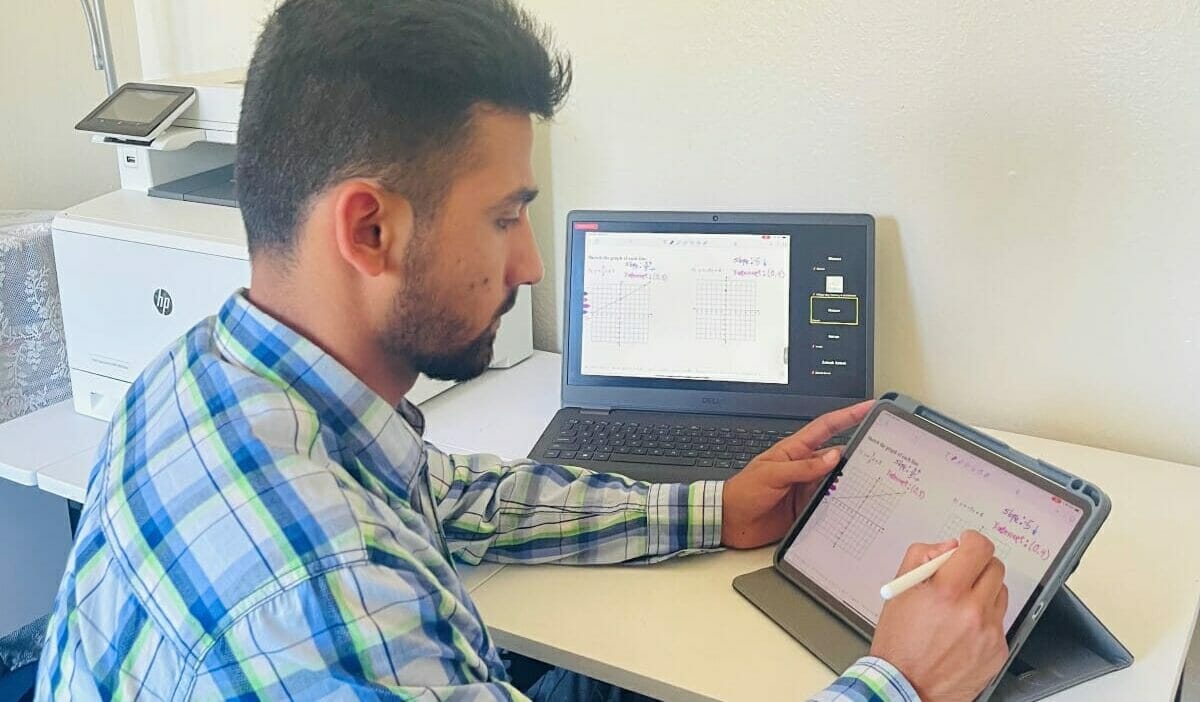
As a volunteer, I work with the middle school and high school newcomer students who just moved to the U.S. I help them with their homework, often speaking in Dari, Farsi and Pashto. Also, I provide tutoring in math, English, science, and biology for middle and high school students. Then, I send weekly and monthly reports to the teachers and the parents about their students’ progress.
In addition, I help enable other students to use their skills to contribute to our community. I provide training and oversight to other multilingual tutors. So, I teach them to how to tutor students and how to write the progress reports for teachers and parents.
What’s been the most rewarding part of your work?
The most rewarding part for me is when the students do their homework, and when it’s clear they are learning from me. Then, I see that progress in their exams and quizzes, and they’re passing their classes with As and Bs – that makes me very proud. It makes me happy knowing that I can change someone’s life by just doing a little thing – just teaching them something that I already know. Now, some of the students I tutored are now in the college, and some are even working with [Willow Way] as tutors themselves.
What have you learned through your experiences as a volunteer?
I learned that even a small effort can change someone’s life, and changing someone’s life doesn’t always need money. Sometimes a smile can change someone’s life. Sometimes displaced people have problems, and it feels like nobody cares about them, because they don’t know English and they don’t know the education system.
Nessar tutors other displaced students on multiple subjects, including math./Courtesy Nessar Hekmatjo
How different is the U.S. education system from Afghanistan?
In Afghanistan, we don’t have homework that is graded, and we don’t have any quizzes. There is only a final test. Most of the displaced people don’t know that in America, you need to turn in the assignments in for grades. Even the college system is different in Afghanistan and the United States. In the United States you go to high school, then to college and you are able to choose whatever major you’d like. But in Afghanistan, you have to choose your major and then take a test. Only if you pass that exam you can study that major. I had to learn these differences on my own because I didn’t have anyone here to teach me, or even speak the same language as me. So now whenever I learn something new I want to I want to teach those things to other displaced people so they can be successful in this country.
What do you want people to learn from your story?
I want people to learn that helping others and making a small change in someone life can cause huge outcomes and success. Everyone is good at something, or God has given them a special gift. Maybe they have a unique talent or even free time, and they should use those things to bring change in someone’s life and bring changes to their community.
College Senior and AmeriCorps Member Focuses on Improving the Lives of Those Around Her
Meet Daily Point of Light Award honoree T’Kiyah Threatt. Read her story and nominate an outstanding volunteer or family as a Daily Point of Light.
T’Kiyah Threatt, a 21 year old passionate about her fashion and her faith, grew up in west-central Alabama in Uniontown, a town of just 2,037 residents. With 11 siblings, her family is not an insignificant part of the community. T’Kiyah became interested in volunteering from a young age but really dove into service when she started working with C.H.O.I.C.E., an organization that ensures young people get the resources they need, as a high school junior. Three years ago, she became the first president of the Youth Advisory Council and began leading mentoring efforts, going above and beyond to find funds for a scholarship for a deserving mentee. Even after moving away for college, T’Kiyah returns to work with her own mentee while recruiting community partners and soliciting funding for programs.
Since then, she has taken advantage of training opportunities offered by community partners to hone her leadership skills and enhance her ability to serve. She is currently serving her second term with AmeriCorps, volunteering for 35 hours each week while preparing for her senior year at University of Alabama at Birmingham (UAB) where she majors in psychology. Her dedication and empathy for others will serve her well as she seeks a career as a mental health therapist with her own practice. Her bubbly personality and determined kindness invites others to pay it forward and endears her to everyone in her path.
What inspires you to volunteer?
I started here in Uniontown, which is how I found my mentor. She’s the founder and executive director of a nonprofit. I started hanging out with her, and we’d always have these big backpack drives. I remember going to the drives and seeing volunteers when I was young, around seventh grade. That sparked a fire in me.
I knew I wanted to do something of that nature, so I started getting my feet wet in different areas of service. We started with backpack drives and did fundraising to help out in the community, community cleanups, working in the community garden, etc. I went to Memphis with UAB’s Blazers on Breaklast spring break to plant another community garden and help out in a food desert. That was very near and dear to me because we, too, are a food desert; we don’t have a grocery store in my own hometown.
I found AmeriCorps through C.H.O.I.C.E. My mentor partners with them and told me I should apply to this position. That first summer, before I went to UAB, I worked for AmeriCorps Vista. And when I got the hang of it, I was like ‘Okay, I can do this again.’ So that’s when I transitioned over to do the full year of service with AmeriCorps. It’s a heavy schedule but it’s worth it. It’s very rewarding.
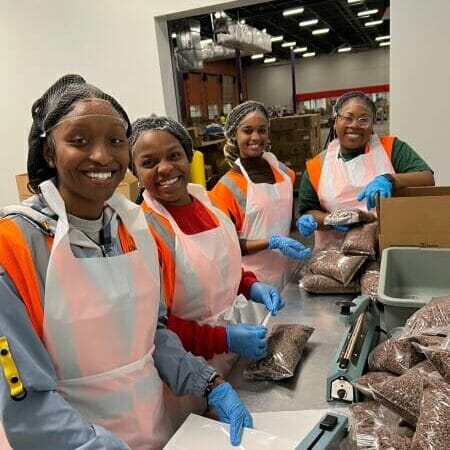
At the Mid-South Food Distribution, T’Kiyah [left] and fellow University of Alabama students package and seal many pounds of cereal for those in need./Courtesy T’Kiyah Threatt
Describe your volunteer roles with C.H.O.I.C.E. and AmeriCorps.
AmeriCorps is so flexible that I’ve been able to work with both. With AmeriCorps, I’m the communication coordinator at my site, so a lot of the work I do is virtual. I help managesocial media, so if we have an event coming up on campus, we’ll put together a project for social media or create a flyer. We’ll create QR codes and videos, as well.
We do a Self-Care Sunday post, too. Every Sunday, I’ll post about things like stress, sleep, self-care or tips for going off to college. A lot of college students follow the page, and while we’re doing outreach, we’ll promote our class and other events. Within AmeriCorps at UAB’s campus, we’ll go out two or three times every week to teach about and promote self-care for college students. We will have events like Jeopardy and Bingo to promote key topics.
With C.H.O.I.C.E.,since I’ve been home, I’ve done mentoring and tutoring. We have a summer feeding program, so I’m up there twice a week for when the kids come. We make sure they’re getting lunches and have an activity planned out for the day. It’s kind of like after-school care but during school hours since it’s summertime.
What’s been the most rewarding part of your work?
Mentoring and tutoring kids has been really rewarding. When I first started, they were young, but now they’re growing up and getting ready for college. I enjoy being that resource for them.
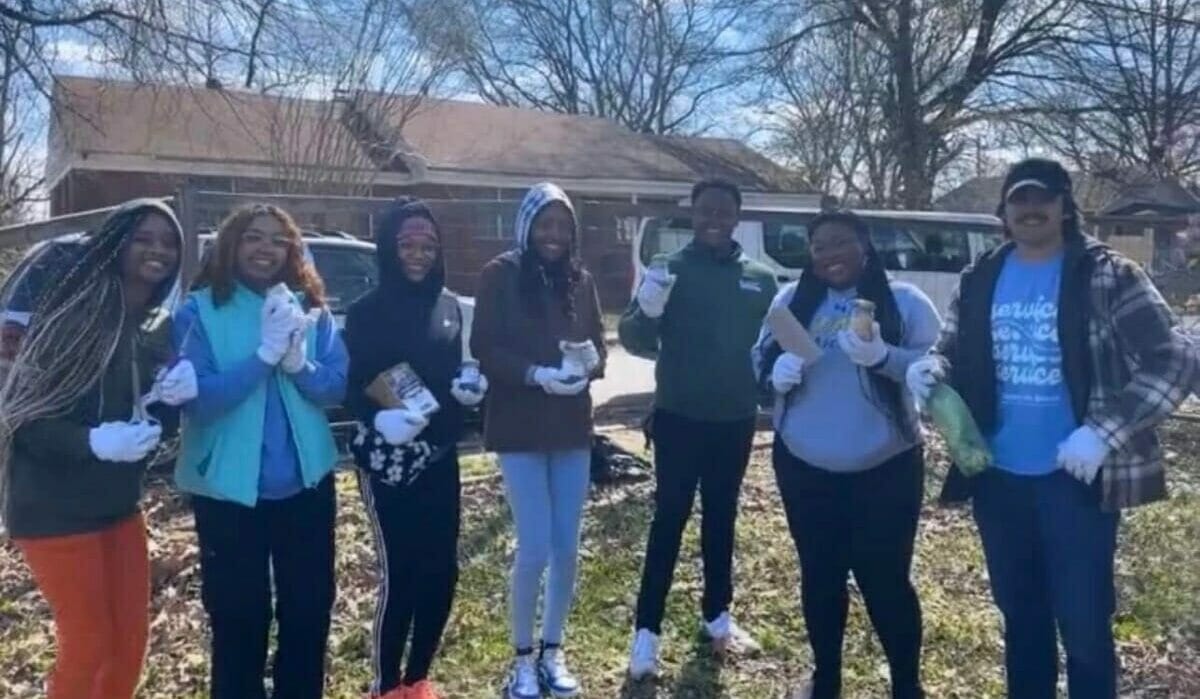
T’Kiyah [middle] and other students from University of Alabama prepare to plant a community garden in Memphis as part of Blazers On Break alternative spring break./Courtesy T’Kiyah Threatt
What have you learned through your experiences as a volunteer?
I’ve learned to be a resource as well as learn, because as I’ve been educating students, I’ve learned that I need to be educated first. I’ve learned to learn from others, whether it’s good or bad. And I’ve learned to just do things for people because you can. If you can do a nice thing for someone, just do it. I would say my biggest lesson is that it costs $0 to be kind.
Are there any future partnerships, programs, or events that you are excited about?
With my AmeriCorps service ending in August and graduation in May, I’m excited about venturing out and getting more jobs within the same field. Which direction I want to go, I’m not sure, but I’m most excited about getting a federal job.
Why is it important for others to get involved in causes they care about?
I think it’s important to do things you’re passionate about, so that you can do it wholeheartedly. No one will have to remind you to do it. No one will have to chase you down or keep telling you, “Hey, I need this.” You do it because it’s something you love and really care about.
What do you want people to learn from your story?
I want people to learn that where you’re from doesn’t determine the work that you can do. Because where I’m from is very small and rural. Everyone knows everyone. I just want people to know that you can be whatever you choose to be. Just always be kind, and always be willing to learn.
Teen Promotes Healthy Lifestyles for Youth Through Anti-Drug and -Alcohol Efforts
Meet Daily Point of Light Award honoree Aarushi Dedhiya. Read her story and nominate an outstanding volunteer or family as a Daily Point of Light.
At just 16 years old, Aarushi Dedhiya understands how important it is for youth to build healthy lifestyle habits to carry with them throughout life. Aarushi is a part of her local Students Against Destructive Decisions chapter at her Enola, Pennsylvania, high school where she advocates against drug, alcohol and vaping use. And her dedication to this cause goes beyond the local level — Aarushi is active at both the state and national levels with SADD. When she’s not working with SADD or writing an ebook for a mental health app, she also leads the anti-vaping curriculum as the national council president of Catch My Breath.
What inspires you to volunteer?
I wanted to make a difference in my community. As a high schooler, I wasn’t sure what to do at first. But then I realized that volunteering was a great opportunity for me to help people in my community, and to make a difference. Right now I’m mostly volunteering in a specific area, which is anti-drug, -alcohol and -vaping. The reason I’m doing that is because I know that it’s a large issue in my school and other schools. It’s very dangerous for the youth and I hope that I can make a difference and prevent others from taking these substances, and also promote healthy lifestyles among the youth.
Describe your volunteer role withSADD and the other organizations you’re a part of.
The first organization that I’m a part of is SADD, which stands for Students Against Destructive Decisions. I’m part of their local chapter, their state chapter and the National Council. I do different work in each level of the chapter systems. For the local level, It’s a part of my school. We make blog posts and keep the school community aware about these substances and how to choose a healthy lifestyle. At the state level, we’re helping create a conference with trainings and we’re also working on a video which has become our passion project to share at the conference. We get to bring everyone in Pennsylvania together and all of the local chapters get to have discussions about this important topic. The National Council is where we do the main work for the organization, like conducting webinars, writing more blog posts and helping connect every single chapter in the entire United States with each other and new partners. Currently, we’re working with the National Road Safety Foundation and we’re hoping to create a global youth traffic safety month webinar to connect the SADD chapters in other countries.
The next organization I’m involved in is Catch My Breath. I’m currently the president of their national council. What we do is create and review curricula that deal with vaping. We hope to see an effective and fun curriculum for middle schoolers, elementary schoolers and high schoolers so that we can make them more aware that vaping is not good for them.
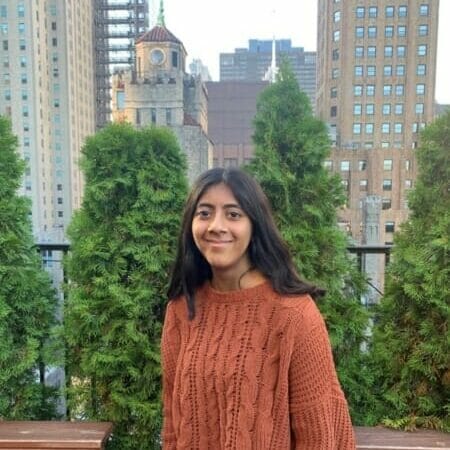
Aarushi Dedhiya advocates for healthier lifestyles without drug, alcohol and vaping use, with organization Students Against Destructive Decisions. /Courtesy Aarushi Dedhiya
I’m also a part of a mental health app team and I’m on a committee called the publication committee. So I’m working on creating an online ebook to share about mental health. We hope to create this ebook to share more information about mental health — the causes of it, different types of it — and just provide a lot more information about mental health that most people are not aware about.
What’s been the most rewarding part of your work?
The most rewarding part is just seeing how my work is actually impactful. I get to see people joining the SADD club at my school and I get to see people start to take initiative to learn about why drugs, alcohol and vaping are a problem
What have you learned through your experiences leading this organization?
I’ve learned that patience is key when making an impact. Specifically, we can’t make a large impact in one day; it takes time for it to settle in and for you to actually see the end result of what you’re doing. So the work we’re doing now may not be impactful at the moment, but in a month or year or so, we’ll have impacted a lot of teenagers and high schoolers.
Are there any future partnerships, programs or events that you are excited about?
Right now, at SADD we have a summer break. So we pause in-person meetings, but we’re planning on having a convention in September where we all meet up and talk about the issues we’re facing. Also, our state conference is coming up too and I’m very excited about that because that helps bring together all the SADD chapters in Pennsylvania. I’ll get to meet local people and also talk about this important issue.
Why is it important for others to get involved in causes they care about?
I think it’s important for people to get involved in this advocacy because it helps them use their voice. There are many platforms for them to do that and it can help them choose a path where they can make a difference in other people’s lives – peoplewho are not aware about the dangers of these issues. As more people step up and take on the role as an advocate, we can start bringing even more awareness and possibly end substance use by youth in our schools.
What do you want people to learn from your story?
One lesson that I want people to take away is that advocacy is for everyone. No matter who they are or what they do, they can all be advocates. It’s important for you to step up and use your voice because there are lots of teenagers who are not aware about what these substances do and get caught up in peer pressure which can cause them to suffer later in life. Using drugs, alcohol and other substances can be very dangerous to your body and also to your future. So I hope that everyone, no matter who they are, can just step up and be an advocate and help make a difference.
New Chicago Resident Finds Community and Peace in Caring for Greenspaces
Meet Daily Point of Light Award honoree Sree Ram. Read his story and nominate an outstanding volunteer or family as a Daily Point of Light.
Moving to a new city can be challenging for many reasons. When that city is outside of your native country, it can be even harder. Eight years ago, thirty-one-year-old Sree Ram moved to the US from a small town in India set amongst forests and mountains, but only settled in Chicago at the end of 2020. He took a job as a product owner for an insurance agency, and while he’s passionate about his work, he likes to get out of the office and into nature on the weekends. With parents and grandparents in forest conservation, the passion for the great outdoors was bound to be passed down.
“Being in nature is something that brings me back to the ground and makes me feel like ‘Okay, I’m a human again,’ when I get caught up with the fast-moving workweek,” he states.
To fill the natural gap in his city-living experience, Sree did a quick web search and found Chicago Cares, an organization that matches volunteers with service opportunities they are passionate about, some of which include working outdoors. Since 2017, Points of Light Global Network member Chicago Cares has engaged over 17,000 volunteers working towards a more vibrant and equitable city for all.
Aside from feeling more grounded, Sree credits a tradition his mom started when he was a child for his motivation to volunteer. As a kid, each year on his birthday, his mom taught him to give something to others instead of buying or doing something for himself. Sree enjoyed it, and it has become a year-round habit well into adulthood.
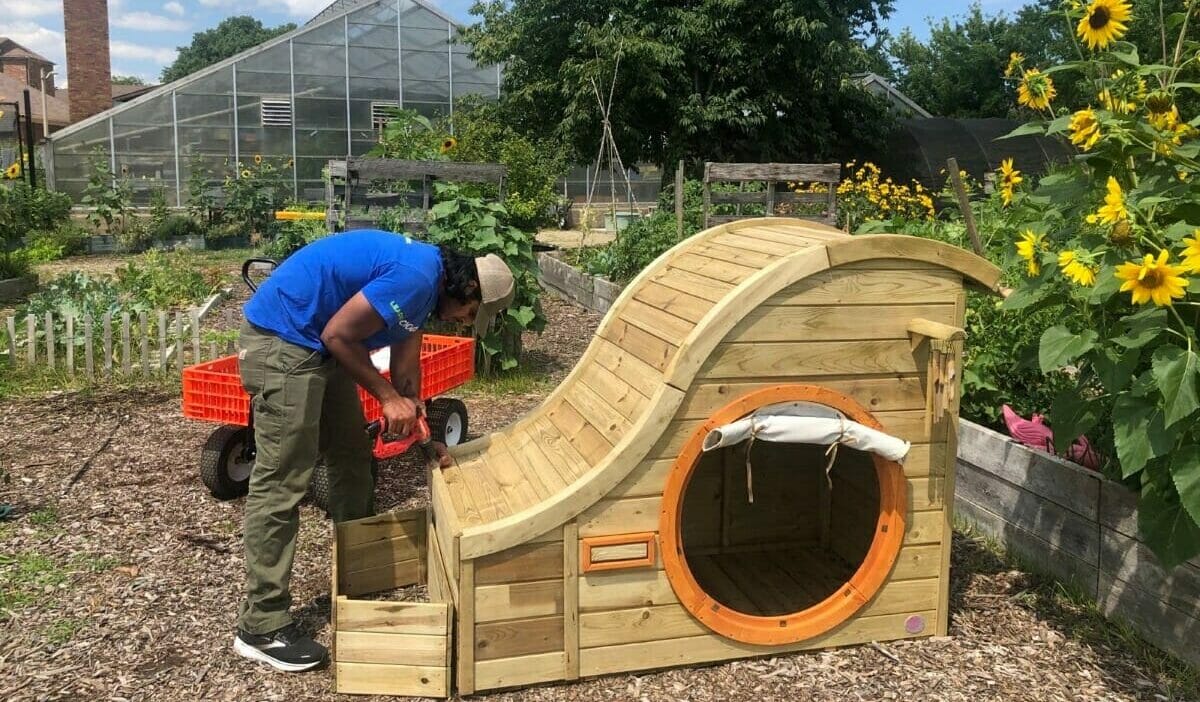
After trying a range of volunteer opportunities from helping out a food pantry to teaching, he landed with the Chicago Park District maintaining greenspaces across the city. He has been a volunteer leader for more than two years now, spending nearly every Saturday caring for the Lincoln Park Conservatory and the Kilbourn Park Organic Greenhouse.
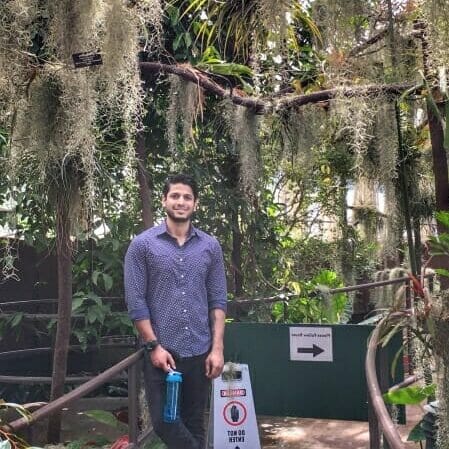
Sree Ram, Chicago Cares volunteer with the Chicago Park District, visits the Lincoln Park Conservatory./Courtesy Sree Ram
“Both of them are very understaffed, especially Kilburn Park Organic Greenhouse. They only have one staff member who takes care of the entire space. Having some support from volunteers helps a lot,” he emphasizes.
Sree also started volunteering as a way to learn more about the city and to make local connections, connections that Chicago Cares strives to foster through its community-driven programs, which help volunteers increase their engagement over time to become more active participants Chicago’s civic fabric. For Sree, the aforementioned staff member in charge of the greenhouse, Renee Costanzo, has become one of his good friends.
“I met Sree last summer. But it feels like I’ve known him for a really long time,” Renee says. “We get a few different people who come to volunteer, mostly people in the tech industry that want to get their hands dirty or do something with their hands. And there are quite a few people who are new to Chicago and want to get involved or become familiarized with the city.”
Both Renee and Sree like to help people make connections and get involved in tasks they enjoy. Each three-hour volunteer shift starts 30 minutes early for the latter. Sree checks in with staff to see what needs to be done that day and any equipment needed. Tasks might include weeding, planting, mulching, tidying greenhouses or prepping for garden shows. The first fifteen minutes of the actual shift is centered around socializing and making sure volunteers get to know staff as well as each other.
“I don’t want them to just come here and work like a job. I want them to come here and enjoy,” he adds. “I believe everyone who spends three hours of time volunteering is a very kind and humble person, because they want to give back to the community. So, I want them all to make a connection of friendship and expand their friends’ community in this beautiful city.”
He also makes a point to find out what everyone wants to do and is able to do from the tasks available. Even after the work begins, he checks in with each person individually every half an hour or so, switching people around when needed.
“There are people who wants to socialize and people who don’t want to socialize, because they want to enjoy some green space time. I try to understand that and put them in a task that gives them some time with plants.”
“When he is helping me with placing people for different tasks, he’s always eager to take the job that nobody wants, which is really encouraging for me because that’s usually my thing,” Renee laughs.
His efforts have paid off. Many volunteers eventually jump from volunteering through Chicago Cares to working directly with the park district. One volunteer, a student in the nursing field, ended up finding friendship and an internship with a fellow volunteer and established therapist.
Sree lends his carpentry skills to building a playhouse for kids at the Kilbourne Park Organic Greenhouse in the community garden space./Courtesy Sree Ram
“He’s really great about building community, which I think is really important for what Chicago Cares’ mission is,” Renee says. “It’s hard to get acquainted with people, even with these opportunities that are meant to be that portal.”
It’s those stories that Sree finds most rewarding. And, of course, simply being in nature.
But that’s not Sree’s only weekend service. Living in a building that doesn’t allow dogs, Sree also spends two Sunday mornings each month at PAWS, a local dog shelter, to get his puppy fix. After a 60-hour program that includes three weeks of training, a practical and an exam, he is getting ready to move up from his role as a level one volunteer to level two. As part of the change, he’ll go from basic tasks like taking the puppies out for walks and cleaning their spaces to handling dogs with behavioral issues or physical challenges.
It’s Sree’s dedication and commitment that makes him a pillar of the community. Not only can everyone in Chicago enjoy the nature that Sree has helped maintain, but they can find a welcoming face in the park or at the shelter ready to introduce them to a new friend.
“Building a connection with selfless minds is always amazing, because they care for you, and they’re always there for you,” he says.
And when it comes to choosing where to donate your time, Sree suggests beginning with what brings you joy.
“Supporting a cause and getting back into the community will help us rediscover ourselves, love ourselves more and care for ourselves more,” he muses. “It’s always about starting with the love within us so that we can spread the love outwards. Find what makes [you] happy, and that will resonate and make the community happy.”
Content Warning: Points of Light is proud to share the following uplifting and inspiring story. However, we acknowledge that a small portion mentions suicide and may be difficult for some readers. We encourage you to please care for your own well-being above all.
Meet Daily Point of Light Award honoree Megan Ruzicka Read her story and nominate an outstanding volunteer or family as a Daily Point of Light.
During the COVID-19 pandemic, a lot of people Megan knew were suffering from isolation, depression, and anxiety. Megan was fortunate to be with her family during this time and didn’t experience the emotional effects of lockdown but she could see how drastically it was affecting many of her peers. Mental health had been a big problem in high schools even before the added stresses of the pandemic but social isolation took it to a new level.
One day, Megan was scrolling online and came across a recommendation: the American Foundation for Suicide Prevention. She clicked on the link and immediately recognized that this was one way she could help.
Megan and her sister are active in the Girl Scouts of America, and they have both done volunteer work before, but nothing as substantial as their work with AFSP. Her sister also volunteers for the organization.
Megan Ruzicka (speaking) conducting the Honor Bead Ceremony at the Morris County Out of the Darkness Walk./Courtesy Megan Ruzicka
What inspires you to volunteer?
The people I meet are what inspires me to volunteer. I work at the various events hosted by AFSP where I get to talk to a lot of people in the community. I hear many stories of overcoming suicidal thoughts. I hear people whose lives have been forever changed because someone they knew took their life. It’s very moving. My heart goes out to each and every one.
Describe your volunteer role with the American Foundation for Suicide Prevention:
The American Foundation for Suicide Prevention is a national organization with chapters in many counties within each state. I don’t work as a counselor, but In 2021 and 2022, I was the Volunteer Coordinator and Committee Member for the AFSP Morris County Out of the Darkness Walk. I provide people with resources. AFSP has a lot to offer for veterans suffering from PTSD, people who have lost loved ones to suicide, and of course people who are struggling with severe depression and suicidal thoughts.
I work at community events such as the Morris County Out of the Darkness Walk. Last year, we had 300 attendees and 25-30 volunteers. Many of these volunteers were from local schools along with various community members.
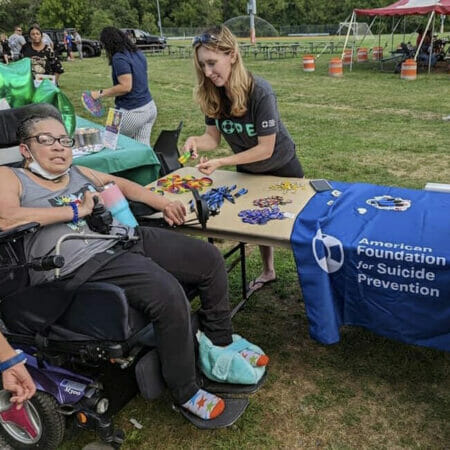
At these events, I assist our special events manager in directing volunteers, manning the T-shirt table that features local sponsors, making sure that other booths are running smoothly, and directing fundraising teams to the various event activities. I also talk to attendees and hand out resource materials about suicide prevention.
Outside of the events, I canvass to raise funds for AFSP and encourage sponsors to attend the event. In 2021 the Morris County Out of the Darkness Walk raised $102,000 and in 2022 it raised $77,000. It’s my goal to increase sponsorship this year.
I also was a speaker at the Out of the Darkness Walk where I conducted the Honor Bead Ceremony, and the event chair for the 2023 Food Truck Festival For Hope.
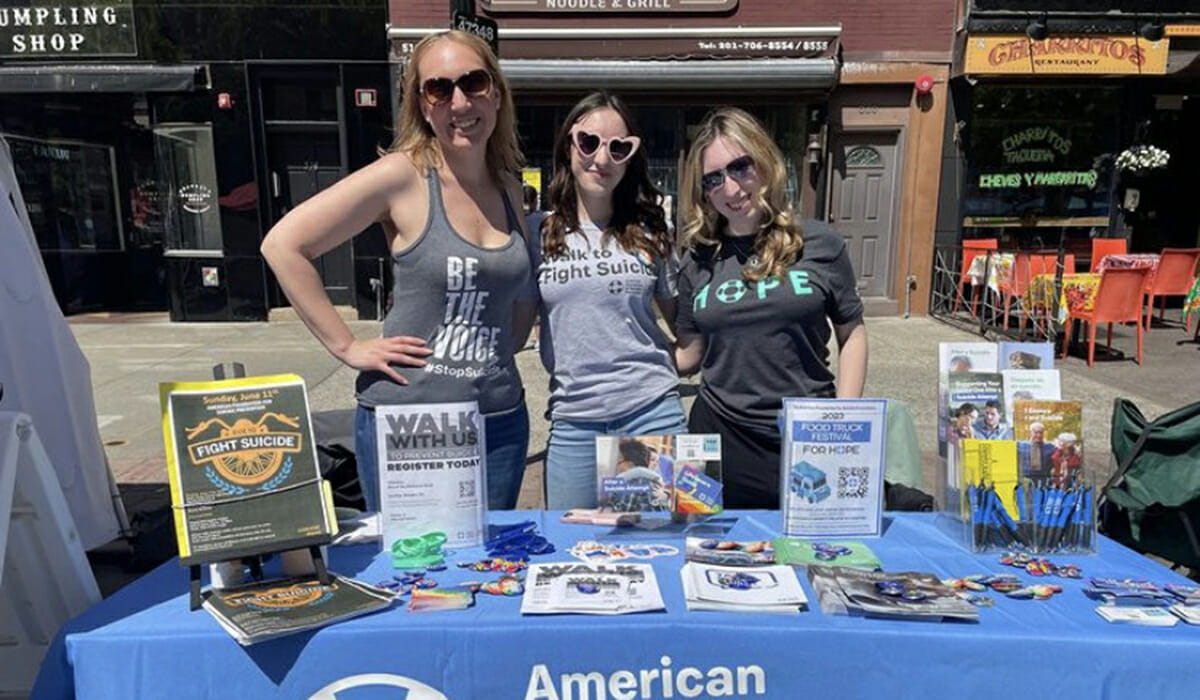
Megan Ruzicka (center) running a booth at the Florham Park National Night Out./Courtesy Megan Ruzicka
What’s been the most rewarding part of your volunteer work?
I love to see people from the community come together for an important cause. Mental health is a huge problem in this country. AFSP is a wonderful resource. It’s rewarding to me to be able to help someone by steering them toward the resources that can help them.
What have you learned through your experiences as a volunteer?
I have learned that nothing can be done alone. I’ve always had someone to support and mentor me. I know it truly takes a community to achieve change whether it’s on a personal or community level, and you especially can’t do it alone when you’re struggling. Having a support system is essential, especially when you might be struggling with mental health.
Are there any future partnerships, programs, or events that you are excited about?
I’m excited about the Out of the Darkness Walks coming later this year. There are walks across the nation that people can attend. Another volunteer and I have been doing sponsorship canvassing today to inform local businesses about how they could contribute. We hope to increase event sponsorship and attendance.
Why is it important for others to get involved with causes they care about?
Making a difference outside of yourself and contributing solely to benefit the lives of others is life-changing. People who aren’t struggling in some way may take their lives for granted. They may not need help now, but they may need it in the future. You just never know.
Megan Ruzicka (right) assisting at the Hoboken Arts and Music Festival AFSP Booth./Megan Ruzicka
What do you want people to learn from your story?
Anyone can be affected by depression and thoughts of suicide. Through volunteering with AFSP or other organizations, you can find a meaningful way to help and to give back to the community.
If you or someone you know may be considering suicide, contact the National Suicide Prevention Lifeline at 1-800-273-8255, or text HOME to 741741 to talk to a trained crisis counselor through Crisis Text Line. Both resources are anonymous, free and available 24/7.
ALS Researcher Volunteers Helping Chicago Neighbors Overcome Hunger
Meet Daily Point of Light Award honoree Hannah Ball. Read her story and nominate an outstanding volunteer or family as a Daily Point of Light.
Born in Tucson, Arizona, Hannah Ball now lives in Chicago. As a graduate student, she works in a lab aiming to understand the mechanisms of the neurodegenerative disease amyotrophic lateral sclerosis (ALS), also known as Lou Gehrig’s disease. Her original interest was genetics, but a happy accident — being placed in an ALS lab — made her fall in love with research.
Hannah’s family has always been active in the community through church events or volunteering at food pantries, so it felt natural for Hannah to continue volunteering once she moved to Chicago. Today, Hannah volunteers at Nourishing Hope, a food pantry whose motto is: “Helping our neighbors overcome hunger, improve mental wellness, and build for the future.”
What inspires you to volunteer?
During the COVID-19 pandemic, I volunteered at a vaccine pod and that’s when I really fell in love with volunteering. I’m inspired by the relationships I’ve built through volunteering. So many people come together from different backgrounds, both on the client side and the volunteer side. It’s fun to get to know them and build friendships.
Describe your volunteer role with Nourishing Hope.
Nourishing Hope is a food pantry where people can come to get food for the week or month. I volunteer several days a week. I am involved in the intake process where we check people in, and give them information they need about the food pantry such as how often they can come, many of a particular item they can take home at one time, and other services. I also “shop” for people, where people will wait outside and I gather their groceries so they don’t have to come inside. This is a great option for people who want a faster option and don’t mind not picking out items themselves. I also prep and restock pantry shelves for the next day.
Hannah Ball quickly found community in Chicago at Nourishing Hope after moving to the city./Courtesy Hannah Ball
What’s been the most rewarding part of your work?
I love seeing how much my efforts benefit people. I’ve gotten to know a lot of our regular clients but now there’s an influx of people from Ukraine and Russia who are new to this. They’ve been uprooted and need guidance. Many of our clients come from hard situations. It feels good to help them by telling them about available social services, housing, and other resources.
I’ve had many clients where it’s their first time and are blown away by how much food they can take home. Of course the relationships and friendships I’ve built are so rewarding!
What have you learned through your experiences as a volunteer?
I’ve learned to appreciate the little things. So many times, a client will get so excited when there are extras of a particular item that week. They’re excited about the little things. That excitement rubbed off on me! And gratitude! We take food for granted. I see people who have had to make big adjustments in their lives, like coming to a food pantry because they’re out of options. They are so grateful for the help.
Why is it important for people to get involved with causes they care about?
It’s important to give back, to learn about people in your community – people you would otherwise never meet. I’ve met so many different people who have been through a lot. It’s rewarding to help with some part of them getting back on their feet.
What do you want people to learn from your story?
Giving your time to other people can impact their lives in a big way even if it’s a little bit of time for you. You can be a bright spot in other people’s lives just from one interaction on one day.
Texas Teen Enlists Family and Friends to Help Restaurants and Feed the Hungry
Meet Daily Point of Light Award honoree Ethan Poon. Read his story and nominate an outstanding volunteer or family as a Daily Point of Light.
When the COVID-19 pandemic hit, math whiz and cooking-enthusiast Ethan Poon just wanted to save the restaurants he loved while keeping the most vulnerable in his community from going hungry. After all, stories of his grandfather’s food insecurity in his younger years had left an impression. At 15, without even having a driving permit, he founded an organization that has been accomplishing both. Now, as the country enters into a new normal, The Food Lounge partners with local restaurants to donate food to those who need it most.
Ethan recently returned from a math competition in Iowa where he and his teammates bonded over the day-long bus rides and midnight gas station stop alongside their interest in numbers. Perhaps that’s why so many of them, teammates and competitors alike, were the first to step up to start new chapters of The Food Lounge. Ethan, a natural teacher who has used his skills to help others with math for years, helps willing volunteers learn to run their local branch.
As a freshman, Ethan also brought The Food Lounge to his high school for a couple of events. He has 100-200 volunteers in his chapter and has worked with over 150 restaurants. Every quarter, he hosts meetings with the others. Outside of his volunteer work, Ethan hopes to pursue a career in biology or robotics. With innovative ideas and empathy for others, he would make him an excellent addition to any field.
What inspires you to volunteer?
It all started during the pandemic in 2020. You’d watch the news, and people were dying left and right. Medical staff had to make life or death decisions about who could use the limited number of ventilators. That hit like a brick on my head. It exposed me to the real world. Looking at millions of people losing jobs and ending up on the streets without money to buy food or to take care of themselves resonated me. My grandfather was poor when he was a child, and he had to work really hard to get where he is now.
Ethan and The Food Lounge pack and donate Chinese food in downtown Dallas./Courtesy Ethan Poon
Knowing that and then seeing it right here really emphasized the importance of taking action. I couldn’t just sit there and do nothing. So, one day at the dinner table, I was thinking about all of the restaurants closing down and said to my mom, “What if we order a ton of food just for us and a bunch of friends? We get food, and they get money. That’s a win-win, right?
We bought the food, and one of them said, “Hey, we want to give back, so pick one or one or two shelters. We’ll give you food, and you can go give it to them.” This was the turning point from when we went from getting food for ourselves to getting food for other, less-fortunate people. We gave it to Emily’s Place, a local woman shelter. Who wouldn’t enjoy giving people the best meal they’ve had in months? That’s how it started. And it snowballed from there.
Describe your volunteer role with The Food Lounge.
I set up The Food Lounge and make sure we know how we are going to raise funds and get donations. I help get the word out using WeChat and social media. Getting the word out there is most of what we did in the beginning.
Because we rejuvenated a lot of restaurants, a lot of them were kind enough to pay us back. They didn’t even ask for compensation. They just started cooking food for us to give to the homeless. Sometimes we go over to their restaurants and cook the food ourselves.
For each chapter we open, I’ll go through the process with them and make sure they know what they’re doing in order to establish a good chapter that helps its community regularly. We teach them about fundraisers, how to negotiate with restaurants, and how to help the community work with other nonprofits as well.
And we have a few traditions. One of the first events we did, we donated to Children’s Hospital. And every Christmas since, we’ve given donated toys, clothes and food to overworked nurses and doctors to give to kids. They were especially overworked during the pandemic, so we were trying to get back to them to say thanks.
What’s been the most rewarding part of your work?
It’s seeing the growth. We have ten chapters nationwide now. It’s crazy to think that a couple of years ago, we were just buying food with friends and family, and now we have chapters in Detroit, the Twin Cities, Oklahoma and Long Island.
What have you learned through your experiences as a volunteer? What have been some of the challenges?
One of the challenges was getting the word out. When I started this, I was an eighth grader. I didn’t have experience talking to people and getting donations. That was a learning hurdle for me. I remember going to my orthodontist one day, and my mom told me, “Okay, this is practice. You’re going to ask for a donation.” I’m a bit of a quiet person, so I struggled, though when I got my first one, it was a big victory.
Introducing it to my school was a challenge as well. At my old middle school, we had this thing called a National Junior Honor Society. It was primarily dealing with volunteer stuff. Teaching and volunteer work. Introducing The Food Lounge and how to write an email to the president and the teacher who sponsoring the whole thing. Learning how to write an effective succinct email and learning how to talk business to solicit donations. I would never have done any of this before The Food Lounge. Learning all of that and then teaching others so they don’t make the same mistakes was very fun but challenging.
Personally delivering the donated food allows Ethan [right] to meet and learn about the people his organization serves./Courtesy Ethan Poon
Are there any future partnerships, programs, or events that you are excited about?
Yes, but unfortunately, I won’t be present for one of them; I’ll be at a six-week math research camp at Texas State University. We’ve donated a lot to the Samaritan Inn, which is a local family shelter in McKinney, and we’ve been partnering with them for a little over two years now. They’re very good friends. So, I organized a summer camp for the kids there. We’ll go there to teach, donate back-to-school supplies and function like a daycare. I would like to be there, because teaching is important to me.
Why is it important for others to get involved in causes they care about?
It’s not enough to just sit there and watch the TV. If we don’t help others, we’re just leaving them in the gutter. And I don’t think I can sit there and watch them rot and die without doing anything. Consider the impact that you can have on people. That’s the main thing that keeps us going.
What do you want people to learn from your story?
Starting out, I was super nervous and hesitant about how it was going to work. Mainly, I was worried about what people would think of me, because I was a middle schooler. If I were to give some advice to someone else and to a past me, it would be ‘Don’t be afraid. Go for it. What’s the worst that can happen.’