Meet Daily Point of Light Award honoree Patricia “Tricia” Dononue. Read her story and nominate an outstanding volunteer or family as a Daily Point of Light.
Tricia Donohue is from Albany, New York. After a brief stint in New Jersey, Tricia and her husband relocated to Portsmouth, New Hampshire, looking for fresh air and natural spaces to raise their children.
Tricia’s business is garden design and maintenance. She attributes her love of gardening to her mother, who is still an avid gardener at age 87. However, it wasn’t until around five years ago that Tricia shifted her focus from perennial foundation gardens into growing vegetables.
Tricia found vegetable gardening to be challenging in Portsmouth since lot sizes are small, and many of them are shaded. She did what she could with the space she had. By now she had the vegetable-growing bug and wanted to join a community garden where she could have a larger space. To her dismay, she found that there wasn’t a community garden in all of Portsmouth, which is home to 21,000 people. And so, she decided to start one.
What inspires you to volunteer?
I noticed that it was hard for folks in Portsmouth to grow their own vegetables. Not only are lots small, but there are also many apartments without any outdoor space. I wanted to join a community garden but I didn’t find one. Opening our community garden was actually perfect timing. It was toward the end of the pandemic, people were still isolated but desperate to get out and socialize. People were desperately missing social connection. An outdoor garden is a perfect way for people to meet safely! For me, the gardening aspect of a community garden is the main reason I started it – a place where anyone can grow their own food in a supportive environment. But now, several years in, the community aspect has become just as important. People who normally wouldn’t meet have created some amazing friendships because of the garden.
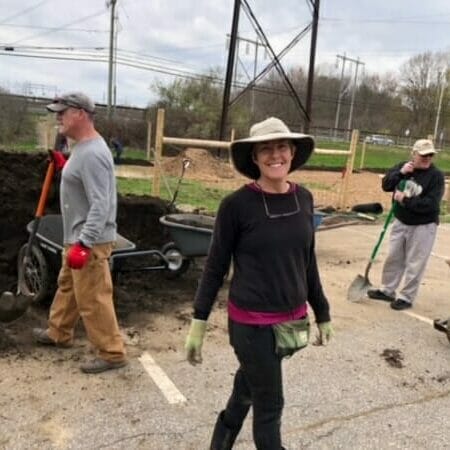
Tricia Donohue (in hat) at the Volunteer Work Day to build the raised beds at the Portsmouth Community Garden./Courtesy Tricia Donohue
Describe your volunteer role with the Portsmouth Community Garden.
I wear many hats, including a gardening hat! I am the founder of the Portsmouth Community Garden. Today, I serve as the Board Chair and take on all kinds of administrative tasks including editing our monthly newsletter, overseeing our food donation program at Gather, which is a local food pantry. I handle member questions and oversee the volunteer program. I keep our website updated, and log the garden’s expenses and income.
I also managed the entire build-out of our garden. We constructed a 60’x200′ deer fence, a storage shed, 70 raised beds – we started with 35 raised beds and added 35 more this year and completely maxed out the space.
What’s been the most rewarding part of your work?
Being able to donate as much surplus food is just amazing. We deliver to Gather, a local food pantry, every Monday. Equally rewarding is being in the garden and seeing people whose garden beds are next to each other helping each other, bonding, and growing friendships. The community garden brings people together who might not otherwise know each other.
What have you learned through your experiences as a volunteer?
I wasn’t much of a volunteer or community service person before I caught the vegetable gardening bug. I was busy raising my kids and running my business but other than occasionally volunteering at the school, I wasn’t very involved.
Once I started the community garden, I discovered a renewed faith in humanity. In a world where the news is so depressing and many people are losing hope, I have been overwhelmed by how many people wanted to take time out of their busy lives to make this happen. After I started the garden, I began seeing the good in people. I didn’t realize that there were so many in the community who were willing to stop what they were doing to share their expertise, effort and money. I am truly overwhelmed!
Are there any future partnerships, programs, or events that you are excited about?
Since we are maxed out at the location and can’t add any beds, we are planning to expand our outreach program. We are building a pergola that will be used for education and programs. We want to invite everyone to come learn how easy it is to grow your own food. We want to invite people who normally wouldn’t grow their own food or want to but don’t have time.
At the beginning of the season we host an opening day celebration where we sell seedlings. At the end of the season we have a potluck where people share dishes using the food they grew. We also do a final cleanup to get the garden ready for spring.
This year, one of our members, who is a local chef, said he would cook for everyone using what we grew. We also plan on holding seminars and various outreach programs later this yea and into next year.
Why is it important for others to get involved with causes they care about?
You feel so good when you do something good. If everyone did a little something in the way of a small community service project, everyone would feel good. I feel happier and more fulfilled since I started this. Yes, it takes a ton of time and energy but I love it. We would be a better society if everyone did a little something!
What do you want people to learn from your story?
If I can do this, anybody can do it! You don’t have to go out and start a new nonprofit. You can try different things until you find something that makes you feel fulfilled and do that, whether it’s one hour a month or one hour a week.
Revitalizing Chicago’s South Side: Volunteer’s 13-Year Commitment Enriches Community
Meet Daily Point of Light Award honoree Joyce Donaly. Read her story and nominate an outstanding volunteer or family as a Daily Point of Light.
Chicago, particularly its South Side, has had its fair share of negative publicity due to its high crime rate. For those who only know the area from news stories and Hollywood portrayals, it might be hard to grasp why Joyce Donaly has such a deep love for her city.
But Joyce sees beyond the headlines and stereotypes. “People here are just like everyone else,” she said. “They’re working hard to support their families, going to work every day, and trying to make a living. There’s beauty here, and there are caring people.”
Little does Joyce know that she is a key player in bringing that beauty to life. Since 2010, she has dedicated herself to volunteering with Chicago Cares, a nonprofit organization that connects prospective volunteers with various projects throughout the city. Just a year into her journey with Chicago Cares, Joyce became a volunteer leader, mobilizing and inspiring others to embrace the organization’s mission and realize their impact.
In the past three years alone, Joyce has participated in more than 400 volunteer engagements, contributing a total of 926 hours. Among those many projects, the Read-With-Me program holds a special place in her heart. “We would read with students and do craft projects together,” Joyce explained. “Since it’s difficult for teachers to provide that one-on-one time with students, we were able to give them that individualized attention. And I was able to see students changing throughout the school year. It was really heartwarming to see.”
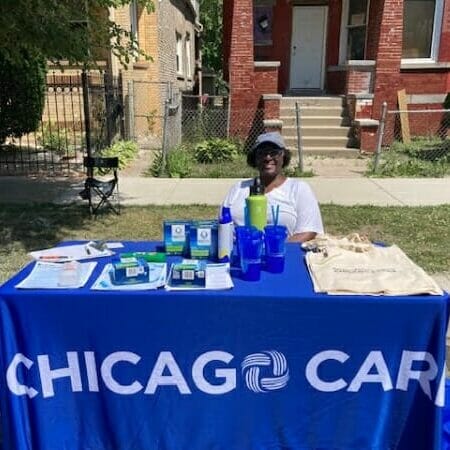
Joyce Donaly has volunteered with Chicago Cares for over a decade, engaging in hundreds of various service projects to support her community./Courtesy Joyce Donaly
Another one of her favorites is Breakfast and Bingo, where Joyce and fellow volunteers would cook breakfast for senior residents at assisted living facilities and play bingo with them. Joyce’s volunteerism extends further, including teaching students about nutrition and preparing healthy meals, supporting Get Out the Vote initiatives, exploring Black history in Chicago, and nurturing the next generation of volunteer leaders through peer-to-peer mentorship.
“It’s important to me to volunteer in the community in which I live because it ensures that it continues to be a vibrant community and that people have the resources they need to thrive. Volunteering and supporting the people here means they’re able to have a good education, to be able to feed themselves and have economic stability and that’s important to keep the community alive,” Joyce said.
As the manager of volunteer engagement at Chicago Cares, Kathryn Nathenson has witnessed firsthand the extraordinary nature of Joyce’s passion for volunteering.
“Volunteers like Joyce are literally the heart of our work. They make the magic happen,” Kathryn said. “Whether as a volunteer or volunteer leader, Joyce brings such a beautiful spirit to all of the programs she attends. She radiates positivity and is always willing to jump in and try something new even if it’s something she’s not used to or comfortable with. We love that about her.”
With hundreds of volunteer projects under her belt, the number one piece of advice she gives to new volunteers is this:
“Have fun. If you come into it with the right heart, the right spirit, you’ll get as much out of it or even more than the people you’re serving,” Joyce said.
Founder of Literacy Organization Brings Books to South African Libraries
Meet Daily Point of Light Award honoree Colin Bloom. Read his story and nominate an outstanding volunteer or family as a Daily Point of Light.
Colin Bloom lives in New York, but has dual citizenship in the U.S. and South Africa. After discovering that 80% of South African 3rd graders can’t read for meaning, and 92% of South African schools don’t have libraries, he became passionately committed to improving South African literacy.
In 2020, Colin created Libraries for Literacy. For his first library, he collected and transported 1,500 books to a Soweto school and in 2022, he created a library in KwaZulu Natal, a province in the southeast of the country, with 3,000 English and Zulu children’s books – housed in a refurbished shipping container he organized. To date, he’s collected over 10,000 books, has facilitated the opening and stocking of four libraries in South Africa, and also spends his summers teaching literacy in these libraries.
Colin’s work transcends literacy to advocate for racial equity and social justice, believing that literacy is a human right. Read on to find out what inspired Colin’s mission and what challenges he’s overcome along the way.
Describe your volunteer role.
I’m the founder of a nonprofit organization called Libraries for Literacy. We bring books from the U.S. to South Africa to support underserved schools. We’ve created four libraries across South Africa and brought 10,000 books with us.
My main role is to organize where the next libraries are going to be, stay in touch with our partners and keep track of inventory – how many books we have in our house at one time – and which libraries they’ll go to. My brother and parents are a huge part of Libraries for Literacy – I wouldn’t be able to do what I do without them.
What inspired you to start this initiative?
It all began when I was walking through a grocery store in South Africa – it was my first time there. I noticed that all of the canned foods had pictures on the outside. I was used to canned food that mostly had words on the labels. I was curious, and when I asked my dad about it, he pointed out that many people in South Africa can’t read.
When I got back to the U.S., I decided to do some research and I discovered that South African kids ranked last in international reading assessments, and more than half of South African kids grow up in homes without books. Only 8% of schools in South Africa have libraries, compared to over 90% in the U.S. Since reading was such an important part of my life, I was determined to do something about that.
Over the next year, I collected about 1,500 books from schools and libraries around my area, as well as donations. I sorted them into categories based on difficulty level and then I brought them to a school in Doornkop-Soweto – which is right outside of Johannesburg – in 2020.
How do you transport the books?
We travel as a family, and we basically take them in our carry-ons. I’m grateful to have my parents’ and my brother’s help on this, as I tend to use a lot of their baggage space!
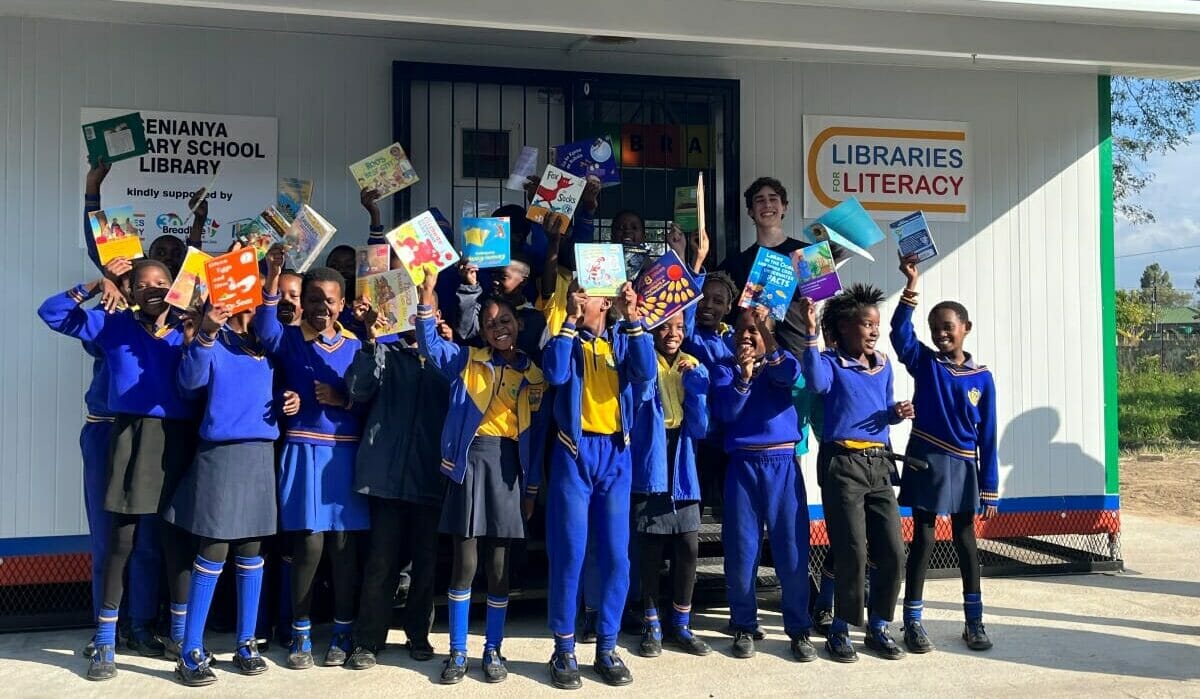
Libraries are a fundamental part of increasing literacy in school-aged children./Courtesy Colin Bloom
Any rewarding stories from your volunteer work?
I would probably say the moment we arrive with the books is always a super rewarding moment. As soon as we step out of the car and start unpacking the books, which is usually a day before the library opening, there are always kids waiting there because they’re so excited. They want to help us unpack the books.
That’s incredibly rewarding – to see that they’ve been waiting so long for that day! After we finish unpacking, the kids start picking books off the shelf and reading them right away. It’s so rewarding.
Why is it important for people to get involved with the causes they care about?
I would say that it’s very important to contribute and help others out. That helps to spark change in the world. People might think it’s one small action – or in my case, one library – with a really small impact, but I think that even if you can make an impact on just one life, or a few lives by your efforts, it’s such a huge thing. So many things don’t happen, simply because people think they’re not making an impact. So realize that you actually are.
What do you want people to learn from your story?
The main thing is to work through challenges. We’ve certainly had a ton of those. For example, for our first library in Doornkop-Soweto in 2020, I had sorted all the books and put numbers on them, then put them into an app called Book Buddy. We had a phone setup that could be used to check out the books and keep track of them online, instead of just using paper. When we brought all the books there, the headmaster said, that’s not possible – she didn’t want the books leaving the library.
Her reasoning was that she thought the books would just be stolen and sold on the side of the road the next day. That was really tough to hear. It was a huge challenge, especially because that was our first experience of bringing books to a library in South Africa. We didn’t know what to do at that point, as it wasn’t our place to insert our opinion of what should happen in their library.
So, those books weren’t allowed to leave the library, but going forward it became super important to us to emphasize for any future library that we’d replace any books that were lost. We’re clear now that it’s so much better for the books to be taken out and used by the kids, to be read, to get dirty and ripped, than to just sit on the shelves collecting dust. Every library after that first one allowed the kids to check out books! So my message is to work through challenges.
Baghdad-Born High Schooler Starts Texas Nonprofit to Help Other Refugees with Resettlement
Meet Daily Point of Light Award honoree Ibraheem Razouki. Read his story and nominate an outstanding volunteer or family as a Daily Point of Light.
Ibraheem Razouki, a student at Lamar High School in Houston, Texas, has an interesting history that has led him to where he is today. Ibraheem was born in Baghdad, Iraq, during the Iraq War and later migrated to Jordan and the United States. Today, he is the founder of AIM to AID, a nonprofit that seeks to help others, particularly refugees, who have also had to navigate the challenges of resettlement.
Through his leadership in various organizations, Ibraheem has organized and executed successful service events that have raised over $3,000. He has partnered with organizations such as Refugee Services of Texas and the Islamic Society of Greater Houston to make a meaningful impact on the lives of refugees. His hard work and dedication have been recognized with two President’s Volunteer Service Awards, one in gold and one in bronze.
Read on to find out what inspired Ibraheem to get involved in these causes.
Describe your volunteer role.
I’m the founder and CEO of a 501(c)(3) nonprofit organization. My main purpose within the organization is to oversee all operations, making sure everything is running to the best of our abilities and most importantly, making sure we have a long-term vision for our goals.
I do actually have a five-year plan for our organization to ensure long-term success! Especially as the refugee crisis is not something we can single-handedly solve in a couple of years, we want to make sure that AIM to AID is playing a role in solving the issue. This is my most important responsibility – setting us up for long-term success.
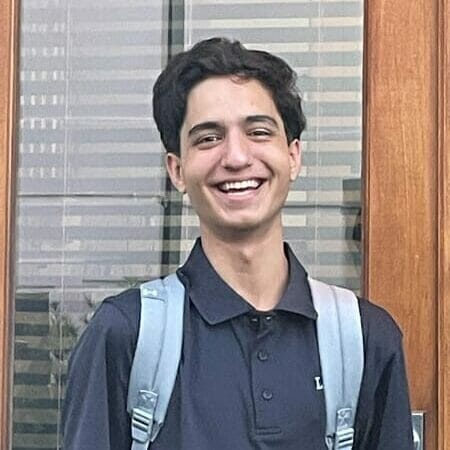
Ibraheem has received recognition for his volunteer work, including two President’s Volunteer Service Awards./Courtesy Ibraheem Razouki
As an organization, we have engaged with over 100 refugees now and raised $15,000 in donations and grants! Furthermore, we have established five nationwide chapters in New York, Texas, Minnesota, California and, recently, Michigan. We have also collected and distributed over 1,000 items, such as clothes and toys for children.
What inspired you to start this initiative?
I come from a Middle Eastern background. I was born in Baghdad, and due to the conflicts taking place there in the early 2000’s, we had to seek refuge first in Jordan then in the United States after that. Watching my parents and family members do this, and the struggles we went through while trying to culturally acclimate in the United States and Western culture in general, inspired me and my co-founder Zane to start this nonprofit.
To an extent, we know what it’s like to struggle, we have an idea of the effects and the barriers raised while getting situated in a new place. And that, coupled with having to move around a lot within the United States – I’m used to being the new kid in school! – inspired me to help others who are resettling.
One of the main focuses we established early on was having tools for the community – for example, a brochure project that describes Middle Eastern culture and United States culture. We distributed these brochures in the Houston area about a year ago, because one of the main issues we identified in resettlement was the host of cultural barriers when coming to the United States – not to mention the economic and financial barriers.
Any rewarding stories from your volunteer work?
Getting in contact with refugees is not as easy as you might think! But we had our first in-person event a few months ago, and that was the most rewarding experience. We finally got to partner with an organization that gave us that privilege and believed in us. So shoutout to Interfaith Ministries of Greater Houston! We worked for 8 to 11 months to secure this partnership, and now that we’ve had that first in-person event, we’re continuing to partner with them.
Why is it important for people, especially young people, to get involved with the causes they care about?
I’ve always had an interest in entrepreneurship, and some people ask me why I’d work with a nonprofit when I want to go into tech or business. But creating a nonprofit that actually served a cause I cared about created more drive to continue pursuing my passions, as well as honing necessary skills.
Social entrepreneurship is something I’m really passionate about, so why not get that experience in a way that’s beneficial to other people? It’s a good foundation to have, and keeps you growing and learning.
What’s your advice for people who want to start volunteering?
Well, first of all, there’s no need to be nervous. You’re helping people out. I’ve volunteered in multiple settings, from hospitals to teaching people how to code. You see different types of stories and reactions to your work. Getting volunteer experience gives you a sense of fulfillment and happiness. Obviously, receiving feedback on your work – the people who come back months later to thank you – is very rewarding too.
For me, it’s more that I’ve been raised in that way, with a core value to be selfless. It’s important in my religion and an important family value too. Helping people and having a purpose greater than just chasing money or success. Pursuing something that’s bigger than yourself is so crucial.
What do you want people to learn from your story?
The most important thing is to just start. If you have something you’re interested in and something you’re passionate about, just start! When we started in March 2022, it was just an idea and a website. I had no idea it would receive the traction it did. We started with blogs and brochures, and it’s led to raising thousands of dollars in funding and grants, and partnering with organizations to spread outreach across the country.
So, I’d say to just do your best. Just start. People put too much emphasis on preparing and being meticulous about their approach, which is important but can also lead to stagnation. Try different things, do your best, and eventually things will take care of themselves if you’re passionate and stick with it for the long term.
Retired Medical Administrator Dedicates Retirement to Caring for Florida State Park
Meet Daily Point of Light Award honoree Francis Folkers. Read her story and nominate an outstanding volunteer or family as a Daily Point of Light.
Francis Folkers, a native of rural Missouri, watched her dad care for the land and animals around them throughout her childhood. They had a garden, cattle, hogs and chickens, but when she turned 18, she left to see more of the world and caring for nature was a comfort of home that got further away.
She married, moved to Florida, had two kids—and now six grandkids—a cat and a 35-year career as an administrator at a medical practice. While there are plenty of plants around the house and inside the safety of the screen enclosure, a traditional garden is out of the question. Living so close to Oscar Scherer State Park, the wildlife likes to snack on any plants they can reach.
In retirement, Francis decided to spend more time with said wildlife and became a two-term AmeriCorps volunteer with the park. She gave the education award she earned during her terms to her granddaughter to help pay for college and simply kept going. With the skills she learned, she now specializes in invasive and non-native plant removal but helps out with events and other areas as well. Since she started, Francis has spent well over 12,000 hours volunteering and was given the Irene DeLaby Award for her service.
What inspires you to volunteer?
Even before I retired, I would go over to the park and mow, because it was instant gratification. It looked really nice, and I enjoyed it. I didn’t get to spend a lot of time doing that, so when I retired I went over and just started doing more and more.
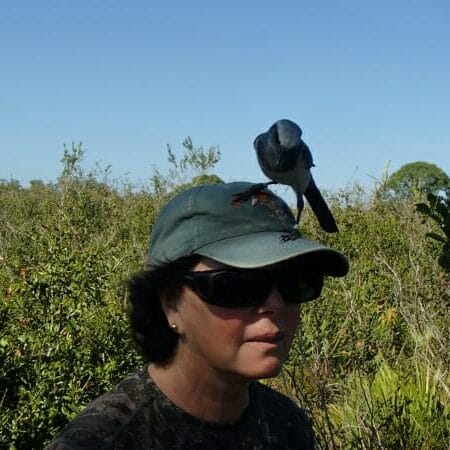
Amongst staff, Francis is known as the Florida scrub jay whisperer due to her work with the rare birds./Courtesy Francis Folkers
Describe your volunteer role with Oscar Scherer State Park.
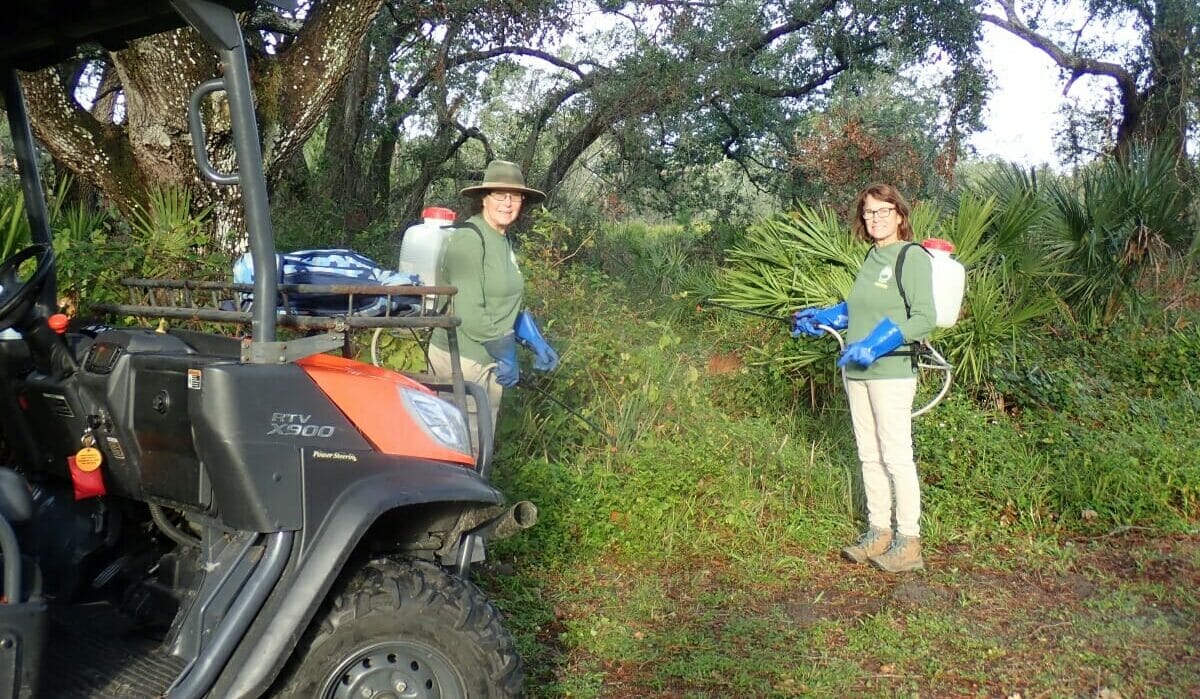
My main job is invasive and non-native plant removal. So, I spend a lot of time in the woods looking for things trying to takeover or smother out the native plants and trees. We do a survey every two years so we know the state of things. I try to work where we need the most help. I hand-pull some of them and use chemicals on others, depending on what the plant is.
Because there are so few Florida scrub jays left, the whole state does surveys at least once a year. We do it once a month, because we only have around 15 birds right now. They’re all banded so that we can identify them. I spend a lot of time out there. They’re very social, very friendly birds about the size of a blue jay. They’re so friendly, and people tend to want to touch them and feed them. So that’s part of it too. I watch that people aren’t doing anything that might be detrimental to the birds.
We also do prescribed burns. They put nutrients back in the soil which makes things grow–things that should be there as well as things that shouldn’t be. You get a better handle on it if you go in after burns. Within a few days, things are growing back, and in a couple of months, depending on the zone and what was in it, you can barely tell that it was burned. We’re fortunate to have a long growing season in Florida.
I do a lot of different things, so it’s never the same every day grind, so to speak. There’s just so much going on. It’s been very rewarding.
What’s been the most rewarding part of your work?
The extension office here in the county has this LIFE program (Learning in Florida’s Environment). In the springtime, they bring busloads of kids from the schools, and we teach them about things like birds, animals and plants. The look on their face as we explain stuff to them is very rewarding.
What have you learned through your experiences as a volunteer?
I have learned that what I know today is just scratching the surface of what I can learn. I find one thing out and that leads to ten other things.
I learned that everything in the park, no matter how small or how large, is a building block. And if one of those crumbles, it affects the whole pyramid. For example, we have gopher tortoise in our park. They call them the keystone species, because if they disappear, so many things in the park will disappear. That’s another thing that I do. When we’re going to do any kind of mechanical treatments, I go in and check and monitor the gopher tortoise burrows so that they go around those during the prescribed burns.
Other animals, other insects, everything goes into those burrows. You’ll have snakes and rabbits and insects and other reptiles that go in there, and during that time you’re all ok together. Once it’s over, they go out and resume their normal life. If we destroy something, or if we somehow take the last one out–not just in our park but anywhere–it’s gone. There are things you can’t get back, so we have to be very careful.
Francis [left] joins her colleague, Deb, in invasive and non-native plant removal./Courtesy Francis Folkers
Are there any future partnerships, programs, or events that you are excited about?
On Father’s Day, we have a compass event. Eagle Scouts come into the park and set up a course out in the woods. It’s not easy! We show them how to use compass and give them coordinates to follow to markers one through 19. Some are easier to find than others, but not too easy. There are a lot of obstacles.
We’ve had a lot of smaller people. We like them to be at least eight years old because of the terrain. And we had a man who brought his ninety-year-old father one year. There’s no limit. We’ve even had people from the service come in who just wanted to do it to refresh themselves. Some bring their kids to show him how to do things.
Why is it important for others to get involved in causes they care about?
I think it’s very rewarding. I think it’s good for the soul. To me, it’s very calming to be out in the woods and commune with nature. I feel like I’m helping and protecting nature and giving back. I’m trying to make it a better place for people who come to visit.
What do you want people to learn from your story?
I want them to know that nature is a gift, and it gives us so much. We need to take care of. It’s not just for us to use. We need to nurture it. And anybody can make a difference. There are so many different volunteer jobs. We have little kids that come in and help. The idea is that we’re taking care of these gifts that we’ve been given.
Retired California Chaplain Volunteers on Board Historical Aircraft Carrier
Meet Daily Point of Light Award honoree Paul “Chappie” Ward. Read his story and nominate an outstanding volunteer or family as a Daily Point of Light.
When Paul “Chappie” Ward retired in 2018, he knew his call to serve was not over. Ever since he visited the USS Midway, an aircraft carrier formerly of the U.S. Navy, he’s been passionate about sharing the stories of the men who served on the vessel. Chappie has volunteered 7,300 hours aboard the ship, with the focus of teaching visitors to “connect the story with the steel.”
Chappie says that his love for history, paired with his appreciation for those who serve our nation is what drives him to repay back what service men and women have done for him. One of the most powerful parts of the job is sitting on the USS Midway while looking across the San Diego Bay and seeing the ships that are currently serving our country.
“I’m sitting on history and I’m looking at history being made,” Chappie says.
WHAT INSPIRES YOU TO VOLUNTEER?
There is something fulfilling when you see a smile, a nod, a gesture of approval or appreciation from someone who has been impacted by a word or an action that you performed on their behalf. It’s a great feeling just knowing that something you said, or did, brightened their day or enriched their experience.
DESCRIBE YOUR VOLUNTEER ROLE WITH THE USS MIDWAY.
I am fortunate to be just one of the approximately 750 volunteers on board the USS Midway Museum. I serve on seven teams on the ship. The teams are as follows: Docent, guide and storyteller; Exhibits, cleaning and preparing the various displays; Guest Services, greeting and assisting guests as they enter and depart the museum; Curatorial, compiling data for the ship’s master log; Outreach, representing the ship at activities and events onboard the ship and in the community such as movie nights, special events, observances in my role as volunteer Chaplain, parades, air shows and Speakers Bureau; and finally Membership “Midway Sailor Program” Liaison, where I help with reconnecting former Midway crew members with each other and their ship in a Facebook group.
In the past six years, Chappie has put in 7,300 hours of service aboard the USS Midway./Courtesy Chanel Mize
The USS Midway Museum is described as “America’s Living Symbol of Freedom” and I am privileged to be one of those volunteers who is committed to preserving the legacy of this historic ship by inspiring over a million guests a year from all around the globe, through educating and entertaining them by sharing the stories of the nearly 150,000 men who served this nation aboard the USS Midway from 1945-1992. To be able to help bring this ship to life and to share the “Midway Magic” of what transpired during times of peace and war is an honor. The humanitarian and combat missions conducted by the ship’s crew is a humbling and rewarding privilege.
WHAT DOES “MIDWAY MAGIC” MEAN?
The term is a moniker that came from the crew that served on the Midway because magic happens every day aboard this ship, even today. The accomplishments of the men who are honored on this vessel, and the hundreds of volunteers who are committed and dedicated to sharing the stories and preserving the legacy to inspire the future generations to patriotism, to educate and entertain. You know, that’s “Midway Magic.”
HOW DID YOU FIRST BECOME INVOLVED WITH USS MIDWAY?
Service has always been a part of my DNA. During my 30 years of pastoral ministry, I taught about serving others and demonstrated it by volunteering my services as a chaplain with local high school sports teams, police and fire departments, service clubs and my 22 years as a chaplain in the Civil Air Patrol-USAF Auxiliary. In 2010, during the annual Civil Air Patrol (CAP) Conference, I visited the USS Midway and immediately was drawn to it because of my interest in history and the military. When my wife, Nan, and I retired in 2017, we relocated from San Luis Obispo to San Diego to be near our family (especially our two young granddaughters). As my time in CAP was nearing an end, it was only natural that I would seek out an opportunity to serve on the USS Midway – and I was able to check that item on my bucket list. It has been a great fit.
DO YOU HAVE A FAVORITE MEMORY FROM YOUR TIME VOLUNTEERING?
There are so many – each encounter is a memorable adventure – but one does stands out. I am fortunate to be able to provide personal tours for the ship’s special guests such as families of special needs children, cancer and serious illness survivors, former Midway crew members and veteran groups. Once, I was given the privilege to provide a tour for a son of a missing/killed in action Vietnam Veteran whose remains were returned to the US and the family 52 years after his plane was shot down, alongside the crew chief who was the last person to see him alive. It was a very special and emotional day that I will long remember.
WHAT’S BEEN THE MOST REWARDING PART OF YOUR WORK?
The most rewarding part of the job is seeing people’s reactions and hearing the responses of those who have a “Midway Magic” experience. I love teaching the youngsters about the lives of those who served through the Midway’s Educational Department. I get to present the participants of the Midway’s Junior Pilot Program with Junior Pilot Wings in an official ceremony with their parents.
It’s fun to see when adults come on board not quite certain what to expect, and then leaving with a greater appreciation of those crew members and their families for the sacrifices made and service rendered.
Also, when former crew members and their families who return to the ship, or their “home,” where memories were made – and now shared – as they visit their workspaces and berthing areas on the ship.
WHAT’S YOUR ADVICE FOR PEOPLE WHO WANT TO START VOLUNTEERING?
Find something to do or an organization to join with which your personal interests and values align. The more you learn about that activity or organization and its purpose, the more you are involved, and the greater the personal fulfillment and reward.
WHAT DO YOU WANT PEOPLE TO LEARN FROM YOUR STORY?
I found myself a retired individual with an Air Force background serving on a Navy ship – talk about an overwhelming task. But by taking advantage of the training provided, the camaraderie and mentoring of others, the embracing of the mission and core values of the organization, and the assuming of responsibilities and tasks – volunteering aboard the USS Midway has been one of the most rewarding experiences in my personal and professional life.
CCHC is a nonprofit organization that provides medical care to uninsured individuals in the surrounding area. With volunteers such as Dallas, who is a pharmacist by training, the free clinic can offer professional attention for patients in the community who aren’t able to afford care at for-profit clinics.
Dallas started spending his weekends at CCHC in early 2020. Between working at the CDC and volunteering at CCHC, Dallas feels he has the best of both worlds. “It’s really nice to work with population-level health [during] the week, and then getting that one-on-one patient interaction by volunteering at Clarkston on the weekends,” Dallas says.
Making a difference in a tight-knit community is something that Dallas found he is passionate about, even before he arrived in Clarkston. First, he worked as a Peace Corps volunteer for two years in Cambodia, and then another year in Malawi.
Dallas’ biggest goal is getting more medicine donations so that patients can receive all the care they need at Clarkston Community Health Center./ Courtesy M. Habib
“What I really loved about Peace Corps was being able to make an impact in the community that you live,” Dallas says. His time in the Peace Corps is what inspired him to get involved with CCHC when he moved from Malawi to Clarkston due to COVID-19. He says that being able to volunteer at a clinic that is serving those who he interacts with daily is his favorite part of the job.
Also at CCHC, Dallas is tasked with training new volunteers at the clinic. The care patients get at CCHC is top notch, and Dallas credits this to the volunteers.
“Training is one of the coolest parts of the job, because the people who work here want to be here,” Dallas says. Also, he finds he learns more about the patients they serve through the new volunteers. Some of the volunteers are refugees, or have family members who are refugees, so they help inform Dallas and CCHC about cultural differences or assist with language barriers. A majority of CCHC’s patients are displaced people, so with this insight, Dallas feels he can connect with patients at a deeper level.
However, providing care at a free clinic has its challenges. Free clinics are provided medication from drug distributors on a donation basis. Whereas a typical, for-profit pharmacy has access to all drugs that are offered on the market, the types of medications and the supply of medication can fluctuate at CCHC depending on what has been donated to the clinic. But Dallas doesn’t let this hurdle impact the patients.
“Everyone deserves high quality, comprehensive care,” says Dallas. In these circumstances, the pharmacists strive to be well-informed on what is the free clinic’s best option for the patient, as well as offering guidance through side effect management and holistic health care.
Dallas has taken on this challenge in stride. One of his personal goals is to expand the number of drug distribution partners, and the amount and diversity of medications that CCHC can offer onsite to its patients. There are instances where patients are offered to get specific medications filled elsewhere, but Dallas understands that some patients have transportation limitations. He says it’s incredibly important to “be able to make the connection from a patient coming into the clinic, being seen by a clinician and then getting the medications – offering them a one-stop-shop.”
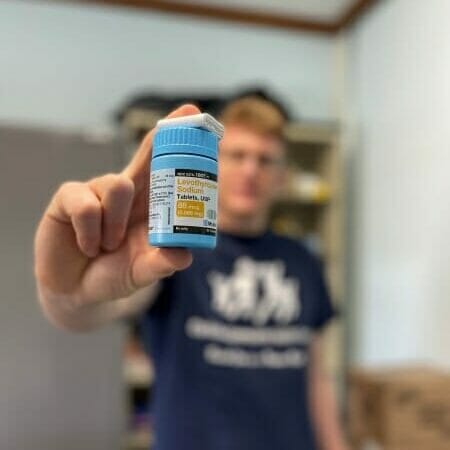
When he first started at CCHC there were two drug distributors that partnered with the clinic, but Dallas has grown that number to approximately five companies. This has had an astounding effect on how many medications CCHC is able to offer the community. On top of accumulating more distributors, Dallas has also been an advocate for a monthly budget for the pharmacy. The budget is used to purchase some of the more expensive but essential medication that the pharmacy can’t receive through charitable donations. With extra funds, patients can still receive free care, while also being able to have access to more expensive prescriptions.
The numbers don’t lie. With Dallas’s leadership and CCHC’s extraordinary care, patients in Clarkston are receiving more care. In the beginning of last year, the health center filled 202 medications a month. Now, the health center is filling 1,518 medications a month.
Dallas encourages others to think local and find ways to make an impact in their community.
“Go next door and volunteer at a clinic or figure out ways to directly contribute to the betterment of the people who you live around,” says Dallas.
Son of Immigrants Works to Create Unity Through Basketball
Meet Daily Point of Light Award honoree George Todorovich. Read his story and nominate an outstanding volunteer or family as a Daily Point of Light.
Born in New York City to parents who emigrated from the former Yugoslavia, George is the oldest of four children. An avid athlete, George has turned his passion for basketball into a force for good in his parents’ home region. Through his nonprofit, Homeland Hoops, George works to renovate community basketball courts in the former Yugoslavia and provide mentorship to young athletes. To date, Homeland Hoops has connected over 100 youth to mentors, and raised over $20,000 to refurbish three basketball courts in Serbia and Bosnia, impacting nearly 10,000 individuals living in the local communities.
Read on to learn about George’s mission, including a service celebration of the 100th anniversary of basketball in Serbia.
What inspires you to volunteer?
In 2015, I visited the Balkans for the first time. My parents took me to where they were from and I vividly remember the playgrounds and parks where the local kids hung out. What stood out was the condition of the basketball courts. I saw cracked concrete and beat-up boards and hoops, but still the kids were having a great time.
I combined my passions for basketball and my roots in the former Yugoslavia. Basketball is huge in Serbia, Bosnia, Croatia, Montenegro and the other smaller countries that emerged from the breakup of Yugoslavia. Today, many top NBA players are from that region. I believe that if the youth from these countries are given the same opportunities as kids have in the United States, the youth would be better off in terms of opportunities to play pro basketball, and their lives in general.
George Todorovich is the founder of Homeland Hoops, a nonprofit refurbishing courts in impoverished areas of ex-Yugoslavia and providing mentorship opportunities to high school and college students from the region./Courtesy George Todorovich
My parents’ experiences with the war through the 1990s shaped my desire to help. Even today, the region is divided ethnically and religiously. Still, the region is one of the greatest sources of elite basketball players. This demonstrates just how much of a unifying force basketball can be.
A couple of years ago, I was suffering from sports injuries. From 8th to 10th grade, I was out of sports, and, because of that, I decided that even though I couldn’t play myself, I wanted to contribute to basketball in another way. I created Homeland Hoops during that time.
Describe your volunteer role with Homeland Hoops.
Currently I’m focused on a new project called the King Peter Project which is a court renovation project that will be installed in time for the 100th anniversary of basketball in Serbia. The first game in the “Land of Basketball” was organized at the King Peter School by the American Red Cross. Since then, the sport has really taken off in Serbia and other Balkan countries, but the infrastructure is in bad shape.
Right now, I’m talking to companies about the designs of the courts and pricing for the King Peter Project. I am also working on social media to help solicit donations. I also update the website and social media, and organize meetings among board members.
The two aspects of our mentorship program are called Man to Man and Zone Defense. Man to Man connects youth athletes to college athletes in the region. Zone Defense provides mentors for college athletes who help prepare them for life after college. My role is to reach out to potential mentors and mentees and connect them with each other.
What’s been the most rewarding part of your work?
On our website you can see before and after pictures of our courts. Looking at what kids had before versus what they have now is so rewarding because I see the impact that we’ve made. Last summer I visited one of the locations where we installed a court, and saw how much nicer it is and how the community is happy and grateful for the courts we’ve installed.
What have you learned through your experiences as a volunteer?
Community service isn’t just about giving back to the community you live in. You can also give back to people all over the world and make a global impact. People often think that community service emphasizes where they live. I’ve found that even kids my age can make a global impact.
Are there any future partnerships, programs, or events that you are excited about?
In addition to the King Peter Project, we’re planning a 100th anniversary celebration of basketball in Serbia. We hope to unite the city Belgrade around basketball.
Why is it important for others to get involved with causes they care about?
When you’re passionate about something, you’ll work on it ceaselessly. People often ask me how I have time for Homeland Hoops when I’m already busy with school. But it doesn’t feel like work because it’s something that I love doing. If you find something you’re passionate about improving, you’ll have that same ceaseless desire to work on it.
Thinking about the youth back in Serbia and if my parents hadn’t emigrated, I would be one of those kids playing basketball in parks that are still in bad shape from the war, which lasted a decade. I want there to be nice hoops, nice basketballs and nice courts for the kids who are still there.
What do you want people to learn from your story?
Even though I’m removed from the region because I live in the United States, I still have a connection there and want to make an impact. Anyone can do this. If you feel ties to somewhere, you can find ways to help.
New York Social Worker Hits the Streets to Help the Unhoused
Meet Daily Point of Light Award honoree Emily Borghard. Read her story and nominate an outstanding volunteer or family as a Daily Point of Light.
Emily Borghard, 34, grew up on a dairy sheep farm in upstate New York after her family returned from a few years in France. Her mom was inspired to make cheese. Emily came back bilingual and later added Spanish to her repertoire. After college, she dove into teaching English as a second language back in France. While there, she discovered humanity in the way the French treated those living on the street and wanted to do more.
Emily found her passion in social work and now works at Columbia Neurology, the same department that saved her life with a groundbreaking experimental surgery for epilepsy in high school. By day, she helps people struggling in a formal setting, but for the past four years, on nights and weekends, she has worked with her nonprofit, Sidewalk Samaritan, connecting New York’s unhoused with resources.
Her wide-ranging role encompasses everything from managing Sidewalk Samaritan’s online presence to educating the public, organizing fundraisers and handout days, to lining up companies willing to donate. Along with her work, she also cares for two of her mom’s outgoing former barn cats who get jealous when they can’t make an appearance on each of her Zoom calls.
What inspires you to volunteer?
I love the book and, later, the movie, Pay It Forward. The idea is that one person helps three people and then each of those people helps three other people. Nobody owes anything. It only goes forward.
I also realized how much more respectful people are to the unhoused in France versus New York City. In France, people were sitting down street-side talking to and acknowledging the person in front of them. Once, in New York, I was walking by someone holding up a sign when they were panhandling that said, I might as well be invisible. That’s how people treat people experiencing homelessness here.
I met a sweet gentleman named Mark sleeping in the subway. I started talking with him and asking if there were things he needed. He never wanted anything for himself, but he always knew somebody who needed something. Mark was a big part of the inspiration for what started out as me handing out socks and became Sidewalk Samaritan. He passed away a few years ago, but I wish he could see where we are now. His mom contacted me to thank me, because she knew that I was in touch with him during the last few years of his life.
Emily Borghard is the founder of Sidewalk Samaritan, Sidewalk Samaritan, a nonprofit connecting New York’s unhoused with resources./Courtesy Emily Borghard
Describe your role with Sidewalk Samaritan.
I work on promotions and inventory. I also do media pieces, and I’m out there on the street. I always have a ginormous backpack on, and it’s not stuff that I need for work. It’s filled with socks, toiletries, underwear, T-shirts, etc. for when I come across anybody who needs it.
On Sunday of Memorial Day weekend, I covered 44 blocks. On Monday, 38. There are certain locations that I’ve kept track of that tend to have more people. For example, during the wintertime, I know which subways are heated or have bathrooms. I have a detailed list of locations – -or both warm and cold weather – where I can ensure they get supplies and meals.
My mom is also a huge player. She just received 20 boxes from the apparel company Bombas. You can’t have big shipments delivered in New York City. Things would get stolen. She drives three hours each way every couple of weeks to help with the big handouts.
What’s been the most rewarding part of your work?
When we do our shoe day, which is a big handout, people get to choose what color shoes they want, and it means so much to them. We’ve had people cry because they haven’t had shoes or a new pair in so long. It’s something so basic.
What is your biggest challenge?
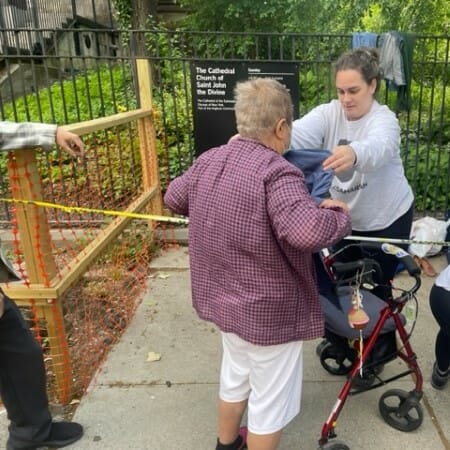
People being receptive has been one of the biggest challenges. One of our big handout locations is in front of a church. Locals were upset. I had somebody smack me on the back of the head the other day and tell me that I am doing the devil’s work. It took a while for the church itself to be receptive to us, too, because it’s also a big tourist location and we had a line of people who are unhoused out front.
Also, everything I knew about the best subway stations in which to hand things out was different through COVID. The police were coming through and making sure that nobody was sticking around. The bathrooms in all the public spaces — like parks — were closed. The news featured a piece about increased urination in the streets and human feces.
People blamed the unhoused. These guys were trying to find places that would let them use bathrooms, and nobody was letting them in, because everyone was terrified of COVID. They couldn’t even go into a fast-food restaurant. We spent most of the first summer of the pandemic racing around getting masks out to everybody so they could hopefully go inside somewhere.
For the unhoused population the pandemic happened overnight. They weren’t watching TV and reading the news. They were used to sleeping in the subway stations and all of a sudden, they weren’t allowed.
What have you learned through your experiences as a volunteer?
It’s not just about educating people but trying to bring back inspiration where a lot of it was lost. People will stop to ask what we do, and I’ll give them a business card. A lot of those people end up making financial donations.
People have lost faith in humanity to some extent. It’s out there. They just have to be seeing it.
Are there any future partnerships, programs, or events that you are excited about?
I’m working on is being able to have emergency packs that we can supply hospitals with. They’ll have things like socks, underwear, toiletries, sweatshirts, sweatpants and a pair of Crocs. I keep running into people on the streets in scrubs. With one man, I had to intervene, because the police were about to arrest him for indecent exposure. His scrubs were around his ankles, because they were too big.
All of these people still had hospital wristbands on. Because of COVID, when the unhoused come into the hospitals, they cut off all their clothes and throw them away. Then they discharge them, but they don’t have any clothes, so they just shove them off with a pair of extra-large scrubs. They had little before, but now they have nothing. The goal is for hospitals to give these packs out to the unhoused after they’re treated.
Why is it important for others to get involved in causes they care about?
It’s the idea of paying it forward. There will be a time in everyone’s life when you’re going to need help. When that time comes, can’t pay back what was given to you. But instead, you can help others.
What do you want people to learn from your story?
Just acknowledge someone on the street. You don’t know what’s going on in their head or what their day has been like. For all you know, you may have just stopped them from doing something negative for themselves. You can be that change.
I hope my story can be inspiring. And I hope it teaches people that it doesn’t take a millionaire-effort to make a change. All it takes is a pair of socks.
Former College Lacrosse Player Destigmatizes Mental Health In Honor of Fallen Teammate and Friend
Meet Daily Point of Light Award honoree Katherine Zempolich. Read her story and nominate an outstanding volunteer or family as a Daily Point of Light.
Content Warning: Points of Light is proud to share the following uplifting and inspiring story. However, we acknowledge that a small portion mentions suicide and may be difficult for some readers. We encourage you to please care for your own well-being above all.
Kat Zempolich, 27, is a friendly, outgoing businesswoman who works in strategy and operations at a startup. This northern Virginia native and second youngest of four majored in public policy while playing lacrosse at Duke and followed with a Master of Management Studies at the same school. Her experiences have led her into retail and e-commerce; they have also led her to address mental health challenges of student athletes with a nonprofit she co-founded in 2020, shortly after graduation.
During undergrad, she and her teammate Morgan both suffered injuries that took them away from the sport they loved and led them to a dark place. While Kat was able to reach out for help, Morgan struggled to. The loss of her friend in 2019 led Kat, along with teammates and Morgan’s mom, Dona, to create Morgan’s Message, a nonprofit that works to eliminate the stigma surrounding mental health within the student-athlete community and equalize the treatment of physical and mental health in athletics, in hopes of saving others who hesitate to ask for assistance.
Aside from being the Vice-president of the Board of Directors, Kat hosts, edits and produces the Mental Matchup, an interview-style podcast and blog series sharing the stories of others addressing mental health issues. Using her grief to amplify a message that saves lives, Kat has begun to heal and, as a self-professed homebody, now enjoys spending her days with her dog Bronco working on projects around the house.
What inspires you to volunteer?
Morgan was one of my teammates. We both went through our own mental health struggles, especially when it came to being injured. I watched her go through so much, and when I was struggling, I was able to get help. So, when she passed, it really hit me hard. I didn’t realize she had never really left that place of hurt, and I wish I could have done more.
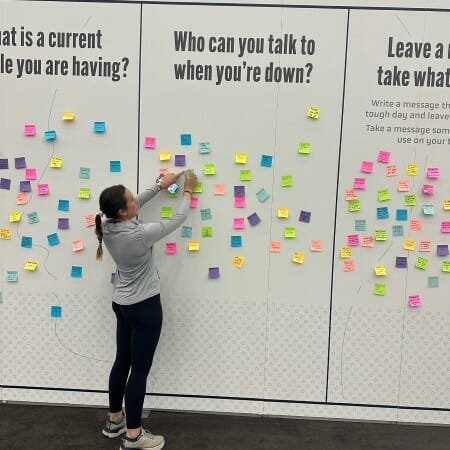
Kat participates in a mental health activity at LaxCon2022 with Morgan’s Message./Courtesy Kat Zemplich
I don’t want anyone to feel the way that Morgan or I have felt. That has inspired me to push for change and to help get these student athletes more support in feeling loved and less alone. How do we prevent losing someone else’s Morgan? That’s really where my drive and passion comes from. I get a lot of joy from helping other people. That’s how I’ve also dealt with my own mental health, really getting outside of myself.
What about your environment made you feel comfortable asking for help when you were struggling?
When I asked for help, I was really scared about going home to my apartment, because I didn’t know if I was going to be there the next day. I was in this really low spot, and I just picked up the phone and called my mom. I said, “I don’t know how we’re going to get me to someone, but I need to come home right now. I’m not okay.”
Thankfully, my mom took me seriously and was like, “Book a flight. I’ll pick you up. I’ll get you an appointment with whoever we need to get you with.” Having that support person who was unconditionally ready to help, instead of minimizing how I was feeling, made all the difference.
Describe your volunteer role with Morgan’s Message.
I’m the director of podcasting, which means I run and oversee our podcasting efforts and our written blog. We have an audio channel where we share people’s stories. This week is the 89th episode over the course of two and a half years. I help identify and screen guests, schedule interviews, edit and produce. I create social media graphics and posts for our stories and do speaking engagements as well as working with outside partners.
Last year, we also launched a stories platform to share written stories from guests. We hope people from all different backgrounds can see themselves in at least one of them. And if they’re struggling, they can identify with someone who went through a similar situation and see how they got help.
As a member of the board, I am always trying to continue figuring out how we spread this message and what’s going well with what we’re doing, and what could be better in the high-level strategy and initiatives.
What’s been the most rewarding part of your work?
We got an email from a parent that said, “My daughter recently got involved with Morgan’s Message and heard about her story. She realized that she was really struggling and found the courage through listening to the podcast and being a part of this ambassador program to ask for help and talk about what she was feeling.”
That’s the most rewarding part, feeling like we’re truly helping people advocate for themselves when they might not have had that courage to do so before. It all goes back to the core idea of helping someone else’s Morgan. That’s what makes it all worth it and makes losing her a little bit easier.
What have you learned through your experiences as a volunteer?
It’s really easy for me to go down a rabbit hole with ideas for things I want to do with the podcast. I’ve learned to know when to invest time versus pull back because there are other priorities in life.
Also, sports were always very fulfilling, but when I graduated and sports were no longer there, I didn’t think there was going to be anything that really felt like that. But working for Morgan’s Message has been uplifting. It’s truly my passion project, and I’m very grateful to have it in my life.
Are there any future partnerships, programs, or events that you are excited about?
Our ambassador program has been growing the mission and getting more student athletes involved. I’m excited to see more Morgan’s Message games where they put stickers on their sticks or helmets and make T-shirts. It’s always incredible to watch.
Podcast-wise, I’m just excited to close out season five and launch season six in the late summer or early fall. We’re going to hit 100 episodes this year, which feels surreal. But mostly, I’m looking forward to continuing to drive our mission forward in whatever way pops up.
Why is it important for others to get involved in causes they care about?
There’s something to be said for gratitude and helping other people. In volunteering, you get more back than you give. It’s incredible. I have my health. I have total use of my arms and legs and brain. Some people aren’t as lucky, and I think it’s so important to give back, especially to things that have given to you and made you who you are.
I’m still involved in coaching lacrosse, because I feel like lacrosse truly helped form me into the human I am today, and I’m so grateful for the opportunities I’ve had and friends I’ve made playing at Duke and part-time coaching. It really fills your cup helping other people. I’m so lucky to be able to do something and give back in a way that’s meaningful.
What do you want people to learn from your story?
It’s really easy to sit in tragedy and ask How did this happen? Why? I’ve been able to pull myself out of grief by doing something for that person. Morgan’s death was tragic. I don’t think it’ll ever be less sad, but we’ve been able to turn that sadness into a mission and hopefully change the world for the better in her honor. You can turn your grief into something beautiful so that it no longer feels as sad.
If you or someone you know may be considering suicide, contact the National Suicide Prevention Lifeline at 1-800-273-8255, or text HOME to 741741 to talk to a trained crisis counselor through Crisis Text Line. Both resources are anonymous, free and available 24/7.