High School Sophomore Spreads Joy to Children in Foster Care
Meet Daily Point of Light Award honoree Max Feinberg. Read his story and nominate an outstanding volunteer or family as a Daily Point of Light.
High school sophomore Max Feinberg was struck with empathy when he heard that the child sharing his hospital room was an orphan. He credits his strong family ties for a large part of his recovery and was alarmed upon the realization that not everyone has that kind of support.
It was after this experience, empathy in tow, that Max founded Fostering Fun in 2021. Without knowing anyone in foster care besides the boy in the hospital, Max has personally solicited and facilitated the donation of over 3,000 gifts worth around $100,000 to children in foster care. He delivers birthday bags, school break “essentials” and holiday gifts about every two months.
As a competitive golfer and aspiring businessman and entrepreneur, Max is always thinking one step ahead. Today he is brightening the days of children who don’t have the same advantages he’s had, but with the ability to see a need and fill it, Max’s own future is also looking bright.
What inspires you to volunteer?
When I was 10 or 11, I was in the hospital for a while with an ongoing illness. I had a strong, supportive family that helped me get through tough days and eventually get out of the hospital.
During the time in the hospital, there was a three- or four-year-old kid who was in next bed. I learned that this kid did not have any parents–he was an orphan–and he was basically growing up in the hospital without any support.
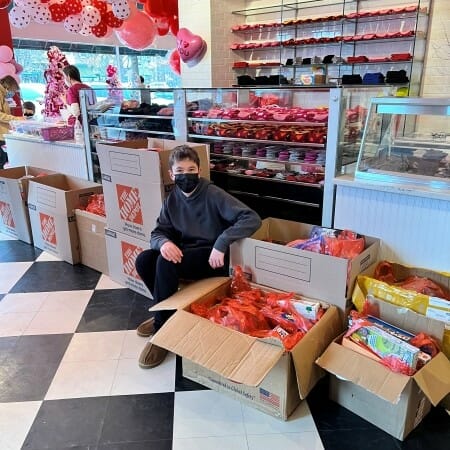
Max Feinberg, 16, founder of Fostering Fun, drops off Valentine’s Day gifts donated for kids in foster care./Courtesy Max Feinberg
That had a profound impact on me. That’s basically how it all started. When I got out of hospital at about 11 or 12 years old, I really started building up Fostering Fun.
Describe your volunteer role with Fostering Fun.
In general, Fostering Fun is like a middleman between those who donate and those who receive donations. I go to Toys for Tots and I receive toys from them. For books, I go to Open Books in Chicago. I basically take items from these places and other various donations, and I’ll organize bags. Then, I’ll allocate those. The main place I send them to is Fill a Heart 4 Kids, and they will make sure that they go directly to children in foster care.
Kids in foster care don’t get to celebrate a lot of holidays like most people do. Most holidays are spaced out every two or three months, so I try to make sure I bring stuff in on those days. It really raises their spirits.
Were there any challenges when starting out?
I think the hardest part, initially, was building that credibility factor. It was hard to solicit donations without people really knowing what I did. After I built it up, it definitely became easier.
What’s something people should know about kids in foster care?
Kids in foster care don’t grow up the same way most people do. A lot of the stuff that they get is funded by the government, and I don’t really think it’s sufficient. That’s basically why I do this. I feel like there should be some additional resources they should be able to access in order to live a more normal life, because I’m fortunate enough to have that.
What’s been the most rewarding part of your work?
I don’t get to see the kids’ reactions or how they feel about receiving the gifts, but I have heard from Fill a Heart 4 Kids that they know who I am and the things I do. That definitely motivates me to continue, because I know at the end of the day, each individual minute that I put in is going towards a good cause.
What have you learned through your experiences as a volunteer?
I’ve learned that the hard work I put in is going to pay off and that I have to stick through things in order to achieve good. There are a lot of people who don’t put in this time, and I feel that just putting in simple volunteer work, overall, will do good.
Why do you think it’s important for others to get involved?
I think it’s important to be involved, because most people don’t realize all the stuff that goes on in their own community. There are a lot of kids who are suffering and aren’t getting the adequate resources to build a stable childhood. Just putting in simple volunteer work, even if it’s just a few hours, can really do a great deal.
What do you want people to learn from your story?
I want people to know that if they have something they’re passionate about and they want to make a change or do some good, they just have to put their minds to it and go for it. Ultimately, you will succeed.
A High School Youth Group Is On a Mission to Improve Their Community
Meet Daily Point of Light Award honoree Sophia Marczuk. Read her story and nominate an outstanding volunteer or family as a Daily Point of Light.
Sophia Marczuk was adopted when she was three, from Yekaterinburg, Russia, and came to live in the United States. Sophia has always been very active in the church. She has been blessed to be a member of the Youth Commission for her village and through that initiative she has made great friendships within the community.
Sophia offers her time and attention to many programs in and around LaGrange, Illinois. At the same time, she maintains a 3.7 GPA, teaches a unique weight training program, holds down a part-time job, participates in her high school marching band and is an active member of her First Presbyterian Church community. She is also a certified lifeguard and teaches swimming to children with disabilities.
Sophia created a local chapter of the “Buy Nothing Group,” and serves as the admin for the group’s Facebook page. The group has grown to over 1,600 members. On the page, people can ask for items that they need and donate gently used or new items. It is, says Sophia, a great way to get to know your neighbors.
What inspires you to volunteer?
I love the feeling that I am making an impact or doing something good for someone!
Describe your volunteer role with the TUXIS and the Youth Commission
I am a member of the TUXIS Youth Group First Presbyterian Church of La Grange, Illinois. TUXIS stands for Together Under Christ In Service. This is a high school group that does yard work for senior citizens, visits senior homes, volunteers at pantry food drives and clothing drives and much more.
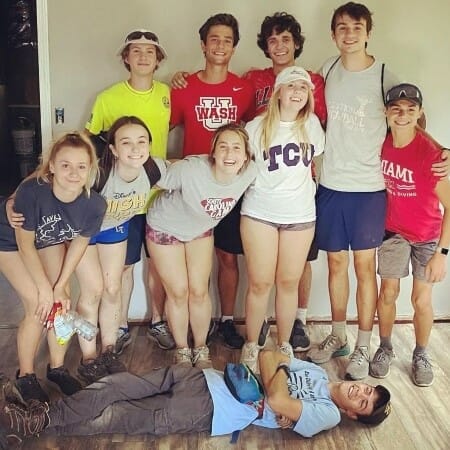
Sophia, bottom left, after finishing a three-day project in a house in Wisconsin, from a previous mission trip for TUXIS./Courtesy Sophia Marczuk
TUXIS works with Feed My Starving Children, where we measure and pack minerals and rice for underserved children. Sometimes we break up into groups and race each other to finish packing as many boxes as possible during our work shift.
We also clean beds at the Beds Plus Homeless Shelter, and clean stables and feed horses at Casey’s Safe Haven Holistic Horse Rescue. The first time I cleaned stables and fed horses at Casey’s Safe Haven, I remember how much I loved brushing the horses’ manes and feeding them apples and carrots.
The Community Days are so rewarding. We gather family and friends to help senior citizens with yard work. We rake, water flowers, pull weeds and spread new mulch.
We visit senior homes to play games with them. We also sing Christmas carols during the holidays and throughout the year we sing songs like, “Lean On Me” and “Don’t Worry Be Happy.” My favorite memory is playing musical chairs and helping seniors write cards to their grandkids.
TUXIS is well known for gathering food for and volunteering at pantry food drives and soup kitchens. Every year we also participate in clothing drives.
My youth leader is a proud owner of a few rescued greyhounds so we decided to work with Greyhounds Only. We brought blankets to Greyhounds Only and cleaned the kennels. In reward, we got to spend time petting and playing with the rescues.
Since my freshman year, I have spent about an hour each week during the school year with TUXIS. During the summers we spend a week on mission trips helping other communities with light handiwork to help people improve their homes. Once when we were working on a flooring project, we got to talk to the homeowner every day and got to know a lot about his story. He invited us to the town gathering where he sang and played the piano. We also shared a meal and played games with his neighbors. It was such a beautiful experience and I really felt connected with him.
What’s been the most rewarding part of your work?
Meeting the people that we are helping out and getting to listen to their stories.
What have you learned through your experiences as a volunteer?
There is always a need for all kinds of help. People are always grateful for you taking time out of your day to give what you can to support them.
Are there any future partnerships, programs or events that you are excited about?
This past summer I took a five hour volunteer shift representing the Youth Commission at the National Night Out which supports our local police department and raises money for the Special Olympics. I had such an amazing experience working and talking with kids that I can’t wait to do it again this summer!
Why do you think it’s important for others to get involved?
It’s a learning experience as well as a positive imprint in the world and people’s lives.
What do you want people to learn from your story?
The more we get the youth to help out, the world could be a beautiful, safe and clean place.
Visually Impaired Teen Creates Community for Disabled Youth to Connect
Meet Daily Point of Light Award honorees Jessica Kim. Read her story and nominate an outstanding volunteer or family as a Daily Point of Light.
Jessica Kim was born with a visual impairment and didn’t learn how to advocate for her needs for a lot of her life. But this Gen-Z changemaker is working tirelessly to ensure that her situation is not the norm for visually impaired individuals or other youth with disabilities.
That’s why she created I-CREATE YOUTH, an organization that empowers, educates and connects disabled youth through language in its various forms—from poetry to programming. As the founder, Jessica hosts summer research and fellowship programs to learn about disability justice, interviews disabled changemakers, hosts workshops for or in support of the disabled, and publishes stories, essays and poetry by disabled creatives.
ICY serves the disability community by focusing on dismantling stereotypes and inequities faced by disabled individuals, since disability rights are basic human rights. Society is inherently ableist—whether it be in healthcare, employment, social infrastructure or education—but Jessica wants to show that disabled people matter. Throughout the COVID-19 pandemic, disabled youth in particular often have not received educational and recreational support to continue their education. At ICY, Jessica educates and empowers disabled youth amidst an alienating and ableist society.
Read more about what drives Jessica toward change in her community and beyond.
What inspires you to volunteer?
I did a lot of volunteer and service work with students with disabilities, and I find that really meaningful because I share the same experience. I’m visually impaired, so it’s always been a mission for me to find this community of people who have the same kinds of experiences as me, and I think having a disability and growing up with a disability was a very solitary experience. But through volunteering, I found that disability justice and disability advocacy was possible, so that sense of community and desire to make that community permanent and really accessible for me but also for other people inspired me to volunteer.
Describe what your organization does.
Firstly, we’re dedicated to disability advocacy through language in its various forms, and we like to take language in a cultural sense, but also in a creative sense. So a lot of the different initiatives we host are based on creative writing, like poetry, or even programming, as well as reaching out to individuals from various cultures to think of disability as this universal language that can unite people from different communities. We host workshops centered on this one aspect of language. We’ve mostly focused on creative writing this past year. So we hosted poetry workshops in partnership with visually impaired organizations like the Braille Institute of America in Los Angeles. I hosted a series of workshops using audio materials to write poetry.
In addition to workshops, our second main initiative is a fellowship program for young people to learn more about the different realms of disability in whatever topic they choose. Various fellows have developed a project on various types of disabilities and how they intersect with literature or society in general. Also, programming – we had someone develop an accessible Chrome extension for disabled users online. We had another person research on the representation of disability in children’s literature. We had another project on eco-ableism. In addition, we do have various creative projects where we interview people who are disabled, seek stories from people who are disabled, post information and graphics and various resources for people who are disabled – anything from book recommendations to how to celebrate Disability Pride Month in July.
What’s your favorite part about volunteering with disabled youth?
I struggled to find a sense of community when I was not vocal about my disability, especially in elementary and middle school. But when I first volunteered with disabled students, particularly visually impaired students, I really found a sense of community and camaraderie immediately when I went into a classroom full of blind people and they shared the same struggles I had. I didn’t need to explain myself; I fit naturally into the community.
I remember volunteering in classrooms for disabled students during Saturday programs, making eye models out of candy, talking to a mayoral candidate who was blind, got to talk about our experiences, play Braille Uno. Bringing accessibility into a space showed me how the disability community could be something tangible. Especially with the COVID-19 pandemic, that kind of physical sense of space with disability advocacy was lost, in a sense. I really wanted to revive that, so it was very imperative to me to continue that volunteer work in an online space, to create a tangible community in a world that was very uncertain and full of unknowns. That kind of unity that I’ve experienced by interacting with disabled people and expanding my volunteer work to reach an audience outside of a classroom, but people worldwide – that was really meaningful to me. So creating this tangible community in a global space, an accessible space, is the reason why disability-focused volunteering is so important to me.
Why is it important for youth to get involved with the causes they care about?
I think youth are, as cliched as it is, the future of the world. Because of that, it’s not too early for youth to be passionate about social issues and involve themselves in their communities. There’s so much youth can do, but they can also be part of a larger community, and they eventually can become individuals leading a large community.
As young people, we approach the world with an open mind and we’re very attuned to the pressing contemporary social issues of the time period. So the youth outlook and voices that youth have can act as the catalyst for change. More than any other demographic, youth will be able to gather resources, gather people, gather a community for this advocacy to be enlarged and eventually integrated into the world.
What’s your advice for people who want to start volunteering?
It’s definitely crucial to reach out for a system of support. Starting an organization or even finding places to volunteer could be very difficult, especially if they’re new to the world of advocacy and volunteerism. My advice would be to reach out to a trusted mentor, or use technology to reach out to other people who have started organizations, or who are able to mentor youth. It’s very daunting to be alone in this world and embark on something new alone. So reach out for support, even if that means you have to be the one who’s vulnerable or take the initiative to ask for guidance.
Brothers Found Nonprofit to Distribute Food, Diapers and Menstrual Hygiene Items to Their Community
Meet Daily Point of Light Award honorees Caleb and Joshua Oh. Read their story and nominate an outstanding volunteer or family as a Daily Point of Light.
Caleb and Joshua may be young, but that didn’t stop them from doing what they could to meet the needs they saw in their community. These Gambrills, MD brothers created Kid Changemakers, a nonprofit that serves the food insecure, unhoused and foster children.
When Caleb and Joshua were in elementary school, they looked for opportunities to volunteer, but they were turned away because they were too young. Instead of being discouraged, they looked for ways to serve with other young people.
“First and foremost, it’s our belief that no matter how old you are or what your means are, you have the ability to make a positive change in the world,” Caleb said. “While an individual can’t fix everything, we can provide margins, and the more of us who are active in our communities and helping those around us, the better shot we have at improving the world for everyone.”
To date, they have raised $100,000 in cash and grants serving communities in need. During the height of the COVID-19 pandemic, they helped host pop-up pantries, giving over 100,000 diapers, 50,000 menstrual products and over 750,000 pounds of food to families.
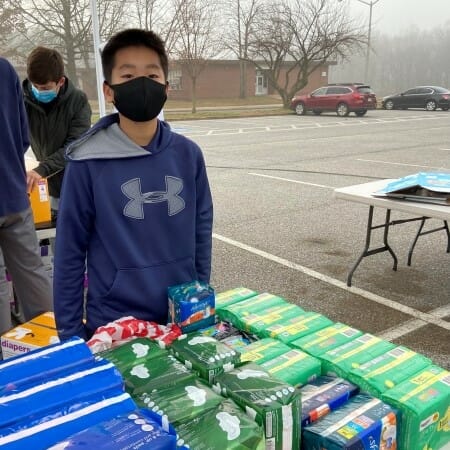
Kid Changemakers is a nonprofit that serves the food insecure, unhoused and foster children by providing basic necessities./Courtesy Caleb & Joshua Oh
“There’s a large need in our community, and we’ve been directly messaged about diaper needs in particular,” Joshua shared. “We see it in our everyday lives. Because of the pandemic and increased prices on diapers, tampons and pads, there was a big gap we wanted to help fill in our local area.”
The brothers are so passionate about diaper poverty that they lobbied to remove the diaper tax in Maryland, testifying before the State Senate. The bill gained bi-partisan support and Governor Hogan signed it into law in April. As a result, diapers in Maryland are no longer taxed, which will save families millions of dollars each year.
“Youth in particular have a powerful and strong voice,” Caleb noted. “When people see youth engaged with their communities, engaged with people around them, it’s highly inspiring. And youth have different ideas. They’re not restrained by the beliefs and structures that society and institutions have created over the last few centuries.”
While Kid Changemakers undoubtedly benefits recipients in the community, it also provides youth service opportunities for kids who want to get involved. Volunteering together, these bonds strengthen and friendships are lasting.
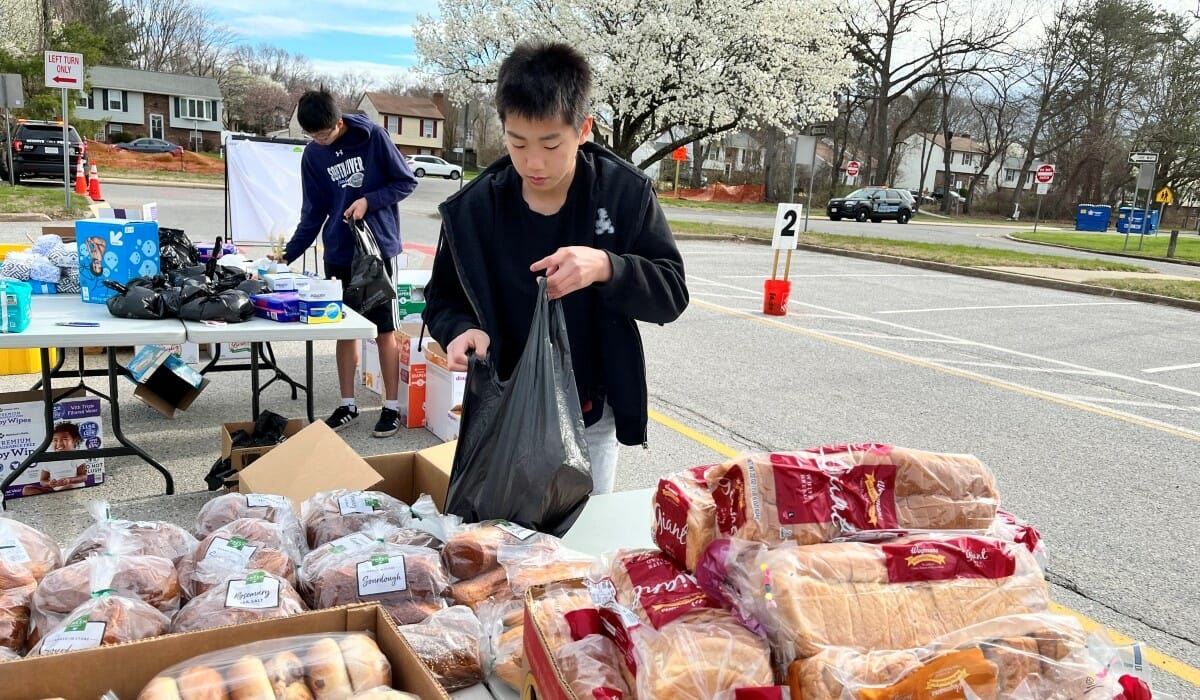
Caleb and Joshua distribute bread to those in their local community who are food insecure./Courtesy Caleb & Joshua Oh
“Working in the pop-up pantries has been incredible,” Caleb shared. “It’s not just that we were providing for others. In a way, it was fulfilling for us, because it was such an isolating time during the pandemic. We were volunteering – and still volunteer – with friends… new friends, old friends. Working with people who you have a strong connection with, in anything but especially in service, has been incredibly important to us over the last several years. It’s something we want everyone to experience. it’s a privilege, and we want more kids to be involved.”
Kid Changemakers, which is made up of elementary through high school students and often their parents, hosts roughly one pop-up pantry event per month, plus coat drives and toy drives throughout the year. Additionally, they partner with other organizations to maximize their impact and broaden their scope of services.
To those looking to volunteer, Caleb offers some advice: “Nervousness is natural with anything new you do. But when you’re trying to approach service, follow what you like outside of service. Try to combine your passions – so if you like sports, find a way to volunteer with sports, for example. For youth trying to start service, it’s really all about trying. There are so many opportunities out there nowadays, and you just have to push yourself to overcome your nervousness and try to serve.”
Meet Daily Point of Light Award honoree JoAnn Mazzei. Read her story and nominate an outstanding volunteer or family as a Daily Point of Light.
For most of her life, JoAnn Mazzei called Staten Island her home. Here, she raised a family and ran two businesses: a local delicatessen and a regular “mom and pop store” which, like many small businesses, got pushed out by big box stores.
After selling her delicatessen, JoAnn was offered a partnership in a lounge and restaurant in the same neighborhood. She ran that business with her partner for five years before retiring.
After retiring, JoAnn wanted a change of pace. JoAnn chose St. Petersburg, Florida, before eventually settling on the northern end of the peninsula in Clearwater, where she resides at a 55+ community.
It was at a Clearwater AARP meeting that JoAnn met some amazing people who welcomed her into the community. They said to her, if you’re new to the community and want to find new friends and something to do, you have to volunteer.
What inspires you to volunteer?
My dad always said, “You do good, you get good.” When you’re retired with a little time on your hands, why not put your life experience to good use?
Describe your volunteer role with “The Kind Mouse.”
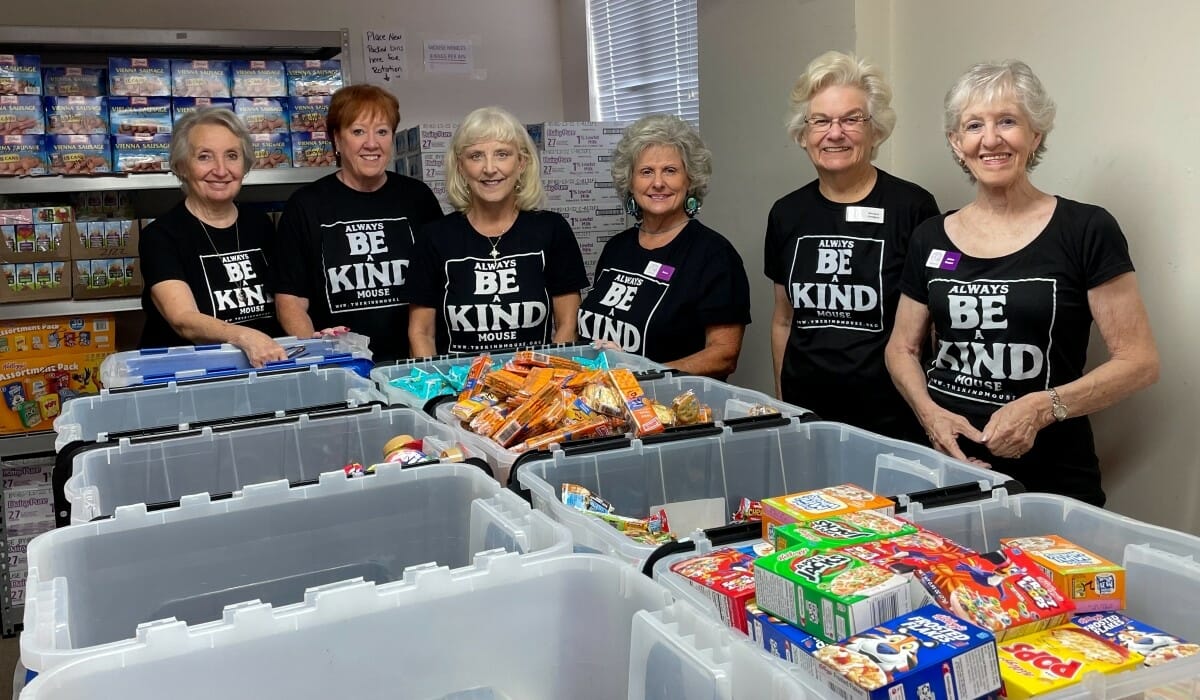
When a friend told me about “The Kind Mouse,” I immediately knew this was where I could do some good. I’ve been volunteering at The Kind Mouse for approximately six years. The Kind Mouse is a local nonprofit founded and run by Gina Wilkins, who works tirelessly to help feed hungry children in our area.
JoAnn Mazzei has volunteered with The Kind Mouse for the past six years./Courtesy JoAnn Mazzei
Over 7,000 local children get fed in school during the week, however many go home to an empty refrigerator. Childhood hunger is a big problem in our county. I was shocked to learn how many children are living with food insecurities and the problem seems to exist no matter the state of the economy.
When children don’t know where their next meal outside of school will come from, this means they go hungry on weekends, holidays and all summer. The problem is not exclusive to race, neighborhood or age. Children dig through dumpsters and trash cans to bring food home for their brothers and sisters.
Currently, The Kind Mouse feeds over 3,500 children weekly. The organization relies on its volunteers, who have put in nearly 11,000 hours to date.
Along with other volunteers, we sort products, cereal, juice, peanut butter and other groceries and put an expiration date on them before packaging them to be delivered to local schools on a weekly basis.
What’s been the most rewarding part of your work?
The satisfaction that I had a small part in helping children. You can’t learn on an empty stomach. Hunger has a terrible effect on a child’s ability to concentrate and learn which puts them at a disadvantage at an age when they can’t do anything about it. The Kind Mouse is helping to keep children fed, so they can do better at school and look forward to a brighter future.
What have you learned through your experiences as a volunteer?
My dad was right: “You do good, You get good.” I am forever grateful for the friendships that I’ve formed through volunteering.
Are there any future partnerships, programs or events that you are excited about?
I look forward to our yearly fundraisers that help fund a small part of the Kind Mouse Pantry.
JoAnn and other Kind Mouse volunteers packaging “Nibbles Bags” getting them ready to be distributed to a local school./Courtesy JoAnn Mazzei
Why do you think it’s important for others to volunteer?
We never know when we’ll need a helping hand. So do what you can now. Down the road, it could be your turn to look for a helping hand.
What do you want people to learn from your story?
Don’t sit home with nothing to do. What we do is so rewarding. We not only feel productive, but we’ve made lasting friendships and feel we have a purpose. We don’t sit around and waste our time. We proudly give up our time to help feed hungry children.
Knowledge Is Power: One Man’s Quest to Spread Financial Literacy
Meet Daily Point of Light Award honoree Paul Baccus. Read his story and nominate an outstanding volunteer or family as a Daily Point of Light.
Volunteering has been part of Paul’s life since childhood, when his mother and her coworkers would adopt and shop for a family in need. Paul remembers that the families would ask for simple things, like a blanket. As an adult, Paul worked and went to school full-time. Thinking back to his mother’s financial struggles, he realized that financial knowledge is critical. “My first financial education was the school of hard knocks,” he laughs. He recognizes that his life definitely could have been easier had he had that basic knowledge sooner.
Today, Paul helps Americans, such as the 60% who don’t have $400 cash for emergencies, and whose $100 payday loans can quickly spiral to over $800 in fees and interest — a dangerous downward spiral that keeps people in poverty and on the brink of losing everything.
Paul’s motto is, “Knowledge is power.” His mission is to help people create a lower cost of living and improve their lives through better money habits and financial literacy. Most of all, he gives them hope for a better future. He is proud to have been named the Pathfinders Volunteer Financial Coach of the Year, a Corporate Volunteer of the Year and a Global Community Volunteer award winner.
What inspires you to volunteer?
The fact that people don’t know what they don’t know. I survived an aneurysm and a stroke, and two years of physical therapy was a reminder that while I was facing a challenge, I hadn’t lost the ability to work, speak or function. I probably shouldn’t be here, but I am here and it’s my duty to help others.
Describe your volunteer role with Pathfinders.
I have been volunteering with Pathfinders for 10+ years. I deliver financial education to the Arlington Life Shelter, a homeless shelter in Arlington. I deliver a five-week series with the same cohort covering budgeting, banking, borrowing and credit, with the last session ending in an individual coaching session.
I coordinate the sessions with the shelter, facilitate all of the sessions and provide coaching to shelter residents. Pathfinders even matches the first $100 when clients open a savings account!
What’s been the most rewarding part of your work?
I am not just educating. I am driving behavior change, emphasizing that what hasn’t worked in the past won’t work in the future, but something else can work. One of the greatest rewards has been helping people believe that they can achieve. In many cases they don’t believe they can. They don’t believe there’s a way out so I help them focus and get them back to the basics and give them a map and tools they can use to create a better financial future.
The letters I’ve received make it all worthwhile. For example, one from a child whose father attended a financial training session was impactful. I hear things like, “Where were you when I was in high school? My life would have been so different!” My favorite has to be, “You’re like an app! I need to put you in my pocket!”
What have you learned through your experiences as a volunteer?
I can’t take for granted that people know even the basics of personal finance. They don’t know what they don’t know, until they know.
Are there any future partnerships, programs or events that you are excited about?
I am also on the Board of Directors at 6 Stones. Our Community Power of Revitalization, or CPR program, will be transforming 18-22 homes in a single weekend with an all-volunteer crew. The recipients, who are often elderly and unable to properly care for their homes or pay for upkeep, can now be proud of where they live and feel hope.
As a Better Money Habits (BMH) Champion, I have the opportunity to share more financial education with others.
Why do you think it’s important for others to get involved?
Tomorrow’s not promised. It’s important to meet people where they are and help them get where they want to go. I have gotten to where I need to be — in a position to help others.
What do you want people to learn from your story?
Never give up. No matter how hard something appears, there’s a way out — you just have to find it. The most sobering time for me was after my aneurysm and stroke. Suddenly, I couldn’t tell time. My life flashed before me and I remember thinking, “What am I not going to be able to do now?” We take our abilities for granted even though they could be gone in an instant. But even though I was afraid about my future, I kept going.
Fourteen Years of Fulfillment Through Volunteering with Canines and Kids
Meet Daily Point of Light Award honorees Dianne Sosnowski. Read her story and nominate an outstanding volunteer or family as a Daily Point of Light.
Dianne Sosnowski knew she wanted to dedicate her time to volunteering after she retired 14 years ago. So this Salem, SC resident became a volunteer with Oconee Humane Society. Having been a pet lover all her life, she found it was an easy transition for her.
Initially, Dianne worked with another volunteer in establishing a Humane Education Team who would teach local youth how to be safe around dogs, but also how to love and treat their pets with compassion.
“I’ve always had a passion for dogs – for animals in general, but more dogs than any others because I grew up with dogs,” Dianne shared. “So when I had the opportunity to work with Oconee Humane Society, I jumped right into it.”
The duo started out doing programs in local libraries, bringing their own dogs so the children could pet them. They also demonstrated for the attendees – including parents – all the right ways to care for dogs. Shortly after they started, Dianne and her friend found out that their dogs needed to be registered therapy dogs.
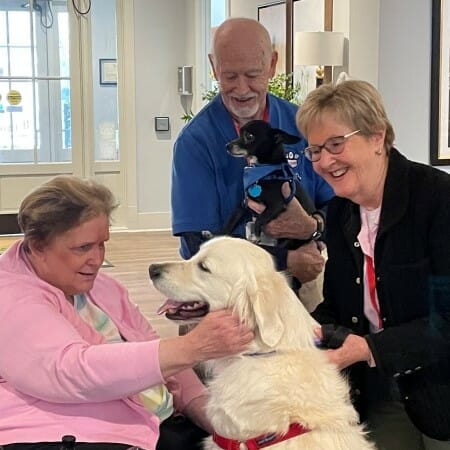
Dianne Sosnowski has been volunteering with her canines for 14 years. Here, she’s pictured with her dog Brinkley./Courtesy Dianne Sosnowski
While her friend moved on from the organization, Dianne worked on getting her dogs trained, evaluated and registered as therapy dogs so that she could continue the program. Hudson and Brinkley, her two golden retrievers, passed their exams and became registered therapy dogs. This is when Dianne also became a member of SCDogs Therapy Group, which schedules visits not only to schools and libraries, but senior living facilities, hospitals, YMCAs, stress relief facilities, hospice and more.
“Knowing that to continue my work with Oconee Humane Society, my dogs had to become registered therapy dogs, then I became involved with SCDogs Therapy Group. And it’s just been a love fest for me to work with people and show them how important dogs are!”
Dianne now serves on the Oconee Humane Society Board of Directors as chair of Humane Education, as well as vice president and board member of SC DOGS Therapy Group. Her responsibilities include scheduling over 60 dog teams and setting up 30 visits a month. In addition, she runs quarterly team leader meetings, hosts quarterly therapy dog certification tests, serves as Chair of the Fundraising Committee for the Wags and Whiskers Gala and leads the BARK children’s reading program.
She is particularly passionate about BARK – a program to help elementary school-aged children become more comfortable with reading. The same children are assigned to the same dogs for the entire school year. Weekly, these children meet with “their dogs” and read to them. The children select books that they think the dogs will enjoy. This year, the program has 19 volunteer teams at 11 schools. And the impact on the kids is palpable.
“I was working with a little girl who was very shy,” Dianne recalled. “And she seemed to be uncomfortable with my dog, a little unsure. She was petting him but she just sat by him. We read and she struggled with the reading a little bit. I felt that I wasn’t making any headway with her in making her feel comfortable or enjoy reading. And then one day, I met her mother, and her mother said to me, ‘Oh, you’re the BARK person that my daughter works with! I have to tell you that when she wakes up on the days you read, she says, ‘Mama, this is my day to read with Hudson!’ I almost started to cry because I knew then that I was making an impact with this wonderful child.”
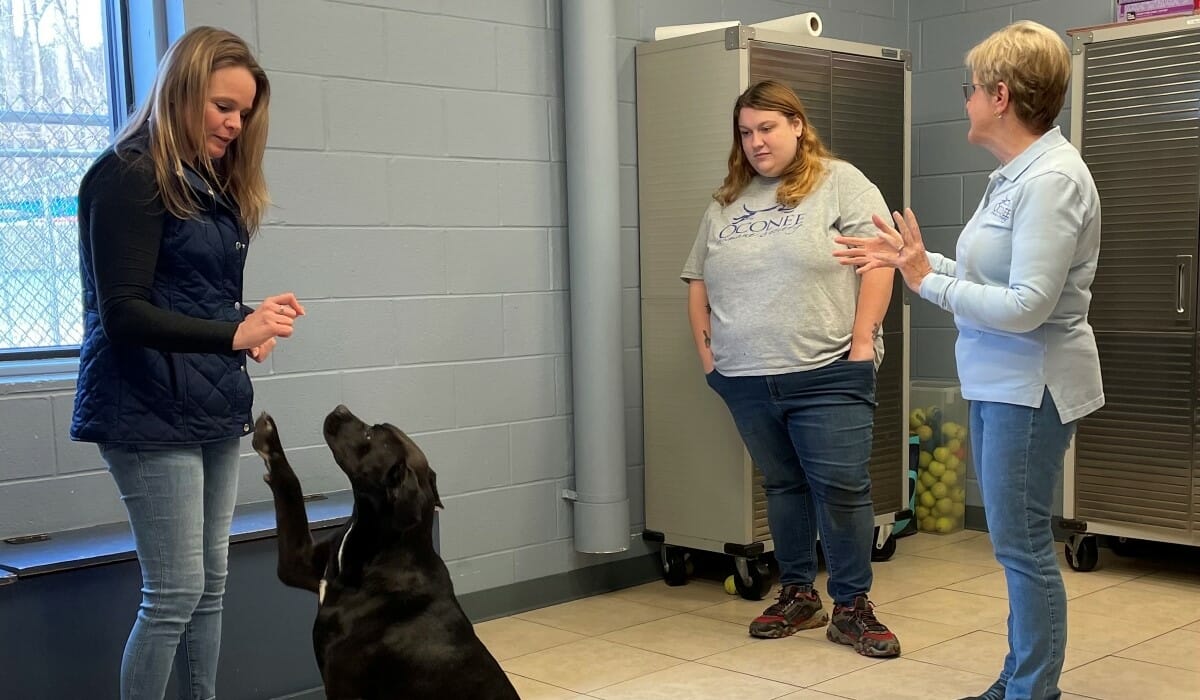
Dianne also serves as a therapy dog evaluator./Courtesy Dianne Sosnowski
In fact, at the elementary school that Hudson and Dianne visit every week, all the children in the school know the dog’s name. They say, “Hudson’s here! We get to hug Hudson!” This enthusiasm brings so much joy to Dianne and keeps her energized about the visits.
“I think until you get involved with volunteerism, you don’t recognize the impact that you can make,” Dianne said. “One person makes such an impact on other people in the community, whether it be working with dogs, working with a food bank, working with your church… Until you get involved, you just don’t recognize the impact you can have.”
Dianne has seen the myriad ways that volunteers contribute to the health of the organizations she works with. She knows that these nonprofits simply could not survive without their volunteers’ contributions of time and talent.
With all of the volunteering that she does, Dianne has some advice for those who might be considering volunteering but are nervous to step out: “I would check out all of the nonprofit organizations in your area and see what may interest you. I started small, with humane education at one organization. Then, the more and more you get involved, you want to do more. It could be the smallest thing, but you can make such an impact on people.”
Cancer Warrior Brings Hope and Empowerment to Others With Medical Hair Loss
Meet Daily Point of Light Award honoree Leslie Rager. Read her story and nominate an outstanding volunteer or family as a Daily Point of Light.
Leslie Rager is a lot of things: a mystery writer, a project manager and a newlywed. After a bout with breast cancer, she also became a survivor. Equipped with personal experience with the disease, she understands the mental and emotional challenge that accompany it, and she wants to help others see themselves as more than someone who is sick.
Two decades ago, Leslie was diagnosed with breast cancer. A year later, Leslie’s sister-in-law, Carolyn, was struck with it and several years after that, Laura, Leslie’s younger sister had the same experience. During this last battle with the disease, when Leslie’s brother wanted to help, Leslie immediately suggested that Laura would need a wig. Her daughter was around eight years old at the time, and Leslie knew seeing her mom without hair would only add to her fear.
When Laura no longer needed it, Carolyn ran with the idea and started a wig exchange, passing the hairpiece to another relative undergoing chemotherapy. And so the EBeauty Community began. From one family’s suffering has come an organization full of support and compassion, 11 years strong.
Leslie works full-time as a project manager and technical writer for a software company and volunteers 20+ hours a week at EBeauty. Even in her limited spare time, she embraces writing fiction as a chance to take people away from their day-to-day life for a while. Sometimes, helping someone see a different reality is the best kind of medicine.
What inspires you to volunteer?
I’ve been there. I know what it’s like to look at yourself and see a sick person. Having hair allows you to see yourself as healthy. That’s the bottom line. It’s not about not feeling pretty. I want to look at myself and see that I’m going to get back to who I am on the other side of this.
Tell me about your volunteerism with the EBeauty Community.
We provide free wigs to women with medical hair loss — whether it’s because they’re undergoing chemotherapy or they have alopecia. Not all insurance covers the cost of a wig.
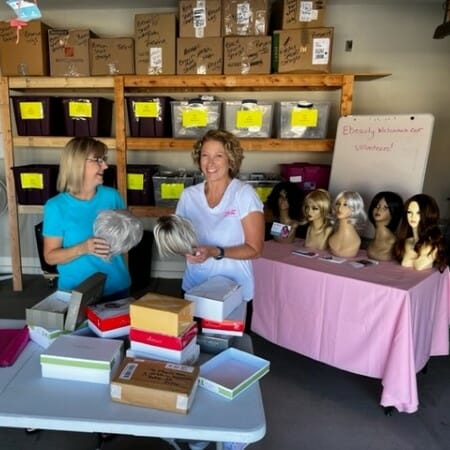
Over the years, I would help with events, but in 2022, after I got married and moved to a senior community, I’ve become more heavily involved. The organization had always been based in Washington, D.C., but we recently started the first EBeauty House in my husband and my second house down the street. Volunteers come to the house to sort and ship wigs.
I wear a lot of hats. I’m a published author, so initially, I wanted to just be involved with social media, the grant writing, newsletters and doing that kind of thing, but I also help ship thousands of wigs every month.
Where do you get the wigs?
A lot of women who no longer need their wigs donate them. We ship them to Paul Mitchell schools to do cleaning and styling, so they’re brand-new again and ready for the next person. Every day, we get wigs. Sometimes it’s five, sometimes one.
Oftentimes it’s not the women, because they didn’t make it. We get memorial cards and letters from husbands donating wigs their wives didn’t get to wear. We have two boards in the house with notes that we get from women passing wigs on to the next woman with the hope that they will bring her some peace or joy and notes from those who donated for the women who didn’t make it.
Additionally, we have a couple of companies that have donated hundreds of brand-new wigs. The American Cancer Society has sent us thousands from their overstock that we distribute. We ship them to individuals who order on our website, but we also send them in batches to hospitals and cancer centers so that a woman who’s going in to get her chemotherapy can try on 10 wigs and pick the ones she wants.
What’s been the most rewarding part of your work?
The most rewarding—and most difficult—thing is having women who are currently undergoing cancer treatment come to the EBeauty House and to try on wigs. It’s very hard, because I’ve been there, and some of them are a much higher stage.
If they have metastatic breast cancer or if they’re stage four, we’re just trying to make whatever time they have as pleasant as it can be. They kind of know that when they come, so that’s very hard, because we need to be positive.
A couple of weeks ago, a young woman came with her mom. She would only try on wigs in the bathroom, because her mom has never seen her without her hair. Her mom was reading the bulletin board of all the letters that we’ve gotten.
There were three other women volunteering that day, two of whom had had cancer. Her daughter felt comfortable enough to talk about what she’s going through. She hadn’t been telling her mom this stuff, because she didn’t want to upset her. I did the same thing. We sent her home with five wigs. I like to think that when she gets up and starts her day and she picks up a fun wig, she’s happy.
What have you learned through your experiences as a volunteer?
I’ve learned to listen more than I did before, because sometimes it’s just good to be quiet and let them tell you their story. You absolutely receive more volunteering than you could ever give. I don’t think you can do it without feeling good. I can’t save the world, but if I can put wigs on 100 women’s heads, I’ve done a good job.
What are some of the best ways to show your support to someone going through cancer treatments?
First of all, don’t give advice. Listen. Unless they’ve been there, your family doesn’t really know what it’s like. Also, we oftentimes will say, let me know what you need, but really, you just need to do it. Show up at the house and say, “Here’s dinner. And I’m going to do a load of laundry while I’m here.” Some communities will say, “We’re going to have a meal train for Mary,” and everybody just brings her dinner. Mary doesn’t have to ask. It just happens.
Why do you think it’s important for others to get involved with causes they care about?
Disease—cancer and alopecia—they’ll touch anybody. If you haven’t had anyone in your life touched by either of those, I’m shocked. There’s so much need out there. There are so many who aren’t as fortunate as you.
What do you want people to learn from your story?
No matter how old you are, or where you are in your life, you always have a little something to give to someone else. I work a full-time job. I try to write. I give EBC up to 20 hours a week. I’m a newlywed. But you can make time to give back. It’s really important and fulfilling.
Youth-led Nonprofit Organization Helps Give Other Service-Oriented Youth a Leg Up
Meet Daily Point of Light Award honoree Sonali Ratnasinghe. Read her story and nominate an outstanding volunteer or family as a Daily Point of Light.
Sonali Ratnasinghe is still in college, but she’s already serving as the executive director of the Youth Ambassadors of Service, a nonprofit she started with her friends, Shayna, and later Vrutika, amid the COVID-19 pandemic. The group saw that it was more important than ever to positively impact the community, as well as seeing a need among their peers who wanted to create a change in their community but didn’t have the necessary resources and guidance to do so.
With their backgrounds in service and existing connections with nonprofits, the small but mighty team created the General Services Foundation in September 2020, now Youth Ambassadors of Service, where they would be the ones to teach up-and-coming community leaders at the high school level. Since they were high schoolers at the time, it was easy for them to connect with other high schoolers and understand their needs – they were part of the demographic they worked with! Sonali and her partners have worked tirelessly to provide opportunities for those around her and have succeeded in raising $35,000, collecting 30,000 items and serving 30+ nonprofits!
Read on to learn more about Sonali’s story and what inspires her about youth engagement.
Describe what your organization does.
My role is really about bringing people together to the nonprofit sector. So providing students the accessibility, understanding mentorship, resources and funding to really provide support to the the nonprofit sector, while really understanding what they want in terms of potential career development, or just creating a lifelong passion for service. So we’re teaching young people the “how” of the community.
What makes you passionate about youth empowerment?
People always like to ask me what my favorite cause is, and at the end of the day, there is no favorite cause for me. I realized that youth empowerment was important to me, but I didn’t want to choose one cause to focus on. So, I made them all my mission. The hope behind this is that any student will be able to find their place and their niche in the sector.
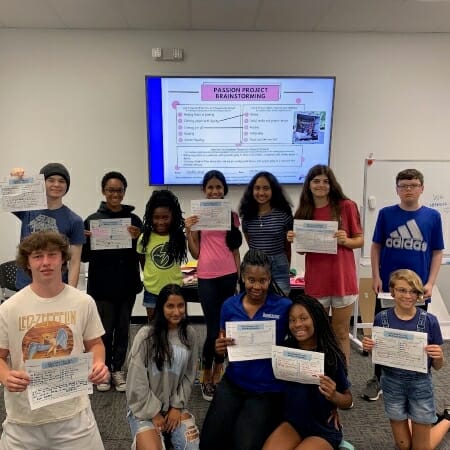
Sonali encourages students to create their own “passion projects.”/Courtesy Sonali Ratnasinghe
We’re teaching high schoolers how to hold drives, fundraisers and initiatives of all types to really do more in their communities. One thing we realized was that a lot of organizations out there are only getting students in the door just because it provides volunteer hours. But there a lot of students looking to have much higher levels of engagement and don’t have the resources to do so. So we’re really the people who bridge that gap and actually provide more of a support system.
We do this through two programs. We have Act and Advance, which is much simpler, for those just starting out and getting an idea of different areas of the industry, able to try different projects for different nonprofits and put in as little or as much time as they want. We also have the Young Nonprofit Fellowship, a program for dedicated students in service. These are for students who are looking for nonprofits as a potential career direction. They’re able to go through a fellowship process. And we connect them with a nonprofit to intern with while they develop professional skills and personal skills. This helps them take what they’re learning experientially further.
What do you hope to do after graduation?
That’s three years away! But I do know that I have lots of interests in both business administration and public policy. I don’t know exactly what I’m going to do with that yet, but my hope is that it’s community-focused and people-focused. I’ve loved working with different corporations, small businesses and policy makers who are asking, “How can we best get involved in community engagement? How can we best serve and actually listen to those with the need?” Learning from those with lived experience is something I hope to do for my entire life.
Why is it important in particular for youth to get involved?
The youth are our “now.” We always hear about how youth are our future, how they’re going to be impacted by the changes we make and what we do or don’t do. In reality, they’re here now! They’re going to be the ones moving the needle forward and they have opportunities and resources that previous generations haven’t. There’s so much hope for this new generation. Sometimes we have higher expectations set for us, but rightfully so, and I’m excited to see what differences we can make.
Sonali Ratnsinghe is passionate about many causes, but particularly empowering youth to get involved in the nonprofit sector./Courtesy Sonali Ratnasinghe
What’s your advice for people who want to start volunteering?
The double R’s: research and resources! There’s so many free research opportunities on different platforms to learn about what the nonprofit sector is really about. But also, learning about what your community is doing in particular and how you can get involved. Every city has local affiliates that share several volunteer opportunities throughout their city and state. There are so many different ways to get involved. Volunteering and donating aren’t your only options. You can think about your purchase power, voting, rallying… there are so many different ways and you just need to figure out your niche.
Additionally, use the resources you have. Actually set up conversations with the people around you, with nonprofits, with businesses, with the community, to see how you’re able to do more. Listening to the needs of the community is really what it’s all about.
How can people help?
You can visit our website and social media pages to learn more about the ongoing projects and initiatives we currently have!
Graduating Senior Helps the Under-Resourced Navigate the College Application Process
Meet Daily Point of Light Award honoree Abhilasha. Read her story and nominate an outstanding volunteer or family as a Daily Point of Light.
Abhilasha Bellapu, 17, is a senior in high school and has spent the last several months navigating the process of applying to college. As a classical violinist and singer as well as a science lover, Abhilasha is interested in ways to bring music into hospitals to treat patients. She has already been involved in music therapy research and hopes to study neuroscience in the coming years.
With her eyes on future, the summer after her school went into lockdown, Abhilasha came up with an idea to compile information on different career options and advice from experts in the field for students to peruse. When she brought the idea to her friend, they decided to narrow down the mission and find resources to aid under-resourced and first-generation students as they find their educational path. It was the birth of AlumniAnswers.
As she waits for an acceptances from colleges, the organization she has built has conducted over 70 interviews with students and alumni, developed of 2,000+ supporters on LinkedIn, and reached over 1000 students vying for spots at their dream school. They’ve organized, written and marketed a 273-page resource book on applying to schools internationally, and as the CEO, she manages a team of 20+ volunteers and ambassadors. Her mission to help students who need extra guidance as they chase their goals is well underway.
What inspires you to volunteer?
I believe that everyone has a role and purpose and should somehow volunteer and give back to their community. It’s a huge aspect of what we do every day, day-to-day, so I think it’s just an important job for us.
Describe your volunteer role with AlumniAnswers.
I co-founded AlumniAnswers three years ago, the summer after my school shut down due to the pandemic. The main reason why I wanted to launch the organization was to help students, especially under resourced, first-generation students, get reliable resources to help them prepare for college and their careers.
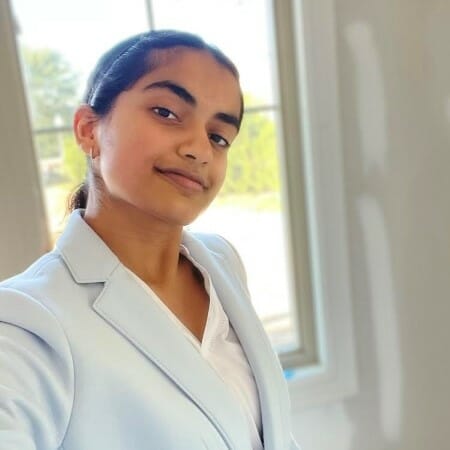
Abhilasha Bellapu, 17, co-founder of AlumniAnswers./Courtesy Abhilasha Bellapu
Essentially, we do this by interviewing college alumni from around the country who have doctorate degrees or PhDs, on topics ranging from landing internships to choosing a college major. What we believe is that if we get advice from experts and those who’ve been successful in their fields, they can really help students who aspire to be like them.
We work with high school counselors to get the word out and pair alumni with students in order to get one-on-one advice. We also write articles on our website, do podcast interviews and put out resources like lists of scholarships available for underrepresented students.
Why is education important to you, and why should it be important to others?
I think education is essentially how we bring a better tomorrow. Every educated individual is another educated citizen in our society, and only good can come out of that. I think education is at the forefront of every good decision and positive impact we can make.
What’s been the most rewarding part of your work?
In school, a lot of peers come up to my co-founder and me, saying complimentary things. It’s so kind of them. It just makes us feel good that we’re able to help these students who are probably struggling through this process, especially with it being so competitive and there being so much misinformation.
What have you learned through your experiences as a volunteer?
There’s a lot you can do to contribute. I used to think that starting anything or even attempting to build an organization was a huge, impossible task, but taking baby steps and getting started is actually the biggest milestone. I shouldn’t ever think that anything’s impossible, and I should just keep moving forward. Volunteering has allowed me to see that there’s so much you can do to impact the world or your community, and nothing is too small.
Are there any future partnerships, programs or events you are excited about?
We recently partnered with Charlotte Mecklenburg libraries. They serve around one million citizens in our county, so we’re excited to be working with them and hosting events like book exchanges or even just holding seminars.
What do you want people to learn from your story?
There’s so much toxicity in things like keeping all the answers to yourself, trying to compete with one another and not being kind and generous with your advice. I learned that in my very competitive high school that that sort of culture is very normal, and I want to help break it. I want to help give a hand to any student who wants help and not keep any advice to myself.
What’s in the future for AlumniAnswers?
At the moment, a lot of our team members are high school seniors, including me and my co-founder, so we’re planning to create a resource where we give our own personal advice. It will be a series where you can hear from the AA team on how we went through this journey, and why we started AlumniAnswers, and so on. That’s one the main thing we’re working on. We also look forward to partnering with more organizations and helping more students.
What are some of the ways that people can support others who need help applying to college?
Once you’ve graduated as a high school senior, I think you have so much information and knowledge after going through the application process, you can help high school freshmen and even juniors who are really stressed out about it. Any perspective is really helpful.
There are so many different ways of getting into college and successful students with many different backgrounds who’ve gone through difficulties, that if they just share their story, it could help so many students, shedding light on how this process works and how their future can be bright, whatever path they decide to take.