Family-oriented Teacher Uses Adventure to Unite and Inspire Veterans and Those in the Armed Forces
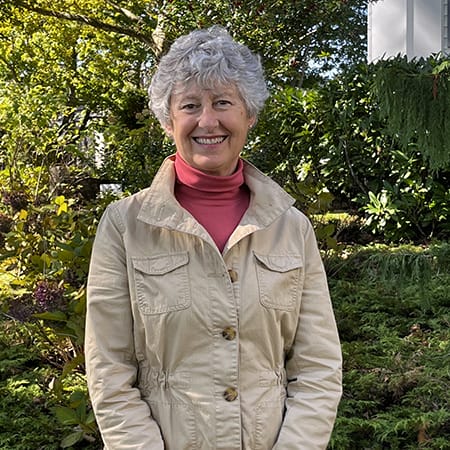
Meet Daily Point of Light Award honoree Claudia Sweger. Read her story, and nominate an outstanding volunteer or family as a Daily Point of Light.
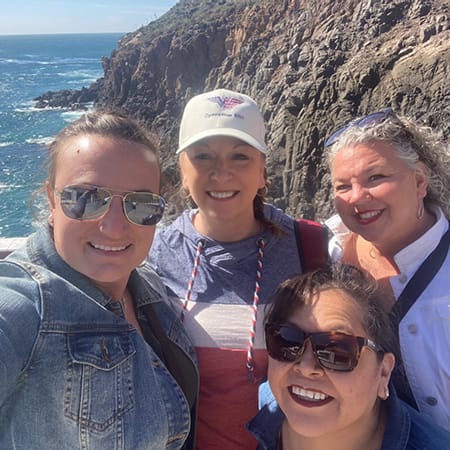
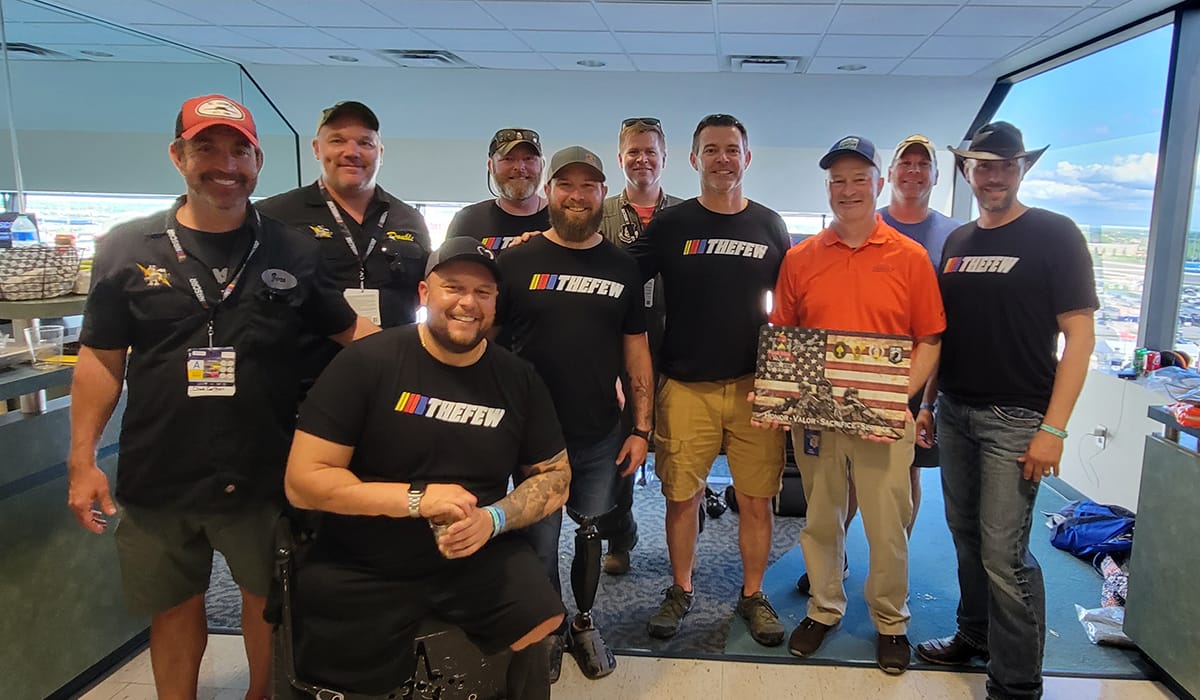
Since 2012, Claudia Sweger has served as the director of programs for the Foundation for Exceptional Warriors, a national organization that provides cost-free adventures for warriors wounded in combat and their families founded by her husband who was a wounded special forces soldier. Claudia helps plan many of the logistics for FEW, which has helped offer thousands of veterans’ adventures throughout the United States, Canada, France, New Zealand and the African continent at no cost.
With FEW, Claudia helps promote healing and community for families impacted by deployment and war. She coordinates all of FEW’s family and wife events, arranges travel and accommodations, sends thank-yous to donors and more.
What inspires you to volunteer?
A lot of different things inspire me to volunteer, but the biggest things have to be being able to make a difference in the lives of others, being a part of something bigger than myself, getting involved with those who need assistance and getting the opportunity to see someone smile.
Claudia coordinates all of Foundation for Exceptional Warriors’ family and wife events, arranges travel and accommodations, sends thank-yous to donors and more.
Tell us about your volunteer roles with the organization you’re a part of.
I have been volunteering with the Foundation for Exceptional Warriors since it was founded back in 2012, so for over ten years now. In my role with FEW, I plan, coordinate and run all of the family and spouse events for the organization. I also assist with arranging travel and accommodations for the Warrior events throughout the year and help with fundraising.
What’s been the most rewarding part of your work?
The most rewarding part of my work with FEW is definitely seeing the positive impact we have on the lives of the Warriors and generations of families. I love getting to see the smiles on the children’s faces and watching families reconnect after wartime.
What have you learned through your experiences as a volunteer?
Volunteering is best known as an act done for the benefit of others, but that’s not to say you can’t take away a lesson or two along the way. These lessons could shed light on the principles of doing good, the community in need and even yourself. Everyone has a story; when volunteering for a community in need, you come to realize that every person has a story of who they are and how they came to be where they are. While it’s important to remember that each person has their own unique narrative, it’s just as important to respect, appreciate and take the time to understand this narrative.
I’ve also learned that small changes can have a big impact. As a volunteer, you come to the understanding that simple actions can have a big impact. No act of kindness is too small! Volunteering also brings with it a deep appreciation of all that you have in life and helping those in need is a firm reminder of what really matters — like family, friends and health. It’s not uncommon for volunteers to see their own lives in a different light, perhaps taking notice of the small things or moments that bring them joy.
Volunteering is also a learning experience. As a volunteer, you never stop learning. Developing new skills, discovering new passions, gaining new insights about yourself and the world around you — volunteering covers it all. Volunteering can mean learning about different communities, organizations and fields as well as learning more about yourself. And once you’re a volunteer, you’re always a volunteer.
Putting aside the fact that doing good is scientifically proven to lead to more good deeds, volunteering is an experience that stays with you forever. The fulfillment that comes with helping another human being, the satisfaction from knowing you’ve made a difference and the good old fun factor are just a few reasons once is never enough.
Any advice for people who want to start volunteering?
Think about what matters to you and be selective about where you spend your time. Choosing opportunities that make you feel good while helping others builds stronger communities and enriches your own life at the same time.
Why is it important for others to get involved with causes they care about?
Volunteering your time to support a cause that you are passionate about is something you will never, ever regret. It will enrich your life, familiarize yourself with your community and connect you to people and ideas that will positively impact your perspective for the rest of your life. For me, volunteering brings people together and fosters a true sense of community and belonging. Individuals forge bonds with fellow volunteers and community members by actively participating in community-driven initiatives. These connections not only strengthen social ties, but they also promote empathy, understanding and unity.
Foundation for Exceptional Warriors, is a national is organization that provides cost-free adventures for warriors wounded in combat and their families
Tell us about future partnerships, programs or events that you are excited about.
I seriously get so excited about all of the events I help with throughout the year, but the family events are my favorite. We have our annual Warrior Family Beach Week in Dauphin Island, Alabama, coming up in the springtime in March. This will be our seventh year to host the event for our families. I hold this particular event pretty close to my heart as it was how our family events got started. Watching the families reconnect after deployments, seeing the smiles and hearing all of their laughter together really warms my heart.
What do you want people to learn from your story?
The Dalai Lama once said, “Just as ripples spread out when a single pebble is dropped into water, the actions of individuals can have far-reaching effects.” Be that pebble! Make a difference! You won’t regret it.
Do you want to make a difference in your community like Claudia? Find local volunteer opportunities.
Alaskan Therapy Dog Team Brings Peace and Joy to Those Dealing With High-Stress Events
Meet Daily Point of Light Award honoree Miranda Miller. Read her story, and nominate an outstanding volunteer or family as a Daily Point of Light.
Miranda Miller met Arya, a 10-week-old Brittany puppy, in 2019 when she was dropped off at Miranda’s in-home dog boarding business, Bird Dog Bed and Breakfast. Her parents later realized they weren’t prepared for a puppy and were planning to return her.
“She’d bonded with me at that point, and I couldn’t imagine her just going back to a breeder and not knowing what happened to her. So, I offered to adopt her and they said yes,” Miranda recalls.
Miranda knew a purebred Brittany like Arya was expensive and offered to pay, but her family refused adding that she had a lot of potential. It was that moment Miranda decided she and Arya would become a therapy dog team.
In addition to the B&B, Miranda is a remote medical coding auditor for a rural Alaskan hospital. She is married with a 3-year-old son and has since adopted a second therapy dog, a Brittany named Mazy Bear.
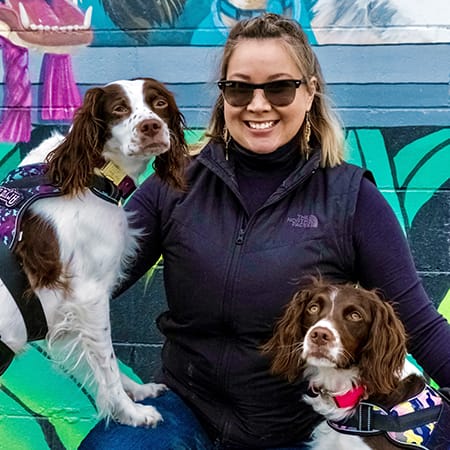
(left to right) Arya Bear, Miranda and Mazy Bear pose in front of AK Bark, a local dog boutique that included Arya in their outdoor mural.
Together, Miranda and her dogs visit many places around Anchorage. They’ve been regulars at the Covenant House’s Rights of Passage program, a transitional living program where young adults who have experienced homelessness can get support but are in between a shelter and independent living. The kids–sometimes working through trauma, mental health issues or substance use—see them as family and will often rearrange their work schedule to be there for visits. As an Alaskan Native, Yu’pik and Inupiaq, Miranda brings understanding to the program made up largely of those of similar cultural background.
At least twice a week, Miranda and one of her pups will head to the Alaska Native Medical Center as well. After entering the Emergency Department, the pair makes their way through every unit on five floors.
“Sometimes, Arya just walks up to a person that doesn’t look like they want a visit. She knows when a person really needs that,” Miranda stated.
They spend time with patients experiencing high anxiety because of lack of clarity about their ailment or upcoming procedures with risk involved. The stress of upset patients, machines beeping and time pressure leaves medical staff in a position to benefit from some dog time, too.
“Her dogs are such a blessing when they come. When she enters a nursing unit, you can physically see the change in the energy. It just changes their attitude,” said Roberta Miljure, volunteer coordinator at the hospital.
The pandemic took a toll on volunteering as much as everything else. A couple of dogs passed away during the time away. Some were hesitant to go through reapplication after things opened up again. Many moved to the National Crisis Response program.
“Pre-COVID, I had six [therapy dog teams]. Right now, I only have Miranda, so I depend on her quite heavily,” Roberta added. “She’s wonderful
about even visiting on call if we have a particular situation or a certain patient who would benefit from it.”
In fact, Miranda and her dogs are a third of the way through the year-long training for Crisis Response but have no plans of leaving their current volunteer circuit behind. Teams in this organization can be deployed all over the country when a tragedy like a natural disaster hits to keep people calm and help where they can. Training is mainly for the handler and involves classes like First Aid, psychological First Aid, suicide awareness and more. Dogs get more obedience and socialization.
“They have to really be in tune with really high emotions, chaos and different environments they don’t go to often,” Miranda said.
While in training, Miranda joins Crisis Response at school visits around town. Arya particularly loves these visits because she loves children. Miranda also looks forward to visiting more police departments and fire stations going forward.
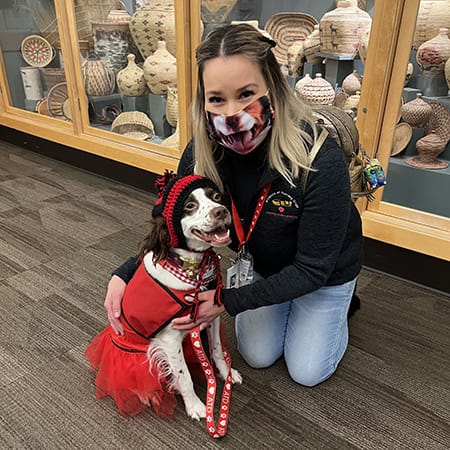
Miranda and Arya Bear, dressed to impress, get ready to visit patients at the Alaska Native Medical Center.
In the meantime, Mazy, Arya and Miranda stop in the local military hospital and their related events as well as assisted living homes as part of the Alaska Red Cross therapy dog team. And Miranda is one of two volunteers in Alaska who helps out with American Brittany Rescues (ABR). She fosters dogs from the shelter and acts as the co-chair of the outreach team that spreads awareness about ABR’s services
“She’s just an incredible person and an incredible mother, and I wish I could clone her. She’s a very sweet, compassionate person,” Roberta effused.
In April, Miranda started Arya Bear’s Closet. Failing to find a dog kuspuk, an indigenous Alaskan garment popular among humans, Miranda created her own lightweight, bandana versions for the pups to wear volunteering.
“People really started looking forward to seeing what they were going to wear and asked for one for themselves,” she smiled. “I just kept getting requests, so I decided to open up a little business, and it took off immediately.”
With the unexpected success, Miranda has incorporated giving back as part of her business’ mission and has donated over $2,000 in funding and gear to various local nonprofits. Currently, this dedicated dog-lover is working on starting the Rural Alaska Therapy Dog program in Bethel, the small town where she grew up.
“There’s no road system there. You can only fly there or take a boat. Bethel is where the airplanes are. And then everyone else boats in the summer or drives on the river in the winter. The river becomes the highway that connects little villages to the big hubs,” Miranda remarked.
Bethel hosts the largest hospital in the western part of the state, and it’s often busy. Miranda is in talks with the hospital president and the Bethel Dog Rescue and hopes to kick things off at the end of the year or early 2024. She believes the program would not only benefit patients and staff but the community at large.
“The culture there…people just have loose dogs. They don’t really understand training, and if they see a dog working, it really could change their mindset on how the dog should be taken care of overall by training them to be a therapy dog. And would result in fewer strays,” she predicted.
She also hopes it would lead to more adoptions from overpopulated rescue centers. Most people in the area have never seen the effects of a therapy dog and have been enthusiastic about her hospital visits in the past.
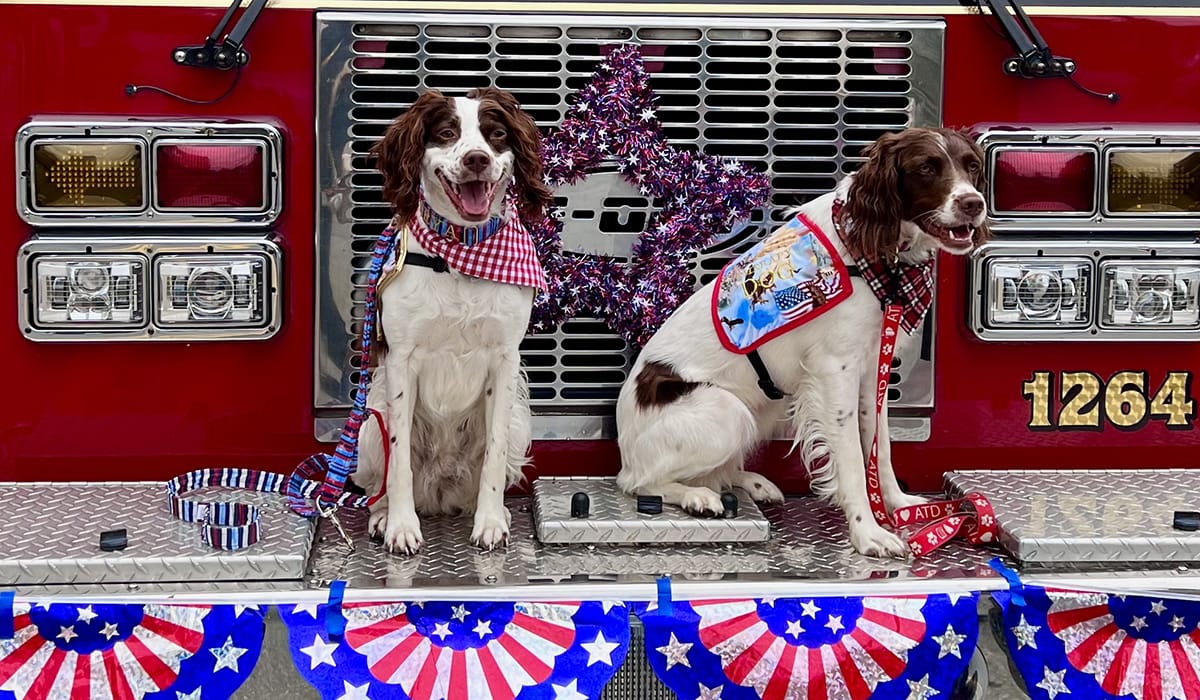
Due to Miranda’s husband’s job at the fire department shop, Arya Bear (left) and Mazy Bear are familiar faces at the fire department and were invited to be part of the Fourth of July parade.
Today, Arya has become a bit of a local celebrity, a fixture in the Anchorage landscape, and people often stop to say hello.
“Before this, I was really shy. I wasn’t a public person. Arya has gotten me out of my shell,” Miranda reflected.
On days she’d rather sleep in, Arya motivates her to get out of bed. After all, she emphasizes how small things you do for people can go a long way.
“It really just sets the standard for the community, and having your friends and family watch you do something you enjoy makes them want to do the same. The act of giving spreads really fast,” she stated.
Miranda and her kuspec-clad Brittanys’ work brings light to everyone they see, even outside their planned stops. Their dedication and kindness ties the community they love together, and they wouldn’t have it any other way.
High School Senior Provides Opportunities to Increase Literacy
Meet Daily Point of Light Award honoree Ryland Adzich. Read her story, and nominate an outstanding volunteer or family as a Daily Point of Light.
Some kids like to play video games or watch YouTube. Ryland Adzich, 18, likes to dig into some Russian literature—a task inspired by Gilmore Girls’ Rory Gilmore—or prep for family trivia nights with in-depth history research. As the only child, she’s starting at an age disadvantage for the latter but often prevails. Reading is a vital part of her daily life and how she moves through the world, especially as it relates to education. But she’s not content to keep the joys of literacy to herself.
Ryland held her first book drive in middle school with Bookworm Global and has since become president of the organization, donating more than 40,000 books to underserved communities and helping others set up clubs at their own schools. Going a step further, Ryland founded The Creative Destination, a place dedicated to designing creative literacy spaces to expose underserved youth to reading outside of the classroom.
Setting aside her cross country and track team successes for now, Ryland has her eyes on finishing out senior year strong and investing more time in her philanthropic work. She looks forward to college next year and hopes to use what she learns there to eventually launch herself into a career on Capitol Hill or at a nonprofit. Or, as she jokes, become a superhero and fight crime at night.
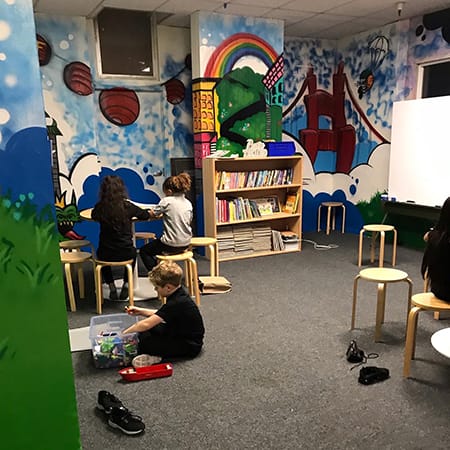
Kids from the Tenderloin district in San Francisco make use of The Creative Destination’s literacy space
What inspires you to volunteer and advocate for literacy?
What inspires me to volunteer is seeing someone have a better day or enjoy reading. Literacy is more than just the ability to read. It’s what connects us. I’ve always been a voracious reader, so when COVID-19 shut local libraries down, I lost access to a space that I really enjoyed. I wanted to provide kids access to books that was lost in the pandemic. I was planning a small book drive when I got a call from a friend who was starting Bookworm Global. She asked me to be the first ambassador.
I founded The Creative Destination after reading in an afterschool program with a group of first grade girls in the Tenderloin. The space was not a welcoming environment. The furniture was ramshackle, the room unkept. This affected the children’s inability to focus.
Tell us about your volunteer role with Bookworm Global and The Creative Destination.
After joining Bookworm Global in middle school, I did my first book drive at a local park and collected over a thousand books. I then established the Bookworm Global Chapter Program for high school students across the nation to start their own club. I train club leaders and new volunteers, and I interview authors and professors of literacy and education for our YouTube channel. In 2022, I became president and manage over 1,000 volunteers.
For The Creative Destination, I enlisted a local artist and a sustainable furniture company to transform the space. Then we raised over $10,000 for the project and have used grant money to purchase laptops for a digital literacy technology room. I’ve created literacy spaces inside 10 laundromats to encourage kids to read and take home books, which we regularly replace. And I manage a partnership between a small school in the Tenderloin and Stanford University’s Reading and Dyslexia Research Program to administer reading assessments for low-income students.
What are your long-term plans or goals for the organizations?
I’d like to get our Bookworm Global volunteer total up to 2,000 by the end of my senior year and to host a nationwide book drive for the upcoming holiday season. My goal for The Creative Destination is to have 20 laundromat literacy spaces by the end of January and my study on how students use the digital literacy technology lab and the benefits.
What’s been the most rewarding part of your work?
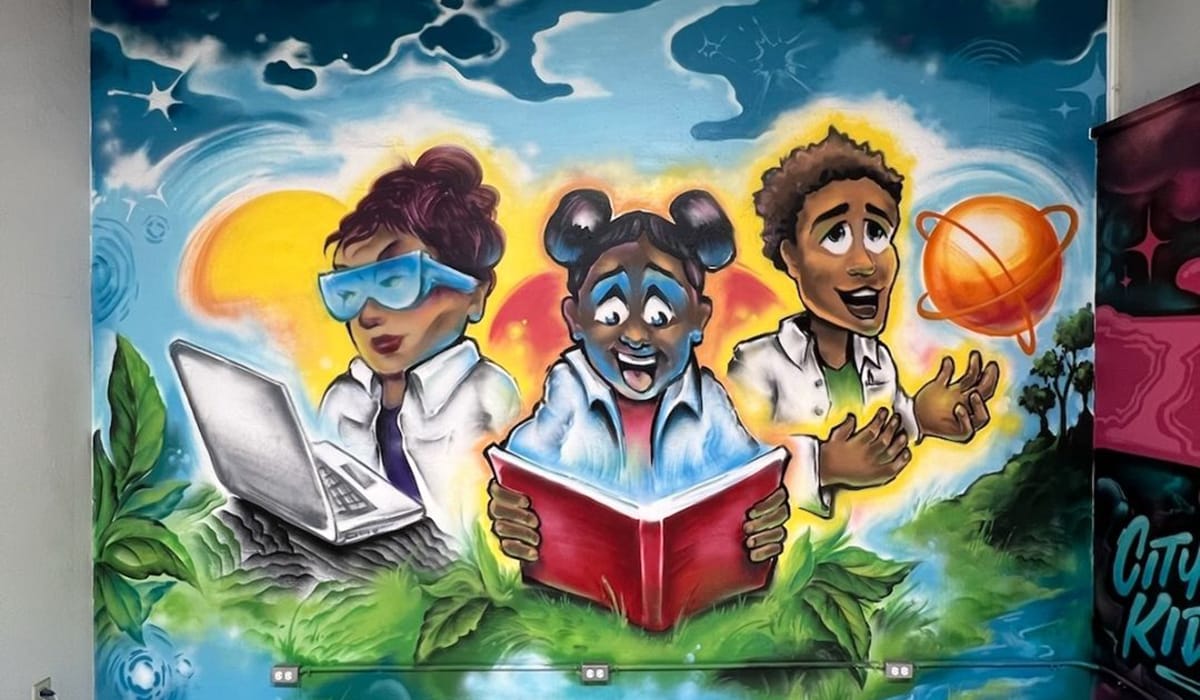
The most rewarding part is seeing that at least one kid has enjoyed finding that special book from a Bookworm Global book drive or has enjoyed feeling comfortable and safe, like they can tackle reading, in a Creative Destination space. My favorite moment was when I was able to see a video of kids coming in to see the new mural work, and one kid shouted, “That’s me!” referencing an image of a girl who was holding up a test tube and a girl opening up a book.
A mural featuring children pursuing science and technology careers inspires visitors to The Creative Destination’s digital literacy technology lab.
What have you learned through your experiences as a volunteer?
An impact comes in all shapes and sizes. Seeing one kid feel safe to read or picking up the first book in the Harry Potter series and wanting to continue reading may seem small, but these moments compound. When you help kids or people in need, people remember that. And those moments create people who want to continue to do good, because they remember the good that someone did for them.
Why is it important for others to get involved with causes they care about?
I think we have a human desire to help someone when they’re in need. Acknowledging that part of human nature and nurturing it creates a world of problem solvers and world shakers, and the world could use some more of that.
What do you want people to learn from your story?
You can start something that may seem small, but as time goes on, as more people see what you’re doing, your impact will grow to heights that you could have never thought possible. I’m truly grateful to everyone at Bookworm Global and The Creative Destination who have been able to help me in my philanthropic work. I would continue to remind people that you have the power to impact someone, and that person is going to impact somebody else. And soon, you have a chain reaction of positive awesomeness.
Young Leader Fosters Unity and Empowerment Through Passionate Volunteerism
Meet Daily Point of Light Award honoree Gavin Alexander Poore. Read his story, and nominate an outstanding volunteer or family as a Daily Point of Light.
In a world increasingly in need of compassionate leaders, Gavin Alexander Poore of Pembroke Pines, Fla., stands out as a beacon of hope and inspiration. His involvement with Joshua’s Heart Foundation (JHF) and his initiative, Discovering Diplomacy, reflect his deep commitment to serving communities and empowering youth.
Since joining Joshua’s Heart Foundation in August 2022, Gavin has been instrumental in both its internal and external operations. As the Miami Chapter head of finance and a member of the Junior Advisory Board, his role is pivotal in securing the organization’s financial stability. He has taken the lead in filling out grant applications, significantly contributing to raising over $100,000 and networking with corporate executives to support JHF’s mission of eradicating hunger.
Gavin’s innovation is evident in his launching of the foundation’s first-ever LinkedIn workshop. Recognizing the importance of interconnectedness and professional growth, he helped JHF members create LinkedIn accounts, fostering a network of opportunities. His initiative not only enhanced the organization’s cohesion but also empowered its members with essential professional skills.
Gavin’s also founded Discovering Diplomacy, a virtual program aimed at engaging students from under-resourced schools in political discussions through Model United Nations (MUN). This project reflects his dedication to nurturing soft skills and encouraging self-expression among youth. By providing a platform for dialogue and learning, Gavin helps students find their voice and develop essential life skills.
Read more about what inspires Gavin to volunteer and why civic engagement, especially among youth, is of the utmost importance to him.
Tell us about your volunteer role.
I’ve served as the head of finance for the Joshua’s Heart Foundation, specifically for the Miami Chapter. I’ve led a team of analysts – all youth, which is great – in researching and applying to grant opportunities in order to fundraise for the organization and pay off some of the fiscal responsibilities. Recently, we’ve been trying to get grants to support our mobile food distributions.
In addition, we’ve been trying to create tier sheets for potential companies to partner with. These are presentations that we present to our teams and potential investors we’d like to partner with in order to help out the organization with additional resources.
Gavin works tirelessly to end food insecurity in his community and beyond.
Why is this organization and issue so important to you?
I’m a South Florida native and have seen how food insecurity has rocked this area. When I’ve worked with the organization and attended food distribution events, I’ve seen how even in my local community, kids my own age are struggling with hunger. I’ve found a kind of moral obligation in myself to help out in any way I possibly can, in order to create more equity in the field and alleviate food insecurity.
So that’s one of my main drivers behind working for the organization – seeing the effects hunger has had on kids my age, and wanting to help relieve that so these kids can have the opportunity to have food on the table and ultimately have a successful life.
What inspired you to get started with JHF?
I got started with Joshua’s Heart Foundation about a year and a half ago. Some of my friends from school were talking about the foundation and they referred me to the Thanksgiving food distribution event. I was curious about the event, so I went. And I really fell in love with everything going on – the people volunteering, the organization itself, the youth-led initiatives within it… I really wanted to find a purpose within the organization, so I networked with some of the officials behind it and was able to apply for a position on the Junior Advisory Board.
What are your long-term plans or goals for the organization?
The long-term vision right now is the transition from Joshua’s Heart Foundation to Joshua’s Heart Foundation 2.0. This is more of a virtual-based method behind the organization, where our internal operations teams would be remote. So, more youth, not just in Miami but across the United States, would be able to contribute in any way they can.
Within the finance team specifically, one of our goals is to obtain more grant funding. With more grant funding, we can have more resources funneled in, more food distribution events, more operations and initiatives supported.
Another thing we’re currently trying to do is partner with more schools. We met with my school’s principal recently to discuss getting more students involved, in more of an internship-like capacity. We want to vertically integrate in other schools specifically in Florida, but all across the United States. We’d like to create a legion, in a way, of innovative youth changemakers who all want to help alleviate food insecurity in their local communities.
What’s been the most rewarding part of your work?
I think the most rewarding experience for me was a workshop I hosted for the foundation – it was a LinkedIn networking workshop. I thought the LinkedIn Thought Leader Forums were a really excellent opportunity to network with people, but I realized that not a lot of youth were involved. Which meant that these really innovative kids who wanted to have these networking opportunities weren’t leveraging the platform.
So I created this workshop to help kids get involved in safe way and help get some opportunities for the organization but also for themselves. The most meaningful thing has been the kids from schools across Florida reaching out and asking for advice and help and sharing the opportunities they’ve been able to get via LinkedIn. It’s been truly phenomenal and I’ve gained a lot of pride in it.
I think it’s incredibly rewarding when people share their soft skills and interpersonal skills and they refine them, then they meet and network with a variety of people and get the opportunity for cross-cultural awareness. This can not only help them in a business setting but also elsewhere in the real world – creating relationships through networking that have the potential to change the world.
Why is it important for people to get involved with the causes they care about?
A the end of the day, a community is not just one person. For a community to thrive, it has to be a cultural makeup of lots of different people. But unfortunately, there are circumstances and systemic issues that plague certain parts of the community. There is a moral obligation we have, which requires some teamwork and dedication to help the entire community.
When people see, for instance in the South Florida community, that there is so much diversity, so many cultures and so much love, if there’s an issue like food insecurity plaguing that community, people should definitely try their best to help in any way they can. Maybe that’s volunteering with an organization like Joshua’s Heart Foundation, or maybe it’s through political advocacy – like lobbying with local policymakers to help fight food insecurity. From a business standpoint, maybe they can create partnerships with companies reduce food waste. There are so many different ways – on a corporate level, a conglomerate level, a political level or an individual level – to get involved.
Any advice for people who want to start volunteering?
I think the easiest way is to try to find the intersection between their work experiences or passions and volunteering. Also, utilize platforms such as LinkedIn to network with people and try to create awareness about certain issues. A single piece of dialogue can make a difference.
Within Joshua’s Heart Foundation, we have a lot of opportunities, specifically youth, to help out. Sometimes kids may not know how to do that, and we take pride in uplifting and empowering youth to become leaders in their own communities. I think one of the best things to note is that love has no barriers. In an organization where everyone has the same objective, the same goal, the same light at the end of the tunnel, there’s nothing to be afraid of. That kind of organization will be motivated to share their skills and help one another out. So, don’t be afraid to take one leap of faith – that could lead to some phenomenal outcomes in your community.
After Retirement, Arizona Father Mentors Youth in STEM
Meet Daily Point of Light Award honoree Greg Lewis. Read his story, and nominate an outstanding volunteer or family as a Daily Point of Light.
Greg Lewis didn’t initially intend on becoming a decades-long volunteer with the FIRST LEGO League robotics program, but after volunteering when his son was in the program, he stayed. Being a volunteer with FLL changed his life, giving him a sense of purpose and a schedule after his first wife passed away from breast cancer.
Lewis has mentored more than 600 youths, has been a part of giving a multitude of scholarships out since joining the program in 2009, and has even grown his volunteerism beyond the FIRST LEGO League to help high school and college students. He coaches and mentors youth on the weekends and even helps a soccer league and dance group transport equipment when needed.
What inspires you to volunteer?
What initially got me to volunteer was when my late wife was going through chemotherapy for breast cancer. She wanted to find something for me and my younger son to do. Our younger son is autistic and he loves computers, so we found the First Lego League Robotics program that offered students robotics and computer programming here in Chandler in 2009.
So that’s what got me started. Initially it was just for him, but then he went through his junior year of high school and on to college. I stayed with the program as a volunteer because I saw how much impact it has on kids; I saw it in my son. I’m inspired today to continue this work because when I was a kid, something like this didn’t exist. These kids get to come and learn on weekends, sometimes spending eight hours with us on a Saturday, and they’re genuinely excited to be there. It gives them opportunities for scholarships, relationships and growth. They have to learn to communicate what they’re doing and working on, so it’s a great pipeline into work experience as well.
Tell us about your volunteer roles with the organizations you’re a part of.
The vast majority of my time is spent with the robotics teams at First Lego League Robotics. We have anywhere from two to 12 teams a year. We mentor the kids, set them up into teams, guide them with picking the projects that they do and give them a little bit of guidance on building the robots. We try to leave that more in the kids’ hands so that they actually do it ourselves. From that standpoint, the Lego League is mostly mentoring. I don’t coach any individual team, but I do coach for the whole group. I try to bring in doughnuts and pizza and stuff like that when they’re there on Saturdays. We make sure they get something to eat since our program mostly centers around underserved families — everything is free. Nobody has to pay to join a team or anything.
TheSi Se Puede Foundation and As I Rise Foundation are kind of one in the same as FLL to me; I started working with the founder Alberto Esparza in 2009 as well and they focus more on college and high school robotics. We also help out a soccer league and dance group, Baille Folklorico. I mostly help them haul around equipment, it’s part of having a truck. We have about 500 kids in the local school district playing soccer and everything is free to the kids like nets, soccer balls, goals, water and stuff like that.
Mostly I tell people I’m not in charge of it all; I’m not the boss or anything. I just want to make sure that everything happens and that there’s never a time that we can’t do something. I want to see all of these kids continue to have these opportunities.
What’s been the most rewarding part of your work?
Seeing my son learning to have and interact with friends. He built a group of friends through the robotics program and in high school he started joining clubs then actually got a scholarship. He actually works in Dallas right now for Ernst and Young as a programmer and he’s gone from being a person that really couldn’t tolerate anybody to being very successful.
I’d love to see any of these kids come back and visit us after they get scholarships to colleges and get jobs all over the country. We’ve seen a lot of kids do that. So we’ve really tried to at least give them the preparation and skills for college and the workplace. Most of the underserved kids that we have might be the first generation to ever go to college and we want to make sure that they continue to see these opportunities.
What have you learned through your experiences as a volunteer?
The main thing I’ve learned is just how lucky I’ve been in my life. I’ve always had people support me and I think we take that for granted sometimes. But I’ve learned that even just a little tiny bit of help makes a huge difference to these kids. It’s nice to learn that even a small act can have a huge impact on somebody and even their whole family.
Any advice for people who want to start volunteering?
I always try to tell people to pick out something that they genuinely like doing or feel a personal connection to. It doesn’t have to be robotics or engineering. People should go out and visit places that pique their interest instead of just reading about them.
Why is it important for others to get involved with causes they care about?
I believe it’s always important for anyone to volunteer. People reach their own success because of the people around them helping. There’s a lot of hidden people around the country who may be under-resourced and they just don’t have the opportunities that a lot of other people have. So it’s good to give back to anybody.
I’m retired now so something like this still keeps me busy and gives me a schedule that I can keep following. I’ve been very thankful for this volunteering opportunity, especially since my first wife passed away — it really gave me something to do and kept me going and kept me doing something good for my community.
Tell us about future partnerships, programs or events that you are excited about.
The soccer team is continuing to do scrimmages on weekends and on December 8, FLL Robotics has an event. Our underwater robotics program picks up in the springtime.
Virginia High Schooler Determined for No One in His Community to Go to Bed Hungry
Meet Daily Point of Light Award honoree Sehaj Grewal. Read his story, and nominate an outstanding volunteer or family as a Daily Point of Light.
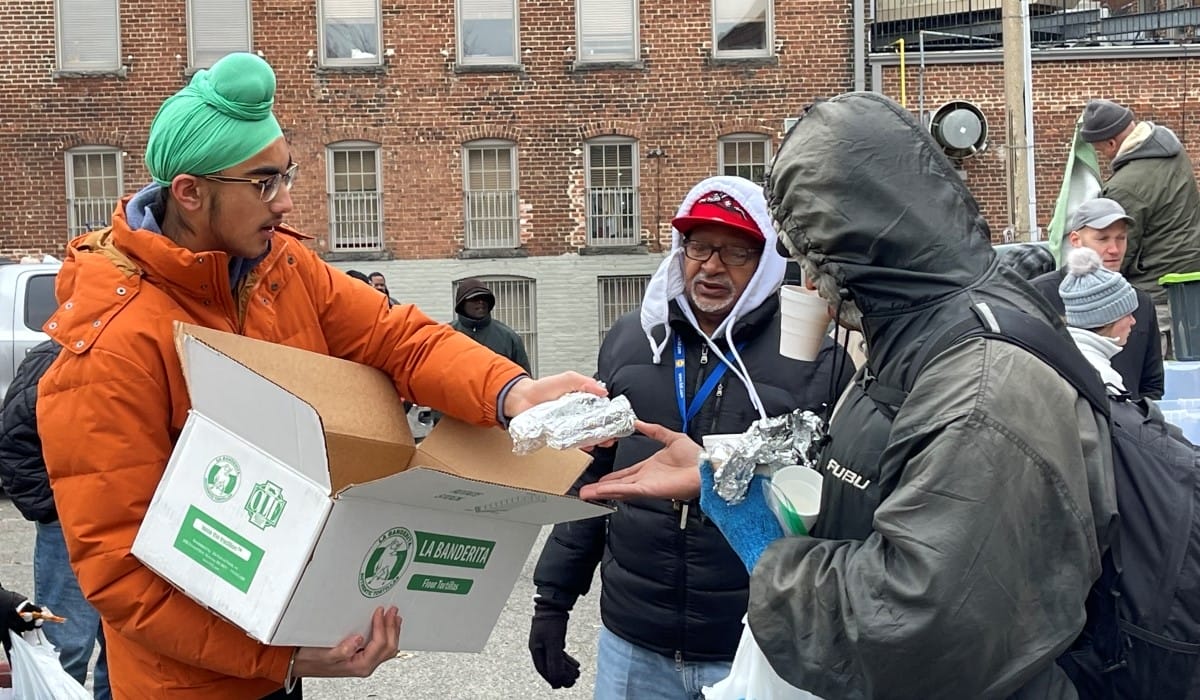
In Sikhism, the word seva means “selfless service.” Growing up in the religion, 17-year-old Sehaj Grewal has always seen community involvement as a pillar of life. So, when he came back from a volunteer event handing out meals one day, he was concerned about the number of people who needed help. His research showed that one in five children in the U.S. struggle with hunger, a statistic that was one in eight before the pandemic. Twenty-two percent of children in Richmond City face the same challenge, a number that led Sehaj and his co-founders to form SevaTruck RVA to start addressing it.
Over 100 volunteers, including Sehaj and his family, collect and grow food, donations and supplies. They have served over 23,000 nutritious meals to members of the community since it’s the organization’s inception in 2021. Local partners include farms who donate food grown in the community to the community. And SevaTruck proudly serves only what its founders would put on their own tables.
Aside from volunteering at events, Sehaj is a student ambassador and has established a group of volunteers in his own high school as well as those around the country. He learned to write grants and, among others, has secured a $120,000 in-kind grant from Google AdWords this year that will allow them to expand the reach of the organization online.
What inspires you to volunteer?
Volunteering is just sort of ingrained in my life, because a big tenet of Sikhism, my religion, is to serve and contribute to the community. Ever since I was a kid, my parents have instilled those values in me. I applied those values to my community and saw there was a need. That really inspired me to volunteer and help the community out.
Tell us about your volunteer role with SevaTruck RVA.
I help out a lot with the planning for events including our annual fundraiser, where local businesses donate products or services for auction. Last year’s event raised over $15,000. I also help with writing grants. And I help get more people involved. I got some classmates and some other people in my community to help volunteer. On weekends, I often do food distribution events. I’ve built some decent connections with people and they all remember me as the “burrito man,” because I am usually passing out burritos, which I find funny. Overall, I just help the organization run smoothly.
What inspired you to get started with this initiative?
I once went to downtown Richmond with my family to pass out meals. I didn’t know until then that there was so much food insecurity in Richmond. So, I went online to research and found it’s well above the national average. In order to solve that, I talked to my parents. Then, they talked to some family friends, and together, we started SevaTruck RVA as an offshoot of SevaTruck in Northern Virginia. RVA means Richmond, Virginia. Initially, we planned to hand out food from trucks but found it was easier to just prepare it in a kitchen. It was also originally intended to serve kids who qualify for a free school lunch but has expanded to include the unhoused.
Because of his usual role handing out burritos, Sehaj is known as “Burrito Man” by return guests./Courtesy Sehaj Grewal
What are your long-term plans or goals for the organization?
The goal for the future is to get as many people as possible to give out as many meals as possible. And to get more money from grants. I always hope there aren’t any other kids out there who are going to bed hungry and that they can go to bed with a warm, nutritious meal.
What’s been the most rewarding part of your work?
The most rewarding part is the internal feeling I get when I know that I’m helping others who struggle with food insecurity. It really humbles me and fills me the gratitude for the conditions I’ve been in, and it helps me understand the perspective of others who aren’t as food secure as I am.
What have you learned through your experiences as a volunteer?
Not everyone is born with the same deck of cards. I’ve also learned that, usually whenever I pass out meals downtown, a lot of the people are kind of lonely and want to have a conversation. So, if they want to, I start up a banter. It feels good to know that they have someone to talk to.
Why is it important for others to get involved with causes they care about?
If nobody else will help people who may need it out there, who will? At the end of the day, they also have lives, and I think it’s our duty as people who have been born with a certain deck of cards to help others however we can.
Any advice for people who want to start volunteering?
Start now. Go out there and see what’s needed in your community, and try to tackle that problem to the best of your ability.
What do you want people to learn from your story?
I’ve been repeating this, but I want others to learn that it’s very important to help others, and even a small contribution will go a long way. Even if they just do one volunteer food distribution event. The meals that they pack and pass out will help keep families from starving or going to bed with an empty stomach. I want others to know that their contributions go a long way.
From New Immigrant to Empowering Underserved Texas Students With More Than 25,000 Books
Meet Daily Point of Light Award honoree Rohan Satija. Read his story, and nominate an outstanding volunteer or family as a Daily Point of Light.
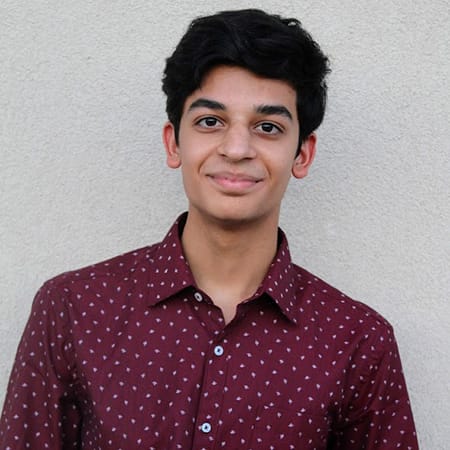
In the heart of Texas, a young person’s compassionate vision has transformed into a pipeline for education to thousands. Rohan Satija, along with his sister, Anya, co-founded the Let’s Learn Foundation in 2018, and since then, they have been unwavering in their mission to provide underserved students in Texas with the priceless gift of knowledge.
Rohan’s journey began with a personal struggle. Immigrating to the United States from New Zealand at the age of 10, he faced the daunting challenge of acclimating to a new environment. In these challenging times, he found solace in the world of books – an escape that many take for granted.
“I just felt isolated on this new continent due to cultural barriers,” Rohan shared. “I often felt lonely, and I found comfort in books since I’d been an avid reader my whole life. I eventually connected with others who also shared a love for books. Books really became a catalyst for change in my life.”
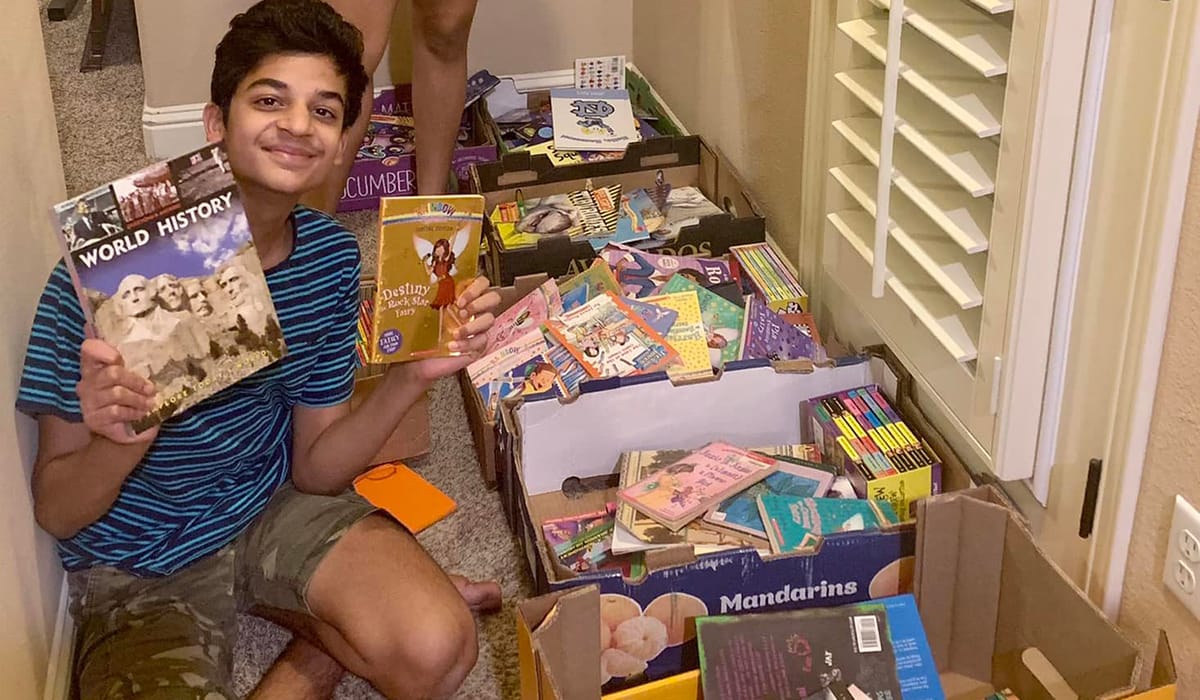
Rohan has always loved the much-needed escape that books can provide.
However, Rohan soon realized that not all children had the same access to this magical world, a realization that sparked a fire within him. Moved by the circumstance of countless school-aged kids in Austin lacking access to books, Rohan, together with his sister Anya, decided it was time to make a change.
“In middle school, we were doing a school project about social inequities in my area,” Rohan recalled. “Being a reader, I knew that I wanted to research something about books. And I came across this phenomenon of book deserts – areas where students don’t have access to books of their own. I looked at some statistics in Central Texas and found that the disparity was pretty shocking. I talked to my sister about this, and we knew we had to make a change.”
Starting humbly with lemonade stands and homemade cookies, the siblings’ determination knew no bounds. What began as a small initiative, the Let’s Learn Foundation has now grown into a substantial force, supported by various school districts, businesses and esteemed institutions like the Dell Children’s Hospital. As CEO, Rohan has been instrumental in coordinating book donations, fundraisers, book drives and collaborations with organizations like Active Minds.
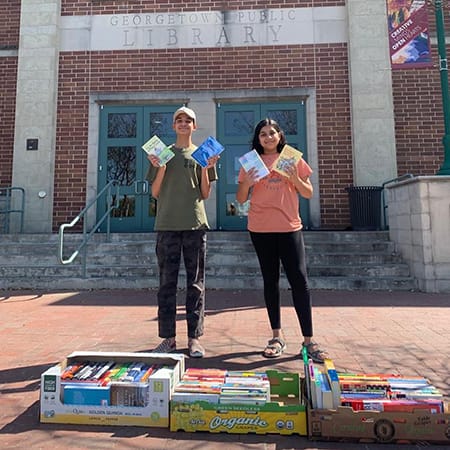
Since its inception, the Let’s Learn Foundation has achieved remarkable feats. More than 25,000 books and 100,000 school supplies have been donated to more than 10,000 underserved students in Central Texas. The organization currently serves 11 school districts in the area and has expanded to include school supplies, including full backpacks, in its donation efforts.
Rohan has learned how to make donations stretch a long way by purchasing books from The Dollar Store so he can reach as many kids as possible.
Rohan and his sister Anya are not just the brains behind the operations; they are also the hands and feet, personally visiting schools to donate books, engaging in the entire process of gathering, packing and distributing these gifts of knowledge.
“Literacy is really the key to any sort of success or knowledge in life,” Rohan said. “I believe that it’s really important to be literate in order to understand the world, the world’s processes, and one great way to do that is through books themselves. They can provide so much knowledge and perspective about so many other parts of the world, characters and processes in place across the globe.”
One of the most heartwarming initiatives Rohan helps lead is the Christmas project. Each year, volunteers collect, wrap and distribute books, ensuring that every student in an elementary school receives a personalized gift. This gesture not only provides educational resources but also brings joy and a sense of belonging to these young minds during the festive season.
Now, Rohan and Anya’s organization is looking to expand. They are currently authoring a children’s book, Myra’s Melody, to teach kids about how to work through fear and insecurity. The book will be self-published and released in November 2023.
Let’s Learn Foundation relies on donations, which allows Rohan and other volunteers to contribute books to local schools and libraries.
He shared, “My sister and I are both passionate mental health advocates, so we really want to take Let’s Learn and also put a focus on mental health education. We collaborated with Active Minds, a leading mental health nonprofit, and we’re working with them to donate mental health education kits to middle schools. These will include some books about mental health, some wellness worksheets, some resources for positive wellbeing and some fun bookmarks with wellness messages. We’d like to donate these to underserved schools.”
Rohan’s story is not just about books; it’s about the power of empathy, initiative and perseverance. From feeling isolated as a new immigrant to becoming a beacon of hope for thousands, Rohan’s journey with the Let’s Learn Foundation is a testament to the impact one individual can have on society. His dedication to bridging the educational gap for underserved students in Texas is an inspiring tale of compassion and the transformative power of volunteerism.
“I believe that if you’re passionate about something, it’s very important to go out and make some change in your community,” Rohan encouraged. “I know a lot of people get nervous about making a big impact, because they’re so passionate about the cause. My advice is to start small. We started pretty small – raising $50 and buying a couple dozen books from The Dollar Store. Eventually, we were able to expand. So don’t be afraid to start small. It’s so important to make any sort of change, at any level, in something you’re passionate about.”
Volunteer Brings Peace and Comfort as an End of Life Doula
Meet Daily Point of Light Award honoree Madeline Cooke. Read her story, and nominate an outstanding volunteer or family as a Daily Point of Light.
Madeline Cooke lived a dream life as a twenty-something: she married a sailor, and the couple lived on a boat for five years. They spent time in the Caribbean, including the island of Antigua where they experienced an international community of people chartering boats and doing what they loved. The couple then moved to Marion, Mass., which overlooks Buzzards Bay and Cape Cod. In addition to raising two children, Madeline volunteered at her church and her kids’ elementary school. When her son and daughter were 12 and 14, Madeline’s husband was diagnosed with lung cancer and passed away at the age of 45.
Over the next two decades, more family members passed, including Madeline’s mother, who had moved in with Madeline, developed Alzheimer’s and died at 98. Soon after, with her mother gone and her children grown, Madeline started hospice volunteering.
During the COVID-19 pandemic, hospice care was virtually unavailable to families. Only essential personnel were allowed to be with patients. However, one patient’s family who had recently met Madeline requested her for much needed relief help. During the pandemic, Madeline was the only volunteer who continued visiting patients so their caregivers could do errands or go for a walk.
Volunteering in hospice work for six years through Community Nurse Home Care (CNHC) was rewarding. Naturally, Madeline’s passion progressed and today she is a certified End of Life Doula. Similar to a Birth Doula, Madeline supports patients and their families in whatever ways they need: by sitting with the patient to relieve caregivers, helping families make arrangements, guiding them through the grief process and more.
What inspires you to volunteer?
I’m curious, and I love to be around people and hear their stories. We all need to be seen and heard, and feel we belong. Volunteering keeps me connected.
Madeline Cooke volunteers with Community Nurse Home Care.
Tell us about your volunteer role with Community Nurse Home Care and as an End of Life Doula.
For the past six years, I have been a hospice volunteer in and around New Bedford, Mass. For most of that time I would visit patients in their homes. I particularly enjoyed one patient, a vibrant and extraordinary lady who still had all her marbles at 106. One of my longest assignments took place during COVID. This assignment lasted seven months with two visits per week. The caregiver was the wife, and I was her only relief.
At Sacred Heart, a nursing facility, I would see two to six people per week. Many residents have few or no visitors. To provide them with a little company is rewarding. I recently decided to become an end-of-life doula, so two months ago I completed my training with the International End of Life Doula Association (INELDA).
Being a doula is an incredibly rich experience. As a doula I provide customized services for each patient. It’s a three-part approach. First, there’s planning. This can include helping the family follow Do Not Resuscitate (DNR) directives. It can include funeral or memorial service logistics. During patient consultations, I get to know the patient and their wishes. I am there for them however they need me, for companionship, conversation or more. I ask open-ended questions and listen carefully.
The second part of being a doula is the vigil, which is sitting with the person who is actively dying. Sometimes I sit in silence. Other times I listen deeply and empathetically. A lot of it is observation, which involves reading their body language and figuring out what they need during their last days and hours of their lives. This is also a time to follow some of the wishes discussed in the planning phase, such as their choice of quiet music, adjustment with the light or having just one visitor at their bedside at a time.
The third part is working with the loved ones around their grief and offering local resources such as support groups. Always, there is listening involved.
To simplify, I think of the three stages. Before to plan, during to sit and after to grieve.
What inspired you to get started with this initiative?
People carry too much fear and anxiety around anything to do with death. I am inspired to ease their minds with information and compassion.
What are your long-term plans or goals for the organization?
I’ve come to realize my region hasn’t yet been introduced to end-of-life doulas, although word is spreading slowly much like the early days of hospice. And so, I find myself in the role of trailblazer. I am very determined to continue my volunteer service to include coaching people on their dying journeys and helping their loved ones as well.
I’m 75, and some of this doula stuff can involve nighttime driving, which I anticipate could become difficult. I am hopeful that spreading the word will inspire people to become doulas or inspire people to help me out with late-night vigils. This is a big area of need. I will also continue to volunteer in focusing on bereavement issues.
What’s been the most rewarding part of your work?
To get a smile from an Alzheimer’s patient when she does her sing-song talking to her baby doll. Calling someone “friend” and seeing the way their face lights up, even when they’ve become nonverbal.
I see incredible connections, like two Alzheimer’s patients who had become very close. They would often sit together and flirt like sweethearts. He was with her when she died. She opened her eyes, looked at him, took her last breath and slowly sighed. I called it “sighing her life away.” Her son, who was also by the bedside, was very moved by it. There are so many small, sweet moments when people are beautiful.
What have you learned through your experiences as a volunteer?
Volunteering helps me to come out of myself and to understand that I’m not alone. We’re all in this together. Serving others feels good and right. It feels comfortable. It’s as much for me as for the people I serve.
As an end-of-life doula I’m humbled to be included in a very sacred, intimate part of people’s lives. Also, volunteers encourage others and I really like that word because it relates to being “in courage.” You need a lot of courage to be vulnerable with others.
This work is a special way of being with people. It’s real, it’s deep and it’s intimate. So many lessons and wisdoms are transferred back and forth, not necessarily verbally. Volunteering is all about kindness.
Why is it important for others to get involved with causes they care about?
To find your purpose in life allows you to feel fully alive and whole, and that is a blessing worth sharing through serving with kindness.
Any advice for people who want to start volunteering?
Start slow. Start with a friend. Do something that resonates. If you love books, go volunteer at a library. If you like children or animals, go find opportunities to help them. Or, if you’re curious about something specific, volunteer in that area and learn about it. Listen to your soul and follow it. And have fun. It can be life-affirming. It’s a way to say “yes” to the universe. If you don’t know what to do, just look around.
Young Visionary Advocating for Change in the Foster Care Community
Meet Daily Point of Light Award honoree Charissa Wagner. Read her story, and nominate an outstanding volunteer or family as a Daily Point of Light.
Charissa Wagner’s journey in philanthropy began in the first grade when a picture of refugee children standing in mud stirred her heart. Concerned they might be cold, she hosted a lemonade stand and raised enough to buy 500 blankets for UNICEF. This early endeavor marked the beginning of a lifelong commitment to helping those in need.
Since then, Charissa’s compassion has touched many lives. She has extended her helping hand to bombing victims through the America 4 Boston Prayer Canvas, participated in disaster relief efforts, crafted hand sanitizers for the homeless during the COVID-19 lockdowns and sent backpacks filled with supplies to Russian orphans.
Charissa’s advocacy took a significant turn when she turned her attention to foster children. As the founder and leader of See Us Now, she has become a voice for those often overlooked. Her group’s mission is to bring to light the severity of the housing crisis, psychological trauma and risks of human trafficking and abuse that foster children face.
Under Charissa’s leadership, See Us Now has made impressive strides in advocating for foster children. She has led her team to Washington, D.C., meeting with senators and congresspeople to promote bills like the Ensuring Medicaid Continuity for Children in Foster Care Act and the CARE for Children Act.
Read on to find out more about Charissa’s volunteerism and why these cause areas are so important to her.
Tell us about your volunteer role.
My role is to put together presentations and events for foster kids. We put together these presentations for congresspeople so that we can help pass the bills we’re trying to pass, which are the Ensuring Medicaid Continuity for Children in Foster Care Act and the Child Care Act bills. We also put together events to help raise awareness about these bills and their importance.
Why is this issue so important to you?
I have friends and family who can help advocate for me and my wellbeing, but many of these kids don’t. So, I think it’s important, since I’m able to help them, that I do.
What inspired you to get started with this initiative?
In 8th grade, we had a community service project at school. I was part of a youth group that worked with an organization called the Sheriff’s Youth Ranch, which is group-style foster care housing. We set up Easter egg hunts, Halloween parties and different events for them. Also, my brother taught chess lessons there. I asked my mom if I could volunteer over there. That’s when we found out that some of the kids were living in tents rather than on the ranch, due to funding cuts and housing shortage. So, we started researching more, and that’s how we found out that kids were being moved around, trafficked and lost in the system – and that this wasn’t just an issue in Florida but across the country.
What are your long-term plans or goals for the organization?
We’re trying to get those two bills passed and we’re also trying to spread awareness about the issue. Because once you learn about it, you can’t unlearn it. We’re hoping that people feel more inspired to get involved and help these kids.
What’s been the most rewarding part of your work?
When I was younger and we were doing events with the kids, it was really rewarding to see their reactions when they saw all the events we set up. Then, presenting to congresspeople – learning how the government works, and how much time it takes to get things done. Learning about how to keep pushing and advocating for things.
Why is it important for people to get involved with the causes they care about?
If you don’t do it, no one else will.
Any advice for people who want to start volunteering?
You should do it, so you can help people. Later, you can look back in life and reflect on the people you’ve helped, and how you impacted people in a positive way.
What do you want people to learn from your story?
I want people to learn about the crisis and about foster kids. Understand what’s happening and what’s going on for these kids. Not many people know about this, so I want more people to learn about the issue.
A Youth-Led Journey to Combat Food Insecurity and Ignite Community Change
Meet Daily Point of Light Award honoree Jett and Luke Justin. Read their story, and nominate an outstanding volunteer or family as a Daily Point of Light.
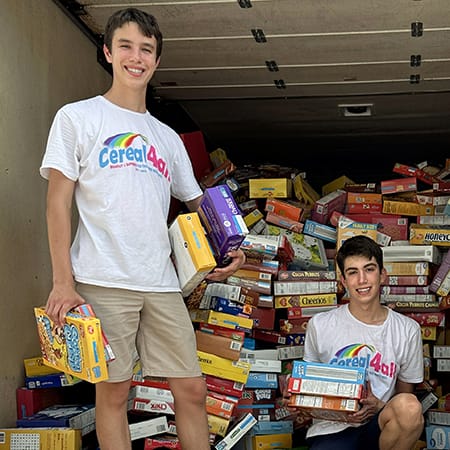
In the bustling corridors of America’s schools, two names have become synonymous with community impact: Jett and Luke Justin. In 2016, these two young brothers, while just in third grade, turned their concern for hungry families into a formidable force for good, founding the nonprofit Cereal4all.
Jett and Luke’s journey began in the local food bank, Boca Helping Hands, where they noticed a stark absence of breakfast foods in the pantry bags. “We knew a lot of the bags were distributed to families with children, and since we were kids who loved eating cereal at home, it bothered us that other kids in our own community might not have breakfast food to start their day,” recalls Luke. Jett adds, “We did some research and learned that breakfast food is one of the least-donated items at food banks. So, we decided to do something about it.”
What started as a local initiative quickly snowballed into a national movement. Cereal4all, now a youth-run nonprofit, teams up with students, schools and food banks across the United States. To date, they’ve provided over 275,000 bowls of cereal to families who have needed them. The organization’s success, the brothers believe, hinges on the special connection young people have with cereal, which helps them empathize with the hunger needs of others.
Jett and Luke’s commitment extends far beyond occasional volunteerism. Their monthly time commitment ranges between 35 and 50 hours, involving running the daily operations of Cereal4all. This includes communicating with students nationwide, planning events like the “Oatmeal Airlift” to the Bahamas and organizing cereal drives.
Luke and Jett Justin created Cereal4all to fight food insecurity and engage youth in volunteerism.
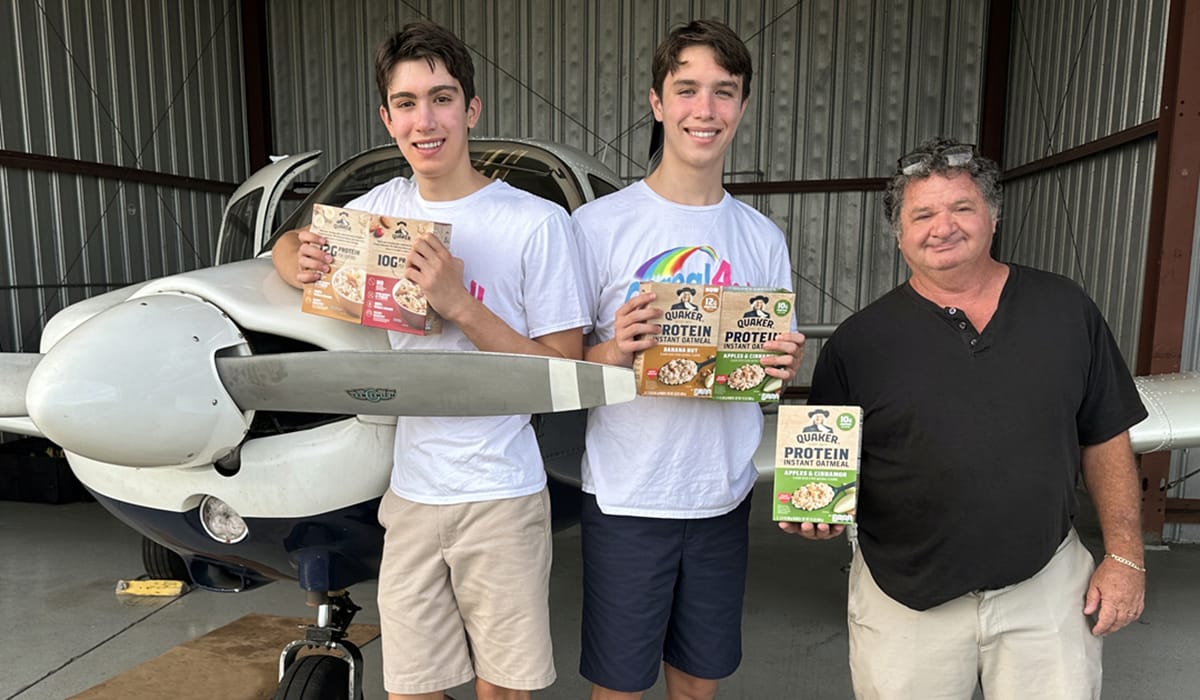
The Oatmeal Airlift involved transporting 100 pounds of Quaker Oats Protein Instant Oatmeal to Bimini, targeting those most vulnerable to food insecurity. This delivery, consisting of 750 protein-rich instant oatmeal packets, was meticulously planned to support children and seniors struggling with food insecurity on the island. Luke and Jett are particularly excited about the prospect of teaming up with Quaker Oats for future Oatmeal Airlifts.
“Each student we partner with becomes part of our team, helping us steer in better directions,” shares Luke. The brothers have ambitious plans for Cereal4all. “Our main goal is to always be getting more effective at carrying out our mission,” states Jett.
The duo envisions expanding their Student Ambassador Program to foster a new generation of compassionate advocates for the food insecure. “We’re excited about expanding our Student Ambassador Program to more states. The program helps students volunteer at food banks for the first time and gives students the opportunity to help shape Cereal4all’s mission and strategy, which makes the nonprofit all the stronger.”
The most rewarding aspect for them is knowing each cereal box makes a tangible difference. “Young people understand that Cereal4all is about more than just breakfast food. It’s about considering someone else’s happiness, or their absence of happiness, and saying you care,” Luke expresses passionately.
Luke and Jett stand proudly beside a Piper Archer aircraft, loaded with 100 pounds of Quaker Oats Protein Instant Oatmeal.
Their journey has been a profound learning experience. “Volunteering truly makes the world a better place,” says Jett. For those hesitant to start volunteering, they advise, “Just do it! Most students tell us they wish they had started volunteering sooner.”
Jett and Luke’s story is a testament to the power of youthful passion and a reminder that even the smallest acts, like a bowl of cereal, can ignite significant change. As Luke puts it, “If you feel passionate about a problem in your community, you can help create a better way.”
In a world often clouded by cynicism and apathy, Jett and Luke Justin stand as beacons of hope, proving that with dedication, creativity and a heart for service, young people can indeed make a profound difference.